Andrew Robertson to Lead Omnicom Advertising as Troy Ruhanen Retires
Ruhanen said he and John Wren had planned his exit for ‘some time’ https://www.adweek.com/agencies/andrew-robertson-to-lead-omnicom-advertising-as-troy-ruhanen-retires/
Ruhanen said he and John Wren had planned his exit for ‘some time’ https://www.adweek.com/agencies/andrew-robertson-to-lead-omnicom-advertising-as-troy-ruhanen-retires/
ADWEEK has appointed Tim Hart as chief operating officer, a newly created role designed to strengthen execution and accelerate the company’s evolution as a media, events and professional-intelligence platform. https://www.adweek.com/media/adweek-appoints-tim-hart-chief-operating-officer/
Samsung U.S. CMO Allison Stransky will become CMO of The Boston Beer Co. on Oct. 12. https://www.adweek.com/brand-marketing/samsung-us-marketing-chief-allison-stransky-to-join-boston-beer-co-as-cmo/
CEO Julie Sweet welcomes Chalwin as a “proven growth leader.” https://www.adweek.com/brand-marketing/accenture-fills-vacant-cmo-post-with-veteran-technology-marketer-emma-chalwin/
Mark Notarainni the three marketing and technology elements redefining consumer financial empowerment. https://www.adweek.com/brand-marketing/kitchen-table-finances-intuit-on-ai-and-everyday-money-management/
Marketing leadership hires and exits from the last seven days. https://www.adweek.com/brand-marketing/8-marketer-moves-to-know-this-week-stellantis-kfc-cleveland-clinic-and-more/
As the largest agency holding companies enact sweeping layoffs and consolidate, Stagwell CEO Mark Penn sees new opportunity.
“We’ve achieved something that nobody really has achieved in 50 or 100 years,” Penn told ADWEEK, “which is to form a real competitor company at scale.”
Stagwell posted 6% net revenue growth in Q2, which Penn attributed to Stagwell’s ability to help brand marketing departments adapt to AI.
This quarter, Stagwell won IBM’s account from WPP’s Ogilvy—which had served as the creative agency of record for 32 years—along with Hershey’s, Allwyn, and appliance maker Haier. During the investor call, Penn described a record-setting second quarter that saw $171 million in new business, a 45% year-over-year increase.
Penn plans to capitalize on that momentum by doubling Stagwell’s new business unit. In particular, he hopes to make inroads with CPG clients, and he intends to use the success of Sport Beach—the activation that began at Cannes Lions in 2022 and expanded to CES earlier this year—to attract sports clients.
This interview has been edited and condensed for conciseness and clarity.
ADWEEK: You position Stagwell as a holding company coming out of challenger status. In what way?
MARK PENN: There are really only four companies that you can go to now for a global marketing campaign, and you see in the string of wins with companies like Mondelez and IBM, we’re clearly taking and beginning to take share away from the majors at a much bigger scale and level than we’ve ever done before.
Revenue from new business increased 45% this quarter. Was this because of a strategic push?
We’re in the process of doubling the new business team because we were having such success. Now, one agency doesn’t go into a pitch. It’s really a group of agencies working collaboratively. Our win rate this year is well north of a third, so that we’re winning more than our share of the pitches that we’re going into.
We’re also learning it takes a while to integrate these bigger accounts. So, a lot of the upside from those accounts will be seen really next year or later this year because the integration time is significant.
Is there a sector that you see room for improvement in at Stagwell?
We’re already in the process of expanding the talent in our media group. A lot of the other companies are focused on media. Almost their whole company is focused on media.
For us, the other divisions are really the growth engines of the company right now. But we believe that our performance-oriented, technology-first approach is something that we’re going to really ramp up in terms of introducing it into the marketplace.
Last year, Stagwell announced a 35% stake in Real Clear Politics. What was the reasoning behind that?
We’re developing an owned media portion of what we do. We’re making sure Real Clear Politics gets the kind of advertising and operations that it really deserves. All it does is get incredible high-level political junkies on the site. So it’s going to be monetized well for the election.
How is the current market disruption impacting Stagwell?
We think that it is a market of opportunity for us. We’ve gone from being a group of companies that had good reputations but weren’t really at scale to be a unit. Now more clients are saying, ‘Well, who’s really a scaled alternative to the holding companies that can get our work done on a global basis?’
We’ve achieved something that nobody really has achieved in 50 or 100 years, which is to form a real competitor, a real technology-first, creative competitor at a scale where you can give us IBM, you can give us Mondelez, you can give us those kinds of major brands.
You said that Stagwell is fourth in the holdco power rankings. Are you content being fourth? What is your growth mindset?
I’m happy to be fourth in revenue, but first in digital transformation. I think some of the other companies have gotten too big, and when they got too big, they couldn’t really adapt to technology.
I like to say that most of our competitors are figuring out how to lay off the next 1,000 people, and we’re still looking at the next 1,000 people that we’re going to hire.
We’re 13,500 people. I think that’s a great scale to have in a world of transformation. It’s big enough to handle these kinds of scales, but it’s small enough to adopt new technologies.
How has the war in Iran impacted business?
Only 3% of our business is in the Middle East. It has slowed down some. Tourism is not exactly thriving at the moment there, and we do have some tourism clients, but it’s overall such a small part of the business. I’m hopeful of its overall growth over time.
https://www.adweek.com/agencies/stagwell-doubles-new-business-team-as-holdco-competition-heats-up-says-ceo-mark-penn/

Higgsfield, the San Francisco-based startup that makes tools to create AI videos, named Mariam Asmar as its first head of B2B marketing on Wednesday, the company shared with ADWEEK exclusively.
Asmar, who started the role on July 13th, will oversee enterprise marketing, including demand generation, account-based marketing, sales enablement, and brand building. She will report to Higgsfield CEO Alex Mashrabov.
The hire comes as Higgsfield, which has raised a $130 million Series A, reported an annualized revenue run rate of $500 million and said it is on pace to reach $1 billion by the end of 2026, according to Business Insider.
Subscribe and get full access to the news, insights, and expertise that keep industry professionals ahead of the curve.
https://www.adweek.com/media/higgsfield-names-mariam-asmar-as-first-enterprise-marketing-exec/

The Cannes Lions 2026 series of Marketing Vanguard continues as host Jenny Rooney sits down with Uzma Rawn Dowler, CMO & SVP of global corporate partnerships at Major League Baseball.
In this conversation, Uzma shares why fandom is not a behavior but an identity, and why that changes the entire MLB marketing equation.
She gets into how baseball’s eight-month season creates a daily storytelling engine, why partner integration needs to feel organic to the fan experience and how MLB thinks about brand building through commercialization, culture and community.
This episode is part of a special vidcast series that was recorded live during Cannes Lions 2026 and presented in partnership with Edelman.
What you’ll learn:
[embedded content]
About our guest:
Uzma Rawn Dowler is the CMO & SVP of global corporate partnerships at Major League Baseball, where she leads marketing for one of the world’s most iconic sports leagues. After more than a decade working across sponsorships and partnerships at MLB, Uzma stepped into the CMO role with a rare dual perspective: how to protect and build the MLB brand while also helping partners solve real business problems through baseball.
Her work sits at the intersection of fan identity, brand storytelling, cultural relevance and commercial growth. From player storytelling to brand partnerships with companies like Mastercard, Adobe and Mountain Dew, Uzma’s approach is rooted in making marketing feel native to the moments fans already care about.
https://www.adweek.com/brand-marketing/marketing-vanguard-at-cannes-why-sports-marketing-starts-with-identity-ft-uzma-rawn-dowler-of-mlb/
The perception of gaming as a niche hobby is rapidly fading as it transforms into a dominant force in global culture and connection.
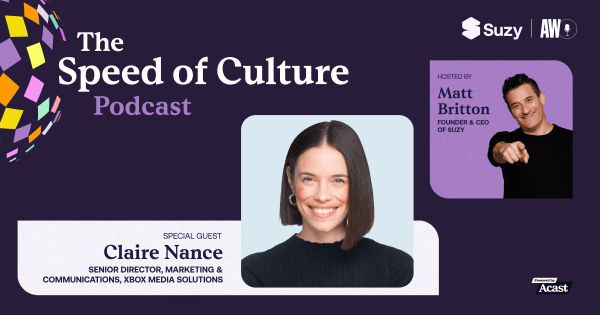
In this episode of The Speed of Culture podcast, Matt Britton welcomes Claire Nance, senior director of marketing communications at Microsoft’s Xbox Media Solutions.
Claire highlights the staggering reality of billions of active participants and the technological advancements that have turned every smartphone into a high-powered gaming device.
This conversation reveals why immersion is the ultimate superpower for brands looking to build authentic relationships with an audience that is already deeply engaged. Claire provides a look at how Xbox is leading this transition by prioritizing the player experience above all else.
The discussion focuses on the global reach of 3.6 billion gamers, the role of mobile gaming in providing universal access, and why the industry must move past outdated stereotypes to understand the modern gaming audience.
Claire also shares her philosophy on player-first advertising and her non-linear career path that led her into one of the most immersive sectors of entertainment.
About our guest:
Claire Nance serves as the Senior Director of Marketing Communications at Microsoft’s Xbox Media Solutions. She oversees B2B marketing communications for the gaming advertising business, focusing on educating brands about the power of gaming for modern entertainment and connection.
Claire joined Activision Blizzard as one of the first marketing communications hires for their early stage ads business, helping to build the team and strategy from the ground up before the company was acquired by Microsoft.
Her career history includes roles in television, media, and advertising at agencies like IPG, reflecting a non-linear path that eventually led her to the gaming industry. Today, she leads the storytelling for a portfolio that includes iconic titles like Candy Crush and Call of Duty across mobile, PC, and console platforms.
[00:03:50] The Scale and Ubiquity of the Global Gaming Community — The sheer number of people engaging with games globally has reached a point where it is impossible for marketers to overlook. With 3.6 billion gamers worldwide and roughly 80 percent of people in the United States playing in some capacity, the medium has become a primary channel for social connection. Many participants do not even identify as gamers because the activity has become such a seamless part of their daily lives through mobile devices. This section highlights how the industry has moved beyond the living room console to become a ubiquitous part of modern culture.
[00:09:25] — A Philosophy of Player First Brand Experiences — Maintaining the integrity of the gaming environment is the highest priority when introducing brand messages into the ecosystem. The strategy centers on creating value exchanges, such as rewarded video or playable ad experiences, that happen during natural breaks in play. Because the developers are protective of the user experience, only high-quality and non-disruptive integrations make it into the final product. This approach ensures that brands are additive to the entertainment rather than an interruption that players want to skip.
[00:11:53] Navigating the Complex Gaming Ecosystem via the Simple Rubric — Understanding where to start in gaming can be daunting for brands due to the variety of platforms and genres available. A helpful framework for simplifying this complexity involves looking at opportunities that are in the game, adjacent to the game, or outside of the game. Whether it is intrinsic billboards within a racing title or connecting with communities through esports and streaming, each entry point serves a different objective. Success in this space comes from returning to first principles and knowing exactly which audience a brand needs to reach.
[00:15:32] Educating the Market and Breaking Cultural Stereotypes — A significant portion of the work involves dismantling the outdated image of the teenage gamer in a basement. The modern gaming audience is diverse, spans all age groups, and is more engaged than viewers on almost any other platform. Immersion is the key differentiator, as players are fully focused on the task at hand rather than second-screening. This provides a unique opportunity for brands to be part of a seamless environment where attention is already guaranteed.
[00:17:40] — Navigating a Non-Linear Path to Success — Professional journeys in the modern era rarely follow a straight line from point A to point B. Claire reflects on how her experience in traditional media and advertising agencies provided the foundation needed to thrive in the gaming sector. The industry offers a vast array of roles beyond engineering and development, from marketing to human resources, many of which are still being invented as technology evolves. Staying curious and being crystal clear on the benefit of every action is the best way to make progress in such a fast-paced environment.
https://www.adweek.com/brand-marketing/beyond-the-console-xbox-maps-the-gaming-ad-ecosystem/