Don’t miss Brandweek, Adweek’s ultimate experience for marketers, September 11-14 in Miami. Connect with peers and gain insights and inspiration from top brand marketers and industry icons at Glossier, Coca-Cola, Taco Bell and more. Register.
Atlanta keeps maturing in the creative agency world and Brandon Rochon is one of the city’s new transplants helping it grow.
Rochon has joined independent agency Hothouse as its evp, head of creative, moving across the country from Los Angeles, where he was CEO and chief creative officer at Kastner & Partners, heading up creative for the shop’s longtime partner Red Bull.
In his career, Rochon has worked with some of the biggest brands, including leading the Samsung account for Leo Burnett, Coca-Cola for Ogilvy Paris and working with Absolut Vodka, McDonalds, PlayStation, Heineken and Nissan at TBWA\Paris.
In Atlanta, Rochon sees a city on the rise, and in Hothouse, he saw an agency he could help to improve.
“After moving to Atlanta, I thought, where could be a place where I could add value, and Hothouse was the one,” Rochon told Adweek, adding that he was impressed by Hothouse’s clients, which include Mercedes, InterContinental Hotels Group, Interface, Deloitte, Cox Automotive and Cort Furniture.
Hothouse, said Rochon, is a sleeping giant. It has developed a quiet reputation for more than 25 years for solid business without an ego, and he sees an opportunity to build on that success while making a bigger name for itself in Atlanta and the greater industry.
“As soon as we have an opinion and a philosophy, and a system of how we see how culture moves and why culture moves that way in Atlanta, it’s poised to be the next great shop to talk about,” added Rochon.
Jon Katinsky, founder and president of Hothouse, said that the agency helps build brands and brings big ideas to connect its clients to culture in authentic ways.
“Our ethos is Brandon Rochon’s foundation,” said Katinsky in a statement. “We exist to help our clients mind the gaps between their vision and their current reality, leading to engagement and loyalty that lives beyond the campaign.”
Promoting creators and the creator economy
Rochon chose Atlanta due to its burgeoning creator culture, and he hopes to promote those creators through Hothouse.
Atlanta already has some top ad agencies, including Majority, Dagger, Six Degrees, 22squared and offices of major shops like BBDO, Digitas, Publicis, Wunderman Thompson and VMLY&R, but Rochon thinks it’s still bubbling under as a top agency city.
“Atlanta has a soul. There’s something happening here, but it still hasn’t found its own yet,’” said Rochon.
Rochon said that Atlanta is the heart of the South and added that the South is about to rise again, but in a way that the originators of that phrase never expected with the people that they never expected it to rise with.
“Troublemakers come from Atlanta. It’s the only city in the world that has produced a king, a queen and the president—Martin Luther King, RuPaul and Jimmy Carter,” Rochon said with a laugh.
At Hothouse, Rochon wants to build a culture and be a part of culture through its creators.
“Culture is so much more about the people who make it than the things that they make. And Atlanta is full of makers and creators,” said Rochon.
He sees Hothouse as being a place that is an incubator for those creators through partnership and collaboration.
“We’re no longer going to appropriate the things that creators make in culture, we’re actually going to figure out how to connect it in a very different way,” said Rochon, adding that he wants those creators to be fairly compensated through the brands they represent.
Rochon is bringing all of his previous brand knowledge playbooks to the table, including those from Red Bull, Samsung and Louis Vuitton, to collaborate with creators and do it right, as Red Bull has done with its extreme athletes who have helped shape the brand.
Rochon is helping to transform how Hothouse does business to help make the shop be more strategic and culturally minded.
“We as partners to storytellers and brand stewards have to keep a client true to their values,” said Rochon.
Rochon added that we are living in the age of ideas, where actions are bigger than ads and the agency’s role is to teach brands how to act in the age of culture.
“Hothouse’s entertainment marketing heritage means the agency is ideally suited to help brands unlock those authentic connections,” said Rochon.
Don’t miss Brandweek, Adweek’s ultimate experience for marketers, September 11-14 in Miami. Connect with peers and gain insights and inspiration from top brand marketers and industry icons at Glossier, Coca-Cola, Taco Bell and more. Register.
In December 2022, I was made redundant. Citing financial challenges, my employer eliminated several roles across the company. I was ten months into leading the Marketing team and about to start my Christmas break.
It stung. Additionally, almost six months later, I’m still waiting out my non-compete.
It raises the question: When faced with an arbitrary set of restrictions, what becomes of the worker? And by its very definition, if redundant means not or no longer needed, how can a former employer exercise such control over an individual’s right to employment?
In this scenario, no one wins. Brands are deprived of talent, while professionals lose out on multiple fronts. For creative industries to thrive, we need to move on from antiquated hiring practices and allow the people behind the work to have access to opportunities without limitation.
The global picture
In January 2023, the U.S. Federal Trade Commission announced a notice of proposed rulemaking that would outright ban non-compete clauses from employment contracts. The agency suggests these measures stifle GDP growth, hamper innovation and impair entrepreneurial activity. Should the ban go ahead, it will take effect retroactively, impacting roughly one-fifth of workers in the U.S. who signed contracts contingent on accepting a non-compete. The FTC claims the withdrawal of non-competes could increase wages by $300 billion per year.
This follows a similar consultation launched back in December 2020 by the U.K. government’s Department for Business, Energy and Industrial Strategy. The call for evidence set out to gather feedback on two motions; to make non-compete clauses enforceable only when the employer provides compensation during the term of the clause and to make post-termination non-compete clauses unenforceable.
Following the consultation, the U.K. government announced a plan to limit non-compete clauses’ duration to three months. A timeline for when this comes into effect is currently unknown.
The picture varies dramatically across labor markets. In Chile, India, Mexico and Vietnam, post-employment non-competes are void. Countries like Poland, France and Germany mandate a proportion of the terminated employee’s salary be paid through the non-compete period.
In other EU countries like Italy and the Netherlands, no such provisions exist. Workers’ rights have historically been governed by each EU member state, but spurred on by the FTC’s motion, the European Parliament could decide to run its own consultation into anti-competitiveness within labor markets.
Limiting movement within the sector
Though the impetus may be vastly different, one thing these consultations seem to agree on is innovation being hampered when we limit competition.
Ingenuity is the lifeblood of our industry. It’s what powers the flywheel that attracts the brands who want to work with us and, in turn, the audiences who enthusiastically respond to creative outputs.
Claiming IP rights when using a non-compete can be stifling to human ideas. It limits movement within the sector, deprives knowledge workers of economic opportunities and kills entrepreneurial ambitions. The laws protecting trade secrets and proprietary data will forever safeguard the company’s interests.
In the absence of challenger brands, it’s consumers who lose out. This has been proven time and time again when disruptor brands or new agencies enter the market delivering something new and exciting.
Reasons to ditch the non-compete
A 2022 study published by the UK Advisory, Conciliation and Arbitration Service estimates that 19 percent of employees in the UK are likely to face redundancy over the next 12 months. As of April 2023, year-to-date job cuts in the U.S. have soared to 270,416, an increase of 396% from the same period in 2022.
We are amidst one of the toughest employment climates of our lifetime. As regulations start to change, employers must reconsider their position on what this could mean for them moving forward.
Losing out on talent Employees—especially those with tenure—are now much better informed when it comes to understanding the restrictions that come with a non-compete. All the investment made in getting the candidate to the final stage could amount to nothing once a non-compete is presented.
Brand positioning is affected The marketing ecosystem is intimately acquainted with one another. We’re all using the same platforms, technologies and partners to get the job done. Individuals regularly crisscross companies, jumping from agency to agency, to client-side and back again. If you think in the context of optics, it would be wise to ensure employees have a satisfactory experience with the company from beginning to end.
Cause and effect There’s a beginning, middle and end to the cycle of employment. You court candidates to get them through the door. Once they join, you assign interesting projects, encourage them to achieve great things and hope they stick along for the ride. If the relationship ends by no fault of the employee, you still have a duty of care to safeguard the individual.
Layoffs have sadly become all too common these days. Rather than being the source of anxiety and financial distress, be magnanimous and have a policy in place for how the company rallies behind displaced employees.
Employer branding matters In tech industries, it’s not uncommon to require an extensive notice period when a senior employee announces their departure. It can ultimately work to the employee’s advantage in a termination scenario, as a former FAANG colleague found out recently. Not only was she compensated for the 6-month notice period required, but she was also relieved of her non-compete obligations and given continued benefits coverage. Her departing words to me were, “Despite everything that went down, I will never allow anyone to speak ill of company X.”
Our industry is built on relationships. The networks we create with agencies, the partnerships forged and the trust we establish with customers are only made possible by the people powering the industry. We must acknowledge that when you stonewall part of the community who are responsible for keeping business flowing, the whole system runs the risk of getting hurt, and we all ultimately suffer.
It’s time for the marketing industry to accept that behavioral change is required. Let’s start doing things differently.
Don’t miss Brandweek, Adweek’s ultimate experience for marketers, September 11-14 in Miami. Connect with peers and gain insights and inspiration from top brand marketers and industry icons at Glossier, Coca-Cola, Taco Bell and more. Register.
In its 16-year history, New York agency Johannes Leonardo never had a chief marketing officer. The creative shop let its work speak for itself while founders Leo Premutico and Jan Jacobs served as its faces and promoters.
The agency has gone through a few changes in the past couple of years, including losing chief creative officer Julia Neumann and elevating longtime employee Emily Wilcox to chief executive officer. Now, one of Johannes Leonardo’s first employees has returned to be its first CMO.
John McCarthy was one of the agency’s 10 initial employees, serving as general manager before leaving in 2016 to be svp of strategy for Y Media Labs and then president of DDB’s West Coast office in San Francisco.
In his new role, he will be tasked with shaping the agency brand and driving growth through new business development. As the first CMO, he brings a strategic perspective to the agency and fits with Wilcox’s growth plans.
Wilcox only worked with McCarthy for a few months before he left, but he made an indelible mark. She saw him in new business pitches and the energy, optimism and strategic thinking he brought, as well as an ability to dig in with the client and talk about their challenges while shaping the work.
“He’s an amazing new business leader, he’s a great partner for our clients, he brings a ton of great energy into the process,” Wilcox told Adweek, adding that new business can be a culture generator since everybody touches it. “So the person who leads that function can really have a big influence on the type of culture that you’re building. I know he’s going to be a great growth driver for us.”
McCarthy told Adweek that Johannes Leonardo holds a special place in his heart because he spent the formative years of his career there and learned what it took to start a business from scratch.
“When I started, we were about seven people. When I left, we were about 60. I’ve just been so excited and inspired by what the team has built since I left, so when this opportunity arose to come back and be able to be a part of kind of the next chapter, I couldn’t resist,” McCarthy told Adweek, adding that he relishes the opportunity to work with Wilcox again.
An agency in transition
Johannes Leonardo has seen its share of executive departures over the past year, including Neumann; president Bryan Yasko, who left for Accenture Song; head of business development Ben Myers; and head of agency brand engagement Elizabeth Hess.
But the agency also has added plenty of new talent and promoted others, like Wilcox, who joined the agency in 2015 and rose to head of account management and is now CEO. In addition, Steve Zaroff, who joined in 2021 as chief strategy officer, has recently taken on the role of chief innovation officer, while Jonathan Santana was promoted from group creative director to executive creative director, a new position at the agency. Sam McCallum and Connor Keeshan were promoted from group account directors to heads of account management, and Paula Daly was hired as chief financial officer from Anomaly.
The agency of 200 continues to churn out inspiring creative work that gets results for clients including Kraft, VW and Oscar Mayer. Wilcox sees a bright future for the agency as it continues to grow its clientele and staff.
A focus on the agency and its people
JL is known for its creative output, but Wilcox and McCarthy want people to know more about the agency and how it drives business results for its clients.
“One of the key drivers of our success as an agency has been the types of client partners that we work with, and there’s one consistency across all of them—they’re endeavoring to do great creativity, and they believe fiercely that a great partnership is the only way to get there,” said Wilcox.
Wilcox believes McCarthy is the best person to lead business results while touting creativity.
“He is a natural strategic thinker, hyper-focused on creativity that impacts business. The more lifeblood we actually give creativity, we can actually prove that it drives brands and business,” said Wilcox, though she added that the agency needs to do a better job of telling people that.
“We get a lot of credit for our great work. I don’t know if people know enough about the story of our impacts on brands and business, so I’m hoping [McCarthy] can help to really elevate the role that we play in helping our clients achieve their goals,” said Wilcox.
The two also want people to get to know the people at the agency.
“I really want to celebrate more externally the power of our people within our walls. We have incredible thinkers and incredible people here, and I would love for more of the world to know about that,” said Wilcox.
McCarthy wants Johannes Leonardo to win quality new business, and that’s his strength.
“I just love new business. The opportunity to really double down and focus there is incredibly exciting for me,” he said. “Agencies are at our best when we’re inspiring our clients. I really look at the role that we play is helping to inspire the industry toward managing some of the change that’s afoot.”
Don’t miss Brandweek, Adweek’s ultimate experience for marketers, September 11-14 in Miami. Connect with peers and gain insights and inspiration from top brand marketers and industry icons at Glossier, Coca-Cola, Taco Bell and more. Register.
Over the weekend, Elon Musk announced a major change for Twitter. We all hoped it was a joke, that he wouldn’t actually change the name of such a well-established brand. But as we’ve all come to see, he was quite serious.
While opinions about the rebrand ranged from confusion to annoyance, it seems like no X users, or those on its competitor Threads, is a fan of the rebrand, and for good reason. Not only was the change unnecessary, it also disregarded the years of brand work that had been done.
I’ll go out (not too far) on a limb to say that this is not only the worst rebrand of the year, it will be the WORST of the worst rebrands of the year. A shit show over a dumpster fire inside of a looming train wreck. Will someone bring marshmallows for the bonfire afterwards? 🔥 https://t.co/RL93G38ROD
Since Twitter’s debut in 2006, a certain vocabulary associated with the brand (retweets, tweeps) along with its recognizable blue bird logo, were rapidly adopted by users. That type of brand advocacy usually takes years to build. Yet within 24 hours, it was all gone… for a single letter.
Over the past few months since the ownership transition in October, we’ve all seen the change in the site’s advertisers. Gone are the Diet Coke, Express and upcoming rom-com ads I was often served in my feed; instead, it’s filled with obscure brands that do not fit my personal buyer persona. Rather than being served a Barbie ad in my feed this weekend, I’ve been served ads for obscure credit cards and b-to-b cybersecurity companies.
Ditching the brand equity of Twitter overnight makes users and advertisers question the decision-making of the brand. Was there a well through-out plan? It’s hard (or easy) to tell by the lack of updates across the platform; even a Google search performed at 4:30 p.m. on Monday still showed Twitter as the main domain. (Not to mention that the Twitter sign on the platform’s headquarters couldn’t even be taken down on Monday due to a lack of a permit.)
Most rebrands begin with an introduction to the name, the story behind it and where the information came from to inform the change. What led to the new name, and why does it reflect who the company is today vs. years ago? And, perhaps most importantly, how does it represent the community that it serves?
When I think of Twitter, I think of a community of people who come together to chat about specific topics. It represents relationship-building and how online followers can become IRL friendships (seriously, I’ve met a number of friends over Twitter).
The bird and the language around Twitter all represented that community in some way. The name and branding of X feel incomplete—consider another controversial rebrand, dropping the HBO from streaming service HBO Max, that had a rollout, providing an explanation of the changes.
The straw that broke the brand’s back
The pattern of hastily made decisions since Musk’s takeover has shaken users’ trust and led advertisers to question whether this is a platform where they want to keep spending precious marketing dollars.
The number of U.S. users has dropped since the change in leadership. I personally see fewer of my peers and friends tweeting than previously. Even the number of advertising-related #TwitterChats has decreased.
In comparison, despite their own missteps, Facebook and Instagram feel more stable. With the recent addition of Threads, a direct rival to Twitter, to Mark Zuckerberg’s social empire, I would rather put money into those platforms or other advertising executions.
At the end of the day, this all feels like it’s more about the ego of the company’s owner than what the target audience truly wants. A short list of those requests: an edit button, less hate speech, more user protection, a chronological feed and suggested users based on our own usage of the platform. And as we all know, a brand is about more than the owner, CEO or any stakeholder within the company. It’s about how the public (your target audience) sees you.
For the first time in months, it feels as though Twitter (or X) is truly no longer going to be the platform that it was even two years ago: a place where you can find reputable news updates, get information on a product or service, build a community of like-minded individuals via Twitter chats or engage in a fun way with a brand (as I loved to do during the Super Bowl every year).
While I may still lurk on the platform (I am in marketing and advertising after all), I have to say goodbye to the eX at this point. See you soon, Threads.
Don’t miss Brandweek, Adweek’s ultimate experience for marketers, September 11-14 in Miami. Connect with peers and gain insights and inspiration from top brand marketers and industry icons at Glossier, Coca-Cola, Taco Bell and more. Register.
Sandra Alfaro recently left DDB Chicago without announcing where she might be headed next. The short mystery is now solved as Alfaro has been named the first U.S. CEO at independent agency network Gut, effective Sept. 5.
Alfaro, who had served as president at DDB Chicago since October 2022, now joins her former CEO Andrea Diquez, who stepped down in 2022 to join Gut as global CEO.
In the newly created role, Alfaro will be responsible for managing the day-to-day operations of Gut’s headquarters in Miami and the Gut Los Angeles office. She will be working with the agency’s global leadership team, especially North America CCOs Ricardo Casal and Juan Javier Peña Plaza; Bruno Acanfora and Ariel Abramovici, executive creative directors at Gut LA; and Carmen Rodriguez, global chief growth officer and partner. Alfaro will report to Diquez and will be based in Miami.
“Sandra is an incredible business leader. She understands where the market and consumers are going, so she is the best at setting up clients’ businesses for success,” said Diquez in a statement. “Also, her integrated thinking amazes me every time. She’s able to merge media, creativity and data seamlessly into the business, and has created models across many categories.”
Alfaro brings more than 25 years of experience across the advertising and marketing industries, with a focus on account management. Prior to serving as president of DDB Chicago, she was the agency’s head of business leadership. During her time there, she helped the agency launch its first dedicated social practice and played a key role in bringing in new business.
Before DDB, Alfaro was at Horizon Media, where she was the first leader of culture-first creative agency 305 Worldwide, a joint venture with rapper Pitbull. Prior to that, she was the managing director of Grey Wing for five years, helping the agency win clients including Pfizer, Papa John’s, Lilly and Nestlé. She began her career at Saatchi & Saatchi and also spent over a decade at The Vidal Partnership, reaching the role of managing partner of the agency.
“The culture of Gut is what most excites me. They are a brave agency for brave clients with clarity on its values of courage, transparency and intuition, which means that Gut knows what it is and what it’s not, which is inspiring,” Alfaro said in a statement. “In my new role, I hope to inspire the U.S. team to continue delivering brave work to its amazing clients, while ensuring the agency operates both effectively and efficiently.”
Alfaro went on to say that she wants her teams to embrace growth as a mindset in everything they do, as an agency and with clients.
In addition to her marketing career, Alfaro earned her professional coaching certification in 2019 and founded Power & Grace, a boutique consultancy offering life and business coaching, corporate training and public speaking.
“After five years of really exciting growth, it was finally time to appoint someone who could help us continue to lead and grow our U.S. offices successfully, which is why we entrust Sandra with this amazing responsibility,” said Anselmo Ramos, co-founder and creative chairman at Gut, adding that having worked with Diquez before made Alfaro a good fit with the team.
The Gut Network has been growing recently, opening up its seventh office in Amsterdam, its first in Europe, earlier this year. The agency also had a strong showing at Cannes Lions, winning a total of 35 Lions, including three Grand Prix, eight golds, 12 silvers and 12 bronzes across its network, and becoming Cannes Lions’ Independent Network of the Year, LATAM Regional Network of the Year, and its Buenos Aires office was honored as its Independent Agency of the Year and Agency of the Year. The agency also landed the business for Vital Farms earlier this year.
Don’t miss Brandweek, Adweek’s ultimate experience for marketers, September 11-14 in Miami. Connect with peers and gain insights and inspiration from top brand marketers and industry icons at Glossier, Coca-Cola, Taco Bell and more. Register.
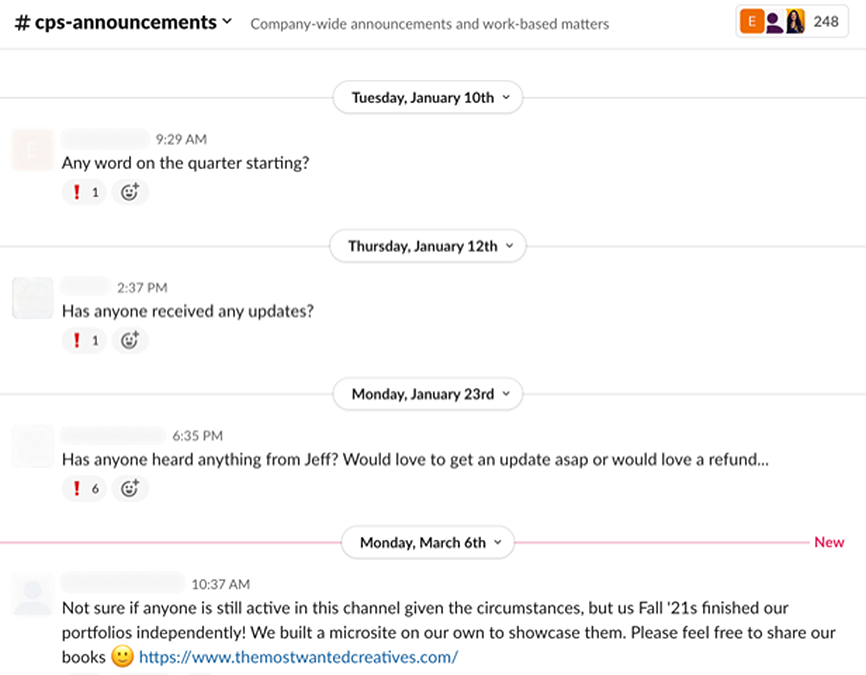
Chicago Portfolio School (CPS), once an institution that steadily fed new talent to top agencies, has ceased operations after periods of disorganization and lulls in communication, six former students and five instructors tell Adweek.
Administrators cut off contact before the winter quarter, which was scheduled to begin in January.
The school’s website shut down in February, CPS has not been active on social media since June 2022, and, according to sources, ended its Slack subscription, which blocks users from viewing past messages. Instructors and students allege the school’s executive director, Jeff Epstein, has dodged refund inquiries and tax form requests.
The cost of the one-year program was $19,260, according to a GoFundMe page that supported scholarships for Black creatives.
Epstein, who founded and led the school since 2000, did not respond to Adweek’s request for comment.
Leading up to the summer 2022 quarter, Adweek covered the ongoing business challenges at CPS. “I’m responsible for all the good things, and I’m responsible for all the bad things,” Epstein told Adweek at the time.
Epstein’s corporation, Dogwhistle, operates CPS as a for-profit business. The State of Illinois changed Dogwhistle’s status to dissolved in August 2016. According to sources, and a 2018 Adweek article, Epstein has also faced a series of landlord disputes.
Deserting students
Shauntee Colston Jr., a design student who started last July, began questioning CPS’ practices just a few months later. After being promised the school’s standard course load of four classes per quarter, Colston said he received access to just two classes. When he was offered courses that did not align with the design track, he said Epstein told him “all classes are helpful to everyone.”
For Colston, the biggest disappointment was failing to experience CPS’ fifth quarter, when the school promised to help students build their portfolios and share their books on social channels.
The facade started to disintegrate.
Sarah Chaffin, former student, CPS
“It would be great if the school existed to help me with a network,” Colston told Adweek. “I wasted all of my time. I ended up doing all the work on my own, when the whole point was to not do it solo.”
While the school’s Pipeline Fund Scholarship covered Colston’s tuition, he reflected on the complications of having to “go back to square one.”
“We were left on our own to complete our portfolios,” he wrote. “We were left on our (own) to reach out to recruiters and market ourselves, things that were promised when we enrolled.”
Sarah Chaffin, who dropped out of the school’s strategy program before the summer 2022 quarter, was feeling frustrated after waiting on Epstein’s delayed schedule releases, only to find out the placements had “nothing to do with my discipline.” Chaffin was in CPS’ first class of strategy students. Previously, the school only offered a creative tracks.
Chaffin left the program alongside former student Arianna Palafox and the rest of her cohort, who claimed they were “being scammed” by an administration that offered another track without expanding resources.
“The facade started to disintegrate,” Chaffin told Adweek. While strategy students were sent course catalogs, obtained by Adweek, before each quarter, sources said Epstein ultimately did not give students a say in their schedules.
“Only one course was strategy, and it was taught by Jeff himself, who has no strategy experience,” she said. “Another was taught by someone with my same level of experience.”
In a July 2022 response to Chaffin’s email about her cohort leaving the program, Epstein wrote, “I understand I made some horrible decisions and disrespected your time and money. I’m embarrassed by my lack of action. I am grateful for your patience and understanding and will do everything I can to make things right for you.”
Palafox requested a refund for classes she wasn’t able to attend while undergoing breast cancer treatment. She attached notes from her surgeon in an Aug. 1, 2022 email to Epstein. She says he hasn’t responded.
Chaffin paid her CPS tuition through the education platform Leif. Despite the school going dark in January, Leif continued requesting payments. “I do not want to be tied to (CPS) anymore, and I do not owe any money towards this program,” Chaffin wrote to Leif. The platform has since cut ties with CPS.
Creating conflict with instructors
A former employee, who requested anonymity, started to grow wary when Epstein put multiple cohorts in the same classes without hiring more instructors.
The employee has also faced tax return complications since 2021. When her home state couldn’t verify Dogwhistle as a business, she needed Epstein to sign a letter that said she was employed by the company. He claimed tax collectors were “just confused” by Dogwhistle doing business as Chicago Portfolio School. She submitted a W-2 in January 2022, but the revenue agent was again unable to verify the withheld amount and couldn’t process the return until June 2022, which was after she resigned. In January 2023, she didn’t receive a W-2 at all.
I didn’t agree with what Jeff was doing. … I wanted to stay for the students.
Former CPS instructor
Another source, a CPS alum, was asked to mentor a student in summer of 2020 and, later, asked to teach a class. “Getting Jeff to pay me was a struggle,” the source said about her experience. Epstein stopped using direct deposit during the winter 2022 term and claimed to have sent her a check that she never received. After “ignoring text messages for a few weeks,” she was finally compensated a month later via Zelle without any response or acknowledgment from Epstein.
“I wouldn’t be where I am if it wasn’t for portfolio school, and even though I didn’t agree with what Jeff was doing, he was having a hard time finding teachers and I wanted to stay for the students,” she said. “Putting their confidence into this program and having been treated this way was so disrespectful.”
Reviewing the value of portfolio school
Once seen as indispensable resume boosters, portfolio schools have more recently stirred debate. Some graduates credit portfolio schools for helping them build a body of work that mirrors actual industry deliverables, while critics point to the additional years of schooling and high price tags that can box talent out of recruitment conversations.
A former CPS student, who chose to be referred to as SC, attended CPS until the school went silent in January.
“I wanted to do something that would give me the foundational skills that I needed without also continuing to break the bank,” said SC, who held down a full-time job while working at CPS. “Everything just seemed to fall apart. It just all seems like it was for nothing.”
Former students Adweek spoke with said CPS was an affordable option. They were also motivated by having conversations with graduates who held positions at top agencies, as well as the school’s claim in promotional materials that 94% of grads get jobs within six months of graduation in their preferred field.
Free online resources, in-house agency incubators and the industry’s prioritization of fresh pipelines and heightened diversity have all led to the demise of ad schools. Ogilvy now offers an internal program for Black public high school students in Chicago, which features a free virtual education series followed by paid experience.
James Kinney, global chief people officer at Media.Monks, said portfolio schools can add value by allowing students to hone their craft and create real campaigns.
I said to myself, ‘I’m going to get a job, and this will be worth the money for me.’
Brittany Theo, former CPS student
“We need the non-portfolio school people, we need the state school people, and you need some Ivy League,” said Kinney, who added that Media.Monks does not require candidates to have college degrees. “To make the best work, you need that cognitive mix. That’s one of the broadest definitions of diversity.”
A new way to learn
Sarah Latz and Francesca Piancone, two former CPS instructors, started Book180 in the fall as a more affordable alternative to the portfolio school market. Other organizations are challenging the portfolio school model, too. One School, a free 16-week portfolio school, is built for Black creatives. The Workshop is a free mentorship program for those looking to pivot into advertising after leaving another industry.
Brittany Theo, a former student who was enrolled at CPS until its closure, was told by friends that “no one would even look at (her)” if she didn’t go to portfolio school. “I said to myself, ‘I’m going to get a job, and this will be worth the money for me.”
A new generation of agency executives is trying to dispel that myth, including Geoffrey Goldberg, co-founder and CCO of Movers+Shakers. He said his agency looks for talent with “creative skills that are relevant today, not those who have been trained by masters of yesterday.”
For Chaffin, the school’s downfall speaks to the need for mentorship across an industry that is notoriously challenging to break into.
“It is of paramount importance for people who are already in the industry to take on mentees and help out where they can,” she said, adding this advice to agency leaders: “If you see a message in your inbox, answer it. If you put on your blinders, our mix of talent is going to be pretty dismal.”
Don’t miss Brandweek, Adweek’s ultimate experience for marketers, September 11-14 in Miami. Connect with peers and gain insights and inspiration from top brand marketers and industry icons at Glossier, Coca-Cola, Taco Bell and more. Register.
The Cannes Lions Festival has, historically, been a place where senior-level agency employees congregate to drink, network and vie for awards. Attending the event is harder for early-career advertisers. Budgetary concerns, and the sheer lack of relevant on-site opportunities for young people, create a barrier.
Some agencies and third-party industry organizations are pushing back on that barrier by sponsoring opportunities for young people to attend the festival. Selecting which early-career employees to send to the festival introduces other challenges, but it is one way industry bodies can do their part to support employee career trajectories and foster inclusion at the event.
Adweek spoke with first-time Cannes attendees and the organizations that sponsored their travel to learn more about their programs.
“From the outside looking in, I suppose you don’t see a lot of the other things that go on [at Cannes], other than the general awards that are given out,” said Conor Smith, a senior A/V designer at 26 agency and MSQ Young Lion who went to the festival this year for the first time.
Internal competitions at agencies
Agencies that send young creatives to the festival create internal competitions for employees. Media.Monks hosts its NextUp.Monks competition that its early-career creatives can compete in to win travel to Cannes, and more specifically, a seat at the Cannes Lions Academies program.
The Academies experience offers attendees classroom-style sessions, along with networking opportunities. The Creative Academy session admits just 30 creatives total.
“Having an internal competition across your global team to see not just who wants to go to Cannes, but who deserves to go to Cannes by winning a competition that tests their creativity, their response to a brief,” is a novel approach, Steve Latham, head of learning at Cannes Lions Festival of Creativity, told Adweek. Media.Monks works closely with Latham to build out a bespoke agenda for the handful of creatives it sends to the festival.
This year’s winners, Yazad Dastur, junior copywriter at Media.Monks, and Anna Zhang, junior designer at Media.Monks, responded to a brief for Meta that asked they imagine a unique VR experience for the company. As many as 300 Media.Monks employees across 25 countries responded to the brief.
“It’s really great to go to Cannes, but I feel like going to Cannes to be a part of a global cohort with creatives from all over the world is going to be so great,” Zhang told Adweek before the event.
The event was competitive, Dastur recalled. “You’re given a very open-ended brief, and you have to interpret it. You have to kind of come up with this idea very, very quickly,” he added.
Media.Monks isn’t the only agency sponsoring an opportunity like this. MSQ is a global collective made up of 11 agencies representing about 1200 people. This year, MSQ sent two creatives from the group to Cannes.
Every year, the collective’s creative council nominates three or three creatives from each agency, and a smaller team later selects two winners from the larger nominee pool to send to the festival.
MSQ offers an all-expenses-paid opportunity for those it sends, and provides its creatives with an on-site event coordinator. Matt Williams, global head of marketing at MSQ, took on coordination responsibilities this year. Williams created a detailed agenda to help young creatives navigate the large event, where on-site functions included dinners with MSQ agency CEOs and creative leads.
“If Cannes is all about inspiration, then that’s why we need the next generation to be inspired by it,” said Williams. “We don’t want our senior leaders running off to the hills for big swanky meals, and everyone else left on the Croisette to fend for themselves,” he added.
The Young Lions event
Some agencies hold internal competitions for young creatives, but with the aim of submitting winning work to the Cannes Young Lions competition. This was the case for Julian Amarillo, creative art director at the creative agency Gut and Haroldo Moriera, creative copywriter at Gut.
The duo responded to a fictional Michelob Ultra brief imagined by Gut and sponsoring organizations including Círculo de Creatividad Argentina and FilmSuez. Participating creatives had 48 hours to respond to the brief, at which point an appointed jury judged the projects.
After winning the internal competition, the two secured tickets to Cannes, but because Gut submitted their winning work for judging, they were also up for an award at the festival.
“We haven’t been to Europe and we haven’t been in Cannes, and this is like a dream for us,” Moriera told Adweek before leaving for the event. Moriera and Amarillo represented Argentina, which was top of mind for them during the competition. This year, Young Lions creatives hailed from a record-breaking 70 countries.
At Cannes, the duo did not win the Young Lions award. However, they did win the Grand Prix award for their work on the Stella Artois’ spot, “The Artois Probability.” That spot also won two Gold and two Silver Lions. Amarillo and Moriera’s home office, Gut Buenos Aires, won the Independent Agency of the Year and Agency of the Year awards. It was the first year the Gut team in Argentina had ever won at Cannes.
Gut leadership told the creatives, “This is a big opportunity for you and we believe in you, so we are going to submit you,” Moriera recalled.
Industry orgs can step up, too
Duncan Meisel, executive director of Clean Creatives, brought a team of five early-career creatives to the festival this year. He sought online creators with large social media followings that either work at agencies now or had in the past. Part of their on-site responsibilities included reporting on various Cannes events from a sustainability lens.
Clean Creatives put out an open call for applications and asked those interested to submit their interest via Google form. Successful applicants prioritized inclusivity and looked at climate change from an intersectional perspective.
“It can be difficult to show up as a young person. We recognized how senior it can feel, how exclusive it can feel,’ said Meisel of the festival.
UK-based talent development organization Digilearning, teamed up with Brixton Finishing School and Lollipop Mentoring to offer a Cannes experience to select people from underrepresented backgrounds. Those that qualified to apply had already completed Digilearning’s professional development courses.
The three organizations covered expenses for those they brought on-site. The experience included event tickets, accommodations, and a daily stipend for food. the organizations helped them set specific goals they could complete while there, and agendas included a session with Teads, a panel about work/life balance, meetings with Accenture leaders and a networking meeting with Trade Desk employees.
It’s always been seen as this elitist [event] that all the leaders go to. We just wanted to make it so much more inclusive,” Digilearning founder Lisa Goodchild told Adweek.
Join the brightest minds in marketing at Brandweek in Miami this September 11–14. We’ll explore the promising trends, proven solutions and pressing challenges facing the industry. Register now to save 20%.
In 2012, at the start of the DTC boom, Katya Constantine founded DigiShopGirl Media. The digital agency used two relatively new technologies at the time—digital media and programmatic advertising—to turn startups into household names.
Some of her star clients have now included luggage brand Away, Rent the Runway, skin care firm Starface and weight-loss program Noom, and DigiShopGirl currently counts more than 150 clients and manages more than $100 million in ad spend. However, getting there was much easier said than done.
The brightest minds in marketing and tech converge at NexTech, Nov. 14–15 in NYC. Get your pass for the latest on generative AI, gaming and more.
Editor’s Note: The following is the college application essay of 18-year-old fashion designer and creator Rush Bogin, best known for his now multimillion-dollar business and success with UGC and fashion designs on Roblox. He leveraged this early success to get accepted to Yale, Harvard and Stanford and has formally accepted his offer to go to Stanford in the fall.
This essay has been lightly edited for clarity. Though the essay is from the 2022 college application timing, it contains lessons about creating for the metaverse from the Gen Z perspective as the advertising and marketing community grapples with seeing success in the space.
My friends joke that I’m a nerd who plays video games most of them haven’t touched since their single-digit years. They’re right, sort of. I’m a virtual fashion designer for the online platform Roblox, which means I spend my time pouring over TikToks, fashion mags and Instagram; whatever it takes to figure out what teens like when it comes to accessorizing their virtual avatars.
I first started playing Roblox when I was seven, loving that, as my avatar, I could pretend to be anyone. In real life, I wore Target tees and ripped jeans. But on Roblox, I rocked a top hat, a three-piece suit and a pirate leg. That’s when my fascination with virtual fashion began.
Over six years, I taught myself to 3D model, created a successful game and was eventually contracted by Roblox to make fashion accessories for their virtual catalog. Having grown up playing Roblox, I thought I knew exactly what the community wanted. But my first few creations flopped … big time! I wanted to quit.
Then one day I met a Brazilian creator named Caio in a Roblox server. We hit it off, and when I asked him why my accessories were failing, he bluntly told me my creations were bad. He said I could 3D model, but I lacked finesse. That summer, Caio taught me how to make more detailed 3D models and textures.
To be successful I also had to understand what items teenagers actually wanted to wear. I immersed myself in social media and came across a popular meme: a twenty-something in a cozy coat, sipping a latte and wearing a beanie. It was my first attempt to bring a real-world trend to Roblox. I released the “Cute White Winter Beanie” at midnight. By the time I woke up in the morning, it was the number one item in the catalog. Eventually, it seemed almost every creator on the platform was making some sort of beanie.
I started to fear I would never make another successful item. My entire reputation revolved around one beanie. I again scoured social media for trends that would appeal to Roblox users. I found lots of “goth” fashion items and a viral TikTok of a teenager in a plush bunny hood. I created a classic white bunny hood and a black goth version with chains, safety pins and rings. Within days, both hoods rocketed to the top of the catalog.
I was recently hired by supermodel and entrepreneur Karlie Kloss to be her chief Roblox consultant for her upcoming fashion experience. Karlie knows real-world fashion like the back of her hand-made Jimmy Choos, but she relies on me to explain how to monetize trends on Roblox.
For example, her team was just about to release a virtual Carolina Herrera designer dress. The team wanted to put it on sale for 24 hours and advertise in advance that it was going to be a “limited” item. I explained that the dress would fail if they followed this plan. Instead, I told them not to advertise it at all, and to take it off the market once it hit a few hundred items in sales.
The dress was released on a Monday morning and sold for 500 Robux (about $5). We took it off sale four hours later. By that night, the dress was reselling for 200K Robux. The team was blown away. Vogue Business even did a story about it eventually reselling for the equivalent of $5,000.
Because of my success on the platform and work with Kloss, I’ve been approached by the NFL, NASCAR, Sony Music, the MLB and even Sir Elton John to both consult and design items to bring their brands successfully to Roblox. Would I one day like to learn how to make virtual fashion that appeals to all ages? Of course! Maybe that’s what college is for?
Leaders from Colgate, TikTok, Amazon and more will gather at Commerceweek to discuss how to leverage new strategies, trends and tech to drive ROI and growth. Join us July 11–12 in NYC.
It was the most traumatic and emotional experience of my life. As the rumors swirled last January insinuating Russia could invade Ukraine, I and many others thought they were just that—rumors. Media hype to fulfill global news coverage holes. This wasn’t going to happen. There was no way this could happen. My birthday was in February. It should have been a time of celebration with loved ones, but fear and uncertainty were set to erupt.
“It started.” The two frightful words my boyfriend told me at 6 a.m. It left me unable to comprehend anything else. Thursday, Friday, Saturday, Sunday—the days were overlapping. I cried and had a lingering migraine. I frantically tried to check in with my team.
It was Monday. I washed my face with cold water and said, “OK. We’re going to work through this.” Then I packed my bags, not knowing if or when I would ever be back to the place I was born, grew up and called home for over 30 years. I still haven’t been back since. Europe was quickly closing its airspace and borders to Russians. We realized we had to move quickly, or it would be too late.
Planning such a traumatic and difficult evacuation—moving quickly through war, forced evacuation and business as usual—we never lost sight of the fact that we are working with human beings. What we were about to do would completely change our team’s lives around in one day—communication and empathy became crucial.
Trust propelled us
Once war was imminent, we were overwhelmed by the obstacles that lay ahead. Worrying about the welfare of our families and friends, banks closing, fears of enlistment—the chaos sunk in. Working in tech, there was no telling if the war would limit access to the internet, email or social media, which were crucial for our day-to-day operations.
In those moments of uncertainty, one thing was clear: It was critical for my team to know their safety wouldn’t be in further jeopardy. Data has shown that only one in three employees trusts their leaders, which paints quite a negative picture. I may have been unprepared, but I had the trust of my team, which allowed us to work together in a highly stressful situation and achieve a successful outcome with little impact to our work and deliverables.
The team had developed trust given past proof of delivering on promises and demonstrating empathy in key moments. In this time of crisis, we decided investing in our people was the only goal. Money was not going to be an obstacle; profit-making and bookkeeping was not a consideration. As such, we did not have a specific budget but focused on getting everyone to safety as quickly as possible while making sure we were relocating to a place that was comfortable and welcoming.
Options were becoming more and more limited by the hour. We consulted with the best legal and immigration experts to act swiftly and decisively. We decided that Dubai was the best option in the short term while we looked for another longer-term option. Why Dubai? We determined the city was accepting of Russians, multicultural and relatively open when it came to visas. While it was not the cheapest option, it was the quickest and safest for the time being. We organized all travel, airfare and accommodations and contracted a third-party relocation group that would help ensure paperwork was fast-tracked and that we had expert advice on next steps.
Part of our team then spent a few weeks in Dubai but did not feel comfortable settling there long term for cultural and practical reasons. We decided that going back to Europe would be best for us. After looking at our options, which included Portugal, Serbia and Cyprus, we opted for the latter. Once again, we took care of all airfare, healthcare, visas and housing and rented an office on the Mediterranean island. Our team has been living in Cyprus for a year now, and we have slowly been repatriating our Russian team at their own cadence based on their personal needs.
A new understanding of connection
When I reflect on my own experience, I find that empathy and compassion were at the core of my ability to connect with my team—vulnerability was never a sign of weakness. We were all going through a difficult situation together, and while I focused on keeping my cool when communicating, I did share with my team how I was feeling: scared, excited, determined, confused. We were going through it together.
Vulnerability, in particular, has been characterized as a negative leadership trait. Leaders are supposed to be strong, and being vulnerable opens a leader to being perceived as weak or tested. I know this to be false, as I have seen vulnerability and empathy go hand in hand. I view my ability to empathize with my team as a personal strength, and as an important tool to be used by leaders to connect and build trust. During the height of our difficult journey, this trust was at the root of our successful outcome.
Authenticity is another key element to building trust—something 88% of consumers say they value. But less than half of marketers actually believe their brand messaging has a significant impact. This is a visible disconnect full of missed opportunities. If we want to enhance loyalty, retention and acquisition among customers and employees alike, we need to invest in understanding their values and developing strategies that allow us to live and evolve alongside them. That ultimately builds trust, which is at the heart of buying decisions.
For any brand, or anyone, that wants to be a leader today, it’s important to understand that the traditional rules we used to live by are outdated. The path to establishing trust among key stakeholders—including employees and consumers—are critically important. Know your value, tap into your emotional intelligence and embrace a certain vulnerability to heighten that connection of trust.