Why Replying to Google Reviews is One of the Highest-ROI Things You Can Do

I have three kids under five — and getting them out of the house regularly is essential. I’m always scouring Google Reviews for new and interesting kid-friendly things to do in our neighbourhood. I look for great reviews, of course, but you know what stands out even more? Reviews with responses from the business.

There’s a “kids’ cafe” not far from us that responds to every review. That tells us they care about their customers — and we go there often. I know I’m not alone in this, either.

BrightLocal’s research found that 88 percent of consumers would use a business that responds to all of its reviews, both positive and negative.

Here’s the data on why you should be replying to Google reviews, how to streamline the process with Buffer, plus a real-life example from boutique social media marketing agency Sapphire Social, which makes replying to reviews a priority for their clients.

Jump to a section:

5 reasons why replying to Google reviews matters

Replying to reviews is inarguably good practice — and common sense — but it can have a powerful effect on the bottom line, too. The numbers are fascinating:

1. Your customers are reading reviews

According to BrightLocal’s 2026 Local Consumer Review Survey, 97 percent of consumers read online reviews, with 41 percent saying they “always” read reviews when evaluating a business. That’s a big jump from 29 percent the year before.

Most of those reviews are on Google — roughly 81% of consumers use Google reviews specifically to evaluate local businesses (Sixth City Marketing).

And they’re not just skimming star ratings, they’re reading what businesses say back, just like I do, as I mentioned up top.

2. Replying to reviews directly impacts whether people choose you

Around 88% are influenced by whether a business responds to its reviews, good and bad. Engaging with your reviews makes consumers nearly twice as likely to choose you. And you don’t have to be perfect at it, you just have to do it.

And it’s not just about responding to the negative ones. Only 47% of consumers said they’d use a business that exclusively responds to negative reviews. Responding to only positive reviews fared similarly poorly. Interesting, right? Consumers apparently don’t love it when you cherry-pick which reviews to acknowledge.

The latest 2026 survey goes even further: 89% of consumers now expect business owners to respond to reviews, and 50 percent say generic, templated responses would make them less likely to choose a business (BrightLocal, 2026).

3. Responding to reviews correlates with more revenue

All of the above might sound like common sense, but there is revenue data behind it, too.

A study by Womply analyzed transaction data from more than 200,000 U.S. small businesses and found that businesses replying to at least 25 percent of their reviews earned 35 percent more revenue than average. Businesses that didn’t respond to any reviews earned 9 percent less (Womply via Illuminate8).

Consumers also spend more when they see a business engaging with feedback. The same study found that people spend up to 49 percent more at businesses that reply to reviews.

And the Harvard Business Review found that when hotels began responding to reviews on TripAdvisor, they received 12 percent more reviews and their ratings increased by an average of 0.12 stars, without ever asking for more reviews (Harvard Business Review). A separate Harvard study found that a one-star improvement in rating can translate to a 5-9 percent increase in revenue.

4. It boosts your local search rankings

Google itself recommends responding to reviews. Their official Google Business Profile help documentation states that responding shows customers you value their feedback and signals responsiveness (Google Business Profile Help).

Review signals, which include volume, quality, recency, and whether a business responds, account for a meaningful portion of local search ranking factors. Research from SOCi found that businesses ranking in Google’s top three local results (the “3-Pack”) earn 126 percent more traffic and 93 percent more conversion-oriented actions than businesses ranked lower (SOCi).

Responding to reviews also feeds into Google’s E-E-A-T framework (Experience, Expertise, Authoritativeness, Trustworthiness), which helps determine how prominently your business appears in local results. Each response is fresh, keyword-rich content on your profile, which is a signal Google rewards.

5. Negative reviews are actually an opportunity

This is the part that surprises most business owners: negative reviews, handled well, can actually help you.

Research from Reputation.com found that consumers are 33 percent more likely to upgrade their review if a business responds with a personalized message within a day. And businesses experience a 16 percent boost in customer advocacy when they address complaints publicly, versus a 37 percent decline when complaints go unanswered (Reputation).

Reputation CEO Joe Burton described the dynamic well in an interview with CX Dive: a negative review where the company visibly makes things right becomes something like a “superpowered review.” It demonstrates accountability in a way that even five-star reviews can’t (CX Dive).

There’s also the practical consideration that 85% of consumers say seeing whether a company responds to negative reviews is important in their purchasing decision. Silence in the face of criticism tells potential customers you either don’t care or aren’t paying attention.

The data makes a pretty compelling case. But keeping on top of Google reviews is easier said than done — especially when you’re managing more than one.”

How one agency made Google reviews manageable

Everything above applies to a single business with one Google Business Profile. Now multiply it. This is something I hear constantly from agencies and multi-location businesses.

Each location receives its own reviews, has its own customer base, and may require a tailored response due to local context. A copy-paste reply that works for one client might sound completely wrong for another.

BrightLocal’s guide on multi-location review management highlights the core tension: maintaining brand consistency while keeping responses local and authentic (BrightLocal). And the stakes are high. BrightLocal found that 91 percent of consumers say local branch reviews impact their overall perception of a multi-location brand.

When Alexandrea Browman, founder of Sapphire Social, described her workflow before Buffer, she talked about logging into individual client accounts, switching between platforms, and trying to make sure nothing fell through the cracks.

Sapphire Social manages around 30 channels across multiple clients, and when I asked her what Buffer feature has made the biggest difference to her workflow, she didn’t hesitate: community management.

Specifically, the ability to respond to Google reviews without logging into each client’s account separately.

“I can’t tell you how amazing community management through Buffer has been,” she told me. “We don’t have to select from inbox or comments, it’s just all in one place. It’s so simple.”

Before, her team had two options: log in with the client’s credentials (a security headache) or navigate through native platforms (a patience-testing headache). Now they handle everything in one dashboard. For an agency juggling multiple Google Business Profiles, that’s the difference between staying on top of reviews and letting them quietly pile up unanswered.

Introducing Google review replies in Buffer

This is exactly why we’ve added support for replying to Google reviews directly in Buffer. If you’re already managing your Google Business Profiles in Buffer, you can now see incoming reviews and respond to them from the same place you manage the rest of your social presence.

For agencies like Sapphire Social, this means no more logging into individual client accounts to check for new reviews. For franchises and chains, it means finally having a centralized view of reviews across every location. And for any business with a Google Business Profile, it means one less reason to let reviews go unanswered.

As Alexandrea told me: “If you want a tool that handles scheduling, quality control, community management, and team management without the usual headaches, Buffer is it.”

How to build a review response habit that actually works

You don’t need to turn review management into a full-time job. A few principles go a long way.

Respond to everything. The data is clear. Consumers prefer businesses that respond to all reviews, not just negative ones, not just positive ones. Selective responding looks calculated.

Be timely. BrightLocal found that 19 percent of consumers expect a same-day response, and 81 percent expect a response within a week. The faster you respond, the more it signals that you’re actively engaged.

Personalize your replies. Half of consumers say generic, templated responses put them off. Mention specifics from the review. Use the reviewer’s name. Keep it conversational, not corporate.

Don’t get defensive with negative reviews. Acknowledge the experience, apologize where appropriate, and offer to take the conversation offline. This isn’t just for the reviewer. It’s for every future customer reading the thread.

Use tools that centralize the work. This is especially critical for multi-location businesses and agencies. Having one place where reviews across all your Google Business Profiles surface, where you can read, respond, and track, turns an overwhelming task into a manageable daily habit. As Alexandrea put it when describing what changed for her team: “We also don’t have to select from inbox or comments, it’s just all in one place.”

Don’t leave reviews on read

Google reviews are one of the most visible pieces of content associated with your business. Every one of them is a conversation waiting to happen and if you have those conversations, you’re earning more trust, more clicks, and more revenue.

(And helping parents like me find a good way to entertain the kiddos!)

More resources for businesses

https://buffer.com/resources/replying-to-google-reviews/



The Weekly Scroll Newsletter: 6th Dec, 2024

👋🏾 Hey folks,

December’s flying by, and I feel like we’re speedrunning the end of the year. I’m deep in planning mode for January and have been thinking through how I want to spend 2025 (very proactive, I know).

It got me thinking — what’s on your mind for the new year? Is 2025 your year of growth as a creator? Or are you taking a step back from social for a while?

If you aren’t thinking about it yet, I highly recommend setting aside some time within the next few weeks before the holidays are in full swing. That way, you can enjoy your time off and come back in the new year with maximum energy.

💌 What’s in this issue: 3 minutes, 19 seconds

  • 💻 The latest content on the blog
  • 📰 Social media news and features to note
  • 📸 Start planning your “2024 Wrapped”
  • 🪂 Dive into our primer on influencer marketing

That’s it from me!

Hope you have a lovely weekend, and we’ll see you next Friday!

Warmly,

Tami & the Buffer team

P.S. You can now schedule videos to Bluesky in Buffer! Try it →

👇 The latest from the blog

  • Here’s a no-frills guide to Instagram hashtags and how to use them.
  • Discover 40 free, high-quality social media icons to elevate your website’s design
  • Get our tips and strategies to help you grow your TikTok following

🖊️ Deep dive

How to Adopt Influencer Marketing As a Business or Creator

Influencer marketing has become a core strategy for many brands—and it’s easy to see why. Done well, it offers:

  • Authenticity: Consumers trust creators more than traditional ads.
  • Niche audiences: You gain access to highly engaged, targeted followers.
  • Scalability: It works whether you’re spending $100 or $100,000.

However, as influencer marketing grows, so does skepticism as audiences become more concerned with authenticity.

Not to worry, even if you’re new to influencer marketing and are just exploring it on either end! Here’s how to get started:

  • Understand what influencer marketing is. Simply put, it’s partnering with creators to promote your brand to their audience. The best influencers aren’t just popular — they actually influence purchasing decisions.
  • Set clear goals. Decide if your focus is brand awareness, engagement, sales, or something else. If you’re on the other end, determine what you offer the brands looking for creators like you. Choose metrics that align with these goals, like impressions for awareness or revenue for sales to focus on or highlight in your media kit.
  • Define your budget or pricing. Whether it’s product gifting or paid sponsorships, figure out what you can afford — and get creative to make it stretch. As a creator, determine your pricing according to the right compensation for what you offer.
  • Find the right influencers. Nano- and micro-influencers are great for smaller budgets, while larger creators can help you scale your reach. For creators, this means that audience size is less important than the quality of your content. Authenticity always wins, regardless of size.
  • Track your results. Focus on 2–3 metrics to measure success and refine your strategy over time.

Influencer marketing offers an organic way to build trust with new audiences and grow — and it won’t hurt your creator or business brand if done authentically.

Start small. Look for influencers of a similar size and niche to yours and explore their brand partnerships to get ideas. You can start outreach by engaging with their content. Or, if you’re a creator, reach out to brands you’ve seen partner with people similar to you and propose a partnership. From there, evaluate what works and build on it.

📱Social tip of the week

If you’re chronically online like me, you’ve likely heard the “…and with that, the [insert year] season comes to an end” sound every year since 2021. The creator, sportscaster Sammy Levitt, always has his voice go viral across TikTok and Instagram

This is your reminder to start putting together the images or videos you’d like to include when doing the trend, ready to go for the end of the year!

Bookmark the sound on Instagram and TikTok.

🤳 What’s happening in social?

  • LinkedIn shares posting tips
  • Threads is planning a significant update to its search features
  • Speaking of Threads, Meta launched a hub that you might find helpful
  • Youtube shared their top trends of 2024 — and Pinterest made some predictions

🎬 How to use Bluesky

If you’re new to Bluesky or don’t quite know to get setup, Kirsti put together a handy guide in this video.

[embedded content]

Thanks for reading! ❤️

What would you like to see more (or less) of in the newsletter? Give us all your feedback in this form or let us know on all our social channels @buffer!

Brought to you by

Try Buffer for free

140,000+ small businesses like yours use Buffer to build their brand on social media every month

Get started now

https://buffer.com/resources/the-weekly-scroll-061224/


The Weekly Scroll by Buffer: 22.11.24

Hey folks 👋

It’s been a very blue week in social — a Bluesky week, that is.

We’re big fans of Bluesky here at Buffer and have been since we first heard whispers about it last year. Fun fact: I’m user number #562!

Bluesky is having a moment, and as such, we’ve pooled all the resources we can find to help you get your feet wet (or dive right in). Scroll to see.

Before we get into it, though, I have a request. We’d like to give you, dear subscriber, a chance to shape the newsletter. Tell us what you think of our weekly emails in this form.

Finally, as American Thanksgiving comes upon us, we’ll be skipping next week’s newsletter. See you in 2 weeks!

Let’s get into it.

Warmly,

Tami & the Buffer team

P.S. You can now connect an Instagram personal profile in Buffer — get all the details →

💌 What’s in this issue – 4-minute read

  • 💻 The latest content on the blog
  • 📰 Social media news and features to note
  • 🖊 A quick guide to get you set up and settled on Bluesky 
  • 📱 Some ideas for your Bluesky posts
  • 🗓 Our latest YouTube video

🖊️ Deep dive: How to get set up on Bluesky

Bluesky is having a moment as users flock the the platform in the millions. Its unique features make it a standout among its fellow decentralized and text-based social media.

Here are some quick-start tips to make the most of Bluesky. (Check out the full guide for a more detailed breakdown.)

  • Set up your account with ease: Visit bsky.app or download the mobile app to get started. Complete your profile with a clear bio and profile picture to build trust and attract followers.
  • Claim your identity with a custom domain: Replace your handle with a custom domain (e.g., yourname.com) for instant credibility. Bonus: It’s quick and easy to set up.
  • Bring your network with SkyBridge: Use this tool to find and follow your Twitter connections on Bluesky, making the transition seamless.
  • Customize your feed: Bluesky’s standout feature is its custom feeds. You can create or select feeds tailored to your interests, like trending topics or quiet posters.
  • Fine-tune your content moderation: Mute specific words, filter replies, and control who can DM you — Bluesky gives you robust moderation tools.
  • Post your first Bluesky update: Start with an introduction post to say hi and share a bit about yourself. After that, try engaging posts like sharing your routine, offering tips, or asking for opinions.
  • Connect your Bluesky account in Buffer: With Buffer, you can easily share your content and cross-post to other platforms.

7 ideas for your first or next Bluesky post

Keeping with the theme so far, here are 7 ideas for your next Bluesky post.

  • Create a “start here” post for your Bluesky profile
  • Showcase your favorite tool or app and explain how it makes your life easier
  • Share a “one thing I wish I knew sooner” tip about your niche or life in general
  • Post a “What I’m working on today” update
  • Ask for recommendations for a specific need
  • Break down a quick how-to in your niche with 2-3 steps
  • Reflect on a recent lesson learned and how it changed your perspective

👇 The latest from the blog

  • Hailley shares how she’s changed her approach to using AI
  • Here’s a round-up of all the features on Bluesky and how to use them
  • Check out four alternative approaches to Black Friday in 2024
  • Find out the best image sizes for all types of Instagram posts to ensure your content is always pixel-perfect

🤳 What’s happening in social?

📹 Video: How to create a social media calendar from scratch

[embedded content]

One last thing before you go ❤️

Help us make this newsletter exactly what you want it to be with a 2-minute survey.

Brought to you by

Try Buffer for free

140,000+ small businesses like yours use Buffer to build their brand on social media every month

Get started now

https://buffer.com/resources/the-weekly-scroll-221124/


Samsung Makes 6 Day Workweeks Mandatory for Executives as the Company Enters ‘Emergency Mode’

Four-day workweeks might have all the buzz, but one major tech company is going in the opposite direction.

Samsung is implementing a six-day workweek for all executives after some of the firm’s core businesses delivered lower-than-expected financial results last year.

A Samsung Group executive told a Korean news outlet that “considering that performance of our major units, including Samsung Electronics Co., fell short of expectations in 2023, we are introducing the six-day work week for executives to inject a sense of crisis and make all-out efforts to overcome this crisis.”

Lower performance combined with other economic uncertainties like high borrowing costs have pushed the South Korean company to enter “emergency mode,” per The Korea Economic Daily.

Related: Apple Is No Longer the Top Phonemaker in the World as AI Pressure and Competition Intensifies

Executives at all Samsung Group divisions will be affected, including those in sales and manufacturing, according to the report.

Samsung had its worst financial year in over a decade in 2023, with the Wall Street Journal reporting that net profit fell 73% in Q4. It also lost its top spot on the global smartphone market to Apple in the same quarter, though it reclaimed it this year.

Though employees below the executive level aren’t yet mandated to clock in on weekends, some might follow the unwritten example of their bosses. After all, The Korea Economic Daily reports that executives across some Samsung divisions have been voluntarily working six days a week since January, before the company decided to implement the six-day workweek policy.

Entrepreneur has reached out to Samsung’s U.S. newsroom to ask if this news includes executives situated globally, including in the U.S., or if it only affects employees in Korea. Samsung did not immediately respond.

Research on the relationship between hours worked and output shows that working more does not necessarily increase productivity.

A Stanford project, for example, found that overwork leads to decreased total output. Average productivity decreases due to stress, sleep deprivation, and other factors “to the extent that the additional hours [worked] provide no benefit (and, in fact, are detrimental),” the study said.

Related: Samsung’s Newest Galaxy Gadget Aims ‘To See How Productive You Can Be’

Longer hours can also mean long-term health effects. The World Health Organization found that working more than 55 hours a week decreases life expectancy and increases the risk of stroke by 35%.

The same 55-hour workweek leads to a 17% higher risk of heart disease, per the same study.

https://www.entrepreneur.com/business-news/samsung-6-day-workweek-for-execs-company-in-emergency-mode/472937


Mark Zuckerberg Announces ‘Big AI News’

This article originally appeared on Business Insider.

Meta’s large language model and AI assistant are getting upgrades.

On Thursday, the company released the first models of Llama 3 in two sizes, 8B and 70B parameters. They’ve also been integrated into Meta AI, the company’s AI assistant.

“With this new model, we believe Meta AI is now the most intelligent AI assistant that you can freely use,” CEO Mark Zuckerberg said Thursday in an Instagram post.

Meta said in a blog post Thursday its newest models saw “substantially reduced false refusal rates, improved alignment, and increased diversity in model responses,” as well as progress in reasoning, generating code, and instruction.

“With Llama 3, we set out to build the best open models that are on par with the best proprietary models available today,” the post reads. “This next generation of Llama demonstrates state-of-the-art performance on a wide range of industry benchmarks and offers new capabilities, including improved reasoning. We believe these are the best open source models of their class, period.”

Though Meta bills Llama as open-source, Llama 2 required companies with more than 700 million monthly active users to request a license from the company to use it, which Meta may or may not grant.

In the near future, Meta hopes to “make Llama 3 multilingual and multimodal, have longer context, and continue to improve overall performance across core LLM capabilities such as reasoning and coding,” the company said in the blog post.

So what do the changes mean for Meta AI now?

The AI assistant can help with tasks like recommending restaurants, planning trips, and making your emails sound more professional.

Using Meta AI’s Imagine feature also now produces sharper images faster: They’ll start to appear as you’re typing and change “with every few letters typed,” according to a press release issued Thursday.

Meta AI is available across Facebook, Instagram, WhatsApp, Messenger, and on browsers. The company says multimodal Meta AI is also coming to its Ray-Ban Meta smart glasses soon. It’s rolling out in English in over a dozen countries outside the US.

As for what comes next, Meta says it’s working on models over 400B parameters that are still in training.

“I don’t think that today many people really think about Meta AI when they think about the main AI assistants that people use,” Meta CEO Mark Zuckerberg told The Verge in an article published Thursday. “But I think that this is the moment where we’re really going to start introducing it to a lot of people, and I expect it to be quite a major product.”

Meta AI, of course, faces stiff competition from better-known AI assistants, including the likes of OpenAI’s ChatGPT, Microsoft’s Copilot, and Anthropic’s Claude.

https://www.entrepreneur.com/business-news/meta-ai-unveils-first-two-versions-of-llama-3/472938


Bezos Earth Fund Is Donating $100 Million to Groups Using AI to Help Combat Climate Change

As the conversation around AI technology and its potential dangers and benefits becomes more mainstream, one billionaire is doubling down on his desire to use the technology for good to help find solutions to climate change.

On Thursday, Jeff Bezos’s Bezos Earth Fund announced that the organization would be donating $100 million in grants to groups through the “AI for Climate and Nature Grand Challenge,” which will seek to help determine how “modern AI might help address climate change and nature loss” and “inspire deeper collaboration between groups on the front line of environmental solutions and leading AI technology providers.”

Related: Jeff Bezos Donates $123 Million to Combat Homelessness

The competition will have multiple rounds addressing different areas of focus and concern — for example, the first round will center on the areas of sustainable proteins, biodiversity conservation, and power grid optimization. Each round will also include a “Wild Card” category for those wishing to submit a proposal that doesn’t fall into the selected categories.

[embedded content]

There will be two funding phases per round. In the first, up to 30 seed grants will be given to the top groups “promising AI ideas addressing the focus areas,” while the second phase will allow these awardees to apply for grants up to $2 million as well as receive mentorship and access to “computing infrastructure and relevant datasets.”

The Bezos Earth Fund said that it will accept applications from “practitioners, researchers, and innovators in universities, NGOs, private companies, and organizations” but that proposals from individuals will not be accepted.

“The future is unlikely to be characterized by straight lines and gentle curves, but rather by unexpected changes and tipping points, good or bad,” Bezos Earth Fund President and CEO Dr. Andrew Steer said in a company release. “The arrival of AI will potentially help solve very difficult challenges. With this program, we hope to make a helpful contribution.”

Applications officially open in May 2024 and those interested can apply next month, here.

Related: Eva Longoria, Bill McRaven Win Jeff Bezos Award for Charity

Last month, Bezos awarded Eva Longoria and Admiral Bill McRaven each $50 million to give to their charity of choice through the Bezos Courage and Civility Award.

Bezos revealed exclusively to CNN in 2022 that he plans to give most of his wealth away in his lifetime. As of Thursday afternoon, his net worth was an estimated $203 billion.

https://www.entrepreneur.com/business-news/bezos-earth-fund-donates-100m-to-ai-fighting-climate-change/472940


I Tried Airchat, the Hottest New Social Media App in Silicon Valley — Here’s How It Works

The new social media app, Airchat, which has attracted high-profile users and investors from OpenAI’s Sam Altman to Accomplice VC’s Jeff Fagnan, is currently a calm departure from the usual cacophony of chatter on social media — even as it puts users’ voices front and center.

Airchat first launched in mid-2023 and is still invitation-only. Bloomberg reported this week that invites have been heavily circulating in Silicon Valley recently after the app relaunched this month. More than 30,000 of Airchat’s 45,000 downloads occurred this month, per the publication.

Entrepreneur secured an invite and tested the app to see if it was worth the hype.

If your eyes glaze over at long social media posts, and you find yourself overstimulated by endless videos, Airchat is a happy medium.

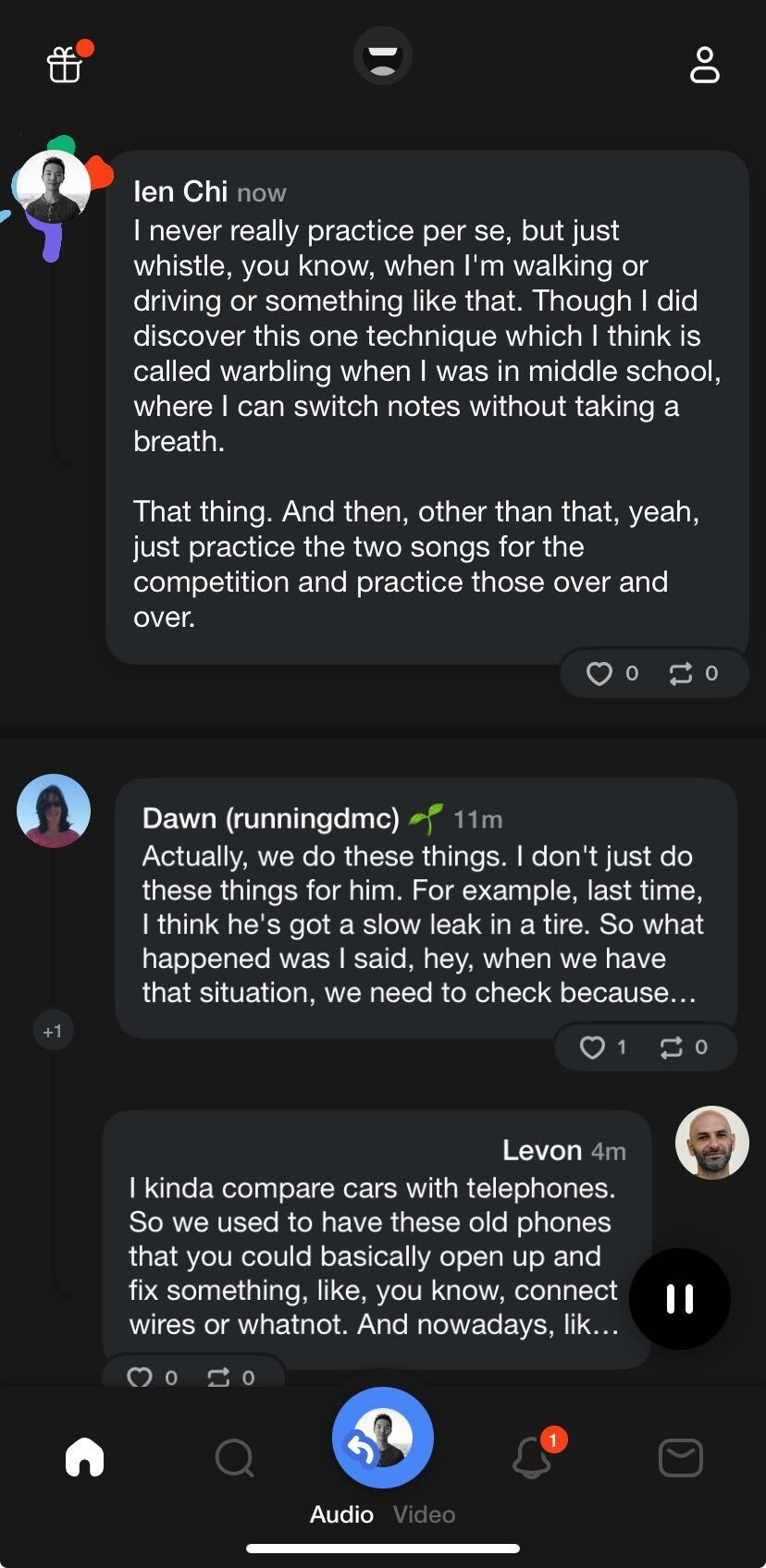
Anyone who has scrolled through Facebook or Threads can figure out Airchat quickly. The app combines the standard newsfeed format with audio notes straight from users. Users speak into the app, they don’t have the option to type posts, and as their followers scroll through their feeds, they hear the voice in addition to seeing the AI-generated transcript.

If a user wants to comment on a post, they record an audio of their thoughts as well. The whole app is a series of ongoing conversations.

Airchat feed of audio recordings and AI-transcribed posts. Credit: Entrepreneur

Airchat’s concept is to allow users to tune into conversations happening right now, not to catch up on what they’ve missed.

“I want a house party in my pocket,” Airchat co-founder Naval Ravikant told Bloomberg. “I want to be able to pull out this phone and talk to someone interesting and delightful and witty anytime I want.”

Related: OpenAI Is Holding Back the Release of Its New AI Voice Generator

What Works

When I scrolled through my Airchat feed, I found that the presence of other peoples’ voices captured my attention, but in a way that was less abrupt than a TikTok video or YouTube Short. I was also more present than if I had been scrolling through text-heavy posts on Facebook.

That said, there is an option to upload videos that I didn’t see anyone using. It was an audio-centered platform.

I could either press the play button at the bottom right-hand corner of the screen and have the newsfeed play all of the audio clips of people I followed, or manually scroll through and find the clips that interested me the most.

If your eyes glaze over at long social media posts, and you find yourself overstimulated by endless videos, Airchat is a happy medium.

Influencers aren’t the focus of the app, with Ravikant saying that the app is more of a social messenger like WhatsApp or WeChat than an influencer platform.

The two founders, Ravikant and former Tinder exec Brian Norgard were both active on Airchat.

Post by Ravikant. Credit: Entrepreneur

Post by Norgard. Credit: Entrepreneur

My overall impression was that the app was both intensely personal and thoughtful in a way that mainstream social media apps aren’t at the moment.

When comparing Airchat to Twitter, now X, Ravikant summed it up perfectly in an Airchat audio. He said that Twitter was once his preferred social media until he saw hundreds of people rephrase what he said in different ways.

“Or I would see people copying the same content a year later or two years later,” he continued. “And you kind of want to say, really? Let’s talk in person. Get in the ring… And that’s what I think this app does. It really allows the people who are incredibly witty to really shine. Or the people who are incredibly empathetic.”

Hearing Ravikant speak added a human element to the app. As social media contends with bots, having that touch of authenticity with tone is important.

Unlike competing social audio app Clubhouse, Airchat isn’t about having live conversations, it’s about having ongoing ones that play out over time with no pressure to respond right away. Clubhouse’s mission of friends over followers seems to be one that Airchat abides by too, but the user experience for both apps is different.

What Could Use Improvement

Since synthetic voices are already being used in scams, it could undermine the genuineness of Airchat if users employ it.

Related: I Tried 3 AI Headshot Generators and There Was a Clear Winner

One thing I noticed that could be improved was that even when I exited the app, the audio feed kept playing in the background. Locking my phone didn’t pause the audio either. I’m thinking about the success of white noise podcasts and channels on Spotify and the possibilities on Airchat for the same sort of thing, even in a smaller community.

Why I’ll Use Airchat Again

I’m most enthusiastic about Airchat prioritizing human connection and voice in social media — and doing so asynchronously, which allows users to drop in on conversations. The quality-over-quantity approach that Airchat’s co-founders are taking bodes well for the app’s overall quality.

Everyone was behaving like they were at a dinner party.

Another possible use of the Airchat app could be to make new friends or even date.

The content was also well-moderated and thoughtful; there was nothing inappropriate on my feed. Everyone was behaving like they were at a dinner party, which made me wonder if it was the audio format of the app that added an extra layer of civility to discussions, or if the app’s relatively small, invitation-only user base created the atmosphere.

I closed the Airchat app feeling more in touch with the world, not more disconnected from it, which is how I usually feel after browsing through major social media. The app is easy to use and the original discussions happening on the app between real people spoke to its quality.

I’m thinking about what to say when I use it again.

https://www.entrepreneur.com/business-news/i-tried-airchat-silicon-valleys-trendy-social-media-app/472917


The FBI Is Warning of a New Text Message Scheme Claiming Unpaid Toll Road Charges

The FBI has issued a new warning of a phishing scam that’s been targeting Americans using toll roads via SMS.

Called a “smishing” grift (a hacking scam that’s performed using fake SMS text messages), and the FBI said that it has received over 2,000 complaints across three different states from people alleging they were contacted through text messages and told they had unpaid toll fees.

The FBI estimates that the scheme has been active since early March.

Related: Andy Cohen Lost ‘A Lot of Money’ in Sophisticated Bank Scam

“(State Toll Service Name): We’ve noticed an outstanding toll amount of $12.51 on your record,” one example of the fake message reads. “To avoid a late fee of $50.00, visit https://myturnpiketollservices.com to settle your balance.”

“Smishing,” which is a combination of the words “phishing” and “SMS,” involves using fake links to trick victims into “downloading malware, sharing sensitive information, or sending money to cybercriminals.”

The FBI said the messages come from numbers from all different states but did not specify the three states that have been affected so far.

However, the Pennsylvania State Police issued a warning to residents and visitors earlier this month, making it clear it was one of the states affected.

“On Sunday afternoon, the PA Turnpike was advised of a smishing scam that is targeting Pennsylvania residents with text messages requesting personal financial information to settle outstanding toll amounts,” the organization warned. “Similar scams have been reported by toll agencies across the country over the past several days.”

Related: ‘Card Draining’ Is the New Retail Scam

Those who think they’ve been affected by the scheme are encouraged to file a complaint online with the IC3 and include the phone number that the fake message came from, as well as the link used in the message.

Victims should also delete any “smishing” texts that they received and check their actual toll balance by using their toll service’s legitimate website or calling their customer service.

https://www.entrepreneur.com/business-news/fbi-says-new-sms-text-grift-alleges-unpaid-toll-road-charges/472932


John Deere Will Pay Up to $192K for a ‘Chief Tractor Officer’ to Travel and Help Launch TikTok Channel

This article originally appeared on Business Insider.

Agriculture equipment company John Deere is on the hunt for a different kind of CTO.

The brand on Tuesday announced a two-week search to find a “Chief Tractor Officer” who would create social media content to reach younger consumers.

One winning applicant will receive up to $192,300 to traverse the country over the next several months showcasing the way John Deere products are used by workers, from Yellowstone National Park to Chicago’s Wrigley Field and beyond.

“No matter what you do — whether it’s your coffee, getting dressed in the morning, driving to work, the building you go into — it’s all been touched by a construction worker, a farmer, or a lawn care maintenance group,” Jen Hartmann, John Deere’s global director of strategic public relations, told AdAge.

To kick off the search, John Deere tapped NFL quarterback Brock Purdy (who will presumably be a bit busy this Fall to take the job himself) to star in a clip in which he attempts to set out on a road trip in an industrial tractor.

Suited up in the obligatory vest, work boots, and John Deere hat, Purdy’s progress is interrupted by teammate Colton McKivitz hopping into the cab while a string of messages floods in from other athletes and influencers expressing interest in the job.

The clip also represents the first time that the 187-year-old company has used celebrities to promote itself, Hartmann told AdAge.

According to the contest rules, entrants have until April 29 at midnight to submit a single 60-second video making their pitch for why they should be the face and voice of the company.

In addition, entrants must live in the 48 contiguous states or DC — sorry Hawaii and Alaska residents. Interestingly, any AI-generated submissions are prohibited, too.

Videos will be judged against four categories — originally, creativity, quality, and brand knowledge — after which five finalists will be chosen and notified after May 17.

https://www.entrepreneur.com/business-news/john-deere-hiring-cto-chief-tractor-officer-tiktok/472873


Country Star Jelly Roll Sued By Local Band For Copyright Infringement, ‘Harm’ to Reputation

Country star Jelly Roll, 39, is having a banner year, but a lawsuit filed last week in Pennsylvania court claims that his past reputation is causing a local band “irreparable harm.”

A wedding band based in Chadds Ford, Penn., a town just outside of Philadelphia, called “Jellyroll” is suing the country musician for trademark infringement and “unfair competition.”

The band, which has been around since the 1980s, claims that it owns the trademark for the name and has sent Jelly Roll (the country singer) and his team a cease-and-desist letter to change his stage name.

Jelly Roll’s team responded via email to discuss, according to the suit.

“Several conversations ensued and at one point Defendant’s counsel inquired as to whether Defendant really was in competition with Plaintiff,” the suit states.

But the conversations did not work out, and the 80s wedding band is claiming that Google search results about Jelly Roll’s past are harming their business.

“Defendant’s unapologetic continued infringing acts and conduct, unless enjoined by this Court, will continue to cause consumer confusion, mistake, and deception,” the lawsuit, which was obtained by FOX Business, alleges. “Because of Defendant’s troubled past, which includes a felony conviction and imprisonment, such association as averred above has caused additional harm to Plaintiff among the public and trade.”

Jelly Roll was in and out of jail for 10 years starting at age 14 for a number of charges including aggravated robbery, drug possession and shoplifting.

It’s noted in the lawsuit that Jelly Roll (the singer) has a space in his name while the band has their name as one word.

Related: Bon Jovi, Darius Rucker Warn About AI Tech in Music Industry

Jelly Roll began his path to country stardom in 2021 with his album “Ballads of the Broken,” which gave the singer his first major hit with “Son of a Sinner.” It peaked at No. 31 on the U.S. Billboard Hot 100.

Most notably, he won the 2023 CMA Award for New Artist of the Year after the success of his second album Whitsitt Chapel, which came out in 2023 and debuted at No. 1 on Billboard’s Top Rock & Alternative Albums chart. In his acceptance speech, he delivered a powerful message that quickly went viral.

“I don’t know where you’re at in your life or what you’re going through, but I want to tell you to keep going,” he said. “I want to tell you, ‘Success is on the other side.'”

According to Celebrity Net Worth, Jelly Roll is worth an estimated $4 million.

Related: Twitter Sued by 17 Music Publishers Over Copyright Infringement

https://www.entrepreneur.com/business-news/jelly-roll-sued-by-wedding-band-jellyroll-for-over-trademark/472866