U.S. Agencies Warn of APTs Exploiting Recent ADSelfService Plus Zero-Day

The U.S. Cybersecurity and Infrastructure Security Agency (CISA), the Federal Bureau of Investigation (FBI), and the Coast Guard Cyber Command (CGCYBER) have sounded the alarm over in-the-wild attacks targeting a recently disclosed vulnerability in Zoho’s ManageEngine ADSelfService Plus product.

Tracked as CVE-2021-40539 and rated critical severity (CVSS score of 9.8), the vulnerability has been exploited since August 2021 to execute code remotely and take over vulnerable systems.

Affecting the representational state transfer (REST) application programming interface (API) URLs of the self-service password management and single sign-on solution, the issue is an authentication bypass bug that affects all ADSelfService Plus builds up to 6113.

“The FBI, CISA, and CGCYBER assess that advanced persistent threat (APT) cyber actors are likely among those exploiting the vulnerability,” reads a joint advisory issued on Thursday.

Academic institutions, critical infrastructure (communications, finance, IT, logistics, manufacturing, transportation, and others), and defense contractors are at risk of compromise because of their use of ADSelfService Plus.

“Successful exploitation of the vulnerability allows an attacker to place webshells, which enable the adversary to conduct post-exploitation activities, such as compromising administrator credentials, conducting lateral movement, and exfiltrating registry hives and Active Directory files,” the advisory reads.

An attacker able to successfully exploit CVE-2021-40539 can upload a .zip archive containing a JavaServer Pages (JSP) webshell posing as an x509 certificate. The attacker then leverages Windows Management Instrumentation (WMI) for lateral movement. Adversaries also attempt to access domain controllers and expand access.

“Confirming a successful compromise of ManageEngine ADSelfService Plus may be difficult—the attackers run clean-up scripts designed to remove traces of the initial point of compromise and hide any relationship between exploitation of the vulnerability and the webshell,” the joint advisory reads.

The security defect was addressed in ADSelfService Plus build 6114 and customers are advised to update to it as soon as possible. Furthermore, the FBI, CISA, and CGCYBER strongly recommend that organizations keep ADSelfService Plus disconnected from the Internet.

Related: Recently Patched Confluence Vulnerability Exploited in the Wild

Related: PetitPotam Vulnerability Exploited in Ransomware Attacks

Related: CISA Issues Emergency Directive to Address ‘PrintNightmare’ Vulnerability

view counter

Ionut Arghire is an international correspondent for SecurityWeek.

Previous Columns by Ionut Arghire:
Tags:

http://feedproxy.google.com/~r/securityweek/~3/6qWQAchzGNA/us-agencies-warn-apts-exploiting-recent-adselfservice-plus-zero-day


Court Rejects Lawsuit Against NSA on “State Secrets” Grounds

A divided federal appeals court has upheld the dismissal of an ACLU lawsuit challenging a portion of the National Security Agency’s warrantless surveillance of Americans’ international email and phone communications.

The 4th U.S. Circuit Court of Appeals ruled Wednesday that the lawsuit must be dismissed after the government invoked the “state secrets privilege,” meaning that a full exploration of the issue in a court of law would damage national security.

In the lawsuit the Wikimedia Foundation, which runs Wikipedia, said that the National Security Agency’s “Upstream” surveillance program necessarily captures some of its international communications and is a violation of free-speech rights and its Fourth Amendment rights against unreasonable search and seizure.

Details of the Upstream program are classified, but it collects data from transmissions over high-speed cables that carry electronic communications into and out of the country.

In a majority opinion, Judge Albert Diaz, an Obama appointee, agreed with government assertions that a lawsuit over the program’s constituionality cannot be conducted without harming national security.

“There’s simply no conceivable defense to this assertion that wouldn’t also reveal the very information that the government is trying to protect: how Upstream surveillance works and where it’s conducted,” Diaz wrote.

In a dissent, Judge Diana Gribbon Motz wrote that the Supreme Court is set to hear arguments on a case that could spell out the breadth of the state secrets privilege, and that allowing the government to invoke it ahead of that ruling is a mistake.

She said that the majority opinion “stands for a sweeping proposition: A suit may be dismissed under the state secrets doctrine, after minimal judicial review, even when the Government premises its only defenses on far-fetched hypotheticals.”

Patrick Toomey, an attorney with the ACLU’s National Security Project, which represented Wikimedia, said he is “extremely disappointed” witht the ruling and lawyers are considering their appeal options.

“Every day, the NSA is siphoning Americans’ communications off the internet backbone and into its spying machines, violating privacy and chilling free expression,” he said in a statement, “Congress has made clear that the courts can and should decide whether this warrantless digital dragnet complies with the Constitution.”

The lawsuit was filed in the aftermath of NSA contractor Edward Snowden’s disclosures about the scope of agency surveillance. The lawsuit was first tossed out in 2015 over the issue of whether plaintiffs had standing to sue. But the 4th Circuit revived the case and sent it back to the lower court, which again dismissed it in 2019 on the state secrets argument.

The Upstream program is just one part of the NSA’s surveillance. The “downstream” portion enlists internet service providers such as Google in collecting the communications of selected targets. The court ruling indicates that downstream collection provides a “vast majority” of what is collected by the NSA.

view counter

Previous Columns by Associated Press:
Tags:

http://feedproxy.google.com/~r/securityweek/~3/fQZ_mrKHX40/court-rejects-lawsuit-against-nsa-state-secrets-grounds


Cybersecurity M&A Roundup for September 1-15, 2021

Cybersecurity M&A roundup for September 1-15, 2021

Nearly two dozen cybersecurity mergers and acquisitions were announced in the first half of September 2021.

Achieve Partners acquires Metmox

Private equity firm Achieve Partners acquired managed security service provider (MSSP) Metmox with the goal of addressing the global talent shortage. As a result of the acquisition, Achieve will create a large-scale cybersecurity apprenticeship program that will prepare entry-level talent for cybersecurity careers at Metmox and its clients.

Baanx acquires stake in Maxwell State Bank

UK-based B2B2C platform Baanx announced buying a stake in US-based fintech bank Maxwell State Bank. Exact financial terms have not been disclosed, but it has been described as a multi-million-dollar deal and Baanx has become the third largest stakeholder in Maxwell. The goal of the investment is to “enhance cybersecurity and banking access to communities throughout America.”

BitSight acquires VisibleRisk

Cybersecurity ratings company BitSight announced the acquisition of VisibleRisk, a cyber risk ratings venture created by credit ratings giant Moody’s and Israel-based cybersecurity think tank and venture creation foundry Team8. BitSight’s acquisition of VisibleRisk adds a cyber risk assessment capability and boosts its ability to analyze and calculate an organization’s financial exposure to cyber risk.

Booz Allen Hamilton acquires Tracepoint

Consulting giant and government contractor Booz Allen Hamilton bought digital forensics and incident response company Tracepoint. Booz Allen Hamilton made a strategic investment in the company in January 2021 and it has now acquired the rest of Tracepoint’s business in an effort to expand its cybersecurity capabilities. Tracepoint and Booz Allen Hamilton’s commercial cyber business will be integrated in early 2022.

Breakwater Solutions acquires Clairvoya

Information governance and data risk management firm Breakwater Solutions acquired Clairvoya, which specializes in data governance solutions. Clairvoya’s CEO will join Breakwater as COO and Clairvoya’s CTO will become Breakwater’s CTO. Breakwater says Clairvoya technology complements its own, adding data lineage for managing unstructured data in motion.

Consilio acquires Adecco Group’s legal consulting and eDiscovery business units

eDiscovery, risk management, document review and legal consulting services provider Consilio acquired the Adecco Group’s legal consulting and eDiscovery business of Special Counsel. Consilio says the acquisition of these business units will help it expand in areas such as document review, legal process outsourcing and cyber incident response.

DDLS acquires Auldhouse

Australia-based ICT and digital skills training firm DDLS has acquired New Zealand-based Auldhouse, which provides the same types of services, in a deal reportedly valued at roughly $17 million ($12 million). DDLS is Australia’s largest cybersecurity training provider and the acquisition will help both companies expand.

Dynatrace acquires SpectX

Software intelligence company Dynatrace announced the acquisition of parsing and query analytics company SpectX. Dynatrace said the deal will enable it to boost its platform’s observability and application security analytics capabilities.

Document Storage Systems acquires SBG Technology Solutions

Health information technology firm Document Storage Systems (DSS) acquired SBG Technology Solutions, a provider of IT services and solutions, including cybersecurity and governance solutions. SBG will operate as a subsidiary of DSS and they will help each other enhance their capabilities.

EY acquires SecureWorx

Professional services giant EY, specifically EY Australia, has acquired Australia-based MSSP SecureWorx in an effort to provide security operations center (SOC) services powered by Microsoft technologies.

FireMon acquires DisruptOps

Network security company FireMon acquired DisruptOps, which specializes in cloud security operations. FireMon said the acquisition will enable it to expand its solution to include security risk monitoring and response in cloud infrastructure. DisruptOps was founded by Jody Brazil, who also founded FireMon. As a result of the acquisition, Brazil will become CEO of the combined entity.

JFrog acquires Upswift

Software development company JFrog has acquired Upswift, a device management platform for connected products. The resulting platform will provide a wide range of capabilities, including several related to application development security.

Kape Technologies acquires ExpressVPN

Consumer cybersecurity firm Kape Technologies announced acquiring VPN service ExpressVPN for $936 million. Kape said the acquisition will help it create a “premium digital privacy and security player” and expand its customer base. The deal should also help Kape in terms of sales, cost savings, and product distribution.

LogPoint acquires SecBI

Denmark-based SIEM solutions provider LogPoint is buying Israel-based threat detection and response firm SecBI in an effort to expand its XDR and SOAR capabilities. SecBI will become LogPoint Israel and it will remain in Tel Aviv.

Mastercard acquires CipherTrace

Payments giant Mastercard is acquiring cryptocurrency intelligence and blockchain analytics company CipherTrace. Mastercard said its goal is to ensure that the digital asset ecosystem is trusted and safe, which it hopes to achieve by combining its own capabilities with those of CipherTrace.

Millennia Technologies merges with Fusion IT

Enterprise communications company Millennia Technologies is merging with Fusion IT, a cybersecurity firm and MSSP. The companies believe the merger will help them expand their offerings and their customer base.

Nexon Asia Pacific acquires Veridian Solutions

Managed IT services provider Nexon Asia Pacific announced buying Veridian Solutions, which provides contact center, cloud and security services. Both companies are based in Australia. Nexon said Veridian’s contact center and unified communications offering complement its own, and Veridian’s dedicated cybersecurity practice complements its MSSP offering.

OPSWAT acquires SNDBOX

Critical infrastructure protection company OPSWAT acquired Israel-based malware analysis sandbox solution SNDBOX. SNDBOX will be integrated into OPSWAT’s Malware Analysis Solution offering, but will also be offered as a separate product. SNDBOX will help increase the accuracy of malware detection in IT and OT environments and reduce the cost of malware processing.

Orro acquires eSecure

Network, cloud, workspace and cybersecurity solutions provider Orro acquired MSSP eSecure in an effort to strengthen its cybersecurity offering. Both companies are based in Australia. Orro’s security business will be expanded with detection and response, assurance testing, vulnerability management and incident response services.

Solvinity acquires majority stake in Securify

MSP Solvinity has acquired a majority stake in Securify, which specializes in application security and penetration testing. Both companies are based in the Netherlands. The acquisition will enable Solvinity to expand its cybersecurity offering. Securify will continue to operate as an independent company under Solvinity.

Tenable acquires Accurics

Attack surface management pioneer Tenable is acquiring Accurics, an early-stage startup selling cloud-native security for DevOps and security teams, for $160 million in cash. The acquisition will help Tenable expand its product portfolio.

TransUnion acquires Neustar

Consumer credit reporting agency TransUnion acquires risk, communications, security and marketing solutions provider Neustar for $3.1 billion. TransUnion said Neustar’s data and analytics technology will help it expand its digital identity capabilities, including fraud detection and prevention.

Related: Cybersecurity M&A Roundup: 42 Deals Announced in August 2021

Related: Cybersecurity M&A Roundup: 38 Deals Announced in July 2021

view counter

Eduard Kovacs (@EduardKovacs) is a contributing editor at SecurityWeek. He worked as a high school IT teacher for two years before starting a career in journalism as Softpedia’s security news reporter. Eduard holds a bachelor’s degree in industrial informatics and a master’s degree in computer techniques applied in electrical engineering.

Previous Columns by Eduard Kovacs:
Tags:

http://feedproxy.google.com/~r/securityweek/~3/6ghwD6_7Fo4/cybersecurity-ma-roundup-september-1-15-2021


Endpoint Security Platform Kolide Banks $17 Million Investment

Endpoint security platform Kolide on Thursday announced that it has raised $17 million in Series B funding, for a total of $27 million raised to date.

The funding round was led by Boston-based venture capital OpenView Partners. Matrix Partners, who led Kolide’s Series A, also invested in the new round.

Kolide sells a Security-as-a-Service (SaaS) platform that engages with employees to address issues identified on Linux, Mac, and Windows devices, rather than only alerting security teams of the identified gaps.

The security firm uses Slack messages to tell employees when their device no longer meet security standards set by their organization, and also instructs them on how to address the identify the issues and verify whether they did that correctly.

With many organizations migrating to remote-work over the past year, Kolide said it has seen major growth, as it could both help security teams gain visibility into devices, and provide remote employees with transparency into how they were being surveilled.

The company plans to invest the new funds in growth and in expanding its go-to market strategy, as well as into hiring new talent to add more capabilities to its product.

Related: Neosec Emerges From Stealth With $20.7 Million in Funding

Related: JumpCloud Raises $159 Million at $2.56 Billion Valuation

Related: Threat Detection Provider ReversingLabs Raises $56 Million

view counter

Ionut Arghire is an international correspondent for SecurityWeek.

Previous Columns by Ionut Arghire:
Tags:

http://feedproxy.google.com/~r/securityweek/~3/TPShSYmZIhA/endpoint-security-platform-kolide-banks-17-million-investment


Regular Users Can Now Remove Password From Their Microsoft Account

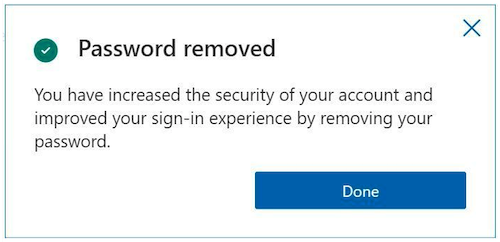
Microsoft on Wednesday informed owners of consumer accounts that they can now go completely passwordless and rely on other, more secure authentication methods.

Users with existing Microsoft accounts can delete their password from the account, and new accounts can be created without a password. Users will be able to rely on Microsoft’s Authenticator app, Windows Hello, physical security keys, or phone/email verification codes to sign in to services such as Outlook, OneDrive and Family Safety.

Users who want to go passwordless need to access the Advanced Security Options menu in their account and select Passwordless Account to remove their password. However, they need to ensure that another authentication method is linked to the account before removing the password.

Microsoft says the feature will be rolled out over the coming weeks.

Remove password from Microsoft account

As for enterprises, Microsoft announced the general availability of passwordless authentication for commercial users in March 2021, and the tech giant says it will soon start working on eliminating passwords for Azure AD accounts.

“Administrators will be able to choose whether passwords are required, allowed, or simply don’t exist for a set of users. Users will be able to choose not to set a password when creating an account or to remove their password from an existing account,” explained Joy Chik, corporate VP of the identity division in Microsoft’s Cloud and Enterprise group.

Passwords are considered a highly insecure authentication method since they can easily get compromised, and attackers who obtain users’ passwords may be able to access even accounts that are protected with multi-step authentication, particularly if it relies on SMS messages.

Related: How Do We Get to a Passwordless World? One Step at a Time

Related: Microsoft Introduces New Password Spray Detection for Azure

Related: Microsoft Edge Adds Password Generator, Drops Support for Flash, FTP

view counter

Eduard Kovacs (@EduardKovacs) is a contributing editor at SecurityWeek. He worked as a high school IT teacher for two years before starting a career in journalism as Softpedia’s security news reporter. Eduard holds a bachelor’s degree in industrial informatics and a master’s degree in computer techniques applied in electrical engineering.

Previous Columns by Eduard Kovacs:
Tags:

http://feedproxy.google.com/~r/securityweek/~3/5JYFss4FaJs/regular-users-can-now-remove-password-their-microsoft-account


Cloud Backup Company Rewind Raises $65 Million

Cloud backup company Rewind has announced raising $65 million in a Series B funding round, which brings the total amount invested in the firm to more than $80 million.

The funding round was led by private equity and venture capital firm Insight Partners, with participation from Bessemer Venture Partners, FundFire, Inovia Capital, Ridge Ventures, ScaleUp Ventures, and Union Ventures.

Rewind plans on using the money to scale its efforts and improve its backup and recovery solutions.

The company’s solutions are designed to help organizations protect SaaS and cloud data. Rewind claims to have more than 100,000 customers across over 100 countries, including GitHub, Shopify, Trello, QuickBooks Online, and BigCommerce.

“While we’ve continued to double revenue and software subscribers year over year, every day our team talks with seasoned technology professionals who still do not realize they lack full control of their vital business data,” said Mike Potter, co-founder and CEO of Rewind.

“We see tremendous opportunities to backup the entire cloud and are working towards that vision. This latest round of funding will allow us to expand our reach, bring additional SaaS backup solutions to the market, and raise awareness for the need to include all cloud and SaaS applications in a business’s backup and recovery strategy,” Potter added.

Related: SaaS Application Backup Firm Rewind Raises $15 Million

Related: OwnBackup Raises $240 Million at $3.35 Billion Valuation

Related: Data Security Startup Qohash Raises $6 Million

Related: Cloud Data Protection Firm Druva Raises $130 Million

view counter

Eduard Kovacs (@EduardKovacs) is a contributing editor at SecurityWeek. He worked as a high school IT teacher for two years before starting a career in journalism as Softpedia’s security news reporter. Eduard holds a bachelor’s degree in industrial informatics and a master’s degree in computer techniques applied in electrical engineering.

Previous Columns by Eduard Kovacs:
Tags:

http://feedproxy.google.com/~r/securityweek/~3/3lxXu9y-9KI/cloud-backup-company-rewind-raises-65-million


Severe Vulnerabilities Could Expose Thousands of Azure Users to Attacks

Four of the fixes that Microsoft released as part of its September 2021 Patch Tuesday updates deal with vulnerabilities in the Open Management Infrastructure (OMI) software agent embedded in Azure services.

Assessed with severity ratings of critical and high, the vulnerabilities, collectively dubbed OMIGOD, could be exploited to execute code remotely or gain elevated privileges on vulnerable Linux virtual machines running on Azure.

“We conservatively estimate that thousands of Azure customers and millions of endpoints are affected,” said cloud security company Wiz, whose researchers identified the flaws. “In a small sample of Azure tenants we analyzed, over 65% were unknowingly at risk.”

An open source project written in C, OMI helps users manage configurations across environments and is used widely in various Azure services, including Azure Automation, Azure Insights, and more. OMI is similar to Windows Management Instrumentation (WMI) and is deployed automatically when an Azure customer creates a Linux virtual machine.

The most severe of the newly addressed security issues is CVE-2021-38647 (CVSS score of 9.8), which could allow a remote, unauthenticated attacker to execute code on a vulnerable machine. Because of this bug, any request without an authentication header has its privileges automatically set to root.

“With a single packet, an attacker can become root on a remote machine by simply removing the authentication header,” security researchers with Wiz explain.

Considered high severity, all of the three other security holes addressed in OMI could lead to privilege escalation. These are tracked as CVE-2021-38648 (CVSS score of 7.8), CVE-2021-38645 (CVSS score of 7.8), and CVE-2021-38649 (CVSS score of 7.0).

Exploitation of CVE-2021-38648, Wiz researchers explain, involves omitting the authentication part of a previously recorded legitimate command execution request from the omicli and reissuing that request. Regardless of the permissions the user has, the command will be run as root.

These vulnerabilities potentially affect over half of Azure instances, all of which are Linux machines, provided they use Azure services such as Automation, Automatic Update, Operations Management Suite (OMS), Log Analytics, Configuration Management, or Diagnostics, among others.

With OMI available for installation on any Linux machine, others might be affected as well. In fact, Microsoft says that patches for the bugs were made available on GitHub on August 11, to ensure that partners who depend on OMI had enough time to implement the fix before details were made public.

Roughly two weeks ago, Microsoft resolved an issue that could have allowed attackers to take over Azure Cosmos DBs. Last week, the company patched an Azure Container Instances (ACI) flaw leading to information disclosure.

Related: Patch Tuesday: Microsoft Plugs Exploited MSHTML Zero-Day Hole

Related: Critical Vulnerability Exposed Azure Cosmos DBs for Months

Related: Microsoft Tells Azure Users to Update PowerShell to Patch Vulnerability

view counter

Ionut Arghire is an international correspondent for SecurityWeek.

Previous Columns by Ionut Arghire:
Tags:

http://feedproxy.google.com/~r/securityweek/~3/8906aAQH7Uk/severe-vulnerabilities-could-expose-thousands-azure-users-attacks


Cybersecurity Seen as Rising Risk for Airlines After 9/11

Aviation Cybersecurity

After remaking their security procedures following the 9/11 attacks to stop airline hijackings, carriers are now faced with rising threats targeting computers and electronic equipment critical to their operations and safety.

Since the tragedy 20 years ago on Saturday, airlines and airports have fortified cockpits, barred sharp objects in carry-on luggage and improved technology to detect explosives.

“We are more secure,” said Willie Walsh, director general of the International Air Transport Association.

Many of today’s security risks are now viewed as targeting the networks and hardware planes and airlines rely on.

From the gradual shift to electronic tickets to the management of jet fuel, even more aspects of aviation go through digital channels now than they did two decades ago.

“We must stay ahead of emerging security threats,” Walsh said. “To do this effectively, we need to take a more integrated approach on things like cyber risks, drones, and insider threats.”

New entry points

Beyond new airline security rules mandated by governments worldwide, security experts say potential hijackers face an additional challenge: other passengers.

“Because of 9/11, if you’re sitting in the airplane, and someone jumps up and tries to enter the cockpit, the passengers themselves are going to fight back and prevent that from happening,” said Dan Cutrer, an expert in aviation safety at Embry-Riddle Aeronautical University.

[ Related: Is the Taliban a Cyber Threat to the West? ]

However the embrace of digital technology has created new opportunities for trouble, with hackers able to penetrate systems through suppliers’ software, online services or WiFi offered to passengers.

Experts consider the potential for a hacker to take control of the plane itself as unlikely, since flight controls are separate from systems used by customers.

Even if plane systems “may exhibit cybersecurity weaknesses, they’re not an attractive target for most actors because of the required access and expertise, plus the risk of loss of life,” said Katelyn Bailey of cybersecurity company FireEye.

A realm of potential vulnerability is the communication system between pilots and air traffic controllers, said Pablo Hernandez, a researcher at Innaxis Research Institute.

The conversations “are open and they’re not encrypted or confidential,” he said. “Anyone with the right radio can join into this conversation.”

However, key flight systems needed to run the plane and air traffic have been well secured, Hernandez said.

There have been some notable hacks of ground or ancillary systems, including a 2020 data breach at British airline EasyJet that exposed the personal data of some nine million customers. There were 1,260 incidents last year against airlines and other aviation bodies, such as airports, according to Eurocontrol, an intergovernmental organization that supports European aviation.

[ Related: FBI Says Researcher Admitted Hacking Airplane in Mid-Flight ]

“Every week, an aviation actor suffers a ransomware attack somewhere in the world, with big impacts on productivity and business continuity,” Eurocontrol said in a note published in July.

Airports use “best practices” to try to mitigate this risk.

This includes sending employees fictitious emails with links such as the ones devised by hackers; workers who click on them then receive additional training, said Christopher Bidwell, senior vice president at the Airports Council International, North America.

Money and espionage

The implications of cyberattacks are significant for airlines.

“In the aviation industry, you can’t have downtime,” said Deneen DeFiore, chief information security officer at United Airlines. “Any system outage or disruption would be detrimental to any company.”

Most hackers are motivated by money. They use or sell stolen credit card data or financial information and sometimes demand ransom from companies to recover their systems.

However Bailey of FireEye said that because they often target the data of passengers, some hackers may be connected to states and engaged in espionage.

The airline industry benefited from the 2014 creation of an information sharing body, Aviation ISAC, focused on cybersecurity, said United’s DeFiore.

She considers cyberattacks an emerging risk throughout aviation that needs to be taken seriously by everyone from air safety directors to maintenance teams.

Related: World Economic Forum on Securing the Aviation Industry in Age of Convergence

view counter

© AFP 2020

Previous Columns by AFP:
Tags:

http://feedproxy.google.com/~r/securityweek/~3/CNKVLqzp3ko/cybersecurity-seen-rising-risk-airlines-after-911


Mēris Botnet Flexes Muscles With 22 Million RPS DDoS Attack

A series of record-breaking RPS-based distributed denial of service (DDoS) attacks observed over the past month are the result of a new, powerful botnet flexing its muscles to prove its capabilities.

Referred to as Mēris (the Latvian word for plague), the botnet is apparently responsible for the largest recorded application layer DDoS assault to date, which, less than a week ago, peaked at 21.8 million requests per second (RPS).

Active since at least June 2021, the botnet has ensnared tens of thousands of devices that use Ethernet connections. To date, the botnet hasn’t shown its true size, but researchers with Qrator Labs believe it is composed of more than 200,000 bots.

Most of the vulnerable devices, the researchers say, are from Mikrotik, which suggests that a previously unknown vulnerability might have been used to compromise them. Ensnared devices run a broad range of RouterOS versions, the majority being on the firmware previous to the current Stable one. To launch DDoS attacks, Mēris employs the HTTP pipelining (http/1.1) technique.

Since the beginning of August, the botnet has apparently launched at least five attacks, each more devastating than the previous one. The first was a 5.2 million RPS assault on August 7, while the last one was last week’s 21.8 million RPS attack on Russian Internet giant Yandex.

The source IPs in the latest attack showed that devices predominantly had ports 2000 and 5678 open, which suggests that they were made by Mikrotik.

Qrator Labs’ researchers discovered “328 723 active hosts on the Internet replying to the TCP probe on port 5678,” with some being Linksys devices, and say that these might be vulnerable to Mēris takeover, if not already ensnared.

The attack on Yandex set a record for application layer attacks roughly two weeks after Cloudflare revealed that it had mitigated a 17.2 million RPS DDoS assault. According to Qrator Labs, Mēris might have been responsible for that incident as well.

Related: TsuNAME Vulnerability Can Be Exploited for DDoS Attacks on DNS Servers

Related: Akamai Sees Largest DDoS Extortion Attack Known to Date

view counter

Ionut Arghire is an international correspondent for SecurityWeek.

Previous Columns by Ionut Arghire:
Tags:

http://feedproxy.google.com/~r/securityweek/~3/6j6Mt8EycB0/m%C4%93ris-botnet-flexes-muscles-22-million-rps-ddos-attack


Google Introduces Private Compute Services for Android

Google this week introduced a new suite of services designed to improve privacy in the Android operating system.

The new features add to the previously introduced Private Compute Core in Android 12 beta, an open source, secure environment designed to be completely isolated from the Android platform itself, as well as from other applications.

For the time being, Private Compute Core includes features such as Live Caption, Now Playing, and Smart Reply, but Google says that additional privacy-preserving features will be added with each new Android release.

To increase privacy, these features keep user data on the device, as the data processed in the Private Compute Core isn’t shared with other apps, and allow for the device to access the cloud without compromising privacy.

No feature within the Private Compute Core has direct access to a network, which is where the newly introduced Private Compute Services come into play. Powered by machine learning, Google says they create a bridge between Private Compute Core and the cloud.

A set of open-source APIs to Private Compute Services are utilized for communication purposes, while ensuring all identifying information is removed in the process through technologies such as Federated Learning, Federated Analytics, and Private information retrieval.

Google plans to make the source code for Private Compute Services available to the public and be audited by security researchers.

“We’re enthusiastic about the potential for machine learning to power more helpful features inside Android, and Android’s Private Compute Core will help users benefit from these features while strengthening privacy protections via the new Private Compute Services,” Google says.

Related: Google Android Security Update Patches 40 Vulnerabilities

Related: Google Details New Privacy and Security Policies for Android Apps

view counter

Ionut Arghire is an international correspondent for SecurityWeek.

Previous Columns by Ionut Arghire:
Tags:

http://feedproxy.google.com/~r/securityweek/~3/pRS85SMwMos/google-introduces-private-compute-services-android