Vulnerabilities Can Allow Attackers to Remotely Gain Control of Weintek HMIs

A cybersecurity researcher who specializes in industrial control systems (ICS) has identified three types of critical vulnerabilities in products made by human-machine interface (HMI) manufacturer Weintek.

The Taiwan-based vendor’s products are used worldwide. The company has posted a technical advisory instructing customers to install available patches and take steps to mitigate risks. It noted that the risk of exploitation is more significant if the devices are connected to an open network.
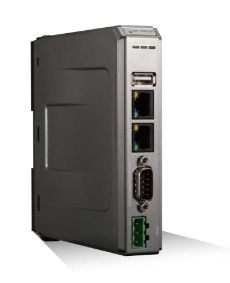
Weintek HMI vulnerabilitiesThe vulnerabilities were discovered by Marcin Dudek, a senior ICS/OT security researcher at Poland’s CERT Polska. The security holes have been found to impact the EasyWeb web-based configuration interface available for Weintek cMT products. Affected products include HMIs (including screenless HMIs), programmable logic controllers (PLCs), and gateways.

The vulnerabilities can be exploited by a remote, unauthenticated attacker for code execution with root privileges (CVE-2021-27446), to remotely access sensitive information and conduct actions on behalf of an admin (CVE-2021-27444), and to execute malicious JavaScript code via a stored XSS flaw (CVE-2021-27442).

Dudek noted on Twitter that there are more than 170 cMT HMIs connected directly to the internet, including systems located in Europe, Asia and North America.

Learn more about vulnerabilities in industrial systems at SecurityWeek’s ICS Cyber Security Conference and SecurityWeek’s Security Summits virtual event series

The researcher told SecurityWeek that an attacker could exploit the first two vulnerabilities with a single request sent to the targeted device. In the case of CVE-2021-27444, an attacker could leverage it to obtain the administrator password hash.

In the worst case scenario, an attacker can exploit the vulnerabilities to take complete control of the targeted device with root privileges, which in a real world environment could have serious consequences.

“Having such high privileges, an attacker can have unlimited access to all functions of the HMI,” Dudek explained. “It could also be used as a proxy to get access to the internal network of an organization, or to have direct access to other industrial devices in the same network, such as PLCs.

Dudek said he worked well with the vendor during the disclosure process. He said it took roughly two months to release all patches, but most of the fixes were ready one month after he reported his findings.

Remotely accessible HMIs can pose a serious threat to organizations in critical infrastructure sectors. Some of the high-profile incidents that came to light recently involve attacks on the water sector.

According to the U.S. Cybersecurity and Infrastructure Security Agency (CISA), which issued an advisory for the Weintek cMT vulnerabilities this week, the impacted products are mostly used in the water and commercial facilities sectors.

Related: Iranian Hackers Access Unprotected ICS at Israeli Water Facility

Related: CISA Issues Advisory for High-Severity Vulnerabilities in Fuji Electric HMI Products

Related: Tens of Vulnerabilities Expose WAGO Controllers, HMI Panels to Attacks

view counter

Eduard Kovacs (@EduardKovacs) is a contributing editor at SecurityWeek. He worked as a high school IT teacher for two years before starting a career in journalism as Softpedia’s security news reporter. Eduard holds a bachelor’s degree in industrial informatics and a master’s degree in computer techniques applied in electrical engineering.

Previous Columns by Eduard Kovacs:
Tags:

http://feedproxy.google.com/~r/Securityweek/~3/SGP3FRQS5uY/vulnerabilities-can-allow-attackers-remotely-gain-control-weintek-hmis


Endpoint Security Provider Morphisec Bags $31 Million Investment

Endpoint security provider Morphisec on Thursday announced that it has raised $31 million in a new funding round led by JVP, with participation from existing investors, such as Orange and Deutsche Telekom Capital Partners.

Founded in 2014, the Israeli cyber-security company claims to have its solutions deployed on more than 7 million endpoints, leveraging automation to keep them safe from a wide range of attacks.

The new investment, the company says, will support aggressive hiring of talent, meant to significantly increase the company’s teams in both the United States and Israel.

Morphisec also announced that Steve Bennett, former Symantec and Intuit CEO, is joining its board of directors, effective immediately.

The cyber-security company claims to be able to help organizations defend against sophisticated attacks without the need of dedicated security teams, by protecting workstations, servers, VDIs, virtual machines, and cloud assets.

Morphisec’s suite of security solutions use moving target defense technology and adopt a prevention-first zero trust approach to defending assets, automatically stopping attacks, instead of reacting to them, the company claims.

“With this new investment, we will further our commitment to bring organizations of all sizes threat prevention that stops advanced attacks in their tracks before the breach and costly damage,” Morphisec CEO Ronen Yehoshua commented.

Related: Feedzai Lands $200M in Series C Funding

Related: Identity Verification Provider Jumio Snags $150M Investment

Related: Aqua Security Achieves Unicorn Status After $135 Million Funding Round

view counter

Ionut Arghire is an international correspondent for SecurityWeek.

Previous Columns by Ionut Arghire:
Tags:

http://feedproxy.google.com/~r/Securityweek/~3/v4FpdmRFGcA/endpoint-security-provider-morphisec-bags-31-million-investment


General Says Attacks by Foreign Hackers Are ‘Clarion Call’

The U.S. Cyber Command conducted more than two dozen operations aimed at thwarting interference in last November’s presidential election, the general who leads the Pentagon’s cyber force said Thursday.

Gen. Paul Nakasone did not describe the nature of the operations in testimony to the Senate Armed Services Committee but said they were designed “to get ahead of foreign threats before they interfered with or influenced our elections in 2020.”

A U.S. intelligence assessment released last week said that neither Russia nor any other nation manipulated votes or conducted cyberattacks that affected the outcome of the vote.

Nakasone’s appearance before the committee came as the U.S. deals with major cyber intrusions, including a breach by elite Russian hackers that exploited supply chain vulnerabilities to break into the networks of federal government agencies and private companies.

Nakasone said in his prepared remarks that Cyber Command and the National Security Agency are helping plan the Biden administration’s response to the SolarWinds intrusion and that “policymakers are considering a range of options, including costs that might be imposed by other elements of our government.”

Separately, the U.S. is working with the private sector to respond to a separate hack that exposed tens of thousands of servers running Microsoft’s Exchange email program to intrusion.

Asked by the committee chairman, Sen. Jack Reed, D-R.I., whether the intrusions represented a “new terrain,” Nakasone said both the SolarWinds and Microsoft hacks revealed “a scope, a scale, a level of sophistication that we hadn’t seen previously.”

“It is the clarion call for us to look at this differently — how do we ensure we have as a nation both the resiliency and the ability to act against these type of adversaries,” he said.

Nakasone said one challenge is that foreign state hackers have taken advantage of legal constraints that prevent U.S. intelligence agencies such as the NSA, whose surveillance is focused abroad, from monitoring domestic infrastructure for cyber threats. Hackers are increasingly using U.S.-based virtual private networks, or VPNs, to evade detection by the U.S. government.

As a result, he said, the problem is not that intelligence agencies can’t connect all the dots but rather “we can’t see all of the dots.”

“We have an inability to see everything,” he added. “We as U.S. Cyber Command or the National Security Agency may see what is occurring outside of the United States, but when it comes into the United States, our adversaries are moving very quickly. They understand the laws and the policies that we have within our nation, and so they’re utilizing our own infrastructure, our own internet service providers, to create these intrusions.”

A senior Biden administration official told reporters earlier this month that the administration was not currently seeking additional authorities to monitor U.S.-based networks. Rather, the U.S. is working to encourage better information-sharing from the private sector about cyber threats.

Private companies are typically reluctant to share information on hacks and attempted hacks with the FBI and other government agencies, mostly out of fear of the negative business fallout if it were to become public. In many cases, companies don’t even report the incidents to the government.

On Wednesday, Sen. Mark Warner, D-Va., lamented in a webinar about being unable to get support in Congress for legislation to make it mandatory for companies to disclose cyber breaches. The chairman of the Senate Intelligence Committee singled out the telecommunications sector — a big target in the SolarWinds hack — as being especially resistant.

view counter

Previous Columns by Associated Press:
Tags:

http://feedproxy.google.com/~r/Securityweek/~3/9ajY6nzeedg/general-says-attacks-foreign-hackers-are-clarion-call


Critical Flaw in Jabber for Windows Could Lead to Code Execution

Cisco this week announced the release of software updates that address several vulnerabilities in Jabber for desktop and mobile platforms, the most severe of which could be abused to execute arbitrary code with elevated privileges.

The bugs impact Cisco Jabber for Windows, macOS, and mobile platforms, and are not dependable to one another. To successfully exploit them, an attacker would need to be authenticated to an Extensible Messaging and Presence Protocol (XMPP) server in use by the affected software and to be able to send XMPP messages.

The most important of them is CVE-2021-1411, a critical arbitrary program execution flaw in Jabber for Windows, which exists because of improper validation of message content. Successful exploitation of this vulnerability could result in code execution, Cisco explains.

Next in line is CVE-2021-1469, a high-severity security hole in Jabber for Windows that, similarly to CVE-2021-1411, could lead to code execution. The third issue is CVE-2021-1417, a medium-severity vulnerability leading to information disclosure.

Two other medium-severity flaws affect Jabber for Windows, Jabber for macOS, and Jabber for mobile platforms. The first of them (CVE-2021-1471) could allow an attacker to inspect or tamper with connections between the Jabber client and a server, while the second (CVE-2021-1418) could be exploited for denial of service.

Cisco has released software updates to address these vulnerabilities and notes that there are no workarounds for them. The company also notes that it is not aware of these bugs being exploited in attacks.

This week, the tech giant also released advisories for more than 40 high- and medium-severity vulnerabilities across its product portfolio.

These include patches for a series of vulnerabilities in IOS XE SD-WAN software (DoS, arbitrary command execution, and buffer overflow), flaws in various IOS XE components (leading to OS command injection, DoS, privilege escalation, and arbitrary code execution), and bugs in Access Points Software (code execution, DoS, and information disclosure).

Cisco also announced that it is investigating the impact of the two high-severity vulnerabilities that the OpenSSL Project patched on Thursday, and which could result in attackers signing certificates, or causing a DoS condition.

This week, Cisco also patched medium-severity vulnerabilities in IOS XE SD-WAN software, IOS application environment, Network Convergence System (NCS) 520 routers, Aironet access points, and IOS XE wireless controller software. The flaws could be exploited for command injection, denial of service, privilege escalation, file overwrite, and other types of attacks.

Information on all of these vulnerabilities is available on Cisco’s security portal.

Related: Cisco Patches Severe Flaws in Network Management Products, Switches

Related: Over 70 Vulnerabilities Will Remain Unpatched in EOL Cisco Routers

Related: Cisco Patches Critical Vulnerabilities in Small Business Routers, SD-WAN

view counter

Ionut Arghire is an international correspondent for SecurityWeek.

Previous Columns by Ionut Arghire:
Tags:

http://feedproxy.google.com/~r/Securityweek/~3/zDuOamY5HgY/critical-flaw-jabber-windows-could-lead-code-execution


New Code Execution Flaws In Solarwinds Orion Platform

Solarwinds has shipped a major security update to fix at least four documented security vulnerabilities, including a pair of bugs that be exploited for remote code execution attacks.

The patches were pushed out Thursday as part of a minor security makeover of the Orion Platform, the same compromised Solarwinds product that was exploited in recent nation-state software supply chain attacks.

The latest Orion Platform 2020.2.5 addresses at least four security flaws, one rated “critical” because of the risk of remote code execution attacks. The company did not release technical details of the vulnerability, which does not yet have a CVE assigned.

Solarwinds described that flaw simply as “RCE via Actions and JSON Deserialization.” The company warned that the critical bug was found via the test alert actions and noted that an Orion authenticated user is required to successfully launch an exploit.

A second bug, rated “high-risk” also brings remote code execution risk, Solarwinds warned. “The vulnerability can be used to achieve authenticated RCE as Administrator. In order to exploit this, an attacker first needs to know the credentials of an unprivileged local account on the Orion Server.”

The update also includes fixes for a “high-risk” stored-XSS vulnerability and a medium-severity issue that could lead to reverse-tabnabbing and open redirect attacks.

Related: SolarWinds Says 18,000 Customers May Have Used Compromised Orion Product

view counter

Ryan Naraine is Editor-at-Large at SecurityWeek and host of the popular Security Conversations podcast series. Ryan is a journalist and cybersecurity strategist with more than 20 years experience covering IT security and technology trends. He is a regular speaker at cybersecurity conferences around the world.
Ryan has built security engagement programs at major global brands, including Intel Corp., Bishop Fox and Kaspersky GReAT. He is a co-founder of Threatpost and the global SAS conference series. Ryan’s career as a journalist includes bylines at major technology publications including Ziff Davis eWEEK, CBS Interactive’s ZDNet, PCMag and PC World.
Follow Ryan on Twitter @ryanaraine.

Previous Columns by Ryan Naraine:
Tags:

http://feedproxy.google.com/~r/Securityweek/~3/DwJLj6WR9qY/new-code-execution-flaws-solarwinds-orion-platform


US Cyber Experts Conducted Operations to Safeguard Election

The U.S. Cyber Command conducted more than two dozen operations aimed at preventing interference in last November’s presidential election, the general who leads the Pentagon’s cyber force said Thursday.

Gen. Paul Nakasone, in prepared remarks to the Senate Armed Services Committee, did not describe those operations, so it was not immediately clear whether these were efforts strictly at defending the United States against intrusions or offensive measures to shut down intruders. He said his command’s operations were designed “to get ahead of foreign threats before they interfered with or influenced our elections in 2020.”

A U.S. intelligence assessment released last week said that neither Russia nor any other nation manipulated votes or conducted cyberattacks that affected the outcome of the vote.

Nakasone’s appearance before the committee comes as the U.S. is grappling with major cyber intrusions, including a breach by Russian hackers that exploited supply chain vulnerabilities to access federal government agencies and private companies.

Nakasone said Cyber Command and the National Security Agency are helping plan the Biden administration’s response to the SolarWinds intrusion and that “policymakers are considering a range of options, including costs that might be imposed by other elements of our government.”

Separately, the U.S. is responding to a breach that affected thousands users of Microsoft’s email server software.

view counter

Previous Columns by Associated Press:
Tags:

http://feedproxy.google.com/~r/Securityweek/~3/k937ZWdfSl4/us-cyber-experts-conducted-operations-safeguard-election


Microsoft Offers Up to $30,000 for Vulnerabilities in Teams Desktop Client

Microsoft on Wednesday announced that its bug bounty programs now also cover the desktop client of its Teams business communications platform.

The tech giant is offering rewards for vulnerabilities in the Teams desktop client as part of its Application Bounty Program, which will feature additional app-related bounties in the future.

The Teams desktop client bug bounty program complements the existing awards for vulnerabilities in online Teams services.

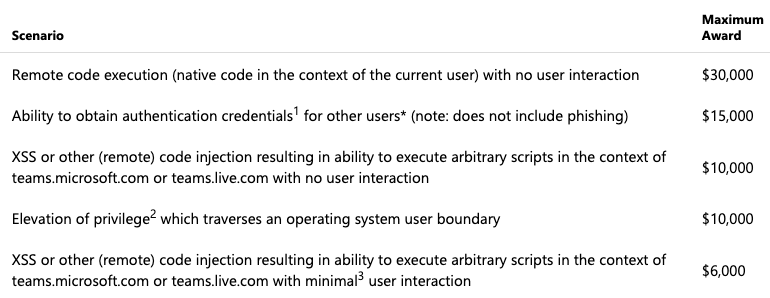
Microsoft says researchers can earn between $500 and $15,000 for general vulnerabilities in the Teams desktop client, and between $6,000 and $30,000 if they demonstrate an exploit that fits one of five scenarios.

For example, white hat hackers can earn up to $30,000 for remote code execution with no user interaction, and $15,000 for the ability to obtain authentication credentials for other users without leveraging phishing attacks.

Payouts for vulnerabilities in Microsoft Teams desktop client

Microsoft reported in August 2020 that it had paid out nearly $14 million through its bug bounty programs in the past year. The single biggest reward was $200,000.

Related: Microsoft Launches ElectionGuard Bug Bounty Program

Related: Microsoft Explains How It Processes Vulnerability Reports

Related: Microsoft Offers Up to $30,000 for Flaws in Chromium-Based Edge

view counter

Eduard Kovacs (@EduardKovacs) is a contributing editor at SecurityWeek. He worked as a high school IT teacher for two years before starting a career in journalism as Softpedia’s security news reporter. Eduard holds a bachelor’s degree in industrial informatics and a master’s degree in computer techniques applied in electrical engineering.

Previous Columns by Eduard Kovacs:
Tags:

http://feedproxy.google.com/~r/Securityweek/~3/z-HHDFK2C1Q/microsoft-offers-30000-vulnerabilities-teams-desktop-client


Judge Rejects Ex-CIA Worker’s Try to Dismiss Hacking Charges

A former CIA employee cannot get espionage charges against him dismissed on the grounds that there weren’t enough Hispanic or Black individuals on the grand jury that indicted him, a judge ruled Wednesday.

U.S. District Judge Paul A. Crotty issued his ruling in the case against Joshua Schulte, finding that there was nothing illegal about a suburban grand jury in White Plains returning the indictment during the coronavirus pandemic rather than a grand jury in Manhattan that normally would have done so.

Schulte faces an October trial on charges that he leaked a massive trove of CIA hacking tools to WikiLeaks.

Schulte, 32, has pleaded not guilty to all charges.

Schulte’s lawyers had argued that nine criminal charges alleging that Schulte leaked national defense information to WikiLeaks should be dismissed because the grand jury did not reflect a fair cross-section of the Black and Hispanic populations in the community.

Crotty, though, said the reliance on a White Plains grand jury rather than one seated in Manhattan was necessitated by an “external force,” the pandemic, rather than an effort to exclude certain segments of the population from being empaneled.

He called the decision by prosecutors to seek indictment in White Plains “entirely proper.”

A lawyer for Schultz did not immediately comment.

Prosecutors say the 2017 release of secrets by WikiLeaks resulted from the largest leak of classified information in CIA history.

Schulte worked as a coder at the agency’s headquarters in Langley, Virginia, where some of the CIA’s digital sleuths design computer code to spy on foreign adversaries.

A jury last year deadlocked on espionage charges, though it convicted Schulte of less serious charges of contempt of court and making false statements. Prosecutors sought a retrial.

Wednesday’s ruling may foreshadow the outcome of a similar request to toss out charges in the case against Ghislaine Maxwell, the ex-girlfriend of Jeffrey Epstein charged with procuring teenage girls in the 1990s for him to sexually abuse.

Lawyers for Maxwell, who has pleaded not guilty in a case presided over by a different judge, argued in pretrial motions earlier this year that the White Plains grand jury that returned an indictment against her after her July arrest did not include enough Hispanic and Black grand jurors.

Maxwell, 59, faces a July trial.

Related: Ex-CIA Employee Suspected in WikiLeaks ‘Vault7’ Leak

Related: Ex-CIA Employee Charged With Leaking Agency’s Hacking Tools

view counter

Previous Columns by Associated Press:
Tags:

http://feedproxy.google.com/~r/Securityweek/~3/4GmToTN7N4s/judge-rejects-ex-cia-workers-try-dismiss-hacking-charges


Facebook Disrupts Chinese Spies Using iPhone, Android Malware

Facebook’s threat intelligence team says it has disrupted a sophisticated Chinese spying team that routinely use iPhone and Android malware to hit journalists, dissidents and activists around the world.

The hacking group, known to malware hunters as Evil Eye, has used Facebook to plant links to watering hole websites rigged with exploits for the two major mobile platforms.

Facebook’s Head of Cyber Espionage Investigations Mike Dvilyanski has published an advisory with indicators of compromise (IOCs) and other data to help victims and targets block the attacks.

Dvilyanski said Evil Eye gang has targeted activists, journalists and dissidents predominantly among Uyghurs from Xinjiang and those living abroad in Turkey, Kazakhstan, the United States, Syria, Australia, Canada and other countries. 

“This group used various cyber espionage tactics to identify its targets and infect their devices with malware to enable surveillance,” he said, warning that the Evil Eye gang is “a well-resourced and persistent operation.”

Facebook published details on the TTPs (tactics, techniques and procedures) by the group, including precise, selective targeting of victims. “This group took steps to conceal their activity and protect malicious tools by only infecting people with iOS malware when they passed certain technical checks, including IP address, operating system, browser and country and language settings,” he explained.

The group also actively hacks — or impersonates — websites that resemble domains for popular Uyghur and Turkish news sites. “They also appeared to have compromised legitimate websites frequently visited by their targets as part of watering hole attacks. Some of these web pages contained malicious javascript code that resembled previously reported exploits, which installed iOS malware known as INSOMNIA on people’s devices once they were compromised,” Dvilyanski said.

Facebook also exposed the use of social engineering with fake accounts to create fictitious personas posing as journalists, students, human rights advocates or members of the Uyghur community to build trust with people they targeted and trick them into clicking on malicious links.

The group has also used fake third party app stores and have been observed outsourcing Android malware development to two Chinese companies. “These China-based firms are likely part of a sprawling network of vendors, with varying degrees of operational security,” Dvilyanski explained.

Facebook has published hashes and domains associated with this threat actor.

Related: Poison Carp Threat Actor Targets Tibetan Groups

view counter

Ryan Naraine is Editor-at-Large at SecurityWeek and host of the popular Security Conversations podcast series. Ryan is a journalist and cybersecurity strategist with more than 20 years experience covering IT security and technology trends. He is a regular speaker at cybersecurity conferences around the world.
Ryan has built security engagement programs at major global brands, including Intel Corp., Bishop Fox and Kaspersky GReAT. He is a co-founder of Threatpost and the global SAS conference series. Ryan’s career as a journalist includes bylines at major technology publications including Ziff Davis eWEEK, CBS Interactive’s ZDNet, PCMag and PC World.
Follow Ryan on Twitter @ryanaraine.

Previous Columns by Ryan Naraine:
Tags:

http://feedproxy.google.com/~r/Securityweek/~3/b6aPlTnPQME/facebook-disrupts-chinese-spies-using-iphone-android-malware


Air Charter Firm Solairus Aviation Suffers Data Breach

Private aviation services provider Solairus Aviation on Tuesday announced that some employee and customer data was compromised in a security incident at third-party vendor Avianis.

In a data breach announcement on March 23, Solairus said aviation business management platform provider Avianis provided notification last December about an intrusion into Avianis’ Microsoft Azure cloud platform, which hosts Solairus flight scheduling and tracking system.

An investigation into the incident has revealed that some of Solairus’ data that was hosted on that environment was indeed accessed by an unknown party.

Solairus data stored in that environment possibly includes employee and client names, along with information such as dates of birth, Social Security numbers, driver’s license numbers, passport numbers, and financial account numbers, the company says.

The private aviation services provider says it has already informed some of the affected individuals, but claims that it does not have the “current addresses for all such individuals.”  

The company also notes that both employees and clients should remain vigilant for any sign of unauthorized activity and to review their financial account statements for any unauthorized charges or activity. If any suspicious activity is identified, the affected individuals should immediately contact their financial institution.

“Solairus regrets the inconvenience or concern this incident may cause you. Every member of the Solairus community is important, and Solairus values your security and privacy,” the aviation services provider notes.

Related: Airlines Impacted by Data Breach at Aviation IT Firm SITA

Related: Airbus Stormshield Discloses Data Breach

Related: Web Developer Hub SitePoint Discloses Data Breach

view counter

Ionut Arghire is an international correspondent for SecurityWeek.

Previous Columns by Ionut Arghire:
Tags:

http://feedproxy.google.com/~r/Securityweek/~3/dMOfIoPM-nY/air-charter-firm-solairus-aviation-suffers-data-breach