Tausight Raises $20M to Protect Healthcare Data

Patient data protection provider Tausight this week announced that it has raised $20 million in Series A funding.

The new funding, Tausight says, will help expand the go-to-market team and invest in a healthcare-specific solution designed to identify security flaws in clinical workflows.

The new funding round was co-led by existing investors Polaris Partners and Flare Capital Partners. New investor .406 Ventures also participated.

Founded in 2018 and based in Boston, Mass., Tausight aims to help organizations ensure the confidentiality, integrity, and availability of patients’ protected health information (PHI).

Tausight’s offerings help healthcare provider CIOs, CISOs, and IT organizations understand the risk associated with the manner in which PHI is used, and help them secure access to clinical workflows and PHI.

“Existing cybersecurity solutions address critical aspects of securing the healthcare IT system but are not adequately addressing hidden vulnerabilities found in clinical workflows – Tausight was created to close this gap and solve this vital problem,” Tausight CEO Dave Dickinson said.

Related: Snyk Raises $300 Million at $4.7 Billion Valuation

Related: Cyber Insurance Provider Corvus Raises $100 Million

Related: OwnBackup Achieves ‘Unicorn’ Status With $167.5M Funding

view counter

Ionut Arghire is an international correspondent for SecurityWeek.

Previous Columns by Ionut Arghire:
Tags:

http://feedproxy.google.com/~r/Securityweek/~3/gSsIrOndL-8/tausight-raises-20m-protect-healthcare-data


At Least 10 Threat Actors Targeting Recent Microsoft Exchange Vulnerabilities

At least 10 threat actors are currently involved in the targeting of Microsoft Exchange servers that are affected by recently disclosed zero-day vulnerabilities, according to cybersecurity firm ESET.

On March 2, Microsoft announced patches for four bugs (CVE-2021-26855, CVE-2021-26857, CVE-2021-26858, and CVE-2021-27065) that were part of a pre-authentication remote code execution (RCE) attack chain already being exploited in the wild.

Successful exploitation of the bugs could result in the attacker deploying webshells onto the vulnerable Exchange servers, potentially taking full control of them. To date, ESET has identified more than 5,000 compromised servers, but others previously reported that tens of thousands of organizations may have been hacked.

Last week, Microsoft said that the flaws were being exploited by Chinese hacking group HAFNIUM, but security researchers were quick to report that several cyber-espionage groups were already targeting the vulnerable Exchange servers.

Now, ESET reveals that at least 10 threat actors are actively engaged in such attacks, including Tick (also known as Bronze Butler), LuckyMouse (also tracked as APT27), Calypso, Websiic, Winnti Group (BARIUM, APT41), Tonto Team (CactusPete), ShadowPad, Mikroceen, and DLTMiner. Activity involving the “Opera” Cobalt Strike and IIS backdoors was also observed.

“On 2021-02-28, we noticed that the vulnerabilities were used by other threat actors, starting with Tick and quickly joined by LuckyMouse, Calypso and the Winnti Group. This suggests that multiple threat actors gained access to the details of the vulnerabilities before the release of the patch,” ESET notes.

Immediately after the patches were released, the researchers noticed a spike in attacks, with adversaries “scanning and compromising Exchange servers en masse.” Overall, more than 10 different threat actors are currently abusing the RCE exploit chain to install implants on vulnerable servers.

“Once the vulnerability had been exploited and the webshell was in place, we observed attempts to install additional malware through it. We also noticed in some cases that several threat actors were targeting the same organization,” ESET says.

Targeted organizations include governmental entities, IT services providers and other private companies (IT, telecommunications, engineering, oil, construction equipment, procurement, cybersecurity consulting, software development, and utility).

“Our ongoing research shows that […] multiple APTs have access to the exploit, and some even did so prior to the patch release. It is still unclear how the distribution of the exploit happened, but it is inevitable that more and more threat actors, including ransomware operators, will have access to it sooner or later,” ESET notes.

The targeted entities are located in the US, Germany, the UK and other European countries (including some located in Eastern Europe), Asia, South America, Africa, and the Middle East.

According to Reuters, at least “60,000 computer systems in Germany” were exposed to the Exchange zero-day flaws. Norway’s parliament, the Storting, was affected by these attacks as well. With proof-of-concept code published online, the number of attacks will only increase.

On Wednesday, the Federal Bureau of Investigation (FBI) and the Cybersecurity and Infrastructure Security Agency (CISA) issued a joint advisory on the compromise of Exchange servers, noting that both state-sponsored actors and cybercriminals are targeting the zero-day flaws.

The attacks could result in adversaries gaining access to and control of enterprise networks, the two agencies warn, adding that tens of thousands of systems in the United States — containing research, personally identifiable information (PII), technology data, and other sensitive information — are potentially at risk.

“Threat actors have targeted local governments, academic institutions, non-governmental organizations, and business entities in multiple industry sectors, including agriculture, biotechnology, aerospace, defense, legal services, power utilities, and pharmaceutical,” the advisory reads.

The FBI and CISA also note that threat actors will continue to exploit these issues, looking to compromise networks and exfiltrate data, encrypt data for ransom, sell access to the compromised networks, or even launch destructive attacks on the vulnerable systems.

Related: Microsoft Shares Additional Mitigations for Exchange Server Vulnerabilities Under Attack

view counter

Ionut Arghire is an international correspondent for SecurityWeek.

Previous Columns by Ionut Arghire:
Tags:

http://feedproxy.google.com/~r/Securityweek/~3/yIoyoBkw9sw/least-10-threat-actors-targeting-recent-microsoft-exchange-vulnerabilities


Facebook Halts Project for Undersea Data Cable to Hong Kong

Facebook has decided to halt its efforts to build a trans-Pacific undersea cable that would have connected California and Hong Kong, due to tensions between the United States and China.

“Due to ongoing concerns from the US government about direct communication links between the United States and Hong Kong, we have decided to withdraw our FCC application,” a Facebook spokesperson told AFP on Wednesday, referring to the Federal Communications Commission.

“We look forward to working with all the parties to reconfigure the system to meet the concerns of the US government,” the spokesperson added.

The social networking giant and several telecom companies filed their first construction permit in 2018, to connect two sites in California to Hong Kong and Taiwan.

The project was supposed to facilitate communications through fiber optics capable of carrying large volumes of data with very low waiting times.

But Washington resisted, because of perceived potential national security risks regarding China, which has tightened its control over Hong Kong.

In June, the US Department of Justice recommended that a trans-Pacific undersea cable proposed by Google and Facebook bypass Hong Kong.

The cable, named the Pacific Light Cable Network, was originally intended to link the United States, Taiwan, Hong Kong and the Philippines.

The Hong Kong landing station “would expose US communications traffic to collection” by Beijing, the department said.

The FCC gave Google permission in April 2020 to operate the link between North America and Taiwan.

view counter

© AFP 2020

Previous Columns by AFP:
Tags:

http://feedproxy.google.com/~r/Securityweek/~3/ErywoEmd2ZI/facebook-halts-project-undersea-data-cable-hong-kong


European Police Pounce After Cracking Crime Chat Network

Police said Wednesday they had arrested at least 80 people and carried out hundreds of raids in two European countries after shutting down an encrypted phone network used by organised crime groups.

Belgian, Dutch and French police said they hacked into the SKY ECC network, allowing them to look “over the shoulders” of suspects as they communicated with customised devices to plot drug deals and murders.

“During an action day on Tuesday, large numbers as well as numerous house searches and seizures were made in Belgium and the Netherlands,” Europol and its judicial twin agency Eurojust, said in a statement.

In France, law officials have identified some 2,000 users of SKY ECC “allowing for procedures to be opened relating to large-scale drug operations and attacks on people,” the Paris prosecutor said.

“The network we are dealing with seems to be almost exclusively used by large-scale criminals.” 

Police launched a top-secret operation to crack the SKY ECC network — which operates over a special phone — and “as of mid-February, authorities have been able to monitor the information flow of approximately 70,000 users,” the Hague-based law agencies said.

Users paid high subscription prices for the encrypted devices, “up to 2000 euros ($2,300) per line and for six months,” the French prosecutor said.

SKY ECC in a statement denied it had been hacked.

It said however that phony devices sold through unauthorised channels had been compromised by a phishing application.

“SKY ECC has not been contacted by any investigative authority,” it added, saying the company “has a strict zero-tolerance policy that prohibits any criminal activity on its platforms.”

– ‘Over criminals’ shoulders’ –

In Belgium, police raided some 200 homes and arrested at least 48 people. Police confiscated at least 185 devices with SKY ECC encryption.

Called “Operation Argus” in the Netherlands, police arrested 30 people and searched 75 homes. Police also recovered 28 guns in Rotterdam.

“We managed to crack the crypto communication of crime groups who smuggled large quantities of cocaine and carried out liquidations,” Amsterdam detective chief Jonne Janssen said.

“I’m not talking about being able to read a small amount. I’m talking about hundreds of millions of messages that our now in our hands,” she said in a video statement.

The breakthrough comes after police last year hacked into the EncroChat network, which operated in a similar fashion.

“Many criminals decided to move over to SKY ECC after that,” Europol spokesman Jan Op Gen Oorth told AFP.

“But police cracked that too and it was like being able to look over the criminals’ shoulders as they were sending messages in real time,” he said.

“The latest breakthrough and arrests so far is just the tip of the iceberg. Many more are going to follow,” Oorth added.

view counter

© AFP 2020

Previous Columns by AFP:
Tags:

http://feedproxy.google.com/~r/Securityweek/~3/ILxzEfpyJRA/european-police-pounce-after-cracking-crime-chat-network


Proposed Bill Would Allow Americans to Sue Foreign Cyber-Actors

A bill introduced in the House of Representatives this week could allow United States citizens to seek monetary damages if cyber-attacks by foreign threat actors harm them in any way.

Referred to as the Homeland and Cyber Threat Act, or the HACT Act, the legislation is the reintroduced version of a bill initially introduced in August 2019.

The bill was reintroduced by Reps. Jack Bergman (MI-01), Colin Allred (TX-32), Brian Fitzpatrick (PA-01), Jaime Herrera Beutler (WA-03), Joe Neguse (CO-02), and Andy Kim (NJ-03).

Per the bill, Americans would be able to make claims in federal or state courts if they are in any way affected by cyber-attacks that foreign states have conducted against them.

The HACT Act seeks to eliminate the immunity of foreign states, officials, and government employees, in courts in the United States, when Americans seek money damages against a foreign state “for personal injury, harm to reputation, or damage to or loss of property,” the bill reads.

Activities the legislation refers to include unauthorized access to a computer in the United States or to confidential, electronic information stored in the country, as well as the use of malware or other harmful applications to infect computers in the United States.

The bill also seeks to cover the unauthorized use or leak of information stolen from those activities and the provisioning of material support for threat actors who engage in those types of activities, including by officials of foreign states.

“Cyberattacks against American citizens are only increasing and Congress should give Americans the tools they need to fight back against foreign attacks. This legislation does just that by giving Americans the ability to hold foreign governments accountable for damage done by cyberattacks,” Rep. Allred commented.

Related: Bill Aimed at Ending ‘Warrant-Proof’ Encryption Introduced in House

Related: D.C. Council Passes Data Security Legislation

Related: New Legislation Would Require a Cybersecurity Coordinator in Every State

view counter

Ionut Arghire is an international correspondent for SecurityWeek.

Previous Columns by Ionut Arghire:
Tags:

http://feedproxy.google.com/~r/Securityweek/~3/fp7EjNv-cAA/proposed-bill-would-allow-americans-sue-foreign-cyber-actors


Developer Security Firm Snyk Raises $300 Million at $4.7 Billion Valuation

Boston-based developer security firm Snyk on Wednesday announced that it has raised $300 million in a Series E funding round that values the company at $4.7 billion.

The funding round includes primary and secondary offerings — $175 million represents new capital for the business. The money will be used to meet the growing global demand for its cloud native application security platform, the company said.

The latest funding round was co-led by Tiger Global and Accel, with participation from Addition, Boldstart Ventures, Canaan Partners, Coatue, GV (formerly Google Ventures), Salesforce Ventures, Stripes, Alkeon, Atlassian Ventures, Franklin Templeton, Geodesic Capital, Sands Capital Ventures and Temasek.

Snyk became a cybersecurity unicorn in January 2020, when it announced raising $150 million in Series C financing. Later, in September, it announced raising another $200 million in a Series D funding round.

The total amount Snyk has raised to date from its venture capital and investment partners is $470 million. The company told SecurityWeek that previously announced amounts included both primary and secondary investment, but in the latest round it decided to be more clear about new investment into the business. In the Series D round, for instance, $155 million represented secondary investment.

Snyk provides solutions that help organizations find and fix security issues in open source software, container images, Kubernetes applications, and infrastructure. It claims that its solutions have been used by more than 2.2 million developers.

The company on Wednesday also announced expanding its executive team and naming two new members to its board of directors.

“Our relentless focus on the experience of the 2.2 million developers building applications of all kinds securely with Snyk has resulted in our success to date, and we believe there is an exponential, generational opportunity still in front of us,” said Peter McKay, CEO of Snyk. “This latest investment allows us to accelerate our growth at every level – doubling down on our successful product led growth strategy, adding to our customer roster, recruiting talent to our team worldwide and expanding geographically.”

Related: Aqua Security Achieves Unicorn Status After $135 Million Funding Round

Related: Cyber Insurance Provider Corvus Raises $100 Million

Related: Lacework Banks $525 Million as Cloud Security Market Heats Up

Related: OwnBackup Achieves ‘Unicorn’ Status With $167.5 Million Funding Round

view counter

Eduard Kovacs (@EduardKovacs) is a contributing editor at SecurityWeek. He worked as a high school IT teacher for two years before starting a career in journalism as Softpedia’s security news reporter. Eduard holds a bachelor’s degree in industrial informatics and a master’s degree in computer techniques applied in electrical engineering.

Previous Columns by Eduard Kovacs:
Tags:

http://feedproxy.google.com/~r/Securityweek/~3/hdSRYMm7ZRg/developer-security-firm-snyk-raises-300-million-47-billion-valuation


Latest Mass Hacks Highlight Challenge for Biden Administration

The potentially devastating hack of Microsoft email servers, the second major cyberattack in months, adds pressure to the Biden administration as it weighs options for “hacking back” or other moves to protect cyberspace.

Security analysts say stronger actions are needed to deter the attacks which exploited vulnerabilities in corporate and government networks and opened opportunities for espionage and cybercrime.

The latest hack exploiting flaws in Microsoft Exchange service is believed to have affected at least 30,000 US organizations including local governments and was attributed to an “unusually aggressive” Chinese cyberespionage campaign.

The news comes on the heels of revelations that Russia was probably behind the massive SolarWinds hack that shook the government and corporate security last year.

“These are two very big incidents and represent a significant litmus test for the early stages of the Biden administration,” said Frank Cilluffo, a former homeland security adviser in the George W. Bush administration who is now the director of Auburn University’s McCrary Institute for Cyber and Critical Infrastructure Security.

“A response is important because it sets a precedent and sets the tone for the administration’s response to unacceptable cyber behavior.”

Cilluffo added that any action would not simply respond to the perpetrators, noting that “everyone else is watching, and other state and nonstate actors are going to pay attention to our ability to respond.”

James Lewis, a cybersecurity specialist with the Center for Strategic and International Studies, said the two incidents suggest “that our cybersecurity strategy isn’t working against our most skilled and dangerous opponents.”

“This means that the espionage advantages are endless,” Lewis said. “The Biden team understands this and is trying to change things, but we are far from having a solution.”

– Hacking back? –

Until recently, the notion of “hacking back” counterstrikes was considered too politically risky under international norms. But a 2019 agreement among 28 countries set a legal framework for such retaliation, Lewis noted.

“Hacking back by private entities is still illegal, but the case has been made that it is legal for a state to do so in response to an attack,” he said.

R. David Edelman, a former digital security adviser to the Obama administration who is now on the faculty at the Massachusetts Institute of Technology, said the new administration faces difficult choices

“The administration has said it wants to impose costs — and it’s unclear what costs are commensurate. Just like with Solar Winds, the private sector is going to have to pay for another state’s adventurism,” Edelman said.

“Indictments? Sanctions? They only have so much effect when we’re talking about agents safely ensconced in a foreign security state thousands of miles away.”

– ‘Surgical’ response –

Microsoft said a state-sponsored hacking group operating out of China is exploiting previously unknown security flaws in its Exchange email services to steal data from business users.

The hacking group, which it has named “Hafnium,” is a “highly skilled and sophisticated actor,” according to the company.

This comes following revelations that hackers managed to compromise and instal malware on a piece of security software developed by SolarWinds which is used for management and supervision of networks at many large companies and several US government agencies.

The attack was discovered by cybersecurity company FireEye, which, along with SolarWinds, has pointed the finger at hackers linked to the Russian government.

Last month, Anne Neuberger, the senior White House cybersecurity advisor, said her team was looking “holistically” at retaliation.

“This isn’t the only case of malicious cyber activity of likely Russian origin, either for us or for our allies and partners,” she said.

Cilluffo said any response must be carefully crafted, like any military action, to punish the intended targets without harming innocent bystanders. That could mean economic, diplomatic or military measures, he said.

“This can’t be treated as a cyber incident alone,” he said. “It has to be woven into the broader geopolitical and national security machinery of the US government.”

This could mean different kinds of responses for Russia, China, North Korea or others believed to be supporting hacker activity.

“A computer network attack is clearly an instrument in our toolbox,” he said.

“But we want to do it surgically, discriminately and obviously have impact on those we want to have impact on.”

Related: Biden Orders Intelligence Agencies to Assess SolarWinds Hack

Related: Biden Says Huge Cyberattack Cannot Go Unanswered

view counter

© AFP 2020

Previous Columns by AFP:
Tags:

http://feedproxy.google.com/~r/Securityweek/~3/qgxPer4_atg/latest-mass-hacks-highlight-challenge-biden-administration


Researchers Show First Side-Channel Attack Against Apple M1 Chips

New Browser Side-Channel Attack Doesn’t Require JavaScript

A team of researchers from universities in the United States, Australia and Israel has demonstrated that attackers could launch browser-based side-channel attacks that do not require JavaScript, and they’ve tested the method on a wide range of platforms, including devices that use Apple’s recently introduced M1 chip.

The researchers — representing the Ben-Gurion University of the Negev, the University of Michigan and the University of Adelaide — have published a paper on what they have described as the first browser side-channel attack that uses only CSS and HTML, and works even if JavaScript is completely disabled.

The analysis focused on Prime+Probe, a cache side-channel attack method that can detect which cache sets are accessed by the target and uses that to infer potentially valuable information.

Conducting these types of attacks in the browser typically involves the execution of JavaScript code and timing measurements. Web browsers vendors and third parties have been working on developing protections against such attacks, including by limiting or completely preventing JavaScript execution and by trying to prevent attackers from precisely measuring time.

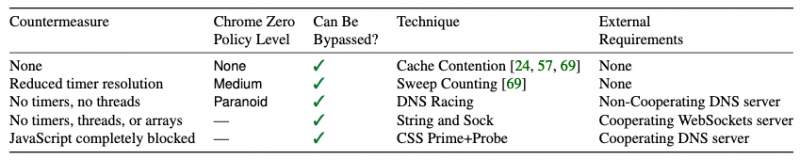
The researchers have developed a sequence of attacks where they have progressively decreased dependency on JavaScript features, which resulted in a method that relies entirely on HTML and CSS. They claim to have shown that all existing countermeasures can be bypassed.

The attack method has been successfully tested — with various levels of success depending on the targeted architecture and existing mitigations — against hardened browser environments (e.g. Tor, Chrome Zero, DeterFox) on devices with Intel, AMD, Samsung and Apple chips.

Side-channel attack test results

Impacted vendors have been notified. Apple told the researchers that the public disclosure of their findings does not raise any concerns.

“We show that advanced variants of the cache contention attack allow Prime+Probe attacks to be mounted through the browser in extremely constrained situations,” the researchers said in their paper. “Cache attacks cannot be prevented by reduced timer resolution, by the abolition of timers, threads, or arrays, or even by completely disabling scripting support. This implies that any secret-bearing process which shares cache resources with a browser connecting to untrusted websites is potentially at risk of exposure.”

Related: New Technique Improves Effectiveness of Timing Channel Attacks

Related: New Side-Channel Attack Targets Intel CPU Ring Interconnect

Related: New Side-Channel Attack Targets OS Page Cache

view counter

Eduard Kovacs (@EduardKovacs) is a contributing editor at SecurityWeek. He worked as a high school IT teacher for two years before starting a career in journalism as Softpedia’s security news reporter. Eduard holds a bachelor’s degree in industrial informatics and a master’s degree in computer techniques applied in electrical engineering.

Previous Columns by Eduard Kovacs:
Tags:

http://feedproxy.google.com/~r/Securityweek/~3/AFzcvAP08tI/researchers-show-first-side-channel-attack-against-apple-m1-chips


Cyber Insurance Provider Corvus Raises $100 Million

Cyber insurance provider Corvus on Wednesday announced that it has raised $100 million in a Series C funding round. To date, the company has raised a total of $147 million.

Founded in 2017 and headquartered in Boston, MA, Corvus relies on artificial intelligence for data analysis and for loss prediction and prevention.

The company has a broker-focused approach to cyber-insurance and claims to be able to fully meet the needs of brokers, policyholders, underwriters and reinsurers.

Following a $33 million Series B round closed in January 2020, Corvus says it has tripled the number of employees and reached a $120 million annual premium run rate at the end of January 2021.

Led by private equity firm Insight Partners, the new funding round brings Corvus’s valuation up to $750 million.

The new funding, the company says, will help it accelerate product development, underwriting, and go-to-market strategies, while allowing it to expand its Crowbar digital platform. Corvus also plans to focus on the delivery of advanced broker-focused solutions and on further expanding its team.

“During these times of unprecedented cyber-attacks, we are arming brokers and their policyholders with the most intuitive tools and capabilities to mitigate risks for companies of all sizes. With the biggest fundraising round of a cyber-insurance company to date, we will continue to realize our vision in making our world a safer place,” Phil Edmundson, founder and CEO of Corvus, commented.

Related: OwnBackup Achieves ‘Unicorn’ Status With $167.5 Million Funding Round

Related: Tanium Announces $150 Million Funding Investment From Ontario Teachers’

Related: DevSecOps Firm Spectral Emerges From Stealth With $6.2 Million in Funding

view counter

Ionut Arghire is an international correspondent for SecurityWeek.

Previous Columns by Ionut Arghire:
Tags:

http://feedproxy.google.com/~r/Securityweek/~3/XQoqDIM6uy0/cyber-insurance-provider-corvus-raises-100-million


Hackers Breach Cameras at Banks, Jails, Tesla and More

A US hacker collective on Tuesday claimed to have tapped into footage from 150,000 security cameras at banks, jails, schools, carmaker Tesla and other sites to expose “the surveillance state.”

Images captured from hacked surveillance video were posted on Twitter with an #OperationPanopticon hashtag.

“What if we just absolutely ended surveillance capitalism in two days?” a purported member of a group called APT-69420 Arson Cats asked amid a string of tweeted images.

“This is the tip of the tip of the tip of the iceberg.”

The hacker group claimed to have ferreted out credentials of an high level administrator account at Silicon Valley firm Verkada, which runs a platform operating security systems online.

“We have disabled all internal administrator accounts to prevent any unauthorized access,” a Verkada spokesperson said in response to an AFP inquiry.

“Our internal security team and external security firm are investigating the scale and scope of this issue, and we have notified law enforcement.”

Verkada added that it has notified companies that rely on its platform.

Surveillance camera imagery posted on Twitter included a jail cell block and a man wearing a fake beard dancing in a bank storage room.

The Verkada breach shows the risk of outsourcing security surveillance to companies in the internet cloud, according to Rick Holland, chief information security officer at Digital Shadows, a risk protection firm.

“Verkada positions itself as a ‘more secure, scalable’ alternative to on-premises network video recorders,” Holland said.

“You don’t always get more secure when you outsource your security to a third party.”

He said he expected the breach to trigger investigations by privacy regulators in the US and Europe.

Related: FBI: Home Surveillance Devices Hacked to Record Swatting Attacks

Related: Apple Awards Researcher $75,000 for Camera Hacking Vulnerabilities

Related: TP-Link Patches Multiple Vulnerabilities in NC Cloud Cameras

view counter

© AFP 2020

Previous Columns by AFP:
Tags:

http://feedproxy.google.com/~r/Securityweek/~3/1ByBStAvxlw/hackers-breach-cameras-banks-jails-tesla-and-more