New ‘Unc0ver’ Jailbreak Uses Vulnerability That Apple Said Was Exploited

Unc0ver jailbreak exploits CVE-2021-1782

The latest version of the Unc0ver jailbreak leverages a vulnerability that Apple said had been exploited before it released a patch in January.

Jailbreaks remove restrictions and give users greater control over their iPhone or iPad. The developers of the jailbreak named Unc0ver recently announced the availability of version 6.0.0, which they claim works on all versions of iOS between 11.0 and 14.3 on many iPhones and iPads, including the iPhone 12 Pro launched a few months ago.

Unc0ver developers say the jailbreak is “designed to be stable” and it preserves the security layers implemented by Apple.

Unc0ver does not work on devices running iOS 14.4. That version of the operating system, released by Apple in late January, patches CVE-2021-1782, a kernel vulnerability that can be exploited for privilege escalation.

CVE-2021-1782 is one of the three vulnerabilities that Apple said “may have been actively exploited” at the time when it released the patches. All three flaws had been reported to Apple by an anonymous researcher. The tech giant has not made public any information regarding the attacks exploiting these vulnerabilities.

The developers of the Unc0ver jailbreak said on Twitter that they wrote their “own exploit based on CVE-2021-1782 for unc0ver to achieve optimal exploit speed and stability.”

Related: ‘Unpatchable’ iOS Bootrom Exploit Allows Jailbreaking of Many iPhones

Related: Apple Patches Recent iPhone Jailbreak Zero-Day

Related: Jailbreak Tool Updated to Unlock iPhones Running iOS 13.5

Related: Apple Targets Jailbreaking in New Complaint Against Corellium

view counter

Eduard Kovacs (@EduardKovacs) is a contributing editor at SecurityWeek. He worked as a high school IT teacher for two years before starting a career in journalism as Softpedia’s security news reporter. Eduard holds a bachelor’s degree in industrial informatics and a master’s degree in computer techniques applied in electrical engineering.

Previous Columns by Eduard Kovacs:
Tags:

http://feedproxy.google.com/~r/Securityweek/~3/B60_7wfX6Rk/new-unc0ver-jailbreak-uses-vulnerability-apple-said-was-exploited


Universal Health Services Takes $67 Million Hit From Cyberattack

Healthcare services provider Universal Health Services (UHS) last week revealed that a cyberattack it fell victim to in September 2020 had an estimated financial impact of $67 million.

With more than 400 facilities in the United States, Puerto Rico, and the United Kingdom, UHS has roughly 90,000 employees and has reported close to $11.6 billion in net revenue for last year.

On September 29, the company announced that its operations in the United States were targeted in a cyberattack, which forced it to shut down its IT networks at multiple hospitals in the country.

Within one month after the incident, hospitals were able to resume normal operations, with technology applications restored at acute care and behavioral health hospitals, and re-established connections to all major systems, including electronic medical records, laboratory, and pharmacy systems.

The company insists that “no evidence of unauthorized access, copying or misuse of any patient or employee data has been identified,” but hasn’t provided specific information on the nature of the attack to date. Initial reports, however, suggested the Ryuk ransomware was involved.

In its 2020 fourth quarter and full year financial results report last week, the company revealed that the attack “had a pre-tax unfavorable impact of approximately $67 million during the twelve-month period ended December 31, 2020.”

“We estimate that approximately $12 million of the unfavorable pre-tax impact was experienced during the third quarter of 2020, and approximately $55 million was experienced during the fourth quarter of 2020,” the company said.

UHS also explains that the financial losses mainly consisted of diminished operating income due to lower patient activity and the associated billing delays. Labor expenses were also included, along with “professional fees and other operating expenses.”

The company also had to divert patients to competitor facilities and says it incurred expenses related to restoring information technology operations as fast as possible. It was also forced to delay certain administrative functions into December, which negatively affected operating cash flows.

“Although we can provide no assurance or estimation related to the receipt timing, or amount, of the proceeds that we may receive pursuant to commercial insurance coverage we have in connection with this incident, we believe we are entitled to recovery of the majority of the ultimate financial impact resulting from the cyberattack,” the healthcare services provider said.

Related: Trucking Giant Says Ransomware Attack Had $7.5M Impact

Related: Crane Maker Palfinger Says Cyberattack Had ‘Massive’ Impact on IT Infrastructure

Related: Financial Impact of Ransomware Attack on Sopra Steria Could Reach €50 Million

view counter

Ionut Arghire is an international correspondent for SecurityWeek.

Previous Columns by Ionut Arghire:
Tags:

http://feedproxy.google.com/~r/Securityweek/~3/joEo9S5nZnI/universal-health-services-takes-67-million-hit-cyberattack


Dairy Giant Lactalis Targeted by Hackers

France-based dairy giant Lactalis revealed last week that it was targeted by hackers, but claimed that it had found no evidence of a data breach.

The company said a malicious third party attempted to breach its computer network, but it immediately took action to contain the attack. This included restricting access to public resources.

Authorities have been notified and Lactalis’ IT team has been working with external cybersecurity experts to investigate the incident. However, the company said it did not appear that any data was compromised.

SecurityWeek has reached out to Lactalis for more information and will update this article if the company responds.

Based on the limited information made public by the company, this could be a ransomware attack conducted by a threat actor that — in addition to encrypting files on the compromised network — steals potentially sensitive files and threatens to leak them unless a ransom is paid.

Lactalis is one of the largest dairy product groups in the world, delivering more than 2,000 types of products — including famous brands such as Président and Galbani — to more than 100 countries. The company employs roughly 85,000 people and has operations in over 50 countries.

Related: Ryuk Ransomware With Worm-Like Capabilities Spotted in the Wild

Related: Asian Food Distribution Giant JFC International Hit by Ransomware

Related: Packaging Giant WestRock Says Ransomware Attack Hit Production

Related: Boat Building Giant Beneteau Says Cyberattack Disrupted Production

view counter

Eduard Kovacs (@EduardKovacs) is a contributing editor at SecurityWeek. He worked as a high school IT teacher for two years before starting a career in journalism as Softpedia’s security news reporter. Eduard holds a bachelor’s degree in industrial informatics and a master’s degree in computer techniques applied in electrical engineering.

Previous Columns by Eduard Kovacs:
Tags:

http://feedproxy.google.com/~r/Securityweek/~3/d-IEHyFI7OU/dairy-giant-lactalis-targeted-hackers


Ryuk Ransomware With Worm-Like Capabilities Spotted in the Wild

In early 2021, security researchers identified a variant of the infamous Ryuk ransomware that is capable of lateral movement within the infected networks.

Active since at least 2018 and believed to be operated by Russian cyber-criminals, the Ryuk ransomware has been involved in numerous high-profile attacks and researchers estimate the enterprise is worth $150 million.

Ryuk has long been associated with the TrickBot malware, supposedly being operated by the same gang. However, the ransomware’s operations have continued even after a TrickBot takedown attempt by Microsoft and other organizations.

Sometimes also distributed through Emotet, Ryuk has been heavily reliant on BazarLoader for distribution since September 2020, with phishing emails used as the attack vector.

In a recently published report, the French National Agency for the Security of Information Systems (ANSSI) said that it identified one Ryuk sample that could spread automatically within infected networks earlier this year.

The ransomware has long relied on the use of other malware for the initial deployment and did not show signs of worm-like capabilities before, although it was able to encrypt data on network shares and removable drives.

Ryuk uses a combination of symmetric (AES) and asymmetric (RSA) algorithms for encryption, kills specific processes on the infected system, appends the .RYK extension to the encrypted files, can turn on workstations using the Wake-on-LAN feature, and destroys all shadow copies to prevent data recovery.

The newly identified version of Ryuk has all of the functions typically found within the ransomware, with the ability to replicate itself over the local network added on top.

To propagate to other machines, the ransomware copies the executable on identified network shares with a rep.exe or lan.exe suffix, after which it creates a scheduled task on the remote machine.

“Through the use of scheduled tasks, the malware propagates itself – machine to machine – within the Windows domain. Once launched, it will thus spread itself on every reachable machine on which Windows RPC accesses are possible,” ANSSI explains.

The French agency also notes that the identified sample does not appear to include a mechanism for blocking its execution, meaning that the same device could be re-infected over and over again.

Related: Anatomy of Ryuk Attack: 29 Hours From Initial Email to Full Compromise

Related: U.S. Hospitals Warned of Imminent Ransomware Attacks From Russia

Related: Backup or Disaster Recovery for Protection Against Ransomware?

view counter

Ionut Arghire is an international correspondent for SecurityWeek.

Previous Columns by Ionut Arghire:
Tags:

http://feedproxy.google.com/~r/Securityweek/~3/Z4DnFVy8yYA/ryuk-ransomware-worm-capabilities-spotted-wild


AI Panel Urges US to Boost Tech Skills Amid China’s Rise

Artificial Intelligence

An artificial intelligence commission led by former Google CEO Eric Schmidt is urging the U.S. to boost its AI skills to counter China, including by pursuing “AI-enabled” weapons – something that Google itself has shied away from on ethical grounds.

Schmidt and current executives from Google, Microsoft, Oracle and Amazon are among the 15 members of the National Security Commission on Artificial Intelligence, which released its final report to Congress on Monday.

“To win in AI we need more money, more talent, stronger leadership,” Schmidt said Monday.

The report says that machines that can “perceive, decide, and act more quickly” than humans and with more accuracy are going to be deployed for military purposes — with or without the involvement of the U.S. and other democracies. It warns against unchecked use of autonomous weapons but expresses opposition to a global ban.

It also calls for “wise restraints” on the use of AI tools such as facial recognition that can be used for mass surveillance.

“We have to develop technology that preserves our Western values, but we have to be prepared for a world in which not everyone is doing that,” said Andrew Moore, a commissioner and the head of Google Cloud AI.

The group has the ear of top lawmakers from both parties, but has attracted criticism for including many members who work for tech companies with big government contracts, and who thus have a lot at stake in federal rules on emerging technology.

The report calls for a “White House-led strategy” to defend against AI-related threats, to set standards on how intelligent machines can be used responsibly and to boost U.S. research and development to maintain the nation’s technological advantage over China.

“We believe we are one or two years ahead of China, not five or 10,” Schmidt told the Senate Armed Services Committee last week. He clarified Monday that that he was expressing his personal opinions and not necessarily those of the commission.

It’s not yet clear whether President Joe Biden’s administration is on board with the commission’s approach. It’s still awaiting confirmation of a new director for the White House Office of Science and Technology Policy, which Biden has elevated to a Cabinet-level position.

“AI policy tends to be very bipartisan,” said Michael Kratsios, who was U.S. chief technology officer under President Donald Trump and led a push to pump more resources into AI development across federal agencies. The greatest imperative, he said, is that “the next great AI technologies are developed in the West.”

One big difference between the two administrations is likely to be the approach to building AI talent. The commission recommends a more open immigration policy than what Trump favored.

Congress formed the AI panel in 2018 and appointed 12 of its 15 commissioners, with the others picked by Trump’s Defense and Commerce secretaries. A judge later compelled the commission to make its meetings and records more accessible to the public after a civil liberties group, the Electronic Privacy Information Center, challenged its secrecy.

It’s been led by Schmidt, who was Google’s CEO and later the executive chairman of its parent company Alphabet. He previously helped lead the Defense Innovation Board, which advises the Pentagon on new technology.

That brought some conflict in 2018 when Google backed out of Project Maven, a U.S. military initiative using AI-based computer vision technology to analyze drone footage in conflict zones. The company, responding to internal activism from employees, also pledged not to use AI in any weapons-related applications.

“I did not agree with the Google decisions on Maven,” Schmidt told senators last week, calling it an “aberration” compared to the tech industry as a whole, where he says there are plenty of companies that want to work with the military. He said AI and machine vision systems are particularly good at “watching for things,” which is something the military spends a lot of time doing.

The commission also includes executives like Safra Catz, the CEO of software giant Oracle, and Amazon’s incoming CEO, Andy Jassy, who currently runs its cloud computing division, as well as top AI experts at Microsoft and Google. All four companies have competed against each other for federal cloud computing contracts. The representatives from Microsoft and Google joined other members in approving the final report Monday, but abstained from the section relating to government partnerships with the private sector.

Excluding human rights groups and rank-and-file tech experts from the commission has led the group to more easily frame this policy issue as a “democracy versus authoritarianism” competition against China while skirting more difficult topics, like the use of AI technologies on the U.S.-Mexico border, said Jack Poulson, a former Google researcher who now directs industry watchdog Tech Inquiry.

“The nominal reason to have these tech CEOs on these committees is they’re experts in the technology. But they’re also, subject to shareholder requirements, acting in the interests of their companies,” Poulson said. “They don’t want significant regulation or antitrust enforcement.”

The government-industry partnership may be important for the U.S. and its allies to help set standards for the responsible use of AI, said Megan Lamberth, a research associate at the Center for a New American Security.

“AI has the potential to really transform not only how militaries fight wars, but how economies operate and how societies and people interact with each other,” Lamberth said. “If there’s a gap in leadership, another country is going to fill that void.”

The American Civil Liberties Union said in a statement Monday that the commission made useful recommendations but it should have gone further by establishing civil rights protections now, before AI systems are widely deployed by intelligence agencies and the military.

The commission asked Congress to make new laws requiring federal agencies to conduct human rights assessments of new AI systems used on Americans. But it didn’t recommend the binding surveillance limits sought by activists.

Related: Pentagon Adopts New Ethical Principles for Using AI in War

Related: The Starter Pistol Has Been Fired for AI Regulation in Europe

Related: The Malicious Use of Artificial Intelligence in Cybersecurity

view counter

Previous Columns by Associated Press:
Tags:

http://feedproxy.google.com/~r/Securityweek/~3/A48ot_TLWJo/ai-panel-urges-us-boost-tech-skills-amid-chinas-rise


US Right-Wing Platform Gab Acknowledges it Was Hacked

The CEO of Gab, a social network favored by the US political right, said the platform had been attacked by “demon hackers” after an activist group released user data described as an important resource for research on the far right.

The activist group called DDoSecrets Collective released the data over the weekend to Wired magazine, claiming it offered “a record of the culture” related to the violent siege of the US Capitol on January 6.

The data included passwords and private messages on thousands of accounts.

Gab chief executive Andrew Torba claimed in a Twitter message Sunday that “demon hackers (I’m very serious) are attacking Gab right now,” also calling members of the group “mentally ill” and using a slur to refer to them as members of the trans community.

“The same people behind this attack targeted law enforcement officers and their families last summer,” Torba wrote, adding that the company was working with authorities to investigate.

The activist group denied Torba’s allegations and said it would release the data to researchers and journalists.

“Our view is that data is a resource and a record,” the collective said in a blog post.

A member of the collective told Wired that the data was a “gold mine of research for people looking at militias, neo-Nazis, the far right, QAnon, and everything surrounding January 6.”

The group’s website said the data was “an important sociological resource” and “a record of the culture and the exact statements surrounding not only an increase in extremist views and actions, but an attempted coup.”

Gab is one of several platforms which have attracted large numbers of conservatives by steering clear of the moderation efforts imposed by Facebook and Twitter, which banned former president Donald Trump and some of his supporters for inciting violence.

view counter

© AFP 2020

Previous Columns by AFP:
Tags:

http://feedproxy.google.com/~r/Securityweek/~3/KE0xmvUYTEY/us-right-wing-platform-gab-acknowledges-it-was-hacked


Suspected Chinese APT Group Targets Power Plants in India

Security researchers at Recorded Future have spotted a suspected Chinese APT actor targeting a wide range of critical infrastructure targets in India, including power plants, electricity distribution centers and Indian seaports.

Recorded Future, a threat-intelligence firm based in Somerville, Mass., said the wave of targeted attacks appear to coincide with the ongoing territorial conflict between India and China.

The company’s analysts applied the “RedEcho” moniker to this threat actor and warned that the group has strong infrastructure and victim overlaps with the notorious APT41/Barium actor.   

Despite these overlaps with known APT actors, Recorded Future said it will contrinue to track the group as a distinct actor because there isn’t enough evidence to firmly attribute the activity to a singular group.

[ Learn more about threats to industrial systems at SecurityWeek’s ICS Cyber Security Conference and SecurityWeek’s Security Summits virtual event series ]

From about the middle of 2020 onwards, Recorded Future said it captured telemetry showing a steep rise in the use of known APT command-and-control servers “to target a large swathe of India’s power sector.”

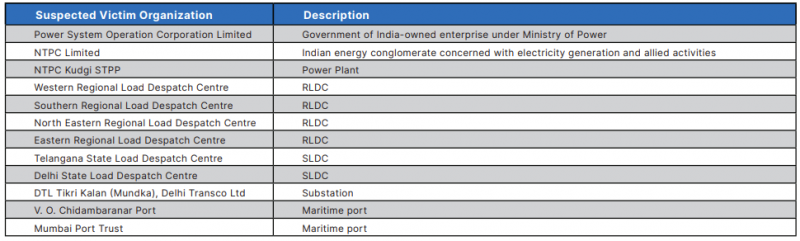
A detailed technical report from Recorded Future said 10 distinct Indian power sector organizations were targeted, including 4 of the 5 Regional Load Despatch Centres (RLDC) responsible for operation of the power grid. Other targets identified included two unidentified Indian seaports.

The company’s threat hunters identified 21 IP addresses among the list of targets in India, noting that they all qualify as critical infrastructure in India.

List of suspected victims of RedEcho campaign targeting Indian critical infrsastructure

The researchers also noticed the targeting of a high-voltage transmission substation and a coal-fired thermal power plant.

“The targeting of these critical power assets offer limited economic espionage opportunities, but pose significant concerns over potential pre-positioning of network access to support other Chinese strategic objectives,” the company added.

Recorded Future has released IOCs and mitigation guidance to help organizations look for signs of malicious activity on corporate networks.

Related: Remote Hacker Caught Poisoning Florida City Water Supply 

Related: U.S. Gov Warning on Water Supply Hack: Get Rid of Windows 7

view counter

Previous Columns by SecurityWeek News:
Tags:

http://feedproxy.google.com/~r/Securityweek/~3/uWSoU2G1Yls/suspected-chinese-apt-group-targets-power-plants-india


Asian Food Distribution Giant JFC International Hit by Ransomware

JFC International, a major distributor and wholesaler of Asian food products, last week revealed that it was recently targeted in a ransomware attack that disrupted some of its IT systems.

The attack apparently only impacted JFC International’s Europe Group, which said it had notified authorities, employees and business partners about the incident.

“A full forensic investigation by in-house specialists together with external cyber experts was immediately started and is underway. Normal conduct of business in Europe will be up and running after a brief interruption for security reasons. The affected servers were secured,” the company said in a statement posted on its European website.

SecurityWeek has reached out to JFC for more information on the type of ransomware involved in the attack and to find out whether any information was compromised. It is possible that the attackers also gained access to some information given that the company described it as a “data security incident.”

JFC International, a subsidiary of Japanese food manufacturer Kikkoman, has been around in various forms for more than a century. In addition to importing branded products from other companies, JFC offers its own products to retailers and restaurants.

Related: Decryptor Released for Ransomware That Allegedly Helped Cybercriminals Make Millions

Related: Ransomware Attacks Linked to Chinese Cyberspies

Related: Packaging Giant WestRock Says Ransomware Attack Hit Production

Related: Boat Building Giant Beneteau Says Cyberattack Disrupted Production

view counter

Eduard Kovacs (@EduardKovacs) is a contributing editor at SecurityWeek. He worked as a high school IT teacher for two years before starting a career in journalism as Softpedia’s security news reporter. Eduard holds a bachelor’s degree in industrial informatics and a master’s degree in computer techniques applied in electrical engineering.

Previous Columns by Eduard Kovacs:
Tags:

http://feedproxy.google.com/~r/Securityweek/~3/8xhhvuQANnk/asian-food-distribution-giant-jfc-international-hit-ransomware


Auth0 Names Jameeka Green Aaron as Chief Information Security Officer

Identity-as-a-Service (IDaaS) company Auth0 announced on Monday that Jameeka Green Aaron has joined the company as Chief Information Security Officer (CISO).

Auth0 offers what it calls a “highly customizable, developer-centric identity management platform” used by thousands of customers around the world. The company has raised more than $330 million in funding, including a $120 million Series F funding at a valuation of $1.92 billion in July 2020.

Auth0 Logo

Aaron brings more than 20 years of industry experience and will be responsible for the security and compliance of Auth0’s platform, products, and corporate environment.

Aaron has spent two decades managing and improving information security systems at each of her previous positions, including Nike, Hurley, Lockheed Martin, and the U.S. Navy. 

“Jameeka is an incredible addition to our executive team, not only for her deep experience and leadership, but for her leadership outside of the security industry as well,” said Eugenio Pace, CEO and co-founder of Auth0. “As a company with a mission of inclusivity and access to technology, we were taken by Jameeka’s stewardship to her causes and look forward to driving lasting positive change together. Her unmatched security expertise and dedication is an inspiration and invaluable asset to Auth0.”

Bellevue, Wash-based Auth0 was founded in 2013 by Eugenio Pace (CEO) and Matias Woloski (CTO). 

In March 2020, the company launched Auth0 Signals, a collection of threat intelligence tools and capabilities designed to protect customers from identity attacks.

view counter

Previous Columns by SecurityWeek News:
Tags:

http://feedproxy.google.com/~r/Securityweek/~3/cfTtL4CleI0/auth0-names-jameeka-green-aaron-chief-information-security-officer


Data Privacy Startup TripleBlind Raises $8.2 Million in Seed Funding

TripleBlind, a Kansas City, Missouri-based startup that provides data privacy solutions, on Monday announced raising $8.2 million in seed funding.

The oversubscribed funding round was led by Dolby Family Ventures, with participation from several companies and angel investors. Investors include Okta Ventures, NextGen Venture Partners, Operator Partners, Wavemaker Three-Sixty Health, AVG Basecamp Fund, Anorak Ventures, Quiet Capital, Clocktower Technology Ventures, Parity Responsible Technology Fund, Manresa Ventures, Accenture Ventures, Flyover Capital and KCRise Fund.

TripleBlind told SecurityWeek that it emerged from stealth mode in November 2020, when Accenture announced a strategic investment in the company.

Founded in 2019, TripleBlind has developed a de-identification and data privacy solution that enables organizations to share, use and monetize sensitive information — including personal, financial and health data — without the fear of violating privacy requirements and government regulations.

The company’s data privacy and API-driven virtual exchange solution encrypts data and allows users to perform approved operations, but without the need to actually decrypt the data.

“The return of all previous investors, the breadth of new investors and the oversubscription of the round demonstrate to us that data privacy experts support our new, breakthrough approach for enforcing data privacy while enabling organizations to leverage and gain insights from data,” said Riddhiman Das, co-founder and CEO of TripleBlind.

He added, “Thanks to our forward-looking investors, TripleBlind can accelerate our mission to free trapped data so enterprises can collaborate while concurrently enforcing data privacy and regulatory standards.”

Related: Data Privacy Management Firm WireWheel Raises $20 Million

Related: Data Protection Firm BigID Raises $70 Million at $1 Billion Valuation

Related: Data Privacy Firm Privitar Raises $80 Million in Series C Funding Round

Related: Privacy Management Firm OneTrust Raises $210 Million at $2.7 Billion Valuation

view counter

Eduard Kovacs (@EduardKovacs) is a contributing editor at SecurityWeek. He worked as a high school IT teacher for two years before starting a career in journalism as Softpedia’s security news reporter. Eduard holds a bachelor’s degree in industrial informatics and a master’s degree in computer techniques applied in electrical engineering.

Previous Columns by Eduard Kovacs:
Tags:

http://feedproxy.google.com/~r/Securityweek/~3/Obpa7MkGQrY/data-privacy-startup-tripleblind-raises-82-million-seed-funding