‘BotenaGo’ Malware Targets Routers, IoT Devices with Over 30 Exploits

A newly discovered Golang-based malware is using over 30 exploits in attacks, potentially putting millions of routers and Internet of Things (IoT) at risk of malware infection, according to a warning from AT&T Alien Labs.

Dubbed BotenaGo, the threat deploys a backdoor on the compromised device, and then waits for commands – either from a remote operator or a malicious module on the device – to initiate an attack.

As part of a typical BotenaGo attack, the malware first maps potential targets to attack functions, then queries the target with a GET request, after which it searches the returned data, and only then it attempts to exploit the vulnerable target.

On a compromised device, the malware creates two backdoor ports: 31412 and 19412, and starts listening on port 19412 to receive the victim’s IP. Next, it loops through mapped exploit functions to execute them with the supplied IP.

AT&T Alien Labs researchers have identified a total of 33 exploit functions that BotenaGo initiates.

One of malware’s functions was designed to exploit CVE-2020-8958, a vulnerability that potentially affects over 2 million Guangzhou devices. Another one targets CVE-2020-10173, a vulnerability in the Comtrend VR-3033 routers that potentially impacts roughly 250,000 devices.

The threat also targets vulnerabilities in devices from DrayTek (CVE-2020-8515), D-Link (CVE-2015-2051, CVE-2020-9377, CVE-2016-11021, and CVE-2013-5223), Netgear (CVE-2016-1555, CVE-2016-6277, CVE-2017-6077, and CVE-2017-6334), GPON (CVE-2018-10561 and CVE-2018-10562), Linksys (CVE-2013-3307), XiongMai (CVE-2018-10088), TOTOLINK (CVE-2019-19824), Tenda (CVE-2020-10987), ZyXEL (CVE-2020-9054 and CVE-2017-18368) and ZTE (CVE-2014-2321).

“As payload, BotenaGo will execute remote shell commands on devices in which the vulnerability has been successfully exploited. Depending on the infected system, the malware uses different links, each with a different payload,” the researchers explain.

The malware doesn’t have active command and control (C&C) communication capabilities, suggesting that another module is likely being deployed on compromised devices alongside BotenaGo, or that the threat currently in testing or may have been been accidentally leaked.

“The links used for the payload on a successful attack imply a connection with Mirai malware. It could be [that] the BotenaGo is a new tool used by Mirai operators on specific machines that are known to them, with the attacker(s) operating the infected end-point with targets,” the researchers added.

Related: Crypto-Hijacking Campaign Leverages New Golang RAT

Related: Zoom Patches High-Risk Flaws in Meeting Connector, Keybase Client

Related: Researcher Shows Windows Flaw More Serious After Microsoft Releases Incomplete Patch

view counter

Ionut Arghire is an international correspondent for SecurityWeek.

Previous Columns by Ionut Arghire:
Tags:

https://www.securityweek.com/botenago-malware-targets-routers-iot-devices-over-30-exploits


Zoom Patches High-Risk Flaws in Meeting Connector, Keybase Client

Video messaging technology giant Zoom has shipped patches for high-severity vulnerabilities that expose enterprise users to remote code execution and command injection attacks.

The company released multiple security bulletins to warn of the risks and called special attention to a pair of “high-risk” bugs affecting its on-prem meeting connector software and the popular Keybase Client.

“The network proxy page on the web portal for the [affected] products fails to validate input sent in requests to set the network proxy password. This could lead to remote command injection by a web portal administrator,” Zoom said in a note.

The CVE-2021-34417 carries a CVSS Base Score of 7.9, and affects multiple Zoom software components — Zoom On-Premise Meeting Connector Controller, Zoom On-Premise Meeting Connector MMR, Zoom On-Premise Recording Connector, Zoom On-Premise Virtual Room Connector. 

[ READ: Vulnerability Allowed Attackers to Join Zoom Meetings ]

A second high-severity bulletin was also released with patches for CVE-2021-34422, a path traversal bug affecting Keybase Client for Windows.

From Zoom’s advisory:

“The Keybase Client for Windows before version 5.7.0 contains a path traversal vulnerability when checking the name of a file uploaded to a team folder. A malicious user could upload a file to a shared folder with a specially crafted file name which could allow a user to execute an application which was not intended on their host machine.” 

“If a malicious user leveraged this issue with the public folder sharing feature of the Keybase client, this could lead to remote code execution.”

Zoom said the issue was fixed in the 5.7.0 Keybase Client for Windows release.  

Zoom’s security response team also shipped patches for a medium-risk bug (CVE-2021-34420) in the Zoom Client for Meetings installer.  “The Zoom Client for Meetings for Windows installer before version 5.5.4 does not properly verify the signature of files with .msi, .ps1, and .bat extensions. This could lead to a malicious actor installing malicious software on a customer’s computer,” the company warned.

The Zoom software does not have an automatic update mechanism.  Users are urged to manually check for software updates within the Zoom client.

Related: Remote Code Execution Flaw in Palo Alto GlobalProtect VPN

Related: Adobe Patches Critical RoboHelp Server Security Flaw

Related: Zero-Days Under Attack: Microsoft Plugs Exchange Server, Excel Holes

view counter

Ryan Naraine is Editor-at-Large at SecurityWeek and host of the popular Security Conversations podcast series. He is a journalist and cybersecurity strategist with more than 20 years experience covering IT security and technology trends.
Ryan has built security engagement programs at major global brands, including Intel Corp., Bishop Fox and Kaspersky GReAT. He is a co-founder of Threatpost and the global SAS conference series. Ryan’s career as a journalist includes bylines at major technology publications including Ziff Davis eWEEK, CBS Interactive’s ZDNet, PCMag and PC World.
Ryan is a director of the Security Tinkerers non-profit, and a regular speaker at security conferences around the world.
Follow Ryan on Twitter @ryanaraine.

Previous Columns by Ryan Naraine:
Tags:

https://www.securityweek.com/zoom-patches-high-risk-flaws-meeting-connector-keybase-client


Researcher Shows Windows Flaw More Serious After Microsoft Releases Incomplete Patch

A researcher has discovered that a Windows vulnerability for which Microsoft released an incomplete patch in August is more serious than initially believed.

Tracked as CVE-2021-34484, the bug is described by Microsoft as a Windows User Profile Service elevation of privilege, and requires local, authenticated access for exploitation. All versions of Windows, including Windows Server, are affected.

The security error resides in the User Profile Service, affecting code designed for creating a temporary user profile folder when the original profile folder is damaged.

Microsoft’s incomplete patch for the issue could be easily bypassed with only a small change in the attacker script, security researcher Abdelhamid Naceri, who discovered the vulnerability, found out.

The security error appears to have a greater impact than Microsoft’s initial assessment of it, as it could allow an attacker logged in as a regular user to execute code with System privileges.

The researcher discovered it was possible to use symbolic links to target the process of copying folders and files from the original profile folder to the temporary folder, which allows an attacker to create attacker-writable folders within a system location, and then use them to launch system processes to execute code.

Microsoft’s fix checked whether a symbolic link was used for the destination folder, and aborted the operation if so. However, the incomplete fix would only check for the symbolic link in the uppermost folder, but not in other folders along the destination path.

An attacker looking to exploit the vulnerability needs to win a race condition and possibly to obtain additional user credentials than the ones they are logged-on with, but they would have an unlimited number of attempts to successfully complete an attack.

A new CVE identifier, CVE-2021-33742, was issued for the flaw, and it is considered a zero-day, given that technical information, along with proof-of-concept (POC) code, have been public since October 22.

ACROS Security’s 0patch service has released an unofficial fix, which extends the security check to the entire destination path of the temporary folder, and aborts the creation of a temporary user profile if any symbolic links are present.

The 0patch fix is available for free until Microsoft releases an official patch for the vulnerability.

Related: Third-Party Patches Available for More PetitPotam Attack Vectors

Related: Microsoft Patch Tuesday: Windows Flaw Under Active Attack

Related: Vendor Ships Unofficial Patch for IE Zero-Day Vulnerability

view counter

Ionut Arghire is an international correspondent for SecurityWeek.

Previous Columns by Ionut Arghire:
Tags:

https://www.securityweek.com/researcher-shows-windows-flaw-more-serious-after-microsoft-releases-incomplete-patch


HPE Says Customer Data Compromised in Aruba Data Breach

Hewlett Packard Enterprise (HPE) has confirmed that a small amount of customer data was compromised in a data breach involving its subsidiary Aruba Networks.

The incident, HPE says, was discovered on November 2, and involved the use of an access key to gain unauthorized access to “a limited subset of information held in the Aruba Central cloud environment.”

Two data repositories were compromised in the incident, one containing network telemetry data on Wi-Fi client devices connected to most Aruba Central customer networks, and another storing location data about Wi-Fi devices, such as details on devices being in proximity of other devices.

Some of the compromised information, HPE explains, includes Media Access Control (MAC) and IP addresses, device operating system details, hostnames, and usernames where authentication is used. Additionally, records of date, time, and the Wi-Fi access point a device was connected to were also stored in the affected repositories.

“The environment did not include any sensitive or special categories of personal data (as defined by GDPR),” the company says.

HPE believes that “a very small amount” of data was exfiltrated, but also notes that it couldn’t specifically identify which customers were impacted by the incident, because the data repositories “are used for streaming of high-volume machine learning data” and no individual file access is logged within these repositories.

“Through traffic volume accounting, we have concluded that unauthorized access, if any, is limited to a small fraction of overall data, but we do not know which specific files or which specific customers might be part of that activity,” the company continues.

Although the data was stored in Apache Parquet format and not in plain text, the adversary was also in the possession of the schema file that allowed them to convert records to plain text.

HPE also explains that the attacker compromised the repositories using a key that provided access to data in multiple buckets, located in various regions, and that data in these buckets is purged every 30 days, meaning that the oldest records there were dated September 10.

The access key employed in this incident was first used on October 9 and automatically decommissioned and rotated on October 27, meaning that the adversary potentially had access to the compromised repositories for 18 days.

Only data collected from Wi-Fi networks was affected in the incident and no vulnerability was exploited in the attack, as the adversary did not access the repositories through the Aruba Central application.

HPE says it’s in the process of notifying potentially affected customers of the incident.

Related: After Security Flaw Found, Missouri Hires Data Breach Group

Related: Telecoms Giant Syniverse Discloses Years-Long Data Breach

Related: Recruiting Firm Apparently Pays Ransom After Being Targeted by Hackers

view counter

Ionut Arghire is an international correspondent for SecurityWeek.

Previous Columns by Ionut Arghire:
Tags:

https://www.securityweek.com/hpe-says-customer-data-compromised-aruba-data-breach


Google, Adobe Announce New Open Source Security Tools

Google and Adobe this week announced the availability of new open source security tools, for continuous fuzzing and detecting living-off-the-land attacks.

Google releases ClusterFuzzLite

Google announced the open source release of ClusterFuzzLite, which it described as a ClusterFuzz-based continuous fuzzing solution that runs as part of continuous integration (CI) workflows in an effort to help users find vulnerabilities before they are committed to the source code.

ClusterFuzzLite can be integrated into CI workflows with only a few lines of code.

“With the release of ClusterFuzzLite, any project can integrate this essential testing standard and benefit from fuzzing,” Google said. “ClusterFuzzLite offers many of the same features as ClusterFuzz, such as continuous fuzzing, sanitizer support, corpus management, and coverage report generation. Most importantly, it’s easy to set up and works with closed source projects, making ClusterFuzzLite a convenient option for any developer who wants to fuzz their software.”

ClusterFuzzLite goes hand in hand with Google’s OSS-Fuzz open source fuzzing service, which has helped identify 6,500 vulnerabilities and 21,000 functional bugs across more than 500 open source projects.

Adobe releases LotL Classifier

Living-off-the-land (LotL) is used to describe attacks where malicious actors leverage legitimate software in an effort to avoid being detected.

Adobe has released an open source tool, named LotL Classifier, that is designed to detect LotL attacks by leveraging a “feature extraction” component and a machine learning-based classifier algorithm.

The feature extraction component takes data from threat intelligence, malware analysis, real incidents and real data logs, and uses that data to generate a series of tags based on binaries, paths, keywords, networks, patterns, and similarity.

The tags are then fed to the classifier component, which decides if the analyzed data set is good or bad. This component also creates a set of tags that can be integrated with rule-based automation or anomaly detection tools, such as One Stop Anomaly Shop (OSAS), which Adobe recently released as open source.

Related: Adobe Open Sources Tool for Sanitizing Logs, Detecting Exposed Credentials

Related: Google Expands Open Source Vulnerabilities Database

view counter

Eduard Kovacs (@EduardKovacs) is a contributing editor at SecurityWeek. He worked as a high school IT teacher for two years before starting a career in journalism as Softpedia’s security news reporter. Eduard holds a bachelor’s degree in industrial informatics and a master’s degree in computer techniques applied in electrical engineering.

Previous Columns by Eduard Kovacs:
Tags:

https://www.securityweek.com/google-adobe-announce-new-open-source-security-tools


macOS Zero-Day Exploited to Deliver Malware to Users in Hong Kong

Google on Thursday shared details about a recent attack that exploited a zero-day vulnerability in macOS to deliver malware to users in Hong Kong.

According to Google, the attack, discovered in late August, was likely conducted by a well-resourced state-sponsored threat group which, based on the quality of their code, had access to their own software engineering team.

While Google has not named any country, users in Hong Kong have been typically targeted by threat actors sponsored by China.

The watering hole involved the websites of a media outlet and an important pro-democracy labor and political group in Hong Kong. The sites hosted two iframes that served iOS and macOS exploits.

In the case of the iOS exploit, Google researchers could not obtain the full exploit chain, but they did discover that it involved a framework based on the Ironsquirrel browser exploit delivery project and exploitation of an older remote code execution vulnerability tracked as CVE-2019-8506.

The macOS exploit, however, leveraged a remote code execution vulnerability in WebKit — tracked as CVE-2021-1789 and patched by Apple in January — and a privilege escalation flaw that was only patched by Apple on September 23, roughly one month after Google spotted the attack.

When it patched the zero-day, tracked as CVE-2021-30869, Apple warned that it had been exploited in attacks. The security hole is a type confusion in XNU, the OS kernel used by both iOS and macOS, and it can be exploited to execute arbitrary code with kernel privileges.

When Google analyzed the macOS exploits, a parameter set up by the attackers to record the number of exploitation attempts had a value of roughly 200.

The Mac malware delivered in the attack can capture keystrokes, take screenshots, fingerprint compromised devices, upload and download files, execute terminal commands, and record audio.

Security researcher Patrick Wardle has published a blog post detailing the malware, which he has named OSX.CDDS — the name CDDS comes from a string format related to the malware’s features.

The malware sample analyzed by Wardle had not been detected by any of the antivirus engines on the VirusTotal malware analysis service.

Related: Apple Ships Urgent Patch for FORCEDENTRY Zero-Days

Related: Apple Warns of New Zero-Day Attacks on iOS, macOS

view counter

Eduard Kovacs (@EduardKovacs) is a contributing editor at SecurityWeek. He worked as a high school IT teacher for two years before starting a career in journalism as Softpedia’s security news reporter. Eduard holds a bachelor’s degree in industrial informatics and a master’s degree in computer techniques applied in electrical engineering.

Previous Columns by Eduard Kovacs:
Tags:

https://www.securityweek.com/macos-zero-day-exploited-deliver-malware-users-hong-kong


Indonesia, UK Discuss Future Technology and Cybersecurity

British Foreign Secretary Liz Truss met with Indonesian officials on Thursday and discussed closer cooperation in future technologies, cybersecurity and economic relations as part of British efforts to deepen ties to Southeast Asia after leaving the European Union.

Truss said she and Foreign Minister Retno Marsudi discussed a roadmap for closer cooperation.

“We need to make sure that technology standards are shaped by the free world. And we want to work together with Indonesia in areas like cyber and also the next generation of technologies, whether that’s 5G, 6G or indeed areas like artificial intelligence and quantum,” Truss said at a news conference. 5G and 6G are technology standards for new cellular phone networks.

“We are also launching a new joint working group on counterterrorism and a cyber dialogue as well,” Truss said.

[ ReadU.S. Gov Announces Support for ‘Paris Call’ Cybersecurity Effort ]

The British foreign secretary also met with President Joko Widodo and discussed closer cooperation in vaccines and biotechnology, the presidential palace said.

Indonesia, the world’s fourth most populous country, is Truss’s last stop in a weeklong visit to Southeast Asia to deepen economic and security relations. She earlier visited Malaysia and Thailand.

“Deeper ties are a win-win, delivering jobs and opportunities for British people while ensuring an open, secure and prosperous Indo-Pacific,” she said before her trip. “Working with key Southeast Asia partners will help us promote freedom and democracy across the world.”

Marsudi said bilateral trade as well as investment from Britain have been growing despite the coronavirus pandemic.

During her visit to Jakarta, Truss also met with the secretary general of the Association of Southeast Asian Nations, Lim Jock Hoi, to build on the U.K.’s recent designation as one of the 10-nation bloc’s “dialogue partners” and to discuss working together on the political crisis in Myanmar since its army seized power in February.

In their talks, Marsudi and Truss said they agreed on the importance of implementing an ASEAN consensus on restoring democracy in Myanmar. Myanmar has refused to cooperate with an envoy appointed by ASEAN to help mediate.

RelatedTaiwan Government Faces 5 Million Cyberattacks Daily: Official

view counter

Previous Columns by Associated Press:
Tags:

https://www.securityweek.com/indonesia-uk-discuss-future-technology-and-cybersecurity


The Wild West of the Nascent Cyber Insurance Industry

A Look Inside The Wild West of Nascent Cyber Insurance Industry

Cyber Insurance is a work in progress, with many existing customers effectively guinea pigs

The basic problem for the cyber insurance industry is easy to state but hard to solve. Income (premiums) must exceed outgoings (claims) by around 30% (operating costs + profit). If claims increase, so must premiums for the insurance model to remain viable.

But the cost of cybercrime is rising dramatically and has been doing so consistently for many years. Continually increasing premiums to counter continuously increasing claims is ultimately unsustainable. Sooner or later, the cost of insurance will make it too expensive to be an effective form of risk management for business. The insurance industry must therefore find an alternative method of balancing its books if it is to succeed.

There is a potential solution. Decreasing costs (claims) improves the profit/loss ratio much faster than increasing sales (premiums). This is the area now being considered by the insurance industry. First, costs can be reduced by increasing exclusions in the insurance policy – but that decreases the value of insurance as a risk management tool, and there is a finite limit to its use. Second, if the customers’ security posture can be improved sufficiently to reduce claims, then the cost of insurance can also decrease (or at least be maintained at current levels).

The current cyber insurance problem

According to Moody’s research (October 19, 2021), “The proliferation of ransomware attacks has driven up losses for cyber insurance policies, and losses will likely increase in 2021 for insurers. Although insurers had been gradually raising cyber insurance pricing, rate increases began to accelerate in 2021 in response to ransomware trends, with double-digit rating increases across the board for coverage. Insurers have also reduced policy limits, increased deductibles and tightened terms and conditions, including sublimits or coinsurance, to lower exposure to ransomware.”

Ransomware is the current bête noire for both industry and insurers. But it is not the only threat. BEC can also cause large and unpredictable losses – and many researchers believe BEC will expand in 2022 as deepfake technology improves.

In most insurance markets, the insurers have hundreds of years of data on losses and their causes in marine, motor, home and life insurance. The data, as actuarial tables, provide accurate evidence on which to base premiums for individual cases. But there are no such actuarial tables for cyber; and it is unlikely that they can be compiled. 

“I don’t think the insurance industry can create cyber security actuarial tables,” commented Chris Reese, head of insurance at Cowbell. “The risk is unpredictable. The threat actors are smart and keep looking for new ways to exploit victims. Yes, we’re getting better, and we have more data – but the loss experience from three years ago is not relevant today. Will the insurance industry get actuarial tables like it has for the motor industry? I don’t see that happening.”

With no history to help, the insurance industry cannot be proactive in setting accurate premiums. It is forced to be reactive – and it is reacting to increased claims by setting higher premiums and insurance conditions. In short, it is becoming more expensive to get insurance, more difficult to renew insurance, and sometimes not possible.

But despite the increasing cost and shrinking coverage of cyber insurance, the market is expanding rapidly. In May 2021, the US Government Accountability Office issued data from global insurance broker Marsh indicating the take-up rate for clients purchasing cyber insurance rose to 47% in 2020 from 26% in 2016, based on all industries.

The primary reason is the continued growth and success of cybercrime. It has been estimated that cybercrime already costs the global economy trillions, and is expected to continue to grow in the years ahead. For the insurance industry to cover increasing claims for a larger market, it will need to do more than repeatedly increase premiums – and the only viable solution is to reduce claims by improving the cyber security of its clients. The question is not whether it will do this, but how it will do it.

Possible routes for the insurance industry

An insurance security standard

The payment card industry operates a security standard (PCIDSS) to which all companies must conform before they are allowed to accept payment by bank cards. One route to improving the insured’s security could be to develop a similar security standard and require conformance.

There is precedent in the motor insurance industry in the UK. Before a driver can insure a motor vehicle, the vehicle must first pass a Ministry of Transport (MoT) designed test, and acquire an MoT Certificate. The insurance is required by law, so the test is also required by law, and the insurance industry benefits.

There is no direct equivalent in the U.S. – but there is generally a requirement for motor insurance to cover third party liabilities.

There is currently no legal requirement for businesses to carry cyber insurance – but it is not inconceivable that it might happen in the future. The route could be through governments wishing to protect their voters (the consumers) through some form of third-party liability protection backed by insurance.

Insurance required by law would benefit from a worthiness certificate such as the UK’s MoT certificate for motor vehicles. That certificate would effectively allow customers to demand, and insurers provide, lower premiums through proven high security.

Sumedh Thakar, president & CEO at Qualys, thinks something like this could evolve naturally, but stresses that it is too soon to know how it might happen or what it might involve. “Most of the interest in this route seems to be coming from the customer,” he told SecurityWeek. “If I do this and implement that, should I not get a reduction in my premiums? There hasn’t been a lot of work done at the industry level, but I think I can see the basic principle working. You can get cheaper home insurance if you can demonstrate you are protecting the home.”

A potential weakness in a PCI-type standard is that it only requires conformance on the audit day – the company concerned could be out of conformance, and therefore at increased risk of breach, for every other day of the year. 

Cowbell’s Reese doesn’t see this as a serious issue. “PCI isn’t required for just one day of the year,” she told SecurityWeek. “The requirement for conformance is for all 365 days. If there is a network security breach and it is due, or potentially due, to a lack of security on behalf of the retailer, then the brand (for PCI, the payment card industry) can withhold the cash. That’s a pretty big stick.” Her argument is the threat to decline a claim if it is shown that a breach occurred due to lack of insurance standard conformance would be enough to ensure that companies maintain continuous compliance.

The question remains, could an insurance security standard reduce insured’s claims sufficient to allow the insurance industry to keep premiums at current or lower levels? “PCI has certainly raised the cyber security bar for a lot of companies,” comments Eric Skinner, head of market strategy and corporate development at Trend Micro. “But it hasn’t magically solved the problem. You can pass a PCI audit, and still get breached. The question for the payment card industry is, does it make a breach sufficiently less likely to be worth it?”

Only time will tell if the insurance industry is able to develop, maintain and require conformance to a solid security standard that actually works. 

Requiring specific controls

An alternative approach for the insurance industry would be to require different controls for individual clients. This would be more flexible than a single all-encompassing standard since it could vary between different industry verticals depending on the perception of risk. It could also be amended at renewal time or annually as specified in the insurance contract.

A possible concern here is that insurance could become intrusive on their customers’ security posture. “That’s a valid concern,” said Skinner, “because some of it is already happening – the process of cyber insurance influencing cybersecurity has already begun in a somewhat rudimentary fashion.”

He refers to the ubiquitous questionnaire, in this case asking the customer for a statement on its security posture. “Like annual compliance audits,” continued Skinner, “these questionnaires are a snapshot in time – and they ask questions that may or may not result in reduced risk because the insurance industry is still learning about security.” 

Nevertheless, these questionnaires are having an influence on cybersecurity postures “Examples could be, ‘do you have EDR deployed?’ We’re hearing from some insurance brokers that if customers say ‘no’ to this, they run a very high risk of being declined or not renewed.” The problem is that security is not enhanced by deploying controls, but by implementing them correctly, using them adequately, and ensuring they are up to date. None of this can be gauged by a questionnaire. “I’m not sure if such questions are currently delivering the benefits the insurance companies expect.” 

The logical extension to enquiring about security postures would be to start insisting on certain controls. This would be a large step too far. To be effective, it would require the insurance company to have the visibility of a CISO, the business understanding of the board, and the purse strings of the CFO within every insured company. This would be far too expensive for the insurer and far too intrusive for the customer. It is, quite simply, a non-runner.

Implementing continuous monitoring

A third approach would be for the insurance industry to base their premiums on recommendations from third-party security scanning companies – such as Qualys, BlueVoyant, ImmuniWeb, Outpost24, SecurityScorecard and many others. This could provide a form of continuous posture monitoring; something missing from both the audited security insurance standard and the questionnaire-based approaches. It also promises to be less intrusive and therefore more acceptable to the customer. The insurance company can simply say, our scans say you are weak in these areas: strengthen them and you will qualify for lower premiums.

The weakness is that most scans only see an external view of the customers’ infrastructure. This is still valid because it is the same view as seen by the hackers, and strengthening all visible weaknesses makes it difficult for hackers to find an entry point.

An evolutionary step up from external monitoring is internal continuous monitoring of the entire infrastructure. This is currently offered by Cowbell, a company that uses an AI engine to scan for posture weaknesses inside the network. The information it returns can be used to strengthen cyber security, but can also allow insurers to make a more intelligent assessment on the premiums necessary to insure individual customers.

In one sense, Cowbell operates as an insurance broker’s assistant. It provides brokers with the information necessary for them to negotiate the best possible premium from among the potential insurers.

The future for the cyber insurance industry

Cyber insurance is still a work in progress, which means that many current customers are effectively guinea pigs. The current model of continuously increasing premiums and exclusions to counterbalance rising claims is unsustainable.  But the insurers know this and are actively seeking a realistic solution.

They will eventually succeed. Every party to the process wants the same result: increased security with lower loss to cyber crime.

Vishaal Hariprasad, CEO at Resilience, believes the solution will come with a new relationship between the insured, cyber security, and the insurer. He came into insurance in 2016, having previously been threat intelligence architect at Palo Alto Networks. He was, and is, cyber operations officer at the U.S. Air Force Reserve, and is also (IMA) Director of Operations, 90th COS, 67th Cyberspace Wing.

“In 2016,” he told SecurityWeek, “you could buy a million-dollar cyber insurance policy and they would ask you, do you have your IT person, and did you guys buy a firewall? They never asked is the firewall turned on, because the insurance industry didn’t care back then.”

This is what must change. “Insurers need to know, is your firewall turned on? Is it consistently patched? Are you continuously bringing in the right data feeds? And are you monitoring them?” What is needed is a new cooperative relationship between the insurer and the insured.

For its part, the insurance industry needs to work in lockstep with the standards bodies, the control organizations, and especially with the information sharing groups. “Insurance should be able to leverage that level of information-sharing and standards-gathering and implement them into their policies. And implement them into the holistic risk transfer package, not just insurance, but the loss control and risk engineering services that help that to happen.”

In effect, the insurance company, through relationships with threat information sharing bodies, needs to become a cyber security advisor to its customers. Since both the insured and insurer seek the same end – better cyber security – this could be done in a mutually acceptable rather than officiously intrusive manner.

The key words in Hariprasad’s view of successful cyber insurance are engagement and continuous monitoring: cooperative engagement between the insured and an insurer that fully understands the threat landscape, and continuous monitoring of cyber controls that mitigate threats.

“A lot of folks still think in that old mindset of you set it up once and you forget about it, and just worry about the renewal in a year or two. And I think that’s the danger,” he said.

Cyber insurance and cyber security must learn to work in harmony and not be considered as alternatives to each other. Insurers must become trusted advisors to the board of the insured – and boards must learn to work with the insurer to improve their security hygiene, to improve their cyber security, and to earn the lowest possible premiums.

Related: Cyber Insurance Firm Coalition Raises $205 Million at $3.5 Billion Valuation

Related: Meeting Backup Requirements for Cyber Insurance Coverage

Related: Cyber Insurance Company Coalition Raises $175M at $1.75 Billion Valuation

Related: Cyber Insurance Firm At-Bay Raises $185 Million at $1.35 Billion Valuation

view counter

Kevin Townsend is a Senior Contributor at SecurityWeek. He has been writing about high tech issues since before the birth of Microsoft. For the last 15 years he has specialized in information security; and has had many thousands of articles published in dozens of different magazines – from The Times and the Financial Times to current and long-gone computer magazines.

Previous Columns by Kevin Townsend:
Tags:

https://www.securityweek.com/wild-west-nascent-cyber-insurance-industry


U.S. Gov Announces Support for ‘Paris Call’ Cybersecurity Effort

United States Vice President Kamala Harris on Wednesday formally announced support for the Paris Call for Trust and Security in Cyberspace, an international collaborative initiative aimed at advancing cybersecurity.

Issued in 2018, the Paris Call details nine principles to improve stability in cyberspace through global collaboration, and has been already signed by 79 countries.

The principles promoted by the Call include:

  • Protecting individuals and infrastructure
  • Protecting against activity that affects the availability of the Internet
  • Protecting the electoral process
  • Protecting intellectual property
  • Preventing the proliferation of malware and nefarious practices
  • Improving the security of digital processes, products and services
  • Strengthening an advanced cyber hygiene
  • Preventing non-state actors from hacking back
  • Promoting international norms in cyberspace

Through supporting the Call, the United States said it will commit to advancing cybersecurity and preserving an open and reliable Internet.

Vice President Harris said the U.S. will work with France and other countries, as well as with private companies and civil society globally to promote responsible behavior in cyberspace.

“This includes working with like minded countries to attribute and hold accountable States that engage in destructive, disruptive, and destabilizing cyber activity,” according to a White House statement.

The decision to support the Call falls in line with the U.S. government’s current effort to improve cybersecurity for both individuals and businesses and to accelerate international cooperation to combat cybercrime.

Related: US Bans China Telecom Over National Security Concerns

Related: Nations Vow to Combat Ransomware at US-Led Summit

Related: US to Curb Hacking Tool Exports to Russia, China

view counter

Ionut Arghire is an international correspondent for SecurityWeek.

Previous Columns by Ionut Arghire:
Tags:

https://www.securityweek.com/us-gov-announces-support-paris-call-cybersecurity-effort


Nearly 100 TCP/IP Stack Vulnerabilities Found During 18-Month Research Project

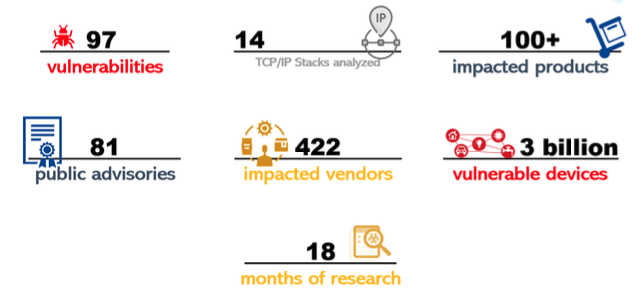
An 18-month research project has resulted in the discovery of nearly 100 vulnerabilities across more than a dozen TCP/IP stacks.

The research, named Project Memoria, was conducted by enterprise device security firm Forescout in collaboration with others. It resulted in the discovery of the vulnerabilities tracked as Ripple20, AMNESIA:33, NUMBER:JACK, NAME:WRECK, INFRA:HALT, and NUCLEUS:13.

TCP/IP stacks are leveraged by a wide range of devices for communication, including medical products, industrial control systems (ICS), printers, and switches.

Researchers have identified a total of 97 vulnerabilities across 14 TCP/IP stacks, including ones that can be exploited for remote code execution, DoS attacks, or to obtain sensitive information. The flaws impact hundreds of products, with researchers estimating that there are roughly 3 billion vulnerable devices.

TCP/IP stack vulnerabilities

Project Memoria targeted a total of 15 TCP/IP stacks, including CycloneTCP, FNET, FreeBSD, IPnet, lwIP, MPLAB Net, NetX, NicheStack, NDKTCPIP, Nucleus NET, Nut/Net, picoTCP, Treck, uC/TCP-IP, and uIP. In only one of them, lwIP, researchers haven’t found any vulnerabilities.

Some of these TCP/IP stacks have been around for nearly 30 years, but they are still actively developed. While their developers continue to release patches for vulnerabilities, those patches often don’t make it to end user devices, in large part due to what researchers describe as “silent patching.” Silent patching refers to some developers fixing vulnerabilities without assigning CVE identifiers, which results in device vendors and their customers not knowing about the flaws.

“[Silently patched vulnerabilities] exist in very critical supply-chain software, so there are millions of devices out there that have been vulnerable for a long time without even their vendors knowing about it because other vendors chose to remain silent,” Forescout said in a report summarizing Project Memoria. “Silently patching a vulnerability does not mean that nobody will get to know about it: these issues tend to be rediscovered again and again.”

While silent patching can be problematic, some vendors don’t respond or fail to take action when notified about vulnerabilities. Forescout has identified 422 device vendors whose products could be vulnerable. However, only 81 of them have issued advisories and of the 36 that have confirmed being impacted 10 said they will not provide patches.

“This means that only 19% of potentially affected vendors have provided some public response and only 5.5% have actually patched the vulnerabilities,” Forescout said.

An analysis of a quarter of a million devices affected by the Project Memoria vulnerabilities showed that the highest number of vulnerable systems are housed by the government and healthcare sectors, followed by manufacturing, retail, and financial.

The most common types of vulnerable devices are printers, VoIP products, industrial controllers, storage systems, and networking devices. In the case of healthcare organizations, infusion pumps and building automation systems are often impacted.

“The main conclusion of Project Memoria is that supply-chain vulnerabilities are here to stay but mitigation is possible, as long as both the security community and individual organizations take action,” Forescout concluded.

Related: Many Healthcare, OT Systems Exposed to Attacks by NUCLEUS:13 Vulnerabilities

Related: At Least 100M Devices Affected by “NAME:WRECK” DNS Flaws in TCP/IP Stacks

view counter

Eduard Kovacs (@EduardKovacs) is a contributing editor at SecurityWeek. He worked as a high school IT teacher for two years before starting a career in journalism as Softpedia’s security news reporter. Eduard holds a bachelor’s degree in industrial informatics and a master’s degree in computer techniques applied in electrical engineering.

Previous Columns by Eduard Kovacs:
Tags:

https://www.securityweek.com/nearly-100-tcpip-stack-vulnerabilities-found-during-18-month-research-project