TikTok Tells Advertisers US Campaigns Will Resume on Sunday After Temporary Pause


.article-native-ad { border-bottom: 1px solid #ddd; margin: 0 45px; padding-bottom: 20px; margin-bottom: 20px; } .article-native-ad svg { color: #ddd; font-size: 34px; margin-top: 10px; } .article-native-ad p { line-height:1.5; padding:0!important; padding-left: 10px!important; } .article-native-ad strong { font-weight:500; color:rgb(46,179,178); }

The stage is set! Advertisers, don’t miss this cultural moment. ADWEEK House The Big Game is headed to New Orleans on February 7. RSVP.

In an about-face, TikTok has told advertisers that ad campaigns targeting U.S. audiences will resume delivering ads on Sunday, following the shutdown of its platform for just a few hours, according to a memo reviewed by ADWEEK.

Live campaigns, however, will have “certain limitations.”

The memo notes that while TikTok has reinforced its infrastructure to minimize disruptions, it still anticipates “temporary service instability that may affect advertising in the U.S.”

The update follows TikTok’s abrupt return after being shut down in the U.S. for over 12 hours late last night. This morning, the company said it was working to restore service and thanked President-elect Donald Trump for “providing the necessary clarity and assurance to our service providers that they will face no penalties providing TikTok to over 170 million Americans and allowing over 7 million small businesses to thrive.”

TikTok’s revival came shortly after Trump announced plans to issue an executive order to stall the federal ban on the app.

Meanwhile, TikTok representatives previously told advertisers that all U.S. ad campaigns will be automatically paused starting January 19 in light of the ban.

Read TikTok’s message to advertisers here:

“We’re excited to let you know that as of today, TikTok will become available for the majority of U.S. users. Over the course of Sunday, ad campaigns that include U.S. audiences will resume operating and delivering ads to U.S.-based users, although LIVE campaigns will have certain limitations.

Although we’ve reinforced our infrastructure to minimize disruptions, we anticipate some temporary service instability that may affect advertising in the U.S.

We’re here to guide you.”

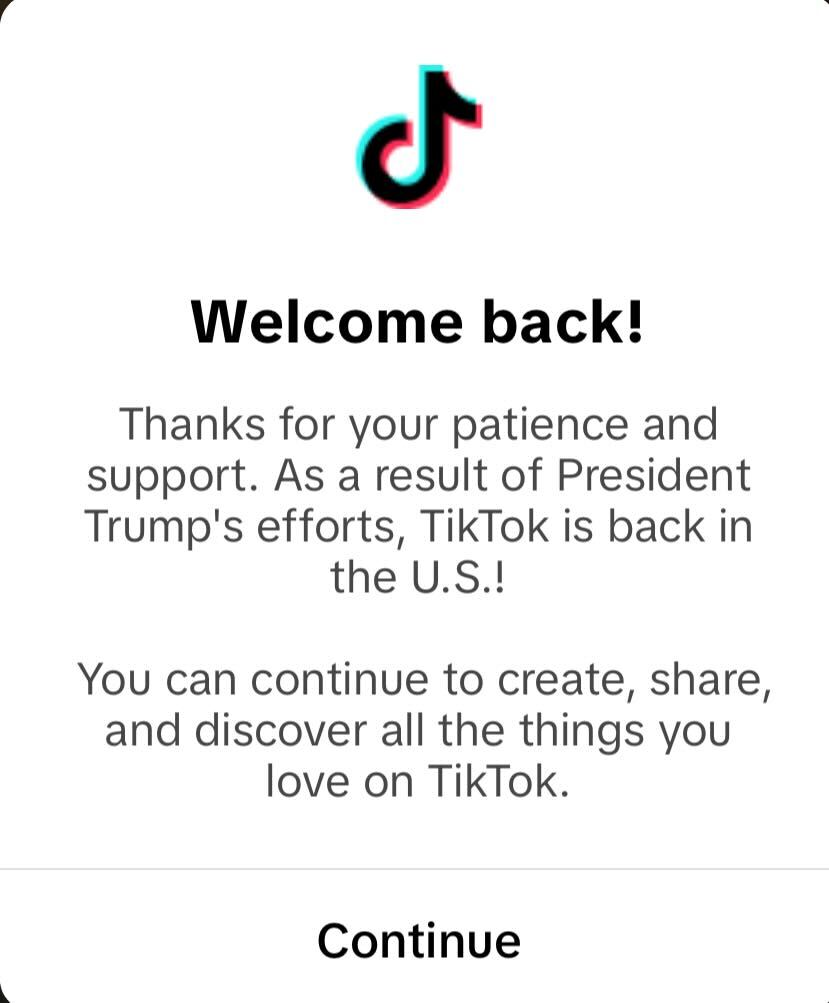
Users of the app are now seeing a welcome back message.

However, the app is still not available in Google Play and Apple App stores.

.font-primary { } .font-secondary { } #meter-count { position: fixed; z-index: 9999999; bottom: 0; width:96%; margin: 2%; -webkit-border-radius: 4px; -moz-border-radius: 4px; border-radius: 4px; -webkit-box-shadow: 0 0px 15px 4px rgba(0,0,0,.2); box-shadow:0 0px 15px 4px rgba(0,0,0,.2); padding: 15px 0; color:#fff; background-color:#343a40; } #meter-count .icon { width: auto; opacity:.8; } #meter-count .icon svg { height: 36px; width: auto; } #meter-count .btn-subscribe { font-size:14px; font-weight:bold; padding:7px 18px; color: #fff; background-color: #2eb3b2; border:none; text-transform: capitalize; margin-right:10px; } #meter-count .btn-subscribe:hover { color: #fff; opacity:.8; } #meter-count .btn-signin { font-size:14px; font-weight:bold; padding:7px 14px; color: #fff; background-color: #121212; border:none; text-transform: capitalize; } #meter-count .btn-signin:hover { color: #fff; opacity:.8; } #meter-count h3 { color:#fff!important; letter-spacing:0px!important; margin:0; padding:0; font-size:16px; line-height:1.5; font-weight:700; margin: 0!important; padding: 0!important; } #meter-count h3 span { color:#E50000!important; font-weight:900; } #meter-count p { font-size:14px; font-weight:500; line-height:1.4; color:#eee!important; margin: 0!important; padding: 0!important; } #meter-count .close { color:#fff; display:block; position:absolute; top: 4px; right:4px; z-index: 999999; } #meter-count .close svg { display:block; color:#fff; height:16px; width:auto; cursor:pointer; } #meter-count .close:hover svg { color:#E50000; } #meter-count .fw-600 { font-weight:600; } @media (max-width: 1079px) { #meter-count .icon { margin:0; padding:0; display:none; } } @media (max-width: 768px) { #meter-count { margin: 0; -webkit-border-radius: 0px; -moz-border-radius: 0px; border-radius: 0px; width:100%; -webkit-box-shadow: 0 -8px 10px -4px rgba(0,0,0,0.3); box-shadow: 0 -8px 10px -4px rgba(0,0,0,0.3); } #meter-count .icon { margin:0; padding:0; display:none; } #meter-count h3 { color:#fff!important; font-size:14px; } #meter-count p { color:#fff!important; font-size: 12px; font-weight: 500; } #meter-count .btn-subscribe, #meter-count .btn-signin { font-size:12px; padding:7px 12px; } #meter-count .btn-signin { display:none; } #meter-count .close svg { height:14px; } }

Enjoying Adweek’s Content? Register for More Access!

https://www.adweek.com/media/tiktok-resumes/


UPDATE: TikTok Said It’s Restoring Service After Trump Reassurance


.article-native-ad { border-bottom: 1px solid #ddd; margin: 0 45px; padding-bottom: 20px; margin-bottom: 20px; } .article-native-ad svg { color: #ddd; font-size: 34px; margin-top: 10px; } .article-native-ad p { line-height:1.5; padding:0!important; padding-left: 10px!important; } .article-native-ad strong { font-weight:500; color:rgb(46,179,178); }

The stage is set! Advertisers, don’t miss this cultural moment. ADWEEK House The Big Game is headed to New Orleans on February 7. RSVP.

UPDATE (Jan 19, 1:20pm ET): After President Elect Donald Trump said he would issue an executive order to delay the TikTok ban, TikTok posted a statement on X saying it is working to restore service, adding: “We thank President Trump for providing the necessary clarity and assurance to our service providers that they will face no penalties providing TikTok to over 170 million Americans and allowing over 7 million small businesses to thrive.”

ADWEEK’s original story can be read below.

The vertical videos that once flowed natively from a sleek smartphone app have been replaced by a link to a website, and the trending tunes that soundtracked them have been silenced.

TikTok has officially gone dark in the U.S., at least for now.

A message on the app for U.S. users says that TikTok isn’t available for now but ends with an optimistic note that puts the ball in President Elect Trump’s court: “We are fortunate that President Trump has indicated that he will work with us on a solution to reinstate TikTok once he takes office. Please stay tuned!”

ByteDance’s first Hail Mary to prevent a ban of its social media app TikTok fell incomplete on the steps of the Supreme Court with Friday’s unanimous ruling upholding the Protecting Americans from Foreign Adversary Controlled Applications Act, which mandated that TikTok sell to a U.S. company by Jan. 19 or face a ban in the country.

Three agency executives told ADWEEK earlier this week that the platform will automatically pause ad campaigns in the U.S. starting Sunday.

Shuree Jones, group director of paid social and influencer media at Rain the Growth Agency, told ADWEEK that historical data, campaign performance reports, and creative assets will remain accessible, and advertisers will be able to manually restart campaigns without losing data if the ban is postponed.

TikTok assured advertisers that all reserved inventory will be refunded.

The fight is far from over for TikTok, which has found an unlikely ally in President-elect Donald Trump.

Despite calling for a TikTok ban in 2020, during his first term in office, Trump is reportedly mulling an executive order that would pause the ban for 60 to 90 days to allow time for negotiating a sale of the app, or some other alternative.

Sen. Ed Markey (D-Mass.) revealed plans to introduce the Extend the TikTok Deadline Act, which would give ByteDance an additional 270 days to find a buyer.

“Although a sale is unlikely, TikTok under U.S. ownership would mark a new era for the massively popular app,” Emarketer senior analyst Minda Smiley said. “For starters, it’s unclear if TikTok’s bread and butter—its algorithm—would be part of a sale. Algorithm concerns aside, TikTok would likely operate differently under new owners. Users, creators, and brands could move on from the app if they feel as though it’s not what it used to be.”

.font-primary { } .font-secondary { } #meter-count { position: fixed; z-index: 9999999; bottom: 0; width:96%; margin: 2%; -webkit-border-radius: 4px; -moz-border-radius: 4px; border-radius: 4px; -webkit-box-shadow: 0 0px 15px 4px rgba(0,0,0,.2); box-shadow:0 0px 15px 4px rgba(0,0,0,.2); padding: 15px 0; color:#fff; background-color:#343a40; } #meter-count .icon { width: auto; opacity:.8; } #meter-count .icon svg { height: 36px; width: auto; } #meter-count .btn-subscribe { font-size:14px; font-weight:bold; padding:7px 18px; color: #fff; background-color: #2eb3b2; border:none; text-transform: capitalize; margin-right:10px; } #meter-count .btn-subscribe:hover { color: #fff; opacity:.8; } #meter-count .btn-signin { font-size:14px; font-weight:bold; padding:7px 14px; color: #fff; background-color: #121212; border:none; text-transform: capitalize; } #meter-count .btn-signin:hover { color: #fff; opacity:.8; } #meter-count h3 { color:#fff!important; letter-spacing:0px!important; margin:0; padding:0; font-size:16px; line-height:1.5; font-weight:700; margin: 0!important; padding: 0!important; } #meter-count h3 span { color:#E50000!important; font-weight:900; } #meter-count p { font-size:14px; font-weight:500; line-height:1.4; color:#eee!important; margin: 0!important; padding: 0!important; } #meter-count .close { color:#fff; display:block; position:absolute; top: 4px; right:4px; z-index: 999999; } #meter-count .close svg { display:block; color:#fff; height:16px; width:auto; cursor:pointer; } #meter-count .close:hover svg { color:#E50000; } #meter-count .fw-600 { font-weight:600; } @media (max-width: 1079px) { #meter-count .icon { margin:0; padding:0; display:none; } } @media (max-width: 768px) { #meter-count { margin: 0; -webkit-border-radius: 0px; -moz-border-radius: 0px; border-radius: 0px; width:100%; -webkit-box-shadow: 0 -8px 10px -4px rgba(0,0,0,0.3); box-shadow: 0 -8px 10px -4px rgba(0,0,0,0.3); } #meter-count .icon { margin:0; padding:0; display:none; } #meter-count h3 { color:#fff!important; font-size:14px; } #meter-count p { color:#fff!important; font-size: 12px; font-weight: 500; } #meter-count .btn-subscribe, #meter-count .btn-signin { font-size:12px; padding:7px 12px; } #meter-count .btn-signin { display:none; } #meter-count .close svg { height:14px; } }

Enjoying Adweek’s Content? Register for More Access!

https://www.adweek.com/media/tiktok-goes-dark-us/


With the TikTok Ban All but Confirmed, Here’s Where Marketers Can Still Focus Their Efforts


As the U.S. Supreme Court upholds the TikTok ban, brands and publishers are grappling with how to maintain their connection to young consumers.

The reality of losing TikTok has sparked reactions ranging from strategic reevaluation to outright panic. However, history shows us that platforms evolve, algorithms shift, and audiences adapt. Here’s what marketers need to know and do to navigate this upheaval.

A shift, not an end

TikTok may disappear or transform, but the cultural impact it has made—and the trends it established—will endure.

TikTok popularized short-form vertical video as the dominant mode of content consumption for young audiences. Whether it’s on Instagram Reels, YouTube Shorts, or other emerging platforms, vertical video will remain a cornerstone of digital communication.

Marketers should continue investing in short, snappy content that grabs attention immediately. Videos should feature:

  • Strong hooks within the first few seconds to capture interest.
  • Authentic storytelling that resonates with younger viewers.
  • Original sound and music to enhance shareability and relatability.

The power of the algorithm

TikTok’s algorithm is one of its defining features, offering unparalleled precision in serving personalized content based on watch time and user behavior.

Expect competitors like Instagram and YouTube to ramp up efforts to replicate its success. Platforms are likely to lean more on watch time as a key metric, shifting focus toward entertainment and engagement. For marketers, this means:

  • Focus on engagement metrics: Prioritize content that holds viewers’ attention rather than solely aiming for reach or impressions.
  • Adapt to platform updates: Stay informed about how competitors are fine-tuning their algorithms and optimize your content accordingly.
  • Experiment across platforms: Diversify your content strategy to include multiple platforms, mitigating the risk of overreliance on any one channel.

Entertainment as the new frontier

TikTok has essentially become television for Gen Z and millennials. Unlike platforms such as Instagram or X, which are more about staying updated on friends and trends, TikTok thrives as an entertainment hub. Other platforms will likely pivot toward a more entertainment-focused model to capture TikTok’s displaced audience. Marketers should:

  • Create binge-worthy content: Think episodic, story-driven videos that encourage viewers to stay engaged.
  • Align with entertainment trends: Collaborate with creators who excel at producing engaging, culturally relevant content.
  • Focus on originality: Avoid overly polished or inauthentic videos; instead, aim for relatable and creative storytelling.

No need to panic

Even with TikTok getting banned, it’s likely that its essence will persist in some form. A potential sale, restructuring, or revival under new ownership could bring the platform back to life.

In the meantime, brands can focus on strategies that align with the broader cultural shift TikTok initiated:

  1. Diversify your platforms: Don’t put all your eggs in one basket. Build a presence across Reels, Shorts, and emerging platforms to maintain your reach.
  2. Prioritize authenticity: Ensure content feels relatable and sincere to resonate with audiences.
  3. Stay agile: Keep a close watch on platform updates and algorithm changes, and be ready to adapt your strategy quickly.
  4. Double down on short-form content: Even if TikTok disappears, the demand for bite-sized, engaging videos isn’t going anywhere.
  5. Invest in AI and analytics: Leverage tools that help predict trends and optimize content for engagement.

The TikTok ban being upheld is just another chapter in the ever-evolving digital landscape. By staying flexible and focusing on the fundamentals of engaging content, marketers can continue to connect with their audiences—no matter the platform.

https://www.adweek.com/social-marketing/tiktok-ban-vertical-video/


TikTok CEO Shou Zi Chew Responds to Supreme Court Ruling

.article-native-ad { border-bottom: 1px solid #ddd; margin: 0 45px; padding-bottom: 20px; margin-bottom: 20px; } .article-native-ad svg { color: #ddd; font-size: 34px; margin-top: 10px; } .article-native-ad p { line-height:1.5; padding:0!important; padding-left: 10px!important; } .article-native-ad strong { font-weight:500; color:rgb(46,179,178); }

The stage is set! Advertisers, don’t miss this cultural moment. ADWEEK House The Big Game is headed to New Orleans on February 7. RSVP.

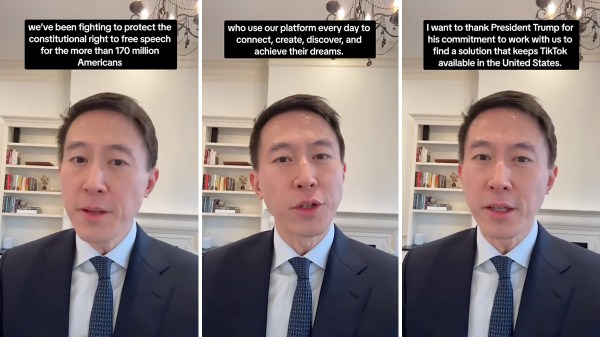
Hours after the Supreme Court unanimously upheld a law banning TikTok in the U.S. as of Sunday, the platform’s CEO, Shou Zi Chew, posted his response in video form, going out of his way to praise President-elect Donald Trump.

“On behalf of everyone at TikTok and all our users across the country, I want to thank President Trump for his commitment to work with us to find a solution that keeps TikTok available in the U.S.,” Chew said in his video.

“We are grateful and pleased to have the support of a president who truly understands our platform—one that has used TikTok to express his own thoughts and perspectives, connecting with the world and generating more than 60 billion views of his content in the process,” he added.

@tiktok

Our response to the Supreme Court decision.

♬ original sound – TikTok

Chew mentioned the application’s 170 million-plus daily users in the U.S., as well as the over 7 million American businesses on the platform, concluding his video with, “Rest assured; we will do everything in our power to ensure that our platform thrives as your online home for limitless creativity and discovery, as well as a source of inspiration and joy for years to come.”

The TikTok CEO met with Trump at his Mar-a-Lago Club in Palm Beach, Fla., last month, according to The Washington Post, and The New York Times reported that he will be seated on the dais at Trump’s inaguration Monday alongside tech luminaries such as Amazon executive chairman Jeff Bezos, Tesla and X CEO Elon Musk, and Meta CEO Mark Zuckerberg.

.font-primary { } .font-secondary { } #meter-count { position: fixed; z-index: 9999999; bottom: 0; width:96%; margin: 2%; -webkit-border-radius: 4px; -moz-border-radius: 4px; border-radius: 4px; -webkit-box-shadow: 0 0px 15px 4px rgba(0,0,0,.2); box-shadow:0 0px 15px 4px rgba(0,0,0,.2); padding: 15px 0; color:#fff; background-color:#343a40; } #meter-count .icon { width: auto; opacity:.8; } #meter-count .icon svg { height: 36px; width: auto; } #meter-count .btn-subscribe { font-size:14px; font-weight:bold; padding:7px 18px; color: #fff; background-color: #2eb3b2; border:none; text-transform: capitalize; margin-right:10px; } #meter-count .btn-subscribe:hover { color: #fff; opacity:.8; } #meter-count .btn-signin { font-size:14px; font-weight:bold; padding:7px 14px; color: #fff; background-color: #121212; border:none; text-transform: capitalize; } #meter-count .btn-signin:hover { color: #fff; opacity:.8; } #meter-count h3 { color:#fff!important; letter-spacing:0px!important; margin:0; padding:0; font-size:16px; line-height:1.5; font-weight:700; margin: 0!important; padding: 0!important; } #meter-count h3 span { color:#E50000!important; font-weight:900; } #meter-count p { font-size:14px; font-weight:500; line-height:1.4; color:#eee!important; margin: 0!important; padding: 0!important; } #meter-count .close { color:#fff; display:block; position:absolute; top: 4px; right:4px; z-index: 999999; } #meter-count .close svg { display:block; color:#fff; height:16px; width:auto; cursor:pointer; } #meter-count .close:hover svg { color:#E50000; } #meter-count .fw-600 { font-weight:600; } @media (max-width: 1079px) { #meter-count .icon { margin:0; padding:0; display:none; } } @media (max-width: 768px) { #meter-count { margin: 0; -webkit-border-radius: 0px; -moz-border-radius: 0px; border-radius: 0px; width:100%; -webkit-box-shadow: 0 -8px 10px -4px rgba(0,0,0,0.3); box-shadow: 0 -8px 10px -4px rgba(0,0,0,0.3); } #meter-count .icon { margin:0; padding:0; display:none; } #meter-count h3 { color:#fff!important; font-size:14px; } #meter-count p { color:#fff!important; font-size: 12px; font-weight: 500; } #meter-count .btn-subscribe, #meter-count .btn-signin { font-size:12px; padding:7px 12px; } #meter-count .btn-signin { display:none; } #meter-count .close svg { height:14px; } }

Enjoying Adweek’s Content? Register for More Access!

https://www.adweek.com/media/tiktok-ceo-shou-zi-chew-responds-to-supreme-court-ruling/


TikTok Will Pause Ads on Jan. 19, But Data Will Remain Accessible


.article-native-ad { border-bottom: 1px solid #ddd; margin: 0 45px; padding-bottom: 20px; margin-bottom: 20px; } .article-native-ad svg { color: #ddd; font-size: 34px; margin-top: 10px; } .article-native-ad p { line-height:1.5; padding:0!important; padding-left: 10px!important; } .article-native-ad strong { font-weight:500; color:rgb(46,179,178); }

The stage is set! Advertisers, don’t miss this cultural moment. ADWEEK House The Big Game is headed to New Orleans on February 7. RSVP.

TikTok has told advertisers that it will automatically pause ad campaigns in the U.S. starting January 19, three agency executives told ADWEEK. TikTok will likely be banned in the U.S. on that date, unless it gets a last-minute reprieve.

However, historical data, campaign performance reports, and creative assets will remain accessible, according to Shuree Jones, group director of paid social and influencer media at Rain the Growth Agency. Jones added that advertisers will be able to manually restart campaigns without losing data if the ban is postponed.

Two other agency executives, who spoke on the condition of anonymity, confirmed that advertisers will still have access to TikTok Ads Manager and can export historical data. U.S.-based media buyers will still be able to buy inventory internationally.

TikTok has assured advertisers that all reserved inventory will be refunded, the executive said.

The Supreme Court might reveal its ruling Friday morning, according to a notice on its webpage that “it may announce opinions on the homepage beginning at 10 a.m.”

TikTok did not respond to a request for comment.

The ban could be lifted if ByteDance sells TikTok’s U.S. operations. Personalities as diverse as creator MrBeast and Elon Musk have been rumored to be in talks to buy TikTok. TikTok has dismissed speculation around Musk as “pure fiction.”

President-elect Donald Trump is reportedly considering an executive order to keep TikTok from being banned, though it’s unclear if that would be enough to save the app.

If TikTok is banned, it would avail billions of ad dollars to be scooped up by rivals.

According to EMARKETER, TikTok generated $12.34 billion in U.S. ad revenue in 2024. If the app is banned, EMARKETER expects Instagram and Facebook to absorb 22.8% and 17.1% of TikTok’s ad spend, respectively, while YouTube would capture around 10%.

Some advertisers have already begun shifting budgets to YouTube and Instagram in anticipation of a ban. Meanwhile, DTC brands that have relied heavily on TikTok Shop for discovery and sales now face an uncertain future, with some scrambling for alternative channels.

.font-primary { } .font-secondary { } #meter-count { position: fixed; z-index: 9999999; bottom: 0; width:96%; margin: 2%; -webkit-border-radius: 4px; -moz-border-radius: 4px; border-radius: 4px; -webkit-box-shadow: 0 0px 15px 4px rgba(0,0,0,.2); box-shadow:0 0px 15px 4px rgba(0,0,0,.2); padding: 15px 0; color:#fff; background-color:#343a40; } #meter-count .icon { width: auto; opacity:.8; } #meter-count .icon svg { height: 36px; width: auto; } #meter-count .btn-subscribe { font-size:14px; font-weight:bold; padding:7px 18px; color: #fff; background-color: #2eb3b2; border:none; text-transform: capitalize; margin-right:10px; } #meter-count .btn-subscribe:hover { color: #fff; opacity:.8; } #meter-count .btn-signin { font-size:14px; font-weight:bold; padding:7px 14px; color: #fff; background-color: #121212; border:none; text-transform: capitalize; } #meter-count .btn-signin:hover { color: #fff; opacity:.8; } #meter-count h3 { color:#fff!important; letter-spacing:0px!important; margin:0; padding:0; font-size:16px; line-height:1.5; font-weight:700; margin: 0!important; padding: 0!important; } #meter-count h3 span { color:#E50000!important; font-weight:900; } #meter-count p { font-size:14px; font-weight:500; line-height:1.4; color:#eee!important; margin: 0!important; padding: 0!important; } #meter-count .close { color:#fff; display:block; position:absolute; top: 4px; right:4px; z-index: 999999; } #meter-count .close svg { display:block; color:#fff; height:16px; width:auto; cursor:pointer; } #meter-count .close:hover svg { color:#E50000; } #meter-count .fw-600 { font-weight:600; } @media (max-width: 1079px) { #meter-count .icon { margin:0; padding:0; display:none; } } @media (max-width: 768px) { #meter-count { margin: 0; -webkit-border-radius: 0px; -moz-border-radius: 0px; border-radius: 0px; width:100%; -webkit-box-shadow: 0 -8px 10px -4px rgba(0,0,0,0.3); box-shadow: 0 -8px 10px -4px rgba(0,0,0,0.3); } #meter-count .icon { margin:0; padding:0; display:none; } #meter-count h3 { color:#fff!important; font-size:14px; } #meter-count p { color:#fff!important; font-size: 12px; font-weight: 500; } #meter-count .btn-subscribe, #meter-count .btn-signin { font-size:12px; padding:7px 12px; } #meter-count .btn-signin { display:none; } #meter-count .close svg { height:14px; } }

Enjoying Adweek’s Content? Register for More Access!

https://www.adweek.com/media/tiktok-will-pause-ads-on-jan-19-but-data-will-remain-accessible/


6 Top TikTok Alternatives for Creators


As discussions about a U.S. TikTok ban continue, with President-elect Trump reportedly considering an executive order to extend the case, creators are migrating to other platforms like Triller and RedNote.

Triller is trying to poach TikTokers with new tools. Chinese-owned RedNote has popped up seemingly overnight. And Snap launched an ad campaign highlighting why creators love its platform.

ADWEEK has compiled a list of six platforms that creators are choosing as they decide where to focus their efforts. We looked at key features that creators use like livestreaming and the app’s functionality like discoverability.

Instagram’s Reels

When it comes to reach and discoverability, Meta-owned Instagram often leads the way. According to social media firm Buffer, Instagram Reels have 36% more reach compared to other post types like photos or carousels. Additionally, Reels posted on Instagram can be shared on Facebook, further increasing the reach of content.

Pros: Instagram has a wide reach for Reels, the ability to livestream and interact with an audience, and in-app tools to edit videos and content. Instagram also offers a program for creators that pays creators for content creation, and tools that help with brand partnerships. For example, a separate inbox helps creators organize messages.

Cons: Discoverability. Instagram does not have a TikTok-equivalent of the ‘For You’ page that helps people find new creators and content based on an algorithm of viewing habits.

YouTube’s Shorts

YouTube has launched the careers of countless creators. Since 2006, YouTube has provided a platform where anyone can create a channel and start uploading videos.

In 2020, YouTube introduced Shorts, its response to the growing popularity of short-form content. In March, YouTube announced that more than 25% of creators in YouTube’s Partner Program are now earning money through YouTube Shorts.

Pros: Shorts has the option to upload short-form and long-form content. There is also a creator program with monetization tools and the ability to livestream.

Cons: YouTube does have a separate app for Shorts. And similar to Instagram, discoverability is a challenge.

Triller

The video app gained traction during the first threat of a TikTok ban in 2020 by establishing a content house where creators lived in exchange for posting to the app, pitching advertisers, and working with prominent creators such as Griff Johnson, Noah Beck, and Josh Richards.

Now, the company developed a tool to assist TikTok creators in transferring their videos to the platform ahead of a larger refresh planned for the first quarter of this year. Triller also has tools to help creators find brand deals and design standalone apps.

Pros: Triller offers a program for creators and tools to help creators own their content and audience. The app also has the equivalent of a ‘For You’ page to surface relevant videos.

Cons: Triller’s size is significantly smaller than TikTok. The app’s algorithm also does not reflect the content that users engage with.

RedNote

If you’ve been online this week, you’ve likely heard about the Chinese app RedNote as a potential alternative to TikTok. More than 700,000 new users joined in just two days, Reuters reported.

Many American users flocking to RedNote are referring to themselves as “TikTok refugees.” The app’s default setting is Mandarin, leading to a 216% increase in U.S. users learning Mandarian with Duolingo’s products.

Pros: RedNote has high-quality videos, a usability akin to TikTok, the ability to easily upload and share content, and has a commerce integration.

Cons: The app’s Mandarian language is a barrier. The app also reportedly censors topics like LGBTQ+.

Substack

The popular newsletter platform is pushing into video, launching a live video feature to all users on Jan. 14.

Substack began testing livestreaming features In the fall of 2024. The development moves Substack from a platform for text and audio content to video, positioning the company as an alternative to TikTok for creators who wish to engage with their communities on a deeper level.

Pros: Substack has the ability to post both short-form content and long-form content like podcasts. There are also features for creators to monetize content and own their audience.

Cons: Discoverability on Substack is a challenge. Live video is also only available on Substack’s mobile app, which has a smaller audience than the web. A media tab groups all of a creator’s content together instead is separating long-form and short-form content.

Clapper

On Jan. 16, Clapper chased RedNote and ByteDance-owned Lemon8 as the third most popular social app in Apple’s App Store.

The short-form video app has experienced a surge in users amid the threat of a TikTok ban. Clapper founder Edison Chen told Deadline that the app is averaging approximately 200,000 new downloads each week.

The app shares many similarities with TikTok, but there are some differences. Users must be at least 17 years old to sign up for Clapper while TikTok allows users as young as 13 years old. Additionally, Clapper does not feature ads. Bita Motiie, Clapper’s head of operations, told Business Insider that Clapper takes a 30% commission from certain creator earnings and a 5% commission from sales on the Clapper Shop.

Pros: Clapper has a similar user experience and interface as TikTok with a ‘For You’ page. There is also a creator program, no ads to distract users, and a livestreaming capability.

Cons: Clapper’s algorithm doesn’t reflect what content users engage with. The app’s users also skews towards Gen X and millennials.

.font-primary { } .font-secondary { } #meter-count { position: fixed; z-index: 9999999; bottom: 0; width:96%; margin: 2%; -webkit-border-radius: 4px; -moz-border-radius: 4px; border-radius: 4px; -webkit-box-shadow: 0 0px 15px 4px rgba(0,0,0,.2); box-shadow:0 0px 15px 4px rgba(0,0,0,.2); padding: 15px 0; color:#fff; background-color:#343a40; } #meter-count .icon { width: auto; opacity:.8; } #meter-count .icon svg { height: 36px; width: auto; } #meter-count .btn-subscribe { font-size:14px; font-weight:bold; padding:7px 18px; color: #fff; background-color: #2eb3b2; border:none; text-transform: capitalize; margin-right:10px; } #meter-count .btn-subscribe:hover { color: #fff; opacity:.8; } #meter-count .btn-signin { font-size:14px; font-weight:bold; padding:7px 14px; color: #fff; background-color: #121212; border:none; text-transform: capitalize; } #meter-count .btn-signin:hover { color: #fff; opacity:.8; } #meter-count h3 { color:#fff!important; letter-spacing:0px!important; margin:0; padding:0; font-size:16px; line-height:1.5; font-weight:700; margin: 0!important; padding: 0!important; } #meter-count h3 span { color:#E50000!important; font-weight:900; } #meter-count p { font-size:14px; font-weight:500; line-height:1.4; color:#eee!important; margin: 0!important; padding: 0!important; } #meter-count .close { color:#fff; display:block; position:absolute; top: 4px; right:4px; z-index: 999999; } #meter-count .close svg { display:block; color:#fff; height:16px; width:auto; cursor:pointer; } #meter-count .close:hover svg { color:#E50000; } #meter-count .fw-600 { font-weight:600; } @media (max-width: 1079px) { #meter-count .icon { margin:0; padding:0; display:none; } } @media (max-width: 768px) { #meter-count { margin: 0; -webkit-border-radius: 0px; -moz-border-radius: 0px; border-radius: 0px; width:100%; -webkit-box-shadow: 0 -8px 10px -4px rgba(0,0,0,0.3); box-shadow: 0 -8px 10px -4px rgba(0,0,0,0.3); } #meter-count .icon { margin:0; padding:0; display:none; } #meter-count h3 { color:#fff!important; font-size:14px; } #meter-count p { color:#fff!important; font-size: 12px; font-weight: 500; } #meter-count .btn-subscribe, #meter-count .btn-signin { font-size:12px; padding:7px 12px; } #meter-count .btn-signin { display:none; } #meter-count .close svg { height:14px; } }

Enjoying Adweek’s Content? Register for More Access!

https://www.adweek.com/commerce/6-top-tiktok-alternatives-for-creators/


Retail Media in 2025: Google’s Big Bets, New Tech and More

.article-native-ad { border-bottom: 1px solid #ddd; margin: 0 45px; padding-bottom: 20px; margin-bottom: 20px; } .article-native-ad svg { color: #ddd; font-size: 34px; margin-top: 10px; } .article-native-ad p { line-height:1.5; padding:0!important; padding-left: 10px!important; } .article-native-ad strong { font-weight:500; color:rgb(46,179,178); }

Introducing the Adweek Podcast Network. Access infinite inspiration in your pocket on everything from career advice and creativity to metaverse marketing and more. Browse all podcasts.

Draw the curtain on 2024 with another insightful episode of The Garage featuring Shawn McGahee, head of retail media ads at Google. 

Shawn joins hosts Dan Massimino and Evan Hovorka with all the details on the future of retail media and what to expect in 2025, from how AI is going to reshape the industry to the importance of focusing on incremental return on ad spend, and YouTube as the next shopping destination.

“We found that 85% of shoppers who use YouTube in their purchase journey have made a plan to make a repeat purchase of that brand,” he says on the podcast. “So not only is it good for discoverability, we also are seeing that it helps with loyalty.”

The conversation further shines a light on the shift toward managed and self-service solutions in retail media networks, the real ways in which consumers today shop, how flexible buying options can change the game, and the potential for YouTube to be a shopping destination, with Shawn sharing impressive stats about product reviews and unboxing videos—specifically, how they can drive consumer engagement and loyalty.

The future of advertising and retail marketing has never been more exciting! So, tune into this insight-packed year-end special and head into 2025 with all the know-how you need to stay ahead of the curve. 

Key takeaways:

[00:04:20] Google’s Big Bets for 2025 — Shawn McGahee runs listeners through Google’s big bets for the retail media landscape in 2025: the importance of driving incremental ROAS (return on ad spend) and how this shifts the focus to managed and self-service solutions. He further explains why an emphasis on incremental advertising impact can be a key driver for brands and their campaigns, elevating their overall marketing efforts. By integrating Google’s vast inventory into retail media campaigns, brands can achieve better results and meet their advertising goals more effectively. 

[00:07:23] How Search Ads 360 Connects Brands to Consumers — In this segment, Shawn shines a light on the presence of Search Ads 360 in the retail media ecosystem, and how it has transformed the potential for retail media networks to support brands. He explains that this tool, if used effectively, has the ability to connect brands with consumers at critical points in their shopping journey. By utilizing Search Ads 360, brands can enhance their visibility and drive traffic to their retail partners, ultimately leading to increased sales and better consumer engagement.

[00:11:38] The Reality of Consumer Search Behavior — Shawn reveals a counterintuitive yet insightful data point about the reality of consumer search behavior—70% of searches on Google are category searches rather than brand-specific queries. This revelation emphasises the importance of targeting consumers early in their shopping journey, before they have made a brand or retailer decision. A shift in focus would allow brands to position themselves as the first stop of interest in a consumer’s purchase journey and efficiently drive conversions, making it crucial for advertisers to adapt their strategies accordingly.

[00:26:19] YouTube as a Shopping Destination — In the current retail media landscape, YouTube serves as much more than just a video platform. Through compelling statistics about YouTube’s role in consumer purchasing behavior (there are 700 million views of unboxing videos each week), Shawn reveals a new perspective: YouTube is a significant shopping destination where consumers research products before making purchases. By integrating shoppable ads into YouTube content, brands can, once again, reach consumers at the moment of interest, enhancing the chances of conversion and even foster brand loyalty.

[00:33:28] The Power of YouTube in Building Brand Loyalty — Shawn takes the case of building brand loyalty through YouTube further in a powerful conclusion to the discussion, highlighting that 85% of shoppers who use YouTube in their purchase journey plan to make repeat purchases of the brands they discover there. This statistic illustrates YouTube’s effectiveness not only in driving initial sales but also in building long-term brand loyalty. 

[00:36:21] The Google Way — In this candid moment, Shawn reveals the Google of it all, looking back at his journey with the company, describing it as a dream job that lives up to its reputation for treating employees well. He shares insights into the supportive and innovative environment at Google, which drives his personal entrepreneurial spirit. This segment provides listeners with a glimpse into the culture at Google and how it fosters creativity and collaboration in the retail media space.

https://www.adweek.com/commerce/retail-media-in-2025-googles-big-bets-new-tech-and-more/


What the #$@! to Do About Your TikTok Shop


If you’ve logged onto TikTok within the past week (haven’t we all?), you’ve probably seen the latest #goodbyetiktok and #savetiktok content as users stateside prepare for the very real possibility that the nationwide ban on the app will go into effect on January 19.

As we anxiously await the Supreme Court’s decision on TikTok’s fate, brands, creators, and the app’s 170 million U.S. users (which include one-third of all U.S. adults) are weighing their options over what platform to turn to next. Do they double down on Instagram Reels? Go straight to the original home of user-generated video content with YouTube Shorts? Test the waters with ByteDance’s Lemon8 or Chinese-owned RedNote, both of which could possibly end up with the same fate as TikTok?

Tough decisions, sure. Because beyond TikTok’s entertainment factor, it has found more social commerce success than any other platform. It’s remarkably easy to make an impulse purchase on TikTok, and 17% of U.S. adults have used TikTok Shop according to CivicScience. TikTok has estimated that small businesses could lose over $1 billion per month in revenues if the ban takes effect.

Despite impassioned pleas from TikTok users and creators and strong arguments from TikTok’s attorneys, the Supreme Court seems likely to uphold the ban as of publication. While a last-minute Hail Mary to save the app in the U.S. is still possible, if you’re a brand or business owner on TikTok, now is truly the time to prepare for the end of the TikTok era.

Because let’s face facts: While there isn’t another platform that can easily replicate the success of the video-first social shopping that TikTok created, the TikTok Shop boom has proven that social commerce works, which should give competitors a clear roadmap to improve their own shoppable offerings.

Bottom line: If social commerce is your goal, the two most viable options are Meta and YouTube Shorts.

Meta

Social commerce isn’t new to Meta, meaning that brands, creators, and consumers are likely to already be active there, eliminating the initial barrier to entry. Direct-to-consumer brands with streamlined product offerings have found the most success with Meta Shops to date, combining the ease of Meta Checkout and advertising with full-funnel paid social campaigns on the platform to drive sales.

The good news is that there are a lot of active Meta users to reach and a strong advertising platform to do just that. The bad news is that there’s a lot of competition for those users’ attention. Plus, setting up shop on Meta is, as any seasoned Meta Business Manager user would expect, very complicated.

Meta integrates with existing ecommerce platforms like Shopify, ChannelAdvisor, and BigCommerce, but businesses can also create a shop directly with Meta Commerce Manager. Building a new or adding an existing product catalog is required, as is having a website for your business, which is not a requirement for TikTok Shop. For every transaction, Meta charges a processing fee, ranging from 2.9% to 3.49% depending on the transaction type.

Unlike TikTok Shop, shoppable content, including video, is unlikely to reach users without a healthy advertising budget to support it.

Before TikTok, and before “content creator” became part of our social media lexicon, Instagram was the platform for influencers and tastemakers. While TikTok may have carved out a different space for creators, many of them are also active on Instagram, publishing the same content on both platforms. Should the ban go into effect, those creators should prioritize their existing presence on Instagram, leaning into Reels and driving social commerce through affiliate marketing platforms like LTK, as well as directly with retailers like Amazon, Target, and Walmart.

YouTube

In terms of YouTube, it’s fair to say that for many brands, creating enough content to maintain an active YouTube presence is already a challenge. Most of us are candidly aware of how the platform is (too) often used as an archive of TV spots and miscellaneous content from old campaigns.

However, for creators, it’s quite the opposite. YouTube’s creator community has effectively shifted the media landscape, turning influencers into their own successful brands and media enterprises.

Because YouTube is focused on video content, shoppable videos and livestreams function more similarly to TikTok than Meta, with an easy shopping button displayed on content and in a product “shelf” below the content.

In order to set up YouTube Shopping, channels must have a minimum of 1,000 subscribers with 4,000 valid public watch hours in the last 12 months, or 1,000 subscribers with 10 million valid public Shorts views in the last 90 days. YouTube Shopping also requires connection with an existing ecommerce platform, like Shopify, and doesn’t offer their own native solution, which may be limiting to both brands and creators.

Until YouTube’s commerce options expand, the platform is best suited for creators or brands with a healthy, engaged subscriber base and frequently produced, timely content that stands out.

Social search and alternative commerce platforms

Regardless of platform, shoppers are increasingly turning to social instead of Google to search for and research products before making a purchase. The shift in behavior is driven by younger consumers on TikTok, and this preference for visual, video-led search results has pushed Meta and YouTube to offer paid social search ads as a complement to paid social campaigns.

For brands building Meta or YouTube shopping experiences, adding social search to the media mix and targeting younger audiences can help boost the success of social shopping. And partnering with creators to amplify these efforts is likely to pay off—creator content drove more social purchases than any other content type, including brand-produced content, according to a March 2024 survey by eMarketer.

Beyond Meta and YouTube, there remains a place for Pinterest, given its focus on visual content and shoppable pins that can fuel product discovery. Creators have also been supplementing their visual content from TikTok and Instagram with longer-form content through the subscription-based platform Substack, which not only offers monetization for creators through its subscription model, but also can easily incorporate affiliate links for subscribers to shop.

On the retailer end of the spectrum, Amazon Inspire is an app that connects brand and creator content directly to Amazon’s marketplace with a focus on user-generated content. Given that many creators promote their Amazon storefronts through Amazon’s affiliate program, Inspire takes this a step further with video content.

Although these platforms aren’t exact replacements of TikTok, they still give creators another option or two worth keeping an eye on.

Moving forward

Change is always happening in some fashion or another.

Perhaps it’s the looming deadline of the ban or the ease of adding to cart, but I, for one, have found myself making a few impulsive TikTok Shop purchases from small businesses. Within minutes, I had checked out and received updates on my order. Then I swiped to the next video and suddenly felt “seen” by a creator’s video listing all of the things TikTok had “successfully manipulated” her into doing.

So, whether you call it manipulation or incredible marketing, there’s one thing we know for sure: Platforms succeed, platforms evolve, and some disappear. While we await the Supreme Court’s decision, let’s all of us—consumers and marketers alike—enjoy TikTok while we can, while also preparing for a future without it.
https://www.adweek.com/commerce/what-to-do-about-your-tiktok-shop/


How Advertisers Can Tap a $175B Opportunity By Breaking Away from Walled Gardens

.article-native-ad { border-bottom: 1px solid #ddd; margin: 0 45px; padding-bottom: 20px; margin-bottom: 20px; } .article-native-ad svg { color: #ddd; font-size: 34px; margin-top: 10px; } .article-native-ad p { line-height:1.5; padding:0!important; padding-left: 10px!important; } .article-native-ad strong { font-weight:500; color:rgb(46,179,178); }

The inaugural AI Trailblazers Power 100 awards is open! We’re accepting nominees with a talent for driving AI innovation. Place nominations before Jan. 31.

This post was created in partnership with Outbrain

Consumers are wandering from “walled gardens” like Google and Meta to the open internet’s sprawling landscape of streaming, audio, and news platforms. Advertisers who follow them can unlock a $175 billion opportunity.

To get there, publishers will have to “break down walls” that are holding back brands from tapping the open internet’s potential, an all-star roundtable revealed at an ADWEEK House event co-hosted by Outbrain at CES 2025 in Las Vegas this month.

“I think there is one fundamental issue that is holding back the open Internet. And that issue is attribution,” Matthew Scott Goldstein, an independent analyst, told the gathering. “Targeting is pretty simple, but if you can’t measure and you can’t attribute, advertising dollars will keep going down.” Amazon and Google, the two biggest walled gardens, “have their own measurement built in. They’re like batters calling their own balls and strikes.”

Because the open internet still carries a tinge of the “wild west”, publishers also need to change perceptions that walled gardens are the sole “bastions of trust and safety” for brands, said Danielle Betras, VP, Partnerships & Portfolio Development at The New York Times.

“We’ve done research. Stagwell did research. And we saw that brand safety is not affected across news, even hard news,” she said. “It’s the same impact as when you show up around sports. I feel like as an industry, we have the data and we have a rational perspective on this. What we don’t have yet is support or even just bravery from advertisers and brands to act on that and to behave differently around it.”

Publishers on the open internet should start pushing back with their own metrics―like one around attention, said Stephanie Mehta, CEO of Mansueto Ventures. “Walled gardens do an amazing job of maximizing impressions. But a majority of our Product Council, which includes brands and agencies across categories, told us they were building attention strategies for 2025. So we’re offering an Attention Metric that’s easy to measure. Attention is something that high-quality content can command.”

David Kostman, CEO of Outbrain, agreed. “Attention is a great way to measure incremental value. There’s no doubt in my mind that a person pays more attention when they are in authentic trust. No matter which political side you are, when you spend the time reading something, the attention metrics are great. That’s something traditional publishers are great at doing. Again, it’s not going to solve the attribution question, but it is a way to show value.”

For marketers willing to make the leap, the open internet also offers “authenticity, trust, more freedom, and more room for innovation,” said Chloe Depiesse, head of the Havas Innovation Lab at Havas. “With the walled gardens, you play by their rules and their ad formats. If you’re lucky, you become part of an alpha or beta program. But with the open internet, the world’s your oyster. You can talk to the platform, talk to the publisher, and create a new kind of experience.”

Platforms and publishers should also amplify how brands can reap added value from the open internet, said Richard Hartell, North America CEO of EssenceMediacom US.

“Ask marketers, ‘What don’t you get from the walled gardens? Maybe you can’t necessarily get a trusted brand context that matches your brand, or certain parts of utility and functionality that do not exist,” he said. “As a publisher, I can say, ‘Hey, agency people, there might be some measurement and attribution problems, but I can give you innovation you can’t get on Facebook, Google, or Amazon.”

.font-primary { } .font-secondary { } #meter-count { position: fixed; z-index: 9999999; bottom: 0; width:96%; margin: 2%; -webkit-border-radius: 4px; -moz-border-radius: 4px; border-radius: 4px; -webkit-box-shadow: 0 0px 15px 4px rgba(0,0,0,.2); box-shadow:0 0px 15px 4px rgba(0,0,0,.2); padding: 15px 0; color:#fff; background-color:#343a40; } #meter-count .icon { width: auto; opacity:.8; } #meter-count .icon svg { height: 36px; width: auto; } #meter-count .btn-subscribe { font-size:14px; font-weight:bold; padding:7px 18px; color: #fff; background-color: #2eb3b2; border:none; text-transform: capitalize; margin-right:10px; } #meter-count .btn-subscribe:hover { color: #fff; opacity:.8; } #meter-count .btn-signin { font-size:14px; font-weight:bold; padding:7px 14px; color: #fff; background-color: #121212; border:none; text-transform: capitalize; } #meter-count .btn-signin:hover { color: #fff; opacity:.8; } #meter-count h3 { color:#fff!important; letter-spacing:0px!important; margin:0; padding:0; font-size:16px; line-height:1.5; font-weight:700; margin: 0!important; padding: 0!important; } #meter-count h3 span { color:#E50000!important; font-weight:900; } #meter-count p { font-size:14px; font-weight:500; line-height:1.4; color:#eee!important; margin: 0!important; padding: 0!important; } #meter-count .close { color:#fff; display:block; position:absolute; top: 4px; right:4px; z-index: 999999; } #meter-count .close svg { display:block; color:#fff; height:16px; width:auto; cursor:pointer; } #meter-count .close:hover svg { color:#E50000; } #meter-count .fw-600 { font-weight:600; } @media (max-width: 1079px) { #meter-count .icon { margin:0; padding:0; display:none; } } @media (max-width: 768px) { #meter-count { margin: 0; -webkit-border-radius: 0px; -moz-border-radius: 0px; border-radius: 0px; width:100%; -webkit-box-shadow: 0 -8px 10px -4px rgba(0,0,0,0.3); box-shadow: 0 -8px 10px -4px rgba(0,0,0,0.3); } #meter-count .icon { margin:0; padding:0; display:none; } #meter-count h3 { color:#fff!important; font-size:14px; } #meter-count p { color:#fff!important; font-size: 12px; font-weight: 500; } #meter-count .btn-subscribe, #meter-count .btn-signin { font-size:12px; padding:7px 12px; } #meter-count .btn-signin { display:none; } #meter-count .close svg { height:14px; } }

Enjoying Adweek’s Content? Register for More Access!

https://www.adweek.com/programmatic/how-advertisers-can-tap-a-175b-opportunity-by-breaking-away-from-walled-gardens/


Meta to Slash 5% of Workforce in Round of Performance-Based Layoffs


.article-native-ad { border-bottom: 1px solid #ddd; margin: 0 45px; padding-bottom: 20px; margin-bottom: 20px; } .article-native-ad svg { color: #ddd; font-size: 34px; margin-top: 10px; } .article-native-ad p { line-height:1.5; padding:0!important; padding-left: 10px!important; } .article-native-ad strong { font-weight:500; color:rgb(46,179,178); }

The stage is set! Advertisers, don’t miss this cultural moment. ADWEEK House The Big Game is headed to New Orleans on February 7. RSVP.

Meta CEO Mark Zuckerberg said in a note to employees Wednesday, seen by Bloomberg, that the company plans to cut approximately 5% of its workforce via performance-based terminations.

The parent company of Facebook and Instagram reported about 72,000 employees as of the end of last September in its third-quarter earnings call, so the cuts could involve roughly 3,600 positions.

In November 2022, the company implemented the first layoffs in its then-18-year history as Facebook and Meta, laying off more than 11,000 of its then roughly 87,000 employees.

Shortly thereafter, in March 2023, the company announced another 10,000 layoffs and the elimination of 5,000 open roles.

However, those two layoff rounds were aimed at cutting staff, whereas in this case, Meta confirmed to Axios that the cuts are strictly performance-based, and that vacated roles will be backfilled.

“I’ve decided to raise the bar on performance management and move out low-performers faster,” Zuckerberg said in his note, as reported by Bloomberg. “We typically manage out people who aren’t meeting expectations over the course of a year, but now we’re going to do more extensive performance-based cuts during this cycle.”

Bloomberg reported that only people who have been with Meta long enough to be eligible for performance reviews will be affected, adding that U.S. workers will be notified if they are part of the cuts on Feb. 10, with those based on other countries finding out at a later date.

Zuckerberg promised “generous severance” in line with previous Meta job cuts to those affected, Bloomberg reported.

He added in the note that he expected total headcount to be down 10% by the end of the current performance cycle, between this layoff round and an additional 5% attrition when compared with the same period last year.

.font-primary { } .font-secondary { } #meter-count { position: fixed; z-index: 9999999; bottom: 0; width:96%; margin: 2%; -webkit-border-radius: 4px; -moz-border-radius: 4px; border-radius: 4px; -webkit-box-shadow: 0 0px 15px 4px rgba(0,0,0,.2); box-shadow:0 0px 15px 4px rgba(0,0,0,.2); padding: 15px 0; color:#fff; background-color:#343a40; } #meter-count .icon { width: auto; opacity:.8; } #meter-count .icon svg { height: 36px; width: auto; } #meter-count .btn-subscribe { font-size:14px; font-weight:bold; padding:7px 18px; color: #fff; background-color: #2eb3b2; border:none; text-transform: capitalize; margin-right:10px; } #meter-count .btn-subscribe:hover { color: #fff; opacity:.8; } #meter-count .btn-signin { font-size:14px; font-weight:bold; padding:7px 14px; color: #fff; background-color: #121212; border:none; text-transform: capitalize; } #meter-count .btn-signin:hover { color: #fff; opacity:.8; } #meter-count h3 { color:#fff!important; letter-spacing:0px!important; margin:0; padding:0; font-size:16px; line-height:1.5; font-weight:700; margin: 0!important; padding: 0!important; } #meter-count h3 span { color:#E50000!important; font-weight:900; } #meter-count p { font-size:14px; font-weight:500; line-height:1.4; color:#eee!important; margin: 0!important; padding: 0!important; } #meter-count .close { color:#fff; display:block; position:absolute; top: 4px; right:4px; z-index: 999999; } #meter-count .close svg { display:block; color:#fff; height:16px; width:auto; cursor:pointer; } #meter-count .close:hover svg { color:#E50000; } #meter-count .fw-600 { font-weight:600; } @media (max-width: 1079px) { #meter-count .icon { margin:0; padding:0; display:none; } } @media (max-width: 768px) { #meter-count { margin: 0; -webkit-border-radius: 0px; -moz-border-radius: 0px; border-radius: 0px; width:100%; -webkit-box-shadow: 0 -8px 10px -4px rgba(0,0,0,0.3); box-shadow: 0 -8px 10px -4px rgba(0,0,0,0.3); } #meter-count .icon { margin:0; padding:0; display:none; } #meter-count h3 { color:#fff!important; font-size:14px; } #meter-count p { color:#fff!important; font-size: 12px; font-weight: 500; } #meter-count .btn-subscribe, #meter-count .btn-signin { font-size:12px; padding:7px 12px; } #meter-count .btn-signin { display:none; } #meter-count .close svg { height:14px; } }

Enjoying Adweek’s Content? Register for More Access!

https://www.adweek.com/media/meta-performance-based-layoffs/