Meta Expands Gen AI Tools to Video Ads As Platform Competition Ramps Up


.article-native-ad { border-bottom: 1px solid #ddd; margin: 0 45px; padding-bottom: 20px; margin-bottom: 20px; } .article-native-ad svg { color: #ddd; font-size: 34px; margin-top: 10px; } .article-native-ad p { line-height:1.5; padding:0!important; padding-left: 10px!important; } .article-native-ad strong { font-weight:500; color:rgb(46,179,178); }

Drive business and brand growth with winning media strategies at Mediaweek. Hear from experts at TIME, Peloton, YouTube, Google and more, October 29-30 in New York City. Register.

Meta unveiled new generative AI ad tools focused on video generation capabilities, aimed at helping advertisers capitalize on the growth in watching video content on Facebook and Instagram, it announced at Advertising Week New York.

According to Meta, 60% of users’ time on both platforms is now spent watching videos.

The Video Expansion feature lets advertisers expand their video creative assets, much like the Image Expansion tool introduced earlier this year.

The tool generates unseen pixels to adjust aspect ratios, giving a more immersive video experience on Instagram and Facebook. The platform said advertisers, particularly small businesses, were asking for this capability.

Additionally, the social network introduced an Image Animation tool that lets advertisers create dynamic video content from a static image. This feature is designed for brands with limited video resources, letting them animate high-performing image ads for use in Reels.

Meta reported positive early feedback, with advertisers praising the tool’s ability to extend the lifespan of their ad creative.

It also said more than 1 million advertisers have used at least one of its gen AI tools monthly, with 15 million ads created in the last month.

On average, Meta said that ad campaigns using Meta’s gen AI ad features resulted in an 11% higher click-through rate and 7.6% higher conversion rate compared to campaigns that didn’t use the features.

It’s no surprise the tech giant is placing bigger bets on AI. But Meta faces fierce competition in the AI-driven creative landscape, not just from the slew of gen AI startups offering similar capabilities, but rival platforms like TikTok (with its Symphony product) provide advanced video generation tools. But Meta’s latest rollout is anchored in what has long set Meta apart: targeted ads.

Meta’s targeting edge vs TikTok’s features

Brainlabs tested Meta’s new video features and saw an incremental lift of 3% to 5% compared to ads with static images, according to Jonathan Molina, vp, paid social, Brainlabs.

“When we talk about technological advances, I don’t think [Meta’s tools] is cutting edge when we consider what AI is capable of,” said Molina, who acknowledged that these advancements translate into practical solutions for small and medium businesses.

“Where Meta has an edge is that their gen AI learns from social media and emoji language,” said Jack Johnston, Tinuiti’s senior social innovation director. “They are developing the best technology for their platform, but it may not be broadly usable outside of Meta. Whereas with Gemini or Google’s other gen AI products, there’s usability outside of those specific platforms.”

Johnston also noted that TikTok is pushing the boundaries further in video generation compared to Meta, with its Symphony tool allowing marketers to upload product images and generate videos with voiceovers based on prompts.

Meta’s new tools will be integrated into Ads Manager as part of the Advantage+ creative suite, set to launch early next year. The platform announced a raft of other new features, including a video tab and tools to better integrate creator marketing assets.

.font-primary { } .font-secondary { } #meter-count { position: fixed; z-index: 9999999; bottom: 0; width:96%; margin: 2%; -webkit-border-radius: 4px; -moz-border-radius: 4px; border-radius: 4px; -webkit-box-shadow: 0 0px 15px 4px rgba(0,0,0,.2); box-shadow:0 0px 15px 4px rgba(0,0,0,.2); padding: 15px 0; color:#fff; background-color:#343a40; } #meter-count .icon { width: auto; opacity:.8; } #meter-count .icon svg { height: 36px; width: auto; } #meter-count .btn-subscribe { font-size:14px; font-weight:bold; padding:7px 18px; color: #fff; background-color: #2eb3b2; border:none; text-transform: capitalize; margin-right:10px; } #meter-count .btn-subscribe:hover { color: #fff; opacity:.8; } #meter-count .btn-signin { font-size:14px; font-weight:bold; padding:7px 14px; color: #fff; background-color: #121212; border:none; text-transform: capitalize; } #meter-count .btn-signin:hover { color: #fff; opacity:.8; } #meter-count h3 { color:#fff!important; letter-spacing:0px!important; margin:0; padding:0; font-size:16px; line-height:1.5; font-weight:700; margin: 0!important; padding: 0!important; } #meter-count h3 span { color:#E50000!important; font-weight:900; } #meter-count p { font-size:14px; font-weight:500; line-height:1.4; color:#eee!important; margin: 0!important; padding: 0!important; } #meter-count .close { color:#fff; display:block; position:absolute; top: 4px; right:4px; z-index: 999999; } #meter-count .close svg { display:block; color:#fff; height:16px; width:auto; cursor:pointer; } #meter-count .close:hover svg { color:#E50000; } #meter-count .fw-600 { font-weight:600; } @media (max-width: 1079px) { #meter-count .icon { margin:0; padding:0; display:none; } } @media (max-width: 768px) { #meter-count { margin: 0; -webkit-border-radius: 0px; -moz-border-radius: 0px; border-radius: 0px; width:100%; -webkit-box-shadow: 0 -8px 10px -4px rgba(0,0,0,0.3); box-shadow: 0 -8px 10px -4px rgba(0,0,0,0.3); } #meter-count .icon { margin:0; padding:0; display:none; } #meter-count h3 { color:#fff!important; font-size:14px; } #meter-count p { color:#fff!important; font-size: 12px; font-weight: 500; } #meter-count .btn-subscribe, #meter-count .btn-signin { font-size:12px; padding:7px 12px; } #meter-count .btn-signin { display:none; } #meter-count .close svg { height:14px; } }

Enjoying Adweek’s Content? Register for More Access!

https://www.adweek.com/media/meta-gen-ai-video/



Perplexity Is Referring Modest Traffic to Publishers, Even to Those Who Try Blocking It


.article-native-ad { border-bottom: 1px solid #ddd; margin: 0 45px; padding-bottom: 20px; margin-bottom: 20px; } .article-native-ad svg { color: #ddd; font-size: 34px; margin-top: 10px; } .article-native-ad p { line-height:1.5; padding:0!important; padding-left: 10px!important; } .article-native-ad strong { font-weight:500; color:rgb(46,179,178); }

Drive business and brand growth with winning media strategies at Mediaweek. Hear from experts at TIME, Peloton, YouTube, Google and more, October 29-30 in New York City. Register.

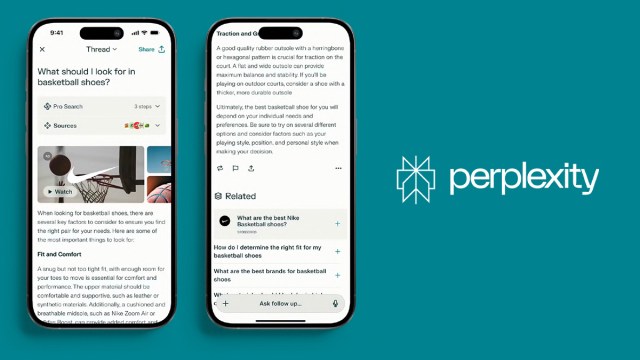
Publishers are starting to see referral traffic from AI search engine Perplexity, according to data from three sources.

The New York Times, The Guardian, and Forbes are all seeing traffic referrals, despite having previously blocked Perplexity’s bots from crawling their content.

Forbes, the news site benefitting from Perplexity’s referral traffic the most, per Similarweb data, received 236,300 visits from Perplexity in August 2024, up from 10,800 in August 2023. The New York Times followed with 96,600 visits, an increase from 11,600 visits year-on-year. The Guardian saw 76,800 visits, a rise from 6,700 visits in August 2023. These news publishers were followed by India Times, BBC, and CNN.

Nearly 13% of the global traffic Perplexity’s search engine refers went to news and media sites, per Similarweb. The rest went to platforms like Google, Reddit, and adult sites.

It’s worth noting that, even in Forbes’ case, 236,300 visits is a tiny portion of its traffic. Referrals make up 3.3% of Forbes’ traffic, per Similarweb. Of total referral traffic, Perplexity is the second most significant behind Wikipedia, referring 9% of traffic, (Perplexity referral traffic is actually down by 23.3% month-over-month). Organic search (Google) makes up 75% of traffic to Forbes, while social makes up 7.11%.

“The New York Times has between 50 and 100 million visitors to our website per week. I don’t really see that number [by Perplexity] as significant,” a New York Times spokesperson told ADWEEK. “Even if Perplexity would refer to publishers, is that interrupting what would normally be a direct connection between a reader and a publisher? It can’t be assumed that it’s 100% of people unfamiliar or unaccustomed to reading The New York Times.”

In Q1 2024, Perplexity reached 15 million monthly users, per Wired, as people gradually adapt to AI-enabled search.

Publishers like The New York Times have blocked Perplexity’s bots from accessing their sites, fearing the potential for regurgitated content to undermine their revenue models. Perplexity has signed multiyear agreements with publishers like Time and Fortune as part of its Publisher Program, which aims to share ad revenue whenever their content appears alongside ads. The search engine is expected to start serving ads in Q4.

Despite Perplexity bots, Google AI threat looms

The Guardian, while declining to comment specifically for this story, pointed instead to what it told ADWEEK in June, that it blocked Perplexity bots and requested to secure a commercial license for using its intellectual property. The New York Times continues to block Perplexity bots. Forbes did not respond to a media request.

Perplexity responded by referring to its blog stating that it “respects robots.txt.” The blog explained, “Perplexity will not crawl full or partial text content of a news publisher that has disallowed PerplexityBot via robots.txt. Some news web pages may still be indexed even if a page is blocked via robots.txt. In this instance, only the website domain, headline, and a factual summary of the page are added to our search index.”

“Traditional SEO and understanding how Google is incorporating AI is still a much bigger concern [for publishers] than the relatively small volume of traffic being driven by Perplexity,” said David Carr David Carr, editor, insights news and research, Similarweb.

Data from Semrush found a 490.5% year-over-year growth in referral traffic from Perplexity to 7,023 U.S. websites in August, with a peak in June. It’s worth noting that this is from a relatively small base.

The Semrush sites monitored include government and educational websites like the National Institute of Health (nih.gov) and Wikipedia receiving 1.93% and 1.25% of their traffic from Perplexity, respectively. Meanwhile, news sites command only 0.56% of the referral traffic, according to Semrush.

Chartbeat’s analysis of 5,013 sites across 71 countries shows that education-related sites—those focused on teaching, universities, and teacher training—are receiving the highest referral traffic from Perplexity. These sites account for 3,935 of the 860,257 total page views analyzed, representing 0.00457% of total referral traffic in the U.S.

As this last stat shows, Perplexity referral traffic is still modest, for now.

.font-primary { } .font-secondary { } #meter-count { position: fixed; z-index: 9999999; bottom: 0; width:96%; margin: 2%; -webkit-border-radius: 4px; -moz-border-radius: 4px; border-radius: 4px; -webkit-box-shadow: 0 0px 15px 4px rgba(0,0,0,.2); box-shadow:0 0px 15px 4px rgba(0,0,0,.2); padding: 15px 0; color:#fff; background-color:#343a40; } #meter-count .icon { width: auto; opacity:.8; } #meter-count .icon svg { height: 36px; width: auto; } #meter-count .btn-subscribe { font-size:14px; font-weight:bold; padding:7px 18px; color: #fff; background-color: #2eb3b2; border:none; text-transform: capitalize; margin-right:10px; } #meter-count .btn-subscribe:hover { color: #fff; opacity:.8; } #meter-count .btn-signin { font-size:14px; font-weight:bold; padding:7px 14px; color: #fff; background-color: #121212; border:none; text-transform: capitalize; } #meter-count .btn-signin:hover { color: #fff; opacity:.8; } #meter-count h3 { color:#fff!important; letter-spacing:0px!important; margin:0; padding:0; font-size:16px; line-height:1.5; font-weight:700; margin: 0!important; padding: 0!important; } #meter-count h3 span { color:#E50000!important; font-weight:900; } #meter-count p { font-size:14px; font-weight:500; line-height:1.4; color:#eee!important; margin: 0!important; padding: 0!important; } #meter-count .close { color:#fff; display:block; position:absolute; top: 4px; right:4px; z-index: 999999; } #meter-count .close svg { display:block; color:#fff; height:16px; width:auto; cursor:pointer; } #meter-count .close:hover svg { color:#E50000; } #meter-count .fw-600 { font-weight:600; } @media (max-width: 1079px) { #meter-count .icon { margin:0; padding:0; display:none; } } @media (max-width: 768px) { #meter-count { margin: 0; -webkit-border-radius: 0px; -moz-border-radius: 0px; border-radius: 0px; width:100%; -webkit-box-shadow: 0 -8px 10px -4px rgba(0,0,0,0.3); box-shadow: 0 -8px 10px -4px rgba(0,0,0,0.3); } #meter-count .icon { margin:0; padding:0; display:none; } #meter-count h3 { color:#fff!important; font-size:14px; } #meter-count p { color:#fff!important; font-size: 12px; font-weight: 500; } #meter-count .btn-subscribe, #meter-count .btn-signin { font-size:12px; padding:7px 12px; } #meter-count .btn-signin { display:none; } #meter-count .close svg { height:14px; } }

Enjoying Adweek’s Content? Register for More Access!

https://www.adweek.com/media/perplexity-referring-traffic-to-publishers/


Publisher Traffic Spiked Thanks to Google’s Gen AI Overview Tweaks


.article-native-ad { border-bottom: 1px solid #ddd; margin: 0 45px; padding-bottom: 20px; margin-bottom: 20px; } .article-native-ad svg { color: #ddd; font-size: 34px; margin-top: 10px; } .article-native-ad p { line-height:1.5; padding:0!important; padding-left: 10px!important; } .article-native-ad strong { font-weight:500; color:rgb(46,179,178); }

Drive business and brand growth with winning media strategies at Mediaweek. Hear from experts at TIME, Peloton, YouTube, Google and more, October 29-30 in New York City. Register.

Google’s AI-generated search, AI Overview, is boosting publisher traffic thanks to a new feature that embeds direct links within the text, according to the tech giant, which held a briefing for the press about new features this week. Google stopped short of giving any more specifics about the increase publishers were seeing.

A query asking about ‘the tallest tree in the world’ now includes an in-line link directing users to the Guinness Book of Records. After initial testing in August, Google is expanding this feature across all seven countries where AI overviews are available, including the UK, India, and Japan.

Google, which has held discussions with publishers about AI Overview and the impact on traffic, said this new format is intended to facilitate diverse content discovery while driving more exposure and traffic to websites.

“This improved experience has driven an increase in traffic to supporting websites compared to the previous design,” said Rhiannon Bell, vp, UX, Google. Bell wouldn’t share any more specifics.

On desktop, the links are displayed on the right side of the page within AI Overview, while mobile users can access them by tapping icons or scrolling to the bottom.

Managing publisher impact

Google’s AI search, launched last May, raised concerns about disrupting organic search traffic for publishers, potentially slashing ad revenue by up to $2 billion annually. Raptive—which runs ad sales for titles like Half Baked Harvest, MacRumors and Stereogum—anticipates at least a 50% reduction in search traffic for publishers by 2025. For example, a publisher earning $75,000 annually could see a $37,500 drop in income due to traffic loss, according to Michael Sanchez, co-founder and CEO.

However, for some, the impact has been less severe than expected.

During a recent earnings call, Vivek Shah, CEO of digital media and internet company Ziff Davis, noted when analyzing thousands of queries across its key domains that generate organic search referrals, AI Overviews appeared in only 8% of the key search queries, with 92% of search results pages remaining unaffected.

“We hypothesize—and Google has confirmed—that links within AI overviews see higher click-through rates compared to traditional web listing links,” Shah said during the call.

Ads go live on AI Overviews

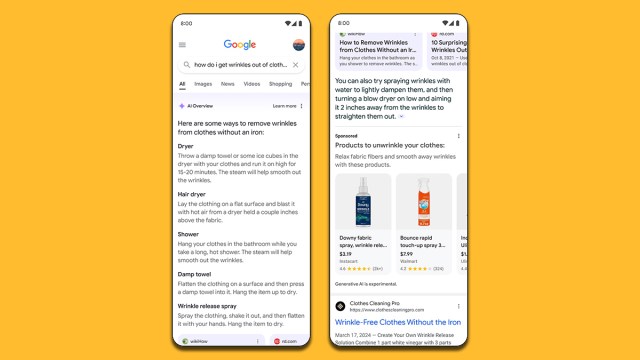
Ads are now displayed in AI Overviews, but only when there’s a commercial intent behind the query, Brendon Kraham, vp of search & commerce, Google, told ADWEEK.

For instance, a query on removing grass stains from jeans might feature shopping or traditional text ads placed above or below the AI-generated answer, all labeled as sponsored.

Google announced it was testing this ad format at GML last year. Although Kraham didn’t share how ads are performing, he noted that ads in AI Overviews rely on Google’s standard auction process, triggered by relevant keywords.

Google has been pitching these ads to agencies, explaining that changes in keyword and search term matching allow ads in AI Overviews to be triggered not only by user searches but also by the content generated within the AI Overview itself.

If a search term appears less directly related, but the AI Overview discusses relevant keywords that advertisers are bidding on, their ad could still be featured, according to Andy Goodwin, head of paid search at digital media agency Brainlabs. The agency has yet to test ads in AI Overview.

Ads will be available through broad match and Performance Max, all operating under a single auction system, maintaining similar cost-per-click (CPC) rates to traditional search ad slots, added Goodwin.

AI-organized search results

Google is also introducing AI-organized search results in the U.S., powered by its Gemini model. This is outside of the AI-overview experience.

This update will offer a more curated experience for topics without a single definitive answer—such as recipe ideas or meal planning—by grouping results into categories. The new layout will help people navigate large amounts of information more easily by offering subcategories, such as ingredients, as they scroll. Sponsored links will continue to appear at the top of these pages, with the initial rollout focusing on recipes and dining.

“With AI-organized results, we’re surfacing more diverse content formats from a broader range of sources,” said Bell.

Google also announced its enhancing its visual search capabilities via Lens, introducing new AI-powered video and voice features for English-language queries.

.font-primary { } .font-secondary { } #meter-count { position: fixed; z-index: 9999999; bottom: 0; width:96%; margin: 2%; -webkit-border-radius: 4px; -moz-border-radius: 4px; border-radius: 4px; -webkit-box-shadow: 0 0px 15px 4px rgba(0,0,0,.2); box-shadow:0 0px 15px 4px rgba(0,0,0,.2); padding: 15px 0; color:#fff; background-color:#343a40; } #meter-count .icon { width: auto; opacity:.8; } #meter-count .icon svg { height: 36px; width: auto; } #meter-count .btn-subscribe { font-size:14px; font-weight:bold; padding:7px 18px; color: #fff; background-color: #2eb3b2; border:none; text-transform: capitalize; margin-right:10px; } #meter-count .btn-subscribe:hover { color: #fff; opacity:.8; } #meter-count .btn-signin { font-size:14px; font-weight:bold; padding:7px 14px; color: #fff; background-color: #121212; border:none; text-transform: capitalize; } #meter-count .btn-signin:hover { color: #fff; opacity:.8; } #meter-count h3 { color:#fff!important; letter-spacing:0px!important; margin:0; padding:0; font-size:16px; line-height:1.5; font-weight:700; margin: 0!important; padding: 0!important; } #meter-count h3 span { color:#E50000!important; font-weight:900; } #meter-count p { font-size:14px; font-weight:500; line-height:1.4; color:#eee!important; margin: 0!important; padding: 0!important; } #meter-count .close { color:#fff; display:block; position:absolute; top: 4px; right:4px; z-index: 999999; } #meter-count .close svg { display:block; color:#fff; height:16px; width:auto; cursor:pointer; } #meter-count .close:hover svg { color:#E50000; } #meter-count .fw-600 { font-weight:600; } @media (max-width: 1079px) { #meter-count .icon { margin:0; padding:0; display:none; } } @media (max-width: 768px) { #meter-count { margin: 0; -webkit-border-radius: 0px; -moz-border-radius: 0px; border-radius: 0px; width:100%; -webkit-box-shadow: 0 -8px 10px -4px rgba(0,0,0,0.3); box-shadow: 0 -8px 10px -4px rgba(0,0,0,0.3); } #meter-count .icon { margin:0; padding:0; display:none; } #meter-count h3 { color:#fff!important; font-size:14px; } #meter-count p { color:#fff!important; font-size: 12px; font-weight: 500; } #meter-count .btn-subscribe, #meter-count .btn-signin { font-size:12px; padding:7px 12px; } #meter-count .btn-signin { display:none; } #meter-count .close svg { height:14px; } }

Enjoying Adweek’s Content? Register for More Access!

https://www.adweek.com/media/publisher-traffic-spiked-googles-gen-ai-overview/


Photographer-Heavy Platform VSCO Starts Selling Ads With Liquid IV Campaign


.article-native-ad { border-bottom: 1px solid #ddd; margin: 0 45px; padding-bottom: 20px; margin-bottom: 20px; } .article-native-ad svg { color: #ddd; font-size: 34px; margin-top: 10px; } .article-native-ad p { line-height:1.5; padding:0!important; padding-left: 10px!important; } .article-native-ad strong { font-weight:500; color:rgb(46,179,178); }

Drive business and brand growth with winning media strategies at Mediaweek. Hear from experts at TIME, Peloton, YouTube, Google and more, October 29-30 in New York City. Register.

Photo editing platform Visual Supply Company (pronounced vis-co), is digging deeper into the ad-selling game with the hope of more effectively monetizing its user base.

The decade-old platform said it has 60 million unique monthly visitors, and over 200 million registered users, (those who have signed up with an email address). The user base skews towards photographers, graphic designers, creators, and people who follow their work, (over 80% are female). Previously, 99% of VSCO’s revenue came from subscriptions to VSCO+, which costs $29.99 per year, and VSCO Pro, which costs $59.99 a year. The platform said it has 160,000 Pro subscribers.

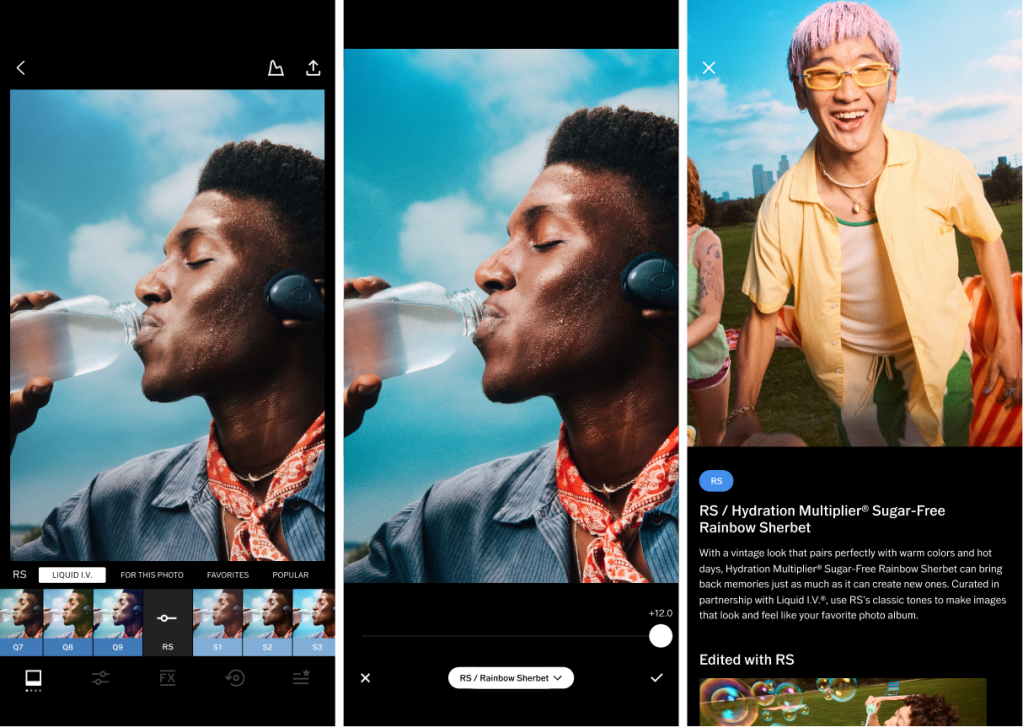
In August, electrolyte drink mix Liquid IV ran a targeted ad campaign on the platform to reach VSCO’s creator network, a community of artists, photographers, and motion graphic designers VSCO offers access to creative tools and showcases their work to help them build business connections. The campaign promoted Liquid IV’s summer drink flavors, such as sugar-free rainbow sherbet, with the brand goal of engaging with creative professionals and using their work in its marketing.

“What we have found a lot from our community is one of the bigger challenges they have, especially with the changes to Instagram [algorithm] and just where social media has landed, is it’s really hard to get exposure and get their work out there,” Eric Wittman, CEO, VSCO, told ADWEEK.

VSCO ran targeted ads, branded presets and brand challenge on VSCO to drum brand awareness for its Summer flavors. VSCO

In the month-long campaign, Liquid IV ran interstitial ads—which appear on user profiles when people click into content—and generated 40 million impressions with 600,000 clicks on the ad, (equating to a 1.42% CTR), said Wittman. These ads are sold on a CPM-based pricing model, ranging from mid-to-low single-digit rates for static display ads and up to double-digits for rich media or video ads.

As part of its VSCO campaign, Liquid IV launched custom filters, called presets, with warm, pastel tones and branded challenges (similar to TikTok challenges), encouraging users to edit and post photos using its filters.

The presets generated 225 million impressions in a month, with people sharing images using the Liquid IV product under the #LiquidIVChallenge. Liquid IV selected four winners whose photos aligned with the brand’s creative vision, licensing six images in total. Each winner received $500 from VSCO.

To buy these ads—paid members won’t see ads—brands need to buy a broader package that includes its other products, like custom branded filters, which the platform has been offering since 2014, and branded challenges. Previously, brands like Marriott, Levi’s, Nike, and Gymshark have tapped into VSCO’s creator-driven community through limited edition co-branded filters.

The company recently became profitable, per Bloomberg, with 25% of its revenue stemming from VSCO Pro. Sensor Tower, while it’s worth noting doesn’t have access to complete revenue data, estimates VSCO’s revenue to be around $3 million as of August 2024.

VSCO has secured $100 million in funding to date, with investors including Accel Partners, Glynn Capital, Icon Ventures, Goldcrest Capital, and Obvious Ventures, according to Bloomberg.

.font-primary { } .font-secondary { } #meter-count { position: fixed; z-index: 9999999; bottom: 0; width:96%; margin: 2%; -webkit-border-radius: 4px; -moz-border-radius: 4px; border-radius: 4px; -webkit-box-shadow: 0 0px 15px 4px rgba(0,0,0,.2); box-shadow:0 0px 15px 4px rgba(0,0,0,.2); padding: 15px 0; color:#fff; background-color:#343a40; } #meter-count .icon { width: auto; opacity:.8; } #meter-count .icon svg { height: 36px; width: auto; } #meter-count .btn-subscribe { font-size:14px; font-weight:bold; padding:7px 18px; color: #fff; background-color: #2eb3b2; border:none; text-transform: capitalize; margin-right:10px; } #meter-count .btn-subscribe:hover { color: #fff; opacity:.8; } #meter-count .btn-signin { font-size:14px; font-weight:bold; padding:7px 14px; color: #fff; background-color: #121212; border:none; text-transform: capitalize; } #meter-count .btn-signin:hover { color: #fff; opacity:.8; } #meter-count h3 { color:#fff!important; letter-spacing:0px!important; margin:0; padding:0; font-size:16px; line-height:1.5; font-weight:700; margin: 0!important; padding: 0!important; } #meter-count h3 span { color:#E50000!important; font-weight:900; } #meter-count p { font-size:14px; font-weight:500; line-height:1.4; color:#eee!important; margin: 0!important; padding: 0!important; } #meter-count .close { color:#fff; display:block; position:absolute; top: 4px; right:4px; z-index: 999999; } #meter-count .close svg { display:block; color:#fff; height:16px; width:auto; cursor:pointer; } #meter-count .close:hover svg { color:#E50000; } #meter-count .fw-600 { font-weight:600; } @media (max-width: 1079px) { #meter-count .icon { margin:0; padding:0; display:none; } } @media (max-width: 768px) { #meter-count { margin: 0; -webkit-border-radius: 0px; -moz-border-radius: 0px; border-radius: 0px; width:100%; -webkit-box-shadow: 0 -8px 10px -4px rgba(0,0,0,0.3); box-shadow: 0 -8px 10px -4px rgba(0,0,0,0.3); } #meter-count .icon { margin:0; padding:0; display:none; } #meter-count h3 { color:#fff!important; font-size:14px; } #meter-count p { color:#fff!important; font-size: 12px; font-weight: 500; } #meter-count .btn-subscribe, #meter-count .btn-signin { font-size:12px; padding:7px 12px; } #meter-count .btn-signin { display:none; } #meter-count .close svg { height:14px; } }

Enjoying Adweek’s Content? Register for More Access!

https://www.adweek.com/media/vsco-sells-ads-liquid-iv/


Exclusive: Location App Life360 Is Growing a $10 Million Ad Business


.article-native-ad { border-bottom: 1px solid #ddd; margin: 0 45px; padding-bottom: 20px; margin-bottom: 20px; } .article-native-ad svg { color: #ddd; font-size: 34px; margin-top: 10px; } .article-native-ad p { line-height:1.5; padding:0!important; padding-left: 10px!important; } .article-native-ad strong { font-weight:500; color:rgb(46,179,178); }

Don’t miss Mediaweek, October 29-30 in New York City. Save 20% on passes and gain winning media strategies to drive growth across channels. Hurry—sale ends Sept 9.

Location-sharing application Life360 is launching its direct advertising sales business today, with Uber as one of its first major advertisers, the company shared with ADWEEK exclusively.

Life360, a publicly traded mobile app company, first said it was starting an advertising business on an earnings call in February, and it expects that business to grow to between $5 million and $10 million by the end of this year, according to Russell Burke, chief financial officer.

“The engagement that we’re having with Uber is emblematic of the kind of direct partnerships we’re creating with various brands that are super-focused on family,” said Brian McDevitt, a Google veteran who started last month at Life360 in a newly created role, vice president of ad sales and strategy. “It’s a sign of many more of those kinds of deals to come.”

Life360 joins a growing list of companies, from retailers to financial service firms to Uber itself, that didn’t start as pure-play media companies but are now looking to translate a captive digital customer base into an audience for advertisers.

Life360 helps families connect by sharing locations and providing other safety services. The company has historically made most of its revenue via subscriptions.

Uber marks the launch of the Life360 direct-sales business, but it tested the program with children’s debit card company Greenlight. Allstate-owned Arity is also a client.

The company has sold ads programmatically since the end of the second quarter of 2024, and it has struck partnerships with The Trade Desk, PubMatic, and Google Ad Manager. In August, Life360 announced a partnership with LiveRamp, which lets advertisers target Life360 on offsite media properties.

The company is a top 10 social networking app, according to the Apple App Store, and it has 70 million monthly active users globally and 40 million in the U.S.

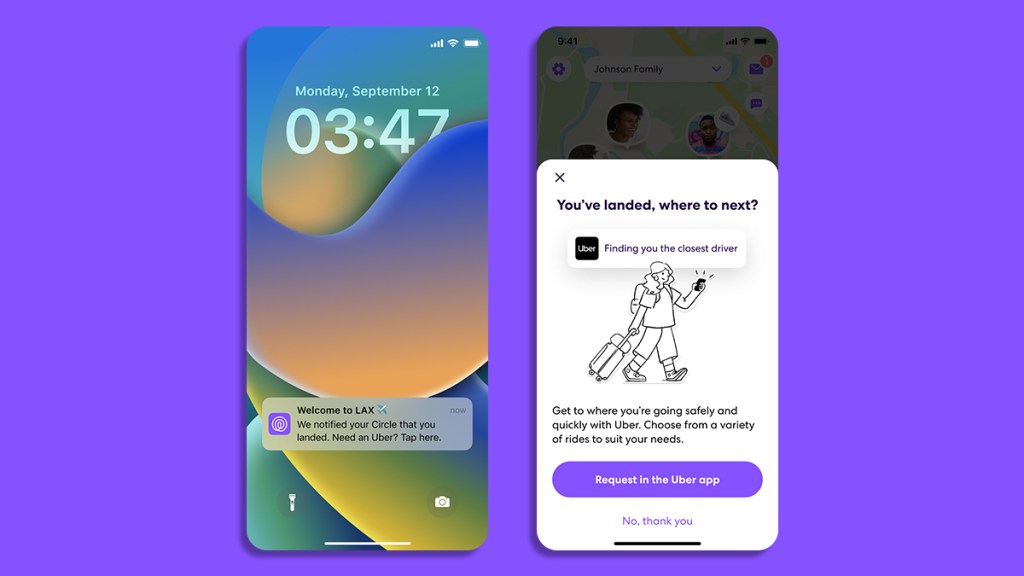
How Uber’s ads on Life360 will look.Life360

For the Uber campaign, when users land from a flight, they will get a prompt to download the ride-hailing app. Uber will also run in-app ads using Life360’s data on its 18+ users starting in mid-September.

The focus is to target parents of teens with teen accounts on Uber, which lets parents monitor their kids’ Uber use. If parents refer teens to create an Uber teen account, the latter will get six free rides and six free orders in September.

“At Uber, we see a tremendous opportunity to connect with families in meaningful ways through our partnership with Life360,” said Cait O’Donovan, interim U.S. and Canada consumer operations and new verticals lead at Uber. “With their deep understanding of family routines and our commitment to safe, reliable transportation, we’re able to provide solutions that simplify everyday life while ensuring peace of mind.”

Advertisers looking for families and location

Life360 believes it can stand out from competitors because of its family-centric audience and location data.

“We’re starting to generate interest from a lot of other brands that are interested in our proximity to modern family life and families in general,” McDevitt said, “and brands and advertisers that really care about location-specific insights and audiences.”

McDevitt suggested that potential advertisers could include automotive brands, which could use Life360’s data to ascertain whether a family is getting a new driver or if it’s growing in size. McDevitt also listed streaming companies and restaurant brands that could fulfill other needs for a family.

“It’s exciting to contemplate something beyond an individual and a household as a targetable group,” said Ana Milicevic, co-founder of programmatic consultancy Sparrow Advisors. “For example, friend groups or extended family can be particularly impactful with key purchasing decisions.”

In an investor presentation, Life360 cites Uber’s own advertising business, which is expected to hit $1 billion this year, as a case study for how investors can think about the potential growth of Life360’s advertising business.

But achieving that level of success might be the exception rather than the rule, said a mobile advertising executive, speaking anonymously. The exec pointed to community-focused platform NextDoor, which made $218 million in revenue last year, primarily from advertising with around 41.8 million weekly active users.

“Every scaled platform is introducing ads in some form,” the exec said. “NextDoor … has a robust ads product and captures a tiny, tiny, tiny share of wallet from the ecosystem.”

Not alienating users

Life360 is mindful that many users didn’t originally sign up for an app with ads. Certain ad formats, like interstitials and video ads, would “be a bridge too far” for maintaining user experience, CEO Chris Hulls said on an August earnings call. The firm will also control which brands advertise on its platform.

Moreover, children represent a significant chunk of Life360’s user base, and location data is sensitive. After an investigation from The Markup in 2021 found that Life360 was selling precise location data to data brokers, the company said it would stop the sale of this location data to all partners except Arity. A proposed class-action lawsuit was also brought against Life360, according to The Markup.

 The company said those under 18 will automatically not be part of the advertising operation.

“Data from users under 18 is strictly excluded from receiving ads and being included in targeted advertising segments,” a Life360 spokesperson said.

.font-primary { } .font-secondary { } #meter-count { position: fixed; z-index: 9999999; bottom: 0; width:96%; margin: 2%; -webkit-border-radius: 4px; -moz-border-radius: 4px; border-radius: 4px; -webkit-box-shadow: 0 0px 15px 4px rgba(0,0,0,.2); box-shadow:0 0px 15px 4px rgba(0,0,0,.2); padding: 15px 0; color:#fff; background-color:#343a40; } #meter-count .icon { width: auto; opacity:.8; } #meter-count .icon svg { height: 36px; width: auto; } #meter-count .btn-subscribe { font-size:14px; font-weight:bold; padding:7px 18px; color: #fff; background-color: #2eb3b2; border:none; text-transform: capitalize; margin-right:10px; } #meter-count .btn-subscribe:hover { color: #fff; opacity:.8; } #meter-count .btn-signin { font-size:14px; font-weight:bold; padding:7px 14px; color: #fff; background-color: #121212; border:none; text-transform: capitalize; } #meter-count .btn-signin:hover { color: #fff; opacity:.8; } #meter-count h3 { color:#fff!important; letter-spacing:0px!important; margin:0; padding:0; font-size:16px; line-height:1.5; font-weight:700; margin: 0!important; padding: 0!important; } #meter-count h3 span { color:#E50000!important; font-weight:900; } #meter-count p { font-size:14px; font-weight:500; line-height:1.4; color:#eee!important; margin: 0!important; padding: 0!important; } #meter-count .close { color:#fff; display:block; position:absolute; top: 4px; right:4px; z-index: 999999; } #meter-count .close svg { display:block; color:#fff; height:16px; width:auto; cursor:pointer; } #meter-count .close:hover svg { color:#E50000; } #meter-count .fw-600 { font-weight:600; } @media (max-width: 1079px) { #meter-count .icon { margin:0; padding:0; display:none; } } @media (max-width: 768px) { #meter-count { margin: 0; -webkit-border-radius: 0px; -moz-border-radius: 0px; border-radius: 0px; width:100%; -webkit-box-shadow: 0 -8px 10px -4px rgba(0,0,0,0.3); box-shadow: 0 -8px 10px -4px rgba(0,0,0,0.3); } #meter-count .icon { margin:0; padding:0; display:none; } #meter-count h3 { color:#fff!important; font-size:14px; } #meter-count p { color:#fff!important; font-size: 12px; font-weight: 500; } #meter-count .btn-subscribe, #meter-count .btn-signin { font-size:12px; padding:7px 12px; } #meter-count .btn-signin { display:none; } #meter-count .close svg { height:14px; } }

Enjoying Adweek’s Content? Register for More Access!

https://www.adweek.com/media/exclusive-location-app-life360-with-help-from-brands-like-uber-is-growing-a-10m-ad-business-this-year/


Google Sought to Pay Agencies Hundreds of Millions to Sway Media Buys


Google planned to spend hundreds of millions of dollars incentivizing agencies to purchase certain types of its media, according to new documents filed last week in the Department of Justice’s upcoming antitrust trial against Google.

The documents reveal the inner workings of Google’s incentive programs with agencies and advertisers. The program gave agencies discounts, special perks like third-party research, and cash back for agreeing to buy certain media from Google.

Google publicly disclosed the program in a blog post, but the new documents detail the specifics of these programs—including what Google planned to pay out to agencies and how Google internally thinks of the initiative.

Arielle Garcia, director of intelligence at industry watchdog Check My Ads, who formerly worked at ad-buying giant UM, described the program as benefitting Google. Garcia has first-hand knowledge of Google’s program, she said.

“[Google] tends to recommend things that benefit themselves more so than advertisers,” Garcia said.

Incentive programs like those outlined in Google’s filing are common among media companies, said a media auditing source who requested anonymity to discuss sensitive industry relations. But they can be controversial, especially if they are employed by agencies that aren’t transparent with their clients about the deals. The risk comes from agencies recommending media because they were paid to do so, and not because it was in the client’s best interest.

The document is dated May 29, 2018 and is “sponsored” by Google exec Debbie Weinstein with contributions from Google execs Kate Alessi, Brian Gargan, Brett Koons and Rekha Natarajan. These programs have existed since at least 2016, per AdExchanger’s reporting. It is not clear in what capacity these programs exist today.

Wooing advertisers with incentives

The documents detail three types of incentives offered by Google.

The first is DVIP Upfronts, where agencies and advertisers make an upfront commitment to spend on Google display and video ads in exchange for receiving a discount on reservation-based spend, a kind of deal where buyers can buy certain media placements at a fixed rate. Buyers also get access to a pool of money called the discretionary incentive funds, which advertisers can use on creative production, third-party research, and reducing platform fees.

Google executives anticipated it would pay out around $100 million in discretionary incentive funds in 2018 to advertisers, according to the doc.

The second type of incentive is called Agency Capability Fund (ACF), where Google provides agencies cash back at the end of the year in exchange for meeting YouTube growth targets and training requirements year-over-year. Google said it expected to pay over $300 million in these payouts in 2018 to advertisers, which Google executives specifically called rebates. ACF makes up most of the “hard costs” across all three incentive programs, per the document.

The final type of incentive Google detailed in the filing is KPI Deals, where agencies get cash at the end of the year for mutually agreed upon display and video KPIs. Google expected to pay out $45 million for this deal type in 2018.

It is not clear from the document how many agencies and advertisers Google executives planned to pay via the incentive programs.

Google executives conducted an internal audit of both ACF and KPI deal types.

“Despite our initial hypothesis that we needed to accelerate a glide path toward ACF removal, what we’ve actually found is that volume-based rebates and KPI deals can still be effective in satisfying existing market needs,” the documents read. “Furthermore, we can successfully minimize any risk of collusion and competition with the right controls in place.”

One of the changes to the program outlined for 2019 was “ensuring ACF grids are discoverable upon requests from clients” to achieve “the right level of transparency.”

Raising red flags?

The incentive programs raise questions about how agencies manage their relationships with the world’s largest media company.

What makes Google completely different “to another publisher or media vendor that participates in upfront negotiations is that the universe that you can transact through Google’s platform is endless,” the media auditor source said.

For instance, to fulfill a minimum spend commitment under an incentive program with a TV company, there are a finite number of shows in which agencies can buy airtime. But with Google, much more inventory is on the table, making it more likely brands don’t know which exact Google media their agency is buying, the source continued.

A Google spokesperson said that brands can learn exactly which Google media their agencies spent on via impression reporting.

It’s not clear how the U.S. Department of Justice plans to use these documents in the upcoming trial, slated to start Sept. 9. But sources believe this shows how Google can influence how brands spend their media budgets.

“This is a perfect example of how they’re able to pull the strings to direct money wherever they want to,” Garcia said.

The documents show Google planning to use the incentive programs to move money toward Waze, preferred deals, and programmatic deals on AdX, Google’s publisher-centric ad exchange now called Google Ad Manager.

There is also a lengthy discussion of whether incentives should be used to encourage buying from Universal App Campaigns, a campaign type for app advertisers now called App Campaigns that was one of the company’s first forays into AI-driven buying that is now increasingly common across Google.

“At the core, we’d like to determine whether incentives are required for formats with [machine-learning] based, automated buying that optimize toward a specific return on investment, or if the performance of these formats alone should enable them to effectively ‘stand on their own’ and not require additional incentives,” the documents read.

Read the full document here:

.font-primary { } .font-secondary { } #meter-count { position: fixed; z-index: 9999999; bottom: 0; width:96%; margin: 2%; -webkit-border-radius: 4px; -moz-border-radius: 4px; border-radius: 4px; -webkit-box-shadow: 0 0px 15px 4px rgba(0,0,0,.2); box-shadow:0 0px 15px 4px rgba(0,0,0,.2); padding: 15px 0; color:#fff; background-color:#343a40; } #meter-count .icon { width: auto; opacity:.8; } #meter-count .icon svg { height: 36px; width: auto; } #meter-count .btn-subscribe { font-size:14px; font-weight:bold; padding:7px 18px; color: #fff; background-color: #2eb3b2; border:none; text-transform: capitalize; margin-right:10px; } #meter-count .btn-subscribe:hover { color: #fff; opacity:.8; } #meter-count .btn-signin { font-size:14px; font-weight:bold; padding:7px 14px; color: #fff; background-color: #121212; border:none; text-transform: capitalize; } #meter-count .btn-signin:hover { color: #fff; opacity:.8; } #meter-count h3 { color:#fff!important; letter-spacing:0px!important; margin:0; padding:0; font-size:16px; line-height:1.5; font-weight:700; margin: 0!important; padding: 0!important; } #meter-count h3 span { color:#E50000!important; font-weight:900; } #meter-count p { font-size:14px; font-weight:500; line-height:1.4; color:#eee!important; margin: 0!important; padding: 0!important; } #meter-count .close { color:#fff; display:block; position:absolute; top: 4px; right:4px; z-index: 999999; } #meter-count .close svg { display:block; color:#fff; height:16px; width:auto; cursor:pointer; } #meter-count .close:hover svg { color:#E50000; } #meter-count .fw-600 { font-weight:600; } @media (max-width: 1079px) { #meter-count .icon { margin:0; padding:0; display:none; } } @media (max-width: 768px) { #meter-count { margin: 0; -webkit-border-radius: 0px; -moz-border-radius: 0px; border-radius: 0px; width:100%; -webkit-box-shadow: 0 -8px 10px -4px rgba(0,0,0,0.3); box-shadow: 0 -8px 10px -4px rgba(0,0,0,0.3); } #meter-count .icon { margin:0; padding:0; display:none; } #meter-count h3 { color:#fff!important; font-size:14px; } #meter-count p { color:#fff!important; font-size: 12px; font-weight: 500; } #meter-count .btn-subscribe, #meter-count .btn-signin { font-size:12px; padding:7px 12px; } #meter-count .btn-signin { display:none; } #meter-count .close svg { height:14px; } }

Enjoying Adweek’s Content? Register for More Access!

https://www.adweek.com/programmatic/google-pay-agencies-sway-media-buys-antitrust-lawsuit/


From Brat Summer to Demure Fall, Microtrends Are Redefining Marketing

In case you haven’t heard: party-girl Brat Summer has given way to a more modest Demure Fall, and brands including Verizon, Lyft, and Zillow are moving at breakneck speed to keep pace amid yet another cultural shift.

“Verizon lets me trade in a musty diva for a demure diva,” says Jools Lebron, the TikToker behind the now ubiquitous “demure” trend—which celebrates a low-key, understated lifestyle—in a sponsored post on the platform. 

The advertiser was among the first major household names to collaborate with Lebron, who recently went viral for describing her workplace demeanor as “very demure, very mindful,” in a satirical video that has now been watched over 35 million times. 

Her tongue-in-cheek TikToks on how to be “demure and cutesy” while doing everyday things have captivated younger audiences.

#paywall-register { margin: 0; padding: 1rem 2.4rem; } #paywall-register .holder { background-color: #eee; border: 15px solid #f2f2f2; padding: 30px; margin: 0 auto !important; text-align: center; } #paywall-register a.underline { color: #000 !important; text-decoration: underline; } #paywall-register a.underline:hover { color: #333 !important; text-decoration: underline; } #paywall-register img { margin-bottom: 10px; width: 140px !important; height: auto !important; } #paywall-register h3 { font-weight: bold; font-size: 18px; text-transform: uppercase; margin-bottom: 20px; text-align: center; } #paywall-register h3 span { display: block; font-size: 14px; } #paywall-register h2 { font-weight: 800; font-size: 24px; text-transform: uppercase; } #paywall-register p { font-size: 16px; color: #000; padding: 0; } #paywall-register .cta { margin-top: 20px; margin-bottom: 10px; font-size: 14px; text-transform: capitalize; color: #181818 !important; background-color: #fff02e; border: none; padding: 12px 28px; text-decoration: none; -webkit-transition: 0.3s ease; -moz-transition: 0.3s ease; -o-transition: 0.3s ease; -ms-transition: 0.3s ease; transition: 0.3s ease; } #paywall-register .cta:hover { color: #fff !important; background-color: #181818; transform: scale(1.02); } #paywall-register .already-a-member { font-size: 14px; } @media (max-width: 1024px) { #paywall-register .holder { border: 12px solid #f2f2f2; padding: 25px; } #paywall-register img { width: 120px !important; } } @media (max-width: 768px) { #paywall-register .holder { border: 10px solid #f2f2f2; padding: 20px; } #paywall-register img { width: 100px !important; } #paywall-register h3 { font-size: 14px; } #paywall-register h3 span { font-size: 12px; } #paywall-register h2 { font-size: 18px; } #paywall-register p { font-size: 14px; } #paywall-register .cta { font-size: 12px; padding: 10px 24px; } #paywall-register .already-a-member { font-size: 11px; } } #adw-logo-svg-new{ max-width: 200px; }

.adw-logo-svg-path { fill: #2a2729; stroke-width: 0px; }

Create Your Free Account

Registration Includes:

The Adweek Daily newsletter with must-read stories direct to your inbox. PLUS, limited access to Adweek.com articles, videos and podcasts.

Join Today

Already a member? Sign in

https://www.adweek.com/social-marketing/brat-summer-demure-fall-microtrends-redefining-marketing/


Meta Is Making a Major Change to Its Algorithm Around Conversions

.article-native-ad { border-bottom: 1px solid #ddd; margin: 0 45px; padding-bottom: 20px; margin-bottom: 20px; } .article-native-ad svg { color: #ddd; font-size: 34px; margin-top: 10px; } .article-native-ad p { line-height:1.5; padding:0!important; padding-left: 10px!important; } .article-native-ad strong { font-weight:500; color:rgb(46,179,178); }

Join the experts at Mediaweek, October 29-30 in New York City. Stay ahead of the shifts impacting the media landscape and gain fresh strategies to drive platform growth. Save 20% on passes.

Meta is making a change to its advertising algorithm that will make the platform temporarily look like it’s performing worse for some advertisers. The change could raise ad prices but also increase advertisers’ trust in the fidelity of Meta’s ad systems, ADWEEK has learned.

The change affects conversion campaigns where a marketer wants someone to make a purchase. Meta will now give more weight to the conversions occurring one day from when a user first clicks, specifically looking at the one-day conversion window. A conversion window is the time between when a user sees an ad and completes an action.

Shorter conversion windows are harder for platforms like Meta because they have less time to prove their ads worked. With longer conversion windows, like a seven-day window, there is more likelihood that a user purchased for reasons outside of the ad.

Previously, the algorithm behind conversion campaigns was equally weighted toward all lengths of conversion windows.

“This ads ranking change will more heavily favor 1 day click conversions, whereas previously, all attribution windows were weighted evenly,” according to a note digital agency Wpromote sent its clients about the change, which was seen by ADWEEK. “From early testing, Meta has seen an average 30% improvement to Meta-attributed conversions in third-party analytics tools. However, this also means that Meta’s in-platform data will be impacted, with the likelihood of decreased conversions reported, along with potentially higher CPAs and CPMs.”

With more conversions only counted by Meta if they happened within one day of seeing the ad, advertisers might see fewer conversions reported for a given campaign than they did previously. Ad prices also might be higher because the change will cause Meta to target a smaller pool of users, looking for those who are more likely to convert in one day.

Advertisers who hadn’t already been optimizing for one-day conversion windows or who sell luxury products with longer purchase windows are more likely to see ad performance decline, said Darren D’Altorio, vice president of social media at Wpromote.

The change is significant because Meta typically doesn’t tell advertisers much about how its algorithm works. Brands have also recently been increasingly skeptical of how Meta measures its ads, ADWEEK has reported.

“We are super excited about these updates,” D’Altorio said. “This is an exciting update for performance advertisers who validate results with third-party measurement tools (which most do) and illustrates that Meta consistently leads the pack as it relates to adtech innovation.”

Separately, Meta announced a slew of changes on Aug.14 to its ad system around how it optimizes and measures conversions. The greater weighting of the one-day attribution window is not directly mentioned in Meta’s blog post, though it was part of how these changes were explained to advertisers, according to D’Altorio.

“With today’s updates we expect advertisers, especially those who use third-party analytics tools, to see improvements in Meta-attributed conversions,” a Meta spokesperson said in response to questions about the role of the one-day attribution window in its ads algorithm. “As the holiday season approaches, our goal is to continue to help improve advertiser performance and deliver more of the results they value.”

Meta did not respond to comment on the change in the weight of a one-day conversion window.

More incrementality and comparison with third parties

Besides the change to conversion windows, Meta is also making changes that show advertisers how many users took an action on an ad as a result of specifically seeing it on one of Meta’s platforms.

When Apple deprecated mobile identifiers in 2021, Meta had less data about who to target and how to measure whether those ads worked, causing ad performance to plummet.

In the past three years, Meta has solved this problem with AI which has improved performance, but advertisers worry the campaign reports Meta gives are more modeling than reality. They worry that the modeling makes Meta ads look like they perform better than they do.

Meta’s updates to its ad systems could alleviate those concerns.

Meta is now allowing advertisers to optimize for incremental conversions. A user who scrolled past a Meta ad for shoes might have bought the shoes anyway, but an incremental conversion would represent a customer brought in uniquely by the ad.

Meta calculates incrementality by comparing conversions from a group of people exposed to an ad to conversions from people who didn’t see any advertisement. The difference between the two helps figure out how many conversions were incremental.

Incrementality testing is a big reason why ad buyers have been turning to third-party measurement solutions like Rockerbox, TripleWhale, and Measured.

Another reason advertisers have turned to these vendors is to figure out which platform is most responsible for a sale. A user could have seen an ad for a product on Meta, TikTok, and Google before making a purchase, and each platform could be taking credit for driving the sale.

Now, advertisers can connect these third parties with Meta, starting with Google Analytics and Northbeam. Meta will soon expand similar tools to Adobe and Triple Whale. Meta will use this data in campaign optimization to improve its relative campaign performance.

“One of the biggest criticisms of Meta, specifically from performance advertisers, is that its in-platform attribution is wildly inaccurate compared to a third party ‘source of truth,’ ” D’Altorio said. “These changes will better calibrate their ad system to close that gap.”

Meta has already started to use some preliminary third-party data from early tests with advertisers to make changes to its overall advertising algorithm.

“We would like our system to be customized to deliver [advertisers’] specific way they think their media performs. We’re not there yet,” Fred Leach, vp of product management, told ADWEEK. “That’s ultimately what the connection with third-party analytics tools should allow us to do. But right now, we’ve gained enough aggregate learning where we can tune the system to where, on average, we believe it’s going to deliver more value for advertisers”

Correction: The headline on an earlier version of this article misstated that Meta was changing how conversions are measured. The headline has been updated to reflect that Meta has changed how its algorithm is optimized. This article has been updated to clarify that the change affects campaigns only where a marketer wants someone to make a purchase, not for app download conversions. And to reflect that Meta will now give more weight to the conversions occurring one day from when a user first clicks.

.font-primary { } .font-secondary { } #meter-count { position: fixed; z-index: 9999999; bottom: 0; width:96%; margin: 2%; -webkit-border-radius: 4px; -moz-border-radius: 4px; border-radius: 4px; -webkit-box-shadow: 0 0px 15px 4px rgba(0,0,0,.2); box-shadow:0 0px 15px 4px rgba(0,0,0,.2); padding: 15px 0; color:#fff; background-color:#343a40; } #meter-count .icon { width: auto; opacity:.8; } #meter-count .icon svg { height: 36px; width: auto; } #meter-count .btn-subscribe { font-size:14px; font-weight:bold; padding:7px 18px; color: #fff; background-color: #2eb3b2; border:none; text-transform: capitalize; margin-right:10px; } #meter-count .btn-subscribe:hover { color: #fff; opacity:.8; } #meter-count .btn-signin { font-size:14px; font-weight:bold; padding:7px 14px; color: #fff; background-color: #121212; border:none; text-transform: capitalize; } #meter-count .btn-signin:hover { color: #fff; opacity:.8; } #meter-count h3 { color:#fff!important; letter-spacing:0px!important; margin:0; padding:0; font-size:16px; line-height:1.5; font-weight:700; margin: 0!important; padding: 0!important; } #meter-count h3 span { color:#E50000!important; font-weight:900; } #meter-count p { font-size:14px; font-weight:500; line-height:1.4; color:#eee!important; margin: 0!important; padding: 0!important; } #meter-count .close { color:#fff; display:block; position:absolute; top: 4px; right:4px; z-index: 999999; } #meter-count .close svg { display:block; color:#fff; height:16px; width:auto; cursor:pointer; } #meter-count .close:hover svg { color:#E50000; } #meter-count .fw-600 { font-weight:600; } @media (max-width: 1079px) { #meter-count .icon { margin:0; padding:0; display:none; } } @media (max-width: 768px) { #meter-count { margin: 0; -webkit-border-radius: 0px; -moz-border-radius: 0px; border-radius: 0px; width:100%; -webkit-box-shadow: 0 -8px 10px -4px rgba(0,0,0,0.3); box-shadow: 0 -8px 10px -4px rgba(0,0,0,0.3); } #meter-count .icon { margin:0; padding:0; display:none; } #meter-count h3 { color:#fff!important; font-size:14px; } #meter-count p { color:#fff!important; font-size: 12px; font-weight: 500; } #meter-count .btn-subscribe, #meter-count .btn-signin { font-size:12px; padding:7px 12px; } #meter-count .btn-signin { display:none; } #meter-count .close svg { height:14px; } }

Enjoying Adweek’s Content? Register for More Access!

https://www.adweek.com/media/meta-is-making-a-major-change-to-how-it-measures-ad-conversions/


Beiersdorf’s Axel Adida on Global Commerce Shifts

.article-native-ad { border-bottom: 1px solid #ddd; margin: 0 45px; padding-bottom: 20px; margin-bottom: 20px; } .article-native-ad svg { color: #ddd; font-size: 34px; margin-top: 10px; } .article-native-ad p { line-height:1.5; padding:0!important; padding-left: 10px!important; } .article-native-ad strong { font-weight:500; color:rgb(46,179,178); }

With C-suite leaders from iconic brands keynoting sessions, leading workshops and attending networking events, Brandweek is the place to be for marketing innovation and problem-solving. Register to attend September 23–26 in Phoenix, Arizona.

On this episode of the Brave Commerce podcast, hosts Rachel Tipograph and Sarah Hofstetter sit down with Axel Adida, chief digital officer at German skincare and hygiene giant Beiersdorf, to discuss the evolving landscape of global commerce. 

Adida, who brings a wealth of experience from his time at L’Oréal and Sanofi, shares insights into the seismic shifts reshaping the beauty and health industries. From the enduring power of great brands to the explosion of digital media and the rise of data-driven marketing, Adida offers a comprehensive look at the forces driving today’s consumer behaviors.

He also dives into the unique dynamics of the Chinese market, explaining why it’s a bellwether for global trends. He explores how China’s digital ecosystem, particularly the dominance of platforms like WeChat and the boom in livestreaming, sets the pace for innovation in commerce. The conversation touches on the challenges and opportunities of translating these trends to other regions, and the nuances that make certain strategies succeed in one market while struggling in another.

Finally, the episode delves into the concept of the “desire economy,” where luxury and beauty brands thrive by creating products that consumers don’t just want, but deeply desire. Adida discusses how today’s consumers engage in an endless loop of inspiration, exploration, and community interaction, reshaping the traditional marketing funnel.

With influencers now playing a pivotal role in purchasing decisions, Adida offers a fresh perspective on how brands can navigate and leverage this new landscape to build lasting connections with their audience.

Key takeaways:

Global Digital Transformation: Explore the fundamental shifts in digital media, data-driven marketing, and consumer engagement that are transforming the global commerce landscape.

China’s Influence: Understand the unique role of China as a trendsetter in digital commerce, and how its rapid innovation cycles provide valuable lessons for other markets.

The Desire Economy: Learn how luxury and beauty brands are capitalizing on the “desire economy,” where consumer motivation is driven by a deep connection to brand values and social validation.

https://www.adweek.com/commerce/beiersdorfs-axel-adida-on-global-commerce-shifts/


The Tech Industry Remembers Susan Wojcicki, Former YouTube CEO, After Her Passing at Age 56

.article-native-ad { border-bottom: 1px solid #ddd; margin: 0 45px; padding-bottom: 20px; margin-bottom: 20px; } .article-native-ad svg { color: #ddd; font-size: 34px; margin-top: 10px; } .article-native-ad p { line-height:1.5; padding:0!important; padding-left: 10px!important; } .article-native-ad strong { font-weight:500; color:rgb(46,179,178); }

Join the experts at Mediaweek, October 29-30 in New York City. Stay ahead of the shifts impacting the media landscape and gain fresh strategies to drive platform growth. Save 20% on passes.

Susan Wojcicki, former YouTube CEO and prominent tech leader, died at 56 after two years of living with non-small cell lung cancer.

“It is with profound sadness that I share the news of Susan Wojcicki passing,” wrote her husband, Dennis Troper, on Facebook on Friday. “My beloved wife of 26 years and mother to our five children left us today after two years of living with non-small cell lung cancer.”

Over the weekend, the tech community has been mourning her passing and celebrating her achievements.

Wojcicki joined YouTube as CEO in 2014, leading the company for nearly a decade before stepping down in February 2023 to “start a new chapter focused on my family, health, and personal projects I’m passionate about.” On stepping down, she said she’d continue working with YouTube teams, coaching members and meeting with creators.

But her influence stretches far further back.

Wojcicki was instrumental in helping build Google in its early years, and she has been credited with shaping some of its most successful products, including co-creating publisher monetization program AdSense, wrote CNBC.

In 1998, to help cover her mortgage, Wojcicki rented her Menlo Park, Calif., garage space for $1,700 per month to two Ph.D. students at Stanford University, Google founders Larry Page and Sergey Brin.

At the time, Wojcicki was working in the marketing department at Intel. But after recognizing its early potential, she joined Google in 1999 as its 16th employee, moving up the ranks, growing the platform’s consumer and analytics products, and building its advertising business.

Besides growing two tech titans, Wojcicki was devoted to improving the workplace for women and parents, being the first to take parental leave at Google and advocating for policies in the workforce, wrote NPR.

“Susan always put others first, both in her values and in the day-to-day. I’ll never forget her kindness to me as a prospective ‘Noogler’ 20 years ago,” Google CEO Sundar Pichai wrote in a statement Saturday. “During my Google interview, she took me out for an ice cream and a walk around campus. I was sold—on Google and Susan.”

In 2006, Wojcicki advocated for Google’s then-$1.65 billion acquisition of YouTube and oversaw its rapid expansion over the past decade, as well as navigating the platform’s battles controlling hate speech, misinformation, and inappropriate content.

“I had the good fortune of meeting Susan 17 years ago, when she was the architect of the DoubleClick acquisition,” wrote current YouTube CEO Neal Mohan in a social media post Friday night. “Her legacy lives on in everything she touched at Google and YouTube.”

“As one of the most important women leaders in tech—the first to lead a major company—she was committed to expanding opportunities for women throughout Silicon Valley,” former Meta chief operating officer Sheryl Sandberg wrote in a social media post. “I don’t believe my career would be what it is today without her unwavering support.”

“She was one of Silicon Valley’s visionaries and she will be missed by so many,” Apple CEO Tim Cook wrote on X. “May she rest in peace.”

.font-primary { } .font-secondary { } #meter-count { position: fixed; z-index: 9999999; bottom: 0; width:96%; margin: 2%; -webkit-border-radius: 4px; -moz-border-radius: 4px; border-radius: 4px; -webkit-box-shadow: 0 0px 15px 4px rgba(0,0,0,.2); box-shadow:0 0px 15px 4px rgba(0,0,0,.2); padding: 15px 0; color:#fff; background-color:#343a40; } #meter-count .icon { width: auto; opacity:.8; } #meter-count .icon svg { height: 36px; width: auto; } #meter-count .btn-subscribe { font-size:14px; font-weight:bold; padding:7px 18px; color: #fff; background-color: #2eb3b2; border:none; text-transform: capitalize; margin-right:10px; } #meter-count .btn-subscribe:hover { color: #fff; opacity:.8; } #meter-count .btn-signin { font-size:14px; font-weight:bold; padding:7px 14px; color: #fff; background-color: #121212; border:none; text-transform: capitalize; } #meter-count .btn-signin:hover { color: #fff; opacity:.8; } #meter-count h3 { color:#fff!important; letter-spacing:0px!important; margin:0; padding:0; font-size:16px; line-height:1.5; font-weight:700; margin: 0!important; padding: 0!important; } #meter-count h3 span { color:#E50000!important; font-weight:900; } #meter-count p { font-size:14px; font-weight:500; line-height:1.4; color:#eee!important; margin: 0!important; padding: 0!important; } #meter-count .close { color:#fff; display:block; position:absolute; top: 4px; right:4px; z-index: 999999; } #meter-count .close svg { display:block; color:#fff; height:16px; width:auto; cursor:pointer; } #meter-count .close:hover svg { color:#E50000; } #meter-count .fw-600 { font-weight:600; } @media (max-width: 1079px) { #meter-count .icon { margin:0; padding:0; display:none; } } @media (max-width: 768px) { #meter-count { margin: 0; -webkit-border-radius: 0px; -moz-border-radius: 0px; border-radius: 0px; width:100%; -webkit-box-shadow: 0 -8px 10px -4px rgba(0,0,0,0.3); box-shadow: 0 -8px 10px -4px rgba(0,0,0,0.3); } #meter-count .icon { margin:0; padding:0; display:none; } #meter-count h3 { color:#fff!important; font-size:14px; } #meter-count p { color:#fff!important; font-size: 12px; font-weight: 500; } #meter-count .btn-subscribe, #meter-count .btn-signin { font-size:12px; padding:7px 12px; } #meter-count .btn-signin { display:none; } #meter-count .close svg { height:14px; } }

Enjoying Adweek’s Content? Register for More Access!

https://www.adweek.com/media/susan-wojcicki-former-youtube-ceo-dies-aged-56/