In the W3C, the Post-Cookie Conversation Finds Consensus


.article-native-ad { border-bottom: 1px solid #ddd; margin: 0 45px; padding-bottom: 20px; margin-bottom: 20px; } .article-native-ad svg { color: #ddd; font-size: 34px; margin-top: 10px; } .article-native-ad p { line-height:1.5; padding:0!important; padding-left: 10px!important; } .article-native-ad strong { font-weight:500; color:rgb(46,179,178); }

Introducing the Adweek Podcast Network. Access infinite inspiration in your pocket on everything from career advice and creativity to metaverse marketing and more. Browse all podcasts.

As the advertising industry braces itself for the deprecation of third-party cookies at the end of this year, web standards body the World Wide Web Consortium (W3C) is getting closer to reaching a consensus among its members on privacy-centric ad-tech that could power advertising in a cookieless future.

In August, Apple introduced a new version of its attribution proposal to the W3C, drawing ideas from the competing proposals of Google and Meta/Mozilla (which have been working together in the W3C).

Last week, Meta floated a new technical approach to its proposal that brings it closer to Apple’s framework at a meeting of the Private Advertising Technology Community Group within the W3C.

These developments from Apple and Meta are significant because if the W3C can usher in a new web standard for advertising without cookies, the major browsers would need to broadly agree. For this to happen, the different proposals of each browser need to be revised to become more similar until they morph into a shared vision.

“It’s interesting to see the size of the very large companies that are cooperating for a unified standard for this kind of thing,” said Don Marti, vice president of ecosystem innovation at publisher network Raptive and participant in the PATCG.

Standards organization the W3C—responsible for crafting technical policies for the structure of the internet—has been around since 1994 and counts nearly 370 members, including Meta, Microsoft, Google, The Trade Desk and The Washington Post. The W3C gained wider awareness among advertisers once Google announced cookie deprecation.

Notably, the W3C meetings last week provided a forum for the IAB Tech Lab and Google to thrash out some disagreements regarding Google’s Privacy Sandbox proposals, specifically the Attribution Reporting application-programming interface.

“We’re excited to see multiple browsers bringing proposals and that those proposals share similarities with the Attribution Reporting API,” a Google spokesperson said. “There’s clearly increasing alignment on the need for privacy-centric solutions that support an open web.”

The recent tone of W3C meetings contrasts with the broader industrywide conversation on cookieless advertising, which has been marred with inaction and discord. But the ability of this work to become anything more than productive conversations also depends on the W3C’s own politics.

Discrepancies in attribution frameworks

The W3C’s PATCG has been focused specifically on the attribution use case of advertising, or matching a customer action to the ad that potentially caused it—a piece of digital advertising that marketers have become reliant on.

One of the major differences to resolve is that the Meta/Mozilla and Apple proposals would break up users’ information and store it in multiple places via a process called multiparty computing. Google’s proposal relies on a trusted server, said Nick Doty, senior technologist at the nonprofit Center for Democracy and Technology.

But the W3C is only focused on the attribution use case, Doty said, adding, “[For] targeting proposals, I haven’t seen as much community consensus.”

For a while, the W3C was reluctant to enter the privacy-centric advertising conversation, said Aram Zucker-Scharff, engineering lead for privacy and security compliance for The Washington Post and co-chair of the PATCG. He said it took until Google Chrome announced that it was deprecating third-party cookies before ad-tech companies were willing to reevaluate measurement solutions they were invested in. Safari and Firefox deprecated third-party cookies in 2017 and 2019, respectively.

The authority of the W3C

There is still reluctance. Most conversations have been happening in the PATCG, and eventually, there would need to be a working group on private advertising for the organization to make any formal standard about advertising on the web.

However, the W3C hasn’t decided yet whether this working group should exist.

“[There are] people who don’t think this consortium should take on this work,” Doty said.

Plus, the W3C is not a government organization. Much of the fate of private advertising solutions is in the hands of the U.K.’s Competition and Markets Authority, which is monitoring Google Chrome’s cookie deprecation process and assessing its Privacy Sandbox proposals. The CMA has the power to stop Google’s plans if the regulatory body feels that they give Google an unfair market advantage.

“The W3C doesn’t have law enforcement,” Zucker-Scharff said. “There isn’t anything that will force browsers to use anything.”

.font-primary { } .font-secondary { } #meter-count { position: fixed; z-index: 9999999; bottom: 0; width:96%; margin: 2%; -webkit-border-radius: 4px; -moz-border-radius: 4px; border-radius: 4px; -webkit-box-shadow: 0 0px 15px 4px rgba(0,0,0,.2); box-shadow:0 0px 15px 4px rgba(0,0,0,.2); padding: 15px 0; color:#fff; background-color:#343a40; } #meter-count .icon { width: auto; opacity:.8; } #meter-count .icon svg { height: 36px; width: auto; } #meter-count .btn-subscribe { font-size:14px; font-weight:bold; padding:7px 18px; color: #fff; background-color: #2eb3b2; border:none; text-transform: capitalize; margin-right:10px; } #meter-count .btn-subscribe:hover { color: #fff; opacity:.8; } #meter-count .btn-signin { font-size:14px; font-weight:bold; padding:7px 14px; color: #fff; background-color: #121212; border:none; text-transform: capitalize; } #meter-count .btn-signin:hover { color: #fff; opacity:.8; } #meter-count h3 { color:#fff!important; letter-spacing:0px!important; margin:0; padding:0; font-size:16px; line-height:1.5; font-weight:700; margin: 0!important; padding: 0!important; } #meter-count h3 span { color:#E50000!important; font-weight:900; } #meter-count p { font-size:14px; font-weight:500; line-height:1.4; color:#eee!important; margin: 0!important; padding: 0!important; } #meter-count .close { color:#fff; display:block; position:absolute; top: 4px; right:4px; z-index: 999999; } #meter-count .close svg { display:block; color:#fff; height:16px; width:auto; cursor:pointer; } #meter-count .close:hover svg { color:#E50000; } #meter-count .fw-600 { font-weight:600; } @media (max-width: 1079px) { #meter-count .icon { margin:0; padding:0; display:none; } } @media (max-width: 768px) { #meter-count { margin: 0; -webkit-border-radius: 0px; -moz-border-radius: 0px; border-radius: 0px; width:100%; -webkit-box-shadow: 0 -8px 10px -4px rgba(0,0,0,0.3); box-shadow: 0 -8px 10px -4px rgba(0,0,0,0.3); } #meter-count .icon { margin:0; padding:0; display:none; } #meter-count h3 { color:#fff!important; font-size:14px; } #meter-count p { color:#fff!important; font-size: 12px; font-weight: 500; } #meter-count .btn-subscribe, #meter-count .btn-signin { font-size:12px; padding:7px 12px; } #meter-count .btn-signin { display:none; } #meter-count .close svg { height:14px; } }

Enjoying Adweek’s Content? Register for More Access!

https://www.adweek.com/programmatic/in-the-w3c-the-post-cookie-conversation-finds-consensus/



How Puma Measures Success Across New Tech


.article-native-ad { border-bottom: 1px solid #ddd; margin: 0 45px; padding-bottom: 20px; margin-bottom: 20px; } .article-native-ad svg { color: #ddd; font-size: 34px; margin-top: 10px; } .article-native-ad p { line-height:1.5; padding:0!important; padding-left: 10px!important; } .article-native-ad strong { font-weight:500; color:rgb(46,179,178); }

Introducing the Adweek Podcast Network. Access infinite inspiration in your pocket on everything from career advice and creativity to metaverse marketing and more. Browse all podcasts.

Puma has some previous experience connecting with new and existing audiences in novel ways.

The 75-year-old sportswear brand has worked on Web3 tactics like NFTs (nonfungible tokens), artificial intellgience, metaverse platforms like Roblox and virtual reality, partnering with Meta in January on fitness experience The World’s Smallest Gym on Apple’s Vision Pro headset in its Berlin flagship store.

This activity has built it a reputation with early technology adopters that it’s willing to embrace new platforms, said Ivan Dashkov, the company’s head of emerging technology and media, speaking on stage at ADWEEK’s Commerceweek New York. That growing buzz helps it get buy-in internally to drive investment in new tech and platforms.

Puma has run several NFT drops that have sold out (during a bear market for these digital collectibles), releasing 10,000 Super Puma NFTs that sold out in 38 minutes in one drop.

The brand has also run two Roblox experiences so far. Its second was the highest-ratest experience on Roblox, with a 90% approval rating, said Dashkov, adding that 4 million people have claimed its digital goods.

“We have this younger audience wearing Puma gear in their digital experience—that’s what we want to see,” he said, adding that the success metrics in these metaverse platforms are often akin to those in physical stores, including key performance indicators like how many people visited, what areas they gravitate to and how long they spend there.

But there’s some leap between selling digital goods and selling sneakers. The challenges in measuring, for now, are reminiscent of the early days of social media: There is no common success metric across emerging tech and platforms, so the brand needs to be expansive and nimble in what it measures.

“We’re testing and learning, and sometimes we fail, and that’s OK—it’s part of the process,” Dashkov added, explaining that KPIs need constant adjustments, eliminating those that don’t work or adding new ones.

Creating relevant social commerce platforms

At social commerce platform Emcee, which launched July 2021, people can exchange ideas, goods and inspiration, and the goal is to turn influential and creative people into retailers. It measures success across three buckets: getting buy-in from talent and brand partners; ensuring that people build meaningful relationships on a social platform around what interests them; and breaking new talent and brands, giving them the tools to build an audience and be culturally relevant.

Hitting all of those ultimately ladders up to driving sales, said John Aghayan, founder and CEO.

“If you are culturally relevant, the sales will come,” said Aghayan. “Go for the why and everything then [flows to] sales.”

(Left to right) John Aghayan, founder and CEO, Emcee; Ivan Dashkov, head of emerging technology and media, Puma; Catherine Perloff, reporter, ADWEEK.Ivan Piedra Photography

Over the past two years, platforms like Facebook and Instagram have rolled back social commerce efforts, while TikTok Shop is receiving plenty of interest from buyers, but success is still nascent and sporadic. Partly, that skepticism comes from platforms trying to retrofit commerce into a platform not initially designed for it. And, as marketers know all too well, changing user behavior can be a difficult and lengthy process.

“Big Tech has a lot of walled gardens, that’s a big learning,” said Aghayan. “We are on a mission to slowly bring them down one by one. It’s difficult and challenging to work within those closed ecosystems.”

For Puma, that challenge can be alleviated by choosing the right, trusted partners to work with, said Dashkov.

Another challenge in embracing new tech, he added, is getting buy-in from the wider organization. For Puma, it faced issues working on NFTs in getting the finance department to accept the brand taking cryptocurrency.

“But our slogan is, ‘Forever Faster,’ so I always go back to that,” he said. “We have to keep pushing the envelope to be an innovative brand.”

.font-primary { } .font-secondary { } #meter-count { position: fixed; z-index: 9999999; bottom: 0; width:96%; margin: 2%; -webkit-border-radius: 4px; -moz-border-radius: 4px; border-radius: 4px; -webkit-box-shadow: 0 0px 15px 4px rgba(0,0,0,.2); box-shadow:0 0px 15px 4px rgba(0,0,0,.2); padding: 15px 0; color:#fff; background-color:#343a40; } #meter-count .icon { width: auto; opacity:.8; } #meter-count .icon svg { height: 36px; width: auto; } #meter-count .btn-subscribe { font-size:14px; font-weight:bold; padding:7px 18px; color: #fff; background-color: #2eb3b2; border:none; text-transform: capitalize; margin-right:10px; } #meter-count .btn-subscribe:hover { color: #fff; opacity:.8; } #meter-count .btn-signin { font-size:14px; font-weight:bold; padding:7px 14px; color: #fff; background-color: #121212; border:none; text-transform: capitalize; } #meter-count .btn-signin:hover { color: #fff; opacity:.8; } #meter-count h3 { color:#fff!important; letter-spacing:0px!important; margin:0; padding:0; font-size:16px; line-height:1.5; font-weight:700; margin: 0!important; padding: 0!important; } #meter-count h3 span { color:#E50000!important; font-weight:900; } #meter-count p { font-size:14px; font-weight:500; line-height:1.4; color:#eee!important; margin: 0!important; padding: 0!important; } #meter-count .close { color:#fff; display:block; position:absolute; top: 4px; right:4px; z-index: 999999; } #meter-count .close svg { display:block; color:#fff; height:16px; width:auto; cursor:pointer; } #meter-count .close:hover svg { color:#E50000; } #meter-count .fw-600 { font-weight:600; } @media (max-width: 1079px) { #meter-count .icon { margin:0; padding:0; display:none; } } @media (max-width: 768px) { #meter-count { margin: 0; -webkit-border-radius: 0px; -moz-border-radius: 0px; border-radius: 0px; width:100%; -webkit-box-shadow: 0 -8px 10px -4px rgba(0,0,0,0.3); box-shadow: 0 -8px 10px -4px rgba(0,0,0,0.3); } #meter-count .icon { margin:0; padding:0; display:none; } #meter-count h3 { color:#fff!important; font-size:14px; } #meter-count p { color:#fff!important; font-size: 12px; font-weight: 500; } #meter-count .btn-subscribe, #meter-count .btn-signin { font-size:12px; padding:7px 12px; } #meter-count .btn-signin { display:none; } #meter-count .close svg { height:14px; } }

Enjoying Adweek’s Content? Register for More Access!

https://www.adweek.com/commerce/how-puma-measures-success-across-new-tech/


3 Ways the Murky Programmatic Industry Made Strides Toward Progress in 2023


.article-native-ad { border-bottom: 1px solid #ddd; margin: 0 45px; padding-bottom: 20px; margin-bottom: 20px; } .article-native-ad svg { color: #ddd; font-size: 34px; margin-top: 10px; } .article-native-ad p { line-height:1.5; padding:0!important; padding-left: 10px!important; } .article-native-ad strong { font-weight:500; color:rgb(46,179,178); }

Introducing the Adweek Podcast Network. Access infinite inspiration in your pocket on everything from career advice and creativity to metaverse marketing and more. Browse all podcasts.

The industrywide practice of complaining about the programmatic ecosystem might be as commonplace as not leaving the couch for five days during the last week of December.

Programmatic advertising has been called out for not being transparent, being wasteful, violating people’s fundamental rights to privacy and depleting the power of independent publishers, among other allegations.

But this year, people working at brands, agencies, ad-tech firms and publishers took critical steps to make the industry a little bit better.

So, as we all sit down for some nice quality time with our phones and computers this week, the programmatic machinery will still be tirelessly working, noting our attention and selling it to advertisers. But Adweek has spotlighted some of the ways ad tech has made progress in an industry known for clinging to bad patterns.

Pruning supply paths

This year, an array of companies took steps to make the supply path between publisher and advertiser shorter, cutting down on wasted dollars and carbon emissions along the way.

Publishers have long been willing to rack up ad-tech partners if it would make them an extra buck, but this year, Insider reassessed its ad-tech partnerships to reduce carbon emissions, and Salon cut out resellers and saw its revenues rise.

Ad-tech firms offered new solutions to make supply-path optimization a reality, sometimes out of necessity. Supply-side platforms PubMatic and Magnite debuted new tools to buy premium video like connected television without a demand-side platform. Yahoo shuttered its SSP and laid off one-half of its ad-tech workforce, only several months later to become a DSP that offered a direct connection to the sell-side through its SPO product, Backstage. And buyers are increasingly working to cut out agencies in their contracts with ad-tech providers, in a ploy to reduce ad-tech taxes and own valuable signals.

These steps can work toward creating a programmatic supply chain that matches advertisers’ goals with publisher supply.

“When you eat a lot of sugar, the human body just gets less responsive,” said Ratko Vidakovic, founder of ad-tech advisory firm AdProfs. “The more the supply side shouts and creates these duplicative bid requests, the less DSPs listen to it, because they know it’s from the same ad opportunity.”

Nonetheless, bid duplication is still widespread, such that any given bid request from an SSP only has a 1% chance of being monetized.

Rooting out low-quality media

New evidence came out this year proving an unsaid truth about programmatic: Low-quality inventory is rampantly available throughout programmatic buying mechanisms, and advertisers are buying it, sometimes inadvertently, but sometimes on purpose.

In response to new research, buyers and ad-tech firms took real action.

In June, the Association of National Advertisers’ first programmatic transparency study found that 15% of ad spend went toward made-for-advertising websites, spammy publishers that aren’t fully fraud but do not publish content designed to be read, merely landing pages to monetize.

Following this research, several SSPs worked to limit their supply of MFA this year, and GroupM launched an initiative to protect advertisers against this inventory. Four trade bodies came to a definition of MFA sites so the industry can be united on how to find these publishers and avoid them.

Additionally, a slew of research from ad-tech research firm Adalytics found quality issues within Google’s vast inventory, including YouTube ads ending up in low-quality placements and on kids’ channels, even though advertisers wanted to be in neither location, and search ads landing on pornographic, sanctioned and pirated websites.  

Google denied Adalytics’ allegations, but instead of shrugging their shoulders, many buyers redirected their YouTube spending strategies to avoid the unsavory pockets of inventory that Adalytics surfaced. And later, when buyers learned that they couldn’t avoid placing their ads on potentially low-quality search partner network sites via Google’s AI-driven buying tool, Performance Max, the platform abruptly let them, responding to buyer demands.

Still, previous solutions to ensure thoughtful media buying, like viewability and private marketplaces, have not fully solved the internet’s quality problem and may have even exacerbated it. And buyers continue to be frustrated with transparency on Google.

More places to advertise

Advertisers gained access to more surfaces this year.

Intuit launched a media company aimed at helping brands target its QuickBooks small business customers. The New York City Subway expanded into programmatic buying. And United Airlines is mulling selling targeted advertising, The Wall Street Journal reported.

These developments not only expand the places ads can reach people, but, coupled with rising investment in retail media and CTV, can give power to publishers outside of the walled gardens, said Robert Webster, global vice president of strategy at marketing consultancy CvE.

“From CTV to retail media, the independent sector is fighting back and growing in importance,” he said.

Still, new media entrants are not yet perfect advertising solutions, with growing pains around standardized reporting and transparency.

.font-primary { } .font-secondary { } #meter-count { position: fixed; z-index: 9999999; bottom: 0; width:96%; margin: 2%; -webkit-border-radius: 4px; -moz-border-radius: 4px; border-radius: 4px; -webkit-box-shadow: 0 0px 15px 4px rgba(0,0,0,.2); box-shadow:0 0px 15px 4px rgba(0,0,0,.2); padding: 15px 0; color:#fff; background-color:#343a40; } #meter-count .icon { width: auto; opacity:.8; } #meter-count .icon svg { height: 36px; width: auto; } #meter-count .btn-subscribe { font-size:14px; font-weight:bold; padding:7px 18px; color: #fff; background-color: #2eb3b2; border:none; text-transform: capitalize; margin-right:10px; } #meter-count .btn-subscribe:hover { color: #fff; opacity:.8; } #meter-count .btn-signin { font-size:14px; font-weight:bold; padding:7px 14px; color: #fff; background-color: #121212; border:none; text-transform: capitalize; } #meter-count .btn-signin:hover { color: #fff; opacity:.8; } #meter-count h3 { color:#fff!important; letter-spacing:0px!important; margin:0; padding:0; font-size:16px; line-height:1.5; font-weight:700; margin: 0!important; padding: 0!important; } #meter-count h3 span { color:#E50000!important; font-weight:900; } #meter-count p { font-size:14px; font-weight:500; line-height:1.4; color:#eee!important; margin: 0!important; padding: 0!important; } #meter-count .close { color:#fff; display:block; position:absolute; top: 4px; right:4px; z-index: 999999; } #meter-count .close svg { display:block; color:#fff; height:16px; width:auto; cursor:pointer; } #meter-count .close:hover svg { color:#E50000; } #meter-count .fw-600 { font-weight:600; } @media (max-width: 1079px) { #meter-count .icon { margin:0; padding:0; display:none; } } @media (max-width: 768px) { #meter-count { margin: 0; -webkit-border-radius: 0px; -moz-border-radius: 0px; border-radius: 0px; width:100%; -webkit-box-shadow: 0 -8px 10px -4px rgba(0,0,0,0.3); box-shadow: 0 -8px 10px -4px rgba(0,0,0,0.3); } #meter-count .icon { margin:0; padding:0; display:none; } #meter-count h3 { color:#fff!important; font-size:14px; } #meter-count p { color:#fff!important; font-size: 12px; font-weight: 500; } #meter-count .btn-subscribe, #meter-count .btn-signin { font-size:12px; padding:7px 12px; } #meter-count .btn-signin { display:none; } #meter-count .close svg { height:14px; } }

Enjoying Adweek’s Content? Register for More Access!

https://www.adweek.com/programmatic/3-ways-the-murky-programmatic-industry-made-strides-toward-progress-in-2023/


C-Suite Collaboration Is Strengthening Kickstarter’s Brand

The relationship between chief executives and chief marketers can be a famously tumultuous one, but not at Kickstarter. Having made the leap from CMO to CEO himself, Everette Taylor has assembled a collaborative team to help him reinvigorate the crowdfunding platform, and less than a year in it’s driving results. At the start of 2023,… https://www.adweek.com/media/kickstarter-c-suite-collaboration-brand-strength/


The News Movement Nets 7-Figure Revenue After First Year in the US


.article-native-ad { border-bottom: 1px solid #ddd; margin: 0 45px; padding-bottom: 20px; margin-bottom: 20px; } .article-native-ad svg { color: #ddd; font-size: 34px; margin-top: 10px; } .article-native-ad p { line-height:1.5; padding:0!important; padding-left: 10px!important; } .article-native-ad strong { font-weight:500; color:rgb(46,179,178); }

Introducing the Adweek Podcast Network. Access infinite inspiration in your pocket on everything from career advice and creativity to metaverse marketing and more. Browse all podcasts.

Social publisher The News Movement is on pace to generate seven-figure revenue after launching in the U.S. a year ago, according to cofounder and president Ramin Beheshti.

While other media companies have increasingly sought to cultivate direct relationships with their readers, The News Movement has moved in the opposite direction, building its business on short-form video platforms like TikTok, YouTube Shorts and Instagram Reels. 

In the third quarter, the publisher grew its total social follower count by 40%, and total views rose from 30 million to 51 million, according to Beheshti. Overall, the company has 275,000 followers across all platforms.

“We spent the first year of our existence trying different things,” Beheshti said. “We are going to continue to experiment, but this next phase is about being a bit more deliberate about the content types that have resonated with audiences.”

Its atypical editorial strategy has made it a test case for the viability of social publishers in the TikTok era, even as publishers who built on the dominant social platforms of the last decade—including BuzzFeed and Vice Media—have suffered setbacks. 

The company, founded by media executives from the BBC and Dow Jones, has attracted attention both for the pedigree of its founders and its unorthodox editorial strategy, but both have recently undergone shakeups.

Earlier this month, cofounder Will Lewis was hired as publisher and CEO of The Washington Post. 

And as it heads into its second year, the company plans to narrow its editorial scope to focus on hard news and three supporting verticals—sex and relationships, arts and entertainment, and lifestyle—according to chief marketing officer Lotte Jones.

The 60-person newsroom, with outposts in the U.S. and the U.K., is not yet profitable, and it raised a second round of funding from its existing investors in September, although it wouldn’t share specifics.

Aiming to break even in 2024

This year, The News Movement generated one-half of its revenue from branded partnerships with companies like Amazon, and one-half from managing social media services for fellow publishers, such as The Associated Press.

The publisher is on track to increase branded partnerships revenue next year to between 70% to 80% of its total business. One year of performance data from its campaigns could also help lure new advertisers, said Josh Rosenberg, CEO of media agency Day 1.

“My background is in the agency side, and I was keen to import some of those client-handling skills, bringing sales and marketing closer together,” Jones said. “That emphasis on relationships is proving dividends.”

The News Movement has also worked with Snap to train creators on the platform to produce journalistic content, and it is paid through a revenue share based on reach. The program has grown from 10 to 50 creators.

In January, the publisher acquired political news outlet The Recount in an all-equity deal. It plans to capitalize on the influx of political ad spend during the election year to break even by the end of 2024, said Beheshti.

Overall, the company is on pace to hit the revenue targets it set for itself in March. Next year, it plans to grow its total business by 120%, said Beheshti. 

“The socially native strategy poses a definite commercial challenge, though engaging with platforms as your primary distribution channel is really interesting from an editorial perspective,” said Niamh Burns, a research analyst at Enders Analysis. “It takes seriously the challenges of present-day digital trends, including the shift to short-form video that is occurring across platforms, and the difficulties of reaching and engaging younger audiences.”

Shifting its editorial strategy

In its second year in the U.S., the publisher plans to further its emphasis on social publishing, although with several tweaks. 

The evergreen nature of lifestyle content can perform better on platforms like TikTok, where publishers can’t control when people encounter their posts, said Rosenberg. Advertisers also tend to prefer content that avoids the brand safety concerns of news reporting.

The News Movement will also invest more resources in creating long-form videos, particularly for The Recount, which has 70,000 subscribers on YouTube. It currently has three new series slated for production, said Beheshti.

And to further maximize its revenue potential, The Recount plans to unveil a reader contributions program, as well as an Instagram subscription option.

“The News Movement has built up a decent audience on TikTok from scratch and is producing really good content that fits that format better than lots of established publishers,” said Burns. “The question is: Can this be more than an interesting editorial experiment?”

.font-primary { } .font-secondary { } #meter-count { position: fixed; z-index: 9999999; bottom: 0; width:96%; margin: 2%; -webkit-border-radius: 4px; -moz-border-radius: 4px; border-radius: 4px; -webkit-box-shadow: 0 0px 15px 4px rgba(0,0,0,.2); box-shadow:0 0px 15px 4px rgba(0,0,0,.2); padding: 15px 0; color:#fff; background-color:#343a40; } #meter-count .icon { width: auto; opacity:.8; } #meter-count .icon svg { height: 36px; width: auto; } #meter-count .btn-subscribe { font-size:14px; font-weight:bold; padding:7px 18px; color: #fff; background-color: #2eb3b2; border:none; text-transform: capitalize; margin-right:10px; } #meter-count .btn-subscribe:hover { color: #fff; opacity:.8; } #meter-count .btn-signin { font-size:14px; font-weight:bold; padding:7px 14px; color: #fff; background-color: #121212; border:none; text-transform: capitalize; } #meter-count .btn-signin:hover { color: #fff; opacity:.8; } #meter-count h3 { color:#fff!important; letter-spacing:0px!important; margin:0; padding:0; font-size:16px; line-height:1.5; font-weight:700; margin: 0!important; padding: 0!important; } #meter-count h3 span { color:#E50000!important; font-weight:900; } #meter-count p { font-size:14px; font-weight:500; line-height:1.4; color:#eee!important; margin: 0!important; padding: 0!important; } #meter-count .close { color:#fff; display:block; position:absolute; top: 4px; right:4px; z-index: 999999; } #meter-count .close svg { display:block; color:#fff; height:16px; width:auto; cursor:pointer; } #meter-count .close:hover svg { color:#E50000; } #meter-count .fw-600 { font-weight:600; } @media (max-width: 1079px) { #meter-count .icon { margin:0; padding:0; display:none; } } @media (max-width: 768px) { #meter-count { margin: 0; -webkit-border-radius: 0px; -moz-border-radius: 0px; border-radius: 0px; width:100%; -webkit-box-shadow: 0 -8px 10px -4px rgba(0,0,0,0.3); box-shadow: 0 -8px 10px -4px rgba(0,0,0,0.3); } #meter-count .icon { margin:0; padding:0; display:none; } #meter-count h3 { color:#fff!important; font-size:14px; } #meter-count p { color:#fff!important; font-size: 12px; font-weight: 500; } #meter-count .btn-subscribe, #meter-count .btn-signin { font-size:12px; padding:7px 12px; } #meter-count .btn-signin { display:none; } #meter-count .close svg { height:14px; } }

Enjoying Adweek’s Content? Register for More Access!

https://www.adweek.com/media/the-news-movement-nets-7-figure-revenue-after-first-year-in-the-us/


Sam Altman returns to OpenAI as CEO ‘in principle’

Sam Altman is returning as CEO, OpenAI announced.

It is – perhaps (hopefully?) – the final chapter of a chaotic week that saw Altman ousted as CEO, two interim CEOs announced and nearly every OpenAI threaten to quit and go to Microsoft unless the entire board resigned.

The announcement. OpenAI announced the news via an X post on Tuesday night:

  • “We have reached an agreement in principle for Sam Altman to return to OpenAI as CEO with a new initial board of Bret Taylor (Chair), Larry Summers, and Adam D’Angelo. We are collaborating to figure out the details. Thank you so much for your patience through this.”

Why we care. Now that the drama is over, let’s solve these ChatGPT service interruptions. Some of us are trying to work.

Status quo ante. Despite all the drama, OpenAI seemingly is now returning back to the way things were before all the drama that unfolded started Friday, with the shocking news that Altman had been ousted as CEO and all the chaos that followed.

They’re back. OpenAI’s (former – and once again(?) president) Greg Brockman shared this image via X:

Microsoft’s reaction. Altman posted that this move had the support of Microsoft Chairman and CEO Satya Nadella:

  • “i love openai, and everything i’ve done over the past few days has been in service of keeping this team and its mission together. when i decided to join msft on sun evening, it was clear that was the best path for me and the team. with the new board and w satya’s support, i’m looking forward to returning to openai, and building on our strong partnership with msft.”

Nadella reposted Altman’s message and added:

  • “We are encouraged by the changes to the OpenAI board. We believe this is a first essential step on a path to more stable, well-informed, and effective governance. Sam, Greg, and I have talked and agreed they have a key role to play along with the OAI leadership team in ensuring OAI continues to thrive and build on its mission. We look forward to building on our strong partnership and delivering the value of this next generation of AI to our customers and partners.”

Dig deeper. See Techmeme for all the coverage.


Related stories

New on Search Engine Land

@media screen and (min-width: 800px) { #div-gpt-ad-3191538-7 { display: flex !important; justify-content: center !important; align-items: center !important; min-width:770px; min-height:260px; } } @media screen and (min-width: 1279px) { #div-gpt-ad-3191538-7 { display: flex !important; justify-content: center !important; align-items: center !important; min-width:800px!important; min-height:440px!important; } }

About the author

Danny Goodwin

Danny Goodwin has been Managing Editor of Search Engine Land & Search Marketing Expo – SMX since 2022. He joined Search Engine Land in 2022 as Senior Editor. In addition to reporting on the latest search marketing news, he manages Search Engine Land’s SME (Subject Matter Expert) program. He also helps program U.S. SMX events. Goodwin has been editing and writing about the latest developments and trends in search and digital marketing since 2007. He previously was Executive Editor of Search Engine Journal (from 2017 to 2022), managing editor of Momentology (from 2014-2016) and editor of Search Engine Watch (from 2007 to 2014). He has spoken at many major search conferences and virtual events, and has been sourced for his expertise by a wide range of publications and podcasts.

https://searchengineland.com/sam-altman-returns-to-openai-as-ceo-in-principle-434969


Advertisers’ X Exit Has Been a Trickle Rather Than an Exodus


.article-native-ad { border-bottom: 1px solid #ddd; margin: 0 45px; padding-bottom: 20px; margin-bottom: 20px; } .article-native-ad svg { color: #ddd; font-size: 34px; margin-top: 10px; } .article-native-ad p { line-height:1.5; padding:0!important; padding-left: 10px!important; } .article-native-ad strong { font-weight:500; color:rgb(46,179,178); }

Introducing the Adweek Podcast Network. Access infinite inspiration in your pocket on everything from career advice and creativity to metaverse marketing and more. Browse all podcasts.

Advertisers’ fresh attention on X, formerly Twitter, following another tumultuous few days, obscures the reality that the alleged advertiser exodus—when Elon Musk assumed control of X in late October 2022—never fully represented all brands.

Like other platform boycotts, there’s a gap between what brands say and the channels they choose to run ads on.

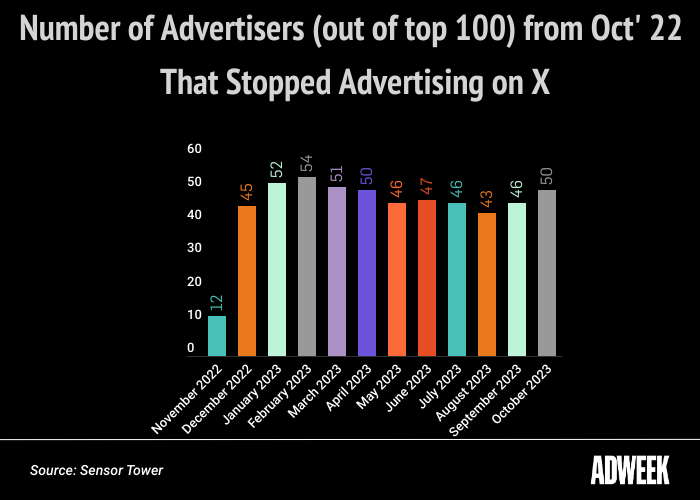
Market intelligence firm Sensor Tower analyzed how many of X’s top 100 advertisers, as of October 2022, have stuck around in the ensuing months of Musk’s ownership.

In December 2022, 45 of these top spenders ceased advertising on the platform. That figure rose to 54 by February 2023, but dropped back to 46 in May, the month that former NBC Universal executive Linda Yaccarino assumed the CEO role. As of October, 50 top advertisers had stopped spending on the platform, according to Sensor Tower.

“All these brands made a big fuss and quietly, as the dust settled, they jumped back into the water,” said an agency media buyer requesting anonymity to discuss sensitive client matters. The buyer had a large entertainment client come back to the platform in the second quarter following Yaccarino’s appointment as CEO. This client stopped advertisements on X in the past week following the latest controversy in which Musk called an antisemitic post “the actual truth.”

Adweek, Sensory Tower

Disney, Comcast and Apple, among others, stopped advertising on the platform in the past week. Additionally, left-leaning watchdog Media Matters published a report last week finding ads on X appearing next to hate speech. In turn, Musk is suing Media Matters for defamation.

There’s a contrarian take [that says] ‘give me the garbage inventory.’

—Anonymous ad buyer

Clients of media analysis firm Ebiquity have gradually stopped spend on X. Throughout 2022, around 30 clients were consistently active. That figure dropped to 24 in December 2022 and 16 in January, staying in the teens until July, when the number of active advertisers on X dropped to 6. Only two Ebiquity clients were on X as of September, the latest month for which data is available.

“A slow trickle [of clients] returned with Linda joining and then a slow decline [left] as issues mounted,” said a second media buyer, requesting anonymity. “About two months after Linda [joined] … it was obvious that Musk made decisions and Yaccarino always backed them.”

Insider Intelligence forecasts X’s global ad revenue will drop to $1.81 billion in 2024, a sharp fall from $4.41 billion in 2022 when Musk took over.

Success in selling products and for entertainment brands

While X’s latest brand safety controversies have been the final push for some brands, others are sticking with the platform.

An ecommerce client of the first media buyer is still on X after finding the platform particularly performative in selling products to men. The customer base is more female-skewing when the brand prioritizes other platforms.

“There is a very favorable CPM, cost arbitrage environment to exploit,” the first buyer said. “There’s a contrarian take [that says] ‘give me the garbage inventory.’ That remains an underpinning of a strategic conversion.”

X still has unduplicated reach compared to some platforms, and is still especially salient for pop culture conversations and entertainment brands, the buyer added.

Amazon spend on X increased by more than 84% in October 2023 compared to October of last year, according to Sensor Tower data. Adweek has reached out to Amazon for comment.

But most brands that have resumed advertising on the platform are spending much less than they did last year, the firm found. For example, Mondelez spent 28% more on X in October than it did in October 2022, according to Sensor Tower. Adweek has reached out to Mondelez for comment.

Other brands say X was never a performance driver.

A media buyer from a large restaurant brand said the platform was always the worst-performing social channel, generating the lowest return on ad spend (though still a positive figure). The brand has stopped spending on ads for over a year, though still posts via brand accounts. X figures less prominently in organic strategy, the buyer said.

“We used to amplify best performing organic via paid,” the brand media buyer said. “Without that, the reach is minimal.”

.font-primary { } .font-secondary { } #meter-count { position: fixed; z-index: 9999999; bottom: 0; width:96%; margin: 2%; -webkit-border-radius: 4px; -moz-border-radius: 4px; border-radius: 4px; -webkit-box-shadow: 0 0px 15px 4px rgba(0,0,0,.2); box-shadow:0 0px 15px 4px rgba(0,0,0,.2); padding: 15px 0; color:#fff; background-color:#343a40; } #meter-count .icon { width: auto; opacity:.8; } #meter-count .icon svg { height: 36px; width: auto; } #meter-count .btn-subscribe { font-size:14px; font-weight:bold; padding:7px 18px; color: #fff; background-color: #2eb3b2; border:none; text-transform: capitalize; margin-right:10px; } #meter-count .btn-subscribe:hover { color: #fff; opacity:.8; } #meter-count .btn-signin { font-size:14px; font-weight:bold; padding:7px 14px; color: #fff; background-color: #121212; border:none; text-transform: capitalize; } #meter-count .btn-signin:hover { color: #fff; opacity:.8; } #meter-count h3 { color:#fff!important; letter-spacing:0px!important; margin:0; padding:0; font-size:16px; line-height:1.5; font-weight:700; margin: 0!important; padding: 0!important; } #meter-count h3 span { color:#E50000!important; font-weight:900; } #meter-count p { font-size:14px; font-weight:500; line-height:1.4; color:#eee!important; margin: 0!important; padding: 0!important; } #meter-count .close { color:#fff; display:block; position:absolute; top: 4px; right:4px; z-index: 999999; } #meter-count .close svg { display:block; color:#fff; height:16px; width:auto; cursor:pointer; } #meter-count .close:hover svg { color:#E50000; } #meter-count .fw-600 { font-weight:600; } @media (max-width: 1079px) { #meter-count .icon { margin:0; padding:0; display:none; } } @media (max-width: 768px) { #meter-count { margin: 0; -webkit-border-radius: 0px; -moz-border-radius: 0px; border-radius: 0px; width:100%; -webkit-box-shadow: 0 -8px 10px -4px rgba(0,0,0,0.3); box-shadow: 0 -8px 10px -4px rgba(0,0,0,0.3); } #meter-count .icon { margin:0; padding:0; display:none; } #meter-count h3 { color:#fff!important; font-size:14px; } #meter-count p { color:#fff!important; font-size: 12px; font-weight: 500; } #meter-count .btn-subscribe, #meter-count .btn-signin { font-size:12px; padding:7px 12px; } #meter-count .btn-signin { display:none; } #meter-count .close svg { height:14px; } }

Enjoying Adweek’s Content? Register for More Access!

https://www.adweek.com/media/advertisers-x-exit-has-been-a-trickle-rather-than-an-exodus/


Sam Altman’s Move to Microsoft Changes Its Bing Search Battle With Google


.article-native-ad { border-bottom: 1px solid #ddd; margin: 0 45px; padding-bottom: 20px; margin-bottom: 20px; } .article-native-ad svg { color: #ddd; font-size: 34px; margin-top: 10px; } .article-native-ad p { line-height:1.5; padding:0!important; padding-left: 10px!important; } .article-native-ad strong { font-weight:500; color:rgb(46,179,178); }

Introducing the Adweek Podcast Network. Access infinite inspiration in your pocket on everything from career advice and creativity to metaverse marketing and more. Browse all podcasts.

While Microsoft’s swift hiring of Sam Altman could boost its position as the frontrunner in the race of AI, there are unintended consequences that will benefit Google’s position in AI dominance, industry analysts tell Adweek.

Altman’s move to Microsoft capped a whipsaw weekend that began Friday with the co-founder and CEO of OpenAI being ousted by the board, attempts to retain him and finally the move to the world’s No. 2 most valuable company, which already had invested $13 billion in OpenAI.

The dizzying unfolding of events has left executives in the ad industry pondering the implications of the market dominance of search engines.

A potential shift by Microsoft from a GPT-powered model to an internal technology might hinder the tech giant’s standing in the AI race. This move could prove advantageous to rival Google, potentially granting it a speed-to-market edge due to its in-house tech development.

“If Altman was ousted because he is moving too quickly to ship products, and that worried some of the AI ethicists at OpenAI, that means ChatGPT could go slower or fall apart,” said Erik Hamilton, vp of search and social at Good Apple.

Microsoft CEO Satya Nadella hired Altman to lead a newly established advanced AI research team.

“He’s basically working for the same team, just on the side of the commercial stakeholder,” said Nicole Greene, vp analyst at Gartner. “It’s a shift in focus.”

Microsoft had a strong quarter ending in September, suggesting the company’s investments in gen AI were starting to positively impact revenue. In addition to integrating gen AI features across its devices, Microsoft expanded AI-powered advertising in its search business on Bing.

Still, advertisers are yet to see a material lift in query volume in Bing after Microsoft launched the generative experience, according to Aaron Levy, vp of paid search at Tinuiti.

“I see this as a long-term advantage for Microsoft as they’ll now be able to develop on their terms, without the oversight from a non-profit board,” he said. “Azure will provide an arguably unlimited supply of computing power, and they’ll be able to develop the search experience in tandem with the model itself.”

Elsewhere, industry insiders have indicated the recent changes at OpenAI might result in short-term product quality issues for ChatGPT, increased downtime and delays in new signups. These developments are raising concerns about OpenAI’s long-term sustainability.

Not an immediate win for Microsoft

Microsoft still has its work cut out for it to change consumer sentiment about AI.

Gartner research found that 82% of consumers are concerned there’ll be no net benefits to society from gen AI. Conversely, 56% of marketing leaders see a greater reward than risk with gen AI.

“Any short-term advantage, or disadvantage, to [Microsoft] will likely be muted until a shift in consumer behavior takes hold,” said Levy.

Meanwhile, if Microsoft remains steady in building its AI capabilities for both its commercial partners and consumers, it could find an opportunity for business growth, according to Greene.

The end of OpenAI?

Following Altman’s departure, OpenAI quickly hired a new interim CEO. In his first order of business, Emmett Shear, former CEO of Twitch, said he planned to enlist an independent investigator to look into the C-suite drama at OpenAI.

“It’s clear that the process and communications around Sam’s removal has been handled very badly, which has seriously damaged our trust,” Shear wrote on X.

Elsewhere, in a letter addressed to the OpenAI board, more than 500 employees have called for the resignations of the three independent board members.

OpenAI had been considering a new funding round with the goal of raising an estimated total of $100 billion, per The Information.

“This seems improbable now, with potential funding at a reduced valuation. Investor confidence may also waver due to the board’s dominant role, evidenced by Altman’s dismissal,” said Chris Harihar, evp of Mod Op-owned Crenshaw Communications. “For ChatGPT, this means likely reduced resources, potentially impacting the maintenance of its capital-intensive infrastructure.”

The head-spinning nature of the changes might not be over. Sources are telling The Verge that Altman, who co-founded OpenAI, would be willing to return as CEO under the right circumstances. Given that Microsoft is already the largest shareholder in OpenAI, the return would be smoother, with a lot less drama, than the departure.

.font-primary { } .font-secondary { } #meter-count { position: fixed; z-index: 9999999; bottom: 0; width:96%; margin: 2%; -webkit-border-radius: 4px; -moz-border-radius: 4px; border-radius: 4px; -webkit-box-shadow: 0 0px 15px 4px rgba(0,0,0,.2); box-shadow:0 0px 15px 4px rgba(0,0,0,.2); padding: 15px 0; color:#fff; background-color:#343a40; } #meter-count .icon { width: auto; opacity:.8; } #meter-count .icon svg { height: 36px; width: auto; } #meter-count .btn-subscribe { font-size:14px; font-weight:bold; padding:7px 18px; color: #fff; background-color: #2eb3b2; border:none; text-transform: capitalize; margin-right:10px; } #meter-count .btn-subscribe:hover { color: #fff; opacity:.8; } #meter-count .btn-signin { font-size:14px; font-weight:bold; padding:7px 14px; color: #fff; background-color: #121212; border:none; text-transform: capitalize; } #meter-count .btn-signin:hover { color: #fff; opacity:.8; } #meter-count h3 { color:#fff!important; letter-spacing:0px!important; margin:0; padding:0; font-size:16px; line-height:1.5; font-weight:700; margin: 0!important; padding: 0!important; } #meter-count h3 span { color:#E50000!important; font-weight:900; } #meter-count p { font-size:14px; font-weight:500; line-height:1.4; color:#eee!important; margin: 0!important; padding: 0!important; } #meter-count .close { color:#fff; display:block; position:absolute; top: 4px; right:4px; z-index: 999999; } #meter-count .close svg { display:block; color:#fff; height:16px; width:auto; cursor:pointer; } #meter-count .close:hover svg { color:#E50000; } #meter-count .fw-600 { font-weight:600; } @media (max-width: 1079px) { #meter-count .icon { margin:0; padding:0; display:none; } } @media (max-width: 768px) { #meter-count { margin: 0; -webkit-border-radius: 0px; -moz-border-radius: 0px; border-radius: 0px; width:100%; -webkit-box-shadow: 0 -8px 10px -4px rgba(0,0,0,0.3); box-shadow: 0 -8px 10px -4px rgba(0,0,0,0.3); } #meter-count .icon { margin:0; padding:0; display:none; } #meter-count h3 { color:#fff!important; font-size:14px; } #meter-count p { color:#fff!important; font-size: 12px; font-weight: 500; } #meter-count .btn-subscribe, #meter-count .btn-signin { font-size:12px; padding:7px 12px; } #meter-count .btn-signin { display:none; } #meter-count .close svg { height:14px; } }

Enjoying Adweek’s Content? Register for More Access!

https://www.adweek.com/media/sam-altman-move-to-microsoft/


Working From Home Spurs Ad Block Rates to Rise


.article-native-ad { border-bottom: 1px solid #ddd; margin: 0 45px; padding-bottom: 20px; margin-bottom: 20px; } .article-native-ad svg { color: #ddd; font-size: 34px; margin-top: 10px; } .article-native-ad p { line-height:1.5; padding:0!important; padding-left: 10px!important; } .article-native-ad strong { font-weight:500; color:rgb(46,179,178); }

Introducing the Adweek Podcast Network. Access infinite inspiration in your pocket on everything from career advice and creativity to metaverse marketing and more. Browse all podcasts.

Mobile and desktop ad-block rates are experiencing a gradual uptick, increasing by 11% in 2023 from 2021, according to ad-filtering tech firm Eyeo and its 2023 Ad-Filtering Report.

Buoyed by the work-from-home trend, the rate of ad blocking on desktops in the U.S. reached 27% by the end of the second quarter this year, according to the report by Eyeo. The ad-blocking rate on mobile phones is 22%.

The report forecasts that publishers around the world will lose $54 billion in ad revenue due to ad blocking in 2024—based on global ad spend figures—representing roughly 8% of total global ad spend. The report suggests the cost would be up to $116 billion if ad-filtering solutions didn’t exist.

Before 2021, rates of ad blockers leveled off after publishers introduced tactics like urging people to deactivate ad blockers to access content or adopting Acceptable Ads standards, which regulate criteria like ad size in order to show people lighter ads.

The increased adoption of mobile devices globally combined with people replicating their ad-blocking experiences from desktop to mobile has spiked the trend on mobile devices, said Jan Wittek, chief revenue officer, Eyeo. There’s a total of 912 million active ad-blocking users worldwide across mobile and desktop.

Despite receiving higher traffic, mobile pages tend to be less lucrative than desktop due to lower revenue per page (RPM). However, the continued shift in traffic from desktop to mobile means that Eyeo anticipates a rise in ad blockers on mobile devices. As of October 2023, the global split among mobile and desktop market share is at 53% and 45.5% respectively, according to Statcounter.

“Safari doesn’t have third-party cookies and obviously there’s third-party cookie demise happening,” said Ben Morrisroe, head of growth at ad-tech firm Publift. “There’s definitely a squeeze on publishers being able to monetize the users as well as we have been able to so far.”

Meanwhile, data from App Annie found that downloads of the top five dedicated ad-blocking apps in the U.S. saw a 17% increase from the second quarter of 2023 to the third quarter, rising from 115,000 to 134,000 across the Google Play app store.

Recouping revenue and gating content

In the last year, Raptive—which runs ad sales for titles like MacRumors and Stereogum—saw ad blocking rates average across its publishers of between 20% and 30% of users, according to chief strategy officer Paul Bannister.

“It’s a pretty big number,” he said.

Raptive works with Eyeo’s Blockthrough solution to tap into the Acceptable Ads program run by the Acceptable Ads Committee, which serve ads that fit specific criteria to people who have chosen to block them. The number of people opting into Acceptable Ads has increased by 42% between the first quarter of 2022 and the second quarter of 2023, crossing the 300 million mark, the company said.

As such, Raptive has been able to deliver 2.7 billion ad impressions to ad blockers, facilitated by Blockthrough, according to estimates from Eyeo. Raptive has recouped millions of dollars in the past.

Elsewhere, Morrisroe said that publishing sites have seen an annual recovery of 12-15% in ad revenue by using Acceptable Ads.

Niche publishers, particularly those with a direct focus like providing weather updates or running calculator sites that heavily rely on a monetization model through display ads, face a higher risk from growing ad-block rates.

“[They have] 10 direct competitors in search, and people can jump to other sites easily,” said Morrisroe.

To mitigate the risk, Morrisroe said, publishers can use models where people are rewarded with some free content in exchange for engaging with an ad, already seen in some paywalled sites and games like Candy Crush.

“The open web is going to end up being a lot more like this,” said Morrisroe. “It’s going get more complex and specific to who this user is, where are they coming from, what’s the RPM and how you optimize that.”

This article has been updated to clarify that Eyeo’s Blockthrough solution taps into the Acceptable Ads program.

.font-primary { } .font-secondary { } #meter-count { position: fixed; z-index: 9999999; bottom: 0; width:96%; margin: 2%; -webkit-border-radius: 4px; -moz-border-radius: 4px; border-radius: 4px; -webkit-box-shadow: 0 0px 15px 4px rgba(0,0,0,.2); box-shadow:0 0px 15px 4px rgba(0,0,0,.2); padding: 15px 0; color:#fff; background-color:#343a40; } #meter-count .icon { width: auto; opacity:.8; } #meter-count .icon svg { height: 36px; width: auto; } #meter-count .btn-subscribe { font-size:14px; font-weight:bold; padding:7px 18px; color: #fff; background-color: #2eb3b2; border:none; text-transform: capitalize; margin-right:10px; } #meter-count .btn-subscribe:hover { color: #fff; opacity:.8; } #meter-count .btn-signin { font-size:14px; font-weight:bold; padding:7px 14px; color: #fff; background-color: #121212; border:none; text-transform: capitalize; } #meter-count .btn-signin:hover { color: #fff; opacity:.8; } #meter-count h3 { color:#fff!important; letter-spacing:0px!important; margin:0; padding:0; font-size:16px; line-height:1.5; font-weight:700; margin: 0!important; padding: 0!important; } #meter-count h3 span { color:#E50000!important; font-weight:900; } #meter-count p { font-size:14px; font-weight:500; line-height:1.4; color:#eee!important; margin: 0!important; padding: 0!important; } #meter-count .close { color:#fff; display:block; position:absolute; top: 4px; right:4px; z-index: 999999; } #meter-count .close svg { display:block; color:#fff; height:16px; width:auto; cursor:pointer; } #meter-count .close:hover svg { color:#E50000; } #meter-count .fw-600 { font-weight:600; } @media (max-width: 1079px) { #meter-count .icon { margin:0; padding:0; display:none; } } @media (max-width: 768px) { #meter-count { margin: 0; -webkit-border-radius: 0px; -moz-border-radius: 0px; border-radius: 0px; width:100%; -webkit-box-shadow: 0 -8px 10px -4px rgba(0,0,0,0.3); box-shadow: 0 -8px 10px -4px rgba(0,0,0,0.3); } #meter-count .icon { margin:0; padding:0; display:none; } #meter-count h3 { color:#fff!important; font-size:14px; } #meter-count p { color:#fff!important; font-size: 12px; font-weight: 500; } #meter-count .btn-subscribe, #meter-count .btn-signin { font-size:12px; padding:7px 12px; } #meter-count .btn-signin { display:none; } #meter-count .close svg { height:14px; } }

Enjoying Adweek’s Content? Register for More Access!

https://www.adweek.com/media/working-from-home-spurs-ad-block-rates-to-rise/


Shocker – Sam Altman out at OpenAI in huge CEO change

Sam Altman is no longer CEO of OpenAI. Mira Murati, OpenAI’s chief technology officer, has been named interim CEO, the company announced.

Why was Altman ousted? Altman was not consistently candid in his communications with the OpenAI’s board of directors, “hindering its ability to exercise its responsibilities. The board no longer has confidence in his ability to continue leading OpenAI,” according to OpenAI’s statement.

What’s next? OpenAI will begin its search for its next permanent CEO, the company said.

Why we care. Search marketers were shocked to learn of Altman being forced out of OpenAI, the company behind the extremely popular generative AI tool ChatGPT, which launched less than a year ago on Nov. 30, 2022. It has changed the way we work and the direction of search. This will be a story to watch over the next few weeks.

State of ChatGPT. It has 100 million active users – including about 90% of Fortune 500 companies. ChatGPT Plus sign-ups were paused Nov. 14 due to surge in demand, according to Altman. That followed a series of ChatGPT outages due to DDoS attacks.

Reaction. Here are some of the early reactions from the industry:

What OpenAI is saying. Here’s the full statement:

The board of directors of OpenAI, Inc, the 501(c)(3) that acts as the overall governing body for all OpenAI activities, today announced that Sam Altman will depart as CEO and leave the board of directors. Mira Murati, the company’s chief technology officer, will serve as interim CEO, effective immediately.

A member of OpenAI’s leadership team for five years, Mira has played a critical role in OpenAI’s evolution into a global AI leader. She brings a unique skill set, understanding of the company’s values, operations, and business, and already leads the company’s research, product, and safety functions. Given her long tenure and close engagement with all aspects of the company, including her experience in AI governance and policy, the board believes she is uniquely qualified for the role and anticipates a seamless transition while it conducts a formal search for a permanent CEO.

Mr. Altman’s departure follows a deliberative review process by the board, which concluded that he was not consistently candid in his communications with the board, hindering its ability to exercise its responsibilities. The board no longer has confidence in his ability to continue leading OpenAI.

In a statement, the board of directors said: “OpenAI was deliberately structured to advance our mission: to ensure that artificial general intelligence benefits all humanity. The board remains fully committed to serving this mission. We are grateful for Sam’s many contributions to the founding and growth of OpenAI. At the same time, we believe new leadership is necessary as we move forward. As the leader of the company’s research, product, and safety functions, Mira is exceptionally qualified to step into the role of interim CEO. We have the utmost confidence in her ability to lead OpenAI during this transition period.”

OpenAI’s board of directors consists of OpenAI chief scientist Ilya Sutskever, independent directors Quora CEO Adam D’Angelo, technology entrepreneur Tasha McCauley, and Georgetown Center for Security and Emerging Technology’s Helen Toner.

As a part of this transition, Greg Brockman will be stepping down as chairman of the board and will remain in his role at the company, reporting to the CEO.

OpenAI was founded as a non-profit in 2015 with the core mission of ensuring that artificial general intelligence benefits all of humanity. In 2019, OpenAI restructured to ensure that the company could raise capital in pursuit of this mission, while preserving the nonprofit’s mission, governance, and oversight. The majority of the board is independent, and the independent directors do not hold equity in OpenAI. While the company has experienced dramatic growth, it remains the fundamental governance responsibility of the board to advance OpenAI’s mission and preserve the principles of its Charter.


Related stories

New on Search Engine Land

@media screen and (min-width: 800px) { #div-gpt-ad-3191538-7 { display: flex !important; justify-content: center !important; align-items: center !important; min-width:770px; min-height:260px; } } @media screen and (min-width: 1279px) { #div-gpt-ad-3191538-7 { display: flex !important; justify-content: center !important; align-items: center !important; min-width:800px!important; min-height:440px!important; } }

About the author

Danny Goodwin

Danny Goodwin has been Managing Editor of Search Engine Land & Search Marketing Expo – SMX since 2022. He joined Search Engine Land in 2022 as Senior Editor. In addition to reporting on the latest search marketing news, he manages Search Engine Land’s SME (Subject Matter Expert) program. He also helps program U.S. SMX events. Goodwin has been editing and writing about the latest developments and trends in search and digital marketing since 2007. He previously was Executive Editor of Search Engine Journal (from 2017 to 2022), managing editor of Momentology (from 2014-2016) and editor of Search Engine Watch (from 2007 to 2014). He has spoken at many major search conferences and virtual events, and has been sourced for his expertise by a wide range of publications and podcasts.

https://searchengineland.com/sam-altman-out-at-openai-in-shocking-leadership-change-434847