Introducing the Adweek Podcast Network. Access infinite inspiration in your pocket on everything from career advice and creativity to metaverse marketing and more. Browse all podcasts.
Car hire app Uber and audio platform Spotify have more evidence that people, especially younger generations, are gravitating toward longer-form content.
“People are spending two and a half hours a day on Spotify’s platform,” Grace Kao, global head of business marketing at Spotify, said on stage at Adweek’s NexTech event this week. “It’s a great opportunity for marketers to tell a brand story in longer formats across the day.”
And bucking public opinion, younger people “don’t have short attention spans,” she added. “They are curious, and they like deeper engagement. You can extend the moments.”
Two recent reports by Spotify—Culture Next, which focuses on younger generations, and the 2023 Podcast Trends Report—revealed insights into how people are listening across the day. Podcasts are popular in the morning, while getting ready for work or school, as well as after 9 p.m. when people watch video podcasts to wind down.
As such, marketers should think not just about the ad content, but the environment. Kao claims that when people go to Spotify to listen to music and podcasts, “they feel good, which increases effectiveness as well as cost efficiency.”
The environment of the car ride is a “lean back” experience and suited to driving awareness, said Mark Grether, vp and general manager of Uber Advertising, adding that the average Uber ride lasts 20 minutes.
Uber differentiates as a platform by combining data from food delivery platform Uber Eats—where it has 450,000 advertisers globally—with Uber’s car riders, he said. Uber’s platform sees 137 million monthly users, according to Grether.
“When you are between two tasks, you are open to new content, new information, you’re receptive,” said Grether. “What’s unique in our case is that we give that single trip over to a single advertiser. We know [the passenger is] on their way to the movies, to work, to the airport, we know what they are eating through Uber Eats, so we can tailor that content.”
The car as the next living room
Younger people are not driving as much as their older peers, and are using car hires apps like Uber more.
Uber estimates that people spend about eight hours a week in the car, mostly driving themselves. In the future, that car will likely be self-driving, or a car hire service like Uber, and people will still have that eight hours a week to be shown content and ads.
“The car in the future will become the next living room, and screens in the cars will become the next TV screens,” said Grether. “That will be a really powerful medium in the future, more than today, more than we anticipate it will be.”
Beyond the siloed thinking of audio or video campaigns that some marketers can be guilty of, early examples of marketers using both Uber’s mobility and food delivery platforms indicate a more holistic approach to campaigns.
“In the future, we will see branding and performance—upper and lower funnel tactics—come together,” he said. “You will have a much more holistic ad campaign that brings branded campaigns, typically video-led, together with more transaction-based campaigns on the performance side.”
Grether pointed to a beverage advertiser using a playable ad format to drive awareness inside the car—a brand-building, upper funnel tactic. People playing with the ad can then order the drink through Uber Eats to get it delivered to their home. The campaign brings together first-party, upper and lower funnel data, to learn who is transacting and then tries to approach them with upper funnel tactics. “This makes the customer journey much more efficient and brings together branding and performance in one single campaign,” he said.
Of course, customer data is the linchpin to making these campaigns work effectively.
Having access to people’s data is a “privilege,” said Kao, it needs “care and transparency.” Spotify Wrapped, which creates a soundtrack for people of their most played songs that year, is an example of creating an “experience that is valuable and meaningful from that data.”
Yahoo Search to start rolling out in the first weeks of 2024
Yahoo Search is expected to start rolling out aspects of its new search engine in the first weeks of 2024. Brian Provost, the Senior VP and General Manager of Yahoo Search, said Yahoo Search will be launching in the very early days of 2024.
We are expecting more basic features to come out from Yahoo’s search team in the early weeks of 2024, maybe as soon as a couple months from now. But then more of the AI and advanced features to continue to roll out in the future.
Watch what Brian Provost said. You can watch the replay of Brian Provost’s talk and Q&A session by registering for free at our SMX Next website and going to the SMX agenda at the 2:10pm session. Note, he spoke more about the release dates during the Q&A session.
Why we care. We have been expecting Yahoo to make its comeback to search since earlier this year and it seems we may be seeing that return in the near future.
I for one am looking forward to a new Yahoo Search experience.
@media screen and (min-width: 800px) { #div-gpt-ad-3191538-7 { display: flex !important; justify-content: center !important; align-items: center !important; min-width:770px; min-height:260px; }
}
@media screen and (min-width: 1279px) { #div-gpt-ad-3191538-7 { display: flex !important; justify-content: center !important; align-items: center !important; min-width:800px!important; min-height:440px!important; }
}
About the author
Barry Schwartz is a Contributing Editor to Search Engine Land and a member of the programming team for SMX events. He owns RustyBrick, a NY based web consulting firm. He also runs Search Engine Roundtable, a popular search blog on very advanced SEM topics. Barry can be followed on Twitter here.
Yandex N.V., which is now a Dutch holding company, is looking to sell off its search engine and all of its other Russian assets as part of a deal estimated to be between $5 billion and $6 billion, Reuters reported.
Likely sale? A sale could come as early as December. Yandex N.V. might sell 100% of all its Russian assets or hold share options.
“Dutch holding company Yandex NV’s planned restructuring is aimed at recouping some shareholder funds with the sale of its main revenue-generating Russian businesses, such as its search and ride-hailing operations. It then plans to develop four other business lines internationally,” Reuters reported.
Yandex also dominates online advertising in Russia.
Why we care.Yandex has been in turmoil since Russia invaded Ukraine in February 2022, though it still has a commanding 65.95% search market share in Russia (only 1.83 globally), in October, per StatCounter, while Yandex announced it had 62.6% market share in its Q3 2023 earnings report. It remains an area international search marketers will want to watch.
@media screen and (min-width: 800px) { #div-gpt-ad-3191538-7 { display: flex !important; justify-content: center !important; align-items: center !important; min-width:770px; min-height:260px; }
}
@media screen and (min-width: 1279px) { #div-gpt-ad-3191538-7 { display: flex !important; justify-content: center !important; align-items: center !important; min-width:800px!important; min-height:440px!important; }
}
About the author
Danny Goodwin has been Managing Editor of Search Engine Land & Search Marketing Expo – SMX since 2022. He joined Search Engine Land in 2022 as Senior Editor. In addition to reporting on the latest search marketing news, he manages Search Engine Land’s SME (Subject Matter Expert) program. He also helps program U.S. SMX events. Goodwin has been editing and writing about the latest developments and trends in search and digital marketing since 2007. He previously was Executive Editor of Search Engine Journal (from 2017 to 2022), managing editor of Momentology (from 2014-2016) and editor of Search Engine Watch (from 2007 to 2014). He has spoken at many major search conferences and virtual events, and has been sourced for his expertise by a wide range of publications and podcasts.
It’s no secret that collaboration is essential to growth, but the how of it isn’t always so clear—and it’s the understanding of how that is a true competitive advantage. Join Adweek X, a uniquely formatted event on December 4 in LA, to unlock fresh perspectives, true collaboration and growth.
As artificial intelligence impacts the operations of digital media publishers, Reddit chief operating officer Jen Wong believes that the community platform might be one of the few companies insulated as a result of being focused on human interactivity and first-hand knowledge sharing.
“We think we will become more important in the future no matter what, in any AI-summarized world, because we have the original source of human ideas,” she said in conversation with Adweek CEO Will Lee at NexTech in New York.
Introducing the Adweek Podcast Network. Access infinite inspiration in your pocket on everything from career advice and creativity to metaverse marketing and more. Browse all podcasts.
Six-year-old cryptocurrency exchange OKX has made significant changes to its marketing strategy over the last year, swapping programmatic ads for strategic brand awareness partnerships and focusing on changing consumer sentiment rather than tying marketing efforts to sales.
“[In 2022] we showed up in the market in a very audacious way when everyone was scared,” said Haider Rafique, OKX’s CMO. “In this case, the fun part was that nobody knew who OKX was.”
The very public display of the crypto industry’s ills over the last few years has eroded people’s trust. The collapse of crypto exchange FTX in November 2022—plus last week’s guilty charges of FTX boss Sam Bankman-Fried for fraud—have further exacerbated the ongoing cooling of sentiment. FTX’s collapse played a role in OKX’s decision to withdraw its Super Bowl ad campaign in 2023, said Rafique, leading to zero crypto ads in the Big Game, a stark contrast to the year prior. Now, crypto companies like OKX, and Kraken which launched its largest marketing campaign to date in October, are finding longer-term ways to connect with potential customers.
“The crypto industry is focused on trying to rehabilitate its image in the wake of so much negative publicity,” said Andrew Frank, VP distinguished analyst at Gartner. “Trying to actually change public perception of an entire industry strikes me as an incredibly difficult thing [in advertising].”
Brand partnerships over digital media spend
OKX was aggressive in digital ad spend during the first half of 2022, especially on Google and Twitter. The company also invested $1 million dollars in testing programmatic ads.
“We realized it took us almost 12 months to break even on that spend,” said Rafique.
OKX roughly spent $30 million on total ad spend in 2022, including programmatic and social ads, according to Rafique. This year, this budget has been reduced to $24 million.
“What’s better is to spend those digital dollars through sports and entertainment properties,” he added.
OKX secured its first exclusive deal with U.K. soccer club Manchester City in March 2022, involving the placement of OKX branding on the left sleeves of players. Since then, the company has inked two more agreements, the most recent in June this year. These combined deals amounted to over $70 million, reported Forbes.
Following the deal with Manchester City, OKX expanded its brand affiliations in a multi-year deal with McLaren Formula 1 in 2022. The latest arrangement this year includes the prominent placing of the OKX brand logo on the cars’ side pods for seven races.
After deals with McLaren Formula 1 and Manchester City, OKX saw 70% brand recall in a survey of 800 people from March 2022 to January of this year, the company said.
The crypto firm also sponsored the Tribeca Film Festival in June and created NFT passes for festival attendees while establishing an interactive “NFT Lab” letting people mint their own NFTs.
“We have access to close to 250 million followers globally [via these partnerships],” said Rafique. “It’s a deeper connection than just buying inventory on a bunch of different websites where you think your audience is.”
In 2022, OKX spent $3 million on social media ads. The company has slashed its Twitter spend by 80% and reallocated that budget to TikTok, where it has noticed more favorable brand recall, according to internal surveys.
The company is also investing in developing branded content, but Rafique wouldn’t share specifics.
Changing public perception
While a whole host of CMOs typically try to connect their marketing endeavors to sales, OKX—as a relatively young company—is placing greater emphasis on internal success metrics related to consumer sentiments. The company tracks this via social media listening tools and polls after its event experiences, such as the F1 activations. Reports claim the exchange has 50 million-plus users.
In a poll of over 350 people that OKX conducted on X, 80% of people expressed positive sentiments towards the company’s partnership initiatives.
After its Token2049 F1 McLaren Fanzone campaign in September, 83% of Fanzone’s 7,000 attendees opened an OKX Wallet, while 80% wanted to learn more about OKX.
“I was very clear in setting that expectation with our founder when I was being recruited,” said Rafique. “It is ultimately about the feeling of our customers and clients.”
Experience the buzz at NexTech, Adweek’s innovative conference for the newest tools in marketing technology. Talk with experts on generative AI, audience management, automation, the metaverse and more. Register.
In the midst of the rapid advancements in generative artificial intelligence, Adweek’s weekly summary provides an overview of the most recent updates, regulatory activities, and business developments in the world of gen AI that marketers need to know.
This week’s news update includes:
On the policy side
Ahead of 2024’s U.S. presidential elections, Meta has barred political advertisers from using its generative AI ad products, per Reuters. Meanwhile, the company mandated global political advertisers to disclose the use of third-party AI tools in political or ads, The New York Times reported.
However, it’s increasingly difficult to correctly detect if an image is generated using AI, according to Patrick Bangert, svp of data, analytics and AI consultancy company Searce. “Simply taking down the ads is not feasible at scale and will be inadequate to prevent damage,” he said.
On the tech side
Google brings gen AI to Performance Max with new tools becoming available to U.S. advertisers by the end of the year. Google promises the AI tool will not create two identical images, skirting the possible outcomes of two competing brands seeing similar images. The company will deploy SynthID watermarks on all creative assets and incorporate open standard metadata for labeling AI-generated images.
Paid subscribers to YouTube’s premium package will get its gen AI updates in the next few weeks. The AI tools will answer questions on the platform’s content and make recommendations, summarizing topics discussed in the video’s comment section, available to users via opt-in.
OpenAI ramps up privacy efforts, the company announced during its first developer conference held in San Francisco on Monday, per CNN. The company introduced Copyright Shield, a protective measure to support OpenAI customers and cover expenses associated with potential copyright infringement issues. Developers now have the ability to tailor ChatGPT, allowing it to integrate with databases, assist in emails, or streamline e-commerce orders, akin to plugins.
Instagram finally catches up in the gen AI image race. The platform will introduce two gen AI filters that let people perform advanced edits by easing the separation of image elements. Ahmad Al-Dahle, vp of generative AI at Meta, shared this development with Axios at its inaugural AI+ conference in San Francisco.
7 must-see Google Search ranking documents in antitrust trial exhibits
The U.S. Department of Justice has released several new trial exhibits – including internal Google presentations, documents and emails related to ranking.
Here are seven that specifically discuss elements of Google Search ranking:
This is a heavily redacted PowerPoint presentation put together by Google’s Eric Lehman – and like most of the other documents, it lacks the full context accompanying it.
However, what’s here is interesting for all SEOs.
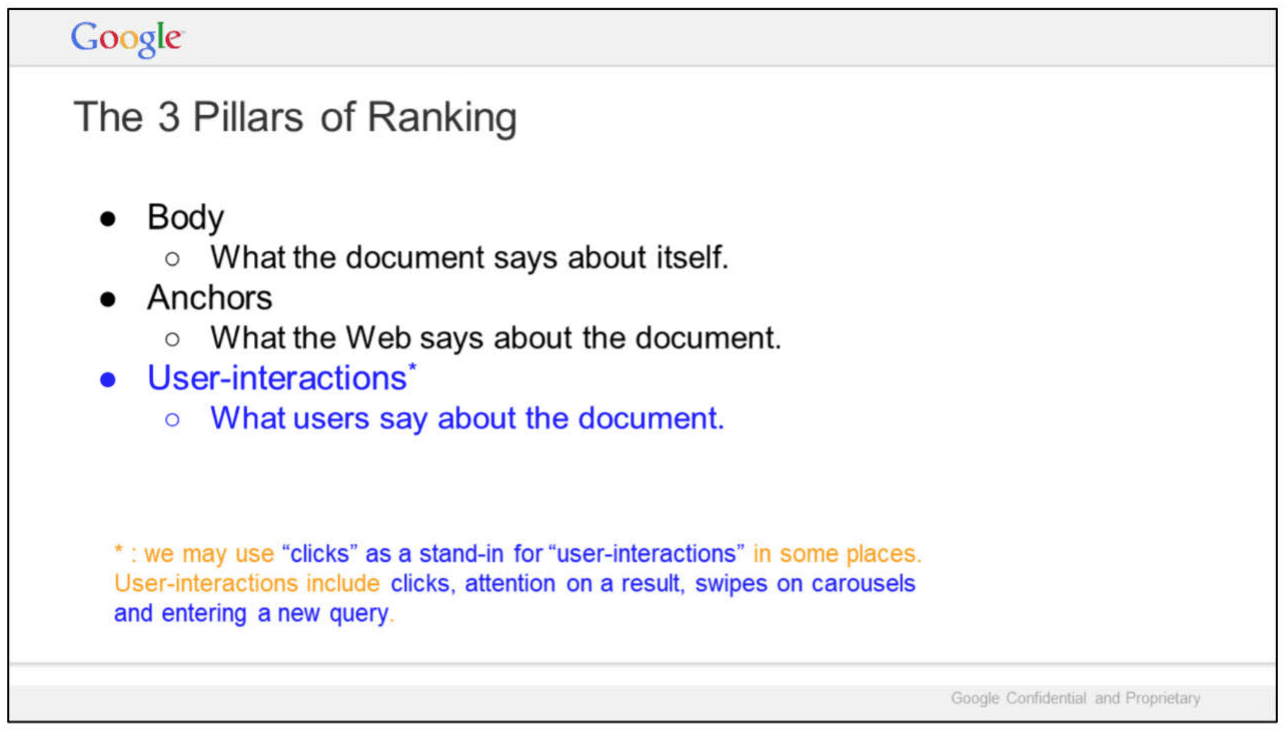
In “The 3 Pillars of Ranking,” slide, Google highlights three areas:
Body: What the document says about itself.
Anchors: What the Web says about the document.
User-interactions: What users say about the document.
Google added a note about user interactions:
“we may use ‘clicks’ as a stand-in for ‘user-interactions’ in some places. User-interactions include clicks, attention on a result, swipes on carousels and entering a new query.
In this slide, titled “User interaction signals,” Google illustrates the relationships of queries, interactions and Search results, alongside results for the query [why is the ocean salty]. Specific interactions mentioned by Google:
Read
Clicks
Scrolls
Mouse hovers
In September, Lehman testified during the antitrust trial that Google uses clicks in rankings. However, once again, it’s important to make clear that individual clicks alone are a noisy signal for ranking (more on that in Ranking for Research). Google has publicly said it uses click data for training, evaluation, controlled experiments and personalization.
What is redacted:
A slide titled “Metrics” – all that is visible is one line: “Web Ranking Components.”
Seven additional slides, including two titled “Outline” and “Summary.”
These seven slides were part of a larger Q4 2016 Search All Hands presentation, prepared by Lehman.
In this slide, Google says “We do not understand documents. We fake it.”
“Today, our ability to understand documents directly is minimal.
So we watch how people react to documents and memorize their responses.”
And the source of Google’s “magic” is revealed:
“Let’s start with some background..
A billion times a day, people ask us to find documents relevant to a query.
What’s crazy is that we don’t actually understand documents. Beyond some basic stuff, we hardly look at documents. We look at people.
If a document gets a positive reaction, we figure it is good. If the reaction is negative, it is probably bad.
Grossly simplified, this is the source of Google’s magic.”
So how does this work?
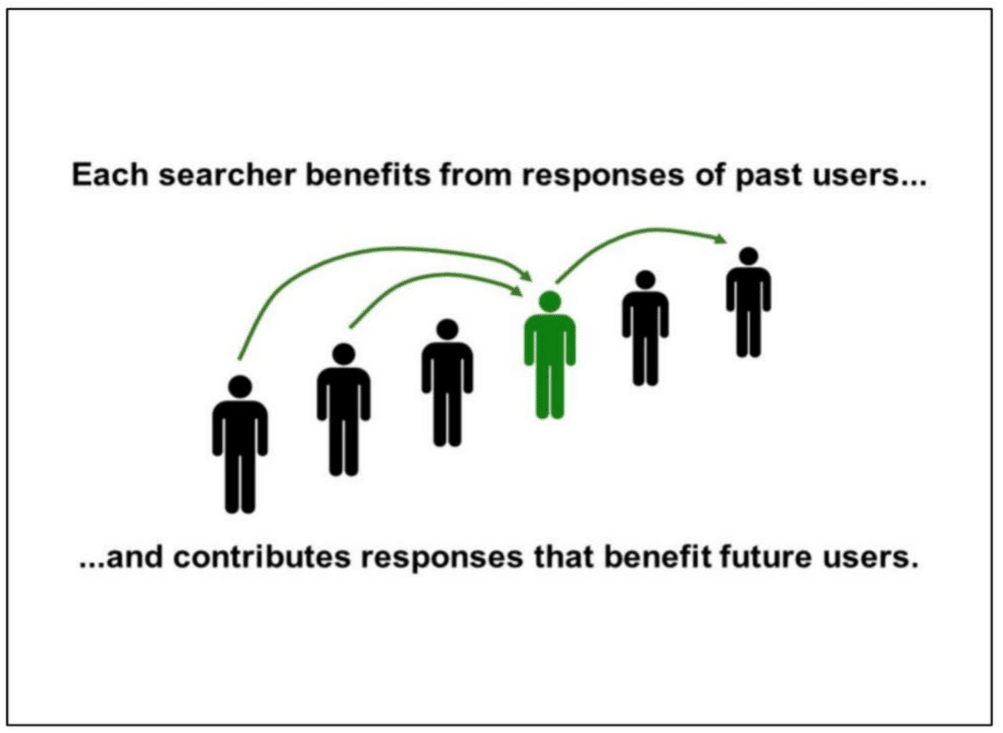
In this slide, Google explains how “each searcher benefits from the responses of past users … and contributes responses that benefit future users”:
“Search keeps working by induction.
This has an important implication.
In designing user experiences, SERVING the user is NOT ENOUGH.
We have to design interactions that also allow us to LEARN from users.
Because that is how we serve the next person, keep the induction rolling, and sustain the illusion that we understand.
Looking to the future, I believe learning from users is also the key to TRULY understanding language.”
And in the final slide, Google sums up with this statement:
“When fake understanding fails, we look stupid.”
The other four slides are entirely skippable, unless you’re interested in knowing that “Search is a great place to start understanding language. Success has implications far beyond Search.”
Google is looking at end users – how people interact with Search results. Not as individuals – but as a collective.
3. Ranking for Research
It’s unclear who created this presentation, but there are some very interesting findings in here.
In this slide, Google talks about 18 aspects of search quality:
Relevance
Page quality
Popularity
Freshness
Localization
Language
Centrality
Topical diversity
Personalization
Web ecosystem
Mobile friendly
Social fairness
Optionalization
Porn demotion
Spam
Authority
Privacy
User control of spell correction
This slide discusses the shortcomings of live traffic evaluations. Yes, essentially Google is talking about clicks not being a good signal because they are hard to interpret.
“The association between observed user behavior and search result quality is tenuous. We need lots of traffic to draw conclusions, and individual examples are difficult to interpret.”
Finally, this slide provides a different illustration of how Google Search result ranking works:
There are some other interesting tidbits in this presentation, though not necessarily tied to ranking. Of note:
“Attempts to manipulate search results are continuous, sophisticated, and well-funded. Information about how search works should remain need-to-know.” (Slide 5)
“Keep talk about how search works on a need-to-know basis. Everything we leak will be used against us by SEOs, patent trolls, competitors, etc.” (Slide 10)
“Do not discuss the use of clicks in search, except on a need-to-know basis with people who understand not to talk about this topic externally. Google has a public position. It is debatable. But please don’t craft your own.” (Slide 11)
In this presentation, we learn how search really works.
This slide explains how search does not work. From the notes:
“We get a query. Various scoring systems emit data, we slap on a UX, and ship it to the user.
This is not false, just incomplete. So incomplete that a search engine built this way won’t work very well. No magic.”
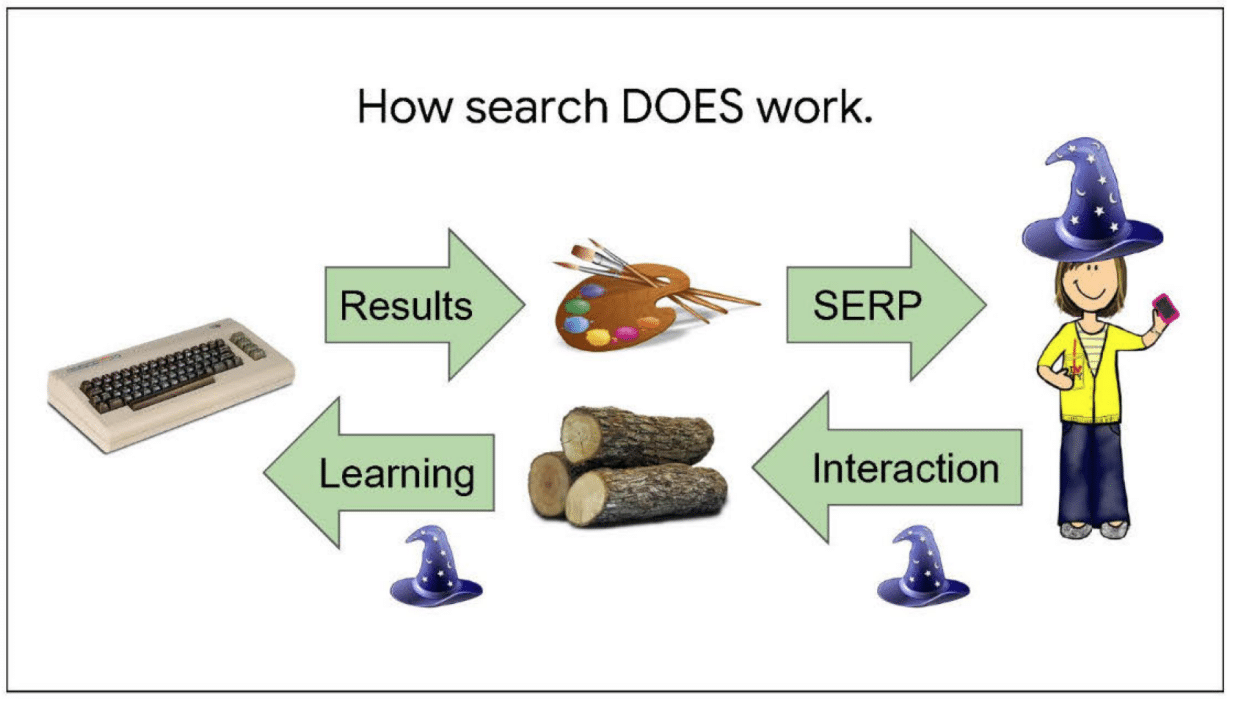
In this slide, we learn how search does work:
“The key is a second flow of information in the reverse direction.
As people interact with search, their actions teach us about the world.
For example, a click might tell us that an image was better than a web result. Or a long look like might mean a KP was interesting.
We log these actions, and then scoring teams extract both narrow and general patterns.”
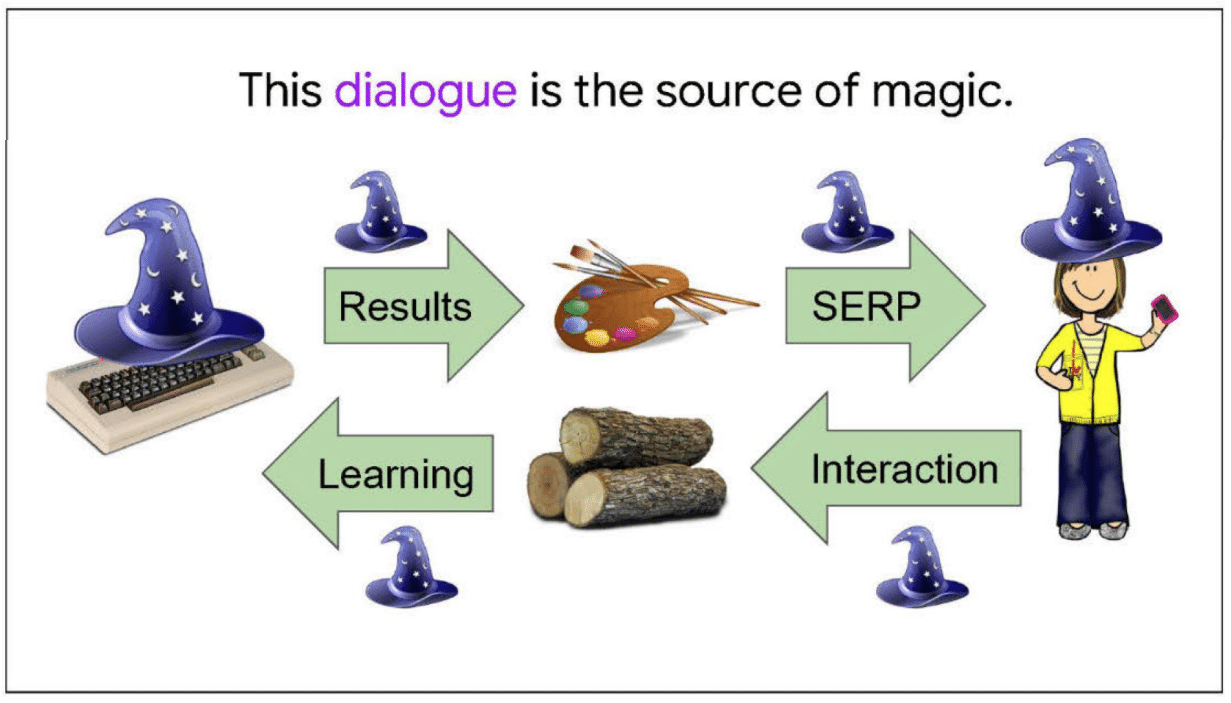
Next, we learn the source of Google’s “magic.” From the notes:
“The source of Google’s magic is this two-way dialogue with users.
With every query, we give a some knowledge, and get a little back. Then we give some more, and get a little more back.
These bits add up. After a few hundred billion rounds, we start lookin’ pretty smart!
This isn’t the only way we learn, but the most effective.”
So how does Google learn more from users? From the notes:
“On the surface, users ask questions and Google answers. That’s our basic business. We can’t screw that up. But we have to quietly turn the tables. One way is to:
ask the user a question implicitly
provide necessary background information
give the user some way to tell us the answer”
This slide looks at the 10 blue links.
“For example, the ten blue links implicitly pose the question, ‘Which result is best?’
Result previews give background. And the answer is a click.
This is a great UX for learning. For years, Google was mocked for great search results in a bland UI.
But this bland UI made the search results great.”
This slide is on Image Search:
“Image search poses a similar question– which do you like best? Thumbnails provide background information, and the user’s answer is logged as a hover, click, or further interaction.”
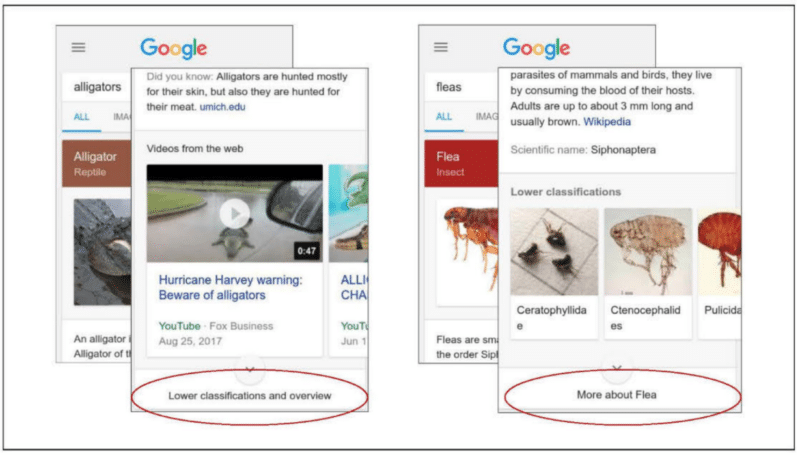
Finally, knowledge cards:
“For example, some knowledge cards need an extra tap to fully open.
On the left, an extra tap means the user wants lower classifications and an overview.
On the right, the user has too little background information.
More what? How is tapping here different from scrolling down? Users can’t make a good decision, so Taps and clicks are such distinctive events in logs; we should endow every one with meaning.”
This presentation discusses the “critical role that logging plays” in ranking and search.
This familiar-looking slide revisits the two-way dialogue being the source of Google’s magic. As explained in the notes:
“Search is a bit like a potluck, where every person brings one dish of food to share. This a great, big spread of food that everyone can enjoy. But it only works because everyone contributes a little bit.
In a similar way, search is powered by a huge mass of knowledge. But it isn’t something we create. Rather, everyone who comes to search contributes a little bit of knowledge to the system from which everyone can benefit.”
In this slide, Google discusses translating user behaviors. From the slide notes:
“The logs do not contain explicit value judgments– this was a good search results, this was a bad one.
So we have to some how translate the user behaviors that are logged into value judgments.
And the translation is really tricky, a problem that people have worked on pretty steadily for more than 15 years.
People work on it because value judgements are the foundation of Google search.
If we can squeeze a fraction of a bit more meaning out of a session, then we get like a billion times that the very next day.
The basic game is that you start with a small amount of ‘ground truth’ data that says this thing on the search page is good, this is bad, this is better than that.
Then you look at all the associated user behaviors, and say, “Ah, this is what a user does with a good thing! This is what a user does with a bad thing! This is how a user shows preference!’
Of course, people are different and erratic. So all we get is statistical correlations, nothing really reliable.
For example:
[REDACTED]
– If someone clicks on three search results, which one is bad? Well, likely ALL of them, because it is probably a hard query if they clicked 3 results. Challenge is to figure out which one is most promising.”
Finally, this slide discusses how logging supports ranking and Search. From the notes:
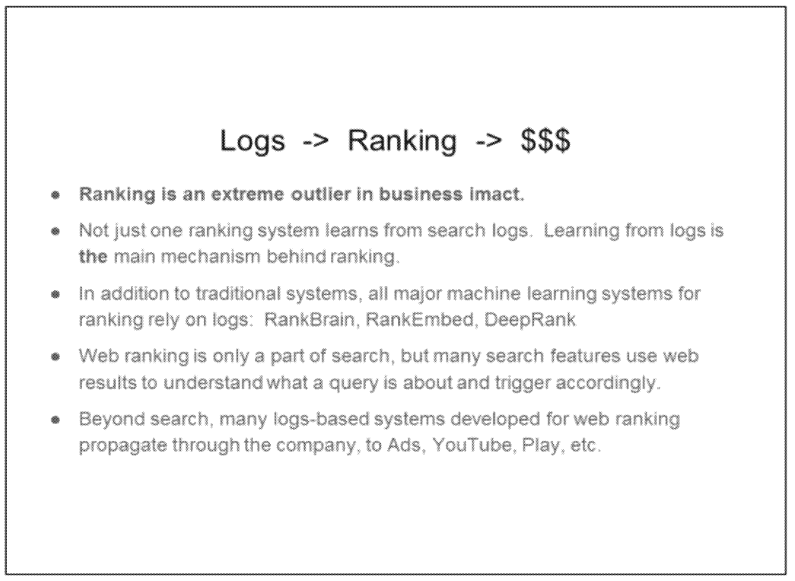
“… and here comes the part I warned you about. I’m selling something. I’m selling the idea of the logs term keeping the needs of the ranking team in mind. Pretty please with sugar on top.
But the basic reason is that the ranking team is really weird in one more way, and that is business impact.
As I mentioned, not one system, but a great many within ranking are built on logs.
This isn’t just traditional systems, like the one I showed you earlier, but also the most cutting-edge machine learning systems, many of which we’ve announced externally– RankBrain, RankEmbed, and DeepRank.
Web ranking is only a part of search, but many search features use web results to interpret the query and trigger accordingly.
So supporting ranking supports search as a whole.
But even beyond this, technologies developed in search spread out across the company to Ads, YouTube, Play, and elsewhere.
So– I’m not in finance– but grossly speaking, I think a huge amount of Google business is tied to the use of logs in ranking.”
This newsletter dove into the differences between desktop and mobile search ranking, user intents and user satisfaction – at a time when mobile traffic was starting to surpass desktop traffic on some days.
Google did a comparison of metrics, including:
CTR
Manual refinement
Queries per task
Query length (in char)
Query lengths (in word)
Abandonment
Average Click Position
Duplicates
Based on the findings, one of the recommendations was:
“Separate mobile ranking signals or evaluation reflecting different intents. Mobile queries often have different intents, and we may need to incorporate additional or supplementary signals reflecting these intents into our ranking framework. As discussed earlier, it is desirable that these signals handle local-level breakdowns properly.
Nothing surprising in this document (it’s unclear who wrote it), but one interesting bullet on BERT and Search ranking:
“Early experiments with BERT applied to several other areas in Search, including Web Ranking, suggest very significant improvements in understanding queries, documents and intents.”
“While BERT is revolutionary, it is merely the beginning of a leap in Natural Language Understanding technologies.”
Revenue, customer growth returns Semrush to profitability in Q3
With customer and revenue growth hitting new highs in Q3, Semrush achieved its first profitable quarter since Q1 2021. That ends a stretch of nine straight quarters posting a net loss.
Semrush’s third quarter revenue was $78.7 million, up 20% year-over-year ($65.8 million) from 2022.
Earlier this year, Semrush said it expected to break even or show a profit for 2023, after losing $33.8 million in 2022.
Customers. Semrush had about 106,800 paying customers as of Sept. 30. This was up nearly 14% from the “over 94,000” figure it reported a year ago. Also:
20% growth in customers who pay more than $10,000 annually.
987,000 registered free active customers (up 25%)
Price increases starting. On the investor call, Eugene Levin, President, discussed one of the company’s growth pillars – to “maximize the value” Semrush generates from its users. Pricing changes started rolling out in Q3, according to Levy:
“We took the opportunity to optimize our pricing strategy to better align with the tremendous value our product delivers. During Q3, and into the early part of Q4, we tested price increases with a cohort of customers, and we were encouraged by the response, as net adds, and retention were in line with our expectations and recent trends.
“In our view, this indicates customers have a strong need for our offering and are willing to pay more given the unique benefits it provides them with. While we are still in the early phases of pricing adjustments, these initial findings suggest there may be room to prudently raise prices to better capture the value we provide, which we think, over time, would also contribute further to our growth.
“Our plan is to be thoughtful and measured. We expect to continue testing and analyzing data so that any broader pricing changes are backed by customer insights while maintaining our commitment to delivering exceptional value.”
Why we care. Many Search Engine Land readers use Semrush daily, so it’s good to know the company continues to be in good shape financially. Meanwhile, these results show SEO and SEO platforms continue to be in-demand. However, be aware pricing changes have started – and if you haven’t seen them yet, they are coming.
@media screen and (min-width: 800px) { #div-gpt-ad-3191538-7 { display: flex !important; justify-content: center !important; align-items: center !important; min-width:770px; min-height:260px; }
}
@media screen and (min-width: 1279px) { #div-gpt-ad-3191538-7 { display: flex !important; justify-content: center !important; align-items: center !important; min-width:800px!important; min-height:440px!important; }
}
About the author
Danny Goodwin has been Managing Editor of Search Engine Land & Search Marketing Expo – SMX since 2022. He joined Search Engine Land in 2022 as Senior Editor. In addition to reporting on the latest search marketing news, he manages Search Engine Land’s SME (Subject Matter Expert) program. He also helps program U.S. SMX events. Goodwin has been editing and writing about the latest developments and trends in search and digital marketing since 2007. He previously was Executive Editor of Search Engine Journal (from 2017 to 2022), managing editor of Momentology (from 2014-2016) and editor of Search Engine Watch (from 2007 to 2014). He has spoken at many major search conferences and virtual events, and has been sourced for his expertise by a wide range of publications and podcasts.
Alternative facts? Google denies rushing out Bard at trial
I was incredibly surprised to see the headline Google VP Says Bard Chatbot Wasn’t Rushed Out to Beat Microsoft on Bloomberg (warning: paywalled).
That Google VP is Elizabeth Reid, the vice president and GM of Search. She spoke yesterday at the ongoing U.S. vs. Google antitrust hearing.
Why we care. If Google fails to recognize what it looked like from everyone watching, they are essentially living in the land of alternative facts. Which, in case you forgot, are called lies. For a company that preaches about how “trustworthiness” is the most important part of E-E-A-T, they really ought to demonstrate some.
The AI Search race. February was one of the most memorable times in all of Search. I remember it well.
Perhaps the worst-kept secret then was that Microsoft Bing was about to announce a new AI-powered version of Bing, powered by OpenAI’s technology that was powering the hottest new thing in the world – ChatGPT. We first reported on this Jan. 4 in Microsoft to add ChatGPT features to Bing Search.
Search Engine Land’s Barry Schwartz was invited by Microsoft on Thursday, Feb. 2 to an exclusive briefing scheduled for Tuesday, Feb. 7 in Redmond, Wash. The invite even said there were no plans to livestream this event – though that quickly evolved into a special press event.
Why? Google, that’s why. Suddenly, Google has huge embargoed news to share. That news – the announcement of Google’s ChatGPT competitor, an experiment called Bard – went live on Monday, Feb. 6, less than 24 hours before Microsoft’s event.
Press coverage called Google’s news a rushed announcement because it clearly was. Google, at this point, had no product to share. Bard was vaporware, supposedly being released to “trusted testers.”
Google Bard fumbles early. Google then held a public demonstration in which Bard got the first answer wrong about NASA’s James Webb Space Telescope – an early warning of hallucinations that LLMs produce. Alphabet paid a big price, losing $100 billion in market value.
Google disagrees. Reid testified that Bard wasn’t rushed out because Microsoft was planning to announce its generative AI take on search.
“I don’t think you can make that conclusion. Microsoft’s announcement also had several errors in it. The technology is very nascent. It makes mistakes. That’s why we’ve been hesitant to put it forward,” Reid said.
Yes, so hesitant, that Google rushed to upstage Microsoft with its Bard news, less than a day before its biggest Search announcement in years.
@media screen and (min-width: 800px) { #div-gpt-ad-3191538-7 { display: flex !important; justify-content: center !important; align-items: center !important; min-width:770px; min-height:260px; }
}
@media screen and (min-width: 1279px) { #div-gpt-ad-3191538-7 { display: flex !important; justify-content: center !important; align-items: center !important; min-width:800px!important; min-height:440px!important; }
}
About the author
Danny Goodwin has been Managing Editor of Search Engine Land & Search Marketing Expo – SMX since 2022. He joined Search Engine Land in 2022 as Senior Editor. In addition to reporting on the latest search marketing news, he manages Search Engine Land’s SME (Subject Matter Expert) program. He also helps program U.S. SMX events. Goodwin has been editing and writing about the latest developments and trends in search and digital marketing since 2007. He previously was Executive Editor of Search Engine Journal (from 2017 to 2022), managing editor of Momentology (from 2014-2016) and editor of Search Engine Watch (from 2007 to 2014). He has spoken at many major search conferences and virtual events, and has been sourced for his expertise by a wide range of publications and podcasts.
20 most profitable Google queries revealed during antitrust trial
Ever wondered which search queries drive the most revenue for Google? It turns out that iPhone, insurance and cheap flight queries drove the most revenue for Google in the U.S., at least for one week in September 2018.
The list of search terms appeared on a heavily redacted slide that was included in a PDF released this week as a trial exhibit during the ongoing U.S. vs. Google antitrust trial.
Why we care. We know Google makes a lot of money (a modest $116.46 billion in 2018, when compared to the $224.47 billion Google made in 2022) and know which CPCs are most expensive. But we’ve never known which search terms were the most lucrative for Google because Google has never before revealed this information.
The 20 most profitable Google searches. The top search terms for the week of Sept. 22, 2018 in the U.S., ordered by revenue, were:
iPhone 8
iPhone 8 plus
auto insurance
car insurance
cheap flights
car insurance quote
direct tv
online colleges
at&t
hulu
iPhone
uber
spectrum
comcast
xfinity
insurance quotes
free credit report
cheap car insurance
aarp
lifelock
All other information was redacted on the slide – specifically:
Revenue (how much Google made off each search term).
Queries (number of).
RPM (ad revenue per thousand impressions).
The slide. It appears in this PDF. Here is a screenshot:
@media screen and (min-width: 800px) { #div-gpt-ad-3191538-7 { display: flex !important; justify-content: center !important; align-items: center !important; min-width:770px; min-height:260px; }
}
@media screen and (min-width: 1279px) { #div-gpt-ad-3191538-7 { display: flex !important; justify-content: center !important; align-items: center !important; min-width:800px!important; min-height:440px!important; }
}
About the author
Danny Goodwin has been Managing Editor of Search Engine Land & Search Marketing Expo – SMX since 2022. He joined Search Engine Land in 2022 as Senior Editor. In addition to reporting on the latest search marketing news, he manages Search Engine Land’s SME (Subject Matter Expert) program. He also helps program U.S. SMX events. Goodwin has been editing and writing about the latest developments and trends in search and digital marketing since 2007. He previously was Executive Editor of Search Engine Journal (from 2017 to 2022), managing editor of Momentology (from 2014-2016) and editor of Search Engine Watch (from 2007 to 2014). He has spoken at many major search conferences and virtual events, and has been sourced for his expertise by a wide range of publications and podcasts.