Meta AI assistant uses Microsoft Bing Search results

Meta AI, announced today, is a new conversational assistant “you can interact with like a person,” according to the company.

Microsoft Bing is working with Meta to “integrate Bing into Meta AI’s chat experiences enabling more timely and up-to-date answers with access to real-time search information,” according to Yusuf Mehdi, corporate vice president and consumer chief marketing officer, in a company blog post.

This includes bringing Bing to Meta AI and Meta’s 28 other new AI characters in Instagram, WhatsApp and Messenger.

What Microsoft is saying. If a request requires fresh information, Meta AI will automatically ask Bing to get the chat answer, according to Jordi Ribas, Microsoft CVP, head of engineering and product for Bing.

  • “Many people ask me whether LLMs will make web search engines less valuable, but the opposite is actually the case. LLMs make web search more critical than ever, since the combination of LLMs + web search is what produces fresher and more accurate chat results,” Ribas posted on X.

Why we care. Search continues to expand and is now essentially everything, everywhere, all at once. This integration means Meta’s AI assistant will have access to real-time information, which in theory should produce better chat results via conversational search. And coming soon: businesses will be able to create their own AIs.

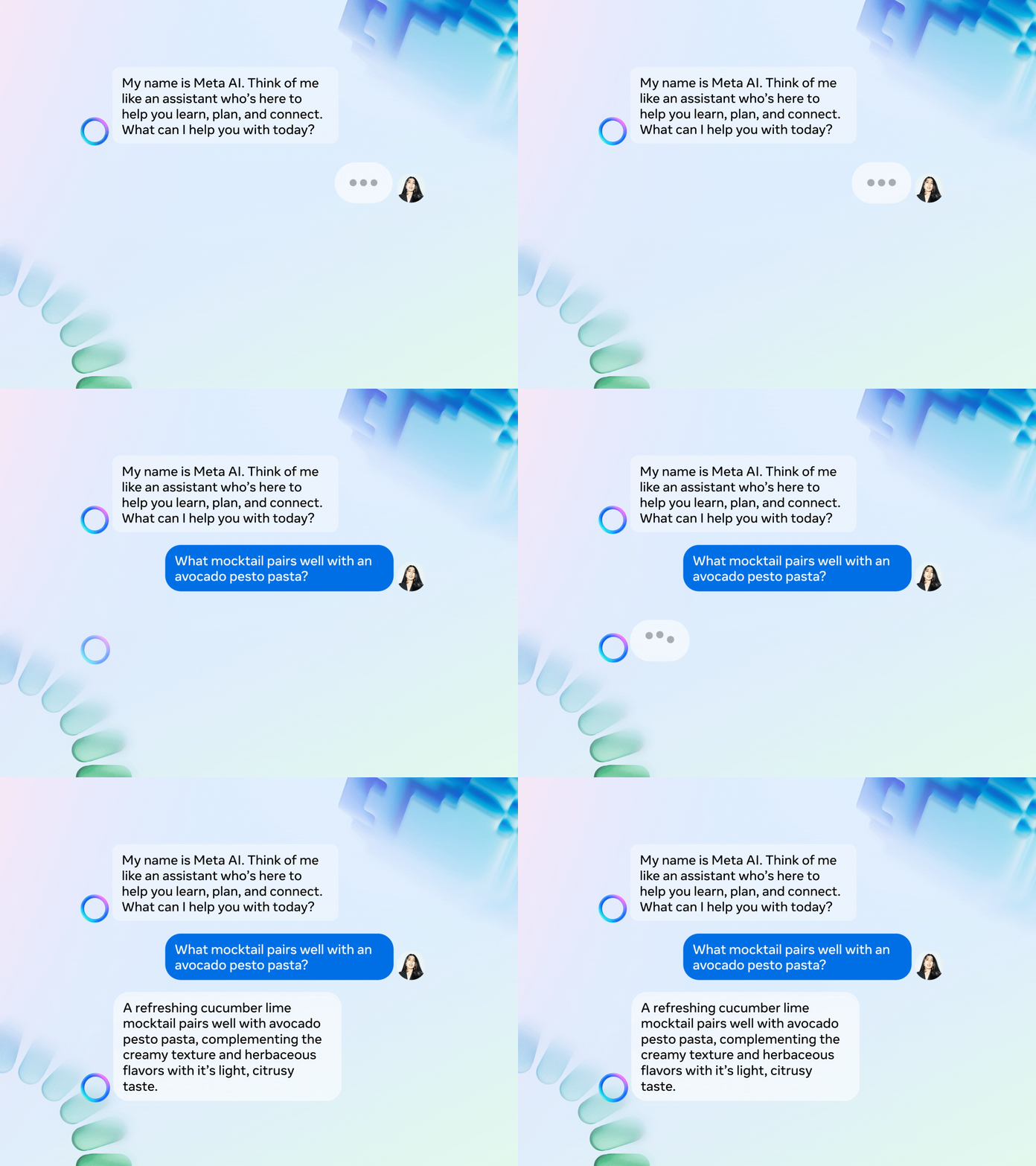
What Meta AI looks like. Here’s a GIF Meta shared:

Meta AI Assistant

More Meta AIs with Bing. Meta announced it is releasing 28 additional AIs, all with unique personas, that users can interact with on its platforms. Meta said it plans to bring Bing search to these AI characters, many of which are based on celebrities (e.g., Tom Brady, Snoop Dogg, Paris Hilton, Mr Beast) “in the coming months.”

Bing’s role. Meta AI is powered by a custom model that leverages technology from Llama 2 and other large language models. However, Meta’s LLMs are only trained on information prior to 2023, which would lead to dated responses. This is where Bing’s real-time web results will come into play.

More to come. Meta promises that it is working on AIs for businesses and creators that will be available next year. From Meta:

  • “Businesses will also be able to create AIs that reflect their brand’s values and improve customer service experiences. From small businesses looking to scale to large brands wanting to enhance communications, AIs can help businesses engage with their customers across our apps. We’re launching this in alpha and will scale it further next year.”

Related stories

New on Search Engine Land

@media screen and (min-width: 800px) { #div-gpt-ad-3191538-7 { display: flex !important; justify-content: center !important; align-items: center !important; min-width:770px; min-height:260px; } } @media screen and (min-width: 1279px) { #div-gpt-ad-3191538-7 { display: flex !important; justify-content: center !important; align-items: center !important; min-width:800px!important; min-height:440px!important; } }
About the author

Danny Goodwin

Danny Goodwin has been Managing Editor of Search Engine Land & Search Marketing Expo – SMX since 2022. He joined Search Engine Land in 2022 as Senior Editor. In addition to reporting on the latest search marketing news, he manages Search Engine Land’s SME (Subject Matter Expert) program. He also helps program U.S. SMX events. Goodwin has been editing and writing about the latest developments and trends in search and digital marketing since 2007. He previously was Executive Editor of Search Engine Journal (from 2017 to 2022), managing editor of Momentology (from 2014-2016) and editor of Search Engine Watch (from 2007 to 2014). He has spoken at many major search conferences and virtual events, and has been sourced for his expertise by a wide range of publications and podcasts.

https://searchengineland.com/meta-ai-assistant-uses-microsoft-bing-search-results-432565


Links are not a top 3 Google Search ranking factor, says Gary Illyes

In 2016, Andrey Lipattsev, a Google search quality senior strategist, said links pointing at your site were one of the top three Google Search ranking factors (along with content and RankBrain).

In 2023, that is no longer the case, according to Gary Illyes, an analyst on the Google Search team, speaking at Pubcon Pro in Austin last week.

Why we care. To be clear, links still matter. Illyes said as much. Nobody is saying otherwise. But it’s also important to understand that the Google Search of today is not the same as it was in 2014 or the early 2000s when PageRank was everything and every link was a “vote.” Technology has advanced and machine learning (e.g., BERT, MUM), natural language understanding and other relevance signals now have more importance in Google’s algorithm.

Dig deeper: AMA with Google’s Gary Illyes: 15 quick SEO takeaways

What Illyes said. Illyes was asked whether links are still among the three most important Google Search ranking factors. He does not.

  • “I think they are important, but I think people overestimate the importance of links. I don’t agree it’s in the top three. It hasn’t been for some time.”

Illyes also said, “it is possible to rank without links.” Although it very much sounded like an edge case, he mentioned one case in which a website had zero links (internal or external) but had such fantastic content that it was ranking number one consistently. Google was only able to discover it via the website’s sitemap.

Illyes delivered a similar message earlier this year during a keynote at a Pubcon event in February, noting you can do fine in many verticals without links:

  • “Links are important, but not as important as people think.”

Not the first to downgrade links. Duy Nguyen from Google’s search quality team also said links have a less significant impact for ranking in November during a Google SEO Office Hours:

  • “First, backlinks as a signal has a lot less significant impact compared to when Google Search first started out many years ago. We have robust ranking signals, hundreds of them, to make sure that we are able to rank the most relevant and useful results for all queries.”

In a Search Off the Record podcast episode, Google’s John Mueller said he believes that links will be not as important of a ranking factor for Google:

“Well, it’s something where I imagine, over time, the weight on the links. At some point, will drop off a little bit as we can’t figure out a little bit better how the content fits in within the context of the whole web. And to some extent, links will always be something that we care about because we have to find pages somehow. It’s like how do you find a page on the web without some reference to it?

“But my guess is over time, it won’t be such a big factor as sometimes it is today. I think already, that’s something that’s been changing quite a bit.”

Mueller also said in 2020:

  • “Links are definitely not the most important SEO factor.”

And in 2014, Matt Cutts, then a distinguished engineer at Google, said backlinks would become less important:

“I think backlinks still have many, many years left in them. But inevitably, what we’re trying to do is figure out how an expert user would say, this particular page matched their information needs. And sometimes backlinks matter for that. It’s helpful to find out what the reputation of the site or a page is. But, for the most part, people care about the quality of the content on that particular page. So I think over time, backlinks will become a little less important.”

Liar, liar? Whenever a Google representative makes a statement like this, many SEOs say it is typical Google disinformation or flat-out lying. Nobody will ever agree on this – it is SEO, after all.

But again, Illyes didn’t say links are not important at all. He just said that it is not in the “top three.” (Illyes disagrees that there even is a “top three” because every site will have something different as the top two or three ranking factors.)


Related stories

New on Search Engine Land

@media screen and (min-width: 800px) { #div-gpt-ad-3191538-7 { display: flex !important; justify-content: center !important; align-items: center !important; min-width:770px; min-height:260px; } } @media screen and (min-width: 1279px) { #div-gpt-ad-3191538-7 { display: flex !important; justify-content: center !important; align-items: center !important; min-width:800px!important; min-height:440px!important; } }

About the author

Danny Goodwin

Danny Goodwin has been Managing Editor of Search Engine Land & Search Marketing Expo – SMX since 2022. He joined Search Engine Land in 2022 as Senior Editor. In addition to reporting on the latest search marketing news, he manages Search Engine Land’s SME (Subject Matter Expert) program. He also helps program U.S. SMX events. Goodwin has been editing and writing about the latest developments and trends in search and digital marketing since 2007. He previously was Executive Editor of Search Engine Journal (from 2017 to 2022), managing editor of Momentology (from 2014-2016) and editor of Search Engine Watch (from 2007 to 2014). He has spoken at many major search conferences and virtual events, and has been sourced for his expertise by a wide range of publications and podcasts.

https://searchengineland.com/links-google-search-ranking-factor-gary-illyes-432422


Ad Buyers Dismiss Google’s Claim of 5% Ad Price Hike as ‘Too Low’


.article-native-ad { border-bottom: 1px solid #ddd; margin: 0 45px; padding-bottom: 20px; margin-bottom: 20px; } .article-native-ad svg { color: #ddd; font-size: 34px; margin-top: 10px; } .article-native-ad p { line-height:1.5; padding:0!important; padding-left: 10px!important; } .article-native-ad strong { font-weight:500; color:rgb(46,179,178); }

Fine-tune your media, marketing and technology strategies at the Convergent TV Summit on October 25 with expert insights and strategies from the pros. Register now to save 35% on your pass.

Google’s admission to quietly inflating ad auction prices up to 5% for search advertisers, potentially increasing them by 10% for some queries, during the U.S. v. Google antitrust trial comes as little surprise to ad buyers.

According to industry execs, the 5% figure is viewed as rather conservative, and the actual inflation rate could be considerably higher.

During the trial’s second week, Jerry Dischler, Google vp and general manager, admitted to changing the search ads and reserve pricing by as much as 5% to meet revenue targets.

“[Google] claiming 5% is a more conservative number to make it sound like the natural ebb and flow of a marketplace,” said Christine Yang, vp of media at Iris.

While the practice of inflating ad prices, also observed with Facebook and Amazon, might not shock marketers, it’s another frustration with the tech giant. While Google’s exclusive inventory cannot be bought elsewhere, its history of lack of transparency has long frustrated the ad industry, underscoring the complex relationship between advertisers and these tech platforms.

According to Yang, the actual range of inflation can sometimes exceed 100%.

For a brand campaign focused on a niche product, she said the average CPC at $11.74 surged to $25.85 over the last six months, amounting to a 108% increase. However, there wasn’t an incremental return on sales.

“The level to which [price manipulations] happens is what we don’t know,” said Yang. “It’s shady business practices because there’s no regulation. They regulate themselves.”

Giovanni Sollazzo, CEO of Italian media agency Aidem, noted that the actual cost-per-click (CPC) for Google search brand campaigns frequently increased, and the 5% figure is at the lower end of the spectrum. In some cases, the inflation can reach between three to five times higher.

As recent as this summer, Sollazzo found that Google’s ad CPC surged from $0.26 to $0.53 while maintaining the same impression share despite no keyword competition.

“If we accept impression share within +-5%, CPC went from $0.14 to $0.53—almost four times increase,” he said. This led his agency to reduce its ad budget by 70%, with no observable impact on the top line.

“Search ads costs are the result of a real-time auction where advertisers never pay more than their maximum bid,” a Google spokesperson told Adweek. “We’re constantly launching improvements designed to make ads better for both advertisers and users. Our quality improvements help eliminate irrelevant ads, improve relevance, drive greater advertiser value, and deliver high-quality user experiences.”

Dischler’s trial testimony, first reported by Bloomberg, on ad auction price manipulation revealed that Google had adjusted ad auctions to meet revenue targets set by CFO Ruth Porat to meet Wall Street’s demands, at times increasing prices by up to 5%. These changes often involved raising the cost of ads and setting minimum spending thresholds, known as reserve pricing. However, Google did not disclose these price adjustments to advertisers.

“We tend not to tell advertisers about pricing changes,” said Dischler.

A redacted email from Dischler read: “I care more about revenue than the average person but think we can all agree that for our teams trying to live in high-cost areas, another $100,000 in stock price loss will not be great for morale, not to mention the huge impact on our sales team.”

Search ad manipulation in the rearview mirror

The price manipulation is a central point in the Justice Department’s case against Google, which alleges illegal monopolization of the online search market by financially incentivizing web browsers and smartphone manufacturers with billions of dollars to favor its search engine.

“People have been aware that something is going on for a long time,” an industry executive who requested to speak on background told Adweek. “We are looking in the rearview mirror here. The schemes covered in these documents will have been replaced by new ones by now.”

Google’s search ad revenue, constituting approximately 60% of its total earnings, amounted to over $100 billion in 2020, according to Dischler.

During cross-examination by DOJ lawyer David Dahlquist on Tuesday, Dischler admitted that in a sworn 2020 interview, he stated that certain auction adjustments resulted in a 5% uptick for a typical advertiser. He also said it’s “possible” some changes to price hikes went up to 10% for certain queries.

However, Dischler acknowledged Monday that a 15% increase in prices could risk driving advertisers to competitors like Meta and TikTok, making it a perilous move for Google. Dischler also disclosed that Google boasts approximately 5 million advertisers, and retail ads account for nearly 35% of Google’s search ads—its biggest ad category.

“Whether it’s pricing or brand safety, there needs to be an overall increase in transparency,” said Avi Ben-Zvi, GM of North America, Winclap. “These are platforms that advertisers are going to be on no matter what.”

.font-primary { } .font-secondary { } #meter-count { position: fixed; z-index: 9999999; bottom: 0; width:96%; margin: 2%; -webkit-border-radius: 4px; -moz-border-radius: 4px; border-radius: 4px; -webkit-box-shadow: 0 0px 15px 4px rgba(0,0,0,.2); box-shadow:0 0px 15px 4px rgba(0,0,0,.2); padding: 15px 0; color:#fff; background-color:#343a40; } #meter-count .icon { width: auto; opacity:.8; } #meter-count .icon svg { height: 36px; width: auto; } #meter-count .btn-subscribe { font-size:14px; font-weight:bold; padding:7px 18px; color: #fff; background-color: #2eb3b2; border:none; text-transform: capitalize; margin-right:10px; } #meter-count .btn-subscribe:hover { color: #fff; opacity:.8; } #meter-count .btn-signin { font-size:14px; font-weight:bold; padding:7px 14px; color: #fff; background-color: #121212; border:none; text-transform: capitalize; } #meter-count .btn-signin:hover { color: #fff; opacity:.8; } #meter-count h3 { color:#fff!important; letter-spacing:0px!important; margin:0; padding:0; font-size:16px; line-height:1.5; font-weight:700; margin: 0!important; padding: 0!important; } #meter-count h3 span { color:#E50000!important; font-weight:900; } #meter-count p { font-size:14px; font-weight:500; line-height:1.4; color:#eee!important; margin: 0!important; padding: 0!important; } #meter-count .close { color:#fff; display:block; position:absolute; top: 4px; right:4px; z-index: 999999; } #meter-count .close svg { display:block; color:#fff; height:16px; width:auto; cursor:pointer; } #meter-count .close:hover svg { color:#E50000; } #meter-count .fw-600 { font-weight:600; } @media (max-width: 1079px) { #meter-count .icon { margin:0; padding:0; display:none; } } @media (max-width: 768px) { #meter-count { margin: 0; -webkit-border-radius: 0px; -moz-border-radius: 0px; border-radius: 0px; width:100%; -webkit-box-shadow: 0 -8px 10px -4px rgba(0,0,0,0.3); box-shadow: 0 -8px 10px -4px rgba(0,0,0,0.3); } #meter-count .icon { margin:0; padding:0; display:none; } #meter-count h3 { color:#fff!important; font-size:14px; } #meter-count p { color:#fff!important; font-size: 12px; font-weight: 500; } #meter-count .btn-subscribe, #meter-count .btn-signin { font-size:12px; padding:7px 12px; } #meter-count .btn-signin { display:none; } #meter-count .close svg { height:14px; } }

Enjoying Adweek’s Content? Register for More Access!

https://www.adweek.com/media/ad-buyers-dismiss-googles-claim-of-5-ad-price-hike-stating-it-too-low/


AI Watch: Weekly Updates on the Latest Generative AI News


.article-native-ad { border-bottom: 1px solid #ddd; margin: 0 45px; padding-bottom: 20px; margin-bottom: 20px; } .article-native-ad svg { color: #ddd; font-size: 34px; margin-top: 10px; } .article-native-ad p { line-height:1.5; padding:0!important; padding-left: 10px!important; } .article-native-ad strong { font-weight:500; color:rgb(46,179,178); }

Get up to speed on AI and all things tech at NexTech, November 14-15 in NYC (+ virtual). Hear from leaders at Roc Nation, Legitimate, Tracer and more. Save 20% now.

Adweek’s weekly AI roundup captures the latest news, regulatory proceedings and business developments revolving around generative AI.

Here’s what happened this week:

On the policy and legal front: 

  • U.K.’s competition watchdog, CMA (Competition and Markets Authority) has concluded its report on “responsible” generative AI and how people and businesses can stand to benefit from the use of the tech. This is comprised of seven principles to ensure consumer protection and market competition while using AI.
  • Prominent authors including George R.R. Martin, John Grisham and Jonathan Franzen are suing OpenAI for copyright infringement, per The Washington Post. The authors allege that OpenAI’s ChatGPT copies their work without permission. They are seeking a permanent injunction and compensation for lost license fees. “At the heart of these algorithms is systematic theft on a mass scale,” the lawsuit states. 

On the brand and tech side:

  • Generative AI assistant comes to Wall Street: Financial firm Morgan Stanely unveiled AI @ Morgan Stanely Assistant, created with OpenAI’s software, which is ready for financial advisors and their support staff, according to CNBC. This tool supports finance advisors with rapid access to its vast database of approximately 100,000 research reports and documents. Advisors will need to prompt questions in complete sentences instead of relying on keywords. 

  • Estée Lauder Companies enters a strategic partnership with Google Cloud to find new generative AI use cases across its brand sites. This includes a better understanding of consumer sentiment, gaining real-time feedback to create relevant content, and extending its R&D efforts, among others. The cosmetic brand is building new generative AI business applications on Google Cloud’s AI platform, Vertex, to streamline business operations to drive down costs.
  • TikTok is introducing new methods to label AI-generated content, the company announced in a blog post. Although the platform already contains guidelines that require creators to disclose when content is made using AI tools, the new feature will require creators to turn on the label feature. This way, people will know when photos or videos are made via AI software. The social media platform is also testing ways to automatically label AI-generated content. “This reminds me of when the FTC implemented the usage of #ad, it increased transparency for the industry,” said Thomas Ma, co-founder of TikTok creative marketing partner, Sapphire Studios. However, the AI labels “won’t make a significant impact [on brands]” said Ma, “because the label doesn’t change things other than having a big label that AI helped put together what is put out.” 

  • Amazon’s Alexa gets a generative AI facelift, the company announced at its annual Devices & Services event in Arlington, Virginia this week. Similar to OpenAI’s ChatGPT, Alexa will soon be able to write messages and send them on people’s behalf. Citing an example, Amazon presented an invitation written by Alexa, inviting a friend to join a football game. The new feature called “Let’s chat” will be available for an early preview for existing Echo owners in the coming weeks, according to Amazon. 
.font-primary { } .font-secondary { } #meter-count { position: fixed; z-index: 9999999; bottom: 0; width:96%; margin: 2%; -webkit-border-radius: 4px; -moz-border-radius: 4px; border-radius: 4px; -webkit-box-shadow: 0 0px 15px 4px rgba(0,0,0,.2); box-shadow:0 0px 15px 4px rgba(0,0,0,.2); padding: 15px 0; color:#fff; background-color:#343a40; } #meter-count .icon { width: auto; opacity:.8; } #meter-count .icon svg { height: 36px; width: auto; } #meter-count .btn-subscribe { font-size:14px; font-weight:bold; padding:7px 18px; color: #fff; background-color: #2eb3b2; border:none; text-transform: capitalize; margin-right:10px; } #meter-count .btn-subscribe:hover { color: #fff; opacity:.8; } #meter-count .btn-signin { font-size:14px; font-weight:bold; padding:7px 14px; color: #fff; background-color: #121212; border:none; text-transform: capitalize; } #meter-count .btn-signin:hover { color: #fff; opacity:.8; } #meter-count h3 { color:#fff!important; letter-spacing:0px!important; margin:0; padding:0; font-size:16px; line-height:1.5; font-weight:700; margin: 0!important; padding: 0!important; } #meter-count h3 span { color:#E50000!important; font-weight:900; } #meter-count p { font-size:14px; font-weight:500; line-height:1.4; color:#eee!important; margin: 0!important; padding: 0!important; } #meter-count .close { color:#fff; display:block; position:absolute; top: 4px; right:4px; z-index: 999999; } #meter-count .close svg { display:block; color:#fff; height:16px; width:auto; cursor:pointer; } #meter-count .close:hover svg { color:#E50000; } #meter-count .fw-600 { font-weight:600; } @media (max-width: 1079px) { #meter-count .icon { margin:0; padding:0; display:none; } } @media (max-width: 768px) { #meter-count { margin: 0; -webkit-border-radius: 0px; -moz-border-radius: 0px; border-radius: 0px; width:100%; -webkit-box-shadow: 0 -8px 10px -4px rgba(0,0,0,0.3); box-shadow: 0 -8px 10px -4px rgba(0,0,0,0.3); } #meter-count .icon { margin:0; padding:0; display:none; } #meter-count h3 { color:#fff!important; font-size:14px; } #meter-count p { color:#fff!important; font-size: 12px; font-weight: 500; } #meter-count .btn-subscribe, #meter-count .btn-signin { font-size:12px; padding:7px 12px; } #meter-count .btn-signin { display:none; } #meter-count .close svg { height:14px; } }

Enjoying Adweek’s Content? Register for More Access!

https://www.adweek.com/programmatic/weekly-updates-on-generative-ai-news/


9 Amazon reviews best practices to boost sales and trust

Asking whether Amazon reviews are important is like wondering whether your body needs water to thrive. 

The answer is a resounding, “Yes!” 

Acquiring as many positive reviews as possible will pay off for Amazon sellers.

8 reasons Amazon reviews are important

Amazon reviews aren’t just testimonials; they are powerful tools that can make or break your sales on the platform.

Here’s why Amazon reviews have so much impact.

1. Consumer trust

Amazon reviews provide valuable insights into the quality and performance of products. Potential buyers often rely on these reviews to make informed decisions about whether to purchase a product.

Positive reviews can instill trust and confidence in a product, while negative reviews can serve as warnings that scare people off.

2. Product information

Reviews often contain detailed information about the product’s features, benefits and drawbacks — even more so than official product descriptions. 

This can help consumers understand what they are buying and whether it meets their specific needs.

3. Quality assurance

Reviews help hold sellers accountable for the quality of their products. A high number of positive reviews can indicate that a product is reliable and of high quality, while a consistent pattern of negative reviews may signal quality issues.

4. Improved products

Constructive feedback in reviews can be valuable for sellers. 

They can use this feedback to make improvements to their products, addressing issues raised by customers and enhancing overall product quality.

5. SEO and visibility

Amazon’s algorithm considers reviews when ranking products in search results. 

Products with more and better reviews often appear higher in search results, making them more visible to potential customers.

6. Seller reputation

For sellers, maintaining a good reputation on Amazon is crucial. Positive reviews can help build a seller’s credibility and attract more customers. Negative reviews, on the other hand, can harm a seller’s reputation and negatively impact sales.

7. Competitive advantage 

In a competitive marketplace like Amazon, positive reviews can give a product a significant advantage. They can differentiate a product from similar offerings and encourage more sales.

8. Risk mitigation

For consumers, reading reviews can help them avoid making poor purchasing decisions. They can learn from the experiences of others and avoid products that consistently receive negative feedback.

Use these Amazon review best practices to your advantage

With reviews playing such an important role in everything from SERP rankings to sales, it’s inevitable that some sellers would try to game the system by manipulating reviews.

As a result, Amazon has been cracking down, revising its review policy to preserve quality and credibility and maintain consumer trust. They have outlawed many of the practices sellers used to solicit reviews.

This doesn’t mean you should give up on trying to obtain reviews any more than you would stop drinking water. The key is to do so smartly, without violating Amazon’s zero-tolerance policy.

The following Amazon reviews best practices will help you boost sales and improve customer satisfaction. 

1. Understand the algorithmic impact

Amazon is notoriously tight-lipped concerning its review methodology.

However, certain factors – including how recently a review was written and whether the purchase was verified – carry significant weight. Fresh reviews are more valuable for long-term relevancy. 

The bottom line remains the same: the more reviews you have, the higher your search rankings and visibility, and the better your sales.

2. Leverage Amazon Vine

Amazon Vine is a program developed to help facilitate the collection of customer reviews for new and pre-release products on its platform.

Amazon Vine primarily targets more established and trusted reviewers, often referred to as “Vine Voices,” who have a history of writing helpful and informative reviews. Amazon Vine reviews include a badge stating “Vine Customer Review of Free Product” to ensure transparency.

In exchange for providing free items, sellers who enroll in the Amazon Vine program get early reviews from unbiased Vine Voices reviewers who have demonstrated high standards in writing trustworthy reviews. This improves visibility and rankings and can boost sales by up to 30%, according to Amazon. 

3. Encourage organic reviews

Encouraging organic Amazon reviews – reviews that naturally occur without manipulation or incentivization:

  • Improves your credibility and trustworthiness.
  • Helps you build a long-term reputation.
  • Helps potential buyers make informed purchasing decisions.
  • Can improve your product’s visibility in search results.

The best way to obtain organic reviews, which ensure compliance with Amazon’s policies, eliminating any risk of penalties or account suspension, is by providing high-quality products, exceptional customer service, and clear communication.

Respond promptly to customer issues, ensure your products meet or exceed expectations, create informative and engaging product listings, and use constructive customer feedback to make product improvements when necessary.

It’s OK to send customers follow-up emails requesting feedback on their purchases as long as you don’t offer incentives that violate Amazon policies.

4. Respond professionally to negative reviews

Nobody likes a negative review, but they are an inevitable part of doing business.

Responding professionally can have a significant impact on your reputation. Negative reviews are visible to the public, and how you respond can influence how your business is perceived.

Professional responses help minimize damage to your brand and help build trust with both current and potential customers. When you acknowledge their concerns and offer solutions, you have an opportunity to turn dissatisfied customers into loyal ones.

Responding professionally to negative reviews may be easier said than done, so start out by taking a deep breath. Next:

  • Avoid getting defensive; focus on the facts and the customer’s concerns by acknowledging their complaint and expressing empathy.
  • Offer a solution to the problem or provide additional information that might help clarify any misunderstandings.
  • Use courteous and professional language, offer a sincere apology when warranted, and suggest moving the conversation offline to address the issue more personally.

5. Highlight positive reviews in marketing

Positive reviews are a blessing. Highlighting them in other channels is a great way to build trust with potential customers and showcase the quality and value of your products and services.

Incorporating positive reviews into your marketing efforts might involve:

  • Including snippets in your Amazon product descriptions.
  • Creating a testimonials section on your website, including a mix of written reviews and star ratings.
  • Sharing positive reviews on your social media profiles.
  • Using pull quotes in marketing collateral.
  • Incorporating reviews into ad campaigns or product packaging.

Remember to always seek permission from customers before using their reviews or testimonials in your marketing efforts. Doing so ensures your marketing practices comply with Amazon’s policies and any other regulations and ethical guidelines. 

6. Regular monitoring and analysis

Regularly tracking customer reviews keeps you informed about customer perceptions, helps you identify emerging trends or recurring issues, improves customer engagement, and allows you to make data-driven improvements.

Consider using an online monitoring tool like Amazon CloudWatch to continuously track the digital experiences of your customers, or third-party services that aggregate and analyze reviews from various platforms, including Amazon. These tools can help you efficiently manage your online reputation and stay proactive in addressing customer feedback. 

Additionally, establish clear internal processes for reviewing and responding to customer reviews to ensure consistent and timely engagement with your customers’ feedback. 

7. Stay compliant with Amazon’s policies

Staying compliant with Amazon’s policies is crucial. The online platform has established a strict set of rules and guidelines to maintain a fair and trustworthy marketplace.

Violating Amazon’s policies, whether intentionally or not, can lead to the suspension or termination of your seller account, with serious long-term business implications. 

Understanding what is allowed and what is not will help you build and maintain trust with both customers and other sellers, and promotes fair competition.

Amazon’s policies are designed to ensure a positive shopping experience for customers; by focusing on compliance, you’ll help contribute to a more consistent and reliable shopping experience, which can result in higher customer satisfaction and loyalty.

8. Learn from your competitors

By tracking customer reviews of your competitors, you can gain insights into their strengths and weaknesses. This knowledge can inform your own business strategies, helping you differentiate your offerings and outperform the competition.

Begin by identifying your key Amazon competitors – those sellers that offer similar products or services. Collect a sample of competitor reviews for analysis (you can do this by manually reading through their reviews or using review aggregation tools or services to streamline the process), analyze the overall star ratings for consistency, and pay attention to recurring complaints or praises.

Look for competitive advantages, evaluate pricing strategies, and assess their overall brand reputation. Compare the insights gained from competitor reviews with your own reviews, identifying areas where you can leverage strengths or address weaknesses. 

9. Use third-party tools for advanced management

Amazon provides sellers with access to many valuable tools for managing their accounts, but third parties often include additional features designed to streamline operations, optimize sales and enhance overall business performance.

Third-party tools can:

  • Automate repetitive tasks.
  • Provide access to robust analytics and reporting capabilities.
  • Track and manage inventory.
  • Optimize product listings.
  • Manage Amazon advertising campaigns.
  • Integrate with other ecommerce platforms to expand your reach.
  • Help manage customer communications. 

Evaluate third-party management tools carefully, investing in those that align with your specific needs, budget, and business goals.


Opinions expressed in this article are those of the guest author and not necessarily Search Engine Land. Staff authors are listed here.


Related stories

New on Search Engine Land

@media screen and (min-width: 800px) { #div-gpt-ad-3191538-7 { display: flex !important; justify-content: center !important; align-items: center !important; min-width:770px; min-height:260px; } } @media screen and (min-width: 1279px) { #div-gpt-ad-3191538-7 { display: flex !important; justify-content: center !important; align-items: center !important; min-width:800px!important; min-height:440px!important; } }

About the author

Evan Facinger

Evan Facinger is a digital marketer with 15 years of experience and is the Director of Sales and Marketing at Foremost Media, a full-service digital marketing and web development agency. Evan has a robust background that includes; Amazon optimization, search engine optimization (SEO), conversion rate optimization (CRO), marketing automation, and pay-per-click management. He has helped hundreds of clients realize their business goals through digital marketing.

https://searchengineland.com/amazon-reviews-best-practices-sales-trust-431879


4 reasons you should try Facebook Dynamic Ads

Are you looking to engage your audience with a personalized experience throughout their meandering journey – from awareness to conversion and Organic Search through Paid Social?

Then Facebook Dynamic Ads could be your marketing funnel’s secret weapon. 

Regardless of whether you’re B2C or B2B, Facebook’s Dynamic Ads are a smart, cost-effective way to expand your reach.

Here are four reasons why you should consider trying Facebook Dynamic Ads.

1. AI does the hard work

AI may be the big buzzword these days, but seasoned marketers know that paid advertising platforms like Meta have been using AI algorithms for all sorts of things, including Facebook’s Dynamic Ads.

Originally released in 2015, Facebook’s Dynamic Ads were touted as a format to help advertisers “capture the intent signals that customers show on websites and apps to ensure the right products are connected to the right people.”

Put simply, Meta uses AI to analyze user behavior and show users applicable content. 

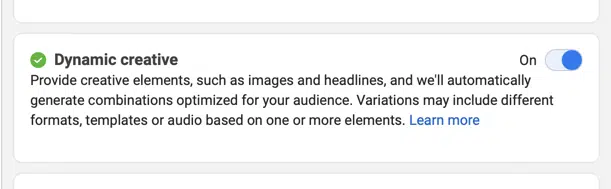
Facebook Dynamic Creative
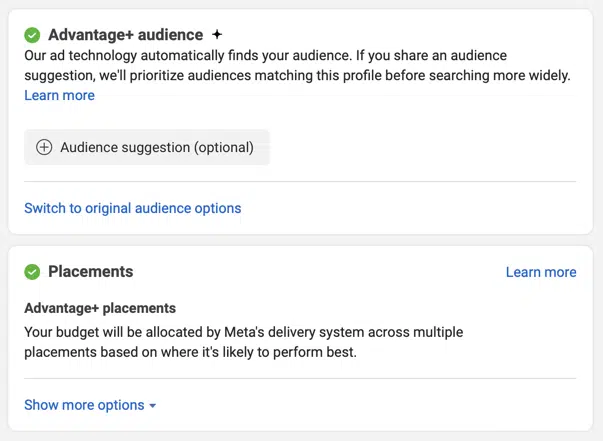
Advantage Plus Audience

Where Dynamic Ads shine is the AI’s ability to decipher user behavior and preferences with precision.

Dynamic Ads tap into Meta’s treasure trove of user data, allowing the ads to adapt seamlessly to each user and their unique surroundings. 

Unlike traditional ad campaigns that require painstaking A/B testing, Dynamic Ads ads eliminate the need for lengthy guesswork. AI does the heavy lifting by continuously analyzing user engagement data and fine-tuning the ad content in real time.

No more creating separate tests. No more manual adjustments. It’s all taken care of behind the scenes.

2. Efficiency

Personalization and performance are intertwined – personalized ads can increase user engagement and significantly enhance ad performance.

So if you aren’t leveraging Dynamic Ads in your Facebook strategy, you’re missing out on that increased user engagement, ad performance and an overall cost-saving tool. 

Finding the winning combination in traditional ad campaigns often requires hefty budgets for A/B testing and manual adjustments after lengthy learning periods.

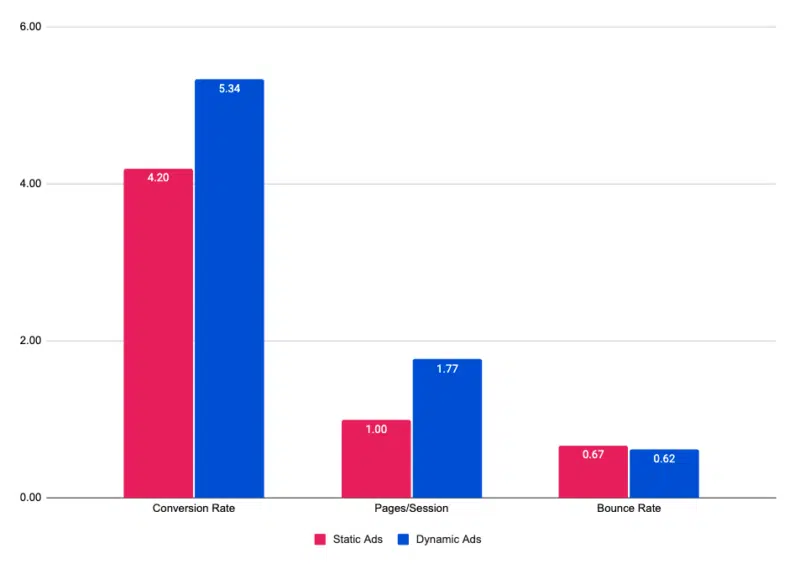
Dynamic Ads, however, continuously optimize ad content based on user behavior, eliminating the need for costly trial and error. This translates into better engagement, higher conversion rate, and reduced cost per lead, making every advertising dollar work more efficiently.

Facebook Dynamic Vs Static Ad Performance 800x569
Three months of data, comparing static versus dynamic ad performance.

3. Low maintenance

In the beginning, crafting Dynamic Ads can be more time-consuming.

You’re selecting individual pieces for the groundwork for your personalized ad journeys. And these pieces all need to play nicely together because they’ll be tossed into a blender and presented in all manner of combinations.

However, the beauty of the approach lies in what follows: once the setup is in place, you get to sit back and watch Facebook take the reins.

Instead of constantly fiddling with ad parameters (which Facebook discourages you from doing anyway), you can entrust the heavy lifting to Meta’s algorithms. Meta uses user behavior, engagement data, and countless other factors to automatically fine-tune your campaigns.

This means your ads become more effective over time without you needing to lift a finger (and to really extend their expiration date without increasing their frequency, use videos!).

In essence, Dynamic Ads allow you to manage your time better, by being high-maintenance upfront with minimal ongoing effort.

It’s the best of both worlds – a personalized, powerful ad experience for users without constant tinkering for marketers.

4. Assets are everything

If a picture is worth 1,000 words, then an ad asset is easily worth $1,000.

Dynamic ads rely so heavily on visual appeal to capture your audience’s attention, that failing to have high-quality creative that resonates with users can make or break your campaign performance.

To ensure your assets have the best shot at performing well, consider three things:

No maximum resolution

Facebook recommends a resolution of at least 1080×1080 pixels.

However, Facebook also notes that there is no maximum resolution.

That means go as high as you can.

Aspect ratios are key

While you can get away with using single images in various sizes for some campaigns, there are many instances where having the correct image ratios is absolutely key to performance.

Your ad could look downright out of place:

Aspect Ratio Dont Do This
Don’t do this.

To ensure maximum coverage across these platforms and the best bang for your buck, you need the trifecta: assets in the right ratios for stories, feed and Instagram Reels. 

Different mediums demand different assets

“Great message, wrong medium,” is a tale as old as time.

If your asset doesn’t take into account the difference between Instagram and Facebook, your campaign will not be as effective as it could be.

Take Instagram Reels, for example. The vertical format demands a way to showcase your product or service in a way that feels native to the platform.

Here’s an Instagram Reel ad that used live-action, high-quality video:

Instagram Reel Harry Potter Scaled

Feed images, on the other hand, need to pop out amidst a sea of content.

The same advertiser also opted to use a colorful graphic, to help it stand out from the photos users share on Facebook:

Facebook Sponsored Post Harry Potter Scaled

Personalization and performance are inextricably linked

If you’re looking to increase your Facebook reach you should consider testing Dynamic Ads. You can leverage user data to produce personalized ads that perform – without huge investments of time or money.


Opinions expressed in this article are those of the guest author and not necessarily Search Engine Land. Staff authors are listed here.


Related stories

New on Search Engine Land

@media screen and (min-width: 800px) { #div-gpt-ad-3191538-7 { display: flex !important; justify-content: center !important; align-items: center !important; min-width:770px; min-height:260px; } } @media screen and (min-width: 1279px) { #div-gpt-ad-3191538-7 { display: flex !important; justify-content: center !important; align-items: center !important; min-width:800px!important; min-height:440px!important; } }

About the author

Ann Robison

Ann Robison has been in the digital marketing industry for over a decade, starting with writing meta descriptions for Google’s then-new Panda update. She currently serves as the Client Services Manager at Portent, a digital marketing agency. She has a strong background in PPC, Paid Social, and digital marketing strategy across B2B and B2C verticals, from Fortune 500 companies to one-woman shows. Robison also provides free-lance consulting to small businesses on digital marketing strategy and analytics. When not working, Robison spends time with family, sings jazz with her local vocal jazz group, and dreams up new adventures for her D&D group.

https://searchengineland.com/facebook-dynamic-search-ads-why-try-431869


Google CEO on SGE and Search evolution: ‘We’ll get it right’

The multibillion-dollar question right now is whether the Search Generative Experience (SGE) will blow up Google’s Search business model. Based on early testing, Google CEO Sundar Pichai is “confident” that won’t happen.

“It’s important to us to connect users with what’s out on the web, and we are working deeply to make sure that continues to work well,” Pichai told Steven Levy in a Q&A published on Wired.

Why we care. Google may be confident that the SGE experiment will continue to send people to websites, but we’re still finding it hard to trust Google at this point. They won’t reveal any real data to us about whether AI answers are driving clicks to websites, click-through rate data, or advertising performance data on what we are calling CHERPs, or Chat Engine Results Pages. And we have no way to track this in Google Search Console, Google Ads or Google Analytics.

Ads vs. organic. Levy pointed out to Pichai that the AI-generated answers are different from a list of links, which could further add confusion about whether an SGE answer is sponsored or organic.

  • “Even in a generative experience we would give you a set of sites that support what we are saying. We want to make sure users are consuming those sites. So I don’t think the core part of the experience will change. We will have a space for ads in a way that makes sense for users and particularly on commercial queries,” Pichai said.

Helping people find information. Pichai pointed out that even though the way Google presents information has evolved greatly in 25 years – but ultimately people are searching for information.

  • “We are still trying to help people find the best information that exists online. Inherently, people are also looking for commercial information, and ads are very valuable commercial information, because they connect merchants and businesses, small and big, to users. None of that changes just because we are applying AI deeply. When we evolve search with generative AI, we’ll apply the same principles,” Pichai said.

Like desktop to mobile? Pichai pointed out that people asked similar questions as Google shifted its focus from desktop to making everything mobile-first.

  • “Our early testing shows that we’ll be able to get it right. It’s core to the company to evolve search while applying the underlying principles. I am confident we’ll be able to get that right through this transition,” Pichai said.

The search community was also extremely worried about Google’s featured snippets stealing traffic. When Bard launched in February, there were no links. And SGE only finally added links to websites Aug. 30 after months of pressure by search marketers and publishers.

Bing burn. Did the new Bing, powered by ChatGPT, make Google “dance.” Pichai essentially dissed their efforts, comparing it to Alexa and Siri. Pichai also claimed:

  • “Around the end of last year, my thoughts were, how can we bring generative AI to search in a way that makes sense for our users? That’s what I’m thinking about, and that’s what will matter in the long run.”

Could that time in late 2022 coincide with OpenAI launching ChatGPT in late November? Generative AI exploded on the scene and supposedly triggered a code red within Google, leading to the return of Google founders Larry Page and Sergey Brin.

Pichai was also asked about the antitrust trial, but had little to say beyond throwing around the word “innovation.”

You can read the full interview here: Sundar Pichai on Google’s AI, Microsoft’s AI, OpenAI, and … Did We Mention AI?


Related stories

New on Search Engine Land

@media screen and (min-width: 800px) { #div-gpt-ad-3191538-7 { display: flex !important; justify-content: center !important; align-items: center !important; min-width:770px; min-height:260px; } } @media screen and (min-width: 1279px) { #div-gpt-ad-3191538-7 { display: flex !important; justify-content: center !important; align-items: center !important; min-width:800px!important; min-height:440px!important; } }

About the author

Danny Goodwin

Danny Goodwin has been Managing Editor of Search Engine Land & Search Marketing Expo – SMX since 2022. He joined Search Engine Land in 2022 as Senior Editor. In addition to reporting on the latest search marketing news, he manages Search Engine Land’s SME (Subject Matter Expert) program. He also helps program U.S. SMX events. Goodwin has been editing and writing about the latest developments and trends in search and digital marketing since 2007. He previously was Executive Editor of Search Engine Journal (from 2017 to 2022), managing editor of Momentology (from 2014-2016) and editor of Search Engine Watch (from 2007 to 2014). He has spoken at many major search conferences and virtual events, and has been sourced for his expertise by a wide range of publications and podcasts.

https://searchengineland.com/google-ceo-on-sge-and-search-evolution-well-get-it-right-431888


TikTok’s EU Changes Set to Impact Advertiser Experience


.article-native-ad { border-bottom: 1px solid #ddd; margin: 0 45px; padding-bottom: 20px; margin-bottom: 20px; } .article-native-ad svg { color: #ddd; font-size: 34px; margin-top: 10px; } .article-native-ad p { line-height:1.5; padding:0!important; padding-left: 10px!important; } .article-native-ad strong { font-weight:500; color:rgb(46,179,178); }

To fall in line with Europe’s new online regulations, TikTok has introduced new compliance measures that could change the whole user experience and restrict advertisers’ reach on the platform while offering them a safer media landscape in which to invest.

Following the introduction of the Digital Services Act (DSA) by the European Union earlier this year, TikTok, which claims to have 134 million users across Europe, has now fallen in line with newly introduced transparency measures.

Those updates include the ability for EU users to turn off personalization, the introduction of commercial content labeling and a restriction on under-18s viewing personalized ads.

“Those who choose to disable personalized content are likely to experience a more homogenized feed, with the biggest global and regional creators dominating timelines, leaving less space to discover content from smaller creators representing more niche communities and interests,” explained Edward East, co-founder of influencer marketing agency Billion Dollar Boy.

He added that this might benefit major celebrities or creators in expanding their reach on the platform, growing their earnings through brand collaborations as a result. However, it might also make it more difficult for niche communities to grow and develop.

TikTokers will be reluctant to part ways with their algorithmically curated For You pages, resulting in few opt-outs overall.

Costas Tsiappourdhi, social product partner, Brainlabs

“Not only is this a concern for some micro and nano influencers to build their following, but it could also impact brands who often find more value in these niche communities—particularly for campaigns with cost-effective engagement and conversion-led objectives. Brands like to exist where culture is. By tapping into small and loyal communities, brands are able to drive better engagement rates and create strong affinities with relevant and targeted audiences,” East continued.

Further measures being taken

A commercial content library will also be introduced, taking the form of a database offering information about the paid ads TikTok hosts as well as metadata such as dates the ad ran and the main parameters used for targeting.

Commercial content labeling will include options such as ad/sponsored, paid partnership or promotional content to ensure users are able to clearly see the difference across the content they are served.

There will also be the ability to report content (including ads) that users believe is illegal, which will then be reviewed against TikTok’s community guidelines and ad policies before being removed should they be found to be in violation. Access will also be given to applying European academics to research the platform.

“With consumer trust of big platforms having been eroded over the past few years, steps like this are essential to empower and inform consumers,” outlined Aengus Boyle, senior director for media at VaynerMedia London.

“The new commercial content library is also an exciting prospect for those interested in seeing how other advertisers are activating on the platform, giving a view into creatives being run, flight dates and details around targeting parameters leveraged,” added Boyle.

These changes are also seen as being a positive step for advertisers by Costas Tsiappourdhi, social product partner at media agency Brainlabs, especially the content reporting and age limitations being introduced, which he believes are likely to see a broader investment in the platform from more risk-averse businesses.

“The ability to opt out of content personalization is particularly interesting for a platform that has built its business and brand on delivering highly personalized content to its users,” he added. “While this could see a change in how those users engage, I expect, in practice, that TikTokers will be reluctant to part ways with their algorithmically curated For You pages, resulting in few opt-outs overall.”

According to Paul Kasamias, chief performance officer for Performics, the moves will create a more level playing field for all of the major tech platforms from an advertiser perspective while offering users more control.

“By embracing DSA compliance, TikTok is actively working to create a more transparent and trustworthy advertising environment. Advertisers can have confidence in the platform’s commitment to responsible advertising practices, which is crucial for building long-term partnerships and maintaining the integrity of the advertising ecosystem. Increased trust could well act as a catalyst for further advertising investment into these platforms,” added Kasamias.

The introductory changes were announced by Madeline Moncrieff, director of legal EMEA for TikTok, on Aug. 28.

.font-primary { } .font-secondary { } #meter-count { position: fixed; z-index: 9999999; bottom: 0; width:96%; margin: 2%; -webkit-border-radius: 4px; -moz-border-radius: 4px; border-radius: 4px; -webkit-box-shadow: 0 0px 15px 4px rgba(0,0,0,.2); box-shadow:0 0px 15px 4px rgba(0,0,0,.2); padding: 15px 0; color:#fff; background-color:#343a40; } #meter-count .icon { width: auto; opacity:.8; } #meter-count .icon svg { height: 36px; width: auto; } #meter-count .btn-subscribe { font-size:14px; font-weight:bold; padding:7px 18px; color: #fff; background-color: #2eb3b2; border:none; text-transform: capitalize; margin-right:10px; } #meter-count .btn-subscribe:hover { color: #fff; opacity:.8; } #meter-count .btn-signin { font-size:14px; font-weight:bold; padding:7px 14px; color: #fff; background-color: #121212; border:none; text-transform: capitalize; } #meter-count .btn-signin:hover { color: #fff; opacity:.8; } #meter-count h3 { color:#fff!important; letter-spacing:0px!important; margin:0; padding:0; font-size:16px; line-height:1.5; font-weight:700; margin: 0!important; padding: 0!important; } #meter-count h3 span { color:#E50000!important; font-weight:900; } #meter-count p { font-size:14px; font-weight:500; line-height:1.4; color:#eee!important; margin: 0!important; padding: 0!important; } #meter-count .close { color:#fff; display:block; position:absolute; top: 4px; right:4px; z-index: 999999; } #meter-count .close svg { display:block; color:#fff; height:16px; width:auto; cursor:pointer; } #meter-count .close:hover svg { color:#E50000; } #meter-count .fw-600 { font-weight:600; } @media (max-width: 1079px) { #meter-count .icon { margin:0; padding:0; display:none; } } @media (max-width: 768px) { #meter-count { margin: 0; -webkit-border-radius: 0px; -moz-border-radius: 0px; border-radius: 0px; width:100%; -webkit-box-shadow: 0 -8px 10px -4px rgba(0,0,0,0.3); box-shadow: 0 -8px 10px -4px rgba(0,0,0,0.3); } #meter-count .icon { margin:0; padding:0; display:none; } #meter-count h3 { color:#fff!important; font-size:14px; } #meter-count p { color:#fff!important; font-size: 12px; font-weight: 500; } #meter-count .btn-subscribe, #meter-count .btn-signin { font-size:12px; padding:7px 12px; } #meter-count .btn-signin { display:none; } #meter-count .close svg { height:14px; } }

Enjoying Adweek’s Content? Register for More Access!

https://www.adweek.com/social-marketing/tiktok-eu-changes-impact-advertiser-experience/


Threads search is coming, but when?

“Search is coming to Threads,” according to Meta CEO Mark Zuckerberg.

Zuckerberg shared the news via Threads about an hour ago, but it’s unclear when it’s coming. But if he’s hyping it up, Threads search must be near.

Why we care. The Threads app launched without several basic and expected features – such as the ability to search for posts using words. We have been frustratingly limited to only searching for accounts, but it seems that will finally change soon, which means more opportunities for your posts to be discovered.

Search being tested now. Threads Search is now being tested in New Zealand and Australia, TechCrunch reported. Search will rollout to more English-speaking countries but we don’t yet know when.

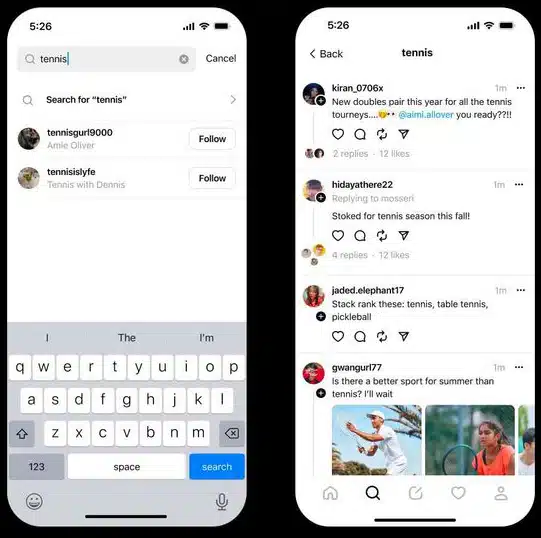
What it looks like. Here’s a screenshot for a Threads search for [tennis], via TechCrunch:

Threads Search Tennis

What Meta is saying. “We are actively listening to the community’s feedback and working on more features to improve the search experience,” the company said in a statement.

Better late than never? Threads took just five days to get 100 million users. However, in the weeks since, engagement has declined and it has an estimated 8 million daily active users now. We’ll soon find out whether launching the web version of Threads and having actual useful search can help reverse Threads’ downward trend.

Dig deeper. Threads FAQ: Everything marketers need to know

“For you on Threads”. Meanwhile, in another attempt to lure in users, Instagram has started testing a For you on Threads carousel with a link to open the app, TechCrunch reported.


Related stories

New on Search Engine Land

@media screen and (min-width: 800px) { #div-gpt-ad-3191538-7 { display: flex !important; justify-content: center !important; align-items: center !important; min-width:770px; min-height:260px; } } @media screen and (min-width: 1279px) { #div-gpt-ad-3191538-7 { display: flex !important; justify-content: center !important; align-items: center !important; min-width:800px!important; min-height:440px!important; } }

About the author

Danny Goodwin

Danny Goodwin has been Managing Editor of Search Engine Land & Search Marketing Expo – SMX since 2022. He joined Search Engine Land in 2022 as Senior Editor. In addition to reporting on the latest search marketing news, he manages Search Engine Land’s SME (Subject Matter Expert) program. He also helps program U.S. SMX events. Goodwin has been editing and writing about the latest developments and trends in search and digital marketing since 2007. He previously was Executive Editor of Search Engine Journal (from 2017 to 2022), managing editor of Momentology (from 2014-2016) and editor of Search Engine Watch (from 2007 to 2014). He has spoken at many major search conferences and virtual events, and has been sourced for his expertise by a wide range of publications and podcasts.

https://searchengineland.com/threads-search-is-coming-but-when-431464


Google’s New GenAI Marketing Tools Speed Up Campaign Planning and Buying


.article-native-ad { border-bottom: 1px solid #ddd; margin: 0 45px; padding-bottom: 20px; margin-bottom: 20px; } .article-native-ad svg { color: #ddd; font-size: 34px; margin-top: 10px; } .article-native-ad p { line-height:1.5; padding:0!important; padding-left: 10px!important; } .article-native-ad strong { font-weight:500; color:rgb(46,179,178); }

The brightest minds in marketing and tech converge at NexTech, Nov. 14–15 in NYC. Get your pass for the latest on generative AI, gaming and more.

At the annual Google Cloud Next conference in San Francisco, GenAI platform Typeface and customer data platform GrowthLoop announced a generative artificial intelligence-powered marketing solution that aims to speed up the time it takes for marketers to build and serve marketing campaigns.

In collaboration with Google, the GenAI Marketing Solution is made available on the tech giant’s cloud platform and is accessible to Google’s BigQuery customers.

This integration will let marketers use data for audience segmentation, use generative AI to create relevant content for each segment, and serve it across marketing channels including Google Ads.

“What’s different about [this tool] is it takes significant challenges that marketers face when creating campaigns and combines it into a single product,” said Josh Brisco, group vp of acquisition media at Tinuiti. “It helps to decrease friction and uncertainty from AI adoption.”

Earlier this year, the search giant introduced a GenAI chatbot-like experience to its traditional search and rolled out additional marketer-facing tools such as text-to-image generation with Product Studio. However, questions over content copyright and ownership could temper investment into such solutions for marketers.

“Marketing leaders across the globe have shared with us that producing personalized content at scale across audience segments can be a significant challenge, often causing campaigns to take [upwards of six months] to launch,” said Vishal Sood, head of product at Typeface. “GenAI Marketing Solution offers marketers the ability to rapidly generate and deploy tailored, on-brand content across customer segments, making it possible to bring ideas to execution in a matter of weeks, days or even less.”

Addressing marketers’ pain points

Through the new integration, BigQuery customers can gain a comprehensive insight into customer behavior by accessing first-party data previously siloed across ads, sales, customers and products.

GrowthLoop lets marketers define these audience segments using natural language capabilities and drag-and-drop tools, all within the cloud environment, ensuring data security.

“These are all very tedious, time-consuming, and require a lot of expertise on the client and marketer side,” said Brisco.

Meanwhile, Typeface’s built-in application helps to create relevant content that combines GrowthLoop’s specific audience groups with Typeface’s brand-personalized AI. This process results in tailor-made content for platforms such as blogs and landing pages.

Marketers can closely monitor audience targeting and content performance metrics such as ROI and A/B tests using GrowthLoop and BigQuery.

“[The integration] touches on and potentially alleviates a lot of pain points within marketing today,” said Brisco. “It is a closed loop system of super-efficient marketing from both media and business process output.”

At the same time, marketers have voiced transparency concerns over campaign effectiveness across Google’s other AI-powered offerings like Performance Max.

“When you’re leveraging BigQuery, at least in my experience, advertisers own that data,” said Brisco. “This doesn’t feel like the third-party audiences within Google Ads that sit within a black box.”

Even so, for all the potential generative AI has to provide marketing solutions, copyright and ownership battles are concerning for marketers.

“There’s a lot of concern over who owns those outputs and what the [AI] models are learning from to create that creative,” said Brisco. “Increasingly, such companies are going to need to be more transparent.”

The potential of AI video solutions

For marketers like Adam Lovallo, founder of digital marketing agency Thesis, Google’s latest AI venture seems to be just one more addition to the array of available tools.

To encourage more ad buyers, especially performance advertisers, there is an opportunity for generative AI tools that can create video content.

“This would make a massive difference,” Lovallo said, citing YouTube’s higher CPMs compared with Facebook and TikTok. “It’s significantly more difficult to hit $100 CPA on YouTube if you’re also hitting that on Facebook and TikTok.”

The agency’s direct-to-consumer brands allocate about 3% of their ad budgets to YouTube, in contrast to 60% to Facebook and 30% to Google Search.

.font-primary { } .font-secondary { } #meter-count { position: fixed; z-index: 9999999; bottom: 0; width:96%; margin: 2%; -webkit-border-radius: 4px; -moz-border-radius: 4px; border-radius: 4px; -webkit-box-shadow: 0 0px 15px 4px rgba(0,0,0,.2); box-shadow:0 0px 15px 4px rgba(0,0,0,.2); padding: 15px 0; color:#fff; background-color:#343a40; } #meter-count .icon { width: auto; opacity:.8; } #meter-count .icon svg { height: 36px; width: auto; } #meter-count .btn-subscribe { font-size:14px; font-weight:bold; padding:7px 18px; color: #fff; background-color: #2eb3b2; border:none; text-transform: capitalize; margin-right:10px; } #meter-count .btn-subscribe:hover { color: #fff; opacity:.8; } #meter-count .btn-signin { font-size:14px; font-weight:bold; padding:7px 14px; color: #fff; background-color: #121212; border:none; text-transform: capitalize; } #meter-count .btn-signin:hover { color: #fff; opacity:.8; } #meter-count h3 { color:#fff!important; letter-spacing:0px!important; margin:0; padding:0; font-size:16px; line-height:1.5; font-weight:700; margin: 0!important; padding: 0!important; } #meter-count h3 span { color:#E50000!important; font-weight:900; } #meter-count p { font-size:14px; font-weight:500; line-height:1.4; color:#eee!important; margin: 0!important; padding: 0!important; } #meter-count .close { color:#fff; display:block; position:absolute; top: 4px; right:4px; z-index: 999999; } #meter-count .close svg { display:block; color:#fff; height:16px; width:auto; cursor:pointer; } #meter-count .close:hover svg { color:#E50000; } #meter-count .fw-600 { font-weight:600; } @media (max-width: 1079px) { #meter-count .icon { margin:0; padding:0; display:none; } } @media (max-width: 768px) { #meter-count { margin: 0; -webkit-border-radius: 0px; -moz-border-radius: 0px; border-radius: 0px; width:100%; -webkit-box-shadow: 0 -8px 10px -4px rgba(0,0,0,0.3); box-shadow: 0 -8px 10px -4px rgba(0,0,0,0.3); } #meter-count .icon { margin:0; padding:0; display:none; } #meter-count h3 { color:#fff!important; font-size:14px; } #meter-count p { color:#fff!important; font-size: 12px; font-weight: 500; } #meter-count .btn-subscribe, #meter-count .btn-signin { font-size:12px; padding:7px 12px; } #meter-count .btn-signin { display:none; } #meter-count .close svg { height:14px; } }

Enjoying Adweek’s Content? Register for More Access!

https://www.adweek.com/programmatic/google-genai-marketing-tools-speed-up-campaign-planning-buying/