EXCLUSIVE: Spotify Debuts Carousel Ads and Branded Playlist Takeovers
Spotify is rolling out interactive carousel ads, the company announced on Tuesday. The company is looking to attract more dollars across the marketing funnel from brand awareness down to generating sales—while also accommodating changing users preferences towards a more visual platform.
The new swipeable ads allow brands to spotlight up to six different products. Each slide in the lineup includes its own image, link, description, and optional pricing or promotional information. The ads will pop up in the app’s Now Playing view appearing on screen while users actively consume content.
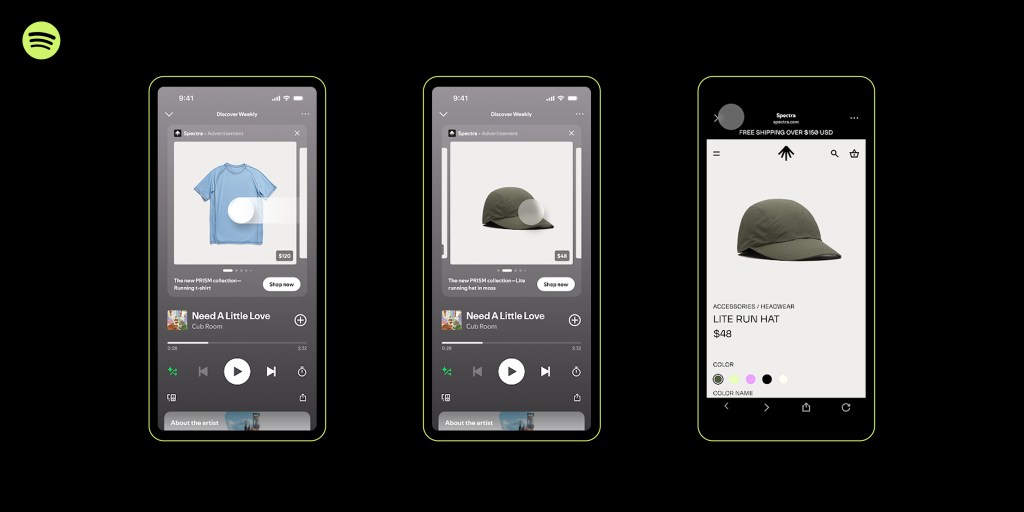
Though the carousel ad format was pioneered by Meta in the mid-2010s, Spotify is only now rolling out the offering as users spend more time watching—and not just listening—to Spotify. This is thanks to the platform’s foray into music videos and its push for podcasts to be published with full video.
“The user experience is becoming a much more interactive, audio and visual experience,” Brian Berner, Spotify’s global head of advertising revenue and partnerships, told ADWEEK. “It’s just time for us to make sure that our ad strategy reflects the trends we’re seeing and the user engagement we’re seeing from our consumers.”
Priceline and GNC are among the brands piloting Spotify’s carousel ads.
The platform is also introducing a branded takeover of select Spotify playlists including some of its flagship selections like Rap Caviar, Today’s Top Hits, and New Music Friday.
Advertisers can pay to be the only featured brand on a given playlist where their name appears prominently on the playlist’s main page and their ads run exclusively during play. To improve the user experience, listeners hear fewer ad breaks throughout the duration of a sponsored playlist.
Both carousel ads and sponsored playlists are served to users of Spotify’s free tier.
Meanwhile, the company has enhanced its performance tooling. It added A/B testing capabilities and automated bidding—which uses machine learning to optimize ad delivery and budgets—directly into its Ads Manager. Although, these features are considered table stakes for major advertising platforms.
With the updates it’s clear that Spotify is positioning itself as a more full-stack ad platform—one capable of delivering upper funnel and mid to lower tier funnel offerings, in addition to performance tools that help marketers get more out of their media buys.
“What we’re trying to build from an ad strategy is to challenge that preconceived notion of audio just being an upper funnel reach play and build a full-funnel suite,” Berner said. “Do I think overnight we’re going to go from upper funnel to suddenly driving bazillions of app installs? Not overnight. But when I think about the next five years…we are absolutely trying to challenge the status quo and show Spotify to be a full-funnel offering.”
To support that vision, the company is bulking up its ads infrastructure and increasingly investing in AI. Last spring, it launched a global ad exchange and began letting advertisers produce custom audio ads using generative AI tools at no additional cost. This year, it plans to roll out additional AI updates, Berner said.
Asked why a marketer would choose to shift more spend toward Spotify particularly in a crowded market with behemoths like Meta, TikTok, and Google vying for dollars, Berner said simply: “User engagement, user attention, time spent.” He might be on to something. On average, consumers spend about two hours a day on Spotify and 90% use Spotify as part of their daily routine, according to recent survey data the company collected from over 5,000 consumers. For marketers, he said, it’s that user attention and engagement that should prove appealing. “That’s advertising 101: Fish where the fish are.”
https://www.adweek.com/media/exclusive-spotify-debuts-carousel-ads-and-branded-playlist-takeovers/




![X is incentivizing advertisers to ditch emojis, hashtags, and links in their ad copy with lower rates on ads for what the company’s head of Americas, Monique Pintarelli, calls “beautiful” […]](https://rassegna.lbit-solution.it/wp-content/uploads/2026/03/exclusive-x-dangles-200k-for-advertisers-to-return-to-the-platform-leaked-deck-shows.jpg)