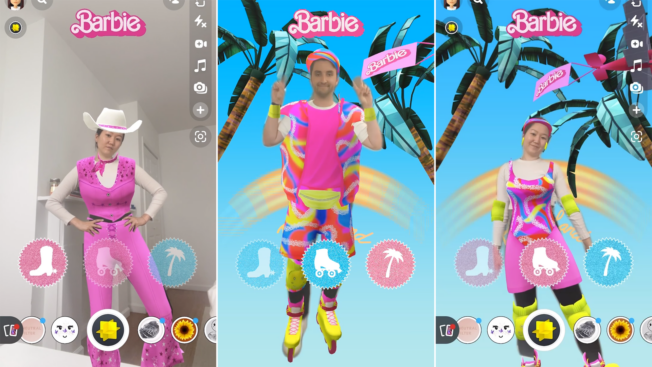
Hoping to cement its lead in the artificial intelligence-powered platform race, Snapchat launched its latest generative AI selfie feature, Dreams, now available in Australia and New Zealand and expected in other markets over the next few weeks.
The AI-powered feature lets people use their own faces to create up to eight generated AI selfies, placing them in an imaginative background, like a royal in the Renaissance era or a mermaid in a deep seascape.
“Snap’s creative focus of generative AI is definitely leading ahead of features and capabilities that have been announced and rolled out by other platforms such as TikTok and Pinterest,” said Katya Constantine, CEO of DTC agency DigiShopGirl.
Snapchat launched its AI-powered chatbot, My AI, in May. Since then, My AI has received over 10 billion messages from 150 million people, the company said. These conversations range from asking for cosmetic recommendations for skincare to chats about apparel and cars. Although competitors like TikTok have been testing their own AI-driven chatbots, and Facebook and Instagram have similar aspirations, Snap’s new offering that comes with in-app purchases could mitigate ad revenue challenges.
“Snap has moved quickly into AI in part because it’s facing serious external threats that have stalled their advertising growth and sunk their stock price,” said Insider Intelligence principal analyst Yory Wurmser. “On the one hand, Apple’s App Tracking Transparency has made targeting and tracking more difficult for advertisers on Snapchat. That’s played a big role in Snapchat’s dropping ad revenues.”
Snap reported revenue of $1,068 million, down from $1,111 million last year, according to its 2023 second-quarter earnings.
Competing against TikTok
Snap is testing new revenue streams via in-app purchases for Dreams. Regular users will get one free pack of eight Dreams with the option to purchase extra sets of eight for $0.99 each. Meanwhile, Snapchat+ subscribers will get a monthly allocation of one free pack containing eight Dreams and can get additional sets of eight by paying $0.99 per set.
“But things are moving very quickly in AI,” said Wurmser. “TikTok has momentum overall at the moment, so a successful global launch of [its chatbot] Tako could quickly erase Snap’s AI lead.”
Wurmser estimates Snap’s U.S. ad revenue to fall to $2.08 billion, down by 1.8% this year. In contrast, TikTok is expected to grow 23.1% to $6.19 billion.
Luring more ad dollars
Despite being among the first to launch a generative AI chatbot, Snap’s My AI, which started testing sponsored links in May, hasn’t managed to lure advertisers to spend on the platform, some buyers told Adweek.
“Our media spend ranges between 2-10% on Snap,” said Constantine. “Currently, it’s on the low end and definitely hasn’t increased since My AI was launched.”
For ad agency Collective Measures, up to 20% of the annual media budget goes to Snap’s in-feed ads or Stories, specifically for clients whose audience utilizes the Snap platform, according to Theresa Swiggum, media director, of Collective Measures. However, most of the agency’s brand partners aren’t looking into My AI’s sponsored ads yet.
“Snapchat is never going to be the top social media platform in terms of time spent or overall reach,” said Swiggum.
Grocery delivery service and advertising platform Instacart filed for its IPO on Friday.
Why we care. Instacart Ads is an emerging platform where CPG (consumer packaged goods) brands can advertise products (via sponsored product ads, display ads, coupons) to 7.7 million “monthly active orderers” as they shop.
1. Instacart’s 2023 ad revenue. Instacart reported $406 million in ad revenue for the six months of 2023, a year-on-year increase of 24%.
This increase was driven by an increase in advertising volume and increased adoption of new advertising features and products – despite decreases in ad spend by brand partners due to “macroeconomic uncertainty” and changes in “brand partners’ businesses and performance.”
Ad revenue was $327 million for the same period in 2022.
2. Instacart’s 2022 ad revenue. Instacart’s full-year advertising revenue hit $740 million in 2022, a 29% YoY increase. Advertising was 29% of Instacart’s total revenue.
Ad revenue was $572 million in 2021, which was 31% of total revenue, and $295 million in 2020.
3. How many brands use Instacart Ads. Intacart had more than 5,500 “active brand partners” using Instacart Ads as of June 30. This number has grown of “over five times” since December 2019.
4. New Instacart Ads offerings coming. Instacart has plans to add new display advertising offerings, specifically mentioning “shoppable products brand pages to serve as destinations for on- and offsite media,” according to the S-1.
5. Instacart plans to expand its ad tech to more retailers. The company plans to invest in and grow the Instacart Enterprise Platform, according to the S-1 filing:
“In 2021, we launched Carrot Ads, which helps our retail partners capture new monetization opportunities while broadening advertiser reach to millions of new customers via additional relevant placements on retailers’ owned and operated online storefronts.”
6. Instacart is impacted by seasonality. Instacart expects seasonality to cause fluctuations in its quarterly financial results.
“Our advertising and other revenue has historically been seasonally high in the fourth quarter and seasonally low in the first quarter in a given year as a result of how advertisers deploy their budgets,” according to the filing.
7. Instacart Ads growth strategy. Here’s how Instacart said it plans to increase its advertising revenue:
“Capture More Ad Spend and Add New Brands on Instacart Ads. We intend to earn a greater portion of brands’ spend across digital marketing as well as other data and customer insights. Growing the number of active brand partners and their spend will depend on our ability to grow the size and engagement of our customer base to create more clicks and impressions and to innovate on our ads offerings to deliver attractive ROI to our brand partners.”
“Grow Sales for Emerging Brands and Non-Food Categories. We intend to grow sales for emerging brands and non-food categories that have higher advertising budgets, such as household products, pet items, and personal care. As we grow sales for emerging brands and these categories, we expect to experience a mix shift towards GTV with higher advertising and other investment rate.”
What Instacart said. The company’s filing also touted its high ROI and ability to drive purchases:
“Our grocery expertise has enabled us to build differentiated advertising solutions and tools that allow CPG brands to reach and engage with high-intent customers at the point of purchase and within minutes of delivery and consumption. With our unique customer data and insights, we provide differentiated analytics for brands, allowing them to better optimize their advertising spend and grow their wallet share.”
@media screen and (min-width: 800px) { #div-gpt-ad-3191538-7 { display: flex !important; justify-content: center !important; align-items: center !important; min-width:770px; min-height:260px; }
}
@media screen and (min-width: 1279px) { #div-gpt-ad-3191538-7 { display: flex !important; justify-content: center !important; align-items: center !important; min-width:800px!important; min-height:440px!important; }
}
About the author
Danny Goodwin has been Managing Editor of Search Engine Land & Search Marketing Expo – SMX since 2022. He joined Search Engine Land in 2022 as Senior Editor. In addition to reporting on the latest search marketing news, he manages Search Engine Land’s SME (Subject Matter Expert) program. He also helps program U.S. SMX events. Goodwin has been editing and writing about the latest developments and trends in search and digital marketing since 2007. He previously was Executive Editor of Search Engine Journal (from 2017 to 2022), managing editor of Momentology (from 2014-2016) and editor of Search Engine Watch (from 2007 to 2014). He has spoken at many major search conferences and virtual events, and has been sourced for his expertise by a wide range of publications and podcasts.
Google sending notifications that UA has stopped processing data
Google has been busy sending notifications that Universal Analytics properties have stopped processing data
Third Door Media, the parent company of Search Engine Land, received one such notification for a UA property – and several other search marketers also confirmed they have received a notice for websites they work on or own within the past 24 hours.
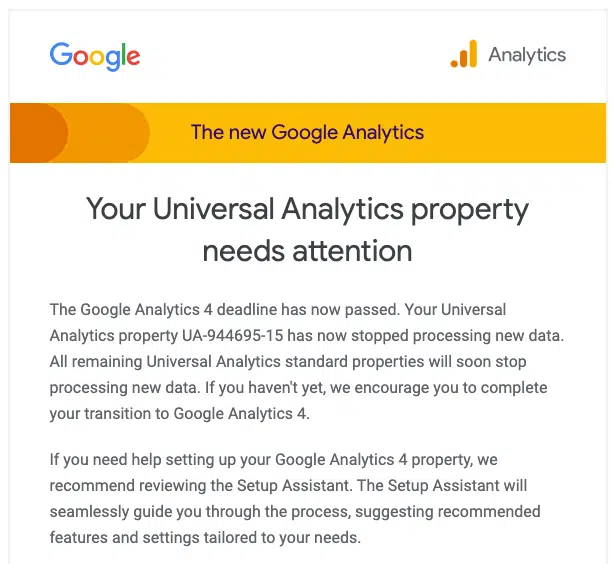
The notification. Google’s email started with “Your Universal Analytics property needs attention” and went on to say:
“The Google Analytics 4 deadline has now passed. Your Universal Analytics property [UA property number] has now stopped processing new data. All remaining Universal Analytics standard properties will soon stop processing new data. If you haven’t yet, we encourage you to complete your transition to Google Analytics 4.
If you need help setting up your Google Analytics 4 property, we recommend reviewing the Setup Assistant. The Setup Assistant will seamlessly guide you through the process, suggesting recommended features and settings tailored to your needs.”
Here’s a screenshot:
Several people also sharing their notifications on social media:
Get ready, Google is starting to turn off UA. 1st of my clients got notification today. That’s nearly 2 months after they said they were going to turn it off on June 30. pic.twitter.com/CmqNomyIKh
And it has started, my first few Google Universal Analytics “Your Universal Analytics property has now stopped processing new data”. A few hundred more emails to receive. pic.twitter.com/s5L0gIpsWE
Why we care. Multiple polls have shown that the majority of search marketers hate Google Analytics 4 – especially GA4’s user interface. Even though many marketers have set up GA4, they will likely continue using UA until the bitter end.
53 days later. It’s now been 53 days since July 1, the date on which we were told – repeatedly – that Google would stop processing data on Universal Analytics properties as part of the forced switch to Google Analytics 4. To our surprise that didn’t happen.
UA continued to process data on July 1. This despite a year-long multichannel assault of switch-or-else warnings (blog posts, emails, social media, etc.) and that super annoying red intrusive interstitial countdown clock every time you logged into GA.
@media screen and (min-width: 800px) { #div-gpt-ad-3191538-7 { display: flex !important; justify-content: center !important; align-items: center !important; min-width:770px; min-height:260px; }
}
@media screen and (min-width: 1279px) { #div-gpt-ad-3191538-7 { display: flex !important; justify-content: center !important; align-items: center !important; min-width:800px!important; min-height:440px!important; }
}
About the author
Danny Goodwin has been Managing Editor of Search Engine Land & Search Marketing Expo – SMX since 2022. He joined Search Engine Land in 2022 as Senior Editor. In addition to reporting on the latest search marketing news, he manages Search Engine Land’s SME (Subject Matter Expert) program. He also helps program U.S. SMX events. Goodwin has been editing and writing about the latest developments and trends in search and digital marketing since 2007. He previously was Executive Editor of Search Engine Journal (from 2017 to 2022), managing editor of Momentology (from 2014-2016) and editor of Search Engine Watch (from 2007 to 2014). He has spoken at many major search conferences and virtual events, and has been sourced for his expertise by a wide range of publications and podcasts.
Master evolving third-party data. Our guide with Datonics debunks misconceptions, offers insights for data selection and respects privacy. Download now.
Ad buyers who asked YouTube not to run their ads on kids’ channels saw their advertisements on this content anyway, three buyers told Adweek.
This comes as Google is, once again, under fire, this time for YouTube ads allegedly leading to tracking of children, according to The New York Times.
A business-to-business client of independent Italian media agency Aidem ran a campaign targeted at business people, explicitly excluding “content suitable for families,” said CEO Giovanni Sollazzo. The ads appeared on channels like stacyplays and lunacreciente, specifically labeled with banners saying “Try YouTube Kids,” according to screenshots from the campaign’s reporting.
“Almost every campaign I have seen on YouTube has run on ‘made for kids,’” Sollazzo said. “All of them were not targeted at children.”
Running ads on kids’ channels is not only a waste of money for most brands, as kids can’t buy products, but could potentially contain regulatory risk, according to new research from Adalytics. Moreover, for buyers, the presence of Google’s AI-powered Performance Max in the report’s findings calls into question the use of controls on its ad products.
Research outfit Adalytics found that YouTube ads that run on kids’ channels contain trackers that advertisers could use to retarget kids across the internet. Under the Children’s Online Privacy Protection Act (COPPA), which YouTube was fined for violating in 2019, it is illegal to run targeted ads on children’s content.
Still, buyers find Google’s controls to avoid targeting kids’ content fall short.
A client of Iris Worldwide also clicked to exclude “content suitable for families” when running a campaign, yet the client’s ads still showed on channels labeled as part of the YouTube Kids network, according to screenshots viewed by Adweek. Such content is meant to run on YouTube made for kids, according to a Google blog post.
“I have seen this on many campaigns in the past. I’ve also tried other methods of excluding ‘made for kids’ channels like excluding child-oriented keywords and categories,” said Keri Thomas, performance media director at Iris. “The ‘made for kids’ channels continue to appear in placement reports anyway.”
A third ad buyer, who was not authorized by her agency to speak to the press, said that at least once a quarter someone at the agency will reach out in a company Slack channel in desperation about the issue. Often they have tried multiple methods to block ads running on kids’ content, including exclusion lists and blocking specific channels, only for their ads to continue to show on these videos.
U.S. Senators Ed Markey and Marsha Blackburn this week sent an open letter to the Federal Trade Commission on the basis of the report, asking the agency to investigate YouTube for potentially violating COPPA.
Google has said the report does not prove it violated COPPA and draws false conclusions via the presence of cookies, which are used for fraud detection and frequency capping but not for tracking kids. It is legal to run ads on kids’ content—parents often watch the shows as well—so long as it is contextual, even if some advertisers would rather not pay for it.
Performance Max amplifies transparency risk
Google says it allows buyers to opt out of showing ads on “made for kids” content on the account level, which applies to all campaign types. But these controls often fail, buyers have told Adweek.
In response, buyers have tried to take a more hands-on approach to eliminate “made for kids” content, including using crowdsourced exclusion lists of channels found on Reddit, the third ad buyer source said.
This approach is most effective when ad buyers know exactly which kids’ channels their ads ran on inadvertently and can exclude those in the future.
But Performance Max, a popular Google ad format that uses artificial intelligence to place ads across Google’s massive swath of inventory, doesn’t let buyers know which YouTube channels their ads ran on, multiple buyer sources told Adweek.
Buyers have already been scrutinizing Google for a lack of transparency. Some say that Performance Max, which was rolled out globally in November 2021, gives brands too little insight into where their ads are running despite achieving good results.
The use of Performance Max—for its ease and performance—has grown. In May this year, Performance Max was 36.3% of total Google spend, according to software company Varos, based on data from its network.
Adalytics identified several brands, like BMO Bank and Intuit, that ended up on kids’ content via advertising on Performance Max.
Moreover, an Adalytics report released earlier this summer accused YouTube of consistently running ads in sound-off, unviewable placements and on low-quality websites, which led some buyers to redirect their YouTube strategy.
Correction: This story previously cited reporting by Insider on IPG Mediabrands’ advice to clients about Performance Max. IPG disputes the story. The citation has been removed.
Six ways generative AI can transform your search strategy by Adthena
With the rise of generative artificial intelligence (AI), search marketing has been empowered with advanced capabilities that go beyond traditional approaches. Generative AI is reshaping how we find information online, transforming search marketing and revolutionizing how marketers optimize online presence.
What does generative search mean anyway?
Google splits its AI products into two categories – Predictive and Generative. Before we dive in, let’s first understand what generative AI is and distinguish it from the more traditional form of predictive AI.
Predictive AI is Google’s bread and butter and has been transformative over the last five years. Google Ads leverages machine learning and predictive modeling to suggest actions or decisions based on user preferences, powering what you should bid in an auction and what search terms your keywords should match to, as well as providing real-time insights to help enhance the search experience.
Generative AI, on the other hand, takes data and creates new and original content, such as text, images (the banner used in this article, for example), and even videos. Unlike traditional AI systems that rely on pre-programmed rules, generative AI utilizes neural networks to learn patterns and generate outputs based on the data it has been trained on.
With the rise of core creative AIs like ChatGPT and Midjourney coming into popular culture, it begs the question, “Does this spell the end of the publisher-backed internet and the ten blue SERP links?!”
Gobert-Jones predicts, “The reality will be much more nuanced, focusing on where the AI creates truly addictive user experiences. We will end up with around 10% of total searches powered by this technology.”
The role of AI in search
AI is transforming the search landscape and revolutionizing how we find information online. Its ability to generate human-like responses, understand context, and personalize search results has elevated the search experience to new heights.
From a more tactical view, here are six ways generative AI can transform your search strategy.
Automated asset generation:
Automated asset generation is a big topic at the moment. These models power ad formats in campaign types like Performance Max to allow core assets to be seamlessly manipulated into different versions for different devices and ad slot sizes.
By analyzing existing ad campaigns, user behavior and market trends, generative AI algorithms can generate original and persuasive ad copy. This AI-generated ad copy saves time and effort and will help marketers experiment with different messaging variations and identify the most effective versions – resulting in increased click-through rates (CTRs) and improved ad performance.
Conversely, Gobert-Jones questions, “Current automated asset creation does not leave room for consistent adherence to brand guidelines, but as the technology develops, I expect we will get greater ability to add the guardrails.”
This question comes up a lot. Adthena’s Campaign Optimization solution leverages AI to propose various ad copy variations and enhancements, aiming to optimize the impact of search ads and achieve maximum effectiveness.
Real-time bid optimization:
The success of a paid search campaign is very much dependent on effective bid management. Leveraging real-time AI-powered data, such as keyword performance, competitors’ bidding strategies and user behavior, will help marketers optimize bidding decisions dynamically. Search marketers can now automate bid adjustments, ensuring optimal ad placement and cost efficiency. This real-time bid optimization, in turn, leads to better ad positioning, increased visibility and improved ROI.
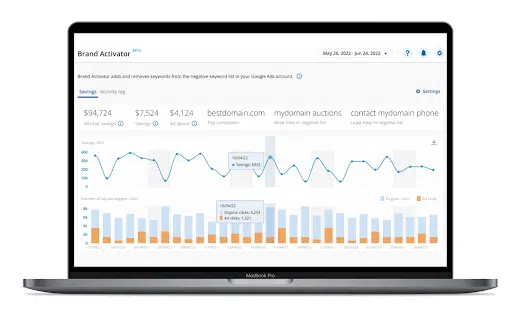
Marketers can now use automated Brand Activator technology to help with just this. When a brand term ranks number one on the SERP for both paid and organic, with no other bidders, there is no need to pay for those clicks. Brand Activator automatically detects those terms and adds them to the negative keyword list. Customers pocket the savings or reinvest in generic terms to drive new revenue.
Audience targeting and segmentation:
By analyzing user data and behavior patterns, marketers can identify relevant audience segments for paid search campaigns. Marketers can use Whole Market View technology to understand user demographics, preferences and online behavior. By leveraging AI to refine targeting strategies, marketers can deliver tailored ads to specific user groups to maximize ad relevance and increase the chance of conversions.
Ad creative testing:
Without question, A/B testing is a vital aspect of paid search strategies. Generative AI can automate the ad creative testing process by generating multiple versions of ads and analyzing their performance. This provides valuable insights into which ad elements, such as headlines, images or calls to action, drive the best results.
Predictive performance analytics:
Generative AI can provide predictive analytics to forecast paid search campaign performance. By analyzing historical data, market trends and user behavior, marketers can predict the potential outcomes of different bidding strategies, budget allocations, and targeting approaches, helping them to make data-informed decisions and optimize their campaigns proactively.
Ad personalization and optimization:
Last but by no means least, generative AI will help deliver personalized ads to individual users based on their preferences and behavior. Generative AI can generate customized ad variations that resonate with specific individuals by analyzing user data and historical interactions. This personalization enhances the user experience, increases relevancy, and drives higher engagement and conversion rates.
To put this into practice, a Campaign Optimization solution is available that helps customers analyze and evaluate ad copy performance by considering factors like click-through rates, conversion rates, and engagement metrics. The technology leverages AI to suggest ad copy variations and improvements to maximize the effectiveness of search ads.
What does this mean at the back end?
So, what does this all mean for marketers working within advertising platforms, such as Google Ads?
Gobert-Jones suggests this is where technology will be more transformative. “Think AI assistants in advertising platforms which are there to help you identify trends, spot opportunities and test new ad variations.”
Omnicom recently announced a series of generative AI partnerships with Google, Amazon, Microsoft and Adobe to access and apply their models within an Omnicom tech environment.
Generative AI – It’s going nowhere but upwards
Generative AI, with its ability to generate human-like responses, understand context and personalize search results, has elevated the search experience to new heights. As generative AI continues to evolve, it will undoubtedly play a vital role in shaping the future of search, offering more accurate, personalized and relevant results to users worldwide.
So, what next?
The curious world of artificial intelligence is a minefield. If you’re a little in the dark about how AI can fit into your search strategy, unsure who is bidding on your brand, where they are doing it and what adverts they are using, check out Adthena’s guide Reveal your wasted budget with AI-powered search intelligence to reveal AI-driven strategies for unparalleled search success and revenue optimization.
Founded in 2012, Adthena is an award-winning search intelligence platform. Our unique combination of patented, AI-driven technology and a world-class team of experts helps brands, marketers, and agencies across the globe dominate their competitive landscapes. We provide our customers with a clear view of the paid search landscape, helping them optimize their spend to increase ROI, all while saving them time and better informing their cross-channel strategies. Adthena’s solutions are powered by our market-leading technology: Whole Market View creates a unique market map of a client’s entire search landscape and Smart Monitor automatically detects threats and opportunities every day. Our award-winning Local View product provides the location-based strategic insights that marketers need to dominate at a local level. For more information, visit: www.adthena.com
How to get Universal Analytics-like insights in Google Analytics 4
While many of us miss Universal Analytics (UA), the fact is it’s gone and it isn’t coming back.
So, how do we get UA-like findings out of Google Analytics 4 (GA4)?
We asked Russell Ketchum, product director of Google Analytics, in the first of a three-part series of conversations with him.
The terminology and concepts in GA4 are different from those in Universal Analytics, what does it mean to recreate UA reports for GA4?
RK: Using GA4 requires a new way of thinking.
First and foremost, when comparing UA and GA4, it’s important to remember that UA was built when the internet looked very different from how it does today – and operated very differently. To accommodate these changes, we’ve updated features in GA4 to meet today’s expectations.
In UA, everything was a report – and there were a lot of them. And, looking back, there was a tendency to overload the purpose of several reports – which might have been great for power users but could be intimidating for newcomers.
With GA4, we’ve taken a more use-case-centric approach.
What we now call “Reports” is intended to be the canonical set of information you’d monitor on a daily basis. It’s customizable in a way that’s shared across your organization so you can be sure that everyone is on the same page and seeing the exact same data (this can be found in the GA4 left navigation).
So how do I come up with customized “reports” about things I want to know?
RK: For that you have Explore. Think of this more as a user’s personal “scratch pad.”
Explore lets you go really deep in your analysis – it actually has its roots in UA’s 360-only “Advanced Analysis” feature set. It offers a lot of functionality that most of our users haven’t seen before.
We don’t expect all users to go there, or at least not every day, but it’s a great option to have.
Explore is there to either answer a specific, one-off question – or to inspire a report that your organization would benefit from when added to the Reports section.
And in the Advertising Workspace, we focus on media measurement.
That said, depending on what your goal is, there are almost always more straightforward ways to get the answer out of GA4, rather than aiming to recreate UA reports.
Such as…?
RK: I think it is more useful to take this even broader and talk about the challenges users can have with GA4 in general.
Let’s be honest, customers were used to Universal Analytics. In a lot of ways, UA taught its users how to think – and GA4 requires you to think differently. We know that’s hard, but it’s also intentional. So we’re committed to helping our customers bridge that gulf – for example, with the newly launched Analytics Academy.
In UA, you had to shoehorn your view of the world into some pretty limiting constructs – sessions, bounces, last click, etc. …In GA4, we’ve broken free of those constraints, but there’s a learning curve.
GA4 measures user engagement with your site or app differently – and more accurately. It focuses on the users and all the things those users do (measured by different events).
Here’s an example:
In UA, you’d typically look at Bounces and Time on Page to get a sense of “not valuable” traffic (or sessions or users or clicks depending on the situation). But that’s not really what it’s measuring. A Bounce is just an “unbound session” — a user came to your site, registered one page view, and took no subsequent navigation action.
Is that a good measure of how engaged the user was? Given how the web worked in 2005 it was. Today, maybe…but more often, maybe not.
What if you have a single-page site? What if your important calls to action on a page don’t trigger navigation?
Even if a user was actively scrolling, reading from one article to another, playing all your video content, submitting every lead gen form you wanted them to, out of the box, UA would tell you that they were all bounces and you’d be looking at a wall of manual tagging if you wanted a better answer.
What’s the answer?
RK: With GA4, we teased it apart and did the hard parts for the customer. Now we have Sessions and Engaged Sessions — and more importantly Engaged Users. Engaged means “active or interacting with” — users that had some interaction with your site not limited to navigation.
There’s a level deeper as well. You could have a user land on a site and immediately leave and a user that lands and just sits there. You can’t distinguish the two in UA even though it’s very different behavior. In GA4 you can. It’s the difference between a Session and an Engaged Session. With modern techniques, we can measure when your site is in focus even if unengaged — so we do.
So that’s really what makes recreating reports from UA hard. In UA you have familiar constructs that may not be answering the questions you think they are. In GA4 you have new terms that mean what they say, but that are different from UA. If you are asking the same questions you did in UA, but GA4 has a better answer to give you, it will.
Are there similarities/overlaps between UA and GA4 I can use to do this?
RK:Yes, absolutely. GA4 can measure a lot more than UA could and can do it at scale – apps for example. But for the web, technologies may have evolved but we expect our customers to still have the same set of fundamental questions.
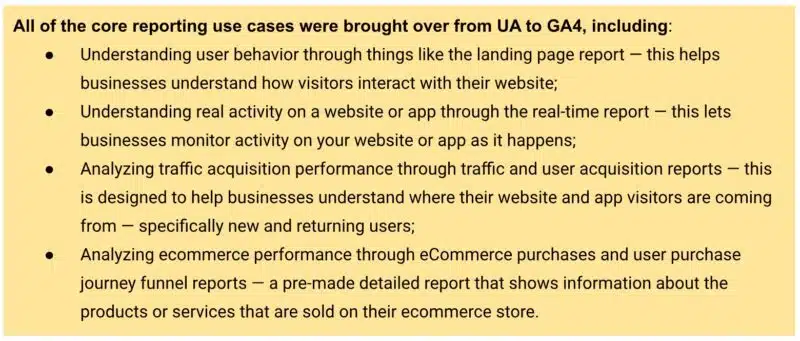
That’s why we made sure to bring over all of the core reporting use cases from UA to GA4.
GA4 takes many of the existing use cases and features Universal Analytics offered and either adds to them or distills them down to be simpler and more intuitive or customizable.
Are there specific things in GA4 I should focus on to do this?
RK: Yes! When you search GA4 for report names from UA, you’ll get pointers to the updated equivalents. Then, when you’re on a given report, but you get a different set of metrics or dimensions than you expected, look to customization – the pencil icon.
Customization is really powerful. Generally speaking, the metrics and dimensions you’re looking for can be added.
I’d suggest making a copy of the report before saving it. That way, you can have a version of the report from the old world and a version from the new.
Unlike UA, GA4 can be tailored for your business from the get-go. By specifying your Business Objectives, the UI will be customized for you to show relevant reports and hide others.
This is another reason that a UA report you expected may not be there. It may not be as relevant for you in GA4 as it was in UA, in other words, GA4 is likely answering your question in a different way.
If you’re new to GA4, I really recommend taking advantage of the many customization options available. It may not be immediately familiar if you’ve been using Universal Analytics for years, but GA4 was intentionally designed to really get businesses the information that matters in a simple and streamlined way, measuring in a way that more accurately reflects the way people use the internet today.
@media screen and (min-width: 800px) { #div-gpt-ad-3191538-7 { display: flex !important; justify-content: center !important; align-items: center !important; min-width:770px; min-height:260px; }
}
@media screen and (min-width: 1279px) { #div-gpt-ad-3191538-7 { display: flex !important; justify-content: center !important; align-items: center !important; min-width:800px!important; min-height:440px!important; }
}
About the author
Constantine von Hoffman is managing editor of MarTech. A veteran journalist, Con has covered business, finance, marketing and tech for CBSNews.com, Brandweek, CMO, and Inc. He has been city editor of the Boston Herald, news producer at NPR, and has written for Harvard Business Review, Boston Magazine, Sierra, and many other publications.
In March, Gap closed its retail media network (RMN), GPS Media, after just one year. For some, the closure of such a short-lived project signaled that the bubble had burst on the frothy growth of retail media networks, a channel forecast to be worth more than $106 billion by 2027 in the U.S., according to Insider Intelligence.
Naturally, there is more nuance.
Gap as an RMN was always limited because it sells mostly Gap products. A key selling point of an RMN—using retailer data to target shoppers with ads very close to the point of sale—wouldn’t apply to other apparel, beauty or consumer packaged goods brands that could happily spend at RMNs like Amazon, Target, Walmart and Kroger.
Still, the excitement around RMNs has been a runaway train.
Why we care. If you sell products on Amazon, this feature could lead to more sales. Reviews remain critical as consumers decide whether to buy a product (Amazon highlighted that “customers contributed nearly 1.5 billion reviews and ratings to Amazon stores” in 2022). The big question is whether this new feature impacts sales positively or negatively.
What it looks like. Amazon’s feature appears at the top of the Customer reviews section on product pages. The AI-generated paragraph, which mentions product features and customer sentiment, appears under a bold Customers say heading. Beneath the paragraph is this line: “AI-generated from the text of customer reviews”:
Several tappable attributes (e.g., Performance, Ease of use, Stability) appear under the customer review highlights. This feature lets you filter to only show reviews mentioning that specific attribute. Here’s a screenshot example Amazon provided for Ease of use:
Who can see the test. A “subset of mobile shoppers in the U.S. across a broad selection of products” have been opted into the test, Amazon said in a blog post.
What Amazon said. The test is likely to expand in the coming months:
“We are always testing, learning, and fine-tuning our AI models to improve the customer experience and, based on customer feedback, may expand our review highlights feature to additional categories and customers in the coming months.”
Newegg has a similar feature. Online retailer Newegg added AI-generated summaries of customer reviews on its product pages, as well as highlighting pros and cons or products.
@media screen and (min-width: 800px) { #div-gpt-ad-3191538-7 { display: flex !important; justify-content: center !important; align-items: center !important; min-width:770px; min-height:260px; }
}
@media screen and (min-width: 1279px) { #div-gpt-ad-3191538-7 { display: flex !important; justify-content: center !important; align-items: center !important; min-width:800px!important; min-height:440px!important; }
}
About the author
Danny Goodwin has been Managing Editor of Search Engine Land & Search Marketing Expo – SMX since 2022. He joined Search Engine Land in 2022 as Senior Editor. In addition to reporting on the latest search marketing news, he manages Search Engine Land’s SME (Subject Matter Expert) program. He also helps program U.S. SMX events. Goodwin has been editing and writing about the latest developments and trends in search and digital marketing since 2007. He previously was Executive Editor of Search Engine Journal (from 2017 to 2022), managing editor of Momentology (from 2014-2016) and editor of Search Engine Watch (from 2007 to 2014). He has spoken at many major search conferences and virtual events, and has been sourced for his expertise by a wide range of publications and podcasts.
What has changed. The New York Times updated its terms of service page Aug. 3. It includes AI-specific additions that apply to its content (which it defines as “including, but not limited to text, photographs, images, illustrations, designs, audio clips, video clips, ‘look and feel,’ metadata, data, or compilations”).
In the “Prohibited use of the services” section:
(3) use the Content for the development of any software program, including, but not limited to, training a machine learning or artificial intelligence (AI) system.
Google and the New York Times Co. already have a lucrative “commercial agreement” in place, but that deal is about working together on “tools for content distribution and subscriptions.”
@media screen and (min-width: 800px) { #div-gpt-ad-3191538-7 { display: flex !important; justify-content: center !important; align-items: center !important; min-width:770px; min-height:260px; }
}
@media screen and (min-width: 1279px) { #div-gpt-ad-3191538-7 { display: flex !important; justify-content: center !important; align-items: center !important; min-width:800px!important; min-height:440px!important; }
}
About the author
Danny Goodwin has been Managing Editor of Search Engine Land & Search Marketing Expo – SMX since 2022. He joined Search Engine Land in 2022 as Senior Editor. In addition to reporting on the latest search marketing news, he manages Search Engine Land’s SME (Subject Matter Expert) program. He also helps program U.S. SMX events. Goodwin has been editing and writing about the latest developments and trends in search and digital marketing since 2007. He previously was Executive Editor of Search Engine Journal (from 2017 to 2022), managing editor of Momentology (from 2014-2016) and editor of Search Engine Watch (from 2007 to 2014). He has spoken at many major search conferences and virtual events, and has been sourced for his expertise by a wide range of publications and podcasts.
YouTube launching New and Returning Viewers by Format report
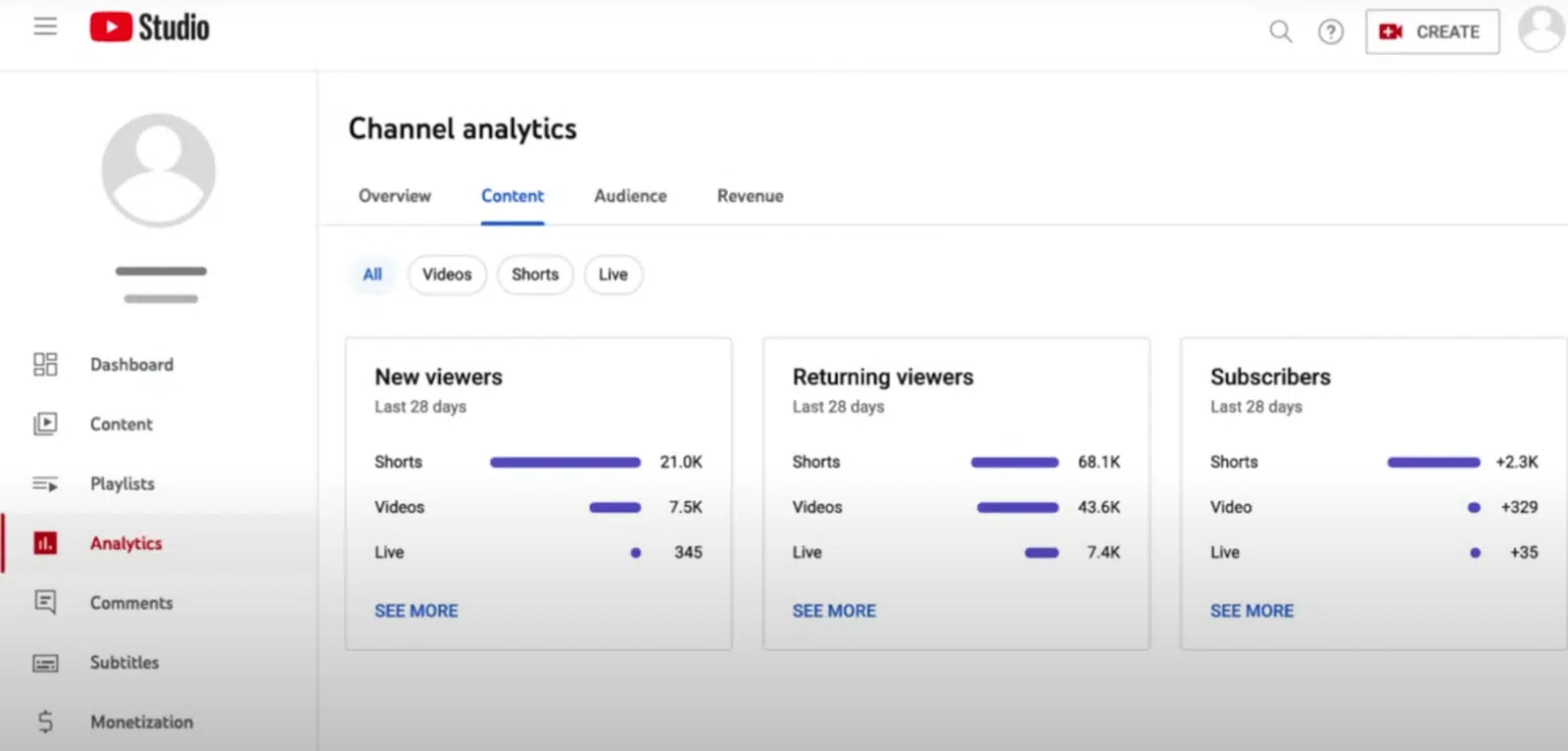
YouTube is launching a new analytics report to show your new and returning viewers by format type.
What it looks like. You will find it on the Content > All tab in YouTube analytics. You’ll initially see data based on the past 28 days by Shorts, Videos and Live. You can click on See More to dig deeper in to your channel’s viewer data.
Why we care. Having more data about your audience could help you understand whether you’re creating the right types of videos to attract new viewers, as well as a loyal audience – and could potentially uncover opportunities where you can further grow your YouTube channel.
@media screen and (min-width: 800px) { #div-gpt-ad-3191538-7 { display: flex !important; justify-content: center !important; align-items: center !important; min-width:770px; min-height:260px; }
}
@media screen and (min-width: 1279px) { #div-gpt-ad-3191538-7 { display: flex !important; justify-content: center !important; align-items: center !important; min-width:800px!important; min-height:440px!important; }
}
About the author
Danny Goodwin has been Managing Editor of Search Engine Land & Search Marketing Expo – SMX since 2022. He joined Search Engine Land in 2022 as Senior Editor. In addition to reporting on the latest search marketing news, he manages Search Engine Land’s SME (Subject Matter Expert) program. He also helps program U.S. SMX events. Goodwin has been editing and writing about the latest developments and trends in search and digital marketing since 2007. He previously was Executive Editor of Search Engine Journal (from 2017 to 2022), managing editor of Momentology (from 2014-2016) and editor of Search Engine Watch (from 2007 to 2014). He has spoken at many major search conferences and virtual events, and has been sourced for his expertise by a wide range of publications and podcasts.