Microsoft’s Performance Max is now in open beta. Select marketers can now access its full inventory and serve ads across its network.
Why we care. Microsoft’s Performance Max offers new features which aim to simplify marketers’ workloads and give them back time to focus on the creative and help them to reach untapped audiences. Being able to work directly with Microsoft on Performance Max campaigns will also give advertisers more transparency and detail into that asset level of reporting.
How to get started. Creating a campaign with Microsoft Performance Max consists of five steps:
Set up Microsoft conversion tracking: While Google import is a great way to get started if you’re already using Performance Max there, you must ensure that conversion tracking is set up with Microsoft too as it’s a requirement. This can be done via UET or with offline conversion goals. This should always be the first set up and Microsoft advises making sure that you’ve set up the appropriate goals.
Set budget and bid strategy: With maximize conversions within optional target return on ad spend goal, you can set and maximize conversion values with optional target CPA goals.
Final URL expansion: Microsoft recommends turning this setting on because it helps drive consumers to the most relevant landing page. It also lets Microsoft create additional assets based on what’s working well on landing pages.
Add assets: Next up, you should add text, images and ensure that their brand’s store is set up with Microsoft when using the Merchant Center.
Audience signals: This helps Microsoft with regard to predictive targeting, which in turn can help you reach your target audience.
What has Microsoft said? Lauren Tallody, Sr. Product Marketing Manager and Automation Lead for Microsoft, told Search Engine Land:
“Since Google launched their Performance Max product in 2021, we took our time to understand if there was a need across advertisers for this kind of product on our side.
“We wanted to understand your needs, where we could differentiate and where we could focus. And this will continue to be a long journey.”
Timeline. Microsoft has been working on the creation of its Performance Max program since the fall of last year and has already seen positive results:
September 2022: Import Google PMAX campaigns using Merchant Center – As more advertisers started embracing the PMAX product in Google, Microsoft wanted to capture that demand and have a parity experience and so started importing Google Max campaigns as either smart shopping or local inventory ads.
October 2022: Import Google PMAX campaigns not using Merchant Center – Microsoft changes its approach slightly by importing Google Max campaigns as DSA campaigns.
May 2023: Closed beta launch of Microsoft’s Performance Max – The close beta launch went “very well” for Microsoft and the results encouraged it to continue building the product and import those campaigns in.
July 2023: Open beta launch – Microsoft’s Performance Max officially went into open beta a couple of weeks ago.
Get the daily newsletter search marketers rely on.
Next steps. Microsoft is now looking to bring its Performance Max product to general availability and continue to build on more features. This includes:
API support.
Microsoft Advertising Editor support.
Expanded reporting like search term and domain reports.
@media screen and (min-width: 800px) { #div-gpt-ad-3191538-7 { display: flex !important; justify-content: center !important; align-items: center !important; min-width:770px; min-height:260px; }
}
@media screen and (min-width: 1279px) { #div-gpt-ad-3191538-7 { display: flex !important; justify-content: center !important; align-items: center !important; min-width:800px!important; min-height:440px!important; }
}
About the author
Nicola Agius is Paid Media Editor of Search Engine Land after joining in 2023. She covers paid search, paid social, retail media and more. Prior to this, she was SEO Director at Jungle Creations (2020-2023), overseeing the company’s editorial strategy for multiple websites. She has over 15 years of experience in journalism and has previously worked at OK! Magazine (2010-2014), Mail Online (2014-2015), Mirror (2015-2017), Digital Spy (2017-2018) and The Sun (2018-2020). She also previously teamed up with SEO agency Blue Array to co-author Amazon bestselling book ‘Mastering In-House SEO’.
Instagram updates Reels to simplify content creation
Instagram is rolling out new features on Reels that will make it easier for brands to jump on trends, increase reach and edit videos.
For the first time, you can search the Template Browser via category, making the Meta-owned platform far simpler to navigate.
You will also now have access to more editing capabilities than ever before as the platform has made it less time-consuming to customise templates.
Why we care. Finding out what videos are trending and adding to that conversation is a great way to maximize reach by capturing the attention of people who might not have otherwise been aware of your brand. These new features not only make it easier to see what videos are popular, but the new editing capabilities make content creation simpler and faster. In addition, if you want to cash in on a trend but are struggling to come up with an original concept, Reels’ new simpler browsing system means they can now explore how other people have recreated templates for much-needed inspiration.
Template Browser revamp. You can browse through different Instagram templates via category in the updated Template Browser. These categories will be organized into Recommended and Trending – as well as whatever templates or audio that you have saved to your account.
How it works. Users be able to access the Template Browser whenever they go to create a reel. Simply:
Tap on the create button from the home page.
Tap on REEL.
Tap the image in the lower left corner of the screen to open your camera gallery.
Tap on Templates.
You can also access the Template Browser via the Reels Tab. Tap on the camera icon and then select Templates.
Save your favorite template. If you see a template you would love to use, you can save that video and return to it later. Simply tap the Use Template button located on the Reel. That footage will then be accessible in the Template Browser.
Get inspired. Whenever you stumble across a template that you would love to use but and need some inspiration, you now have the option to check out the competition. By tapping on the Template by icon in their chosen reel, brands will be shown examples of how others have used the template and gotten creative to make that video their own.
New editing capabilities. When you create templates, the audio, number of clips, duration of the clips, and AR effects will automatically be added to your reel. This means they no longer have to manually add or recreate these features themselves, saving a lot of time.
Instagram has also announced that it will start adding text and transitions that were used in the original reel to templates, which will again help save you time. However, the templates will still be fully customizable so that you can add or remove clips, adjust timings and edit preloaded elements. This new feature is expected to be rolled out in the coming weeks.
Get the daily newsletter search marketers rely on.
Added bonus. Meta also confirmed this week that Instagram Reels will now also be served on Facebook. People will also have the opportunity to write comments on these clips without switching between the apps. This means that brands now have the potential to reach more people than ever before across the Meta network.
What has Instagram said? The platform said via its announcement:
“Reels templates allow you to easily create a reel by reusing elements from another reel you love. Just drop in your own videos and photos to save time and put your own creative spin on a reel.
“We’re excited to share some upgrades to Reels templates that will help you more easily find inspiration and create engaging reels.
“Whether you’re joining in on a trend or want to create a fun reel to express your creativity, Reels templates can get you started in just a few taps.
“We’re always working on ways to improve your Reels experience. We’ll continue to build on the Reels templates feature to make it easier and more fun to create and share on Instagram.”
@media screen and (min-width: 800px) { #div-gpt-ad-3191538-7 { display: flex !important; justify-content: center !important; align-items: center !important; min-width:770px; min-height:260px; }
}
@media screen and (min-width: 1279px) { #div-gpt-ad-3191538-7 { display: flex !important; justify-content: center !important; align-items: center !important; min-width:800px!important; min-height:440px!important; }
}
About the author
Nicola Agius is Paid Media Editor of Search Engine Land after joining in 2023. She covers paid search, paid social, retail media and more. Prior to this, she was SEO Director at Jungle Creations (2020-2023), overseeing the company’s editorial strategy for multiple websites. She has over 15 years of experience in journalism and has previously worked at OK! Magazine (2010-2014), Mail Online (2014-2015), Mirror (2015-2017), Digital Spy (2017-2018) and The Sun (2018-2020). She also previously teamed up with SEO agency Blue Array to co-author Amazon bestselling book ‘Mastering In-House SEO’.
Are you looking for new ways to save time doing research and competitive analysis?
Then these five handy SEO tools and plugins – which are completely free to use – should help:
Competitor research: Wayback Machine
Data analysis: Copy Selected Links
Design and layout: GoFullPage
Research and data formatting: Docs Online Viewer
Reformat content from an image: OneNote
1. Competitor research: Wayback Machine
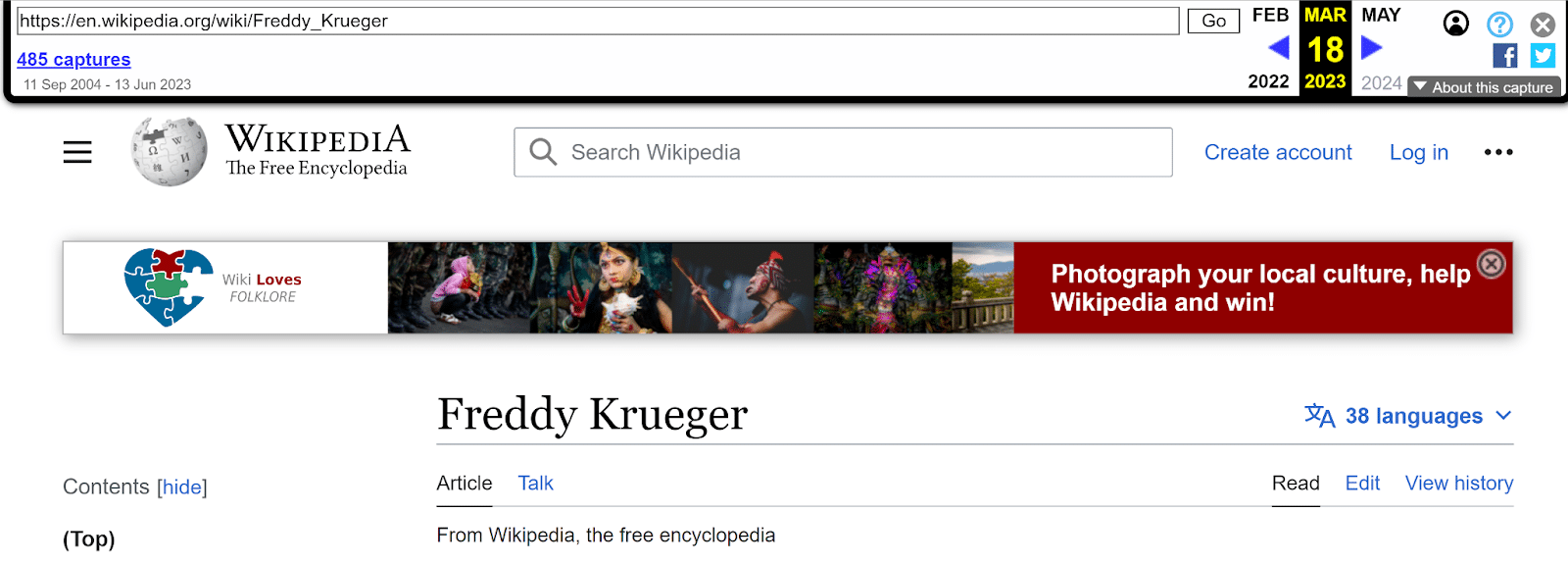
The Internet Archive Wayback Machine is one of the most underrated free tools for SEO. Not only can you use it to view past versions of your own website, but you can also use it to view competitor changes.
There are probably hundreds of tools and approaches for competitive SEO analysis, like Fluxguard and Visualping. But the Wayback Machine is free and can be used on any site. And it can’t easily be blocked by a competitor’s firewall (yes, your competitor can block IPs coming through your company’s VPN).
You can view past versions of competitor pages to see what they’ve updated, tested and reverted, like:
Design and layout elements
Calls to action (CTAs)
Content and headline changes
Keyword focus
Web Archives also has extensions for all the major browsers that let you instantly view versions of any page you’re on.
When to use it
Spot and track trends over time, or come up with ideas to test on your own site.
Use the Changes tab to see how much a page has changed over time. It can give you clues if competitors seem to update certain pages on a regular timeline.
For sites that use a category or folder structure, the Sitemap tab lets you see a visual map of the structure of the site. This is especially useful for sites without an obvious or public sitemap.
Share before and after screenshots if you can’t access previous versions of your page.
When you can’t use it
The Wayback Machine has one major downside: You can’t view a page that hasn’t been archived before.
The Wayback Machine doesn’t have a record of every webpage, though it does come pretty darn close.
The Archive claims it has 813 billion web pages in its collection. With an estimated 4.5 billion indexed webpages in existence, that’s about 18% of the whole internet.
Fortunately, you can add any page to the archive that you can view later. If you search for a URL and it’s not in the archive, click the option to save it to add it to the collection. But there won’t be historical data before that point.
Let’s say you have a list of linked article titles in a spreadsheet. But you need to add the actual URLs in a column too.
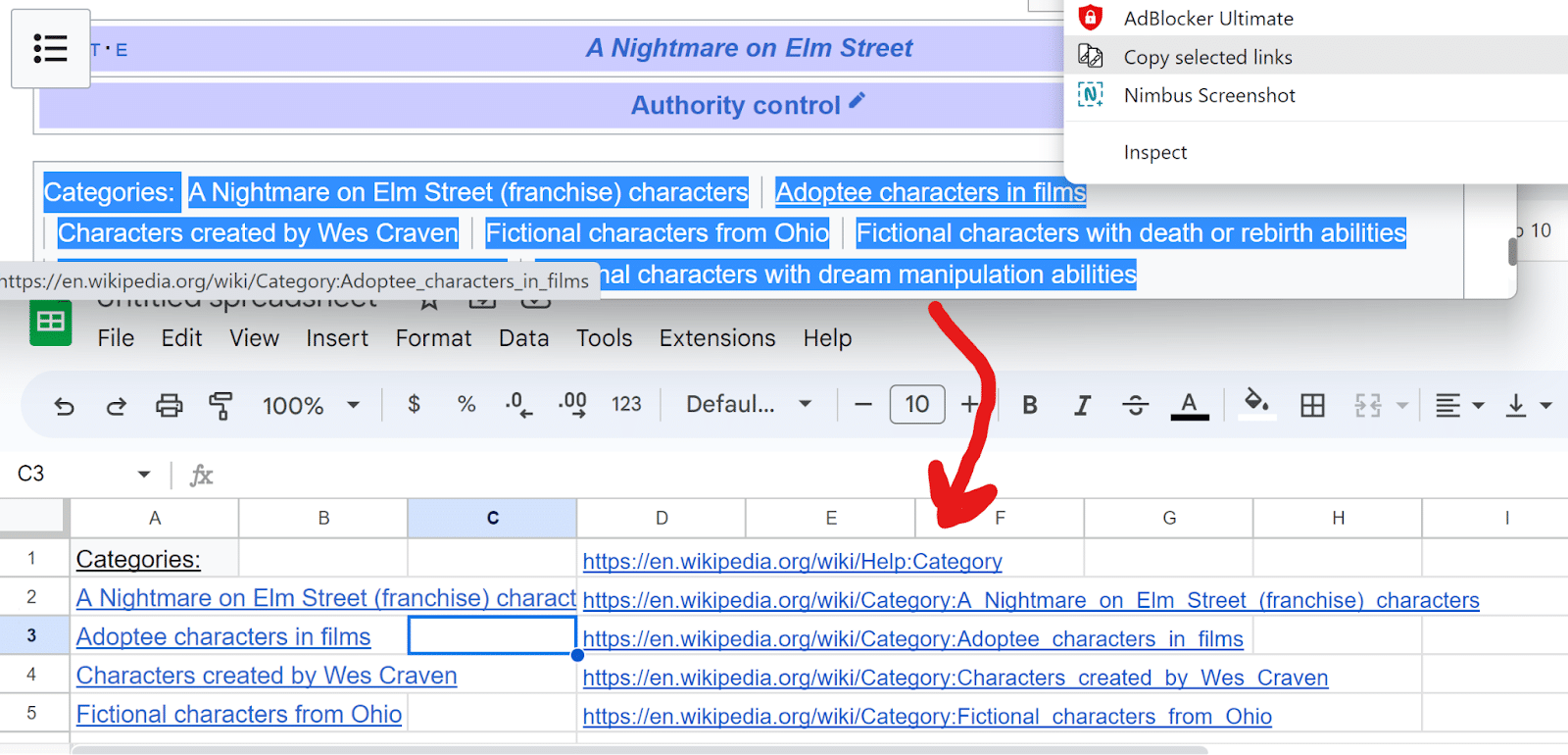
Instead of right-clicking and copying each URL into a new cell, you can use the Copy Selected Links extension for Chrome and Firefox.
Copy the linked text, then right-click and paste. Now you have a list of the URLs for the content you copied.
When to use it
If you’re making edits across many pages on your site, typically, you’d have to log into your CMS, open each page and then click Edit. Or you might search for each page in the CMS dashboard and click Edit on each one.
If you use a CMS like WordPress, you can often copy the list of pages straight from your CMS dashboard, along with the Edit links, into the same spreadsheet.
Create a spreadsheet.
In your CMS, select all the pages to edit and copy with Ctrl/Cmd + C.
In your spreadsheet, paste the list of linked pages.
Right-click the page titles and paste the live URLs in one column.
Right-click the Edit links and paste in another column.
Get the daily newsletter search marketers rely on.
3. Design and layout: GoFullPage
Now you have a spreadsheet with a list of the page links and edit links. You can right-click and open all the Edit links in new tabs instead of opening each page individually.
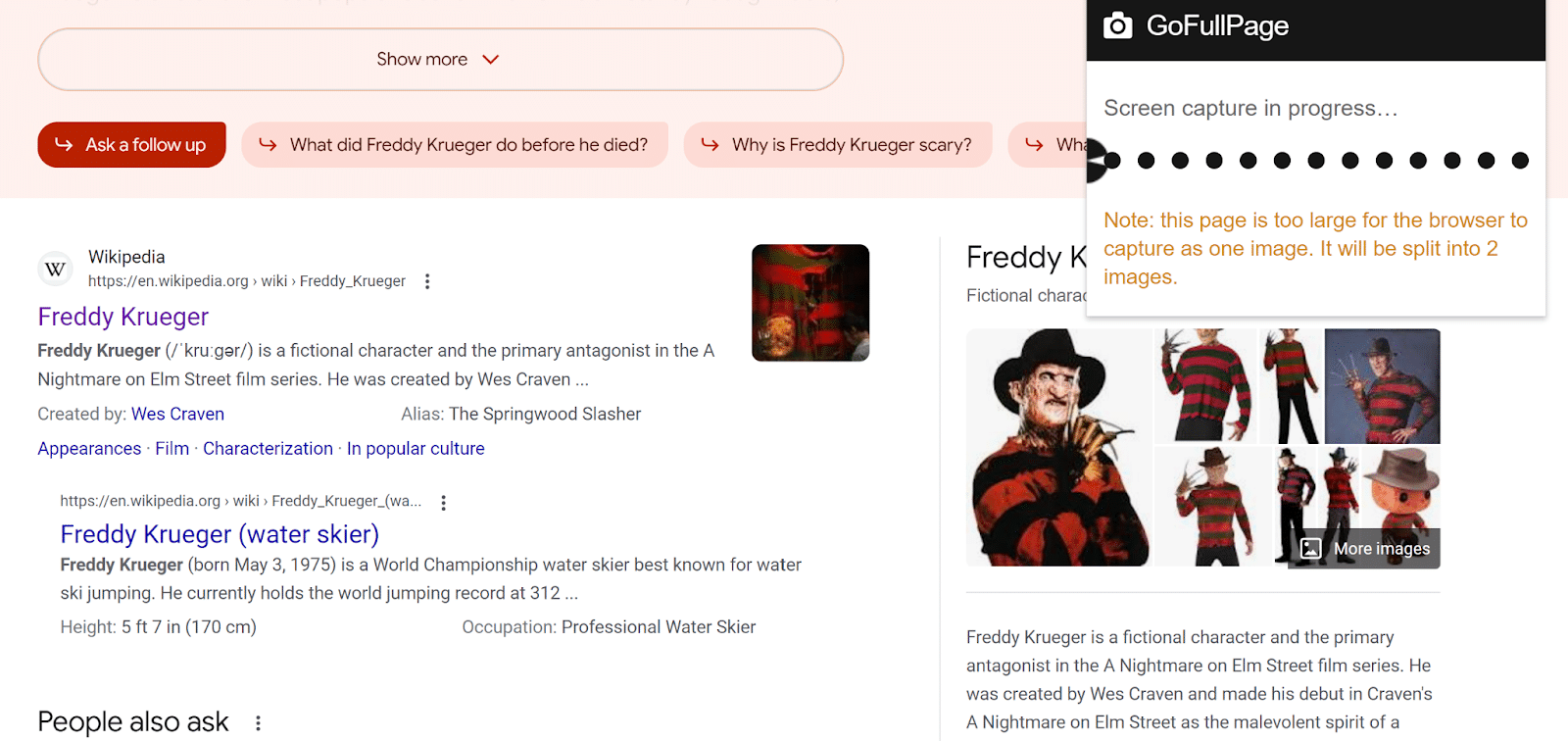
GoFullPage is a Chrome browser extension that lets you take a screenshot of an entire page at once.
You can take a picture of an entire page on desktop and mobile without needing to scroll and take multiple screenshots.
Save your screenshot as a PDF or PNG, or mark up your image with notes before you save it or share it.
When to use it
Save search results for specific keywords to see how the SERP changes over time.
Compare SERP results side-by-side for users in different locations or using different devices.
Share before and after screenshots of page changes.
User test different versions of the same page without the need for a designer.
4. Research and data formatting: Docs Online Viewer
Doing an advanced web search for filetype:pdf is enormously helpful for finding specific data types, like sample files and reports.
But some sites require you to download the PDF instead of letting you view it directly in your browser. You can always open a PDF in Chrome from your Privacy and Security settings. But this isn’t foolproof.
Docs Online Viewer, a Chrome or Firefox browser extension, puts a linked cloud icon next to any PDF. Click it to view the PDF in your browser.
When to use it
The obvious use case is so you never have to download a PDF first before you find out if the PDF is useful.
Sometimes this plugin lets you view a PDF that’s behind an email signup button – without giving away your email address.
Viewing the PDF in your browser also means you can combine this with other extensions, too. Use this plugin with Copy Selected Links to copy all the URLs in a database of links, for example.
5. Reformat content from an image: OneNote
OneNote is a go-to program for organizing notes and your work life. It also has a lesser-known feature: copying text from images.
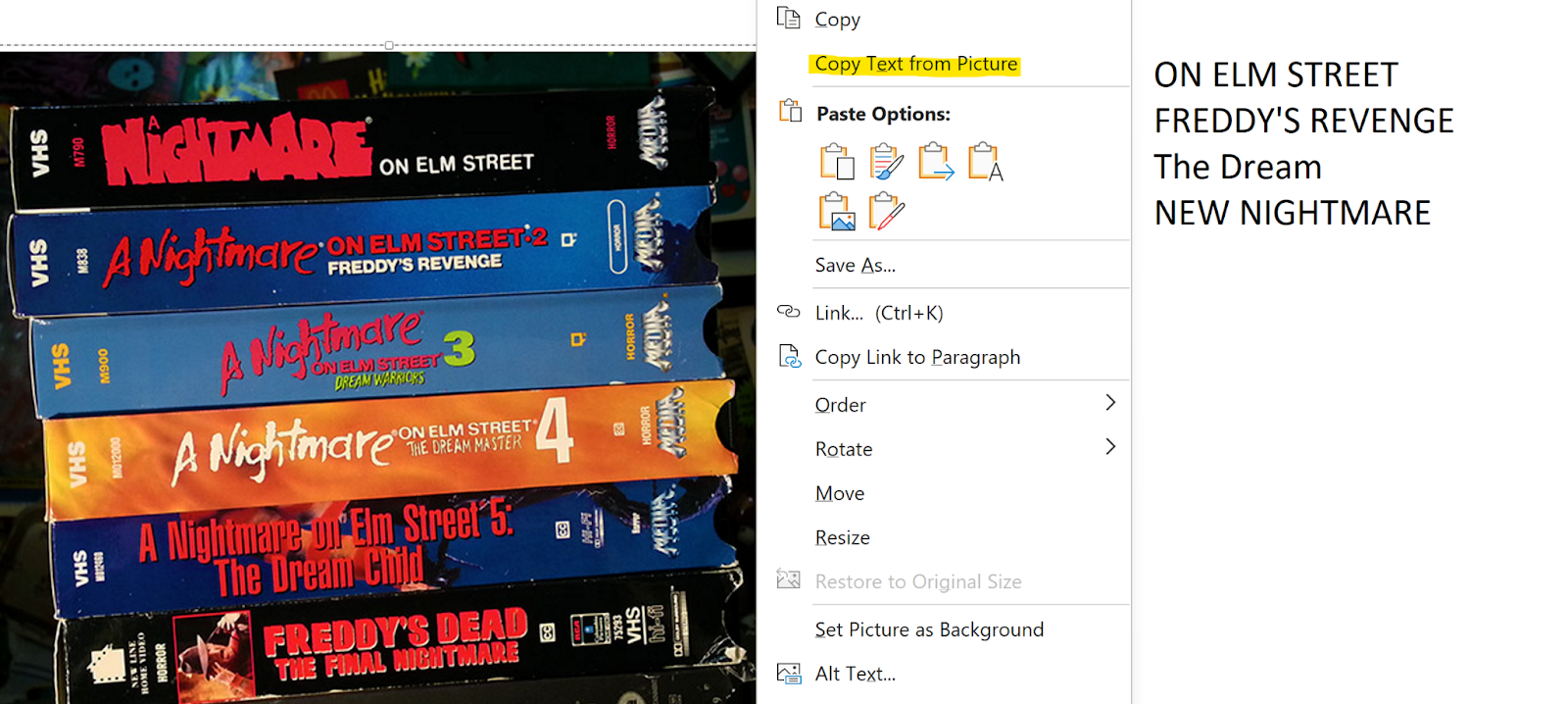
Copy any image into a OneNote page.
Right-click on the image.
Select Copy Text from Picture.
Paste it into your Note with Ctrl/Cmd + V or right-click + paste.
It’s not perfect at copying text by any means. But for images that are structured around copy, it can be up to 80% accurate.
You’ll often need to check certain letters and numbers manually. OneNote might mix up a 1 and an L, for example.
When to use it
This is helpful for pulling out content from an image so you can analyze the data or turn it into on-page content.
Google can’t read content from images like it reads on-page copy, even if it does have proper alt text. Neither can screen readers.
Whenever you have an image on a page, it’s useful to include the same info from the image in another, more readable format. Use this tool to take a diagram and turn it into copy, or include both an image of a table and an HTML table on your page.
The image-to-text feature is available with free or premium versions of OneNote. OneNote is available for both PC and Mac.
To get the most out of your SEO tools, share the best tools and tips you’ve found with your team, clients and peers.
SEOs love to try new things, so try new tools and feature whenever you can, then spread your wealth of knowledge to others.
Opinions expressed in this article are those of the guest author and not necessarily Search Engine Land. Staff authors are listed here.
@media screen and (min-width: 800px) { #div-gpt-ad-3191538-7 { display: flex !important; justify-content: center !important; align-items: center !important; min-width:770px; min-height:260px; }
}
@media screen and (min-width: 1279px) { #div-gpt-ad-3191538-7 { display: flex !important; justify-content: center !important; align-items: center !important; min-width:800px!important; min-height:440px!important; }
}
About the author
Roslyn Ayers is a contributing writer for Search Engine Land. With over a decade of experience in SEO, her subject matter expertise includes everything from finance and tech to ecommerce and education. Her expert analysis has been featured on sites like Bankrate, MSN and Reader’s Digest. Roslyn is currently an SEO Manager for ValuePenguin by LendingTree.
The brightest minds in marketing and tech converge at NexTech, Nov. 14–15 in NYC. Get your pass for the latest on generative AI, gaming and more.
The nonprofit Center for Intimacy Justice filed a complaint with the Federal Trade Commission against Meta, accusing the social giant of systemically rejecting advertisements and information from women’s sexual health brands. These rejections lead to suspended accounts, diluted brand messaging and missed marketing opportunities.
The organization, which filed the complaint in March but is announcing the action today, alleges Meta engages in unfair and deceptive trade practices by purporting to allow women’s sexual health brands to advertise on its platform, but in practice rejecting their ads. Several representatives of Congress, including Senators Elizabeth Warren, Amy Klobuchar, Mazie Hirono, Peter Welch and Representative Adam Schiff, signed a public letter sent last week supporting the CIJ’s complaint.
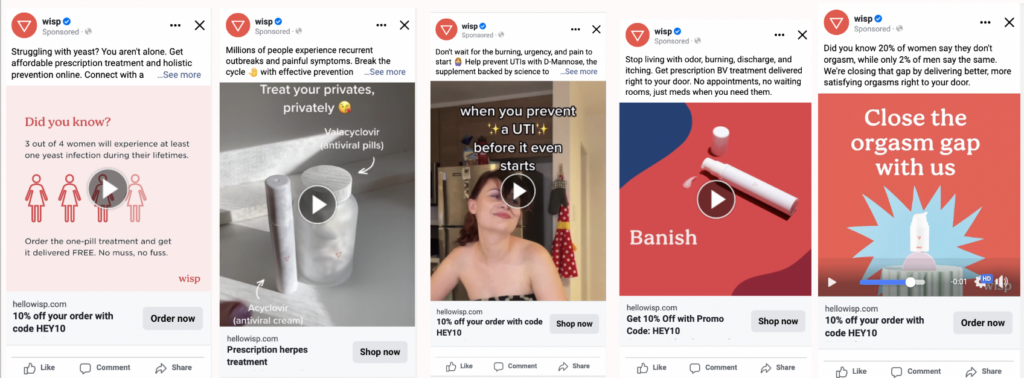
“We have had to water down our messaging, and because we can’t use specific words, our ads are less direct,” said Jenny Dwork, vp of marketing at reproductive healthcare company Wisp, who said hundreds of their ads have been flagged, and that ads that have been approved can be later rejected in future campaigns. “As a result, our mission and brand commitment to destigmatize sexual and reproductive health does get diluted.”
The latest scuffle between sexual health brands and Meta reflects the challenges the social platform has had in balancing free expression with content moderation efforts, intended to make the platform more palatable for users and advertisers. For example, Meta has been found to allow content that violates its policies around climate misinformation and misleading health claims. Meta also has tools to let people report content that could violate its policies, which has led to the accounts of creators receiving backlash being suspended, even if the creator has not actually violated any policy.
Lauren Wang, founder of menstruation product Flex, estimates that the company has lost $10 million in online revenue due to censorship of its ads from Meta and other digital channels since its founding in 2016.
“We use honest portrayals of periods in our marketing and advertising so menstruators everywhere understand that their bodies are beautiful,” Wang said. “Bleeding is completely normal, and periods are nothing to be ashamed of.”
Meta says it allows advertising of sexual health products, so long as they conform to the platform’s policies.
“We welcome ads for women’s health and sexual wellness products but we prohibit nudity and have specific rules about how these products can be marketed on our platform,” said Meta’s spokesperson Ryan Daniels.
Ads created by Wisp that have been rejected by Meta.Meta
The CIJ has requested the FTC take legal action and investigate Meta’s policies, urge the platform to improve its advertising appeal process and order Meta to increase resources to monitor advertising acceptance and rejection, among other requirements.
In January 2022, the CIJ published a report, in partnership with pelvic health startup Origin, that sampled 60 organizations serving women and people of diverse genders on their experience with Meta. All brands in the sample, including a startup helping with the consequences of endometriosis and a nonprofit offering sexual health education in Kenya, had their ads rejected. Further, 50% of organizations had their accounts suspended by Meta.
In October 2022, Meta updated its advertising policies, including those around sexual health products. The company said the updates were less substantive changes than ones to improve clarity, though claimed enforcement has improved. In practice, sexual health ads have still been routinely rejected since October, said Jackie Rotman, founder and CEO of CIJ. Wang agrees that Meta’s censorship has not improved since October.
Uneven enforcement
Flex is a disc that people can use on their periods, with one of its primary use cases being mess-free period sex. In order to explain how the product works in its advertisements, Flex needs to show blood, though this has been labeled as “too graphic” by Facebook, according to Wang.
“Since we couldn’t initially say period, period sex, or show period blood as red, we had to fight all of the platforms (including Meta) at the executive level to have their policies changed,” Wang said. “But from time to time the policies go back and then (without notice) block our ads, so we go back to the drawing board.”
A key talking point of the CIJ is the inconsistencies in Meta’s policies. The policy explicitly states that ads can’t promote products focused on sexual pleasure or enhancement, like sex toys, but can advertise products to prevent erectile dysfunction and premature ejaculation.
Many sexual pleasure brands have felt the sting of these policies. When sex toy brand Womanizer saw its account banned in summer 2021 without ever knowing what policy it violated, the company had to ask its customers to submit complaints to Instagram to reinstate its account, in exchange for a product giveaway. The company even went so far as to offer Meta employees a complimentary toy if they submitted a short anonymous testimonial. Womanizer eventually got its account reinstated after two weeks.
“We hoped by asking an independent agency to take action that they could impact …. a wider array of companies,” CIJ’s Rotman said. “The calls to action about injunctive relief are actually to require change at Meta.”
5 Google Analytics 4 ‘flaws’ that you can use to your advantage
Marketers have criticized Google Analytics 4 since it was released in late 2020.
The list of complaints is long – from the move from user tracking to event tracking, to the missing standard reports, and the replacement of bounce rate with engagement rate, to name just a few.
GA4 is the predominant platform for measuring website performance and user behavior. (This is partly because it is free, and many competitors disappeared over the years as they couldn’t give away their software at no cost.)
Although some will argue that GA4 falls short in many areas, I believe that many of these perceived flaws are, in fact, true improvements to the product.
This article explores five main criticisms of GA4 and sheds light on how they actually contribute to its improvement.
1. Data discrepancies and disruptions
One primary concern about GA4 is the potential for data discrepancies and disruptions. This also happened in 2012, when users were forced to change from the original Google Analytics (GA2) to Universal Analytics (GA3, AKA UA).
With each iteration, the method used by any analytics tool for calculating unique users and sessions changes. This is to measure more accurately these critical data points used in virtually all key performance indicators (KPIs).
Critics argue that the new data model and measurement protocol lead to inconsistencies, making relying on GA4 for accurate reporting difficult. This is a flaw in their logic.
By not understanding the differences, they assume it is inaccurate, while the reality is that it is more accurate than UA.
This is why analytics professionals (like myself) have been advocating for businesses to enable GA4 for well over a year now. This ensures you have a full year of data for meaningful comparisons (comparing GA4 vs. UA with over a year of data).
For various reasons, many organizations waited or didn’t bother to review the configuration until the last minute to ensure correct data collection. They are now faced with a great challenge when conducting period comparative analysis.
Users must embrace this opportunity, revisit their measurement plans and adopt a more comprehensive and holistic approach to data analysis. With GA4, organizations can leverage multiple data sources (through third-party data imports) and integrate them to gain a deeper understanding of their users and their journey, which was nearly impossible with UA.
2. Learning curve and interface complexity
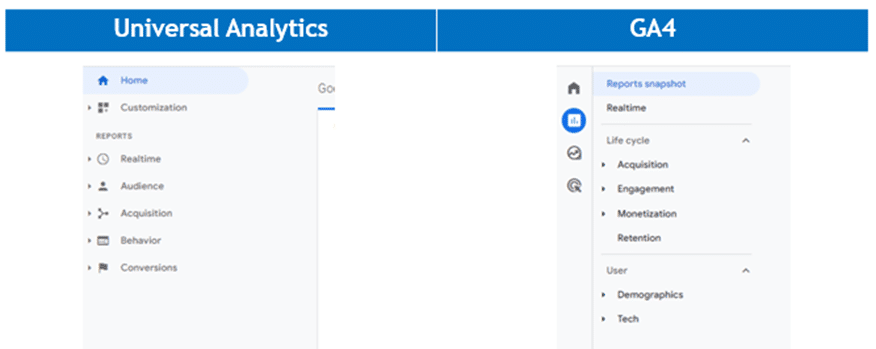
GA4 introduces a revamped user interface and a different approach to reporting, leading to a steep learning curve for many users.
Any change in a UI is difficult. GA4’s UI has been completely overhauled with no similarities to its predecessor. Critics argue that the complexity of the new interface hinders its adoption and usability.
This should not be a surprise to any user. Most software upgrades to new versions come with a new UI. With any new UI, there is always a learning curve.
The redesigned interface reflects a shift toward a more user-centric approach. It empowers all users (marketers and analysts) to explore data in a more intuitive and customizable manner, enabling deeper analysis and uncovering hidden patterns.
The new customizable interface lets you make the GA4 interface truly your own. Remove reports that do not apply to your business. Add custom reports that are tailored to your organization. Organize and group reports into meaningful categories. (No need to learn how Google thinks reports should be named or grouped!)
While the initial learning curve may be daunting, the long-term benefits of improved data interpretation and actionable insights and a fully customizable interface far outweigh this temporary inconvenience.
3. Limited historical data
Another critique of GA4 is its limited compatibility with historical data from UA. Users argue that this limitation hampers the ability to conduct meaningful trend analysis and track long-term performance accurately.
This is not new.
The same attitude was taken when GA migrated to UA. Back in 2012, there wasn’t an option either to port old data into the new measurement logic of UA. This left businesses with comparing apples to oranges (before and after the change) in their data.
Many analytics professionals have long advocated and argued that there was little analytics insight to gain from revisiting data more than a year old and most certainly over two years old. The pandemic’s impact on many businesses makes comparing year-over-year data meaningless, and so does comparing the past months to the same period from three or four years prior.
Websites and apps have been updated, marketing strategies modernized and the global economy and user preferences have changed. Unless your reporting considers this, simply reporting users, sessions and even sales numbers out of context was and still is meaningless.
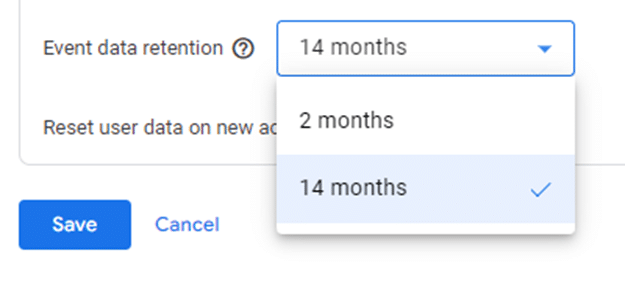
The new maximum GA data storage limit of 14 months is disconcerting compared to the previous “unlimited” option. To address this issue, Google has given all accounts a free BigQuery (data warehouse) account. By storing your data here, you still get virtually an unlimited time frame of storage.
Granted, configuring and using BigQuery is not simple. It entails a steep learning curve and time commitment that is beyond many Google Analytics users, especially those without their own data team.
With limited historical data, you must reevaluate your approach to measurement. How are you going to evaluate success? Adopting GA4 enables us to revisit our data collection strategies and redefine KPIs.
This shift prompts a fresh perspective on data analysis, focusing on real-time and forward-looking insights rather than relying solely on historical trends. Consequently, we can better align strategies with current market dynamics and adapt swiftly to changing consumer behavior.
While digital analytics helps evaluate marketing performance, it is far more effective at generating questions than answering them. Reviewing your analytics for user behavior changes — and then investigating why — yields greater value than simply using it to validate campaign effectiveness.
4. Reduced customization options
GA4 offers a more streamlined approach to event tracking and customization compared to its predecessor.
Critics claim that this reduction in customization options (custom reports only) limits the ability to track specific user actions and tailor analytics to individual business needs. However, this apparent flaw ushers in a new era of efficiency.
GA4 enables marketers and analysts to focus on the most critical metrics and outcomes by simplifying event tracking. It forces us to reevaluate our tracking requirements and prioritize the metrics that truly matter, leading to more concise and actionable insights.
The reduced customization options promote a more standardized approach to analytics, facilitating benchmarking and industry-wide comparisons.
Despite critics’ claims of a reduction in customization, GA4 does offer greater levels of customization to the UI.
You can (using the library feature) completely customize the user interface and add any number of custom reports and report sections.
With a little effort, the entire UI can be customized to your business needs.
By doing so, commonly required reports become easily accessible.
Reports that were never used can be removed from the UI.
The result is faster access to data yielding greater productivity.
5. Privacy concerns and consent management
With the growing emphasis on user privacy, GA4’s stricter data collection and consent management mechanisms have drawn criticism. Critics argue that the enhanced privacy measures limit the availability of data for analysis and hinder marketers’ ability to understand their audience fully.
However, this perceived flaw is crucial to building trust and transparency. By embracing privacy-centric practices, businesses can strengthen their relationships with users and establish themselves as ethical data stewards.
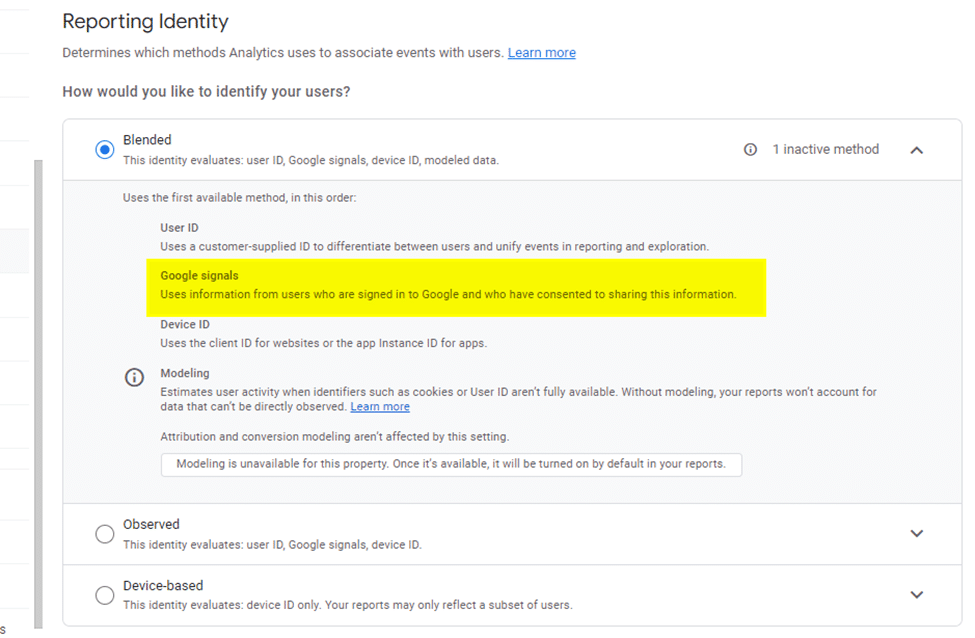
As part of the migration to GA4, website and app privacy policies must be reviewed. For sites that have enabled Google signals as part of the “Reporting Identity” and operate under the legal aspects of GDRP, this review is critical.
Embrace changes in your measurement approach
Once you get past the initial surprise of the new interface and understand why the top five complaints about it are actually positive improvements, you will likely begin to appreciate GA4.
While items are missing from the standard features, there is hope that Google will add these back in a future release. (The annotation tool and ability to save predefined segments from standard reports are missed by users.)
Although many marketers widely consider the rollout of the GA4 upgrade as “one of the worst ever,” it brings improvements that will likely be embraced by most users within a few months.
Opinions expressed in this article are those of the guest author and not necessarily Search Engine Land. Staff authors are listed here.
@media screen and (min-width: 800px) { #div-gpt-ad-3191538-7 { display: flex !important; justify-content: center !important; align-items: center !important; min-width:770px; min-height:260px; }
}
@media screen and (min-width: 1279px) { #div-gpt-ad-3191538-7 { display: flex !important; justify-content: center !important; align-items: center !important; min-width:800px!important; min-height:440px!important; }
}
About the author
Alan K’necht an independent SEO, social and analytics consultant, a public speaker, award-winning author and a corporate trainer (SEO, social media marketing and digital analytics).
Threads is adding branded content tools to create paid promotion opportunities
Threads is implementing branded content tools to give marketers access to paid promotion opportunities.
Meta’s new social platform doesn’t serve ads yet. However, this feature will enable brands to explore the possibility of running influencer campaigns.
Why we care. Meta is waiting until Threads reaches a critical mass before selling ad space, which is proving a little frustrating for brands wanting to be one of the first to advertise on the fastest-growing social app in the world. With that in mind, paid promotion opportunities could be an effective way for brands to connect with the Threads audience in the meantime, in a way beyond creating organic posts.
Following Instagram’s lead. Threads has adopted the terms of services implemented by its Meta sister platform, Instagram. The terms include guidance regarding sponsored content. Under these guidelines, Threads has to ensure that:
Brands use Instagram’s branded content tools when they work with influencers on sponsored content.
Only eligible brands have access to paid partnership labels to posts.
Why now? Marketers are eager to ensure that their brands are one of the first to establish their voice and identity on Threads, while it’s still one of the world’s most talked about social apps.
More than 100 million people signed up to Threads in its first week, and marketers are desperate to start reaching the platform’s users in the most effective way possible while it’s still trending.
Deep dive. Read our Threads FAQ guide for a more in-depth overview of the new platform.
@media screen and (min-width: 800px) { #div-gpt-ad-3191538-7 { display: flex !important; justify-content: center !important; align-items: center !important; min-width:770px; min-height:260px; }
}
@media screen and (min-width: 1279px) { #div-gpt-ad-3191538-7 { display: flex !important; justify-content: center !important; align-items: center !important; min-width:800px!important; min-height:440px!important; }
}
About the author
Nicola Agius is Paid Media Editor of Search Engine Land after joining in 2023. She covers paid search, paid social, retail media and more. Prior to this, she was SEO Director at Jungle Creations (2020-2023), overseeing the company’s editorial strategy for multiple websites. She has over 15 years of experience in journalism and has previously worked at OK! Magazine (2010-2014), Mail Online (2014-2015), Mirror (2015-2017), Digital Spy (2017-2018) and The Sun (2018-2020). She also previously teamed up with SEO agency Blue Array to co-author Amazon bestselling book ‘Mastering In-House SEO’.
Amazon Prime Day 2023 sets U.S. sales record: $12.7 billion
Amazon Prime Day 2023 broke records to become the retailer’s most successful to date.
The two-day event, which took place on July 11 and 12, saw year-on-year spending shoot up by 6.1% to $12.7 billion in the U.S., according to Adobe Analytics data.
Prime members splashed out on more than 375 million products worldwide and saved over $2.5 billion on Amazon’s discounted deals.
Why we care. Amazon Prime Day is soaring in popularity and with such a high footfall of traffic, it’s an excellent time for marketers to advertise and optimize on the platform for maximum reach. For those advertising on Amazon already, it may be worth considering increasing ad spend. The bi-annual event provides brands with the opportunity to not only strengthen their relationship with existing customers but also reach and attract new ones, which could potentially help drive brand awareness and result in a higher ROI.
What categories reported the biggest increase in sales? Surges in spend were reported across several categories by Adobe. In comparison to average daily sales in June:
Appliance sales increased by 52%
Toy sales increased by 27%
Apparel sales increased by 24%
Electronics sales increased by 12%
Stationary and office supplies sales increased by 76%
“Prime Day has become one of the biggest e-commerce moments of the year, as consumers latch onto major discounts from a number of different retailers. The record spending shows us that consumers are tapping into their inner bargain hunters, stocking up on specific categories such as electronics and apparel while the discounts remain steep,” said Vivek Pandya, lead analyst at Adobe Digital Insights.
Get the daily newsletter search marketers rely on.
What discounts were offered? Amazon offered discounts across all categories of its product portfolio – although not all products were included:
Electronics were discounted by up to 16%
Apparel was discounted at 13%
Toy were discounted by up to 15%
Sporting goods were discounted at 9%
Furniture was discounted at 7%
Additional findings. In addition to identifying how much customers spent, the Adobe Analytics report also identified how customers are changing their buying process:
Buy Now Pay Later (BNPL) orders were up 19.5% year-on-year and accounted for 6.4% of all online orders.
BNPL generated $461 million in revenue.
BNPL was primarily used for products purchased in apparel, furniture/home and electronics categories
Smartphone sales were up 42.7% year on year and drove 43.7% of sales
When is the next Amazon Prime Day? Amazon is yet to confirm if there will definitely be a second Prime Day this year. However, last year, in addition to hosting the two-day sale in July, Amazon also hosted one Oct. 11 and 12.
Retail Media Networks. A new force this year, retail media networks (RMNs) also contributed to Prime Day returns. Traffic referred to retail websites from RMNs increased by more than 70% over last year, according to Salesforce.
“Ads on retail media networks caught consumers’ eyes throughout Prime Day. We saw a huge surge in traffic from this emerging media – making it a critical component of the marketing mix,” said Rob Garf, Salesforce’s VP and GM of retail.
Additional reporting on this story from Chris Wood.
@media screen and (min-width: 800px) { #div-gpt-ad-3191538-7 { display: flex !important; justify-content: center !important; align-items: center !important; min-width:770px; min-height:260px; }
}
@media screen and (min-width: 1279px) { #div-gpt-ad-3191538-7 { display: flex !important; justify-content: center !important; align-items: center !important; min-width:800px!important; min-height:440px!important; }
}
About the author
Nicola Agius is Paid Media Editor of Search Engine Land after joining in 2023. She covers paid search, paid social, retail media and more. Prior to this, she was SEO Director at Jungle Creations (2020-2023), overseeing the company’s editorial strategy for multiple websites. She has over 15 years of experience in journalism and has previously worked at OK! Magazine (2010-2014), Mail Online (2014-2015), Mirror (2015-2017), Digital Spy (2017-2018) and The Sun (2018-2020). She also previously teamed up with SEO agency Blue Array to co-author Amazon bestselling book ‘Mastering In-House SEO’.
Digital advertising checklist: Your essential guide to launching successful campaigns by Digital Marketing Depot
Are you ready to take your digital advertising campaigns to the next level?
Launching and managing successful campaigns requires careful planning and a deep understanding of the strategies that drive results. To help you navigate the intricacies of digital advertising, MoreVisibility created a comprehensive checklist that will equip you with the knowledge and tools needed to achieve outstanding outcomes. It includes:
Campaign preparation
Selecting the right channels
Developing creative assets
Budget allocation
Whether you’re a seasoned marketer or just starting out, this guide is a must-have resource to supercharge your advertising efforts. Visit Digital Marketing Depot to download the 2023 Digital Advertising Campaign Checklist.
@media screen and (min-width: 800px) { #div-gpt-ad-3191538-7 { display: flex !important; justify-content: center !important; align-items: center !important; min-width:770px; min-height:260px; }
}
@media screen and (min-width: 1279px) { #div-gpt-ad-3191538-7 { display: flex !important; justify-content: center !important; align-items: center !important; min-width:800px!important; min-height:440px!important; }
}
About the author
Digital Marketing Depot is the resource center for digital marketing strategies and tactics. Created by Third Door Media, Digital Marketing Depot features a robust library of hosted white papers, eBooks, original research, and webinars on a wide range of digital marketing topics- from advertising, analytics, data and content management, to email marketing, SEO and PPC campaign management, and much more. Visit us at http://digitalmarketingdepot.com.
The brightest minds in marketing and tech converge at NexTech, Nov. 14–15 in NYC. Get your pass for the latest on generative AI, gaming and more.
Ad buyers have switched up their YouTube strategies after a report rocked the industry late last month, accusing the tech giant of misleading advertisers, sources told Adweek.
Google Video Partner (GVP) inventory is a network of third-party online video that Google says meets high-quality standards. For certain ad formats like Video Action Campaigns, buyers are automatically opted-in to buy GVP inventory alongside YouTube content.
The report, authored by independent ad-tech research outfit Adalytics, found that when advertisers pay for premium campaigns that include GVP, the third-party inventory did not meet Google’s own standards for these campaigns. As such, ads were silent rather than playing with sound-on, ads were found on tiny out-stream video players in the corner of webpages, and ads ran on publisher sites that failed to meet Google’s quality media standards, due to peddling disinformation and copyright infringements.
By analyzing clients’ ad-buy placement reports and using web archive data, Adalytics found that this kind of unsavory GVP inventory, at times, made up the majority of campaign budgets from Fortune 500 brands.
In response, five ad buyers told Adweek they are taking action to limit their exposure to GVP inventory.
“Since the report, all campaigns that were running on GVP are being reevaluated based on performance against primary KPIs, as well as inventory served on,” said David Mirsky, group director of media at Crispin, Porter & Bogusky, who noted few clients were advertising on GVP inventory prior to the report. “Decisions to pause, or not, are being made on an instant-by-instant basis.”
Buyers redirect away from GVP
A director of media at a large brand said 19% of their YouTube inventory was being spent on GVP inventory, without the brand knowing. The brand is directing its media away from GVP and assessing all YouTube buys, the executive said, who requested anonymity to discuss sensitive industry relations.
A buyer at an agency said they are in the process of auditing clients’ exposure to GVP inventory. For one campaign, with a $1 million budget that ran on over 25,000 sites and apps, 33% of impressions were delivered on GVP inventory. The agency is working with Google to turn off GVP for this client.
We turn off GVP, so performance is going to tank
Anonymous media buyer source
Two other agency buying sources said clients were en masse working to eliminate their exposure to GVP. One buyer said that before the Adalytics report, the majority of the agency’s brand advertiser clients were opted-out of GVP placements, while most performance advertisers opted in. Now, nearly all brand clients and half of performance clients are opting out of GVP inventory. The agency is also negotiating with Google to get more granular reporting data.
“It just feels like a bit of bait and switch,” the buyer said.
The buyer backlash comes at a time when Google, a long-dominant force in the advertising industry, is under particular stress. Google laid off 12,000 employees earlier this year after tepid earnings, and the company faces antitrust suits from multiple jurisdictions. Moreover, the company had already rankled buyers with its Performance Max buying tool, which places ads on Google’s vast swath of media properties via AI, causing concern to some who say it lacks transparency.
Google did not respond to a request for comment by press time, though the company did publish a blog post shortly after the Adalytics report came out, calling its claims “extremely inaccurate.” The post said that in the majority of video ad campaigns served on YouTube, GVP inventory enhances campaign performance and is more than 90% viewable, among other rebuttals.
The performance dilemma
But, removing spend from GVP has consequences, and buyers divesting from the third parties YouTube sends their ads to are worried performance will suffer.
“We turn off GVP, so performance is going to tank,” said one of the media buyer sources.
This is partly because GVP inventory cannot be opted out of for certain performance-centric campaign types, like video action campaigns.
A fourth media buyer said that their agency has been monitoring Video Action Campaign buys since YouTube made GVP inventory the default more than a year ago. Throughout, the buyer said GVP inventory has never made up more than single-digit percentages of campaign inventory and has performed comparably or better than YouTube on return on ad spend and cost per acquisition. This buyer’s experience contrasts with the findings of the Adalytics report, where some brand YouTube campaigns had as much as 84% of inventory via GVP.
“GVP for business goals works pretty well,” said the media buyer, who is not altering their YouTube strategy following the Adalytics report.
Other sources said third parties’ supposedly good performance on lower-funnel metrics is misleading. The open internet is filled with so-called made-for-advertising sites, research has found, which are designed to game the kind of metrics campaigns optimize for but actually have very few engaged viewers.
“In theory, a lot of YouTube works, however, this is an area that makes me question whether a media mix model can be gamed by buying tons of impressions for very low CPMs,” the media buyer source said, noting that YouTube often comes up in the top three in a brand’s mixed media model based on return on investment. “By doing so, you inherently make it a math equation that drives a higher level of return, yet no one ever heard the ad that was delivered below the fold and sound off.”
Buyers might be able to figure out what’s driving performance—scammy websites or legitimately good inventory—if the process was more transparent, sources said.
YouTube does provide buyers with a list of where all websites run, but the list includes thousands of domains that are difficult to parse through, and which brand safety vendors usually don’t evaluate, sources said. And there’s less transparency into the ad’s placement, whether in-stream or out-stream, sound on or sound off.
Duplicating buys and media wastage
With the lack of transparency inherent to buying third-party inventory via YouTube, some buyers have always avoided GVP.
“We’ve always had a hypothesis that it’s better to buy open exchange video inventory through programmatic than using GVP,” said George Tarnopolsky, vp of programmatic at Good Apple. “YouTube is treated like a direct publisher.”
Most buyers are already buying open web video inventory, and if GVP is taking up a greater chunk of YouTube buys than a brand anticipated, these efforts could be duplicative.
“You can buy the same exact inventory in DV360,” one media buyer said, referring to the Google-owned demand-side platform. “You’re doubling up where you only want YouTube.”
At least one media buyer is holding onto some GVP inventory in their buys to see if Google makes changes to inventory quality behind the scenes.
“The pressure is on Google to clean up that supply,” the buyer said. “Those that are opting out are doing it out of caution and wanting to hold Google’s feet to the fire.”
The brightest minds in marketing and tech converge at NexTech, Nov. 14–15 in NYC. Get your pass for the latest on generative AI, gaming and more.
Getting consumers’ attention is about to get easier.
Supply-side platform (SSP) PubMatic and attention vendor Playground xyz have struck a commercial partnership, offering marketers easier access to high-attention ads. It’s the latest in the industry’s lunge toward transacting on attention, a potentially more viable success metric compared with measures like viewability.
“We’re hearing more and more from buyers, through RFPs and larger pieces of business from advertisers or agencies, that [attention] is an increasingly important component,” said Peter Barry, vp of addressability and commerce media at PubMatic. “We’re seeing this as up and to the right in terms of demand and revenue.”
A broader push toward attention should, in theory, realign some of the more broken incentives between consumers, publishers and advertisers that have led to clunky user experience and cluttered webpages, since ads with high attention scores are proving to be more effective both in driving performance and brand objectives.
Plus, inventory that scores high on attention, often found on premium, uncluttered sites, typically emit less carbon. Naturally, transacting on attention leads to brands paying a small premium.
Despite that logic, it’s been a long time coming.
“We are asking clients to completely reconsider how they value media,” said Jonathan Waite, global managing director at Havas Media Group. “It’s a much bigger conversation,” he added, pointing to changes in KPIs and how contracts are written. All clients are at least thinking about attention, he noted.
Attention-based metrics focus on placement and context, a preference as signal loss increases with the looming deprecation of the third-party cookie. There’s also more movement from trade bodies and industry groups: The Advertising Research Foundation received 40 responses to its request for information to vendors for attention-based solutions, according to sources.
Boosting brand and performance
Using panels collecting eye-tracking data plus predictive models, Playground xyz measures the attention on ads through time spent, applying it to PubMatic’s inventory to create private marketplaces for buyers via its Attention Intelligence Platform (AIP).
This lets demand-side platforms and agencies buy packages of inventory categorized in the top 10% or top 30% for attention, for instance.
While some vendors measure based on proprietary attention scores, Playground xyz uses time spent in the hope that it’s more familiar to ad buyers.
“We’ve found [attention] to be extremely valuable when understanding advertising effectiveness, presenting innovative opportunities to optimize campaigns towards what matters most to our clients: outcomes,” said Amit Maniar, head of solutions and global investment at Omnicom Media Group.
Past campaigns measured by Playground xyz found that campaigns running in marketplaces curated by high attention on average drive 61% more awareness and 65% more unaided recall than non-curated marketplaces. Looking at performance goals, marketplaces with ads driving high attention lead to 389% increase in conversion rate compared with other marketplaces.
In time, advertisers might identify a 3-second ad that drives consideration, whereas a 5-second ad works better at driving awareness, for instance.
While many attention-based advertising solutions offer measurement, this also lets buyers make adjustments to campaigns based on attention.
“Measuring is one part, but optimizing is the goal,” said Playground xyz CEO Rob Hall. “There is strong demand, but we want to make attention actionable.”
That demand is growing. More than 400 global brands have used the vendor’s AIP for managed display campaigns, as well as a standalone measurement and optimization tool on channels like YouTube. The attention platform has been used across more than 8,000 campaigns.
Solving for scale
Despite a flurry of news and partnerships around attention-based ads, this integration sits on PubMatic’s supply-side platform. Being so close to publishers’ supply makes it easier to identify high-attention formats, and increases the scale for buyers. As opposed to integrations with certain DSPs, all buyers working with PubMatic—which has SPO agreements with four of the five agency holding companies—will have access to these high-attention marketplaces.
Over 35% of PubMatic’s total activity in the first quarter of 2023 comes from its SPO efforts, an area it expects to grow.
Agencies welcome the consolidation of pure play providers with well-established ad tech, said Waite, since it reduces complexity and additional ad-tech costs.
Similarly, Phil Tolliday, global head of marketing science at GroupM Nexus, believes the partnership is a sign of the space beginning to address market fragmentation and consistency challenges.
“It’s clear from our consultancy work that there are differences in what attention means to different businesses and verticals,” Tolliday said.
But that fragmentation is enough to put some off.
At least one large CPG advertiser is avoiding all attention-based metrics until industry standards are established, a cautious approach that misses out on early potential gains of bagging high-attention inventory with lower costs, said Waite.