Marketers Lukewarm on Meta’s Twitter Clone App


.article-native-ad { border-bottom: 1px solid #ddd; margin: 0 45px; padding-bottom: 20px; margin-bottom: 20px; } .article-native-ad svg { color: #ddd; font-size: 34px; margin-top: 10px; } .article-native-ad p { line-height:1.5; padding:0!important; padding-left: 10px!important; } .article-native-ad strong { font-weight:500; color:rgb(46,179,178); }

Transforming your ad sales process just got a lot easier. Learn how to extract more value for existing technology and ultimately drive revenue, ratings and retention in Slack’s new ebook.

Marketer response to Meta reportedly building its own decentralized Twitter clone app this summer is tepid, three industry leads told Adweek. That’s mostly due to questions circling around the platform’s handling of data, adoption and monetization.

Meta is reportedly working on a text-based app that would compete against Twitter, which has had its fair share of tribulations since Elon Musk took over last year.

Meta’s app, codenamed P92, or Barcelona, will be partially integrated with Instagram. Meta is currently seeking agency partners to approach celebrities, high-profile stars, and big influencers to offer early access to the platform as soon as this week, according to an internal email sent by a talent agency that works with A-list celebrities and influencers, seen by Adweek.

The email states this will not be a paid partnership with the agency. Meta is holding direct calls with individual celebrities or their representatives to entice them to be the first users of the app, Adweek has learned.

“I don’t jump with joy and excitement at the immediate breaking news,” said Avi Ben-Zvi, vp of paid social at Tinuiti. “There are so many things that have to happen, like user adoption, before it becomes something really serious from an advertising perspective.”

Meta has not returned a request for comment.

Meta’s Twitter-killer app comes at a time when Twitter’s future still remains dubious, but slightly more hopeful after ad leader Linda Yaccarino was announced as CEO earlier this month. Many of Twitter’s advertisers fled the platform over brand safety concerns. Meanwhile, a recent study by Pew Research Center found that 60% of the platform’s users have taken a break from the app in the past year, while other apps such as Mastodon and BlueSky have tried to capture that audience.

What we do know is people will keep their Instagram handle and verification, while their followers will receive a notification to follow them on the yet-to-be-named platform. Meta’s text-based app will be interoperable with Twitter competitor Mastodon. People can attach links, photos, and videos up to five minutes long, according to Lia Haberman, author of social media newsletter ICYMI, who shared leaked details about the app.

The internal email, too, acknowledged the emergence of Mastodon and BlueSky as direct competitors to Twitter. But the company pointed out Meta’s advantage of access to billions of users through its other apps, including Facebook and Instagram.

Before marketers get too excited, they will be watching the adoption of the yet-to-be-named platform and how people interact with the content.

“Clubhouse was something that everybody was talking about a year ago,” said Ben-Zvi. “Ultimately, [it] never really reached that adoption point.”

Plugging signal loss with more data

Sources presume Meta will monetize via ads since that’s the platform’s dominant revenue stream: In 2022, Meta made over $113 billion dollars in ad revenues, according to Statista.

But its ad revenue has taken a hit from Apple’s ATT roll-out, upending Meta’s ability to target users. Earlier this week, the tech giant was hit with a record $1.3 billion in privacy fines for violating European Union privacy laws by transferring the personal data of Facebook users to the U.S., further exacerbating its signal loss.

“[Meta] needs more engagement and users doing things to create data that they can feed into their machine learning to target ads,” said Jason Kint, CEO of trade body Digital Content Next.

Meta has often made headlines for mishandling people’s data, especially since its reputation took a hit after the Cambridge Analytica scandal broke in 2018.

Just this week, Axios and Harris Poll surveyed 16,310 Americans to capture the reputation of the most visible brands in the U.S. Meta was at number 96, while Twitter was at number 97.

“You stop and reflect on who am I going to trust as a company that’s launching a service that I want to go use instead of Twitter because I’ve lost my appetite for Twitter,” said Kint. “I don’t know if [Meta] is the place I’d be jumping.”

Lower funnel monetization and subscriptions

For Ben Jeffries, CEO & co-founder at Influencer, the new platform could attract ad dollars depending on the type of ad placements, such as sponsored content within a feed or pre-rolls. Marketers could also likely expect organic influencer marketing, without paid media, to address lower-funnel objectives by driving conversions based on link sharing.

“Instagram feed doesn’t offer links in the organic content, and this is what that app will be able to do,” he said. “We could see the return of a lot of creators promoting links from a conversion-based activation.”

Jeffries speculates that Meta could launch, or extend, its premium subscription model to creators, similar to its verification model, Meta Verified, on Instagram and Facebook, currently priced at $11.99 per month on the web and $14.99 per month on mobile.

Still, marketers are most enthusiastic about what’s new and shiny.

“Instagram reels were very close to Tik Tok,” said Jeffries. “I would really like to see something very original, that isn’t necessarily seen as a clone of another app.”

.font-primary { } .font-secondary { } #meter-count { position: fixed; z-index: 9999999; bottom: 0; width:96%; margin: 2%; -webkit-border-radius: 4px; -moz-border-radius: 4px; border-radius: 4px; -webkit-box-shadow: 0 0px 15px 4px rgba(0,0,0,.2); box-shadow:0 0px 15px 4px rgba(0,0,0,.2); padding: 15px 0; color:#fff; background-color:#343a40; } #meter-count .icon { width: auto; opacity:.8; } #meter-count .icon svg { height: 36px; width: auto; } #meter-count .btn-subscribe { font-size:14px; font-weight:bold; padding:7px 18px; color: #fff; background-color: #2eb3b2; border:none; text-transform: capitalize; margin-right:10px; } #meter-count .btn-subscribe:hover { color: #fff; opacity:.8; } #meter-count .btn-signin { font-size:14px; font-weight:bold; padding:7px 14px; color: #fff; background-color: #121212; border:none; text-transform: capitalize; } #meter-count .btn-signin:hover { color: #fff; opacity:.8; } #meter-count h3 { color:#fff!important; letter-spacing:0px!important; margin:0; padding:0; font-size:16px; line-height:1.5; font-weight:700; margin: 0!important; padding: 0!important; } #meter-count h3 span { color:#E50000!important; font-weight:900; } #meter-count p { font-size:14px; font-weight:500; line-height:1.4; color:#eee!important; margin: 0!important; padding: 0!important; } #meter-count .close { color:#fff; display:block; position:absolute; top: 4px; right:4px; z-index: 999999; } #meter-count .close svg { display:block; color:#fff; height:16px; width:auto; cursor:pointer; } #meter-count .close:hover svg { color:#E50000; } #meter-count .fw-600 { font-weight:600; } @media (max-width: 1079px) { #meter-count .icon { margin:0; padding:0; display:none; } } @media (max-width: 768px) { #meter-count { margin: 0; -webkit-border-radius: 0px; -moz-border-radius: 0px; border-radius: 0px; width:100%; -webkit-box-shadow: 0 -8px 10px -4px rgba(0,0,0,0.3); box-shadow: 0 -8px 10px -4px rgba(0,0,0,0.3); } #meter-count .icon { margin:0; padding:0; display:none; } #meter-count h3 { color:#fff!important; font-size:14px; } #meter-count p { color:#fff!important; font-size: 12px; font-weight: 500; } #meter-count .btn-subscribe, #meter-count .btn-signin { font-size:12px; padding:7px 12px; } #meter-count .btn-signin { display:none; } #meter-count .close svg { height:14px; } }

Enjoying Adweek’s Content? Register for More Access!

https://www.adweek.com/programmatic/marketers-lukewarm-on-metas-twitter-clone-app/


Meta Sells Giphy to Shutterstock in $53 Million Deal


.article-native-ad { border-bottom: 1px solid #ddd; margin: 0 45px; padding-bottom: 20px; margin-bottom: 20px; } .article-native-ad svg { color: #ddd; font-size: 34px; margin-top: 10px; } .article-native-ad p { line-height:1.5; padding:0!important; padding-left: 10px!important; } .article-native-ad strong { font-weight:500; color:rgb(46,179,178); }

Transforming your ad sales process just got a lot easier. Learn how to extract more value for existing technology and ultimately drive revenue, ratings and retention in Slack’s new white paper.

Stock media provider Shutterstock is set to acquire Giphy from Meta in a deal worth $53 million.

The deal followed the UK’s Competitions and Markets Authority ruling that Meta breached competition law and must divest the platform.

“This is an exciting next step in Shutterstock’s journey as an end-to-end creative platform,” said Shutterstock CEO Paul Hennessy. “Shutterstock is in the business of helping people and brands tell their stories. Through the Giphy acquisition, we are extending our audience touch points beyond primarily professional marketing and advertising use cases and expanding into casual conversations.”

Meta announced in 2020 that it had reached a deal worth around $315 million to acquire Giphy, a GIF library and search engine. That deal immediately came under scrutiny over claims of being anti-competitive to the U.K. market.

The finding, upheld by The Competition Appeal Tribunal (CAT), ruled that the takeover could limit other social media platforms from accessing GIFs, which might limit their appeal to users.

Giphy claims to have 1.7 billion daily users working alongside platforms such as Instagram, Facebook, Whatsapp, Microsoft, TikTok, Samsung, Twitter, Slack and Discord.

Meta lost the tribunal on the ruling last October, forcing it to find a new buyer for the platform.

“We will work closely with the CMA on divesting Giphy” a Meta spokesperson said in October, upon the ruling. “We are grateful to the Giphy team during this uncertain time for their business, and wish them every success.”

“Giphy enables everyday users to express themselves in memorable ways with GIF and sticker content while also enabling brands to be a part of these casual conversations,” added Hennessy. “We plan to leverage Shutterstock’s unique capabilities in content and metadata monetization, generative AI, studio production and creative automation to enable the commercialization of our GIF library as we roll this offering out to customers.”

.font-primary { } .font-secondary { } #meter-count { position: fixed; z-index: 9999999; bottom: 0; width:96%; margin: 2%; -webkit-border-radius: 4px; -moz-border-radius: 4px; border-radius: 4px; -webkit-box-shadow: 0 0px 15px 4px rgba(0,0,0,.2); box-shadow:0 0px 15px 4px rgba(0,0,0,.2); padding: 15px 0; color:#fff; background-color:#343a40; } #meter-count .icon { width: auto; opacity:.8; } #meter-count .icon svg { height: 36px; width: auto; } #meter-count .btn-subscribe { font-size:14px; font-weight:bold; padding:7px 18px; color: #fff; background-color: #2eb3b2; border:none; text-transform: capitalize; margin-right:10px; } #meter-count .btn-subscribe:hover { color: #fff; opacity:.8; } #meter-count .btn-signin { font-size:14px; font-weight:bold; padding:7px 14px; color: #fff; background-color: #121212; border:none; text-transform: capitalize; } #meter-count .btn-signin:hover { color: #fff; opacity:.8; } #meter-count h3 { color:#fff!important; letter-spacing:0px!important; margin:0; padding:0; font-size:16px; line-height:1.5; font-weight:700; margin: 0!important; padding: 0!important; } #meter-count h3 span { color:#E50000!important; font-weight:900; } #meter-count p { font-size:14px; font-weight:500; line-height:1.4; color:#eee!important; margin: 0!important; padding: 0!important; } #meter-count .close { color:#fff; display:block; position:absolute; top: 4px; right:4px; z-index: 999999; } #meter-count .close svg { display:block; color:#fff; height:16px; width:auto; cursor:pointer; } #meter-count .close:hover svg { color:#E50000; } #meter-count .fw-600 { font-weight:600; } @media (max-width: 1079px) { #meter-count .icon { margin:0; padding:0; display:none; } } @media (max-width: 768px) { #meter-count { margin: 0; -webkit-border-radius: 0px; -moz-border-radius: 0px; border-radius: 0px; width:100%; -webkit-box-shadow: 0 -8px 10px -4px rgba(0,0,0,0.3); box-shadow: 0 -8px 10px -4px rgba(0,0,0,0.3); } #meter-count .icon { margin:0; padding:0; display:none; } #meter-count h3 { color:#fff!important; font-size:14px; } #meter-count p { color:#fff!important; font-size: 12px; font-weight: 500; } #meter-count .btn-subscribe, #meter-count .btn-signin { font-size:12px; padding:7px 12px; } #meter-count .btn-signin { display:none; } #meter-count .close svg { height:14px; } }

Enjoying Adweek’s Content? Register for More Access!

https://www.adweek.com/media/meta-sells-giphy-to-shutterstock-in-53m-deal/


Pay to Play: Focus Turns to How Platform Verification Subscriptions Impact Reach


.article-native-ad { border-bottom: 1px solid #ddd; margin: 0 45px; padding-bottom: 20px; margin-bottom: 20px; } .article-native-ad svg { color: #ddd; font-size: 34px; margin-top: 10px; } .article-native-ad p { line-height:1.5; padding:0!important; padding-left: 10px!important; } .article-native-ad strong { font-weight:500; color:rgb(46,179,178); }

Transforming your ad sales process just got a lot easier. Learn how to extract more value for existing technology and ultimately drive revenue, ratings and retention in Slack’s new white paper.

As the popularity of platforms like TikTok and Instagram grow, people are getting discovered faster and entering influencer status sooner.

With Instagram parent Meta and Twitter both recently rolling out subscription products—where people can become verified overnight—there is no longer the need to build out online portfolios proving themselves as experts to support a claim of being worthy of verification.

Twitter’s blue tick verification has been around since 2009 as a way for celebrities, politicians, news brands, or other notable people with accounts to show their authority.

With new owner Elon Musk making changes to the verification process—including making people subscribe to the monthly $8 Twitter Blue service to receive a check, partly to crack down on parody accounts and grow revenue—brands and creators are left wondering whether subscription-based verification from platforms is the new normal and whether they will need to pay to not only prove their identity but help maintain their visibility online.

“I’ve worked with clients in the past who worked to establish themselves as a public figure and earn the blue check,” said Drea Fernandes, CEO and founder of Speak Media Group. “Publicists know that there’s real work that went into helping a client get verified.”

The Twitter Blue(s)

When Twitter’s Blue subscription was announced in 2021, many doubted there would be enough of an audience to pay for the additional features, such as an edit tweet button.

Now, subscribing to Twitter Blue is the only way to add a blue checkmark to your account. Subscribers also get early access to select features, as well as priority the rankings of their tweets in conversations and search.

It’s important to be verified so you don’t have to deal with any misleading impersonations

Gigi Robinson, creator

In April, Twitter removed many legacy blue checks from those who were not Twitter Blue subscribers, leaving journalists, creatives, actors and others opting not to pay for the blue check.

“After working for years to build up my portfolio as a creator and reputation in the process as a thought leader, I was initially frustrated with the fact that anyone could just buy a blue checkmark,” said Gigi Robinson, creator and chronic-illness advocate.

“When you get to a certain level as a creator, journalist or are notable in public spaces, it’s important to be verified so you don’t have to deal with any misleading impersonations,” she added.

For small businesses or brands looking for credibility online, paying for Twitter’s verification service to access Twitter Blue’s feature of prioritized rankings in conversations and search makes some sense.

“It is beneficial to brands, especially smaller and mid-sized brands that maybe don’t have that established presence as much just to get some of that verification,” said Cameron Clow, senior director of creative strategy at Day One Agency.

With the majority of Twitter users preferring not to subscribe to the service, marketers and social media managers are left wondering how this will affect their companies’ organic reach and if this type of model for social media is here to stay.

Meta follows

When one platform makes a change, others often follow. In February, Meta announced its subscription program Meta Verified.

For between $11.99 and $14.99 a month, Instagram and Facebook users get a blue verified mark as well as access to better security features, more visibility in search, access to Meta support and more. For now, it’s only available to creators and individuals in the U.S., Australia and New Zealand.

For creators looking for credibility, this was good news. But marketers and communications professionals raise the same concerns spurred by Twitter Blue since, to apply for Meta Verified, people need to prove their identity with a form of a government-issued ID.

Going forward, marketers are monitoring these newer models to see how they affect their business.

Still, many marketers know that building their followings through platforms means they don’t truly own their audiences.

“It is a great tool for those creators, professionals and anyone that’s trying to make their living in the space…Give them that stamp of credibility,” said Clow. “If you’re pursuing that, eight to $15 a month is a small investment.”

.font-primary { } .font-secondary { } #meter-count { position: fixed; z-index: 9999999; bottom: 0; width:96%; margin: 2%; -webkit-border-radius: 4px; -moz-border-radius: 4px; border-radius: 4px; -webkit-box-shadow: 0 0px 15px 4px rgba(0,0,0,.2); box-shadow:0 0px 15px 4px rgba(0,0,0,.2); padding: 15px 0; color:#fff; background-color:#343a40; } #meter-count .icon { width: auto; opacity:.8; } #meter-count .icon svg { height: 36px; width: auto; } #meter-count .btn-subscribe { font-size:14px; font-weight:bold; padding:7px 18px; color: #fff; background-color: #2eb3b2; border:none; text-transform: capitalize; margin-right:10px; } #meter-count .btn-subscribe:hover { color: #fff; opacity:.8; } #meter-count .btn-signin { font-size:14px; font-weight:bold; padding:7px 14px; color: #fff; background-color: #121212; border:none; text-transform: capitalize; } #meter-count .btn-signin:hover { color: #fff; opacity:.8; } #meter-count h3 { color:#fff!important; letter-spacing:0px!important; margin:0; padding:0; font-size:16px; line-height:1.5; font-weight:700; margin: 0!important; padding: 0!important; } #meter-count h3 span { color:#E50000!important; font-weight:900; } #meter-count p { font-size:14px; font-weight:500; line-height:1.4; color:#eee!important; margin: 0!important; padding: 0!important; } #meter-count .close { color:#fff; display:block; position:absolute; top: 4px; right:4px; z-index: 999999; } #meter-count .close svg { display:block; color:#fff; height:16px; width:auto; cursor:pointer; } #meter-count .close:hover svg { color:#E50000; } #meter-count .fw-600 { font-weight:600; } @media (max-width: 1079px) { #meter-count .icon { margin:0; padding:0; display:none; } } @media (max-width: 768px) { #meter-count { margin: 0; -webkit-border-radius: 0px; -moz-border-radius: 0px; border-radius: 0px; width:100%; -webkit-box-shadow: 0 -8px 10px -4px rgba(0,0,0,0.3); box-shadow: 0 -8px 10px -4px rgba(0,0,0,0.3); } #meter-count .icon { margin:0; padding:0; display:none; } #meter-count h3 { color:#fff!important; font-size:14px; } #meter-count p { color:#fff!important; font-size: 12px; font-weight: 500; } #meter-count .btn-subscribe, #meter-count .btn-signin { font-size:12px; padding:7px 12px; } #meter-count .btn-signin { display:none; } #meter-count .close svg { height:14px; } }

Enjoying Adweek’s Content? Register for More Access!

https://www.adweek.com/media/pay-to-play-focus-turns-to-how-platform-verification-subscriptions-impact-reach/


Nearly 30% of Instacart’s revenue is from advertising

Instacart made $740 million in ad revenue in 2022, a 30% increase over 2021.

Surging ad business. The Information reported:

“The grocery-delivery firm’s ad revenue totaled about $740 million last year, up 30% from 2021, according to a person familiar with the matter. That’s a striking increase, given that the digital ad market was largely stagnant last year. Nearly 30% of Instacart’s 2022 revenue came from selling advertising rather than actually delivering groceries.”

Ads accounted for about 20% of Instacart’s $1.5 annual revenue in 2021 – about $300 million – according to a June 2021 Insider report.

For comparison. Advertising accounted for about 10% of Amazon’s revenue in 2022, according to The Information. Meanwhile, Amazon made $37.7 billion in revenue through advertising last year.

Why we care. Instacart remains a viable alternative for brands to promote products directly to consumers. And the company has updated its platform to attract more advertisers.

The bigger picture. In 2022, Google and Meta’s advertising market share dropped below 50%. This trend is expected to continue in 2023, in part, due to the rise of emerging ad platforms like Instacart.

The rise of retail media networks. Retail media search spend is forecast to be near $30 billion this year – and RMN digital ad revenue is expected to hit $45 billion. Dig deeper in U.S. paid search spend forecast to hit $110 billion in 2023.


Related stories

New on Search Engine Land

@media screen and (min-width: 800px) { #div-gpt-ad-3191538-7 { display: flex !important; justify-content: center !important; align-items: center !important; min-width:770px; min-height:260px; } } @media screen and (min-width: 1279px) { #div-gpt-ad-3191538-7 { display: flex !important; justify-content: center !important; align-items: center !important; min-width:800px!important; min-height:440px!important; } }

About the author

Danny Goodwin

Danny Goodwin has been Managing Editor of Search Engine Land & Search Marketing Expo – SMX since 2022. He joined Search Engine Land in 2022 as Senior Editor. In addition to reporting on the latest search marketing news, he manages Search Engine Land’s SME (Subject Matter Expert) program. He also helps program U.S. SMX events. Goodwin has been editing and writing about the latest developments and trends in search and digital marketing since 2007. He previously was Executive Editor of Search Engine Journal (from 2017 to 2022), managing editor of Momentology (from 2014-2016) and editor of Search Engine Watch (from 2007 to 2014). He has spoken at many major search conferences and virtual events, and has been sourced for his expertise by a wide range of publications and podcasts.

https://searchengineland.com/instacart-ad-revenue-2022-427360


YouTube to offer unskippable 30-second ads on connected TV

Non-skippable ads are coming to YouTube Select on connected TV. This means that viewers will see one 30-second ad instead of two consecutive 15-second ads.

Why we care. YouTube was the most popular U.S. video streaming platform in April and watch time increased, according to Nielsen. It remains to be seen whether a non-skippable 30-second format provides a good advertising ROI.

What YouTube said. YouTube explained in a blog post:

“We know that running longer-form creative on the big screen aligns with your objectives, and allows for richer storytelling. YouTube Select is now landing over 70% of impressions on the TV screen, so we’re making it easier for you to use existing assets in front of the most-streamed content.”

YouTube Select is the top 5% of the most-viewed and most-engaging content.

U.S. first. YouTube’s new ad type will initially be available only in the U.S., with plans to expand availability internationally later this year.

Pause Ads. YouTube also announced it will be testing “Pause experiences” on CTV. This experimental feature will allow viewers to pause videos, to potentially help drive awareness or an action – perhaps via a QR code.


Related stories

New on Search Engine Land

@media screen and (min-width: 800px) { #div-gpt-ad-3191538-7 { display: flex !important; justify-content: center !important; align-items: center !important; min-width:770px; min-height:260px; } } @media screen and (min-width: 1279px) { #div-gpt-ad-3191538-7 { display: flex !important; justify-content: center !important; align-items: center !important; min-width:800px!important; min-height:440px!important; } }

About the author

Danny Goodwin

Danny Goodwin has been Managing Editor of Search Engine Land & Search Marketing Expo – SMX since 2022. He joined Search Engine Land in 2022 as Senior Editor. In addition to reporting on the latest search marketing news, he manages Search Engine Land’s SME (Subject Matter Expert) program. He also helps program U.S. SMX events. Goodwin has been editing and writing about the latest developments and trends in search and digital marketing since 2007. He previously was Executive Editor of Search Engine Journal (from 2017 to 2022), managing editor of Momentology (from 2014-2016) and editor of Search Engine Watch (from 2007 to 2014). He has spoken at many major search conferences and virtual events, and has been sourced for his expertise by a wide range of publications and podcasts.

https://searchengineland.com/youtube-unskippable-ads-connected-tv-427344


OpenAI launches ChatGPT iOS app

ChatGPT is now available as an iOS app. The app is free and offers all the features you’ll find on the web version.

Why we care. ChatGPT has become an essential and popular tool for several SEOs, search marketers and content creators. Now you can use it whenever and wherever you want, all while maintaining your history. Plus, the app interface seems a bit more user-friendly than using ChatGPT on a mobile browser.

Plus. You’ll need to subscribe to ChatGPT Plus to get access to its GPT-4 model, as well as the other Plus features.

Voice input. The app also uses OpenAI’s speech-recognition system, called Whisper, to enable voice input. Early reports indicated this feature to be a bit buggy.

U.S. only for now. The app will roll out to U.S. users first, then expand to more countries in the coming weeks.

ChatGPT on Android “soon.” OpenAI said an app is coming soon for Android users.


Related stories

New on Search Engine Land

@media screen and (min-width: 800px) { #div-gpt-ad-3191538-7 { display: flex !important; justify-content: center !important; align-items: center !important; min-width:770px; min-height:260px; } } @media screen and (min-width: 1279px) { #div-gpt-ad-3191538-7 { display: flex !important; justify-content: center !important; align-items: center !important; min-width:800px!important; min-height:440px!important; } }

About the author

Danny Goodwin

Danny Goodwin has been Managing Editor of Search Engine Land & Search Marketing Expo – SMX since 2022. He joined Search Engine Land in 2022 as Senior Editor. In addition to reporting on the latest search marketing news, he manages Search Engine Land’s SME (Subject Matter Expert) program. He also helps program U.S. SMX events. Goodwin has been editing and writing about the latest developments and trends in search and digital marketing since 2007. He previously was Executive Editor of Search Engine Journal (from 2017 to 2022), managing editor of Momentology (from 2014-2016) and editor of Search Engine Watch (from 2007 to 2014). He has spoken at many major search conferences and virtual events, and has been sourced for his expertise by a wide range of publications and podcasts.

https://searchengineland.com/openai-launches-chatgpt-ios-app-427341


How Snap Fuels and Rewards Authenticity for Its Creators


.article-native-ad { border-bottom: 1px solid #ddd; margin: 0 45px; padding-bottom: 20px; margin-bottom: 20px; } .article-native-ad svg { color: #ddd; font-size: 34px; margin-top: 10px; } .article-native-ad p { line-height:1.5; padding:0!important; padding-left: 10px!important; } .article-native-ad strong { font-weight:500; color:rgb(46,179,178); }

Learn to partner with creators and build customer trust with authenticity. Join leaders from TikTok, the NBA and more at Social Media Week, May 16–18. Register now.

Innovative platform features play a leading role in giving creators the tools they need to enhance their storytelling abilities and establish long-term, viable businesses. From forging brand partnerships to establishing their own brands, creators rely on dedicated platform support to achieve their goals.

Rajni Jacques, head of fashion and beauty partnerships at Snap, and Snapchat creator Alyssa McKay joined Adweek’s Social Media Week to share insights on how brands can tap into the potential of realness through collaborations with creators.

Keeping community at heart

Social media platform Snapchat has undergone a significant transformation from its early days of flower crown filters and rainbow vomit. Today, it stands as a vital player in the thriving creator economy. The platform recently doubled down on its investment in creators, opening ad-revenue sharing and launching public stories to all users over 18.

“Snap creators are being rewarded for just being themselves and being authentic. It’s helping them build their brand, grow as entrepreneurs and build their businesses,” Jacques explained. “It’s a game-changer. Snap started with a community of creators, and this is a way to give back and make sure we’re funneling back into the group that essentially made the app.”

While evolving at the speed of culture, Jacques said the brand has always remained centered in building community.

“Snap has always been a platform where you connect with your friends, your tribe,” she said. “Snapchat was built differently. It’s designed differently. That separates us. Snapchat is about community. We’ve always pushed privacy and being real. Snapchat isn’t curated. It’s not the best of you. It’s not the polished you. It’s, ‘Hey, this is who I am at this moment.’ I don’t think that’s a feeling you can get on any other platform.”

Sharing genuine moments

McKay is a Snap creator who posts 150-250 Snaps a day to her 2 million-plus followers. As a creator who primarily focuses on scripted content on other platforms, McKay said she’s thankful to have an outlet where she can show up “unfiltered.”

“Snapchatting is genuinely a part of my DNA,” she said. “Every single moment I have—whether it’s positive or sad—I want to share it with my audience. I start posting first thing in the morning, exactly what I look like, bedhead and all.”

Unlike platforms that primarily revolve around consuming content, Snapchat inspires users to be active creators, expressing themselves through various features and creative tools. McKay said this encourages creators to show up as their authentic selves.

“One of my favorite features about Snap is that it opens right up to the camera,” she explained. “On other platforms, you’re taken to a feed where you’re consuming content. I love how Snap is so creator-focused. You open it, and you’re prompted to create. As a creator, it makes it so much easier to capture immediately what’s in front of me. I like posting things in the moment, and I don’t want to miss it, and Snapchat aids me.”

.font-primary { } .font-secondary { } #meter-count { position: fixed; z-index: 9999999; bottom: 0; width:96%; margin: 2%; -webkit-border-radius: 4px; -moz-border-radius: 4px; border-radius: 4px; -webkit-box-shadow: 0 0px 15px 4px rgba(0,0,0,.2); box-shadow:0 0px 15px 4px rgba(0,0,0,.2); padding: 15px 0; color:#fff; background-color:#343a40; } #meter-count .icon { width: auto; opacity:.8; } #meter-count .icon svg { height: 36px; width: auto; } #meter-count .btn-subscribe { font-size:14px; font-weight:bold; padding:7px 18px; color: #fff; background-color: #2eb3b2; border:none; text-transform: capitalize; margin-right:10px; } #meter-count .btn-subscribe:hover { color: #fff; opacity:.8; } #meter-count .btn-signin { font-size:14px; font-weight:bold; padding:7px 14px; color: #fff; background-color: #121212; border:none; text-transform: capitalize; } #meter-count .btn-signin:hover { color: #fff; opacity:.8; } #meter-count h3 { color:#fff!important; letter-spacing:0px!important; margin:0; padding:0; font-size:16px; line-height:1.5; font-weight:700; margin: 0!important; padding: 0!important; } #meter-count h3 span { color:#E50000!important; font-weight:900; } #meter-count p { font-size:14px; font-weight:500; line-height:1.4; color:#eee!important; margin: 0!important; padding: 0!important; } #meter-count .close { color:#fff; display:block; position:absolute; top: 4px; right:4px; z-index: 999999; } #meter-count .close svg { display:block; color:#fff; height:16px; width:auto; cursor:pointer; } #meter-count .close:hover svg { color:#E50000; } #meter-count .fw-600 { font-weight:600; } @media (max-width: 1079px) { #meter-count .icon { margin:0; padding:0; display:none; } } @media (max-width: 768px) { #meter-count { margin: 0; -webkit-border-radius: 0px; -moz-border-radius: 0px; border-radius: 0px; width:100%; -webkit-box-shadow: 0 -8px 10px -4px rgba(0,0,0,0.3); box-shadow: 0 -8px 10px -4px rgba(0,0,0,0.3); } #meter-count .icon { margin:0; padding:0; display:none; } #meter-count h3 { color:#fff!important; font-size:14px; } #meter-count p { color:#fff!important; font-size: 12px; font-weight: 500; } #meter-count .btn-subscribe, #meter-count .btn-signin { font-size:12px; padding:7px 12px; } #meter-count .btn-signin { display:none; } #meter-count .close svg { height:14px; } }

Enjoying Adweek’s Content? Register for More Access!

https://www.adweek.com/social-marketing/how-snap-fuels-and-rewards-authenticity-for-its-creators/


Meta Introduces Promotional Ads for Ecommerce Deals

.article-native-ad { border-bottom: 1px solid #ddd; margin: 0 45px; padding-bottom: 20px; margin-bottom: 20px; } .article-native-ad svg { color: #ddd; font-size: 34px; margin-top: 10px; } .article-native-ad p { line-height:1.5; padding:0!important; padding-left: 10px!important; } .article-native-ad strong { font-weight:500; color:rgb(46,179,178); }

Introducing the Adweek Podcast Network. Access infinite inspiration in your pocket on everything from career advice and creativity to metaverse marketing and more. Browse all podcasts.

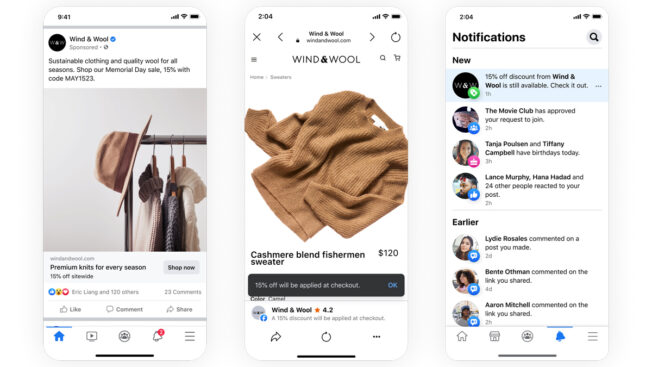
Meta is launching a new ad format called promotional ads to make it easier for shoppers to find deals from retail brands.

When Facebook users see an ad with a special promotion, they can click through to claim the offer and the discount code will be automatically applied. If they don’t complete the purchase, they will receive a reminder notification before the deal ends. 

“In today’s economic environment, it’s important for businesses to find the right customers, and for people to find the best deals so their dollars go further,” said Helen Ma, Meta’s senior director of product management. “That’s why we’re expanding our lead ad capabilities and testing this new promotional ads format, so people can gain more information about a brand’s product or service as well as access to deals that help them save.”

At its NewFronts earlier this month, the company hinted at new ecommerce products to its advertiser audience.

“Offering advertisers a customized experience through promotional ads with reminders will combat some of the ad fatigue often associated with ads that feature price reduction/discount,” said Lucy Coomer, associate director, digital investment at Media.Monks.

A data play after privacy changes

“Meta is very interested in and eager to claim that data and use it to power algorithmic learning and targeting experiences for advertisers,” said Paul DeJarnatt, vp of digital at media agency Novus.

Meta’s move toward enhancing ecommerce capabilities comes nearly two years after Apple’s privacy changes, which cost Facebook upward of $10 billion in lost revenue. The App Tracking Transparency (ATT) changes limited the ability of apps like Facebook and Instagram to track user behavior. Elsewhere, Meta is phasing out Shops on its platforms that don’t use the checkout feature, cutting off referral traffic for brands.

Since the changes, Novus clients have seen a significant hit to the return on ad spend, said DeJarnatt.

“Some have cut their budgets by 20% [on Meta’s platforms],” DeJarnatt told Adweek. “But there are some who had to cut their budgets by 80% because they just weren’t able to get a return on ad spend that was profitable for their business.”

Meta’s new promotional ads could encourage advertisers to increase spend in the short term to boost sales. Ultimately, they may lose value in these ads if Meta chooses to gatekeep customer data and limit advertisers from capturing it.

Advertisers who test the new promotional ads will look at metrics further down the funnel beyond just cost per view and CPM, said Alexander Stone, Horizon Media’s svp of advanced video and agency partnerships.

Still, privacy remains a top concern for advertisers that engage with Meta’s platforms. On Wednesday, the tech giant made headlines for a record privacy fine of $809 million for mishandling people’s data across transatlantic borders, according to Politico.

According to DeJarnatt, these lapses get in the way of people trusting the platforms.

.font-primary { } .font-secondary { } #meter-count { position: fixed; z-index: 9999999; bottom: 0; width:96%; margin: 2%; -webkit-border-radius: 4px; -moz-border-radius: 4px; border-radius: 4px; -webkit-box-shadow: 0 0px 15px 4px rgba(0,0,0,.2); box-shadow:0 0px 15px 4px rgba(0,0,0,.2); padding: 15px 0; color:#fff; background-color:#343a40; } #meter-count .icon { width: auto; opacity:.8; } #meter-count .icon svg { height: 36px; width: auto; } #meter-count .btn-subscribe { font-size:14px; font-weight:bold; padding:7px 18px; color: #fff; background-color: #2eb3b2; border:none; text-transform: capitalize; margin-right:10px; } #meter-count .btn-subscribe:hover { color: #fff; opacity:.8; } #meter-count .btn-signin { font-size:14px; font-weight:bold; padding:7px 14px; color: #fff; background-color: #121212; border:none; text-transform: capitalize; } #meter-count .btn-signin:hover { color: #fff; opacity:.8; } #meter-count h3 { color:#fff!important; letter-spacing:0px!important; margin:0; padding:0; font-size:16px; line-height:1.5; font-weight:700; margin: 0!important; padding: 0!important; } #meter-count h3 span { color:#E50000!important; font-weight:900; } #meter-count p { font-size:14px; font-weight:500; line-height:1.4; color:#eee!important; margin: 0!important; padding: 0!important; } #meter-count .close { color:#fff; display:block; position:absolute; top: 4px; right:4px; z-index: 999999; } #meter-count .close svg { display:block; color:#fff; height:16px; width:auto; cursor:pointer; } #meter-count .close:hover svg { color:#E50000; } #meter-count .fw-600 { font-weight:600; } @media (max-width: 1079px) { #meter-count .icon { margin:0; padding:0; display:none; } } @media (max-width: 768px) { #meter-count { margin: 0; -webkit-border-radius: 0px; -moz-border-radius: 0px; border-radius: 0px; width:100%; -webkit-box-shadow: 0 -8px 10px -4px rgba(0,0,0,0.3); box-shadow: 0 -8px 10px -4px rgba(0,0,0,0.3); } #meter-count .icon { margin:0; padding:0; display:none; } #meter-count h3 { color:#fff!important; font-size:14px; } #meter-count p { color:#fff!important; font-size: 12px; font-weight: 500; } #meter-count .btn-subscribe, #meter-count .btn-signin { font-size:12px; padding:7px 12px; } #meter-count .btn-signin { display:none; } #meter-count .close svg { height:14px; } }

Enjoying Adweek’s Content? Register for More Access!

https://www.adweek.com/programmatic/meta-introduces-promotional-ads-for-ecommerce-deals/


50% of product searches start on Amazon

Amazon continues to be the most popular starting point for online shoppers with one exception – Gen Z, according to a new survey.

Why we care. Nearly all consumers research purchases online and rely heavily on ratings and reviews. So it remains absolutely critical to be visible on any relevant platforms at moments when shoppers are researching and purchasing products.

By the numbers. Here’s where respondents said they start searching when shopping online:

  • Amazon: 50%
  • Google: 31.5%
  • Retail or brands websites: 14%
  • Reviews websites: 2%
  • Social media: 2%

But. For Generation Z, Google bested Amazon (38% vs. 36%, respectively). Gen Z was also the most likely group to start their shopping journey on social media (5%).

Reviews and ratings. Reviews and ratings can make or break a sale more than any other factor, including product price, free shipping, free returns and exchanges, and more.

Overall, 77% of respondents said they specifically seek out websites with reviews – and this number was even higher for Gen Z (87%) and millennials (81%).

  • Ratings without accompanying reviews are considered untrustworthy by 56% of survey respondents.

Where people read reviews and ratings:

  • Amazon: 94%
  • Retail websites (e.g., Target, Walmart): 91%
  • Search engines: 70%
  • Brand websites (the brand that manufactures the product: 68%
  • Independent review sites: 40%

User-generated photos and videos gain value. Sixty percent of consumers looked at user-generated images or videos when learning about new products. 

  • 77% of respondents said they trust customer photos and videos.
  • 53% said user-generated photos and videos from previous customers impacted their decision whether to purchase a product.

Google (and search). 56% of consumers consider search results (on Google and other search engines) when making purchase decisions. Also:

  • 63% of respondents said they use search engine results to learn about products they haven’t purchased before.
  • 50% said they trust search engine results when making a purchase decision.

Bottom line. Amazon continues to be the go-to product search engine for consumers. And ratings and reviews are king.

About the survey. PowerReviews surveyed 8,153 U.S. consumers in March 2023. It skewed heavily toward millennials, who made up 53% of respondents, followed by Gen X (29%); Baby Boomers (10%) and Gen Z (8%). You can learn more in the full results from PowerReviews: Survey: The Ever-Growing Power of Reviews (2023 Edition).


Related stories

New on Search Engine Land

@media screen and (min-width: 800px) { #div-gpt-ad-3191538-7 { display: flex !important; justify-content: center !important; align-items: center !important; min-width:770px; min-height:260px; } } @media screen and (min-width: 1279px) { #div-gpt-ad-3191538-7 { display: flex !important; justify-content: center !important; align-items: center !important; min-width:800px!important; min-height:440px!important; } }

About the author

Danny Goodwin

Danny Goodwin has been Managing Editor of Search Engine Land & Search Marketing Expo – SMX since 2022. He joined Search Engine Land in 2022 as Senior Editor. In addition to reporting on the latest search marketing news, he manages Search Engine Land’s SME (Subject Matter Expert) program. He also helps program U.S. SMX events. Goodwin has been editing and writing about the latest developments and trends in search and digital marketing since 2007. He previously was Executive Editor of Search Engine Journal (from 2017 to 2022), managing editor of Momentology (from 2014-2016) and editor of Search Engine Watch (from 2007 to 2014). He has spoken at many major search conferences and virtual events, and has been sourced for his expertise by a wide range of publications and podcasts.

https://searchengineland.com/50-of-product-searches-start-on-amazon-424451


What Marketers Expect From Elon Musk’s ‘Best Hope’ Linda Yaccarino at Twitter


.article-native-ad { border-bottom: 1px solid #ddd; margin: 0 45px; padding-bottom: 20px; margin-bottom: 20px; } .article-native-ad svg { color: #ddd; font-size: 34px; margin-top: 10px; } .article-native-ad p { line-height:1.5; padding:0!important; padding-left: 10px!important; } .article-native-ad strong { font-weight:500; color:rgb(46,179,178); }

Introducing the Adweek Podcast Network. Access infinite inspiration in your pocket on everything from career advice and creativity to metaverse marketing and more. Browse all podcasts.

Elon Musk’s choice to onboard NBCU ad sales chief Linda Yaccarino has left marketers on the edge of their seats, while Yaccarino inherits a company in absolute turmoil.

“I have an unbelievable level of confidence in Linda’s ability to turn Twitter around and save it from the clutches of the evil overlord who owns it,” Lou Paskalis, chief strategy officer of Ad Fontes Media, told Adweek.

Most marketers think Yaccarino is Twitter’s best shot at reconnecting with advertisers who’ve fled the platform. Five brand leaders Adweek spoke with expect Yaccarino to return Twitter to a more brand-safe and innovative environment.

If Linda can’t turn Twitter around, it’s done.

Rishad Tobaccowala, author and brand strategist

Musk’s tumultuous takeover last October paired with his unpredictable behavior has left many advertisers wary of doing business with the platform. From dissolving the board of directors to laying off more than 6,000 staff, starting a subscription business that has seen limited success and defenestrating content moderation tools, Musk has Yaccarino’s work cut out for her.

“Between now and the end of the year, we’ll understand if Twitter can come back or will go out of business,” said Rishad Tobaccowala, author and former high-ranking executive at Publicis Groupe, told Adweek. “If Linda can’t turn Twitter around, it’s done.”

Fix content moderation and brand safety

To immediately pacify advertisers’ concerns, Yaccarino’s priority should be restoring Twitter’s content moderation team that was fired by Musk last November, according to Paskalis.

“The content moderation tech team was responsible for language translation, understanding new threat vectors and for deploying new technology to moderate content successfully,” he said. “I think that will be [Yaccarino’s] first priority because that’s what advertisers are most concerned about.”

Yaccarino could also reinstate Twitter’s “influence council,” a group composed of four dozen marketing executives from Twitter’s former major advertisers—a meeting she could possibly convene in Cannes this year.

Paskalis also expects Yaccarino to create more transparency around the algorithmic orchestration on the platform, purging the unwanted experience of random profiles popping up in feeds.

Reversing the purging of legacy verified blue check marks could be a peace offering for marketers to get back on the platform, said Amy Gilbert of social agency The Social Element.

After buying Twitter for $44 billion, Musk denounced the platform’s blue checks and instead rolled out a paid verification option as part of the company’s subscription product, Twitter Blue. Paying for verification led to fake accounts impersonating brands including Nintendo and Eli Lilly, causing panic inside brands and leading to a further pullback in ad spend.

“There’s a lot more that needs to happen in making sure that that platform feels secure, that they have people that are taking care of spammers,” added Gilbert. The Social Element primarily leveraged Twitter for consumer engagement but slowly moved to Meta’s platforms and TikTok after the blue check mark fiasco.

Compelling ad products

Just fixing content moderation and algorithmic transparency won’t make the cut for many marketers.

For Avi Ben-Zvi, vp of paid social at Tinuiti, Twitter needs to take it up a notch by making the platform more compelling for advertisers either in the performance, consideration or awareness part of the funnel.

“Can they get back to a place where they’re developing interesting ad products while emphasizing safety and ad revenue for advertisers?” he told Adweek.

Video has become front and center for marketers and platforms. Pinterest is testing Premiere Spotlight, which gives advertisers access to a premium placement for 24 hours on the Pinterest app’s search page.

These platforms are “very focused on developing things that advertisers are asking for,” said Ben-Zvi, adding, “That innovation has either stalled or been overshadowed by everything else going on at Twitter.”

Can Musk be controlled?

Ultimately, as Adland waits to see how Yaccarino steers marketers’ trust back to Twitter, the question industry leaders still ask is whether Musk can be controlled.

“Linda can hit the ground running—unless Musk interferes and loses control of his impulses, the way he way he did with his tweet last week when he hired her,” said Paskalis.

“If he causes her to fail in that role,” he continued, “there’s no one that can restore advertising revenue on Twitter.”

.font-primary { } .font-secondary { } #meter-count { position: fixed; z-index: 9999999; bottom: 0; width:96%; margin: 2%; -webkit-border-radius: 4px; -moz-border-radius: 4px; border-radius: 4px; -webkit-box-shadow: 0 0px 15px 4px rgba(0,0,0,.2); box-shadow:0 0px 15px 4px rgba(0,0,0,.2); padding: 15px 0; color:#fff; background-color:#343a40; } #meter-count .icon { width: auto; opacity:.8; } #meter-count .icon svg { height: 36px; width: auto; } #meter-count .btn-subscribe { font-size:14px; font-weight:bold; padding:7px 18px; color: #fff; background-color: #2eb3b2; border:none; text-transform: capitalize; margin-right:10px; } #meter-count .btn-subscribe:hover { color: #fff; opacity:.8; } #meter-count .btn-signin { font-size:14px; font-weight:bold; padding:7px 14px; color: #fff; background-color: #121212; border:none; text-transform: capitalize; } #meter-count .btn-signin:hover { color: #fff; opacity:.8; } #meter-count h3 { color:#fff!important; letter-spacing:0px!important; margin:0; padding:0; font-size:16px; line-height:1.5; font-weight:700; margin: 0!important; padding: 0!important; } #meter-count h3 span { color:#E50000!important; font-weight:900; } #meter-count p { font-size:14px; font-weight:500; line-height:1.4; color:#eee!important; margin: 0!important; padding: 0!important; } #meter-count .close { color:#fff; display:block; position:absolute; top: 4px; right:4px; z-index: 999999; } #meter-count .close svg { display:block; color:#fff; height:16px; width:auto; cursor:pointer; } #meter-count .close:hover svg { color:#E50000; } #meter-count .fw-600 { font-weight:600; } @media (max-width: 1079px) { #meter-count .icon { margin:0; padding:0; display:none; } } @media (max-width: 768px) { #meter-count { margin: 0; -webkit-border-radius: 0px; -moz-border-radius: 0px; border-radius: 0px; width:100%; -webkit-box-shadow: 0 -8px 10px -4px rgba(0,0,0,0.3); box-shadow: 0 -8px 10px -4px rgba(0,0,0,0.3); } #meter-count .icon { margin:0; padding:0; display:none; } #meter-count h3 { color:#fff!important; font-size:14px; } #meter-count p { color:#fff!important; font-size: 12px; font-weight: 500; } #meter-count .btn-subscribe, #meter-count .btn-signin { font-size:12px; padding:7px 12px; } #meter-count .btn-signin { display:none; } #meter-count .close svg { height:14px; } }

Enjoying Adweek’s Content? Register for More Access!

https://www.adweek.com/programmatic/what-marketers-expect-from-elon-musks-best-hope-linda-yaccarino-at-twitter/