Elon Musk names new Twitter CEO: Linda Yaccarino

Elon Musk today announced that Linda Yaccarino will be the next Twitter CEO.

The announcement. Musk tweeted the news, adding that Yaccarino would “focus primarily on business operations.” Musk will focus on product design and new technology. Musk added:

  • “Looking forward to working with Linda to transform this platform into X, the everything app.”

Twitter technically is no longer a company. It is officially known as X Corp. But we don’t yet know exactly what the X platform will be.

Why we care. Twitter under Musk has been a trainwreck at times. It will be worth watching whether having a new Twitter CEO may help repair some of the damage done and lure back advertisers, marketers and brands.

About Yaccarino. Most recently, Yaccarino was chairman of global advertising and partnerships at NBCUniversal Media. Yaccarino had been at NBC for more than 11 years in various roles.

Watch Yaccarino interview Musk. Yaccarino recently interviewed Musk about the future of marketing on Twitter at MMA’s POSSIBLE Miami Event 2023.

Gaining Twitter followers. When Yaccarino last tweeted on May 10, she had 7,187 Twitter followers, as Dan Barker tweeted. After Musk announced Yaccarino as CEO, she started gaining hundreds of followers per minute. As of publishing, she had more than 150,000 followers.


Related stories

New on Search Engine Land

@media screen and (min-width: 800px) { #div-gpt-ad-3191538-7 { display: flex !important; justify-content: center !important; align-items: center !important; min-width:770px; min-height:260px; } } @media screen and (min-width: 1279px) { #div-gpt-ad-3191538-7 { display: flex !important; justify-content: center !important; align-items: center !important; min-width:800px!important; min-height:440px!important; } }

About the author

Danny Goodwin

Danny Goodwin has been Managing Editor of Search Engine Land & Search Marketing Expo – SMX since 2022. He joined Search Engine Land in 2022 as Senior Editor. In addition to reporting on the latest search marketing news, he manages Search Engine Land’s SME (Subject Matter Expert) program. He also helps program U.S. SMX events. Goodwin has been editing and writing about the latest developments and trends in search and digital marketing since 2007. He previously was Executive Editor of Search Engine Journal (from 2017 to 2022), managing editor of Momentology (from 2014-2016) and editor of Search Engine Watch (from 2007 to 2014). He has spoken at many major search conferences and virtual events, and has been sourced for his expertise by a wide range of publications and podcasts.

https://searchengineland.com/new-twitter-ceo-linda-yaccarino-418973


Linda Yaccarino Exits NBCUniversal, Mark Marshall Named Interim Ad Sales Chief


.article-native-ad { border-bottom: 1px solid #ddd; margin: 0 45px; padding-bottom: 20px; margin-bottom: 20px; } .article-native-ad svg { color: #ddd; font-size: 34px; margin-top: 10px; } .article-native-ad p { line-height:1.5; padding:0!important; padding-left: 10px!important; } .article-native-ad strong { font-weight:500; color:rgb(46,179,178); }

Introducing the Adweek Podcast Network. Access infinite inspiration in your pocket on everything from career advice and creativity to metaverse marketing and more. Browse all podcasts.

UPDATE: Yaccarino’s appointment as Twitter CEO was made official on Friday afternoon.

PREVIOUSLY: Hours before Linda Yaccarino was named Twitter CEO, her time at NBCUniversal has officially ended. 

The longtime ad sales chief—NBCUniversal’s chairman of global advertising and partnerships—has departed the company “effective immediately,” NBCUniversal announced Friday morning. 

Mark Marshall, currently president, advertising sales and client partnerships, has been named interim chairman of NBCUniversal’s advertising and partnerships group. He will report to Mark Lazarus, chairman, NBCUniversal Television and Streaming.

Yaccarino’s departure—the morning after news broke that she was in talks to take over for Elon Musk as Twitter’s next CEO—comes just three days before she was set to take the stage to lead NBCUniversal’s upfront week presentation Monday morning at Radio City Music Hall. Hours later, Musk tweeted that Yaccarino will indeed be Twitter CEO, and “will focus primarily on business operations, while I focus on product design & new technology.”

It upends NBCU’s upfront plans, though Marshall was already set to lead negotiations, after Yaccarino restructured her ad sales team in January, giving Marshall an elevated role, following the exit of ad sales president Laura Molen.

“It has been an absolute honor to be part of Comcast NBCUniversal and lead the most incredible team. We’ve transformed our company and the entire industry—and I am so proud of what we’ve accomplished together, and grateful to my colleagues and mentors, especially [Comcast CEO] Brian Roberts, [Comcast president] Mike Cavanagh and the entire NBCU leadership team,” said Yaccarino in a statement. 

Cavanagh said in a statement: “We are grateful for Linda Yaccarino’s leadership of NBCUniversal’s advertising sales business, and for the innovative team and platform she has built. Linda has made countless contributions to the company during her 12-year tenure, and we wish her the best.”

There was still no official word about Yaccarino taking over as Twitter CEO. Earlier on Thursday, Musk—who bought the social media platform last October and two months later vowed to step down as Twitter CEO when he found “someone foolish enough to take the job”—indicated that he had settled on a replacement. 

He tweeted, “Excited to announce that I’ve hired a new CEO for X/Twitter. She will be starting in ~6 weeks! My role will transition to being exec chair & CTO, overseeing product, software & sysops.”

Yaccarino has been a public advocate for Musk’s ownership of Twitter since the billionaire bought the platform in October. The duo appeared onstage together in April during the inaugural Possible marketing event in Miami for a keynote around “Twitter 2.0.”

NBCUniversal has also expanded its Twitter partnership under Musk. Twitter did not put on an official NewFronts advertising event this year, as it had in past years. But the company held a smaller presentation during the week for clients, and announced expanded Olympics and Paralympics partnerships with NBCUniversal around the 2024 Paris Summer Games. 

Yaccarino has long been one of advertising’s most dynamic forces. She joined NBCUniversal in 2011 after spending two decades at Turner. Initially, she was in charge of cable and digital sales, but within two years was elevated to head up all the cable and broadcast networks under a single portfolio—a then-revolutionary shake-up that was eventually adopted by almost all of her competitors.

As Twitter CEO, Yaccarino will be tasked with helping restore advertiser faith in a platform that has grown increasingly destabilized since Musk’s rocky takeover. According to a Bloomberg report, Twitter advertising dollars have plummeted 89% since Musk bought the platform and revenue dropped by half.

If anyone can help restore advertiser confidence in Twitter, it will likely be Yaccarino. Longtime advertising industry vet Lou Paskalis tweeted that Yaccarino “would be my first choice, and my only choice, to save the platform from the hands of its owner.”

Yaccarino is the second major NBCUniversal exec to depart the company in the last month. CEO Jeff Shell was fired in April following what was described as “an inappropriate relationship with a woman in the company.” 

More upfront week tumult

The Yaccarino news is the latest shakeup in what is shaping up to be a tumultuous upfront week. Wednesday night, Netflix shifted to an all-virtual upfront week presentation after hearing of the WGA’s planned protest during its May 17 event.

NBCUniversal was among the upfront week presenters who told Adweek on Thursday they would be moving forward with in-person events despite the possibility of picketers.  

Marshall told Adweek earlier this week that “NBCU will have an extremely powerful upfront show and will still have great talent participating.”

.font-primary { } .font-secondary { } #meter-count { position: fixed; z-index: 9999999; bottom: 0; width:96%; margin: 2%; -webkit-border-radius: 4px; -moz-border-radius: 4px; border-radius: 4px; -webkit-box-shadow: 0 0px 15px 4px rgba(0,0,0,.2); box-shadow:0 0px 15px 4px rgba(0,0,0,.2); padding: 15px 0; color:#fff; background-color:#343a40; } #meter-count .icon { width: auto; opacity:.8; } #meter-count .icon svg { height: 36px; width: auto; } #meter-count .btn-subscribe { font-size:14px; font-weight:bold; padding:7px 18px; color: #fff; background-color: #2eb3b2; border:none; text-transform: capitalize; margin-right:10px; } #meter-count .btn-subscribe:hover { color: #fff; opacity:.8; } #meter-count .btn-signin { font-size:14px; font-weight:bold; padding:7px 14px; color: #fff; background-color: #121212; border:none; text-transform: capitalize; } #meter-count .btn-signin:hover { color: #fff; opacity:.8; } #meter-count h3 { color:#fff!important; letter-spacing:0px!important; margin:0; padding:0; font-size:16px; line-height:1.5; font-weight:700; margin: 0!important; padding: 0!important; } #meter-count h3 span { color:#E50000!important; font-weight:900; } #meter-count p { font-size:14px; font-weight:500; line-height:1.4; color:#eee!important; margin: 0!important; padding: 0!important; } #meter-count .close { color:#fff; display:block; position:absolute; top: 4px; right:4px; z-index: 999999; } #meter-count .close svg { display:block; color:#fff; height:16px; width:auto; cursor:pointer; } #meter-count .close:hover svg { color:#E50000; } #meter-count .fw-600 { font-weight:600; } @media (max-width: 1079px) { #meter-count .icon { margin:0; padding:0; display:none; } } @media (max-width: 768px) { #meter-count { margin: 0; -webkit-border-radius: 0px; -moz-border-radius: 0px; border-radius: 0px; width:100%; -webkit-box-shadow: 0 -8px 10px -4px rgba(0,0,0,0.3); box-shadow: 0 -8px 10px -4px rgba(0,0,0,0.3); } #meter-count .icon { margin:0; padding:0; display:none; } #meter-count h3 { color:#fff!important; font-size:14px; } #meter-count p { color:#fff!important; font-size: 12px; font-weight: 500; } #meter-count .btn-subscribe, #meter-count .btn-signin { font-size:12px; padding:7px 12px; } #meter-count .btn-signin { display:none; } #meter-count .close svg { height:14px; } }

Enjoying Adweek’s Content? Register for More Access!

https://www.adweek.com/convergent-tv/linda-yaccarino-exits-nbcuniversal-mark-marshall-named-interim-ad-sales-chief/


These 2 charts show Microsoft Bing’s search market share problem

Despite having gotten the jump on Google when it launched the new Bing, featuring its own generative search experience fueled by GPT-4, data shows Microsoft has failed to gain market share.

In fact, if the latest numbers from StatCounter are directionally accurate, it appears Bing is actually losing market share to Google.

Why we care. It would be nice to live in a world where we didn’t have to rely so heavily on Google. It was encouraging to see Bing making some small gains. But we later learned the New Bing attracted new Edge users who then used Google Search. And now that Google has unveiled its Search Generative Experience, Bing has lost its first-mover advantage and it seems we won’t see a true search competitor anytime soon.

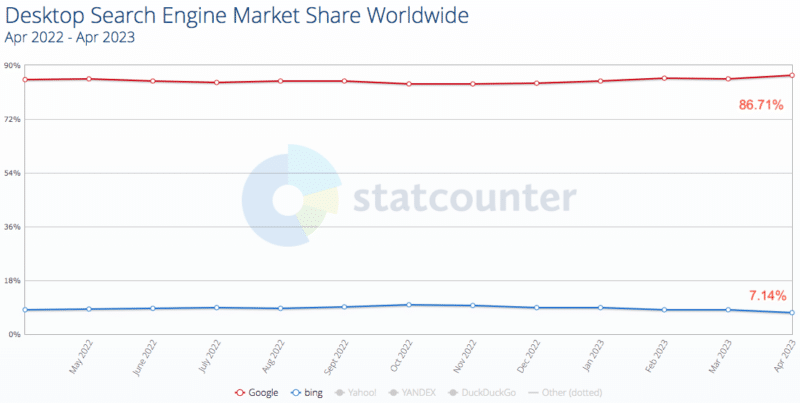
7.14%. That’s Microsoft Bing’s worldwide desktop market share as of April, according to Statcounter. The new Bing launched in February.

Statcounter Desktop Search Market Share April 2022 2023 800x403
  • Why this number is a problem: Bing’s market share peaked in October 2022, at 9.92%. And the 7.14% figure is actually lower than April 2022 (8.05%).

Meanwhile, Google’s desktop search market share is 86.71%.

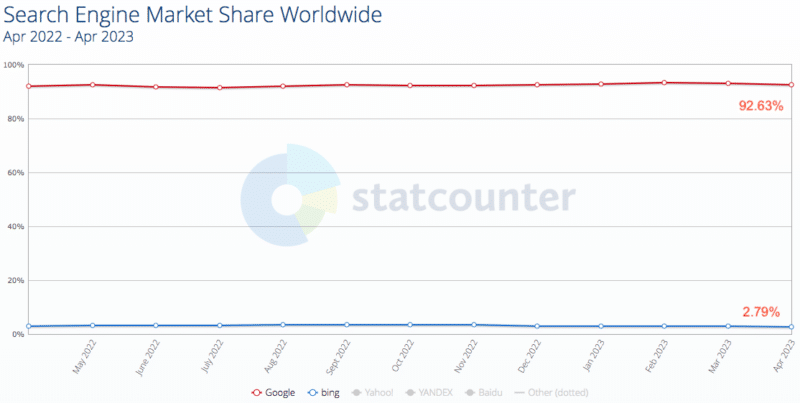
2.79%. The picture gets even bleaker for Microsoft Bing when you look at search engine market share worldwide, across all devices (desktop, mobile, tablet), also via Statcounter. While Bing is at just 2.79%, Google is at 92.63%.

Statcounter Search Market Share April 2022 2023 800x403
  • Why this number is a problem: Bing’s market share peaked in October 2022, at 3.59%. And the 2.79% figure is actually lower than April 2022 (3.02%).

Google isn’t vying with Microsoft Bing. News headlines discussing the AI search competition between Google and Bing tend to focus on the rivalry element instead of simply admitting the reality. Which is that these two charts show Microsoft’s problem: even with the new Bing and all the investments Microsoft has made in search – they’re still not making meaningful gains on Google.

Granted, size isn’t everything. Microsoft’s advertising and search revenue increased 3.4% to just over $3 billion in its most recent earnings report.

But the search game? It’s over. Google won long ago.


Related stories

New on Search Engine Land

@media screen and (min-width: 800px) { #div-gpt-ad-3191538-7 { display: flex !important; justify-content: center !important; align-items: center !important; min-width:770px; min-height:260px; } } @media screen and (min-width: 1279px) { #div-gpt-ad-3191538-7 { display: flex !important; justify-content: center !important; align-items: center !important; min-width:800px!important; min-height:440px!important; } }

About the author

Danny Goodwin

Danny Goodwin has been Managing Editor of Search Engine Land & Search Marketing Expo – SMX since 2022. He joined Search Engine Land in 2022 as Senior Editor. In addition to reporting on the latest search marketing news, he manages Search Engine Land’s SME (Subject Matter Expert) program. He also helps program U.S. SMX events. Goodwin has been editing and writing about the latest developments and trends in search and digital marketing since 2007. He previously was Executive Editor of Search Engine Journal (from 2017 to 2022), managing editor of Momentology (from 2014-2016) and editor of Search Engine Watch (from 2007 to 2014). He has spoken at many major search conferences and virtual events, and has been sourced for his expertise by a wide range of publications and podcasts.

https://searchengineland.com/microsoft-bing-search-market-share-problem-charts-417698


YouTube wants users to stop using ad blockers

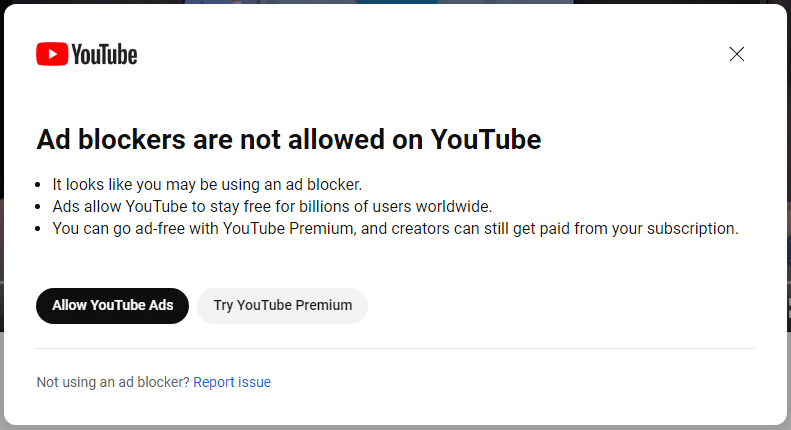
“Ad blockers are not allowed on YouTube.” That’s the message YouTube may show to some users who use ad blockers. It’s part of what appears to be a small experiment the platform is running.

Why we care. In theory, this could mean more views for YouTube Ads. The question is whether those users will be at all receptive to YouTube Ads – they may simply choose to abandon watching a video or, more drastically, ditch the entire platform.

Ad blockers are not allowed on YouTube. Here’s what the message looks like, as shared via Reddit:

Youtube Ad Blockers

It says:

  • It looks like you may be using an ad blocker.
  • Ads allow YouTube to stay free for billions of users worldwide.
  • You can go ad-free with YouTube Premium, and creators can still get paid from your subscription.

It then offers users two choices: Allow YouTube Ads or Try YouTube Premium.

How this message is triggered. This screen could appear whenever a user who has installed an ad blocker tries to view YouTube content.

Interesting timing? Google yesterday unveiled its new Search Generative Experience. It’s too early to know the impact SGE may have on your paid and organic search performance (not to mention Google’s ad business).

But video content and video ads may become more valuable for some brands that need visibility as a result of lost traffic or clicks in search. This would also mean YouTube wants to make sure its users are seeing as many ads as possible.


Related stories

New on Search Engine Land

@media screen and (min-width: 800px) { #div-gpt-ad-3191538-7 { display: flex !important; justify-content: center !important; align-items: center !important; min-width:770px; min-height:260px; } } @media screen and (min-width: 1279px) { #div-gpt-ad-3191538-7 { display: flex !important; justify-content: center !important; align-items: center !important; min-width:800px!important; min-height:440px!important; } }

About the author

Danny Goodwin

Danny Goodwin has been Managing Editor of Search Engine Land & Search Marketing Expo – SMX since 2022. He joined Search Engine Land in 2022 as Senior Editor. In addition to reporting on the latest search marketing news, he manages Search Engine Land’s SME (Subject Matter Expert) program. He also helps program U.S. SMX events. Goodwin has been editing and writing about the latest developments and trends in search and digital marketing since 2007. He previously was Executive Editor of Search Engine Journal (from 2017 to 2022), managing editor of Momentology (from 2014-2016) and editor of Search Engine Watch (from 2007 to 2014). He has spoken at many major search conferences and virtual events, and has been sourced for his expertise by a wide range of publications and podcasts.

https://searchengineland.com/youtube-ads-ad-blockers-417561


Amazon working on AI tools to generate videos, images for advertisers

Amazon advertisers may soon gain the ability to create AI-generated image and video assets to use in ad campaigns.

The company has confirmed it is now building a team to provide those tools, The Information reported. There is no estimated timeline for when this will become available.

Why we care. The ability to natively create image and video assets could help Amazon advertisers improve their listings, leading to more sales and greater ROI on the platform.

Amazon is diversifying its growing ad business. Amazon advertising accounted for $38 billion in revenue in 2022. Its biggest offering is letting merchants get greater visibility in search results. Amazon’s other advertising efforts include:

  • Videos ads on Freevee, its video-streaming service, and Thursday Night Football on Prime Video.
  • Audio ads on Amazon Music.
  • Digital ads inside Amazon Fresh grocery stores.

Joining the AI arms race. Elsewhere, Google plans to bring generative AI to Google Ads and has already been testing a way to create RSAs using AI. And Microsoft continues testing ads in the New Bing.


Related stories

New on Search Engine Land

@media screen and (min-width: 800px) { #div-gpt-ad-3191538-7 { display: flex !important; justify-content: center !important; align-items: center !important; min-width:770px; min-height:260px; } } @media screen and (min-width: 1279px) { #div-gpt-ad-3191538-7 { display: flex !important; justify-content: center !important; align-items: center !important; min-width:800px!important; min-height:440px!important; } }

About the author

Danny Goodwin

Danny Goodwin has been Managing Editor of Search Engine Land & Search Marketing Expo – SMX since 2022. He joined Search Engine Land in 2022 as Senior Editor. In addition to reporting on the latest search marketing news, he manages Search Engine Land’s SME (Subject Matter Expert) program. He also helps program U.S. SMX events. Goodwin has been editing and writing about the latest developments and trends in search and digital marketing since 2007. He previously was Executive Editor of Search Engine Journal (from 2017 to 2022), managing editor of Momentology (from 2014-2016) and editor of Search Engine Watch (from 2007 to 2014). He has spoken at many major search conferences and virtual events, and has been sourced for his expertise by a wide range of publications and podcasts.

https://searchengineland.com/amazon-working-on-ai-tools-to-generate-videos-images-for-advertisers-414854


Microsoft Details How Advertising Works on Bing’s AI-Driven Chat-Based Search


.article-native-ad { border-bottom: 1px solid #ddd; margin: 0 45px; padding-bottom: 20px; margin-bottom: 20px; } .article-native-ad svg { color: #ddd; font-size: 34px; margin-top: 10px; } .article-native-ad p { line-height:1.5; padding:0!important; padding-left: 10px!important; } .article-native-ad strong { font-weight:500; color:rgb(46,179,178); }

The search for this year’s Media All-Stars has begun! Submit an entry by May 22 to be considered.

Amid frenzied conversations about how artificial intelligence is upending media and advertising, Microsoft is finally giving marketers a peak into how integrating ChatGPT into Microsoft’s Bing search engine will change its ads business.

The answer is, to start, not a lot.

The process of buying advertising on Bing is no different now than it has been earlier in Bing’s 14-year existence. The one differentiator is that now ads can appear within peoples’ conversations’ with an AI chatbot. Marketers will not need to specify that they want their ads in the chat format, nor will they know whether their ads appeared in the chat format when they receive performance reports, corporate vice president of Microsoft Advertising Kya Sainsbury-Carter told a room of reporters this week.

“Advertisers, from what we hear, don’t want to be disrupted right now. Marketers are tired; they have less resources. They’ve had a crazy three years of pandemic and war and economy,” Sainsbury-Carter said. “People aren’t really looking for wild disruption, but rather an evolution and transformation that helps move their businesses forward.”

While marketers appreciate Microsoft’s approach, and are encouraged by its investments in AI, questions remain, such as how to judge success when it’s unclear whether ads show up in the chat.

When the AI chatbot comes up with an answer, a citation is included which is accessible by hovering over the answer. Among the links included in the citation might be an ad. Photo ads can appear at the end of a chatbot’s answer.

Brands don’t need to write new copy that mimics the form of a chatbot answer. Instead, all text ads and other creative assets uploaded into Bing will appear in the new chat formats. Sainsbury-Carter told Adweek, in a separate conversation, that Microsoft doesn’t want to disrupt advertisers’ workflows before they know it works.

“We didn’t want to say there might be a difference so do double the work,” she said.

image
An example of Microsoft’s ad formats in AI-based search Bing Microsoft

The current advertising formats have been in place since Microsoft launched its AI-powered Bing search engine in limited preview in February, Sainsbury-Carter said, but the company has not widely communicated how the new tech changes its advertising business until now.

Microsoft also announced that it is moving its AI-chat product from limited preview to open preview and eliminating the waitlist for trial, in the hope of expanding the product’s user base. Microsoft also debuted a slew of new generative AI-enabled features throughout Bing.

Bing has grown to more than 100 million daily active users, the company said, a third of whom use the AI chat daily. Daily installs of the Bing mobile app have increased fourfold since February and the introduction of its AI-powered search.

Working with the advertising community

So far, ad products within Microsoft’s chat AI will operate under the same auction dynamics as Bing search auctions, meaning advertisers won’t necessarily see an inflated cost per click. The search engine is also keeping ad load within chats low to start, Sainsbury-Carter said.

It’s making us think about Microsoft more than we did in the past.

Aaron Levy, vp of search, Tinuiti

Microsoft is currently having conversations with advertisers to flesh out the next steps, and is hosting several “envisioning sessions” with agencies.

From those meetings, which began in April, the platform has learned that advertisers are interested in visually rich, immersive advertising experiences, more automation to learn the best place to serve an ad in real time and formats that lend themselves to shoppable experiences, including visual comparison layouts or shop-the-look formats, Sainsbury-Carter said.

Marketers welcome the measured approach, although expect temporary hiccups, especially if chats don’t convert as well as traditional search.

“To make the ad units perform is going to take a lot of tweaking,” said Aaron Levy, vp of search at performance marketing agency Tinuiti. “What they’ve done now makes sense. I can’t imagine it’s going to stay there.”

And because advertisers currently view Bing as a performance product, the bar will be higher for success.

“The gambit of chat as a branding vehicle…I don’t see advertisers [thinking] that, nor do they have an option to do that because you can’t buy specifically for the chat UI,” said Michael Cohen, evp of performance media services at Horizon Media. “It kind of has to be driven by performance.”

Conversational search shortens the customer journey

The bulk of news Microsoft delivered Wednesday was around the new ways its existing products will incorporate generative AI. Chat will be more visually immersive, Microsoft’s browser Edge will incorporate chat to help users better understand web pages, and people can save and export their chat history, among other features.

The new features are intended to draw more users and will also help Microsoft gain more understanding from advertising. Microsoft has already gleaned that with the new Bing, people ask for more information when buying a product in a shorter time frame than traditional search, meaning the AI-powered tool may provide advertisers more information about people and convert them to buyers faster, Sainsbury-Carter said.

“That’s a super powerful outcome that we would expect to show great campaign improvement,” she said.

Levy said this finding is believable, cutting down on the choice paralysis that comes with traditional search by giving people fewer options in chat could help them make faster purchases. But for all the bells and whistles, Bing still needs to prove it has the results to capture ad dollars, Levy says.

“It’s making us think about Microsoft more than we did in the past,” he said, adding, “In these complicated economic times no one is going to commit budget if they don’t know what’s going to happen.”

.font-primary { } .font-secondary { } #meter-count { position: fixed; z-index: 9999999; bottom: 0; width:96%; margin: 2%; -webkit-border-radius: 4px; -moz-border-radius: 4px; border-radius: 4px; -webkit-box-shadow: 0 0px 15px 4px rgba(0,0,0,.2); box-shadow:0 0px 15px 4px rgba(0,0,0,.2); padding: 15px 0; color:#fff; background-color:#343a40; } #meter-count .icon { width: auto; opacity:.8; } #meter-count .icon svg { height: 36px; width: auto; } #meter-count .btn-subscribe { font-size:14px; font-weight:bold; padding:7px 18px; color: #fff; background-color: #2eb3b2; border:none; text-transform: capitalize; margin-right:10px; } #meter-count .btn-subscribe:hover { color: #fff; opacity:.8; } #meter-count .btn-signin { font-size:14px; font-weight:bold; padding:7px 14px; color: #fff; background-color: #121212; border:none; text-transform: capitalize; } #meter-count .btn-signin:hover { color: #fff; opacity:.8; } #meter-count h3 { color:#fff!important; letter-spacing:0px!important; margin:0; padding:0; font-size:16px; line-height:1.5; font-weight:700; margin: 0!important; padding: 0!important; } #meter-count h3 span { color:#E50000!important; font-weight:900; } #meter-count p { font-size:14px; font-weight:500; line-height:1.4; color:#eee!important; margin: 0!important; padding: 0!important; } #meter-count .close { color:#fff; display:block; position:absolute; top: 4px; right:4px; z-index: 999999; } #meter-count .close svg { display:block; color:#fff; height:16px; width:auto; cursor:pointer; } #meter-count .close:hover svg { color:#E50000; } #meter-count .fw-600 { font-weight:600; } @media (max-width: 1079px) { #meter-count .icon { margin:0; padding:0; display:none; } } @media (max-width: 768px) { #meter-count { margin: 0; -webkit-border-radius: 0px; -moz-border-radius: 0px; border-radius: 0px; width:100%; -webkit-box-shadow: 0 -8px 10px -4px rgba(0,0,0,0.3); box-shadow: 0 -8px 10px -4px rgba(0,0,0,0.3); } #meter-count .icon { margin:0; padding:0; display:none; } #meter-count h3 { color:#fff!important; font-size:14px; } #meter-count p { color:#fff!important; font-size: 12px; font-weight: 500; } #meter-count .btn-subscribe, #meter-count .btn-signin { font-size:12px; padding:7px 12px; } #meter-count .btn-signin { display:none; } #meter-count .close svg { height:14px; } }

Enjoying Adweek’s Content? Register for More Access!

https://www.adweek.com/media/microsoft-details-how-advertising-works-on-bings-ai-driven-chat-based-search/


Despite Marketer Investment In AI, Studies Find Awareness Remains Low


.article-native-ad { border-bottom: 1px solid #ddd; margin: 0 45px; padding-bottom: 20px; margin-bottom: 20px; } .article-native-ad svg { color: #ddd; font-size: 34px; margin-top: 10px; } .article-native-ad p { line-height:1.5; padding:0!important; padding-left: 10px!important; } .article-native-ad strong { font-weight:500; color:rgb(46,179,178); }

The search for this year’s Media All-Stars has begun! Submit an entry by May 22 to be considered.

Increasingly, marketers are investing in artificial intelligence for content generation and customizing user journeys.

Despite this excitement, AI awareness among the general population remains relatively low, several studies find.

Research from Gartner in March, on why people’s opinions of ChatGPT impact brands, found that more than half (53%) of the 320 respondents have not yet heard of the AI tool.

Another study highlights the perception gap between brands and consumers. In an upcoming report by customer engagement platform Twilio on the State of Personalization, 81% of 500 businesses surveyed feel that recent AI tech, including ChatGPT, Google’s Bard, and AI-powered Bing, has the potential to positively impact customer experiences.

However, 59% of the 3,001 people surveyed said they aren’t comfortable with AI being used to customize their experiences, according to the report seen by Adweek.

“As marketers are racing to experiment with AI-powered personalization, they also need to prioritize thoughtful and responsible implementations,” said Joyce Kim, CMO at Twilio. “It’s a clear opportunity to move with the times by embracing first-party data as well as real-time data tools that can help manage data effectively.”

Below are charts that capture people’s awareness, where they place trust and their expectations on who should regulate AI.

Use of AI-enabled tools does not lead to awareness

The University of Queensland and KPMG surveyed people across 17 countries and found that 68% had used these common AI-enabled technologies, such as social media, chatbots and virtual assistants, yet two in five people (45%) were unaware that these tools were using AI. The use of AI does not necessarily translate into an increased understanding.

But there was more awareness of AI among people (75%) when used in voice activation through virtual assistants or for facial recognition (70%).

Despite low awareness of the AI-based tool ChatGPT, its use as a search engine is growing, rivaling that of traditional search engines.

Data by Similar Web shows that ChatGPT is ahead of Bing (957 million visits) and DuckDuckGo (857.6 million) in worldwide traffic, although it lags behind Google.

At the beginning of the year, Microsoft invested in OpenAI, the company ChatGPT, and has been integrating ChatGPT features into its products like Office, browser Edge and search engine Bing. The latter has 100 million daily users and has seen downloads jump since the addition of AI features, CEO Satya Nadella said to investors on its earnings call this week

People are more comfortable with AI in healthcare

Increasingly, concerns are growing around AI algorithms containing biases, knocking on peoples’ trust in using AI within certain industries.

The study by Queensland University found nearly 44% of people trust AI significantly more for use in the healthcare industry. In comparison, the least trusted use of AI was in HR at 34%.

Similarly in the Gartner research, 57% of consumers expressed concerns that AI-based content generators like ChatGPT could spread false or misleading information.

Further, two-thirds of people said that it’s of the utmost importance that brands explicitly label whether the content they publish includes the help of AI.

“Marketers need to think about how they can take their companies’ brand and data to leverage these models,” said Nicole Greene, vp analyst in the Gartner Marketing Practice.

By 2027, Gartner expects 80% of enterprise marketers will establish a dedicated content authenticity function to combat misinformation and fake material.

People strongly believe AI needs regulation

Most people believe AI regulation is required and expect some form of independent oversight, with 71% disagreeing with the statement that AI does not need regulation. But consensus on who that should fall to is split.

Responses are fairly even across three different answers: AI being regulated by governments; independent bodies or the industries that develop and use AI. The strongest sentiment believes that AI should be co-regulated by more than one of these three.

Meanwhile, the research found emerging economies displayed a higher trust in AI on average, such as Brazil (56%), China (77%) and South Africa (57%).

Despite the hesitation to trust in Finland, the use of AI (39%) is higher than the worldwide average (33%).

“Finland really pushed on the need for an independent regulator to oversee AI adoption, rather than a government body,” said Jonathan Merry, CEO, BanklessTimes. “Perhaps the key issue is not whether the algorithms are biased or whether the software is faulty. But whether we repose trust in those who deliver it, vet it, and regulate it.”

.font-primary { } .font-secondary { } #meter-count { position: fixed; z-index: 9999999; bottom: 0; width:96%; margin: 2%; -webkit-border-radius: 4px; -moz-border-radius: 4px; border-radius: 4px; -webkit-box-shadow: 0 0px 15px 4px rgba(0,0,0,.2); box-shadow:0 0px 15px 4px rgba(0,0,0,.2); padding: 15px 0; color:#fff; background-color:#343a40; } #meter-count .icon { width: auto; opacity:.8; } #meter-count .icon svg { height: 36px; width: auto; } #meter-count .btn-subscribe { font-size:14px; font-weight:bold; padding:7px 18px; color: #fff; background-color: #2eb3b2; border:none; text-transform: capitalize; margin-right:10px; } #meter-count .btn-subscribe:hover { color: #fff; opacity:.8; } #meter-count .btn-signin { font-size:14px; font-weight:bold; padding:7px 14px; color: #fff; background-color: #121212; border:none; text-transform: capitalize; } #meter-count .btn-signin:hover { color: #fff; opacity:.8; } #meter-count h3 { color:#fff!important; letter-spacing:0px!important; margin:0; padding:0; font-size:16px; line-height:1.5; font-weight:700; margin: 0!important; padding: 0!important; } #meter-count h3 span { color:#E50000!important; font-weight:900; } #meter-count p { font-size:14px; font-weight:500; line-height:1.4; color:#eee!important; margin: 0!important; padding: 0!important; } #meter-count .close { color:#fff; display:block; position:absolute; top: 4px; right:4px; z-index: 999999; } #meter-count .close svg { display:block; color:#fff; height:16px; width:auto; cursor:pointer; } #meter-count .close:hover svg { color:#E50000; } #meter-count .fw-600 { font-weight:600; } @media (max-width: 1079px) { #meter-count .icon { margin:0; padding:0; display:none; } } @media (max-width: 768px) { #meter-count { margin: 0; -webkit-border-radius: 0px; -moz-border-radius: 0px; border-radius: 0px; width:100%; -webkit-box-shadow: 0 -8px 10px -4px rgba(0,0,0,0.3); box-shadow: 0 -8px 10px -4px rgba(0,0,0,0.3); } #meter-count .icon { margin:0; padding:0; display:none; } #meter-count h3 { color:#fff!important; font-size:14px; } #meter-count p { color:#fff!important; font-size: 12px; font-weight: 500; } #meter-count .btn-subscribe, #meter-count .btn-signin { font-size:12px; padding:7px 12px; } #meter-count .btn-signin { display:none; } #meter-count .close svg { height:14px; } }

Enjoying Adweek’s Content? Register for More Access!

https://www.adweek.com/media/despite-marketer-investment-in-ai-studies-find-awareness-remains-low/


Reddit Hires Former Meta Exec as It Continues to Woo Marketers


.article-native-ad { border-bottom: 1px solid #ddd; margin: 0 45px; padding-bottom: 20px; margin-bottom: 20px; } .article-native-ad svg { color: #ddd; font-size: 34px; margin-top: 10px; } .article-native-ad p { line-height:1.5; padding:0!important; padding-left: 10px!important; } .article-native-ad strong { font-weight:500; color:rgb(46,179,178); }

Introducing the Adweek Podcast Network. Access infinite inspiration in your pocket on everything from career advice and creativity to metaverse marketing and more. Browse all podcasts.

Reddit has hired former Meta exec Jim Squires in a newly created role of evp of business marketing and growth, the latest move in the platform’s charm offensive toward the marketing community, Adweek can exclusively report.

With the appointment of Squires, Reddit will be uniting the product marketing team, responsible for listening to marketer needs and working with the engineers to create new ad products, and the business marketing team, which handles outbound efforts, previously two separate departments.

Squires, who worked at Meta for 13 years and helped bring advertising to Facebook’s newsfeed and Instagram, will be charged with expanding Reddit’s work with small businesses and with growing Reddit’s international footprint.

The hire is Reddit’s latest move to woo advertisers as it prepares for a long-awaited IPO.

In the past year, Reddit has released a bevy of new ad products, including updates to its self-serve ad manager tool, a simple creative tool to help make ad campaigns, over 1,000 new communities for advertisers to target and a tool that makes these communities easier to search.

The platform has also offered increased support for marketers hoping to design campaigns bespoke to the platform, sources tell Adweek, and has offered discounts to agencies. Reddit told Canvas Worldwide that it would waive the 15% media fee typically associated with using third-party data, said Raul Tafur, vp of paid social. Reddit did not comment on offering agency discounts.

Some of the efforts appear to be paying off. Since the beginning of the year, Reddit has signed up thousands of new advertisers to the platform and doubled the number of advertisers activating campaigns, the company said. Reddit’s U.S. advertiser revenues are anticipated to increase by 15% to $443.9 million this year, according to Insider Intelligence.

Yet, Reddit is still an underdog among social platforms. By comparison, Insider Intelligence pegs TikTok’s 2023 revenue at $8.75 billion. Ad buyers told Adweek that they are finding more success with Reddit campaigns than previously, but it still has work to do to become a serious performance player or mainstay of the media budget.

Marketers, meet Reddit

Reddit has not always been known as a place for advertising, with brands fearing previous brand safety scandals and tight-knit communities that are wary of intrusion.

“Some [clients] are a little bit more cautious about going into Reddit for the reason of the Reddit backlash,” said Tom Olivieri, group director of creative services at performance agency Within. “They feel they can do more harm than good to their brand.”

Olivieri said that recently, Reddit has climbed to take up around 5% of budgets, driven by the platform’s agency outreach and new tools, marketers wanting to diversify away from Twitter, TikTok and brands wanting to connect with Reddit’s niche communities.

Reddit is this community of communities focused around interest and having anonymity.

Jim Squires, evp of business marketing and growth, Reddit

Within’s clients have found success testing messaging within Reddit’s communities before rolling out the messages wider.

“The Redditters … let you know if this feels wrong,” said Olivieri.

Breanne Morrison, vp of paid social and search engine marketing at Publicis Canada, expects clients’ investment to increase between 70% and 80% year over year, which she attributed to the platform’s growth in Canada and improved performance.

Riches in niches

Marketers have struggled to find a place for Reddit on the media plan, given its text-based, anonymous nature is different than most other social platforms. Squires is positioning this difference as an asset.

“Reddit is this community of communities focused around interest and having anonymity,” Squires told Adweek. “It’s not focused around the individual. It’s not focused around the me; it’s focused around the we.”  

This resonates with some marketers.

“With paid social and influencer marketing being such a cluttered space, Reddit stands out for being the anti-influencer platform,” said Phil Lewicki, associate media director at agency Dagger.

Reddit is a place where people go because they’re genuinely interested in learning about a topic rather than becoming famous. That helps brands who want to drive discoverability and clicks to their site, said Natasha Blumenkron, senior director of paid social at Tinuiti.

Indeed, a viral blog post last year noting the flaws in Google started with the claim that Reddit is the most popular search engine.

“If I’m looking for a new pair of shoes or boots, I can talk to people on the subreddit,” Blumenkron said. “If I see a brand with very unique messaging, they’re right where I am in my journey.”  

Still, several marketers said Reddit does not serve as a true performance platform that can drive sales. Tafur’s clients still have been reluctant to test Reddit, even with discounts and new tools.

“There needs to be a re-education for the clients,” Tafur said. “Reditters can go really dark and can go really wholesome, and the fear of being in that mix can stop clients from activating.”

.font-primary { } .font-secondary { } #meter-count { position: fixed; z-index: 9999999; bottom: 0; width:96%; margin: 2%; -webkit-border-radius: 4px; -moz-border-radius: 4px; border-radius: 4px; -webkit-box-shadow: 0 0px 15px 4px rgba(0,0,0,.2); box-shadow:0 0px 15px 4px rgba(0,0,0,.2); padding: 15px 0; color:#fff; background-color:#343a40; } #meter-count .icon { width: auto; opacity:.8; } #meter-count .icon svg { height: 36px; width: auto; } #meter-count .btn-subscribe { font-size:14px; font-weight:bold; padding:7px 18px; color: #fff; background-color: #2eb3b2; border:none; text-transform: capitalize; margin-right:10px; } #meter-count .btn-subscribe:hover { color: #fff; opacity:.8; } #meter-count .btn-signin { font-size:14px; font-weight:bold; padding:7px 14px; color: #fff; background-color: #121212; border:none; text-transform: capitalize; } #meter-count .btn-signin:hover { color: #fff; opacity:.8; } #meter-count h3 { color:#fff!important; letter-spacing:0px!important; margin:0; padding:0; font-size:16px; line-height:1.5; font-weight:700; margin: 0!important; padding: 0!important; } #meter-count h3 span { color:#E50000!important; font-weight:900; } #meter-count p { font-size:14px; font-weight:500; line-height:1.4; color:#eee!important; margin: 0!important; padding: 0!important; } #meter-count .close { color:#fff; display:block; position:absolute; top: 4px; right:4px; z-index: 999999; } #meter-count .close svg { display:block; color:#fff; height:16px; width:auto; cursor:pointer; } #meter-count .close:hover svg { color:#E50000; } #meter-count .fw-600 { font-weight:600; } @media (max-width: 1079px) { #meter-count .icon { margin:0; padding:0; display:none; } } @media (max-width: 768px) { #meter-count { margin: 0; -webkit-border-radius: 0px; -moz-border-radius: 0px; border-radius: 0px; width:100%; -webkit-box-shadow: 0 -8px 10px -4px rgba(0,0,0,0.3); box-shadow: 0 -8px 10px -4px rgba(0,0,0,0.3); } #meter-count .icon { margin:0; padding:0; display:none; } #meter-count h3 { color:#fff!important; font-size:14px; } #meter-count p { color:#fff!important; font-size: 12px; font-weight: 500; } #meter-count .btn-subscribe, #meter-count .btn-signin { font-size:12px; padding:7px 12px; } #meter-count .btn-signin { display:none; } #meter-count .close svg { height:14px; } }

Enjoying Adweek’s Content? Register for More Access!

https://www.adweek.com/media/reddit-brings-on-former-meta-exec-as-it-continues-to-woo-marketers/


Google’s Rare Privacy Sandbox Test Highlights More Questions for the Cookieless Future


.article-native-ad { border-bottom: 1px solid #ddd; margin: 0 45px; padding-bottom: 20px; margin-bottom: 20px; } .article-native-ad svg { color: #ddd; font-size: 34px; margin-top: 10px; } .article-native-ad p { line-height:1.5; padding:0!important; padding-left: 10px!important; } .article-native-ad strong { font-weight:500; color:rgb(46,179,178); }

Introducing the Adweek Podcast Network. Access infinite inspiration in your pocket on everything from career advice and creativity to metaverse marketing and more. Browse all podcasts.

Despite the protracted timeline for deprecating third-party cookies scheduled for next year, there is still little data to help marketers understand what that future might look like.

Google Ads is trying to add some clarity to this murky picture.

This week, Google released results of testing interest-based audience solutions, a suite of tools that are designed to be more privacy-safe than third-party cookies.

Essentially, the results found that these solutions only do a slightly worse job in scale, ad quality, and ad relevance than third-party cookies, digital advertising’s decades-old workhorse, which regularly offered inaccurate representations of real audiences online.

In a blog post, vp of Google Ads Dan Taylor called the results “encouraging.” A white paper that further details the findings notes that without third-party cookies, the internet will likely have coarser, less precise data signals. So, the fact the findings show just a slightly weaker performance than cookies might be promising.

Still, broadly, marketers are lagging in testing alternative IDs. Supply-side platforms aren’t testing Google Privacy Sandbox retargeting protocol Fledge (which Google renamed Protected Audience API this week), even though industry experts agree that it’s one of the more promising privacy tech solutions.

Crucially, the utility of the findings lies in the degree to which the industry trusts them.

The fact that Google has introduced Privacy Sandbox solutions like Topics into its browser, Chrome, and that this test was run by separate business units Google Ads and Demand & Video 360, has some people uneasy. Some are wary to take Google’s word that life without cookies will be just fine.

“I find these numbers unverifiable and heavily in Google’s interests,” said Robert Webster, global vp of strategy at marketing tech consultancy CvE. “We have still yet to see independent tests show such results.”   

A Google spokesperson said that the company is committed to using the Privacy Sandbox and other privacy-preserving signals, so it makes sense for the company to test these signals just as any other ad-tech firm might.

“We are conducting this work under the purview of the U.K.’s Competition and Markets Authority and privacy regulators, so there is independent regulatory oversight,” the spokesperson added. The spokesperson added that Google’s aim with Privacy Sandbox is to be transparent and collaborative, and it will continue to do more tests.

What we know: performance is only slightly worse

Google tested the efficacy of three types of interest-based audience solutions (dubbed IBA); contextual signals, Privacy Sandbox protocol Topics API and Publisher Provided IDs, which lets brands transact on first-party data within a particular publisher.

The study did not include publisher-provided signals, a tool Google introduced last fall that lets publishers transact contextual data across the open web according to seller-defined audiences protocol.

Google compared status quo traffic, which includes some IBA signals and third-party cookies, with traffic where third-party cookies had been removed.

Google looked at whether advertisers spent more money bidding on the IBA traffic, compared to traffic with third-party cookies, to understand whether campaigns using privacy-preserving signals would allow marketers to run the same size campaigns. It found advertiser spend on privacy-preserving IBA was 2%-7% less than on third-party cookies.

Google also measured the average number of conversions on an ad compared to the dollars spent on that ad, as a measure of how well the ad worked for marketers. Google found that on the IBA inventory, conversions per dollar were 1% to 3% lower than the conversions generated for status quo traffic powered by third-party cookies.

Finally, click-through rates on IBA traffic were within 90% of the status quo.

Google said click-through rates were a proxy for ad relevance, though Webster questioned the reliability of this metric.

“CTR is a fairly meaningless metric,” Webster said, noting that the IAB U.K. has called on brands to stop using the measure to judge ad effectiveness. “Most clicks on mobile (ie, most clicks) are accidents due to annoying placements.”

What we don’t know: efficacy of each protocol

Google’s test grouped together three different types of signals, showing all their results together, making it hard to isolate the efficacy of any one in the post-cookie landscape.

Of note, observers can’t pull out the results on Topics API, which was rejected by trade body W3C earlier this year and has faced criticism from the wider industry.

Taylor said on a briefing call with reporters this week that not testing Topics API in isolation was intentional.

“We did this because the Topics API is not being designed as a standalone offering,” he said.

The experiment also only tested a set of privacy-preserving targeting protocols and not other current use cases for cookies, like remarketing and attribution, which Privacy Sandbox protocols Fledge and Attribution API aim to respectively solve.

“We definitely want to be able to see how the other APIs perform both in isolation and then as a total package,” Taylor said on the call, on the choice to not test Fledge or Attribution API.

Finally, the test showed that the IBA traffic produced better results for advertisers when they also used some of Google’s AI-driven ad-buying tools. Machine learning has been advantageous in filling gaps amid signal loss.

But what is unknown is how buyers using other demand-side platforms outside of Google’s ad-tech tools might replicate those results.

“Other companies provide their own solutions in this space …. based on their own proprietary technology,” Taylor said. “Google built solutions that are focused on leveraging Google’s AI to deliver results.”

.font-primary { } .font-secondary { } #meter-count { position: fixed; z-index: 9999999; bottom: 0; width:96%; margin: 2%; -webkit-border-radius: 4px; -moz-border-radius: 4px; border-radius: 4px; -webkit-box-shadow: 0 0px 15px 4px rgba(0,0,0,.2); box-shadow:0 0px 15px 4px rgba(0,0,0,.2); padding: 15px 0; color:#fff; background-color:#343a40; } #meter-count .icon { width: auto; opacity:.8; } #meter-count .icon svg { height: 36px; width: auto; } #meter-count .btn-subscribe { font-size:14px; font-weight:bold; padding:7px 18px; color: #fff; background-color: #2eb3b2; border:none; text-transform: capitalize; margin-right:10px; } #meter-count .btn-subscribe:hover { color: #fff; opacity:.8; } #meter-count .btn-signin { font-size:14px; font-weight:bold; padding:7px 14px; color: #fff; background-color: #121212; border:none; text-transform: capitalize; } #meter-count .btn-signin:hover { color: #fff; opacity:.8; } #meter-count h3 { color:#fff!important; letter-spacing:0px!important; margin:0; padding:0; font-size:16px; line-height:1.5; font-weight:700; margin: 0!important; padding: 0!important; } #meter-count h3 span { color:#E50000!important; font-weight:900; } #meter-count p { font-size:14px; font-weight:500; line-height:1.4; color:#eee!important; margin: 0!important; padding: 0!important; } #meter-count .close { color:#fff; display:block; position:absolute; top: 4px; right:4px; z-index: 999999; } #meter-count .close svg { display:block; color:#fff; height:16px; width:auto; cursor:pointer; } #meter-count .close:hover svg { color:#E50000; } #meter-count .fw-600 { font-weight:600; } @media (max-width: 1079px) { #meter-count .icon { margin:0; padding:0; display:none; } } @media (max-width: 768px) { #meter-count { margin: 0; -webkit-border-radius: 0px; -moz-border-radius: 0px; border-radius: 0px; width:100%; -webkit-box-shadow: 0 -8px 10px -4px rgba(0,0,0,0.3); box-shadow: 0 -8px 10px -4px rgba(0,0,0,0.3); } #meter-count .icon { margin:0; padding:0; display:none; } #meter-count h3 { color:#fff!important; font-size:14px; } #meter-count p { color:#fff!important; font-size: 12px; font-weight: 500; } #meter-count .btn-subscribe, #meter-count .btn-signin { font-size:12px; padding:7px 12px; } #meter-count .btn-signin { display:none; } #meter-count .close svg { height:14px; } }

Enjoying Adweek’s Content? Register for More Access!

https://www.adweek.com/media/googles-rare-privacy-sandbox-test-highlights-more-questions-for-the-cookieless-future/


Publishers Seek More Money From Platforms to Pacify Their AI Woes


As excitement—and anticipation—of how artificial intelligence will upend the media industry grows, legislation that would let publishers collectively negotiate with tech giants for fair compensation for the use of their content has been reintroduced in Congress earlier in March.

Similar bills have been passed recently in Australia and Canada and have had seemingly positive impacts on publishers’ revenue and newsroom size. Following the year after the Australian bill was passed, Australian newsrooms were paid a collective of nearly $150 million, based on 2022 numbers.  

“Those are some quantifiable measurements,” said Danielle Coffey, executive vice president and general counsel of publisher trade body News Media Alliance.

Here’s an explainer of the Journalism Competition and Preservation Act (JCPA) and what it means for marketers and publishers.

What is the JCPA?

First introduced in March 2021 by Senate Antitrust Chairwoman Amy Klobuchar, the JCPA circulated in the previous session of Congress but was dropped in a defense-spending bill last December.

“Local news is facing an existential crisis, from ad revenues plummeting and newsrooms across the country closing to artificial intelligence tools taking content,” said Klobuchar at the time. “To preserve strong, independent journalism, news organizations must be able to negotiate on a level playing field with the online platforms that dominate news distribution and digital advertising.”

How does it work?

If passed, the JCPA will let digital publishers, with fewer than 1,500 full-time employees, collectively negotiate with dominant online platforms on pricing. Dominant platforms include companies with at least 50 million U.S.-based users and are owned or controlled by a person with net annual sales or marketing capitalization of over $550 billion, or at least one billion global monthly active users. Naturally, that includes Google and Facebook.

These platforms will be prohibited from retaliating or discriminating against the outlets based on their size or views expressed in their content, according to the bill. If platforms are found in violation, publishers can sue them through a private right of action.

The bill lets non-broadcaster news publishers demand a final-offer arbitration if their joint negotiation with a covered platform fails to result in an agreement after six months.

“The panel of arbitrators step in and decide which offer most closely approximates fair market value and wins,” said Coffey.

So, what has changed?

Publishers have fresh concerns now that AI tools are developing at a formidable pace, adding another dimension to the tensions already existing between big tech and publishers.

Lawmakers are aware of this fraught relationship. The bill continues to have bipartisan support, and as AI advances, the bill sponsors are eager to move it across the finish line.

Although its reintroduction spurred conversations around new provisions catering to AI, the bill is the same version that was passed out the Senate Judiciary markup, according to Coffey, which covers “access” or crawling of content, including AI.

“We’ve always considered AI in what we would want to be paid for,” said Coffey. “That wasn’t new to us.”

The bill will allow for fair compensation subject to individual publishers. This includes the revenue extracted from the platform’s views of a news publisher, including photos, summaries, snippets, data from readers, engagement, advertising against that content, use of content in AI and ad tech tax.

Okay, so what’s the concern?

While publishers get roughly an average of 27.72% % of their traffic on a trailing 12-month calculation from Google search, according to a small sample of 20 publishers from Parse.ly, there have been long-standing concerns, especially in Europe, that the content snippets visible in search engines lead to publishers receiving less traffic and generating less revenue.

As tech giants like Microsoft and Google’s version of AI search engines gain market muscle, this has further aggravated publishers in the U.S. who are already grappling for fair compensation from big tech.

If the bill passes, it could lead to an increase in publishers’ revenue and newsroom size. But, currently, there’s no unified protocol for publishers to make claims.

This sounds familiar. What are other countries doing?

A similar bill went into effect in March in Australia, called the News Media and Digital Platforms Mandatory Bargaining Code. Publishers have been able to collectively extract hundreds of millions from platforms, as well as grow newsrooms, with the public Australian Broadcasting Corporation can place at least fifty new journalists across the country. However, the exact details of where the money goes and who benefits are unclear.

Similarly, the Canadian government too introduced the Online News Act in April last year, and estimates point to a growth of at least 30% in Canada’s newsrooms, according to Coffey.

Other regions, including Latin America, the U.K., India and New Zealand, are looking to introduce similar legislation.

What is big tech’s stance?

In response to Adweek, Meta shared a statement stating the company will be forced to remove news from its platform if “Congress passes an ill-considered journalism bill.”

Meta similarly threatened to pull its news content from Australia but eventually reached voluntary commercial agreements alongside Google for the region’s news organization.

Meanwhile, according to Reuters, Meta is said to pull similar stunts in Canada if the bill goes through. Google, which started testing news censorship for some Canadians earlier in February, confirmed with Reuters that the time-limited tests would impact less than 4% of random users in Canada.

A global report by NERA Economic Consulting that Meta commissioned found that publishers reap “considerable economic benefits” from their use of Facebook, constituting approximately 1% to 1.5% of their revenues. Even so, the proportion of adults using Facebook for news fell by about a third between 2016-2022, from 45% to 30%, according to the report.

What’s next?

The bill sponsors are moving the bill through regular order in the Senate and are hoping the legislation will cross the finish line this time, in the next few months.

“They recognize that there’s a problem,” said Coffey. “And it’s a matter of what we can come up with is a solution that they would be amenable to.”


https://www.adweek.com/media/publishers-seek-more-money-from-platforms-to-pacify-their-ai-woes/