Google Slapped With $3.5B Fine for Adtech Practices That Violate EU Competition Law


Google must pay a €2.95 billion ($3.5 billion) fine after the EU’s executive branch, the European Commission, determined that the tech giant breached antitrust law by impeding competition in the display advertising market. 

The commission said in a statement published today that Google abused its dominance in the space by giving preference to its own ad exchange, thereby blocking out competitors and harming advertisers, publishers, and other adtech companies. 

As part of the decision, Google has been ordered to put an end to some self-preferential practices and “cease its inherent conflicts of interest along the adtech supply chain” within 60 days, the regulatory body said. 

“Digital markets exist to serve people and must be grounded in trust and fairness,” said Teresa Ribera, the Commission’s top antitrust enforcer. “And when markets fail, public institutions must act to prevent dominant players from abusing their power. True freedom means a level playing field, where everyone competes on equal terms and citizens have a genuine right to choose.”

Ribera added that the Commission would “not hesitate to impose strong remedies” should Google not comply with the order to change its business practices. 

Some activists are already celebrating the decision. Timothy Cowen, co-founder of the advocacy group Movement for an Open Web, said in a statement: “It’s great to see that the European Commission is standing up for consumers, and for fairness. This should be seen as a signal that the EU will not be intimidated and understands that the rule of law is important.”

Google plans to appeal the decision. 

In a statement shared with ADWEEK, the company’s vice president and global head of regulatory affairs Lee-Anne Mulholland called the decision “wrong,” arguing that “[i]t imposes an unjustified fine and requires changes that will hurt thousands of European businesses by making it harder for them to make money.” She added: “There’s nothing anticompetitive in providing services for ad buyers and sellers, and there are more alternatives to our services than ever before.”  

While Google battles the decision from Europe, it is facing a similar challenge on its home turf. In a landmark antitrust decision in April, a federal judge in the U.S. ruled that the company operated an illegal monopoly in both ad exchanges and ad servers. The U.S. Department of Justice has urged the court to require a breakup of Google’s adtech stack. 

The case is set to enter the remedies phase later this month, when Judge Leonie Brinkema of the U.S. District Court for the Eastern District of Virginia will rule on the appropriate penalties.

Earlier this week, Google was hit with an order from a different U.S. federal judge to share some of its search data with rivals and limit exclusive deals with device makers—remedies in a separate antitrust case against the company.

https://www.adweek.com/media/google-fine-adtech-violate-eu-competition-law/

Instagram Now Available on iPad

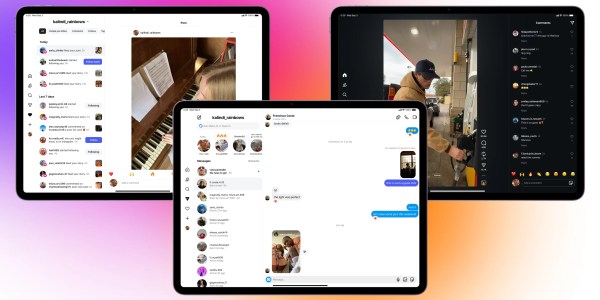
Instagram launched a dedicated application for the Apple iPad Wednesday. 

Taking advantage of the bigger screen, Instagram said its iPad app was designed for “lean-back entertainment.” Reels will be the prominent feature when the app is launched, with Stories still positioned at the top.

New for the Instagram for iPad app is a Following tab, which the Meta-owned social media platform said enables users to keep up with the accounts they follow. The app provides multiple viewing options in the Following tab, including All, Friends, and Latest.

All lets users see recommended posts and Reels from the accounts they follow. Friends allows users to see recommended posts and Reels from accounts they follow and follow back. And Latest displays posts and Reels from followed accounts in chronological order.

Taking advantage of the additional real estate, Instagram for iPad allows users to view messages and notifications with layouts that display both tabs. Additionally, when watching Reels, the comments section can be accessed while the Reel stays at full size. 

Instagram joins WhatsApp in launching dedicated apps for the iPad. WhatsApp’s app for the tablet launched in May, with users able to enjoy the same features commonly available on the iPhone or desktop version. 

This includes making video and audio calls with up to 32 people, sharing screens, and using both front and rear cameras.

https://www.adweek.com/media/instagram-now-available-on-ipad/


LinkedIn to Verify More Businesses and Key Job Titles

LinkedIn announced a set of new verification options Thursday, including the expansion of its Company Page verification, as it seeks to build more authenticity, trust, and credibility on its platform.

The professional network said companies with a Premium Company Page subscription will be eligible for the Company Page verification badge. This feature was previously available to a limited number of organizations, as well as by request.

Other business-level verifications being introduced include recruiters and talent acquisition specialists verifying their workplace on their profile. The addition of this badge helps recruiters build trust with potential candidates and also protects those clients from scams or fraudulent accounts. 

Finally, LinkedIn is introducing a C-suite verification feature, including executive director, managing director, and vice president. This badge helps prevent executive impersonation, along with protecting the integrity of leadership representation on the platform.

“These updates help ensure that the people and organizations you engage with on LinkedIn are who they say they are,” LinkedIn vice president of product Oscar Rodriguez said in a statement. He added that these features strengthen “trust across every interaction, whether you’re a business building credibility, a recruiter interacting with job seekers, or an executive representing your company.”

https://www.adweek.com/media/linkedin-to-verify-more-businesses-and-key-job-titles/


NFL Teams Up With Front Office Sports on Business-Focused Content

With the 2025-26 National Football League season set to kick off Thursday night, the league is joining forces with Front Office Sports to develop business-focused content around off-field key league moments.

This unique, first-of-a-kind partnership between the No. 1 sports league in the U.S. and the sports business-focused digital platform will enable the creative development and execution of projects tied to major NFL tentpole events, including NFL International Games, the Super Bowl, and the NFL Draft.  

Starting this fall, FOS will highlight behind-the-scenes moments from these NFL tentpole events on its website, as well as its various social media channels.

According to Axios, FOS is paying the NFL for this yearlong access, which also allows the digital platform to use emblems from the league and its teams for its coverage.

White told Axios this partnership will make FOS a more attractive option for advertisers and make it easier for his sales team to sell inventory out in the market.

Meanwhile, FOS has been building its content portfolio beyond its website and newsletters. In April, it relaunched its daily show, Front Office Sports Today, hosted by Baker Machado and Renee Washington. 

The show streams live on YouTube, X (formerly Twitter), and LinkedIn, and is also available on-demand on platforms like Apple Podcasts and Spotify.

“Front Office Sports has built a highly engaged community, and the NFL looks to FOS for unique storytelling opportunities and insights into the business of sports,” said Amanda Kersen, director of business development and strategic investments at the NFL, in a statement. “Partnering with Front Office Sports allows us to connect with this targeted audience through a fresh, thoughtful lens, reinforcing our commitment to making the NFL’s story accessible to all fans who are passionate about our game.”

FOS CEO Adam White noted that the platform is “a leader in the coverage of the business of sports, and we’re excited to collaborate with the NFL and expand our access to the country’s most-popular league,” adding, “The sports media landscape is increasingly driven by off-the-field happenings, and this partnership will bring fans closer than ever to their favorite players and teams across one of the most captivating sports leagues anywhere in the world.”

https://www.adweek.com/media/nfl-teams-up-with-front-office-sports-on-business-focused-content/


The Trade Desk Shareholders Will Vote Whether CEO Jeff Green Should Keep Supervoting Shares


The Trade Desk shareholders will vote whether to change the voting structure of the company, potentially imperiling CEO Jeff Green’s control, according to an SEC filing.

The Trade Desk is holding a special stockholder vote on September 16 on whether to amend the date in which Green’s super-voting shares expire, or maintain the company’s current dual-class structure. Under that structure, the company offers two kinds of stock: Class A stock, which carries one vote per share; and Class B stock, which comes with super-voting rights that equate to 10 votes per share. 

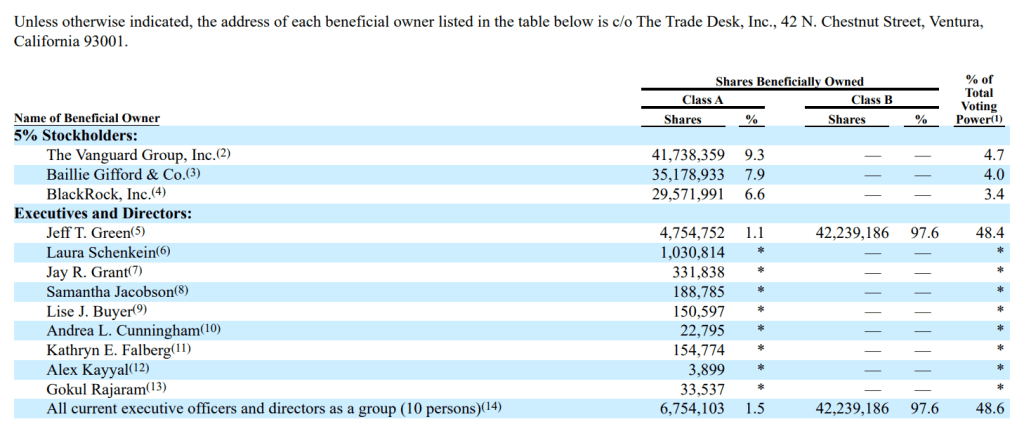
Green, who controls more than 42 million shares of Class B stock and nearly 5 million shares of Class A stock in The Trade Desk, maintains 48.4% of total voting power in the company, according to the filing.

While not required, it’s general practice for companies with dual-class stock structures to have triggers for when those super-voting shares expire, or automatically become Class A voting shares. Those triggers include when Green’s term as chairman and CEO ends, if more than two-thirds of shareholders vote to end it, or at a pre-determined sunset trigger, which is currently set for December 22, 2025. In the filing, The Trade Desk’s board has proposed extending that sunset trigger by 10 years, to December 22, 2035.

In a proxy statement, the company urged shareholders to vote to approve the proposal, citing Green’s tenure as chief executive and The Trade Desk’s high valuation as confidence in extending the sunset trigger. Should shareholders reject it, which analysts say is unlikely in part also because of the dual-class share structure, Green’s position as top decision-maker at the company could be up in the air. 

“We have outperformed other ad-tech enterprises during our tenure with a unique approach and dedication to our customers,” the committee wrote, crediting Green’s “foresight, vision and grit.”

The committee praised Green for steering the company through a stock dip in early 2025 and accelerating its rebound, inking new partnerships, and debuting “a flurry of AI-powered innovations.” As such, the group said, “we concluded that it is in the best interest of all of our stockholders to stay the course that has served us so well to date by again asking to keep the Class A and B structure in place.”

The Trade Desk declined to provide further comment.

“My opinion is they’re going to extend it. [Jeff is] not going to give up his super vote,” said Jason S. Helfstein, managing director, head of internet research at Oppenheimer & Co. “While the stock is down from a valuation standpoint, at this point there are plenty of adtech companies that trade at much lower multiples than The Trade Desk does. It’s a very high probability that the board extends super voting shares.”

Dual-class structures have become increasingly common among U.S. tech companies since the early 2000s, spiking in the mid-2010s with major IPOs including Facebook in 2012, Square in 2015, Pinterest in 2019, and Coinbase in 2021, according to data compiled by Jay R. Ritter, a finance professor at the University of Florida.

While the structure can empower visionary leaders, it also limits checks on power. Without such a structure, Green would be forced to bend to the will of outside shareholders on any number of matters. 

“If this vote goes against Jeff, he would lose control of the company. He wouldn’t be able to appoint his own board members, and he would essentially have to report to a functioning board of directors of the company,” said a former Trade Desk employee who still has some equity in the company, speaking on condition of anonymity. 

The company held a similar vote in 2020 and was set to vote on the dual-class structure every five years thereafter. In that initial vote, the board of directors and investors chose to extend the dual-class arrangement. 

In essence, the request asks stockholders to trust Green’s instincts over their own voting power. Whether investors will agree with this recommendation is yet to be seen.

The Trade Desk’s market value soared as high as $69 billion in December of 2024, nearly 70 times its 2016 IPO valuation, before sliding to around $25 billion today. Despite its largely positive revenue, earnings, and margins trendlines, the stock—and Green himself—have attracted recent scrutiny.

Wall Street reacted harshly to Green’s commentary on an August 7 earnings call on which he brushed aside concerns about intensifying competition from Amazon. “I think Amazon is more of a potential partner, honestly, than it is a long-term competitor,” he said. Millions of dollars in marketing spend had funneled out of The Trade Desk and to Amazon’s DSP this year, as ADWEEK previously reported. The company’s shares crashed nearly 40% in the days after the earnings call.

Correction, Aug 29 at 9:45 a.m. ET: This story has been corrected to clarify the details of the proxy vote.

https://www.adweek.com/programmatic/the-trade-desk-shareholders-will-vote-whether-ceo-jeff-green-should-keep-supervoting-shares/


Meta Updates Brand Rights Protection Tool for Businesses

Meta announced new protections for businesses using Facebook and Instagram, updating its Brand Rights Protection tool to include scam ad reporting.

According to the social media platform, all businesses enrolled in Brand Rights Protection have the ability to report suspected scam ads at scale. This also includes instances where it does not explicitly use their intellectual property, as well as suspected scams and misleading ads that exploit a brand’s name without authorization.

In a statement, the company said, “These updates further empower businesses to take control of how their brand is used and help protect people from harmful or misleading experiences.”

Meta said businesses seeking to access this option should, in the ads tab, use the “Other” violation type.

The Brands Right Protection navigation experience has also been updated, making it easier for businesses to access certain functionalities using fewer steps.

This includes the Drafts tab (previously called Requests) having sub-tabs per violation type, comprising Copyright, Counterfeit, Impersonation, and Trademark. Within the Reports tab, searches and/or filtering are made possible using email report IDs, keywords, trademark names, and report owner names.

Brands Right Protection, which was established in October 2021, was previously known as Meta’s, then Facebook’s, Commerce & Ads IP Tool. It enables enrolled trademark owners to search and report content that they believe infringes on their IP rights

Rights holders can upload and save up to 10 images to their account, such as logos and product images. Meta’s image-matching technology automatically scans ads on the platform, enabling brands to more easily review and report content that may infringe on their IP.

https://www.adweek.com/social-marketing/meta-updates-brand-rights-protection-tool-for-businesses/


Yelp Launches Local Co-Branded Showcase Ads

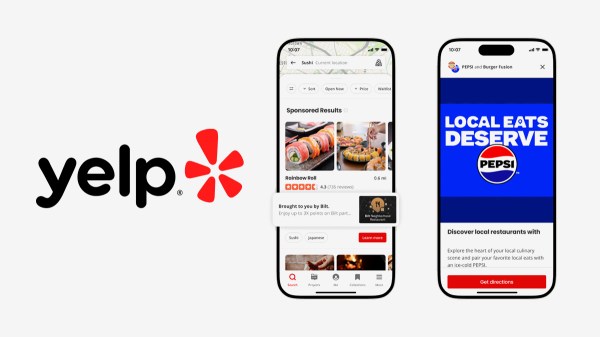
Yelp is diving deeper into the ad business game, launching Local Co-Branded Showcase Ads. This new ad unit provides national brands with an avenue to showcase their small business partners by putting them and their products or services in front of Yelp’s high-intent audiences.

Local Co-Branded Showcase Ads give brands the ability to amplify consumer discovery of their products and local business partners. This can be done through engaging photo or video ads in contextually relevant searches within Yelp.

Yelp teamed up with Pepsi and Bilt during the piloting phase of the ad product.

For Pepsi, its “Local Eats” ad campaign seamlessly appeared in real-time during Yelp searches as customized ads, ​​co-branded with relevant local restaurant partners.

“We’re excited to partner with Yelp on the Local Co-Branded Showcase Ads campaign and to work alongside our valued local business partners,” said André Moraes, head of PepsiCo’s Away From Home digital lab, in a statement. “At Pepsi, building strong community connections is core to our mission, and this co-branded approach has made it easier to spotlight local restaurants proudly serving Pepsi.”

As for Bilt, using Local Co-Branded Showcase Ads drove over 300,000 restaurant visits in New York, and showcased restaurants saw an average 5.5% increase in Yelp business page views.

“Yelp’s Local Co-Branded Showcase Ads allowed us to highlight partner restaurants offering exclusive neighborhood benefits at the moment diners are choosing their next spot,” said Nicole Treiman, senior vice president, product and growth marketing at Bilt, in a statement. “By driving awareness to our exclusive benefits directly on Yelp’s restaurant pages, we were able to create meaningful increases in both spend and transaction volume at our partner locations during the test period.”

Yelp noted that national advertisers having their ads appear in search results through Local Co-Branded Showcase Ads gain an authentic, contextual way to support small businesses, while local partners benefit from increased visibility at no cost to them.

Yelp’s high-intent audience already comes to the platform during the decision-making process, with 82% of users hiring or buying from a business they found on Yelp within one week.

Local Co-Branded Showcase Ads join Yelp’s other ad products, Sponsored Collections and Seasonal Spotlight Ads, which launched in November 2021.

https://www.adweek.com/social-marketing/yelp-launches-local-co-branded-showcase-ads/


Google Will Use Machine Learning to Estimate Users’ Age and Block Them From Restricted Content and Ads


Google this week will begin using machine learning to estimate users’ ages in order to tailor ad experiences more appropriately for minors, the company said in a blog post Wednesday. 

The technology will use behavior like search queries and the kinds of videos they’ve consumed on YouTube to help determine whether a user is under 18. 

When a user is flagged as likely to be under the age of 18, the system will notify the user and automatically implement guardrails across Google’s products, including disabling ad personalization and restricting “age-sensitive ad categories” such as alcohol, gambling, weight loss, and high fat and sugar food and beverages.

Users Google identifies as minors will also be barred from accessing apps restricted to adult users in the Google Play store and will automatically be opted into YouTube’s Digital Wellbeing program, which includes features like content protections, limiting repeat views of some kinds of videos, and reminders to take breaks from the platform. The Timeline setting in Google Maps, which keeps a chronological record of places the user has visited, will also be switched off for users estimated to be under 18. 

Google will test the new feature, called ‘age assurance,’ for some signed-out users in the U.S. over the coming weeks. 

The changes were summarized in the blog post as part of the company’s efforts to “further protect young people as they use Google products” and were shared with some Google advertising customers via email Wednesday afternoon. 

The development follows a February announcement from YouTube CEO Neal Mohan that outlined Google’s plans to expand advertising protections for minors using machine learning this year. 

Last fall, Google accused some advertisers of purposefully targeting teens on YouTube, in violation of the platform’s policy, ADWEEK previously reported.

The rollout of Google’s ‘age assurance’ tool comes just months after Meta introduced a similar product to Instagram that can scan for indicators that minors are lying about their age—to help ensure that under-18 users are using safeguarded ‘Teen Accounts’ rather than an unrestricted version of the app.

https://www.adweek.com/media/google-will-use-machine-learning-to-estimate-users-age-and-block-them-from-restricted-content-and-ads/


EXCLUSIVE: TikTok to Roll Out New Tool for Advertisers to Follow People Beyond the App


TikTok is rolling out a new advertising tool to measure user behavior after they leave the app without using pixel technology, ADWEEK has learned. The new tool, called Engaged Session, will allow advertisers to target users who spend at least 10 seconds on a website or retailer landing page after clicking an ad.

According to an email sent to buyers, TikTok said the new tool is designed to “bring high-intent users to your website” while providing insights into engagement metrics like Total Engaged Sessions and Cost per Engaged Session, metrics that “align closely with third-party analytics like Google and Adobe Analytics.”

The feature is set to become available to all advertisers on July 31, according to three media agency executives who received early announcements of Engaged Session.

A representative for TikTok did not respond to requests for comment.

The launch of Engaged Session marks TikTok’s latest effort to offer advertisers deeper insight into post-click behavior, a common blind spot in social media advertising where clicks don’t always translate to meaningful site engagement. Regulation and other privacy restrictions have made pixel-based tracking more difficult for platforms like TikTok, Meta, and Google, which have previously relied on the technology to target and track users.

Meta recently made a similar move by rolling out Google Analytics integration, linking advertiser data with its ad platform to enhance insights into post-click user actions.

This comes at a key moment, as Gen Z increasingly ditches traditional search platforms like Google Search in favor of TikTok. According to the marketing platform Soci, 34% of Gen Z uses TikTok for search and discovery, while 40% of U.S. adults aged 18–24 use social networks like TikTok to look up information about local businesses. 

With this new tool, brands will be able to target people who stay longer on their websites—making it easier to reach the right audience and move them closer to buying, said Lauren Kramer, director of social media solutions at Basis Technologies.

Engaged Session is available under TikTok’s Traffic Objective, which helps advertisers reach people who visit their website after seeing an ad. The tool can be toggled on for all TikTok ad placements, including Search Ads.

Early results TikTok shared with advertisers show a 46% decrease in cost per engaged session, a 62% increase in average session duration, and a 13% decrease in bounce rate compared to traditional landing page view campaigns—a metric that counts when a person clicks on a TikTok ad and an external landing page successfully loads.

https://www.adweek.com/media/tiktok-to-roll-out-new-tool-for-advertisers-to-follow-people-beyond-the-app/


Meta to Stop Serving Political Ads in the EU in October

Political, electoral, and social issue ads will no longer be served on Meta-owned platforms in the European Union, starting in October.

The parent company of Facebook and Instagram is complying with the Transparency and Targeting of Political Advertising regulation that is set to take effect Oct. 10, requiring tech companies to clearly label political advertising on their platforms and disclose who paid for it and how much, as well as which elections are being targeted, or risk fines up to 6% of their annual turnover.

Meta said in a blog post, “We continue to believe online political advertising is a vital part of modern politics, connecting people to important information about the politicians that represent them, and ensuring that candidates have a cost-effective way of reaching their audiences.”

The company detailed the various ways political ads served on its platforms are “authentic, and information about them is transparent.” However, it noted, the new TTPA regulation “is yet another threat to the principles of personalized advertising, ignoring the benefits to advertisers and the people they want to reach.”

Meta is following in the footsteps of Alphabet, parent company of Google, which announced that it would stop serving political advertising in the EU before the regulation went into effect.

TTPA is not the only piece of regulation that has constrained Meta’s abilities within the EU. In October 2024, the EU’s top court ruled that social media networks cannot retain user information for indefinite ad targeting. 

The ruling meant that Facebook and Instagram, alongside other social media networks, must comply with the EU’s General Data Protection Regulation data minimization principles. Breaching GDPR could result in fines of up to 4% of a company’s global annual turnover.

https://www.adweek.com/social-marketing/meta-to-stop-serving-political-ads-in-the-eu-in-october/