After robotaxi dragged pedestrian 20 feet, Cruise founder and CEO resigns
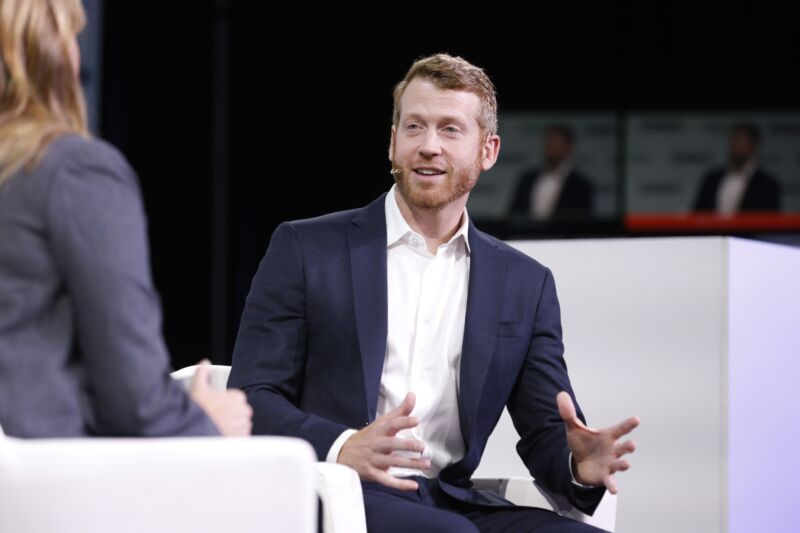
Enlarge/ Then-Cruise CEO Kyle Vogt speaks at TechCrunch Disrupt 2023 on September 20, 2023, in San Francisco.
Getty Images | Kimberly White
The CEO of self-driving car firm Cruise resigned yesterday following an accident in which a Cruise robotaxi dragged a pedestrian 20 feet. California officials accused Cruise of withholding key information and video after the accident, and the company’s self-driving operations are on hold while federal authorities investigate.
“Today I resigned from my position as CEO of Cruise,” co-founder Kyle Vogt wrote in a post on twitter.com. “The startup I launched in my garage has given over 250,000 driverless rides across several cities, with each ride inspiring people with a small taste of the future,” he also wrote.
Cruise is owned by General Motors, which bought the company in 2016. Vogt expressed optimism about Cruise’s future without him, saying the team is “executing on a solid, multi-year roadmap and an exciting product vision.”
“As for what’s next for me, I plan to spend time with my family and explore some new ideas. Thanks for the great ride!” Vogt wrote.
On Saturday, one day before resigning, Vogt reportedly apologized to staff in an email. “As CEO, I take responsibility for the situation Cruise is in today. There are no excuses, and there is no sugar coating what has happened. We need to double down on safety, transparency, and community engagement,” he wrote in the email quoted by Reuters.
Robotaxi kept moving after hitting woman
The California Department of Motor Vehicles (DMV) last month suspended Cruise’s permits for autonomous vehicle deployment and driverless testing. Cruise subsequently announced a “pause” of all of its driverless operations in the US, which includes San Francisco, Austin, Phoenix, Houston, Dallas, and Miami. Cruise said the pause affects about 70 vehicles.
The DMV action came three weeks after a Cruise vehicle hit and dragged a pedestrian in San Francisco. A woman entered a crosswalk at nighttime and was hit by two cars, the second of which was the Cruise vehicle. First, a Nissan Sentra “tragically struck and propelled the pedestrian into the path of the AV,” Cruise said in a description of the incident.
The Cruise vehicle then moved “rightward before braking aggressively, but still made contact with the pedestrian,” the company said. “The AV detected a collision, bringing the vehicle to a stop; then attempted to pull over to avoid causing further road safety issues, pulling the individual forward approximately 20 feet.”
The accident happened at 9:29 pm on October 2. The Nissan driver fled the scene, and Cruise said it was sharing information with authorities to help them track down the hit-and-run driver. The woman suffered severe injuries and was reportedly still in “serious condition” at San Francisco General Hospital in late October.
In an order of suspension that was published by Vice, the California DMV said that in a meeting on October 3, “Cruise failed to disclose that the AV executed a pullover maneuver that increased the risk of, and may have caused, further injury to a pedestrian. Cruise’s omission hinders the ability of the department to effectively and timely evaluate the safe operation of Cruise’s vehicles and puts the safety of the public at risk.”
The US National Highway Traffic Safety Administration on October 16 opened an investigation into Cruise vehicles after receiving reports of two pedestrian injuries, including the October 2 incident. The Cruise cars “may not have exercised appropriate caution around pedestrians in the roadway,” the agency said. Another Cruise robotaxi hit a fire truck in San Francisco in August.
https://arstechnica.com/?p=1985468
Apple fights EU gatekeeper status to avoid opening up services to rivals
Apple has officially joined Meta and TikTok in appealing the European Union’s designation of their services as “gatekeepers” under the Digital Markets Act (DMA)—a strict EU antitrust law aimed at “preventing gatekeepers from imposing unfair conditions on businesses and end users” and “ensuring the openness of important digital services.”
On Friday, the EU Court of Justice confirmed the Apple appeal in a post on X. No other details about Apple’s legal challenge have been made public, Reuters reported. But last week, sources told Bloomberg that Apple’s appeal was expected to oppose gatekeeper status of its App Store, iOS operating system, and Safari browser. That report, however, noted that sources had only seen a draft of the appeal, which could have been edited ahead of filing.
Apple had previously argued that its App Store could be considered not one software application marketplace, but five distinct marketplaces offered across five devices: iPhones, iPads, Mac computers, Apple TVs, and Apple Watches. Following this logic, only the iOS App Store should be considered a gatekeeper, Apple argued. Ultimately, the EU disagreed, saying that the “nature, function, and usage of the different devices on which the App Store can be accessed” does not “alter the common purpose the App Store serves across all Apple’s devices.”
Similarly, Apple argued that its iOS operating system should not be designated as one single gatekeeper, but five distinct operating systems across the same five devices, and because each device required a uniquely designed operating system, the EU seemed to agree that only iOS met the threshold as a gatekeeper.
Finally, Apple similarly argued that its Safari browser is actually three different browsers accessed on three devices: iPhones, iPads, and Mac computers. According to Apple, Safari works differently on different devices depending on use cases, leading to different versions of Safari on each device, disputing Safari features like a sidebar that’s available on desktop that does not appear in Safari on mobile. The EU rejected Apple’s arguments, finding that Safari is a single web browser providing the same services “irrespective of the device.”
Apple’s appeal came after Meta became the first to appeal gatekeeper status of its Messenger and Marketplace services on Wednesday, Reuters reported. According to Meta, its Facebook, Instagram, and WhatsApp services qualify as gatekeepers, but not other designated services that the social giant considers simply functionalities of Facebook—its Messenger and Marketplace services. Further, Meta argued that its Marketplace enables consumer-to-consumer services—which it said is different from businesses promoting outside services—and therefore, Meta contends that service falls outside the DMA’s scope.
That same day, ByteDance quickly followed suit, appealing TikTok’s gatekeeper status. According to a TikTok blog post, TikTok shouldn’t be designated as a gatekeeper because it’s a newcomer that “does not hold an ‘entrenched’ position.”
TikTok claimed that its services were entirely miscategorized by the European Commission because, unlike other companies, “no market investigation was conducted in relation to” TikTok’s designation.
“Multiple studies and findings agree that TikTok is a challenger bringing important new competition to the space,” TikTok’s blog said. “The designation decision is based on a fundamental misunderstanding of our business and threatens our ability to grow and compete with true gatekeepers—put simply, it risks protecting the very monopolies that the law intended to open up.”
TikTok likely feels shirked because the Commission has conducted four market investigations “to further assess Microsoft’s and Apple’s submissions arguing that, despite meeting the thresholds, some of their core platform services do not qualify as gateways,” including Bing, Edge, Microsoft Advertising, and iMessages. Those ongoing investigations could delay designations of these services until next September, sparing Apple and Microsoft risks of infringement and “fines up to 10 percent of the company’s total worldwide turnover, which can go up to 20 percent.” The Commission also granted rebuttals from Google and Samsung, deciding not to designate services Gmail, Outlook.com, and Samsung Internet Browser as core platform services under the DMA.
Further, TikTok said it is the “only service designated under the DMA that does not meet the law’s threshold for revenues generated in the European Economic Area.” According to TikTok, the EU designated TikTok as a gatekeeper based on ByteDance’s global market capitalization, derived “primarily on the performance of business lines that do not even operate in Europe.”
If the Commission had conducted a market investigation, TikTok suggested, its platform would never have been designated as a gatekeeper. Without the investigation, “the result is a designation decision based on inaccuracies and errors, to which we were not given the opportunity to fully respond,” TikTok’s blog said.
It’s unclear how successful Meta and ByteDance will be with their appeals. In earlier rebuttals, Meta and ByteDance have already argued against gatekeeper status for the services at the core of their appeals. The European Commission has said that only “exceptional circumstances” would enable a tech company that meets the threshold to avoid being designated as a gatekeeper.
Meta has said its appeal represents the company’s struggle to gain clarity about why Messenger and Marketplace should be designated as gatekeepers.
“This appeal seeks clarification on specific points of law regarding the designations of Messenger and Marketplace under the DMA,” a Meta spokesperson told Reuters. “It does not alter or detract from our firm commitment to complying with the DMA, and we will continue to work constructively with the European Commission to prepare for compliance.”
TikTok has come out a bit stronger, warning the Commission that designating TikTok as a gatekeeper would contradict everything the DMA stands for.
“We fully support the principles of the DMA, which aims to better enable challengers to compete with incumbent players,” TikTok’s blog said. “Indeed, our appeal is based on the belief that our designation risks undermining the DMA’s own stated goal by protecting actual gatekeepers from newer competitors like TikTok. Far from being a gatekeeper, our platform, which has been operating in Europe for just over five years, is arguably the most capable challenger to more entrenched platform businesses.”
Twenty-two services managed by six tech companies have so far been designated as gatekeepers under the DMA, including services from Google owner Alphabet, Amazon, Apple, ByteDance, Meta, and Microsoft. When the DMA takes effect on March 7, it will require companies with more than 45 million monthly active users and a market capitalization of 75 billion euros to allow third-party apps and app stores on their platforms and force platforms to make it easier for users to switch services. It will also stop platforms from favoring their own services over rivals’ or using third-party businesses’ data against them to squash competition.
Thursday is the deadline for designated gatekeepers to appeal the European Commission’s decision. Google and Microsoft have decided not to appeal, Reuters reported.
A spokesperson for the European Commission told Ars that the Commission has taken note of the appeals, respects companies’ right to appeal, and will defend its decisions in court.
“Our designation decisions are publicly available,” the spokesperson told Ars, and “they set out a solid reasoning for the designations.”
“In parallel, we will continue our work with all gatekeepers towards effective implementation of the DMA by March,” the Commission’s spokesperson said.
This story was updated on Nov. 17, 2023, to note Apple’s appeal.
https://arstechnica.com/?p=1984413
Elon Musk’s antisemitic post draws rebuke from White House; IBM pulls X ads
Outcry over antisemitic content on X (formerly Twitter) continues as the White House condemns a post from X owner Elon Musk and IBM halts advertising on the platform after a Media Matters report showed one of its ads was placed next to pro-Hitler content.
“IBM has zero tolerance for hate speech and discrimination, and we have immediately suspended all advertising on X while we investigate this entirely unacceptable situation,” an IBM spokesperson said in a statement provided to Ars.
Media Matters’ report came a day after X owner Elon Musk sparked outrage by endorsing an X post that referenced an antisemitic conspiracy theory that “hordes of minorities” are flooding Western countries and claimed that Jews have been “pushing hatred” against White people. Since Musk responded to that post—saying, “you have said the actual truth”—it has been viewed more than 1 million times. The exchange drew so much controversy that a White House spokesperson, Andrew Bates, released a statement condemning Musk’s post.
“It is unacceptable to repeat the hideous lie behind the most fatal act of Antisemitism in American history at any time, let alone one month after the deadliest day for the Jewish people since the Holocaust,” Bates’ statement said, referring to Hamas’ surprise attack on Israel on October 7.
According to Media Matters, IBM wasn’t the only brand with ads appearing next to “content that touts Adolf Hitler and his Nazi Party.” The watchdog group also documented similarly problematic placements of ads from Apple, Bravo (NBCUniversal), Oracle, and Xfinity (Comcast).
Officially, an X executive told Ars that the company has made investments to strengthen safety controls allegedly beyond what other platforms allow and has been unable to verify that any of these brands’ ads appeared next to the pro-Nazi content, as Media Matters alleged. X is currently trying to figure out what account Media Matters used on which date to take the screenshots embedded in its report.
Further, X’s executive said that 99 percent of measured ad placements in 2023 have been next to safe content. As for the account with pro-Hitler content seemingly appearing next to IBM’s ad, the exec said that the account would not have been monetizable and noted that the post itself had been labeled “sensitive media” and received relatively low impressions.
“While we understand it’s not an ideal placement for any ad, the post itself had about 8,000 impressions,” the X executive told FT.
On X, Musk shared different reactions to these reports, seemingly taking a swipe at IBM by responding to an X user calling out IBM for “saving face” due to its documented history dealing directly with Holocaust organizers in the 1930s. The X user suggested that IBM’s history was worse for the brand than its ads appearing next to antisemitic content on X, to which Musk responded, “precisely.”
An IBM spokesperson told Ars that “IBM has never been silent on this issue.”
“As with other foreign-owned companies that did business in Germany at that time, IBM’s German operations came under the control of Nazi authorities prior to and during World War II,” IBM’s spokesperson said. “Most documents were destroyed or lost during the war. Whatever archives IBM had from this period were donated to universities in New York and Germany several years ago for scholarly review. IBM and its employees around the world maintain that the atrocities committed by the Nazi regime are abhorrent and condemn any actions which aided their unspeakable acts.”
Musk called Media Matters “evil”
Musk also called Media Matters “an evil organization.”
He was responding to a post from XDaily seemingly suggesting that Media Matters was hunting down antisemitic content to scare off advertisers.
XDaily noted that ads were being placed next to antisemitic content in examples pulled by Media Matters because “X’s automated Ad Adjacency tools aren’t able to determine if the content in images is antisemitic.” It’s likely, XDaily said, that “X’s recent decision to help users monetize on Ads that run on users profiles is also the culprit” while suggesting that Media Matters was exploiting this by “just scrolling down on user profiles of antisemitic accounts until they see an ad.”
X’s executive also suggested to Ars that Media Matters’ monitoring for hate speech on the site would make it more likely that the watchdog group would catch these types of ad placements. According to the executive, brands and users should be able to control settings to avoid seeing such content or presumably avoid placing their ads next to such content.
“Ads follow the people on X, in this case the Media Matters researcher that was going to actively look for this content—that’s how user targeting works,” the X exec said. “As it relates to the platform itself, control settings are in place there for every user and every brand.”
Angelo Carusone, president of Media Matters for America, told Ars that “there’s a whole bunch of conspiracies” proliferating on X that Media Matters doctored images of ads next to antisemitic posts. Carusone said there is a “big concern” if X is giving “a little bit of a wink and a nod and some oxygen to conspiracy theories that somehow these images are fabricated,” because “it’s not true.”
Carusone confirmed that Media Matters used a clean account to gather data used in its report over two days from Nov. 14 to Nov. 16. Carusone told Ars that a new Media Matters report put out today shows that X’s ad targeting is currently still placing ads next to antisemitic posts using white nationalist hashtags.
“Fundamentally all this research shows is that the system that they’re supposed to have in place” to prevent ads being served on antisemitic content “that they’ve been telling advertisers exist,” either “doesn’t exist at all,” or if “it does exist, it’s not working,” Carusone told Ars.
X criticizing Media Matters’ methodology for surfacing problematic ad placements, Carusone said, is a “cop out.”
https://arstechnica.com/?p=1984814
Massive cryptomining rig discovered under Polish court’s floor, stealing power
Police were called to dismantle a secret cryptomining rig winding throughout the floors and ventilation ducts of a Polish court in September, according to Polish news channel TVN24.
Several secured computers were discovered, potentially stealing thousands of Polish Zlotys worth of energy per month (the equivalent of roughly $250 per 1,000 Zlotys.) It’s currently unknown how long the rig was running because the illegal operation went undetected, partly because the computers used were connected to the Internet through their own modems rather than through the court’s network.
While no one has been charged yet with any crimes, the court seemingly has suspects. Within two weeks of finding the rig, the court terminated a contract with a company responsible for IT maintenance in the building, TVN24 reported. Before the contract ended, the company fired two employees that it said were responsible for maintenance in the parts of the building where the cryptomine was hidden.
Poland’s top law enforcement officials, the Internal Security Agency, have been called in to investigate. The Warsaw District Prosecutor’s Office has hired IT experts to help determine exactly how much electricity was stolen from Poland’s Supreme Administrative Court in Warsaw, TVN24 reported.
The Supreme Administrative Court is the last resort for sensitive business and tax disputes, but no records seem to have been compromised. Judge Sylwester Marciniak—the chairman of the Judicial Information Department of the Supreme Administrative Court—told TVN24 that the discovery of the cryptomine “did not result in any threat to the security of data stored” in the court.
Although very few instances have been publicized, the Polish cryptomining rig is not the only time public institutions have been targeted by bad actors seeking to siphon electricity to mine cryptocurrency. Experts told TVN24 that dishonest miners trying to rapidly collect as much cryptocurrency as possible are known to install illegal rigs in “less visited places” or to operate rigs during off hours when public institutions or enterprises targeted for electricity theft are typically closed.
There was at least one prominent case in the US of another cryptomine illegally and secretly set up at a public institution. That case provides some insight into how much electricity can be stolen to power a single rig.
The Department of Homeland Security investigated for three months, and a former employee who had been serving as assistant facilities director for the town, Nadeam Nahas, was accused of vandalizing the school and stealing at least $17,492 in electricity to operate the cryptomine.
According to Boston news station WHDH, police traced SKU numbers on ductwork that Nahas allegedly installed to keep the rig from overheating. Nahas reportedly got “nervous” when confronted with evidence allegedly showing that he purchased the materials from Home Depot, as well as his posts on the social platform formerly known as Twitter, which cops found indicated his strong interest in cryptocurrency.
Ars was not able to immediately determine the outcome in this case. Nahas resigned from his position in 2022 and, as of June 2023, has pleaded not guilty.
https://arstechnica.com/?p=1984512
Apple’s China ties under Congressional scrutiny after Jon Stewart cancellation
In a letter to Apple CEO Tim Cook, the Republican and Democratic leaders of the House of Representatives’ Select Committee on Competition with the Chinese Communist Party urged Apple to explain its decision to end production of The Problem with Jon Stewart and “accelerate its efforts to reduce its dependence on” China. These steps, lawmakers wrote, are critical to help address “broader concerns about indirect Chinese Communist Party (CCP) influence over the creative expression of American artists and companies on CCP-related topics.”
While lawmakers acknowledged that Apple has “the right to determine what content is appropriate for their streaming service,” they argued that “the coercive tactics of a foreign power should not be directly or indirectly influencing these determinations.”
According to lawmakers, “previous incidents involving production companies other than Apple” have shown that “fear” of the CCP’s retaliation—as well as the “lure” of China’s market and financing opportunities—”have significantly chilled the creation of American content that could be perceived as critical of the CCP.”
On top of requesting that Apple provide a briefing on its decision to cancel Stewart’s show by December 15, they also want Apple to explain matters regarding its dependency on China. Lawmakers wrote that Cook’s “recent trip to Beijing” makes it appear as if “maintaining a positive relationship with the CCP may be a priority given ongoing supply chain and financial dependencies.”
“We support the ability of artists, writers, studios, and streaming services alike to create content without fear of potential CCP retaliation and punishment,” lawmakers wrote. “We similarly encourage American technology companies to diversify their supply chains, reduce their potential susceptibility to CCP pressure, and decrease their overall dependence on” China.
According to Reuters, the letter was released on Wednesday before a dinner where “top US business leaders” will be dining with Chinese President Xi Jinping in San Francisco, as Xi “seeks to court American companies and counter his country’s recent struggles to entice foreign investment.” That dinner follows a summit between President Joe Biden and Xi, where the leaders reportedly hoped to ease tensions and restore military communications between the two countries.
“I think it’s paramount that you and I understand each other clearly, leader to leader, with no misconceptions or miscommunication,” Biden told Xi as their talks kicked off, CNN reported.
“Planet Earth is big enough for the two countries to succeed,” Xi told Biden.
One of Biden’s goals with the summit is to ensure that competition between the US and China does not boil over into conflict. That is the primary focus of the House’s Select Committee on Competition with the Chinese Communist Party, and in the lawmakers’ letter to Cook, they said that “potential decisions to not renew shows, or not produce a film or show in the first place, due to anticipated CCP objections to particular content deny US viewers and global audiences access to important information” about China that “reflects a broader variety of perspectives” and “speaks to an important geopolitical challenge of our time.”
As China seemingly seeks to deepen financial ties with US companies, the committee’s letter pointed out that Apple’s reliance on China as a market and manufacturing hub may be a prime example of what could be an increasingly common situation that “may raise concerns over the impacts of the CCP’s coercive tactics.” Lawmakers noted that if a major star like Jon Stewart can be censored, there can be little hope for “an aspiring comedian who wants to use satire to make broader points about human rights and authoritarianism.”
Last month, a person familiar with the matter told The New York Times that Stewart told his staff that the cancellation came after “potential show topics related to China and artificial intelligence were causing concern among Apple executives.” Sources told The Hollywood Reporter that Stewart felt “hamstrung” by Apple’s requests to be “aligned” regarding topics on the show.
Lawmakers confirmed that they would also reach out to Stewart to hear his side of the story.
To ensure that no Americans will be censored due to the tech giant’s ties to China, lawmakers now expect Apple to “publicly commit that content that could be perceived as critical of the CCP or [China] is welcome on Apple TV+ and other Apple services.”
Apple did not immediately respond to Ars’ request to comment.
https://arstechnica.com/?p=1984300
Judge tosses social platforms’ Section 230 blanket defense in child safety case
This week, some of the biggest tech companies found out that Section 230 immunity doesn’t shield them from some of the biggest complaints alleging that social media platform designs are defective and harming children and teen users.
On Tuesday, US district judge Yvonne Gonzalez Rogers ruled that discovery can proceed in a lawsuit documenting individual cases involving hundreds of children and teens allegedly harmed by social media use across 30 states. Their complaint alleged that tech companies were guilty of negligently operating platforms with many design defects—including lack of parental controls, insufficient age verification, complicated account deletion processes, appearance-altering filters, and requirements forcing users to log in to report child sexual abuse materials (CSAM)—and failed to warn young users and their parents about those defects.
Defendants are companies operating “the world’s most used social media platforms: Meta’s Facebook and Instagram, Google’s YouTube, ByteDance’s TikTok, and Snapchat.” All of these companies moved to dismiss the multi-district litigation entirely, hoping that the First Amendment and Section 230 immunity would effectively bar all the plaintiffs’ claims—including, apparently, claims that companies ignored addressing when moving to dismiss.
“Defendants were adamant that the entirety of the complaint should be dismissed under Section 230 of the Communications Decency Act of 1996 and the First Amendment,” Gonzalez Rogers wrote.
Under the 9th Circuit’s three-part test to see if Section 230 applies, tech companies must prove that (1) they are providers of an interactive computer service, (2) whom plaintiffs seek to treat as a publisher or speaker, and (3) of information provided by another information content provider.
Plaintiffs argued that the second prong wasn’t met because their complaint was allegedly entirely aimed at how platforms were designed—not at content published by platforms—and tech companies argued that all prongs were met because all the alleged harms allegedly stemmed from content on their platforms.
Gonzalez Rogers found that both sides’ “all or nothing” approaches to the motions to dismiss did “not sufficiently address the complexity of the issues facing this litigation” or “fairly or accurately represent the Ninth Circuit’s application of Section 230 immunity.”
Gonzalez Rogers’ ruling sheds new light on how courts interpret the scope of Section 230 immunity. She wrote that “the issue is whether the defendant’s alleged duty to the plaintiff could ‘have been satisfied without changes to the content posted by the website’s users and without conducting a detailed investigation.'”
While platforms hoped she would find that none of their duties could have been satisfied without those conditions being met, Gonzalez Rogers identified nine alleged design defects that “do not implicate publishing or monitoring of third-party content,” “are not equivalent to speaking or publishing,” and “can be fixed by defendants without altering the publishing of third-party content” and “thus are not barred by Section 230.”
Alleged defects not barred by Section 230 include: not providing effective parental controls; not providing options for young users to self-restrict time used on the platform; making it challenging for users to delete their accounts; not using robust age verification; making it challenging for users to report predators and inappropriate content; offering appearance-altering filters; not labeling filtered content; the timing of notifications alleged to increase addictive use; and not implementing “reporting protocols to allow users or visitors of defendants’ platforms to report CSAM and adult predator accounts specifically without the need to create or log in to the products prior to reporting,” the order said.
https://arstechnica.com/?p=1984148
Google loses battle to redact confidential info leaked by final witness
On Tuesday, Google ended two and a half weeks of defending its search business against the Department of Justice’s monopoly claims, reportedly with a whimper.
During the DOJ’s cross-examination of Google’s final witness, Kevin Murphy, the economist got “upset” when the DOJ introduced a 2011 email from an ex-Google executive, Chris Barton, which suggested that Google’s default search agreements with wireless carriers, mobile device manufacturers, and browser partners had to be “exclusive,” Big Tech on Trial reported, or else they were worthless.
“Without the exclusivity, we are not getting anything,” Barton’s email said. “Without an exclusive search deal, a large carrier can and will ship alternatives to Google.”
Google had argued that these deals are not exclusive but are reasonable contracts that Google has competed fairly for and repeatedly won by making the best search engine available, Big Tech on Trial reported.
Murphy’s testimony was supposed to shore up this part of Google’s defense, but as Google’s defense wound down, the DOJ appeared intent to remind Judge Amit Mehta that evidence allegedly showed that these default deals were the key to maintaining Google’s alleged illegal monopolies in search and advertising. By the time the DOJ began their line of questioning, Murphy was likely already eager to get out of the hot seat.
Big Tech on Trial reporter Lee Hepner—who also serves as antitrust legal counsel for the nonprofit the American Economic Liberties Project—posted on X (formerly Twitter) to summarize Murphy’s testimony as arguing, “Google’s Search monopoly is good for you, consumer choice is ‘irrational,’ and privacy is bad quality.”
On the day prior, Murphy potentially bolstered the DOJ’s case by accidentally leaking a key figure that both Google and Apple had specifically requested remain confidential—confirming that Apple gets a 36 percent cut of search ad revenue from its Safari deal with Google.
Google seemingly sought to redact this information from Murphy’s trial transcript, but Mehta “ruled against redacting transcripts of inadvertently disclosed information (presumably the 36 percent Google-Apple revenue share figure) finding a lack of competitive harm,” Big Tech on Trial reported. Meanwhile, Google CEO Sundar Pichai, during Google’s other monopoly trial, confirmed on Tuesday that the 36 percent figure that Murphy shared was accurate, Bloomberg reported.
Although it’s still unclear exactly how much money Apple gets from its default deal with Google, it’s obvious that the default placements in Safari are extremely valuable to Google. Experts estimated that with such significant revenue-sharing, the Safari deal is potentially worth tens of billions of dollars to Apple, on top of the $18 billion that Google pays annually just to keep the deal in place.
In the coming days, the DOJ will present its rebuttal to Google’s arguments.
Mehta is expected to rule next year “after both sides summarize their cases in writing and deliver closing arguments,” The New York Times reported. It’s currently hard to tell which way the judge is leaning. Big Tech on Trial reporter Yosef Weitzman wrote that the judge has kept his “cards close to his chest” throughout the trial.
Mehta will have to resolve complex legal questions in the case and parse conflicting expert analyses, Weitzman said, to confidently decide if Google’s business model is helping or harming consumers. While many have reported that the risk of Mehta ruling against Google could be a breakup of Google’s search business that could shake up the way the Internet works for nearly everyone around the world, Weitzman also pointed out that Google would likely appeal an unfavorable verdict, possibly sending the case to the Supreme Court.
The DOJ hopes that Mehta will conclude that Google is paying tens of billions not just to drive traffic to its search engine and boost search ad revenue but also to lock out rivals who can’t possibly compete without winning those default placements.
And Google is hoping that Mehta will land on its side, perhaps most crucially agreeing that Google pays Apple so much for the Safari deal because, as Pichai testified earlier in this monopoly trial, Google users depend on its search engine to get the best results, and Google feared that Apple may have degraded their experience in Safari without the deal, The Times reported. Rather than strong-arming Apple into an allegedly exclusive deal just to stop rivals from competing, Pichai testified that for Google, “there was a lot of uncertainty about what would happen if the deal didn’t exist.”
https://arstechnica.com/?p=1983877
Google sues people who “weaponized” DMCA to remove rivals’ search results
Getty Images | Bloomberg
Google yesterday sued a group of people accused of weaponizing the Digital Millennium Copyright Act (DMCA) to get competitors’ websites removed from search results. Over the past few years, the foreign defendants “created at least 65 Google accounts so they could submit thousands of fraudulent notices of copyright infringement against more than 117,000 third-party website URLs,” said Google’s lawsuit filed in US District Court for the Northern District of California.
Another 500,000 URLs were also targeted, according to Google. “To date, Defendants’ scheme has forced Google to investigate and respond to fraudulent takedown requests targeting more than 117,000 third-party website URLs, as well as takedown requests targeting more than half a million additional third-party URLs that are likely fraudulent based on preliminary investigation,” the lawsuit said.
Google filed the lawsuit against Nguyen Van Duc and Pham Van Thien, who are both said to live in Vietnam, and 20 defendants whose identities are unknown. Google alleged that the defendants “appear to be connected with websites selling printed t-shirts, and their unlawful conduct aims to remove competing third-party sellers from Google Search results.”
Google hopes to use the court system to deter further copyright-takedown abuse. But the lawsuit helps show how easy it is for fraudsters to game Google’s system for responding to DMCA notices.
“Defendants have weaponized copyright law’s notice-and-takedown process and used it not for its intended purpose of expeditiously removing infringing content, but instead to have the legitimate content of their competitors removed based on false allegations,” the lawsuit said. “Defendants’ illegal, fraudulent scheme harms consumers, third-party businesses, and Google; stifles competition; and threatens to tarnish Google’s trusted brand.”
Google said it removed a “significant” number of search results based on the fraudulent takedowns. “Unfortunately, to ensure compliance with the DMCA and in reliance on the information submitted in Defendants’ takedown requests, Google’s system removed a significant number of third-party website URLs targeted by Defendants for a period of time before Google and/or the websites’ owners figured out what was going on and took appropriate steps to reinstate the URLs,” Google said.
Defendants impersonated Elon Musk and Amazon
According to Google, some or all of the 20 Doe defendants “are individuals or entities working at the direction of and/or in active concert with Defendants Nguyen and Pham to prepare and submit thousands of fraudulent takedown requests to Google.”
In the defendants’ most egregious series of takedown requests, spanning from August to December 2022, they allegedly “submitted fraudulent takedown requests targeting more than 35,000 website URLs from a Google customer that spends tens of millions of dollars per year on Search Ads.” The customer’s website traffic plunged during the 2022 holiday season, “resulting in over $5 million in revenue losses for that customer (and its sellers), with a corresponding loss to Google of between $2 and $3 million, before Google was able to reinstate all the targeted URLs,” the lawsuit said.
The defendants provided fake names in their takedown requests and “falsely purported to represent large companies (e.g., Amazon, Twitter, NBC News), sports teams (e.g., Philadelphia Eagles, Los Angeles Lakers, San Diego Padres), prominent individuals (e.g., Elon Musk, Taylor Swift, LeVar Burton, Kanye West), and famous bands (e.g., Blink 182),” the Google lawsuit said.
For example, “Defendants falsely claimed to represent Elon Musk, alleging infringement of a t-shirt with a logo with the text ‘Pharmacy Technician,'” the lawsuit said. Defendants falsely claimed to represent Amazon in a notice alleging “infringement of a t-shirt with the text ‘In 2006 Beyonce Said To The Left, To The Left And My Political Compass Was Born,'” Google said.
In other takedown notices, the defendants are accused of listing fake company names or providing “plainly disingenuous information in the company name field on the Copyright Webform, such as ‘TESTTT’ and ‘this is funny game.'”
“Defendants signed and submitted their thousands of fraudulent takedown requests containing false information under penalty of perjury,” Google said.
https://arstechnica.com/?p=1983771
US studying 2,786 megahertz of spectrum to fuel “next-generation” services
Getty Images | Jaiz Anuar
The Biden administration is studying 2,786 megahertz of spectrum that could be reallocated for purposes including wireless broadband networks, satellites, and drones, the White House said today. Some of the spectrum bands were already being investigated by federal agencies, though inclusion in the updated national strategy may speed up those processes.
“These spectrum bands are a mix of Federal and shared Federal/non-Federal bands—with an emphasis on mid-band frequencies,” the new National Spectrum Strategy says. The bands “will be studied for a variety of uses, including terrestrial wireless broadband, innovative space services, and unmanned aviation and other autonomous vehicle operations.”
The plan details “five spectrum bands meriting in-depth study in the near term,” saying they could be useful for “expanded governmental and non-governmental use for an array of advanced, next-generation applications and services.”
The biggest chunk is from 7.125–8.4 GHz and could be used for wireless broadband. But some parts of this band will likely be off-limits to prevent interference with existing users, the spectrum strategy report said:
This 1,275 megahertz of spectrum will be studied for wireless broadband use (on a licensed and/or unlicensed basis), though some sub-bands eventually may be studied for other uses. There are, however, a variety of mission-critical Federal operations in this band (including Fixed, Fixed Satellite, Mobile, Mobile Satellite, Space Research, Earth Exploration Satellite, and Meteorological Satellite services) that will make it challenging to repurpose portions of the band while protecting incumbent users from harmful interference.
Four more spectrum bands
Another spectrum band consists of 350 megahertz from 3.1–3.45 GHz, which the Department of Defense has already studied for possible sharing with the private sector.
“DoD determined that sharing is feasible if certain advanced interference-mitigation features and a coordination framework to facilitate spectrum sharing are put in place,” the new report said. The Departments of Commerce and Defense will work on follow-up studies that “explore dynamic spectrum sharing and other opportunities for private-sector access in the band, while ensuring DoD and other Federal mission capabilities are preserved, with any necessary changes.”
One smaller band being studied is 5.03–5.091 GHz. In January 2023, the Federal Communications Commission sought public comment on rules to let unmanned aircraft systems (UAS) use the band.
“The FCC, in coordination with NTIA (National Telecommunications and Information Administration) and the Federal Aviation Administration, is expected to take near-term action to facilitate limited deployment of UAS in this band,” the White House report said. “Thereafter, this 61 megahertz of spectrum will be studied so that the FCC can optimize UAS spectrum access across the band while avoiding harmful interference to other protected in-band and adjacent-band operations.”
The National Spectrum Strategy also includes 500 megahertz in the 18.1–18.6 GHz range and 600 megahertz in the 37.0–37.6 GHz range. The 18 GHz band is already authorized for fixed satellite service downlink operations, but could gain an additional authorization for space-to-space transmissions.
The 37 GHz band “will be further studied to implement a co-equal, shared-use framework allowing Federal and non-Federal users to deploy operations in the band,” the report said.
US hopes to prevent spectrum battles
More generally, the plan calls for collaborating with industry over the next 12 to 18 months “to advance research, create investment incentives, and set forth measurable goals for advancing the state of technology for spectrum access, with an emphasis on dynamic forms of spectrum sharing for all users.”
Repurposing spectrum can lead to public battles over potential interference, including a recent high-profile fight over 5G deployment between airlines and wireless carriers. Such battles often involve competing studies that present wildly different conclusions. The White House plan calls for formalizing standards of analysis to prevent disputes over whether one use of spectrum will interfere with another use.
Spectrum management should rely “upon unbiased technical, scientific, mission, and economic analyses,” the spectrum strategy said. “To provide greater visibility into, and acceptance of, key studies, and to reduce contention and disputes of findings, the US Government will formalize its best practices for conducting these analyses in support of spectrum management decisions. Studies should be peer-reviewed, and the underlying findings should be published to the greatest degree possible.”
https://arstechnica.com/?p=1983557
Google witness accidentally blurts out that Apple gets 36% cut of Safari deal
Google’s default search deal with Apple is worth so much to the search giant that Google pays 36 percent of its search advertising revenue from Safari to keep its search engine set as the default in Apple’s browser, Bloomberg reported.
Google and Apple objected to making this key detail public from their long-running default search deal. But their closely held secret came out on Monday during testimony from Google’s main economics expert, Kevin Murphy, during the Department of Justice’s monopoly trial examining Google’s search business.
“Probably the biggest slip of the entire trial,” Big Tech on Trial, an account dedicated to providing updates from the Google trial, posted on X (formerly Twitter).
According to Bloomberg Law, Google attorney John Schmidtlein “visibly cringed” when Murphy revealed the confidential information, which Google had initially claimed needed to be kept secret because otherwise it “would unreasonably undermine Google’s competitive standing in relation to both competitors and other counterparties.”
For the DOJ—which has made the Google-Apple deal the center of its case alleging that Google maintains an illegal monopoly over search—this detail confirms how valuable default placements on iPhones are to the search leader.
The DOJ has argued that Google pays so much for default search deals to block out competitors, lock search users into its services, and maintain a stronghold over the search industry—a dominant position that could be further entrenched by Google’s advances with AI, Microsoft CEO Satya Nadella testified. In September, an Apple exec testified that the default deal between Google and Apple was seemingly so lucrative that it even stopped Apple from creating its own rival search engine.
It’s still unclear exactly how much money that portion of Google’s search advertising revenue that comes from Safari amounts to, but several estimates have been floated. Statista reported that Google’s advertising revenue was $224 billion in 2022, and based on that, Engadget estimated that Apple likely gets paid in the tens of billions of dollars for Google’s default Safari placements.
Previously, sources told The New York Times that Google paid Apple approximately $18 billion in 2021 for the deal, but the exact amount of revenue sharing remained unknown until Monday. The DOJ’s trial also recently revealed that Google paid $26 billion in total for default contracts, which are ostensibly responsible for driving up its search advertising revenue that is right now rapidly climbing. Google’s global ad revenue will likely reach nearly $340 billion by 2027, Statista reported, driven largely by Google’s search engine traffic, which is currently responsible for “roughly 38 percent” of its global ad revenue.
In total, across all those default deals, Digital Content Next CEO Jason Kint estimated in a post on X that it’s possible that Google derives “at least $90 billion of its current annual revenue.”
Last month, Google CEO Sundar Pichai testified that default deals “can make a difference” and can be “very valuable” if “done correctly” but maintained Google’s chief defense that partners like Apple enter these deals with Google because Google has a superior search engine.
If the DOJ proves that these default deals ensure that Google maintains an illegal monopoly in general search markets, Google could be ordered to break up its search business, shifting not just Google’s bottom line but also its partners, like Apple.
While the trial resumes for another week, Google continues profiting off the deals. From 2022 to 2023, Google’s ad revenue increased by $5 billion, Search Engine Land reported, and seemingly as Nadella predicted, Pichai attributed these gains to AI-driven innovations across Google products, including search.
“We’re continuing to focus on making AI more helpful for everyone; there’s exciting progress and lots more to come,” Pichai said in a statement reported by Search Engine Land.
Judge Amit Mehta, presiding over the antitrust trial, has said that the Google-Apple default deal is the “heart” of the DOJ’s case against Google. With each new detail revealed about how much Google is willing to pay Apple to maintain their deal, the DOJ hopes to convince Mehta that the deal gives Google an unfair advantage over competitors. This week’s slip-up from one of Google’s witnesses threatens to disrupt the narrative that Google is trying to build as it winds down its defense of that deal and others.
Mehta is not expected to issue a ruling in the case until 2024.