“Most notorious” illegal shadow library sued by textbook publishers [Updated]

“Most notorious” illegal shadow library sued by textbook publishers [Updated]

Yesterday, some of the biggest textbook publishers sued Library Genesis, an illegal shadow library that publishers accused of “extensive violations of federal copyright law.”

Publishers suing include Cengage Learning, Macmillan Learning, McGraw Hill, and Pearson Education. They claimed that Library Genesis (aka Libgen) is operated by unknown individuals based outside the United States, who know that the shadow library is “one of the largest, most notorious, and far-reaching infringement operations in the world” and intentionally violate copyright laws with “absolutely no legal justification for what they do.”

According to publishers, Libgen offers free downloads for over 20,000 books that the publishers never authorized Libgen to distribute. They claimed that Libgen is “a massive piracy effort” and noted that their complaint may be updated if more infringed works are found. This vast infringement is causing publishers and authors serious financial and creative harm, publishers alleged.

“The Libgen sites deprive plaintiffs and their authors of income from their creative works, devalue the textbook market and plaintiffs’ works, and may cause plaintiffs to cease publishing certain works,” the complaint said.

This is not the first lawsuit to go after Libgen, and if history repeats, it likely won’t be the last. TorrentFreak reported that after the publisher Elsevier sued Libgen in 2015, a court ordered Libgen to shut down. But after briefly disappearing, Libgen popped back up and has been online ever since, operating in defiance of that order—as well as court orders “in several countries, including Belgium, France, Germany, Greece, Italy, and the United Kingdom,” publishers’ complaint filed yesterday said. Those countries even tried ordering “Internet service providers to block access to Libgen Sites as a result of infringement actions,” publishers said, all seemingly to no avail.

It’s hard to say if the new lawsuit will have better luck forcing Libgen offline. Publishers have asked a US district court in New York to order Libgen to pay damages that TorrentFreak estimated could exceed $30 million. They also want an order blocking Libgen from any future or ongoing infringement, an accounting and disgorgement of Libgen’s profits, the destruction of all Libgen’s copies of infringed works, and an order forcing all of Libgen’s domain names to either be transferred to publishers or deleted.

Anonymity is key to Libgen’s success

According to Similarweb data cited in the complaint, Libgen attracted “an average of over 9 million visitors per month from the United States” from March through May 2023. This includes tons of students whom publishers claimed are “bombarded with messages to use Libgen sites” on social media rather than paying full price for textbooks. This, publishers claimed, devalues the textbook market and caused a “substantial decline in revenue from sales.”

Instead of paying publishers to distribute books like a real library does, the complaint alleged, Libgen profits off pirated works by running advertisements alongside e-book downloads for things like online games and browser extensions. Sometimes Libgen’s ads, publishers claimed, “appear to be phishing attempts, which can result in users downloading a virus or other malicious program onto their computers.” Libgen also fields donations from users, reporting that it has raised $182,540 so far in 2023, the complaint noted.

Publishers said the key to Libgen’s success as a pirate website is its carefully guarded anonymity. Libgen staff, the publishers alleged, hide behind usernames like “librarian” or “bookwarrior” and rely “on proxy services that specifically conceal website operators’ identifying information.” As a business, Libgen never provides names or addresses as contact information, and when they register for new domains, they use registrars that “keep registrant information private and/or registrant proxy services.”

So far, they’ve proven seemingly impossible to unmask, but Libgen’s operators “are believed to reside outside of the United States at unknown foreign locations,” the complaint said. But while Libgen staff remains anonymous, publishers know that they also “rely on US companies as intermediaries to operate the sites,” and those companies could help disable the operation. Those companies include Cloudflare, Protocol Labs, Namecheap, and Google, which publishers claimed help to enable Libgen’s file-sharing, proxy services, domain registrations, and search engine services.

Thanks in part to these US companies, Libgen operators can “rely on the anonymity of the Internet and their overseas locations to hide their names and addresses and frustrate enforcement efforts against them,” publishers alleged.

Publishers hope their lawsuit will finally end years of Libgen’s alleged mass copyright infringement, but shadow libraries like Libgen have proven resilient through multiple attacks from the highest levels of US law enforcement. Even when the US government arrested operators of another shadow library called Z-Library last year, Z-Library returned a few months later and found a way to continue operating after the US seized its login domain.

Ars could not immediately reach publishers’ lawyers or Libgen for comment. [Update: Publishers’ lawyer Matthew Oppenheim told Ars that Libgen is a “thieves’ den” of illegal books, and “there is no question” that Libgen’s conduct is “massively illegal.” Oppenheim said that “really, the only question is why it’s been allowed to exist this long.” He also said that it’s possible that US companies may not realize that they are aiding Libgen’s infringement, but publishers hope that when they “are confronted” with the fact “that this library is massively illegal, that hopefully they will voluntarily do the right thing” and cut off Libgen.]

https://arstechnica.com/?p=1968849


Musk’s X revokes paid blue check from United Auto Workers after strike called

Musk’s X revokes paid blue check from United Auto Workers after strike called

Last night when the clock struck midnight, nearly 13,000 workers at Ford, General Motors, and Stellantis went on strike after the so-called “Big Three” car companies failed to reach an agreement with United Auto Workers (UAW). By Friday morning, UAW discovered that X, the platform formerly known as Twitter—in what appeared to be a petty move by platform owner and Tesla CEO Elon Musk—had stripped their account’s verified status, The Intercept reported.

The move seemingly makes it harder for UAW to maximize reach for its posts on X, just as workers have begun striking, demanding better wages and other benefits.

Ford has claimed that the deal UAW was negotiating would have doubled automaker labor costs, and the Intercept noted that often wage increases won by union workers “trickle down” to non-unionized workers like Tesla’s. That perhaps worried Musk, who seemingly has a financial interest in keeping autoworker wages low and a history of union-busting. Earlier this year, Musk lost a court battle and had to delete a tweet that threatened Tesla workers attempting to unionize.

A UAW official told The Intercept that the union had paid for X verification and confirmed that the account had been marked as verified until earlier today when UAW said it was removed without any notification from X.

By midday Friday, UAW’s verified check was reinstated. The Intercept’s reporter, Ryan Grim, posted on X, writing, “Elon put the blue check back up. Maybe the Big Three will fold this fast too.”

To a request for comment, X only sent Ars an auto-response, saying, “Busy now, please check back later.” (To be fair, in this case “check back later” is a good summary of what happened.)

According to Axios, Tesla pays lower wages than the Big Three automakers currently faced with striking workers, with Tesla paying “an estimated labor cost of $45 to $50 per hour” compared to “about $64 to $67 per hour.”

In a post on X, Musk claimed that Tesla pays more than UAW’s required wages.

“We pay more than the UAW btw, but performance expectations are also higher,” Musk said. “Quite a few of our factory techs who work on the line have become millionaires over the years from company stock grants.”

Musk’s stake in the strike could go beyond wage questions, though. UAW’s negotiations also seek to expand benefits for union workers involved “in the production of electric vehicles and the batteries needed to power them,” The Intercept reported, and those conversations could also impact Tesla operations.

On top of the backlash over Musk’s union-busting tweet, Tesla has a history of violating labor laws.

The company previously was found in violation of labor laws for banning workers from wearing pro-union shirts. Last year, the National Labor Relations Board (NLRB) ordered Tesla to revise its policies “to make clear that it does not prohibit production associates from wearing black union shirts.”

There was also tension earlier this year when Tesla Autopilot Buffalo-based workers tried to unionize, alleging that they were being treated “like robots” and pressured to skip bathroom breaks.

And most recently in April, the NLRB again ruled that Tesla violated labor laws when managers at an Orlando repair shop illegally silenced workers attempting to discuss pay and working conditions, Reuters reported.

Whether X was really attempting to limit reach of UAW’s posts at a critical moment—or there is some other possible justification for removing the verification—is still unknown. But UAW didn’t let the setback stop it from returning to the platform to amplify strikers’ demands as soon as the blue check was back.

In the moments after X reinstated UAW’s verification, the union began posting in support of strikers in Ohio and Missouri, some of them chanting, “No justice, no jeeps!”

https://arstechnica.com/?p=1968789


Social media restrictions “profoundly damaging,” Biden admin tells SCOTUS

Social media restrictions “profoundly damaging,” Biden admin tells SCOTUS

In July, a federal judge issued an order limiting the Biden administration’s social media contacts over Republicans’ concerns that officials illegally suppressed speech. That order was mostly overturned last week, and now, US Solicitor General Elizabeth B. Prelogar has rushed to ask the Supreme Court to reevaluate one of the order’s remaining restrictions.

In a court filing yesterday, Prelogar requested that the Supreme Court extend the stay of a preliminary injunction banning officials from “coercing” or “significantly encouraging” social media content removals. The injunction would’ve taken effect Monday, but the Biden administration wants the stay extended while the Supreme Court reviews the lower court’s decision. If the stay isn’t extended, Prelogar argued that the allegedly overly broad injunction “would impose grave and irreparable harms on the government and the public” by preventing officials from quickly responding during emergencies and generally advocating and defending policies that advance the public interest.

The “sweeping preliminary injunction” governs “thousands of federal officials’ and employees’ speech concerning any content posted on any social-media platform by anyone,” Prelogar said. “The implications of the Fifth Circuit’s holdings are startling. The court imposed unprecedented limits on the ability of the President’s closest aides to use the bully pulpit to address matters of public concern, on the FBI’s ability to address threats to the Nation’s security, and on the CDC’s ability to relay public health information at platforms’ request.”

Prelogar alleged that the “unprecedented injunction” improperly installed the Fifth Circuit “as the superintendent of the Executive Branch’s communications with and about social-media platforms.” She also argued the lower court adopted “a novel and disruptive conception of the state-action doctrine” that allegedly runs afoul of the First Amendment, “trenches on the separation of powers, and conflicts with the decisions of other courts of appeals.”

The Solicitor General emphasized the urgency of the request, confirming that the federal government would officially petition the Supreme Court to review the case by October 12, ensuring that the Supreme Court has a chance to possibly reverse the lower court’s decision this term. Urging even faster action, Prelogar requested that yesterday’s court filing be taken as the government’s official request for the Supreme Court review, requiring no further briefings or filings to expedite the process.

Prelogar said that the injunction should be fully blocked until the Supreme Court decides whether it would review the case. “At minimum,” Prelogar argued that the injunction should at least be restricted to preventing the Biden administration from discussing with platforms “any content posted by the individual respondents themselves,” rather than restricting officials from contacting platforms about any content hosted on any platform.

“The injunction sweeps far beyond what is necessary to address any cognizable harm to respondents: Although the district court declined to certify a class, the injunction covers the government’s communications with all social-media platforms (not just those used by respondents) regarding all posts by any person (not just respondents) on all topics,” Prelogar wrote.

That’s far from the standard that an injunction “be no more burdensome to the defendant than necessary to provide complete relief to the plaintiffs,” Prelogar argued.

“Any injunctive relief must be limited to government actions targeting respondents’ social-media accounts and posts,” Prelogar said. That “would largely or entirely eliminate any harm that respondents might face without burdening a vast universe of government actions lacking any connection to respondents,” Prelogar said.

https://arstechnica.com/?p=1968691


TikTok hit with €345 million fine over privacy settings for children

TikTok hit with €345 million fine over privacy settings for children

TikTok has been hit with a €345 million EU fine over the way it processes the personal data of children and teenage users, the first handed out by the bloc to the Chinese-owned social media platform.

Ireland’s Data Protection Commission, the regulator responsible for holding TikTok Technology to EU data protection law, announced the fine on Friday after an investigation that began in September 2021.

The DPC’s probe found TikTok had infringed EU data protection rules by setting the profiles of children aged 13-17 to default to a public setting, meaning anyone on or off TikTok could view their content and contact them.

TikTok, which set up an office in Ireland in 2020 and this month opened a long-planned site in Dublin to store EU citizens’ data, was investigated by the DPC over its compliance during the period July 31, 2020, to December 31, 2020.

The fine is the latest against social media platforms for lax privacy protections and comes as the DPC is finalizing an investigation into TikTok over data transfers to China.

Meta, the owner of Facebook, this year was handed a record €1.2 billion fine and ordered to suspend transfers of user data to the US. Meta’s Instagram app was fined €405 million by the DPC in September 2022 for failing to safeguard children’s data.

TikTok, which has 134 million monthly EU users, failed to provide child users with enough transparency over what was happening to their data and nudged them toward more privacy-intrusive options, the DPC said. TikTok does not say how many of its users are children.

In addition, under a family pairing setting, it could not be verified that the adult paired with a child’s account was the parent or guardian, and that adult was able to allow over-16s to access direct messaging features, the DPC said.

The social media app, which is owned by Beijing-based ByteDance, said it had changed its policy on most of the issues covered well before the investigation began and had not yet decided whether to appeal.

“We respectfully disagree with the decision, particularly the level of the fine imposed,” a TikTok spokesperson said.

“The DPC’s criticisms are focused on features and settings that were in place three years ago, and that we made changes to well before the investigation even began, such as setting all under-16 accounts to private by default,” the spokesperson added.

In a statement, Elaine Fox, TikTok’s head of privacy for Europe, said the platform would “continue to strengthen protections for teenagers.”

The DPC was ordered by the European Data Protection Board, the independent umbrella authority for the sector, to toughen the initial decision it had reached last year, following objections raised by the Italian and German data protection bodies. But the level of fine remained unchanged.

TikTok has three months to comply with the ruling.

The DPC expects to share its draft findings on its investigation into TikTok data transfers to China with other European data protection agencies by the end of this year.

© 2023 The Financial Times Ltd. All rights reserved. Not to be redistributed, copied, or modified in any way.

https://arstechnica.com/?p=1968631


Private AI summit with senators, titans of tech garners controversy

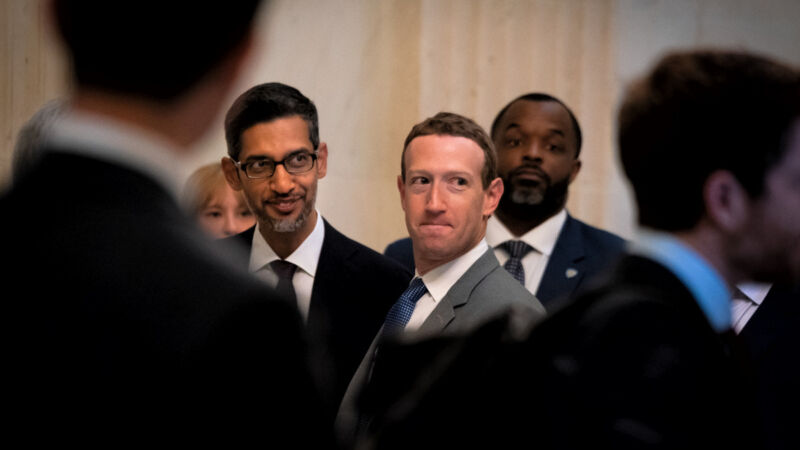
WASHINGTON, DC - SEPTEMBER 13: Google CEO Sundar Pichai and Meta CEO Mark Zuckerberg arrive to the Senate bipartisan Artificial Intelligence (AI) Insight Forum on Capitol Hill in Washington, DC, on September 13, 2023. (Photo by Elizabeth Frantz for The Washington Post)
Enlarge / Google CEO Sundar Pichai and Meta CEO Mark Zuckerberg arrive to the Senate bipartisan Artificial Intelligence (AI) Insight Forum on Capitol Hill in Washington, DC, on September 13, 2023.
Getty Images

On Wednesday, US Senator Chuck Schumer (D-N.Y.) hosted an “AI Insight Forum” in the Senate’s office building about potential AI regulation. Attendees included billionaires and modern-day industry titans such as Elon Musk, Bill Gates, Mark Zuckerberg, OpenAI’s Sam Altman, and Jensen Huang of Nvidia. But this heavily corporate guest list—with 14 out of 22 being CEOs—had some scratching their heads.

“This is the room you pull together when your staffers want pictures with tech industry AI celebrities. It’s not the room you’d assemble when you want to better understand what AI is, how (and for whom) it functions, and what to do about it,” wrote Signal President Meredith Whittaker on X.

The CEO-heavy list had others questioning the technical AI acumen of the attendees. “I hope that Schumer and others pivot to hear counterpoints from the many technical people who are good at explaining tech,” said Dr. Margaret Mitchell of AI platform Hugging Face, whose CEO attended the meeting. “These CEOs are largely not. And they are very much incentivized to obscure critical details, to the extent they themselves understand them.”

Mitchell also raised concerns about the lack of technically skilled women in the meeting. Overall, seven of the 22 invitees were women, but not all of them hold technical roles in AI, including representatives from the AFL-CIO and the Writers Guild. “Women are technical, but you wouldn’t know that from Schumer’s invitees—and this is a massive problem if we want to create AI regulation that helps AI work for everyone,” Mitchell said.

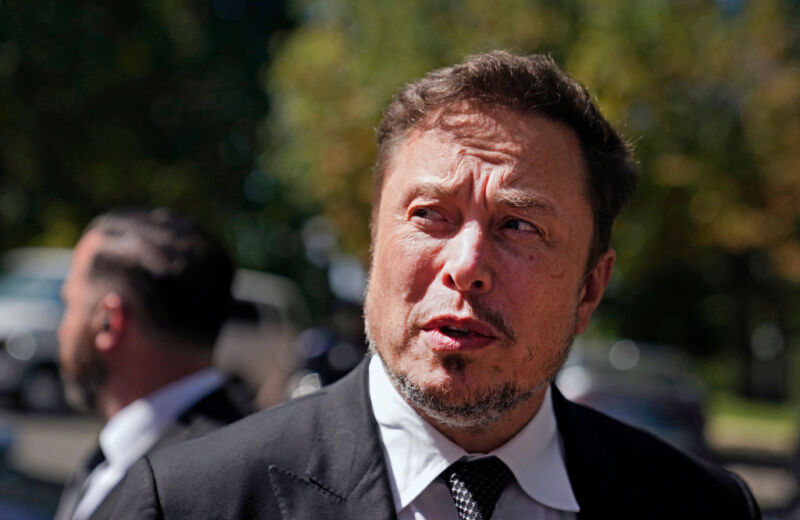
Elon Musk, CEO of Tesla and X, speaks to reporters as he leaves the “AI Insight Forum” at the Russell Senate Office Building on Capitol Hill on September 13, 2023, in Washington, DC.
Enlarge / Elon Musk, CEO of Tesla and X, speaks to reporters as he leaves the “AI Insight Forum” at the Russell Senate Office Building on Capitol Hill on September 13, 2023, in Washington, DC.
Getty Images

Some Senators criticized the nature of the meeting as well. “I think it’s ridiculous that all these monopolists are all here to tell senators how to shape the regulatory framework so they can make the maximum amount of money,” said Senator Josh Hawley (R-Mo.).

Despite the controversy, the meeting drew bipartisan interest, with more than 60 senators participating. Democratic Senate Majority Leader Schumer and Senator Todd Young (R-Ind.) expressed optimism about the Senate’s readiness to consider legislative proposals. However, Senator Mike Rounds (R-S.D.) pointed out that the process of drafting appropriate legislation would take time. “Are we ready to go out and write legislation? Absolutely not,” Reuters quoted Rounds as saying. “We’re not there.”

While the meeting was closed to media and the public, Reuters and The New York Times reported on some of the discussion, conducted in private so that no one would “play to the press,” Schumer said.

According to Reuters, Musk argued for the necessity of a “referee” in the AI space. He described the regulation of AI as akin to a sports game, where rules ensure fair play and protect the participants. “It’s important for us to have a referee to ensure that companies take actions that are safe and in the interest of the general public,” Musk said.

The multi-billionaire, who manages various tech ventures, including the social media platform X, framed the meeting as a “service to humanity,” suggesting its ramifications “may go down in history as very important to the future of civilization.” Musk’s comments echo his previous calls for a six-month pause on the development of AI systems more powerful than OpenAI’s GPT-4, which some critics say overlooked current harm from AI in favor of unproven, hypothetical dangers.

On the other hand, Meta’s Zuckerberg reportedly pushed for a collaborative approach between the government and tech companies. He urged Congress to “engage with AI to support innovation and safeguards,” highlighting the strategic advantage of having American companies set global standards.

Due to the rapid rise of generative AI in the public eye over the past year—especially related to the success of AI assistant ChatGPT and warnings about potential dangers of hypothetical super-intelligent machines—artificial intelligence tools have fallen squarely into the crosshairs of potential US government regulation, with heavy interest recently from Schumer and others in Congress. Last week, US Senators Richard Blumenthal (D-Conn.) and Hawley proposed a bipartisan legislative framework that would require companies working on “high-risk” AI applications, such as GPT-4, to obtain a government license.

The call for AI regulation has become increasingly global, with countries worldwide grappling to set rules about facial recognition, deepfakes, training data sets, and more. This week, companies Adobe, IBM, and Nvidia announced they had joined President Joe Biden’s voluntary AI commitments, which mandate measures like watermarking AI-generated content to flag its artificial origins.

With so much hype out there—and so many dollars flying around—industry experts like Mitchell are worried that the technical details may get lost in the conversation. “The right thing to do would have been to communicate first with people who are technically skilled and who can speak to people’s rights,” said Mitchell. “They would have set the foundation of Schumer’s understanding. Instead the foundation of his understanding is now aligned to short-term profit maximization.”

https://arstechnica.com/?p=1968348


Biden called Arizona fab a “game-changer.” Analyst calls it a “paperweight”

The Taiwan Semiconductor Manufacturing Co. facility under construction in Phoenix, Arizona, US, on Tuesday, Dec. 6, 2022.
Enlarge / The Taiwan Semiconductor Manufacturing Co. facility under construction in Phoenix, Arizona, US, on Tuesday, Dec. 6, 2022.

A new report has revealed that America may be quickly approaching a major roadblock in its bid to become a global chips leader by the end of the decade. Employees of the Taiwan Semiconductor Manufacturing Company (TSMC)—which is leagues ahead of competitors in mass production of advanced chips— told The Information that TSMC has no plans to build a packaging facility in the US.

This likely means that thousands of chips that will eventually be manufactured at a $40 billion fab in Arizona—which is scheduled to be operational in 2025—will ultimately still have to be shipped to Taiwan for packaging. That’s a problem, since President Joe Biden introduced the CHIPS and Science Act to reduce US reliance on Taiwan facilities amid China’s ongoing threats to invade and possibly take over Taiwan. It would almost seem to defeat the point of building fabs in the US if the US-made chips still ultimately need to be packaged and shipped back from overseas.

TSMC’s Arizona fab is a critical part of Biden’s plan to design and produce “leading-edge logic chips” that power computers, smartphones, servers, and supercomputers, according to a 2023 report from the National Institute of Standards and Technology (NIST). Construction on the fab has already been delayed, due to what TSMC called a lack of skilled US workers.

These chips “are increasingly foundational” to US infrastructure and military modernization efforts, NIST said, and they “will be essential to the technologies of the future, from artificial intelligence to biotechnology to clean energy.” But to safeguard national security and forge ahead as a leading chips supplier, the US needs to be able to not just manufacture, but also package all those mass-produced chips domestically, and the US knows it can’t afford to ignore its packaging problem.

“Today, none of the most advanced logic and memory chips—the chips that power PCs, smartphones, and supercomputers—are manufactured at commercial scale in the United States,” NIST reported. The US having limited packaging capability is “a strategic vulnerability,” NIST said, reporting that “bolstering frontend fabrication capacity without investing in packaging will limit supply-chain resiliency.”

But both government and tech leaders seem to be avoiding talking about America’s packaging problem. Last December, when Apple announced that it would become the Arizona fab’s biggest customer, Biden said that Apple shifting from buying its advanced chips overseas would be a “game-changer,” CNBC reported. Apple CEO Tim Cook said that Apple was “proud” to “nurture” the growth of America’s domestic chip supplies.

“These chips can be proudly stamped Made in America,” Cook said in 2022.

But a chief analyst for a semiconductor research firm called SemiAnalysis, Dylan Patel, told The Information that the “TSMC Arizona fab is effectively a paperweight,” unable to boost America’s advanced chips supplies without first sending a ton of chips “back to Taiwan.”

A bipartisan nonprofit policy research organization, the Center for Strategic and International Studies (CSIS), reported that in 2021, “US semiconductor firms offshore nearly all packaging processes,” with only 46 facilities located in the US that specialize in outsourced testing and assembly operations. Most of the facilities where packaging processes are outsourced are in Asia, CSIS said—with 107 in Taiwan and 111 in China—which is where at least 81 percent of global chips are assembled, packaged, and tested.

According to The Information, Apple hasn’t specified how many chips it plans to purchase from the Arizona fab. The company could be planning to buy less advanced chips that could be packaged outside of Taiwan for its iPads and MacBooks. But Apple’s greater investment would still be in more advanced chips that are used for the iPhone, the Apple Watch, and advanced Mac desktops, and those would still likely have to come from Taiwan.

Former Apple and TSMC employees told The Information that “Apple pays a lot to use TSMC’s advanced packaging and Apple is the only customer using TSMC’s method at high volumes.” Because Apple means so much to TSMC, Apple also “gets a significant discount on TSMC’s packaging,” The Information reported.

TSMC employees told The Information that TSMC building a packaging facility in the US is unlikely because it would cost too much. That’s why TSMC “always develops its newest manufacturing and packaging processes close to home, where costs are lower and talent is easier to find,” The Information reported.

Analysts told The Information that the Arizona fab also won’t produce enough chips to entice TSMC to build a packaging facility in the US. When the fab is finally fully operational, it will produce 600,000 wafers per year to meet the US chip demand, CNBC reported, and that’s a relatively small amount compared to the 15 million total wafers TSMC produced in 2022.

https://arstechnica.com/?p=1968149


Judge in US v. Google trial didn’t know if Firefox is a browser or search engine

Judge in US v. Google trial didn’t know if Firefox is a browser or search engine

Today, US District Judge Amit Mehta heard opening statements in the Department of Justice’s antitrust case challenging Google’s search dominance.

Mehta alone will decide if Google maintained its role as the world’s search leader by competing on its own merits—as Google has claimed—or through anticompetitive conduct—which the DOJ has alleged.

The DOJ’s head of antitrust, Jonathan Kanter, kicked off the proceedings. He told Mehta that the DOJ plans to establish that since 2007, Google has illegally maintained monopoly power in search and advertising markets by focusing on “weaponizing” the “power” of being the default search engine on mobile devices.

To prove this, the DOJ plans to bring in Hal Varian, who served as Google’s chief economist at that time. Another key witness will be the co-founder of now-defunct search engine Neeva, Sridhar Ramaswamy, who will testify to barriers to entry that Google still poses today for new search providers. Kanter said that most of the DOJ’s witnesses will be former and current Google employees and others with a financial interest in Google’s conduct.

Much of the opening statements was a rehash of pre-trial briefs that the DOJ and Google filed last week. Ars has summarized those arguments more in-depth here. The gist of the DOJ’s position is that Google regularly blocked search competitors and prevented innovations that could have made searching the web “faster, easier, and better for consumers. “

Mehta asked Kanter to clarify a few points so he could understand how long Google has been illegally maintaining monopoly power (more than a decade, the DOJ said) and how much of Google’s search traffic comes from being set as the default (50 percent).

William Cavanaugh, a lawyer representing the state of Colorado, also appeared to raise one unique claim still being weighed in this case regarding Google’s search engine marketing (SEM) tool SA 360. According to Cavanaugh, Google had a “duty to deal” with Microsoft and integrate Bing ads into SA 360, but after choosing to work with Microsoft, Google delayed implementing Bing ads—simply motivated as an alleged monopolist to diminish a competitor.

It’s unclear if Cavanaugh’s arguments were persuasive or if Google’s lawyer, John Schmidtlein, was more successful in convincing Mehta that Google had no contract with Microsoft and thus no “duty to deal.”

For Mehta, wading through these arguments requires a decent knowledge of tech history. During the more than 10-year time period that the case covers, browsers, phones, and search engines all evolved rapidly. So, on top of weighing complicated antitrust questions, Mehta might also struggle to keep track of basic facts like how search was conducted at any given point in the case’s timeline. While Cavanaugh delivered his opening statement, Mehta even appeared briefly confused by some of the references to today’s tech, unable to keep straight if Mozilla was a browser or a search engine. He also appeared unclear about how SEM works and struggled to understand the options for Microsoft to promote Bing ads outside of Google’s SEM tools.

https://arstechnica.com/?p=1967759


Order limiting Biden admin contacts with social networks is mostly overturned

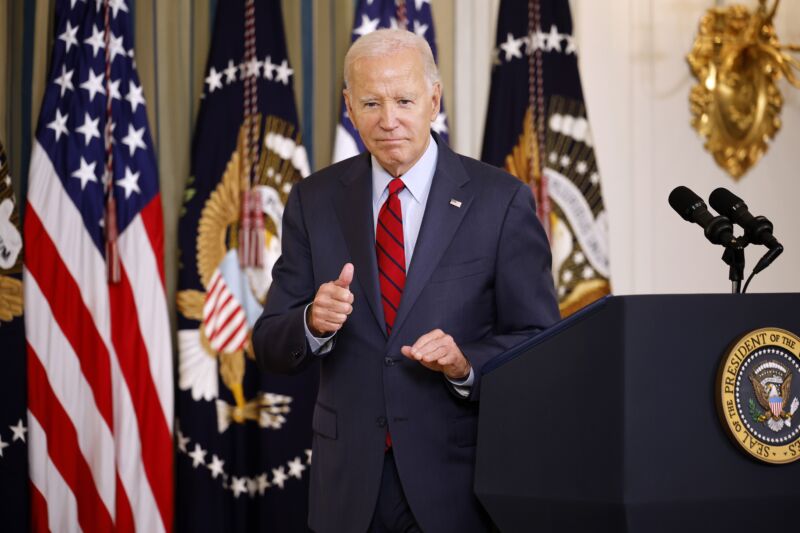
President Joe Biden gives a thumbs-up after delivering remarks to an audience.
Enlarge / President Joe Biden at the White House on September 6, 2023.
Getty Images | Chip Somodevilla

The White House and FBI likely violated the First Amendment by coercing social media platforms into moderating content and changing their moderation policies, the US Court of Appeals for the 5th Circuit ruled Friday. The Centers for Disease Control and Prevention also acted improperly but did not “coerce” social networks, the ruling said.

However, the appeals court threw out the majority of a controversial preliminary injunction that ordered the Biden administration to halt a wide range of communications with social media companies. The injunction issued by a US District Court judge in July was far too broad and vague and applied to too many government officials, a three-judge appeals court panel unanimously decided.

The ruling on Friday involves a case in which the states of Missouri and Louisiana and other plaintiffs sued President Biden and his administration.

“The Plaintiffs—three doctors, a news website, a healthcare activist, and two states—had posts and stories removed or downgraded by the platforms,” the appeals court wrote in a summary of the case. “Their content touched on a host of divisive topics like the COVID-19 lab-leak theory, pandemic lockdowns, vaccine side-effects, election fraud, and the Hunter Biden laptop story. The Plaintiffs maintain that although the platforms stifled their speech, the government officials were the ones pulling the strings—they ‘coerced, threatened, and pressured [the] social-media platforms to censor [them]’ through private communications and legal threats.”

The injunction previously issued by Judge Terry Doughty, a Trump nominee at US District Court for the Western District of Louisiana, prohibited Biden administration officials from communications with social media companies that fall under 10 broadly written categories. The injunction was only in place for about a week and a half because the 5th Circuit temporarily blocked the order on July 14 and conducted an expedited review.

Injunction “vague and broader than necessary”

The September 8 order allows a greatly modified version of the injunction to take effect:

The preliminary injunction here is both vague and broader than necessary to remedy the Plaintiffs’ injuries, as shown at this preliminary juncture. As an initial matter, it is axiomatic that an injunction is overbroad if it enjoins a defendant from engaging in legal conduct. Nine of the preliminary injunction’s ten prohibitions risk doing just that. Moreover, many of the provisions are duplicative of each other and thus unnecessary.

Prohibitions one, two, three, four, five, and seven prohibit the officials from engaging in, essentially, any action “for the purpose of urging, encouraging, pressuring, or inducing” content moderation. But “urging, encouraging, pressuring” or even “inducing” action does not violate the Constitution unless and until such conduct crosses the line into coercion or significant encouragement…

The eighth, ninth, and tenth provisions likewise may be unnecessary to ensure Plaintiffs’ relief. A government actor generally does not violate the First Amendment by simply “following up with social-media companies” about content-moderation, “requesting content reports from social-media companies” concerning their content-moderation, or asking social media companies to “Be on The Lookout” for certain posts. Plaintiffs have not carried their burden to show that these activities must be enjoined to afford Plaintiffs full relief.

Under these restrictions, “it is not clear whether the Surgeon General could publicly urge social media companies to ensure that cigarette ads do not target children,” the ruling said.

One prohibition will take effect

One of the 10 prohibitions will take effect, but even that one was modified by the appeals court. The original version barred officials from “threatening, pressuring, or coercing social-media companies in any manner to remove, delete, suppress, or reduce posted content of postings containing protected free speech.”

But as the appeals court noted, “those terms could also capture otherwise legal speech. So, the injunction’s language must be further tailored to exclusively target illegal conduct and provide the officials with additional guidance or instruction on what behavior is prohibited.”

The appeals court’s standard practice is to remand a decision to the lower court to alter the injunction in accordance with the ruling. “But this is far from a standard case. In light of the expedited nature of this appeal, we modify the injunction’s remaining provision ourselves,” the Friday ruling said.

The ruling modified the prohibition to state the following:

Defendants, and their employees and agents, shall take no actions, formal or informal, directly or indirectly, to coerce or significantly encourage social-media companies to remove, delete, suppress, or reduce, including through altering their algorithms, posted social-media content containing protected free speech. That includes, but is not limited to, compelling the platforms to act, such as by intimating that some form of punishment will follow a failure to comply with any request, or supervising, directing, or otherwise meaningfully controlling the social-media companies’ decision-making processes.

“Under the modified injunction, the enjoined Defendants cannot coerce or significantly encourage a platform’s content-moderation decisions,” the court wrote. “Such conduct includes threats of adverse consequences—even if those threats are not verbalized and never materialize—so long as a reasonable person would construe a government’s message as alluding to some form of punishment.”

https://arstechnica.com/?p=1967034


X sues Calif. to avoid revealing how it makes “controversial” content decisions

X sues Calif. to avoid revealing how it makes “controversial” content decisions

Today, Elon Musk’s X Corp. sued to block California’s content moderation law, AB 587. In its complaint, filed a US district court in California, X Corp. is seeking a preliminary and permanent injunction stopping California Attorney General Robert Bonta from enforcing the law.

AB 587 passed in September 2022, requiring social media platforms to submit a “terms of service report” semi-annually to California’s attorney general, providing “a detailed description of content moderation practices used” and “information about whether, and if so how, the social media company defines and moderates” hate speech or racism, extremism or radicalization, disinformation or misinformation, harassment, and foreign political interference. Under the law, social media platforms must also provide information and statistics on any content moderation actions taken in those categories.

In X’s complaint, the company accused California of trying to dictate X’s terms of service and compel “controversial disclosures about how X Corp. moderates content on its platform.”

The law stipulated that all platforms were required to start collecting data for their first terms of service report covering content moderation during the third quarter of 2023 and submit those reports to Bonta by January 1, 2024.

Platforms could be found violating the law for failing to post terms of service about content moderation, missing a deadline to submit a terms of service report, or materially omitting or misrepresenting information about content moderation. Any platform violating the law risks fines—which X described as “draconian financial penalties”—up to $15,000 per violation per day.

In its complaint, X Corp. argued that AB 587 violates the First Amendment by compelling “companies like X Corp. to engage in speech against their will” and “impermissibly” interfering “with the constitutionally protected editorial judgments of companies.” X Corp. said that if the court did not block the law, California could pressure companies “to remove, demonetize, or deprioritize constitutionally protected speech that the state deems undesirable or harmful.”

“The State of California touts AB 587 as a mere ‘transparency measure’ under which certain social media companies must make their content moderation policies and statistics publicly available,” X’s complaint said. But, X alleged, the state’s “true intent” is “to pressure social media platforms to ‘eliminate’ certain constitutionally protected content viewed by the state as problematic.”

X Corp. alleged that AB 587 violates other laws, including the Dormant Commerce Clause—”failing to restrict its extensive reporting requirements to information about Californians”—and Section 230 of the Communications Decency Act—which grants platforms immunity from liability for “any action voluntarily taken in good faith to restrict access to or availability of material that the provider or user considers to be obscene, lewd, lascivious, filthy, excessively violent, harassing, or otherwise objectionable, whether or not such material is constitutionally protected.”

“Because AB 587 imposes liability on such actions if they are taken without the required disclosures, AB 587 is preempted by the broad immunity afforded by Section 230,” X’s complaint said.

Ars could not immediately reach X for comment. Bonta’s office said: “While we have not yet been served with the complaint, we will review it and respond in court.”

The author of AB 587, California assemblymember Jesse Gabriel, released a statement saying that the law “is a pure transparency measure that simply requires companies to be upfront about if and how they are moderating content. It in no way requires any specific content moderation policies—which is why it passed with strong, bipartisan support. If Twitter has nothing to hide, then they should have no objection to this bill.”

But tech groups and policy experts echoed X’s concerns over AB 587.

Adam Kovacevich, the CEO of the tech industry policy coalition Chamber of Progress, said that “requiring companies to give their content moderation playbook to scammers and conspiracists is a bad idea.”

“Even if you don’t like anything about Elon Musk’s leadership of X, it’s clear that requiring tech platforms to publish a detailed blueprint of how to work around content moderators will have negative consequences for users online,” Kovacevich said. “Letting platforms set their own editorial standards also leaves consumers with more choices about what kind of platforms they spend time on.”

Netchoice, a group representing tech companies and trade associations, has called AB 587 “the Golden State’s new online censorship law.” In a statement about X Corp.’s lawsuit, Netchoice said that the law would force companies to submit “intrusive” and “often impossible to comply with” disclosures “about constitutionally protected editorial decisions.” Netchoice’s director of litigation, Chris Marchese, said that the court should enjoin AB 587 to protect free speech online.

“The First Amendment prohibits the government from regulating lawful speech—directly or indirectly,” Marchese said. “States cannot avoid this prohibition by rebranding censorship as ‘transparency’ requirements.”

https://arstechnica.com/?p=1966853


FTC judge rules Intuit broke law, must stop advertising TurboTax as “free”

A United States tax filing form. A pen and a calculator sit on top of the form.
Getty Images | Sasirin Pamai

The Federal Trade Commission’s chief administrative law judge ruled that Intuit violated US law with deceptive advertising and should be forced to stop promoting TurboTax as “free” unless all conditions imposed on the free offer are immediately and conspicuously displayed to consumers.

The initial decision by Administrative Law Judge D. Michael Chappell was released today and is subject to an automatic review by the full commission. The FTC commissioners will likely rule against Intuit, which issued a statement indicating that it will take the matter to federal court. The order would be in effect for 20 years if it survives appeal.

The response from Intuit noted that the administrative law judge is “an employee of the FTC” and “ruled in favor of the FTC in the agency’s own lawsuit.” The FTC filed an administrative complaint against Intuit in March 2022.

“Intuit will appeal this groundless and seemingly predetermined decision by the FTC to rule in its own favor and is confident that when the matter ultimately returns to a neutral body Intuit will prevail, as it has previously in this matter,” the company said.

Intuit also said it “already adheres to most of the advertising practices in the FTC’s erroneous decision. There is no monetary penalty, and Intuit expects no significant impact to its business.”

Clearly and conspicuously

According to Chappell’s 242-page ruling, “the evidence proves that Intuit engaged in deceptive advertising in violation of Section 5 of the FTC Act.” Intuit “advertised to consumers that they could file their taxes online for free using TurboTax, when in truth, for approximately two-thirds of taxpayers, the advertised claim was false,” he wrote.

The order said Intuit “must not represent that a good or service is ‘Free'” unless it actually offers the good or service for free to all consumers, or “All the terms, conditions, and obligations upon which receipt and retention of the ‘Free’ good or service are contingent are set forth clearly and conspicuously at the outset of the offer so as to leave no reasonable probability that the terms of the offer might be misunderstood.”

Moreover, if an Intuit good or service is not free for most US taxpayers, that fact must be “disclosed clearly and conspicuously at the outset of any disclosures required” by the order. The order defines “clearly and conspicuously” in some detail.

“In any communication that is solely visual or solely audible, the disclosure must be made through the same means through which the communication is presented,” it says. “In any communication made through both visual and audible means, such as a television advertisement, the disclosure must be presented simultaneously in both the visual and audible portions of the communication even if the representation requiring the disclosure is made in only one means.”

The order then provides more specifics on how disclosures must be conveyed in various formats. For example, visual disclosures “must stand out from any accompanying text or other visual elements so that it is easily noticed, read, and understood,” and audible disclosures “must be delivered in a volume, speed, and cadence sufficient for ordinary consumers to easily hear and understand it.”

Similarly strict requirements apply to online advertisements, product labels, and face-to-face communications. The disclosures also “must not be contradicted or mitigated by, or inconsistent with, anything else in the communication.”

Court denied FTC injunction request

At the same time it filed the administrative complaint last year, the FTC also sued Intuit in US District Court for the Northern District of California. In the federal court, a judge denied the FTC’s motion for a preliminary injunction in an April 2022 order that said the issue could remain on hold while the FTC’s administrative process unfolds.

The ruling said that “Intuit had removed several of the most plausibly deceptive advertisements—that is, three videos that repeated the word ‘free’ a dozen or more times over 30 seconds before a very brief disclaimer.”

“However, if Intuit resumes its full advertising campaign… or the facts on the ground change significantly, the FTC may return to this Court to request relief,” US District Judge Charles Breyer wrote.

In a separate case involving all 50 US states and the District of Columbia, Intuit, in May 2022, agreed to pay $141 million in restitution to nearly 4.4 million consumers who “started using TurboTax’s Free Edition for tax years 2016 through 2018 and were told that they had to pay to file even though they were eligible to file for free using the IRS Free File program offered through TurboTax,” New York Attorney General Letitia James’ office said at the time. Under that settlement, Intuit was required to stop its “free, free, free” ad campaign.

In its response to the administrative law judge’s decision, Intuit said it expected the ruling because of the FTC’s “flawed and highly questionable process, Chair Lina Khan’s previous public and prejudicial statements against Intuit, and the fact that the FTC has ruled in its own favor in nearly every consumer protection case for the last two decades.”

“We believe the FTC’s decision is improper, wholly ignores the facts, and tramples on the foundations of an independent American judicial system with its serving as prosecutor, judge, and jury on its own matters,” Intuit said.

https://arstechnica.com/?p=1966820