FBI finally tracks “swatting” incidents as attacks increase nationwide

FBI finally tracks “swatting” incidents as attacks increase nationwide

Last month, the FBI created a national online database to finally start coordinating law enforcement reports about “swatting” attacks nationwide, NBC News reported yesterday.

Swatting is a form of domestic terrorism that is sometimes deadly and has become more widespread in the US, according to a March report from Hal Berghel, a computer science professor at University of Nevada, Las Vegas. Berghel’s report defined swatting as:

A malicious act that involves making fraudulent 911 calls to cause emergency response teams, such as law enforcement special weapons and tactics teams, or SWAT teams (that’s where the gerund’s root comes from), to react forcefully to a nonexistent public threat.

Scott Schubert, of the FBI’s Criminal Justice Information Services, told NBC News that the database will help combat the growing swatting problem by facilitating “information sharing between hundreds of police departments and law enforcement agencies across the country pertaining to swatting incidents.”

On college campuses, swatting is notably increasing. Nine campuses across the US were targeted by swatting attacks in a single week in April, NBC News reported.

Swatting has become so common, Berghel wrote, that several subclasses have already been defined, including celebrity swatting, gamer swatting, partisan swatting (directed against politicians), and hate swatting. The FBI’s database will help to unify law enforcement efforts to combat the problem nationwide, Schubert told NBC News, by piecing together a “common operating picture of what’s going on across the country.”

Berghel wrote that “by everyone’s estimate,” swatting is on the rise, but until now, law enforcement has not officially tracked swatting incidents, because law enforcement does not track swatting as a separate category of crime and there is no federal swatting law. Instead, swatting statistics get absorbed as cases are prosecuted “under other statutes dealing with fraud, civil rights, hate crimes, the national defense, and so on,” Berghel wrote.

While there are no official statistics on swatting now, a former FBI swatting expert told the Economist in 2019 that he estimated that “annual swatting incidents have climbed from roughly 400 in 2011 to more than 1,000” in 2019. More recently, a 2023 survey from a non-governmental organization dedicated to civil rights, the Anti-Defamation League (ADL), found that while swatting may not be as common as other forms of online harassment—like being the target of hate speech or doxxing—teens (11 percent) report experiencing swatting more often than adults (2 percent).

Ars could not immediately reach the FBI to confirm whether the online database will be used to generate official statistics moving forward.

“We’re taking every step to monitor this national problem and help however we can,” Schubert told NBC News.

Will the FBI database help stop swatting?

Experts aren’t sure whether the FBI’s online database will actually help reverse the troubling swatting trend.

ADL’s director of policy and impact, Lauren Krapf, told Ars that “it’s good” to see the FBI take swatting “seriously,” because ADL’s most recent report showed that “people are experiencing serious online harassment and digital abuse at alarming—and increasing—rates.” However, ADL has “pushed for increased protections for targets of swatting” for years and advocates for legislation that could meaningfully reduce swatting.

Berghel told Ars that he wasn’t necessarily confident that the FBI’s database would help address the problem of swatting, either.

“My initial reaction to the proposed FBI database plan is that I would feel more confident if this matter were given to the FBI profilers than data engineers, law enforcement investigators, and ultimately, politicians,” Berghel said.

Berghel told Ars that it’s common for “big government’s solutions to computing crimes” to be “reactive and retributive—rather than solving problems at the source.” This, Berghel said, often leads to ineffective or counterproductive laws crafted by politicians who react to a problem like swatting before fully understanding it.

To disincentivize people from launching swatting attacks, Berghel said that mental health professionals are needed more than laws threatening heavy fines or prison time.

“When it comes to 911 swatting, the most important questions of our age is, ‘Why are 911 swatters engaging in this behavior?’ and ‘How can society deal with it?’” Berghel told Ars.

To help answer these questions, the “greatest benefit” from creating the FBI database could be granting access not just to lawmakers and law enforcement but also mental health professionals, Berghel suggested.

https://arstechnica.com/?p=1951389


Reddit API changes are imminent. Here’s what’s happening to your favorite apps

Apollo for Reddit on AppStore displayed on a phone screen and Reddit logo on the website displayed on a screen

It’s been a contentious journey, but Reddit’s new API pricing will take effect on July 1. What started as a fight over creating an affordable option for valued third-party Reddit apps has evolved into a bitter battle pitting Reddit against indignant developers, mods, and users. Protests remain, but some users are now preparing to exit the platform, including some of Reddit’s most seasoned moderators.

Where does that leave third-party developers, some of which said they would have to pay Reddit $20 million annually to continue? Ars Technica spoke with developers to learn where their apps stand, how some will manage to stay afloat, and what Reddit’s changes mean for the future.

Surviving apps

When Reddit announced that, starting on July 1, it would no longer permit free API access except for certain non-commercial apps, many Reddit app developers responded by telling users that they were unsure if they could keep the apps running. Now that the new API pricing ($12,000 per 50 million API requests) is set to be reality, here’s a look at the most popular apps that will still be available.

Narwhal for Reddit

A new version of the Narwhal for Reddit app, Narwhal 2, will be available as a subscription. Pricing isn’t confirmed yet, but developer Ricker Harrison told Ars he hopes the updated app will be ready to ship within the next one to two months, after he gets more data on API usage. He’s considering a base subscription fee with a certain number of API calls, allowing users to buy more if needed.

I asked Harrison if he can afford to keep the original Narwhal available ahead of Narwhal 2’s release, but the dev said he couldn’t say currently “due to an NDA.”

“I’m just trying to be open-minded about it right now,” he said of the current situation. “Instead of just shutting down completely, I at least want to give it a shot… Even if I’m the only person who uses Narwhal 2, then I’d still rather it exists.”

The dev said that Narwhal has made a “very small amount of money over time” with ads. Reddit’s new rules don’t allow third-party apps with ads.

Infinity for Reddit

Infinity for Reddit plans to be available sometime after July 1 as a subscription.

“I need to change the API key, since Infinity is open source and the key is visible on the repo,” developer Alex Ning told Ars. “If I cannot afford it before I finish the update, I will just change the key, and that means Infinity will not be usable until the update is available.”

The price hasn’t been finalized, but $3 a month is under consideration. Ning said he’s “not trying to make money” off the app, which doesn’t have ads.

Contrary to some of the discussions that devs claimed they had with Reddit, Reddit was accommodating in discussions with Infinity over “several calls,” where the company provided API usage insights, according to Ning.

https://arstechnica.com/?p=1951212


Google tells Canada it won’t pay “link tax,” will pull news links from search

The Google logo on a large sign at a tech fair.
Enlarge / A Google sign at the Viva Tech fair in Paris on June 15, 2023.
Getty Images | Bloomberg

In response to a new Canadian law requiring payments to news organizations, Google said it will remove links to Canadian news sources from Google Search and Google News for users who access the services in Canada. Google’s announcement yesterday followed a similar announcement by Meta that it will end news access on Facebook and Instagram.

The new law’s “duty to bargain” requires large search engines and social media services to negotiate payments with news businesses or groups of news businesses. The law requires mediation and then arbitration if negotiations don’t result in a deal. The law is expected to take effect in six months.

“We have now informed the Government that when the law takes effect, we unfortunately will have to remove links to Canadian news from our Search, News and Discover products in Canada, and that [bill] C-18 will also make it untenable for us to continue offering our Google News Showcase product in Canada,” Google President of Global Affairs Kent Walker wrote yesterday.

Google complained that Canada’s Online News Act “requir[es] two companies to pay for simply showing links to news, something that everyone else does for free. The unprecedented decision to put a price on links (a so-called ‘link tax’) creates uncertainty for our products and exposes us to uncapped financial liability simply for facilitating Canadians’ access to news from Canadian publishers. We have been saying for over a year that this is the wrong approach to supporting journalism in Canada and may result in significant changes to our products.”

Canada official blasts Big Tech

With the law now approved, the Department of Canadian Heritage is tasked with drafting regulations to implement it. In a tweet, Heritage Minister Pablo Rodriguez criticized Google’s announcement that it would pull news links in Canada.

“Big tech would rather spend money changing their platforms to block news from Canadians instead of paying a small share of the billions they make in advertising dollars. Canadians won’t be bullied. Big tech isn’t bigger than Canada,” Rodriguez wrote. “The Online News Act is simple. Tech giants should compensate news organizations fairly for their work,” Rodriguez also wrote.

Google took a similar position against an Australian “link tax” law in January 2021. But Google agreed to pay for news in Australia just weeks later. An Australian government report in December 2022 said the law “has been a success to date,” resulting in “over 30 commercial agreements between digital platforms (Google and Meta) and a cross section of Australian news businesses.”

Google also agreed to pay French news sites.

Similar US bill is controversial

In the US, Senators Amy Klobuchar (D-Minn.) and John Kennedy (R-La.) in March reintroduced their Journalism Competition and Preservation Act (JCPA), which would provide an antitrust exemption “for publishers of online content to collectively negotiate with dominant online platforms regarding the terms on which content may be distributed.” The bill was advanced to the full Senate by the Senate Judiciary Committee in a 14-7 vote on June 15.

“We’ve seen a massive decline in local news over the past few decades driven, in part, by large online gatekeepers like Google and Facebook siphoning away more and more of the advertising revenue that news organizations have traditionally relied upon to fund their work,” Senate Judiciary Committee Chair Dick Durbin (D-Ill.) said. “The JCPA… will help reverse this trend by allowing news publishers… to band together and enter into structured negotiations with the biggest online platforms over access to news content.”

The proposed US law was opposed by the tech industry and about two dozen advocacy groups, which wrote in a letter that the “bill forces platforms to carry and pay for the content of any digital journalism provider that becomes part of a joint negotiation entity, regardless of how extreme their content.”

The letter criticized a proposed arbitration process, noting that publishers and Facebook and Google have provided dramatically different estimates of the value of news to the online platforms. “The values are simply irreconcilable: by definition, the arbitrators will be choosing from wildly inflated or deflated offers. The bill is also artificially one-sided—it precludes consideration of any benefit provided to any negotiating publisher or broadcaster for being listed in search or gaining reach on a platform. And any negotiation structured so that one party cannot walk away from the table is inherently not ‘fair’ or ‘level,'” the letter said.

California considers “journalism usage fee”

There’s also a California Journalism Preservation Act (CJPA) that would require “journalism usage fee payments” from online platforms to news providers. Santa Clara University law professor Eric Goldman called the proposal unconstitutional and wrote a letter to state senators urging them to reject it.

In addition to arguing that the proposed state law would violate the First Amendment, Goldman said it is “unlikely to create or sustain any journalism at all” and “will simply enrich the journalism operators’ stockholders, even if they don’t spend any payments on journalism at all.”

“The ‘arbitrations’ will likely set royalties that are greater than the profits of the associated content, which encourages online services to categorically remove that content,” Goldman wrote. “If so, CJPA counterproductively would make journalism more obscure and further impoverish journalism operations by reducing their referral traffic.”

https://arstechnica.com/?p=1951352


YouTube scammer who stole millions in song royalties sentenced to 5 years

YouTube scammer who stole millions in song royalties sentenced to 5 years

A YouTube scammer conspiring to run what Billboard described as possibly the largest music royalty scam in history, Jose Teran was recently sentenced by the US government to 70 months in prison.

He was hit with a “significant sentence,” US attorney for the District of Arizona, Gary Restaino, wrote in the sentencing memo, because of the “greed and the great lengths” that Teran’s scam went over the course of five years to fraudulently claim rights to 50,000 songs. Ultimately, the scam routed $23 million in royalty proceeds away from mostly Latin artists and into the bank accounts of Teran and his co-conspirators.

Teran, the sentencing memo said, “obtained more than $6 million in personal profits” and continued pocketing $190,000 in stolen royalties—which he hid from officials—even after he was indicted for the fraud. Partly because of this, Teran is considered a “high-risk to re-offend,” Restaino wrote.

A hefty sentence, Restaino said, was necessary not only to deter Teran from launching future scams—as he plans to remain in the music business and could potentially regain access to further manipulate YouTube’s system monitoring royalties. It was also critical to deter people generally from launching similar scams because they might believe that “any potential punishment is worth the payout,” Restaino wrote.

Restaino noted that Teran’s sentence is at the low end of the recommended sentencing guidelines range but that it was appropriate to address the government’s concerns that his sentence “reflects the seriousness of the offense and deters future conduct.”

The US government requested a restitution hearing to determine how much should be repaid to victims. A presentencing report set a restitution amount of $1.4 million, but the government is attempting to connect with victims. Because many of the victims reside outside the US, the government is attempting to broaden its public outreach and translate its notification into Spanish to gather more information.

“A future restitution hearing would afford sufficient time for additional victims involved in this case to come forward,” a footnote in the sentencing memo said.

Ars could not immediately reach YouTube, lawyers for Teran, or attorneys for the US government for comment.

To scammers, song selection was key

Earlier this year, Teran pleaded guilty to conspiracy, wire fraud, and money laundering, finally admitting that he conspired with Webster Batista Fernandez “to steal royalty payments for approximately 50,000 song titles.”

Batista took a plea agreement in April 2022, Billboard reported, revealing “key insights” into how the scam worked, while Teran sought to fight the charges, initially pleading not guilty.

Starting in 2017, Batista and Teran created a record label known as MediaMuv to seize unearned royalties by claiming ownership of songs on YouTube. According to the sentencing memo, they did this by hiring as many as eight employees and searching YouTube “for recorded songs that were not actively monetized.”

Once they knew what songs were vulnerable, MediaMuv manipulated YouTube’s system that pays music rights holders.

YouTube employs a content management system and Content ID tool to help rights holders identify and collect royalties on sound recordings. According to Billboard, many artists and their teams don’t have access to these tools and instead hire third parties to monitor their copyrights and royalty payments. Because of how YouTube’s system works, a cottage industry of rights management groups appeared, motivated to get a piece of all those royalty payments.

Among those rights management groups is AdRev, which MediaMuv partnered with to cultivate “a layered façade” and give their stolen 50,000-song library “a greater veneer of credibility,” Restaino wrote.

https://arstechnica.com/?p=1951098


FTC prepares “the big one,” a major lawsuit targeting Amazon’s core business

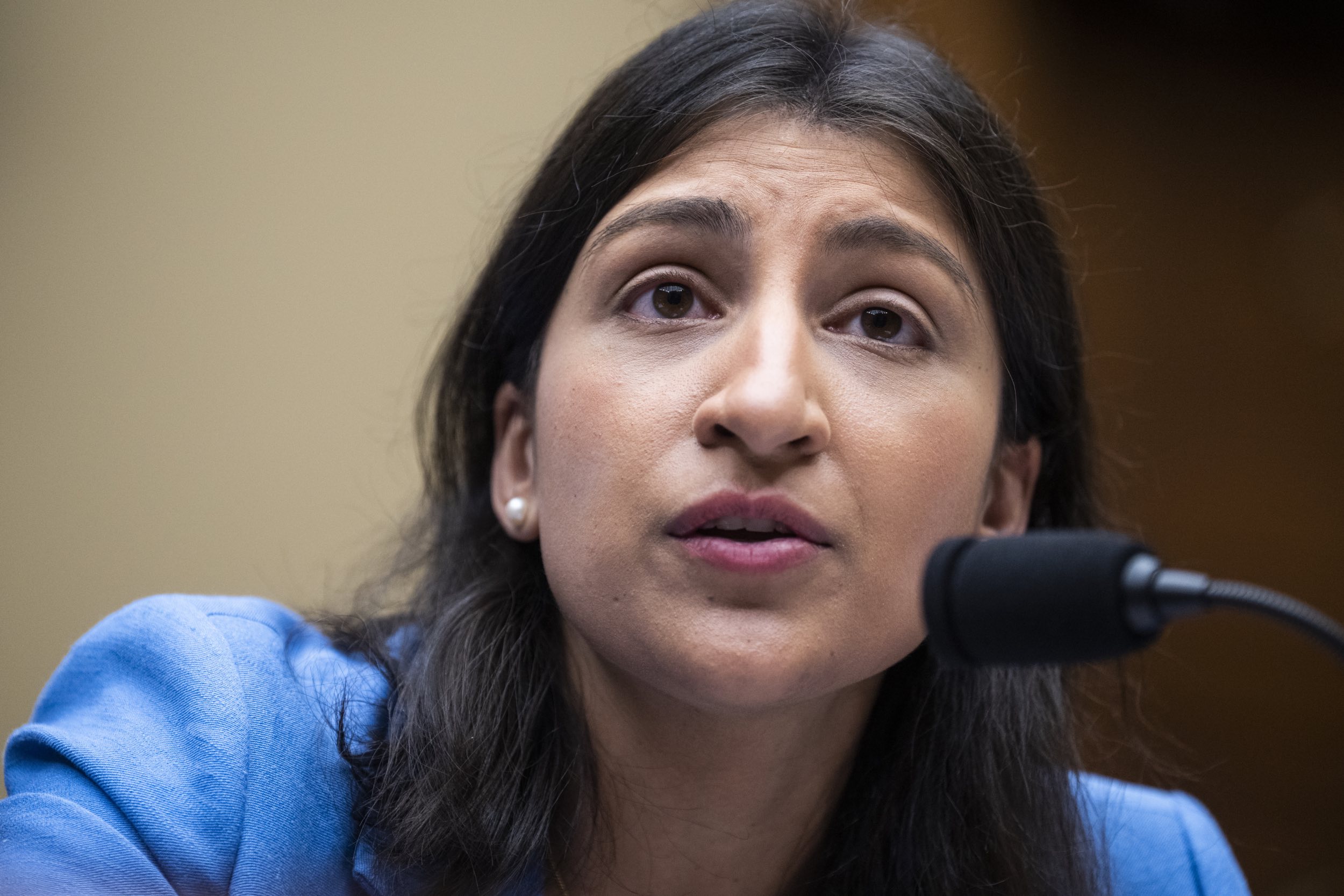
FTC Chair Lina Khan sits at a table and speaks into a microphone during a congressional hearing.
Enlarge / FTC Chair Lina Khan testifies during a House subcommittee hearing on the agency’s fiscal 2024 budget on Tuesday, April 18, 2023.
Getty Images | Tom Williams

The Federal Trade Commission is preparing to file a major antitrust lawsuit accusing Amazon of “leverag[ing] its power to reward online merchants that use its logistics services and punish those who don’t,” Bloomberg reported today. Bloomberg described the forthcoming lawsuit as “the big one,” following several earlier lawsuits filed by the FTC under Chair Lina Khan.

“In the coming weeks, the agency plans to file a far-reaching antitrust suit focused on Amazon’s core online marketplace, according to documents reviewed by Bloomberg and three people familiar with the case,” the report said.

Khan may try to force Amazon to “restructure” its business. “Based on her public comments, Khan is unlikely to accept compromises from Amazon and could seek to restructure the company—a dramatic outcome that Amazon would surely appeal,” Bloomberg wrote.

Amazon declined to comment when contacted by Ars today.

FTC filed three other lawsuits against Amazon

Khan was known as a critic of Amazon before becoming FTC chair in 2021. In 2017, Khan wrote a Yale Law Journal article titled “Amazon’s Antitrust Paradox,” which argued for a more aggressive approach to antitrust enforcement to counter “Amazon’s dominance.”

The FTC sued Amazon last week, claiming it violated US law by tricking consumers into signing up for the $14.99-per-month Amazon Prime subscription service and making it exceedingly difficult to cancel. In the Prime case, the FTC is seeking a permanent injunction, civil penalties, and other monetary relief.

The FTC also recently filed one privacy lawsuit against Amazon with allegations related to kids’ Alexa voice recordings and another with allegations that Amazon’s Ring division invaded users’ privacy by “allowing thousands of employees and contractors to watch video recordings of customers’ private spaces.” In both cases, Amazon agreed to settlements requiring financial penalties and changes to privacy practices.

As for the upcoming “big one,” Bloomberg wrote that “FTC investigators and Khan’s office have been honing the complaint for several months… and finalizing key details such as where to file suit.” The FTC can file complaints in either federal court or in the FTC’s own administrative process. Suing in a federal court “would avoid drawn-out litigation on whether Khan has a conflict of interest, but could make the case harder to win,” the Bloomberg article said.

In June 2021,  Amazon petitioned the FTC to have Khan recuse herself from antitrust investigations into the company because of her previous public statements criticizing Amazon and later accused Khan’s FTC of “harassing” its top executives. The Meta-owned Facebook also sought Khan’s recusal. She has rejected such requests despite a recommendation from an FTC ethics official to recuse herself from adjudicating the Meta case.

Amazon fulfillment takes big chunk of seller revenue

Third-party sellers can rely on Amazon for warehousing, shipping, and other services through the Fulfillment by Amazon (FBA) system, but it takes a big cut out of their revenue. A recent Marketplace Pulse study based on profit and loss statements from a sample of sellers found that “Amazon is pocketing more than 50 percent of sellers’ revenue—up from 40 percent five years ago,” because “Amazon has increased fulfillment fees and made spending on advertising unavoidable.”

“According to P&Ls provided by a sample of sellers, a typical Amazon seller pays a 15 percent transaction fee (Amazon calls it a referral fee), 20–35 percent in Fulfillment by Amazon fees (including storage and other fees), and up to 15 percent for advertising and promotions on Amazon. The total fees vary depending on the category, product price, size, weight, and the seller’s business model,” Marketplace Pulse wrote in February.

According to Bloomberg’s article, the “FTC has amassed evidence that the company disadvantages sellers that don’t use these services, and the agency is investigating an algorithm that selects merchants for the web store’s coveted ‘Buy Box,’ where consumers can add products to their cart with one click.”

“The expected allegations are similar to a 2020 report from a US House subcommittee—which counted Khan as a staff member—and overlap with a European antitrust case that charged Amazon with rewarding sellers that use its fulfillment services and using merchants’ sales data to boost its own retail business,” Bloomberg wrote. Amazon agreed to a settlement with the EU in December 2022.

The FTC’s current investigation began two years before Khan became chair. “Amazon received the initial investigation notice in June 2019, according to documents viewed by Bloomberg. The first request for records followed two months later,” the Bloomberg article said. Upon taking charge in 2021, Khan “personally helped draft some lines of questioning for investigators” and took other actions to beef up the probe into Amazon.

https://arstechnica.com/?p=1951005


Apple criticizes UK bill that could require scanning of encrypted messages

The Messages app icon displayed on an iPhone screen.
Getty Images | NurPhoto

Apple has joined the growing number of organizations opposed to the UK’s pending Online Safety Bill, saying the proposed law threatens the end-to-end encryption that protects private messages.

“End-to-end encryption is a critical capability that protects the privacy of journalists, human rights activists, and diplomats,” Apple said in a statement reported by the BBC yesterday. “It also helps everyday citizens defend themselves from surveillance, identity theft, fraud, and data breaches. The Online Safety Bill poses a serious threat to this protection, and could put UK citizens at greater risk. Apple urges the government to amend the bill to protect strong end-to-end encryption for the benefit of all.”

The BBC quoted a government spokesperson as saying that “companies should only implement end-to-end encryption if they can simultaneously prevent abhorrent child sexual abuse on their platforms.”

Though the bill isn’t yet finalized, UK regulator Ofcom provided an update this month on how it is preparing for its expanded regulatory role, saying the bill is in “the final stages of the parliamentary process.” The bill, which includes criminal penalties like imprisonment, was approved by the House of Commons in January and is nearing approval in the House of Lords.

The bill is expected to be changed, but it’s not clear whether the changes will eliminate concerns about mandated scanning of encrypted messages. The BBC article on Apple’s opposition to the bill said there is “a growing expectation… that changes may be made to part of the bill which critics say could be used to mandate scanning. These could be included in a package of amendments to be revealed in the coming days. But it is not clear what the detail of those changes might be, or if they will satisfy the concerns of campaigners.”

Signal and WhatsApp oppose weakening security

Signal said it will stop providing services in the UK if it’s forced to weaken the privacy of its encrypted messaging system. The Meta-owned WhatsApp also told the BBC last year that it would refuse to lower the security of its messaging service.

We contacted Apple about its stance on the UK bill today and will update this article if we get any further information.

Apple faced backlash from privacy advocates and security experts in 2021 when it announced a plan to scan iPhones for child sexual abuse images. Apple initially defended the plan but later abandoned it.

According to the privacy-focused Open Rights Group, the proposed law could make the UK “the first liberal democracy to require the routine scanning of people’s private chat messages.” However, the group said the bill could be improved with a small change.

“Removing the word ‘privately’ from the draft legislation could preserve the security and privacy of billions of messaging app users,” the Open Rights Group said, referring to a requirement to identify illegal content in private messages.

Finding child-abuse content in private messages

The UK’s proposed law focuses heavily on terrorism content and child sexual abuse content. The bill text says that Ofcom may issue notices to service providers requiring them to “use accredited technology to identify CSEA [child sexual exploitation and abuse] content, whether communicated publicly or privately by means of the service, and to swiftly take down that content.”

Ofcom would be authorized to issue “information notices” requiring recipients to provide Ofcom with “any information that they require for the purpose of exercising, or deciding whether to exercise, any of their online safety functions.”

A person or technology provider that receives a notice requiring information “commits an offence if, in response to an information notice, the person provides information which is encrypted such that it is not possible for Ofcom to understand it, or produces a document which is encrypted such that it is not possible for Ofcom to understand the information it contains,” the bill says.

The Open Rights Group organized an open letter signed this week by “over 80 national and international civil society organizations, academics, and cyberexperts.” It says the bill would require client-side scanning software that “intercepts chat messages before they are encrypted, and as the user is uploading their images or text.”

The required “scanning software would have to be pre-installed on people’s phones, without their permission or full awareness of the severe privacy and security implications,” the letter said. “The underlying databases can be corrupted by hostile actors, meaning that individual phones would become vulnerable to attack.” The letter further said the bill “would infringe the rights to privacy to the same extent for the Internet’s majority of legitimate law-abiding users as it would for potential criminals.”

https://arstechnica.com/?p=1950676


Cyberstalkers shielded by SCOTUS ruling on speech and online threats

Cyberstalkers shielded by SCOTUS ruling on speech and online threats

Yesterday, the US Supreme Court decided that a lower court’s logic was flawed when it convicted a Colorado man, Billy Raymond Counterman, for stalking. Counterman had sent hundreds of online messages—some of which the lower court ruled that a reasonable person would consider threatening—to a local musician, Coles Whalen, whom he’d never met.

The Supreme Court ruled that the objective standard that the Colorado lower court used to convict Counterman violated his First Amendment rights and, if upheld, could have a chilling effect on online speech.

“The State prosecuted Counterman in accordance with an objective standard and did not have to show any awareness on Counterman’s part of his statements’ threatening character,” the SCOTUS opinion said. “That is a violation of the First Amendment.”

Now the Supreme Court has sent the case back to the lower court to apply a different test—instead using a subjective recklessness standard that’s used to decide defamation cases. Free speech advocates applauded the decision for ensuring that nonthreatening speech like sarcasm or hyperbole won’t be taken out of context and lead to legal consequences.

The trade-off, Supreme Court Justice Elena Kagan wrote in her opinion, is that it will now be harder to prosecute people sending threats online at a time when advocates have warned and justices have acknowledged that the Internet is becoming more toxic.

“No doubt, the approach in all of those cases has a cost: Even as it lessens chill of protected speech, it makes prosecution of otherwise proscribable, and often dangerous, communications harder,” Kagan wrote.

To uphold Counterman’s conviction, the state of Colorado must now prove that Counterman acted with reckless disregard while knowing that his barrage of online messages risked harming Whalen.

“Fuck off permanently,” read one. “Staying in cyber life is going to kill you,” read another. A third said, “You’re not being good for human relations. Die.”

The Washington Post reported that Counterman may have sent Whalen as many as a thousand messages from 2014 to 2016—so many that Whalen said she couldn’t even read them all. But she also felt too threatened to ignore the potentially serious consequences of never responding, canceling some of her shows and hiring a bodyguard at one point. Her mental health deteriorated as she lived for years in fear and considered ending her dreams of being a musician to avoid the unwanted attention.

Counterman’s lawyer, John Elwood, has argued that his client suffers from mental illness and was not aware that his messages were being perceived as threatening, CNN reported.

“The bedrock principle underlying the First Amendment is that the government may not prohibit expression of an idea simply because society finds the idea itself offensive or disagreeable,” Elwood successfully argued during the case.

David Greene, senior staff attorney and civil liberties director for the Electronic Frontier Foundation (EFF), told Ars that it’s unclear how much of a record there is documenting Counterman’s subjective feelings in this case. That could make it harder for Colorado to uphold Counterman’s stalking conviction, Kagan wrote, if “the State cannot prove what the defendant thought.”

The EFF filed a brief in the case arguing for an even more rigorous subjective standard than the recklessness standard that SCOTUS decided is appropriate in these cases. But Greene acknowledged that while a subjective standard shields nonthreatening online speech, it may not be helpful in some stalking cases because it’s common for the accused person to be delusional and thus unaware of harms caused by communications perceived as threatening. Partly for that reason, Greene couldn’t comment on whether Colorado would likely be successful in upholding Counterman’s stalking conviction.

https://arstechnica.com/?p=1950612


Tesla on Autopilot crashed into stopped truck during highway lane closure

A Tesla logo seen on a charging station outdoors during daytime.
Getty Images | NurPhoto

A Tesla vehicle being operated on Autopilot mode crashed into a stopped truck that was providing traffic control for a highway lane closure on Friday night, according to Pennsylvania State Police.

David Clough, 18, was behind the wheel of a 2016 Tesla while traveling eastbound on I-76 in Plum when he “lost control” due to the car being on Tesla’s Autopilot mode, according to a crash report issued by the State Police. Clough was cited for careless driving.

A Freightliner truck “was at a stationary position in the middle lane providing traffic control for a right lane closure for a paving detail,” the crash report said. Police say the Tesla being driven on Autopilot, which was also traveling in the middle lane, crashed into the truck’s rear end at around 10:25 pm ET.

There were no injuries to Clough or the driver of the truck. It’s not clear how much damage there was to the vehicles, but the report said that troopers were assisted by a towing service and the local fire department.

We contacted Tesla and will update this article if we get any response.

US official: Tesla shouldn’t call it “Autopilot”

Tesla says that Autopilot and Full Self-Driving “are intended for use with a fully attentive driver, who has their hands on the wheel and is prepared to take over at any moment.” But many Tesla owners have relied a bit too much on the driver-assistance features.

The Pennsylvania crash is far from the first in which a Tesla vehicle hit a stopped car. The National Highway Traffic Safety Administration (NHTSA) has been investigating “crashes in which Tesla models of various configurations have encountered first responder scenes and subsequently struck one or more vehicles involved with those scenes.” The analysis is focusing on 16 collisions with first responder and road maintenance vehicles.

As the Associated Press reported last month, “Transportation Secretary Pete Buttigieg says he’s concerned about Tesla’s marketing of the system, which is under investigation by his department in connection with crashes that have caused at least 14 deaths.”

“I don’t think that something should be called, for example, an Autopilot, when the fine print says you need to have your hands on the wheel and eyes on the road at all times,” Buttigieg told the AP. NHTSA data shows that Teslas using Autopilot crashed 273 times between July 2021 and May 15, 2022.

https://arstechnica.com/?p=1950267


Twitter gets buggier: Followers don’t display, users restricted in error

Twitter gets buggier: Followers don’t display, users restricted in error

Since the earliest days of Twitter, the easiest way to find out more about an account was to look beyond its tweets and dig deeper into who follows that account and who that account is following. Now, users are discovering that Twitter seems to either be glitching or intentionally limiting access to the complete lists of any given user’s followers or who they are following.

Ars easily replicated the error by clicking on various accounts and finding that Twitter only showed a partial list of accounts a user follows or is following. For Twitter owner Elon Musk’s account, for example, instead of seeing all 339 accounts he follows, Twitter only showed 64 accounts. Currently, it seems that users can only review complete lists of their own followers and following lists.

It’s likely that Twitter is simply glitching, but it’s possible that the company is planning to restrict who can view an account’s followers and following lists, potentially reserving that privilege for paid subscribers someday. Earlier this month, the @TitterDaily account confirmed that the ability to direct message accounts that don’t follow you would be restricted to paid Twitter subscribers.

Twitter responded to Ars’ request to clarify whether this is a bug or a feature with its signature auto-response poop emoji.

While it’s annoying and possibly impedes research to only be able to view partial lists of an account’s followers or following activity, more frustrating glitches on the platform are threatening to temporarily block average Twitter users from accessing core functions on the platform.

Starting yesterday, some users began reporting that Twitter is randomly restricting their accounts from following, liking, and retweeting for three days, supposedly after they violated Twitter’s spam policy. These users claim that Twitter took this action after they blocked ads or simply tweeted a few times.

Ars attempted to reach one user, Robert Dale Smith, a software engineer who was sent a spam violation notice but said that Twitter didn’t seem to actually be limiting his use of the platform. Smith did not immediately respond to Ars’ request to comment, but he speculated on Twitter that the issue is due to a bug.

It’s now clear that Smith was correct, and users were receiving Twitter spam violation notices in error.

Seemingly to counter the ongoing issue of Twitter glitches, @TitterDaily last week announced that Twitter launched a Community called “x bugs” to allow users to report bugs.

“Twitter staff are now testing using Communities as a way to gather feedback about the platform,” TitterDaily reported. “Join this community and help report bugs and share feedback.”

As of this writing, “x bugs” has approximately 1,000 members and is being moderated by two Twitter engineers. The admin is Twitter designer Andrea Conway, whose personal website says she is “currently on the 2.0 team leading design for Core Products.”

On the “x bugs” community, Conway responded to a user, @NIBLEM__, who asked, “What is happening? Lot of original accounts are getting 3 day ban.”

“Apologies, there was an issue last night, the team’s looking into it,” Conway responded.

While Twitter quietly looks into a fix, spam violation notices could lead users to change their behaviors, potentially decreasing engagement on the platform at a time when Twitter owner Elon Musk has been trying to launch new features to spike engagement in any way he can.

https://arstechnica.com/?p=1950234


Lawyers have real bad day in court after citing fake cases made up by ChatGPT

A robot hand places blocks spelling
Getty Images | style-photography

A federal judge tossed a lawsuit and issued a $5,000 fine to the plaintiff’s lawyers after they used ChatGPT to research court filings that cited six fake cases invented by the artificial intelligence tool made by OpenAI.

Lawyers Steven Schwartz and Peter LoDuca of the firm Levidow, Levidow, & Oberman “abandoned their responsibilities when they submitted non-existent judicial opinions with fake quotes and citations created by the artificial intelligence tool ChatGPT, then continued to stand by the fake opinions after judicial orders called their existence into question,” US District Judge Kevin Castel wrote in an order yesterday. The lawyers, Castel wrote, “advocated for the fake cases and legal arguments” even “after being informed by their adversary’s submission that their citations were non-existent and could not be found.”

The judge issued one fine of $5,000 to be paid by the two lawyers and their firm under joint and several liability. More embarrassingly for the lawyers, they are required to send letters to six real judges who were “falsely identified as the author of the fake” opinions cited in their legal filings. Castel described the legal analysis in one of the fake cases as “gibberish.”

“The Court will require Respondents to inform their client and the judges whose names were wrongfully invoked of the sanctions imposed,” Castel wrote. “The Court will not require an apology from Respondents because a compelled apology is not a sincere apology. Any decision to apologize is left to Respondents.”

Submitting fake opinions to a court harms the lawyers’ client, wastes the court’s time, forces the opposing party to waste “time and money in exposing the deception,” and causes “potential harm to the reputation of judges and courts whose names are falsely invoked as authors of the bogus opinions and to the reputation of a party attributed with fictional conduct,” Castel wrote. “It promotes cynicism about the legal profession and the American judicial system. And a future litigant may be tempted to defy a judicial ruling by disingenuously claiming doubt about its authenticity.”

Case dismissed

As we wrote last month, Schwartz admitted using ChatGPT for research and did not verify whether the “legal opinions” provided by the AI chatbot were accurate. Schwartz wrote in an affidavit that he had “never utilized ChatGPT as a source for conducting legal research prior to this occurrence and therefore was unaware of the possibility that its content could be false.”

The real case, Roberto Mata vs. Avianca, was originally filed in a New York state court but was moved to US District Court for the Southern District of New York. Schwartz was representing Mata in state court but wasn’t admitted to practice in the federal court. Schwartz continued to write the legal briefs and LoDuca filed them under his own name.

Mata sought damages for injuries suffered during an Avianca flight from El Salvador to New York in August 2019 when a metal snack and drink cart struck his knee. Mata’s lawyers used the phony citations from ChatGPT to argue that the case should be moved back to the New York state court where a three-year statute of limitations would apply.

Unsurprisingly, their argument citing phony cases wasn’t persuasive to the judge. In addition to punishing the lawyers, Castel yesterday granted Avianca’s motion to dismiss the case. The judge agreed with the defendant that a two-year statute of limitations under the Montreal Convention applies and that the plaintiff’s lawsuit was filed too late.

“I just never thought it could be made up”

The dispute over fake precedents played out over a few months. On March 1, Mata’s lawyers cited the fake cases in a brief that opposed Avianca’s motion to dismiss the case.

“But if the matter had ended with Respondents coming clean about their actions shortly after they received the defendant’s March 15 brief questioning the existence of the cases, or after they reviewed the Court’s Orders of April 11 and 12 requiring production of the cases, the record now would look quite different,” Castel wrote. “Instead, the individual Respondents doubled down and did not begin to dribble out the truth until May 25, after the Court issued an Order to Show Cause why one of the individual Respondents ought not be sanctioned.”

Castel found that the lawyers were guilty of “bad faith” and “acts of conscious avoidance and false and misleading statements to the Court.” While Schwartz wrote the bogus legal filings, LoDuca didn’t check them for accuracy.

“Mr. LoDuca simply relied on a belief that work produced by Mr. Schwartz, a colleague of more than twenty-five years, would be reliable,” Castel wrote. But Schwartz’s practice was exclusively in state court. The lawyers admitted in a memorandum of law that Schwartz attempted “to research a federal bankruptcy issue with which he was completely unfamiliar.”

At a June 8 hearing on potential sanctions, Schwartz testified that he was “operating under the false perception that this website [ChatGPT] could not possibly be fabricating cases on its own.” Schwartz stated, “I just was not thinking that the case could be fabricated, so I was not looking at it from that point of view… My reaction was, ChatGPT is finding that case somewhere. Maybe it’s unpublished. Maybe it was appealed. Maybe access is difficult to get. I just never thought it could be made up.”

The Levidow firm did not have Westlaw or LexisNexis accounts, instead using a Fastcase account that had limited access to federal cases. Schwartz testified that he “heard about this new site which I assumed—I falsely assumed was like a super search engine called ChatGPT, and that’s what I used.”

https://arstechnica.com/?p=1949734