As the Reddit war rages on, community trust is the casualty

snoos-volcano
Aurich Lawson | Getty Images

Over 8,400 subreddits went dark from June 12 through June 14 in protest over new API pricing that is about to shutter many third-party Reddit apps. But now that the biggest uprising in Reddit history is slowing, what’s next for Reddit?

Despite weeks of heated debate, Reddit still plans to begin its API pricing system on July 1. The social media company has until now provided free API access, but—after claiming it didn’t want AI chatbots to profit off Reddit’s content for free—it announced pricing changes so dramatic that popular third-party Reddit app Apollo faced a $20 million annual bill. Apollo now plans to close ahead of the API changes; so do other third-party apps.

With the blackout over on many subreddits, Reddit is banking on the outrage passing. But Reddit—once a thriving, distinct community—has depleted significant communal goodwill in this battle. Volunteer moderators remain apprehensive of a future without third-party apps, and thousands of subreddits still aren’t public again. Reddit will try to grow revenue off a community whose most dedicated members remain anxious.

The war continues

Reddit’s sudden rollout of high prices is a needlessly painful way of reminding the community who makes the rules, but Reddit has always had the right to make money off the platform it built. No one can stop Reddit from charging what it wants or boxing out third-party apps. But because Reddit is built on user-generated content, volunteer moderators, and thousands of unique and almost totally self-governed communities, it doesn’t get to decide when the war is over. The argument will continue indefinitely—and for hundreds of subreddits, so will the blackouts. (Reddit declined to comment about the continuing protests to Ars Technica.)

A post on the r/ModCoord subreddit says that over 300 subreddits will “remain private or otherwise inaccessible indefinitely until Reddit provides an adequate solution.” Included subreddits include high-trafficked communities like r/aww (34.1 million subscribers) and r/music (32.3 million). The number of subreddits still dark as of this writing, though, is much larger. According to the Reddark counter on Twitch, around 5,200 subreddits are still dark (about 60 percent of the number of subreddits that promised to join the original protest). This number is steadily declining, however.

“More is needed for Reddit to act,” the June 13 post on r/ModCoord says. For subreddits with difficulties going private due to the social value of their subject matter (such as r/StopDrinking), the post suggests “a weekly gesture of support” like “a weekly one-day blackout, an automod-posted sticky announcement” or “a changed subreddit rule to encourage participation themed around the protest.”

The same community that built Reddit is now weaponizing its unity in its fight against Reddit. Protestors are using Reddit to organize protests against Reddit. And they’re using Reddit to share images illustrating how bad they think the platform will become.

https://arstechnica.com/?p=1947808


Twitter evicted from office amid lawsuits over unpaid rent and cleaning bills

An envelope labeled
Getty Images | Peter Dazeley

A judge in Colorado recently authorized law enforcement to evict Twitter from an office building in Boulder, according to news reports. The ruling came after the Elon Musk-owned company was sued by the building’s landlord over unpaid rent.

“A judge for Boulder County’s district court permitted law enforcement to evict the tenant on May 31, directing the tech giant to evacuate its suites at 3401 Bluff St. in Boulder and return them to the owner and landlord, Lot 2 SBO LLC,” The Denver Post wrote yesterday.

This isn’t even the only Boulder building where Twitter apparently failed to pay bills. At the other building on 1301 Walnut St., Twitter is reportedly facing demands for unpaid rent and unpaid cleaning bills.

Separately, Twitter stopped paying rent of over $3 million a month at its US headquarters building in San Francisco, according to a lawsuit filed in January. The case is still pending. Twitter was also sued for nonpayment of rent at another San Francisco building and at its UK headquarters. Twitter faces numerous other lawsuits from vendors that say Twitter hasn’t paid various types of bills since Musk bought the company in October.

Twitter used to have 300 employees at the Bluff St. building, where it had signed a lease in 2020, but many of them were laid off or resigned after Musk bought the company, the Denver Business Journal wrote Tuesday. Twitter had employees in Boulder since a 2014 acquisition of tech company Gnip.

Landlord’s lawsuit

The Bluff St. landlord sued Twitter in May. Lot 2 SBO’s lawsuit sought possession of the building and “past-due rent, attorneys’ fees and costs, and both pre-judgment and post-judgment interest,” the Denver Post wrote.

According to the Denver Business Journal, the lawsuit “alleges that Twitter set up a letter of credit for $968,000 that the landlord could draw upon if the company failed to pay its rent, and the lease agreement said Twitter must replenish that letter of credit within 10 days if that were to happen.” Prior to the lawsuit’s filing, Lot 2 SBO drew from the letter of credit to cover the unpaid rent, and Twitter reportedly did not replenish the funds.

“Court documents say the landlord served Twitter with a ‘demand for compliance or possession’ in April, meaning that Twitter needed to return possession of the property back to the landlord, or replenish the letter of credit within three days. Twitter did neither of those things, according to the complaint, and so the landlord has proceeded with terminating Twitter’s rights to the property,” the Denver Business Journal wrote.

The Boulder County judge on May 31 issued a writ of restitution ordering the sheriff to evict Twitter, the Business Journal article said. Evictions are usually carried out within two weeks of a writ of restitution being issued, according to the Boulder County Sheriff’s Office.

At the other Boulder building on Walnut St., Twitter was sued last month by Avalanche Commercial Cleaning over $93,504 in allegedly unpaid bills for three months’ worth of cleaning, the Denver Post reported on May 22. “In December, the landlord posted an eviction notice on the door of 1301 Walnut St. and accused Twitter of owing it $179,000 in back rent,” the article said.

https://arstechnica.com/?p=1948273


Texas will require parental consent for kids to use social media

Texas will require parental consent for kids to use social media

Teens will likely soon be losing online privileges in Texas, which this week became the third state to require parental consent for minors under 18 to access social media. Utah passed a similar law in March, and Louisiana followed suit this month.

Texas Governor Greg Abbott signed HB 18 into law on Wednesday. It takes effect on September 1, after which platforms will be required to verify the ages of all minors, secure parental consent to register the minor as a user, or risk legal action from the state attorney general or private actions from parents who report violations.

“Online platforms have been collecting data and manipulating our children’s online behavior,” the Texas House Republican Caucus tweeted Thursday after the bill, sponsored by Representative Shelby Slawson (R), was signed into law. Slawson also tweeted, thanking Abbott and Texas House Speaker Dade Phelan for “prioritizing this issue.”

“Texas is leading to empower parents to protect our kids online,” Slawson tweeted.

Slawson did not immediately respond to Ars’ request for comment.

The broad law comes with heavy burdens for online platforms. It requires basically any digital services provider that collects an email at sign-up to conduct age verification to identify all minors, verify parents or guardians connected to all minors identified, and secure parental consent for a wide range of account activity.

The expectation is that online platforms must go above and beyond to protect minors from harmful, deceptive, or unfair trade practices.

In addition to the burden of verifying minors and parents, guardians, or caregivers, the law stipulates that online platforms will also be responsible for creating new parental controls, building a portal to communicate with parents about minor activity, and allowing parents to more easily monitor minors’ behaviors and control their activity on online platforms.

Platforms must also take steps to restrict minors from accessing harmful content that “promotes, glorifies, or facilitates” suicide, self-harm, eating disorders, substance abuse, stalking, bullying, harassment, grooming, trafficking, child sexual abuse materials, or other sexual exploitation or abuse. Part of that effort includes developing a strategy to maintain “a comprehensive list of harmful material” to “block from display to a known minor” and hiring actual people to review and verify that filters are working—not just relying on automated content moderation.

Any missteps could lead to additional requirements, including platforms being subjected to periodic independent audits to ensure content filters are functioning optimally to protect kids.

On top of all of that, the Texas law requires online platforms to make their algorithms more transparent to users, clearly disclosing in terms of service or privacy policies precisely how algorithms organize and filter content.

https://arstechnica.com/?p=1948255


Music publishers sue Twitter, slam Musk for calling DMCA a “plague on humanity”

Photo illustration shows the Twitter logo on a phone screen with checkmarks in the background behind the phone.
Getty Images | NurPhoto

Twitter was sued yesterday by music publishers who are seeking about $250 million in damages for alleged copyright violations. Members of the National Music Publishers’ Association (NMPA) trade group say that Twitter does little to stop copyright infringement and doesn’t pay for music rights like other social media companies do.

“Twitter knows perfectly well that neither it nor users of the Twitter platform have secured licenses for the rampant use of music being made on its platform as complained of herein,” said the complaint filed against X Corp. (aka Twitter) in US District Court for the Middle District of Tennessee. “Nonetheless, in connection with its highly interactive platform, Twitter consistently and knowingly hosts and streams infringing copies of musical compositions… Twitter also routinely continues to provide specific known repeat infringers with use of the Twitter platform, which they use for more infringement.”

Unlike Twitter, social media firms “TikTok, Facebook, Instagram, YouTube, and Snapchat have entered into agreements with Publishers and other rights holders that compensate creators of musical compositions for use of their works on those platforms,” the lawsuit said. The plaintiffs asked for up to $150,000 in statutory damages for each infringed work and provided a list of about 1,700 infringed works. That adds up to about $250 million, but the court exhibit said the list of songs is a “non-exhaustive, illustrative list of works infringed by Twitter.” This list “will be amended as the case proceeds,” the lawsuit said.

The 17 plaintiffs include Sony Music Publishing, various subsidiaries of Universal Music Publishing Group, the Warner Chappell subsidiaries of the Warner Music Group, BMG Rights Management, and independent publishing companies. Allegedly infringed works include songs by Taylor Swift, Beyonce, Rihanna, Katy Perry, Harry Styles, the Rolling Stones, Rush, 50 Cent, John Denver, Justin Timberlake, Louis Armstrong, Frank Sinatra, and many others.

Musk called DMCA “plague on humanity”

The lawsuit criticizes Twitter owner Elon Musk and points to his tweets about copyright law. “Twitter’s most senior executive [Musk] has previously described the Digital Millennium Copyright Act (DMCA)—a statute that, among other things, provides for notice and takedown of infringing copyrighted material—as a ‘plague on humanity,'” the lawsuit said.

The lawsuit shows a screenshot of Musk tweets from May 2022 in which he wrote, “Current copyright law in general goes absurdly far beyond protecting the original creator. Overzealous DMCA is a plague on humanity.”

The lawsuit follows stalled licensing negotiations between Twitter and the biggest record labels. “Twitter had been in negotiations for licensing rights with the three major music labels—Universal, Sony and Warner—since 2021, though the talks stalled after Mr. Musk’s $44 billion takeover of the company in October [2022],” according to The New York Times. “Deals for music rights, which require social media companies to compensate publishers and record labels when users post or play content with songs, can cost well over $100 million a year.”

The NYT noted in a March 2023 story about the stalled talks that “Twitter is one of the last big social media platforms without music licensing deals, which allow the sites to host virtually all commercially available audio content without fear of takedowns or legal reprisal.”

Though Musk claims to have saved Twitter from bankruptcy, the company’s value has reportedly dropped to about one-third of the $44 billion acquisition price. Musk has gotten rid of most of Twitter’s staff to cut costs, but the company owes $1.5 billion a year in interest payments related to the $13 billion of debt Musk used to fund the takeover. Twitter also faces numerous lawsuits from vendors that say Twitter hasn’t paid its bills.

https://arstechnica.com/?p=1948136


EU votes to ban AI in biometric surveillance, require disclosure from AI systems

The EU flag in front of an AI-generated background.
Enlarge / The EU flag in front of an AI-generated background.
EU / Stable Diffusion

On Wednesday, European Union officials voted to implement stricter proposed regulations concerning AI, according to Reuters. The updated draft of the “AI Act” law includes a ban on the use of AI in biometric surveillance and requires systems like OpenAI’s ChatGPT to reveal when content has been generated by AI. While the draft is still non-binding, it gives a strong indication of how EU regulators are thinking about AI.

The new changes to the European Commission’s proposed law—which have not yet been finalized—intend to shield EU citizens from potential threats linked to machine learning technology.

The changes come amid the proliferation of generative AI systems that imitate human conversational abilities, such as OpenAI’s ChatGPT and GPT-4, which have triggered controversial calls for action among AI scientists and industry executives regarding potential societal risks. However, the EU’s proposed AI Act is over 2 years old, so it isn’t just a knee-jerk response to AI hype. It includes provisions that guard against other types of AI harm that are more grounded in the here and now than a hypothetical AI takeover.

“While Big Tech companies are sounding the alarm over their own creations, Europe has gone ahead and proposed a concrete response to the risks AI is starting to pose,” said Brando Benifei, who is co-rapporteur of the bill. (A co-rapporteur is similar to a co-sponsor of a bill in the US Congress, sharing responsibility with another person for drafting and guiding proposed legislation through the legislative process.)

The new draft of the AI Act includes a provision that would ban companies from scraping biometric data (such as user photos) from social media for facial recognition training purposes. News of firms like Clearview AI using this practice to create facial recognition systems drew severe criticism from privacy advocates in 2020. However, Reuters reports that this rule might be a source of contention with some EU countries who oppose a blanket ban on AI in biometric surveillance.

The new EU draft also imposes disclosure and transparency measures on generative AI. Image synthesis services like Midjourney would be required to disclose AI-generated content to help people identify synthesized images. The bill would also require that generative AI companies provide summaries of copyrighted material scraped and utilized in the training of each system. While the publishing industry backs this proposal, according to The New York Times, tech developers argue against its technical feasibility.

Additionally, creators of generative AI systems would be required to implement safeguards to prevent the generation of illegal content, and companies working on “high-risk applications” must assess their potential impact on fundamental rights and the environment. The current draft of the EU law designates AI systems that could influence voters and elections as “high-risk.” It also classifies systems used by social media platforms with over 45 million users under the same category, thus encompassing platforms like Meta and Twitter.

According to Reuters, Microsoft and IBM applaud the new rules proposed by EU lawmakers, though they hope for further refinement of the proposed legislation. “We believe that AI requires legislative guardrails, alignment efforts at an international level, and meaningful voluntary actions by companies that develop and deploy AI,” a spokesperson for Microsoft told the news service.

However, despite growing calls for AI regulation, some companies like Meta have downplayed the potential threats of machine learning systems. At a conference in Paris on Wednesday, Meta Chief AI Scientist Yann LeCun said, “AI is intrinsically good because the effect of AI is to make people smarter.”

Also, some critics think the alarm over the existential risk from AI systems is overblown and only serves to aid companies like Microsoft and OpenAI achieve regulatory capture—using their clout and influence to shape regulations to their advantage. Especially concerning potential US-based AI regulation, critics argue that allowing tech giants to write the rules could harm smaller firms and stifle competition.

The European Commission first introduced the AI Act draft rules in April 2021, and some have criticized the slow pace of regulations on the global stage, but with the technology changing so quickly, it’s difficult to keep up. EU industry chief Thierry Breton emphasized the need for swift action rather than delaying progress. “AI raises a lot of questions—socially, ethically, economically,” he said. “But now is not the time to hit any ‘pause button.’ On the contrary, it is about acting fast and taking responsibility.”

Experts say that after considerable debate over the new rules among EU member nations, a final version of the AI Act isn’t expected until later this year.

https://arstechnica.com/?p=1948103


Report: Microsoft launched Bing chatbot despite OpenAI warning it wasn’t ready

Report: Microsoft launched Bing chatbot despite OpenAI warning it wasn’t ready

Tension and confusion have made the partnership between Microsoft and OpenAI “awkward,” people familiar with the matter revealed in a Wall Street Journal report today.

Not only has this tension and confusion extended to Microsoft’s internal AI team—which apparently is dealing with budget cuts and limited access to OpenAI technology—but sources said it also clouded Microsoft’s controversial rollout of AI-powered Bing search last February. At that time, Bing was found to be vulnerable to prompt injection attacks revealing company secrets and providing sometimes inaccurate and truly unhinged responses to user prompts.

According to WSJ, OpenAI warned Microsoft “about the perils of rushing to integrate OpenAI’s technology without training it more” and “suggested Microsoft move slower on integrating its AI technology with Bing.” A top concern for OpenAI was that Bing’s chatbot, Sydney, might give inaccurate or unhinged responses, but this early warning seemingly was easily ignored by Microsoft.

In a Wired interview published today, Microsoft CEO Satya Nadella suggested that any hiccups with Sydney at first were just part of Microsoft’s plan for training the chatbot to respond to real-world prompts that couldn’t be tested in a lab.

“We did not launch Sydney with GPT-4 the first day I saw it, because we had to do a lot of work to build a safety harness,” Nadella told Wired. “But we also knew we couldn’t do all the alignment in the lab. To align an AI model with the world, you have to align it in the world and not in some simulation.”

So that’s partly why Microsoft rushed ahead anyway, but sources told WSJ that the rush was also partly due to Microsoft executives who had “misgivings about the timing of ChatGPT’s launch last fall.”

Because OpenAI started ChatGPT’s public testing while Microsoft was still working on integrating OpenAI tech into Bing, tension seemingly spiked between the partners, who also stood as rivals in an AI race to capture the world’s attention.

As ChatGPT’s success grew, some Microsoft employees raised concerns that ChatGPT was stealing Bing’s “thunder,” WSJ reported. Others sensibly posited that Microsoft could learn valuable lessons ahead of Bing’s rollout from ChatGPT’s early public testing. While Microsoft watched its partner grow ever more popular by the minute, it’s easy to see why the company placed more urgency on AI-powered Bing’s release. Public interest in the technology was there, and Microsoft wanted to be a bigger part of the conversation.

Of course, ChatGPT ultimately won the AI race, instantly attracting the fastest-growing user base in history. Meanwhile, “the new Bing,” released a month later, “has yet to come close to the breakout success of ChatGPT,” WSJ reported. Citing data from analytics firm YipitData, WSJ reported that ChatGPT “has nearly double the average number of daily search sessions as Bing search does.” YipitData reported that ChatGPT has reached 200 million monthly users, while Bing hit 100 million daily active users in March.

ChatGPT and Bing were later criticized for launching chatbots guilty of making up stuff, lying, and other issues that many users didn’t expect to encounter. OpenAI is still looking for ways to limit chatbots’ so-called “hallucinations,” CNBC reported in May. In February, Microsoft had to update Bing to limit long conversations until the company could find a better solution. Even after working on the issue for months, though, The Verge reported that—while Bing may respond with fewer unhinged outbursts during long conversations—”it still often gets things wrong.”

Nadella told Wired that Microsoft has found “very practical stuff that reduces hallucination” and that seemingly serves as a stopgap until the technology improves and new solutions emerge.

Nadella also said that sometimes “hallucinations” are desirable, though, and any solutions to limit “hallucinations” should be mindful that users should maintain the option to use AI chatbots for creative purposes, too.

OpenAI did not immediately respond to Ars’ request to comment. A Microsoft spokesperson told Ars that another reason why the company launched the new Bing preview was to respond to half of all standard web searches that typically go unanswered. Microsoft is also continually seeking to improve the authority and credibility of the web results that underpin their chat mode response, the spokesperson said, and stands prepared to quickly fix unanticipated issues that arise.

“Our approach is to make AI tools available to people responsibly with guardrails in place so we can get feedback, continue to learn, and quickly improve these tools, as we have done with Bing,” Microsoft’s spokesperson told Ars.

https://arstechnica.com/?p=1947867


Google risks forced breakup of ad business as EU alleges shocking misconduct

Google risks forced breakup of ad business as EU alleges shocking misconduct

Google may soon be ordered to break up its lucrative ad business, which amounted to nearly $225 billion in 2022 and represented nearly 80 percent of Google’s total revenue. Today, as expected, the European Commission (EC) sent Google a statement of objections, detailing ad tech antitrust charges and explaining exactly why the EC thinks that breaking up Google’s ad business may be the only acceptable remedy.

“We are concerned that Google may have illegally distorted competition in the online advertising technology industry,” Margrethe Vestager, the EC’s executive vice president, said in remarks published today.

According to Vestager, an EC investigation launched in 2021 found that Google may have favored its own ad tech services when serving as an intermediary ad exchange, matching advertiser supply and publisher demand for advertising space online.

To the EC, it seems like Google has its hand in too many pots to be trusted to conduct business fairly. Google operates an ad exchange, AdX, as well as ad tech services for advertisers—Google Ads and Google Display & Video 360 (DV 360)—and services for publishers, DoubleClick For Publishers (DFP).

Vestager said there’s potential for misconduct because “Google may hold a dominant position on both ends of the ad tech supply chain” and “appears to have abused its market position” by ensuring that both advertising and publisher services allegedly favored AdX over other ad exchanges when matching advertisers and publishers.

By allegedly favoring AdX, Vestager said that Google was able to charge “a high fee for its ‘exchange’ services.”

Two examples she provided show Google’s seeming self-preferencing conduct that has led the EC to expect that Google breaking up its ad business may be the only path forward for the ad tech industry to remain fair.

First, when DFP selects ads for publishers, it is supposed to find ads that “bring the most value to them” by auctioning off the online placement to advertisers who place bids in a “sealed bid auction.” This means that each advertiser supposedly had no prior knowledge of how other advertisers were bidding. However, the EC found that Google was allegedly “allowing Google’s own participant in that auction, AdX, to open the sealed envelopes of all other rivals before placing its own bid.” This allegedly gave AdX an unfair advantage to beat out competitors for DFP placements.

The second scenario the EC pointed to as being potentially problematic focuses on Google Ads practices. When advertisers buy Google Ads, the expectation, the EC suggested, is that Google would place bids on as many ad exchanges as possible to get the highest distribution for ads. That wasn’t what Google was doing, the EC alleged. Instead, Google was allegedly only—or “almost only”—placing bids on its own exchange, AdX. This practice, the EC alleged, “make[s] AdX the most attractive marketplace” and “gave it a significant competitive advantage over rival ad exchanges.”

These are only two examples of Google’s alleged self-preferencing in its ad tech business. Vestager said there are “a number of similar” other examples that concerned the EC.

“We see the risk that Google’s conduct distorted competition among ad exchanges: rather than letting the best of the ad exchanges win the race, the helping hand of the powerful Google ecosystem gave Google’s own exchange a unique head start over all other rivals in the industry,” Vestager said.

Because of this, “AdX could afford to keep its commissions high without losing its advertisers,” Vestager said.

https://arstechnica.com/?p=1947761


Comcast complains to FCC that listing all of its monthly fees is too hard

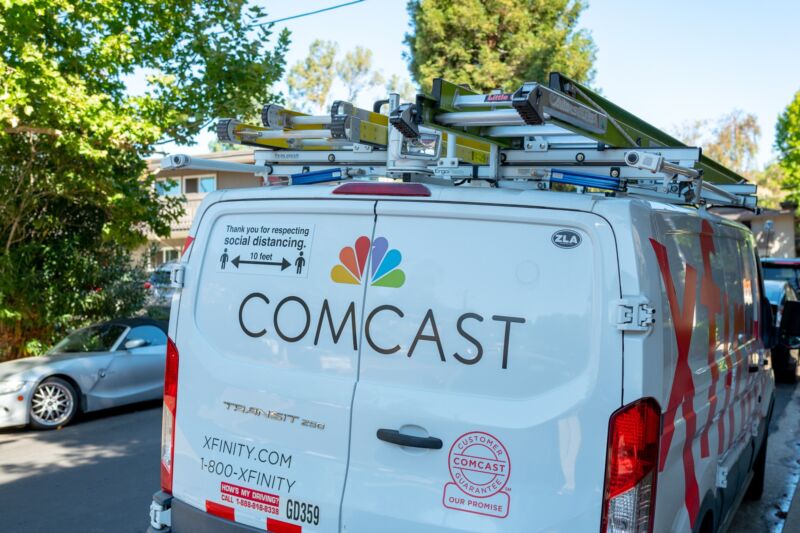
A Comcast service van seen from behind.
Getty Images | Smith Collection/Gado

Comcast is not happy about new federal rules that will require it to provide broadband customers with labels displaying exact prices and other information about Internet service plans.

Broadband label that ISPs will be required to display to consumers at the point of sale.
Enlarge / Broadband label that ISPs will be required to display to consumers at the point of sale.

In a filing last week, Comcast told the Federal Communications Commission that it is “working diligently to put in place the systems and processes necessary to create, maintain, and display the labels as required.” But according to Comcast, “two aspects of the Commission’s Order impose significant administrative burdens and unnecessary complexity in complying with the broadband label requirements.”

Comcast noted that five major cable and telecom industry trade groups petitioned the FCC in January to change the rules. Comcast’s new filing urged the FCC to grant the petition “as soon as possible before the rules become effective to help providers streamline and simplify their labeling processes, which will ultimately benefit consumers.”

The FCC was required to implement broadband label rules in a 2021 law passed by Congress. Although the FCC approved the label rules in November 2022, it’s not clear when they will take effect. They are subject to a federal Office of Management and Budget (OMB) review because of requirements in the US Paperwork Reduction Act. Medium-sized and large ISPs would be required to comply six months after the OMB review, while providers with 100,000 or fewer subscribers would have one year to comply.

“The label hasn’t even reached consumers yet, but Comcast is already trying to create loopholes. This request would allow the big ISPs to continue hiding the true cost of service and frustrating customers with poor service. Congress created the label to end these practices, not maintain them, and Comcast offers no compelling reason for the FCC to violate Congress’ intent,” Joshua Stager, policy director at media advocacy group Free Press, told Ars. Stager previously advocated for the broadband labels when he was deputy director of New America’s Open Technology Institute.

The FCC rules require ISPs to display the labels at the point of sale. The labels must disclose broadband prices, introductory rates, data allowances, Internet speeds, and include links to information about an ISP’s network management practices and privacy policies.

Comcast doesn’t want to list all monthly fees

Comcast pointed to “recent filings regarding the Commission’s underestimation of the burdens associated with implementing the broadband consumer label rules.” Those filings came from Verizon, AT&T, Lumen (aka CenturyLink), and a trade group representing rural broadband providers.

Comcast and other ISPs have annoyed customers for many years by advertising low prices and then charging much bigger monthly bills by tacking on a variety of fees. While some of these fees are related to government-issued requirements and others are not, poorly trained customer service reps have been known to falsely tell customers that fees created by Comcast are mandated by the government.

The FCC rules will force ISPs to accurately describe fees in labels given to customers, but Comcast said it wants the FCC to rescind a requirement related to “fees that ISPs may, but are not obligated to, pass through to customers.” These include state Universal Service fees and other local fees.

As Comcast makes clear, it isn’t required to pass these costs on to customers in the form of separate fees. Comcast could stop charging the fees and raise its advertised prices by the corresponding amount to more accurately convey its actual prices to customers. Instead, Comcast wants the FCC to change the rule so that it can continue charging the fees without itemizing them.

The portion of the FCC order that Comcast and other ISPs object to says that “providers must list all recurring monthly fees,” including “all charges that providers impose at their discretion, i.e., charges not mandated by a government.”

Comcast wrote:

[T]he Order appropriately refrains from requiring ISPs to itemize state and local taxes, recognizing that they “often vary according to a customer’s geographic location.” The Order adopts the same treatment for government fees that a “relevant state or local government ‘mandate[s]'” must be passed through to customers… However, the Order appears to take a different tack with respect to fees that ISPs may, but are not obligated to, pass through to customers. The language of the Order creates much uncertainty over how ISPs must treat these fees on their labels because it may be read to require ISPs to itemize each of these pass-through government-imposed fees on their labels… If these fees must be itemized, a separate label must be created for each unique combination of applicable nonmandatory pass-through government fees. Itemizing these fees would substantially increase the burden on providers to generate and maintain their labels, particularly as the fees are subject to change, in some cases as often as quarterly.

https://arstechnica.com/?p=1947752


Lead admin of child sex abuse website pleads guilty, faces 20 years to life

The bars of a jail cell are pictured along with a man's hand turning a key in the lock of the cell door.
Getty Images | Charles O’Rear

A man described as the lead administrator of a child sexual abuse website pleaded guilty to engaging in a child exploitation enterprise and faces a sentence of at least 20 years and possibly life in prison. The website was “dedicated to the advertisement and distribution of images and videos depicting child sexual abuse,” the federal government said.

William Michael Spearman, a 57-year-old from Alabama, pleaded guilty yesterday in US District Court for the Southern District of Florida, the US Department of Justice announced. Four other defendants were previously convicted of crimes related to “their involvement with the same website,” the DOJ said.

“The website included a section devoted to the sexual abuse of infants and toddlers, a section devoted to images and videos depicting children being subjected to pain and torture, and a section devoted to avoiding detection by law enforcement,” the DOJ said. “As the lead administrator, Spearman managed numerous ‘staff’ members, directed them how to help run the site, recommended other users for promotion, kept records of child pornography files advertised and distributed over the site, presided over staff meetings, praised and scolded users, and counseled users and other managers about the function and expectations of the website. Spearman also advertised and distributed images over the website.”

Spearman is scheduled to be sentenced on August 31. He “faces a mandatory minimum sentence of 20 years in prison and a maximum sentence of life in prison,” the announcement said.

Website had 100+ registered users

FBI Special Agent David Backlund described details of the case in a November 2022 affidavit. The website—referred to as “target website” in the affidavit—had at least 100 registered members who accessed their accounts with passwords, Backlund wrote.

Website users “traffic in child pornography images and videos via the posting of web links within messages,” the affidavit said. “These links allow a user to navigate to another website, such as a file-hosting website, where images and/or videos were stored in order to download these images and videos. When posting the links, users of the target website also generally include descriptive text that provides information about the sexual acts and age and gender of the child victim depicted in the linked-to child pornography files. The target website provides rules that instruct users to share child pornography in this manner.”

Defendant Selwyn Rosenstein was previously convicted of conspiracy to advertise child pornography, five counts of advertisement of child pornography, and possession of child pornography, the DOJ said. He was sentenced to 28 years in prison and ordered to pay $85,000 in restitution to victims.

Defendants Gregory Good, Robert Boyles, and Matthew Garrell were convicted of conspiracy to advertise child pornography and conspiracy to distribute child pornography. Their sentencing hearings are scheduled for August.

https://arstechnica.com/?p=1947631


Reddit CEO assures employees that API pricing protests haven’t hurt revenue

In this photo illustration the American social news

There are nearly 8,500 subreddits that are private or read-only right now in protest over Reddit’s upcoming API price hike. The protest started on June 12, crashed Reddit for three hours, and is scheduled to continue until June 14. Reddit CEO Steve Huffman, according to an internal memo reportedly viewed by The Verge today, isn’t too worried, though, since it hasn’t hurt Reddit’s pockets yet.

According to The Verge (where you can view the full memo), Huffman sent the note to employees on Monday afternoon. It starts by noting the “challenge” from the Reddit API pricing protest.

“We do anticipate many of [the subreddits] will come back by Wednesday, as many have said as much. While we knew this was coming, it is a challenge nevertheless, and we have our work cut out for us,” the note reportedly says. “A number of Snoos [Reddit’s nickname for employees] have been working around the clock, adapting to infrastructure strains, engaging with communities, and responding to the myriad of issues related to this blackout.”

This, too, shall pass

Then, the note seemingly looks to calm employee anxieties or fears around the protests by depicting the blackout as a temporary occurrence that hasn’t yet impacted Reddit’s finances:

We have not seen any significant revenue impact so far and we will continue to monitor.

There’s a lot of noise with this one. Among the noisiest we’ve seen. Please know that our teams are on it, and like all blowups on Reddit, this one will pass as well.

Some subreddits have said they will go dark indefinitely. As of this writing, 8,444 subreddits are protesting, according to the Reddark counter, which says 8,838 subreddits pledged to join.

Similar to how Twitter was accosted when it jacked up its API pricing in February, Reddit has been accused of corporate greed as it seeks to suddenly charge what some argue are exorbitant amounts for something that used to be free.

For its part, Reddit hasn’t been shy about its desire to make money, especially considering many popular third-party Reddit apps don’t run Reddit’s ads, its biggest source of revenue.

“Reddit needs to be fairly paid to continue supporting high-usage third-party apps. Our pricing is based on usage levels that we measure to be comparable to our own costs,” Reddit spokesperson Tim Rathschmidt said in a statement to Bloomberg on June 6.

News of Reddit’s initial public offering has drawn further attention during this spectacle, as The Information in February reported that Reddit aims to go public in 2023. Additionally, there’s a sense that Reddit is seeking greater control over its platform.

Huffman’s memo reportedly said that the long-term solution to challenges brought on by the protests is to improve Reddit and noted “a few upcoming critical mod tool launches we need to nail.”

Reddit recently started allowing NSFW image uploads on its desktop app but will remove NSFW content from third-party apps with its API changes, attributing the move to regulatory concerns. Reddit has also refrained from offering any compromise that would see lower API fees for developers that run Reddit’s ads.

Further, Reddit showed interest in growing the use of its apps when it experimented with blocking logged-in mobile browser access earlier this year.

Community consequences

Reddit might not have seen any financial consequences yet. But its announced API fees, the revelation that those fees would cost it $20 million a year for one third-party app, and the backlash from other developers, users, and moderators have shaken the Reddit community. It’s hard to quantify that impact, but a sense of community is why some people visit Reddit in the first place.

Huffman’s note, according to The Verge, said:

I am sorry to say this, but please be mindful of wearing Reddit gear in public. Some folks are really upset, and we don’t want you to be the object of their frustrations.

In an active Q&A on Friday, someone asked Huffman if he was concerned “that Reddit has become increasingly profit-driven and less focused on community engagement,” and his response didn’t foster a sense of community either.

“We’ll continue to be profit-driven until profits arrive. Unlike some of the 3P apps, we are not profitable,” Huffman said.

In Monday’s note, Huffman reportedly mentioned the planned closures of Apollo, Reddit Is Fun, “and a couple others,” and said, “We are still in conversation with some of the others.”

As some might have expected, the protests haven’t yet brought any sign of Reddit relenting on its API pricing. The company has given accessibility-focused apps exemptions, though.

“In this whole saga, I don’t think I’ve seen Reddit offer to give an inch on any of the things,” Apollo developer Christian Selig told The Vergecast podcast this week.

Advance Publications, which owns Ars Technica parent Condé Nast, is the largest shareholder in Reddit.

https://arstechnica.com/?p=1947571