Musk testifies in fraud trial, points out that not everyone believes what he says
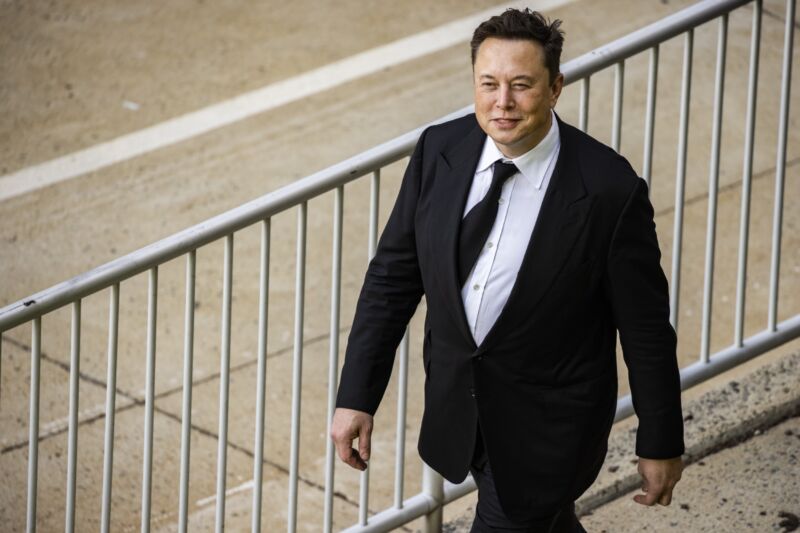
Elon Musk wearing a suit while leaving a courthouse during a 2021 trial.
Enlarge / Tesla CEO Elon Musk leaves court during the SolarCity trial in Wilmington, Delaware, on July 12, 2021.
Getty Images | Bloomberg

Elon Musk began testifying today in the jury trial over whether his false tweets in 2018 about taking Tesla private caused investors to lose billions of dollars.

During testimony in a federal courtroom in San Francisco, Musk denied that his tweets cause Tesla’s stock price to go up or down. “Just because I tweet something does not mean people believe it or will act accordingly,” Musk said in response to a question from attorney Nicholas Porritt, who represents investors in the class-action lawsuit against Musk.

“It’s difficult to say that the stock price is linked to the tweets. There have been many cases where I thought if I were to tweet something that the stock price would go down,” the Tesla CEO said on the witness stand.

Musk brought up a tweet in May 2020 in which he wrote, “Tesla stock price is too high imo.” Musk today said Tesla’s stock price “counterintuitively” went up after the tweet.

“Even though I tweeted that, in my opinion, the stock price was too high, the stock price then went up from that,” Musk said today. “You’d think that if I tweeted the stock price was too high, it would go down, but it actually went up.”

In fact, Tesla’s stock price dropped 10 percent on the day Musk made that tweet, though the price did go back up the following week.

“What I’m trying to say is the causal relationship is clearly not there simply because of a tweet,” Musk said in court today.

“Funding secured” tweet was false, judge ruled

The current case is primarily about two tweets Musk made on August 7, 2018. The first said, “Am considering taking Tesla private at $420. Funding secured.” The second tweet said, “Investor support is confirmed. Only reason why this is not certain is that it’s contingent on a shareholder vote.”

Musk only testified for less than a half hour today but will retake the stand on Monday. Because of that, Porritt hasn’t yet questioned Musk about the specific tweets this case is about.

Judge Edward Chen already ruled that the two tweets about taking Tesla private were false and made recklessly. Before today’s testimony began, Chen reminded the jury that they must assume that the tweets were false.

However, the jury still must decide whether Musk knew they were untrue and whether the tweets gave reasonable investors an impression of Tesla’s situation that was different from reality, Chen said. The case is being held in US District Court for the Northern District of California.

Before Musk started testifying today, jurors heard from two other witnesses called by plaintiffs—an investor who bought Tesla stock after Musk’s tweets and an expert witness who testified about management buyouts. Musk’s testimony began near the end of the trial day.

During opening statements on Wednesday, Musk’s lawyer Alex Spiro argued that Musk’s false tweets were just “technical wordsmith inaccuracies” and weren’t material to investors. Porritt said that investors bought Tesla stock based on Musk’s claim that he’d secured funding to take the company private at $420 a share.

“There was no dispute that Elon Musk lied, and there was no dispute that Tesla investors were hurt by these lies,” Porritt said.

Musk: “You are trying to conflate misleading with short”

Today, Porritt asked Musk if he’s aware that his tweets about Tesla are governed by federal securities laws requiring them to be accurate, just like press releases and Securities and Exchange Commission filings.

“Yes, but obviously, there is a limit if you have 240 characters to what you can say. You can obviously be far more verbose in a filing, and everyone on Twitter understands that,” Musk answered. (Twitter’s character limit is 280 characters, but Musk repeatedly said it was 240 characters during his testimony.)

Porritt responded, “There’s no exception in SEC rules based on the character limitation on Twitter, is there?”

“There isn’t, but I think one cannot ignore the character limitation and everyone on Twitter is aware of the character limitation,” Musk said. “I think you can absolutely be truthful. But can you be comprehensive? Of course not,” Musk said in response to another question.

Musk accused Porritt of asking misleading questions. “The tweets are truthful. They are simply short. I think you are trying to conflate misleading with short. That’s misleading,” Musk said.

“The tweets are information that I think the public should hear,” Musk also said.

In response to other questions, Musk also discussed short sellers in the context of why he wanted to take Tesla private in 2018. “I believe that short selling should be made illegal. It is a means for bad people on Wall Street to steal money from small investors,” Musk said.

Short sellers “want Tesla to die” and “plant false stories in the media to get the stock to go down and do anything in their power to make the company die. It’s evil,” Musk said.

https://arstechnica.com/?p=1911612


FTC: Shkreli may have violated lifetime pharma ban, should be held in contempt

Martin Shkreli, former CEO of Turing, smirked his way through a congressional hearing.
Enlarge / Martin Shkreli, former CEO of Turing, smirked his way through a congressional hearing.

Infamous ex-pharmaceutical executive Martin Shkreli is yet again in trouble with the Federal Trade Commission, which announced today that the convicted fraudster has failed to cooperate with the commission’s investigation into whether he violated his lifetime ban from the pharmaceutical industry by starting a company last year called “Druglike, Inc.”

In a court filing today, the FTC asked a federal judge in New York to find Shkreli in contempt for failing to turn over requested documents to the FTC and failing to make himself available for an interview. Under the 2022 court order barring him from involvement in the pharmaceutical industry for life, Shkreli is required to provide such information to the FTC, the commission noted.

“Martin Shkreli’s failure to comply with the court’s order demonstrates a clear disregard for the law,” Holly Vedova, director of the FTC’s Bureau of Competition, said in a press release. “The FTC will not hesitate to deploy the full scope of its authorities to enable a comprehensive investigation into any potential misconduct.”

At the center of the dispute is whether Shkreli’s co-founding of Druglike runs afoul of his lifetime ban from the pharmaceutical industry, which was in response to Shkreli’s infamous move to raise the price of the cheap, life-saving anti-parasitic drug, Daraprim, from $17.50 a pill to $750 a pill in 2015. In the January 2022 court ruling barring him from the industry, US District Judge Denise Cote wrote:

Banning an individual from an entire industry and limiting his future capacity to make a living in that field is a serious remedy and must be done with care and only if equity demands. Shkreli’s egregious, deliberate, repetitive, long-running, and ultimately dangerous illegal conduct warrants imposition of an injunction of this scope.

The injunction prevents Shkreli from “participating in the pharmaceutical industry in any capacity.”

Yet, Shkreli’s new company appears squarely in the realm of the pharmaceutical industry. In a press release last year, the company said it would “revolutionize” early-stage drug discovery with a decentralized computing network “enabled by Web3 technology.” Overall, the company’s web-based suite was touted as allowing drug developers to carry out the development tasks of “target identification, drug design, and tools for both constructing and running large-scale virtual screening workflows.”

Shkreli is quoted in the press release saying that users “might be responsible and rewarded for discovering the next breakthrough medicine” and that the technology “will disrupt the economics of the drug business” and compete with “pharmaceutical giants.”

The FTC said in its announcement today that it had initially sought information about the new company and his compliance with his lifetime ban in October, but that Shkreli disregarded the agency’s “repeated requests.” In addition to requesting the court find Shkreli in contempt, the FTC also asked that Shkreli be ordered to comply with the FTC’s investigation within 21 days of the court’s decision.

The FTC also noted in its court filing that Shkreli has so far failed to pay any of the $64.6 million in disengagement he was ordered to pay alongside his lifetime ban.

https://arstechnica.com/?p=1911591


Supreme Court allows Reddit mods to anonymously defend Section 230

Supreme Court allows Reddit mods to anonymously defend Section 230

Over the past few days, dozens of tech companies have filed briefs in support of Google in a Supreme Court case that tests online platforms’ liability for recommending content. Obvious stakeholders like Meta and Twitter, alongside popular platforms like Craigslist, Etsy, Wikipedia, Roblox, and Tripadvisor, urged the court to uphold Section 230 immunity in the case or risk muddying the paths users rely on to connect with each other and discover information online.

Out of all these briefs, however, Reddit’s was perhaps the most persuasive. The platform argued on behalf of everyday Internet users, whom it claims could be buried in “frivolous” lawsuits for frequenting Reddit, if Section 230 is weakened by the court. Unlike other companies that hire content moderators, the content that Reddit displays is “primarily driven by humans—not by centralized algorithms.” Because of this, Reddit’s brief paints a picture of trolls suing not major social media companies, but individuals who get no compensation for their work recommending content in communities. That legal threat extends to both volunteer content moderators, Reddit argued, as well as more casual users who collect Reddit “karma” by upvoting and downvoting posts to help surface the most engaging content in their communities.

“Section 230 of the Communications Decency Act famously protects Internet platforms from liability, yet what’s missing from the discussion is that it crucially protects Internet users—everyday people—when they participate in moderation like removing unwanted content from their communities, or users upvoting and downvoting posts,” a Reddit spokesperson told Ars.

Reddit argues in the brief that such frivolous lawsuits have been lobbed against Reddit users and the company in the past, and Section 230 protections historically have consistently allowed Reddit users to “quickly and inexpensively” avoid litigation.

The Google case was raised by the family of a woman killed in a Paris bistro during a 2015 ISIS terrorist attack, Nohemi Gonzalez. Because ISIS allegedly relied on YouTube to recruit before this attack, the family sued to hold Google liable for allegedly aiding and abetting terrorists.

A Google spokesperson linked Ars to a statement saying, “A decision undermining Section 230 would make websites either remove potentially controversial material or shut their eyes to objectionable content to avoid knowledge of it. You would be left with a forced choice between overly curated mainstream sites or fringe sites flooded with objectionable content.”

Eric Schnapper, a lawyer representing the Gonzalez family, told Ars that the question before the Supreme Court “only applies to companies, like Reddit itself, not to individuals. This decision would not change anything with regard to moderators.”

“The issue of recommendations arises in this case because the complaint alleges the defendants were recommending ISIS terrorist recruiting videos, which under certain circumstances could give rise to liability under the Anti-Terrorist Act,” Schnapper told Ars, noting that the question of that liability is the subject of another SCOTUS case involving Twitter, Meta, and Google.

https://arstechnica.com/?p=1911531


Twitter hired experts for case against Musk—now Musk won’t pay them, lawsuit says

Envelopes with unpaid-bill notices laying on a doormat
Getty Images | wragg

Twitter was sued yesterday by a consulting firm that says it was never paid for work it did on the lawsuit that forced Elon Musk to complete his purchase of the company.

Charles River Associates (CRA) says it was hired by Twitter in August 2022, shortly after Twitter sued Musk over his refusal to complete their $44 billion merger agreement. Musk finally completed the purchase in late October after it became clear that he was likely to lose in court.

From August 15 to October 27, “CRA provided all requested expert consulting work and services to Twitter and its legal counsel in connection with the Musk Litigation and pursuant to the terms and conditions of the Contract,” according to the lawsuit filed yesterday in Suffolk County Superior Court in Boston, Massachusetts. The lawsuit said that “Twitter has breached the Contract by failing to pay all of the CRA Invoices,” which added up to $2.19 million.

CRA is seeking the full amount owed on the invoices and double or treble damages due to Twitter’s “deceptive, intentional breach of the consulting agreement, plus interest, costs, and legal fees.” CRA’s lawsuit is one of several alleging that the Musk-owned Twitter has refused to pay bills for services provided before he bought the company.

Software vendor Imply Data previously alleged that Twitter failed to pay a $1,092,000 invoice and apparently intends to stiff Imply on another $7 million worth of payments on a contract that expires in late 2024. Additional breach-of-contract lawsuits allege that Twitter failed to pay $136,000 in rent at a San Francisco office tower and $197,725 for private jet services.

Twitter didn’t respond to payment requests, lawsuit says

The new lawsuit said that “CRA and its Senior Consultant, Professor Mark Zmijewski, were retained by Twitter to provide economic consulting services related to Professor Zmijewski’s anticipated expert rebuttal report and expert rebuttal testimony, which were to be in rebuttal of the expert report and testimony of one of the experts for the Musk parties, Yvette Austin Smith.”

CRA’s work included “research and analysis underlying the expert opinions to be included in the expert rebuttal report,” preparation of drafts of the report, “and other expert consulting and litigation support at the direction of Twitter’s legal counsel,” the lawsuit said.

The lawsuit describes CRA’s attempts to get paid for its work after Musk reluctantly completed his purchase of Twitter instead of continuing to fight the lawsuit. CRA said it received no response to a series of messages it sent about the unpaid invoices during the month after Musk’s purchase.

Twitter also hasn’t followed the agreed-upon process for objecting to the invoices, CRA said. “Twitter agreed pursuant to the terms of the Contract that any ‘objection with respect to CRA’s invoices must be made by the client in writing within five (5) business days following receipt of the invoice to which objection is made,'” the lawsuit said. “Twitter has never provided any objection to CRA with regard to the CRA Invoices.”

https://arstechnica.com/?p=1911496


Twitter retroactively changes developer agreement to ban third-party clients

Diff check between former and current Twitter Developer Agreement
Enlarge / Here’s the line that Twitter added to its API Developer Agreement on Jan. 19, two days after it cited “long-standing API rules” for why third-party apps may not be working.
diffchecker

“Long-standing” can apparently mean “later this week” at Elon Musk’s Twitter, as the company has changed its developer agreement to seemingly justify its banning of third-party clients. The change happened two days after a vague tweet about “enforcing long-standing API rules” without pointing to any.

As noted by Internet sage Andy Baio, a text comparison (diff check) of Twitter’s developer agreement between the effective dates of October 10, 2022, and January 19, 2023, shows only one change besides the effective date: a new line added to the section “Restrictions on Use of Licensed Materials.” The addition restricts the ability of developers to:

c) use or access the Licensed Materials to create or attempt to create a substitute or similar service or product to the Twitter Applications;

With that, Twitter put an end to an era, one in which third-party clients not only coexisted with Twitter’s official app—originally based on Tweetie, an early third-party app itself—but often introduced and drove new features. Twitter’s official apps and its website are now the only reliable ways to access the service.

Baio noted that third-party client Twitterific “first used ‘tweet’ to describe an update, first used a bird icon, and [was] the first native client on iPhone and Mac.” In a post announcing the discontinuation of Twitterific, developer Sean Heber wrote that the app’s “sudden and undignified demise” is due to “an increasingly capricious Twitter—a Twitter that we no longer recognize as trustworthy nor want to work with any longer.” Heber asked subscribers to Twitterific to not request refunds, as thousands of refund requests “would be devastating to a small company like ours.”

Paul Haddad, co-creator of Tweetbot, wryly noted on Mastodon that Twitter provided “some clarity” on why his app was suspended. “I guess I didn’t realize long standing actually means a couple hours ago, once again I’m deeply sorry,” he wrote.

While Twitter has only officially tweeted the much-maligned “long-standing” statement and modified its developer agreement, internal chats seen by The Information (subscription required) last week showed a senior software engineer telling workers that the “third-party app suspensions are intentional.” A product marketing manager said at the time that Twitter had “started to work on comms” about the change, though not much has been communicated.

Twitter is officially banning third-party clients—which don’t receive and display ads through the API but can pay fees for enhanced access—at the same time that the company is facing a significant drop in ad revenue and heavy upcoming debt payments as part of Elon Musk’s leveraged purchase of the social media network. A recent timeline of Musk’s Twitter ownership noted that an entire API team responsible for working with third-party apps was let go during company-wide layoffs in early November.

Listing image by iStock / Getty Images

https://arstechnica.com/?p=1911442


Twitter auction’s highest bid was $100K; it could owe $300M next week

Twitter auction’s highest bid was $100K; it could owe $300M next week

Twitter owes $13 billion, and it’s expected to make its first payment against that debt next week, Bloomberg reports. Due to this looming financial burden, CEO Elon Musk has been doing everything he can to cut costs—including directing mass layoffs, skipping rent payments, and slashing employee benefits. But even those major cost-cutting moves weren’t enough to keep Musk from turning to penny-pinching. Twitter held an auction this week that was essentially a garage sale, selling off equipment no longer needed by Twitter’s drastically reduced staff.

The liquidation of Twitter’s corporate office assets occurred during an online auction that ended yesterday, seemingly generating thousands from the sale of more than 600 items, including kitchen equipment, furniture, electronics, and memorabilia.

The auction site, Heritage Global Partners, chose not to publish the auction results, so it’s impossible to tell at a glance how big a dent the auction put in Twitter’s overall debt. Heritage Global Partners President Nick Dove told Fortune last month that the auction had “nothing” to do with Twitter’s dire finances.

“They’ve sold for $44 billion, and we’re selling a couple of chairs and desks and computers,” Dove told Fortune. “So, if anyone genuinely thinks that the revenue from selling a couple computers and chairs will pay for the mountain there, then they’re a moron.”

The Wall Street Journal reported that a Twitter bird statue sold for approximately $100,000, while the lowest-priced item sold for $150. Unusual items garnered higher bids, like a Twitter bird neon light that sold for $40,000, The Guardian reported, while everyday items found in pretty much every large office’s supply closet went for less, like 68 packs of Belkin power strips that sold for $1,000.

All items will be picked up by auction winners next week, the WSJ reported.

According to Bloomberg, Twitter could owe $300 million by the first loan payment deadline on January 27. One analyst told Bloomberg that Musk would likely be motivated to make the payment “come hell or high water.” Last year, Musk warned that bankruptcy was still a possibility for Twitter, though, and right now, it’s looking like Musk is running out of palatable options.

Twitter and Heritage Global Partners did not immediately respond to Ars’ request for comment.

A potentially more lucrative auction that Twitter has considered, but has yet to act on, is auctioning off user names, The New York Times reported earlier this month. Nobody’s sure if Twitter will move forward with that plan. Historically, the platform has forbidden selling usernames.

https://arstechnica.com/?p=1911315


Facebook approves ads calling for children’s deaths in Brazil, test finds

Brazilian President Luiz Inácio Lula da Silva kisses a child onstage at the end of a speech to supporters.
Enlarge / Brazilian President Luiz Inácio Lula da Silva kisses a child onstage at the end of a speech to supporters.

“Unearth all the rats that have seized power and shoot them,” read an ad approved by Facebook just days after a mob violently stormed government buildings in Brazil’s capital.

That violence was fueled by false election interference claims, mirroring attacks in the United States on January 6, 2021. Previously, Facebook-owner Meta said it was dedicated to blocking content designed to incite more post-election violence in Brazil. Yet today, the human rights organization Global Witness published results of a test that shows Meta is seemingly still accepting ads that do exactly that.

Global Witness submitted 16 ads to Facebook, with some calling on people to storm government buildings, others describing the election as stolen, and some even calling for the deaths of children whose parents voted for Brazil’s new president, Luiz Inácio Lula da Silva. Facebook approved all but two ads, which Global Witness digital threats campaigner Rosie Sharpe said proved that Facebook is not doing enough to enforce its ad policies restricting such violent content.

“In the aftermath of the violence in Brasilia, Facebook said that they were ‘actively monitoring’ the situation and removing content in violation of their policies,” Sharpe said in a press release. “This test shows how poorly they’re able to enforce what they say. There is absolutely no way the sort of violent content we tested should ever be approved for publication by a major social media firm like Facebook.”

To ensure that none of their test ads reached vulnerable audiences, Global Witness deleted the ads before alarming messages like “Death to the children of Lula voters” could be published.

Global Witness identified this as a problem that is particularly concerning on Facebook—not necessarily a weakness of all ad-based social platforms—by also testing the same ad set on YouTube. Unlike Facebook, YouTube did not approve any of the ads. YouTube also took the additional step of suspending the accounts that attempted to publish the ads.

“YouTube’s much stronger response demonstrates that the test we set is possible to pass,” Sharpe said.

Ars could not immediately reach YouTube or Meta for comment. Global Witness digital threats campaign leader Naomi Hirst told Ars, “It is difficult to have any confidence that Facebook will take the necessary action to combat the spread of disinformation and hate on their platform. Despite promises that they take this issue seriously, our investigations have exposed repeated failings.”

Meta downplays test results

A Meta spokesperson told Global Witness that its sample size of 16 ads while performing the test was too small to represent Facebook’s ability to enforce its ad policies at scale.

“Like we’ve said in the past, ahead of last year’s election in Brazil, we removed hundreds of thousands of pieces of content that violated our policies on violence and incitement and rejected tens of thousands of ad submissions before they ran,” a Meta spokesperson said in Global Witness’ press release. “We use technology and teams to help keep our platforms safe from abuse, and we’re constantly refining our processes to enforce our policies at scale.”

Hirst told Ars that Global Witness has now shown that “before, during, and now after the recent elections in Brazil,” it has remained easy to get “ads containing incitement to violence, incorrect information, and hateful content” approved by Facebook.

“Democracy is at risk if Facebook and other social media firms fail to stem the tide of division and violence that flourish online,” Hirst told Ars.

In its press release, Global Witness seems to suggest that Facebook is not taking the Brazil attacks as seriously as the social platform took the US attacks last year when the company implemented “break-glass measures” to prevent civil unrest from spreading on Facebook.

Ahead of the 2020 US elections, Facebook head of global affairs and communications Nick Clegg told USA Today that Facebook had “developed break-glass tools which do allow us to—if for a temporary period of time—effectively throw a blanket over a lot of content that would freely circulate on our platforms, in order to play our role as responsible as we can to prevent that content, wittingly or otherwise, from aiding and abetting those who want to continue with the violence and civil strife that we’re seeing on the ground.”

After Global Witness’ recent test seemed to show Facebook was putting less effort into preventing violence-inciting content from inflaming civil unrest in Brazil, Global Witness has recommended that Facebook and all other social media companies commit to ramping up content-moderation efforts with the same gusto shown after the US attacks.

“Global Witness is calling on Facebook and other social media firms to immediately implement ’break the glass’ measures and declare publicly what else they are doing to combat disinformation and incitement to violence in Brazil and how those efforts are being resourced,” Sharpe said.

https://arstechnica.com/?p=1911121


Websites selling abortion pills are sharing sensitive data with Google

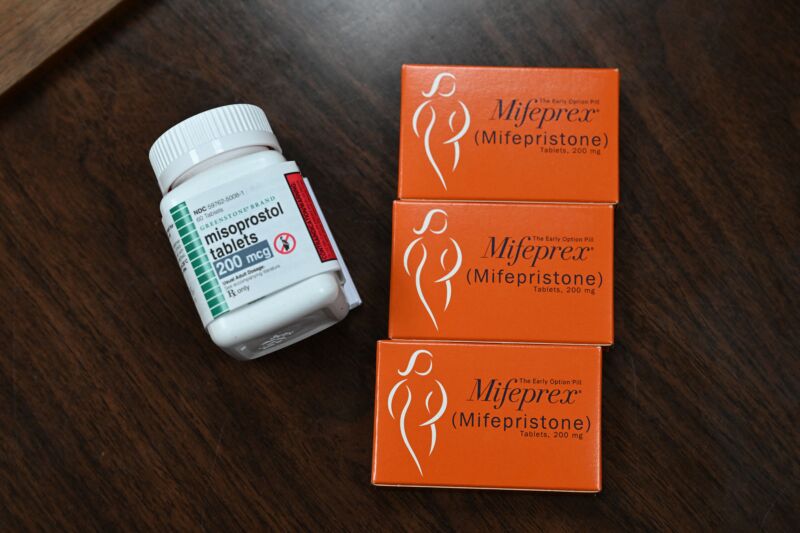
Package of Mifeprestone

This story originally appeared on ProPublica.

Online pharmacies that sell abortion pills are sharing sensitive data with Google and other third parties, which may allow law enforcement to prosecute those who use the medications to end their pregnancies, a ProPublica analysis has found.

Using a tool created by the Markup, a nonprofit tech-journalism newsroom, ProPublica ran checks on 11 online pharmacies that sell abortion medication to reveal the web tracking technology they use. Late last year and in early January, ProPublica found web trackers on the sites of at least nine online pharmacies that provide pills by mail: Abortion Ease, BestAbortionPill.com, PrivacyPillRX, PillsOnlineRX, Secure Abortion Pills, AbortionRx, Generic Abortion Pills, Abortion Privacy and Online Abortion Pill Rx.

These third-party trackers, including a Google Analytics tool and advertising technologies, collect a host of details about users and feed them to tech behemoth Google, its parent company, Alphabet, and other third parties, such as the online chat provider LiveChat. Those details include the web addresses the users visited, what they clicked on, the search terms they used to find a website, the previous site they visited, their general location, and information about the devices they used, such as whether they were on a computer or phone. This information helps websites function and helps tech companies personalize ads.

But the nine sites are also sending data to Google that can potentially identify users, ProPublica’s analysis found, including a random number that is unique to a user’s browser, which can then be linked to other collected data.

“Why in the world would you do that as a pharmacy website?” said Serge Egelman, research director of the Usable Security and Privacy Group at the International Computer Science Institute at the University of California, Berkeley. “Ultimately, it’s a pretty dumb thing to do.”

Representatives for the nine sites did not respond to requests for comment. All were recommended on the popular website Plan C, which provides information about how to get abortion pills by mail, including in states where abortion is illegal. Plan C acknowledged that it does not have control over these sites or their privacy practices.

While many people may assume their health information is legally protected, US privacy law does little to constrain the kind or amount of data that companies such as Google and Facebook can collect from individuals. Tech companies are generally not bound by the Health Insurance Portability and Accountability Act, known as HIPAA, which limits when certain health care providers and health plans can share a patient’s medical information. Nor does federal law set many limits on how companies can use this data.

Law enforcement can obtain people’s data from tech companies such as Google, whose privacy policies say the companies reserve the right to share users’ data with law enforcement. Google requires a court order or search warrant, which law enforcement can obtain with probable cause to believe a search is justified. The company received more than 87,000 subpoenas and search warrants in the US in 2021, the most recent year available; it does not provide a breakdown of these requests by type, such as how many involved abortion medication.

In a statement, Steve Ganem, product director of Google Analytics, said: “Any data in Google Analytics is obfuscated and aggregated in a way that prevents it from being used to identify an individual and our policies prohibit customers from sending us data that could be used to identify a user.”

https://arstechnica.com/?p=1911084


Elon Musk’s lies about Tesla deal cost “regular people” millions, jury hears

Elon Musk's lawyer Alex Spiro seen walking toward a courthouse.
Enlarge / Alex Spiro, attorney for Elon Musk, arrives for the shareholder lawsuit trial at federal court in San Francisco on January 18, 2023.
Getty Images

The jury trial in Tesla investors’ class-action lawsuit against Elon Musk proceeded today with opening statements in a San Francisco federal courtroom. Plaintiff’s attorney Nicholas Porritt told the jury the case was brought “because Elon Musk, Tesla’s chairman and chief executive officer, who is not in court today but you will see him sitting right there in the witness box, lied. And his lies caused regular people like Glen Littleton to lose millions and millions of dollars.”

Porritt pointed out that Judge Edward Chen already ruled Musk’s statements in August 2018 about having “funding secured” to take Tesla private were false and made recklessly. The case is being held in US District Court for the Northern District of California.

Because of the judge’s ruling and instructions that will be given to the jury, “you are to assume that every word, every part of this tweet is false,” Porritt said.

“There was no dispute that Elon Musk lied,” Porritt also said. “And there was no dispute that Tesla investors were hurt by these lies. How were they hurt? They lost lots of money in a short period, from August 7 to August 17, 10 days, because of Elon Musk’s lies.”

After Musk’s false “funding secured” claim, “Tesla’s stock price shot up. Millions of shares were bought,” Porritt said. “But then the stock price tanked almost as quickly as it went up and millions of dollars were lost when his lies were exposed. The question for you, the jury, is to decide whether Elon Musk and Tesla and its board of directors should be held responsible for the hurt and the harm that were caused by his lies.”

Musk’s defense claimed the false statements were just “technical wordsmith inaccuracies” and that they weren’t material to investors.

Lead plaintiff lost most of life savings

Lead plaintiff Glen Littleton, 71, testified today after opening statements. He’s a self-employed investor from Kansas City.

Porritt told the jury in his opening statement that Littleton “was a big believer in Tesla and Elon Musk. He believed in the technology, he supported the environmental message. He will describe the pain and upset he suffered on August 7 when almost his entire life savings, the product of 50 years of work, were almost wiped out by Elon Musk’s lies and tweets about ‘funding secured.'”

Porritt described another witness who will testify during the trial as a hard-working product manager who is investing what he can for retirement. “He heard of Elon Musk’s tweets and thought it was a good time to buy Tesla stock. He lost thousands of dollars which he could not afford to lose when the falsity of the August 7 tweets were revealed,” Porritt said.

The class-action lawsuit seeks billions of dollars of damages overall. Thousands of investors lost money because of Musk’s false tweets, Porritt said.

The case is primarily about two tweets Musk made on August 7, 2018. The first said, “Am considering taking Tesla private at $420. Funding secured.” The second tweet said, “Investor support is confirmed. Only reason why this is not certain is that it’s contingent on a shareholder vote.”

Porritt said Musk tweeted when he was driving his car to the airport and that he selected the proposed share price of $420 as a cannabis-related joke. “It was no joke to Glen Littleton or other Tesla investors who lost millions of dollars. It’s no joke to millions of investors who rely on true information going into the market to buy or sell stock,” Porritt said.

https://arstechnica.com/?p=1910951


Twitter says third-party apps broke “long-standing API rules,” won’t name rules

Two birds fighting on a tree branch
Enlarge / Two birds are enforcing long-standing bird feeder access rules. That may result in some birds not eating.
Tony Quinn / EyeEm / Getty Images

Ever since Twitter revoked the API access of prominent third-party clients, developers, dedicated fans, and tech pundits have been waiting for an explanation. They still haven’t received one, but a recent tweet from Twitter’s API team suggests it’s all the developers’ fault for breaking “long-standing API rules” that the company will not name.

The Twitter Dev account says the social network “is enforcing” those rules, and it “may result in some apps not working.” Twitter’s API documentation is extensive and contains many rules and limits dependent on several factors. Tech video producer Marques Brownlee, who has 6 million followers, replied to the account soon after its post, asking, “What are the rules.” Neither Brownlee’s nor any other questions elicited a response.

No one outside of Twitter can say whether the company sought a reason to ban third-party clients and found it in its API language or if the company suddenly decided to enforce API rules against some of the most popular third-party clients just as the company was seeking to bolster its revenues against a significant drop in ad revenue and upcoming debt payments. (Third-party clients typically don’t show Twitter’s “promoted” tweet advertising.) A timeline of Musk’s Twitter ownership published recently by The Verge and New York Magazine noted that the entire API team of Amir Shevat was wiped out during an early November layoff.

Internal chats seen recently by tech news site The Information (subscription required) last week showed a senior software engineer stating that “third-party app suspensions are intentional.” Third-party app developers who changed out their API keys for those that were severely limited found their access quickly revoked again. Tweetbot co-creator Paul Haddad posted on Mastodon that the quick re-ban proved that the bans were “intentional” and that “we and others [third-party client apps] were specifically targeted.”

Twitter has redefined and restricted its API many times before, but prior to Musk’s ownership, the changes were communicated in advance, with ample time for developers to shift or, as often happened, make public complaints. Twitter’s Dev team suggests that this time, the rules were already in place, but it has no comment on what they might be.

https://arstechnica.com/?p=1910770