Biden tries to end 2 years of deadlock at FCC by renominating Gigi Sohn

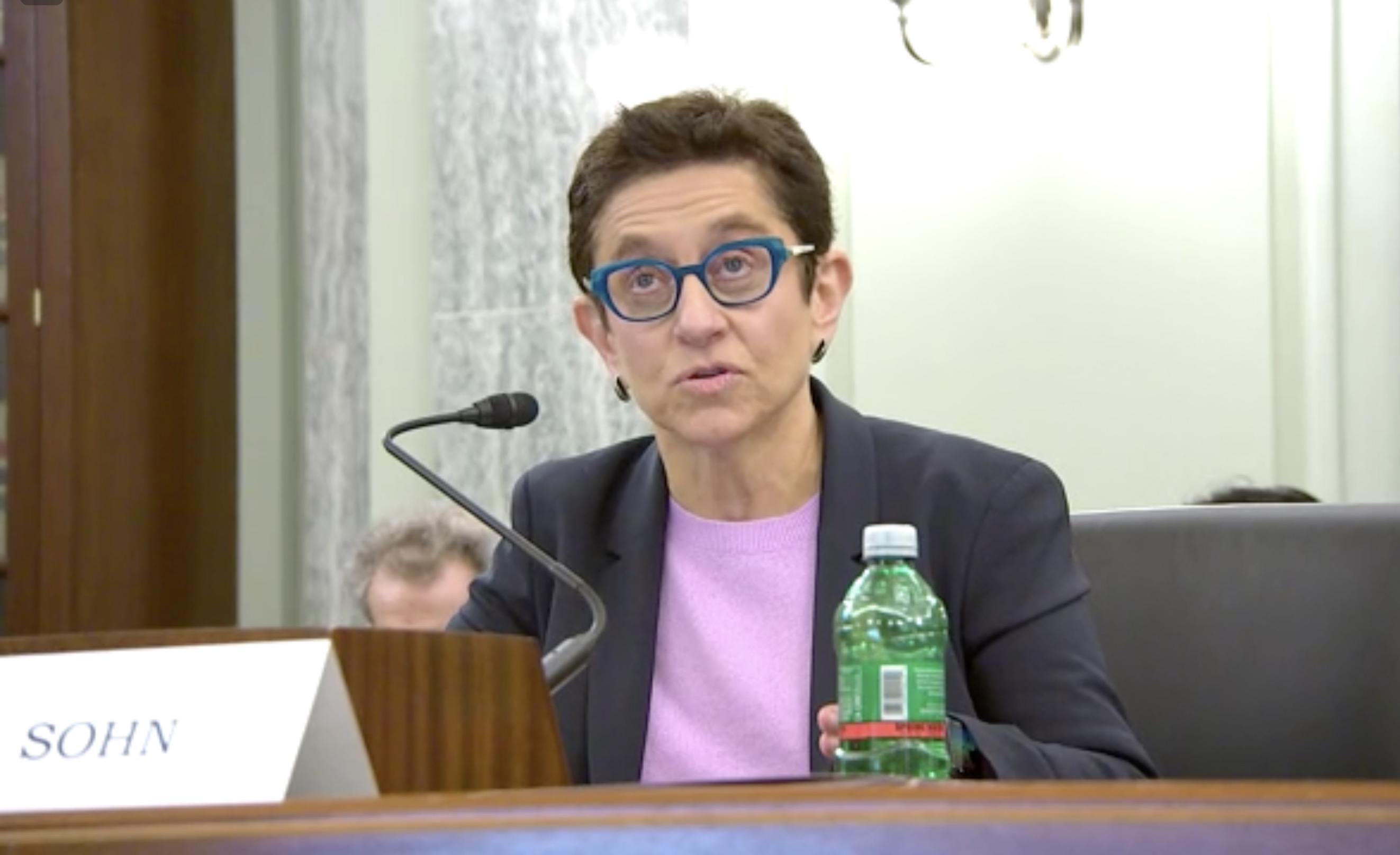
Gigi Sohn sitting and answering questions posted by US senators at a hearing.
Enlarge / Gigi Sohn answering questions on December 1, 2021, at a Senate Commerce Committee hearing on her nomination to the Federal Communications Commission.

President Joe Biden yesterday renominated Gigi Sohn to the long-empty fifth spot on the Federal Communications Commission in hopes that the Senate will finally give Democrats a 3-2 FCC majority.

The FCC has been deadlocked with two Democrats and two Republicans for Biden’s entire presidency so far. He first nominated Sohn, a longtime consumer advocate and former FCC official, on October 26, 2021.

The full Senate never voted on whether to confirm Sohn as an FCC commissioner. Republicans vocally opposed her, and Democratic leaders seemingly weren’t able to line up support from more conservative party members such as Joe Manchin (D-W.Va.).

Sohn’s chances are better now that Democrats have a 51-49 majority (including three independents who caucus with Democrats). There was previously a 50-50 split, with Vice President Kamala Harris giving Democrats a tiebreaker on party-line votes.

“Senate buckled to industry pressure”

“Industry gatekeepers and big-money opposition have done their part to stall Ms. Sohn’s confirmation because they know a fully functional FCC would hold them accountable for engaging in discriminatory and anticompetitive practices,” former FCC Commissioner Michael Copps, now special adviser to advocacy group Common Cause, said yesterday.

“No other nominee in the FCC’s history has had to wait so long for a confirmation vote, and none have been better qualified to serve the needs of the public,” CEO Craig Aaron of advocacy group Free Press said. “But the Senate buckled to industry pressure and kept her in limbo for more than a year.”

Sen. Ted Cruz (R-Texas) and other Republicans claimed Sohn would use a post at the FCC to censor conservatives—despite executives at conservative news networks Newsmax and One America News Network supporting Sohn’s nomination and praising her longtime commitment to free speech.

Sohn faced further criticism from Republicans and the National Association of Broadcasters for being a former board member at Locast, a nonprofit online TV service that shut down after losing a copyright case launched by major broadcast networks. Separately, Comcast apparently lobbied against Sohn behind the scenes despite not publicly opposing the nomination.

“Industry spent millions of dollars on astroturf groups to repeatedly misrepresent Sohn’s record in the media and on Capitol Hill. They’ve lied repeatedly about her record and principles,” Aaron said.

Sohn co-founded consumer advocacy group Public Knowledge in 2001 and led the organization until taking a position as counselor for then-FCC Chairman Tom Wheeler in 2013. If Sohn is confirmed, she could help revive the net neutrality rules and common-carrier broadband regulations that were implemented under Wheeler and later repealed during the Trump era.

FCC chair hopes to finally get a majority

FCC Chairwoman Jessica Rosenworcel said that “Gigi is a knowledgeable nominee with a long record of commitment to the issues before the FCC… I look forward to the day we have a full complement of five commissioners.” Despite leading the FCC without a majority for two years, Rosenworcel said she’s proud of the agency’s work on “closing the Homework Gap, broadband access and affordability, telehealth, mapping, and network security.”

Sen. Richard Blumenthal (D-Conn.) issued a press release supporting Sohn’s confirmation. “Gigi Sohn will be a strong, effective voice and vote for the public interest, and a key to breaking the FCC’s current deadlock. She is indisputably qualified, and unstintingly dedicated, winning her support across the political spectrum,” Blumenthal said.

A swift Senate vote was urged by the Communications Workers of America, a union for workers at telecoms such as AT&T, Lumen/Centurylink, Frontier, and Windstream. “We are in a critical period of increased federal investment in broadband networks and digital equity initiatives, and the FCC has gone for too long without a fully seated commission. Continued delay on this nomination is inexcusable and only benefits large corporations who wish to avoid oversight and accountability,” the group said.

“During the T-Mobile/Sprint merger, Sohn was a key ally in the fight to protect the jobs of the working families who ultimately ended up being harmed by the merger,” the CWA also said.

https://arstechnica.com/?p=1907542


Twitter lifts political ad ban designed to stop misinformation spread [Updated]

Twitter lifts political ad ban designed to stop misinformation spread [Updated]

Online advertising on social platforms is changing. Google and Meta no longer hold majority control over advertising dollars, according to The Wall Street Journal, with Amazon and TikTok cutting in to sway advertisers to other platforms. Twitter is also hungry to redirect ad dollars to its platform, as it announced yesterday that it would be “relaxing” its political ads policy and allowing more “cause-based” ads. The company is also planning to expand to allow other forms of political advertising “in the coming weeks.”

Promising to share more details soon, the @TwitterSafety account tweeted Tuesday that from now on, Twitter’s goal is to align its advertising policy “with that of TV and other media outlets.” It’s unclear what exactly that means on a platform like Twitter, but the Federal Communications Commission specifies that it works to restrict censorship and ensure equal opportunity for political advertisers. This aligns somewhat with Twitter CEO Elon Musk’s stated “free speech absolutist” position. Twitter could also be looking to emulate the FCC to diminish the company’s responsibility to review or ensure the accuracy of all political ad content.

Twitter’s recent policy change reverses a decision the platform made in 2019 to ban political ads to limit misinformation spread. That 2019 ban included exceptions for some cause-based advertising, where advertisers were permitted to conduct some microtargeting of Twitter users based on limited geographic location information, keywords, and interests. Notably, advertisers were not allowed to target audiences based on political affiliation like “conservative” or “liberal.” Under these prior rules, Twitter-certified cause-based advertisers approved to promote content created to “educate, raise awareness, and/or call for people to take action in connection with civic engagement, economic growth, environmental stewardship, or social equity.”

In 2019, the Electronic Frontier Foundation said that Twitter limiting cause-based advertising wasn’t a good policy because the microtargeting exception applies to “an almost impossibly broad range of advertisements adjacent to the banned campaign content.” The EFF said this policy had “the potential to worsen the problem it is trying to solve,” suggesting that smaller social media platforms that “let users choose the moderation approaches that work for them” do more to empower their users to “protect themselves from manipulative advertising.”

The coming weeks will show if Musk will provide more tools to empower Twitter users to protect themselves or whether his company will simply leave it up to the users to distinguish between valid causes and manipulative ads. It could be that Twitter’s priority to expand public conversation depends on users relying on their own judgment. In November 2022, Twitter said its mission has always been to be the town square of the Internet, insisting that was only possible if everyone has “the power to create and share ideas and information, instantly without barriers.”

Ars could not immediately reach Twitter or the EFF for comment. [Update: EFF civil liberties director David Greene told Ars that “it’s hard to assess whether the new policy is better than the old one without knowing the specifics of the new policy.” Greene said that Twitter isn’t the first social platform to say that “they will follow the rules that ‘TV and other media outlets follow'”—he criticized a similar move that Parler made in 2020— and that description alone “isn’t really helpful, since those policies can vary greatly.”

Greene said that Twitter’s new policy “can and should be criticized” for being a US-only policy that overlooks the fact that “the majority of Twitter’s users are not US users.” Those international users rely just as much on Twitter during key elections. The new policy can also be criticized for being too vague. “To properly respect human rights, content policies should be clear and precise, and readily understandable to users,” Greene said. “It is not sufficient for Twitter to vaguely roll out an important new policy.”

Without more detail, Greene told Ars that Musk’s Twitter “lifting the ban is potentially good” in at least one way. “We thought the old policy was bad and especially harmful for less well-resourced cause organizations for which social media advertising remains an important way to raise awareness and funds,” Greene told Ars. “And social media bans on political advertisers tends to entrench better-funded candidates who can afford the more expensive advertising platforms.”]

Bloomberg reported that political advertising before the 2019 ban was a “minor source of income” for Twitter, generating less than $3 million during the 2018 midterm elections. That’s a pittance compared to Twitter’s overall ad revenue today, which S&P Global Market Intelligence reported in 2021 was $4.5 billion. And although Musk was penny-pinching in 2022—even failing to pay $136,000 in rent for Twitter headquarters—he seems focused on bigger-picture moneymaking strategies for Twitter than bringing back a couple of million dollars in ad revenue. In an investor pitch deck reviewed by The New York Times, Musk said he planned to grow Twitter revenue to $26 billion by 2028, with an influx of $10 billion expected to come from Twitter Blue subscriptions.

Whatever Musk’s intentions are for relaxing Twitter’s political ad policies—whether it’s about profits, stirring up more Twitter engagement, or some other motivation—the policy update carries some potential for increasing misinformation spread on the platform. That’s alarming to some users, especially considering that Twitter’s recent decision to relax its COVID-19 misinformation policy has already caused drama. This week, The Washington Post reported that “baseless” tweets from anti-vaxxers and right-wing provocateurs spread throughout Twitter, claiming without evidence that NFL player Damar Hamlin collapsed on the field during a Monday game because he had been vaccinated against COVID-19.

Until more details are officially announced about its political ad policy change, Twitter has sought to reassure users that their safety won’t be impacted by the decision.

“As with all policy changes, we will first ensure that our approach to reviewing and approving content protects people on Twitter,” the @TwitterSafety account tweeted.

https://arstechnica.com/?p=1907503


Lawsuit: Twitter failed to pay $136,000 in rent at San Francisco office tower

Lawsuit: Twitter failed to pay $136,000 in rent at San Francisco office tower
Jakub Porzycki/NurPhoto

The Elon Musk-owned Twitter is facing another lawsuit alleging that it failed to pay its bills.

The plaintiff in the latest case is Columbia REIT-650 California, LLC, the landlord of the 650 California Street office tower in San Francisco. Exhibit A in the lawsuit is a lease between Columbia REIT and CrossInstall, a mobile ad company purchased by Twitter in May 2020. All of CrossInstall’s 70 employees joined Twitter at the time.

The lease was made in September 2017 for a period of seven years and covered 15,500 square feet, the entire 30th floor of the building. The annual rent started at $1.29 million, and the lease had automatic increases throughout the seven-year term.

The breach-of-contract lawsuit says Columbia REIT served a notice of default to Twitter on December 16, 2022, “stating the amount of Rent due in the estimated sum of $136,260.00 and notifying Tenant that it was in default of the Lease if it failed to pay that sum within five (5) business days after service of the Default Notice.”

The lawsuit says Twitter failed to comply by the required date and asks the court for damages of at least $136,260. The lawsuit was filed in California Superior Court in San Francisco County on December 29, 2022. We contacted Twitter about the lawsuit today and will update this article if we get a response, but the company reportedly eliminated its communications department after Musk took over.

Two other lawsuits allege nonpayment

Columbia REIT’s lawsuit against Twitter was filed just 16 days after software vendor Imply Data sued Twitter for an alleged breach of contract in the same court. Imply Data’s lawsuit said Twitter failed to pay a $1,092,000 invoice in a software contract that doesn’t expire until late 2024 and that Twitter apparently intends to stiff the vendor on another $7 million worth of payments.

Additionally, a private jet provider sued Twitter in US District Court in New Hampshire on December 9, alleging it refused to pay $197,725 for “private air charter passenger transportation services” provided to Twitter Chief Marketing Officer Leslie Berland on October 26 and 27, 2022. Musk completed his Twitter acquisition on October 27, and Berland was among the many executives who left shortly after.

Before the lawsuits, a New York Times report on November 22 said Twitter began stiffing some vendors after Musk took over. The report said Twitter “executives had racked up hundreds of thousands of dollars in travel invoices that the social media service planned to pay” but that Musk “refused to reimburse travel vendors for those bills.” Musk “issued an order to slow or in some cases halt transfers of funds to Twitter’s vendors and contract services” and “declined to pay for the travel services incurred by the former Twitter executives,” the NYT report said.

Another NYT report on December 13 said Twitter had stopped paying rent at multiple offices. “To cut costs, Twitter has not paid rent for its San Francisco headquarters or any of its global offices for weeks, three people close to the company said,” according to the article.

Twitter sublease included in exhibits

CrossInstall, the original party in the lease with Columbia REIT, was dissolved well before Musk bought Twitter. Twitter renamed CrossInstall to MoPub Acquire after the 2020 purchase and said it “completed the wind down of MoPub Acquire (formerly known as CrossInstall)” in December 2021. Twitter also sold MoPub, a different ad company it bought in 2013, to AppLovin in January 2022.

But with Twitter still on the hook for the lease at 650 California Street, it signed a sublease with Dentsu International Americas on October 5, 2022, a few weeks before Musk completed his acquisition of Twitter. Dentsu is not a party in the breach-of-contract case, but the sublease is one of the exhibits submitted by Columbia REIT.

The sublease, which runs through January 31, 2025, describes Twitter as the sublandlord and successor in interest to CrossInstall. It shows that Dentsu’s monthly payments to Twitter start at $91,980 a month, covering most but not all of what Twitter allegedly owes Columbia REIT.

https://arstechnica.com/?p=1907193


Google develops free terrorism-moderation tool for smaller websites

Google develops free terrorism-moderation tool for smaller websites

Google is developing a free moderation tool that smaller websites can use to identify and remove terrorist material, as new legislation in the UK and the EU compels Internet companies to do more to tackle illegal content.

The software is being developed in partnership with the search giant’s research and development unit Jigsaw and Tech Against Terrorism, a UN-backed initiative that helps tech companies police online terrorism.

“There are a lot of websites that just don’t have any people to do the enforcement. It is a really labor-intensive thing to even build the algorithms [and] then you need all those human reviewers,” said Yasmin Green, chief executive of Jigsaw.

“[Smaller websites] do not want Isis content there, but there is a ton of it all over [them],” she added.

The move comes as Internet companies will be forced to remove extremist content from their platforms or face fines and other penalties under laws such as the Digital Services Act in the EU, which came into force in November, and the UK’s Online Safety bill, which is expected to become law this year.

The legislation has been pushed by politicians and regulators across Europe who argue that Big Tech groups have not gone far enough to police content online.

But the new regulatory regime has led to concerns that smaller start-ups are not equipped to comply and that a lack of resources will limit their ability to compete with larger technology companies.

“I have noticed a big shift in the [leading] platforms becoming much more effective at moderating, and that pushes terrorist content and COVID hoax claims to [other sites],” Green added.

A report by the Global Internet Forum to Counter Terrorism in 2021 estimated that for every 10,000 posts on Facebook, six would contain terrorist or extremist content. On smaller platforms, this figure could be as high as 5,000, or 50 percent of content.

GIFCT, a non-governmental organization founded by Facebook, Microsoft, Twitter, and YouTube in 2017 to foster partnerships between many tech platforms, is supporting the project by Jigsaw. The non-governmental organization has a database of terrorist content shared across its membership of tech companies, which moderation systems can use to detect existing materials.

On December 13, Facebook and Instagram-owner Meta launched open source software that other platforms can deploy to match terror content to existing images or videos in the database and highlight them for urgent human review.

Jigsaw’s tool aims to tackle the next step of the process and help human moderators make decisions on content flagged as dangerous and illegal. It will begin testing with two unnamed sites at the beginning of this year.

“In our experience, we find that terrorists seek to exploit smaller platforms where content moderation is challenging due to limited resources,” said Adam Hadley, director of Tech Against Terrorism.

Jigsaw has about 70 staff, primarily based in Google’s offices in New York. Green, who became chief executive in July, said the loss-making division was not expected to become profitable.

“There’s an understanding that there’s a long-term business return… Google needs a healthier Internet,” Green added. “We are helping Google and helping the Internet in a way that delivers value even though it isn’t monetary.”

© 2023 The Financial Times Ltd. All rights reserved. Not to be redistributed, copied, or modified in any way.

https://arstechnica.com/?p=1907156


New York governor signs modified right-to-repair bill at the last minute

Computer repair concept Close-up view.Hardware.

New York state governor Kathy Hochul has signed the Digital Fair Repair Act into law, months after it had passed both chambers of the state’s legislature with overwhelming bipartisan majorities. The bill had originally passed in June, but it was only formally sent to Hochul’s desk earlier this month; the governor had until midnight on December 28th to sign the bill, veto it, or allow it to pass into law without her signature.

The Digital Fair Repair Act is the country’s first right-to-repair bill that has passed through a state legislature (as opposed to being implemented via executive order), and has been hailed as “precedent-setting” by right-to-repair advocacy groups like iFixit. The law will require companies to provide the same diagnostic tools, repair manuals, and parts to the public that they provide to their own repair technicians.

But tech industry lobbyists and trade groups like TechNet had already worked to weaken the law as it made its way through the state legislature, and the bill as signed by Hochul contains even more conditions and exceptions, ostensibly added to address the governor’s concerns about “technical issues that could put safety and security at risk, as well as heighten the risk of injury from physical repair projects.”

“I am pleased to have reached an agreement with the legislature to address these issues,” Hochul wrote.

Most notably, only devices manufactured and sold in New York on or after July 1, 2023 will be required to meet the law’s requirements, excluding all currently extant products—the ones people already own that they might conceivably want to repair at some point down the line. “Business-to-business” and “business-to-government” equipment that isn’t sold to consumers is also excluded. And manufacturers won’t be required to provide passwords or other tools for circumventing device security lockouts—on balance, probably good for anti-theft features that Apple and other manufacturers offer for stolen phones, but bad for people locked out of their own otherwise functional devices because they’ve forgotten a password or can’t track down a recovery key.

Manufacturers can also opt to provide “assemblies” of parts instead of parts by themselves “when the risk of improper installation heightens the risk of injury.” If you wanted to replace your phone’s display or battery, for example, a company could provide you a display or battery with a bunch of extra cables or other parts connected to it, regardless of whether you needed those parts or not. This could drive up the cost of repairs, lessening their appeal.

These compromises are stacked on top of some broad exemptions already in the original bill, which exclude medical devices, motor vehicles, off-road equipment, or home appliances.

Right-to-repair activists praised passage of the bill while acknowledging that the compromises make it weaker than it ought to be.

“This is a huge victory for consumers and a major step forward for the right to repair movement,” wrote iFixit CEO Kyle Wiens. “New York has set a precedent for other states to follow, and I hope to see more states passing similar legislation in the near future.”

“The right-to-repair bill that I’ve spent seven years of my life trying to get passed in my home state got fucked,” said activist Louis Rossmann in a video explaining Hochul’s changes to the bill. “And it’s funny, it got fucked in the exact manner that I thought it would… Because it getting passed without being tainted or screwed with would actually be good for society, and that’s not something that [the] New York state government is going to allow to happen.”

https://arstechnica.com/?p=1906947


Suit accusing YouTube of tracking children is back on after appeal

Kids looking at a laptop

An appeals court has revived a lawsuit that accuses Google, YouTube, DreamWorks, and a handful of toymakers of tracking the activity on YouTube of children under 13. In an opinion released Wednesday, the Ninth US Circuit Court of Appeals ruled that the Children’s Online Privacy Protection Act does not bar lawsuits based on individual state privacy laws.

Passed in 1998 and amended in 2012, COPPA requires websites to obtain parental consent for the collection and dissemination of personally identifiable information of children under the age of 13. COPPA gives the FTC and state attorneys general the ability to investigate and levy fines for violations of the law.

Several states across the US have laws similar to COPPA on the books. The revived lawsuit cites laws in California, Colorado, Indiana, and Massachusetts to argue that Hasbro, DreamWorks, Mattel, and the Cartoon Network illegally lured children to their YouTube channels in order to target them with ads.

A federal judge in San Francisco dismissed the original lawsuit, ruling that COPPA bars individuals from suing companies for privacy violations. In a unanimous decision, the Ninth Circuit judges hearing the appeal disagreed with the district court’s reasoning. COPPA is not, in fact, the only route to enforcement, according to the ruling.

“Since the bar on ‘inconsistent’ state laws implicitly preserves ‘consistent’ state substantive laws, it would be nonsensical to assume Congress intended to simultaneously preclude all state remedies for violations of those laws,” wrote Judge Margaret McKeown.

This is not the first time YouTube has faced legal problems for how it handles children’s data. The Alphabet subsidiary was fined $170 million by the FTC and the New York state attorney general in 2019 for COPPA violations.

The case, which seeks damages for a seven-year time period between 2013 and 2020, now heads back to district court.

https://arstechnica.com/?p=1906948


Twitter rival Mastodon rejects funding to preserve nonprofit status

Founder Eugen Rochko said Mastodon would not "turn into everything you hate about Twitter."
Enlarge / Founder Eugen Rochko said Mastodon would not “turn into everything you hate about Twitter.”
NurPhoto via Getty Images

Twitter rival Mastodon has rejected more than five investment offers from Silicon Valley venture capital firms in recent months, as its founder pledged to protect the fast-growing social media platform’s non-profit status.

Mastodon, an open-source microblogging site founded in 2016 by German software developer Eugen Rochko, has seen a surge in users since Elon Musk bought Twitter for $44 billion in October amid concerns over the billionaire’s running of the social media platform.

Rochko told the Financial Times he had received offers from more than five US-based investors to invest “hundreds of thousands of dollars” in backing the product, following its fast growth.

But he said the platform’s non-profit status was “untouchable,” adding that Mastodon’s independence and the choice of moderation styles across its servers were part of its attraction.

“Mastodon will not turn into everything you hate about Twitter,” said Rochko. “The fact that it can be sold to a controversial billionaire, the fact that it can be shut down, go bankrupt and so on. It’s the difference in paradigms [between the platforms].”

This month, Twitter temporarily suspended the accounts of Mastodon and several journalists, after they shared content about the flight path of Musk’s private jet. Twitter also suggested it would ban links to rival social media platforms including Mastodon but later reversed course on the policy.

In a blog post in response, Rochko said this was a “stark reminder that centralized platforms can impose arbitrary and unfair limits on what you can and can’t say,” adding that monthly active users of Mastodon increased from 300,000 to 2.5 million between October and November.

Financial Times

Daily downloads of Mastodon rose from 6,000 on October 27, the day Musk acquired Twitter, to a peak of 243,000 on November 18, according to data from Sensor Tower. Usage of other smaller rival sites, such as Tumblr, has also rocketed.

Mastodon has similar features to Twitter but is made up of many decentralized, independently moderated servers. Users join one server but can connect with people on other servers throughout the so-called “federated” system.

Rochko is Mastodon’s sole shareholder and, according to its 2021 annual report, he paid himself €2,400 per month last year, a figure he said has since risen by €500.

Mastodon will continue to rely on donations to fund the platform. The site has more than 8,500 donors on the membership platform Patreon, through which it is raising over £25,000 a month. This compares with total earnings of just over €55,000 in the six months from June to December 2021.

According to data from Sensor Tower, the initial wave of new joiners slowed to 6,000 new daily downloads on December 9 but rebounded to 64,000 on December 18, when Musk restricted links to other social media sites on Twitter.

New users have encountered problems, with some servers struggling to cope with the increased level of activity and confusion over moderation policies on different servers.

Josh Cowls, a researcher at the Oxford Internet Institute, said Mastodon could evolve into a “satellite” platform to Twitter, “seeing greater use at times when Twitter is down, as well as in response to further Musk-related outrages.”

Rochko said his long-term ambition for Mastodon was to replace Twitter and other commercial social networks. “It’s a long road ahead but at the same time, it’s bigger than it ever has been.”

© 2022 The Financial Times Ltd. All rights reserved. Not to be redistributed, copied, or modified in any way.

https://arstechnica.com/?p=1906861


Comcast debacles dominate Ars Technica’s biggest ISP horror stories of 2022

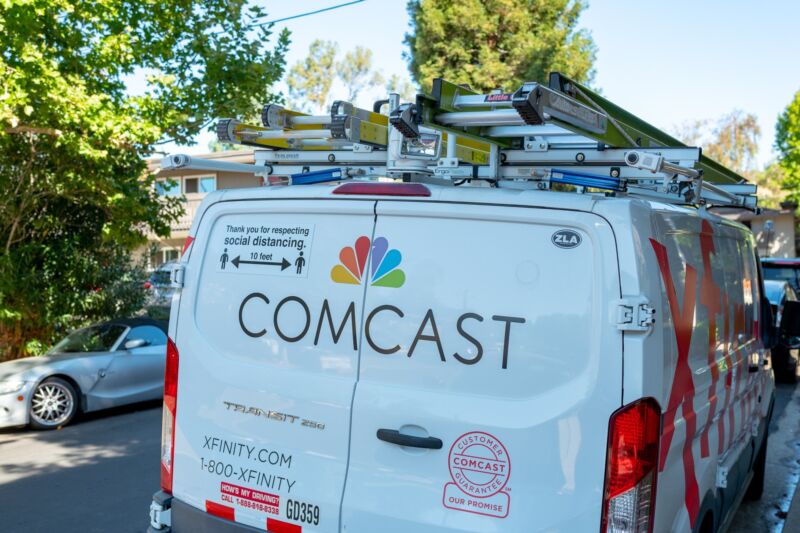
A Comcast service van seen from behind.
Getty Images | Smith Collection/Gado

Internet service provider horror stories have been a longtime staple at Ars Technica, and over the past 12 months we detailed some of the most horrific broadband customer experiences we’ve ever heard of.

Comcast, the largest home Internet provider in the US, figured prominently in these stories as usual. Let’s take a look back at the biggest ISP horror stories we covered in 2022.

Comcast wanted man to pay $19,000 after falsely advertising service on his street

This article from April 6 detailed the plight of Jonathan Rowny after he and his wife and child moved from Virginia to Washington state. Rowny was victimized by a common problem in the broadband industry—ISPs falsely telling customers that service is available.

Rowny said he scheduled a Comcast installation for the day after they moved into the new house, in May 2021, only to have Comcast cancel the order because the house wasn’t wired. Despite Comcast falsely advertising that service was available, the cable company told Rowny he’d have to pay over $19,000 for a line extension.

Rowny lowered his upfront cost to about $10,000 by hiring a contractor to do part of the work. But the family had to go without wired Internet service for over six months partly because Comcast construction took longer than expected.

Even after construction seemingly finished in mid-December 2021, Comcast initially refused to schedule an installation appointment because the company’s internal systems incorrectly showed the house still wasn’t serviceable.

“I spent weeks calling Comcast, and they said, ‘Your house is not serviceable, and our records show it will be serviceable in April [2022],'” Rowny said. “Staring at this connection box in my yard that I paid $10,000 for and not being able to get Internet still—I think that was the most frustrating part,” he added.

An email from a Comcast store manager told Rowny that “the current hurdle is the billing system. You can’t activate any equipment or service in our system until the billing codes are in place. I can’t put the billing codes in place until I can get the Serviceability team to recognize the address is serviceable.”

Desperate for a solution, Rowny had to escalate the problem to a Comcast regional vice president. The executive was able to help, and Rowny finally got his Comcast service connected on January 13, 2022. Comcast told Ars that it was “very sorry for the inconvenience all of this has caused.”

Couple bought home in Seattle, then learned Comcast Internet would cost $27,000

Zachary Cohn and his wife, Lauryl Zenobi, assumed they’d be able to get home Internet service when they bought a house in Seattle. The house was surrounded on all sides by houses that had Comcast service, but they learned after closing that it was never wired up.

“All six neighbors I share a property line with are wired for Comcast, but our house never was,” Cohn told Ars, saying he was “flabbergasted that a house like this, in an area like this, could possibly have never been wired for Internet.” Because the house is “in the middle of Seattle, it didn’t even dawn on me that that was possible,” he said.

Getting any information from Comcast was nearly impossible. After about eight months of trying to get an answer on how they could get Internet service, Cohn gave up on contacting Comcast directly and reached out to a member of the Seattle City Council. Finally, Comcast revealed that it would only provide Internet service if the homeowners paid over $27,000 upfront.

Cohn and Zenobi decided not to pay, and they continued to rely on a mobile hotspot, despite working at home. “I’m just very nervous about dropping $27,000 to lock myself into a company who can then jack the rates up, and we don’t even have the classic ‘send me to your retention department because I’m going to threaten to quit and switch to another company’ argument. You just have to pay whatever they want to charge,” Cohn said.

Comcast wanted $210,000 for Internet—so this man helped expand a co-op fiber ISP

This story from October 2022 mixes elements of horror with feel-good vibes. Sasha Zbrozek bought a house in Los Altos Hills, California, in December 2019, only to learn afterward that the house wasn’t wired.

Zbrozek recalled a Comcast agent telling him it would be “no big deal” to connect the house he was buying, and several of his neighbors had Comcast service. But after Zbrozek spent more than a year trying to get information from Comcast about a line extension, Comcast told him in February 2021 that it would charge him $210,000 to run cable about 700 feet.

By the time Comcast finally provided that estimate, Zbrozek had gotten involved with a co-op ISP called Los Altos Hills Community Fiber (LAHCF). He’s now an LAHCF board member, and he organized an expansion that brought multi-gigabit fiber Internet service to his home and others on nearby roads.

“Residents just get tired of having to deal with telcos, and they just want to take this into their own hands,” LAHCF Board President Scott Vanderlip told Ars. LAHCF’s network was built by a company called Next Level Networks, which uses a model in which residents own the infrastructure and split the upfront costs.

Next Level has six broadband networks either built or in progress in California and plans to expand to other states, CEO David Barron told Ars. Next Level’s approach is based on “the idea of microscale networks rather than doing municipal-wide builds, just doing neighborhoods, home associations, buildings, whatever the case may be, where you know that there is demand, and having them actually share the cost of the network,” he said.

https://arstechnica.com/?p=1905715


No more TikTok on House of Representatives’ smartphones

No more TikTok on House of Representatives’ smartphones


TikTok will no longer be allowed on any device managed by the US House of Representatives. On Tuesday, the House’s Chief Administrative Office announced the ban of the popular video-sharing app, a move that comes just a week after legislation that would bar TikTok from all federal devices was introduced.

Congresspersons and their staffers will not be able to download the app on managed devices, the CAO’s Office of Cybersecurity said in an email seen by Reuters. The mobile app is a “high risk to users due to a number of security risks,” the email said.

“If you have the TikTok app on your House mobile device, you will be contacted to remove it,” the email continued.

Potential federal bans aside, TikTok is already at least partially banned from government-owned devices in 19 states. And the federal omnibus spending bill passed last week will put the kibosh on TikTok when it comes to all federally managed smartphones and devices.

TikTok has been in discussions with the federal government over the security of user data, offering assurances that data on US-based users would be stored on servers within the US that are inaccessible to China-based employees.

Those assurances are even more likely to fall flat after we learned TikTok was spying on reporters. Four employees of TikTok parent ByteDance surveilled a handful of journalists, using IP and log-in data, routinely accessing the journalists’ TikTok accounts as part of an internal investigation of who was leaking company material to reporters. ByteDance fired Chief Internal Auditor Chris Lepitak, the head of team behind the surveillance campaign, along with a few employees.

2023 is going to be a challenging year for both TikTok and its owner ByteDance. Short of selling the app to an American owner, which ByteDance is apparently unwilling to do, there seems to be very little the company can do to assuage governments’ growing privacy and user-tracking concerns.

https://arstechnica.com/?p=1906817


Musk contradicts Twitter safety chief, disavows statement as “fake news”

Musk contradicts Twitter safety chief, disavows statement as “fake news”

Ever since The Verge reported that Twitter shut down its communications office, it’s been harder to confirm information about the company, which seems to be the way that CEO Elon Musk likes it. However, increasingly, Twitter trust and safety chief Ella Irwin seems more willing to confirm or deny rumors to media outlets, a move that’s possibly irking Musk. Over the holiday weekend, Musk tweeted to directly contradict a statement Irwin provided to Reuters, causing even more confusion over what’s going on at Twitter—and whether there’s tension brewing between Musk and Irwin.

The timeline of the contradictory statements went like this: On Friday, Dec. 23, Reuters reported that Twitter had seemingly removed the social media platform’s #ThereIsHelp feature, which was designed to share suicide-prevention resources alongside certain content.

Shortly after Reuters’ report went live, Irwin emailed Reuters to confirm that the feature was “temporarily removed.” She said that it would be brought back this week, once Twitter finished “fixing and revamping our prompts.”

“We know they are useful, and our intent was not to have them down permanently,” Irwin told Reuters.

The very next day, at 6:27 a.m. on Christmas Eve, Musk tweeted to contradict Irwin’s statement, saying that Reuters’ report was false and the feature was never removed. In another tweet soon after, Musk declared Reuters’ report “fake news,” while reminding Twitter users that “Twitter doesn’t prevent suicide.”

Approximately 12 hours later, Reuters confirmed that the feature was restored, continuing to contradict Musk’s statement that the feature was never removed. That second report credited “two people familiar with the matter” as saying that the #ThereIsHelp feature had been down for two days and claiming that the takedown order had come from Musk.

As of this writing, it’s still unclear which Twitter executive is telling the truth. A tweet linking to the initial Reuters report currently displays a community note sharing Musk’s statement clarifying that the report is false, suggesting enough users rated Musk’s statement above Irwin’s. Musk did not respond to tweets from both legacy blue checks and Twitter Blue verified blue checks, asking if he was calling Irwin a “liar” or if he planned to fire Irwin.

Twitter did not respond to Ars’ request to clarify. Perhaps due to the holidays, Irwin has gone silent on Twitter; her last tweet was sent on Dec. 20.

“Direction of Ella”

According to her LinkedIn profile, Irwin joined Twitter’s trust and safety team last June, after working in similar roles at Google, Amazon, and Twilio. She rose to the top trust and safety post after Yoel Roth exited Twitter shortly after Musk took over.

Many Twitter users became familiar with Irwin after her handle appeared as a watermark during Musk’s release of “The Twitter Files,” indicating that she was the one feeding journalists internal files from Twitter.

A few days later, when Twitter began suspending journalists, the Washington Post reported that internally, the suspensions were marked as ordered not by Musk, but by “direction of Ella.”

It’s possible that after a few media cycles scrutinizing Twitter safety features, Irwin’s interest grew in setting the record straight, and she will likely only continue to be scrutinized for any trust and safety policy changes as long as she remains at Twitter. But with the communications department seemingly nonexistent—and after Musk’s rush to contradict one of the few official statements provided by a Twitter exec to media since his takeover—it seems unlikely that Irwin will clarify anytime soon whether she made “false” statements about Twitter removing the suicide prevention feature.

While Irwin dealt with some backlash from users who have defended Musk as a proven truth teller, Musk was busy introducing another new Twitter feature that has become controversial. On Dec. 22, Twitter added Views to the other metrics publicly displayed on tweets. These view counts now appear alongside likes, comments, and retweets.

Over the next couple days, however, many users had criticized the new feature. Some suggested that it went against research on platforms like Facebook and Instagram and could negatively impact mental health of Twitter users. But perhaps millions more hated the feature simply because of how janky the views display looked jammed next to retweets and likes. By Dec. 24, Musk announced that soon Twitter users would be able to toggle the feature off.

“I think almost everyone will grow to like it,” Musk tweeted, almost like it was his Christmas wish to introduce a universally popular Twitter feature and blissfully break free from all the backlash he’s faced since stepping up as Chief Twit.

https://arstechnica.com/?p=1906814