19 states choke TikTok on gov’t devices; feds push for nationwide restrictions
In the past two weeks, United States lawmakers have increasingly restricted access to China-owned TikTok on government-managed devices. TikTok is one of the most popular apps in the world. Most recently, state agencies in Louisiana and West Virginia yesterday implemented new bans to prevent TikTok from tracking government employees or censoring their content. According to Reuters, that brings the total up to 19 out of 50 US states that have “at least partially blocked access on government computers to TikTok.”
It seems that states are taking what actions they can to protect US data, as, for months, President Joe Biden has seemingly dragged his feet after reportedly coming close to completing a deal with TikTok that would prevent a nationwide ban from wrenching the popular app out of the hands of 100 million Americans. Now news outlets report that it’s unlikely that Biden will seal that deal before the year ends. The New York Times reported that the deal’s terms are “unlikely to satisfy anyone.”
While Biden ponders his potential agreement, Congress seems just as ready as states to move more aggressively against TikTok. Just today, Congress introduced a new spending proposal that included a plan to restrict TikTok access for all federal employees on all government devices. Last week, the Senate voted to approve a similar ban restricting all federal employee access to the app. Reuters reported that this week, the US House of Representatives would have to approve that bill before passing it on to Biden. Even more aggressively, last week, Congress also introduced bipartisan legislation that went even further, seeking to ban TikTok for all users nationwide, citing national security concerns.
TikTok has repeatedly issued statements to Ars, saying that all these state and potential federal bans “will do nothing to advance the national security of the United States.”
If the federal ban restricting TikTok on government devices passes in the House, Reuters reported that the White House Office of Management and Budget would have 60 days to develop standards and guidelines for federal employees impacted by the ban.
Where is TikTok already blocked?
In the US, TikTok access is already restricted by some federal agencies, including all US military, the White House, the Department of Defense, the Department of Homeland Security, and the State Department.
Louisiana and West Virginia join other states imposing at least some restrictions on TikTok access on state devices, including Alabama, Florida, Georgia, Idaho, Iowa, Maryland, Montana, Nebraska, New Hampshire, North Dakota, Oklahoma, South Carolina, South Dakota, Tennessee, Texas, Utah, and Virginia. Most of these states announced new restrictions within the past few weeks, indicating mounting pressure to widely restrict TikTok in the US.
https://arstechnica.com/?p=1905904
Ukraine to get 10,000 more Starlink antennas; funding problems are “resolved”
Enlarge/ A Starlink satellite dish in Odesa, Ukraine, in March 2022.
Getty Images | NurPhoto
Ukraine will get more than 10,000 more Starlink terminals in the coming months thanks to a new deal with SpaceX and funding from several European countries, Ukraine government official Mykhailo Fedorov said in an interview with Bloomberg. Fedorov said that “all financial issues have been resolved,” at least until the spring.
SpaceX previously asked the Pentagon to fund the Ukraine government and military’s use of Starlink broadband, saying it can’t afford to donate more user terminals or pay for operations indefinitely. But CEO Elon Musk backtracked from that stance in October, writing, “The hell with it… even though Starlink is still losing money & other companies are getting billions of taxpayer $, we’ll just keep funding Ukraine govt for free.”
Fedorov, Ukraine’s vice prime minister and minister of digital transformation, said in the new interview with Bloomberg that “Musk assured us he will continue to support Ukraine. When we had a powerful blackout, I messaged him on that day and he momentarily reacted and has already delivered some steps. He understands the situation.”
Starlink’s satellite Internet service has been vital for Ukraine’s military amid disruptions to wired broadband networks. “There is no alternative to satellite connections,” Fedorov told Bloomberg during the interview in his office in Kyiv.
Governments partially funded Starlink for Ukraine
Although the US government helped fund Starlink service in Ukraine, Musk wrote on October 7 that “only a small percentage” of Starlink terminals and service were paid for by outside sources and that the “operation has cost SpaceX $80M & will exceed $100M by end of year.”
The US Agency for International Development purchased 1,508 Starlink terminals for Ukraine in March for about $3 million and “delivered an additional 3,667 terminals that SpaceX donated, with the company paying for Internet service for all the terminals,” a Foreign Policy report last month said. Poland’s government “has paid around $5.9 million for Starlink services [in Ukraine], with support from Polish state enterprises,” and the UK has contributed as well, the report said.
Fedorov told Bloomberg that Ukraine has received about 22,000 Starlink antennas since February, not including the 10,000 expected to be sent in the coming months. He also described new funding deals with European countries:
While there’s no contract yet, the governments of several European Union countries are ready to share payment, he said, declining to publicly identify them. “As of now all financial issues have been resolved,” he said, adding that Ukraine will need to find additional funding in the spring.
Ukraine is preparing for possible long-term outages “if Russia manages to further destroy the country’s energy infrastructure,” the Bloomberg story noted.
“We are ready to live without electricity for a month with at least mobile network and text messages being available,” Fedorov was quoted as saying. “Regarding Internet, we have a lot of Starlinks, but the key point is we have got a nod for another shipment that will be used to stabilize connection for critical situations.”
https://arstechnica.com/?p=1905838
Lobbyists have held up nation’s first right-to-repair bill in New York
Enlarge/ Tech companies, including Apple, have lobbied hard to prevent a New York bill that would require them to make repair information and parts available to individuals and non-affiliated repair techs.
Getty Images
The Digital Fair Repair Act, the first right-to-repair bill to entirely pass through a state legislature, is awaiting New York Governor Kathy Hochul’s signature. But lobbying by the nation’s largest technology interests seems to have kept the bill parked on her desk for months, where it could remain until it dies early next year.
Gay Gordon-Byrne, executive director of the Repair Association, said that “opposition has not backed off” despite the bill’s nearly unanimous passage in June. Gordon-Byrne has heard that industry groups are pushing for late amendments favoring tech firms but that the bill’s sponsors would have to approve—or convince the governor to sign the bill without them. “It’s up to the sponsors at this point,” she said.
The final version of the bill received rare bipartisan support, passing the state assembly 147–2 and the senate 59–4. The bill was delivered to the governor Friday, according to the New York Senate’s bill tracker, though she has been considering it since late June.
As written, the Digital Fair Repair Act would require the makers of “digital electronic parts and equipment” to make diagnostic and repair instructions, and parts, available to consumers and non-affiliated repair workers, so long as those makers already provide them to their own technicians or authorized repair networks.
The Digital Fair Repair Act, and similar bills introduced in 41 other states this year, aims to expand repair options for devices. Advocates say that lack of documentation and spare parts access, plus software restrictions that thwart repairs outside companies’ networks, limit consumer choice, raise ownership costs, and add to a growing e-waste stream. Manufacturers and trade groups have countered that authorized, serialized repairs are necessary to ensure product quality, avoid injuries, and protect their intellectual property.
Since passing in June, the New York bill has been aggressively lobbied by various trade groups to limit its impact. An earlier version of the bill would have included lawn equipment, gaming consoles, and appliances, but a “burst of end-of-session lobbying from companies worth billions and their affiliated trade associations” succeeded in stripping the bill down to small electronics, according to the Times Union of Albany. Assemblymember Patricia Fahy, the bill’s sponsor, slimmed it down to ensure some part of it could pass in June.
State filings showed that trade group TechNet (not to be confused with Microsoft’s social/wiki entity) and lobbyists for Microsoft and Apple jumped in then, focusing their efforts on Hochul’s office as the bill seemed destined to pass. The Times Union reported that Apple, Google, HP, and Microsoft all paid lobbyists from “the highest-earning professional lobbying firms in Albany” to push back against the bill at the legislative and executive levels.
We’ve reached out to TechNet and will add to this post if we hear back.
Because the bill was delivered Friday while the New York Legislature was out of session, the governor has 30 days to act on the bill. Failing to act has the same effect as a veto (a “pocket veto”). The bill was originally introduced in 2021, so it cannot be easily re-introduced during the next session and would have to be re-drafted and submitted.
A spokesperson for the governor’s office told VICE’s Motherboard on October 31 that “Governor Hochul is reviewing the legislation.” Asked about the bill’s status today by Ars Technica, a spokesperson responded that “Governor Hochul is reviewing the legislation.”
Disclosure: The author has previously worked for iFixit, a company active in right-to-repair advocacy. He holds no financial stake in the company.
https://arstechnica.com/?p=1905487
Musk’s alleged stalker identified; no evidence of ElonJet tracking, report says
Police have since investigated the incident, and the alleged stalker, Brandon Collado, has come forward. On Saturday, Collado reportedly even tweeted directly at Musk to say, “I am the guy in the video.”
But so far, police told The Washington Post, there’s “no evidence to suggest the man police were investigating had used the jet-tracking account.” The Post also found no evidence that either of Musk’s kids were in the car when the incident occurred. Police told The Post that no arrests had been made, and no crime reports had been filed by Musk or his security team.
Twitter, Musk, and Sweeney could not immediately be reached by Ars for comment. [Update: Sweeney told Ars that he has received no legal notices from Musk so far, suggesting that at this point, any legal action from Musk would just make Musk “look worse.” Sweeney finds it “kind of suspicious” that the incident happened almost a day later, so far from the airport, and seemed to follow internal Twitter Slack discussions—that an employee shared with Sweeney—which suggested that Twitter was considering restricting visibility of his @ElonJet account starting December 2. For now, his account remains suspended, and Sweeney told Ars that he removed the Twitter app from his phone to prevent the company from tracking his device. The whole experience has turned him off to Twitter almost entirely, he said. “I don’t know if I would want to use Twitter because they would just be watching everything I would do,” Sweeney said.]
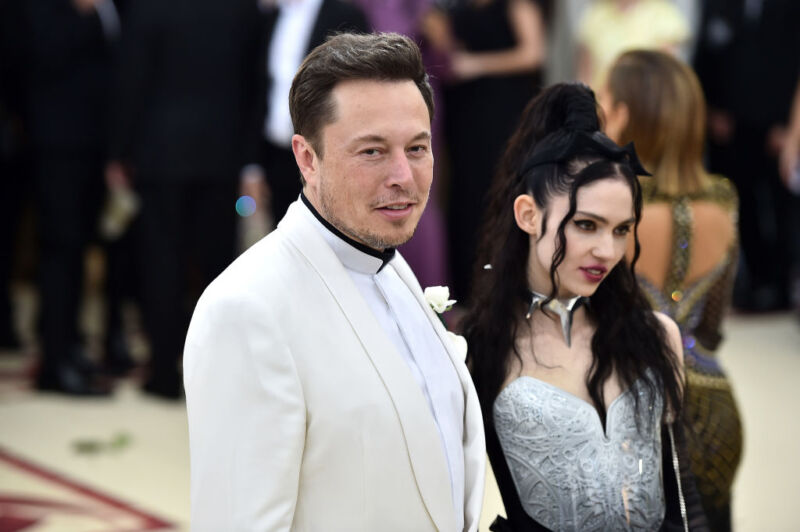
According to The Post, the incident occurred approximately 23 hours after Musk’s jet landed at an airport near a gas station in south Pasadena. The gas station is about 26 miles from the airport but right down the street from Musk’s ex-girlfriend Grimes’ house.
Collado told The Post that he had “an interest” in Musk and Grimes, whose real name is Claire Elise Boucher. Collado claimed that he stopped by the gas station after working as an Uber Eats delivery driver and visiting a friend in Boucher’s neighborhood. Once he got to the gas station, Collado claimed that Musk’s security worker confronted him “without reason.” Afterward, police arrived and told Collado that police would be filing a report after he answered questions. Collado told The Post that he has not heard from police since.
Collado apparently believed that Grimes was sending him coded messages via her Instagram posts and that Musk had been tracking Collado in real time, perhaps even blocking Collado from receiving Uber Eats delivery orders. In his tweet to Musk, which seems to have since been deleted, The Post reported that Collado claimed that Musk has “connections to me” and has “stalked me and my family for over a year.”
Uber did not immediately respond to Ars’ request for comment on Collado’s current status as an Uber Eats delivery driver.
https://arstechnica.com/?p=1905518
Musk polls Twitter users on whether he should be CEO—57.5% want him to quit
Aurich Lawson
Elon Musk polled Twitter users yesterday on whether he should remain as the company’s CEO and claimed he would abide by the results. The poll concluded with 17.5 million votes, with a large majority urging Musk to step down.
“Should I step down as head of Twitter? I will abide by the results of this poll,” Musk wrote. The “Yes” option was selected by 57.5 percent of poll respondents.
Musk hasn’t confirmed whether he will actually step down. “The question is not finding a CEO, the question is finding a CEO who can keep Twitter alive,” Musk wrote last night after posting the poll. “No one wants the job who can actually keep Twitter alive. There is no successor,” he also wrote in response to a tweet speculating that he “already has the new CEO picked out.”
Even if Musk does cede the CEO title, he would still be in charge as the owner of Twitter. Musk has said in the past that “CEO is a made-up title” and doesn’t “mean anything.” He has called himself the “Technoking” of Tesla and “Chief Twit” at Twitter, but officially is the CEO of both of those companies and SpaceX.
Musk has also previously said he intends to eventually give up the top spot at Twitter. “I expect to reduce my time at Twitter and find somebody else to run Twitter over time,” Musk said last month in testimony during a trial over his pay at Tesla.
Musk promises votes on major policy changes
Meanwhile, Musk wrote yesterday that Twitter will rely on polls for major policy changes in the future. Over the weekend, Twitter implemented but then quickly deleted a policy that banned links to other social media platforms such as Facebook, Instagram, Mastodon, and Truth Social.
“At both the Tweet level and the account level, we will remove any free promotion of prohibited 3rd-party social media platforms, such as linking out (i.e. using URLs) to any of the below platforms on Twitter, or providing your handle without a URL,” the now-deleted policy says. The policy also said that accounts “used for the main purpose of promoting content on another social platform may be suspended.”
“Going forward, there will be a vote for major policy changes. My apologies. Won’t happen again,” Musk wrote.
The official Twitter Safety account announced the ban on social media links in a series of tweets yesterday, but those tweets were deleted. Shortly after Musk promised to hold votes on major policy changes, the Twitter Safety account posted a poll asking whether Twitter should “have a policy preventing the creation of or use of existing accounts for the main purpose of advertising other social media platforms.” The poll runs for 24 hours and ends tonight.
https://arstechnica.com/?p=1905482
Twitter stiffs software vendor with $8 million left on contract, lawsuit says
Getty Images | NurPhoto
A lawsuit says Twitter failed to pay a $1,092,000 invoice in a software contract that doesn’t expire until late 2024, and that the Elon Musk-led company apparently intends to stiff the vendor on another $7 million worth of payments.
Imply Data, Inc. sued Twitter in California Superior Court in San Francisco County, alleging breach of contract. The lawsuit was filed on Tuesday (see complaint) and reported by Bloomberg today.
“For over four years, Imply has licensed its proprietary software to Twitter, and Twitter has paid Imply over $10 million,” the lawsuit said. “Twitter has always been very pleased with Imply’s product and its related maintenance and support services, so, in mid-2021, the parties extended the term of their software license and service agreement for an additional three years from October 1, 2021, through September 30, 2024.”
In May, a few weeks after Musk struck a deal to buy Twitter, the company notified Imply Data that it would not renew the contract again but “acknowledged the License agreement would ‘continue in full force and effect’ until the end of its term on September 30, 2024,” the lawsuit said.
Payments stopped after Musk took over
Twitter continued making quarterly payments on the contract until Musk completed the purchase in late October. “However, shortly after Musk’s purchase of Twitter closed, Twitter refused to pay the outstanding quarterly invoice, which was due on November 30, 2022, and Twitter disclaimed any obligation to pay any future invoices from Imply, despite the unambiguous language in the software license and service agreement requiring Twitter to do so,” the lawsuit said.
Imply makes a database based on Apache Druid open source software as well as products for managing and monitoring Druid clusters.
The New York Times reported on November 22 that Twitter was stiffing some vendors. Imply’s complaint notes the press coverage of Twitter refusing to pay vendors and says, “This lawsuit involves one such egregious case.”
Imply uploaded the $1,092,000 invoice to Twitter’s vendor portal, and the invoice was approved by Twitter on October 5, the lawsuit said. “On November 28, 2022, when Imply accessed the vendor portal, Imply learned that Twitter had deleted the invoice and closed the License Agreement,” the lawsuit said.
“We will not be paying Imply any longer”
Imply says Twitter “also uploaded an internal email chain to the vendor portal to support those actions.” The lawsuit said this email chain included a message from Martin O’Neill, head of global strategic sourcing at Twitter, that stated, “A heads up that we will not be paying Imply any longer. If we can flag them in our AP system to not route any of their invoices for approval that would be great, thank you!”
The Twitter executive who received the email, Kristena Bravo, “forwarded that email to other Twitter employees and wrote: ‘Can you please cancel all invoices for Imply currently pending in Oracle (if any) and deactivate the supplier using the email below as evidence?'” the lawsuit said.
After reviewing these emails, Imply asked Twitter about the status of the payment due November 30. “Twitter’s account payable department notified Imply that the invoice had been ‘cancelled’ and that, if Imply had any concerns, Imply should ‘reach out to [Imply’s] Twitter business partner.’ Imply has reached out to Twitter to discuss the cancellation of the invoice; however, Twitter has not yet responded in substance to that outreach,” the lawsuit said.
Imply is seeking financial damages for breach of contract. “Imply anticipates that Twitter’s breach will continue, with the amount in default increasing each quarter until the end of the License Agreement’s term… Twitter’s breach has damaged and will damage Imply in an amount that will be proven at trial, but which will likely be in excess of $8 million,” Imply told the court.
Dispute over whether Twitter can terminate contract
The lawsuit also alleges breach of covenant of good faith and fair dealing, and anticipatory repudiation. The latter term describes when a party to a contract declares they do not intend to live up to their contractual obligations.
“Twitter has expressly, unequivocally, and absolutely repudiated and renounced the License Agreement by declaring that Twitter would not pay Imply and instructing its employees not to approve any invoices and to deactivate Imply from the vendor portal. Twitter has thereby breached the License Agreement,” the lawsuit said.
Twitter may argue it had a right to terminate the contract early. Imply’s complaint said there is a dispute between the companies as to “whether Twitter had the unilateral right to terminate the License Agreement before the end of its term.” Imply is seeking a declaratory judgment that Twitter doesn’t have that right.
We contacted Twitter about the lawsuit, but the company reportedly dismantled its public relations team after Musk took over.
https://arstechnica.com/?p=1905345
Musk suspends NYT and WaPo reporters from Twitter, claims they doxxed him
Getty Images | Nathan Stirk
Twitter owner and CEO Elon Musk is now suspending some journalists who write about him, including reporters from The New York Times, Washington Post, and CNN. The journalist suspensions seem to be part of Musk’s quest to erase references or links to the now-suspended ElonJet account that used publicly available data from ADS-B Exchange to track Musk’s private jet.
Musk claimed the suspended journalists violated the new policy that bans sharing of live locations in most scenarios. Musk wrote that the “same doxxing rules apply to ‘journalists’ as to everyone else” and that the suspended journalists “posted my exact real-time location, basically assassination coordinates, in (obvious) direct violation of Twitter terms of service.”
It appears that simply posting a link to the ElonJet account on other social networks is enough for a suspension.
“I have no idea what rules I purportedly broke. I haven’t heard anything from Twitter at all,” journalist Aaron Rupar wrote on his Substack. He later added an update, writing that “it occurred to me just after I published this that I did post a tweet yesterday noting that the ElonJet account that was suspended from Twitter was still active on Facebook, with a link to the Facebook page. As hard as it may be to interpret linking to a Facebook page that uses publicly available information to track a private jet as violating a ‘doxxing’ policy, it appears that’s what Twitter did to justify my banning.”
Mashable journalist Matt Binder, who was also suspended, said he did not post any links to ElonJet or any other location-tracking accounts. Washington Post reporter Drew Harwell was suspended and he disputed Musk’s claim that he violated the doxxing policy, as Reuters wrote:
Harwell, however, was able to speak on a Twitter Spaces conversation with fellow journalists late on Thursday evening, a chat that Musk himself briefly dropped in on.
“You dox, you get suspended. End of story,” Musk said on the chat as Harwell rejected the assertion that he had exposed Musk’s real-time location, saying he had simply posted about @elonjet.
The suspensions may be temporary as Musk polled his followers on whether “accounts who doxxed my exact location in real-time” should be reinstated now, or in seven days.
Washington Post: “Our journalist should be reinstated”
In what was apparently Harwell’s last post before being suspended, he wrote that Twitter suspended the account of rival social network Mastodon “because it posted a link to its own website’s version of @ElonJet—public, legally acquired data that Twitter decided two days ago was against the rules. Loving the free speech.”
Washington Post Executive Editor Sally Buzbee said Harwell’s suspension “directly undermines Elon Musk’s claim that he intends to run Twitter as a platform dedicated to free speech. Harwell was banished from Twitter without warning, process or explanation, following the publication of his accurate reporting about Musk. Our journalist should be reinstated immediately.”
Suspended journalists also include Ryan Mac of The New York Times, Donie O’Sullivan of CNN, Micah Lee of The Intercept, commentator Keith Olbermann, Steve Herman of the government-funded Voice of America, and freelance journalist Tony Webster.
According to CNN, “A New York Times spokesperson called the mass bans ‘questionable and unfortunate,’ adding: ‘Neither The Times nor Ryan have received any explanation about why this occurred. We hope that all of the journalists’ accounts are reinstated and that Twitter provides a satisfying explanation for this action.'” Also, a “CNN spokesperson said the company has asked Twitter for an explanation, and it would ‘reevaluate our relationship based on that response.'”
“Webster said he had been tweeting about @ElonJet” but “said he received no explanation of the social media platform’s decision,” Politico wrote.
https://arstechnica.com/?p=1905198
TikTok would be banned from US “for good” under bipartisan bill
In September, President Joe Biden announced that TikTok would remain accessible in the US once a deal could be worked out to assuage national security concerns. At that time, Biden said it would take months for his administration to weigh all the potential risks involved in inking the deal. Among detractors of the brewing deal, Senator Marco Rubio (R-FL) and Congressman Mike Gallagher (R-WI) emerged, alleging in a Washington Post op-ed that any deal that Biden arranged with the Chinese-owned social media platform “would dangerously compromise national security.”
Now, Marco and Gallagher have teamed up with Congressman Raja Krishnamoorthi (D-IL) to introduce new bipartisan legislation in the Senate and House of Representatives, formally calling for a ban on TikTok. It’s the only way, lawmakers feel, that TikTok can truly be stopped from collecting sensitive data on Americans for the Chinese Communist Party (CCP) and censoring content to influence elections, sow discord, or potentially even “indoctrinate” users.
“The federal government has yet to take a single meaningful action to protect American users from the threat of TikTok,” Rubio said in a press release. “We know it’s used to manipulate feeds and influence elections. We know it answers to the People’s Republic of China. There is no more time to waste on meaningless negotiations with a CCP-puppet company. It is time to ban Beijing-controlled TikTok for good.”
The bill—officially known as the ‘‘Averting the National Threat of Internet Surveillance, Oppressive Censorship and Influence, and Algorithmic Learning by the Chinese Communist Party Act’’ or the ‘‘ANTI-SOCIAL CCP Act”—is designed to block and prohibit all transactions by social media companies controlled or influenced by “countries of concern.” The legislation specifically names TikTok and owner ByteDance as existing national security threats. But if passed, its provisions would also extend to any social media platform controlled by other US foreign adversaries, including Russia, Iran, North Korea, Cuba, and Venezuela.
TikTok spokesperson Brooke Oberwetter told Ars that the company considers the bipartisan legislation most recently introduced “politically motivated.”
“It is troubling that rather than encouraging the [Biden] Administration to conclude its national security review of TikTok, some members of Congress have decided to push for a politically-motivated ban that will do nothing to advance the national security of the United States,” Oberwetter told Ars.
In talks with the Committee on Foreign Investment in the United States, TikTok reportedly agreed to take steps to address US national security concerns, including storing American user data on US servers to prevent China-based employees from accessing American data. TikTok also said it would grant US-based Oracle permission to monitor recommendations churned out by its algorithm, as well as form a TikTok board of security experts that reported directly to the US government.
TikTok’s motivation to work closely to appease the Biden administration, Oberwetter said, was to ensure that “millions of Americans who use the platform to learn, grow their businesses, and connect with creative content that brings them joy” wouldn’t lose access.
But what Oberwetter describes as a joyful experience that more than 100 million Americans have using TikTok, Gallagher describes in Rubio’s press release as giving Americans access to “digital fentanyl that’s addicting Americans, collecting troves of their data, and censoring their news.”
“Allowing the app to continue to operate in the US would be like allowing the USSR to buy up the New York Times, Washington Post, and major broadcast networks during the Cold War,” Gallagher said.
In their op-ed, Gallagher and Rubio pointed to LinkedIn profiles connecting ByteDance employees with China propaganda outlets, as well as a concerning report from Forbes, showing that TikTok “planned to use the app to monitor the locations of American citizens for undisclosed purposes unrelated to advertising.”
Since then, Rep. Krishnamoorthi joined their cause, saying in the press release that “at a time when the Chinese Communist Party and our other adversaries abroad are seeking any advantage they can find against the United States through espionage and mass surveillance, it is imperative that we do not allow hostile powers to potentially control social media networks that could be easily weaponized against us.”
Krishnamoorthi told Ars that Biden’s deal—which would allow TikTok to continue operating in the US while China still controls ByteDance—seemingly would be too risky. As long as ByteDance is China-owned, ByteDance could be required to hand over data by the country’s 2017 National Intelligence Law, and it’s hard for Krishnamoorthi to see how any deal struck with the US would permit ByteDance to skirt that Chinese law.
Krishnamoorthi said that because of concerns over TikTok data, he’s found that there’s “widespread concern” on “both sides of the aisle” in Congress over how to handle TikTok’s growing influence and popularity in the US. He also told Ars that he’s worried about evidence showing TikTok’s already censored content opposed by the CCP. “It’s a toxic brew of concerns that at this point, I think, is widely shared,” Krishnamoorthi told Ars.
“Recent revelations surrounding the depth of TikTok’s ties to the CCP highlight the urgency of protecting Americans from these risks before it’s too late,” Krishnamoorthi warned in the press release.
For Kirshnamoorthi, the only acceptable way for TikTok to keep operating in the US would be if Biden could make it so that “it’s controlled by an American company or American interests.”
Spokespersons for Rubio and Gallagher declined to comment further.
While Congress weighs the ANTI-SOCIAL CCP Act, Oberwetter said that TikTok plans to keep working to persuade US officials that TikTok isn’t a national security risk.
“We will continue to brief members of Congress on the plans that have been developed under the oversight of our country’s top national security agencies—plans that we are well underway in implementing—to further secure our platform in the United States,” Oberwetter told Ars.
https://arstechnica.com/?p=1904154
DOJ divided over charging Binance for alleged crypto crimes, report says
Suspected of alleged money laundering, tax evasion, and US sanctions violations, Binance has been under investigation by the US Department of Justice since 2018 but has never been formally accused of any wrongdoing. Now, Reuters reports that some federal prosecutors feel they’ve amassed enough evidence to file criminal charges against Binance—including individual charges against Binance founder Changpeng Zhao—but other DOJ officials are standing in the way.
Reuters reviewed Binance records and spoke to nearly a dozen sources to compile a “comprehensive” progress report detailing DOJ’s inquiry so far. Sources included former Binance advisers, as well as current and former US law enforcement officials. These sources told Reuters that prosecutors spread across three DOJ offices—the Money Laundering and Asset Recovery Section (MLARS), the US Attorney’s Office for the Western District of Washington in Seattle, and the National Cryptocurrency Enforcement Team (NCET)—would have to agree “on any action against Binance.” But for now, they can’t agree. It seems that while NCET and the Seattle office are eager to prepare charges, MLARS leadership is causing further delay because they want more time to weigh all the evidence gathered against the world’s largest cryptocurrency exchange.
According to Reuters, evidence shows that Binance allegedly spent the past year processing “over $10 billion in payments for criminals and companies seeking to evade US sanctions,” while keeping “weak anti-money laundering controls” and plotting to evade regulators both in the US and globally.
While no charges have been filed, Binance has seemingly devoted resources to persuading DOJ against taking any actions. In the past few months, sources said that Binance lawyers have even met with DOJ to discuss potential plea deals. During those meetings, Binance lawyers reportedly also expressed concerns that the DOJ filing charges now could further disrupt the already crashing cryptocurrency market.
Amid the crypto crash, Binance continues to be influential as the most dominant crypto exchange platform, positioning itself as the hero crypto needs to reverse the current market downturn. Today, as Reuters published its report, Binance published a blog from Tigran Gambaryan—a former IRS cybercrimes special agent who’s now the company’s global head of intelligence and investigations—seemingly getting ahead of the Reuters report by discussing how Binance fights against crypto crime.
“Crypto is NOT a safe haven for illicit activities,” Gambaryan wrote in his blog. “I know this is the truth for Binance, at least.”
The blog doesn’t mention DOJ’s investigation, or the company’s alleged activity involving money laundering or sanctions violations. Instead, Gambaryan reports more generally on Binance efforts taken since November 2021, including responding to “more than 47,000 law enforcement requests” and drastically expanding the exchange’s security and compliance teams to span 300 investigators that are dedicated to protecting users from bad actors.
“We are proud to have in our ranks some of the most celebrated cyber investigators representing virtually every single major international law enforcement agency across the globe,” a Binance spokesperson told Reuters.
Binance has been scrutinized by DOJ for its supposedly secretive policies, with founder Zhao allegedly instructing staff to encrypt or delete internal messages, or else avoid putting any company information into writing. This, Reuters reported, has obstructed DOJ from accessing some records officials have requested and could be partly responsible for MLARS’ hesitancy to file charges.
A DOJ spokesperson declined to comment to Ars. Binance did not immediately respond to Ars’ request for comment but has disputed Reuters’ reporting on company activity regarding illicit funds and secretive policies. A Binance spokesperson told Reuters, “We don’t have any insight into the inner workings of the US Justice Department, nor would it be appropriate for us to comment if we did.”
The Binance Twitter account also tweeted today to dispute Reuters’ reporting, claiming, “Reuters has it wrong again.”
If an end to DOJ’s inquiry can ever be reached, Binance and its executives could face indictments, Reuters reported. However, the inquiry could also end in a settlement or no actions taken whatsoever.
https://arstechnica.com/?p=1903824
Leaked email shows Musk threatened to sue Twitter employees who leak to media
Getty Images | Henrik Sorensen
A leaked email sent by Elon Musk to Twitter staff shows that he threatened to sue employees who leak confidential information to the media.
Musk’s emails and other internal communications have repeatedly been leaked to media outlets since he bought the company in late October. The leaked email about leaks said Twitter will aggressively enforce non-disclosure agreements going forward.
“As evidenced by the many detailed leaks of confidential Twitter information, a few people at our company continue to act in a manner contrary to the company’s interests and in violation of their NDA,” the Musk email said, according to a Twitter thread by journalist Zoë Schiffer of tech news site Platformer.
“This will be said only once: If you clearly and deliberately violate the NDA that you signed when you joined, you accept liability to the full extent of the law & Twitter will immediately seek damages,” Musk wrote, according to Schiffer’s account posted Saturday. Schiffer wrote that she was “choosing not to post the actual email as it’s clear Twitter is doing everything it can to catch sources.”
According to Schiffer, the Musk email said that “occasional slipups are understandable ‘but breaking your word by sending detailed info to the media’ with the intent to harm Twitter ‘will receive the response it deserves.'”
Musk tells staff to sign another pledge
Musk also asked staff “to sign a pledge indicating they’ve understood” and gave them a deadline of Saturday at 5 pm, Schiffer wrote. The pledge requirement is similar to how Musk handled an earlier ultimatum demanding that employees agree to an “extremely hardcore” approach that involves “working long hours at high intensity.” In that previously leaked email, Musk ordered employees to sign the “hardcore” pledge or resign with three months of severance.
Twitter reportedly no longer has a public relations department, but a company source confirmed that Musk sent the email about NDA violations to Twitter staff, according to a report by Business Insider on Saturday.
One leak on Saturday showed that Twitter reduced the visibility of an account that tracks Musk’s private jet on December 2. Jack Sweeney, who runs the @ElonJet account, said today that the account’s visibility was restored after he published internal screenshots about the visibility filtering. “I think Twitter noticed my tweets and back tracked. Guilty in my book,” he wrote. Musk had previously written that his “commitment to free speech extends even to not banning the account following my plane, even though that is a direct personal safety risk.”
Musk authorized leaks of other information to reporters, giving Twitter’s new trust and safety chief Ella Irwin the green light to provide screenshots of user accounts flagged in internal content moderation systems. Journalist Bari Weiss published screenshots from Musk’s “Twitter Files” leak, alleging they show “Twitter’s secret blacklists” of conservative accounts. Musk pointed his followers to the “secret blacklists” thread last week in a tweet with two popcorn emojis.
“The Twitter Files on free speech suppression soon to be published on Twitter itself. The public deserves to know what really happened,” Musk wrote in late November before the first of several document releases. But even in conservative circles, some commentators met the actual details from Musk’s Twitter files with a shrug, describing them as underwhelming.