Musk brings back Twitter Blue with new features to prevent impersonation
Musk brings back Twitter Blue with new features to prevent impersonation

Today is apparently the day when Twitter Blue is coming back. Reuters reported that subscriptions would be available sometime Friday for purchase in the Apple App Store for $11 and on the web for $7.

This was confirmed in an email sent to advertisers Thursday, which Reuters reviewed, announcing some new Twitter Blue security features and advertiser controls. The email informed advertisers that individuals would be able to purchase blue checkmarks, while verified businesses would be distinguished by gold checks and government accounts by gray checks.

The purpose of the email was partly to reassure advertisers that the Twitter Blue impersonation scandal is actually over and partly to announce new controls allowing advertisers to prevent branded ads from appearing “above or below tweets containing certain keywords,” Reuters reported.

Advertisers may not be so easily persuaded back to the platform, however. While Musk has been moving to convince advertisers that Twitter is a safe place to run ads, today three members of Twitter’s Trust and Safety Council—Eirliani Abdul Rahman, Anne Collier, and Lesley Podesta—resigned. Their letter said, “contrary to claims by Elon Musk, the safety and wellbeing of Twitter’s users are on the decline.” They pointed to reported spikes in hate speech, Musk’s reinstatement of banned accounts, and the decline in content moderation staff as reasons to distance themselves from the platform.

“A Twitter ruled by diktat is not a place for us,” their letter states, while claiming that Musk has not acknowledged the council—which in 2019 included more than 40 experts and organizations—since he took over.

Twitter couldn’t immediately be reached for comment. According to Reuters, Musk told advertisers that he might be addressing at least one of the exiting council members’ chief complaints: how content moderation teams are currently staffed.

A Twitter insider told Reuters that on Thursday, a Twitter representative told advertisers that “the platform was considering bringing its content moderators, many of whom are contracted through third-party vendors, in-house.”

Bringing content moderation completely in-house could help Twitter address the reported gaps in the platform’s child safety team following staff cuts abroad, by allowing the platform to “invest more in moderation for non-English languages,” a source told Reuters.

Twitter’s new trust and safety chief scrutinized

Twitter’s new head of trust and safety, Ella Irwin, contradicted reports that staff cuts impacted Twitter’s child safety team in comments to Reuters. She also confirmed that Twitter would be relying more on automated content removal.

Irwin has been active on Twitter recently, responding to tweets from concerned Twitter users. She also got dragged into “Twitter Files” discourse when Twitter users noticed that the screenshots from Twitter’s internal tool shared in journalist Bari Weiss’ “secret blacklist” thread were watermarked with Irwin’s information.

Twitter users became alarmed, with some concerned that Weiss potentially had access to the internal tool via Irwin’s login and possibly had access to read direct messages. Some suggested this would violate the Stored Communications Act, but Berkeley Law professor Orin Kerr pointed out that even if Weiss did have access, it could be considered an exception since her access was authorized “by the person or entity providing a wire or electronic communications service.”

Irwin tweeted to clarify that Weiss did not have access to the internal tool in the screenshots she shared, and thus had no access to direct messages or other personal identifiable information.

“For security purposes, the screenshots requested came from me so we could ensure no PII was exposed,” Irwin tweeted. “We did not give this access to reporters, and no, reporters were not accessing user DMs.”

Not every Twitter user was convinced that they could trust this messaging from Irwin, though. Tech reporter Tom McKay thanked Irwin for her transparency, but then Irwin stopped responding when he asked her what one “Twitter Files” journalist, Abigail Shrier, meant when she tweeted, “Our team was given extensive, unfiltered access to Twitter’s internal communications and systems.”

With the first two installments focused on the Hunter Biden laptop scandal and blacklisted right-wing accounts, the “Twitter Files” release seems custom-designed to engage some of the right-wing influencers whose accounts Musk recently reinstated. Former Twitter CEO Jack Dorsey seemed to criticize Musk for focusing on making Twitter’s past more transparent but being less transparent about Twitter decisions being made currently.

“If the goal is transparency to build trust, why not just release everything without filter and let people judge for themselves?” Dorsey tweeted. “Including all discussions around current and future actions? Make everything public now.”

Musk did say recently that one way he plans to make Twitter more transparent is to make it clear when the platform has limited the reach of an account’s tweets.

“Twitter is working on a software update that will show your true account status, so you know clearly if you’ve been shadowbanned, the reason why and how to appeal,” Musk tweeted.

While Musk is busy pushing Twitter engineers to go “hardcore,” installing potentially building code-violating bedrooms in the Twitter headquarters, bringing back Twitter Blue, and striking deals with advertisers, it will likely be Irwin’s job to deliver on Musk’s promises of even more transparency. Maybe she’ll even help follow through on Musk’s promise to publish weekly data on @TwitterSafety.

https://arstechnica.com/?p=1903477



Trashed lithium-ion batteries caused three garbage truck fires in California

Lithium ion battery in a press to demonstrate their fire-causing potential
Enlarge / A safety seminar on lithium-ion batteries from May 2022 illustrates what happens when you subject charged batteries to pressure or puncture—or both.
Getty Images

A firm that handles returned Amazon electronics has agreed to pay a $25,000 fine after lithium-ion batteries it threw away caused at least three different garbage truck fires.

iDiskk, LLC, based in San Jose, California, agreed to a settlement with the district attorney of Santa Clara County in late November over civil charges regarding improper waste disposal, as noted by E-Scrap News. The company, according to the district attorney’s office, “dismantles, recycles, and disposes of consumer computer electronics that are returned through Amazon, some of which contain lithium-ion batteries.”

On three different dates in 2021—September 22, October 6, and October 13—trucks picked up residential waste from iDiskk’s office address in Campbell, California. A Google Street View look at the address shows a home with a driveway and garage on a tree-lined street. Dozens of lithium-ion batteries were included with typical recycling materials, allowing them to be crushed and compressed with other waste. “In each case, the … garbage truck driver ejected the truck’s load,” the initial complaint reads, and the cause was found to be batteries.

Although nobody was hurt in the fires, the October 13 fire, while being dumped into the street to avoid a vehicle fire, caused the raised bin to catch on overhead utility lines. The attached utility pole broke and fell to the ground. “These fires are incredibly dangerous to the safety of the garbage truck drivers and first responders who must then act quickly to deal with the fire,” said Deputy District Attorney Christopher Judge in a press release after the settlement.

[embedded content]
Lithium-ion batteries don’t just cause fires when they’re punctured or crushed—they’ll keep starting that fire, over and over again.

While this case involves the owners of an e-waste business that (by law) should have known better than to toss batteries into standard recycling, batteries continue to be the leading cause of fires in the waste stream. A 2018 survey of recycling facilities by the California Product Safety Council found that 83 percent of 26 facilities had a fire in the two years prior, and 65 percent of them were caused by batteries. A study in MDPI by Austrian professors found that, amid increased numbers of fires and significant potential for damage, “No other substance or material has ever comparably endangered the whole waste industry” as discarded portable batteries.

Of course, some batteries end up in trash and recycling because there’s nowhere better to take them. In many parts of the country, a Best Buy or Walmart that will take used electronics is the best option residents may have. Otherwise, the best options include hunting down a proper facility, hoarding them until your local politician hosts a hazardous waste event, or just stashing them away indefinitely (where at least they’ll slowly lose charge).

Scientists have suggested solutions to making lithium-ion batteries less fire-prone. Stanford University researchers suggested in 2017 using built-in flame retardants as an anode/cathode separator, which would release when things get hot. Powdered silica in the electrolyte mix was proposed by Oak Ridge National Laboratory in 2018. Neither improvement, obviously, has gone mainstream.

https://arstechnica.com/?p=1903346


Disgraced FTX founder to testify at House hearing on crypto exchange crash

Disgraced FTX founder to testify at House hearing on crypto exchange crash

It has been a little more than a week since disgraced FTX co-founder Sam Bankman-Fried was interviewed at a New York Times conference, telling attendees, “I didn’t ever try to commit fraud on anyone.” Shortly after that interview, US Senate Committee on Banking, Housing, and Urban Affairs Chairman Sherrod Brown sent a letter to Bankman-Fried, requesting that he appear next week at a Senate committee hearing entitled “Crypto Crash: Why the FTX Bubble Burst and the Harm to Consumers.”

Brown wrote that “there are still significant unanswered questions about how client funds were misappropriated, how clients were blocked from withdrawing their own money, and how you orchestrated a cover up.” Bankman-Fried missed the deadline yesterday to respond to Brown, but this morning, he finally tweeted to confirm that he is willing to talk to Congress. Now on this upcoming Tuesday, Bankman-Fried appears set to testify to the House Financial Services Committee on the day before Brown’s Senate hearing is scheduled.

“I still do not have access to much of my data—professional or personal,” Bankman-Fried tweeted. “So, there is a limit to what I will be able to say, and I won’t be as helpful as I’d like. But as the committee still thinks it would be useful, I am willing to testify.”

Ars could not immediately reach Bankman-Fried’s lawyer, Mark Cohen, for comment, but his legal team had previously urged the FTX founder to keep quiet. Cohen declined to comment to The New York Times beyond Bankman-Fried’s tweets.

In Bankman-Fried’s tweet thread this morning, he vowed to “try to be helpful during the hearing,” still seeming to feign ignorance over what went so wrong with FTX. He said he can “shed what light” he can during the House hearing on his own failings, FTX’s ability to repay debts to American customers, and his own thoughts on the crash.

Since the FTX collapse, Bankman-Fried has been “lounging in a $30 million Bahamas penthouse,” Bloomberg reported, granting interviews via video calls with reporters, and it’s possible that he may go that route when providing testimony to the House committee.

It’s still unclear whether Bankman-Fried will also testify before the Senate on December 14. In his letter, Brown warned Bankman-Fried that he was prepared to issue a subpoena to compel Bankman-Fried’s testimony.

While Bankman-Fried has recently seemed to open up in media interviews about what happened at FTX, it’s riskier for him to talk to Congress. If Bankman-Fried is found to have concealed information or made false statements in the House hearing, he could face fines or imprisonment of up to five years.

Last December, Bankman-Fried testified before the US House of Representatives Committee on Financial Services. At that time, he was helping Congress understand the benefits of financial innovation. He told the House committee then that FTX had become a success because customers enjoyed “easy access to financial products all in one place, in many cases on a mobile phone, without multiple gatekeepers assessing rents and posing risks to the investor along the way.” This, he said, “is how the digital-asset ecosystem is impacting the real everyday lives of those involved and helping them achieve economic security along the journey.”

Less than a year later, Reuters reported that Bankman-Fried had “secretly moved $10 billion of FTX customer funds to Alameda Research,” while “at least $1 billion in customer funds had vanished.” At the time, Bankman-Fried denied “secretly” moving the funds, insisting he instead had misread “confusing internal labeling.”

This morning, Bankman-Fried tweeted that part of the problem at FTX was that he stopped being a “model CEO” when he became “lazy” and “disconnected.” As Congress investigates FTX’s “clear misuse of client funds” and actions that “wiped out billions of dollars owed to over a million creditors,” Bankman-Fried continues his apology tour from the penthouse that he moved into three months after FTX’s success peaked and two months before advising Congress on the “future of finance.”

“I’m sorry,” Bankman-Fried tweeted. “Hopefully people can learn from the difference between who I was and who I could have been.”

https://arstechnica.com/?p=1903320


Pentagon picked four tech companies to form $9B cloud computing network

Pentagon picked four tech companies to form $9B cloud computing network

In a press conference that Ars attended today, Department of Defense officials discussed the benefits of partnering with Google, Oracle, Microsoft, and Amazon to build the Pentagon’s new cloud computing network. The multi-cloud strategy was described as a necessary move to keep military personnel current as technology has progressed and officials’ familiarity with cloud technology has matured.

Air Force Lieutenant General Robert Skinner said that this Joint Warfighting Cloud Capability (JWCC) contract—worth $9 billion—would help quickly expand cloud capabilities across all defense departments. He described new accelerator capabilities like preconfigured templates and infrastructure as code that will make it so that even “people who don’t understand cloud can leverage cloud” technologies. Such capabilities could help troops on the ground easily access data gathered by unmanned aircraft or space communications satellites.

“JWCC is a multiple-award contract vehicle that will provide the DOD the opportunity to acquire commercial cloud capabilities and services directly from the commercial Cloud Service Providers (CSPs) at the speed of mission, at all classification levels, from headquarters to the tactical edge,” DOD’s press release said.

Until now, officials did not have direct access to cloud providers, and military personnel located around the world didn’t have cloud technology capable of providing access to files at all three classification levels: unclassified, secret, and top secret. With JWCC, that’s changed, and now the defense department expects to be able to pass on intelligence more quickly.

How tech companies will split the contract

The $9 billion contract is expected to be completed by June 2028 and will not be evenly split by Google, Oracle, Microsoft, and Amazon. Instead, each company was guaranteed $100,000, and will have to bid for their piece of the rest of the budget. This, defense department officials said, would create price competition, just as it does in industry, and each task order requiring cloud services will be carefully weighed to identify the best fit. There will be a government evaluation team selecting vendors based on the best price and the best technology based on mission requirements.

Microsoft—which initially had a $10 billion sole-source deal with the Pentagon to provide cloud services, which Reuters reported was scrapped last year so the Pentagon could pursue more advanced technologies—has backed DOD’s multi-cloud strategy. Microsoft Federal president Rick Wagner wrote in a blog today that “the multi-cloud approach for JWCC is the right one for the DOD’s enterprise infrastructure.”

“Multi-cloud is already an established best practice in the commercial industry because it enables organizations to maximize flexibility, enhance resiliency, and access the best technologies across providers,” Wagner wrote.

Wagner called the JWCC contract a “significant milestone” and promised that “Microsoft will help deliver mission-critical 21st century technology to our nation’s service members and strengthen US national security.”

Ars also reached out to other JWCC vendors. Each offered similar statements, while none seemed prepared yet to discuss bidding strategies. Karen Dahut, CEO of Google Public Sector, said Google was “proud to be selected.” Oracle Executive Vice President Ken Glueck told Ars, “Built to enable interoperability, Oracle Cloud Infrastructure will help drive the DOD’s multi-cloud innovation and ensure that our defense and intelligence communities have the best technology available to protect and preserve our national security.” An Amazon Web Services spokesperson told Ars, “From the enterprise to the tactical edge, we are ready to deliver industry-leading cloud services to enable the DOD to achieve its critical mission.”

Competition for the rest of the $9 billion will likely be fierce, and the Pentagon expects to cut costs because of it. Analysts told AP News that tech companies viewed the Pentagon contract as “a stamp of approval in a market where ensuring a client’s data security is important.”

https://arstechnica.com/?p=1903180


Twitter sued for targeting women and staff on family leave in layoffs

Twitter sued for targeting women and staff on family leave in layoffs

In photos taken before and after Twitter’s mass layoffs, it appeared to many that Musk’s widespread staff cuts severely reduced the number of women on Twitter staff. Now, women laid off by Twitter have filed a class-action lawsuit, alleging that Musk violated employment laws by discharging significantly more women than men.

“Women at Twitter never had a decent shot at being treated fairly once Elon Musk decided to buy the company,” the attorney representing women suing, Shannon Liss-Riordan, said in a press statement provided to Ars. “Instead, they had targets on their backs and regardless of their talent and contributions, they were at greater risk of losing their jobs than men.”

Lead plaintiffs in the class-action lawsuit are Miami-based Carolina Bernal Strifling, who worked at Twitter for seven years, and California-based Willow Wren Turkal, an engineer who joined Twitter in 2021 after four years at Facebook and LinkedIn. They’re suing Twitter “on their own behalf and on behalf of other female Twitter employees across the country who have been discharged or constructively discharged from their jobs during the chaotic weeks since multi-billionaire Elon Musk purchased the company.”

Their complaint cites calculations provided by Mark Killingsworth, an economics professor at Rutgers University, to allege that, overall, “57 percent of female employees were laid off on November 4, 2022, while 47 percent of male employees were laid off.”

This disparity, the complaint alleges, “cannot be explained based upon a justification that Musk intended to retain more employees in engineering-related roles.” Killingsworth estimated that Musk terminated 63 percent of female employees in engineering-related roles, compared to 48 percent of male employees in engineering-related roles.

Musk’s own tweets are cited in the complaint as evidence of alleged sexism at Twitter. The complaint points to one tweet Musk deleted, naming a school using the acronym “TITS,” as well as a more recent tweet, where the billionaire said, “Testosterone rocks ngl.” The complaint also links to media reports from PC Mag and Futurism discussing the impact of Musk’s alleged misogyny on women who work for him.

Alleging that Musk’s layoffs violated Title VII protections prohibiting discrimination on the basis of sex, women suing have requested a jury trial. They are seeking “lost back pay, front pay, lost benefits, bonuses, and equity, as well as emotional distress damages, punitive damages, interest, and any other appropriate relief.” They also want the court to require Twitter to reinstate female employees who wish to return to work.

Twitter did not immediately respond to Ars’ request for comment.

Other discrimination allegations

On top of allegedly laying off more women than men, the class-action lawsuit alleges that Musk has discriminated against female employees in other ways.

The complaint alleges that when Musk asked employees to agree to work in the office 24/7 or else voluntarily leave their jobs, “Musk would certainly have known that these policy changes and expectations would have a disproportionate impact on women, who are more often caregivers for children and other family members, and thus not able to comply with such demands.”

On the same day the women filed their class-action lawsuit, disabled employees and employees taking family or medical leave hit by layoffs also filed a class-action suit, represented by Liss-Riordan. Their complaint alleges that Twitter violated the Americans with Disabilities Act and the federal Family and Medical Leave Act.

Lead plaintiffs in that complaint are California-based Dmitry Borodaenko, who joined Twitter in 2021 after four years at Facebook, and Abhijit Mehta, a Twitter engineer since 2017 who, according to their LinkedIn profile, was the founding engineer lead for Twitter Blue. They’re suing “on behalf of employees who have taken or planned soon to take a family or medical leave, as well as disabled employees who can perform their jobs with or without reasonable accommodation but who were not permitted to continue their jobs, either through termination or forced resignation after being required to accept working under unreasonable circumstances for an employee with a disability.”

Borodaenko has a disability that puts him at extra risk of health complications if he contracts COVID-19. The complaint says he was assured when he was hired in 2021 that “he would always have the option to work remotely,” but Musk’s takeover changed those terms. After Musk required all employees to return to the office, Borodaenko sent an email to his manager, explaining, “In case I didn’t mention it before, as [a] cancer survivor I’m at extra risk from Covid (it also counts as a disability), so I’m definitely not working from [the] office until the pandemic is over.”

Shortly after sending that email, Twitter human resources notified Borodaenko that he was laid off, with allegedly no explanation other than: “Your recent behavior has violated company policy.”

In Mehta’s case, after his wife became pregnant, he had previously gotten family leave approved by Twitter management, set to start this upcoming December 28 until next May. Instead, Mehta was laid off, which shocked him.

“He was very surprised to hear this news, as he was a very high performer at the company, had recently received a promotion, and was working on an important project for Twitter,” the complaint says.

The complaint estimates that Twitter laid off “approximately 60 percent of employees who were on leave” at the time of the November 4 layoffs.

In this case, employees have also requested a jury trial. They’re asking the court to award damages and require Twitter to “reinstate disabled employees who wish to return to their jobs with reasonable accommodations” and “employees who have taken or plan to take family or medical leave who wish to return to their jobs.”

https://arstechnica.com/?p=1903041


Amazon sued by DC attorney general for deceiving customers who tipped drivers

Amazon sued by DC attorney general for deceiving customers who tipped drivers

Today, as Amazon dealt with a site-wide outage impacting thousands of customers, the District of Columbia attorney general, Karl Racine, filed a lawsuit against the online shopping giant for deceiving its customer base. In a press release, Racine said that Amazon still needs to pay for tricking DC consumers by “stealing” portions of their Amazon Flex delivery driver tips between 2016 and 2019 and “secretly” diverting millions to “reduce its own labor costs and increase profits.”

Amazon already paid $61.7 million in restitution to Amazon Flex drivers after the Federal Trade Commission investigated. But Racine said Amazon “has thus far escaped appropriate accountability, including any civil penalties, for consumer harm.” In his complaint, filed in the Superior Court of the District of Columbia, Racine is seeking, so far, unawarded “civil penalties in connection with the misrepresentations and omissions it made to consumers with respect to these deceptive tipping practices.”

“When a company is caught stealing from its workers, it is not enough for the company to repay the amount stolen,” Racine’s complaint said. “Stealing from workers is theft, and significant penalties are necessary to strongly disincentivize this unlawful conduct.”

A spokesperson for Racine’s office told Ars that Amazon has three weeks to respond to the court filing. An Amazon spokesperson, Maria Boschetti, provided a statement to Ars.

“Nothing is more important to us than customer trust,” Boschetti told Ars. “This lawsuit involves a practice we changed three years ago and is without merit. All of the customer tips at issue were already paid to drivers as part of a settlement last year with the FTC.”

Racine’s complaint alleges that Amazon violated DC’s Consumer Protection Procedures Act (CPPA) by “lying to consumers about whether tips would be fully passed on to Amazon Flex drivers and increase worker compensation.” Because customers received no restitution from the FTC settlement, Racine’s complaint suggests that it’s now up to the court to “send a clear message to employers not to divert tips for their own benefit.”

Amazon’s tip-diversion scheme worked by quoting a guaranteed minimum payment to a driver and then offsetting that payment with tips instead of providing tips on top of the minimum payment. To ensure Amazon paid the least amount out-of-pocket, the complaint alleges that the company even tested models with different default tip options, ultimately selecting the amount that led customers’ tips to cover as much of the cost as possible. Racine’s complaint said this made it so that “a consumer’s ‘tip’ made no difference at all to the driver’s take-home pay,” and drivers only noticed this was happening because “they noticed a decrease in their take-home pay.” The FTC reported the highest amount of tips withheld from a single Amazon Flex driver was “more than $28,000.” The average amount for tips withheld was $422.

According to the FTC, Amazon agreed in the 2021 settlement to never misrepresent any driver’s rate of pay or likely income, “how much of their tips will be paid to them,” or “whether the amount paid by a customer is a tip.” The FTC also prohibited Amazon from “making any changes to how a driver’s tips are used as compensation without the driver’s express informed consent.” Amazon must comply with these nationwide orders until 2041.

Racine’s concern, however, is that Amazon has made no assurances to customers that it will not engage in such deceptive practices. In his complaint, he notes that before, during, and after the settlement, Amazon never stopped telling customers that 100 percent of tips would go to drivers. Sometimes that was true, but for three years, it was not, and there has been no enforcement action to prohibit “unfair and deceptive trade practices in connection with the offer, sale, and supply of consumer goods and services.”

The DC attorney general has asked the court to declare that Amazon violated CPPA. If found in violation, Racine requests the court award any restitution not already provided, as well as civil penalties, as punishment to prevent Amazon from any future CPPA violations. That’s the only way, the complaint states, “to deter Amazon and other merchants from soliciting tip money from DC consumers to subsidize their own labor costs.”

“Consumers need to know where their tips are going,” Racine said in his press release. “This suit is about providing workers the tips they are owed and telling consumers the truth. Amazon, one of the world’s wealthiest companies, certainly does not need to take tips that belong to workers. Amazon can and should do better.”

https://arstechnica.com/?p=1902785


Twitter running major brands’ ads with extremist tweets—until they get flagged

Twitter running major brands’ ads with extremist tweets—until they get flagged

After the US Department of Health and Human Services realized its promoted tweet about updated COVID vaccines was appearing on Twitter pages of white nationalist accounts, the agency told The Washington Post it promptly moved to remove the ads from Twitter. But their promoted tweets weren’t the only ones populating near extremist tweets.

A review by the Post found “roughly 40 brands” put in the same position due to Elon Musk’s recent decision to restore controversial accounts of Twitter users known to promote white nationalist views.

Kanye West, who now goes by Ye, was among the most famous accounts that Musk restored (and then quickly banned again), but around the same time, Musk also brought back other controversial right-wing influencers, like the editor of The Daily Stormer, Andrew Anglin, and the former leader of a white nationalist group called the American Identity Movement, Patrick Casey. It was these recently reinstated influencers whose accounts raised red flags for some brands with promoted tweets that the Post reported began appearing in Anglin’s and Casey’s feeds, including Amazon, Uber, and Snap.

The Verge reported, and a subsequent Ars review confirmed that currently, Twitter seems to have resolved this issue by preventing promoted tweets from appearing on Anglin’s and Casey’s pages. A former Twitter employee told the Post that any previously banned accounts that are restored will likely need to be flagged again “to prevent advertising from appearing near them.” Either these two accounts were flagged since the Post’s report, or Twitter independently took action to block ads from reaching these feeds.

In addition to noting that some promoted tweets were appearing on recently restored white nationalist accounts, the Post report also shared examples of major brand ads appearing “under white supremacist posts from accounts with display names including ‘No White Guilt Clips’ and ‘White Power Ranger.’”

Advertisers’ response

Amazon recently committed to spending $100 million annually as one of Twitter’s biggest advertisers but so far has not commented on its promoted tweets appearing in white nationalist feeds. The Post’s report realizes a fear previously expressed by some major brands pausing Twitter ads until confidence could be restored in Musk’s content-moderation policies. Mondelez CEO Dirk Van de Put told Reuters last month, “We felt there is a risk our advertising would appear next to the wrong messages.”

Since rejoining Twitter, unlike the reinstated account of Donald Trump, both Anglin and Casey immediately began tweeting. A screenshot of one promoted tweet in the Post report shows the Uber Eats Twitter account joking about how “take out” and “order in” mean the same thing next to a tweet from Anglin endorsing Ye for president in 2024. Another showed an HHS tweet promoting COVID vaccines next to Casey’s tweet claiming he was previously banned from Twitter in 2019 “for nothing” (Media Matters documented Casey’s repeated failed attempts to skirt Twitter’s ban prior to his reinstatement).

Of extreme examples that could concern Twitter advertisers, the Post referenced inflammatory messaging that previously came from Anglin and Casey. Anglin once suggested that “all enemies should be combined into one enemy, which is the Jews,” and Casey once suggested that “America isn’t going to be America if there isn’t a European-America supermajority.”

Ars could not immediately reach Anglin, Casey, or any of the brands mentioned in the Post’s story for comment. Casey told the Post that he did not consider himself a white nationalist, saying instead, “I am a paleoconservative.” (Paleoconservatism is defined as a deeply right-wing American political philosophy “that seeks, among other goals, to preserve the country’s Anglo-Saxon and Christian heritage.”)

Twitter will likely have to offer reassurances to some of the advertisers that were impacted. An HHS spokesperson, Sarah Lovenheim, told the Post that the department chose to pause the COVID vaccine ad on Twitter because “having it appear on hateful Twitter channels is inconsistent with our values and we are pulling it down.”

As Musk continues restoring banned accounts, it’s unclear if Twitter will default to limiting advertising on controversial reinstated accounts, or if each restored account will need to be flagged individually as they come back online. Twitter did not respond to Ars’ request for comment to clarify. Since Musk’s takeover, reports have suggested Twitter cut its communications team, but last week, Musk tweeted that the @TwitterSafety account will publish data weekly, so it’s possible there will be more transparency about restored accounts in the future.

More recently, Musk claimed that his “Twitter Files” release of internal Twitter documents was intended to “improve transparency,” particularly about Twitter content moderation decisions made before Musk took over. For now, the release of additional “Twitter Files” has been stalled after Musk realized that Twitter general counsel Jim Baker was reviewing the information that Musk was sharing with journalists. The Wall Street Journal reported today that Musk “exited” Baker, and journalist Matt Taibbi tweeted to confirm that the next update to the “Twitter Files” would be coming from the Twitter account of journalist Bari Weiss.

https://arstechnica.com/?p=1902704


Meta needs explicit user consent to run personalized ads, EU watchdog rules

Meta needs explicit user consent to run personalized ads, EU watchdog rules

Meta has already been coping with a slump in ad revenue this year, and now a decision from European Union privacy regulators threatens to reduce Meta’s ad revenue even more next year. According to Reuters, a person familiar with the matter said that the European Data Protection Board ruled Monday that Meta cannot continue targeting ads based on its own users’ online activity—like the Instagram reels they’ve viewed or Facebook profiles they’ve clicked.

If the EU data privacy watchdog gets its way, Meta could face “hefty fines,” Reuters reported, for continuing to rely on its terms of service to gain user consent for running personalized ads.

But this decision has not yet been publicly disclosed, The Wall Street Journal reported, and it won’t be finalized until Ireland’s Data Protection Commission (DPC) issues public orders. That could take a month, and at any point, Meta could appeal either decision.

Reportedly, neither board can comment yet on their decisions. Meta told Ars that it cannot comment on any plans to appeal until after the DPC announces its decision.

Meta’s ad business was hit hard when Apple updated its privacy settings to easily allow users to opt out of third-party data tracking. On Meta platforms like Facebook and Instagram, users could already opt out of such tracking on the websites they visited, but by joining the platforms, they agreed that Meta could track their clicks and taps within Meta platforms. That would change if the DPC agrees with the EU board, threatening to further reduce Meta access to behavioral data, and according to AdAge, Meta was already struggling with advertisers losing trust in the company’s abilities to effectively target ads. It already reimagined its ad platform once and would likely have to go back to the drawing board if the DPC upholds the EU watchdog group’s ruling.

A Meta spokesperson told Ars that the EU watchdog group’s ruling “is not the final decision, and it is too early to speculate.” Because the EU’s General Data Protection Regulation “allows for a range of legal bases under which data can be processed, beyond consent or performance of a contract” and provides “no hierarchy between these legal bases,” Meta’s spokesperson said that as Meta sees it now, no legal basis for data processing “should be considered better than any other.” However, Meta has “engaged fully with the DPC on their inquiries and will continue to engage with them as they finalize their decision.”

https://arstechnica.com/?p=1902431


In win for EU, Amazon will settle high-profile antitrust probes

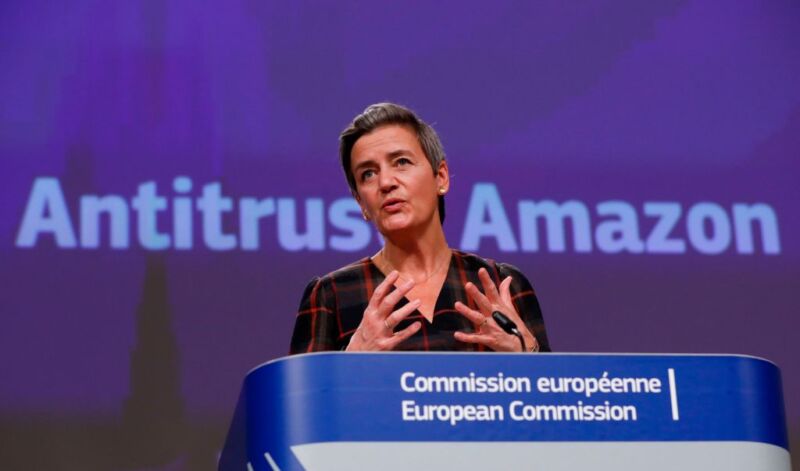
European Commission Executive Vice President Margrethe Vestager gives a press conference on Amazon's antitrust case in November.
Enlarge / European Commission Executive Vice President Margrethe Vestager gives a press conference on Amazon’s antitrust case in November.

Amazon has reached a final deal with EU antitrust regulators over concerns its use of data undermined rivals, in a move that will close two of the most high-profile probes in Brussels.

The US ecommerce group has committed to increasing the visibility of rival products by giving them equal treatment on Amazon’s “buy box,” which generates the majority of purchases on the site. It will also create an alternative featured offer for those buyers where speed of delivery is less important.

The European Commission plans to announce the deal on December 20, according to four people with direct knowledge of the timing. However, they warned the date could still change at the last minute.

The commitments, which are set to remain in force for five years, have been “market tested” with rivals and agreed with EU officials, these people said. “There’s very little to discuss,” a person with knowledge of the process said.

The move represents a win for the EU, as it will serve as a blueprint for the tech group’s compliance with the new Digital Markets Act, a piece of legislation aimed at curbing the power of Big Tech.

It also means Amazon will avoid formal charges of breaking EU law and a large fine of up to 10 percent of global revenues.

The DMA is the first big overhaul of the rules governing technology groups in more than two decades. It sets out new obligations on large online platforms to give equal treatment to data, banning so-called self-preferencing whereby a company ranks its products ahead of rivals on its own marketplace.

Amazon’s deal with Brussels comes three years after EU regulators opened a probe into the group’s alleged anti-competitive practices in how it handles data from competitors.

As part of the settlement, Amazon will let sellers using its Prime membership scheme choose any logistics company and negotiate terms directly, instead of being locked into using Amazon’s logistics services.

The deal provides the first glimpse of how global tech companies will follow the EU’s new digital legislation.

Chris Meyers, Amazon’s associate general counsel, told a conference on Monday that the commitments were in line with how the group planned to comply with Brussels’ new rules.

“The specific commitment that we have proposed, and which we think also meets the obligations of the DMA, is really the approach we are going to take under the DMA,” he said.

Amazon declined to comment on Tuesday but pointed to a previous statement by the company, which said, “while we have serious concerns about the DMA unfairly targeting Amazon… we have engaged constructively with the commission.”

The commission declined to comment.

© 2022 The Financial Times Ltd. All rights reserved. Not to be redistributed, copied, or modified in any way.

https://arstechnica.com/?p=1902390


Stalkers’ “chilling” use of AirTags spurs class-action suit against Apple

https://www.gettyimages.com/detail/news-photo/discussion-of-apple-airtags-by-washington-post-reporter-news-photo/1239635536?phrase=apple%20airtag

When Apple released AirTags in 2021, the small electronic tracking devices were touted by top executives as being “stalker-proof.” Since then, Vice reported a minimum of 150 police cases documenting stalkers using AirTags, and there have already been two severe stalking cases involving AirTags that ended in murder in Ohio and Indiana.

Confronted by police reports and concerns from privacy advocates, Apple released updates in February, claiming that new features would mitigate reported stalking risks. Stalking reports kept coming, though, and it increasingly seemed to victims that Apple had not done enough to adequately secure AirTags. Now, Apple is being sued by two women who claim that the company is still marketing a “dangerous” product.

In the complaint filed yesterday in a federal court in California, the women suing Apple say that AirTags have become “one of the most dangerous and frightening technologies employed by stalkers.” It has become the “weapon of choice,” they say, because the small size makes the devices hard to detect, the accuracy of Apple’s location tracking is “unparalleled,” and the $29 price is extremely affordable. Victims say that stalkers can effectively track them, and if the device gets deactivated, AirTags are easy to replace at the next opportunity.

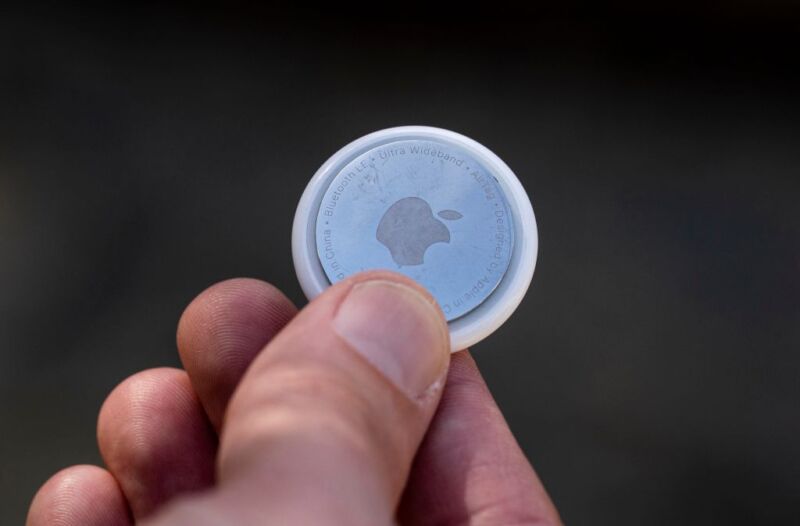
These AirTags are supposed to work by emitting Bluetooth signals to Apple’s massive “Find My” network of connected devices, accurately reporting the location of a missing AirTag to the owner. The coat button-size tracking devices can be easily clipped to key rings or dropped in purses to help owners recover lost items.

But the AirTags are also so small that they can easily go undetected, especially when stalkers alter the devices to make them harder to find. For one woman suing, Lauren Hughes, her ex-boyfriend allegedly used a Sharpie to color the AirTag and hide it inside the wheel well of her car. The other woman suing, who remains anonymous out of fear for her physical safety, found an AirTag that her “estranged husband” had allegedly planted in her child’s backpack. When she removed the device from the backpack, it was soon replaced by another.

Lawyers representing the women suing did not immediately respond to Ars’ request for comment.

Apple previously acknowledged “reports of bad actors attempting to misuse AirTag for malicious or criminal purposes,” describing in a blog how the company had partnered with law enforcement to help trace AirTags back to the stalkers who owned them. They also said they worked with safety groups to take other steps to prevent unwanted tracking and promised to release a “series of updates” before the end of this year. So far, Apple has not made any mention on its blog of those updates and did not immediately respond to Ars’ request to comment on whether those updates are still expected to be released in 2022.

The lawsuit Apple now faces is not just about two women being harassed by stalkers using AirTags. It’s a class-action lawsuit that represents all persons residing in the United States who own iOS and Android devices, as well as other sub-classes at risk of stalking.

Plaintiffs suing represent various stalked classes. They are asking for a jury to assess whether, in addition to injunctive relief and damages, Apple should owe punitive damages for allegedly releasing a defective product with insufficient safeguards to prevent stalking, then profiting off sales after allegedly misleading the public to believe AirTags were “stalker-proof.”

“This is problematic for all Class members, as they are unlikely to learn of the dangers associated with AirTags until they have become victims of stalking,” the complaint states.

https://arstechnica.com/?p=1902353