Former Twitter employees explain why Apple actually paused ads
https://www.gettyimages.com/detail/news-photo/in-this-photo-illustration-a-twitter-logo-is-displayed-on-a-news-photo/1244312033?phrase=apple%20twitter

After five people were killed and dozens more were injured in November during a shooting at an LGBTQ+ nightclub in Colorado, Apple made what many would consider a very ordinary business decision to pause ads on Twitter temporarily. Two former Twitter employees told The New York Times that the tech company was protecting its brand by ensuring that Apple ads wouldn’t appear next to news reports of the mass shooting.

But Twitter CEO Elon Musk didn’t seem to connect the dots between the horrific event and Twitter’s biggest advertiser pulling ads from the platform. Instead, Musk sparked a rumor that Apple’s decision was about how Musk moderates Twitter content after he tweeted, “Apple has mostly stopped advertising on Twitter. Do they hate free speech in America?”

Now, Bloomberg reports that Apple has “fully resumed” advertising on Twitter approximately two weeks after the Colorado shooting and days after Musk had a “good conversation” with Apple CEO Tim Cook, according to Musk. According to Reuters, Amazon is also investing big in Twitter advertising—committing $100 million a year—and joining other advertisers seemingly lured by the “biggest advertiser incentive ever” offered on Twitter.

So far, Musk seems pleased with Twitter’s renewed appeal to advertisers.

“Just a note to thank advertisers for returning to Twitter,” Musk tweeted Saturday.

Twitter, Amazon, and Apple did not immediately respond to Ars’ request for comment.

Twitter’s big strategy to win back advertisers

This December, Twitter is attempting to win back advertisers by offering incentives like 100 percent matching on any ad spending between $500,000 and $1 million. For any takers, this offer doubles the ad impressions enjoyed by the platform’s biggest advertisers. Similar incentives offering 25 and 50 percent more impressions are being offered to advertisers spending $200,000 and $350,000, respectively.

A New York Times report suggests Twitter had to offer advertiser deals as “massive” as these incentives because during what should have been one of Twitter’s biggest sales events, the World Cup, “ad revenue was running at 80 percent below internal expectations for that week.”

As Twitter failed to hit numbers, former employees told the Times that the company repeatedly adjusted its revenue projections for the final quarter of the year, going from $1.4 billion to $1.1 billion. By the end of October, Twitter had lost more than 1,500 advertisers, the Times reported. Because Apple had been one of Twitter’s most loyal advertisers, already spending $180 million in 2022—which was $30 million more than initially projected—the sudden loss of Apple ads in November seemed to hit Twitter hardest when it was already down.

The Times sources said that to turn the situation around, Musk offered the “massive” incentives but also made other concessions to woo advertisers back. These included heavy discounts on Super Bowl ads and even agreeing that big brands like PepsiCo could withdraw ads “for any reason” so long as they agreed to buy now.

PepsiCo did not immediately respond to Ars’ request for comment.

Not every major brand has been sold on Musk’s deals or the idea that Twitter is a safe place to advertise.

A General Motors spokesperson told the Times that it wasn’t just hate speech keeping some automakers off the platform since Musk took over. Like Apple, GM seems to have stalled ads due to legitimate business concerns. GM is worried about another Musk company, Tesla, benefiting from his ownership of Twitter by accessing data on Tesla competitors like GM.

“It’s important for us to ensure our advertising strategies and data can be safely managed by a platform owned by a competitor,” a GM spokesperson told the Times.

GM did not immediately respond to Ars’ request for comment.

https://arstechnica.com/?p=1901963



How Chinese netizens swamped China’s Internet controls

Demonstrators cover their faces with sheets of blank paper while protesting China's zero-COVID policy in Hong Kong on November 28, 2022.
Enlarge / Demonstrators cover their faces with sheets of blank paper while protesting China’s zero-COVID policy in Hong Kong on November 28, 2022.
Anthony Kwan / Getty Images

A week ago, demonstrators took to the streets of the northwestern city of Urumqi to protest China’s strict zero-COVID policy. That night, a much bigger wave of protest crested on Chinese social media, most notably on the super app WeChat. Users shared videos of the demonstrators and songs like “Do You Hear the People Sing” from Les Misérables, Bob Marley’s “Get Up, Stand Up,” and Patti Smith’s “Power to the People.”

In the days that followed, protests spread. A mostly masked crowd in Beijing’s Liangmaqiao district held up blank sheets of paper and called for an end to tough COVID policies. Across the city at the elite Tsinghua University, protesters held up printouts of a physics formula known as the Friedmann equation because its namesake sounds like “free man.” Similar scenes played out in cities and college campuses across China in a wave of protest that has been compared to the 1989 student movement that ended in a bloody crackdown in Tiananmen Square.

Unlike those earlier protests, the demonstrations that have roiled China in the past week were entwined with and spread by smartphones and social media. The country’s government has tried to strike a balance between embracing technology and limiting citizens’ power to use it to protest or organize, building up wide-ranging powers of censorship and surveillance. But last weekend, the momentum of China’s digital savvy population and their frustration, bravery, and anger seemed to break free of the government’s control. It took days for Chinese censors and police to tamp down dissent on the Internet and in city streets. By then images and videos of the protests had spread around the world, and China’s citizens had proven that they could maneuver around the Great Firewall and other controls.

“The mood on WeChat was like nothing I’ve ever experienced before,” says one British national who has lived in Beijing for more than a decade, who asked not to be named to avoid scrutiny from Chinese authorities. “There seemed to be a recklessness and excitement in the air as people became bolder and bolder with every post, each new person testing the government’s—and their own—boundaries.” He saw posts unlike those he’d seen before on China’s tightly controlled Internet, like a picture of a Xinjiang official bluntly captioned “Fuck off.”

Chinese netizens have built up a sense of what censors will and won’t allow, and many know how to skirt some Internet controls. But as the protests spread, younger WeChat users seemed to become unconcerned with the consequences of their posts, one tech worker in Guangzhou told Wired, calling on an encrypted app. Like other Chinese nationals quoted, he asked not to be named because of the danger of government attention. More seasoned organizers used encrypted apps like Telegram or shared to Western platforms, like Instagram and Twitter, to get the word out.

The anti-lockdown demonstrations began as unofficial vigils for the victims of a fatal fire in Urumqi, the capital of China’s northwestern Xinjiang province. The city had been under COVID lockdown restrictions for more than 100 days, which some observers believe hindered victims trying to escape and slowed emergency responders. Most, if not all, of the victims were members of the Uyghur ethnic minority, which has been subject to a campaign of forced assimilation that sent an estimated 1 million to 2 million people to reeducation camps.

The tragedy came as frustrations with zero-COVID policies were already starting to spike. Violent confrontations had broken out between workers and security at a Foxconn plant in Zhengzhou that manufactures iPhones. Scott Kennedy, of the Center for Strategic and International Studies, a think tank in Washington, DC, says that when he visited Beijing and Shanghai in September and October, it was clear that people had “grown weary” of measures like regular PCR testing, scanning QR “health codes” to go anywhere, and the constant specter of a fresh lockdown. “I’m not surprised that things have boiled over,” Kennedy says. The government in early November signaled some restrictions would soon loosen, but the Urumqi fire and news that COVID cases were rising again, he says, “pushed people over the edge.”

https://arstechnica.com/?p=1901755


Darknet markets generate millions in revenue selling stolen personal data

Hacker in binary code digital background. Cyber crime and internet privacy hacking. Network security, Cyber attack, Computer Virus, Ransomware, and Malware Concept. 2D illustration.

It is common to hear news reports about large data breaches, but what happens once your personal data is stolen? Our research shows that, like most legal commodities, stolen data products flow through a supply chain consisting of producers, wholesalers, and consumers. But this supply chain involves the interconnection of multiple criminal organizations operating in illicit underground marketplaces.

The stolen data supply chain begins with producers—hackers who exploit vulnerable systems and steal sensitive information such as credit card numbers, bank account information, and Social Security numbers. Next, the stolen data is advertised by wholesalers and distributors who sell the data. Finally, the data is purchased by consumers who use it to commit various forms of fraud, including fraudulent credit card transactions, identity theft, and phishing attacks.

The stolen data supply chain, from data theft to fraud.
Enlarge / The stolen data supply chain, from data theft to fraud.

This trafficking of stolen data between producers, wholesalers, and consumers is enabled by darknet markets, which are websites that resemble ordinary e-commerce websites but are accessible only using special browsers or authorization codes.

We found several thousand vendors selling tens of thousands of stolen data products on 30 darknet markets. These vendors had more than $140 million in revenue over an eight-month period.

Darknet markets

Just like traditional e-commerce sites, darknet markets provide a platform for vendors to connect with potential buyers to facilitate transactions. Darknet markets, though, are notorious for the sale of illicit products. Another key distinction is that access to darknet markets requires the use of special software such as the Onion Router, or TOR, which provides security and anonymity.

Silk Road, which emerged in 2011, combined TOR and bitcoin to become the first known darknet market. The market was eventually seized in 2013, and the founder, Ross Ulbricht, was sentenced to two life sentences plus 40 years without the possibility of parole. Ulbricht’s hefty prison sentence did not appear to have the intended deterrent effect. Multiple markets emerged to fill the void and, in doing so, created a thriving ecosystem profiting from stolen personal data.

Example of a stolen data "product" sold on a darknet market.
Enlarge / Example of a stolen data “product” sold on a darknet market.

Stolen data ecosystem

Key stats from individual darknet stolen data marketplaces
Market Vendors Listings Sales Revenue
Agartha 302 16,296 237,512 $91,582,216.00
Amazin 6 43 – –
Apollon 650 9,885 238 $3,703.00
Asean/ASAP 59 2,921 0 0
Aurora 71 2,913 128,561 $3,003,846.00
Babylon 14 55 – –
CanadaHQ 125 2,886 4,271 $241,656.00
Cartel 44 487 61,604 $31,280,508.00
Corona 95 2,979 19,149 $1,553,850.00
Cypher 56 2,472 123 $20,009.00
Dark 248 8,679 19,783 $571,512.00
Dark0de 52 487 – –
DarkBay/Lime 101 10,004 72 $60,076.00
Darkfox 159 2,040 15,929 $74,057.00
DeepMart 23 218 37,095 $9,156,025.00
DeepSea 141 4,437 11,905 $116,962.00
Elite 52 691 22,079 $147,245.00
Icarus 88 557 – –
Liberty 19 189 – –
Neptune 160 6,507 1,140 $23,696.00
Royal 13 54 0 0
Silk Road* 28 38 490 $15,053.00
Tor2Door 52 1,908 207 $1,796.00
Torrez 85 1,707 5,189 $145,198.00
Versus 99 3,959 6,532 $125,363.00
ViceCity 101 1,776 3,150 $57,018.00
WhiteHouse 306 11,184 56,950 $2,146,730.00
World 24 749 223 $3,280.00
Yakuza 48 411 5 $8,200.00
YellowBrick 39 140 – –
Data source: Christian Jordan Howell

Recognizing the role of darknet markets in trafficking stolen data, we conducted the largest systematic examination of stolen data markets that we are aware of to better understand the size and scope of this illicit online ecosystem. To do this, we first identified 30 darknet markets advertising stolen data products.

Next, we extracted information about stolen data products from the markets on a weekly basis for eight months, from September 1, 2020, through April 30, 2021. We then used this information to determine the number of vendors selling stolen data products, the number of stolen data products advertised, the number of products sold, and the amount of revenue generated.

In total, there were 2,158 vendors who advertised at least one of the 96,672 product listings across the 30 marketplaces. Vendors and product listings were not distributed equally across markets. On average, marketplaces had 109 unique vendor aliases and 3,222 product listings related to stolen data products. Marketplaces recorded 632,207 sales across these markets, which generated $140,337,999 in total revenue. Again, there is high variation across the markets. On average, marketplaces had 26,342 sales and generated $5,847,417 in revenue.

After assessing the aggregate characteristics of the ecosystem, we analyzed each of the markets individually. In doing so, we found that a handful of markets were responsible for trafficking most of the stolen data products. The three largest markets—Apollon, WhiteHouse, and Agartha—contained 58 percent of all vendors. The number of listings ranged from 38 to 16,296, and the total number of sales ranged from 0 to 237,512. The total revenue of markets also varied substantially during the 35-week period: It ranged from $0 to $91,582,216 for the most successful market, Agartha.

For comparison, most midsize companies operating in the US earn between $10 million and $1 billion annually. Both Agartha and Cartel earned enough revenue within the 35-week period we tracked them to be characterized as midsize companies, earning $91.6 million and $32.3 million, respectively. Other markets like Aurora, DeepMart, and WhiteHouse were also on track to reach the revenue of a midsize company if given a full year to earn.

Our research details a thriving underground economy and illicit supply chain enabled by darknet markets. As long as data is routinely stolen, there are likely to be marketplaces for the stolen information.

These darknet markets are difficult to disrupt directly, but efforts to thwart customers of stolen data from using it offers some hope. We believe that advances in artificial intelligence can provide law enforcement agencies, financial institutions, and others with information needed to prevent stolen data from being used to commit fraud. This could stop the flow of stolen data through the supply chain and disrupt the underground economy that profits from your personal data.

Christian Jordan Howell is assistant professor in cybercrime, University of South Florida, and David Maimon is professor of criminal justice and criminology, Georgia State University.

This article is republished from The Conversation under a Creative Commons license. Read the original article.

https://arstechnica.com/?p=1901711


FCC lets Starlink start deploying Gen2 satellites as Gen1 speeds keep falling

A Starlink satellite dish placed on a roof.
Enlarge / SpaceX Starlink satellite dish at Pelican Beach on Willard Bay Reservoir in Willard, Utah, in October 2022.

Starlink Internet speeds are continuing to drop as more people use the service, new speed tests show. But SpaceX this week won approval to launch another 7,500 satellites, kicking off a second-generation deployment that will provide the broadband network more capacity in the long run.

SpaceX has been seeking permission to launch another 29,988 low-Earth orbit satellites, and the Federal Communications Commission partially granted the request in an authorization order released Thursday. “Specifically, we grant SpaceX authority to construct, deploy, and operate up to 7,500 satellites operating at altitudes of 525, 530, and 535 km and inclinations of 53, 43, and 33 degrees, respectively, using frequencies in the Ku- and Ka-band,” the FCC said.

The FCC deferred action on the rest of the requested satellites. “To address concerns about orbital debris and space safety, we limit this grant to 7,500 satellites only, operating at certain altitudes,” the FCC said. But the approval of 7,500 satellites “will allow SpaceX to begin deployment of Gen2 Starlink, which will bring next generation satellite broadband to Americans nationwide, including those living and working in areas traditionally unserved or underserved by terrestrial systems,” the FCC said.

The partial authorization came as Ookla speed tests showed Starlink speeds dropping again in Q3 2022. The service’s median download speed in the US is about half what it was at the end of 2021.

Starlink’s median US download speed hit 105Mbps in Q4 2021. It dropped to 90.6Mbps in Q1 2022, 62.5Mbps in Q2 2022, and 53Mbps in the Q3 2022 report released on Wednesday of this week.

Starlink’s median US upload speed dropped from 12Mbps to 7.2Mbps from Q4 2021 to Q3 2022. Median latency rose from 40 ms to 67 ms in the same timeframe.

Starlink gets slower in Canada, too

In Canada, Starlink’s Q3 2022 median download speeds were 65.8Mbps, upload speeds were 9.2Mbps, and latency was 77 ms. Those are all downgrades since Q4 2021, when Starlink’s Canadian users got median download speeds of 106.6Mbps, uploads of 12.8Mbps, and latency of 55 ms.

“Over the past year, as we’ve seen more users flock to sign up for Starlink (reaching 400,000 users worldwide during Q2 2022), speeds have started to decrease,” the latest Ookla report said. But Starlink can still be “a life-changing service for consumers where connectivity is inadequate or nonexistent.”

With Starlink’s current performance, the biggest problems would affect users of multiplayer online games because Starlink “latency still lags far behind low-latency fixed broadband connections,” the report said. We previously wrote about Starlink’s slowing speeds in September. At the time, Ookla said that “Starlink speeds decreased in every country we surveyed over the past year as more users sign up for service.”

Ookla’s user-initiated speed tests show growing numbers of Starlink users across the US. A year ago, Starlink had at least 10 unique users in 776 US counties—now it’s up to at least 10 users in 2,399 counties, about 75 percent of the counties in the US.

https://arstechnica.com/?p=1901676


Parler and Twitter both cut ties with Kanye West as he says, “I like Hitler”

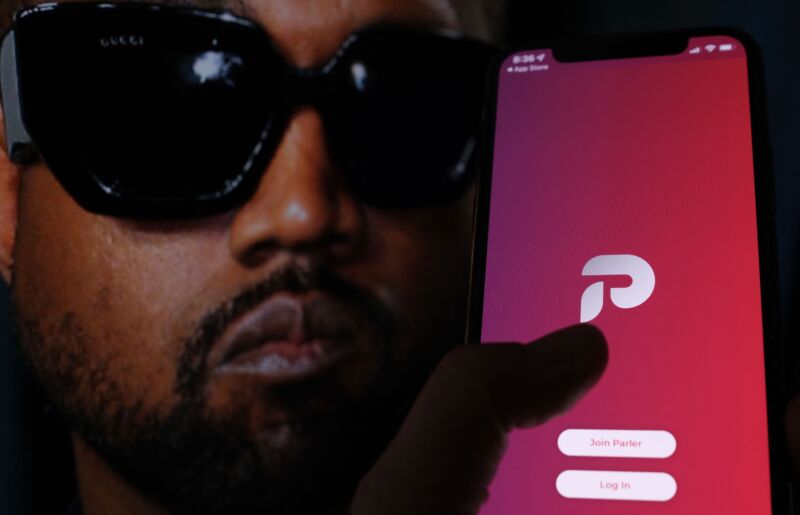
Photo illustration shows the Parler social network app on a smartphone screen with a picture of rapper Kanye West in the background.
Getty Images | Chris Delmas

Kanye West’s deal to buy the self-described “free speech” social network Parler lasted only a month. Parler’s owner announced the termination of the deal shortly after West—who now goes by Ye—praised Adolf Hitler and Nazis in an appearance yesterday on Alex Jones’ Infowars show.

Despite Parler making the announcement yesterday, it said the deal was terminated in mid-November. In a statement emailed to Ars and other news organizations Thursday afternoon, Parlement Technologies said it “mutually agreed with Ye to terminate the intent of sale of Parler. This decision was made in the interest of both parties in mid-November. Parler will continue to pursue future opportunities for growth and the evolution of the platform for our vibrant community.”

Parler and Ye had announced a merger agreement on October 17. The deal was struck after Ye made antisemitic posts that got his Twitter account locked, putting it into a read-only mode while leaving it visible to the public.

Ye’s Twitter account was unlocked in late October just as Elon Musk’s acquisition of Twitter was finalized. Musk supported Ye publicly but said the account unlocking happened before the acquisition and that Twitter “did not consult with or inform me.”

Ye suspended after swastika tweet

But now Ye may have lost his Twitter account for good after tweeting an image of a swastika inside the Star of David last night. Ye “again violated our rule against incitement to violence,” Musk wrote. This time, the account was suspended, removing his profile and tweets completely.

Hate speech on Twitter against Black people, gay men, and Jews has increased significantly since Musk bought the company, according to research by the Center for Countering Digital Hate and the Anti-Defamation League described in a New York Times article today.

As Deadline noted, “West’s Twitter account was initially locked temporarily for 12 hours after the offensive tweet, which was deleted,” but the “account then disappeared with a ‘suspended’ label over it.” Ye has started posting on Truth Social, the social network launched by former President Donald Trump. Ye’s Parler account is still online, but he hasn’t posted in a week.

The swastika tweet came a few hours after the interview with Jones in which Ye said, “I like Hitler” and “I love Jewish people, but I also love Nazis,” among various other antisemitic statements. “Every human being has something of value that they brought to the table, especially Hitler,” Ye said, while denying that Hitler killed 6 million Jews in the Holocaust. Ye also claimed that Hitler invented highways and microphones.

Ye said he’d protect conservative opinions at Parler

When his now-terminated deal to buy Parler was announced, Ye said he intended to protect conservative opinions. “In a world where conservative opinions are considered to be controversial, we have to make sure we have the right to freely express ourselves,” Ye said in the deal announcement. Ye also said in an interview with Bloomberg that “when I got kicked off of Instagram and Twitter at the time, I knew it was time to acquire my own platform.”

Parler said on October 17 that it expected Ye to complete the purchase during the fourth quarter of 2022. “The proposed acquisition will assure Parler a future role in creating an uncancelable ecosystem where all voices are welcome,” Parler said at the time.

Apple kicked Parler off its app store in January 2021 after Trump supporters attacked the US Capitol. With Parler users’ role in the attack under scrutiny, Parler told Congress that “in the days and weeks leading up to January 6th, Parler referred violent content from its platform to the FBI for investigation over 50 times, and Parler even alerted law enforcement to specific threats of violence being planned at the Capitol.”

Apple allowed Parler back on its app store in April 2021 after the social network changed its content moderation. Google also booted Parler in January 2021 and didn’t allow the company back until September 2022.

https://arstechnica.com/?p=1901606


Tesla finally delivers first electric Semi to Pepsi after years of delay

https://www.gettyimages.com/detail/news-photo/tesla-chairman-and-ceo-elon-musk-steps-out-of-the-new-semi-news-photo/875152678?phrase=Tesla%20semi

Yesterday, Elon Musk appeared at his first Tesla unveiling since he took the helm at Twitter. At a Tesla plant in Nevada, the billionaire announced that after five long years, Tesla’s first heavy-duty Semi had been delivered to PepsiCo.

The Semi, Tesla announced, would go into production in 2023 and feature an updated version of Tesla’s Supercharger, which uses liquid-cooling technology in its charging cable and is capable of charging the large electric vehicle at 1 megawatt.

“If you’re a trucker and you want the most badass rig on the road, this is it,” Musk told those gathered for the reveal, according to a Reuters report.

However, Musk failed to clarify key details like how much the Semis can haul, how much they will cost, and when Tesla will start producing hundreds of Semis for companies that pre-ordered them as early as 2017. Analysts told Reuters that they were especially disappointed that Tesla did not disclose the weight of an unloaded Semi, which would have helped them calculate efficiency on the road.

Instead, Musk touted truck features, painting a future of fleets of Tesla long haulers helping to reduce highway emissions while outperforming today’s diesel trucks. Musk seemed most excited about the Semi’s powertrain technology, which relies on three motors to generate “crazy power,” Musk said, by engaging one at highway speed and reserving two for acceleration. He likened the Tesla Semi to “an elephant moving like a cheetah.”

Tesla did not immediately respond to Ars’ request for comment.

Reuters reported that Tesla would use the Semi to transport parts between its Nevada and California plants. In test runs, Tesla completed a 500-mile haul of 81,000 pounds (a total that includes the truck’s weight and cargo), but that didn’t impress everyone gathered. Oliver Dixon, a senior analyst at the consultancy firm Guidehouse, told Reuters the truck is “not very impressive” and still could not be considered a “definitive proof of concept” without key details that Tesla failed to share during its event.

Five years ago, when Tesla offered the world its first look at the Semi in 2017, Pepsi promptly ordered 100 trucks. It was expected that the trucks would be hauling loads for companies like Pepsi, United Parcel Service, and Walmart by 2019. But production of the heavy-duty truck became stalled while competitors beat Tesla to market with rival fully electric Class 8 vehicles. Before this week, the only glimpse that the public got suggesting that the Semi could soon be hitting roads was a prototype spotted in 2018.

Now, with the Tesla trucks already significantly delayed, Pepsi got the first one. But companies still aren’t sure when Tesla will be prepared to ship more trucks. Musk had previously promised to produce 50,000 Semis in North America in 2024.

Pepsi got a chance to test the truck and finally did a cargo run this week, though. A driver for the company rolled up in the Semi to bring snacks to attendees of Musk’s reveal.

At the reveal, Musk also teased a new “robotaxi” in development at Tesla and suggested that the fast-charging technology propelling the updated Supercharger would also be used to power the Tesla pickup truck.

All these announcements came after Musk discussed drops in Tesla stock by 45 percent. Last month, Reuters reported that Tesla investors were concerned by how much time and money—including selling billions in Tesla stock—Musk was devoting to Twitter, potentially distracting him from completing Tesla projects.

https://arstechnica.com/?p=1901604


Twitter dangles incentives to try to lure advertisers back

Twitter dangles incentives to try to lure advertisers back

Elon Musk’s Twitter is offering brands generous incentives to advertise on the social media platform, in a bid to boost business after the billionaire’s approach to content moderation prompted many major marketers to curb spending.

In one email sent to advertising agencies, a copy of which was seen by the Financial Times, Twitter said that it was launching its “largest advertiser incentive ever” in December, offering additional impressions if brands spent a certain amount.

According to the email, Twitter will match the spending of those who pay at least $500,000 with a cap of $1 million per advertiser. Those spending $350,000 will receive “50 percent value add”—meaning they receive additional impressions worth half of what they spend. A $200,000 investment grants advertisers a “25 percent value add,” or extra impressions worth a quarter of what they spend.

Another email sent to a separate agency, also seen by the FT, contained that same offer for US brands, as well as slightly different offers for brands in the UK and the rest of the world, for example.

The attempt to lure advertisers comes as Musk, who closed his $44 billion deal for the social media platform in October, has increasingly alienated brands and advertising agencies by loosening Twitter content moderation policies, undoing suspensions of rule-breaking accounts and laying off more than half of the workforce, including many of its ad sales team.

Brands including Mondelez, Carlsberg, United Airlines, and General Motors have ceased advertising on the platform, while agencies including Omnicom Media and Interpublic Group have recommended their clients pause spending, dealing a blow to Twitter’s $5 billion business.

Musk is on the hook for $1 billion in annual interest payments after loading the company with $13 billion of debt to help fund his acquisition of the business.

The Twitter incentives will last through December, according to the email, which invited brands and agencies to talk by phone to discuss scenarios “given the timeliness.”

Platformer and Morning Brew first reported details of the incentives. Twitter did not respond to a request for comment.

Musk, a self-declared “free speech absolutist,” is allowing all speech on the platform as long as it is legal, although “negative/hate speech” will not be boosted in users’ feeds. The company is no longer enforcing its policy of banning coronavirus misinformation, though in a blog post on Wednesday it said none of its policies had changed and that its trust and safety team remained “strong and well-resourced.”

Tensions between Musk and advertisers have escalated as the billionaire entrepreneur has personally called chief executives who reduced spending in order to berate them. In the case of Apple, one of Twitter’s largest advertisers, Musk on Monday publicly called out the chief executive Tim Cook for shrinking spending on the platform.

After several waves of job cuts and departures, Twitter’s ads business team has shrunk so much that many agencies and brands no longer have any point of contact at the company, according to multiple people familiar with the situation. Others are complaining that Twitter’s ads systems have also become buggy during Musk’s overhaul.

While the December deals Twitter is offering are unusually generous, some brands remain unconvinced, according to industry insiders. One agency executive said it would make “no impact to advertisers’ decisions.”

“They sound like the guy playing the violin on the Titanic,” another senior media buyer said. “I don’t think any client is willing to take the risk.”

© 2022 The Financial Times Ltd. All rights reserved. Not to be redistributed, copied, or modified in any way.

https://arstechnica.com/?p=1901561


Elon Musk appears to reconcile with Apple after Twitter tirade

Elon Musk appears to reconcile with Apple after Twitter tirade

Elon Musk said he had a “good conversation” with Apple chief executive Tim Cook and “resolved the misunderstanding” about his claim that Twitter could be removed from the App Store, just days after the world’s richest man unleashed a tirade against the most valuable tech company.

In a tweet on Wednesday, Musk said that “Tim was clear that Apple never considered” potentially removing Twitter from the App Store, describing it as a “misunderstanding.”

Musk, who bought Twitter for $44 billion last month, also thanked Cook for “taking me round Apple’s beautiful HQ,” and posted a video from Apple Park.

The volte-face comes after the billionaire entrepreneur on Monday accused Apple of threatening to “withhold Twitter from its App Store” without explaining why, and criticized the iPhone maker for curbing advertising on the platform, writing: “Do they hate free speech in America?”

The Tesla and SpaceX chief executive also raised concerns about Apple’s “in-app purchase” policy, which gives it a 15-30 percent cut of digital purchases made on the iPhone, and claims that the company abuses its market power.

Musk has previously outlined plans to shift Twitter away from relying on advertising revenues—in which Apple takes no cut—towards more subscription revenues, from which Apple would take a slice.

Apple declined to comment.

The apparent reconciliation comes amid growing concern among some nonprofits and regulators about Musk’s relaxation of Twitter’s content moderation policing. Musk, a self-declared “free speech absolutist,” is reversing most permanent bans on the platform and allowing all speech as long as it is legal, although “negative/hate speech” will not be boosted in users’ feeds.

The approach has prompted dozens of large brands to pull spending from the platform over fears their advertising may run alongside toxic content.

In a blog post on Wednesday, Twitter said none of its policies had changed and that its trust and safety team remained “strong and well-resourced.”

Apple maintains guidelines requiring social media apps to “block abusive users,” allow users to “report offensive content” and to filter “objectionable material from being posted.”

When Apple expelled Parler, a Twitter rival used by rightwing extremists, Apple said it had “not upheld its commitment to moderate and remove harmful or dangerous content encouraging violence and illegal activity.”

Although the feud appears to be over for now, Musk’s tweets were a catalyst for renewed criticism of Apple that could prove damaging, as antitrust regulators and app developers voice concerns over its rules and the role it plays as “gatekeeper” by deciding what content is allowed on more than 1 billion phones worldwide.

Florida’s Republican governor, Ron DeSantis, warned Apple that removing Twitter from the App Store would be viewed as a “raw exercise of monopolistic power” and “would merit a response from the United States Congress.”

Mark Zuckerberg, the founder of Facebook parent Meta, was also critical of Apple’s market power during an interview at The New York Times’s Dealbook summit on Wednesday, saying: “I do think Apple has sort of singled themselves out as the only company that is trying to control, unilaterally, what apps get on the [Apple] device and I don’t think that’s a sustainable or a good place to be.”

Apple has been dealing with criticism of the App Store for years. Epic Games, the maker of popular mobile game Fortnite, sued Apple in 2020 but only won on one of the 10 counts. Epic and Apple have both appealed against the decision.

© 2022 The Financial Times Ltd. All rights reserved. Not to be redistributed, copied, or modified in any way.

https://arstechnica.com/?p=1901199


EU threatens Musk with Twitter ban as firm defends new approach to moderation

Twitter logo displayed on a cracked phone screen is seen through broken glass
Getty Images | NurPhoto

A European regulator today reportedly threatened Elon Musk with a continent-wide ban on Twitter if the company fails to enforce content moderation rules required by the Digital Services Act. Also today, Twitter claimed it hasn’t changed any policies—even though it stopped enforcing rules against COVID misinformation.

“As we carry out this work, we want to assure you of a few things: First, none of our policies have changed,” Twitter wrote in a blog post titled, “Twitter 2.0: Our continued commitment to the public conversation.”

Twitter made this claim just a week after the major reversal in how it handles COVID misinformation. “Effective November 23, 2022, Twitter is no longer enforcing the COVID-19 misleading information policy,” Twitter said. We wrote about the change yesterday.

A very literal interpretation of Twitter’s “none of our policies have changed” claim might say it’s technically accurate—instead of rewriting the COVID misinformation policy, Twitter just stopped enforcing it. But that’s a big change in how content is moderated, and the reversal of the ban on former President Donald Trump and other controversial users signals a different approach to rules enforcement under Musk’s ownership.

Today’s “Twitter 2.0” blog post went on to say: “Our approach to policy enforcement will rely more heavily on de-amplification of violative content: freedom of speech, but not freedom of reach.”

EU warnings

Meanwhile, EU Commissioner Thierry Breton in a video meeting warned Musk about complying with European Commission rules. “There is still huge work ahead, as Twitter will have to implement transparent user policies, significantly reinforce content moderation and protect freedom of speech, tackle disinformation with resolve, and limit targeted advertising,” Breton told Musk, according to a Reuters article.

“Musk and Breton agreed the EU will carry out a ‘stress test’ at Twitter’s headquarters in early 2023 to assess Twitter’s compliance with EU rules,” Reuters wrote.

According to the Financial Times, “Breton told Musk that Twitter must adhere to a checklist of rules, including ditching an ‘arbitrary’ approach to reinstating banned users, pursuing disinformation ‘aggressively’ and agreeing to an ‘extensive independent audit’ of the platform by next year.”

The Financial Times cited “people with knowledge of the conversation,” while the quote in the Reuters article came from a readout of the conversation provided by Breton. “Musk was warned that unless he stuck to those rules Twitter risked infringing the EU’s new Digital Services Act, a new law that sets the global standard for how Big Tech must police content on the Internet. Breton reiterated Twitter could face a Europe-wide ban or fines of up to 6 percent of global turnover if it breached the law,” the FT article said.

Musk reportedly told Breton that the Digital Services Act is “very sensible.” One of “the EU’s demands is that Musk provides clear criteria on which users are at risk of being banned,” the FT wrote. With Trump, Musk restored the account after polling Twitter users.

Twitter: Moderation team “strong and well-resourced”

Twitter’s blog post tried to ease concerns that a lack of staff will prevent proper content moderation. “Our Trust & Safety team continues its diligent work to keep the platform safe from hateful conduct, abusive behavior, and any violation of Twitter’s rules. The team remains strong and well-resourced, and automated detection plays an increasingly important role in eliminating abuse,” the company said.

As previously reported, layoffs and resignations gutted the Twitter team responsible for policing child sexual abuse material.

Twitter’s former head of trust and safety, Yoel Roth, yesterday said he resigned because Musk rules by “dictatorial edict,” and that mass layoffs and resignations harm Twitter’s ability to block harmful content. Roth said automated systems cannot entirely replace human review and that he doesn’t think Twitter has “enough people left at the company who can do that work to keep pace” with malicious campaigns.

Roth also said the COVID “policy change is really bad and damaging.”

https://arstechnica.com/?p=1901042


Musk’s Twitter abandons COVID misinfo policy, shirking “huge responsibility”

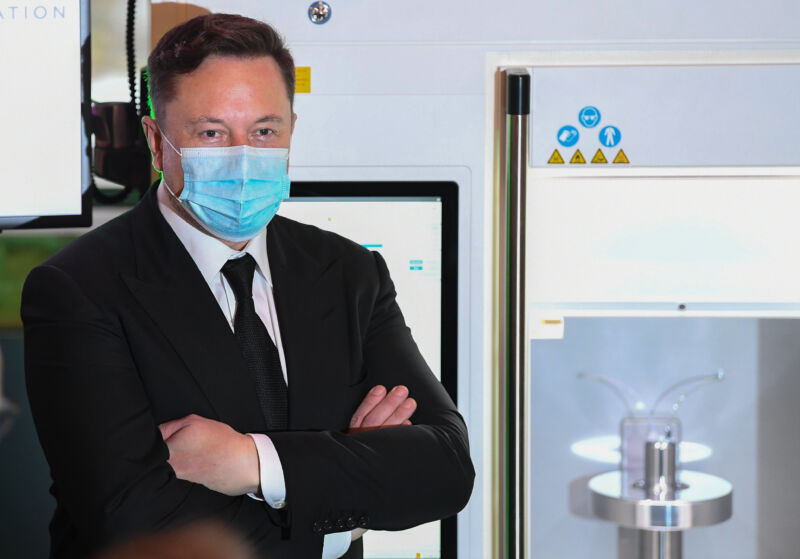
Tesla and SpaceX CEO Elon Musk presents a vaccine production device during a meeting September 2, 2020, in Berlin, Germany. Musk met with vaccine-maker CureVac, with which Tesla has a cooperation to build devices for producing RNA vaccines.
Enlarge / Tesla and SpaceX CEO Elon Musk presents a vaccine production device during a meeting September 2, 2020, in Berlin, Germany. Musk met with vaccine-maker CureVac, with which Tesla has a cooperation to build devices for producing RNA vaccines.

Under the leadership of billionaire Elon Musk, social media platform Twitter has abandoned its efforts to prevent the spread of dangerous COVID-19 misinformation on its platform, dismaying experts who say false and misleading health information can harm individuals and put lives at risk.

“Effective November 23, 2022, Twitter is no longer enforcing the COVID-19 misleading information policy,” the company noted in various places on its website.

From the outset of the COVID-19 pandemic, public health responses have been severely stymied by a plague of misinformation, often in digital spaces.

At the end of 2020, the World Health Organization put out a call to action to address what it called the “infodemic,” which aimed to “mitigate harm from health misinformation” that can cause confusion, mistrust, harmful risk-taking behaviors, and can prolong and intensify disease outbreaks. WHO started a myth-busting campaign to try to fight back against misinformation, producing advisories clarifying that medical masks do not cause oxygen deprivation, and drinking bleach does not prevent COVID-19 but will certainly harm you.

In a press briefing earlier this year, Katherine O’Brien, WHO’s director of the Department of Immunization, Vaccines, and Biologicals, noted that false and misleading information on social media is not innocuous. “This is not just a matter of chatter on social media channels,” O’Brien said. “It really has an impact on what people do, what they choose to do—what they choose to do for themselves, for their children, for their families. So, it’s something we take really seriously.”

Consequences

But the problem has been tenacious and has hamstrung health responses, likely exacerbating the pandemic’s toll of disease and death. In January 2021, a poll by the Kaiser Family Foundation found that adults who were hesitant about getting vaccinated or against it entirely were more likely to say they got their vaccine information from social media than other information sources. In November, another KFF poll found that 78 percent of US adults either believed or weren’t sure about at least one of eight falsehoods about the pandemic or COVID-19 vaccines.

Much of the misinformation has been amplified in the US by Republican politicians, leading to divergent health outcomes along party lines. A study in February of this year found Republican political affiliation was linked to increased prescribing of the ineffective COVID-19 treatments hydroxychloroquine and ivermectin. And partisan spread of misinformation has cost lives. A study in June found that counties with a majority of Republican voters experienced 72.9 additional COVID-19 deaths per 100,000 people relative to majority-Democratic counties in the first two years of the pandemic, and COVID-19 vaccine uptake explained approximately 10 percent of the difference.

“In cases like this pandemic, good information is life-saving,” Mike Ryan, executive director of the WHO’s Health Emergencies Programme, said in a press conference earlier this year. “In some cases, [it’s] more life-saving than having a vaccine in the sense that bad information sends you to some very, very bad places.”

Amid the misinformation plague, Twitter began ramping up efforts in 2020 to address the scourge on its platform, unveiling new policies that challenged accounts, removed false or misleading content, annotated potentially misleading content, and banned violating accounts. In September 2022, prior to Musk’s takeover, Twitter boasted that enforcement of its COVID-19 misinformation policy led it to challenge 11.72 million accounts, suspend 11,230 accounts, and remove 97,674 pieces of content since 2020.

The continued enforcement of its misinformation policies would “ensure that users can readily find credible information during this critical phase” of the pandemic, the company wrote.

Dereliction

But under Musk, the company’s priorities have clearly changed. Musk himself has a murky relationship with COVID-related health misinformation. In March 2020, he tweeted that “the coronavirus panic is dumb,” as well as the falsehood that children are “essentially immune” to COVID-19. However, he later tweeted support of vaccines.

Yesterday, Musk manufactured a skirmish with Apple after claiming that the tech giant had “mostly stopped” advertising on Twitter and threatened to pull Twitter’s app from its App Store. Musk accused Apple of hating free speech and of “censorship” after a Twitter user alleged that Apple filtered app search terms related to COVID-19.

The devolution of credible content and discourse on Twitter is likely to spur yet more concern from health officials over misinformation on social media platforms.

“When anyone reaches a position in life where they have so much potential influence over the way information is shared with communities, they take on a huge responsibility,” WHO’s Mike Ryan said earlier this year, referring to Musk’s upcoming takeover of Twitter. “We wish Mr. Musk luck with his endeavors to improve the quality of information that we all receive.”

https://arstechnica.com/?p=1900693