Google Maps accused of leading users to fake abortion clinics

Google Maps accused of leading users to fake abortion clinics

In 2018, Google was first confronted by media reports investigating why crisis pregnancy centers (CPCs)—often religious, non-medical organizations that do not provide abortion services or referrals for abortion services—frequently dominate Google Maps search results for “abortion clinics.” Now, four years later, the tech company seems to be making some moves to potentially change the quality of these sorts of search results.

In response to a Bloomberg report that “Google Maps routinely misleads people looking for abortion providers,” Google says it is “actively” seeking to improve the relevancy of search results of categories of businesses like “abortion clinics.” It seems that currently, search results based on business categories aren’t as relevant as the similar business results displayed following searches for specific business names.

The question being aimed at Google is whether its ongoing practice of displaying CPCs in results for abortion clinics qualifies as spreading health misinformation. Women claiming they were misled by Google Maps say the CPCs they visited went to extremes to dissuade them from seeking an abortion. That included relaying “misinformation about the abortion procedure, including risk to life, risk of breast cancer, risk to mental health, risk to future fertility, and fetal pain.”

On average, a quarter of results for anyone searching for US abortion clinics on Google Maps directs users instead to visit CPCs, and in about a quarter of the country, CPCs comprise more than half of search results.

This is surely a problem for those validly searching for safe and legal abortion services, as some states have banned abortion—shrinking the number of available US abortion clinics. It’s expected that people seeking services outside those states will plan to travel farther to find services in areas that are less familiar, many relying on Google Maps to find the closest nearby businesses.

Because Google Maps search results by category of business often display similar businesses instead of indicating when there are no relevant results nearby, experts say that as abortion access is restricted, CPCs could dominate results, leading more users to risk encountering abortion misinformation. Worse, some users may travel long distances to visit businesses that do not really provide abortion services. This problem isn’t necessarily just limited to the category of business searches, either. In some cases, the NARAL Pro-Choice America Foundation has shown that CPCs “deliberately” use similar or sometimes the exact same business names as existing abortion providers. This contributes additional confusion, even for Google Maps users who are searching for specific business names (not just conducting general “abortion clinic” searches).

Bloomberg says that their analysis of the “abortion search result problem” is the most extensive conducted publicly so far. They collected data from 50 states, interviewed women who were directed to CPCs by Google Maps after searching for “abortion clinics,” and fielded insights from “33 abortion care providers, reproductive justice, and digital rights experts.”

Responding, Google told Bloomberg that “it works hard to surface business results that are relevant, accurate, and help users find what they’re looking for,” claiming to swiftly remove any business that misrepresents itself once it learns of violations to its policies against such behavior. The company also says that it has added “extra layers of verification” to confirm that businesses marked as “abortion clinics” on both Google Search and Maps “actually offer abortions.” One example is a Google policy update where advertisers have to certify that they provide abortion services to run ads with keywords “related to getting an abortion,” but Bloomberg notes that “it’s unclear whether Google would be able to apply that knowledge to its maps results.”

https://arstechnica.com/?p=1873736


US approves Google plan to let political emails bypass Gmail spam filter

A woman sits at a desk in front of a computer but her head is hidden because she is covered by a massive pile of envelopes labeled

The US Federal Election Commission approved a Google plan on Thursday to let campaign emails bypass Gmail spam filters. The FEC’s advisory opinion adopted in a 4-1 vote said Gmail’s pilot program is permissible under the Federal Election Campaign Act and FEC regulations “and would not result in the making of a prohibited in-kind contribution.”

The FEC said Google’s approved plan is for “a pilot program to test new Gmail design features at no cost on a nonpartisan basis to authorized candidate committees, political party committees, and leadership PACs.” On July 1, Google asked the FEC for the green light to implement the pilot after Republicans accused the company of giving Democrats an advantage in its algorithms.

Republicans reportedly could have avoided some of their Gmail spam problems by using the proper email configuration. At a May 2022 meeting between Senate Republicans and Google’s chief legal officer, “the most forceful rebuke” was said to come “from Sen. Marco Rubio (R-Fla.), who claimed that not a single email from one of his addresses was reaching inboxes,” The Washington Post reported in late July. “The reason, it was later determined, was that a vendor had not enabled an authentication tool that keeps messages from being marked as spam, according to people briefed on the discussions.”

As Techdirt’s Mike Masnick explained, “[I]t sounds like Rubio’s spamming operation didn’t set up a DKIM/DMARC authentication setup. I know this is plaguing lots of folks. Hell, it’s something we’ve had to deal with at Techdirt after we realized that Google was sending a lot of our emails to spam. But rather than whine about ‘bias’ against us, we explored the details and figured out how to fix our email configuration.”

Republicans cited a study to support their claims of bias, but one of the study’s authors said Republicans misrepresented the findings. The Democratic National Committee told the FEC that Gmail’s plan will help Republicans expand the use of “abusive fundraising tactics.”

Gmail users don’t want this

Gmail users who submitted comments to the FEC overwhelmingly criticized Google’s plan. The FEC received over 2,500 comments, which can be found on the docket page.

The commission’s three Republicans and Democratic Commissioner Dara Lindenbaum voted for the order approving Google’s plan. The Hill wrote that “Commissioner Ellen Weintraub, a Democrat who voted against the order, said she has ‘a hard time getting around the fact that this is a unique benefit offered to political committees, and only to political committees.'”

Lindenbaum reportedly said, “I don’t want to [support this], and it’s for the same reasons all the commenters don’t want to, but I think the law and commissioner regulations and commission precedent permits this.” Democrat Shana Broussard abstained from the vote.

“We appreciate the FEC’s speedy review of our request and we will reflect on the positive and negative feedback received during the public comment period,” Google said in a statement provided to Ars. “Our goal during this pilot program is to assess alternative ways of addressing concerns from bulk senders, while giving users clear controls over their inboxes to minimize unwanted email. We will continue to monitor feedback as the pilot rolls out to ensure it is meeting its goals.”

https://arstechnica.com/?p=1873460


Musk wants Twitter to identify employees who calculate spam percentage

Illustration of a chat bot on a computer screen.
Getty Images | Carol Yepes

Elon Musk’s lawyers want to question the Twitter employees responsible for calculating spam-account estimates, and they claim that Twitter is hiding these potential witnesses, Bloomberg reported yesterday.

Musk on Wednesday filed a proposed order requesting that Delaware Court of Chancery Judge Kathaleen McCormick compel Twitter “to produce discovery from specific custodians.” Musk provided further details on the request in a letter to McCormick that was filed under seal as part of the case in which Twitter seeks to enforce the $44 billion merger contract that Musk is trying to exit.

While the letter isn’t public yet, Bloomberg cited “people familiar with the allegations” to describe the letter’s contents. “Musk contends the social media company isn’t producing the names of employees specifically responsible for evaluating how much of Twitter’s customer base is made up of spam and robot accounts… Musk’s lawyers have asked the judge in the case to force Twitter to identify the workers so the defense can get their records and question them,” Bloomberg wrote.

Musk’s request is part of his effort to disprove Twitter’s claim that fewer than 5 percent of its monetizable daily active users (mDAU) are spam or fake. Twitter says Musk has no right to exit the merger agreement based on the number of spam accounts; it also claims that Musk hasn’t “present[ed] even a shred of supporting evidence” that the mDAU figure is incorrect. Musk’s spam analysis relied on a web tool that once called his own Twitter account a likely bot, Twitter pointed out.

Twitter hasn’t responded to Musk’s new filing yet. “Under the court’s rules, Twitter’s attorneys have five business days to decide what should be redacted from the filing as proprietary information,” Bloomberg wrote.

Pre-trial wrangling before October 17 start

The filing comes a few days after Musk challenged Twitter CEO Parag Agrawal to “a public debate about the Twitter bot percentage.” No such debate is likely to happen, of course. Twitter is content to let its lawsuit against Musk play out, particularly given that McCormick granted its request to expedite the trial, scheduled to begin October 17.

Though Twitter apparently hasn’t provided access to employees who work on the spam estimates, the company has detailed its process for calculating mDAU and gave Musk access to its data firehose. Twitter evaluates daily samples of 100 mDAU, or about 9,000 each quarter, saying the analysis includes “multiple human reviews (in replicate) of thousands of randomly selected accounts each quarter using both public and private data.”

“[A]s a basic statistical matter, the approximately 9,000-account sample Twitter reviews of accounts included in mDAU each quarter is sufficiently sized to extrapolate across the mDAU population,” Twitter wrote.

Musk’s attempt to question Twitter employees over spam counts is just the latest in pre-trial wrangling. Twitter previously issued subpoenas seeking messages written by Musk’s friends, advisers, banks, legal team, and investors, as well as by Oracle co-founder Larry Ellison. Musk sent subpoenas to Twitter advisers JPMorgan Chase and Goldman Sachs.

If Twitter wins the case, Musk could be forced to complete the merger. He has sold $15.4 billion of Tesla shares since agreeing to buy Twitter.

https://arstechnica.com/?p=1873200


Lawsuits: OnlyFans bribed Instagram to put creators on “terrorist blacklist” [Updated]

Lawsuits: OnlyFans bribed Instagram to put creators on “terrorist blacklist” [Updated]

(Update, 5:27 pm ET: A GIFCT spokesperson clarified how the “blacklist”—or more accurately, in its terms, its terrorist content database—works to log terrorist activity between different online platforms. She says only videos and images are currently hashed, and nothing gets automatically removed from other platforms. Instead, once content is hashed, each platform considers things like the type of terrorist entity it is or the severity of the content and then weighs those measurements against its own policies to decide if it qualifies for removal or content advisory labels.

The GIFCT spokesperson also noted that Instagram accounts are not hashed, only Instagram images and videos, and there is no “blacklist” of users, although GIFCT analyzes who produces the content the organization hashes. The database records hashes to signal terrorist entities or terrorism content based on the United Nations sanctions list of terrorist entities from the UN Security Council. And all that content remains in the database unless a platform/GIFCT member like Meta uses a GIFCT feedback tool that was introduced in 2019 to flag the content as not qualifying as terrorist content. The feedback tool can also be used to recommend modified labels of content. Currently, that’s the only way to challenge content that gets hashed. GIFCT members also maintain active discussions on content moderation with GIFCT’s “centralized communications mechanism.” In these discussions, the spokesperson says none of the complaints raised in the lawsuit have been mentioned by members.

About two years ago, GIFCT became an independent nonprofit, and since then, it has released annual transparency reports that provide some insights into the feedback it receives. The next transparency report is due in December.)

Original story: Through the pandemic, OnlyFans took over the online adult entertainment world to become a billion-dollar top dog, projected to earn five times more net revenue in 2022 than in 2020. As OnlyFans’ business grew, content creators on rival platforms complained that social media sites like Facebook and Instagram were blocking their content but seemingly didn’t block OnlyFans with the same fervor, creating an unfair advantage. OnlyFans’ mounting success amid every other platform’s demise seemed to underscore its mysterious edge.

As adult entertainers outside of OnlyFans’ content stream looked for answers to their declining revenue, they realized that Meta had not only allegedly targeted their accounts to be banned for posting supposedly inappropriate content but seemingly also for suspected terrorist activity. The more they dug into why they had been branded as terrorists, the more they suspected that OnlyFans paid Meta to put the mark on their heads—resulting in account bans that went past Facebook and Instagram and spanned popular social media apps across the Internet.

Now, Meta has been hit with multiple class action lawsuits alleging that senior executives at Meta accepted bribes from OnlyFans to shadow-ban competing adult entertainers by placing them on a “terrorist blacklist.” Meta claims the suspected scheme is “highly implausible,” and that it’s more likely that OnlyFans beat its rivals in the market through successful strategic moves, like partnering with celebrities. However, lawyers representing three adult entertainers suing Meta say the owner of Facebook and Instagram will likely have to hand over documents to prove it.

Meta and its legal team did not immediately respond to Ars’ request for comment, but in their motion to dismiss, Meta says that even if “a vast and sophisticated scheme involving manipulation of automated filtering and blocking systems” was launched by Meta employees, Meta would not be liable. As a publisher, Meta says it is protected by the First Amendment and the Communications Decency Act to moderate content created by adult entertainment performers how it sees fit. The tech company also says it would be against Meta’s interests to manipulate algorithms to drive users off Facebook or Instagram to OnlyFans.

Fenix International Limited owns OnlyFans and also filed a motion to dismiss, claiming that the lawsuit had no merits and that OnlyFans has the same protected rights as a publisher as Meta. Neither Fenix nor its legal team immediately responded to Ars’ request for comment.

A spokesperson for the legal team representing the adult entertainers, Millberg, provided documents filed last week in response to both companies’ motions to dismiss, which Millberg considers “meritless.” They say that the First Amendment and CDA protections cited by Meta don’t apply, because plaintiffs aren’t suing over their content being blocked, but over allegations that the companies engaged in unfair business practices and “a scheme to misuse a terrorist blacklist.”

Rather than dismiss their complaint, plaintiffs asked the judge to reject the motions, which by law would ordinarily prevent discovery in the case, or if the judge is persuaded by the motions to dismiss, to allow for limited discovery before deciding. A Millberg spokesperson says this is just the start of a long legal process, and they expect that their request for discovery will be granted. That would mean that Meta and OnlyFans would have to share evidence to disprove the claim, which as of yet, neither has.

It’s likely that any judgment on the companies’ motions to dismiss will influence how the companies defend against other lawsuits. For the Millberg class action lawsuit, a hearing is scheduled in the Northern District of California on September 8. The judge will be William Alsap, who some may recall in 2014 received media attention for siding with a woman who contested the federal government’s no-fly policy and recommended a process of correcting mistakes, so that the US is not labeling people as terrorists who aren’t. Adult entertainers are hoping that he’ll be equally sympathetic in helping them to remove that unearned label.

What is this terrorist watch list?

It’s not just adult entertainers suing. Rival adult entertainment platforms, FanCentro and JustFor.Fans, are also suing, claiming that their social media traffic dropped so dramatically that “it could not have been the result of filtering by human reviewers.” Instead, they allege that Fenix relied on a “secret Hong Kong subsidiary into offshore Philippines bank accounts set up by the crooked Meta employees” to pay off Meta and tank its rivals’ traffic.

To achieve maximum effect in its alleged mission to delete rival adult content from the Internet, Fenix allegedly asked Meta to add 21,000 names and social media accounts to a terrorist blacklist that would ensure their content wouldn’t be displayed on Facebook, Instagram, Twitter, or YouTube.

The Global Internet Forum to Counter Terrorism (GIFCT) was co-founded in 2017 by owners of major social media platforms and other companies “to prevent terrorists and violent extremists from exploiting digital platforms.” Whenever a content moderation system flags an account on one platform, a digital fingerprint called a hash is shared with all the other platforms so that the image, video, or post won’t show up anywhere.

Critics, like the Electronic Frontier Foundation, have said the practice limits users’ rights to free expression across the Internet any time a post gets mistakenly flagged, with little recourse to get off the terrorist list, or even confirm if they’re on it. The GIFCT told the BBC that it continually works to “enhance transparency and oversight of the GIFCT hash-sharing database” by extensively engaging with stakeholders.

GIFCT did not immediately respond to Ars’ request for comment. The Millberg legal team says that it wants to begin discovery in September by asking Meta and GIFCT to share records that would either prove or disprove whether 21,000 Instagram accounts were improperly branded as terrorists.

https://arstechnica.com/?p=1873221


FTC aims to counter the “massive scale” of online data collection

FTC Chair Lina Khan said the commission intends to act on commercial data collection, which happens at "a massive scale and in a stunning array of contexts."
Enlarge / FTC Chair Lina Khan said the commission intends to act on commercial data collection, which happens at “a massive scale and in a stunning array of contexts.”
Getty Images

The Federal Trade Commission has kicked off the rulemaking process for privacy regulations that could restrict online surveillance and punish bad data-security practices. It’s a move that some privacy advocates say is long overdue, as similar Congressional efforts face endless uncertainty.

The Advanced Notice of Proposed Rulemaking, approved on a 3-2 vote along partisan lines, was spurred by commercial data collection, which occurs at “a massive scale and in a stunning array of contexts,” FTC Chair Lina M. Khan said in a press release. Companies surveil online activity, friend networks, browsing and purchase history, location data, and other details; analyze it with opaque algorithms; and sell it through “the massive, opaque market for consumer data,” Khan said.

Companies can also fail to secure that data or use it to make services addictive to children. They can also potentially discriminate against customers based on legally protected statuses like race, gender, religion, and age, the FTC said. What’s more, the release said, some companies make taking part in their “commercial surveillance” required for service or charge a premium to avoid it, employing dark patterns to keep the systems in place.

One of the three votes for the rulemaking came from Alvaro Bedoya, the founding director of Georgetown Law’s Center on Privacy & Technology, who was appointed three months ago. Bedoya, who focused on unregulated facial recognition, has described privacy as a civil right.

This marks the first step in what could be a years-long, multi-administration effort by the FTC to act under its existing authority to regulate and enforce privacy protections. The Industry Association of Privacy Professionals said that, should the FTC work under its Magnuson-Moss, or “warranty,” authority, it faces “a lengthy process that can take several years to complete.” The FTC gave no indication of a timeline for enacting a final rule, though it’s unlikely to come before the end of this year.

Both critics and supporters want to see Congress act, too

The FTC is seeking input from stakeholders and the public, starting with a public forum on September 8. Before the announcement was a day old, however, many organizations issued statements on the move.

Consumer Reports (CR) had effusive praise for the regulatory agency seeking to do some regulating. “While we continue to support federal and state efforts to enact and enforce comprehensive privacy legislation, consumers can wait no longer to have their personal information protected,” Justin Brookman, director of technology policy at CR, said in a release. “The FTC has the authority to issue clear rules to safeguard personal data by holding companies accountable for unwanted data collection, use, and disclosure.”

CR was one of more than 40 organizations that urged the FTC to act on data privacy in 2021, including the American Civil Liberties Union, the Electronic Frontier Foundation, and Public Knowledge.

Energy and Commerce Chairman Frank Pallone, Jr. (D-NJ) said in a release that while the lack of online privacy in the US is “completely unacceptable,” the FTC shouldn’t be stuck with only its existing authority to deal with it. Pallone pushed his American Data Privacy and Protection Act, which would broaden the FTC’s authority to create and enforce data protections. That bill has cleared a key House committee, but it awaits an uncertain floor vote and even tougher Senate future.

Senator Edward J. Markey (D-Mass.), meanwhile, believes that his own Children and Teens’ Online Privacy Protection Act is the best, if narrowest, way forward. The bill would create a Youth Privacy and Marketing Division at the FTC that focuses on protections for those 16 and younger.

Both Republican commissioners on the FTC would be fine with deferring privacy to Congress. Christine Wilson and Noah Phillips cited privacy laws that are seemingly moving ahead and the vast implications of any FTC action. Phillips said an FTC privacy action “will impact many thousands of companies, millions of citizens, and billions upon billions of dollars in commerce.”

https://arstechnica.com/?p=1873142


FCC cancels Starlink’s $886 million grant from Ajit Pai’s mismanaged auction

Man's hand holding stack of US currency with some bills flying away.
Getty Images | PM Images

The Federal Communications Commission (FCC) has rejected Starlink’s application to receive $885.51 million in broadband funding, essentially canceling a grant awarded by the FCC during then-Chairman Ajit Pai’s tenure.

Starlink was tentatively awarded the Rural Digital Opportunity Fund (RDOF) grant in December 2020. But the satellite provider still needed FCC approval of a long-form application to receive the money, which is intended for areas with little or no high-speed broadband access.

We wrote about potential problems with the SpaceX grant a week after the FCC’s reverse auction, in which ISPs bid on grants organized by census blocks. Consumer advocacy group Free Press accused Pai of “subsidiz[ing] broadband for the rich,” pointing out that Starlink was awarded money in urban areas including locations at or adjacent to major airports.

Today, Chairwoman Jessica Rosenworcel’s FCC announced that it rejected the long-form applications from both Starlink and LTD Broadband. The FCC said that both Starlink and LTD “failed to meet program requirements,” submitted “risky proposals,” and that their “applications failed to demonstrate that the providers could deliver the promised service.”

FCC cites $600 dish cost

The Starlink grants were supposed to fund broadband to 642,925 homes and businesses in 35 states. Losing the grants may not impact the actual availability of Starlink much because the satellite service isn’t geographically restricted in the same way as wireline networks.

“After careful legal, technical, and policy review, we are rejecting these applications. Consumers deserve reliable and affordable high-speed broadband,” Rosenworcel said. “We must put scarce universal service dollars to their best possible use as we move into a digital future that demands ever more powerful and faster networks. We cannot afford to subsidize ventures that are not delivering the promised speeds or are not likely to meet program requirements.”

The grants were meant for specific census blocks even though Starlink doesn’t have to build the typical infrastructure needed when ISPs expand into new geographic areas. Starlink relies on its own satellites in low Earth orbits, the user terminals that each customer buys, and ground stations scattered around each country in which it operates. (SpaceX has said that laser links on Starlink satellites reduce the need for those ground stations.)

Rosenworcel cited concerns about the Starlink technology and the $600 price each customer must pay in up-front hardware costs. “Starlink’s technology has real promise,” Rosenworcel said. “But the question before us was whether to publicly subsidize its still-developing technology for consumer broadband—which requires that users purchase a $600 dish—with nearly $900 million in universal service funds until 2032.”

Starlink called “nascent” tech with “capacity constraints”

In a public notice that provided more detail, the FCC called Starlink a “nascent LEO satellite technology” with “recognized capacity constraints.” The FCC questioned Starlink’s ability to consistently provide low-latency service with the required download speeds of 100 Mbps and upload speeds of 20 Mbps. The FCC also cited Ookla speed test data showing declining Starlink speeds in the second quarter of 2022, “including upload speeds that are falling well below 20 Mbps.”

The FCC Wireline Competition Bureau said it received “inadequate responses” to follow-up questions from both Starlink and LTD. As a result of the ruling, both ISPs are now “in default on all winning bids not already announced as defaulted,” the FCC said.

LTD was slated to get even more money than Starlink—over $1.3 billion. The FCC’s rejection of LTD was less surprising, as the company had failed to meet filing deadlines. LTD’s failures were detailed in a recent Wall Street Journal article.

“Although LTD was a relatively small fixed wireless provider before the auction, it was the largest winning bidder in the auction, submitting winning bids in 15 states,” the FCC said. “Subsequently, it failed to timely receive eligible telecommunications carrier status in seven states, rendering it ineligible in those states for support. Ultimately, the FCC review concluded that LTD was not reasonably capable of deploying a network of the scope, scale, and size required by LTD’s extensive winning bids.”

FCC started auction “cleanup” over a year ago

Rosenworcel made it clear over a year ago that she believes the auction was mismanaged, announcing in July 2021 that the agency must “clean up issues with the program’s design originating from its adoption in 2020.” The FCC cited “complaints that the program was poised to fund broadband to parking lots and well-served urban areas.”

At the time, Rosenworcel’s FCC asked Starlink to voluntarily give up funding in about 6 percent of the 113,900 census blocks where it tentatively won FCC grants. Now SpaceX isn’t getting anything out of the auction. We contacted SpaceX and LTD Broadband today and will update this article if we get any response.

The auction originally awarded $9.2 billion to 180 broadband providers. Rosenworcel has doled money out on a rolling basis as providers secure final approvals. “To date, the RDOF program has authorized more than $5 billion in funding to bring primarily fiber gigabit broadband service to over 3,000,000 locations in 47 states,” the FCC said today. “With support from this program, hundreds of carriers have already begun deploying these future-proof networks to connect unserved areas.”

Update at 8:15pm ET: LTD Broadband CEO Corey Hauer provided a statement. “We are extremely disappointed in the FCC staff decision. I don’t believe the FCC fully appreciated the benefits LTD Broadband would bring to hundreds of thousands of rural Americans. We are continuing to review the letter and are evaluating our next steps,” Hauer said.

https://arstechnica.com/?p=1872985


It’s not just social media: Cable news has bigger effect on polarization

It’s not just social media: Cable news has bigger effect on polarization

The past two election cycles have seen an explosion of attention given to “echo chambers,” or communities where a narrow set of views makes people less likely to challenge their own opinions. Much of this concern has focused on the rise of social media, which has radically transformed the information ecosystem.

However, when scientists investigated social media echo chambers, they found surprisingly little evidence of them on a large scale—or at least none on a scale large enough to warrant the growing concerns. And yet, selective exposure to news does increase polarization. This suggested that these studies missed part of the picture of Americans’ news consumption patterns. Crucially, they did not factor in a major component of the average American’s experience of news: television.

To fill in this gap, I and a group of researchers from Stanford University, the University of Pennsylvania, and Microsoft Research tracked the TV news consumption habits of tens of thousands of American adults each month from 2016 through 2019. We discovered four aspects of news consumption that, when taken together, paint an unsettling picture of the TV news ecosystem.

TV trumps online

We first measured just how politically siloed American news consumers really are across TV and the web. Averaging over the four years of our observations, we found that roughly 17 percent of Americans are politically polarized—8.7 percent to the left and 8.4 percent to the right—based on their TV news consumption. That’s three to four times higher than the average percentage of Americans polarized by online news.

Moreover, the percentage of Americans polarized via TV ranged as high as 23 percent at its peak in November 2016, the month in which Donald Trump was elected president. A second spike occurred in the months leading into December 2018, following the “blue wave” midterm elections in which a record number of Democratic campaign ads were aired on TV. The timing of these two spikes suggests a clear connection between content choices and events in the political arena.

Staying in TV echo chambers

Besides being more politically siloed on average, our research found that TV news consumers are much more likely than web consumers to maintain the same partisan news diets over time: after six months, left-leaning TV audiences are 10 times more likely to remain segregated than left-leaning online audiences, and right-leaning audiences are 4.5 times more likely than their online counterparts.

While these figures may seem intimidating, it is important to keep in mind that even among TV viewers, about 70 percent of right-leaning viewers and about 80 percent of left-leaning viewers do switch their news diets within six months. To the extent that long-lasting echo chambers do exist, then, they include only about 4 percent of the population.

Narrow TV diets

Partisan segregation among TV audiences goes even further than left- and right-leaning sources, we found. We identified seven broad buckets of TV news sources, then used these archetypes to determine what a typical unvaried TV news diet really looks like.

We found that, compared to online audiences, partisan TV news consumers tend not to stray too far from their narrow sets of preferred news sources. For example, most Americans who consume mostly MSNBC rarely consume news from any other source besides CNN. Similarly, most Americans who consume mostly Fox News Channel do not venture beyond that network at all. This finding contrasts with data from online news consumers, who still receive sizable amounts of news from outside their main archetype.

People who get their news from MSNBC rarely stray beyond MSNBC and CNN for their news consumption.
Enlarge / People who get their news from MSNBC rarely stray beyond MSNBC and CNN for their news consumption.

Distilling partisanship

Finally, we found an imbalance between partisan TV news channels and the broader TV news environment. Our observations revealed that Americans are turning away from national TV news generally in substantial numbers—and crucially, this exodus is more from centrist news buckets than from left- or right-leaning ones. Within the remaining TV news audience, we found movement from broadcast news to cable news, trending toward MSNBC and Fox News.

Together, these trends reveal a counterintuitive finding: Although the overall TV news audience is shrinking, the partisan TV news audience is growing. This means that the audience as a whole is in the process of being “distilled”—remaining TV viewers are growing increasingly partisan, and the partisan proportion of TV news consumers is on the rise.

Why it matters

Exposure to opposing views is critical for functional democratic processes. It allows for self-reflection and tempers hostility toward political outgroups, whereas only interacting with similar views in political echo chambers makes people more entrenched in their own opinions. If echo chambers truly are as widespread as recent attention has made them out to be, it can have major consequences for the health of democracy.

Our findings suggest that television—not the web—is the top driver of partisan audience segregation among Americans. It is important to note that the vast majority of Americans still consume relatively balanced news diets.

However, given that the partisan TV news audience alone consumes more minutes of news than the entire online news audience, it may be worth devoting more attention to this huge and increasingly politicized part of the information ecosystem.

Homa Hosseinmardi, Associate Research Scientist in Computational Social Science, University of Pennsylvania

This article is republished from The Conversation under a Creative Commons license. Read the original article.

The Conversation

https://arstechnica.com/?p=1872969


Teen’s jailing shows exactly how Facebook will help anti-abortion states

Teen’s jailing shows exactly how Facebook will help anti-abortion states

For the first time since Roe v. Wade was overturned, there’s a clear example showing exactly how Facebook will react to law enforcement requests for abortion data without user consent.

Forbes reports that a 17-year-old named Celeste Burgess in Nebraska had her Facebook messages subpoenaed by detective Ben McBride, who suspected that Burgess’ reported stillborn birth was a medication abortion. In the officer’s affidavit, he explains that he asked that Meta not notify the teen of the request for her Facebook data because she might tamper with or destroy evidence. Court records show that Meta complied with the logic.

Meta did not immediately respond to Ars’ request for comment on this case, but previously, Meta has said that “we notify users (including advertisers) about requests for their information before disclosing it unless we are prohibited by law from doing so or in exceptional circumstances, such as where a child is at risk of harm, emergencies, or when notice would be counterproductive.” (Update: A Meta spokesperson says, “Nothing in the valid warrants we received from local law enforcement in early June, prior to the Supreme Court decision, mentioned abortion. The warrants concerned charges related to a criminal investigation and court documents indicate that police at the time were investigating the case of a stillborn baby who was burned and buried, not a decision to have an abortion.” The spokesperson also clarified the reason why data was shared without notifying Celeste or Jessica Burgess: “Both of these warrants were originally accompanied by non-disclosure orders, which prevented us from sharing any information about them. The orders have now been lifted.”)

In this case, no child was at risk of harm because the abortion occurred in April, months before the data request in June. There was also no emergency seemingly. That leaves some other kind of “exceptional circumstances” to justify Meta sharing the data without notice, or else this case counts as being “counterproductive” for Meta to provide notice, as McBride suggests in his affidavit.

What happened?

According to court documents, Burgess was 28 weeks pregnant when her mother, Jessica Burgess (who is also being charged), helped her mail-order abortion pills in April to terminate the pregnancy.

An abortion at 28 weeks breaks Nebraska law, which hasn’t changed since the Dobbs decision, but prevents abortion after 20 weeks.

McBride says his investigation started when he learned that the mother and daughter had buried a child after claiming the baby was stillborn. Immediately, McBride sought medical records to find out when Celeste miscarried, and when he interviewed the teen about the day of her miscarriage, he noticed that she consulted her Facebook Messenger app to determine the exact date.

This led McBride to believe that there was more evidence in the case stored on Facebook owner Meta’s servers. So, even though the final autopsy report said the cause of the baby’s death was undetermined, McBride still sought evidence to confirm that Celeste had an abortion. He says in his affidavit that Celeste sharing her messages with him was a turning point that led him to believe that “there will be more messages.”

His request to Meta cited suspicions that the tech company was keeping evidence of a crime under Prohibited Acts with Skeletal Remains, not abortion. To support his case, he sought every photo of mother and daughter, plus every photo they’d been tagged in, all their private messages, and location data via their IP logs.

Following the data request, both Celeste and Jessica Burgess were arrested, with bond set at $10,000. Since then, both have been released, and their jury trial is now planned for October. Celeste will be tried as an adult for two misdemeanors and one felony for burying the stillborn child. Jessica is charged with two misdemeanors, as well as three felonies for performing an abortion after 20 weeks as an unlicensed abortion provider and then hiding the body.

Attorneys representing the state of Nebraska and public defenders representing Celeste Burgess did not immediately respond to Ars’ requests for comment or requests from other outlets.

Although the criminal charges seem to have little to do with Roe v. Wade being overturned, the notion that helping someone procure mail-order abortion pills equates to performing an abortion as an unlicensed provider is another wrinkle that’s concerning for people in states losing access to abortion. Attorney General Merrick Garland previously stated that states could not ban abortion pills but didn’t specify that providing abortion pills couldn’t be banned. The case in Nebraska has exposed that new hurdle to reproductive rights.

In her messages to her mother, Celeste seems to carefully avoid directly mentioning “abortion pills,” seemingly taking advice from experts who have recommended using code words. Jessica, however, refers to pills, hormones, and the time Celeste will have to wait before taking doses of the medication. Because of these messages, law enforcement pursued a second search warrant, seizing 13 laptops and phones that yielded 24GB of data, including texts and web histories. The Facebook data opened the floodgate to all their data.

Unless Meta changes its stance on sharing sensitive data without user consent, experts have offered advice to help abortion seekers avoid law enforcement mining online data for evidence. The Electronic Frontier Foundation has posted guides like this one to help anyone concerned about protecting the privacy of abortion-related data. Or, for anyone who’s deeply troubled by Facebook’s actions or is living in a state without abortion access, there is still one way to guarantee that Facebook won’t share your data in the future—a method that started trending on Twitter after news of the Nebraska teen’s case broke nationwide—#DeleteFacebook.

https://arstechnica.com/?p=1872574


It’s official: US chipmakers will receive billions in grants and tax breaks

It’s official: US chipmakers will receive billions in grants and tax breaks

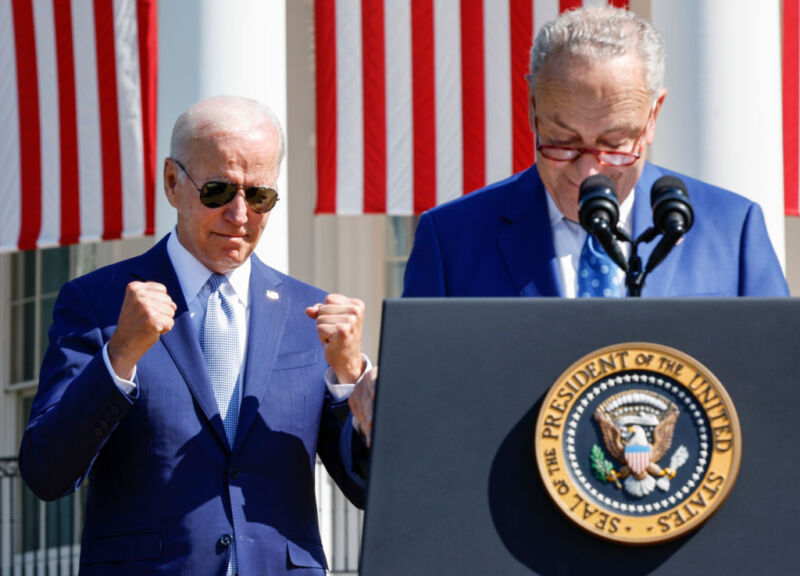
Chipmakers eager to receive huge subsidies stood with President Joe Biden as he signed a bill injecting $52.7 billion into their industry today. Executives from companies like Micron, Intel, HP, and Lockheed Martin witnessed the flick of Biden’s pen, alongside auto industry leaders and other stakeholders. They are hopeful that these new subsidies will end “a persistent shortage” in memory chips that Reuters reports has affected “everything from cars, weapons, washing machines, and video games.”

In total, the CHIPS and Science Act—also known as the Creating Helpful Incentives to Produce Semiconductors for America Act—authorizes up to $200 billion in subsidies over 10 years, should the US decide to continue investing. The long-term vision is to shove the US ahead of China and other invested countries in a global race to become a chip industry leader.

Once the law is enacted, the Department of Commerce will decide on rules for how grants will be disbursed, dictating who gets how much money and for how long. Because advanced semiconductor production that’s necessary for chipmaking requires a significant investment of time and money, venture capitalists have been less likely to fund long-term projects. This law positions the federal government to fill that funding gap while advancing highly coveted technology domestically.

Some chipmakers have already announced long-term investments ahead of Biden signing the bill into law, including a commitment from Qualcomm to purchase $7.4 billion worth of semiconductor chips over the next six years from a New York factory. Micron committed even more, setting aside $40 billion to fund memory chip manufacturing. Micron’s investment alone would “boost US market share from 2 percent to 10 percent”—an ample recovery that’s still relatively modest when compared to the 38 percent market share that the US used to enjoy in 1990.

In addition to federal grants, chip manufacturers are eligible for a 25 percent investment tax credit through the bill. For the entire industry, that’s another estimated $24 billion boon, on top of the $50 billion in grants.

Historically, US lawmakers consider corporate subsidies of such proportion to be counterintuitive to ensuring a fair, free market. But lawmakers seem to think it’s necessary to ward off national security risks and address global supply chain concerns by investing billions into America’s chip production—much like how the European Union and China have invested in their own production.

This could help put the US ahead as a top global chip manufacturer, but there are some signs that the US will need to monitor progress closely to ensure maximum profitability on its investment. Biden’s move today comes just after China’s chipmaking industry has “descended into chaos,” with top Chinese chip industry officials arrested on corruption charges for misusing government money. After investing $30 billion, China is still on the hook for another $20 billion as investigations begin, and their technology still lags behind Taiwan’s.

Experts have said there’s nothing surprising about discovering corruption in an industry with so much money “sloshing around.” In the US, corruption from increasing corporate welfare has been heavily criticized since the 1980s, when watchdogs first attempted to “drain the swamp” of politically motivated and financially controlling corporations working against consumer interests for profits. China is one example of how government investment in the chip industry can go wrong—wasted money on low-quality technology that can’t compete in global trade—but it also illustrates why cutting ties with foreign suppliers is considered crucial, even by more frugal lawmakers who otherwise would hesitate to approve large corporate subsidies.

https://arstechnica.com/?p=1872458


US blacklisting of Tornado Cash sparks outcry from cryptocurrency industry

Abstract image of a blockchain displays ones and zeroes imposed on interconnected chain links.
Getty Images | Yuichiro Chino

The US Treasury Department blacklisted the virtual currency mixer Tornado Cash on Monday, saying the system “has been used to launder more than $7 billion worth of virtual currency since its creation in 2019.” The platform was added to the Specially Designated Nationals and Blocked Persons List (SDN), prohibiting all transactions on Tornado Cash by people in the US “unless authorized by a general or specific license issued by OFAC [Office of Foreign Assets Control]”, the Treasury Department announcement said.

“As a result of today’s action, all property and interests in property of the entity above, Tornado Cash, that is in the United States or in the possession or control of US persons is blocked and must be reported to OFAC,” the announcement said. There is reportedly over $412 million of assets on Tornado Cash. Prices of Tornado’s crypto token TORN plummeted after the blacklisting announcement.

The Treasury action was criticized within the crypto industry because it affects any US person using Tornado Cash, not just those involved in money laundering or other crimes. The SDN list is generally used to “identify persons involved in terrorism, enemy states, or other state-sanctioned activities and ensure that these individuals cannot get the benefit of the US financial system,” Coin Center Executive Director Jerry Brito and Research Director Peter Van Valkenburgh wrote yesterday. Coin Center is a cryptocurrency research and advocacy group.

The sanction of Tornado Cash is unusual because a “smart contract is a robot, not a person,” and Treasury’s action seems “to be the sanctioning of a tool that is neutral in character and that can be put to good or bad uses like any other technology,” they wrote. “It is not any specific bad actor who is being sanctioned, but instead it is all Americans who may wish to use this automated tool in order to protect their own privacy while transacting online who are having their liberty curtailed without the benefit of any due process.”

Open source code gone from GitHub

Tornado Cash’s open source code disappeared from GitHub, apparently just after the Treasury announcement. Tornado Cash co-founder Roman Semenov wrote yesterday, “My @GitHub account was just suspended. Is writing an open source code illegal now?”

When contacted by Ars, the Microsoft-owned GitHub said, “Trade laws require GitHub to restrict users and customers identified as Specially Designated Nationals (SDNs) or other denied or blocked parties, or that may be using GitHub on behalf of blocked parties. At the same time, GitHub’s vision is to be the global platform for developer collaboration. We examine government sanctions thoroughly to be certain that users and customers are not impacted beyond what is required by law.”

Tornado Cash says it uses a decentralized protocol in which smart contracts are “implemented within the Ethereum blockchain, making them immutable. They can neither be changed nor tampered with. Therefore, nobody—including the original developers—can modify or shut them down.” Despite the GitHub code removal, Tornado Cash said the “smart contracts are on the Ethereum blockchain. It doesn’t change anything for Tornado Cash contracts,” Decrypt wrote.

Decrypt also reported that an “anonymous troll is sending celebrities Ethereum from a Tornado Cash wallet—presumably as a way to demonstrate how difficult it will be for the US government to enforce its ban on the mixing service.”

The Treasury Department said Tornado Cash “indiscriminately facilitates anonymous transactions by obfuscating their origin, destination, and counterparties, with no attempt to determine their origin. Tornado receives a variety of transactions and mixes them together before transmitting them to their individual recipients. While the purported purpose is to increase privacy, mixers like Tornado are commonly used by illicit actors to launder funds, especially those stolen during significant heists.”

The US agency also said that money laundered on Tornado Cash “includes over $455 million stolen by the Lazarus Group, a Democratic People’s Republic of Korea (DPRK) state-sponsored hacking group,” plus “$96 million of malicious cyber actors’ funds derived from the June 24, 2022, Harmony Bridge Heist, and at least $7.8 million from the August 2, 2022 Nomad Heist.”

“Despite public assurances otherwise, Tornado Cash has repeatedly failed to impose effective controls designed to stop it from laundering funds for malicious cyber actors on a regular basis and without basic measures to address its risks,” said Under Secretary for Terrorism and Financial Intelligence Brian Nelson. He said Tornado Cash “launders the proceeds of cybercrimes, including those committed against victims in the United States.”

https://arstechnica.com/?p=1872426