Server hack yields harrowing images of life inside Chinese detention camps

Server hack yields harrowing images of life inside Chinese detention camps

A hack on police servers in China’s Xinjiang region has yielded thousands of graphic images and videos of Uighur detainees suffering in detention camps in one of the starkest accounts yet of the ongoing humanitarian crisis caused by the country’s persecution of ethnic minorities.

The images are accompanied by training manuals, detailed police work rosters, and instructions for guarding the camps. Using a euphemism to describe inmates, one document states: “If students do not respond to warning shots and continue to try to escape, the armed police shoot to kill,” the BBC reported. Images show one prisoner in an iron torture device known as a tiger chair, which immobilizes the arms. Der Spiegel, one of the other outlets that published the tranch of hacked photos and documents, said it confirmed their authenticity in part by analyzing GPS data included in some of the images.

“The material is unprecedented on several levels,” Dr. Adrian Zenz, director and senior fellow in China Studies at the Victims of Communism Memorial Foundation, who obtained the files and shared them with news outlets, wrote on Twitter. His thread provided a broad overview of the leaked materials that included “high-level speeches, implicating top leadership and containing blunt language,” “camp security instructions, far more detailed than China Cables [that] describe heavily armed strike units with battlefield assault rifles,” and other evidence of Uighur oppression at the hands of the Chinese government.

Most of the images and documents are available on a dedicated site. Contents include the images of 2,884 detainees, training images and Powerpoint documents for security drills, and speeches and directives from top government officials documenting Beijing’s knowledge and backing of the camps and policies.

Little is known about the specifics of the hack that made the leaked items available. The BBC said only that, “The source of the files claims to have hacked, downloaded and decrypted them from a number of police computer servers in Xinjiang, before passing them to Dr. Adrian Zenz, a scholar at the US-based Victims of Communism Memorial Foundation who has previously been sanctioned by the Chinese government for his influential research on Xinjiang.”

The Chinese Embassy in Washington, DC, issued a statement to the BBC that said: “Xinjiang related issues are in essence about countering violent terrorism, radicalization, and separatism, not about human rights or religion,” and went on to say that Chinese authorities had taken “a host of decisive, robust and effective deradicalization measures.” The statement added: “The local people are living a safe, happy, and fulfilling life.”

https://arstechnica.com/?p=1856217


Judge: Tesla can’t force alleged sexual harassment victim into arbitration

Aerial view of Tesla cars in a parking lot at the company's factor. The word
Enlarge / Tesla cars in a lot at the company’s factory in Fremont, California.
Getty Images | Justin Sullivan

Tesla can’t force a woman who sued the company over sexual harassment into arbitration, a judge ruled on Monday.

Jessica Barraza sued Tesla in November 2021 in Alameda County Superior Court in California, alleging that she and other women working in the carmaker’s Fremont factory were subjected to “nightmarish conditions of rampant sexual harassment.” The Tesla factory “resembles a crude, archaic construction site or frat house,” with women enduring sexual comments, propositions, and inappropriate touching, the lawsuit said.

Barraza also alleged Tesla retaliated against her after she complained about sexual harassment and that she was “denied certain privileges and benefits that were afforded to women who did not object to supervisors’ sexual advances and flirtations.” Many more details are in our coverage of the lawsuit.

Tesla moved to compel arbitration, saying Barraza signed an agreement that “[a]ny claim, dispute, or cause of action must be brought in a party’s individual capacity, and not as a plaintiff or class member in any purported class or representative proceeding.” The arbitration agreement “encompasses every claim pleaded in Plaintiff’s complaint,” Tesla said.

Barraza’s legal team called the agreement procedurally unconscionable, writing that “Tesla increased its leverage by not telling Ms. Barraza about the arbitration provision until she had already accepted a verbal offer and quit her other job.” The offer letter she signed “does not explain that Ms. Barraza was giving up the right to a jury trial,” Barraza’s court filing said.

“It is procedurally unconscionable to force a low-wage, unsophisticated worker to sign an adhesion contract relinquishing the right to go to court after she had already quit her [previous] job in reliance on Tesla’s verbal job offer and had already signed three documents stating that disputes would be decided in court,” the filing said. The previously signed documents included an applicant NDA, a visitor NDA, and a Proprietary Information and Inventions Agreement (PIIA).

Judge: “Barraza was ambushed”

Tesla argued its case in a hearing, but Judge Stephen Kaus was not convinced and, in an order issued on Monday, denied Tesla’s motion to compel arbitration. Kaus wrote, “The amount of procedural unconscionability here is considerable. Having left her previous employment, the pressure on Barraza to sign the offer letter was more significant than that found to be minimal in other cases.”

While Tesla argued that Barraza had the option of not signing the offer letter, Kaus found “it is obvious that signing was a condition of employment.”

“Tesla either orchestrated this sequence of events on purpose or was unacceptably indifferent to the situation in which this placed Barraza,” the judge wrote. “Basically, Barraza was ambushed. She had gone through extensive pre-employment activities, had been offered a job, signed multiple forms and had left her previous employment in reliance on that offer, all without Tesla giving any indication that she would have to agree to arbitrate employment claims and give up her right to a jury trial.”

In a press release, Barraza attorney David Lowe said, “Because of this ruling, Tesla will not be able to hide behind the closed doors of confidential arbitration,” and Barraza’s claims will be heard in a jury trial.

“I’m so grateful that this decision brings us one step closer to justice,” Barraza said.

https://arstechnica.com/?p=1856138


Judges block Florida law that says Facebook and Twitter can’t ban politicians

Facebook and Twitter logos.
Getty Images | NurPhoto

The Florida law that makes it illegal for large social media sites like Facebook and Twitter to ban politicians likely violates the First Amendment, according to a unanimous ruling by a panel of three federal appeals court judges.

The ruling, released today by the US Court of Appeals for the Eleventh Circuit, upheld key portions of a preliminary injunction issued by a US District Court judge in June 2021. Florida appealed that injunction. As a result of today’s ruling, the state still cannot enforce the law’s content-moderation requirements.

“It is substantially likely that [the Florida law’s] content-moderation restrictions and its requirement that platforms provide a thorough rationale for every content-moderation action violate the First Amendment,” the appeals court judges found in today’s ruling. It wasn’t a complete loss for Florida, as the judges said it is “unlikely that the law’s remaining (and far less burdensome) disclosure provisions violate the First Amendment.” Florida can thus enforce those less burdensome disclosure requirements while litigation is pending.

The Florida law is similar to a Texas statute that prohibits large social media companies from moderating posts based on a user’s “viewpoint.” The Texas law was also blocked by a federal judge who ruled that it violates the social networks’ First Amendment right to moderate user-submitted content.

But the Texas law was revived this month by the US Court of Appeals for the Fifth Circuit. Big Tech groups have asked the US Supreme Court to reinstate the preliminary injunction. Florida and 11 other states filed a Supreme Court brief supporting Texas, saying they “have a strong interest in defending the regulatory authority of sovereign states in this area.”

Judges: Social networks have First Amendment rights

The Florida law says a social media platform “may not willfully deplatform a candidate for office” and imposes fines of up to $250,000 per day on social media companies that ban candidates for elected office. “Deplatforming” under the law includes permanent account bans and bans lasting more than 14 days.

The law also says social platforms “may not apply or use post-prioritization or shadow banning algorithms for content and material posted by or about… a candidate,” and may not “censor, deplatform, or shadow ban a journalistic enterprise based on the content of its publication or broadcast.”

Florida’s law further said each platform must “apply censorship, deplatforming, and shadow banning standards in a consistent manner among its users on the platform,” but the law does not define the term “consistent,” today’s ruling noted. Here’s how the Eleventh Circuit appeals court explained why it’s blocking the key content-moderation restrictions in the Florida law:

The question at the core of this appeal is whether the Facebooks and Twitters of the world—indisputably “private actors” with First Amendment rights—are engaged in constitutionally protected expressive activity when they moderate and curate the content that they disseminate on their platforms. The State of Florida insists that they aren’t, and it has enacted a first-of-its-kind law to combat what some of its proponents perceive to be a concerted effort by “the ‘big tech’ oligarchs in Silicon Valley” to “silenc[e]” “conservative” speech in favor of a “radical leftist” agenda. To that end, the new law would, among other things, prohibit certain social-media companies from “deplatforming” political candidates under any circumstances, prioritizing or deprioritizing any post or message “by or about” a candidate, and, more broadly, removing anything posted by a “journalistic enterprise” based on its content.

We hold that it is substantially likely that social-media companies—even the biggest ones—are “private actors” whose rights the First Amendment protects, that their so-called “content-moderation” decisions constitute protected exercises of editorial judgment, and that the provisions of the new Florida law that restrict large platforms’ ability to engage in content moderation unconstitutionally burden that prerogative. We further conclude that it is substantially likely that one of the law’s particularly onerous disclosure provisions—which would require covered platforms to provide a “thorough rationale” for each and every content-moderation decision they make—violates the First Amendment. Accordingly, we hold that the companies are entitled to a preliminary injunction prohibiting enforcement of those provisions.

https://arstechnica.com/?p=1855776


Texas looks to a Clarence Thomas opinion to defend its social media law

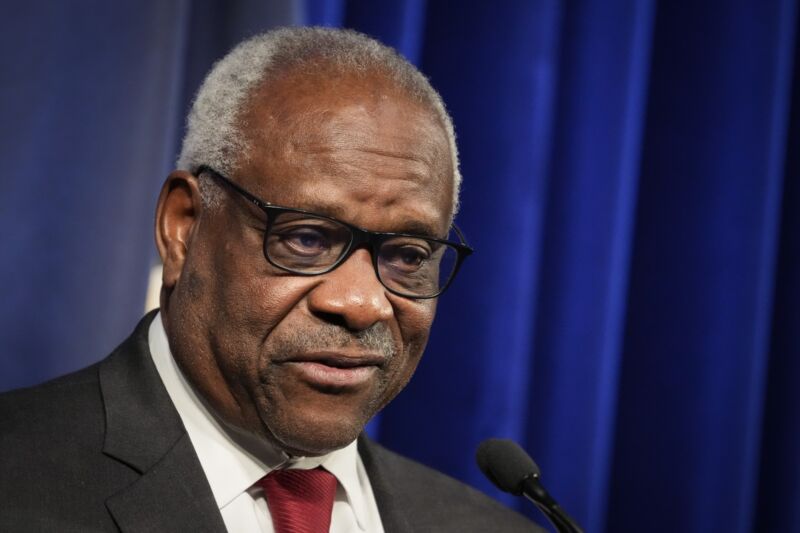
Supreme Court Justice Clarence Thomas speaking into a microphone at an event.
Enlarge / Supreme Court Justice Clarence Thomas speaks at the Heritage Foundation on October 21, 2021, in Washington, DC.
Getty Images | Drew Angerer

With tech groups asking the US Supreme Court to block the new Texas law against social media “censorship,” the state’s defense relies in part on an opinion issued last year by Justice Clarence Thomas in a case involving Donald Trump and Twitter.

Thomas’ opinion, as we wrote at the time, criticized the Section 230 legal protections given to online platforms’ moderation decisions and argued that free-speech law shouldn’t necessarily prevent lawmakers from regulating those platforms as common carriers.

“In many ways, digital platforms that hold themselves out to the public resemble traditional common carriers,” Thomas wrote. “Though digital instead of physical, they are at bottom communications networks, and they ‘carry’ information from one user to another. A traditional telephone company laid physical wires to create a network connecting people. Digital platforms lay information infrastructure that can be controlled in much the same way.” The similarity between online platforms and common carriers “is even clearer for digital platforms that have dominant market share,” Thomas also wrote.

The April 2021 opinion had no immediate practical impact. It was a concurring opinion in a case in which the Supreme Court vacated a 2019 appeals court ruling that said then-President Donald Trump violated the First Amendment by blocking people on Twitter. The court declared the case “moot” because Trump was no longer president.

But Thomas’ opinion raised eyebrows at the time, and it was cited yesterday in the Texas response to Big Tech’s attempt to block a state law that prohibits social media companies from moderating content based on a user’s “viewpoint.” With help from the Thomas opinion, Texas Attorney General Ken Paxton argued that Texas can regulate social media platforms as common carriers.

“Texas law declares the platforms are common carriers”

“Even if the Hosting Rule implicated the platforms’ First Amendment rights in some way, the Attorney General is still likely to prevail because Texas law declares the platforms are common carriers. The State may therefore properly limit the platforms’ ability to discriminate among their customers,” Paxton argued.

Pointing to historical examples of telegraphs, telephones, and cable operators, Paxton told the Supreme Court that “Texas has as compelling an interest in preserving its residents’ ability to communicate and receive information on the platforms as States had regarding these previous generations of communications technology.”

There is “little doubt that the platforms resemble historical communications-provider common carriers sufficiently to justify the continued application of these principles, as Justice Thomas has explained,” Paxton wrote, referring to Thomas’ concurring opinion in the Trump case. On the question of “whether the platforms possess market power,” Paxton cited Thomas again while writing that “[s]everal jurists have suggested that they believe the platforms wield such power.” Paxton also quoted Thomas’ statement that the social networks have become “dominant digital platforms.”

Texas also cited Thomas’ concurring opinion earlier in the litigation when filing briefs in lower courts.

Texas, Florida laws blocked on First Amendment grounds

Despite Thomas’ views, courts have ruled that the First Amendment does not prohibit websites from restricting speech on their platforms. Even after Thomas issued his opinion, the Texas law and a similar one in Florida were blocked by federal judges who ruled that the laws violate social media companies’ First Amendment right to moderate user content. Additionally, Section 230 of the Communications Decency Act explicitly says online platforms shall not be held liable for restricting access to content the platforms consider objectionable, “whether or not such material is constitutionally protected.”

Although the Texas law was originally blocked by a US District Court judge on First Amendment grounds, it was revived last week by the US Court of Appeals for the Fifth Circuit. The Fifth Circuit judges issued a one-sentence order that did not explain their reasons for staying the preliminary injunction. Big Tech groups then asked the Supreme Court to reinstate the injunction to prevent Texas from enforcing the law while litigation continues.

Florida’s law remains blocked, and the state is keenly interested in the outcome of the Texas battle. Florida yesterday filed a Supreme Court brief supporting Texas, and the Florida brief was co-signed by 11 other states: Alabama, Alaska, Arizona, Arkansas, Iowa, Kentucky, Mississippi, Missouri, Montana, Nebraska, and South Carolina.

“Amici states have a strong interest in defending the regulatory authority of sovereign states in this area,” the Florida brief said. “Indeed, many states have enacted, or are considering, laws that resemble Texas’s and Florida’s laws, and believe that the Fifth Circuit was correct to stay the district court’s injunction pending appeal.”

The Texas law applies to social media platforms with “more than 50 million active users in the United States in a calendar month.” It says that a “social media platform may not censor a user” based on the user’s “viewpoint” and defines “censor” as “block, ban, remove, deplatform, demonetize, de-boost, restrict, deny equal access or visibility to, or otherwise discriminate against expression.” Under the law, users or the Texas attorney general can sue platforms that violate the ban.

https://arstechnica.com/?p=1855325


Twitter deal leaves Elon Musk with no easy way out

Twitter deal leaves Elon Musk with no easy way out
Chris Delmas/Getty Images

Since the financial crisis, corporate lawyers have aspired to build the ultimate ironclad merger contract that keeps buyers with cold feet from backing out.

The “bulletproof” modern deal agreement now faces one of its biggest tests, as Elon Musk, the Tesla boss and richest person in the world, openly entertains the possibility of ditching his $44 billion deal for Twitter.

Musk said in a tweet this week that the “deal cannot move forward” until the social media platform provides detailed data about fake accounts, a request that Twitter seems unlikely to meet. Twitter’s board, meanwhile, has stated its commitment “to completing the transaction on the agreed price and terms as promptly as practicable.”

Simply abandoning the deal is not an option. Musk and Twitter have both signed the merger agreement, which states that “the parties… will use their respective reasonable best efforts to consummate and make effective the transactions contemplated by this agreement.”

With tech stocks falling—dragging down the price of the Tesla shares that form the basis of Musk’s fortune and collateral for a margin loan to buy Twitter—all eyes are on the mercurial billionaire’s next move.

Could Musk walk away for $1 billion?

The agreement includes a $1 billion “reverse termination fee” that Musk would owe if he withdrew from the merger agreement. However, if all other closing conditions are met and the only thing left is for Musk to show up at the closing with his $27.25 billion in equity, Twitter can seek to make Musk close the deal. This legal concept, known as “specific performance,” has become a common feature in leveraged buyouts since the financial crisis.

In 2007 and 2008, leveraged buyouts typically included a reverse termination fee that often allowed a company backing the acquisition to pay a modest 2 to 3 percent of a deal’s value to get out. Sellers believed at the time that private equity groups would follow through and close their transactions in order to maintain their reputations. But some did pull the plug on those agreements, leading to several court fights involving prominent companies such as Cerberus, Blackstone, and Apollo.

Since that era, sellers have implemented much higher termination fees as well as specific performance clauses that effectively require buyers to close. Most recently, a Delaware court in 2021 ordered private equity group Kohlberg & Co to close the buyout of a cake decorations business called DecoPac.

Kohlberg had argued it was allowed out of the deal because the DecoPac business had suffered a “material adverse effect” when the pandemic struck between signing and closing. The court rejected that argument and ruled that DecoPac could force Kohlberg to close—which it did.

https://arstechnica.com/?p=1855305


Twitter board tells Elon Musk: We will not alter the deal

Twitter's bird-shaped logo on the outside of the company's headquarter building. The camera angle also shows nearby tree branches, making it appear as if the bird is sitting on a branch or flying through the branches.
Enlarge / The Twitter logo is seen at the company’s headquarters on April 26, 2022, in downtown San Francisco, California.
Getty Images | Amy Osborne

With Elon Musk waffling on his commitment to buy Twitter for $44 billion, Twitter’s board of directors yesterday said it intends to enforce the merger agreement at the original price.

“The Board and Mr. Musk agreed to a transaction at $54.20 per share. We believe this agreement is in the best interest of all shareholders. We intend to close the transaction and enforce the merger agreement,” the Twitter board said in a statement reported by CNN and other media outlets. Twitter on Tuesday also released a preliminary proxy statement laying out reasons shareholders should approve the deal.

“Twitter is committed to completing the transaction on the agreed price and terms as promptly as practicable,” the company said in a press release announcing the proxy statement.

Exit options

The sale agreement lets either Twitter or Musk kill the deal and pay a breakup fee of $1 billion under certain circumstances. For example, Musk would have to pay the termination fee if he “fails to consummate the Merger as required pursuant to, and in the circumstances specified in, the Merger Agreement.”

However, Musk can’t necessarily get out of it based solely on his complaints about the number of spam accounts on the social network. As Bloomberg wrote, the merger agreement also “includes a specific performance provision that allows Twitter to force Musk to consummate the deal, according to the filing. That could mean that, should the deal end up in court, Twitter might secure an order obligating Musk to complete the merger rather than winning monetary compensation for any violations of it.”

That provision can be found in section 9.9 of the merger deal. If Twitter meets its obligations under the agreement, it “shall be entitled to specific performance or other equitable remedy” to “cause the Equity Investor [Musk] to fund the Equity Financing, or to enforce the Equity Investor’s obligation to fund the Equity Financing directly, and to consummate the Closing,” the agreement says.

Twitter and Musk agreed that if either party fails to take required actions to consummate the agreement, there would be “irreparable damage for which monetary damages, even if available, would not be an adequate remedy.” Twitter or Musk would thus “be entitled to an injunction, specific performance and other equitable relief to prevent breaches of this Agreement and to enforce specifically the terms and provisions hereof, in addition to any other remedy to which they are entitled at law or in equity.”

The deal also has a non-disparagement clause that says Musk can tweet about the merger “so long as such Tweets do not disparage the Company or any of its Representatives,” but Musk has repeatedly criticized Twitter and its representatives since signing the deal.

https://arstechnica.com/?p=1854942


Supreme Court urged to block “shocking” reinstatement of Texas social media law

The US Supreme Court Building seen during daytime.
Enlarge / The US Supreme Court building.
Getty Images | Grant Faint

Big Tech lobby groups have asked the US Supreme Court to block a Texas state law that prohibits social media companies from moderating content based on a user’s “viewpoint.”

The state’s so-called “censorship” law was previously blocked by a federal judge who ruled that it violates the social networks’ First Amendment right to moderate user-submitted content. But the law was reinstated last week by the US Court of Appeals for the Fifth Circuit, which granted Texas Attorney General Ken Paxton’s motion to stay the preliminary injunction.

The Fifth Circuit ruling came in a majority vote of three judges. Instead of seeking an en banc hearing with all the Fifth Circuit court’s judges, two tech groups submitted an emergency application to the Supreme Court on Friday. The appeal was filed by NetChoice and the Computer & Communications & Industry Association (CCIA), which represent companies including Amazon, eBay, Facebook, Google, Twitter, and Yahoo.

“The divided panel’s shocking decision to green-light an unconstitutional law—without explanation—demanded the extraordinary response of seeking emergency Supreme Court intervention,” NetChoice Counsel Chris Marchese said.

The emergency application was directed to Justice Samuel Alito, who is assigned to the Fifth Circuit. “Under Court procedures, Justice Alito may rule unilaterally or refer the matter to the full Court for consideration,” NetChoice said.

Court’s “one-sentence order explains nothing”

NetChoice and CCIA told the Supreme Court that the Texas statute “is a flatly unconstitutional law that compels government-preferred speech from select private entities and would require enormous upheaval to the worldwide operations of covered Internet websites.” The brief also warns that the law “is an invitation for lawsuits into platforms’ editorial judgments” and will let Texas be “the ultimate arbiter of how platforms should apply their policies.” Pointing out specific services the law applies to, the brief calls it “an unprecedented assault on the editorial discretion of private websites (like Facebook.com, Instagram.com, Pinterest.com, Twitter.com, Vimeo.com, and YouTube.com) that would fundamentally transform their business models and services.”

The Fifth Circuit appeals court ruling in Texas’ favor did not explain the judges’ reasons for staying the injunction. The Supreme Court brief filed by NetChoice and CCIA said the “panel majority granted Defendant’s five-month-old stay motion in a one-line order without any explanation or reasoning—although a footnote stated, ‘The panel is not unanimous.'”

Noting similarities between the Texas law and one in Florida that was also blocked by a US District Court judge, the tech groups wrote:

Last year, both Texas and Florida embarked on an unprecedented effort to override the editorial discretion of social media platforms and to compel them to disseminate a plethora of speech the platforms deem objectionable and antithetical to the speech they want to present to users (and advertisers). Both laws are an undisguised effort to level the speech playing field and control “Big Tech.” To that end, both laws override editorial discretion and compel speech—imposing their burdens only on selected speakers and carving out favored content. In short, the laws defy established First Amendment doctrine by taking virtually every action forbidden to state actors by the First Amendment.

https://arstechnica.com/?p=1854405


Social media sites work to limit spread of Buffalo shooting footage

An icon for the Twitch app displayed on a smartphone screen.


Twitch, the Amazon-owned livestreaming site that caters primarily to gamers, said it removed streamed footage of a shooting in Buffalo, New York, this weekend “less than two minutes after the violence started.”

An 18-year-old white man used an assault rifle to fire on crowds of shoppers in a Buffalo supermarket Saturday, authorities said. The attack—which killed 10 and injured three, including 11 Black victims—is being investigated as a hate crime after the shooter allegedly posted a lengthy manifesto citing 4chan posts regarding the racist “great replacement theory” as his motivation.

Buffalo Police Commissioner Joseph Gramaglia said Saturday that the shooter “had a camera and was livestreaming what he was doing” during the attack. The Twitch channel that had hosted that video has now been taken down, with its content marked as “currently unavailable due to a violation of Twitch’s community guidelines or terms of service.”

“We are devastated to hear about the shooting in Buffalo, New York,” Twitch said in a statement provided to the press. “Our hearts go out to the community impacted by this tragedy. Twitch has a zero-tolerance policy against violence of any kind and works swiftly to respond to all incidents. The user has been indefinitely suspended from our service, and we are taking all appropriate action, including monitoring for any accounts rebroadcasting this content.”

The New York Times reported that a Discord account with a name matching that of the now-suspended Twitch account made posts on a private server that included apparent planning for the attack. “We extend our deepest sympathies to the victims and their families, and we will do everything we can to assist law enforcement in the investigation,” Discord told the Times.

Discord tracks thousands of reports of extremist or violent content in its regular transparency reports and noted last June that such reports “continued to make up comparably small fractions of our overall volume” of moderation issues.

Footage whack-a-mole

Despite the quick Twitch takedown, copies of the livestreamed footage continue to proliferate on other social media sites. A Meta spokesperson told Engadget that the footage has been added to a database that will be used to identify copies and remove them automatically before they are visible on Facebook.

In April, Twitter updated its content moderation rules regarding “perpetrators of terrorist, violent extremist, or mass violent attacks,” making it clear that manifestos and footage related to such attacks were not welcome on the platform. But that policy includes a possible exception for tweets where “there is a clear and explicit intent to provide additional context and counterspeech” to the violent content.

“We believe the hateful and discriminatory views promoted in content produced by perpetrators are harmful for society and that their dissemination should be limited in order to prevent perpetrators from publicizing their message,” Twitter said in a statement Sunday.

In 2019, a livestreamed shooting in Germany was reportedly available on Twitch for 30 minutes, where it was viewed thousands of times before being taken down. And in 2018, a shooting at a Jacksonville Madden NFL tournament was inadvertently livestreamed on Twitch as part of that tournament broadcast. https://arstechnica.com/?p=1854381


Musk says Twitter deal “on hold” over concern about number of spam accounts

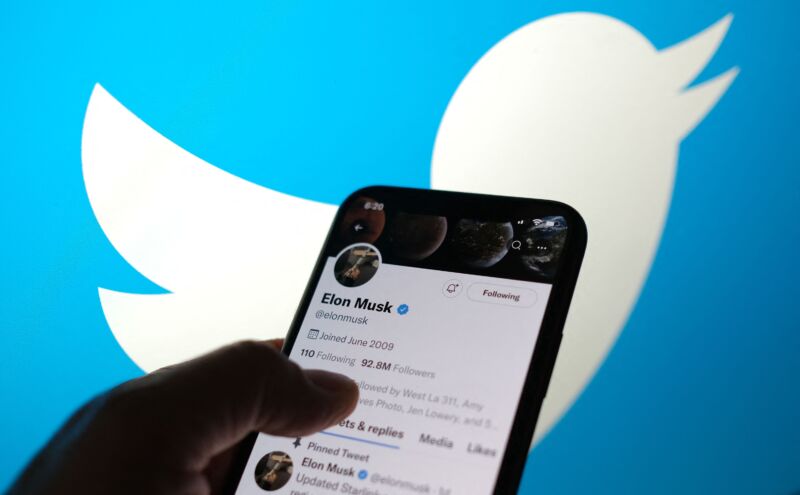
In this photo illustration, Elon Musk's twitter account is displayed on a smartphone in front of a background with the twitter logo.
Getty Images | SOPA Images

Elon Musk today said his deal to purchase Twitter is “temporarily on hold” while he awaits details on the number of spam and fake accounts on the site, but he later added that he remains “committed” to the acquisition.

“Twitter deal temporarily on hold pending details supporting calculation that spam/fake accounts do indeed represent less than 5 percent of users,” Musk wrote in a tweet Monday morning. In a follow-up tweet two hours later, he wrote, “Still committed to acquisition.”

The first tweet saying that the deal is “on hold” included a link to a May 2 Reuters article noting that Twitter had “estimated in a filing… that false or spam accounts represented fewer than 5 percent of its monetizable daily active users during the first quarter.”

Twitter shares reportedly fell more than 20 percent in premarket trading after Musk’s initial tweet but gained much of that back after Musk said he’s still committed to the deal. Twitter shares were down about 8 percent in today’s trading as of this writing.

Musk could renegotiate price or back out

While Musk could back out of the Twitter deal and pay a $1 billion breakup fee, he could also renegotiate the price. The Wall Street Journal wrote today:

Mr. Musk might be using Twitter’s recent disclosure as a means to get out of or renegotiate the deal, said Daniel Ives, a technology analyst at Wedbush Securities. One reason is the impact on Tesla shares since the deal was announced.

“Leveraging his stock and potential sales of Tesla is a huge overhang on the stock,” Mr. Ives said.

Tesla shares “have fallen 29 percent over the past month through Thursday,” the WSJ report noted.

Musk has more fake followers than similar accounts

Musk has said his priorities as Twitter owner will include “defeating the spam bots and authenticating all humans.” SparkToro, which makes a “Fake Followers Audit” tool, says its research suggests that 5 to 30 percent of followers on Twitter are fake. That includes “bots, spam accounts, inactive users, propaganda, or other non-engaged/non-real users.”

The number of fake followers is generally much bigger for high-profile accounts such as Musk’s. Nearly 58 percent of Musk’s followers are fake, according to a check of his account using the SparkToro tool today. That amounts to nearly 53 million accounts following Musk “that are unreachable and will not see the account’s tweets (either because they’re spam, bots, propaganda, etc. or because they’re no longer active on Twitter).”

“Accounts with a similar sized following to @elonmusk have a median of 41 percent fake followers. This account has more fake followers than most,” SparkToro says.

https://arstechnica.com/?p=1854158


Bitcoin plunges to lowest price since 2020 amid broader sell-off

Bitcoin plunges to lowest price since 2020 amid broader sell-off
R.Tsubin / Getty

The price of one Bitcoin briefly fell below $27,000 on Thursday morning, the lowest price for the cryptocurrency since 2020. The world’s leading virtual currency bounced back later in the day and now trades at $28,600. But that’s still 20 percent below the price one week ago and 57 percent below last November’s peak.

Bitcoin’s fall is part of a broader cryptocurrency sell-off. Ethereum is currently down 8 percent over the last 24 hours and 28 percent over the last week. Additionally, Cardano (39 percent), Dogecoin (36 percent), and Litecoin (32 percent) have all fallen during the past week.

Perhaps most alarming for the cryptocurrency world: The “stablecoin” Tether lost its peg to the US dollar early Thursday, briefly dipping to 96 cents. Tether is now trading at $1 once again.

Paolo Ardoino, the CTO of Bitfinex, the company that created Tether, tweeted on Thursday morning that the company had redeemed $300 million worth of Tether to defend the peg “without a sweat drop.” He vowed to redeem as much as necessary to keep its price at par with the dollar.

Tightening financial conditions

Nobody knows why cryptocurrencies move on any given day. But one likely factor driving the broad cryptocurrency sell-off is the broader macroeconomic environment.

In late 2021, with inflation raging, the Federal Reserve signaled that it would begin tightening monetary policy. The Fed made good on its pledge in March by raising interest rates. Last week, the Fed increased its target interest rate by 0.5 percent, the most significant one-day hike in two decades.

Rising interest rates tend to push down the market value of all assets. The tightening financial conditions have driven a broad-based decline in the stock market, with the S&P 500 declining by 18 percent since its December peak.

High interest rates have a particularly big impact on speculative assets. The tech-heavy NASDAQ index is down 29 percent since its November peak.

Tesla stock has fallen by 40 percent since last November. Two of its rivals, Lucid and Canoo, are down 71 and 76 percent, respectively, since their November peaks. Canoo recently warned it could run out of money before producing its first car.

The last six months have been brutal for “meme stocks.” GameStop stock is down 63 percent from last November, while AMC is down 77 percent over the same period.

All of these assets saw their value soar in early 2021 as the Fed and Congress pumped record amounts of money into the economy. As 2022 began, the Fed started putting that process in reverse, pulling money out of the economy to push up interest rates. And as cash has gotten scarcer, people who need money have been selling off speculative assets to get it.

The cryptocurrency sell-off can be understood as part of that broader trend. And it may be far from over. The Fed signaled that it plans to continue raising interest rates aggressively in the coming months.

Tim Lee was on staff at Ars from 2017 to 2021. In 2021, he launched Full Stack Economics, an independent email newsletter about the economy, technology, and public policy. You can subscribe to his newsletter here.

https://arstechnica.com/?p=1854056