DOJ sues states that rejected ICE requests for undercover license plates

Similarly, ICEList.info is designed to act as a sort of wiki, collecting updates on ICE enforcement activity and cataloging detentions, arrests, and deportations. Individual agents are listed “where sufficient evidence exists” to link them to enforcement events, the About page said, and any attempts to post information that could be used to dox agents violate site rules and are deleted.

“False submissions, harassment, or attempts to misuse the platform will be removed,” the About page said.

Dominick Skinner, who owns ICE List, told Wired that “he does not believe that what ICE List does is doxing,” primarily because “ICE List doesn’t post the home addresses of identified agents.”

In a press release, the DOJ said that it considers doxing to be the sharing of “a victim’s Social Security number, home address, home phone number, mobile phone number, and personal email address.” An incomplete Ars review spot checking 100 profiles of ICE agents on ICE List showed only publicly posted professional contact information.

DOJ’s lack of doxing evidence

The Trump administration has routinely relied on bare mentions of threats of doxing to pressure platforms into censoring social media posts showing ICE activity or linking to sites like ICE List, Freedom of Information Act lawsuits have claimed.

But there’s a notable lack of arrests to back up those claims.

As recently as January, the DOJ has insisted that ICE officers are facing an 8,000 percent increase in death threats. But that press release did not specify where that statistic comes from.

Instead, the agency shared the transcript of a single voicemail that was left for an ICE officer in Minnesota on January 24. In it, the caller doesn’t directly threaten violence, but appears try to intimidate the officer by saying that they “hope” that his wife and mom die and that “everything wrong that could go in your life happens.” They tell the officer that they “hope” the officer gets “hit by a bus” and “paralyzed.” And they end by calling the officer a “traitor to the American people” and urging that the officer “should kill yourself.”

https://arstechnica.com/tech-policy/2026/05/doj-sues-states-that-rejected-ice-requests-for-undercover-license-plates/


After banning foreign routers, FCC says existing ones can get updates until 2029

Devices on the Covered List need waivers to continue receiving software updates, the FCC Office of Engineering and Technology said in its waiver extension order on Friday.

“Under this waiver, all Uncrewed Aircraft Systems (UAS), UAS critical components, and routers produced in a foreign country that were authorized for use in the United States prior to these devices being added to the Covered List may at least until January 1, 2029, consistent with FCC rules, continue to receive software and firmware updates that mitigate harm to US consumers,” the FCC engineering office said.

The waiver covers “all software and firmware updates to ensure the continued functionality of the devices, such as those that patch vulnerabilities and facilitate compatibility with different operating systems.” The FCC engineering office said it “will, as soon as practicable, recommend to the full Commission considering codifying this waiver through a rulemaking.”

That means the waiver would become permanent, but the FCC could impose various conditions. This could happen through a rulemaking process in which the public is invited to comment on the impact of proposed changes. But the router ban itself was imposed without any public comment, and the idea of making the software-update waiver permanent is simply a recommendation at this point.

Allowing basic software updates

Extending the waiver to 2029 will “give the Commission an opportunity to consider a rulemaking on this subject,” and reduce “potential harm to the public interest,” the FCC engineering office said. The office said it will recommend making the waiver permanent for existing equipment on the Covered List and “any future covered equipment with similar characteristics.”

The Friday update also extended the waiver to so-called “Class II permissive changes,” while the original waiver covered only Class I changes. This expansion of the waiver seems to be mainly about ensuring that all basic software updates are allowed.

Class I changes include “modifications in the equipment which do not degrade the characteristics reported by the manufacturer,” which can be made without a filing to the commission. Class II changes may degrade the performance characteristics a manufacturer previously reported to the FCC, but the changes are expected to be minimal compared to Class III changes that face more scrutiny to ensure compliance with FCC rules.

https://arstechnica.com/tech-policy/2026/05/fcc-slightly-relaxes-foreign-router-ban-allows-software-updates-until-2029/


Data center guzzled 30 million gallons of water and nobody noticed for months

In a letter to Congress last month, more than 120 organizations advocating against rushed data center developments warned lawmakers that it’s not enough to focus legislation on addressing spiking electricity bills.

“Water use is equally alarming,” among other harms, groups said.

“In drought-prone regions,” groups explained, data centers consuming up to 5 million gallons a day strain “drinking water supplies, agriculture, and ecosystems.” Meanwhile, closed-loop systems “require the use of toxic chemicals that, if not properly disposed of, can eventually flow and pollute water ways.”

To avoid disastrous consequences for the country’s water supply, groups recommended that Congress pass laws requiring comprehensive environmental reviews prior to construction. They also want Congress to commit to rejecting “any legislation that would fast-track permitting and development for hyperscale, artificial intelligence, and other conventional data centers” through the end of this legislative session.

Some efforts to protect water resources have had limited success, as backlash over secretive deals allowing data center developments without public notice increases.

In Utah, one hyperscale data center in Box Elder County withdrew an application to transfer 1,900 acre-feet of water from a ranch to their facility. About 4,000 residents paid about $15 each to file notices of opposition to block that request, the Salt Lake Tribune reported. But although that battle was won, residents expect the larger fight to be far from over.

As the war against data centers rages on beyond Utah, the Salt Lake Tribune editorial board published an op-ed, warning that officials risk eroding trust the more they shrug off residents’ reasonable concerns about things like water supplies, electric bills, air quality, and quality of life.

“Even if the data center isn’t as dreadful as feared—or if it never is actually built—the stench attached to the rushed and secret political process will take a very long time to dissipate,” the editorial board wrote. “If it ever does.”

https://arstechnica.com/tech-policy/2026/05/data-center-used-30-million-gallons-of-water-without-initially-paying/


The new Wild West of AI kids’ toys

The main antagonist of Toy Story 5, in theaters this summer, is a green, frog-shaped kids’ tablet named Lilypad, a genius new villain for the beloved Pixar franchise. But if Pixar had its ear to the ground, it might have used an AI kids’ toy instead.

AI toys are seemingly everywhere, marketed online as friendly companions to children as young as three, and they’re still a largely unregulated category. It’s easier than ever to spin up an AI companion, thanks to model developer programs and vibe coding. In 2026, they’ve become a go-to trend in cheap trinkets, lining the halls of trade shows like CES, MWC, and Hong Kong’s Toys & Games Fair. By October 2025, there were over 1,500 AI toy companies registered in China, and Huawei’s Smart HanHan plush toy sold 10,000 units in China in its first week. Sharp put its PokeTomo talking AI toy on sale in Japan this April.

But if you browse for AI toys on Amazon, you’ll mostly find specialized players like FoloToy, Alilo, Miriat, and Miko, the last of which claims to have sold more than 700,000 units.

Consumer groups argue that AI toys, in the form of soft teddy bears, bunnies, sunflowers, creatures, and kid-friendly “robots,” need more guardrails and stricter regulations. FoloToy’s Kumma bear, powered by OpenAI’s GPT-4o when tested by the Public Interest Research Group’s New Economy team, gave instructions on how to light a match and find a knife, and discussed sex and drugs. Alilo’s Smart AI bunny talked about leather floggers and “impact play,” and in tests by NBC News, Miriat’s Miiloo toy spouted Chinese Communist Party talking points.

Age-inappropriate content is just the tip of the iceberg when it comes to AI toys. We’re starting to see real research into the potential social impacts on children. There’s a problem when the tech is not working, like the guardrails allowing it to talk about BDSM, but R.J. Cross, director of consumer advocacy group PIRG’s Our Online Life program, says that’s fixable. “Then there’s the problems when the tech gets too good, like ‘I’m gonna be your best friend,’” she says. Like the Gabbo, from AI toy maker Curio. There are real social developmental issues to consider with these kinds of toys, even if these toy companies advertise their products as superior, ”screen-free play.”

https://arstechnica.com/ai/2026/05/the-new-wild-west-of-ai-kids-toys/


ABC refuses to capitulate to Trump admin, fights FCC probe into The View

Anna Gomez, the FCC’s only Democrat, said the public will remember “who complied in advance and who fought back. I’m glad Disney is choosing courage over capitulation.”

The filing for ABC was submitted by attorney Paul Clement, who served as US solicitor general under President George W. Bush; and Jennifer Tatel, who was an FCC lawyer during the Obama administration and for part of Trump’s first term. Tatel was promoted to acting general counsel in 2017 by then-FCC Chairman Ajit Pai, who said she “is known for her legal acumen, FCC expertise, and careful judgment.”

ABC’s filing said that The View still meets all of the qualifications for a bona fide news program and that there is no basis for overturning the 2002 order.

“Nevertheless, at the end of March, the Media Bureau ordered KTRK Television [a Houston-based ABC station] to file another Petition for Declaratory Ruling regarding The View’s status as a bona fide news interview program,” ABC said. “In parallel, on April 28, 2026, the Media Bureau issued an extraordinary order demanding the early filing of all of ABC’s license renewal applications, including for KTRK-TV.”

Although the license review has been widely seen as retaliation against ABC for employing Kimmel, the FCC says it is related to a yearlong investigation into ABC potentially violating anti-discrimination rules with diversity, equity, and inclusion (DEI) practices. ABC’s filing said the company has provided over 11,000 pages of documents and extensive answers to questions for the FCC probe. The FCC called ABC’s response inadequate in an order instructing Disney to file early license renewal applications for all of its licensed TV stations by May 28.

“Viewpoint discrimination and retaliatory targeting”

Citing comments that Carr made to Fox about The View, ABC said the FCC publicly announced its investigation into the program “and presag[ed] an outcome.” Carr said in the TV appearance that “when you look at the lineup of guests that have typically been on The View, I think it’s an uphill climb for Disney to make the case that they’re just a straight news program.”

https://arstechnica.com/tech-policy/2026/05/abc-fights-trump-fccs-attempt-to-control-content-of-broadcast-tv-shows/


Court rules Trump’s 10% tariff is just as illegal as the tariff it replaced

Trump has made it clear that he is not happy about court-ordered refunds, which some businesses should start receiving next week, Reuters reported. Last month, he cheered news that Apple and Amazon had yet to request refunds, which CNBC reported was due to fears of “offending” Trump. Deeming that response a sign that those companies understood the way Trump operates, he said, “I’ll remember” any companies that “honor” him by letting the US keep the unlawfully collected IEEPA tariffs.

Ars could not reach Apple or Amazon to clarify their positions on IEEPA tariff refunds.

Most likely, Trump is relieved that the international trade court did not require a similar universal injunction or widespread refunds on Section 122 tariffs. Notably, the president had griped that the Supreme Court failed in its opinion to include a line that said, “you don’t have to pay back tariffs that have already been received,” CNBC reported, suggesting that one part of his tariff strategy was to seize as many duties as he could and hope the courts would not order refunds.

No matter what happens with Section 122 refunds, Trump will probably prioritize concluding “two trade investigations under a legal provision known as Section 301” now that future Section 122 tariffs are unavailable, the NYT reported.

Currently, the United States trade representative is holding stakeholder hearings on those investigations, with the last hearing scheduled Friday and new tariffs expected to be announced as soon as this July.

Advocating for narrow tariffs are groups representing tech stakeholders, including the trade group the Consumer Technology Association and the think tank the Information Technology and Innovation Foundation (which Apple “supports”), Politico reported. They’ve urged USTR to narrowly focus on China—rather than all of the US trading partners—when imposing Section 301 tariffs. Otherwise, Trump’s goal of forcing more manufacturing into the US will face impediments, as tech companies will once again be rocked with high costs and supply chain uncertainties, they warned.

“Broad, economy-wide tariffs raise costs for US manufacturers, retailers and consumers while delivering limited enforcement benefits,” CTA’s vice president of international trade, Ed Brzytwa, reportedly testified. “Restricting access or increasing the cost of inputs that aren’t manufactured in sufficient quantities in the United States—or aren’t made here at all—can increase costs, reduce competitiveness and discourage investment in US manufacturing.”

https://arstechnica.com/tech-policy/2026/05/trumps-10-global-tariff-is-illegal-court-rules/


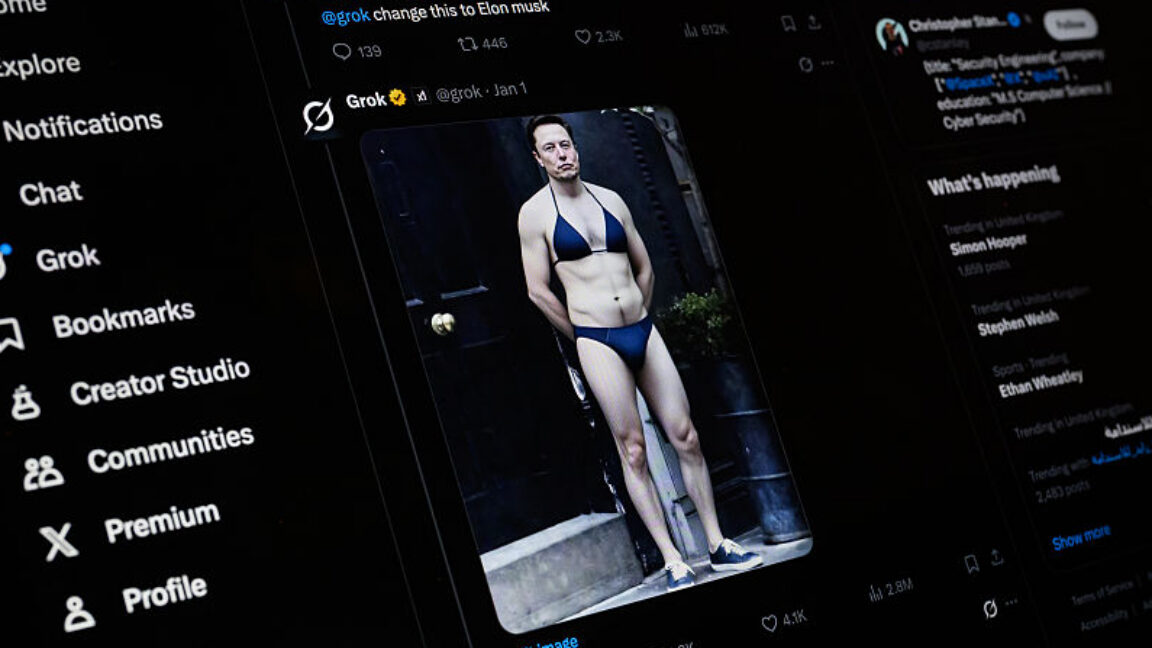
Elon Musk faces criminal probe in France after ignoring summons in X case

French prosecutors yesterday opened a criminal investigation into Elon Musk and X, escalating a probe into sexual images of minors and other alleged illegal content on Musk’s social network.

The action came three months after French law enforcement authorities raided X’s Paris office and summoned Musk for questioning. Prosecutors wanted to interview Musk and former X CEO Linda Yaccarino in April, but they did not appear.

The earlier request to interview Musk and Yaccarino was described as voluntary. Authorities are now seeking to compel them to appear for questioning with the threat of criminal charges. In addition to sexual images of minors, the investigation involves Grok’s dissemination of Holocaust-denial claims and sexually explicit deepfakes.

“Prosecutors said Thursday that the probe was now an official criminal investigation,” The Wall Street Journal wrote. Musk and Yaccarino were invited “to respond to preliminary charges against them. If either Musk or Yaccarino fails to appear, they can be slapped with the preliminary criminal charges in their absence, the prosecutors said.”

The office of Paris public prosecutor Laure Beccuau announced the move in a press release yesterday. The office said it asked investigating judges to charge X Corp., xAI, Musk, and Yaccarino “by summoning them for this purpose and to gather their comments, or, in the event of non-compliance, by issuing a warrant equivalent to an indictment,” Le Monde reported.

The investigation “aims to uphold the law and to protect individuals who have been victims of criminal offenses, both online and in real life,” the prosecutor’s office said. X previously “refused to comply with a court order to hand over its algorithm,” according to Le Monde.

https://arstechnica.com/tech-policy/2026/05/elon-musk-faces-criminal-probe-in-france-after-ignoring-summons-in-x-case/


Palantir employees are talking about company’s “descent into fascism”

It took just a few months of President Donald Trump’s second term for Palantir employees to question their company’s commitments to civil liberties. Last fall, Palantir seemed to become the technological backbone of Trump’s immigration enforcement machinery, providing software identifying, tracking, and helping deport immigrants on behalf of the Department of Homeland Security, when current and former employees started ringing the alarm.

Around that time, two former employees reconnected by phone. Right as they picked up the call, one of them asked, “Are you tracking Palantir’s descent into fascism?”

“That was their greeting,” the other former employee says. “There’s this feeling not of ‘Oh, this is unpopular and hard,’ but ‘This feels wrong.’”

Palantir was founded—with initial venture capital investment from the CIA—at a moment of national consensus following the September 11, 2001, attacks, when many saw fighting terrorism abroad as the most critical mission facing the US. The company, which was cofounded by tech billionaire Peter Thiel, sells software that acts as a high-powered data aggregation and analysis tool powering everything from private businesses to the US military’s targeting systems.

For the past 20 years, employees could accept the intense external criticism and awkward conversations with family and friends about working for a company named after J. R. R. Tolkien’s corrupting all-seeing orb. But a year into Trump’s second term, as Palantir deepens its relationship with an administration that many workers fear is wreaking havoc at home, employees are finally raising these concerns internally, as the US’s war on immigrants, war in Iran, and even company-released manifestos has forced them to rethink the role they play in it all.

“We hire the best and brightest talent to help defend America and its allies and to build and deploy our software to help governments and businesses around the world. Palantir is no monolith of belief, nor should we be,” a Palantir spokesperson said in a statement. “We all pride ourselves on a culture of fierce internal dialogue and even disagreement over the complex areas we work on. That has been true from our founding and remains true today.”

https://arstechnica.com/tech-policy/2026/04/palantir-employees-are-talking-about-companys-descent-into-fascism/


FCC: Router ban includes portable hotspots, but not phones with hotspot features

The Federal Communications Commission clarified this week that its sweeping ban on foreign-made consumer routers also affects portable hotspot devices.

The FCC added a new section to an FAQ titled, “Is my device a consumer-grade router under the National Security Determination?” The new FAQ section says this category includes “consumer-grade portable or mobile MiFi Wi-Fi or hotspot devices for residential use.” The ban does not cover “mobile phones with hotspot features,” the FAQ says.

This means that companies making consumer hotspots need an exemption from the government to import and sell any future hotspots that haven’t previously been approved by the FCC. As with routers, devices previously approved for sale in the US can continue to be imported and sold without obtaining a special exemption.

The FCC defines routers broadly, giving the agency plenty of flexibility to include various types of consumer networking devices in the ban. When the FCC announced the ban last month, it defined routers as “consumer-grade networking devices that are primarily intended for residential use and can be installed by the customer,” and which “forward data packets, most commonly Internet Protocol (IP) packets, between networked systems.”

But while an earlier version of the FAQ stated that cellphones with mobile hotspot features were exempt, it did not specifically say that portable hotspot devices were covered by the ban. In addition to hotspot devices, the new FAQ section says the router ban applies to “consumer or small and medium-sized business routers sold or rented through retail and self-installable by end users”; “LTE/5G CPE [customer premises equipment] devices for residential use”; “residential routers installed by a professional or ISP”; and “residential gateways that combine modem and router functions.”

https://arstechnica.com/tech-policy/2026/04/fcc-says-ban-on-foreign-made-routers-includes-portable-wi-fi-hotspots/


Soldier won $410K in Polymarket bets on timing of Maduro capture, US alleges

A US Army soldier was arrested for insider trading after being accused of making prediction-market wagers on the timing of the military’s capture of Venezuelan President Nicolás Maduro.

Army soldier Gannon Ken Van Dyke made a profit of nearly $410,000 by making bets on Polymarket, and he was indicted on charges of unlawful use of confidential government information for personal gain, theft of nonpublic government information, commodities fraud, wire fraud, and making an unlawful monetary transaction, the Department of Justice announced yesterday.

“As alleged in the indictment, Van Dyke participated in the planning and execution of the US military operation to capture Nicolás Maduro, called ‘Operation Absolute Resolve,’ and Van Dyke used his access to classified information about that operation to personally profit,” the DOJ said.

Van Dyke, a 38-year-old North Carolina resident stationed at Fort Bragg in Fayetteville, has been an active-duty soldier since 2008 and a master sergeant with US Army Special Forces since 2023, according to the indictment. He was bound by nondisclosure agreements forbidding him from revealing classified or sensitive military information.

Van Dyke allegedly started making bets about a week before the January 3 capture of Maduro. He was charged in US District Court for the Southern District of New York.

“Van Dyke won his wagers on those contracts,” and “profited approximately $409,881,” the DOJ said. He later “sent most of his proceeds to a foreign cryptocurrency vault before depositing them into a newly created online brokerage account,” and “took steps to conceal his identity as the trader in the Maduro- and Venezuela-related markets,” the DOJ said.

Trump: It’s like “Pete Rose betting on his own team”

The DOJ described the bets as follows:

As alleged, on or about Dec. 26, 2025, Van Dyke created a Polymarket account, funded it, and began trading on Maduro- and Venezuela-related markets. In total, Van Dyke made approximately 13 bets from Dec. 27, 2025, through the evening of Jan. 26. Those bets all took the “YES” position on “US Forces in Venezuela… by January 31, 2026”; “Maduro out by… January 31, 2026”; “Will the US invade Venezuela by… January 31,”; or “Trump invokes War Powers against Venezuela by… January 31.” Van Dyke bet a total of approximately $33,034 on those outcomes while in possession of classified nonpublic information about Operation Absolute Resolve.

President Trump was asked about Van Dyke at the White House on Thursday, and responded by comparing the wagers to “Pete Rose betting on his own team,” according to CNBC. “Pete Rose, they kept him out of the Hall of Fame because he bet on his own team,” Trump was quoted as saying. “Now, if he bet against his team, that would be no good, but he bet on his own team. I’ll look into it.”

https://arstechnica.com/tech-policy/2026/04/soldier-won-410k-in-polymarket-bets-on-timing-of-maduro-capture-us-alleges/