Woman lost @metaverse Instagram handle days after Facebook name change

Woman lost @metaverse Instagram handle days after Facebook name change
Liu Guanguan/China News Service

Thea-Mai Baumann had posted to Instagram using the @metaverse handle for nearly a decade when her account was disabled on November 2.

“Your account has been blocked for pretending to be someone else,” the app told her. 

Baumann wasn’t exactly sure what had happened, but the timing was curious. The account block came just days after Facebook had announced its new name, Meta. CEO Mark Zuckerberg said the name reflected the company’s new focus on its vision of the metaverse, a virtual world meant to facilitate commerce, communication, and more. Baumann’s @metaverse handle was suddenly a hot commodity.

This account is a decade of my life and work. I didn’t want my contribution to the metaverse to be wiped from the internet,” Baumann told The New York Times. “That happens to women in tech, to women of color in tech, all the time.”

In 2012, when Baumann started Metaverse Makeovers, she grabbed the Instagram handle @metaverse to showcase her art and technology. The Australian had created an app that would display virtual holograms over her company’s fingernail designs. She envisioned making an entire line of clothing and accessories that would be virtually augmented. After five years, funding ran dry and she began to use her Instagram account to promote her other work.

Baumann’s @metaverse account went relatively unnoticed over the years, attracting fewer than 1,000 followers. Then Facebook changed its name. 

On October 28, Zuckerberg announced the change in his Connect 2021 keynote, saying that the Facebook name “just doesn’t encompass everything we do.” Zuckerberg had been selling his idea of the metaverse for months, telling The Verge in an interview last summer that “the metaverse is a vision that spans many companies—the whole industry,” he said. “It’s certainly not something that any one company is going to build.” 

Baumann, with her years of experience running a company based around and named after the concept, would seemingly be an ideal partner in that venture.

After Zuckerberg’s keynote, Baumann started receiving unsolicited messages on Instagram, including some that offered to buy @metaverse from her. One person delivered a warning, though: “fb isn’t gonna buy it, they’re gonna take it.”

It’s unclear whether Meta/Facebook had anything to do with Baumann losing access to her account. Baumann attempted to verify her identity with Instagram, but she didn’t receive a reply for weeks. She tried working with an intellectual property attorney to see what rights she had to get her account back, but she couldn’t afford their services.

Once a journalist got wind of the story, though, things changed. On December 4, two days after a New York Times reporter contacted Meta about the account, Baumann suddenly regained access to @metaverse.

“This account was incorrectly removed for impersonation, and we’ve now restored it,” Stephanie Otway, a Meta company spokesperson, told Ars. “We’re sorry that this happened.”

Baumann’s experience could have a chilling effect on companies’ and individuals’ willingness to participate on social media for fear of having their online identity arbitrarily seized. “Facebook has essentially unfettered discretion to appropriate people’s Instagram user names,” Rebecca Giblin, director of the Intellectual Property Research Institute of Australia at the University of Melbourne, told The New York Times. “There can be good reasons for that—for example, if they’re offensive or impersonating someone in a way that causes confusion.”

“But the @metaverse example highlights the breadth of this power,” Giblin said. Users “essentially have no rights.”

https://arstechnica.com/?p=1820222


US wins appeal against UK ruling that blocked Julian Assange’s extradition

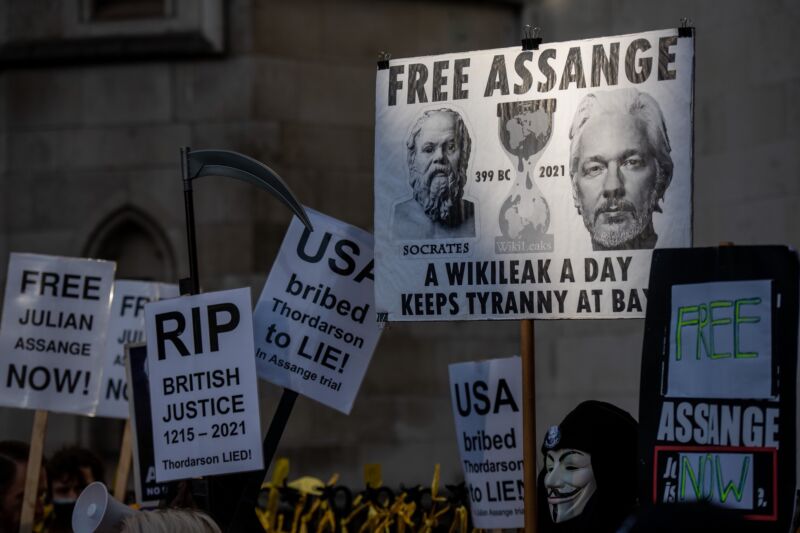
Protestors hold signs calling for Julian Assange to be freed.
Enlarge / Supporters of Julian Assange outside the Royal Courts of Justice on December 10, 2021, in London, England.
Getty Images | Chris Ratcliffe

A UK court ruling today brought the US government one step closer to securing the extradition of Julian Assange, the WikiLeaks founder who faces criminal charges for his alleged role in helping Chelsea Manning steal classified information from the US Department of Defense. The ruling was issued today by the UK’s High Court of Justice in London.

Today’s decision came in response to the United States’ appeal of a January 2021 district judge’s ruling that rejected the extradition request on the grounds that Assange would be at greater risk of suicide in the American prison system. The district judge’s ruling criticized US prison conditions and noted that “Jeffrey Epstein committed suicide at the MCC jail in August 2019” and Chelsea Manning “was hospitalized after an attempt to commit suicide at the ADC jail [William G. Truesdale Adult Detention Center in Alexandria, Virginia] in 2020.”

In February, the US offered several assurances to the UK about how Assange will be treated after extradition. The High Court was satisfied that these assurances “[e]xclude the possibility of Mr. Assange being made subject to ‘special administrative measures’ or held at the ‘ADX’ facility (a maximum-security prison in Florence, Colorado, in the US), either pretrial or after any conviction, unless, after entry of the assurances, he commits any future act which renders him liable to such conditions of detention,” according to the court’s summary of today’s ruling.

The US also agreed to let Assange serve any prison sentence in Australia if he is convicted and to give Assange appropriate clinical and psychological treatment while he is held in the US prison system. The High Court was “satisfied that the assurances were sufficient to meet the concerns” that led to the district judge’s decision to block the extradition.

Extradition not imminent

Today’s ruling does not guarantee the extradition of Assange. The High Court “ordered that the case must be remitted to Westminster Magistrates’ Court with a direction that a DJ [district judge] send the case to the Secretary of State, who will decide whether Mr. Assange should be extradited to the USA,” the summary of the ruling said.

Assange can also appeal today’s ruling. “Mr. Assange’s fiancée, Stella Moris, said in a statement following the verdict that Mr. Assange and his team ‘will appeal this decision at the earliest possible moment,’ setting the stage for weeks or even months of further legal wrangling, lawyers say,” according to The Wall Street Journal.

Espionage Act charges raised press-freedom concerns

Assange was arrested by British police in April 2019 after spending nearly seven years in the Ecuadorean embassy in London. The US charged Assange with conspiracy to obtain and disclose national defense information, conspiracy to commit computer intrusions, six counts of obtaining national defense information, and nine counts of disclosure of national defense information, according to a superseding indictment entered in June 2020 in US District Court for the Eastern District of Virginia.

The US’s decision to charge Assange under the Espionage Act was criticized by the top editors of The New York Times, Washington Post, Wall Street Journal, and USA Today as an attack on freedom of the press. “Dating as far back as the Pentagon Papers case and beyond, journalists have been receiving and reporting on information that the government deemed classified,” Washington Post then-Executive Editor Marty Baron told the Daily Beast after the initial indictment was unsealed in 2019. “Wrongdoing and abuse of power were exposed. With the new indictment of Julian Assange, the government is advancing a legal argument that places such important work in jeopardy and undermines the very purpose of the First Amendment.”

“A fundamental principle of the First Amendment is that journalists have the right to publish truthful information, even when a source may have broken the law to provide that information,” New York Times Executive Editor Dean Baquet said at the time. “In charging Julian Assange for receiving and disclosing classified information in violation of the Espionage Act, the government threatens to undermine that basic tenet of press freedom. Obtaining and publishing information that the government would prefer to keep secret is vital to journalism and democracy.”

While Assange was indicted during Trump’s presidency, the Biden administration has continued to seek Assange’s extradition.

https://arstechnica.com/?p=1819586


Elizabeth Holmes takes final swipe at ex-boyfriend as defense rests

Theranos founder and former CEO Elizabeth Holmes and her partner, Billy Evans, right, leave the Robert F. Peckham Federal Building on November 23, 2021, in San Jose, Calif.
Enlarge / Theranos founder and former CEO Elizabeth Holmes and her partner, Billy Evans, right, leave the Robert F. Peckham Federal Building on November 23, 2021, in San Jose, Calif.
Ethan Swope/Getty Images

Theranos founder Elizabeth Holmes took one last shot at ex-boyfriend Ramesh “Sunny” Balwani yesterday, attempting to reinforce her defense’s strategy of blaming the former COO.

Once Holmes was finished, the defense rested. It was a surprise move. The other defense witnesses—a former Theranos board member who joined the company in 2016 and a paralegal who provided a summary of the defense’s view of the case—were relatively small players. Many people had expected that Mindy Mechanic, an expert on intimate partner violence, would help the defense contextualize Holmes’ testimony about Balwani’s allegedly abusive and controlling behavior.

But the defense never called Mechanic, and at the end of the session, assistant US attorney Robert Leach told Judge Edward Davila that the government would be filing a motion asking the court to strike Holmes’ testimony relating to Balwani’s alleged abusive behavior. Why? The defense didn’t call an expert to explain the psychological effects the alleged abuse had on Holmes, making certain events irrelevant to the case.

Defense attorney Kevin Downey doesn’t appear concerned. “I’m surprised to hear that motion after the close of evidence,” Downey said, especially since prosecutors questioned Holmes about the matter. Regardless, he told Davila that he was open to discussing the matter.

More Balwani blame

If the government’s gambit succeeds, it would eliminate a key pillar of Holmes’ defense. Yesterday, before the prosecution made its plans clear, Holmes spent much of her time on the stand attempting to bolster her argument. 

Holmes told jurors that she would repeat things back to Balwani on text message threads so he would know she was paying attention. When Balwani got mad about something at Theranos, she said she would let him “personally take over whatever he was upset about and that he would own it and he would fix it.” She also said she was unsure whether Balwani was forthcoming about all of the lab’s problems.

Holmes also testified that breaking up with Balwani was “a process” and that after she told him things were over, he would show up at her church or wait for her at the Dish on Stanford’s campus, where she would go running. Holmes also claimed that she didn’t receive any proceeds from the sale of the home they shared through an LLC.

Downey, Holmes’ attorney, wrapped with a series of questions meant to paint a sympathetic portrait for the jury.

Did she try to mislead investors? “Never.”

Does she recognize that investors lost money? “I do.”

Was it because she attempted to mislead them? “Of course not.”

After Holmes left the stand, Davila set the calendar for the remainder of the trial. Closing arguments won’t begin until December 16 and will run for two days. (He said that jury instructions will take a couple of days to sort out, and then the court isn’t available for the first half of next week.) After closing arguments are over, jury deliberations will begin on December 20.

https://arstechnica.com/?p=1819207


Amazon fined €1.1 billion by Italy for antitrust abuse

Amazon fined €1.1 billion by Italy for antitrust abuse
NurPhoto | Amazon

Amazon said it would appeal a €1.1 billion fine from Italy after antitrust investigators found the online shopping giant had given unfair preference to sellers who also ship their goods through Amazon’s logistics service.

Amazon had previously tried to halt the case in Italy on the grounds that it is facing a parallel investigation in Brussels covering the same ground. Its attempt was dismissed in November by the European General Court in Luxembourg.

On Thursday, Italy’s competition regulator said Amazon had been more lenient in applying performance criteria, which can lead in extreme cases to merchants being suspended, if sellers were also paying for Amazon to ship their parcels.

Because of the advantage of signing up with Amazon for delivery, the Italian regulator said Amazon had damaged “ecommerce logistics competitors” that could not offer the same benefits as Amazon’s own logistics service.

Amazon has to offer equal treatment in terms of offers made by sellers that use their own carriers and sellers that use the Amazon carrier services, the watchdog said.

When announcing its probe, Brussels said that it would allow the Italian authority to carry out its own investigation over concerns that Amazon might be “artificially” favoring “its own retail offers and offers of marketplace sellers that use Amazon’s logistics and delivery services.”

Amazon said it disagreed with the decision and that it would challenge it.

“The proposed fine and remedies are unjustified and disproportionate. More than half of all annual sales on Amazon in Italy come from [small and medium businesses], and their success is at the heart of our business model,” it said in a statement, adding that Amazon faces competition in Italy and that its services are “just one” of multiple options.

Italy’s move against Amazon comes as national competition authorities have in recent months rushed to impose multimillion fines on other online tech giants.

In May, the German competition authority opened an investigation against Amazon to determine whether it has to comply with new rules in the country aimed at curbing the power of Big Tech.

Since June this year the French competition watchdog has hit Google with €720 million in fines in two separate cases. The French authority has also fined Apple €1.1 billion for anti-competitive behavior.

The UK and the EU are jointly investigating how Facebook uses customer data to allegedly advance its position and undermine rivals. Brussels has antitrust probes opened on all large US platforms — Google, Apple, Facebook and Amazon.

The Italian political debate over the regulation of platforms’ operations has been charged with tension over the past few years as their market share grew across the country, increasing their profits, and workers demanded more rights and higher salaries.

Andrea Orlando, Italy’s labor minister, on Thursday praised the European Commission’s draft directive to regulate platforms’ employment practices. “This is an important step forward and a priority for the Italian government.”

On Black Friday, at the end of November, a group of logistics workers protested outside Amazon’s largest logistics hub near Piacenza, in Italy.

A labor union representative said the pandemic and the mass consumption model had worsened labor conditions for platforms’ logistics contractors and drivers.

© 2021 The Financial Times Ltd. All rights reserved Not to be redistributed, copied, or modified in any way.

https://arstechnica.com/?p=1819195


Apple reaches quiet truce over iPhone privacy changes

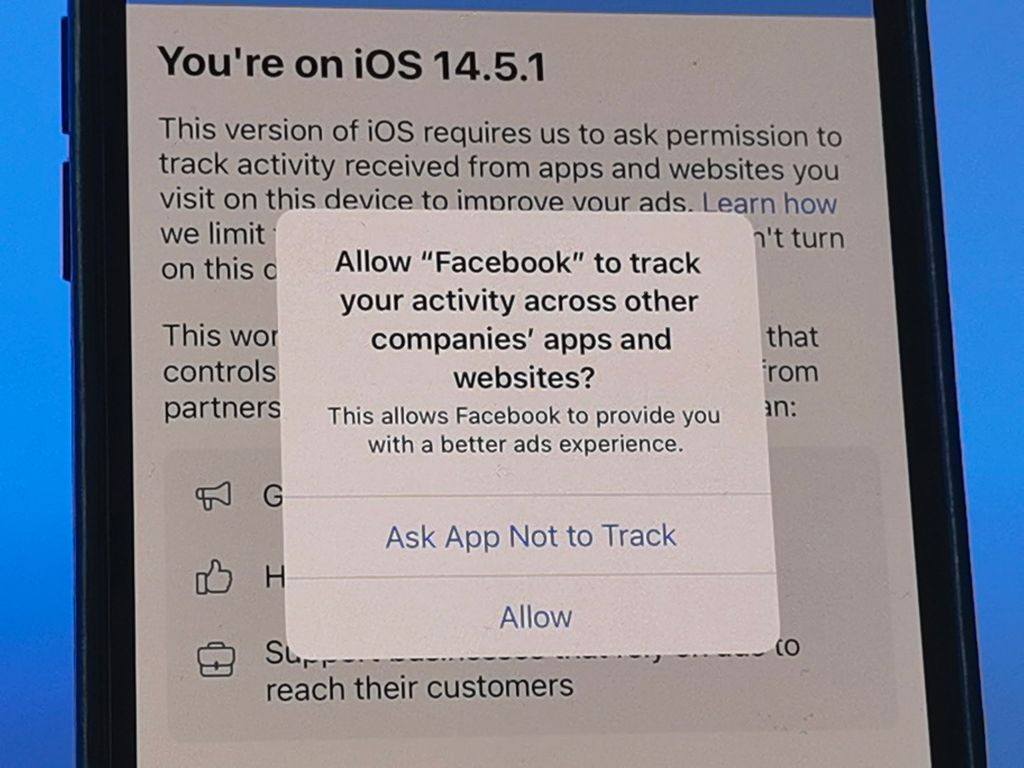
A privacy notice appears on an iPhone 12 under the new iOS 14.5.1 operating system. Developers of an application have to ask for the user's permission to allow cross-app tracking.
Enlarge / A privacy notice appears on an iPhone 12 under the new iOS 14.5.1 operating system. Developers of an application have to ask for the user’s permission to allow cross-app tracking.
Picture Alliance | Getty Images

Apple has allowed app developers to collect data from its 1 billion iPhone users for targeted advertising, in an unacknowledged shift that lets companies follow a much looser interpretation of its controversial privacy policy.

In May Apple communicated its privacy changes to the wider public, launching an advert that featured a harassed man whose daily activities were closely monitored by an ever-growing group of strangers. When his iPhone prompted him to “Ask App Not to Track,” he clicked it and they vanished. Apple’s message to potential customers was clear—if you choose an iPhone, you are choosing privacy.

But seven months later, companies including Snap and Facebook have been allowed to keep sharing user-level signals from iPhones, as long as that data is anonymised and aggregated rather than tied to specific user profiles.

For instance Snap has told investors that it plans to share data from its 306 million users—including those who ask Snap “not to track”—so advertisers can gain “a more complete, real-time view” on how ad campaigns are working. Any personally identifiable data will first be obfuscated and aggregated.

Similarly, Facebook operations chief Sheryl Sandberg said the social media group was engaged in a “multiyear effort” to rebuild ad infrastructure “using more aggregate or anonymized data”.

These companies point out that Apple has told developers they “may not derive data from a device for the purpose of uniquely identifying it.” This means they can observe “signals” from an iPhone at a group level, enabling ads that can still be tailored to “cohorts” aligning with certain behavior but not associated with unique IDs.

This type of tracking is becoming the norm. Oren Kaniel, the chief executive of AppsFlyer, a mobile attribution platform that works with app developers, said that when his company introduced such a “privacy-centric” tool based on aggregated measurement in July 2020, “the level of pushback that we received from the entire ecosystem was huge.”

But now such aggregated solutions are the default for 95 percent of his clients. “The market changed their minds in a radical way,” he said.

It is not clear whether Apple has actually blessed these solutions. Apple declined to answer specific questions for this article but described privacy as its North Star, implying it was setting a general destination rather than defining a narrow pathway for developers.

Cory Munchbach, chief operating officer at customer data platform BlueConic, said Apple had to stand back from a strict reading of its rules because the disruption to the mobile ads ecosystem would be too great.

“Apple can’t put themselves in a situation where they are basically gutting their top-performing apps from a user-consumption perspective,” she said. “That would ultimately hurt iOS.”

For anyone interpreting Apple’s rules strictly, these solutions break the privacy rules set out to iOS users.

Lockdown Privacy, an app that blocks ad trackers, has called Apple’s policy “functionally useless in stopping third-party tracking.” It performed a variety of tests on top apps and observed that personal data and device information is still “being sent to trackers in almost all cases.”

But the companies aggregating user-level data said the reason apps continue to “leak” information such as a user’s IP address and location was simply because some require such information to function. Advertisers must know certain things such as the user’s language or the device screen size, otherwise the app experience would be awful.

The risk is that by allowing user-level data to be used by opaque third parties so long as they promise not to abuse it, Apple is in effect trusting the very same groups that chief executive Tim Cook has lambasted as “hucksters just looking to make a quick buck.”

Companies will pledge that they only look at user-level data once it has been anonymized, but without access to the data or algorithms working behind the scenes, users won’t really know if their data privacy has been preserved, said Munchbach.

“If historical precedent in adtech holds, those black boxes hide a lot of sins,” she said. “It’s not unreasonable to assume it leaves a lot to be desired.”

© 2021 The Financial Times Ltd. All rights reserved Not to be redistributed, copied, or modified in any way.

https://arstechnica.com/?p=1818800


T-Mobile “inexplicably” rejected iPhone 13 rebates worth hundreds of dollars

Stamp Rejected isolated on white. Agreement or approval concept. 3d illustration

T-Mobile has been incorrectly rejecting rebate requests from customers who purchased new iPhones, according to an article yesterday by Bloomberg reporter Mark Gurman. T-Mobile acknowledged the problem and said it is being fixed.

Gurman experienced the problem himself when he traded in an iPhone 12 Pro Max for an iPhone 13 Pro Max. He was promised a $790 credit from Apple for trading in his year-old iPhone “plus $500 in bill credits over several months” from T-Mobile. Getting the trade-in credit from Apple was quick and easy, but T-Mobile denied rebate requests from Gurman and people who made similar iPhone upgrades.

Gurman submitted the iPhone rebate request to T-Mobile on September 27 and received T-Mobile’s rejection last week. In the replies to Gurman’s tweet showing a screenshot of the rejection notice, about 20 other people reported getting similar denials from T-Mobile.

“Just checked based on this tweet and T-Mobile denied our two iPhone promos as well without even so much as a text to let us know,” one of those people wrote. T-Mobile had offered customers up to $800 for iPhone upgrades.

T-Mobile gave vague reason for denials

Gurman separately had trouble getting a $100 Apple Watch rebate from T-Mobile. He tweeted about that a couple of weeks earlier and heard from numerous people who had similar problems with T-Mobile or Verizon. He wrote:

Customers complained of suffering through long phone calls with carriers’ representatives and confusingly being transferred to Apple customer service. In my case, I was even told that the Apple Watch promotion didn’t exist.

Fast forward to this past week, when I and many other users found that rebates for the iPhone 13 were also inexplicably denied. The vague reason: “Apple returned as ineligible.”

These denials came despite the carrier verifying that terms were followed correctly. After I tweeted about the issue, T-Mobile was able to quickly fix it on my account, but I am alarmed that these denials may be a widespread problem.

T-Mobile promises a fix

T-Mobile acknowledged that “an iPhone rebate issue was caused by a bug, which it is in the process of fixing,” Gurman wrote. “In response to my questions, T-Mobile will contact customers via text who were incorrectly denied rebates and automatically process the promotion and ensure they are enrolled,” he also wrote.

T-Mobile also told Bloomberg that it intends to “make any needed improvements in the overall offer experience” and that “while every offer has various eligibility requirements and terms, we never want anyone to feel like those terms are misleading, confusing or hidden.”

We asked T-Mobile if it will reach out directly to every customer who was wrongly denied a rebate. A company spokesperson responded, “All eligible customers will be enrolled in the rebate and notified via text.” That sounds promising, but customers may want to contact T-Mobile again soon if they don’t get an update from the carrier.

“After calling customer service, some readers said they have received the $500 via a lump-sum account credit. Others are still having trouble,” Gurman wrote.

We also asked T-Mobile for details about the bug that caused the rebate rejections, but the company didn’t provide any specifics. “A small number of people who redeemed through Apple were impacted, but the issue is fixed,” T-Mobile told Ars.

Verizon customers hit rebate roadblock

Some Verizon customers also say they’ve been wrongly denied rebates, although Verizon denied that eligible customers were affected. Gurman wrote that he “heard from numerous buyers of the Verizon 5G iPad Pro who said they never received rebates” and that he “provided the carrier with 13 claims on Twitter from customers stating that the rebate didn’t work properly for them.”

Despite that, Verizon told Bloomberg that the “promotion is working as it should for eligible Verizon customers.” We contacted Verizon and will update this article if we get more information.

“Multiple hourlong phone calls with T-Mobile”

Gurman’s separate set of troubles with the $100 Apple Watch Series 7 rebate began a few weeks after he submitted a rebate request. “T-Mobile’s promotion website said that my claim was denied because the product wasn’t activated during the promotion window. This, of course, was false,” Gurman wrote.

Gurman reported having “multiple hourlong phone calls with T-Mobile customer service” and sending Twitter messages to the company’s support team. “Ultimately, the issue was only fixed after talking to T-Mobile at the corporate level,” he wrote. “We figured out that my rebate was denied because the fine print of the deal—depending on how you read it—requires the opening of an entirely new phone number.”

Apple had announced in early October that “customers can buy Apple Watch (GPS + Cellular) directly from apple.com/store or at an Apple Store and get $100 back when they activate it with T-Mobile/Sprint or Verizon.” But the rebate requirements enforced by T-Mobile would have forced Gurman “to keep paying for a second smartwatch line with no device connected to it for three months in order to receive the offer,” he wrote. As with the similar iPhone problem, T-Mobile eventually gave Gurman the rebate.

https://arstechnica.com/?p=1818359


How a carbon tax can fight inequality and climate change

Cartoonish footprints on dried mud.
Enlarge / Footprints made out of fresh green grass on a dry cracked earth base.

Carbon taxes can attract a lot of flak. On one hand, some groups hate taxes and are indifferent to climate change—in Canada, various provincial governments actively fought (and ultimately lost) against the federal government’s implementation of a carbon levy. On the other hand, some progressives worry that a carbon tax would hurt lower-income people by costing them more money.

According to new research, however, this doesn’t need to be the case. Noah Scovronick, a researcher at the Gangarosa Department of Environmental Health at Emory University and one of the paper’s authors, said that it’s possible to help reduce emissions while also implementing a carbon tax that redistributes wealth to people on the lower side of the socioeconomic spectrum.

And that’s good news, as carbon taxes are already in use. According to the World Bank, in 2020, around 40 countries and 20 cities, states, or provinces already have some kind of carbon-pricing mechanism. The United States has, occasionally, mulled over the idea of implementing one itself. “[It] does have a history in terms of being endorsed by a number of politicians and/or economists as a sort of—I don’t want to say straightforward—but one of the potentially more straightforward ways you could approach emissions reductions,” Scovronick told Ars.

Environment and equality

The primary way a carbon tax could be used to generate equality is by taking the funds it raises and redistributing them to lower-income people. According to Mark Budolfson—one of the new paper’s authors and a researcher at Rutgers University’s Department of Environmental and Occupational Health and Justice—this can be an effective tool in reducing poverty. He noted that the Canadian province of British Columbia, for instance, has been fairly successful in this regard.

The paper suggests that this mechanism could be rolled out around the world to help reduce inequality and that poorer people in poorer nations would benefit the most from it. “Some of the largest improvements in well-being would happen if this were done in developing countries,” Budolfson told Ars.

In the paper, the researchers divvied the world up into 12 regions. Some of these are particularly large, populous countries like India and the United States, while the rest are groupings of other smaller nations. Ideally, in the future, research will look at this at a country level—“The next generation of models will represent, I think, typically all nations individually,” he said.

Within the 12 groupings, the model breaks the populations down into five quintiles, representing different levels of wealth in each country or region. According to Budolfson, unlike previous models of its kind, the one they’ve developed can quantify the distinctions between the impacts of a progressive carbon tax on, for examples, wealthy and poorer people in India. “It’s the first one that represents inequalities within regions of the world,” he said.

Punching poverty

In all, the research found that, if all the countries adopted carbon taxes at a high-enough level, the world could limit warming to 2º C. This, in turn, also helps vulnerable populations around the world, who are particularly susceptible to climate change.

The paper also found that implementing progressive carbon taxes can be fairly straightforward—though some countries might currently lack the administrative capacity to do so, and others might not want to—which can help alleviate poverty. A research brief on the paper also notes that the positive effects of a progressive carbon tax can still be seen even if some of the money is lost due to things like administrative costs or if some of the funds are used to pay for other government programs.

According to Scovronick, a progressive carbon tax isn’t the only way to combat climate change while reducing poverty. But it is a fairly straightforward way to do so. Other ideas could and probably should be explored in more detail in the future, he said.

Nature, 2021. DOI: 10.1038/s41558-021-01217-0 (About DOIs)

https://arstechnica.com/?p=1818028


The movement to hold AI accountable gains more steam

The movement to hold AI accountable gains more steam
MirageC | Getty Images

Algorithms play a growing role in our lives, even as their flaws are becoming more apparent: a Michigan man wrongly accused of fraud had to file for bankruptcy; automated screening tools disproportionately harm people of color who want to buy a home or rent an apartment; Black Facebook users were subjected to more abuse than white users. Other automated systems have improperly rated teachers, graded students, and flagged people with dark skin more often for cheating on tests.

Now, efforts are underway to better understand how AI works and hold users accountable. New York’s City Council last month adopted a law requiring audits of algorithms used by employers in hiring or promotion. The law, the first of its kind in the nation, requires employers to bring in outsiders to assess whether an algorithm exhibits bias based on sex, race, or ethnicity. Employers also must tell job applicants who live in New York when artificial intelligence plays a role in deciding who gets hired or promoted.

In Washington, DC, members of Congress are drafting a bill that would require businesses to evaluate automated decision-making systems used in areas such as health care, housing, employment, or education, and report the findings to the Federal Trade Commission; three of the FTC’s five members support stronger regulation of algorithms. An AI Bill of Rights proposed last month by the White House calls for disclosing when AI makes decisions that impact a person’s civil rights, and it says AI systems should be “carefully audited” for accuracy and bias, among other things.

Elsewhere, European Union lawmakers are considering legislation requiring inspection of AI deemed high-risk and creating a public registry of high-risk systems. Countries including China, Canada, Germany, and the UK have also taken steps to regulate AI in recent years.

Julia Stoyanovich, an associate professor at New York University who served on the New York City Automated Decision Systems Task Force, says she and students recently examined a hiring tool and found it assigned people different personality scores based on the software program with which they created their résumé. Other studies have found that hiring algorithms favor applicants based on where they went to school, their accent, whether they wear glasses, or whether there’s a bookshelf in the background.

Stoyanovich supports the disclosure requirement in the New York City law, but she says the auditing requirement is flawed because it only applies to discrimination based on gender or race. She says the algorithm that rated people based on the font in their résumé would pass muster under the law because it didn’t discriminate on those grounds.

“Some of these tools are truly nonsensical,” she says. “These are things we really should know as members of the public and just as people. All of us are going to apply for jobs at some point.”

Some proponents of greater scrutiny favor mandatory audits of algorithms similar to the audits of companies’ financials. Others prefer “impact assessments” akin to environmental impact reports. Both groups agree that the field desperately needs standards for how such reviews should be conducted and what they should include. Without standards, businesses could engage in “ethics washing” by arranging for favorable audits. Proponents say the reviews won’t solve all problems associated with algorithms, but they would help hold the makers and users of AI legally accountable.

A forthcoming report by the Algorithmic Justice League (AJL), a private nonprofit, recommends requiring disclosure when an AI model is used and creating a public repository of incidents where AI caused harm. The repository could help auditors spot potential problems with algorithms and help regulators investigate or fine repeat offenders. AJL cofounder Joy Buolamwini coauthored an influential 2018 audit that found facial-recognition algorithms work best on white men and worst on women with dark skin.

https://arstechnica.com/?p=1818000


Meta’s failed Giphy deal could end Big Tech’s spending spree

Meta’s failed Giphy deal could end Big Tech’s spending spree
Daniel Grizelj | Getty Images


Instagram? Sure! WhatsApp? Go nuts. But don’t mess with GIFs. That’s the strange position taken by Britain’s competition watchdog in choosing to block Meta’s takeover of GIF repository Giphy. Meta, the UK’s Competition and Markets Authority (CMA) ruled, must now sell all the GIFs—just 19 months after it reportedly paid $400 million for them. It’s a bold move—and a global first.
Never before has a tech giant been ordered to press undo on a completed deal rather than pay a fine or make promises about how the newly merged businesses would operate. Meta, the parent company of Facebook, isn’t pleased. A spokesperson says the company disagrees with the decision and that it is considering all options, including an appeal. Usually a cautious bunch, lawyers agree that the CMA’s decision is a significant moment in the global regulatory wrangling of Big Tech, as it means deals that slipped through in the past may now have a new bar to clear. “There’s been a realization that quite small deals over the years have not been scrutinized very extensively,” says Richard Pepper, a partner at the law firm Macfarlanes.

That realization means regulators everywhere will now be on high alert for what the legal world calls “killer acquisitions”—where an established company buys an innovative startup in an attempt to squash the competition it could pose in the future. The CMA’s decision is also significant because Facebook’s Instagram takeover was waved through by its predecessor, the Office of Fair Trading, back in 2012, in what was the most high-profile probe into the deal outside the US. “The same worldwide enforcers that allowed Facebook to suck up Instagram and WhatsApp are now very wary of even small purchases by the major platforms,” says Eleanor Tyler, a legal analyst at Bloomberg Law, a legal research company. “What this shows is a change in attitude, and that’s critical.”

Compared to some of Meta/Facebook’s other well-known acquisitions, Giphy is small fry. WhatsApp cost it $19 billion in 2014, Oculus VR was $2 billion, also in 2014, and Instagram just $715 million in 2012. But regulators are starting to take the attitude that smaller acquisitions can also damage competition. “I think of serial acquisitions as a Pac-Man strategy,” Rebecca Slaughter, US Federal Trade Commissioner, said in September. “The collective impact of hundreds of smaller acquisitions can lead to a monopolistic behemoth.”

Giphy might not be the whole game, but it’s arguably a crucial pellet for Pac-Man, or Meta CEO Mark Zuckerberg, to gobble up. When anyone on any major social media or messaging platform—TikTok, Twitter, Tinder, Slack, or iMessage—wants to send a GIF, they are almost always using animations from Giphy or its main rival, Google-owned Tenor. In a blog post, Meta said it bought Giphy to help users on Instagram “express themselves.” The CMA said the deal could result in another side effect: giving Meta power over its competitors to either deny them precious GIFs or to demand data in exchange.

This concern, however, only formed half of the CMA’s argument. While cautioning about reduced competition between social media platforms, the regulator simultaneously warned about its impact on a market that  doesn’t yet exist. The CMA said Giphy had the potential to rival Facebook in the UK advertising market if it had not been bought. “Before the merger, Giphy had launched innovative advertising services which it was considering expanding to countries outside the US, including the UK,” the watchdog said in a statement, citing GIFs that Pepsi and Dunkin’ Donuts had created to promote their brands.

https://arstechnica.com/?p=1817989


FTC sues Nvidia to preserve Arm’s status as “Switzerland” of semiconductors

FTC sues Nvidia to preserve Arm’s status as “Switzerland” of semiconductors

The Federal Trade Commission has sued to block Nvidia’s acquisition of Arm, the semiconductor design firm, saying that the blockbuster deal would unfairly stifle competition.

“The FTC is suing to block the largest semiconductor chip merger in history to prevent a chip conglomerate from stifling the innovation pipeline for next-generation technologies,” Holly Vedova, director of the FTC’s competition bureau, said in a statement. “Tomorrow’s technologies depend on preserving today’s competitive, cutting-edge chip markets. This proposed deal would distort Arm’s incentives in chip markets and allow the combined firm to unfairly undermine Nvidia’s rivals.”

Nvidia first announced its intention to acquire Arm in September 2020. At the time, the deal was worth $40 billion, but since then, Arm’s stock price has soared, and the cost of the cash and stock transaction has risen to $75 billion. The FTC lawsuit threatens to scuttle the deal entirely.

“As we move into this next step in the FTC process, we will continue to work to demonstrate that this transaction will benefit the industry and promote competition,” an Nvidia spokesperson told Ars. “Nvidia is committed to preserving Arm’s open licensing model and ensuring that its IP is available to all interested licensees, current and future.”

Global pressure

The FTC isn’t the first government regulator to scrutinize the deal. In October, the European Union announced that it was investigating the acquisition, and last month UK officials said they were concerned that the merger would threaten both competition and national security. China’s regulators are also looking into the deal, Nvidia said.

Much of the angst surrounding the acquisition stems from the fact that, for most of its history, Arm has been a relatively neutral player in the semiconductor world, offering access to its intellectual property to nearly anyone willing to pay the licensing fee. In the complaint, the FTC called Arm the “Switzerland” of the semiconductor industry. Customers fear that an Nvidia-controlled Arm would place them at the mercy of a competitor, while regulators are concerned that the acquisition would threaten to topple a massive, thriving ecosystem that depends on the architecture.

Arm began as a niche semiconductor designer, offering low-power chips for embedded systems and for portable devices like the Apple Newton and Palm Pilot. Over the years, as the performance of ARM chips improved and the importance of energy efficiency grew, the semiconductors found their way into a wider range of devices.

Today, Arm’s designs and instruction sets are widely used, appearing in everything from mobile phones to servers, automotive airbag controllers, and supercomputers. Recently, ARM chips have started making inroads in the PC world, ramping up pressure on incumbents Intel and AMD. Apple’s M1 chips showed just how competitive the architecture could be with x86 designs, and others have begun to follow suit. Earlier this week, Qualcomm announced a new Snapdragon processor, the awkwardly named 8cx Gen 3, which would run an ARM-specific version of Windows.

ARM eats the world

Because the ARM architecture is low-power and available to so many different companies, the chips have taken over the industry. Last year, companies sold 25 billion ARM chips, an increase of more than four-fold since 2010.

Nvidia has also become an increasingly powerful player in the semiconductor world. Its graphics cards became key tools in machine learning and other artificial intelligence applications, and soon the company started selling chips tailored to high-performance computing. Its mobile Tegra chips, which license Arm’s designs, powered a series of smartphones and Tesla infotainment systems in the mid-2010s, and today they run inside Nintendo’s Switch. 

Jensen Huang, Nvidia’s CEO, has been clear that he hopes to push into more corners of the computing market. “Starting from computer graphics, the reach of our architecture has reached deep into the world’s largest industries,” he said at a company keynote last month. “We start with amazing chips, but for each field of science, industry and application, we create a full stack.”

Those ambitions have stumbled amid a shifting antitrust landscape, though. Since Lina Khan was appointed as chair of the FTC, the agency has taken a more forceful stance toward mergers and acquisitions. The full complaint is not yet available, but an administrative trial has been scheduled for May 10, 2022.

https://arstechnica.com/?p=1817930