Emails show what happened before Missouri gov. falsely called journalist a “hacker”

Missouri Gov. Mike Parson speak from behind a podium during a press conference
Enlarge / Missouri Gov. Mike Parson speaks during a press conference on May 29, 2019 in Jefferson City, Missouri.
Getty Images | Jacob Moscovitch

Missouri state government officials planned to publicly thank a journalist who discovered a security flaw until a drastic change in strategy resulted in the governor labeling the journalist a “hacker,” while threatening both a lawsuit and prosecution.

As we wrote on October 14, St. Louis Post-Dispatch reporter Josh Renaud identified a security flaw that exposed the Social Security numbers of teachers and other school employees in unencrypted form in the HTML source code of a publicly accessible website. Renaud and the Post-Dispatch handled the problem the way responsible security researchers do—by notifying the state of the security flaw and keeping it secret until after it was fixed.

Despite that, Missouri Gov. Mike Parson called Renaud a “hacker” and said the newspaper’s reporting was nothing more than a “political vendetta” and “an attempt to embarrass the state and sell headlines for their news outlet.” The Republican governor said further that his “administration has notified the Cole County prosecutor of this matter,” that the Missouri State Highway Patrol’s Digital Forensic Unit would investigate “all of those involved,” and that state law “allows us to bring a civil suit to recover damages against all those involved.”

“We are grateful to the member of the media”

But only two days earlier, a government spokesperson was preparing a quote to publicly thank the journalist, as the Post-Dispatch reported today:

In an Oct. 12 email to officials in Gov. Mike Parson’s office, Mallory McGowin, spokeswoman for DESE [Department of Elementary and Secondary Education], sent proposed statements for a press release announcing the data vulnerability the newspaper uncovered.

“We are grateful to the member of the media who brought this to the state’s attention,” said a proposed quote from Education Commissioner Margie Vandeven.

The Parson administration and DESE did not end up using that quote. The next day, on Oct. 13, the Office of Administration issued a news release calling the Post-Dispatch journalist a “hacker.” And on Oct. 14, Parson held a news conference to rail against the Post-Dispatch and announce a criminal investigation by the Missouri State Highway Patrol.

“We will not let this crime against Missouri teachers go unpunished,” Parson said at the news conference. “And we refuse to let them be a pawn in the news outlet’s political vendetta. Not only are we going to hold this individual accountable, but we will also be holding accountable all those who aided this individual and the media corporation that employs them.”

The Post-Dispatch obtained the October 12 email in a public-records request. The plan to thank the journalist was apparently scrapped by 1:18 pm on October 13, when “McGowin emailed Kelli Jones and Johnathan Shiflett, who both work in the governor’s office, to say Vandeven wanted her to meet with governor’s office officials,” the Post-Dispatch wrote. A draft news release emailed by McGowin at 3:46 pm, apparently after that meeting, referred to the journalist as an “individual.” A further revision emailed by Shiflett at 4:20 pm called him a “hacker.”

https://arstechnica.com/?p=1817891


Judge tears apart Texas social media law for violating First Amendment

US and Texas flags seen in daytime outside the Texas State Capitol Building.
Enlarge / US and Texas flags flying outside the Texas State Capitol building in Austin.
Getty Images | PA Thompson

A federal judge yesterday blocked a Texas state law that bans “censorship” on social media platforms, ruling that the law violates the social networks’ First Amendment right to moderate user-submitted content.

“Social media platforms have a First Amendment right to moderate content disseminated on their platforms,” Judge Robert Pitman wrote. He found that the Texas law “compels social media platforms to disseminate objectionable content and impermissibly restricts their editorial discretion” and that the law’s “prohibitions on ‘censorship’ and constraints on how social media platforms disseminate content violate the First Amendment.”

Pitman’s ruling granted a preliminary injunction requested by tech industry groups NetChoice and the Computer & Communications & Industry Association (CCIA), which sued Texas in US District Court for the Western District of Texas. Facebook, Google, Twitter, and various other tech companies belong to the groups.

The injunction prohibits the Texas attorney general from enforcing the law. The judge found that the plaintiffs are likely to succeed on the merits of their case, a prerequisite for granting a preliminary injunction.

“Replete with constitutional defects”

Pitman rejected a severability clause that aimed to save parts of the law if the rest was invalidated. He found that nothing can be severed from the law and survive because the unconstitutional portions are “replete with constitutional defects, including unconstitutional content and speaker-based infringement on editorial discretion and onerously burdensome disclosure and operational requirements.”

“This ruling upholds the First Amendment and protects Internet users,” CCIA President Matt Schruers said yesterday. “Without this temporary injunction, Texas’s social media law would make the Internet a more dangerous place by tying the hands of companies protecting users from abuse, scams, or extremist propaganda… The First Amendment ensures that the government can’t force a citizen or company to be associated with a viewpoint they disapprove of, and that applies with particular force when a state law would prevent companies from enforcing policies against Nazi propaganda, hate speech, and disinformation from foreign agents.”

When Texas Gov. Greg Abbott signed the bill in September, he claimed the law is needed to protect Texans’ First Amendment rights against “a dangerous movement by social media companies to silence conservative viewpoints and ideas.” Florida tried to impose a similar social media law but it was also blocked by a federal judge for violating the First Amendment.

Parler and Gab excluded from law

Under the Texas law, a platform that labels a post as misinformation “may be discriminating against that user’s viewpoint by adding its own disclaimer,” Pitman wrote. The law thus “restricts social media platforms’ First Amendment right to engage in expression when they disagree with or object to content.”

The threat of lawsuits for violating the state law “chills the social media platforms’ speech rights.” Pitman also found that the law’s disclosure and operational requirements impose burdens on social media platforms’ editorial discretion, and that the law “discriminates based on content and speaker.”

Pitman noted that Texas lawmakers excluded conservative social networks Parler and Gab by applying the law only to platforms with 50 million or more monthly active users in the US. One state senator “unsuccessfully proposed lowering the threshold to 25 million monthly users in an effort to include” sites like Parler and Gab, Pitman wrote.

https://arstechnica.com/?p=1817628


Prosecution gets Elizabeth Holmes to admit she was in control of Theranos

Elizabeth Holmes, founder of Theranos Inc., arrives at federal court in San Jose, California, on Tuesday, Nov. 30, 2021.
Enlarge / Elizabeth Holmes, founder of Theranos Inc., arrives at federal court in San Jose, California, on Tuesday, Nov. 30, 2021.
David Paul Morris/Bloomberg

At this point in her criminal trial, Theranos founder Elizabeth Holmes’ best chance for acquittal is for the jury to believe that she was a puppet being controlled by her boyfriend, company president Ramesh “Sunny” Balwani. Yesterday, the prosecution attempted to pick apart that defense.

In Holmes’ first several days on the stand, jurors heard about Balwani’s abusive behavior. He forced Holmes to have sex with him, prescribed her meals and schedule, and told her that she needed to “kill” herself to be reborn as an entrepreneur, Holmes testified. Balwani has denied the claims of abuse. When recounting various episodes, Holmes broke into tears several times. Based on her testimony and her contemporaneous notes submitted as evidence, it certainly sounds like it was a toxic relationship.

The question for the jury, though, is whether that influenced Holmes’ actions. Was she in control of Theranos? Did her relationship with Balwani make her oblivious to a fraudulent scheme? To be convicted of wire fraud, which Holmes has been charged with, a person’s participation must be both willful and knowing. Yesterday, the prosecution set out to make it clear that Holmes was both in control and aware that what she was doing was wrong.

Logos resurface

In one damning exchange, the prosecution returned to the Theranos reports that Holmes had doctored with pharmaceutical company logos. In earlier testimony, Holmes admitted to adding the logos herself, though she claimed her intentions were good. “This work was done in partnership with these companies, and I was trying to convey that,” she told the court.

But yesterday, the prosecution pressed her on the matter. Jurors saw contracts between Theranos and the pharmaceutical companies showing that the use of their logo was expressly forbidden without prior written authorization. Did she obtain that permission?

“I don’t know,” Holmes replied.

One report was actually authored by a drug company, GlaxoSmithKlein, though the original version didn’t contain the company’s logo, and the intended audience was clearly GSK and Theranos employees. Nonetheless, Holmes added a GSK logo and sent it to investors. But that’s not all—before she sent it to investors, someone at Theranos removed a line from the original saying that the “finger prick/blood draw procedure was difficult.” Was it Holmes?

“I don’t know,” she said.

The second damning exchange involved a legal review of Theranos’ marketing materials, including its website, in advance of the Walgreens rollout. Holmes was directly involved in the process, emails show. 

“I haven’t quite worked my way through the whole website, but I’m worried,” an attorney emailed Holmes. “For example, every time you say ‘better’ without specifying what it is better than, you are making a comparative claim, at least to all market leaders. You must be able to substantiate these claims.”

Lawyers working on the review proposed a number of changes, including replacing “highest levels of accuracy” with “high levels of accuracy.” They also suggested to Holmes that her company provide evidence for certain claims. Many of those tweaks made it onto the website, but the original claims—including “highest levels of accuracy”—remained unchanged in materials she sent investors. 

Holmes had been made aware that her exaggerated claims weren’t legally advisable, yet she continued to make them to investors.

https://arstechnica.com/?p=1817262


Judge blocks Biden vaccine rule, citing “liberty interests of the unvaccinated”

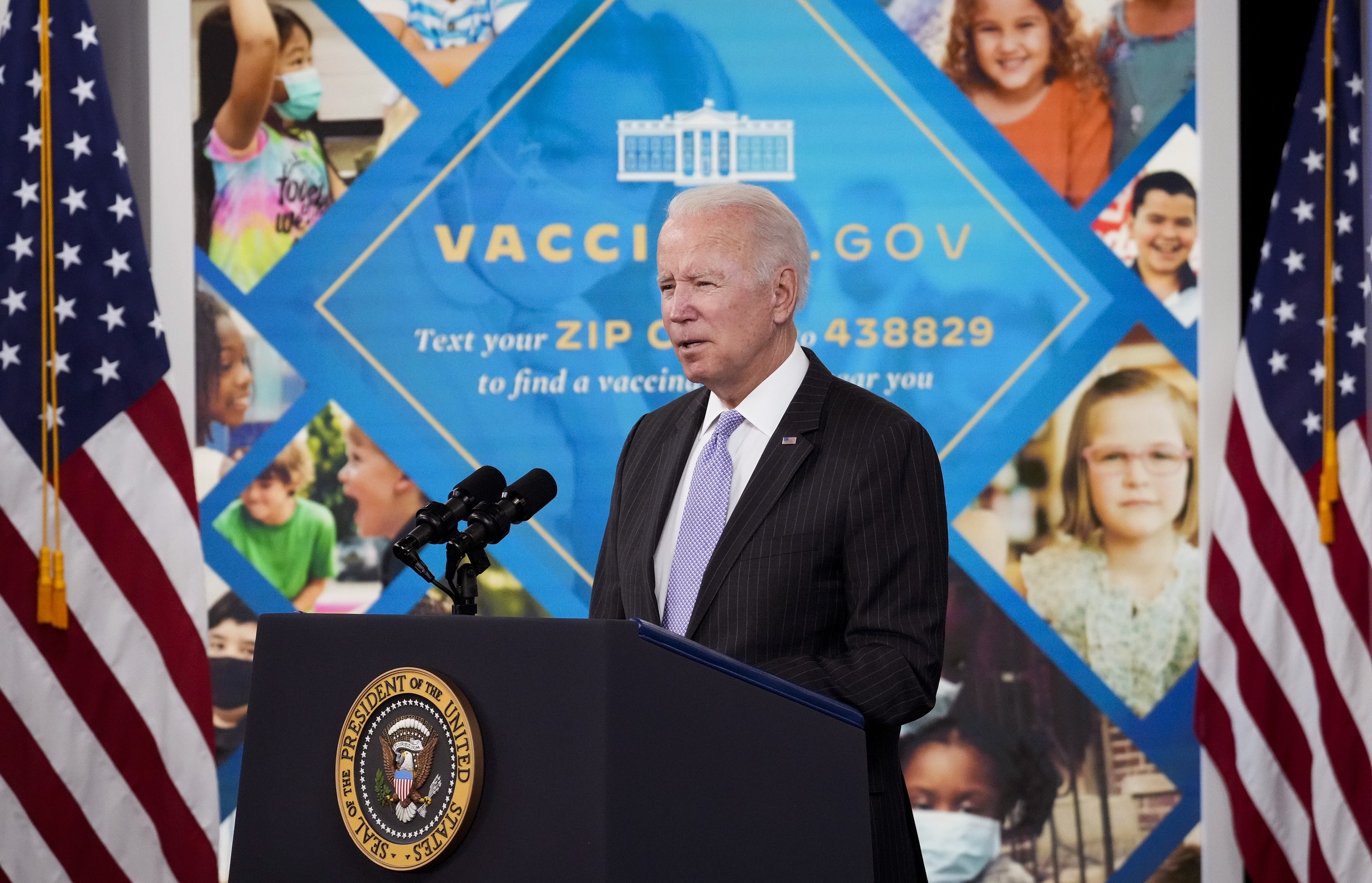
President Joe Biden speaks in front of a sign advertising the vaccines.gov website.
Enlarge / President Joe Biden speaks about the authorization of the COVID-19 vaccine for children ages 5-11 on November 03, 2021, in Washington, DC.
Getty Images | Drew Angerer

A federal judge yesterday blocked a Biden administration COVID-19 vaccine mandate for health care workers, granting a request for preliminary injunction filed by Republican attorneys general from 14 states.

US District Judge Terry Doughty ruled that the government lacks authority to implement the rule that “requires the staff of twenty-one types of Medicare and Medicaid healthcare providers to receive one vaccine by December 6, 2021, and to receive the second vaccine by January 4, 2022.” Providers that don’t comply face penalties, including “termination of the Medicare/Medicaid Provider Agreement.”

The Centers for Medicare and Medicaid Services (CMS) mandate regulates over 10.3 million health care workers in the US, of which 2.4 million are unvaccinated. The Biden vaccine rule is being challenged by the attorneys general from Louisiana, Montana, Arizona, Alabama, Georgia, Idaho, Indiana, Mississippi, Oklahoma, South Carolina, Utah, West Virginia, Kentucky, and Ohio. The Republican AGs’ lawsuit was filed against CMS and the US Department of Health and Human Services.

The preliminary injunction they won applies nationwide except for 10 states that “are already under a preliminary injunction order dated November 29, 2021, issued by the Eastern District of Missouri,” a court order said. Those states are Alaska, Arkansas, Iowa, Kansas, Missouri, New Hampshire, Nebraska, Wyoming, North Dakota, and South Dakota.

“Liberty interests of the unvaccinated”

Doughty’s order can be challenged in the US Court of Appeals for the Fifth Circuit, which already ruled against the US in a similar case. It could eventually reach the Supreme Court. If no higher court overturns the preliminary injunction, it will remain in effect until the states’ lawsuit against the Biden administration is fully resolved.

Doughty wrote in his conclusion:

If the separation of powers meant anything to the Constitutional framers, it meant that the three necessary ingredients to deprive a person of liberty or property—the power to make rules, to enforce them, and to judge their violations—could never fall into the same hands. If the Executive branch is allowed to usurp the power of the Legislative branch to make laws, two of the three powers conferred by the Constitution would be in the same hands.

If human nature and history teach anything, it is that civil liberties face grave risks when governments proclaim indefinite states of emergency. During a pandemic such as this one, it is even more important to safeguard the separation of powers set forth in our Constitution to avoid erosion of our liberties…

This matter will ultimately be decided by a higher court than this one. However, it is important to preserve the status quo in this case. The liberty interests of the unvaccinated requires nothing less.

Doughty “considered limiting the injunction to the fourteen Plaintiff States” but decided to make it nationwide because “there are unvaccinated healthcare workers in other states who also need protection.”

Biden contractor rule also blocked

In a different ruling yesterday, a judge granted a preliminary injunction preventing the Biden administration from “enforcing the vaccine mandate for federal contractors and subcontractors in all covered contracts in Kentucky, Ohio, and Tennessee.” That ruling was issued by Judge Gregory Van Tatenhove of the US District Court for the Eastern District of Kentucky.

Van Tatenhove wrote that vaccines are effective and that the government can “in some circumstances” require citizens to be vaccinated. But the question in the case is narrow, asking whether the president can “use congressionally delegated authority to manage the federal procurement of goods and services to impose vaccines on the employees of federal contractors and subcontractors… In all likelihood, the answer to that question is no.”

Judge cites recent ruling against OSHA

Doughty cited a November 12 decision from the Fifth Circuit appeals court, which issued a stay preventing the Occupational Safety and Health Administration (OSHA) from enforcing a mandate that “required employees of covered employers to undergo a COVID-19 vaccination or to take weekly COVID-19 tests and wear a mask.” The appeals court “stayed the OSHA Mandate because of perceived grave statutory and Constitutional issues pending briefing and an expedited judicial review,” and many of the issues in that case “are similar to the issues here included in the CMS Mandate,” Doughty wrote.

The appeals court found “that the OSHA Mandate exceeded the federal government’s authority under the Commerce Clause because it regulated noneconomic inactivity (person’s choice to remain unvaccinated) that falls squarely within the State’s police power” and “that separation of powers principles (‘the major questions doctrine’) casts doubt over the OSHA Mandate’s assertion of virtually unlimited power to control individual conduct under the guise of a workplace regulation,” Doughty’s ruling noted.

“Additionally, the Court found ‘irreparable harm’ to the petitioners’ liberty interests of having to choose between their jobs and the vaccine,” Doughty wrote.

https://arstechnica.com/?p=1817233


Microsoft shareholders back protest vote over sexual harassment claims

The shareholder revolt comes in the shadow of recent cases and the revelation that co-founder Bill Gates had a relationship with a company employee.
Enlarge / The shareholder revolt comes in the shadow of recent cases and the revelation that co-founder Bill Gates had a relationship with a company employee.
Jeff Pachoud | Getty Images

Microsoft’s shareholders have backed a protest vote calling on the company to reveal more about its handling of sexual harassment claims, in the shadow of recent cases and the revelation that co-founder Bill Gates had a relationship with a company employee.

The call amounted to a rare vote against management at the company’s annual shareholder meeting and brought an immediate promise from Microsoft of more transparency. However, the company stopped short of saying it would reveal details about individual cases, and it did not make any commitment to reopen its handling of cases from previous years.

The shareholder revolt followed years of complaints from some workers that the company had brushed pervasive claims of harassment under the carpet. Arjuna Capital, which submitted the shareholder proposal challenging management, said Microsoft’s human resources department upheld only one claim against the group out of a total of 238 that were included in a class-action lawsuit alleging discrimination and harassment in 2012.

“Reports of Bill Gates’ inappropriate relationships and sexual advances towards Microsoft employees have only exacerbated concerns, putting in question the culture set by top leadership, and the board’s role holding those culpable accountable,” it added.

Microsoft revealed earlier this year that its board had hired an external firm to look into a decades-old “intimate relationship” that Gates had with an employee. Gates stepped down from the board before an investigation was completed. The outcome of any investigation has not been revealed.

The shareholder vote deals a blow to Microsoft’s lofty reputation with investors focused on environmental, social, and governance (ESG) issues. The group is the most widely held company in US ESG funds as of July, according to Bank of America.

Shareholder advisory groups ISS and Glass Lewis recommended investors back the Arjuna resolution, arguing that a failure to deal effectively with sexual harassment claims would hurt a company’s reputation and ability to hire, affecting its shareholders.

“There are new steps we are going to take that we were thinking about,” Brad Smith, Microsoft’s president, said after the vote. “I think the resolution, and the dialogue we’ve had, has helped us advance our decision-making.”

Smith said the company had been compiling more information internally on harassment claims and recognized that “shareholder interest” made it important to disclose more of this publicly as well.

As an example of the kind of disclosure it might make in future, he said that, in Microsoft’s last financial year, it had investigated 51 complaints and that 47 percent were substantiated, compared with 49 percent of the 142 cases investigated the year before. The decline in claims probably reflected the fact that more people were working from home, he added.

Smith also said Microsoft would commission an independent review of how it handles harassment claims and publish the results. However, he stopped short of promising the company would adopt any recommendations, saying only that it would “think hard” about making changes.

Smith said Microsoft would also publish more details on the company’s gender pay gap, despite shareholder rejection of a separate proposal on the issue. The company is already required to publish the data in the UK and would extend this globally, he added.

© 2021 The Financial Times Ltd. All rights reserved Not to be redistributed, copied, or modified in any way.

Listing image by Drew Angerer | Getty Images

https://arstechnica.com/?p=1817098


Lawsuit: Google employees were fired for upholding “Don’t be evil” code

The fictional character Dr. Evil in front of a Google sign.

Three former Google software engineers who sued the company yesterday claim they were fired for following Google’s famous “Don’t be evil” mantra.

“Google terminated each plaintiffs’ employment with it for adhering to the directive ‘Don’t be evil’ and calling out activity by Google that they each believed betrayed that directive,” according to the complaint filed in Santa Clara County Superior Court by Rebecca Rivers, Sophie Waldman, and Paul Duke. The ex-employees say Google falsely blamed them for a data leak after they circulated an internal petition.

The lawsuit notes that the Google Code of Conduct “that each full-time Google employee is required to sign as a condition of employment” specifically instructs them not to be evil. The ex-employees say they tried to uphold the “Don’t be evil” policy in August 2019 by circulating a petition “requesting that Google affirm that it would not collaborate with CBP [US Customs and Border Protection] or ICE [Immigration and Customs Enforcement] with respect to enforcement of the Trump border control policies.”

“[E]ach plaintiff protested Google’s engagement in supporting BCP policies that resulted in separation of families and ‘caging’ of immigrants who were seeking asylum in the United States,” the complaint said.

Google’s firings of Rivers, Waldman, and Duke are also part of an ongoing case in which the National Labor Relations Board filed a complaint against Google.

Plaintiffs “harmed by their reliance” on Google code

Each of the three plaintiffs had “relinquished other employment opportunities” to work for Google and “believed that by accepting employment with Google, their labor would not be used to produce products or services that would facilitate unethical, inhumane or ‘evil’ conduct,” the complaint said. The fired employees were allegedly “harmed by their reliance upon Google’s representation that Google employees were entitled, and required to ‘call out’ Google for engaging in action that they believed violated its ‘Don’t be evil’ code of conduct.”

The plaintiffs also allege that Google violated California labor law by restricting their political activities, specifically by “interrogating and subsequently terminating the employment of plaintiffs for speaking out about and objecting to Google’s involvement in contracting with the Trump administration’s CBP and ICE agencies to provide goods and services.”

The plaintiffs are seeking financial damages. We contacted Google about the lawsuit and will update this article if we get a response.

Google blamed plaintiffs for data leak

The petition the then-employees circulated included the information “that Google had already offered a ‘free trial’ of its new cloud platform, ‘Anthos,’ to CBP.” Rivers found this information “by conducting ordinary online searches and reviewing internal Google documents that were readily available to her and all other full-time Google employees,” and the petition “expressly directed their co-workers to refrain from sharing this information outside of Google,” the lawsuit said. But the information about the free trial was leaked and reported by Business Insider.

The three employees say they were fired on November 25, 2019, “within minutes of one another,” even though Google’s investigation found no evidence that they leaked the information. “Neither Duke, Waldman or Rivers ever shared any information pertaining to the free Anthos trial (or any other ‘confidential’ or ‘need to know’ information) to Business Insider or any other publication or person outside of Google,” the complaint said.

The employees “fully complied” with their terms of their employment, including by “complying with the directive to tell Google if they believed that Google, other employees, or its Board members were violating the obligation ‘Don’t be evil,'” the complaint said. The plaintiffs say they upheld the “Don’t be evil” directive when they “questioned Google management regarding its intent to enter into a contract with the Trump administration’s” immigration and border control agencies.

A month before circulating the petition, Waldman “openly questioned Google’s commitment to refraining from working with CBP,” leading to comments and followup questions from hundreds of employees, the complaint said. A Google manager allegedly “took the highly unusual step of advising Waldman that the comments on this topic were going to be closed.”

Shortly after that, the lawsuit says, Google Cloud CEO Thomas Kurian said “during a workplace meeting that Google in general and Google Cloud in particular would not participate in any projects ‘associated with the Southern Border,’ and affirmed that Google products and services would only be used for ‘good stuff’ such as crop protection.”

https://arstechnica.com/?p=1817029


Labor board orders a do-over in Amazon warehouse union election

The Amazon logo on the side of a multistory window.
Enlarge / An Amazon warehouse in Germany on April 2, 2020.

A regional official at the National Labor Relations Board has called for a new union election at Amazon’s Bessemer, Alabama, fulfillment center following recommendations issued in August by a hearing officer. The Retail, Wholesale, and Department Store Union (RWDSU), which seeks to represent workers in the Bessemer warehouse, filed 23 objections disputing the fairness of the election shortly after votes were tallied back in April. 

No date has been set for the new election, and Amazon could still appeal the decision to the full National Labor Relations Board.

The decision to call a new election hinges primarily on a mailbox that Amazon installed in the warehouse’s parking lot to collect ballots. According to the NLRB’s report (PDF), the mailbox was installed without the approval of the NRLB, creating the impression that the box was being surveilled and that Amazon, not the NLRB, was conducting the election. Amazon also installed a tent over the mailbox with Amazon’s anti-union campaign messaging “printed on at least one side,” and the company conducted “mandatory small group meetings” where it provided anti-union campaign materials to employees.

The election that commenced on February 8, 2021, was set aside because the National Labor Relations Board found the Employer interfered with the employees’ exercise of a free and reasoned choice by creating the appearance of irregularity in the election procedure due to issues surrounding the installation of a mailbox outside the main entrance and by improperly polling employees’ support during mandatory meetings. Therefore, a new election will be held in accordance with the terms of this Notice of Second Election. All eligible voters should understand the National Labor Relations Act, as amended, gives them the right to cast their ballots as they see fit and protects them in the exercise of this right, free from interference by any of the parties.

The original union election at the Bessemer warehouse was conducted in February and March of 2021, and votes were counted in early April. The final count wasn’t particularly close, with 738 votes in favor of unionizing and 1,798 votes against; a further 505 disputed ballots would not have affected the outcome one way or the other. 

Amazon staunchly opposed the unionization of the Bessemer warehouse, and a successful unionization among its workers could encourage other Amazon employees to unionize. The Amazon Labor Union, an organization independent of existing unions like the RWDSU, is currently seeking to unionize Amazon’s JFK8 warehouse in New York City.

https://arstechnica.com/?p=1816949


UK orders Facebook to sell Giphy, rejects Meta’s proposed merger conditions

Facebook and Giphy logos are displayed on a laptop and a mobile phone screen.
Getty Images | Anadolu Agency

The UK’s Competition and Markets Authority (CMA) today ordered Facebook owner Meta to sell Giphy, saying the merger “would reduce competition between social media platforms and that the deal has already removed Giphy as a potential challenger in the display advertising market.”

Facebook bought Giphy in May 2020 for a reported $400 million “but has been required to hold the businesses separate” since June 2020, when the CMA imposed an Initial Enforcement Order (IEO), the UK government body said in a summary of its final report today. After the 17-month investigation, “we have decided that the only effective way to address the competition issues that we have identified is for Facebook to sell Giphy, in its entirety, to a suitable buyer,” the CMA wrote.

The CMA said it found that “Facebook would be able to increase its already significant market power in relation to other social media platforms by denying or limiting other platforms’ access to Giphy GIFs, driving more traffic to Facebook-owned sites—Facebook, WhatsApp and Instagram—which already account for 73 percent of user time spent on social media in the UK” and by “changing the terms of access by, for example, requiring TikTok, Twitter, and Snapchat to provide more user data in order to access Giphy GIFs.”

Facebook had proposed merger conditions in order to save the purchase, but the CMA said that “behavioral remedies” won’t fix the competition problems and that Facebook could “circumvent” such requirements. Meta can appeal the CMA’s ruling.

CMA rejects claim that Giphy can’t compete on its own

The CMA also said that “Facebook terminated Giphy’s advertising services at the time of the merger, removing an important source of potential competition,” which is “particularly concerning given that Facebook controls nearly half of the £7 billion display advertising market in the UK.”

The CMA said:

The parties told us that it was likely that Giphy would have become a significantly weakened business had it not been bought by Facebook. Our view is that, had the merger not gone ahead, Giphy would have continued to supply GIFs to social media platforms (including Facebook), as it had done before the merger, and would have continued to innovate, develop its products and services, generate revenue and explore (with the financial and commercial support of investors) various options to further monetize its products. This would have been the case regardless of Giphy’s ownership (i.e., whether it operated independently, as it did before the merger, or in the hands of an alternative purchaser).

If Facebook hadn’t purchased Giphy, it would have had the options of “(i) paying some form of platform fee or license fee to Giphy, (ii) relying more heavily on other GIF providers (eg Tenor), or (iii) building its own GIF library,” the CMA said.

Meta considers appeal

Meta said in a statement provided to Ars that it disagrees with the ruling and is considering whether to appeal. “Both consumers and Giphy are better off with the support of our infrastructure, talent, and resources,” the Facebook owner said. “Together, Meta and Giphy would enhance Giphy’s product for the millions of people, businesses, developers, and API partners in the UK and around the world who use Giphy every day, providing more choices for everyone.”

An appeal would apparently be heard by the UK Competition Appeal Tribunal. The Wall Street Journal noted that the appeal tribunal recently upheld a CMA decision that “blocked Sabre Corp.’s tie-up with rival travel booking service Farelogix Inc.”

https://arstechnica.com/?p=1816906


Big Tech firms should pay ISPs to upgrade networks, telcos in Europe claim

A person's hand holding a roll of 50-Euro notes.
Getty Images | Alicia Llop

The CEOs of 13 large European telecom companies today called on tech giants—presumably including Netflix and other big US companies—to pay for a portion of the Internet service providers’ network upgrade costs. In a “joint CEO statement,” the European telcos described their proposal as a “renewed effort to rebalance the relationship between global technology giants and the European digital ecosystem.”

The letter makes an argument similar to one that AT&T and other US-based ISPs have made at times over the past 15 years, that tech companies delivering content over the Internet get a “free” ride and should subsidize the cost of building last-mile networks that connect homes to broadband access. These arguments generally don’t mention the fact that tech giants already pay for their own Internet bandwidth costs and that Netflix and others have built their own content-delivery networks to help deliver the traffic that home-Internet customers choose to receive.

Today’s letter from European ISPs was signed by the CEOs of A1 Telekom Austria Group, Vivacom, Proximus Group, Telenor Group, KPN, Altice Portugal, Deutsche Telekom, BT Group, Telia Company, Telefónica, Vodafone Group, Orange Group, and Swisscom. They wrote:

Large and increasing part of network traffic is generated and monetized by big tech platforms, but it requires continuous, intensive network investment and planning by the telecommunications sector. This model—which enables EU citizens to enjoy the fruits of the digital transformation—can only be sustainable if such big tech platforms also contribute fairly to network costs.

Growing calls for payments from Big Tech

The European telcos didn’t mention any specific tech giants, but Reuters wrote today that “US-listed giants such as Netflix and Facebook are companies they have in mind.” The letter also discusses other regulatory topics related to fiber and mobile broadband, saying that “regulation must fully reflect market realities… Namely, that telecom operators compete face-to-face with services by big tech.”

The European ISPs’ letter isn’t the only recent example of ISPs claiming that tech giants should help them pay for network upgrades. “South Korean Internet service provider SK Broadband has sued Netflix to pay for costs from increased network traffic and maintenance work because of a surge of viewers to the US firm’s content,” Reuters reported on October 1.

The traffic surge was driven in part by the show Squid Game. The Seoul Central District Court ruled against Netflix in a related case in June, finding that it is “reasonable” for Netflix to be “obligated to provide something in return for the service” provided by SK, Reuters wrote.

BT annoyed by net neutrality

The CEO of BT Group’s consumer division, Marc Allera, recently argued that net neutrality rules should be changed to let ISPs demand payments, as The Guardian reported on October 10:

Allera says the rules that stop companies such as BT from passing on some of the costs to the biggest drivers of the capacity growth—net neutrality rules that stipulate that all Internet traffic is treated equally—are outdated for the streaming era.

“A lot of the principles of net neutrality are incredibly valuable, we are not trying to stop or marginalize players but there has to be more effective coordination of demand than there is today,” he says. “When the rules were created 25 years ago I don’t think anyone would have envisioned four or five companies would be driving 80 percent of the traffic on the world’s Internet. They aren’t making a contribution to the services they are being carried on; that doesn’t feel right.”

The Guardian article said the companies driving 80 percent of the traffic were YouTube, Facebook, Netflix, and Activision Blizzard, but it isn’t clear where that data came from or whether it’s accurate. A May 2020 report by the vendor Sandvine found that YouTube accounted for 15.9 percent of home-Internet traffic globally during the first months of the pandemic, compared to 11.4 percent for Netflix and 3.7 percent for Facebook.

All video streaming combined accounted for 57.6 percent of traffic. Social networking accounted for 10.7 percentm and general Web browsing clocked in at 8.1 percent. The entire gaming category accounted for 4.2 percent, slightly less than the “marketplace,” “messaging,” and “file sharing” categories. Of course, those numbers are probably a bit different now, but it doesn’t seem likely that four companies account for 80 percent of all Internet traffic worldwide.

https://arstechnica.com/?p=1816718


We transformed a London borough into a game to get fewer people traveling by car

Dice on a table.

In England, only 37 percent of adults aged 16 or over travel actively (walk, cycle, scoot, or wheel to get from place to place) at least twice a month. We need to find exciting ways to encourage more people to travel actively for the sake of population and planetary health.

Active travel can help reduce congestion, air pollution, and climate change. However, in the UK—as in many countries across the world—traveling by car remains the dominant social norm.

Our research shows that gamification—offering points, badges, prizes, or spots on a leaderboard in exchange for participating in specific, non-game-related activities—can encourage people to travel actively to school or work.

To test this, we set up a gamification initiative called Beat the Street to see whether it could encourage people in the London borough of Hounslow to travel actively.

During our game, which ran from September 18 to October 30, 2019, residents and visitors to Hounslow could earn points by tapping a card on physical boxes placed throughout the borough. Players were given 10 points each time they touched two boxes consecutively with a card, indicating they had actively traveled between them. And yes, we made sure to remove any obvious cheaters from the game.

At the end of the six-week game, the highest-scoring individuals and teams (schools, community groups, and workplaces) were rewarded with prizes, such as vouchers for sports equipment, craft materials, or books.

We investigated the impact of this game on active travel by looking at when people played, comparing how active people said they were before and after the game, and using a traffic camera to look for a reduction in motorized vehicles traveling along a frequently congested local road.

Methods

I walked far more than I would normally have walked: about five times as much. I visited roads that I have never walked down before or even didn’t know existed and I have lived in the borough all my life!

(Male participant, aged 60-69)

Over the course of the game, 28,219 people took part (9.6 percent of the population of Hounslow). Collectively, they traveled 96,849 miles.

In total, participants recorded 638,697 taps on the 161 “beat boxes” situated throughout the borough. Over half of all these taps were made between 08:00-08:59 and 15:00-15:59, which are typical periods of travel between home and school or work.

To look more closely at specific physical activity outcomes, we asked 346 adults to complete a physical activity questionnaire before and after taking part in the game.

These results showed that the proportion of participants who reported being physically inactive (defined as taking part in fewer than 30 minutes of activity per week) decreased from 25 percent pregame to 18 percent postgame. And the proportion of participants who reported meeting the World Health Organization’s target of 150 minutes of moderate intensity activity a week increased from 62 percent pregame to 75 percent postgame.

It certainly was motivational for the kids, which then motivated me! Once they got into it, they wanted to walk everywhere and started to refuse to go to school in the car. So we’re walking to school only now!

(Female participant, aged 30-39)

Next, to provide an objective measure of behavior change achieved through the game, we observed local traffic through a monitoring camera. We assessed the number of vehicles traveling in both directions along the often-congested Cambridge Road, between 07:00-09:30 and between 14:00-16:30.

The data we collected showed that, between the week before and the week following Beat the Street, 1,199 fewer cars (a 53 percent reduction) and 130 fewer vans (also a 53 percent reduction) traveled along Cambridge Road between 07:00-09:30, and 705 fewer cars (a 34 percent reduction) and 36 fewer vans (a 20 percent reduction) traveled along the road between 14:00-16:30.

These findings suggest that turning a whole area of a town or city into an interactive game could be a promising approach to nudge people into traveling by foot, bicycle, or wheelchair.

Implications

It was a very nice way to motivate people to walk, and also it created a team. Every day it gave you the enthusiasm to get up and walk to raise money for charity.

(Female participant, aged 70-79)

One of the major issues faced when attempting to move people away from using cars and toward sustainable transport options is the fact that cars indicate a high social status, making many reluctant to get rid of them.

Another problem is the ingrained nature of car use for short journeys, where many people instinctively choose to drive for convenience or just as a habit. This means that many suggested ways to decrease car usage, like increasing taxes on fuel or congestion, aren’t usually supported by policymakers, who may fear backlash from interfering with many people’s preferred way of life.

I was choosing to scoot or walk instead of a car ride, and I was taking longer ways to get home to be able to add some points.

(Female participant, aged 30-39)

In light of this, gamification can be used to create an environment where behaviors such as walking, cycling, or wheeling to school or work are viewed more positively than car use. The mass appeal of community-level competitions like these, which reward active travel with points, badges, and a higher position on a leaderboard, may be more effective in shifting the social norms of the communities in which they take place.

The ConversationMarc Harris is a senior researcher of Sociology and Philosophy of Sport at Cardiff Metropolitan University. Diane Crone is a professor in Exercise and Health at Cardiff Metropolitan University.

This article is republished from The Conversation under a Creative Commons license. Read the original article.

https://arstechnica.com/?p=1815801