One America News founder claimed he started network at AT&T’s request

Eagle-trimmed logo for One American News Network.

A Reuters report published today with the title “How AT&T helped build far-right One America News” alleges that the telecom giant played a significant role “in creating and funding OAN, a network that continues to spread conspiracy theories about the 2020 election and the COVID-19 pandemic.”

While there’s no evidence or allegation that AT&T played a direct role in creating OAN, Reuters points to a court case in which OAN’s founder said he created the network after AT&T “told us they wanted a conservative network.” OAN also apparently gets the vast majority of its revenue from a carriage deal with the AT&T-owned DirecTV, which is by far the largest cable or satellite TV provider that carries the channel. OAN is carried by providers including DirecTV, AT&T U-verse, Verizon FiOS, and CenturyLink, but not by large cable operators such as Comcast, Charter, and Cox.

OAN owner Herring Networks claimed in a 2016 lawsuit that AT&T promised to carry OAN on DirecTV in exchange for OAN’s public support of AT&T’s attempt to purchase the satellite provider, which required government approval. OAN’s lawsuit claimed that AT&T reneged on the deal once its purchase of DirecTV was finalized in 2015. OAN finally got on DirecTV in 2017, weeks after agreeing to drop its lawsuit against AT&T. Herring also claimed in court that AT&T in 2013 proposed acquiring a 5 percent ownership stake in Herring, but that purchase was never made.

When contacted by Ars today, AT&T provided a statement saying it never invested directly in OAN:

AT&T has never had a financial interest in OAN’s success and does not “fund” OAN. When AT&T acquired DirecTV, we refused to carry OAN on that platform, and OAN sued DirecTV as a result. Four years ago, DirecTV reached a commercial carriage agreement with OAN, as it has with hundreds of other channels and as OAN has done with the other TV providers that carry its programming. DirecTV offers a wide variety of programming, including many news channels that offer a variety of viewpoints, but it does not dictate or control programming on the channels. Any suggestion otherwise is wrong.

AT&T “wanted a conservative network”

The Reuters story is based almost entirely on court documents but doesn’t provide any of those documents or even say which courts they were filed in. Reuters described one of the court cases as “a labor lawsuit brought against OAN by a former employee and unrelated to AT&T,” apparently referring to a racial-discrimination case in which a San Diego County Superior Court jury last year awarded ex-employee Jonathan Harris nearly $290,000 in damages.

A deposition in the labor lawsuit revealed AT&T’s request for “a conservative network,” Reuters wrote:

OAN founder and chief executive Robert Herring Sr. has testified that the inspiration to launch OAN in 2013 came from AT&T executives.

“They told us they wanted a conservative network,” Herring said during a 2019 deposition seen by Reuters. “They only had one, which was Fox News, and they had seven others on the other [leftwing] side. When they said that, I jumped to it and built one.”

Since then, AT&T has been a crucial source of funds flowing into OAN, providing tens of millions of dollars in revenue, court records show. Ninety percent of OAN’s revenue came from a contract with AT&T-owned television platforms, including satellite broadcaster DirecTV, according to 2020 sworn testimony by an OAN accountant.

OAN certainly provided what it claims AT&T asked for. “OAN’s influence rose in late 2015, when it began covering Trump rallies live, at a time when some of the media still saw the New York celebrity businessman as a longshot presidential contender,” Reuters wrote. “The network continues to shower Trump with attention and often provides a friendly platform for his Republican allies. As president, Trump frequently urged supporters to watch OAN.”

Herring alleged quid pro quo

The other lawsuit that Reuters alluded to is Herring Networks v. AT&T. It was filed in March 2016 in US District Court for the Central District of California and dismissed at the request of the parties in March 2017. The complaint alleged that AT&T misled Herring about its intentions for the U-verse wireline TV platform. “When the parties negotiated and entered into their agreement, AT&T led Herring to believe that U-verse TV—AT&T’s new television distribution service—would continue to expand and grow. But unbeknownst to Herring, AT&T had decided to acquire DirecTV and wind down U-verse, i.e., move AT&T’s pay-TV customers to the DirecTV system,” the complaint alleged.

The complaint further claimed that “AT&T promis[ed] to put Herring’s channels on DirecTV in return for Herring’s support and lobbying with governmental regulators in favor of AT&T’s $65 billion acquisition of DirecTV” but that “[a]fter AT&T got Herring’s support, and the acquisition was completed, AT&T reneged on its promise and agreement to put Herring’s channels on DirecTV.”

In a May 2016 declaration in that lawsuit, Herring Networks President Charles Herring, the son of Robert Herring Sr., described an October 2013 meeting with AT&T executives Aaron Slator and Ryan Smith. They offered a deal that had been authorized by AT&T’s then-CEO Randall Stephenson, Charles Herring told the court:

During that meeting, Mr. Slator proposed that AT&T acquire a 5 percent ownership stake in Herring so that Herring’s channels would become AT&T-affiliated channels. Once that happened, Mr. Slator said, AT&T would “put” Herring’s networks to DirecTV, i.e., require DirecTV to carry our networks under the terms of a “Put Agreement” between AT&T and DirecTV. Mr. Slator told me that Randall Stephenson, CEO of AT&T, both instructed him and gave him the authority to propose this “Put Agreement” to Herring on behalf of AT&T, the parent company in Dallas, Texas. I accepted Mr. Slator’s proposal on behalf of Herring (the “Put Right Deal”).

Herring lobbied for AT&T

AT&T announced a pending agreement to purchase DirecTV in May 2014. Shortly after that announcement, Charles Herring visited AT&T’s Los Angeles office. He told the court:

At that meeting, Mr. Slator told me that Randall Stephenson, AT&T’s Chairman and CEO, no longer wanted to move forward with the Put Right Deal… because Mr. Stephenson did not want to affect the acquisition and his negotiations with his then-counterpart at DirecTV, Chairman and CEO Mike White. Mr. Slator said that, instead, Mr. Stephenson authorized Mr. Slator to offer Herring a different deal. Mr. Slator proposed that if Herring publicly supported AT&T during the acquisition process, AT&T would cause DirecTV to carry Herring’s networks after the acquisition.

“Charles accepted Slator’s terms,” and the parties agreed to a deal in which DirecTV would pay over $100 million in licensing fees over five years, the lawsuit said.

“At AT&T’s direction and in reliance on the parties’ agreement, Herring did everything AT&T asked to obtain governmental approval of the acquisition,” the lawsuit claimed. Herring “filed briefs with the FCC in support of the [AT&T/DirecTV] acquisition and against the Comcast/TWC merger, including one that was ghostwritten by AT&T,” and he “invited AT&T to utilize OAN’s news programs to cast a positive light on the acquisition and advocated for other issues affecting AT&T’s business,” the lawsuit said.

Charles Herring’s 2016 declaration described one more meeting he had in October 2014 in the District of Columbia with James Cicconi, who was then AT&T’s senior executive VP of external and legislative affairs:

Mr. Cicconi told me that he was responsible for ensuring that AT&T successfully completed the acquisition of DirecTV. Mr. Cicconi thanked me for Herring’s work in support of the acquisition. Mr. Cicconi reiterated the DirecTV promise that Mr. Slator had made to me several months earlier. Mr. Cicconi confirmed that, since Herring had performed its end of the bargain, AT&T would get Herring’s networks carriage on DirecTV after the acquisition. Mr. Cicconi told me that he had authority from his superiors at AT&T Inc. in Dallas, Texas, to make this promise on behalf of AT&T Inc.

AT&T completed its acquisition of DirecTV in July 2015 and did not include OAN in its roster of channels for nearly two years. OAN finally launched on DirecTV on April 5, 2017, a little more than two weeks after a federal judge granted a joint stipulation to dismiss the lawsuit filed by Herring against AT&T. No settlement was mentioned in that filing, but the litigation was no longer necessary once the AT&T-owned DirecTV agreed to pay for OAN.

AT&T denied that it promised to carry OAN in exchange for the company’s support of the DirecTV merger. “Support for the merger was never a condition of or part of any content agreement,” an AT&T spokesperson told Ars today. DirecTV also carries the Herring-owned network called A Wealth of Entertainment, formerly known as Wealth TV.

OAN’s value without DirecTV “would be zero”

AT&T’s purchase of DirecTV was a financial failure. In August, AT&T completed a spinoff of DirecTV after six years of mismanagement in which nearly 10 million customers ditched the company’s pay-TV services. AT&T still owns 70 percent of DirecTV, but the satellite provider now operates more independently of its parent company.

“The decision of whether to renew the carriage agreement [with OAN] upon its expiration will be up to DirecTV, which is now a separate company outside of AT&T,” AT&T told Ars today.

The exact amount that DirecTV pays OAN is confidential but crucial to OAN’s survival, Reuters wrote, citing court testimony from OAN’s accountant. “In addition to testifying that AT&T provided 90 percent of Herring Networks’ income, the accountant said the company’s book value—the net value of its assets—was a modest $16.6 million,” according to Reuters. The news article also quotes the accountant as testifying that, without the DirecTV deal, OAN’s value “would be zero.”

https://arstechnica.com/?p=1801788


Algorithms shouldn’t be protected by Section 230, Facebook whistleblower tells Senate

Former Facebook employee Frances Haugen testifies during a Senate Committee on Commerce, Science, and Transportation hearing on October 5, 2021. Haugen left Facebook in May and provided internal company documents about Facebook to journalists and others, alleging that Facebook consistently chooses profit over safety.
Enlarge / Former Facebook employee Frances Haugen testifies during a Senate Committee on Commerce, Science, and Transportation hearing on October 5, 2021. Haugen left Facebook in May and provided internal company documents about Facebook to journalists and others, alleging that Facebook consistently chooses profit over safety.

Facebook whistleblower Frances Haugen testified before a Senate panel yesterday, recommending a slate of changes to rein in the company, including a Section 230 overhaul that would hold the social media giant responsible for its algorithms that promote content based on the engagement it receives in users’ news feeds.

“If we had appropriate oversight, or if we reformed [Section] 230 to make Facebook responsible for the consequences of their intentional ranking decisions, I think they would get rid of engagement-based ranking,” Haugen said. “Because it is causing teenagers to be exposed to more anorexia content, it is pulling families apart, and in places like Ethiopia, it’s literally fanning ethnic violence.”

Haugen made sure to distinguish between user-generated content and Facebook’s algorithms, which prioritize the content in news feeds and drive engagement. She suggested that Facebook should not be responsible for content that users post on its platforms but that it should be held liable once its algorithms begin making decisions about which content people see.

That suggestion mirrors a bill, the Protecting Americans from Dangerous Algorithms Act, which has been introduced in the House.

Yet despite the call for Section 230 reform, Haugen also cautioned that reform alone would not be enough to adequately oversee the company’s broad reach. “The severity of this crisis demands that we break out of previous regulatory frames,” she said. “Tweaks to outdated privacy protections or changes to Section 230 will not be sufficient.”

“False choices”

The sweeping hearing was called to address tens of thousands of documents Haugen obtained from Facebook before she left the company in May. The former product manager handed over the files to Congress and the SEC and is seeking whistleblower protection. She has filed eight lawsuits with the SEC, including allegations that Facebook overcharged advertisers and misled investors about the size of its user base. The company, she said, is not being upfront about the nature of the problems it’s facing. “Facebook wants you to believe that the problems we’re talking about are unsolvable. They want you to believe in false choices,” Haugen said. 

“They want you to believe that you must choose between a Facebook full of divisive and extreme content or losing one of the most important values our country was founded upon: free speech,” she added. “That you must choose between public oversight of Facebook’s choices and your personal privacy. That to be able to share fun photos of your kids with old friends, you must also be inundated with anger-driven virality. They want you to believe that this is just part of the deal. 

“I am here today to tell you that’s not true. These problems are solvable. A safer, free-speech-respecting, more enjoyable social media is possible.”

Haugen was similarly optimistic about Facebook’s mission, despite its myriad problems. “I believe in the potential of Facebook,” she said. “We can have social media we enjoy, that connects us without tearing apart our democracy, putting our children in danger, and sowing ethnic violence around the world. We can do better.”

Algorithmic choices

Time and again, the hearing came back to the problems posed by the prevalence of algorithms and artificial intelligence in Facebook’s operations. 

Documents that Haugen collected from Facebook show that engagement-based ranking algorithms prioritize divisive and extreme content on the platform. To solve that problem, she said, Facebook uses artificial intelligence to find dangerous content before it spreads. The problem is that “Facebook’s own research says they cannot adequately identify dangerous content. And as a result, those dangerous algorithms that they admit are picking up the extreme sentiments, the division, they can’t protect us from the harms that they know exist in their own system,” Haugen said.

One solution, floated by Sen. Rick Scott (R-Fla.) during the hearing, proposes that users be offered a choice between an algorithmic news feed and a chronological one. Haugen did not think that would be sufficient. “I worry that if Facebook is allowed to give users the choice: do you want an engagement-based news feed or a chronological news feed… that people will choose the more addictive option, that engagement-based ranking, even if it is leading their daughters to eating disorders.”

Facebook’s research

In an internal message later posted publicly, Facebook CEO Mark Zuckerberg alluded to research the company has done on its platform. “If we’re going to have an informed conversation about the effects of social media on young people, it’s important to start with a full picture. We’re committed to doing more research ourselves and making more research publicly available.” 

Despite promising a “full picture,” Zuckerberg did not commit to releasing all of Facebook’s research or opening its platforms to study by researchers not employed or funded by the company. Haugen’s documents show that, as recently as last week, the company has released research selectively to paint a rosier picture of what is happening on its platforms.

The company’s lack of transparency has tied regulators’ hands, Haugen said. “This inability to see in Facebook’s actual systems and confirm that they work as communicated is like the Department of Transportation regulating cars by only watching them drive down the highway,” she said. Haugen urged the senators to consider a government agency that would audit social media platforms, giving regulators greater insight into the companies’ inner workings.

“Today, no regulator has a menu of solutions for how to fix Facebook because Facebook didn’t want them to know enough about what’s causing the problems,” Haugen said. “Otherwise, there wouldn’t have been a need for a whistleblower.”

https://arstechnica.com/?p=1801618


Amazon wins record US tax breaks to expand delivery network

Amazon wins record US tax breaks to expand delivery network
NurPhoto | Amazon

Amazon has won a record amount of tax breaks this year as local officials try to lure the online shopping giant to expand its one-day or same-day delivery networks in their areas.

According to data from Good Jobs First, an economic development watchdog based in Washington, DC, Amazon has so far secured about $650 million in sweeteners from local and state governments in 2021, a mixture of grants, tax exemptions, and other incentives. This was likely to be a conservative estimate, the group said, because of the secrecy around some of the deals.

With three months still to go, 2021 already has the largest yearly tally since Good Jobs First began collecting the data in 2000, excluding incentives for non-logistics projects, such as filmmaking and office development, and the more than $750 million package Amazon was awarded in 2019 to build its “second” headquarters in Arlington, Virginia.

The bumper deals for Amazon’s delivery network come as local authorities grapple with rebuilding their economies and job markets in the wake of the coronavirus pandemic, a crisis that has seen Amazon’s profits soar because of its pivotal role in distributing goods during lockdown and beyond.

“I was hopeful public officials would step back and say: ‘We’re in such a difficult situation, we have to stop subsidizing very wealthy companies,’” said Kasia Tarczynska, research analyst at Good Jobs First. “Unfortunately, it’s the opposite.”

“Amazon should stop asking for any kind of incentives,” she added.

Amazon has defended the practice, pointing to its record of job creation and saying that in many cases it was taking up offers that were on the table for any business, not just Amazon.

“These incentives are typically available to any firm that meets the criteria and companies do not receive a penny until after they have created jobs and made capital investments,” Amazon said. “In 2020 alone, Amazon invested $150 billion in the US, opened more than 100 sites and created more than 400,000 jobs across more than 40 states.”

The company also referred to statements from the Progressive Policy Institute (PPI) describing Amazon as its top “investment hero.” Like several other large companies, Amazon is a donor to PPI. The think tank would not disclose how much it had received from the company but said its research was based on “published financial data and [used] a clearly-documented methodology.”

Including breaks relating to corporate offices, Whole Foods grocery stores, Zappos warehouses, the company’s movie and television productions, and even a fashion studio in New York City, Amazon has received “at least” $4.1 billion in incentives since 2000, Good Jobs First has calculated. Secrecy makes a precise tally difficult. In some cases, tax breaks are voted on prior to confirmation that the beneficiary will be Amazon, and in other cases dollar amounts are never disclosed.

The e-commerce giant is aggressively adding warehouses as it seeks to cut delivery times in more markets across the US. The company’s capital expenditure has rocketed from $16.8 billion in 2019 to $40.1 billion in 2020. As of the end of this year’s second quarter, Amazon said capex had reached $26.4 billion.

Meanwhile, the company has petitioned local officials for incentives, often via third-party development companies.

https://arstechnica.com/?p=1801593


Facebook misled investors about shrinking user base, ex-employee alleges

A person using a smartphone in front of a TV screen displaying the Facebook logo.
Getty Images | Chesnot

Facebook has been misleading investors about its “shrinking” teen and young-adult user bases and about the actual number of Facebook users, former employee Frances Haugen alleged in a whistleblower complaint filed with the US Securities and Exchange Commission. “For years, Facebook has misled investors and advertisers about [its] shrinking user base in important demographics, declining content production, and the true number of recipients of ‘Reach & Frequency’ advertising,” the complaint said.

Noting that “Facebook’s stock valuation is based almost entirely on predictions of future advertising revenue,” the complaint cites “evidence showing that Facebook has, for years past and ongoing, violated US securities laws by making material misrepresentations and omissions in statements to investors and prospective investors, including… through filings with the SEC, testimony to Congress, online statements, and media stories.”

“Facebook has misrepresented core metrics to investors and advertisers including the amount of content produced on its platforms and growth in individual users (especially in high-value demographics),” the complaint said. Facebook’s advertising algorithms did not properly account for what the complaint calls Single Users with Multiple Accounts (SUMA), and the company thus “systematically overcharg[ed] advertisers” by misrepresenting the number of individual users, Haugen alleged.

“Facebook’s mishandling of duplicate accounts constitutes extensive fraud against its advertisers, and misrepresentations to investors,” the complaint alleged.

While Facebook reported user growth to investors, the company “failed to disclose internal data showing a contraction of the user base in important demographics, including American teenagers and young adults. The company has also hidden the extent to which content production per user has been in long-term decline,” the complaint said.

Complaints based on internal Facebook documents

Haugen filed eight whistleblower complaints with the help of nonprofit group Whistleblower Aid, all of which were published in a CBS News article yesterday. The complaints are “based on tens of thousands of internal Facebook documents secretly copied by Haugen before she left the social media company in May,” CBS wrote.

Some of the allegations in the complaints were revealed weeks ago, such as one regarding the XCheck program that allowed 5.8 million VIPs including celebrities, politicians, and athletes to evade the posting rules that applied to most users.

Haugen’s other complaints allege that Facebook misled investors and the public about various problems including Facebook’s role in the January 6 insurrection, Facebook’s failure to remove the vast majority of hate speech, the harm Facebook caused teenagers’ mental and physical health, Facebook’s enablement of human trafficking, Facebook’s promotion of misinformation and hate speech, and how Facebook “promotes global division and ethnic violence.” Haugen initially filed the complaints anonymously but spoke in a 60 Minutes interview and testified in a Senate Commerce Committee hearing today about protecting kids online.

Facebook said in a statement to Ars that “These claims are simply false. It’s important to note that Frances herself admits that she has no direct knowledge of how our ads system works. We tell investors and advertisers about our user base and how it is calculated in our public filings, and we provide additional information to advertisers in our ad products, ad interfaces, in our help centers, and in other places. We stand by these disclosures. Ultimately, advertisers use Facebook because they see results—we help them meet their business objectives and provide appropriate metrics in our reporting tools.”

In its most recent quarterly earnings report, Facebook said it had 1.91 billion average daily active users and 2.9 billion monthly active users in June, with both figures up 7 percent year over year.

Young adults see FB as “negative, fake, and boring”

The complaint cited an internal Facebook report that said, “Facebook’s teen and young adult DAU [Daily Active Users] has been in decline since 2012/2013. Data science findings indicate that only users 25 and above are increasing their use of Facebook. The Teen DAU has plateaued and the Young Adult (18-24) DAU continues to decline.”

Another internal record said that young adults “want uplifting and motivating content, yet see FB content as negative, fake, and boring.” Internal records also said that teen daily active users dropped 13 percent from 2019 to 2021 and that during the pandemic, “every cohort’s use of Facebook increased, except for those 23 and under, which continued to decline.”

One internal document said that over 15 percent of new teen accounts were existing users creating a second account, a higher percentage than for users overall. Facebook acknowledged its duplicate-account problem in a January 2021 filing with the SEC, saying that “duplicate accounts may have represented approximately 11 percent of our worldwide MAUs [monthly active users],” the complaint noted. But in a 2018 earnings call, Facebook CEO Mark Zuckerberg claimed the company’s tally of MAUs “refers to individual people rather than active accounts, so it excludes when people have multiple active accounts on a single app,” the complaint said.

Facebook CFO David Wehner seemed to contradict Zuckerberg in that same call, acknowledging that “the Facebook MAU number does count multiple accounts for a single user when such accounts exist, and we estimate those represent approximately 10 percent of our Facebook MAUs as previously disclosed in the limitation of key metrics section in our SEC filings.” Haugen’s complaint also pointed to a September 2017 AdWeek article that said Facebook claimed to reach more people than actually existed in certain age groups, and to a November 2019 Financial Times article on “Facebook’s fake numbers problem.”

“Facebook overcharged advertisers on a vast scale”

In the section alleging that “Facebook’s mishandling of duplicate accounts constitutes extensive fraud against its advertisers, and misrepresentations to investors,” the complaint notes that Facebook offers “Reach and Frequency” tools that let advertisers control the number of users who are shown an ad and the number of times each person sees an ad.

“By delivering too many ads to users that the advertisers did not want to pay for, Facebook overcharged advertisers on a vast scale,” the complaint alleged, citing a document that said adjusting numbers for duplicate accounts “would reduce overestimation of population in age groups for our top 30 ad markets by 50 percent when included by itself and by 63 percent when included in conjunction with age modeling.”

“We find that, after including SUMA accounting in audience size calculation, 82 percent of current R&F revenue would see an audience size reduction [of] less than 10 percent, [while] 95 percent [of current R&F revenue would see] a reduction less than 16 percent,” the Facebook document said.

The whistleblower complaint concluded by urging the SEC to take action:

The SEC is charged with enforcing the laws that protect investors in public companies like Facebook. Facebook’s investors care about these misrepresentations and omissions about duplicate accounts and corresponding user numbers/growth for two reasons. First, if advertisers were aware of the discrepancies, they would spend less on ads, leading to lower advertising revenue and lower profits. Second, some investors simply will not want to invest in a company that does not have the growth (e.g., daily and monthly active users) that is represented and then engages in misstatements and omissions on this topic.

https://arstechnica.com/?p=1801234


Tesla ordered to pay $137M to Black former worker subjected to racist workplace

Tesla ordered to pay $137M to Black former worker subjected to racist workplace

Tesla owes Owen Diaz $137 million after a jury found that the Black former worker was subjected to racial abuse that the electric vehicle company insufficiently addressed during his tenure.

Diaz, an elevator operator at the company’s Fremont factory for nine months from 2015 to 2016, had been called racial epithets by coworkers, was told to “go back to Africa,” and saw racist graffiti in the bathrooms. The trial lasted a little over a week, and the jury found that Tesla had not taken reasonable steps to prevent racial harassment.

“It shines a light on what’s going on inside of Tesla’s factory,” Diaz told The Wall Street Journal. “Elon Musk, you’ve been put on notice. Clean that factory up.”

The automaker’s defense hinged on the fact that many of the approximately 10,000 workers at its Fremont plant are contractors hired through external staffing agencies. Because of that, company lawyers claimed that there was no evidence that Tesla employees were directly responsible for the racial slurs and graffiti.

The federal jury didn’t buy the argument, though. Diaz and his attorneys had brought three claims against Tesla—that the company subjected him to a racially hostile workplace, that it failed to provide a workplace free from harassment, and that it was negligent in its supervision of employees—and the jury found in favor of the plaintiff on all claims. It ordered Tesla to pay Diaz $6.9 million in compensatory damages and $130 million in punitive damages, amounts far in excess of what his attorneys requested. 

The group of eight jurors reached its decision after about four hours of deliberation.

Arbitration clauses questioned

Activist shareholders have been pressing Tesla to evaluate the practice of mandatory arbitration. Nia Impact Capital said in a shareholder proposal, “The use of mandatory arbitration provisions limits employees’ remedies for wrongdoing, precludes employees from suing in court when discrimination and harassment occur, and can keep underlying facts, misconduct, or case outcomes secret and thereby prevent employees from learning about and acting on shared concerns.”

Tesla’s reliance on contractors was part of what allowed the lawsuit to proceed in the first place. Because Diaz had been employed by a staffing agency, he never had to sign the company’s arbitration agreement. That freed him to sue the company in court—apparently the first time a worker lawsuit against Tesla has gone to trial.

Other workers, such as Melvin Berry, have been forced into arbitration. In Berry’s case, an arbitrator found that Tesla had failed to stop racial discrimination at its Fremont factory, where supervisors had called him racial slurs. Yet partly because Berry’s case went to arbitration, the judgment was far less—just $1 million. 

In a blog post published on Tesla’s website last night, Vice President of People Valerie Capers Workman said that the company had turned a new leaf. “The Tesla of 2015 and 2016 (when Mr. Diaz worked in the Fremont factory) is not the same as the Tesla of today,” she wrote. “We acknowledge that we still have work to do to ensure that every employee feels that they can bring their whole self to work at Tesla.”

Tesla has not said whether it plans to appeal the verdict. The company is facing another similar lawsuit in California state court, where the plaintiffs are seeking class certification. There, Marcus Vaughn and others allege that Tesla created a hostile workplace for Black workers.

https://arstechnica.com/?p=1801106


FCC plans to rein in “gateway” carriers that bring foreign robocalls to US

Drawing of a robot holding a telephone.
Getty Images | Juj Winn

The Federal Communications Commission hopes to reduce the number of illegal robocalls from overseas with an expansion of rules that require phone companies to implement Caller ID authentication technology and block illegal calls. “Eliminating illegal robocalls that originate abroad is one of the most vexing challenges the commission faces because of the difficulty in reaching foreign-based robocallers and the foreign voice service providers that originate their traffic,” the FCC said.

To make a dent in that problem, the FCC is proposing new requirements on domestic gateway providers that accept calls from outside the US. A Notice of Proposed Rulemaking (NPRM) adopted Thursday and released on Friday proposes requiring those gateway phone companies to implement STIR (Secure Telephone Identity Revisited) and SHAKEN (Signature-based Handling of Asserted Information Using toKENs) protocols, which verify the accuracy of Caller ID by using digital certificates based on public-key cryptography.

“This proposal would subject foreign-originated calls, once they enter the United States, to requirements similar to those of domestic-originated calls, by placing additional obligations on gateway providers in light of the large number of illegal robocalls that originate abroad and the risk such calls present to Americans,” the NPRM said. Gateway providers would be required to “apply STIR/SHAKEN caller ID authentication to, and perform robocall mitigation on, all foreign-originated calls with US numbers,” the FCC said.

International calling loophole

STIR/SHAKEN is already widely deployed in the US on IP networks due to separate requirements that apply to large phone providers. Another newly implemented rule prohibits phone companies from accepting calls from providers that haven’t met requirements to deploy STIR/SHAKEN or other robocall-mitigation methods. But the STIR/SHAKEN requirements don’t apply to all carriers yet.

“We don’t want international calling to become a loophole for our policies,” FCC Acting Chairwoman Jessica Rosenworcel said on Thursday at a commission meeting. “So today we are proposing that gateway providers in the United States—the companies that bring in calls from overseas—take action to stop this stuff from coming in from abroad. That means they need to use STIR/SHAKEN technology, register in our Robocall Mitigation Database, and comply with traceback requests to figure out where these junk calls are originating from overseas.”

The FCC said those traceback requests “are used to help block illegal robocalls and inform FCC enforcement investigations.” The NPRM also proposes a new call-blocking requirement. When the FCC notifies a gateway provider about an ongoing robocall campaign, the provider would have to conduct “a prompt investigation to determine whether the traffic identified in the Enforcement Bureau’s notice is illegal” and “promptly block all traffic associated with the traffic pattern identified in that notice.”

The NPRM seeks public comment on these proposed rules. Deadlines for initial comments will be 30 days after the NPRM is published in the Federal Register and 60 days after publication for reply comments. The docket is located here.

Who is the customer?

The FCC said its NPRM includes a proposed requirement “that gateway providers ensure foreign calls using US phone numbers are legally authorized to do so,” which would be similar to the “Know Your Customer” rules that apply to the banking industry. Adapting such rules to telephony is a little tricky, the NPRM explained:

Our rules currently require a voice service provider to “[t]ake affirmative, effective measures to prevent new and renewing customers from using its network to originate illegal calls, including knowing its customers and exercising due diligence in ensuring that its services are not used to originate illegal traffic.” This rule generally applies to originating providers and, under our proposed definition, gateway providers do not have a direct relationship with the call originator and instead receive calls from a number of upstream originating or intermediate providers. As a result, gateway providers may not have a “customer” to “know” for the purpose of complying with a “know your customer” requirement.

We believe, however, that extending “know your customer” obligations to gateway providers could benefit US consumers. First, we propose and seek comment on requiring gateway providers to confirm that a foreign call originator is authorized to use a particular US number that purports to originate the call. We then seek comment on whether, and how, to apply additional “know your customer” requirements to gateway providers to reduce the risk of illegal calls entering the US network, including who the gateway provider’s “customer” should be for this purpose.

Though STIR/SHAKEN is now common on the IP networks of large phone companies, carriers with 100,000 or fewer customers still have until June 30, 2023, to deploy the technology. The FCC in May asked for comment on a plan to make that deadline June 30, 2022, instead. Another problem is how to implement Caller ID authentication on TDM-based networks that use copper landlines. Because STIR/SHAKEN only works on IP networks, the FCC has said its rules “require providers using older forms of network technology to either upgrade their networks to IP or actively work to develop a caller ID authentication solution that is operational on non-IP networks.”

https://arstechnica.com/?p=1800615


Elizabeth Holmes’ defense strikes back in cross-examination of lab director

Theranos founder Elizabeth Holmes leaves the Robert F. Peckham Federal Building and US Courthouse in San Jose, Calif., on Wednesday, Sept. 22, 2021. Holmes is charged with two counts of conspiracy to commit wire fraud and nine counts of wire fraud and could face up to 20 years in prison if convicted.
Enlarge / Theranos founder Elizabeth Holmes leaves the Robert F. Peckham Federal Building and US Courthouse in San Jose, Calif., on Wednesday, Sept. 22, 2021. Holmes is charged with two counts of conspiracy to commit wire fraud and nine counts of wire fraud and could face up to 20 years in prison if convicted.

Theranos’ former lab director has become a central focus of early questioning in Elizabeth Holmes’ criminal trial. Late last week, the defense continued its cross-examination of one of the prosecution’s key witnesses, attempting to paint Dr. Adam Rosendorff as unreliable.

Three facts could damage Rosendorff in the eyes of the jury. Whether those facts diminish his prior testimony depends largely on Holmes’ defense team. Given the damning facts Rosendorff laid out during the prosecution’s questioning, that will be a difficult task. But discrediting key witnesses is something all defenses have to attempt.

Three lines of questioning

First, Rosendorff admitted under questioning by Holmes’ attorney Lance Wade that he had approved of the company’s controversial pseudo-policy regarding outliers. While Theranos had no official policy for how to eliminate outliers—despite there being ample guidance for how to do so—the company did develop a framework called the “six tip policy.” Each sample produced six results, and from that, two were discarded and the remaining four were averaged. The policy says it was OK to eliminate two, but it didn’t help lab techs identify which are the best candidates for omission. So, this is kind of a policy, but it’s one that didn’t cover everything it should have.

Second, Rosendorff seems to have had a stronger hand in developing and implementing lab protocols than his earlier testimony let on. For one, he had signed off on an “alternative assessment procedure” for Theranos’ proprietary Edison devices, which are essentially a set of proficiency tests that differed from those used to validate other diagnostic equipment. And he admitted that lab tech Erika Cheung hadn’t been using Rosendorff’s alternative procedure when she raised concerns about the Edison devices failing quality control.

Rosendorff also worked with Ramesh “Sunny” Balwani, Theranos’ president and COO, to edit a slide deck that was intended to instruct lab techs on the company’s unique proficiency testing procedure. “Theranos tests have no peer groups,” one slide said.

Third, Rosendorff appears to have had the ear of upper management for most of his time at the company. About a month before he quit, Rosendorff had been invited to a meeting with Balwani and other executives to voice his concerns about Theranos’ testing procedures. Rosendorff admitted under Wade’s questioning that there had been no restrictions on what he could say at that meeting.

Out of the loop

Together, those three lines of questioning could undermine Rosendorff’s previous testimony. But other parts of Friday’s testimony appeared to reinforce his earlier statements.

For one, Balwani sent an email to a Theranos vice president in June 2014, several months before Rosendorff quit. The email said, “Adam came by my office EXTREMELY frustrated that as a lab director he is not being kept in the loop.” Furthermore, the jury heard about backlogs for pregnancy tests, which Rosendorff said he was not aware of. Those more or less confirm what Rosendorff told the prosecution—that he had been left out of the loop.

Another of Wade’s tactics may not have landed as he intended. In a series of new emails, we learned that Rosendorff was slow to follow up on complaints. On two separate occasions, the lab director took more than a week to follow up with a doctor about questionable test results.

Now, the jury could interpret this a few ways. Jurors could see Rosendorff as unreliable, which is probably what Wade wants. But they could also take a more sympathetic view—after all, Rosendorff seems to have been dealing with more complaints than a normal lab. On top of that, he was constantly sparring with executives about how to run the lab. Given those fires, it’s easy to see why he might have pushed “reply to customer complaints” further down the list.

Taking a week to address a complaint may not be normal practice in clinical labs, but Theranos was clearly not running a typical lab.

Listing image by Jane Tyska/Digital First Media/The Mercury News

https://arstechnica.com/?p=1800306


YouTube TV keeps NBC, won’t have to bundle Peacock as companies strike new deal

NBC's peacock-shaped logo on the NBC Tower in Chicago.
Enlarge / NBC’s logo on the NBC Tower in Chicago on March 25, 2011.
Getty Images | Raymond Boyd

Update on October 2 at 1:35 pm ET: YouTube TV and NBC today announced a new contract that will let NBC channels remain on YouTube TV. “We’re thrilled to share that we’ve reached a deal to continue carrying the full NBCUniversal portfolio of channels. That means you won’t lose access to any of their channels, and YouTube TV will continue to offer 85+ networks for $64.99,” YouTube said. NBC confirmed the deal in a statement to Ars.

YouTube confirmed to Ars that the new contract is a multi-year deal but neither company revealed the exact length. The sides previously agreed to a short extension of the old contract to avoid a blackout and were then able to finalize a new channel-carriage agreement.

The new contract does not require YouTube TV to bundle NBC’s Peacock online service, an NBC source confirmed to Ars. NBC previously sought a YouTube TV/Peacock bundle but dropped the demand earlier in the negotiations. The NBC source said that Peacock was not a “major part” of the negotiations with YouTube TV but that Peacock is “a part of the conversation” in all negotiations with partners.

Original story as published on October 1:

YouTube TV and NBCUniversal are still at odds in negotiations over a new contract that would allow NBC channels to remain on the Google-owned streaming service. The existing contract was set to expire at 12 am ET today, but the companies agreed to a short extension that prevents a blackout for now.

“NBCUniversal and YouTube TV have agreed to a short extension while parties continue talks. NBCUniversal will not go dark on YouTube TV at midnight eastern tonight,” NBC said in a statement provided to Ars last night.

NBC declined to say how long the extension is, and YouTube TV owner Google did not comment. About 15 NBC-owned channels and eight regional NBC Sports networks could still go dark on YouTube TV if the companies don’t agree on terms before the extension expires.

NBC’s unusual Peacock demand

Channel blackouts and contentious carriage negotiations have long been part of the TV industry, though some things have changed now that online streaming services like YouTube TV compete against cable and satellite. The Comcast-owned NBCUniversal came up with an unusual tactic in this round of negotiations, demanding that YouTube TV bundle Peacock, NBC’s own streaming service. NBC has struggled to convince individual subscribers to purchase the $5 or $10 premium tiers of Peacock, and the company is “falling back on their legacy business model of wholesale bundling to drive distribution,” as investor research firm LightShed Partners wrote.

Peacock is unlikely to be in a final contract between NBC and YouTube TV, as we reported Tuesday. An NBC source who is familiar with the negotiations told Ars at the time that NBC’s Peacock demand was “out” of the negotiations—but the source wouldn’t say definitively that NBC wouldn’t try to put Peacock back on the table. Google had objected, saying that a bundle would force subscribers to pay twice for the same programming because Peacock has much of the same content as NBC channels.

Even if Peacock is out of the mix, the sides still have to agree on an overall price and other considerations. YouTube TV is seeking a most-favored-nation clause, saying that it wants contractual protections ensuring that YouTube TV doesn’t pay more for NBC channels than similarly sized TV providers do. Google said it will cut the YouTube TV monthly price from $65 to $55 if NBC channels are blacked out and pointed out that customers can sign up for Peacock separately.

NBC claimed it is just “seeking fair rates from Google” and tried to pressure the company by setting up a “You Need Channels” website that warns users, “YouTube TV may drop your favorite channels.” The NBC website urges users to complain to YouTube TV and to consider switching to other TV providers.

https://arstechnica.com/?p=1799978


This software aims to make your flight smoother—and help the planet

So many airplanes are in line on the runway waiting for take off. These Air Force planes are part of Operation stop service to transport in Covid-19 situation.
Enlarge / So many airplanes are in line on the runway waiting for take off. These Air Force planes are part of Operation stop service to transport in Covid-19 situation.
Naruecha Jenthaisong | Getty Images

Fastening the seat belt buckle and knowing your flight is on its way to its destination: Nice. Getting stuck in a tarmac traffic jam and waiting for your flight to take off: Not so nice. Turns out the wait is also not nice for the planet.

Flying in an airplane is already one of the most emissions-intensive things you can do. Globally, aviation produced over 1 billion tons of carbon emissions in 2019, more than 2 percent of all human-generated emissions—more than either shipping or rail. Aircraft engines also emit nitrogen oxides, soot particles, and water vapor, which also contribute to warming the planet.

Taking off and landing is usually just a short part of a flight, but accounts for a quarter of its emissions, according to NASA. Unnecessary plane stops during that process increase fuel use. It would be better for everyone—passengers included—if airplanes smoothly exited and entered airports.

That’s because airplane engines are designed to operate in the air, says Hamsa Balakrishnan, a professor of aeronautics and astronautics at MIT who studies airport operations. When aircraft are waiting at their gates, they rely on auxiliary power systems to keep just the essentials running. But once a plane pushes back, it starts running its engines, and burning fuel. Idling at airports also hurts local air quality, says Balakrishnan—people live and work closer to airports than they do to the middle of the sky. It’s noisy, too.

Now the Federal Aviation Administration and NASA have created a system to smooth the takeoffs and landings, wringing out delays and unnecessary emissions in the process. Real rocket scientists were involved—the system grew out of NASA’s work to help spaceships establish steady trajectories into space.

Today, most airports create a queue for takeoffs, based on when a plane pushes back from the gate. That can lead to traffic jams on the tarmac, and overloaded runways where airplanes idle while waiting to take off. Plus, air traffic controllers don’t always have a great sense of how long it will take a plane to taxi and ascend into the air. In fact, while the FAA does get each airline’s schedule, controllers don’t know exactly when a flight is going to depart until it hits a specific part of the ramp. They deal with this unpredictability by building in buffers, extra time here and there that ensures that the entire system operates without a hitch. As a result, “there’s a lot of inefficiency that gets built in,” says Balakrishnan, the MIT professor.

For passengers, inefficiency looks like waiting to board an airplane that was supposed to land 30 minutes ago, or strapped into an uncomfortable seat while waiting in a line of airplanes to take off. For airlines, inefficiency looks like burning unnecessary fuel—and releasing unnecessary emissions into the air.

The new software is part of a two-decade effort to modernize the country’s air traffic control system. It incorporates 11 bits of real-time data from airlines—including when a plane actually left the gate, and when another actually hit the tarmac— to more accurately choreograph aircraft movement in and out of the airport. It’s not that the information is that complicated, or that new. It’s that the players at the airport—operators, air traffic control, airlines—have a way to automatically share it, in real time, with fewer phone calls. Eventually, the system should kill the paper progress strips that controllers use to manually keep track of flights, creating an all-digital system that can, for example, remind controllers when a certain runway is closed.

The system can save a lot of fuel. After the FAA spent four years testing the new software with American Airlines at Charlotte Douglas International Airport in North Carolina, it concluded that the reduced taxiing times saved over 275,000 gallons of fuel a year, the equivalent of 185 flights between New York and Chicago aboard a Boeing 737. Carbon emissions fell by over 2,900 tons a year, roughly the same amount emitted by burning 15 railcars of coal. For passengers, the project reduced delays by almost 40 minutes a day. For the Charlotte airport—which is among the world’s busiest, when including commercial, cargo, military, and private flights—that means “you’re able to get more aircraft on and off the ground,” says Haley Gentry, the airport’s aviation director. “We’re maximizing the use of the pavement that we have.”

The FAA hopes to roll out the new software to 27 of the nation’s busiest airports in cities including Baltimore, Boston, Chicago, Dallas, New York, Phoenix, and San Francisco, starting in 2022. It could take the agency 10 years to reach all 27.

For a single passenger, the changes might feel incremental, says Pam Whitley, the FAA’s assistant administrator for its modernization program. But she expects there will be fewer annoyances. “That experience of showing up to the gate, the plane’s not there, not sure when the plane is going to show up—hopefully, the passenger will not experience that,” she says.

This story originally appeared on wired.com.

https://arstechnica.com/?p=1800121


Biden sued by Air Force officers who compare vaccine rule to death sentence

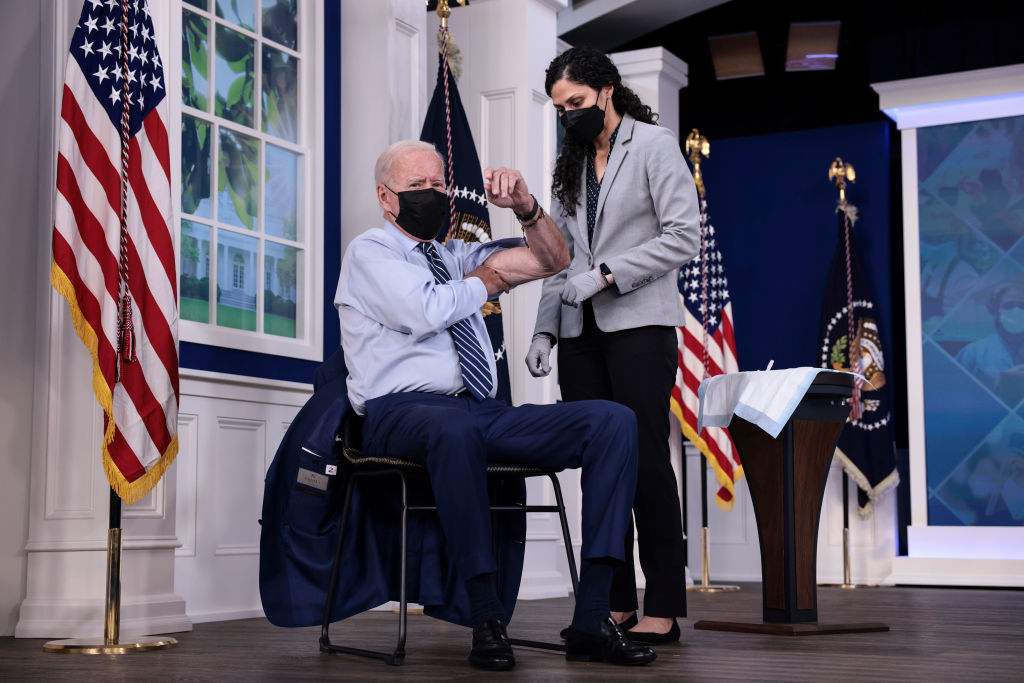
President Joe Biden rolls up his sleeve before receiving a third dose of the Pfizer/BioNTech COVID-19 vaccine
Enlarge / President Joe Biden receiving a third dose of the Pfizer/BioNTech COVID-19 vaccine in the White House September 27, 2021.
Getty Images | Anna Moneymaker

President Biden’s vaccine mandate is being challenged in a lawsuit filed by four active-duty US Air Force officers, a Secret Service agent, a Border Patrol agent, and four other federal employees or contractors. The lawsuit claimed that “convicted serial killers who have been sentenced to death receive more respect” than citizens who are required to take vaccines.

The lawsuit alleges that the vaccine mandate forces service members, federal employees, and federal employees to “inject themselves with: (1) a non-FDA approved product; (2) against their will; and (3) without informed consent.” Plaintiffs seek a ruling that the vaccine mandates issued by Biden and the Department of Defense “violate the Fifth Amendment’s guarantee of substantive due process” and “the equal protection component of the Fifth Amendment.” (The Pfizer vaccine does have full FDA approval.)

Plaintiffs also claim the mandate violates the Free Exercise and Establishment clauses of the First Amendment, the Religious Freedom Restoration Act, and other US laws including “Title VII of the Civil Rights Act of 1964 by discriminating against Plaintiffs and service members, federal employees, and federal contractors on the basis of their religion or disability.” Biden’s order does allow exceptions for medical or religious reasons but exemptions reportedly may be difficult to obtain.

“There is perhaps no greater usurpation of fundamental constitutional rights than forcibly injecting a foreign substance into an American citizen,” the lawsuit claims. “The rights of our nation’s most heinous convicted serial killers who have been sentenced to death receive more respect than this—and often times, even while already strapped to the chair.”

Biden and DOD chief named as defendants

The lawsuit names Biden and Department of Defense Secretary Lloyd Austin as defendants, claiming that “our President’s abject derelict [sic] of duty and callous disregard for the laws of this nation have compelled this action.” The suit continued:

Americans have remained idle for far too long as our nation’s elected officials continue to satisfy their voracious appetites for power while neglecting to uphold and defend the Constitution and preserve the values upon which this nation was founded. Indeed, the forty-seven (47) year subjugation to our Commander-in-Chief’s vapid political career our nation has endured leaves little remain [sic] uncertain–with more power, comes greater destitution.

This action seeks redress from Executive Order No.’s 14042 and 14043 (collectively, “Executive Orders”) issued by President Biden on September 9, 2021, and an order (“DoD Order”) issued by Department of Defense Secretary Lloyd Austin (collectively, Vaccine Mandates”) and the unlawful, manipulative, coercive, and deceptive tactics Defendants have employed and continue to employ to facilitate the mass vaccination of all active-duty service members, federal contractors, and federal employees.

The typo-filled lawsuit was filed on September 23 in US District Court for the District of Columbia. It names the plaintiffs as Air Force Captain and Georgia resident Gregg Costin, Air Force Captain and Florida resident Daniel Schultz, Air Force Lieutenant Cassidy Hollowell (no state of residence listed), Air Force Captain and Florida resident Nathaniel Steele, US Border Patrol Agent and California resident Bogdan Matuszynski, Department of State Foreign Services Officer and Florida resident Daniel Jackson, and Secret Service Special Agent and New York resident Lionel Klein. The other three plaintiffs, employees of government contractors, including 3M employee and New York resident Zachary Amigone; Thomas Handyside of Medline Industries, who lives in Illinois; and California resident Tanya Murrieta, an emergency medical technician for Loyal Source Government Services.

Biden acted “comfortably within president’s power”

US states have more power to take actions protecting the public’s health than the federal government does, but Biden’s order is well within his authority, according to Georgetown Law professor Lawrence Gostin, director of the O’Neill Institute for National and Global Health Law. Gostin was cited in a Bloomberg Law article as follows:

“While states have near plenary power to protect the public’s health, the federal government’s powers are limited,” Gostin said, adding that Biden “is acting fully lawfully pursuant to those powers.”

Gostin said the president “is using his executive power to order vaccinations for the federal workforce. He is using his spending power through Medicaid and Medicare to ensure vaccine mandates in health care settings. And he is using the Occupational Health and Safety Act to mandate vaccinations in all businesses of 100 or more employees. All of these are comfortably within the president’s power.”

States get their power in part from a 1905 Supreme Court decision in Jacobson v. Massachusetts, a precedent that helped Indiana University defend its vaccine mandate against a lawsuit filed by students. Jacobson “holds that a state may require all members of the public to be vaccinated against smallpox,” a federal appeals court noted in an August 2021 ruling. Gostin explained that Jacobson isn’t relevant to federal law but that Biden’s order was lawful anyway.

The Department of Justice wrote in July that Section 564 of the Food, Drug, and Cosmetic Act allows the Food and Drug Administration to issue an Emergency Use Authorization (EUA) for vaccines and other medical products under certain emergency circumstances. The DOJ also said that this law “does not prohibit public or private entities from imposing vaccination requirements for vaccines that are subject to EUAs.” While COVID vaccines have been administered under EUAs, the FDA granted full approval to the Pfizer/BioNTech COVID-19 in August.

Biden is separately facing opposition to his plan for requiring vaccines for health-care workers in US-funded facilities and vaccines or weekly tests for employees of private companies with at least 100 employees. Republican attorneys general from 24 states claimed the mandate is illegal and “a threat to individual liberty,” and threatened to sue if the administration doesn’t change course. Arizona AG Mark Brnovich already sued Biden to block the vaccine rules.

Plaintiffs object on religious and medical grounds

The lawsuit filed by Air Force members and other federal employees claims that “the US Constitution and numerous federal laws make it unlawful to compel persons to be vaccinated.” The plaintiffs cite different reasons for not taking the COVID-19 vaccine themselves. Some object on religious grounds while others have immunity from having already had COVID or are “medically exempt” from COVID vaccination for other reasons.

Biden’s executive order directs federal agencies to “require COVID-19 vaccination for all of its Federal employees, with exceptions only as required by law.” A separate executive order and related guidance detail requirements for federal contractors. The Department of Defense’s mandatory-vaccine order was issued about two weeks before Biden’s and covers “all members of the Armed Forces under DoD authority on active duty or in the Ready Reserve, including the National Guard.” There’s a temporary exemption for service members actively participating in COVID-19 clinical trials to avoid invalidating results of such trials.

The lawsuit seeks a complete reversal of the vaccine mandates or, at minimum, an order that Biden and the Department of Defense “promptly establish objective criterion and an objective procedure by which Plaintiffs and other service members, federal employees, and federal contractors may submit their religious or medical exemptions expeditiously and be able to do so without fearing or receiving unjust or unlawful denials.”

Guidance issued by the Biden administration on September 16 says that “an agency may be required to provide a reasonable accommodation to employees who communicate to the agency that they are not vaccinated against COVID-19 because of a disability or because of a sincerely held religious belief, practice, or observance. Determining whether an exception is legally required will include consideration of factors such as the basis for the claim; the nature of the employee’s job responsibilities; and the reasonably foreseeable effects on the agency’s operations, including protecting other agency employees and the public from COVID-19.”

https://arstechnica.com/?p=1800089