China bans online gaming for minors except from 8 pm-9 pm Friday to Sunday
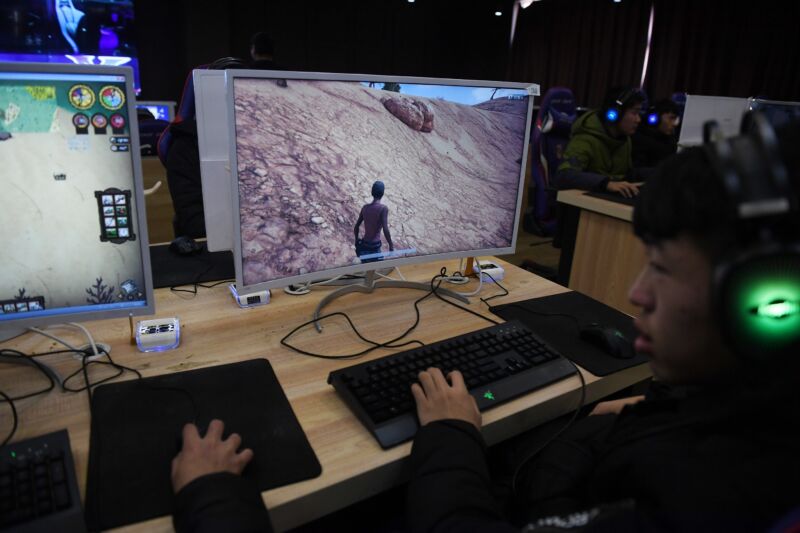
Enlarge/ Students practicing computer games in an eSports class at the Lanxiang technical school in Jinan, in China’s eastern Shandong province, on January 29, 2018.
Getty Images | AFP | Greg Baker
China reportedly issued new rules today forbidding minors from playing online video games more than three hours a week, while banning kids from online gaming entirely every Monday to Thursday. While some news reports say the ban applies to all video games, enforcement measures issued by the National Press and Publication Administration (NPPA) primarily target online games and online services related to gaming.
“Gaming companies will be barred from providing services to minors in any form outside the stipulated hours and must ensure they have put real-name verification systems in place, said the regulator, which oversees the country’s video games market,” a Reuters article said. “Previously, China had limited the length of time under-18s could play video games to 1.5 hours on any day and three hours on holidays under 2019 rules.”
People under 18 will reportedly be allowed to play video games only from 8pm to 9pm on Fridays, Saturdays, Sundays, and public holidays—limiting minors to three hours most weeks and not even letting them choose which three hours. Young people are reportedly prohibited from gaming at any time from Monday to Thursday each week under the new rules, which apply to all devices, including phones.
The NPPA claimed the regulation is about “protecting the physical and mental health of minors… and relates to the cultivation of the younger generation in the era of national rejuvenation.”
Facial-recognition and other technologies could be used to prevent underage gaming. “Enforcement measures weren’t detailed, but in response to previous moves by the government to limit video game playing by young people, Tencent Holdings… has used a combination of technologies, automatically booting off players after a certain period of time and using real-name registration and facial-recognition technology to limit game play for minors,” The Wall Street Journal wrote.
The changes announced today also require online games to “be linked to a state anti-addiction system,” and government regulators “will ratchet up checks over how gaming firms carry out restrictions on things like playing time and in-game purchases,” Bloomberg wrote.
China gov’t blames “societal ills” on gaming
China’s government has blamed video game addiction “for a host of societal ills, including distracting young people from school and family responsibilities,” the Journal wrote. A state-run media outlet this month described online games as “opium for the mind,” and “Chinese leader Xi Jinping, too, has warned publicly in recent months about the perils of youth gaming addiction, remarks that have put more pressure on officials to act,” the article said.
While China’s new regulation is a blow to both young gamers and the country’s gaming companies, some people expect to be able to evade the age rule. On the social-network Weibo, people “expressed doubt that the restrictions could be enforced. ‘They will just use their parents’ logins, how can they control it?’ asked one,” according to Reuters.
China’s government has a long history of imposing restrictions on the video game industry. It banned most gaming consoles in 2000 and finally lifted that restriction in 2015.
https://arstechnica.com/?p=1790532
Amazon urges FCC to reject SpaceX proposals for next-generation Starlink
Amazon is urging US regulators to reject an update to SpaceX’s plan for a second-generation Starlink system.
Kuiper Systems, Amazon’s satellite-broadband subsidiary, says that SpaceX broke Federal Communications Commission rules by “propos[ing] two different configurations for the nearly 30,000 satellites of its Gen2 System, each of which arranges these satellites along very different orbital parameters. SpaceX’s novel approach of applying for two mutually exclusive configurations is at odds with both the commission’s rules and public policy and we urge the commission to dismiss this amendment.”
Amazon summarized its views in a meeting with commission staff and in an ex partefiling on Wednesday that summarized the meeting, saying that SpaceX should be allowed to resubmit the amendment to its application only “after settling on a single configuration for its Gen2 System.”
Bezos/Musk fights continue
In response to a PCMag article about Amazon’s filing, SpaceX CEO Elon Musk took a dig at Amazon founder Jeff Bezos by tweeting, “Turns out Besos [sic] retired in order to pursue a full-time job filing lawsuits against SpaceX.” The FCC proceeding isn’t a lawsuit, but Bezos’ Blue Origin recently sued NASA over a lunar-lander contract given to SpaceX.
SpaceX’s Starlink division is providing broadband service in beta from about 1,600 low-Earth-orbit satellites, and it has FCC approval to launch nearly 12,000. In May 2020, SpaceX applied for a license to launch another 30,000 satellites at even lower altitudes to boost network capacity.
Amazon has US approval to launch 3,236 low-Earth-orbit satellites, but the company recently told Ars that 2023 is the earliest it expects to start. Amazon also objected to a previous SpaceX application but said it was satisfied with the outcome because of interference requirements imposed by the FCC.
SpaceX’s two proposals
SpaceX’s FCC filing on August 18 proposed one configuration that “will more evenly spread capacity by latitude by targeting multiple inclinations, ensuring better, more consistent global coverage,” along with a second configuration that “utilizes a smaller number of satellites per plane than Configuration 1, yet also spreads capacity more evenly by latitude for more consistent coverage across the globe.” Another major difference between them is that “Configuration 1 fully leverages the upgraded satellite capabilities and the availability of Starship, bringing significantly increased capability to deliver satellites to orbit” while “Configuration 2 provides an alternative that also leverages the capabilities of the reliable Falcon 9 rocket,” SpaceX said.
SpaceX said it prefers the first configuration but that neither of them requires “any additional spectrum or results in a significant increase in the potential for interference to any other spectrum user, including other NGSO [non-geostationary satellite orbit] licensees and current applicants.”
Amazon says two proposals is one too many
Amazon wrote that the SpaceX approach forces the FCC and other parties to do twice as much technical work:
Forcing both the commission and interested parties to grapple with the interference concerns posed by two separate configurations doubles the technical effort of every operator faced with the task of reviewing the interference and orbital debris concerns raised by SpaceX’s amendment. SpaceX points to this as a convenience, arguing that applying for both configurations will “enable the commission to evaluate both approaches even as development proceeds.” It is SpaceX, however, that is required to evaluate and select among different approaches; both the commission and interested parties need only examine a single “comprehensive proposal.”
Amazon contends that the SpaceX application violates a rule requiring applications to be complete and have no internal inconsistencies. The commission has said it applies the rule to avoid encouraging “speculative applications.”
Amazon’s filing continued:
Here, by leaving nearly every major detail unsettled—such as altitude, inclination, and even the total number of satellites—SpaceX’s application fails every test that section 25.112(a)(1) enumerates. And with respect to the requirement that license applications contain a “comprehensive proposal,” SpaceX’s proposed amendment contains either two comprehensive proposals or none at all. The effects cascade throughout SpaceX’s entire amendment. As one example, SpaceX is forced to seek a waiver of “the limitations in Schedule S” because, among other reasons, Schedule S does not allow it to “properly characterize the relationship between [its] two orbital configurations.”
The FCC should insist that “SpaceX adhere to the well-settled framework under Part 25—namely, that licensees submit an application for a single system,” Amazon argued.
SpaceX says this is the international norm
SpaceX acknowledged in its application that it is uncommon to ask the FCC to consider two alternative configurations, but the company argued that “it is consistent with the international approach to NGSO regulation.” SpaceX wrote:
Although this application proposes alternative amendments to the pending application, this concept is familiar to those who submit satellite network filings to the International Telecommunication Union (ITU) to initiate the international process for deploying NGSO constellations. Specifically, in recognition that constellation designs mature through development, the ITU allows mutually exclusive configurations at the filing stage. Each of these mutually exclusive configurations is independently evaluated to determine whether it meets the requirements for a favorable finding. As the satellite system is deployed, however, only one configuration may be notified and brought into use. If a pending modification has been made but has not yet received favorable findings by the time the notification deadline arrives, a single backup mutually exclusive configuration can be specified and used in the event that the primary configuration is not found to be suitable.
We contacted SpaceX about Amazon’s filing and will update this article if we get a response.
https://arstechnica.com/?p=1790325
Man robbed of 16 bitcoin hunts down suspects, sues their parents
Andrew Schober was almost all-in on cryptocurrency. In 2018, 95 percent of his net wealth was invested in the digital tokens, which he hoped he could sell later to buy a home and support his family.
But then disaster struck. Schober had downloaded an app called “Electrum Atom” after clicking a link on Reddit, mistakenly thinking it was a bitcoin wallet. Instead, it was malware that allowed hackers to steal 16.4552 bitcoin when he tried moving some of his tokens. At the time, they were worth nearly $200,000. Today, they would be worth over $750,000.
Distressed, Schober didn’t eat or sleep for days. He vowed to track down the culprits. After years of private investigations costing more than $10,000, Schober thinks he has found the thieves, and he’s suing their parents to get his bitcoin back. Krebs on Security first reported on the lawsuit.
The lawsuit alleges that two men in the UK—both minors at the time, now attending university for computer science—used the supposed wallet app to deliver malware that inserted itself into a computer’s Java libraries. The malware then proceeded to monitor Schober’s activity, waiting for him to copy a bitcoin address. When Schober went to paste it, the malware swapped the copied address for another that was stored in the code. Schober was intending to transfer bitcoin from one of his addresses to another, but instead the malware sent the cryptocurrency to the hackers’ own address—a classic man-in-the-middle attack.
The clever twist is that when Schober went to paste an address, the malware would swap it out for one that looked similar—there were 195,000 addresses embedded in its code.
Tracing transactions
In the wake of the hack, Schober hired experts to trace the flow of cryptocurrency from his addresses to accounts controlled by the hackers.
The blockchain analysis presented in the lawsuit suggests that the hackers tried to launder the bitcoin into Monero, a privacy-focused cryptocurrency. But to do that, they needed the private key that went along with the public key for the address used by the malware. Around the time of the theft, one of the young men, using an account apparently under his name, posted a question to GitHub about how to obtain said private key. That account also contained GitHub repositories for the malware along with code for a program that allowed for algorithmic trading at the Bitfinex exchange, where two deposits involving Schober’s bitcoin were traced to. Together, it led Schober to the alleged thieves.
At the time of the theft, the alleged perpetrators were both minors, so as Schober learned their identities, he sent their parents notes informing them of what he knew. “It seems your son has been using malware to steal money from people online,” he wrote. Schober appealed to the parents, asking them to “make this right, without involving law enforcement.” He said he would drop the matter if the stolen bitcoin was returned in full, and he listed an address and gave them a deadline. He sent one note in 2018 and another in 2019. He never heard back from either of the young men’s parents.
That silence led him earlier this year to file a lawsuit against the young men and their parents, claiming that the adults “knew or should have known” that their children were engaged in “illegal computer abuse(s) and/or cryptocurrency theft(s).”
One of the defendants, Hazel D. Wells, mother of one of the young men, filed a motion to dismiss the case, saying that the statute of limitations on three of the four claims had expired (conversion, trespass to chattel, and a violation of the Computer Fraud and Abuse Act). Defendants did not reply to the fourth, civil conspiracy. Schober’s attorney replied that the clock didn’t begin when the bitcoin was stolen, but rather when he learned of the identities of the alleged hackers.
At issue in this case is the fact that cryptocurrency transactions are hard to trace and are irreversible, unlike those that happen within the traditional banking system. Tracking down thieves requires investing significant sums of money, as Schober did, and even then, getting back the stolen tokens is a long shot.
Lucrative operations
Cryptocurrency theft is big business. Last year alone, nearly $2 billion in cryptocurrencies was involved in theft, hacks, or fraud. That number seems to be down this year, but only because theft of decentralized finance investments is on the rise.
Many of the thefts involve SIM swaps, where criminals convince employees at mobile carriers to transfer a phone number to a different SIM card, giving imposters access to various accounts that allow them to perpetrate thefts. In one, a prominent crypto investor had $24 million stolen from him after a SIM swap allowed the hackers access to his Skype account, which they used to trick a client into sending payments to them rather than the investor. The investor sued AT&T for the full amount plus damages. In another case, a California man lost $1.8 million after “prolific SIM swappers” who worked for AT&T profited from his misfortune. That man also sued AT&T.
Though significant, those cases are small potatoes compared with the Poly Network breach that happened earlier this month. The hacker managed to exploit a vulnerability in the way the company handled smart contracts to steal $600 million “for fun” before returning the stolen coins and netting a $500,000 bug bounty.
https://arstechnica.com/?p=1790287
EU set to launch formal probe into Nvidia’s $54 billion takeover of Arm
Brussels is set to launch a formal competition probe early next month into Nvidia’s planned $54 billion takeover of British chip designer Arm, after months of informal discussions between regulators and the US chip company.
The investigation is likely to begin after Nvidia officially notifies the European Commission of its plan to acquire Arm, with the US chipmaker planning to make its submission in the week starting September 6, according to two people with direct knowledge of the process. They added that the date might yet change, however.
Brussels’ investigation would come after the UK’s Competition and Markets Authority said its initial assessment of the deal suggested there were “serious competition concerns” and that a set of remedies suggested by Nvidia would not be sufficient to address them.
The UK watchdog said it feared the deal could “stifle innovation across a number of markets” including by giving Nvidia the power to hurt its rivals by limiting their access to Arm’s technology.
Nvidia announced a plan in September last year to buy the UK chip designer from SoftBank, the Japanese investment conglomerate.
But rival chip companies have raised objections to the deal, noting that Arm’s chip designs were widely licensed through the chip industry and that Nvidia would have the power to restrict rivals from using Arm technology, something the US company has denied it would do.
The CMA recommended an in-depth investigation into the deal, but the UK may also decide to block the takeover on national security grounds.
The European Commission said the EU had not yet been notified of the deal.
Nvidia said: “This transaction will be beneficial to Arm, its licensees, competition and the industry. We are working through the regulatory process and we look forward to engaging with the European Commission to explain the transaction and address any concerns they may have.”
Apple will finally let devs tell users about non-App Store purchase options
Getty Images | NurPhoto
Apple will finally let developers tell users about purchase options available outside the iOS App Store. The iPhone-maker agreed to this and other concessions—including $100 million in payments to developers—in a proposed settlement of a class-action lawsuit filed by two app developers in 2019.
Apple and the developer plaintiffs who sued the company filed motions today urging a federal judge to approve the settlement. The case is in US District Court for the Northern District of California.
“Apple has agreed to revise its App Store Guidelines to permit developers of all app categories to communicate with consenting customers outside their app, including via email and other communication services, about purchasing methods other than in-app purchase… This injunctive relief is extremely valuable. By informing customers of alternative payment options, developers can avoid paying Apple’s commissions and, moreover, exert competitive pressure on Apple to discipline its pricing,” the plaintiffs’ brief said.
The settlement term would not let developers tell users about non-App Store purchase options within apps themselves, requiring such communication to take place outside the apps. App makers would be able to contact customers using email addresses and phone numbers obtained within their apps and tell them how to purchase subscriptions and other digital content from the developers’ own websites or elsewhere.
Apple currently does not allow developers to “use contact information (emails, phone numbers, etc.) obtained within an app to contact their user base outside the app,” which effectively “prevents developers from alerting their customers to alternative payment options,” the plaintiffs’ brief said. “The proposed settlement lifts this restriction, and it does so for all app categories.”
It isn’t clear whether Apple will make the change in the near future or wait until the settlement is approved and implemented. There was no mention of the Mac App Store in the settlement motions.
Apple calls deal “a win-win”
Apple described the settlement in a press release, saying it will let developers “use communications, such as email, to share information about payment methods outside of their iOS app. As always, developers will not pay Apple a commission on any purchases taking place outside of their app or the App Store. Users must consent to the communication and have the right to opt out.”
Apple’s motion for approval called the settlement “a win-win situation” that benefits developers and Apple. The benefits for Apple are that the “class members ‘expressly agree to the appropriateness of Apple’s commission structure,'” and “release their claims against Apple, including ‘any claim, contention, argument, or theory that they were ‘overcharged’ during the Class Period by virtue of commissions charged by Apple on paid downloads or in-app purchases of digital content (including subscriptions) through the App Store.'” Apple said those concessions by developers “are important acknowledgments.”
Apple said it also agreed to “expand the number of price points available to developers for subscriptions, in-app purchases, and paid apps from fewer than 100 to more than 500.”
Apple said it is “confident” that it would win at trial and that the evidence “establishes that the practices challenged in this and other cases are both lawful and well-justified by business necessity—including the protection of Apple’s intellectual property, and protecting the security and privacy of Apple’s customers.” However, Apple said it “would rather work with developers than litigate against them” and that the settlement “will avoid the expense and distraction of further litigation.”
Antitrust bill could force bigger changes
The concession takes place as Apple faces antitrust pressure, including legislation that could force Apple to allow sideloading of applications on iOS and third-party app stores. That bill, the Open App Markets Act, was proposed by US Senators Richard Blumenthal (D-Conn.), Marsha Blackburn (R-Tenn.), and Amy Klobuchar (D-Minn.).
Blumenthal issued a statement calling today’s settlement a “powerful sign that Apple and Google’s stranglehold over app store markets is purely self-serving.”
“This marks a significant step forward, but does not rectify the full and vivid range of market abuses and practices still widespread across app markets that [the] Open App Markets Act would address,” he said. “Today’s move only adds to the momentum and further exposes rampant anticompetitive abuses in the app markets. The fox-guarding-the-hen-house status quo will remain until there are clear and enforceable rules for Apple and Google to play by.”
Group that includes Epic Games calls it a “sham settlement”
Apple is also facing a lawsuit over the App Store filed by Epic Games, the maker of Fortnite. The Coalition for App Fairness advocacy group launched by Epic and other companies such as Spotify and Match Group called the Apple settlement a “sham.” The group’s statement said:
Apple’s sham settlement offer is nothing more than a desperate attempt to avoid the judgment of courts, regulators, and legislators worldwide. This offer does nothing to address the structural, foundational problems facing all developers, large and small, undermining innovation and competition in the app ecosystem. Allowing developers to communicate with their customers about lower prices outside of their apps is not a concession and further highlights Apple’s total control over the app marketplace. If this settlement is approved, app makers will still be barred from communicating about lower prices or offering competing payment options within their apps. We will not be appeased by empty gestures and will continue our fight for fair and open digital platforms.
67,000 developers eligible for payments
Apple agreed to pay $100 million into a Small Developer Assistance Fund for a settlement class consisting of about 67,000 developers who “earned proceeds in the App Store of no more than $1,000,000 in calendar years 2015 through 2021.” Developers will get payments based on their “historic proceeds” from selling apps on Apple’s App Store, apparently meaning their total sales since 2015.
The smallest minimum payouts of $250 each would go to developers who made $100 or less on the store, which consists of 51 percent of the 67,000-member class. Minimum payments will go up to $30,000 for developers who earned over $1 million during the class period, but about 95 percent of the class would receive minimum payments of between $250 and $2,000.
Those really are “minimum payments,” the developers’ brief said. “They would apply only if every member of the Settlement Class submits an approved claim,” the brief said. The proposed deal requires the settlement administrator to send notices by email and mail to the 67,000 class members. However, the proposed settlement administrator “estimates a claims rate of 35 percent in this matter,” and “minimum payment amounts will increase proportionally in each tier” to distribute money that would have gone to developers who are eligible but don’t make claims.
Apple also agreed to maintain some of its current policies for at least three years after the settlement. That includes the small-business commission pricing that lets businesses earning under $1 million annually pay 15 percent of App Store proceeds to Apple instead of 30 percent. Apple said it also “agreed that its Search results will continue to be based on objective characteristics like downloads, star ratings, text relevance, and user behavior signals,” and to “maintain the option for developers to appeal the rejection of an app based on perceived unfair treatment.”
https://arstechnica.com/?p=1790177
Facebook eyes “Election Commission” in possible bid to shed political scrutiny
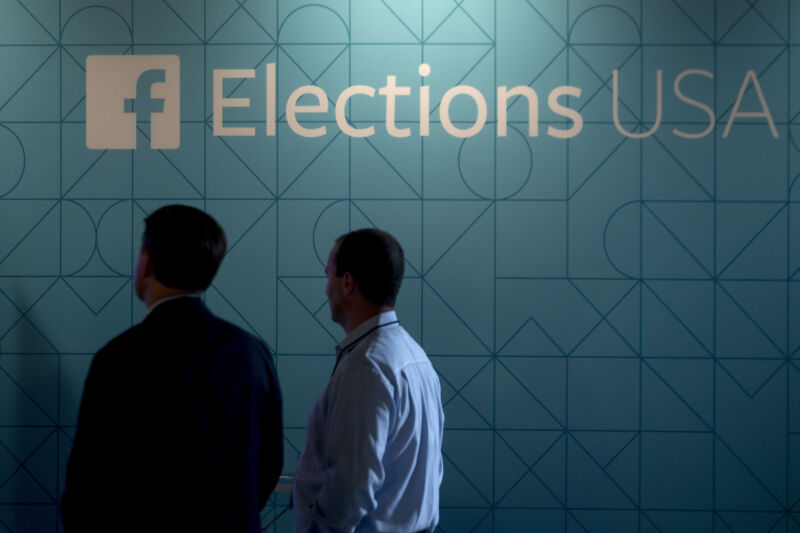
Enlarge/ Guests stand next to a Facebook Elections USA sign in the Facebook Lounge ahead of the first Republican presidential debate at Quicken Loans Arena in Cleveland, Ohio, U.S., on Thursday, Aug. 6, 2015.
Facebook may finally be acknowledging that its handling of elections around the world has been less than stellar. And this time, the company’s response could amount to more than just another apology from Mark Zuckerberg.
The social media company is considering creating an “election commission” that would guide it on election-related issues around the world, according to a report in The New York Times. The commission would advise Facebook on everything from disinformation to political advertising, and if implemented, the change could be a boon for the company’s public relations. The commission would ideally also take some heat off CEO Mark Zuckerberg, who reportedly doesn’t want to be the “sole decision maker on political content,” the Times reports.
A Facebook spokesperson declined to comment for this story when contacted by Ars.
“There is already this perception that Facebook, an American social media company, is going in and tilting elections of other countries through its platform,” Nathaniel Persily, a law professor at Stanford University, told The New York Times. “Whatever decisions Facebook makes have global implications.”
Bungled elections
Facebook has caught plenty of flak over the years in its handling of elections in the US and elsewhere. Among its many missteps, the company bungled the handling of a disinformation and manipulation campaign by Russian operatives seeking to shape the outcome of the 2016 presidential election. Facebook also drew fire for its Cambridge Analytica scandal, in which a researcher gathered the personal data of 87 million users who hadn’t consented and handed it over to the consulting firm, which then used it to shape election and advertising campaigns for politicians around the world.
The missteps continued well after the 2016 election had receded. In Brazil, Facebook’s WhatsApp messaging service was a main conduit of disinformation in the 2018 elections, and the company’s flagship site was at the nexus of similar campaigns during the 2019 elections in India. Back in the US, Democrats for years had been decrying the company’s tolerance of Donald Trump’s inflammatory speech on the platform. And when he was ultimately banned in January after sparking an insurrection at the US Capitol, Republicans became furious.
In the run-up to the 2020 election, CEO Mark Zuckerberg said that Facebook would take steps to “protect our democracy,” though those steps were relatively small and well-trodden. They included encouraging voter registration, offering information about how elections work, and giving a vague promise to do things that would “reduce the chances of violence and unrest.” The company also added labels to posts with election-related disinformation, a strategy that has seen mixedresults at best.
Passing the buck
Handing off contentious decisions related to politics and elections would allow the company to claim that it has sufficient external oversight in such cases, even though implementing any changes is ultimately the responsibility of Facebook’s executives.
The commission apparently takes cues from the company’s so-called Oversight Board, which reviews a small selection of contested moderation decisions—commissions and omissions—and suggests changes the company can make to address any related issues. Though nominally independent, the group still has Facebook’s fingerprints on it. Its board members, who range from nonprofit leaders to professors, journalists, and think tank executives, were initially selected by Facebook, and Facebook is allowed to propose replacements as members step down. Its trustees, which oversee the organization and confirm board members, are selected by Facebook.
The Oversight Board’s rulings are binding, which means that if the board says a post should be reposted or an account reactivated, Facebook must accept the decision. The board also provides broader recommendations for how the company can improve, and while these recommendations could drive more substantial changes on its platforms, they are non-binding. So far, the company has taken a pick-and-choose approach, implementing a majority of changes “fully or in part,” studying a few more, and taking no action on at least two of them.
Because of the way it’s set up, the Oversight Board is a reactive organization. Much like the US court system, it cannot rule on cases that are not brought before it. The election commission would apparently be more proactive, offering Facebook a chance to fix problems before they get out of hand.
https://arstechnica.com/?p=1790008
Reddit takes a teach-the-controversy approach to pandemic and vaccines
Getty Images | Yuriko Nakao
Reddit yesterday defended its stance on allowing pandemic misinformation after hundreds of subreddit moderators joined an open letter urging the company to “take action against the rampant Coronavirus misinformation on their website.”
The open letter on r/VaxxHappened was joined by over 450 moderators and said that subreddits existing “solely to spread medical disinformation and undermine efforts to combat the global pandemic should be banned.” The hundreds of subreddits that joined the open letter include 10 with over 10 million subscribers each, over 40 subreddits with 1 million to 10 million subscribers each, and about 20 others with 500,000 to 1 million subscribers.
In response, Reddit posted an explanation of its approach, saying it will continue to allow “debate” and “dissent” on vaccines and other COVID-related matters, even when there is a scientific consensus.
“While we appreciate the sentiment of those demanding that we ban more communities that challenge consensus views on the pandemic, we continue to believe in the good of our communities and hope that we collectively approach the challenges of the pandemic with empathy, compassion, and a willingness to understand what others are going through, even when their viewpoint on the pandemic is different from yours,” Reddit wrote. Comments are not allowed on the r/Announcements post with Reddit’s response, but it can be crossposted to and discussed on other subreddits.
Disputing vaccine “consensus” is allowed
Explaining why it doesn’t ban Reddit communities that generally disagree with the “consensus” on vaccines, Reddit said dissent is “the foundation of democracy”:
We appreciate that not everyone agrees with the current approach to getting us all through the pandemic, and some are still wary of vaccinations. Dissent is a part of Reddit and the foundation of democracy. Reddit is a place for open and authentic discussion and debate. This includes conversations that question or disagree with popular consensus. This includes conversations that criticize those that disagree with the majority opinion. This includes protests that criticize or object to our decisions on which communities to ban from the platform.
Vaccines have been safe and effective in reducing the number and severity of COVID cases, and the Food and Drug Administration this week granted full approval of the Pfizer/BioNTech COVID-19 vaccine.
Reddit pointed out that expert advice on COVID-19 has shifted during the pandemic and said that disagreeing with the CDC doesn’t violate the site’s policies:
When it comes to COVID-19 specifically, what we know and what are the current best practices from authoritative sources, like the CDC, evolve continuously with new learnings. Given the rapid state of change, we believe it is best to enable communities to engage in debate and dissent, and for us to link to the CDC wherever appropriate. While we believe the CDC is the best and most up to date source of information regarding COVID-19, disagreeing with them is not against our policies.
Reddit does set some limits on misinformation, saying that “manipulating or cheating Reddit to amplify any particular viewpoint is against our policies, and we will continue to [take] action [against] communities that do so or that violate any of our other rules, including those dedicated to fraud (e.g. fake vaccine cards) or encouraging harm (e.g. consuming bleach); and we will continue to use our quarantine tool to link to authoritative sources and warn people they may encounter unsound advice.”
Disinformation and lies help prolong pandemic
Though Reddit promised to tackle pandemic misinformation last year, the open-letter signers say that “nothing of substance has been done aside from quarantining a medium-sized subreddit, which barely reduces traffic and does little to stop misinformation.”
“We could have been better off months ago, but disinformation and lies have been allowed to spread readily through inaction and malice, and have dragged this on at the cost of lives,” it said. “There are those who deny that the pandemic even exists, there are those who think that wearing a mask will literally suffocate you, there are those who think it’s no worse than a regular flu virus, that it’s a bioweapon, and everything in between. This volume of blatant misinformation is problematic and dangerous.”
Masks, vaccines, and social distancing are all “under attack” despite scientific evidence showing that they are safe and effective tools in fighting the pandemic, the open letter noted.
“Trying to keep children safe is painted as ‘child abuse,'” the post said. “Lies are repeated so frequently that misinformed people begin to believe them wholeheartedly, trusting that they can’t be incorrect because they’re surrounded by people who believe it also.” The post called on Reddit administrators “to take ownership of their website and remove dangerous medical disinformation that is endangering lives and contributing to the existence of this ongoing pandemic.”
Reddit’s response disappoints
Reddit’s response is now being discussed on the VaxxHappened subreddit, where members are disappointed in the company’s refusal to take more aggressive action against misinformation.
“What happened to ‘you’re entitled to your own opinion, but not entitled to your own facts,'” one person asked.
“I can’t stand how absolutely blatant and disingenuous misinformation is considered ‘the other half of the conversation,'” another wrote. “It’s not a conversation, one half is entirely evidence-backed, the other is not.”
Disclosure: The majority shareholder of Reddit is Advance Publications, the parent company of Condé Nast, which owns Ars Technica.
https://arstechnica.com/?p=1789975
FCC seeks $5M fine for robocalls telling Black people that voting helps “the man”
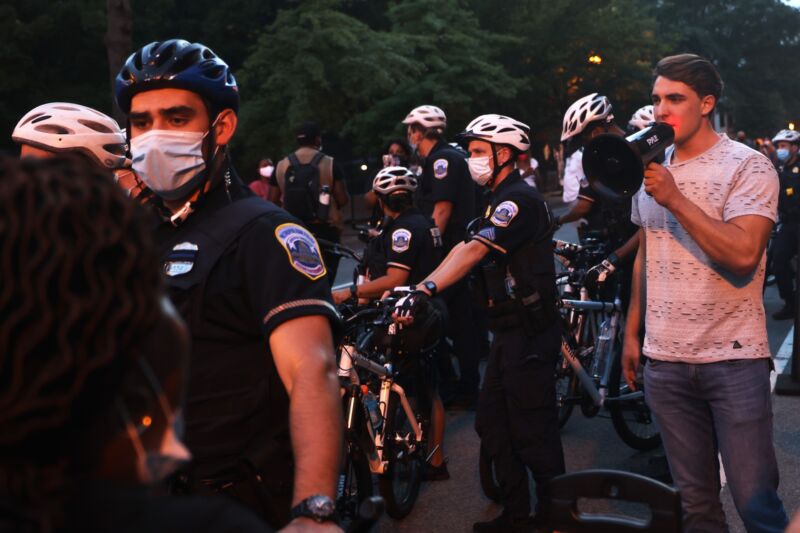
Enlarge/ Police officers surround Jacob Wohl as he taunts protesters during a “Trump/Pence Out Now” rally at Black Lives Matter plaza August 27, 2020 in Washington, DC.
Getty Images | Michael Santiago
The Federal Communications Commission yesterday proposed a $5.1 million fine against two right-wing political operatives accused of making over 1,100 illegal robocalls. The calls were an attempt to convince people not to vote.
The recorded messages sent before the November 2020 election “told potential voters that if they voted by mail, their ‘personal information will be part of a public database that will be used by police departments to track down old warrants and be used by credit card companies to collect outstanding debts,'” the FCC said. Those messages were apparently targeted at Black voters and told them, “don’t be finessed into giving your private information to the man.”
John Burkman and Jacob Wohl were already facing felony charges in Wayne County Circuit Court for “orchestrating a robocall to suppress the vote in Detroit and other cities with significant minority populations,” as Michigan Attorney General Dana Nessel announced in November 2020. They were also indicted in Ohio, and New York Attorney General Letitia James is seeking fines that would add up to $2.75 million.
The felony election-law charges in Michigan carry combined maximum sentences of 24 years, while the proposed FCC fine of $5.1 million would be the largest ever under the US Telephone Consumer Protection Act (TCPA). The FCC said this is “the first action where the FCC was not required to warn robocallers before robocall violations could be counted toward a proposed fine, per Congress’s recent amendment of the TCPA.”
Conspiracy theorists
Wohl and Burkman are widely known for being conspiracy theorists and supporters of former President Donald Trump.
“Wohl and Burkman have been involved in a number of deceptive practices to debase those they view as adversaries to conservatives,” Politico noted in an October 2020 article about the robocall charges in Michigan. “They fabricated sexual assault allegations against former Democratic candidate Pete Buttigieg, White House coronavirus task force member Anthony Fauci, and former special counsel Robert Mueller.” Amid their smear campaign against Buttigieg in 2019, Wohl apparently “staged a fake protest against himself, only to have it become immediately apparent that he was behind it,” The Daily Beast wrote at the time.
Robocalls from “Project 1599”
The FCC issued a Notice of Apparent Liability accusing Burkman, Wohl, and J.M. Burkman & Associates of “apparently making 1,141 unlawful robocalls to wireless numbers without subscribers’ prior express consent, absent an emergency purpose, in violation of the Telephone Consumer Protection Act.” The calls were made between August 26 and September 14, 2020.
The FCC noted that the content of the messages wasn’t relevant to its determination that the calls were illegal, but the agency provided a transcript of the recording sent to voters:
Hi, this is Tamika Taylor from Project 1599, the civil rights organization founded by Jack Burkman and Jacob Wohl. Mail-in voting sounds great, but did you know that if you vote by mail, your personal information will be part of a public database that will be used by police departments to track down old warrants and be used by credit card companies to collect outstanding debts? The CDC is even pushing to use records for mail-in voting to track people for mandatory vaccines. Don’t be finessed into giving your private information to the man, stay safe and beware of vote by mail.
The FCC explained that “‘Project 1599’ is not a legal entity, but rather a branding name used to describe the activities of Burkman, Wohl, and Burkman & Associates.”
In October, a federal judge in New York ordered Burkman and Wohl to call voters back and inform them that the first message was false and violated US voting-rights laws. The judge’s order said the defendants’ actions were similar to those of the Ku Klux Klan except that instead of “guns, torches, burning crosses, and other dire methods perpetrated under the cover of white hoods,” they “carry out electoral terror using telephones, computers, and modern technology adapted to serve the same deleterious ends.”
“Send it to black neighborhoods”
In May, the New York AG’s office said its “investigation revealed that Wohl and Burkman clearly and deliberately targeted Black communities in carrying out their widespread robocall campaign. On August 25, 2020, the day before the robocalls were placed, Wohl emailed Burkman the audio file for the call and stated, ‘[w]e should send it to black neighborhoods…’ The next day, after the calls were sent and received by thousands of voters, Burkman emailed to congratulate Wohl, stating that ‘I love these robo calls…getting angry black call backs… win or lose… the black robo was a great [Jacob Wohl] idea.'”
The FCC said it received complaints in which “consumers expressed outrage at receiving the unsolicited robocalls.” The FCC investigation hit a slight roadblock because “many of the mobile phone customers declined to speak with [Enforcement] Bureau staff,” but “the two consumers who were willing to provide information stated that they had not given consent to the calls, and had not heard of Burkman, Wohl, or Burkman & Associates prior to receiving the robocalls. None of the consumers that the Bureau contacted stated that they consented to the calls,” the FCC said.
FCC is bad at collecting fines
The FCC has a poor record of collecting robocall fines, so it is far from certain that Wohl and Burkman will pay $5.1 million or anything close to that. Wohl and Burkman have 30 days to pay the proposed fine or file an appeal seeking a reduction or cancellation of the penalty.
Cases can end in a settlement or with the FCC issuing a forfeiture order, which the commission would refer to the Justice Department if it isn’t paid. Acting FCC Chairwoman Jessica Rosenworcel issued a statement about the proposed fine in which she cited “the unanimous support of my colleagues,” suggesting that the commission’s 2-2 deadlock between Democrats and Republicans won’t be a roadblock in this instance.
As for the criminal charges, “Burkman and Wohl are awaiting trial in Wayne County Circuit Court after a failed dismissal attempt,” and their next court date is on September 21, Nessel’s office said yesterday.
“This massive fine properly reflects the seriousness of the allegations these two political operatives face,” Nessel said. “Mr. Burkman and Mr. Wohl allegedly orchestrated a series of robocalls aimed at suppressing the vote in the November general election. While my office will continue to pursue the criminal case against these men, I applaud the FCC for its action today.”
https://arstechnica.com/?p=1789874
Three Cyber Ninjas got COVID, delaying $6M Arizona vote “audit”
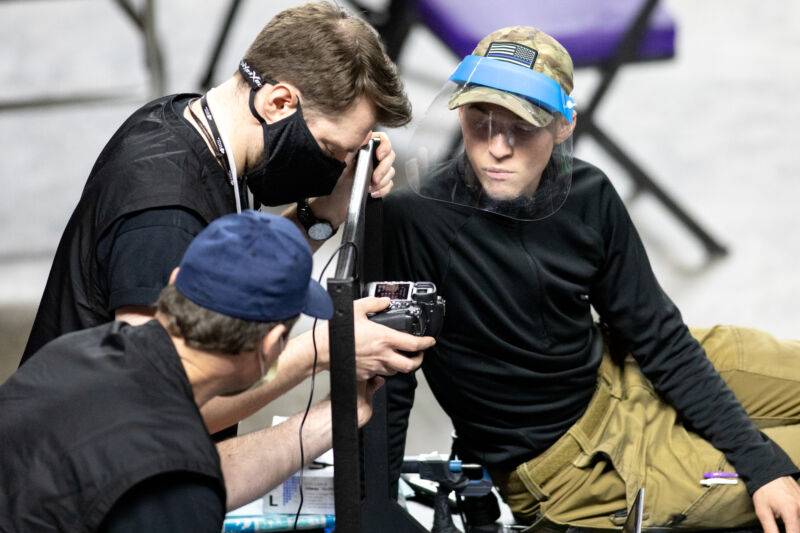
Enlarge/ Contractors working for Cyber Ninjas, who was hired by the Arizona State Senate, examine and recount ballots from the 2020 general election at Veterans Memorial Coliseum on May 1, 2021 in Phoenix, Arizona. The Maricopa County ballot recount comes after two election audits found no evidence of widespread fraud.
In a development that’s sure to fan the flames of a thousand conspiracy theories, a report from the presidential election “audit” in Arizona has been delayed because COVID-19 has swept through the private company running the show.
“The team expected to have the full draft ready for the Senate today, but unfortunately, Cyber Ninjas CEO Doug Logan and two other members of the five-person audit team have tested positive for COVID-19 and are quite sick,” Arizona Senate President Karen Fann said in a statement. It’s not clear whether any of the people were vaccinated against the virus.
Though state Republicans launched the spectacle, politicians from both parties have panned the so-called audit. Election experts have called the exercise “deeply reprehensible,” saying that it more closely resembles a “clown show” than an audit. The Maricopa County Board of Supervisors, all but one of whom are Republicans, said in a letter, “Your ‘auditors’ are in way over their heads.”
The company doing the “audit,” Cyber Ninjas, does not have any experience auditing elections, and its CEO does not appear to be nonpartisan; he has tweeted “#StoptheSteal” and voiced his support for former President Trump. “I’m tired of hearing people say there was no fraud,” he said in a tweet archived by the Arizona Mirror. The company is legally based in Florida, though CNN discovered that its business address sits vacant, while the address on its contract with the Arizona Senate is a rented UPS mailbox.
Though the report is delayed, Arizona is already feeling the effects of the exercise. Arizona Secretary of State Katie Hobbs, a Democrat, said in May that Maricopa County will have to replace all of its voting machines after Cyber Ninjas permanently compromised the devices. The proceeding, she said, has been riddled with “security lapses, delays, disorganization, and [a] lack of transparency.” The computers at the site had single logins, shared passwords, and no multifactor authentication, she said, and there was no evidence that the workers handled chain of custody properly. Hobbs said that she’ll be seeking reimbursement for the now-useless voting machines.
Maricopa County, which has become a focal point for the partisan review, conducted two audits earlier this year and found no evidence of voter fraud.
Cyber Ninjas’ workers haven’t limited their investigation to the voting machines, either. They literally have been grasping at straws, reportedly checking absentee ballots for bamboo fibers because they think fake ballots were brought in from Asia, according to the Associated Press. The partisan review is being funded by $150,000 of Arizona taxpayers’ money and $5.7 million in private funds. Overstock.com founder and former CEO Patrick Byrne donated $1 million and planned to raise $2.5 million more. Byrne is being sued by Dominion Voting Systems for defamation over his claims that the company’s machines were involved in voter fraud.
Whatever the report ends up producing, it will have no bearing on the outcome of the 2020 presidential election, though it will certainly spawn more disinformation that conspiracy theorists can latch onto as definitive proof that they are correct, no matter what is being discussed.
https://arstechnica.com/?p=1789491
President Biden to host infosec roundtable with tech giant CEOs
Enlarge/ If there’s any single photo that better encapsulates the state of enterprise information security in 2021, we weren’t able to find it.
Unnamed sources told Bloomberg that the White House will host a meeting between President Joe Biden and some of the country’s largest tech firms on Wednesday afternoon. According to those sources, the CEOs of Microsoft, Amazon, and Apple have confirmed their attendance. Other large companies, including Google, IBM, Southern Company, and JP Morgan, have been invited.
The meeting is intended to address the severe increase in ransomware, online attacks, and data leaks seen this year. Although we don’t know the exact agenda, one senior official familiar with the event said discussions of better supply chain security are likely, and there will probably be a focus on software-driven solutions.
High-profile security breaches Biden and the tech CEOs might discuss include, but are not limited to:
This month’s T-Mobile server breach, which exposed up to 100 million Americans’ personal data
July’s SolarWinds supply chain attack, which compromised server management tools themselves
July’s massive Kaseya ransomware attack—which also initially targeted a management tool rather than the end-victims themselves
A months-long Geico breach exposing customers’ driver’s license numbers, addresses, dates of birth, etc.
A misconfigured Experian API that leaked credit scores of tens of millions of Americans
A May attack that took Colonial Pipeline down, disrupting fuel distribution across the eastern US seaboard
March attacks targeting small businesses, towns, cities, and local governments via Microsoft Exchange vulnerabilities
SIM swapping attacks on T-Mobile customers in February, resulting from one or more of the company’s earlier breaches
Bloomberg’s sources only mentioned CEOs, so it’s unclear if the CISOs of the invited companies are participating as well.
Neither the White House nor any of the companies mentioned have responded to press requests for comment.