Intel Foundry Services gets a boost from $100M Pentagon award for US-made chips
Intel announced Monday that it has been awarded a contract for foundry services through a Department of Defense program intended to support leading-edge semiconductor manufacturing in the US.
Though Intel’s share of the estimated $100 million award wasn’t disclosed, it is certain to boost Intel’s fledgling Foundry Services division that was announced in March as a part of the company’s IDM 2.0 strategy. The company will be working alongside IBM and electronic design automation companies Cadence and Synopsys. The program, known as “Rapid Assured Microelectronics Prototypes—Commercial or RAMP-C,” seeks to expand the Pentagon’s access to trusted, secure, and reliable chips from sub-7 nm process technology.
“One of the most profound lessons of the past year is the strategic importance of semiconductors and the value to the United States of having a strong domestic semiconductor industry,” Intel CEO Pat Gelsinger said. “When we launched Intel Foundry Services earlier this year, we were excited to have the opportunity to make our capabilities available to a wider range of partners, including in the US government, and it is great to see that potential being fulfilled through programs like RAMP-C.”
The EUV hurdle
So far, only a handful of companies have successfully incorporated the technologies needed to etch ever-smaller features into silicon, and TSMC’s mastery of extreme ultraviolet lithography (EUV) has helped to catapult it to the front of the pack. The Taiwanese company and South Korea-based Samsung are the only two semiconductor firms currently using EUV to produce logic chips at a commercial scale, and TSMC dominates at the leading edge, making more than 80 percent of the world’s 5 nm chips.
Intel has struggled to keep pace with its Asian rivals. It has yet to introduce EUV into the manufacturing of any of its commercial products, and it won’t be widely adopting the technology until the second half of 2023. Meanwhile, TSMC announced last year that it owned 50 percent of all installed EUV machines and had made 60 percent of all wafers produced using the technology, giving the company a significant head start. That sort of manufacturing lead also confers certain advantages for future process development—progress toward the next node frequently depends on solving problems that appear at the current one.
Though Intel isn’t expected to introduce a rival to TSMC’s 7 nm node—which was introduced in 2018—until early next year, the company expects by 2024 to begin ramping up production of its “20A” process, which should be largely equivalent to TSMC’s 2 nm node that is anticipated to be in full production by then.
Dearth of domestic manufacturers
As TSMC has steamed ahead, the Pentagon has been left with no domestic semiconductor manufacturer at the leading edge. IBM sold its microelectronics division to GlobalFoundries in 2014, and since then, GlobalFoundries has abandoned the forefront for more mature nodes. Intel remains the only contender, and the Pentagon clearly hopes that this award will help keep it in play.
“The United States currently has no onshore access to foundry technology capable of meeting the Department of Defense’s (DoD) long-term leading-edge microelectronics manufacturing needs,” the program’s request for solutions said.
When complete, the RAMP-C program expects to award a total of $320 million. Though significant, it’s a small portion of what’s needed for semiconductor companies to stay at the leading edge. Intel has announced that it will spend $20 billion on two fabs in Arizona alone, and TSMC has said it will spend $100 billion over the next three years to add capacity.
https://arstechnica.com/?p=1789164
Homegrown app helping Kabul residents steer clear of danger
Enlarge/ Taliban fighters stand guard in a vehicle along the roadside in Kabul on August 16, 2021.
Getty Images
As Kabul fell on Sunday, 20 young Afghan tech workers tracked the Taliban’s advance, broadcasting real-time reports of gunfire, explosions, and traffic jams across the city through a new app.
Called Ehtesab, the app relies on ground-level reports from a vetted team of users to a private WhatsApp group.
The reports, which are then verified by the app’s fact checkers, range from security incidents, such as fires, gunshots and bombings, to road closures and traffic problems to electricity cuts. Sara Wahedi, the 26-year-old founder of the app, said the team tried to confirm the reports with the interior ministry, “when it used to exist.”
On Sunday morning, Wahedi and her team were supposed to be uploading the new version of their iOS app but instead found themselves dealing with an ever more frantic stream of reports.
“Breaking on the @ehtesabaf App: Taliban have entered Arghandi, Paghman District. South Gate of Kabul. ANDSF [Afghan National Defence and Security Forces] under attack,” Wahedi wrote on Twitter at the time.
She said that as the Taliban advanced across Afghanistan, Ehtesab had built a reliable way of “getting reports from a lot of different security structures,” including police, the government and international organisations.
Soon the team started receiving reports that the Taliban had captured Bagram prison, in the former US military base just north of Kabul.
“At that point our reporting mechanisms were still in place, so it was easy to converse with our security team and all our reporters. We were monitoring minute by minute, talking to different police districts, tracking the Taliban kilometer by kilometer by that point,” she said.
“But by the time they reached the city center, everything shut down, nothing was online, there was no way of speaking to each other. People deleted their messages or turned off their phones. When the Taliban reached the president’s office, it was like, ‘OK, now we have to work alone’.”
Ehtesab, which means “accountability” in Pashto and Dari, is co-owned by Afghan company Netlinks, which invested $40,000, and Wahedi, who said she has put in $2,500 of her own money.
“I didn’t want to register as an NGO, to be benchmarked or limited by the United Nations or the United States. This is an Afghan-led and funded, fully 100 percent Afghan team working on this,” she said.
Enlarge/ Users of the app can receive phone alerts based on their location, warning them of dangers, and can report incidents themselves.
Users of the app can opt to receive phone alerts based on their location, warning them to avoid certain areas, buildings or businesses. They can also report incidents themselves via the app, which turns on your camera and microphone so you can send video footage to Wahedi’s team. The goal, she said, is to empower local communities with live information on which to act.
Ehtesab is still running, and Wahedi said she wants to keep operating it as long as possible, although she is currently outside Afghanistan. She has managed to raise nearly $15,000 through a GoFundMe campaign, part of which she will send to her team in Kabul as emergency funds.
Her plan is to build a nationwide alert system, not just through the apps but through SMS warnings as well. Their office in central Kabul remains closed, with employees working from home, but they plan to upload a new iOS version as soon as they can get back to their desks.
“We just want to alleviate some of the anxieties that Afghans have in these uncertain and volatile times,” she said. “We will find different ways of garnering data about the city and security… That’s the beauty of tech, it knows no borders,” she said.
Wahedi founded the company in 2018, after spending two years working for President Ashraf Ghani’s office on Afghanistan’s social development policy, but insists she is not affiliated to any political group.
She had moved back to her hometown as a 21-year-old, after having escaped Taliban rule in her native Kabul to go to Canada as a refugee at the age of six. Two decades later, the Afghan entrepreneur found herself fleeing from the Taliban again. This time she does not know if she will ever be able to return. “It’s like Groundhog Day,” she said.
Today, she is using what she calls the “privilege” of having escaped Kabul to try to put her friends and family on charter flights out of Afghanistan.
“I’m grateful to be with my mom but the guilt is crippling when I think about my home, when I think about the fact I’ll never be able to go back to the Kabul I’ve known for so long,” she said. “I don’t think any of us will ever be the same again.”
Hydrogen lobbyist quits, slams oil companies’ “false claims” about blue hydrogen
A hydrogen filling station.
Peter Gercke/picture alliance via Getty Images
The head of a hydrogen lobbying group has stepped down amid concerns that blue hydrogen made from natural gas would serve as a “lock-in” for fossil fuels.
Oil and gas companies in recent years have been touting the purported advantages of hydrogen made from natural gas. Supporters admit that blue hydrogen is not zero carbon, but they argue that its use would help build demand and infrastructure while costs for green hydrogen, which is made from renewable power, are brought down.
At issue, though, is whether blue hydrogen is truly low carbon, as its boosters suggest. According to a recent study, blue hydrogen may be worse for the climate than coal. The low-carbon claims about blue hydrogen hinge on the fact that carbon dioxide needs to be captured at every step, from the steam reformation process that makes the gas from methane to the natural gas generators that provide heat and power for the reactions. Not every step is perfect, and between 10–40 percent of the carbon dioxide can evade capture depending on the system.
But where blue hydrogen really suffered in the analysis was when leaky natural gas infrastructure was included in the calculations. Methane, the primary component of natural gas, is a potent greenhouse gas that warms the planet 83 times more than an equivalent amount of carbon dioxide. Gas pipelines are notoriously leaky in places, and from production to consumption, anywhere between 1.5–4.3 percent slips through the cracks. At the low end of that range, blue hydrogen was still worse than burning natural gas because of the additional methane use throughout the process. As assumptions about leakage rates rose above 3.5 percent, blue hydrogen’s climate impact became worse than coal.
Last straw
That study was apparently a tipping point for Chris Jackson, who this week stepped down as chair of the UK Hydrogen and Fuel Cell Association. Jackson, who founded a green hydrogen company two years ago, was head of the industry group for a little over a year.
“The energy transition cannot be achieved by one silver bullet, and green hydrogen alone cannot solve all the worlds challenges,” he wrote in a LinkedIn post announcing his resignation. “But while there might not be a single ‘right’ answer, there are answers that are wrong.”
Jackson continues by saying that blue hydrogen is “at best an expensive distraction, and at worst a lock-in for continued fossil fuel use” which would derail goals that the country and the world have set for decarbonizing the economy. He takes particular issue with the fact that oil and gas companies have asked the UK government for decades of subsidies while also claiming that blue hydrogen will be inexpensive to produce. “If the false claims made by oil companies about the cost of blue hydrogen were true, their projects would make a profit by 2030,” he told The Guardian.
“Instead, they’re asking taxpayers for billions in subsidies for the next 25 years. They should tell the government they don’t need it. The fact that they don’t tells you everything you need to know.”
Blue hydrogen hand-outs
The UK government has endorsed hydrogen in its plans to decarbonize the British economy, saying the fuel could reduce the climate impact of heavy industry and long-haul transportation. The recently announced plan calls for blue hydrogen to bridge gap until green hydrogen is commercially viable.
In the US, the Biden administration appears to embrace blue hydrogen, too. In its infrastructure plan announced in March, the White House called for “investment in 15 decarbonized hydrogen demonstration projects,” which would appear to leave the door open for blue hydrogen. The infrastructure bill currently working its way through Congress calls for the creation of four hydrogen hubs, including one that would demonstrate the production of “clean hydrogen” from fossil fuels. In the Senate version of the bill, “clean hydrogen” means that for every kilogram of hydrogen produced, two kilograms of carbon dioxide can result. Ideally, most of it is captured and stored, but the bill doesn’t require a specific amount, and it only addresses methane leaks from orphaned wells.
The US hydrogen lobbying organization, the Fuel Cell and Hydrogen Energy Association, also supports both blue and green hydrogen, collectively calling them “low-carbon hydrogen” in a recent report. Ars has reached out to the group to ask if they have a stance on blue hydrogen, specifically. We’ll update this article if we hear from them.
In the UK, such hubs are already forming, with both Equinor and BP announcing blue hydrogen plants which, together, would represent nearly half of the government’s targeted 5 GW of “low-carbon” hydrogen capacity.
https://arstechnica.com/?p=1788930
OnlyFans bans sexually explicit content to appease banks and payment services
OnlyFans today announced an upcoming ban on “sexually explicit” material in a move that will affect a large amount of the content that creators post on the platform. Nudity will still be allowed, but OnlyFans has yet to detail where it will draw the line between acceptable and unacceptable content.
Critics of the move pointed out that it will reduce income for sex workers who helped make the site popular. OnlyFans said in a statement that it is making the change “to comply with the requests of our banking partners and payout providers.” The new strategy also seems to be part of OnlyFans’ attempt to attract investors at a valuation of $1 billion, a project that has reportedly hit a roadblock because of the site’s racy content.
“Effective October 1, 2021, OnlyFans will prohibit the posting of any content containing sexually explicit conduct,” OnlyFans said in a statement the company provided to Ars. “In order to ensure the long-term sustainability of the platform, and to continue to host an inclusive community of creators and fans, we must evolve our content guidelines. Creators will continue to be allowed to post content containing nudity as long as it is consistent with our Acceptable Use Policy.”
OnlyFans did not define “sexually explicit conduct” or provide guidelines on what will and won’t be allowed. The company said it “will be sharing more details in the coming days and we will actively support and guide our creators through this change in content guidelines.” The Acceptable Use Policy currently says that content featuring “sexual activities” is allowed if it features only consenting adults and is not filmed in a public place, so there will presumably be some changes to that text by October 1.
OnlyFans, a UK company founded in 2016, says it has 200 employees, 150 million registered users, and over 1.5 million content creators. It says it “has paid out over $3 billion in creator earnings” since its founding.
Sex workers “built [OnlyFans] into a major platform”
“OnlyFans would be nothing without the sex workers whose labor built it up into a major platform,” journalist and labor organizer Kim Kelly wrote on Twitter today. “Now it’s tossing them aside and removing a vital source of income from a population of workers who are disproportionately marginalized and have no protections under US labor law.”
OnlyFans’ move away from NSFW content includes this week’s launch of OFTV, which it calls “a curated platform” where “all content is required to meet our minimum quality and safe for work standards.”
OnlyFans made $375 million in net revenue in 2020 and expects $1.2 billion in 2021 and $2.5 billion in 2022, an Axios report today said. Despite its revenue, OnlyFans “is struggling to find outside investors, according to multiple sources,” Axios wrote. OnlyFans hired a merchant bank to help it solicit venture capital in the spring, but “[s]everal deep-pocketed firms quickly passed, not even engaging in serious due diligence,” the report said.
“In short, OnlyFans has a porn problem, even though it never once mentions porn in its pitch-deck (something that multiple investors called ‘disingenuous’),” the report said. The pitch-deck, compiled at the end of March, said that over 300 OnlyFans creators earn at least $1 million a year and that about 16,000 earn at least $50,000 a year, Axios wrote.
Remember Tumblr?
Obviously, banning much of the content that makes OnlyFans popular could significantly reduce its user base and revenue. “Did no one at OnlyFans call Verizon to ask how Tumblr worked out?” telco and antitrust attorney Paul Overbite asked on Twitter.
Yahoo bought Tumblr for $1.1 billion in 2013, and Verizon bought Yahoo’s operating business, including Tumblr, for $4.48 billion in June 2017. Verizon banned porn and most nudity on Tumblr about six months after buying Yahoo, and in 2019, it sold Tumblr to Automattic. Tumblr was by then worth a fraction of its previous value. The sale price wasn’t announced but was reportedly “well below” $20 million.
https://arstechnica.com/?p=1788655
Sacklers say they won’t pay $4.5B settlement if judge rejects immunity deal
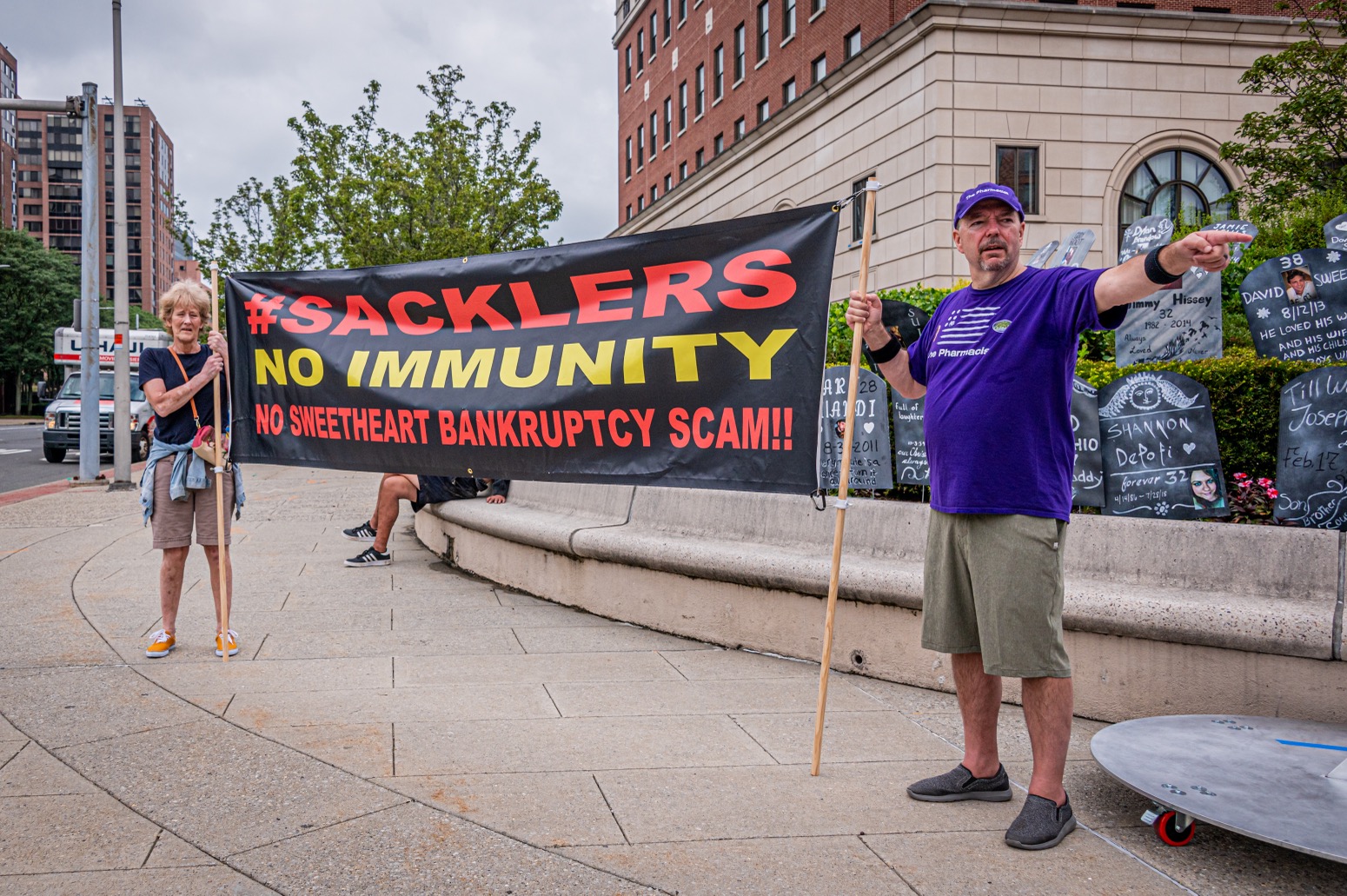
Enlarge/ Members of PAIN (Prescription Addiction Intervention Now), Truth Pharm, and other advocacy groups working in response to the overdose crisis protested the Sacklers’ immunity deal outside US Bankruptcy Court in White Plains, New York on August 9, 2021.
The Sackler family is threatening to back out of a $4.5 billion opioid settlement if it is not granted broad immunity from lawsuits. The pending settlement between the Sacklers and 15 states includes an immunity provision, but other states oppose it, and a bankruptcy court judge is still considering whether to approve the deal.
Forty-one-year-old David Sackler, a former Purdue Pharma board member and grandson of one of the company’s founders, “vowed in court on Tuesday that the family would walk away from a $4.5 billion pledge to help communities nationwide that have been devastated by the opioid epidemic, unless a judge grants it immunity from all current and future civil claims associated with the company,” The New York Times wrote.
“We need a release that’s sufficient to get our goals accomplished,” Sackler said in testimony via video at a hearing in US Bankruptcy Court for the Southern District of New York. “If the release fails to do that, we will not support it.” The family is worth $11 billion, a fortune boosted substantially by sales of OxyContin.
Without immunity protecting the Sacklers from lawsuits over the activities of Purdue Pharma, “I believe we would litigate the claims to their final outcomes,” Sackler said, according to CBS News.
Sacklers and Purdue “hook[ed] Americans on opioids”
Previously, the Sacklers and 15 states agreed to a settlement that would have the family pay $4.325 billion over nine years “to fund prevention, treatment, and recovery programs in communities across the country,” an announcement from New York Attorney General Letitia James said on July 8. The total settlement is $4.5 billion because the Sacklers would also have to “relinquish control of family foundations” that have at least $175 million in assets to a new group that will be “dedicated to abating the opioid crisis.”
The agreement will “shut down Purdue Pharma and end the Sackler family’s ability to manufacture opioids ever again” and “make public tens of millions of documents related to the company and the family’s roles in igniting the opioid crisis—requiring unprecedented disclosure about the role Purdue and the Sacklers played in hooking Americans on opioids,” the announcement said.
The settlement’s inclusion of legal immunity for the family has drawn plenty of criticism and has become a focus of the hearings on whether to approve the deal. “Two offices of the US Justice Department, nine states, and the District of Columbia are objecting to the company’s settlement plan largely because it would grant legal protection to members of the wealthy Sackler family even though none of them are declaring bankruptcy themselves,” CBS News wrote.
As The New York Times noted, “objections to the legal shield for the Sacklers have become the sharp focus of much of the testimony. The details of the Sacklers’ liability releases are so far-reaching that last week Judge Robert Drain himself said he had ‘some concerns about the breadth.'”
In his testimony, Sackler “said the family anticipated that the liability shield would cover him, other members of his extensive family, and about 1,000 other individuals, including contractors and consultants, and protect them from lawsuits that had nothing to do with opioids,” the Times wrote. “That means they would be forever immunized from any current and future lawsuits worldwide related not only directly to Purdue’s opioids but to other drugs the company makes, including drugs for addiction reversal, high cholesterol and even constipation as a result of taking prescription opioids.”
Billionaires “manipulate bankruptcy system”
The Sacklers’ stance is nothing new. In September 2019, they threatened to not agree to any settlement that didn’t include immunity. At that time, Massachusetts Attorney General Maura Healey said, “It’s yet another effort by Purdue to avoid accountability and shield the Sackler family fortune, and we will be opposing it.”
Healey nonetheless agreed to the settlement last month while saying the case has “shown us that our legal system needs to change so that billionaires are never allowed to manipulate the bankruptcy system.”
“In June 2021, AG Healey testified before the US House Oversight Committee about the need for legislation to close the loophole that the Sackler billionaires are using to gain protection from bankruptcy court,” Healey’s announcement pointed out. That legislation—the SACKLER Act (Stop Shielding Assets from Corporate Known Liability by Eliminating Non-Debtor Releases)—hasn’t been approved.
Washington state Attorney General Bob Ferguson and eight other state attorneys general formally objected to the settlement on July 19.
“This settlement plan allows the Sacklers to walk away as billionaires with a legal shield for life,” Ferguson said. “It’s up to the states—not a bankruptcy court—to decide whether states should hold the Sacklers accountable in a court of law. We’re asking the court to reject this flawed proposal. The Sacklers should not be allowed to profit from their misconduct.”
States objecting to the settlement have said the Sacklers could see their wealth rise to $14.6 billion by 2030 through investment returns and interest despite paying $4.325 billion over nine years.
James acknowledged last month that the settlement is flawed but argued that it will do plenty of good and avoid years of costly litigation.
“For nearly two years, since Purdue Pharma declared bankruptcy, the company and the Sackler family have used every delay tactic possible and misused the courts—all in an effort to shield their misconduct,” James said when she announced the settlement. “While this deal is not perfect, we are delivering $4.5 billion into communities ravaged by opioids on an accelerated timetable and it gets one of the nation’s most harmful drug dealers out of the opioid business, once and for all. We’ll be able to more quickly invest these funds in prevention, education, and treatment programs, and put an end to the delays and legal maneuvering that could possibly continue for years and across multiple continents.”
https://arstechnica.com/?p=1788235
Facebook reveals top posts but still won’t share key data about disinformation
Facebook released its first report today detailing which content it says is widely viewed on the site and Instagram. The report comes as research and news stories have highlighted how misleading posts and outright disinformation can draw intense engagement on the company’s platforms.
Much of the scrutiny has focused on far-right accounts, which according to Facebook’s own tool, CrowdTangle, receive the most engagement—likes, shares, and comments. For example, Kevin Roose, a reporter at The New York Times, uses CrowdTangle to tweet out a list of the “10 top-performing link posts by US Facebook pages every day, ranked by total interactions.” His experiment has revealed that, day after day, far-right accounts and pages from the likes of Ben Shapiro, Dan Bongino, and Newsmax appeared on the list, sometimes occupying multiple spots. Facebook’s critics have pointed to the list as evidence that the platform has become a right-wing media machine.
The Twitter account, Roose said, “drove executives crazy” at Facebook. They felt it was making Facebook look like it favored right-wing accounts. All of that brings us to today.
Facebook released the first of what will be a quarterly “Widely Viewed Content Report.” The report will appear alongside the company’s Community Standards Enforcement Report, an existing release that includes data on hate speech and child endangerment. The newest report is Facebook’s attempt to provide more “transparency and context,” said Anna Stepanov, the company’s director of product management.
The top-performing link posts by U.S. Facebook pages in the last 24 hours are from:
1. Dan Bongino 2. Ben Shapiro 3. Ben Shapiro 4. Ben Shapiro 5. Dan Bongino 6. Dan Bongino 7. Dan Bongino 8. Ben Shapiro 9. Ben Shapiro 10. Ben Shapiro
— Facebook’s Top 10 (@FacebooksTop10) May 14, 2021
The new report shows a slew of information, including which domains, links, pages, and public posts cracked the top 20, along with how many people saw that content. In a blog post, Stepanov pointed out that just under 13 percent of content views were posts with links—post types that may send users to other sites with disinformation—and that 57 percent of posts users viewed were from family and friends. Notably, the report does not include data on ads.
Scattered among the top posts are the expected meme questions (e.g., “What is something you will never eat no matter how hungry you get?”), a Joe Biden post, and how to DIY a swimming pool from old pallets.
Domains that received the most views are another significant part of the report, and here, Facebook could use more transparency and context. Among the top 10 domains are sites that have struggled to tame disinformation themselves, including YouTube and Twitter. The report doesn’t include any additional information like which channels or accounts the posts pointed to.
Partial picture
In focusing on views over engagement, Facebook is only providing part of the picture. As anyone who has used Facebook knows, there’s a significant difference between content appearing on a user’s news feed and their engaging with it. Many posts are displayed but quickly scrolled past. Those that draw engagement, though, are literally worth more. Advertisers will pay 10 times more for one engagement than they will a single view. By withholding information about engagement, the “Widely Viewed Content Report” obfuscates the impact of the disinformation.
The fact that family and friends are a primary generator of content doesn’t help counter the idea that Facebook might be reinforcing partisan echo chambers. One study showed that when a headline agreed with a person’s political views, the person was 20 percent more likely to share the link with friends, whether or not the person felt the information was true.
The way that Facebook calculates “widely viewed” is complicated, too. Only posts that are created or shared publicly are considered and shown in the report. All links, though, whether shared publicly or privately, are included, creating a misalignment in reporting the two different post types.
The report also omits what might be the most important number—the denominator that underlies these percentages, or the total amount of content that is viewed on Facebook every day. Saying that the 20 most widely viewed posts represent less than 0.1 percent of all US views is like saying only 0.03 percent of Americans got COVID yesterday. That may not seem like a lot, but when you multiply that number by how many people live in this country and when you consider the number of available hospital beds, the scope of the problem comes into sharper focus. Ars asked Facebook how much content was seen by users in the US, but the company refused to provide that information. Until Facebook discloses more data, no one will know the true extent of the company’s disinformation problem.
Still, it’s easy to make a quick-and-dirty estimate. Facebook has 1.88 billion daily active users, and many post several times per day. So there are likely tens of billions of content views per day. To pressure test that theory, I tallied the report’s top 20 posts, which the report said represent about 0.1 percent of all content viewed in the US, and then spread it out over the 91 days in the second quarter. The math suggests that, at a minimum, at least 10 billion posts are viewed every day in the US. Even that estimate is probably extremely conservative since it includes only links and public posts. If just a tiny fraction of that number is disinformation, the problem could be small as a percentage, like the report suggests, and simultaneously enormous in absolute terms.
https://arstechnica.com/?p=1788178
iPhone keyboard for blind to shut down as maker cites Apple “abuse” of developers
An iPhone keyboard for blind users will be discontinued, according to the app’s developer, who alleges that “Apple has thrown us obstacle after obstacle for years while we try to provide an app to improve people’s lives.”
FlickType includes an Apple Watch keyboard and the iPhone keyboard intended for blind and low-vision users of VoiceOver, an Apple technology that can speak the key a user selects. FlickType’s Apple Watch keyboard will continue, at least for a while, but the iPhone keyboard will be disabled.
“It’s with a heavy heart today that we’re announcing the discontinuation of our award-winning iPhone keyboard for blind users,” the FlickType account on Twitter wrote yesterday. FlickType is developed by Kosta Eleftheriou, who recently filed a lawsuit alleging that Apple used its control over iPhone app distribution to induce him to sell FlickType to Apple at a discount. He says he refused to sell the app.
Apple “incorrectly” rejected app update
The last straw for FlickType’s keyboard extension came last week when Eleftheriou “submitted an update that fixes various iOS 15-related issues & improves the app for VoiceOver users,” FlickType wrote. “But Apple rejected it. They incorrectly argue again that our keyboard extension doesn’t work without ‘full access,’ something they rejected us for THREE years ago. Back then we successfully appealed and overturned their decision, and this hadn’t been a problem since. Until now.”
FlickType said it contacted Apple nine times last week “with no success. At this point they seem to be ignoring our attempts to contact them directly, despite previously explicitly telling us to ‘feel free’ to contact them if we need ‘further clarification.'”
The app’s keyboard extension will stop working after future updates. “We wish to keep providing the last working version that includes the keyboard extension, but Apple makes it impossible to stop automatic updates for individual apps. So unless you stop automatic updates for all your apps, you will soon lose the FlickType keyboard extension,” FlickType wrote.
The app’s App Store listing says, “FlickType keyboard is designed to be as accessible as possible on both iPhone and Apple Watch, featuring large keys, high-contrast colors, prominent visuals, and effective VoiceOver feedback. FlickType can speak back to you for a completely eyes-free writing experience, enabling people who are blind to type just as fast as everyone else.”
The American Foundation for the Blind’s AccessWorld publication wrote an article in October 2018 about how FlickType solves an annoying problem for blind users. “When I first began to use a smartphone, I found that the most cumbersome aspect was the touchscreen keyboard,” AccessWorld Editor-in-Chief Aaron Preece wrote. “Finding the correct key is fairly simple, but the delay as you wait to hear the name of the focused key adds a surprising amount of time to the act of typing.” Preece found that “FlickType is much more fluid to use than the default keyboard” and that when “FlickType predicts what I have typed correctly, I find it increases the speed of my typing around 30 percent or so.”
A National Federation of the Blind article called FlickType “a much faster experience than the standard iOS keyboard.”
Keyboard works without full access
Apple rejected the app update on August 13, sending Eleftheriou a note that says, “We noticed that your keyboard extension does not function when the ‘Full Access’ setting is toggled off. To resolve this issue, please revise your app to ensure that your keyboard extension is fully functional with or without full network access.”
Eleftheriou showed Ars the message from Apple, which contained a screenshot of the FlickType keyboard that asks users to “please enable full access for FlickType under the iOS Settings app.”
FlickType keyboard.
Kosta Eleftheriou
Without full access, “FlickType supports regular touch typing where you explore the keyboard and then lift your finger to enter the desired character,” a support page says. Enabling full access unlocks “tap typing,” in which blind and low-vision users can “lightly tap where you think each letter is, and FlickType’s powerful algorithm will correctly guess the right word almost every time.”
Tap typing “allows users who are blind to not have to wait for feedback for each key, effectively allowing them to type as fast as anyone,” Eleftheriou told us. He pointed out that other keyboards, such as the Microsoft-owned SwiftKey, also ask for full access to enable extra capabilities.
“Requiring full access for certain additional features is nothing new,” he told Ars.
Apple’s App Store reviewers don’t seem to realize that the iPhone keyboard works without full access as long as VoiceOver is enabled, Eleftheriou told The Verge. “They’d have to try it as a VoiceOver user, something that they don’t seem to bother doing. I’ve had several rejections in the past because the reviewer didn’t know anything about VoiceOver,” he said.
Eleftheriou says Apple must stop “developer abuse”
When asked if he’d continue providing the iPhone keyboard if Apple reverses the update rejection, Eleftheriou told Ars that “Apple would need to do more than just reverse their decision. I’ve already gone to great lengths over the years to personally convince them to reverse dozens of their wrong decisions in the past. They’d need to at least admit that they’ve been treating me and thousands (millions?) of other developers unfairly and unreasonably for years. Admitting this would be the first step towards them actually reducing, and eventually stopping, this developer abuse.”
Eleftheriou said he isn’t sure how long he’ll keep developing the Apple Watch portion of the app. “I’m still going to try to provide the watch keyboard, for now at least,” he told Ars.
Developers’ complaints about the Apple App Store have resonated with some lawmakers, as Congress is considering legislation that would force Apple to let users sideload apps and access third-party app stores.
We contacted Apple today and will update this article if the company answers our questions.
Eleftheriou’s lawsuit against Apple
This is not the first public dispute between FlickType’s developer and Apple. Eleftheriou calls himself a “professional App Store critic” and has worked to identify scam apps that trick users into making payments that might otherwise go to legitimate apps.
Eleftheriou’s California-based company, Kpaw, sued Apple in March, alleging that the iPhone maker “threw up roadblock after roadblock” to make it difficult to get FlickType onto the App Store.
Apple was trying to buy FlickType from Eleftheriou and evidently “thought plaintiff would simply give up and sell its application to Apple at a discount,” the lawsuit alleged. The complaint, which was filed in the state superior court in Santa Clara County, continued:
Once plaintiff finally got its application to market, plaintiff’s application vaulted to the top of the App Store’s sales worldwide. Then, copycat and scam applications surfaced, driving down plaintiff’s sales. What’s worse, these scammers vaulted to the top of sales in the App Store by submitting fake reviews to elevate themselves in Apple’s system. Plaintiff complained to Apple and, in response, Apple did next to nothing, despite its stated policies forbidding this precise type of unfair competition. While Apple enticed plaintiff to develop and publish applications for sale in the App Store based on Apple’s promise of a “safe” environment, Apple does not in fact police its App Store, undoubtedly because it profits massively from rampant developer misconduct and consumer fraud. By this lawsuit, plaintiff seeks to recover its losses as result of, and bring to an end to, Apple’s fraudulent and unfair practices.
Last week’s app-update rejection “is the tip of the iceberg,” Eleftheriou told Ars. “The big picture is the years-long pattern of rejections as well as the extremely poor 3rd-party keyboard APIs.”
https://arstechnica.com/?p=1787881
WhatsApp shuts down Taliban helpline in Kabul
Enlarge/ Experts in the region said shutting down the WhatsApp numbers was “absurd” and “unhelpful.”
SOPA Images | Getty Images
WhatsApp has shut down a complaints helpline set up by the Taliban when it took control of Kabul, after the messaging app came under pressure to block the group from using its services.
The complaints number was supposed to act as an emergency hotline for civilians to report violence, looting or other problems. The Taliban advertised the helpline on Sunday when it captured the city, and has used similar WhatsApp hotlines in the past, for example when it took over the city of Kunduz in 2016.
After taking Kabul, the Taliban pledged to create a stable government and not to harm the “life, property and honor” of citizens.
Facebook, the owner of WhatsApp, said it had blocked the number on Tuesday, along with other “official Taliban channels,” and added that it was actively scanning group names, descriptions and profile pictures on the messaging app to try to prevent the Taliban from using it. It added that its team of native Dari and Pashto speakers were “helping to identify and alert us to emerging issues on the platform.”
Critics in the US have attacked WhatsApp, along with other social media platforms, for not taking more action to shut down Taliban communications.
But experts in the region said that shutting down the WhatsApp numbers was “absurd” and “unhelpful” at a time when the military group was in effect governing the country, and citizens in Kabul were facing looting, panic, and chaos.
“Preventing communication between people and the Taliban doesn’t help Afghans, it is just grandstanding,” said Ashley Jackson, a former Red Cross and Oxfam aid worker in Afghanistan, and author of a book on the Taliban and its relationship to Afghan civilians.
“If the Taliban all of a sudden can’t use WhatsApp, you’re just isolating Afghans, making it harder for them to communicate in an already panicky situation. [WhatsApp’s actions] are really misguided.”
Activists and academics say the group’s leadership pays attention to citizens’ complaints to maintain order, and to keep the Taliban rank-and-file in line.
“It’s long known that the Taliban has these helplines, they advertise them all over the country in response to news articles or NGO complaints about looting, because if there’s one thing they are doing, it is trying to maintain law and order,” Jackson said.
“I know it sounds improbable that these could actually help, but in this really bizarre, fast-moving situation, civilians need all the resources they can get, and this is one of them.”
Masuda Sultan, an Afghan-American entrepreneur and founder of a non-profit called Women for Afghan Women, praised the helpline on Twitter, saying that her office had been looted by 30 criminals calling themselves Taliban. “The complaints commission is asking to speak to them and may come to our office soon,” she wrote.
The WhatsApp helpline advertised in Kunduz in 2016 was used by various NGOs, and even the UN, to complain about—and get back—looted property, such as medical supplies.
Moustafa Ayad, who monitors Middle Eastern extremist group activity online at the Institute for Strategic Dialogue agreed that social media bans of official channels during this period were unhelpful, but warned he would also be wary of how WhatsApp could be misused by the Taliban.
Jackson also questioned the timing of Facebook and WhatsApp’s decision to ban Taliban-related accounts, saying that the US government is still engaged in peace talks with the militant group in Doha, and has signed a diplomatic agreement with its leadership, unlike terrorist groups such as Isis and al-Qaeda. “Why is this coming now, that they are taking power? Why didn’t it come years ago then?” she said.
Facebook said: “The Taliban is sanctioned as a terrorist organization under US law and we have banned them from our services. This means we remove accounts maintained by or on behalf of the Taliban and prohibit praise, support, and representation of them.
“Facebook does not make decisions about the recognized government in any particular country but instead respects the authority of the international community in making these determinations.”
T-Mobile apparently lied to government to get Sprint merger approval, ruling says
Enlarge/ A T-Mobile logo at a store in New York on April 30, 2018.
T-Mobile apparently lied to government regulators about its 3G shutdown plans in order to win approval of its merger with Sprint, according to a ruling in a proceeding in front of the California Public Utilities Commission (CPUC). The ruling issued Friday ordered T-Mobile “to show cause why it should not be sanctioned by the commission for violating” a CPUC rule with “false, misleading, or omitted statements.”
T-Mobile won approval for its 2020 acquisition of Sprint in part by agreeing to sell Sprint’s Boost Mobile prepaid business and other assets to Dish, which is building its own 5G network and reselling capacity from other networks. T-Mobile agreed to make its 4G LTE and 3G CDMA networks available to Dish customers during a three-year transition period from 2020 to 2023, the CPUC ruling said. But T-Mobile now plans to stop providing CDMA network services nationwide on January 1, 2022, and Dish has urged government regulators to force T-Mobile to live up to its commitments.
T-Mobile’s false and misleading statements under oath indicated, among other things, that T-Mobile would make its CDMA network “available to Boost customers until they were migrated to Dish Network Corporation’s LTE or 5G services” and that Dish would have up to three years to complete the migration, the ruling said.
The CPUC can impose penalties against T-Mobile of up to $100,000 for each offense.
T-Mobile used “false” statements to get merger done
The ruling was made by Administrative Law Judge Karl Bemesderfer and a CPUC commissioner who was assigned to the case, Clifford Rechtschaffen. They ordered T-Mobile to appear via video conference at a hearing before the administrative law judge on September 20.
Their ruling said there is “a reasonable basis to conclude that T-Mobile… misrepresented material facts and misled the commission” with statements under oath. The ruling said that when the CPUC allowed the merger, it “relied on the specific false statements, omissions, and/or misleading assurances T-Mobile gave regarding its use of [Sprint’s] PCS spectrum and its repeated references to a three-year customer migration period without a degraded experience… it appears that these false statements, omissions and/or misleading assurances and the related time references were intended to induce the commission to approve the merger.” The premerger statements made in testimony to the commission were later contradicted by T-Mobile’s response to a Dish complaint, the ruling said.
“The discrepancy between information in T-Mobile’s testimony and information provided in its response is so serious that it warrants further investigation by this commission. Furthermore, impacts on service could harm Boost prepaid customers, who are frequently low-income, rural, and transient,” the ruling said.
The CPUC fight may extend beyond 3G, as the ruling said that “upon further investigation, we may amend this Order to Show Cause to include charges related to the early retirement of the Sprint LTE network.”
T-Mobile/Dish feud escalates
When contacted by Ars today, T-Mobile said the decision “is meritless and without basis in fact. We look forward to presenting evidence and setting the record straight through the upcoming process. For months, T-Mobile has been working aggressively to ensure no customer is left behind as we transition to technology that will better serve them into the future. We remain committed to that goal.”
In a blog post last week, T-Mobile CEO Mike Sievert called the situation “a manufactured crisis, orchestrated by Dish” and accused Dish of “dragging their feet in getting their customers upgraded to the superior 4G/5G world.” Sievert also suggested that Dish customers switch to T-Mobile to “get onto more advanced and reliable technology.”
Dish, which recently decided to switch most of its network traffic from T-Mobile to AT&T, has said T-Mobile should have to maintain the 3G CDMA network until at least July 2023, three years after Dish’s purchase of Boost. Dish told the Federal Communications Commission that T-Mobile’s “blatantly anticompetitive decision to prematurely shut down the operation of the legacy Sprint CDMA network” will likely “harm millions of Boost consumers, [including] many who already face economic challenges.”
T-Mobile “contradicted sworn statements”
T-Mobile is moving its PCS spectrum from CDMA to 5G, even though it previously “omitted and/or provided misleading information regarding the fact that PCS spectrum was used to provide service to Boost customers on the CDMA network” and “never indicated that using PCS spectrum for CDMA service could impact T-Mobile’s 5G buildout,” the ruling said.
After Dish complained to the CPUC in April 2021, “T-Mobile flatly contradicted its witness [CTO Neville] Ray’s prior statements regarding the type of spectrum needed for CDMA and 5G service, now saying that ‘PCS spectrum comprises the significant majority of spectrum being used to provide CDMA.'” In premerger testimony, Ray listed the types of spectrum T-Mobile needed for 5G “several times” but never mentioned PCS spectrum.
“T-Mobile further contradicted prior sworn statements that maintaining CDMA services would not delay its 5G buildout, now saying that the buildout requires both the PCS spectrum and the cell towers presently employed to provide CDMA service including the equipment on the towers,” the ruling said.
Before the merger was approved, Ray said in testimony that T-Mobile’s MVNO [mobile virtual network operator] agreement with Dish “will have no adverse impact at all on our existing LTE network or on our planned world-leading 5G network,” the CPUC ruling said.
“In a December, 2019 pleading, T-Mobile stated that its ‘service to existing Sprint CDMA and LTE customers will be maintained until they are migrated to the New T-Mobile network as customers of New T-Mobile or Dish,'” the ruling said. “Emphasizing the three-year duration of the migration period (‘That’s why we’ve always said it’s a three-year integration program’), T-Mobile pledged ‘to make sure that no Sprint customer during that migration process, be they a Boost customer or a Sprint customer… suffers anything approaching a degraded experience.”
Summary of findings
The CPUC commissioner and administrative law judge’s ruling summarized T-Mobile’s false and misleading statements as follows:
Specifically, 1) T-Mobile previously represented that it would not need PCS spectrum for its 5G build-out and the 800 MHz spectrum would be used for CDMA service for Boost customers but now indicates a significant need for PCS spectrum for both CDMA service and its 5G build-out, 2) T-Mobile generally stated that the MVNO agreement with Dish would have no adverse impact on T-Mobile’s existing and 5G networks but now claims that maintaining the CDMA network would delay the 5G build-out, and 3) T-Mobile previously stated that service would be maintained for Boost customers until migration was completed during the migration period (2020-2023), but now contends that it cannot delay its planned shutdown of its CDMA network on January 1, 2022, which could impair the service of customers who have not yet migrated to Dish’s LTE or 5G service.
Department of Justice has “grave concerns”
The US Department of Justice said in a letter to both Dish and T-Mobile on July 9 that it has “grave concerns about the potential for a nationwide CDMA shutdown to leave a substantial proportion of Boost’s customers without service.” The DOJ said that either or both companies could potentially violate the merger agreement “if the network shutdown strands a substantial proportion of Boost customers, particularly if either or both parties have not taken all appropriate steps to affirmatively alleviate any such harms in the leadup to implementing the network shutdown.”
While T-Mobile is forbidden from “impeding Boost’s customer relationships, rejecting their lawful traffic, and unreasonably frustrating Dish’s use of T-Mobile’s networks,” Dish is required “to pursue all available avenues to prevent a widespread loss of services to the customers,” the DOJ said.
https://arstechnica.com/?p=1787524
A simple software fix could limit location data sharing
Enlarge/ Pretty Good Phone Privacy wants to minimize how much your wireless provider knows about your location.
Noam Galai | Getty Images
Location data sharing from wireless carriers has been a major privacy issue in recent years. Marketers, salespeople, and even bounty hunters were able to pay shadowy third-party companies to track where people have been, using information that carriers gathered from interactions between your phone and nearby cell towers. Even after promising to stop selling the data, the major carriers—AT&T, T-Mobile, and Verizon—reportedly continued the practice in the US until the Federal Communications Commission proposed nearly $200 million in combined fines. Carriers remain perennially hungry to know as much about you as they can. Now, researchers are proposing a simple plan to limit how much bulk location data they can get from cell towers.
Much of the third-party location data industry is fueled by apps that gain permission to access your GPS information, but the location data that carriers can collect from cell towers has often provided an alternative pipeline. For years, it’s seemed like little could be done about this leakage because cutting off access to this data would likely require the sort of systemic upgrades that carriers are loath to make.
At the Usenix security conference on Thursday, though, network security researchers Paul Schmitt of Princeton University and Barath Raghavan of the University of Southern California are presenting a scheme called Pretty Good Phone Privacy that can mask wireless users’ locations from carriers with a simple software upgrade that any carrier can adopt—no tectonic infrastructure shifts required.
“The primary problem we’re trying to address is bulk data collection and the sale of it,” Raghavan says. “We see it as a user privacy issue that carriers can amass this location data whether or not they are currently actively selling it. And our goal here was backward compatibility. We didn’t want the telecoms to have to roll out anything because we knew they weren’t going to.”
The opportunity to collect bulk location data from wireless networks arises from the fact that each SIM card has a permanent ID number, known as an “international mobile subscriber identity,” or IMSI number. When your device reboots, has been inactive for a while, or just needs to establish a fresh connection, it reaches out to the nearest cell tower and presents an IMSI number. This allows carriers to check whether you’ve paid your phone bill and should be allowed access to service, and it also tells the network which cell towers you’re close to. Surveillance tools known as “stingrays” or “IMSI catchers” take advantage of this same interaction to grab your physical location and even eavesdrop on your calls and texts.
To make it more difficult to track you all the time, wireless standards already assign each device a random, rotating ID after the initial IMSI exchange. This means that there are already some protections built into the system; making that first IMSI step more private would have far-reaching benefits for users.
Pretty Good Phone Privacy, whose name is a nod to the groundbreaking 1991 communication encryption program Pretty Good Privacy, aims to achieve just that by reimagining the billing check that networks perform. The researchers propose installing portals on every device—using an app or operating system function—that run regular checks with a billing server to confirm that a user is in good standing. The system would hand out digital tokens that don’t identify the specific device but simply indicate whether the attached wireless account is paid up. When the device attempts to connect to a cell tower, the exchange would funnel through this portal for a “yes” or “no” on whether to provide service. The researchers further realized that if the system has an alternate method of confirming billing status, it can accept the same IMSI number or any random ID for each user.
“When you attach to the network, you offer the IMSI number to show the backend database that you are a paying customer, and here are the services that you have subscribed to,” Schmitt says. “The system then informs the rest of the core to allow you onto the network. But what we do with PGPP changes the calculus. The subscriber database can verify that you’re a paying user without knowing who you are. We’ve decoupled and shifted billing and authentication.”
Reworking some billing systems and distributing an app to users would be far more manageable for carriers than deeper network overhauls. Raghavan and Schmitt are in the process of turning their research into a startup to make promoting the project easier among United States telecoms. They acknowledge that even with the ease of adoption, it’s still a long shot that the whole industry would shift to PGPP anytime soon. But getting only a few carriers, they say, could still make a big difference. That’s because bulk location data becomes much less reliable if any significant portion of the total set is tainted. If 9 million Boost Mobile subscribers, for instance, were to broadcast identical or randomized IMSI numbers, that would undermine the accuracy and usefulness of the entire data set.
The fact that small, virtual providers who don’t even operate their own cell towers—known as MVNOs—could implement this scheme independently is significant, says cryptographer Bruce Schneier, who originally learned about PGPP in January and has recently become a project adviser.
“One carrier can do it on their own without anybody’s permission and without anybody else changing anything,” Schneier says. “I can imagine one of these smaller companies saying they’re going to offer this as a value-add because they want to differentiate. This is privacy at very little cost. That’s the neat thing.”
In the competitive, monolithic wireless market, standing apart on privacy could be appealing as a marketing tactic. It’s possible that the big three carriers could attempt to block MVNOs from adopting something like PGPP through contractual moratoria. But the researchers say that some MVNOs have expressed interest in the proposal.
Between potential pressure from law enforcement and loss of data access—plus the need to distribute an app or get mobile operating systems to participate—carriers could have little incentive to adopt PGPP. To the extent that law enforcement might oppose such a scheme, Schmitt notes that it would still be possible for carriers to perform targeted location history lookups for specific phone numbers. And the researchers say they believe the approach would be legal in the US under the Communications Assistance for Law Enforcement Act. This is because one caveat of PGPP is that it only adds privacy protections for cell tower interactions that involve data networks like 4G or 5G. It doesn’t attempt to interoperate with the historic telephony protocols that facilitate traditional phone calls and SMS text messages. Users would need to rely on VoIP calling and data-based messaging for maximum privacy.
The approach also focuses on IMSI numbers, along with their 5G counterparts known as Subscription Permanent Identifiers, or SUPI, and it doesn’t protect or occlude static hardware identifiers like International Mobile Equipment Identity (IMEI) numbers or media access control (MAC) addresses. These aren’t used in the cell tower interactions the researchers are trying to anonymize, but they could provide other avenues for tracking.
Having a simple and straightforward option to address one major location data exposure is still significant, though, after years of data misuse and rising privacy concerns.
“Just to be totally frank, the feeling for me now is, how did we not see this before?” Raghavan says. “It’s not, ‘Wow, this was so difficult to figure out.’ It’s obvious in retrospect.”
“That actually made us feel better as systems researchers,” Schmitt adds. “Ultimately, the simpler the system, the better the system.”