Biden silent on municipal broadband as he makes $65B deal with Republicans
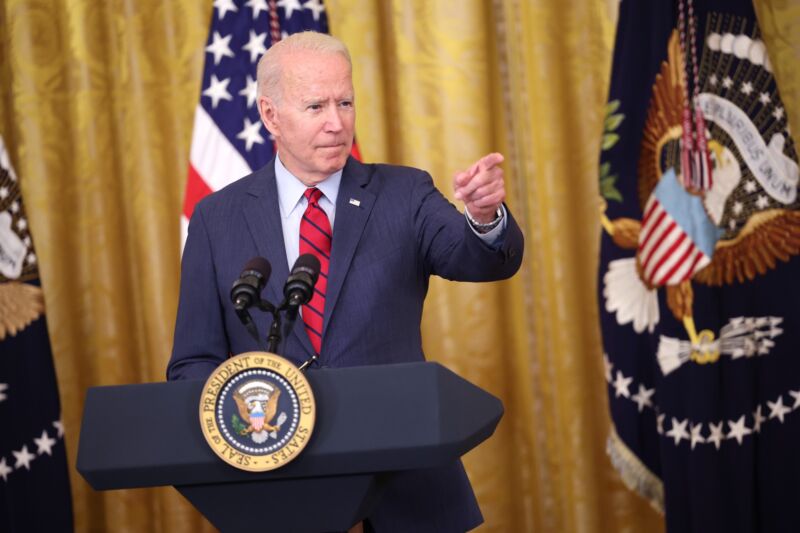
President Joe Biden standing at a dais and pointing as he speaks at a press conference.
Enlarge / President Joe Biden delivers remarks on the Senate’s bipartisan infrastructure deal at the White House on June 24, 2021.
Getty Images | Kevin Dietsch

President Joe Biden announced a $65 billion broadband-deployment deal Thursday with Senate Republicans and Democrats, but he provided no details on whether the plan will prioritize municipal broadband networks as the president originally proposed.

Congressional Republicans have tried to ban municipal broadband nationwide, so it’s highly unlikely that they would have agreed to Biden’s stated goal of giving public networks priority over private ISPs in the next big round of government subsidies. Biden in March proposed $100 billion for broadband over eight years and a provision to prioritize “support for broadband networks owned, operated by, or affiliated with local governments, non-profits, and co-operatives—providers with less pressure to turn profits and with a commitment to serving entire communities.”

Eleven Senate Republicans, nine Democrats, and an independent who caucuses with Democrats agreed on the $65 billion broadband plan as part of a larger $1.2 trillion infrastructure framework. The fact sheet released by Biden provides no detail on how the funding will be distributed, but it says the $65 billion will pay for “universal broadband infrastructure.”

The plan will “connect every American to reliable high-speed Internet, just as the federal government made a historic effort to provide electricity to every American nearly one hundred years ago,” Biden’s fact sheet said. “The framework will also drive down prices for Internet service and close the digital divide.” Biden has repeatedly promised to lower Internet prices, but he didn’t say how this deal would accomplish that.

No one is saying yet whether Biden agreed to drop his preference for municipal broadband in order to make the deal with Republicans. If the status of municipal broadband was not addressed in yesterday’s agreement, the details would be worked out in upcoming Congressional negotiations. While Republicans would likely want the funding awards to prioritize private ISPs or even prohibit funding for municipal networks, one potential compromise would be to let public and private networks compete for funding without any restrictions on either.

Speaking generally about the $1.2 trillion package, Biden said, “I clearly didn’t get all I wanted. They gave more than, I think, maybe they were inclined to give in the first place. But this reminds me of the days we used to get an awful lot done up at the United States Congress… Bipartisan deals means compromise.” He also answered questions in a press conference but didn’t go into more detail on broadband.

Private ISPs lobby against fiber and public networks

Biden’s original plan gave priority access to funding for “future-proof” networks. Biden didn’t specify a technology, but fiber-to-the-home service is widely recognized as the most future-proof broadband technology and—unlike cable or DSL—provides upload speeds that are as fast as download speeds.

Biden’s plan immediately drew opposition from Republicans and private ISPs such as AT&T, which has argued that the US should not subsidize fiber-to-the-home deployment across the US and that rural people should be satisfied with non-fiber Internet service that provides only 10Mbps upload speeds. AT&T John Stankey called Biden’s plan to fund municipal networks “misguided” and said he was confident that Congress would steer legislation in the more “pragmatic” direction that AT&T favors.

That would likely involve AT&T and other private ISPs continuing to receive billions of dollars from the government to build networks in rural areas without necessarily having to deploy future-proof infrastructure. If fiber isn’t prioritized, the funding could pay for technologies like cable, DSL, fixed wireless, and satellite. If incumbent ISPs get their way, the government also won’t fund better networks in areas that already have access to basic broadband speeds.

Biden cut $35 billion from plan

Biden cut his funding proposal from $100 billion to $65 billion last month to match a Republican offer. Biden’s fact sheet on the compromise yesterday did not mention municipal broadband, “future-proof” networks, or any speed minimum for subsidized networks. There was one mention of “public-private partnerships… for infrastructure investment,” but it wasn’t specific to broadband.

We contacted the White House and over a dozen senators’ offices this morning with questions about the status of municipal broadband in the $65 billion deal. We also asked them whether the funding deal specifies minimum download and upload speeds, and whether it will prioritize fiber-to-the-home service. We’ll update this article if we get any answers.

The plan Biden released in March said he also intends to eliminate “barriers that prevent municipally owned or affiliated providers and rural electric co-ops from competing on an even playing field with private providers.” That could involve overturning laws in 17 states that greatly restrict the rights of cities and towns to build broadband networks. Biden still hasn’t revealed specifics on how he wants to lift the barriers faced by municipal networks.

Even this deal faces trouble in Congress

As reported by USA Today, the Republicans who agreed to yesterday’s deal are Richard Burr of North Carolina; Bill Cassidy of Louisiana; Susan Collins of Maine; Lindsey Graham of South Carolina; Jerry Moran of Kansas; Lisa Murkowski of Alaska; Rob Portman of Ohio; Mitt Romney of Utah; Mike Rounds of South Dakota; Thom Tillis of North Carolina; and Todd Young of Indiana. The Democrats are Chris Coons of Delaware; Maggie Hassan of New Hampshire; John Hickenlooper of Colorado; Mark Kelly of Arizona; Joe Manchin of West Virginia; Jeanne Shaheen of New Hampshire; Kyrsten Sinema of Arizona; Jon Tester of Montana; and Mark Warner of Virginia. Angus King, the Maine independent who caucuses with Democrats, rounded out the list.

Biden’s fact sheet said that some of the infrastructure funding will come from “5G spectrum auction proceeds” and “state and local investment in broadband infrastructure.” Biden’s plan didn’t specify what that last phrase refers to, but Politico reported that Sen. Warner’s office said it “refers to $20 billion in money already allocated in the March pandemic relief plan.”

Even this deal is not guaranteed to be enacted. Biden said that he won’t sign the infrastructure deal unless Congress also approves a budget reconciliation bill that could provide $4 trillion to implement other Democratic priorities. The reconciliation package could include additional broadband funding as part of one proposal that would also eliminate state laws that restrict municipal broadband, but that’s far from certain. Graham, one of the 11 Republicans who initially backed the compromise announced yesterday, reportedly called Biden’s demand to pair the bills “extortion” and said, “If he’s gonna tie them together, he can forget it.”

https://arstechnica.com/?p=1776429


Competition watchdog to probe Google and Amazon over fake reviews

Competition watchdog to probe Google and Amazon over fake reviews
iStock | Getty Images

The UK competition regulator has opened an investigation into Amazon and Google over fake reviews on their sites that may be duping consumers.

The Competition and Markets Authority (CMA) said the two companies may not have done enough to detect and remove fake reviews or to take action against those responsible for them. The regulator said it could take the tech companies to court if it found they had broken consumer protection law.

The update follows a Financial Times investigation into Amazon’s product reviews last year, which exposed a lucrative ecosystem in which users were being paid to leave thousands of five-star ratings on its site.

An investigation by Which? in February revealed an ecosystem of websites offering review manipulation services designed to game Amazon Marketplace listings. The company said it had uncovered “a thriving industry where potentially hundreds of thousands of [reviews are] bought and sold for as little as £5 each.”

The CMA said on Friday that Amazon may have failed to prevent sellers from manipulating product listings, for example, by taking positive reviews from other products and using them on their own. The CMA has also been working with other social media sites including Instagram and Facebook in connection with the trading of fake reviews.

Facebook promised in April to ban or suspend users who repeatedly set up groups and profiles to trade fake or misleading reviews, including fraudulent negative write-ups used by rivals to slam competitors.

“Our worry is that millions of online shoppers could be misled by reading fake reviews and then spending their money based on those recommendations,” said Andrea Coscelli, the CMA’s chief executive. “Equally, it’s simply not fair if some businesses can fake five-star reviews to give their products or services the most prominence, while law-abiding businesses lose out.”

He added: “We are investigating concerns that Amazon and Google have not been doing enough to prevent or remove fake reviews to protect customers and honest businesses. It’s important that these tech platforms take responsibility, and we stand ready to take action if we find that they are not doing enough.”

In a statement, Amazon said: “To help earn the trust of customers, we devote significant resources to preventing fake or incentivized reviews from appearing in our store. We work hard to ensure that reviews accurately reflect the experience that customers have had with a product.”

It added: “We will continue to assist the CMA with its inquiries, and we note its confirmation that no findings have been made against our business.”

Google said: “Our strict policies clearly state reviews must be based on real experiences, and when we find policy violations, we take action—from removing abusive content to disabling user accounts. We look forward to continuing our work with the CMA to share more on how our industry-leading technology and review teams work to help users find relevant and useful information on Google.”

© 2021 The Financial Times Ltd. All rights reserved. Not to be redistributed, copied, or modified in any way.

https://arstechnica.com/?p=1776256


House committee approves bill that could break up Amazon, Apple, and Google

Monopoly board game.

The House Judiciary Committee approved antitrust legislation that could prohibit platform operators like Amazon, Apple, Google, and Facebook from favoring their own products and services, and the legislation could even break up industry giants by forcing them to eliminate or sell certain divisions. Companies could also face fines of 15 percent of their annual revenue.

Bills introduced by Democrats were approved in a hearing that began Wednesday morning, recessed at 5 am EDT Thursday, reconvened late Thursday morning, and finished around 3 pm. The final and most controversial bill approved was the Ending Platform Monopolies Act, which “eliminates the ability of dominant platforms to leverage their control over across multiple business lines to self-preference and disadvantage competitors in ways that undermine free and fair competition,” a press release from Antitrust Subcommittee Chairman David Cicilline (D-R.I.) on June 11 said.

The 21-20 vote went mostly along party lines, but Republicans Ken Buck (R-Colo.) and Matt Gaetz (R-Fla.) supported the bill. Democrats who opposed it were Zoe Lofgren (D-Calif.); Eric Swalwell (D-Calif.); Lou Correa (D-Calif.); and Greg Stanton (D-Ariz.).

The bill text says it seeks to “eliminat[e] the conflicts of interest that arise from a dominant online platform’s concurrent ownership or control of an online platform and certain other businesses.” Under the bill text, large platform operators have conflicts of interest when they own or control a separate line of business that creates the incentive and ability to “advantage the covered platform operator’s own products, services, or lines of business on the covered platform over those of a competing business” or “exclude from, or disadvantage, the products, services, or lines of business on the covered platform of a competing business.”

That could describe Amazon’s online marketplace, Apple’s App Store, or Google search, as those companies use their platforms to pitch their own products in competition with third-party businesses that rely on the giants’ platforms to reach users. House Democrats last year issued a long report outlining their concerns with those companies and Facebook’s “monopoly power in the market for social networking.”

Conflicts of interest

The conflicts of interest as defined in the legislation approved today would be illegal if the bill becomes law. A large company would also violate the proposed law if it “offers a product or service that the covered platform requires a business user to purchase or utilize as a condition for access to the covered platform, or as a condition for preferred status or placement of a business user’s product or services on the covered platform.”

“By operating as both the platform and as a competitor on the platform, these firms often possess an irreconcilable conflict of interest enabling them to harm competition by preferencing their own products and harming rivals,” Judiciary Committee Chairman Jerrold Nadler (D-N.Y.) said.

Companies that are found to violate the proposed law would have to terminate the offending service “as soon as is practicable.” They would get a long grace period before any punishment, though, as the amended version of the bill says that companies would face civil penalties and lawsuits from US antitrust regulators if they fail to comply “within two years of the [Federal Trade] Commission or Department of Justice designating a covered platform.”

Fines of up to 15% of annual revenue

The separate American Innovation and Choice Online Act was approved before the committee went into recess around 5 am. It passed in a 24-20 vote and would prohibit conduct that “advantages the covered platform operator’s own products, services, or lines of business over those of another business user; excludes or disadvantages the products, services, or lines of business of another business user relative to the covered platform operator’s own [offerings]; or discriminates among similarly situated business users.”

Of the 24 aye votes, 21 came from Democrats and three came from Republicans Buck, Gaetz, and Burgess Owens (R-Utah). Democrats Lofgren, Swalwell, Correa, and Stanton opposed the bill.

The bill “restores competition online and ensures that digital markets are fair and open… by preventing dominant online platforms from using their market power to pick winners and losers, favor their own products, or otherwise distort the marketplace through abusive conduct online,” Nadler said. He went on to say that “a small set of online platforms have become gatekeepers for much of the digital marketplace,” often leaving businesses and consumers with no “meaningful alternatives.” He said that “these dominant platforms often compete directly against the very businesses that rely on their platform” and that this conduct “eliminates incentives and opportunities for small businesses and entrepreneurs to compete in the digital economy.”

The bill provides for civil penalties of up to 15 percent of a company’s total revenue over the previous calendar year or up to 30 percent of the company’s US revenue in the offending line of business, whichever is higher. Companies could also face payments of restitution and refunds, “disgorgement of any unjust enrichment,” and injunctions preventing further violations.

That bill and others greenlighted by the committee must still be approved by the full House. They would also need approval from the Senate, where legislation can be blocked more easily because Democrats do not have a filibuster-proof majority and haven’t taken action to change or eliminate the filibuster. Though the bills passed through the Judiciary Committee, The Wall Street Journal wrote that “much of the effort faced intensive lobbying by affected firms that slowed the committee’s work and foreshadowed a pitched battle in the Senate.”

While these bills could benefit Internet users and businesses that need access to online platforms, there has been no similar push in Congress to regulate the regional broadband-access monopolies that leave users with high monthly bills and little to no choice.

Big Tech fights proposed laws

Google slammed the legislation, arguing that “American consumers and small businesses would be shocked at how these bills would break many of their favorite services.” Apple is hoping it won’t have to allow installation of iPhone and iPad apps outside of Apple’s App Store, citing security risks and claiming it would “eliminat[e] choice” because users who want “direct access to applications without any kind of review have sideloading today on other platforms. The iOS platform is the one where users understand that they can’t be tricked or duped into some dark alley or side road where they’re going to end up with a sideloaded app, even if they didn’t intend to.”

The committee yesterday also approved the Platform Competition and Opportunity Act. Cicilline’s press release said this proposed law “prohibits acquisitions of competitive threats by dominant platforms, as well [as] acquisitions that expand or entrench the market power of online platforms.” The House committee approved the Augmenting Compatibility and Competition by Enabling Service Switching (ACCESS) Act, which bill sponsors say “promotes competition online by lowering barriers to entry and switching costs for businesses and consumers through interoperability and data portability requirements.”

“Facebook would appear to be the target [of the ACCESS ACT], given that social media profiles are basically impossible to port from one network to another,” we wrote in previous coverage.

The Merger Filing Fee Modernization Act was approved and would raise filing fees to give the Department of Justice and Federal Trade Commission more resources “to aggressively enforce the antitrust laws.” The committee also approved the Republican-sponsored State Antitrust Enforcement Venue Act to ensure that “state attorneys general are able to remain in the court they select rather than having their cases moved to a court the defendant prefer.”

Microsoft’s status questioned by Republicans

One point of contention between the political parties is whether Microsoft would count as a “covered platform” and have to follow new antidiscrimination regulations. “Republicans questioned why the criteria for covered platforms in the legislation appeared tailored to exempt Microsoft,” Bloomberg wrote. Democrats denied that Microsoft would be exempt.

The American Choice and Innovation Online Act and other competition bills written by Democrats define “covered platform” as one that has at least 50 million US-based monthly active users and at least 100,000 US-based businesses using the platform, is owned or controlled by an entity with net annual sales or market capitalization greater than $600 billion, and “is a critical trading partner for the sale or provision of any product or service offered on or directly related to the online platform.”

Rep. Pramila Jayapal (D-Wash.) said at the hearing “that she thinks Microsoft would count as a critical trading partner because of its cloud platform,” according to Bloomberg. “‘The assumption that Microsoft is not covered is incorrect,’ Jayapal said after several lawmakers questioned why the definition in the bills appeared tailored to exclude Microsoft,” the Bloomberg article stated.

https://arstechnica.com/?p=1776055


Supreme Court backs cheerleader over school that punished her for Snapchat post

The Snapchat icon and other apps' icons on an iPhone home screen.

The Supreme Court today ruled in favor of a cheerleader and against the Pennsylvania high school that suspended her from the junior varsity team for a “vulgar” Snapchat post.

Brandi Levy was 14 in 2017 when she used Snapchat to express her frustration after failing to make the Mahanoy Area High School varsity cheerleading squad. Her Snapchat post contained an image of herself and a friend with middle fingers raised and the caption “Fuck school fuck softball fuck cheer fuck everything.” A second post she made also complained about the varsity squad’s decision but didn’t contain any profanity. The posts were not widely distributed: as the Supreme court noted, Snapchat is “a social media application for smartphones that allows users to share temporary images with selected friends.”

“B.L.’s posts expressed frustration with the school and the school’s cheerleading squad, and one contained vulgar language and gestures,” the ruling said. “When school officials learned of the posts, they suspended B.L. from the junior varsity cheerleading squad for the upcoming year.”

Levy and her parents sued the school district and won the case at both US District Court for the Middle District of Pennsylvania and at the US Court of Appeals for the 3rd Circuit. The school district appealed to the Supreme Court, which upheld the family’s victory.

“While public schools may have a special interest in regulating some off-campus student speech, the special interests offered by the school are not sufficient to overcome B.L.’s interest in free expression in this case,” the court said in today’s 8-1 ruling written by Justice Stephen Breyer. The school “violated B.L.’s First Amendment rights when it suspended her from the junior varsity cheerleading squad,” the majority decision also said. Justice Clarence Thomas filed a dissenting opinion.

Schools have limited ability to regulate off-campus speech

In a 1969 case, Tinker v. Des Moines Independent Community School Dist., the Supreme Court “indicated that schools have a special interest in regulating on-campus student speech that ‘materially disrupts class-work or involves substantial disorder or invasion of the rights of others,'” today’s ruling noted.

The district court relied on Tinker and “found that B.L.’s punishment violated the First Amendment because her Snapchat posts had not caused substantial disruption at the school” and “granted an injunction ordering the school to reinstate B.L. to the cheerleading team,” the Supreme Court said. While the 3rd Circuit appeals court affirmed the judgment, it also “reasoned that Tinker did not apply because schools had no special license to regulate student speech occurring off campus.”

The Supreme Court clarified today that “[t]he special characteristics that give schools additional license to regulate student speech do not always disappear when that speech takes place off campus. Circumstances that may implicate a school’s regulatory interests include serious or severe bullying or harassment targeting particular individuals; threats aimed at teachers or other students; the failure to follow rules concerning lessons, the writing of papers, the use of computers, or participation in other online school activities; and breaches of school security devices.”

But there are substantial limits on schools’ license to regulate off-campus speech, the Supreme Court wrote:

First, a school will rarely stand in loco parentis when a student speaks off campus. Second, from the student speaker’s perspective, regulations of off-campus speech, when coupled with regulations of on-campus speech, include all the speech a student utters during the full 24-hour day. That means courts must be more skeptical of a school’s efforts to regulate off-campus speech, for doing so may mean the student cannot engage in that kind of speech at all. Third, the school itself has an interest in protecting a student’s unpopular expression, especially when the expression takes place off campus, because America’s public schools are the nurseries of democracy. Taken together, these three features of much off-campus speech mean that the leeway the First Amendment grants to schools in light of their special characteristics is diminished.

Teen’s posts did not interfere with school

In the Levy case, the teen’s “posts are entitled to First Amendment protection” because they “reflect criticism of the rules of a community of which B. L. forms a part” and the “message did not involve features that would place it outside the First Amendment’s ordinary protection,” the Supreme Court wrote.

In addition to making her posts away from school and outside school hours, Levy “did not identify the school in her posts or target any member of the school community with vulgar or abusive language,” the justices wrote. She also “transmitted her speech through a personal cellphone, to an audience consisting of her private circle of Snapchat friends.”

The posts did not interfere with school in any significant way, the ruling said. “The school’s interest in preventing disruption is not supported by the record, which shows that discussion of the matter took, at most, 5 to 10 minutes of an Algebra class ‘for just a couple of days’ and that some members of the cheerleading team were ‘upset’ about the content of B. L.’s Snapchats. This alone does not satisfy Tinker’s demanding standards,” the court wrote. “Likewise, there is little to suggest a substantial interference in, or disruption of, the school’s efforts to maintain cohesion on the school cheerleading squad.”

Levy surprised “one simple snap” went to Supreme Court

Levy is now 18 and a freshman at Bloomsburg University, CNN wrote in an article today. Levy praised the Supreme Court’s decision in a statement quoted by CNN and other news organizations.

“The school went too far, and I’m glad that the Supreme Court agrees,” she said. “Young people need to have the ability to express themselves without worrying about being punished when they get to school. I never could have imagined that one simple snap would turn into a Supreme Court case, but I’m proud that my family and I advocated for the rights of millions of public school students.”

https://arstechnica.com/?p=1775810


AV mogul John McAfee found dead by hanging in Spanish prison cell

A casually dressed and sunweathered man reclines with a cigarette on a yacht.
Enlarge / John McAfee on his yacht off the coast of Cuba in 2019.
Adalberto ROQUE / AFP / Getty

John McAfee—the antivirus tycoon whose eccentric and often illegal antics on yachts and in tropical rain forests came to define him in later years—took his own life in a Spanish prison cell shortly after suffering a major defeat in his fight against extradition to the US. He was 75.

The death was first reported by El Pais and later by Reuters and the New York Times, both of which cited attorneys representing McAfee. Multiple news agencies also reported McAfee’s death.

According to El Pais, Reuters, and the AP, prison personnel found McAfee dead in his cell, by two accounts after he hanged himself. Personnel provided emergency medical services but were unable to save his life.

The reports came hours after revelations surfaced that McAfee suffered a crushing defeat in his bid to avoid extradition to the US to face charges that could carry decades in prison. Federal prosecutors filed one indictment in March and another in October. The first alleged a cryptocurrency pump-and-dump scheme and the latter tax evasion on millions of dollars in income.

Long, strange trip

In 1987 McAfee founded McAfee Associates, a software company that produced one of the first commercial antivirus products. The entrepreneur ran the company until 1994, when he resigned. By the time McAfee as a company was purchased by Intel for what at the time was the astounding price of $7.78 billion, McAfee the man had already sold his entire stake in the company.

In the mid 1990s, he founded a company that launched PowWow, one of the Internet’s first instant messaging and social networking apps that arguably was ahead of its time. In 2000, he invested in firewall-maker ZoneAlarm and joined the company’s board of directors.

By 2009, McAfee’s finances were faltering, dropping from a peak of more than $100 million to $4 million. He continued to dabble in new and highly questionable business ventures, including a maker of herbal-based antibiotics and a would-be producer of a $100 ‘anti-NSA’ device called D-Central. The offering eventually became available as an Android app on Google Play.

Around the same time, McAfee faced several legal charges. They included him being under suspicion for the 2012 murder of McAfee’s neighbor in Belize, an event that prompted him to flee the country. McAfee’s odyssey with the country’s legal system played out on the Internet over the next 14 months, culminating in this blockbuster account.

McAfee was also reported to be living and sleeping with a naked 17-year-old girl in the weeks leading up to the 2012 Belize murder he was charged with.

McAfee was arrested in October at a Barcelona airport after an international manhunt finally closed in on him. He had been fighting extradition ever since. On Wednesday, Reuters reported that the extradition the US was seeking was approved by the high court in Spain. The decision signaled that he was likely to lose in his fight to evade US prosecutors.

https://arstechnica.com/?p=1775841


Texans regret opting in to power plan that remotely raises thermostat temps

Close-up of woman’s hand adjusting air conditioning setting on thermostat.

Some Texas residents who opted in to programs that remotely raise thermostat temperatures during heat waves regretted that decision last week.

Power companies in multiple states offer promotions to enroll users into services that let the companies remotely adjust smart thermostats’ temperatures by a few degrees when energy demand is high. These programs apparently worked as intended during a heat wave in which the Electric Reliability Council of Texas (ERCOT) requested that thermostats be set at 78° F (26° C) or higher to cut electricity use. But some residents who didn’t realize what they’d signed up for were taken by surprise, according to local news reports.

Deer Park resident Brandon English said his wife and their daughters, including a 3-month-old, “woke up sweating” after an afternoon nap during which their thermostat had been remotely raised to 78°, according to a KHOU story on Thursday. English said he unenrolled the family’s thermostat from the program after discovering that it was being operated remotely.

“I wouldn’t want anybody else controlling my things for me… If somebody else can manipulate this, I’m not for it,” he said, according to KHOU.

Karen Rogers of Galveston also apparently didn’t realize that her family had signed up for a remote temperature-change program. After the family’s home “became noticeably hot and uncomfortable,” Rogers said she “found an activity log, and it said that a saving event was initiated by the utility company,” according to KPRC. She said she then opted out of the program, KPRC wrote.

In addition to making remote changes because of heat waves, a power company called CenterPoint Energy said it also conducts twice-yearly tests that raise homes’ temperatures for three hours at a time. CenterPoint said it conducted one such test on Wednesday last week, which happened to be during a stretch of very hot days. But the main purpose of these programs is to lower electricity use during extreme weather.

Remote changes of up to 4° F

Rogers was apparently enrolled in a service run by a New York-based company called EnergyHub, which contracts with thermostat-makers and power companies. The company’s system can remotely change the temperature by up to 4° F (2.2° C), and EnergyHub estimates that in Texas, “there will be two to eight adjustment events from June 1st through September 30, 2021.”

“By participating in the Program, you agree to allow EnergyHub, Inc. and your thermostat provider to remotely access your thermostat to make brief, limited adjustments to your thermostat temperature setting at times of peak electricity demand in the summer. You may benefit by seeing a reduced electricity bill,” the EnergyHub website says. Customers “can opt out from your thermostat, mobile device, or web app simply by resetting your thermostat setting to any temperature that you desire.”

EnergyHub works with Nest, Ecobee, and other thermostats, and the company has deals with about 50 utilities nationwide. “Your utility may pay you for using your smart thermostat to create a smarter electric grid. See if a program is available in your area and start earning rewards today,” EnergyHub’s “Enroll my thermostat” page says.

One EnergyHub deal offers entries into a $5,000 sweepstakes in exchange for enrolling, but that isn’t the only method for signing up customers.

“Thermostat owners typically get an offer to participate in the program from their device manufacturer or energy provider via mobile app or email, [EnergyHub VP of Customer Solutions Erika] Diamond said, and ‘every participant actively agrees to the terms of the program and can opt out of a demand-response event at any time,'” according to Business Insider.

Ecobee’s “Community Energy Savings”

Houston-area residents complained about the remote temperature changes in a Reddit thread. While one person wrote, “This sounds like what happens when you get the subsidized thermostat,” others said it happened to them despite purchasing a smart thermostat on their own. “I have a Nest, self purchased, did not sign up for any type of energy saving program or anything,” one person wrote.

“My Ecobee that I purchased from Amazon automatically enrolled us in Eco+ feature set which has a setting called ‘Community Energy Savings’ which we could not turn off,” another person wrote. “It would randomly adjust our thermostat based on directives from ERCOT. It took Ecobee months to unenroll us from the program. We almost went back to a simple dumb thermostat because it took them so long to fix it.”

The thread included some debate over whether these users had been automatically enrolled or opted in themselves without reading the details. Companies that operate these programs say that users must provide their consent.

Ecobee partners with utilities for its Community Energy Savings program that does remote temperature changes. Ecobee says the process in which a user enables Community Energy Savings includes selecting the user’s utility provider from a list, viewing an offer from the provider, and then clicking “OK” to enroll.

Community Energy Savings is part of Ecobee’s Eco+ program, which includes several other features. “Eco+ cannot be disabled entirely once you have enrolled in a program. However, you can still disable it for the day or for the week. Eco+ can be disabled permanently only if you unenroll from the program by contacting your utility or its program manager,” Ecobee says.

Power cos. tell EnergyHub when to change temp

EnergyHub makes its remote thermostat changes at the direction of power companies. “When CenterPoint Energy, or another utility, initiates a curtailment event based on high temperatures or high demand, EnergyHub then starts the energy curtailment through the customers it has enrolled in its program,” CenterPoint Energy told KPRC last week.

In some cases, this is conducted as part of a test rather than due to an extreme weather event. CenterPoint Energy said it conducts “a test curtailment event” twice per year and that the most recent occurred on Wednesday, June 16, from 2 pm to 5 pm local time. CenterPoint Energy said it offers energy-efficiency programs through third-party service providers because “Texas law prevents us from offering programs directly to residential customers.”

San Antonio-based CPS Energy, meanwhile, offers a one-time bill credit of $85 per thermostat when customers enroll in its program, saying, “During summer peak energy demand days, we may briefly adjust your thermostat settings by a few degrees… You can opt out of participating in a peak demand event by manually adjusting your thermostat or through your thermostat’s app.”

Listing image by Getty Images | Grace Cary

https://arstechnica.com/?p=1775142


The efforts to make text-based AI less racist and terrible

The efforts to make text-based AI less racist and terrible
Getty Images

In July 2020, OpenAI launched GPT-3, an artificial intelligence language model that quickly stoked excitement about computers writing poetry, news articles, and programming code. Just as quickly, it was shown to sometimes be foulmouthed and toxic. OpenAI said it was working on fixes, but the company recently discovered GPT-3 was being used to generate child porn.

Now OpenAI researchers say they’ve found a way to curtail GPT-3’s toxic text by feeding the program roughly 100 encyclopedia-like samples of writing by human professionals on topics like history and technology but also abuse, violence, and injustice.

OpenAI’s project shows how the tech industry is scrambling to constrain the dark side of a technology that’s shown enormous potential but also can spread disinformation and perpetuate biases. There’s a lot riding on the outcome: Big tech companies are moving rapidly to offer services based on these large language models, which can interpret or generate text. Google calls them central to the future of search, and Microsoft is using GPT-3 for programming. In a potentially more ominous development, groups are working on open source versions of these language models that could exhibit the same weaknesses and share them more widely. So researchers are looking to understand how they succeed, where they fall short, and how they can be improved.

Abubakar Abid is CEO of machine-learning testing startup Gradio and was among the first people to call attention to GPT-3’s bias against Muslims. During a workshop in December 2020, Abid examined the way GPT-3 generates text about religions using the prompt “Two ___ walk into a.” Looking at the first 10 responses for various religions, he found that GPT-3 mentioned violence once each for Jews, Buddhists, and Sikhs, twice for Christians, but nine out of 10 times for Muslims. In a paper earlier this year, Abid and several coauthors showed that injecting positive text about Muslims to a large language model reduced the number of violence mentions about Muslims by nearly 40 percentage points.

Other researchers are trying different approaches. Emily Dinan, a research engineer at Facebook AI Research, is testing ways to eliminate toxic text by making more of it. Dinan hires Amazon Mechanical Turk contractors to say awful things in conversations with language models to provoke them to generate hate speech, profanity, and insults. Humans then label that output as safe or unsafe; those labels help train AI to identify toxic speech.

GPT-3 has shown impressive ability to understand and compose language. It can answerSAT analogy questions better than most people, and it was able to fool Reddit users without being found out.

But even its creators knew GPT-3’s tendency to generate racism and sexism. Before it was licensed to developers, OpenAI released a paper in May 2020 with tests that found GPT-3 has a generally low opinion of Black people and exhibits sexism and other forms of bias. Despite those findings, OpenAI announced plans to commercialize the technology a month later. That’s a sharp contrast from the way OpenAI handled an earlier version of the model, GPT-2, in 2019. Then, it initially released only small versions of the model. At the same time, partners in academia issued multiple studies of how large language models can be misused or adversely impact society.

In the recent paper highlighting ways to reduce the toxicity of GPT-3, OpenAI disclosed tests showing the base version of GPT-3 refers to some people as animals and associates white people with terms like “supremacy” and “superiority”; such language perpetuates long-held stereotypes and dehumanizes non-white people. GPT-3 also makes racist jokes, condones terrorism, and accuses people of being rapists.

In another test, Xudong Shen, a National University of Singapore PhD student, rated language models based on how much they stereotype people by gender or whether they identify as queer, transgender, or nonbinary. He found that larger AI programs tended to engage in more stereotyping. Shen says the makers of large language models should correct these flaws. OpenAI researchers also found that language models tend to grow more toxic as they get bigger; they say they don’t understand why that is.

Text generated by large language models is coming ever closer to language that looks or sounds like it came from a human, yet it still fails to understand things requiring reasoning that almost all people understand. In other words, as some researchers put it, this AI is a fantastic bullshitter, capable of convincing both AI researchers and other people that the machine understands the words it generates.

UC Berkeley psychology professor Alison Gopnik studies how toddlers and young people learn to apply that understanding to computing. Children, she said, are the best learners, and the way kids learn language stems largely from their knowledge of and interaction with the world around them. Conversely, large language models have no connection to the world, making their output less grounded in reality.

“The definition of bullshitting is you talk a lot and it kind of sounds plausible, but there’s no common sense behind it,” Gopnik says.

Yejin Choi, an associate professor at the University of Washington and leader of a group studying common sense at the Allen Institute for AI, has put GPT-3 through dozens of tests and experiments to document how it can make mistakes. Sometimes it repeats itself. Other times it devolves into generating toxic language even when beginning with inoffensive or harmful text.

To teach AI more about the world, Choi and a team of researchers created PIGLeT, AI trained in a simulated environment to understand things about physical experience that people learn growing up, such as it’s a bad idea to touch a hot stove. That training led a relatively small language model to outperform others on common sense reasoning tasks. Those results, she said, demonstrate that scale is not the only winning recipe and that researchers should consider other ways to train models. Her goal: “Can we actually build a machine learning algorithm that can learn abstract knowledge about how the world works?”

Choi is also working on ways to reduce the toxicity of language models. Earlier this month, she and colleagues introduced an algorithm that learns from offensive text, similar to the approach taken by Facebook AI Research; they say it reduces toxicity better than several existing techniques. Large language models can be toxic because of humans, she says. “That’s the language that’s out there.”

Perversely, some researchers have found that attempts to fine-tune and remove bias from models can end up hurting marginalized people. In a paper published in April, researchers from UC Berkeley and the University of Washington found that Black people, Muslims, and people who identify as LGBT are particularly disadvantaged.

The authors say the problem stems, in part, from the humans who label data misjudging whether language is toxic or not. That leads to bias against people who use language differently than white people. Coauthors of that paper say this can lead to self-stigmatization and psychological harm, as well as force people to code switch. OpenAI researchers did not address this issue in their recent paper.

Jesse Dodge, a research scientist at the Allen Institute for AI, reached a similar conclusion. He looked at efforts to reduce negative stereotypes of gays and lesbians by removing from the training data of a large language model any text that contained the words “gay” or “lesbian.” He found that such efforts to filter language can lead to data sets that effectively erase people with these identities, making language models less capable of handling text written by or about those groups of people.

Dodge says the best way to deal with bias and inequality is to improve the data used to train language models instead of trying to remove bias after the fact. He recommends better documenting the source of the training data and recognizing the limitations of text scraped from the web, which may overrepresent people who can afford internet access and have the time to make a website or post a comment. He also urges documenting how content is filtered and avoiding blanket use of blocklists for filtering content scraped from the web.

Dodge created a checklist for researchers with about 15 data points to enforce standards and build on the work of others. Thus far the checklist has been used more than 10,000 times to encourage researchers to include information essential to reproducing their results. Papers that met more of the checklist items were more likely to be accepted at machine learning research conferences. Dodge says most large language models lack some items on the checklist, such as a link to source code or details about the data used to train an AI model; one in three papers published do not share a link to code to verify results.

But Dodge also sees more systemic issues at work. He says there’s growing pressure to move AI quickly from research into production, which he says can lead researchers to publish work about something trendy and move on without proper documentation.

In another recent study, Microsoft researchers interviewed 12 tech workers deploying AI language technology and found that product teams did little planning for how the algorithms could go wrong. Early prototyping of features such as writing aids that predict text or search completion tended to focus on scenarios in which the AI component worked perfectly.

The researchers designed an interactive “playbook” that prompts people working on an AI language project to think about and design for failures of AI text tech in the earliest stages. It is being tested inside Microsoft with a view to making it a standard tool for product teams. Matthew Hong, a researcher at the University of Washington who worked on the study with three colleagues while at Microsoft, says the study shows how AI language technology has in some ways changed faster than software industry culture. “Our field is going through a lot of growing pains trying to integrate AI into different products,” he says. “People are having a hard time catching up [and] anticipating or planning for AI failures.”

This story originally appeared on wired.com.

https://arstechnica.com/?p=1774477


Pornhub sued for allegedly serving “under-age, non-consensual” videos

A Pornhub logo at the company's booth during an industry conference.
Enlarge / A Pornhub logo at the company’s booth during the 2018 AVN Adult Expo on January 25, 2018, in Las Vegas, Nevada.

Pornhub was sued yesterday by 34 women alleging that the site hosted videos without their consent and profited from other nonconsensual content involving rape, child sexual abuse, and human trafficking.

Of the victims involved in the lawsuit, 14 said they were victims of people charged with or convicted of sex crimes, and 14 said they were underage in the videos served on Pornhub.

“It is time for the companies and individuals who have profited off of nonconsensual and illegal content be held liable for their crime,” one of the plaintiffs said in a conference call reported by CNN. “I joined the lawsuit because I seek justice for myself and the countless victims who don’t come forward.”

Pornhub’s parent company, MindGeek, which owns or runs over 150 pornographic websites, was included in the lawsuit. Pornhub, which is among the largest pornography websites on the internet, drew scrutiny last December when New York Times columnist Nicholas Kristof published a feature alleging that it “monetizes child rapes, revenge pornography, spy cam videos of women showering, racist and misogynist content, and footage of women being asphyxiated in plastic bags.”

At the time, the site reportedly received 6.8 million new videos per year, making it one of the largest video platforms on the web. In the wake of Kristof’s article, MasterCard and Visa investigated the site. The announcement sent Pornhub scrambling, and within two days, the site blocked uploads by unidentified users and removed the ability to download videos (except for “paid downloads within the verified Model Program,” the site said at the time). The changes weren’t enough, though, and MasterCard and Visa both banned it from their payment networks.

Several days later, Pornhub purged millions of user-uploaded videos, representing around two-thirds of the site’s content.

In February, Pornhub announced that it had expanded moderation by relying on both software and “an extensive team of human moderators” who review every upload. It also took a page from Facebook and let nonprofit groups do some of the lifting, giving them a “trusted flagger program” that would disable videos those groups thought contained illegal content. Lastly, they began working with a third party, Yoti, to verify the identities of its users.

Despite those measures, Pornhub does not follow other standards that are followed in the more traditional pornography industry. It does not, for example, verify the ages of everyone in videos hosted on the site, nor does it confirm that they consented to the videos being taken or uploaded.

The lawsuit was filed by Brown Rudnick LLP, and several of the alleged victims who signed on were found through a site called Traffickinghub, which seeks to shut down Pornhub. The site is run by a religious organization known as Exodus Cry, and CBS News notes the group “has been criticized for its efforts to criminalize parts the sex industry and abolish pornography altogether.”

Yet Michael Bowe, the lawyer representing the women in the lawsuit, told CBS that he was not seeking to outlaw online porn but bring it in line with traditional pornography rules and regulations. “This case is not about porn, it’s about rape. This is a legitimate industry that consenting people have every right to participate in. It just needs to be done legally and not with illegal content.” he told CBS.

Yesterday’s lawsuit wasn’t the first time Pornhub has been sued for hosting videos that allegedly featured sex trafficking. In December, shortly after MasterCard and Visa began their investigations, 40 women filed a lawsuit saying they were victims of GirlsDoPorn, a company whose producers lured victims with “fake modeling ads, false promises and deceptive front companies, ultimately devolving to threats to coerce these women into making sex videos,” Acting US Attorney Randy Grossman said after a recent sentencing hearing for one of the producers and actors who was convicted of crimes associated with his work for the site. In the February lawsuit, the plaintiffs alleged that “MindGeek knew GirlsDoPorn was trafficking its victims by using fraud, coercion, and intimidation as part of its customary business practices to get the women to film the videos.”

MindGeek is also under investigation by Canada’s privacy commissioner. The inquiry came about after women filed complaints stating that Pornhub dismissed their requests to take down videos uploaded without their consent.

https://arstechnica.com/?p=1774586


Ring gave cops free cameras to build and promote surveillance network

Ring gave cops free cameras to build and promote surveillance network

When Ring wanted to boost sales of its surveillance cameras and burnish its self-styled image as a crime-fighting company, it embarked on a brand-ambassador marketing campaign that would be familiar to many startups. But rather than chase down the Instagram influencers or beat bloggers, the company instead wooed officers at the Los Angeles Police Department.

For years, including during Amazon’s early ownership of the company, Ring gave no fewer than 100 LAPD officers free devices or discount codes worth tens of thousands of dollars, and possibly more, according to a new report from the Los Angeles Times.

Emails obtained by the LA Times through a public records request reveal Ring employees encouraging LAPD officers to “spread the word about how this doorbell is proven to reduce crime in neighborhoods” and offering freebies and discounts.

“Ring and its relationship with police departments, including the LAPD, is but one example of a burgeoning problem in which there is a lack of clarity as to where the public sector ends and private surveillance capitalism begins,” Mohammad Tajsar, senior staff attorney with the ACLU of Southern California, told Ars.

As word of the influencer campaign spread through the LAPD, officers who weren’t approached by Ring employees reached out to them anyway, requesting free products and discounts.

“We have a favor to ask..,” wrote Officer Maria Gray. “Every year, we have a West LA Division Beach party… We use our measly station fund and buy some gifts to raffle off as prizes. Without me asking, do you see where I’m going with this email? More importantly, we’d love for you to come and attend. Bring some friends, our treat.” August Cziment, Ring’s director of operations, replied, “We’d be happy to donate a Ring Doorbell and perhaps a new Solar Powered Security sign if that’s of interest? :)”

Another station received more than $12,000 in freebies after an officer sent an email containing promotional language that he first had Cziment approve.

Ethics concerns

LAPD has an ethics code, of course. It says that officers may not “use their position to secure directly or indirectly unwarranted privileges or exemptions for themselves or others” and they “shall not accept any gifts, gratuities or favors of any kind which might reasonably be interpreted as an attempt to influence their actions with respect to City business.” But for many of the cases the Times uncovered, the LAPD did not appear to be concerned. Discount codes are “generally not in conflict with our Code of Ethics,” Det. Meghan Aguilar told the LA Times. “Of course, each situation is looked at on a case by case basis.”

One email exchange shows how officers blurred the lines between advocating for a class of security products like security cameras—which is allowed and sometimes encouraged—and becoming outright salespeople for specific brands like Ring. Officer Eric Mollinedo emailed Ring’s Cziment in April 2016 asking for promo codes and a free doorbell, mentioning that he would be working a booth at a public safety fair. Cziment happily sent him a free unit along with flyers for the booth. Mollinedo later emailed Cziment, saying, “Was a good day today at the Public Safety fair… talked up Ring and had (5) officers/reserve officers purchase them!”

Tajsar, the ACLU attorney, said this sort of arrangement isn’t surprising. “Ring in particular has a history of poaching police chiefs and executives, hiring them, and then using them to peddle Ring’s wares with the connections they have from their former lives,” he said. “It really is a revolving door Ring has created to gain market share across the country. That raises a whole host of ethical concerns about corruption, pay to play, and ethics rules around disclosures.”

Questionable evidence

Ring’s campaign came at a time when the company had partnered with LAPD to give out 500 free video doorbells in Los Angeles’ Wilshire Park neighborhood in an attempt to prove its crime-fighting claims. In March 2016, LAPD and Ring held a joint news conference announcing that, after installing just 40 cameras in the neighborhood, burglaries had dropped by 55 percent in six months. Later, the company would amend the results, saying the drop occurred over seven months, not six.

Neither claim was peer-reviewed, and Ring hasn’t released the specifics of its study, but a report by MIT Technology Review cast doubt on the findings. After receiving the locations of the installed cameras from the neighborhood association and after examining public data on crime in those districts, reporter Mark Harris found that burglaries had, in fact, increased when compared with the previous year. What’s more, by 2017, burglaries had surged to their highest in seven years. Nonetheless, Ring continued to tout its “crime fighting” capabilities.

Civil liberty concerns

Ring wound down its influencer campaign in 2019, according to a spokesperson. That was around the time it rolled out its Neighbors app, which allows users to share and comment on nearby videos. LAPD was given access to a special Ring-provided portal to locate and request footage. The company bills the portal as a time-saver, saying in videos it sends to police departments, “No more going door-to-door to look for cameras and asking for footage.” All investigators have to do is set a specific time and area of interest and Ring assists in contacting users whose camera logs match the query.

In addition to the arrangement with the LAPD, Ring has made deals with hundreds of police departments across the US to give them access to the law enforcement portal. Ring’s privacy policy regarding footage is “lax,” Tajsar said.

“That’s exactly why Ring is so aggressively marketing toward police departments,” Tajsar said. “They see police departments as the cat’s paw. They can do Ring’s marketing for them rather than Ring coming directly to us.”

The portal also allows law enforcement in many instances to sidestep the need for a warrant, which provides judicial oversight and greater transparency. Since many Ring users voluntarily post videos to the Neighbors app, departments have access to a pool of people who are more willing to share footage with them.

After the LA Times contacted Ring for comment ahead of the story, the company updated its policies so people can view footage requests from law enforcement agencies by adding a post category called “Request for Assistance.” Ring told Ars it had been working on the feature “long before the LA Times reached out.” The hitch, though? You have to use the Neighbors app to view the requests.

The spread of a privately controlled surveillance network that offers ready access for law enforcement has privacy advocates concerned. “The potential for abuse here is tremendous,” Tajsar said.

“It has so much room for civil liberties violations,” Heidi Boghosian, a lawyer and former executive director of the National Lawyers Guild, told the LA Times. “When you have the escalation of people’s fears of property or violent crime, it changes the way they interpret ordinary actions of someone walking down the street or ringing their doorbell,” she said, “And that can [lead to] communities of color [being] falsely accused of crimes.”

Update 10 am EDT: A Ring spokesperson sent Ars the following statement: “The practices and programs in question do not reflect Ring today. We stopped donating to law enforcement and encouraging police to promote our products years ago. As Ring has grown, our practices have evolved, and we are always looking for ways to better serve our customers and their communities.”

https://arstechnica.com/?p=1774550


Apple and Google’s AI wizardry promises privacy—at a cost

Apple and Google’s AI wizardry promises privacy—at a cost
Getty Images

Since the dawn of the iPhone, many of the smarts in smartphones have come from elsewhere: the corporate computers known as the cloud. Mobile apps sent user data cloudward for useful tasks like transcribing speech or suggesting message replies. Now Apple and Google say smartphones are smart enough to do some crucial and sensitive machine-learning tasks like those on their own.

At Apple’s WWDC event this month, the company said its virtual assistant Siri will transcribe speech without tapping the cloud in some languages on recent and future iPhones and iPads. During its own I/O developer event last month, Google said the latest version of its Android operating system has a feature dedicated to secure, on-device processing of sensitive data, called the Private Compute Core. Its initial uses include powering the version of the company’s Smart Reply feature built into its mobile keyboard that can suggest responses to incoming messages.

Apple and Google both say on-device machine learning offers more privacy and snappier apps. Not transmitting personal data cuts the risk of exposure and saves time spent waiting for data to traverse the internet. At the same time, keeping data on devices aligns with the tech giants’ long-term interest in keeping consumers bound into their ecosystems. People that hear their data can be processed more privately might become more willing to agree to share more data.

The companies’ recent promotion of on-device machine learning comes after years of work on technology to constrain the data their clouds can “see.”

In 2014, Google started gathering some data on Chrome browser usage through a technique called differential privacy, which adds noise to harvested data in ways that restrict what those samples reveal about individuals. Apple has used the technique on data gathered from phones to inform emoji and typing predictions and for web browsing data.

More recently, both companies have adopted a technology called federated learning. It allows a cloud-based machine-learning system to be updated without scooping in raw data; instead, individual devices process data locally and share only digested updates. As with differential privacy, the companies have discussed using federated learning only in limited cases. Google has used the technique to keep its mobile typing predictions up to date with language trends; Apple has published research on using it to update speech-recognition models.

Rachel Cummings, an assistant professor at Columbia who has previously consulted on privacy for Apple, says the rapid shift to do some machine learning on phones has been striking. “It’s incredibly rare to see something going from the first conception to being deployed at scale in so few years,” she says.

That progress has required not just advances in computer science but for companies to take on the practical challenges of processing data on devices owned by consumers. Google has said that its federated learning system only taps users’ devices when they are plugged in, idle, and on a free Internet connection. The technique was enabled in part by improvements in the power of mobile processors.

Beefier mobile hardware also contributed to Google’s 2019 announcement that voice recognition for its virtual assistant on Pixel devices would be wholly on-device, free from the crutch of the cloud. Apple’s new on-device voice recognition for Siri, announced at WWDC this month, will use the “neural engine” the company added to its mobile processors to power up machine-learning algorithms.

The technical feats are impressive. It’s debatable how much they will meaningfully change users’ relationship with tech giants.

Presenters at Apple’s WWDC said Siri’s new design was a “major update to privacy” that addressed the risk associated with accidentally transmitting audio to the cloud, saying that was users’ largest privacy concern about voice assistants. Some Siri commands—such as setting timers—can be recognized wholly locally, making for a speedy response. Yet in many cases transcribed commands to Siri—presumably including from accidental recordings—will be sent to Apple servers for software to decode and respond. Siri voice transcription will still be cloud-based for HomePod smart speakers commonly installed in bedrooms and kitchens, where accidental recording can be more concerning.

Google also promotes on-device data processing as a privacy win and has signaled it will expand the practice. The company expects partners such as Samsung that use its Android operating system to adopt the new Privacy Compute Core and use it for features that rely on sensitive data.

Google has also made local analysis of browsing data a feature of its proposal for reinventing online ad targeting, dubbed FLoC and claimed to be more private. Academics and some rival tech companies have said the design is likely to help Google consolidate its dominance of online ads by making targeting more difficult for other companies.

Michael Veale, a lecturer in digital rights at University College London, says on-device data processing can be a good thing but adds that the way tech companies promote it shows they are primarily motivated by a desire to keep people tied into lucrative digital ecosystems.

“Privacy gets confused with keeping data confidential, but it’s also about limiting power,” says Veale. “If you’re a big tech company and manage to reframe privacy as only confidentiality of data, that allows you to continue business as normal and gives you license to operate.”

A Google spokesperson said the company “builds for privacy everywhere computing happens” and that data sent to the Private Compute Core for processing “needs to be tied to user value.” Apple did not respond to a request for comment.

Cummings of Columbia says new privacy techniques and the way companies market them add complexity to the trade-offs of digital life. Over recent years, as machine learning has become more widely deployed, tech companies have steadily expanded the range of data they collect and analyze. There is evidence some consumers misunderstand the privacy protections trumpeted by tech giants.

A forthcoming survey study from Cummings and collaborators at Boston University and the Max Planck Institute showed descriptions of differential privacy drawn from tech companies, media, and academics to 675 Americans. Hearing about the technique made people about twice as likely to report they would be willing to share data. But there was evidence that descriptions of differential privacy’s benefits also encouraged unrealistic expectations. One-fifth of respondents expected their data to be protected against law enforcement searches, something differential privacy does not do. Apple’s and Google’s latest proclamations about on-device data processing may bring new opportunities for misunderstandings.

This story originally appeared on wired.com.

https://arstechnica.com/?p=1774415