Ukraine arrests ransomware gang in global cybercriminal crackdown
Enlarge/ A Colonial Pipeline facility in Woodbridge, New Jersey. Hackers last month disrupted the pipeline supplying petroleum to much of the East Coast.
Ukrainian police have arrested members of a notorious ransomware gang that recently targeted American universities, as pressure mounts on global law enforcement to crack down on cybercriminals.
The Ukraine National Police said in a statement on Wednesday that it had worked with Interpol and the US and South Korean authorities to charge six members of the Ukraine-based Cl0p hacker group, which it claimed had inflicted a half-billion dollars in damages on victims based in the US and South Korea.
The move marks the first time that a national law enforcement agency has carried out mass arrests of a ransomware gang, adding to pressure on other countries to follow suit. Russia, a hub for ransomware gangs, has been blamed for harbouring cybercriminals by failing to prosecute or extradite them.
Cl0P is one of several ransomware cartels that seize a target’s data, demanding a ransom to release it. The group has also increasingly threatened to leak sensitive information online if a target refuses to pay, a tactic known as “double extortion.”
Recent targets have included oil company Shell and international law firm Jones Day, as well as several US universities including Stanford and the University of California. In most cases, the hackers wielded a vulnerability in a file transfer product run by Accellion to compromise their victims.
The arrests come as ransomware has been thrust into the spotlight in recent weeks, following a number of audacious attacks hitting critical infrastructure. Last month, hackers disrupted the Colonial Pipeline supplying petroleum to much of the US East Coast—an attack the White House has attributed to a Russian-based group.
As a result, governments are under increasing pressure to curb the activities of cybercriminals. This week, US President Joe Biden attended a summit in Geneva with Russia’s President Vladimir Putin, in which both parties were expected to discuss the threat of ransomware.
Some experts allege Moscow allows ransomware criminals to operate with impunity in the country on the understanding that hackers will not target Russian-speaking organizations and will share access with the government if called upon to do so. Ahead of the summit, however, both Putin and Biden suggested they were open to exchanging cybercriminals.
As part of its Cl0P takedown, the Ukrainian police on Wednesday said that it had conducted 21 searches in the Kyiv region of homes and cars of those arrested, seizing computer equipment, 5 million Ukrainian hryvnias (around $185,000), and property. Video footage shared by the police showed officers raiding homes in what appeared to be wealthy neighborhoods, and towing luxury cars including Teslas.
The police also said it had “managed to shut down” some of the group’s digital infrastructure.
It is unclear whether those arrested were core members of the group or affiliates. The defendants face eight years in prison, the statement said.
World Bank slams bitcoin, declines to help El Salvador’s cryptocurrency plan
Aurich Lawson | Getty Images
Last week, El Salvador’s government passed a law to accept bitcoin as legal tender alongside the US dollar. The country receives $6 billion in remittances per year—nearly a quarter of its gross domestic product—and the hope is that bitcoin’s lower transaction costs could boost that amount by a few percentage points.
The move was first proposed by the country’s president, Nayib Bukele, who said he hoped that in addition to facilitating lower remittance fees, the bitcoin plan would attract investment and provide an avenue for savings for residents, about 70 percent of whom are unbanked. (What Bukele didn’t say, but what Bloomberg has reported, is that he and members of his political party have owned bitcoin for years.)
Adding the cryptocurrency to the roster isn’t a simple task, though, and the new law gives the country just three months to roll the plan out nationwide. No country has ever used bitcoin or any other cryptocurrency as legal tender, and challenges abound. To address those concerns, El Salvador turned to the World Bank and the International Monetary Fund for assistance; the latter is currently considering a $1.3 billion financing request from the country.
The IMF offered a guarded assessment of El Salvador’s bitcoin move, with spokesperson Gerry Rice saying at a press briefing, “Adoption of bitcoin as legal tender raises a number of macroeconomic, financial, and legal issues that require very careful analysis.”
The World Bank was less generous. “We are committed to helping El Salvador in numerous ways, including for currency transparency and regulatory processes,” a World Bank spokesperson told Reuters. “While the government did approach us for assistance on bitcoin, this is not something the World Bank can support given the environmental and transparency shortcomings.”
In other words, bitcoin’s energy demands and its ease of use in money laundering, tax evasion, and other illegal schemes makes the cryptocurrency a no-go in the eyes of the World Bank.
Technical challenges
There are other reasons the World Bank and the IMF may be skeptical of El Salvador’s bid to use bitcoin. The technical challenges aren’t insignificant. For one, bitcoin’s price relative to the dollar has been highly volatile. How do you price a dozen eggs in bitcoin if the price of bitcoin fluctuates 10 percent in a few hours? Perhaps the answer is that you don’t. In the “Bitcoin Beach” of El Zonte, El Salvador, where bitcoin use is relatively widespread, merchants still price their goods in dollars, and the exchange rate is set at the time of purchase. That approach appears to be what the El Salvadoran government is taking, but it treats bitcoin more as a token than a true currency.
Second, bitcoin transactions can be notoriously slow. Each must be verified by miners, and miners only process blocks of transactions, not individual ones. So for a purchase in bitcoin to be confirmed, both parties have to wait for the block to be completed. Currently, one block takes about 10 minutes to be added to the blockchain, though in El Zonte, one merchant said transactions are confirmed in her local app in about two minutes. Various projects are working to improve the transaction speed, but they’re not part of bitcoin proper yet.
Lastly, while bitcoin transactions could be inexpensive or even free, they do tend to have a fee attached to them. Fees aren’t required, but they do entice miners to verify a transaction. Plus, should Salvadorans want to exchange their bitcoin for dollars, there are charges associated with that, too. So while the move could save on remittance fees, which run about 3 percent, the system won’t be costless.
El Salvador could still pull off the move without help from the World Bank or the IMF, but it will be that much more challenging. And the clock is ticking. Unless businesses don’t have access to the technology required, they’ll have to accept bitcoin by September 7, 2021.
https://arstechnica.com/?p=1774253
Ohio Republicans close to imposing near-total ban on municipal broadband
Ohio’s Republican-controlled legislature is on the verge of imposing a state law to dramatically restrict the rights of cities and towns to build and operate municipal broadband networks.
The Ohio Senate on June 9 approved a budget bill that contains an anti-municipal broadband amendment. It’s not a done deal yet, and advocates for public networks are urging the legislature to strip the amendment from the final budget. The budget bill is expected to be hammered out within the next two weeks.
If passed, the proposed law could kill existing broadband services and prevent new ones from being deployed. There are reportedly 30 or more municipal broadband providers in Ohio that “would not be allowed to operate so long as there is a private-sector company operating in the area, as there are in most, if not all of the cities.”
“If the amendment contained in the Senate’s budget survives the budget process, it would make Ohio the first state in a decade to erect barriers to the establishment and expansion of municipal broadband networks,” according to the Community Networks team at the Institute for Local Self-Reliance (ILSR), which has been tracking the legislative process.
10Mbps Internet counts as “served”
The amendment would let cities and towns provide broadband service only to unserved areas and uses a definition of “unserved” that reportedly makes over 98 percent of the state ineligible for municipal broadband. The proposed law defines “unserved areas” as those without access to service with download speeds of at least 10Mbps and upload speeds of at least 1Mbps. Any cable provider and even many DSL lines can provide those speeds—but no one considers DSL to be modern broadband.
The legislation would also prohibit a city or town from offering service outside its borders, even if a nearby town has areas that meet the “unserved” definition. The proposal “would prohibit the new construction of and limit the ongoing provision of broadband and other services provided by existing government-owned networks in the state of Ohio, including restricting such networks to solely providing service to unserved areas within the political subdivision’s jurisdiction,” the Ice Miller law firm wrote in an analysis of the bill.
At the 10Mbps/1Mbps standard, “[i]t is estimated that 98.28 percent of Ohio households have access to service at this speed threshold, leaving only 1.72 percent of the population. Other uses of such networks would need to be abandoned and services terminated,” the law firm wrote.
Making matters worse for municipalities, the amendment “language prohibits a political subdivision from using federal funds or public services revenues to fund or subsidize the construction, deployment, purchase, lease, or operation of broadband facilities or the provision of broadband service to subscribers,” Ice Miller wrote.
Cleveland may sue if law is enacted
The amendment was condemned in a resolution by the Board of Commissioners of Medina County, which built its own broadband network and is now expanding it. The board said it is “strongly opposed to any measure that would hinder or impose excessive requirements upon a governmental-owned and operated broadband service from existing, growing, and providing services to their residents and businesses.”
Cleveland City Council President Kevin Kelley said the city would challenge the restrictions in court if they are enacted, according to Cleveland.com.
“It is just a transparent attack on municipalities and our efforts to extend broadband services for those who need it the most at a time when we need it the most,” Kelley said, according to the news site. “It is absolutely irresponsible legislating. It is done as a favor to the legacy carriers, and we’re going to do everything we can to fight it.”
Charter, the second biggest broadband provider in the US after Comcast, covers most of Ohio. AT&T, Frontier, and WOW have significant presences in Ohio, while Comcast serves just a small portion of the state.
House and Senate will hash it out
Last week’s vote to restrict municipal broadband “was along party lines, with 25 GOP State Senators voting in favor of the Senate budget bill and the chamber’s eight Democrats voting against it. With the House having passed its budget bill in April, now the two legislative bodies have until June 30 to negotiate the differences,” the ILSR wrote.
The House and Senate budget bills have plenty in common, but the two chambers are “split on issues like the size of an income tax cut, school funding, rural broadband, and access to subsidized childcare,” The Columbus Dispatch wrote.
Ohio Republicans have large majorities in both the Senate and House of Representatives, and Gov. Mike DeWine is a Republican.
It’s not even clear who proposed the new law. “The language, inserted without prior public discussion during recent state Senate deliberations on Ohio’s two-year budget, is drawing condemnation from numerous sources. Officials have not said who put the language in the Senate budget document, only that they learned of it for the first time last week,” the Akron Beacon Journal wrote on June 13.
Republican State Rep. Rick Carfagna, who was government relations manager for Time Warner Cable (now Charter) from 2002 to 2017, is one of the legislature’s more active lawmakers on broadband policy. He couldn’t have submitted the amendment because he isn’t in the Senate, but he could play a role in House-Senate negotiations over the anti-municipal broadband proposal.
At TWC, Carfagna “oversaw legislative and regulatory issues at the local, state and federal levels” and was “the company’s primary liaison to more than 400 municipalities and townships throughout Central and Southeast Ohio,” his official state House bio says. Carfagna sponsored a separate bill that became law last month and set the 10Mbps/1Mbps broadband standard that the pending anti-municipal broadband proposal also now uses.
The Ohio Republicans’ standard of 10Mbps/1Mbps isn’t even half as fast as the 25Mbps/3Mbps threshold the Federal Communications Commission adopted in 2015. Some US senators and FCC Acting Chairwoman Jessica Rosenworcel have called for a rise to 100Mbps for both downloads and uploads in the FCC standard, which is used to measure how many people lack modern broadband access. Rosenworcel would be able to make that happen once President Biden gives the FCC a Democratic majority.
Proposed funding restrictions
Under the proposed Ohio law, even a city or town that contains an area meeting the restrictive “unserved” definition would have to jump through new hoops to build a network and comply with various restrictions on how to fund the network. Before providing service, a city or town would have “to (1) provide notice in a newspaper of its intent to provide broadband service in an unserved area and (2) obtain the same approvals and authorizations that private entities must obtain to construct and deploy broadband facilities in public rights of way,” the amendment says.
Cities and towns would not be allowed to pay for the broadband network with revenue from other public services, such as electric, water, and gas. The proposed language also:
Requires the political subdivision to perform certain other tasks such as (1) preparing a formal business plan for the network, (2) establishing measures to protect residents from any increase in taxes or fees to offset any losses if the network performance is poor or demand for the service is insufficient, (3) providing information demonstrating that the network and provision of broadband service does not adversely affect the political subdivision’s credit rating, and (4) establishing a mechanism to refund any profits to taxpayers if the provision of broadband service through the operation of the network generates a net profit.”
Two states removed restrictions this year
Until a few months ago, 19 US states had laws restricting municipal broadband, passed for the benefit of private Internet providers that don’t want to face competition from public networks. South Carolina is the most recent one, having imposed its law in 2012.
Washington state lawmakers voted in April to end their restrictions on municipal broadband, and Gov. Jay Inslee approved the measure in May. “This critical leap forward in Washington drops the number of states with laws restricting community broadband to 17,” the ILSR wrote at the time.
Arkansas also recently ended many of its restrictions on municipal broadband. The list of states that impose significant limits on municipal broadband does not include Ohio for now.
“We will stay in business”
The ILSR published a fact sheet describing existing networks in Ohio that might have to be abandoned if the proposed law is enacted. One of those is in Fairlawn, which has a population of about 7,500:
Fairlawn’s city-run FairlawnGig network has consistently ranked as one of the fastest ISPs in the country, serving residents and businesses in Fairlawn, Akron, and Bath with affordable gigabit Internet services. The slowest service tier delivers 300Mbps symmetrical speeds for $55/month. The municipal network has resulted in more businesses choosing to locate in Fairlawn, and at least 700 jobs can be directly attributed to the network. In recent subscriber surveys, 95 percent of respondents rated FairlawnGig’s service as “very good to excellent,” with some customer testimonials referring to the network as “a life saver” throughout the pandemic.
Fairlawn is ready to fight for its network, Mayor William Roth said. He told the Akron Beacon Journal that he’s confident the proposed law is “an overreach” that would be overturned in litigation. “As far as we’re concerned, we will stay in business,” he said.
Disclosure: The Advance/Newhouse Partnership, which owns 13 percent of Charter, is part of Advance Publications. Advance Publications owns Condé Nast, which owns Ars Technica.
https://arstechnica.com/?p=1774198
Pai’s legacy lives on for now as Biden fails to nominate Democrat to FCC
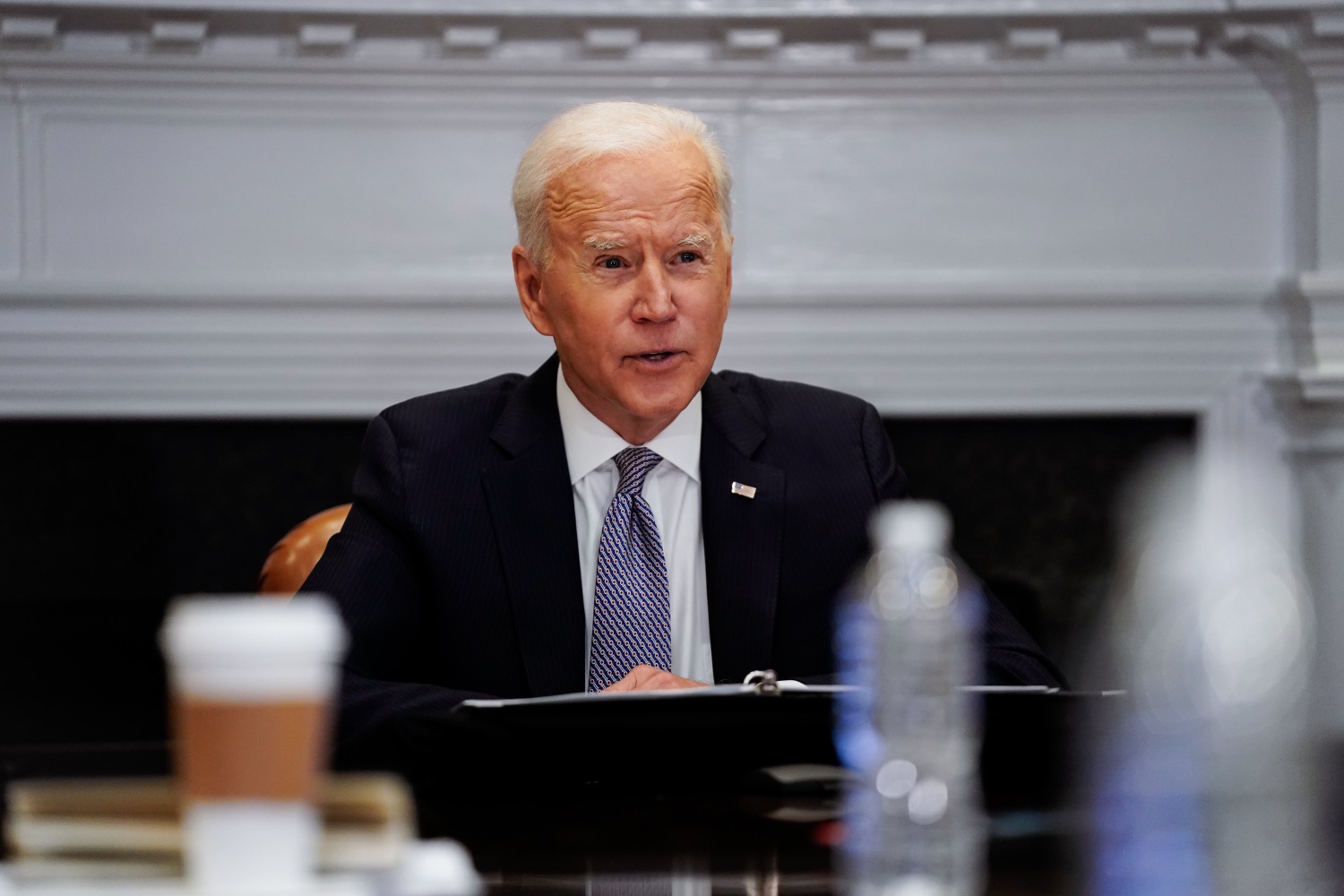
Enlarge/ President Joe Biden joins a CEO Summit on Semiconductor and Supply Chain Resilience via video conference from the Roosevelt Room at the White House on April 12, 2021, in Washington, DC.
President Joe Biden’s failure to break the Federal Communications Commission’s 2-2 partisan deadlock is reaching a “critical point,” 57 advocacy groups wrote in a letter to Biden and Vice President Kamala Harris Friday.
Nearly five months after his inauguration, Biden has not yet nominated a Democratic FCC commissioner to fill the empty fifth slot. Democrat Jessica Rosenworcel has been leading the commission as acting chairwoman, but she lacks the majority needed to do anything opposed by the FCC’s two Republicans, such as reinstating net neutrality rules and reversing former Chairman Ajit Pai’s deregulation of the broadband industry. Even a step like raising the FCC’s broadband-speed standard—which hasn’t changed in over six years—will likely require a party-line vote because Republicans prefer a low speed standard for the FCC’s annual report on how many Americans lack modern broadband access.
In early April, over 100,000 people signed a petition urging Biden to quickly break the FCC deadlock. Advocacy groups are frustrated that they are still waiting. Why Biden is taking so long is unclear.
“Given the legislative calendar and the diminishing number of days for hearings and confirmation votes, we have reached a critical point to guarantee the agency charged with ensuring affordable communications access can do its work during your administration,” the groups wrote in their new letter.
Senate takes months to approve nominees
Senate Republicans cemented the 2-2 deadlock in December 2020 by confirming a Trump nominee during the lame-duck session before Democrats took control of the White House and Senate. If not for that confirmation, the FCC would have had a 2-1 Democratic majority heading into Biden’s presidency.
Even if Biden were to nominate someone today, months could go by before the FCC has a Democratic majority because of the lengthy Senate confirmation process. For example, Biden nominated Lina Khan to the Federal Trade Commission on March 22, and she is expected to finally receive a confirmation vote on the Senate floor this week.
Even once there is a Democratic majority, complicated rule-makings could take a long time. During Obama’s second White House term, FCC Chairman Tom Wheeler took office in November 2013, made his first net neutrality proposal in April 2014, and led a vote to impose net neutrality rules in February 2015. The rules took effect in June 2015.
Biden’s broadband goals
Biden in March proposed spending $100 billion to deploy high-speed Internet access to all who lack it in the US, with municipal broadband providers getting priority access to that funding. He also promised action to lower prices, saying that ISPs charge too much. But he’s already cut his spending plan to $65 billion in the face of opposition from Republicans and private ISPs such as AT&T. They want to maintain the status quo in which private ISPs get most of the government funding and face little competition or pressure to lower their rapidly rising prices.
The advocacy groups’ letter praised Biden for recognizing the problems in the US broadband market but said he must act more quickly:
The emergency funding allocated and deployed through COVID-19 economic relief legislation and the billions proposed in the American Jobs Plan to close the digital divide are crucial measures. Time and again, your administration has demonstrated a deep understanding that broadband access is critical to education, work, health and wellbeing, and can literally be a matter of life and death.
Yet, as we move toward the second half of 2021 with no nomination for the fifth and final commissioner, the Federal Communications Commission remains below full capacity, which is incompatible with the goal of delivering open, affordable and reliable high-speed broadband to every home. This is all the more urgent given the fact poor families and people of color are disproportionately disconnected from high-speed Internet access, compounding grave inequalities that were made worse during the pandemic.
Restoring net neutrality
The groups that signed the letter include Demand Progress, Fight for the Future, Free Press Action, Public Knowledge, Institute for Local Self-Reliance, Mozilla, National Consumer Law Center, National Digital Inclusion Alliance, National Hispanic Media Coalition, Consumer Reports, Electronic Frontier Foundation, Communications Workers of America, American Library Association, and various others.
The groups told Biden that a fifth commissioner will allow the FCC to “reclassify broadband Internet access as a Title II service to ensure fair and equitable access for everyone and to reinstate strong net neutrality protections.” A 3-2 Democratic majority would also be able to “remedy previous neglect of the Lifeline program that supports low-income access to communications; create rules to make our nation’s networks more reliable and resilient; help guide the deployment of new broadband infrastructure built with federal dollars to make it as effective as possible; approve emergency waivers for E-rate funded infrastructure to be opened up for remote education; [and] meet the challenge of the 2018 Broadcast Ownership Quadrennial Review and halt the dangerous trend towards consolidated ownership in broadcasting by reasserting principles of localism, competition, and ownership diversity.”
The letter concluded:
The FCC, as an expert agency with a mandate from Congress, has the singular ability to act as an empowered advocate to ensure affordable and reliable communications for all. The pandemic showed us the unshakable image of children doing their classwork from fast-food parking lots using borrowed WiFi. We cannot let those students or any family wait any longer. We urge the administration to not lose any more time and to nominate a fifth commissioner who is dedicated to bringing open, affordable and reliable Internet access to all and fulfilling all of these vital goals.
https://arstechnica.com/?p=1773260
Five new bills aim to break up Big Tech platforms, force them to play nice
Enlarge/ The dome of the United States Capitol Building in Washington, DC.
Getty Images | Phil Roeder
Legislators in the US House of Representatives introduced five new bills Friday afternoon that promise the biggest overhaul of antitrust law since the trust-busting era of the early 1900s.
The bills take aim at the many platforms that Big Tech companies have rolled out over the last decade or so, including Apple’s iOS, Google’s search and ad platforms, Amazon’s marketplace, and Facebook’s social media and messaging networks. The proposed legislation would usher in sweeping changes both in the way monopoly regulations are enforced and in how companies run their platforms. They would require divestments in some cases while mandating interoperability and portability in others.
“Right now, unregulated tech monopolies have too much power over our economy,” said Rep. David Cicilline (D-R.I.), who introduced one of the bills. “They are in a unique position to pick winners and losers, destroy small businesses, raise prices on consumers, and put folks out of work. Our agenda will level the playing field and ensure the wealthiest, most powerful tech monopolies play by the same rules as the rest of us.”
“Big Tech companies are stifling American innovation with their monopolistic behavior,” said Rep. Lance Gooden (R-Tex.), who co-sponsored two of the bills. “By acquiring their competition and eliminating alternatives in the marketplace, they are denying fair access to the free market for small businesses across the country.”
While the legislation would not ban the platforms outright, it would subject companies to new regulations that would constrain their ability to provide certain products and services, while leveling the playing field for competitors.
Five proposals
The five bills all attempt to address issues that have arisen as various platforms have grown in power. None of the four major platform companies—Apple, Google, Facebook, and Amazon—would appear to be exempt from new regulations if they were signed into law.
One bill, known as the American Choice and Innovation Online Act, forbids platforms from favoring their own products and services. It would also stop companies from using private data to get a leg-up on the competition, and it would prevent them from kicking competitors off a platform or harming competitors by restricting their ability to “access or interoperate with the same platform, operating system, hardware, and software features that are available to the covered platform operator’s own products, services, or lines of business.” Introduced by Cicilline and co-sponsored by Gooden, the bill would levy significant penalties on companies that fail to comply—the greater of either 15 percent of the company’s average daily revenue or 30 percent of average daily revenue of the offending line of business.
Apple would appear to be most affected by this bill, though Google, Facebook, and even Amazon would not be exempt. By ensuring interoperability, the legislation would require each platform owner to open their software to competitors to some degree. Apple’s iOS and its tie-ins with Apple Music would be a primary target. Spotify has sued the company in the EU on antitrust grounds, and while Apple has been slowly allowing rival music services access to more system services like Siri, there’s still no way to supplant Apple Music as the default player.
Google’s ad marketplace would be impacted as well. The company’s Ad Manager is already the subject of a settlement with French competition authorities, who said the platform unfairly advantaged Google’s own products.
Another bill, the Ending Platform Monopolies Act, would prevent large platforms—those with at least 50 million monthly active US users and a market cap of $600 billion or more—from owning or operating businesses that would cause them to advantage their own products and services or disadvantage those of their competitors. App stores would be potential violators, but so would ad exchanges and music or video services. The bill, which was introduced by Rep. Pramila Jayapal (D-Wa.) and co-sponsored by Gooden, would impose fines similar to the American Choice and Innovation Online Act.
The Augmenting Compatibility and Competition by Enabling Service Switching (ACCESS) Act, introduced by Rep. Mary Gay Scanlon (D-Pa.) and co-sponsored by Rep. Burgess Owens (R-Utah), would require platforms to guarantee some minimum standard of interoperability and data portability. Facebook would appear to be the target here, given that social media profiles are basically impossible to port from one network to another.
The Platform Competition and Opportunity Act, introduced by Rep. Hakeem Jeffries (D-N.Y.) and co-sponsored by Rep. Ken Buck (R-Colo.), would require companies proposing mergers or acquisitions, not the government, to prove their case. Affected companies have 50 million monthly active users or 100,000 monthly active sellers and profits or a market cap of $600 billion or more. This bill is the only one to include “business users”—or seller accounts—which seems to single out Amazon’s marketplace with its millions of third-party sellers.
And the last bill, the Merger Filing Fee Modernization Act, is the only one that aligns with bipartisan legislation proposed in the Senate. The legislation would significantly increase filing fees for mergers, directing the money to regulators in the Department of Justice and the Federal Trade Commission to beef up their antitrust oversight capabilities. It was introduced by Rep. Joe Neguse (D-Colo.) and co-sponsored by Rep. Victoria Spartz (R-Ind.) and several other representatives and is similar to a Senate bill introduced by Sen. Amy Klobuchar (D-Minn.) and Sen. Chuck Grassley (R-Iowa).
Bipartisan movement
It’s unclear whether any of these bills will pass. The last one, the Merger Filing Fee Modernization Act, appears most likely at this point since it’s a relatively incremental piece of legislation that already has bipartisan support in both chambers. But the fact that the other bills, which garnered bipartisan support in the otherwise highly partisan House, suggests that a major overhaul of antitrust law may be imminent, even if these specific bills don’t survive.
https://arstechnica.com/?p=1773208
How to protect species and save the planet—at the same time
Getty Images
Humanity is struggling to contain two compounding crises: skyrocketing global temperatures and plummeting biodiversity. But people tend to tackle each problem on its own, for instance by deploying green energies and carbon-eating machines while roping off ecosystems to preserve them. But in a new report, 50 scientists from around the world argue that treating each crisis in isolation means missing out on two-fer solutions that resolve both. Humanity can’t solve one without also solving the other.
The report is the product of a four-day virtual workshop attended by researchers of all stripes and is a collaboration between the United Nations’ Intergovernmental Science-Policy Platform on Biodiversity and Ecosystem Services and the Intergovernmental Panel on Climate Change. In light of the Paris Agreement, it’s meant to provide guidance on how campaigns that address biodiversity might also address climate change, and vice versa.
The plain-language report should prove to be hugely influential not only among governmental policymakers and conservation groups, but also among corporations, says Betsy Beymer-Farris, a sustainability scientist at the University of Kentucky, who wasn’t involved in the report but did peer review it. “It’s hard for companies or even nation states to really distill academic literature,” Beymer-Farris says. The report both lays out the climate and biodiversity science and the social science of how to effect change with the help of the people who actually rely on the land for farming and grazing. “I definitely got excited when I reviewed the report,” Beymer-Farris adds. “I thought: OK, this is definitely different from what I’ve seen before because it’s a conscious and serious engagement with a more equitable and just way forward.”
So what might these campaigns look like? Say, for instance, you turn a heavily logged forest into a national park. As the trees grow back, they would sequester carbon in their tissues and provide habitat for the return of animals. Letting a forest come back naturally, rather than planting a single species of tree to offset some corporation’s carbon emissions, makes it more resilient. This is known as a nature-based solution, a campaign that both sequesters carbon and provides an extra ecological or economic benefit.
“You’re helping biodiversity, and you may actually generate opportunities for people to use that system sustainably,” says climatologist Hans-Otto Pörtner of the Alfred Wegener Institute in Germany. Pörtner cochaired the scientific steering committee for the workshop that produced the report. But, he continues, if you create a monoculture, “there’s only one use. And then if that crop that you’re using there is hit by some catastrophe, you’re losing that purpose altogether.”
A monoculture is less resistant to the ravages of a single disaster—like a wildfire—or the slower, constant stress of climate change. “When trees are stressed and sort of weak, they tend to be quite vulnerable to, let’s say, attacks from insects and other sorts of diseases,” says report coauthor Almuth Arneth, a modeling expert at the Karlsruhe Institute of Technology in Germany. And if that species is pretty much on its own, and it gets stressed and dies off, now the entire new forest is gone.
Biodiversity is a sort of insurance policy against this. A naturally growing forest includes a greater variety of species, and the odds are better that some of them will ride out a one-time catastrophe or endure ongoing stressors like higher temperatures and more intense droughts. Resilience is built into the ecosystem because it’s been functioning for thousands or even millions of years. Its greater odds of survival also mean that it’s got a better chance of holding onto all of its sequestered carbon, keeping it out of the atmosphere and preventing further global warming.
Halting humanity’s attacks on ecosystems can also help fight climate change, the study’s authors write. The draining of wetlands for agriculture kills off species and disrupts an important process for sequestering carbon. Slash-and-burn agriculture in the tropics ignites concentrated underground carbon known as peat, which releases astonishing amounts of greenhouse gases. (Yes, peat’s not just an Arctic thing.) Protecting coastal mangrove forests comes with a particularly long list of co-benefits, the report points out: They sequester four times the amount of carbon per area as a rainforest, they’re home to a wide range of species, and they act as a barrier that absorbs the energy of storm surges.
Even cities can get in on the action, the report notes. Urban areas turn into “heat islands” because they absorb the sun’s energy during the day and slowly release it at night. They are therefore much hotter than surrounding rural areas. Planting more trees cools cities and provides habitats for birds and shade for humans, which will be ever more critical as global temperatures rise. As an added bonus, green spaces are great for people’s mental health.
Which is all to say: People should be restoring habitats large and small. “When we talk about biodiversity conservation, we don’t necessarily mean that we have to set aside 30 to 50 percent of pristine areas and keep people out,” says Pörtner. “But there will be a transition between places that should be real nature reserves, and places where we have mixed uses, and the areas being shared between biodiversity and human uses. These sustainable uses may actually represent opportunities for sustainable livelihoods.”
Consider agroforestry, in which farmers grow crops within a forest instead of clearcutting it. In Brazil, for example, some farmers are switching from raising cattle, which requires the obliteration of a forest, to growing cacao, which does just fine in the shade of trees. Researchers have shown that this boosts the biodiversity of the rainforest. It’s a triple win: Farmers earn a livelihood, the forest holds on to its carbon, and a range of species is able to thrive. There’s a lot of room to improve when it comes to agriculture, the report notes, as the global food system is responsible for between 21 and 37 percent of humanity’s total net greenhouse gas emissions.
It’s critically important that conservationists don’t just steam into an area and tell the residents how they’re going to preserve their lands, says Daniela Miteva, an environmental economist at Ohio State University, who wasn’t involved in the report. Local people know the area’s flora and fauna better than anyone—and there are plenty of ways for them to make a living off the land without damaging it.
“Based on my experiences, working lands should not be underestimated,” says Miteva. “Local communities are very familiar with these lands. At least in my opinion, the way to go is to actually work with them to make sure that they have an incentive to protect the forest.” For example, there are ways to log a forest sustainably, known as reduced impact logging. Instead of clear-cutting, loggers would carefully fell individual trees to avoid crushing surrounding vegetation.
That means the solution won’t be as easy as saying, “Get people off the land and let nature take its course.” And that’s not what the report is arguing for. The authors conclude there has to be a balance between the well-being of people and protecting the land they rely on. “At the end of the day, these are local decisions,” says biogeochemist Rich Conant, who studies nature-based solutions at Colorado State University but wasn’t involved in the report. “And it’s going to continue to be very challenging to reassess this balance all the time as our priorities change.”
The big caveat, the authors stress, is that nature-based solutions alone can’t stop climate change. Ecosystems are only so resilient: As temperatures climb and droughts get more severe, it’ll be harder for forests, wetlands, and mangroves to survive, even with our help. First and foremost, humanity has to dramatically reduce its greenhouse gas emissions. “Nature is not going to save us,” Arneth says. “I think that is something that is going to be very clear in that report. We can only use nature to support efforts.”
Still, governments and corporations are becoming more conscious of the importance of maintaining biodiversity while also fighting climate change, says Beymer-Farris, from the University of Kentucky. Monocropping trees to offset emissions is out, and more nuanced and effective solutions are increasingly in. This new report could well accelerate that trend. “People might feel despondent over the status of biodiversity loss right now,” she says. “But I myself, as a professor who has been working in this for 20 years, I see a lot of hope, because I see a lot of change on the horizon.”
NY can’t force ISPs to offer $15 low-income broadband plans, judge rules
Getty Images | PM Images
On Friday, the broadband industry won a court order that prohibits New York from enforcing a state law that would require ISPs to sell $15-per-month broadband plans to low-income households.
Lobby groups for ISPs sued New York to block the law that was scheduled to take effect on June 15 and received a preliminary injunction today from US District Court for the Eastern District of New York. The state law is preempted by federal law, US District Judge Denis Hurley wrote in the order. While the case will continue, Hurley found that the industry is likely to succeed in its lawsuit.
The Affordable Broadband Act (ABA) would require ISPs to offer “all qualifying low-income households at least two Internet access plans: (i) download speeds of at least 25 megabits-per-second at no more than $15-per-month, or (ii) download speeds of at least 200 megabits-per-second at no more than $20-per-month,” the ruling noted. The low-income qualifications specified by the law cover about 7 million New Yorkers in 2.7 million households, over one-third of all households in the state. The law allows exceptions to the minimum-speed requirement “where such download speed is not reasonably practicable.”
$15 requirement “is rate regulation”
The New York law “is rate regulation, and rate regulation is a form of common carrier treatment,” Hurley wrote, rejecting arguments made by New York Attorney General Letitia James. he continued:
In Defendant’s words, the ABA concerns “Plaintiffs’ pricing practices” by creating a “price regime” that “set[s] a price ceiling,” which flatly contradicts her simultaneous assertion that “the ABA does not ‘rate regulate’ broadband services.” “Price ceilings” regulate rates.
The judge rejected New York’s argument that the Federal Communications Commission abandoned “its authority to regulate broadband at all” when Chairman Ajit Pai led a vote to undo the common-carrier classification that was imposed on ISPs during the Obama era.
“In reclassifying broadband Internet as a Title I information service, the FCC made the affirmative decision not to treat it as a common carrier,” the judge wrote. “The FCC’s affirmative decision is different from an abdication of jurisdiction writ large, even though Title I may not confer as expansive of powers as, say, Title II and its grant to impose common-carrier obligations.”
Hurley quoted from the Supreme Court’s Brand X ruling from 2005, which said that information-service providers “are not subject to mandatory common-carrier regulation under Title II, though the Commission has jurisdiction to impose additional regulatory obligations under its Title I ancillary jurisdiction to regulate interstate and foreign communications.”
Ultimately, the New York law “conflicts with the implied preemptive effect of both the FCC’s 2018 Order and the Communications Act,” Hurley wrote.
The FCC’s preemption power is limited. Pai tried to preempt all state net neutrality laws, even ones that didn’t exist at the time of his order, and was rebuffed in court. But Hurley decided that the ruling in that separate case “does not preclude or revoke the 2018 Order’s implicit preemptive effect.”
Interstate service
The judge also found that the state law is preempted because it covers an “interstate communication service.” The fact that the law only covers Internet users based in New York does not offset the fact that broadband access itself is an interstate service with transmissions that routinely cross state lines, the judge wrote:
The sole basis on which Defendant relies to call the ABA “intrastate” is its applicability only to “[c]ompanies that have chosen to provide service in New York.” But any state law can be construed as applicable only to those subject to that state’s jurisdiction, which, accordingly, does not make it “intrastate.” “The key to [the FCC’s] jurisdiction,” the line between inter- vs. intrastate, “is the nature of the communication itself rather than the physical location of the technology” or the consumers served.
Because the ABA regulates within the field of interstate communications, it triggers field preemption. Binding Second Circuit decisions are clear: the Communications Act’s “broad scheme for the regulation of interstate service by communications carriers indicates an intent on the part of Congress to occupy the field to the exclusion of state law.”
Hurley found that a preliminary injunction is needed to prevent ISPs from suffering “unrecoverable losses.”
“Beginning June 15, 2021, Plaintiffs will suffer unrecoverable losses increasing with time, and the enormity of the matter—six plaintiffs with multiple member organizations attacking a statute affecting one-third of all New York households—portends a lengthy litigation,” Hurley wrote. The lawsuit against New York was filed by the New York State Telecommunications Association, USTelecom, CTIA–The Wireless Association, NTCA–The Rural Broadband Association, the Satellite Broadcasting & Communications Association, and America’s Communications Association.
Hurley also cited statements from ISPs that suggest the law may “reduce Internet access statewide” by discouraging expansion. “Empire Telephone Corporation’s declarant avers that Empire will have to cancel expansion projects which, if completed, would result in Empire ‘serv[ing] more than 20,000 households,’ thereby disqualifying Empire from an exemption,” Hurley wrote. Providers with fewer than 20,000 residential customers are eligible for exemptions from the law. Hurley quoted two other small ISPs making similar claims.
https://arstechnica.com/?p=1772604
AT&T CEO seems confident industry can kill Biden’s municipal broadband plan
Enlarge/ AT&T’s logo at its corporate headquarters in Dallas, Texas.
AT&T CEO John Stankey yesterday called President Biden’s plan to fund municipal broadband networks “misguided” and said the US shouldn’t pay for any broadband deployment in areas that already have networks. But as AT&T and other ISPs lobby against public networks and government-funded competition, Stankey said he is confident that Congress will steer legislation in the more “pragmatic” direction that AT&T favors.
In an interview with The Economic Club of Washington, DC, (video), Stankey was asked, “Do you support the president’s proposal to have municipalities own broadband facilities?” Stankey responded, “I think actually the president’s proposal is probably a bit misguided in that regard.”
“It would be a shame that we take taxpayer money or ask local governments to go into a business that they don’t run today,” Stankey said. “You know, their job is to deliver water, patch streets, things like that, not be in a capital-intensive technology business that requires constant refresh and constant management.”
AT&T and other private ISPs have taken billions from the government to deploy incremental upgrades in rural areas over the years, and they don’t want public networks getting any of the cash they’re accustomed to receiving. Stankey claimed there isn’t much of a broadband problem to be solved, as networks “functioned incredibly well for the vast majority of citizens in the United States” during the pandemic. “Why would we want to go overbuild in areas where there’s already great infrastructure?” Stankey said, saying that would be a “waste” of subsidy dollars.
AT&T thinks 10Mbps uploads are enough
Of course, Stankey’s definition of “great infrastructure” would disappoint many Internet users. AT&T has fought proposals to subsidize fiber-to-the-home deployment across the US, arguing that rural people don’t need fiber and should be satisfied with Internet service that provides only 10Mbps upload speeds. Meanwhile, tens of millions of Americans lack modern broadband access, and a new study pushes back against industry claims that networks performed smoothly during the pandemic.
“Despite reports that the Internet handled the surge in traffic well, we find that complaints about Internet speed nearly tripled, and performance was degraded,” the study by Carnegie Mellon University researchers said. “Downstream data rates changed little, but median upstream data rates at midday dropped by about a third.”
Stankey yesterday said that government money for broadband should be used only for “getting somebody on the Internet who doesn’t have facilities and access” and for subsidies that pay the monthly bills of people who can’t afford service. Such an approach would help AT&T avoid competition and get more money by selling its existing services to customers who qualify for subsidies like the ongoing Emergency Broadband Benefit, which AT&T doesn’t even accept on all of its service plans. Although AT&T is expanding fiber access in metro areas this year, the company is not extending fiber to homes in most of its 21-state copper territory, and it intends to replace many of those copper lines with wireless service instead of fiber.
AT&T lobbyists always exert influence over telecom policymaking, and Stankey did not seem worried about Congress approving the portions of Biden’s plan that AT&T dislikes. “I don’t believe that policy is really practical and I actually believe that most policymakers that are in the sausage-making right now are seeing that and are probably steering this in a more pragmatic direction, in my view,” he said.
“Less pressure to turn profits” for public networks
In March, Biden proposed spending $100 billion over eight years to bring high-speed broadband to all Americans who lack access, with the plan “prioritiz[ing] support for broadband networks owned, operated by, or affiliated with local governments, non-profits, and co-operatives—providers with less pressure to turn profits and with a commitment to serving entire communities.”
That “commitment to serving entire communities” is important because private providers focus on building in the most profitable areas while municipal providers strive for universal service. City and town governments that build their own networks often take that action because private providers failed to give everyone affordable high-speed service.
The USTelecom lobby group claimed last month that “government broadband networks aren’t built for the long haul,” but provided only two of what it called “cautionary examples” in the US. By contrast, the Institute for Local Self-Reliance provides information on municipal broadband successes and a map of existing municipal networks across the US that “includes more than 900 communities, of which more than 560 are served by some form of municipal network and more than 300 are served by a cooperative.” The municipal fiber provider in Chattanooga, Tennessee, led PCMag to name the city the “number-one remote-working town in the US.”
Laws in nearly 20 states prevent the growth of these municipal services, however. While Congressional Republicans recently proposed a nationwide ban on municipal broadband, Democrats have proposed overturning the state laws that inhibit public networks.
Biden already cut $35 billion from broadband plan
Biden’s plan for municipal networks and his pledge to lower broadband prices set off a flurry of lobbying from cable and telco lobbies that prefer the status quo. Biden’s call for “future-proof” networks also set off alarm bells within the industry, as incumbent ISPs want to avoid competition from fiber-to-the-home technology in areas where their download and/or upload speeds lag behind fiber.
Biden already reduced his broadband ambitions. Even though Democrats control both chambers of Congress, Biden last month cut his spending plan from $100 billion to $65 billion to match a Republican proposal. The cut could ensure that no money goes toward funding networks in areas where there’s already broadband at basic speeds. Stankey yesterday said, “I will compliment the [Biden] administration on the bipartisan approach they’re using to try to define how we go forward from here.”
The amount of funding isn’t the only thing to be determined by Congress, as Stankey also pointed out in his criticism of municipal broadband. If Democrats try to devote funding to municipal networks, broadband-industry lobby groups and Republicans will do their best to redirect the money to private companies instead.
https://arstechnica.com/?p=1772540
Amazon, eBay fight legislation that would unmask third-party sellers
Enlarge/ Boxes move along a conveyor belt at the Amazon.com Inc. fulfillment center in Robbinsville, New Jersey.
Amazon and a who’s who of online-only retailers are trying to kill proposed federal and state legislation that would make the companies disclose contact information for third-party sellers.
The bills would force Amazon and others to verify the identities of third-party sellers and provide consumers with ways to contact the stores. The proposed legislation is pitting brick-and-mortar retailers—including Home Depot, Walgreens, and JC Penney, which support the bills—against online retailers like Amazon, Etsy, eBay, Poshmark, and others, which argue that the legislation would harm small sellers.
The bills come as brick-and-mortar retailers lost ground to online retailers throughout the pandemic—in 2020, 20 percent of consumer retail purchases were made online, compared with about 14 percent in 2019. But the legislation is also being proposed in response to a slew of counterfeit, stolen, and dangerous items that have appeared on marketplace sites.
The online retailers argue that the bills would compromise the privacy of third-party sellers. On some platforms, the majority of merchants run their businesses out of their homes. Etsy, for example, says 97 percent of its sellers do. A survey of Amazon sellers found that 70 percent have work outside of their Amazon businesses, suggesting that they, too, run the business from their homes.
“When you look at the unintended consequences of sellers trying to choose between their privacy and their safety and their livelihood, the result is you’re going to have fewer sellers online—and that really just benefits the Walmarts and Home Depots and the Lowes,” Alexis Marvel, a spokesperson for the Makers and Merchants Coalition, told Axios.
Cover for fraudsters
That anonymity, though, provides cover for fraudsters. It’s not uncommon to find counterfeit and potentially harmful items on marketplace sites. In 2018, the Government Accountability Office ordered 47 items, including shoes, travel mugs, cosmetics, and phone chargers, from third-party sellers on “popular consumer websites” and determined that 20 of them were counterfeit.
Even non-counterfeit items bought from third-party sellers have been implicated in consumer harm. In April 2018, a 19-month-old in Texas was injured after ingesting a battery that fell out of a loose battery compartment in a third-party Apple TV remote. The parents asked Amazon to stop selling the defective product and requested contact information for Hu Xi Jie, who ran the Amazon store “USA Shopping 7693” that sold the remote. Hu Xi Jie never responded, and Amazon was not able to locate the individual. The parents sued Amazon in Texas state court, arguing that the retailer is liable for the defective product. Amazon, on the other hand, says it serves as a middleman and bears no liability.
It’s that argument, among others, that has brick-and-mortar retailers pushing for changes. Consumer product laws hold businesses like Target and Home Depot liable for injuries if the stores do not take sufficient measures to keep defective products from reaching consumers. Online marketplaces haven’t been subject to those rules since they don’t control third-party sellers.
That doesn’t mean Amazon hasn’t felt pressure to address the issue. Last month, the company issued a report stating that it had “seized and destroyed” more than 2 million counterfeit products sent to its warehouses last year. To fight counterfeiters, Amazon said it introduced a new seller verification system that “connects one-on-one with prospective sellers through a video chat or in person at an Amazon office to verify sellers’ identities and government-issued documentation.”
Taking sides
Online retailers have formed two groups to fight the bills. One was started just six weeks ago and calls itself the Makers and Merchants Coalition. It’s funded by the Internet Association, which is supported by a range of companies, including retailers Amazon, Etsy, and Rakuten, and other Internet-related companies including PayPal, Google, and Microsoft. The other, the Coalition to Protect America’s Small Sellers, was started 10 weeks ago by platforms including eBay, Etsy, and Poshmark, which sell items exclusively from third parties.
On the other side, physical retailers have formed the Buy Safe America Coalition, which includesHome Depot, Lowes, Walgreens, CVS, and others.
No fewer than 17 states have proposed legislation to push online retailers to offer more transparency about third-party sellers. Federal legislation has been proposed, too. In March, Sen. Richard Durbin (D-Ill.) and Sen. Bill Cassidy (R-La.) introduced the INFORM Consumers Act and recently attempted to include it as an amendment to the United States Innovation and Competition Act. That effort failed, though the bill remains before the Senate.
https://arstechnica.com/?p=1772441
Some people can’t get FCC subsidy because “Street” isn’t the same as “St.”
Some broadband users who qualify for the government’s new $50-per-month subsidies haven’t been able to obtain the discounts because of technical problems in the Federal Communications Commission’s rollout of the program.
The problems stem from the FCC’s National Verifier and how the broadband providers’ systems interact with the FCC database, as detailed in an article published by Protocol today. Small mismatches between entries in databases—such as having an address recorded as “Elm St.” in an ISP’s system and “Elm Street” in the FCC’s—can cause people’s applications to be rejected.
ISPs may be partly to blame as some collected information in the wrong format despite having received training on how to use the system from the FCC. In hindsight, though, the FCC could have allowed ISPs to use the program without requiring such strict data matching. The Emergency Broadband Benefit (EBB) was rolled out quickly relative to other government programs because of the pressing need to get subsidies to consumers, and the FCC hasn’t been able to fully stamp out this problem in the month since the program began.
The FCC is working on fixes scheduled to roll out over the next couple of weeks, and ISPs have been in frequent communication with the agency. But customers continue to have problems in the meantime. People can apply for the subsidy at the program website, but they may run into frustrating snags when they follow up with their ISP.
Comcast and Charter customers stymied
Customers of Comcast and Charter have suffered this problem, as Protocol noted. But it appears to have affected numerous ISPs since the program began on May 12. Comcast and Charter have the most residential broadband customers in the US—over 60 million combined—and thus have more customers who could be wrongly denied the subsidy.
Protocol interviewed Louis Corsaro, who said he qualifies for the Emergency Broadband Benefit but has had his applications rejected by Comcast repeatedly over the past few weeks. Corsaro applied through the FCC’s verification site and quickly received an email response that said, “Your application has been approved.” The email “included instructions to sign up with his Internet service provider, so Corsaro went to Comcast’s website and filled out the required form.”
But Comcast rejected his application, Protocol wrote. The article continued with a description of Corsaro’s plight and a similar situation involving Charter’s Spectrum Internet service:
Over the last several weeks, Corsaro said he’s reapplied and been rejected by Comcast another three times. He’s followed the circuitous trails of automated FCC phone lines that all lead to dead ends and appealed to the kindness of mystified Comcast agents, who have told him again and again that he needs to finish the FCC’s verification process. “I keep telling them, ‘I’ve been approved. There’s nothing to finish,'” Corsaro said.
He’s not alone. A nursing student in California, who asked to remain anonymous to protect information about her income status, told Protocol she’s been experiencing the same problems with Spectrum. Like Corsaro, she also received an email from the FCC saying she was approved. And like Corsaro, she’s also been repeatedly rejected by Spectrum and told to complete the FCC eligibility screening. “It seems like everyone is very confused,” she said. “Once they do their application on their end, everything just goes into the void.”
People with low incomes or who suffered a substantial loss of income since the pandemic began to qualify for the subsidies. There are other ways to qualify, such as by participating in Medicaid or other assistance programs. Corsaro’s household qualified because his daughter has a disability and is on Medicaid.
“It was only after Protocol contacted Comcast for this story that Corsaro got a call saying his case had been ‘elevated’ on Wednesday,” the news site wrote. “Corsaro said a Comcast rep explained that the problem stemmed from the fact that Comcast’s website didn’t initially include a field to enter his daughter’s name, and his daughter’s Medicaid coverage is what made him eligible for the program. ‘She took my daughter’s info and redid the application,’ Corsaro said. ‘She said she will call me every day until it is resolved.'”
Besides the two people who talked to Protocol, customers have complained about the same problem in Reddit threads about both Comcast and Charter.
1,000 ISPs in subsidy program
Over 1,000 fixed and mobile ISPs across the US are participating in the subsidy program. In addition to being the nation’s largest home-Internet providers, Comcast and Charter accept the subsidies on a wider range of service plans than some other major ISPs. Both factors give the large cable companies the biggest number of residential customers who could possibly be affected by the FCC-subsidy problem.
Verizon has frustrated customers by limiting the plans on which they accept the subsidy, forcing people to switch to different and sometimes more expensive plans in order to get the temporary $50 monthly discount. AT&T offers the subsidy on only a few home-Internet plans.
By contrast, Comcast has said it offers the subsidy on all plans—even old ones it no longer sells to new customers. Charter is more restrictive than Comcast, as it forces customers on legacy plans to switch to new plans to get the subsidy. Charter offers the subsidies on all of its current Spectrum Internet plans except for the gigabit tier.
The FCC-run Emergency Broadband Benefit was created by Congress and funded with $3.2 billion. The pandemic-related program will continue until the money runs out or six months after the Department of Health and Human Services declares an end to the pandemic. Since it is temporary, people who face technical problems signing up could get the subsidy for fewer months than they are entitled to. So far, over 2.3 million people have successfully obtained subsidies, the FCC says.