Big Oil finds it hard to ignore pollution amid investor, court pressure
What comes up might go back down.
Yesterday was a bad day to be an oil company.
First, a court in the Netherlands ruled that Royal Dutch Shell needs to slash its emissions more than it had planned in order to meet Paris Agreement targets. The court ordered the oil supermajor to cut carbon pollution by 45 percent by the end of the decade.
Next, shareholders of ExxonMobil elected at least two board candidates—and possibly a third—put forth by activist investors who want the company to rein in its sprawling oil and gas operations and invest more in clean energy.
And lastly, Chevron’s shareholders rebuffed the company’s board to approve a proposal to reduce emissions produced by the use of its products, like the burning of gasoline.
Together, the legal ruling and shareholder votes appear to represent a dramatic shift in the way courts and shareholders plan to hold oil companies accountable in the face of a changing climate.
Court orders
The Shell ruling goes the furthest, demanding steeper cuts to emissions than the company had originally outlined. Like its European counterparts and unlike American companies, Shell has adopted a plan, including interim targets, for how it will reach net-zero emissions by 2050. But the plaintiffs in the Dutch case argued that Shell’s goal of a 20 percent reduction by 2030 didn’t go far enough and as a result violated human rights by shifting the majority of the burden onto later generations.
The rough outlines of the decision echo the outcome of a recent German court case in which the government was sued for punting on emissions reductions after 2030. In that case, the Constitutional Court ordered the German government to move more aggressively and detail emissions cuts between 2030 and 2050. Less than a week later, government officials announced that they had moved up the net-zero deadline by five years and set interim targets of 65 percent below 1990 levels by 2030 (up 10 percent from before) and 88 percent by 2040.
Other European oil companies like BP and Total have set emissions goals that reflect Shell’s. In the wake of the ruling, they may also find themselves the target of lawsuits. Shell has vowed to appeal, so the outcome of the case may be some years off. But the decision was a clear warning that oil companies should begin to take serious measures to reduce their emissions.
Board votes
The Exxon board vote sounded a similar warning. Hedge fund Engine No. 1, which Bloomberg reports as having no history of activism in oil and gas, put forward a slate of four candidates for the board. Their goal is to push the descendent of Standard Oil toward more investments in clean energy and to force the company to pare back new capital expenditures on oil and gas projects. Exxon spent $35 million to defeat the candidates and beat back the proposals.
Engine No. 1 was partly victorious thanks to votes from BlackRock, Exxon’s second-largest shareholder and the world’s largest investment manager, with more than $8.6 trillion under management. The firm has taken an increasingly aggressive stance on how companies it invests in should approach climate-related risks.
Two of Engine No. 1’s candidates won their elections outright, and the tally for a third was too close to announce. The new board members are Kaisa Hietala, former renewable products VP at Neste, a Finnish oil refiner, and Geoffrey Goff, former CEO of Andeavor, another oil refiner. The third candidate who may yet win is Alexander Karsner, a senior strategist at X, the Alphabet division.
In addition, Exxon shareholders approved two proposals aimed at increasing the transparency of the company’s lobbying efforts. One requires all lobbying expenses to be reported, and another requires the board to report on whether the company’s lobbying of lawmakers lines up with the Paris Agreement.
Chevron’s shareholders also voiced their displeasure with the way the company has handled environmental concerns. More than 60 percent voted for a proposal to reduce “scope 3 emissions,” which are produced when customers use the company’s products. For oil and gas companies, that’s a lot—much of what they sell goes up in smoke. Chevron’s own data suggests that its scope 3 emissions dwarf its direct emissions by at least an order of magnitude.
Separately, none of these decisions will make a significant dent in carbon emissions or do much to mitigate climate change. But taken together, they start to add up to something. And more broadly, they may represent a turning of the tide. Big oil and gas companies are coming under increasing scrutiny, and that situation looks unlikely to change any time soon.
https://arstechnica.com/?p=1768090
Amazon’s most-favored nation clauses slammed in lawsuit filed by Washington, DC
The District of Columbia sued Amazon Tuesday, alleging that the online retail giant violated antitrust law with policies that prevent sellers from offering products at lower prices on other websites.
“Amazon fixed online retail prices through contract provisions and policies” that “prevent third-party sellers that offer products on Amazon.com from offering their products at lower prices or on better terms on any other online platform, including their own websites,” Attorney General Karl Racine’s office said in an announcement of the lawsuit. The complaint was filed in the District of Columbia Superior Court.
Amazon’s most-favored nation (MFN) agreements “effectively require third-party sellers to incorporate the high fees charged by Amazon—as much as 40 percent of the total product price—not only into the price charged to customers on Amazon’s platform but also on any other online retail platform,” Racine’s announcement said. “As a result, these agreements impose an artificially high price floor across the online retail marketplace and allow Amazon to build and maintain monopoly power in violation of the District of Columbia’s Antitrust Act.”
The lawsuit asks for a judgment stating “that Amazon’s actions constitute unreasonable and unlawful restraints of trade” and “that Amazon acted unlawfully to maintain or attempt to achieve a monopoly in the online retail sales market in the United States.” The complaint seeks an injunction prohibiting Amazon from continuing the allegedly anticompetitive practices described in the lawsuit, along with civil penalties, attorneys’ fees, and “restitution and damages for harmed consumers.”
Amazon says DC “has it exactly backwards”
Amazon will fight the lawsuit.
“The DC Attorney General has it exactly backwards—sellers set their own prices for the products they offer in our store,” Amazon said in a statement provided to Ars. “Amazon takes pride in the fact that we offer low prices across the broadest selection, and like any store, we reserve the right not to highlight offers to customers that are not priced competitively. The relief the AG seeks would force Amazon to feature higher prices to customers, oddly going against core objectives of antitrust law.”
Amazon’s statement did not explain how the lawsuit would force it to “feature higher prices.” We asked the company for an explanation and will update this article if it responds.
Racine’s lawsuit describes the competitive advantages sellers get when they are “awarded the ‘Featured Offer’ or ‘Buy Box'” on a product listing. The lawsuit said that Amazon’s “Buy Box selection algorithm favors those sellers who pay Amazon for FBA [Fulfillment by Amazon] over those who do not,” even when a different seller offers the same product at a lower price. The algorithm also favors sellers whose products are eligible for free two-day shipping with Amazon Prime, but paying for Amazon’s fulfillment service “is the easiest way to become Prime-eligible,” the lawsuit said.
Racine’s press release said that Amazon claimed in 2019 to have “removed its price parity policy that explicitly prohibited third-party sellers from offering their products on a competing online retail sales platform” at lower prices. But Amazon replaced that policy “with an effectively identical substitute, its Fair Pricing Policy,” Racine’s office said. “Under the Fair Pricing Policy, third-party sellers can be sanctioned or removed from Amazon altogether if they offer their products for lower prices or under better terms on a competing online platform.”
Amazon’s most-favored nation clauses were also cited in a recent lawsuit filed by a small bookstore that alleges Amazon colluded with the five major book publishers to fix wholesale prices and block other sellers “from competing on price or product availability.”
The DC lawsuit’s potential to bring refunds to consumers is limited by the fact that Racine filed the suit in DC Superior Court. “It’s not nearly as direct as a federal case,” Herb Hovenkamp, an antitrust professor at Pennsylvania Law School, told The Washington Post. “In this case, we’ve got one party suing in one state court, so if they win, it’s going to cover DC and that’s pretty much it.”
Amazon’s market power
Hovenkamp also said it might be difficult to prove that Amazon has dominant market power. Despite Amazon’s size, “when you start taking apart its individual products—other than e-books—it generally doesn’t have a dominant share,” he said.
Racine’s lawsuit said that Amazon “control[s] between 50-70 percent of all online retail sales in the US, and Amazon holds an even larger market share of multi-seller online retail platforms, such as Walmart.com and eBay.” Walmart and eBay each have about 5 percent of the online retail sales market, the lawsuit said. As for where that data comes from, Racine’s press release points to a 2020 Congressional report on competition in digital markets, which cites estimates from various sources. The same report said that “Amazon has monopoly power over most third-party sellers and many of its suppliers.”
Over 2 million independent, third-party sellers use Amazon to sell their products, Racine’s lawsuit said.
“Sixty-six percent of consumers start their search for new products on Amazon, and a staggering 74 percent go directly to Amazon when they are ready to buy a specific product,” the complaint said. “Given its ubiquitous presence in the online retail sales market, Amazon’s business practices and decisions have an outsized effect on the US economy.”
https://arstechnica.com/?p=1767630
Florida makes it illegal for Facebook and Twitter to ban politicians
Enlarge/ Florida Gov. Ron DeSantis speaks during the Conservative Political Action Conference (CPAC) in Orlando, Florida, on Friday, Feb. 26, 2021.
Florida Gov. Ron DeSantis yesterday signed a bill into law to stop what he called the “censorship” of conservatives on social-media websites such as Twitter and Facebook. The law is likely to be challenged in court and has been described as blatantly unconstitutional by legal experts and advocacy groups across the political spectrum.
But Florida’s governor and legislature were undeterred by the possibility that courts will strike down the law as violating the First Amendment. The law gives Floridians the right to sue Big Tech companies over content-moderation decisions and prohibits the companies from “deplatforming” political candidates and journalistic enterprises. It is scheduled to take effect on July 1.
“This session, we took action to ensure that ‘We the People’—real Floridians across the Sunshine State—are guaranteed protection against the Silicon Valley elites,” DeSantis, who has a Harvard University law degree, said in a press release. “Many in our state have experienced censorship and other tyrannical behavior firsthand in Cuba and Venezuela. If Big Tech censors enforce rules inconsistently, to discriminate in favor of the dominant Silicon Valley ideology, they will now be held accountable.” Lt. Gov. Jeanette Nuñez said the law is important because many Floridians “know the dangers of being silenced or have been silenced themselves under communist rule.”
The new law (full text) carves out an exception for tech companies that happen to also own theme parks. That would exempt both Disney and Comcast, the latter of which owns NBCUniversal including Universal Theme Parks. Specifically, the law exempts “any information service, system, Internet search engine, or access software provider operated by a company that owns and operates a theme park or entertainment complex as defined in [Florida law].” To qualify for the exemption, the company’s theme park or entertainment complex must be “comprised of at least 25 contiguous acres,” provide “permanent exhibitions and a variety of recreational activities,” and have “a minimum of 1 million visitors annually.”
While the governor’s announcement didn’t explain the theme-park exemption, it said that “Floridians treated unfairly by Big Tech platforms will have the right to sue companies that violate this law—and win monetary damages. This reform safeguards the rights of every Floridian by requiring social-media companies to be transparent about their content moderation practices and give users proper notice of changes to those policies, which prevents Big Tech bureaucrats from ‘moving the goalposts’ to silence viewpoints they don’t like.”
Additionally, the Florida attorney general “can bring action against technology companies that violate this law, under Florida’s Unfair and Deceptive Trade Practices Act.” Companies that violate the law “will be restricted from contracting with any public entity.”
Ban on banning politicians
The prohibition on kicking politicians off social media platforms allows the Florida Election Commission to “impose fines of $250,000 per day on any social media company that deplatforms any candidate for statewide office, and $25,000 per day for deplatforming candidates for non-statewide offices.”
The law says that “[a] social media platform may not willfully deplatform a candidate for office who is known by the social media platform to be a candidate” and that the “platform must provide each user a method by which the user may be identified as a qualified candidate.” Deplatform is defined as “the action or practice by a social media platform to permanently delete or ban a user or to temporarily delete or ban a user from the social media platform for more than 14 days.”
DeSantis objected to the banning of then-President Donald Trump, who was kicked off Twitter and Facebook for inciting violence. “Any Floridian can block any candidate they don’t want to hear from, and that is a right that belongs to each citizen—it’s not for Big Tech companies to decide,” the governor’s announcement said.
US Sen. Ron Wyden (D-Ore.) blasted Florida’s leaders in a statement yesterday. “Following Donald Trump’s lead, Republican-led states are determined to pass laws to force websites and apps to host lies, misinformation and other slime, with full knowledge that those laws are unconstitutional,” Wyden said. “The latest such example out of Florida—which compels online sites to host the speech of politicians—is particularly egregious, and an invitation for extremists, racists and liars to register as political candidates just to keep their posts online.”
While numerous experts believe the Florida law will eventually be struck down, Supreme Court Justice Clarence Thomas recently argued that social media platforms could be regulated as “common carriers.”
Defining censorship
Nuñez claimed that there has been “an effort to silence, intimidate, and wipe out dissenting voices by the leftist media and big corporations. Today, by signing SB 7072 into law, Florida is taking back the virtual public square as a place where information and ideas can flow freely. Many of our constituents know the dangers of being silenced or have been silenced themselves under communist rule. Thankfully in Florida we have a governor that fights against big tech oligarchs that contrive, manipulate, and censor if you voice views that run contrary to their radical leftist narrative.”
The law requires social media platforms to “publish the standards, including detailed definitions, it uses or has used for determining how to censor, deplatform, and shadow ban” and to “apply censorship, deplatforming, and shadow banning standards in a consistent manner among its users on the platform.” It also says the platforms “may not take any action to censor, deplatform, or shadow ban a journalistic enterprise based on the content of its publication or broadcast,” unless the content is “obscene.”
The law defines censorship as “any action taken by a social media platform to delete, regulate, restrict, edit, alter, inhibit the publication or republication of, suspend a right to post, remove, or post an addendum to any content or material posted by a user,” and “actions to inhibit the ability of a user to be viewable by or to interact with another user of the social media platform.” Shadow banning is defined as actions “to limit or eliminate the exposure of a user or content or material posted by a user to other users of the social media platform.”
Supreme Court precedent may doom Florida law
Experts who say the new law is unconstitutional cite a previous case in which a similar Florida law was struck down. After DeSantis announced the proposal in February, First Amendment attorney Ari Cohn told Law & Crime that it “raises the same issue as a previous Florida law which required newspapers that criticized a political candidate to publish that candidate’s response.” In the 1974 case, Miami Herald v. Tornillo, “the Supreme Court struck down the law, ruling that it violated the newspapers’ First Amendment right to choose which content to run or not run,” Cohn said. That case involved a law enacted in 1913.
The Law & Crime article continued:
Professor Daxton “Chip” Stewart, a media law expert who referred to the proposal as “hilariously unconstitutional,” said that DeSantis exhibited a fundamental misunderstanding of corporations’ rights.
“Basically, DeSantis seems to forget that private companies like Facebook and Twitter have First Amendment rights, too,” Stewart noted. “The government can’t force them to host speech they don’t want to, or threaten punishment like these absurd fines for refusing to give platforms to people they find intolerable. Just as a platform can remove accounts of terrorists or the KKK or a cabal that conspires to violently overthrow the government, they can remove accounts of any other individual.”
EFF and TechFreedom agree
The Electronic Frontier Foundation cited the same case. “Since Tornillo, courts have consistently applied it as binding precedent, including applying Tornillo to social media and Internet search engines, the very targets of the [Florida] Transparency in Technology Act (unless they own a theme park),” EFF General Counsel Kurt Opsahl wrote earlier this month. “Indeed, the compelled speech doctrine has even been used to strike down other attempts to counter perceived censorship of conservative speakers.”
On the Lawfare blog in March, TechFreedom Internet Policy Counsel Corbin Barthold and President Berin Szóka also pointed to the Miami Herald v. Tornillo case as an example of why the new law won’t pass constitutional muster. The Supreme Court “has repeatedly held that digital media enjoy the same First Amendment protection as traditional media,” they wrote.
“Only once has the Supreme Court upheld a ‘fairness’ or ‘equal time’ mandate on privately owned media. But that was a special case,” they wrote. “In 1969, Red Lion Broadcasting Co. v. FCC upheld the Federal Communication Commission’s Fairness Doctrine only because broadcast frequencies are scarce, they are owned by the public, and the government licenses their use—clear ‘state action.'”
DeSantis’ argument that Big Tech companies are monopolistic is similar to an argument rejected in the 1974 case, they wrote. “The plaintiff in Miami Herald made a similar argument—and, indeed, many local markets really did have only a single newspaper,” Barthold and Szóka wrote. “Yet the court ruled that no degree of monopoly power could diminish the First Amendment’s protection of newspapers’ editorial discretion.”
Section 230 also protects websites
Wyden pointed out that Section 230 of the Communications Decency Act is also relevant. That US law gives legal immunity to online platforms that block or modify content posted by users.
“The First Amendment to the United States Constitution—backstopped by Section 230—makes it abundantly clear that states have no power to compel private companies to host speech, especially from politicians,” Wyden said. “People eager to chip away at core First Amendment protections for speech must remember that the consequences won’t just impact content they dislike—they’ll apply to everything. Government control of speech on, or off-line, will inevitably be abused by those in power, as made crystal clear by Republican state legislatures at home, and governments abroad like India and China that are already censoring critics.”
https://arstechnica.com/?p=1767478
Sensor-driven turbine platforms could unlock 4,000 TWh of offshore wind
Enlarge/ A rendering of GE and Glosten’s actively managed tension leg platform for floating offshore wind projects.
The US took its first steps toward embracing offshore wind power earlier this month with the approval of the Vineyard Wind 1 project off the coast of Massachusetts. When the site is complete, 62 massive wind turbines anchored in the continental shelf will crank out 800 MW of electricity, giving the East Coast its first taste of a large, nearby, and renewable power source. And while the project shows the promise of offshore wind, the industry’s future may lie even deeper in the ocean.
In US waters alone, 58 percent of offshore wind capacity—some 4,200 TWh per year—is beyond the reach of fixed-foundation wind turbines, which are commercially limited to depths of less than 60 m. Offshore wind represents a massive untapped resource and could go a long way toward addressing the approximately 4,000 TWh of electricity used in the US last year.
To access offshore wind power, companies have been experimenting with floating platforms that would support the industry’s largest turbines. Yesterday, General Electric and Glosten, an engineering consultancy, announced a new design and control scheme that could significantly lower the cost of floating offshore wind as part of the ARPA-E ATLANTIS program.
Researchers from GE began with their company’s latest design, the 220-meter rotor Haliade X turbine that produces anywhere between 12 and 14 MW of power. “The Halide X turbine is a massive machine,” Rogier Blom, senior principal engineer at GE and the project’s lead, said to Ars. “To have a floating platform that can support that, these platforms need to be pretty massive. The state-of-the-art is to design the platform independent from the turbine.”
That design philosophy results in massive platforms that require more materials than may be necessary, driving up costs and making installation more challenging. Many of today’s floating platforms rely on gravity to keep turbines upright, and the platforms weigh up to three times more than the turbines. Other platforms are simply tethered to the seafloor, a situation that can make controlling the turbine more challenging.
“The reality is the platform behavior—its motions back and forth, its tilting behavior as a result of the waves—are very dynamically coupled with the behavior of the turbine, the bending of the tower, for example,” Blom said. “By separately designing turbine and platform, you’re essentially ignoring that coupling. That’s what’s driving inefficiency of overall design.”
Blom and his colleagues investigated whether they could design a dynamic platform that could communicate with the turbine so the two could work together to manage the myriad forces acting on the combined structure. The researchers landed on a tension leg platform, which essentially looks like a pirate ship’s anchor with many flukes instead of just two. Each of those flukes is then tethered to the seafloor.
Those tethers, or tendons, are key to the new GE design. “We’re looking to make the platform active, allow it to adjust its positioning through active tendons, to ride with the waves, control the positioning as it’s being moved back and forth, up and down with the waves, to ensure that it’s safe,” Blom said. “But we also want to ensure that all of those mechanical loads that the turbine would experience are as low as possible, while maximizing the resulting energy the turbine produces.”
Wind turbines already actively manage the pitch of their blades and the torque of their generator to optimize energy production while minimizing fatigue. The new tension leg platform that Blom and his colleagues designed coordinates the turbine’s responses with the tensioning or loosening of each tendon. All of this happens several times a second to continuously adjust the entire system.
The active design could trim up to 35 percent of the total mass of the platform, GE says, allowing wind developers to cut a significant driver of costs. It could also mean that a future platform may help install itself. Today, tension leg platforms require a special ship to bring the platform down to the correct depth. An active system could winch itself down, further reducing costs. How much money could be saved remains to be seen—the team has yet to do a full analysis of how the system would change the levelized cost of electricity, a key metric used to compare different sources of power, though it’s in the team’s plans. Currently, ARPA-E is looking to the next two-year phase of the project, which would result in a prototype that could be tested out at sea.
Offshore wind developers have already begun eyeing floating platforms in addition to more traditional fixed-platform projects. Winds offshore are more favorable than onshore, and floating platforms allow developers to site turbines in even more beneficial locations. Plus, floating platforms can be placed beyond the horizon, tackling one of offshore wind’s most challenging issues—NIMBYism.
As the offshore wind industry has matured, prices have dropped significantly. In Europe, costs of fixed platforms have fallen so much that the platforms may not require government subsidies. That could free up money for floating platforms, which remain pricier.
Blom said that his group isn’t seeking to replace fixed platforms; instead, it wants to open new swaths of the ocean to wind development.
https://arstechnica.com/?p=1767468
Biden cuts broadband plan from $100 billion to $65 billion to match GOP offer
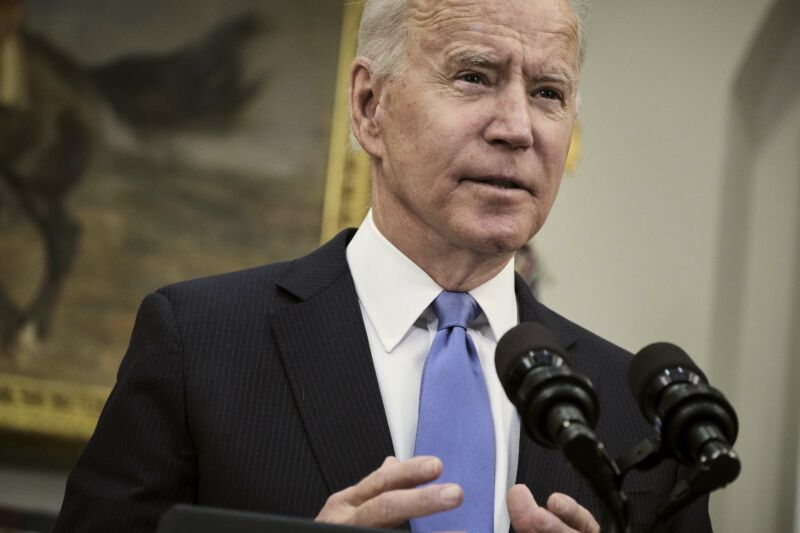
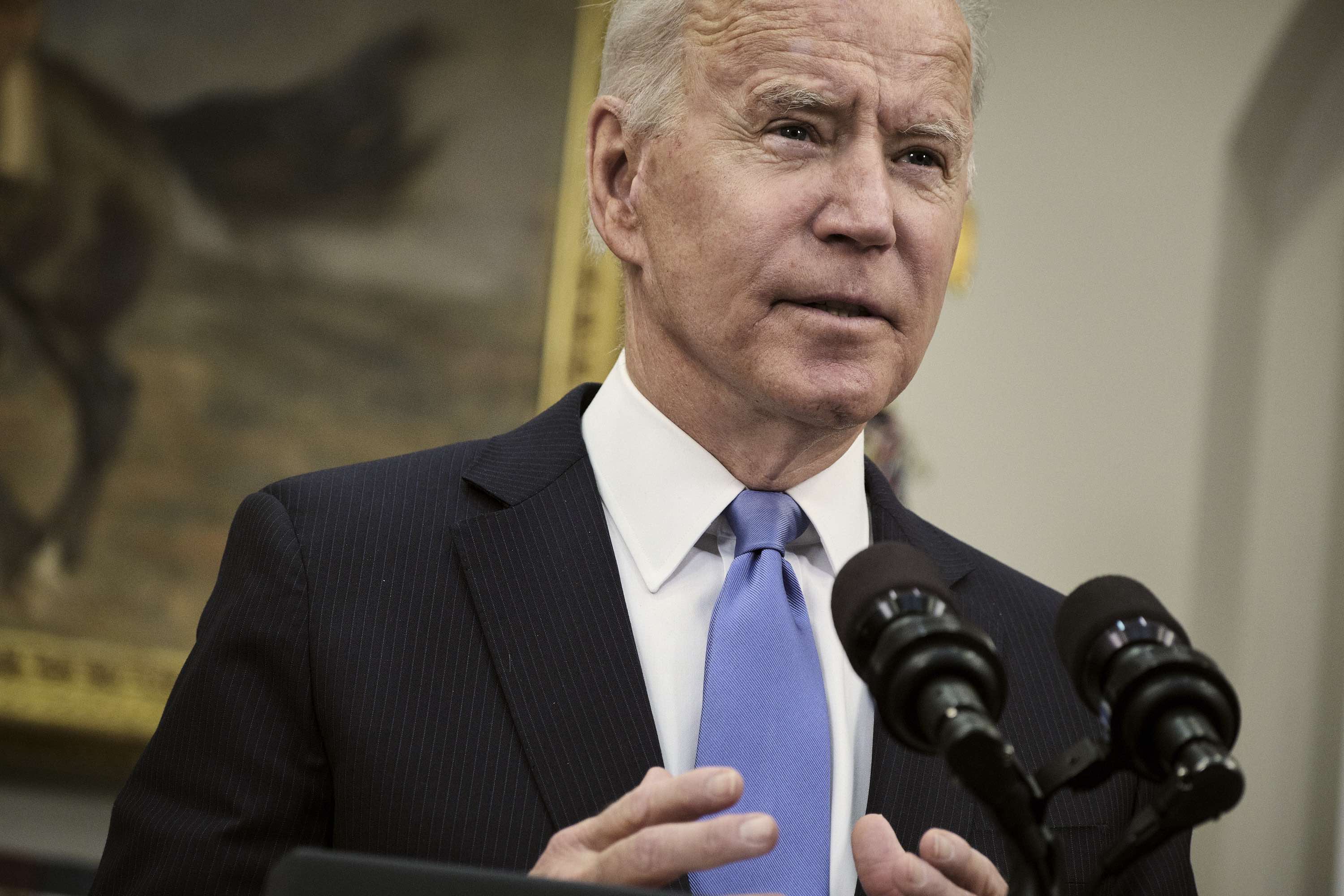
Enlarge/ President Joe Biden speaks in the Roosevelt Room of the White House on Thursday, May 13, 2021.
Getty Images | Bloomberg
President Biden has cut his broadband-deployment spending proposal from $100 billion to $65 billion, matching the lower amount proposed by Republicans. But Republicans still object to Biden’s overall infrastructure spending plan and have consistently opposed the municipal broadband networks that Biden wants to prioritize in government-funded projects.
Biden “agreed to reduce the funding request for broadband to match the Republican offer and to reduce the proposed investment in roads, bridges, and major projects to come closer to the number proposed by the senators. This is all in the spirit of finding common ground,” White House Press Secretary Jen Psaki said on Friday during a media briefing.
Biden made the $100 billion broadband proposal on March 31 as part of his larger American Jobs Plan, saying the multi-year funding would pay for “‘future-proof’ broadband infrastructure in unserved and underserved areas so that we finally reach 100 percent high-speed broadband coverage.”
The White House informed Republicans of Biden’s willingness to cut $35 billion from his broadband proposal in a memo on Friday. “We believe we can still achieve universal access to affordable high-speed Internet at your lower funding level, though it will take longer,” the White House told Republicans, according to NPR. “Any funding agreement would need to be paired with reforms to ensure these investments create good jobs, promote greater competition, and close the digital divide.”
Biden cut his overall plan from $2.25 trillion over eight years to $1.7 trillion. That’s still about three times larger than the $568 billion Republican counteroffer, and Senate Minority Leader Mitch McConnell “has said he doesn’t see Republican lawmakers supporting spending much more,” NPR wrote.
Biden “believes that the extraordinarily wealthy, the companies that, many of whom have not paid taxes in recent years, can afford a modest increase to pay for middle-class jobs,” Psaki said. McConnell has opposed reversing any part of the 2017 corporate tax cut.
“Democrats could try to pass a spending proposal on party lines using Senate reconciliation rules, but several moderate Democrats, such as Sen. Joe Manchin of West Virginia, have made it clear to the White House they’d prefer a bipartisan plan,” the NPR article said.
Sen. Ed Markey (D-Mass.) pushed for the Senate to move ahead without any further cuts to Biden’s plan. “Despite President Biden’s efforts to engage with Republicans, they have shown no willingness whatsoever to negotiate in good faith with Democrats to confront the intersecting crises we face… Let’s not waste time trading the necessary scope and scale of this critical infrastructure package for Congressional Republican votes that have yet to and will never materialize,” Markey said.
Republicans oppose municipal broadband
Even though Biden’s new offer of $65 billion for broadband matches the amount proposed by Republicans, the size isn’t the only part likely to be opposed by the GOP. Instead of giving private ISPs the best shot at receiving funding, Biden proposed “prioritiz[ing] support for broadband networks owned, operated by, or affiliated with local governments, non-profits, and co-operatives—providers with less pressure to turn profits and with a commitment to serving entire communities.” This could be a major change from previous US spending programs that doled out billions to private Internet providers. Republicans have consistently fought against public broadband for years, and this year they proposed a nationwide ban on municipal broadband networks.
By contrast, Biden proposed “lifting barriers that prevent municipally owned or affiliated providers and rural electric co-ops from competing on an even playing field with private providers,” suggesting he wants to overturn state laws that restrict municipal broadband. Biden’s proposal would also “requir[e] Internet providers to clearly disclose the prices they charge,” which is an attempt to end the rampant hidden fees that ISPs use to raise actual prices above their advertised rates. The cable lobby claimed that Biden’s plan is “a serious wrong turn.”
Biden’s pitch to build “future-proof” broadband technology is also facing opposition from broadband providers who don’t want to build fiber-to-the-home networks in rural areas. Just before Biden announced his plan, AT&T said it opposes subsidizing fiber-to-the-home deployment across the US, arguing that rural people don’t need fiber and should be satisfied with Internet service that provides only 10Mbps upload speeds.
Biden’s American Jobs Plan also said that “the president is committed to working with Congress to find a solution to reduce Internet prices for all Americans,” drawing protests from ISPs that don’t want any limits on what they can charge consumers.
https://arstechnica.com/?p=1767143
IMF says $50 billion is needed to end Covid pandemic in 2022
The world could “end the pandemic” in mid-2022 by vaccinating 60 percent of the population at a cost of $50 billion, the IMF has said, as rich countries and vaccine manufacturers pledged to address the inequality undermining the global response to coronavirus.
Countries with sufficient vaccine supplies could afford to donate 1 billion doses in 2021, even while continuing to prioritise the immunisation of their own populations against Covid-19, the IMF said in its report released at a virtual G20 Health Summit on Friday.
Combined with upfront financing, the vaccine donations would bring a faster end to the pandemic, saving millions of lives and yielding economic benefits of about $9tn to global gross domestic product by 2025, it estimated.
“In the absence of urgent actions, many emerging and developing economies may have to wait until the end of 2022 or later to bring the pandemic under control,” the IMF warned. “That will be too late not just for those countries but also for the world.”
The $50 billion figure is tiny compared with the $16tn that the IMF estimates countries have already spent supporting households and businesses during the pandemic. But some health experts say the biggest impediments to vaccination drives are not funding but logistics and national politics.
The IMF proposal was released as Ursula von der Leyen, European Commission president, told the virtual meeting that the EU would donate at least 100m vaccines to poorer countries by the end of the year, including 30m doses each from Germany and France.
While some countries have begun to celebrate falling infection rates, successful vaccination campaigns and a return to some semblance of normality, global cases of Covid infections are at present at some of the highest levels since the start of the pandemic.
“As we prepare for the next pandemic, our priority must be to ensure that we all overcome the current one together. We must vaccinate the world, and do it fast,” said Italian prime minister Mario Draghi, who hosted the virtual meeting.
Pfizer and BioNTech also pledged to supply 1 billion cut-price doses to poorer nations in 2021 and a further 1 billion in 2022. The companies’ breakthrough Covid-19 shot has become the mainstay of vaccination campaigns in Europe and the US.
To date, about 1.6 billion vaccinations have been administered worldwide out of a global population of almost 8 billion, according to Financial Times data. But vaccination campaigns continue to be interrupted by practical and political difficulties.
Although the UK has vaccinated 60 percent of its adults with at least one dose of a Covid vaccine, most African countries have immunized less than 1 percent of their population. The IMF said the world should aim to have vaccinated 40 percent of all countries’ populations by the end of 2021 and at least 60 percent by the middle of 2022.
“The proposal requires not just commitments but upfront financing, upfront vaccine donations and upfront ‘at-risk’ precautionary investments,” Kristalina Georgieva, IMF managing director told the virtual summit. “It is essential that all necessary financing is available immediately.”
Manufacturing has been constrained this year by shortages of key materials and supply disrupted by export controls in leading producers such as India. The possibility that the mutating virus will undermine the efficacy of existing shots has also raised concerns that the pandemic could drag on, even if the manufacturing and supply problems are overcome.
To prevent the spread of new and more virulent variants of Sars-CoV-2, the IMF also outlined the need to invest in widespread deployment of test-and-trace initiatives as a precautionary measures.
The proposed measures could be funded with $35 billion in grants from donor countries and $15 billion in financing from national governments, the IMF said. The $35 billion in donations would include a $4 billion increase in upfront funding to the international Covax initiative to increase vaccination coverage in low- and middle-income countries from the current target of 20 percent to 30 percent by the end of this year.
The report suggested vaccine production capacity had already become less of a constraint on vaccination than previously feared. The IMF “conservatively” expected “at least 6 billion vaccine doses [to be] produced and administered worldwide by the end of 2021,” it said.
Thomas Bollyky, a senior fellow at the US Council on Foreign Relations, said the IMF proposal was “useful for prodding people to think about what’s needed” but warned that money was “no substitute for political leadership.”
“The challenge hasn’t been financing, it’s been an unwillingness of leaders around the world to engage in those actions prior to addressing domestic vaccine needs,” he said. “It’s going to take more than money to get us out of this.”
Crypto payments above $10,000 would be reported to IRS under Treasury plan
Getty Images | R.Tsubin
The Biden administration wants businesses to report cryptocurrency transactions with values of at least $10,000 to the Internal Revenue Service.
“Cryptocurrency already poses a significant detection problem by facilitating illegal activity broadly including tax evasion,” the US Treasury Department said in its proposal for implementing the tax compliance initiatives in President Biden’s American Families Plan. The larger Biden plan still needs approval from Congress.
The Treasury document said that crypto reporting is one part of “the President’s tax compliance initiatives that seek to close the ‘tax gap’—the difference between taxes owed to the government and actually paid.” The proposal calls for a $4.5 billion investment in IT to implement a new information-reporting regime that would help close that gap, which was nearly $600 billion in 2019.
US law already “requires that trades and businesses report cash payments of more than $10,000 to the federal government,” the IRS website notes. This information “assists law enforcement in its anti-money laundering efforts” and “provide[s] authorities with an audit trail to investigate possible tax evasion, drug dealing, terrorist financing and other criminal activities,” the IRS says. The Treasury Department said it would apply that same threshold to crypto transactions under the proposed new reporting system:
Within the context of the new financial account reporting regime, cryptocurrencies and cryptoasset exchange accounts and payment service accounts that accept cryptocurrencies would be covered. Further, as with cash transactions, businesses that receive cryptoassets with a fair market value of more than $10,000 would also be reported on. Although cryptocurrency is a small share of current business transactions, such comprehensive reporting is necessary to minimize the incentives and opportunity to shift income out of the new information reporting regime.
Boosting IRS tech and enforcement
Virtual currencies “have grown to $2 trillion in market capitalization,” and the threat of illegal activity including tax evasion “is why the President’s proposal includes additional resources for the IRS to address the growth of cryptoassets,” the Treasury Department said. In a footnote, the Treasury Department cited a 2013 Michigan Law Review report that said, “To the extent that cryptocurrencies continue to gain momentum, we could reasonably expect tax evaders—who traditionally executed their tax-evasion techniques through the use of offshore bank accounts in tax-haven jurisdictions—to opt out of traditional tax havens in favor of cryptocurrencies.”
The Treasury Department said its tax enforcement plan “would more than double the IRS workforce over a decade,” Reuters wrote yesterday.
“The IRS investment plan also would replace the Treasury’s 1960s-era computer architecture with new machine-learning-capable systems that will be better able to detect suspect tax returns,” Reuters wrote, adding that, according to the Treasury, the “IRS is the only federal agency with computers that run on the antiquated Common Business-Oriented Language (COBOL) system.”
SEC chair wants crypto exchange regulation
There are also calls for new regulations on cryptocurrency exchanges to prevent investors from getting ripped off. Securities and Exchange Commission Chairman Gary Gensler said yesterday that “he would like to see more regulation around cryptocurrency exchanges, including those that solely trade bitcoin and do not currently have to register with his agency,” Reuters reported.
“This is a quite volatile, one might say highly volatile, asset class, and the investing public would benefit from more investor protection on the crypto exchanges,” Gensler said at the Financial Industry Regulatory Authority’s annual conference.
Earlier this month, Gensler told a House committee that, “right now, these exchanges do not have a regulatory framework at the SEC or at our sister agency, the Commodity Futures Trading Commission. Right now, there’s not a market regulator around these crypto exchanges and thus there’s really no protection around fraud or manipulation.” Gensler’s comments appeared in a Coindesk article.
A CNBC article yesterday said that “[i]ncreased regulation will likely upset some cryptocurrency investors, who have seen the value of bitcoin slide about 25 percent over the past month and talk of capitulation creep into online forums.” However, CNBC quoted policy analyst Ed Mills as saying that “regulation would add further legitimacy to the asset class and could provide a regulatory moat around existing cryptocurrency exchanges.”
Bitcoin and other cryptocurrencies had a big selloff earlier this week. The bitcoin price today was about $37,000, down from a high of over $63,000 in mid-April.
https://arstechnica.com/?p=1766695
Apple CEO Tim Cook to take stand in Epic/Apple trial today
Enlarge/ Tim Cook speaks during an event at Lane Technical College Prep High School in Chicago on Tuesday, March 27, 2018.
Tim Cook will on Friday be confronted with allegations that Apple is operating an illegal monopoly, in a high-stakes case brought by Epic Games, the maker of Fortnite, where the verdict could have far-reaching consequences for 1 billion iPhone users and thousands of developers.
Cook will be among the final witnesses in the month-long trial, scheduled to end on Monday, in which Epic argues that Apple abuses its allegedly dominant position by forcing developers to distribute applications through the App Store, where it takes a commission of 15–30 percent.
Apple expelled Fortnite from its App Store last year when Epic tried to get around the fees by giving the game’s players a zero-commission way to make in-app purchases.
At stake is “billions of dollars” of high-margin revenue for Apple and legal precedent for what constitutes a monopoly in the digital era, argues Loup Ventures’ Gene Munster.
Apple’s software, hardware, and services ecosystem is coming under increased scrutiny by regulators in Washington and Brussels, where Epic has also been remonstrating against the iPhone maker. But Epic has faced an apparently uphill battle in court after Judge Yvonne Gonzalez Rogers said late last year that the company was arguing on the frontier of antitrust theory.
Epic has drawn on economists, fellow app developers and the words of Apple’s own executives to make its case that Apple deliberately lured developers in with one set of expectations—an App Store that didn’t seek to make profits, as Steve Jobs said in 2008—before introducing a series of mechanisms to lock consumers into its ecosystem and make it difficult to switch.
Apple said Jobs’ statement was not a pledge so much as a prediction—a wrong one, to be sure, but wrong because the App Store turned out to be, in the words of Cook, an “economic miracle.”
Jobs had said it might become “a billion-dollar marketplace at some point in time,” whereas, according to Sensor Tower, spending in the App Store reached $72 billion in 2020.
Outside experts called by Epic suggest the App Store boasts operating margins of 78 percent—a rate reflecting its dominance and abuse of power, according to the games maker. But Apple called those figures nonsense, claiming it does not even calculate App Store margins.
The serious case has taken bizarre turns, including an argument about whether the animated bananas in Fortnite are “naked” without their tuxedos, as Apple’s lawyer said.
The seemingly trivial comment in fact went to a core argument that Apple has used in its defense: that an exclusive and curated App Store is good for iPhone users because it protects them from lewd content that might appear if the company was forced to give up control and allow alternative app stores on its hardware.
Epic called that argument “security theatre,” a pretext for maintaining high fees and strict control. Epic’s counsel Katherine Forrest took several minutes to show that iPhone users are allowed to search terms such as “porn” and “BDSM” on apps including TikTok, Instagram, and Reddit. In the App Store itself, Apple sells ads for search terms including “escort” and takes a commission for in-app purchases on apps such as Love Positions 3D, Forrest said.
Whatever the outcome, the trial has offered a rare glimpse into the inner workings of the world’s largest company and surfaced materials that Apple’s critics around the globe may yet use to advance claims it has acted anti-competitively.
Emails uncovered in the discovery process, for instance, showed Apple executives opposed allowing the company’s iMessage app to also be used on rival Android phones, since that would “remove [an] obstacle to iPhone families giving their kids Android phones.”
In another exchange, an Apple engineer said that “it would be awesome” if Apple could sell ads in the App Store, like Google does for the Play Store, but he acknowledged this would be “at odds” with Cook “telling the world we make great products without monetizing users.” Nevertheless, Apple launched the service in 2017 and expanded it last month.
Apple has complained about “trial by anecdotes.” Its lawyers maintain Epic has failed to show that Apple’s App Store rules are unusual, that its 30 percent fee is excessive, or that its interest in preserving user safety is a pretext.
What exactly Epic plans to ask Cook is not clear. No emails of substance written by Cook have been made public, and Epic’s multi-hour deposition of him earlier this year remains under seal.
Speaking to Congress last year, Cook defended App Store curation as one of the iPhone’s “chief features.” He said he welcomed “reasonable and appropriate” scrutiny but would “make no concession on the facts.”
Texas gov knew of natural gas shortages days before blackout, blamed wind anyway
Enlarge/ Icicles hang off the State Highway 195 sign on February 18, 2021, in Killeen, Texas. A winter storm brought historic cold weather and power outages to Texas as storms swept across 26 states with a mix of freezing temperatures and precipitation.
Texas Governor Greg Abbott’s office knew of looming natural gas shortages on February 10, days before a deep freeze plunged much of the state into blackouts, according to documents obtained by E&E News and reviewed by Ars.
Abbott’s office first learned of the likely shortfall in a phone call from then-chair of the Public Utility Commission of Texas DeAnne Walker. In the days leading up to the power outages that began on February 15, Walker and the governor’s office spoke 31 more times.
Walker also spoke with regulators, politicians, and utilities dozens of times about the gas curtailments that threatened the state’s electrical grid. The PUC chair’s diary for the days before the outage shows her schedule dominated by concerns over gas curtailments and the impact they would have on electricity generation. Before and during the disaster, she was on more than 100 phone calls with various agencies and utilities regarding gas shortages.
After the blackouts began, Abbott appeared on Fox News to falsely assert that wind turbines were the driving force behind the outages.
Wind turbines were a factor, but only a small one. Wind in Texas doesn’t produce as much power in the winter, and regulators don’t typically rely on wind turbines to provide significant amounts of power. Instead, regulators anticipated that natural gas and coal power plants would meet demand.
In public, Bill Magness, then-CEO of ERCOT, the state’s electric grid regulator, didn’t seem concerned about the approaching weather. In a virtual meeting on February 9, Magness said, “As those of you in Texas know, we do have a cold front coming this way… Operations has issued an operating condition notice just to make sure everyone is up to speed with their winterization and we’re ready for the several days of pretty frigid temperatures to come our way.” During the two-and-a-half-hour public portion of the meeting, Magness devoted just 40 seconds to the unusual weather.
Early signs
The first sign of trouble came the next day, when Magness, concerned that supply wouldn’t match demand, asked customers to conserve energy. Later that day, Walker took a call from officials at energy provider Vistra Corporation, which told her that several of its power plants had received notices that natural gas supplies would be curtailed.
Curtailing the flow of gas usually happens when cold weather increases demand or damages infrastructure. In Texas, both happened. The higher demand could be anticipated, but the problems with the natural gas infrastructure, detailed in a US Department of Energy situation report, were particularly troubling. Wellheads were “freezing off,” and gas processing facilities were dropping offline due to the cold weather, sharply reducing production that would feed the region’s pipelines.
Walker noted her call with Vistra in her diary and phone log for February 10-19, which she produced at the behest of the State Senate Committee on Business and Commerce. The document provides a striking blow-by-blow account of what was happening behind the scenes as bitter winter weather brought down Texas’ grid. “I received information from Vistra Corporation that they had received notices of gas curtailments at several power plants. I notified the Governor’s office and Chairman Hancock about the information from Vistra,” she wrote, referring to State Senator Kelly Hancock, chair of the committee.
Also on February 10, Walker followed up with the chair of the Texas Railroad Commission, the regulator that oversees gas pipelines, and the leadership of the Texas House and Senate to inform them of the impending problem. She also spoke with utilities and power companies, as well as their major customers. “I began discussions with representatives of the Texas Industrial Electric Consumers, in an attempt to resolve concerns that the gas curtailment issues could raise with electric generators. I spoke with representative of generators about the impact the gas curtailment would have on generation and began discussions with the various parties to resolve those concerns,” she wrote.
Gas curtailments dominated Walker’s schedule for the next three days.
Grid collapse
On February 12, the Railroad Commission issued an emergency order dictating which customers should be prioritized for natural gas deliveries, and late on February 14, Texas’ grid finally began collapsing. In two text messages sent around midnight, ERCOT chief Magness told Walker that some wind turbines had frozen and several fossil fuel generators had tripped offline. Blackouts began just before 2 am, February 15. Walker promptly notified the governor’s office.
That was the only time Walker’s diary or logs mention wind power. After the two late-night text messages from Magness, Walker’s report does not mention wind power again. But it does reference gas curtailments more than 70 times over the next four days, a possible reflection of the scope, severity, and impact of the shortages.
The power outages soon found their way back to natural gas suppliers. “The concerns related to natural gas moved from concerns about curtailment to concerns about electric outages for gas producers,” Walker wrote on February 15. Power plants, short on gas, couldn’t generate enough electricity to power the infrastructure that kept gas flowing from suppliers to users, including the power plants themselves. It created a feedback loop that compounded the problem further. “I met with and informed the office of the Governor about the situation,” Walker wrote. “I interacted throughout the day with ERCOT and the Governor’s office related to the ongoing issues.”
Between when the outages began and when Abbott appeared on Fox host Sean Hannity’s show on February 16, Walker had spoken with the governor’s office more than 50 times. By this time, natural gas production in the South Central US, which includes Alabama, Arkansas, Kansas, Louisiana, Mississippi, Oklahoma, and Texas, was down 30 percent, representing a loss of 7 percent of all US production.
Continued blackouts
Over the next three days, blackouts plagued the state. According to Walker’s logs, Samsung’s fab outside of Austin shut down on the morning of February 16. The facility lost 71,000 wafers to the disruption, costing the company at least $268 million. It took Samsung more than a month to bring it back online. Power was cut to NXP’s fab the next day. The company also lost a month of production, and it estimated that the outage cost it $100 million.
The same day that NXP’s fab was shut down, Abbott ordered natural gas producers to halt exports and sell to power plants in an effort to get them running again.
As the cold weather continued, millions remained without power, some for days. Pipes burst, flooding customers’ homes and forcing them to look elsewhere for fresh water. Chemical plants and fuel refineries spewed tons of toxic pollutants into the air as they executed emergency shutdowns. The effects of the gas shortage were felt as far north as Minnesota. According to the Texas Department of Health and Human Services, 151 people died of causes related to the disaster.
https://arstechnica.com/?p=1766567
Mandatory opt-out, data breach notification part of new privacy bill
Enlarge/ Sen. Amy Klobuchar (D-Minn.), during a Senate Commerce, Science, and Transportation Committee hearing on Jan. 21, 2021.
Sen. Amy Klobuchar (D-Minn.) and a trio of her colleagues have reintroduced a bill to protect people’s privacy when their data is collected by big tech companies like Facebook, Twitter, and Google.
Klobuchar originally proposed the bill in 2018 with Sen. John Kennedy (R-La.) and again in 2019 when the Senate was under Republican control. The legislation, known as the Social Media Privacy Protection and Consumer Rights Act, would compel companies to allow people to opt out of tracking and collection. The Verge first reported the latest reintroduction.
The bill didn’t get any traction the first two times it was introduced, though plenty has changed in the last few years. Social media companies have come under greater scrutiny due to their market power, data collection, and privacy practices, and Congress has held severalhearings to question big-tech firms on these issues. Perhaps reflective of the shift, the bill today has three co-sponsors: Kennedy returns, and Sens. Joe Manchin (D-W.Va.) and Richard Burr (R-N.C.) are new.
“For too long, companies have profited off of Americans’ online data while consumers have been left in the dark,” Klobuchar said in a statement to Ars. “This legislation will protect and empower consumers by allowing them to make choices about how companies use their data and inform them of how they can protect personal information.”
The bill prescribes several changes to the way social media, search, and other data-centric companies handle user data. For one thing, they have to give consumers a way to opt out of data collection. That process might be as straightforward as someone declining the terms of service. If a person does opt out, the bill says companies are free to deny users access.
In reality, some companies may find it challenging to deny access to all users who opt out. Take Google, for example. The site does not require someone to be logged in to perform a search, and while untracked users may be less lucrative, they can still be served ads. With a company like Facebook, it might be harder for people to opt out of tracking while retaining their account. According to the 2018 bill, a company could present terms of service that detail how a user’s data will be collected and used. If the user accepts the terms, Facebook could access the user’s data. Declining the terms would effectively opt the user out.
Terms of service likely will have to be rewritten to comply with the proposed legislation, though. Today’s terms of service are often lengthy and filled with legalese. On some sites, they’re also poorly formatted, making them almost impossible to digest. The bill addresses all of those problems, saying that terms of service must be in a form that is “easily accessible, of reasonable length… and uses language that is clear, concise, and well organized and follows other best practices appropriate to the subject and intended audience.”
If a user closes an account, companies would have 30 days to delete the user’s data unless some other law compels them to keep it.
The bill also prescribes what companies must do if they suffer a data breach or if personal data somehow leaks out in violation of a company’s privacy policy (think Cambridge Analytica). Within 72 hours of a breach or leak, a company has to notify its users of the incident, send a reminder of the ability to opt out or close their account, allow them to request that their data be deleted, and provide them with a full copy of the data that has been collected, including a list of the other parties with which it has been shared.
Though the bill has just been reintroduced and its passage remains uncertain, support for it or something similar has been gaining steam, even among social media companies. As state legislatures have introduced a patchwork of dozens of privacy bills, Facebook has called for federal privacy regulations to simplify compliance.
Should the legislation pass, it would be enforced jointly by the Federal Trade Commission and states’ attorneys general.
“It’s common sense that people have a right to data privacy, and that right does not evaporate when someone logs on to their social media profile,” Kennedy said in a statement to Ars. “Social media companies have a duty to protect their users’ data and to offer quick solutions when a breach occurs. The Social Media Privacy Protection and Consumer Rights Act would strengthen users’ control over their own data and better protect their privacy.”