Frontier knowingly sold Internet speeds it can’t deliver, FTC lawsuit says

An Internet cable tied into a knot and plugged into a router's DSL port.
Getty Images | Hans-Guenther Oed | STOCK4B-RF

The Federal Trade Commission and officials from six states yesterday sued Frontier Communications, alleging that the telecom provider misrepresented Internet speeds and charged many customers for higher speeds than it actually provided or was capable of providing.

The complaint was filed in US District Court for the Central District of California by the FTC and attorneys general from Arizona, Indiana, Michigan, North Carolina, and Wisconsin. California-based customers are represented in the suit by the district attorneys of Los Angeles County and Riverside County.

The lawsuit concerns the advertised speeds of DSL, which Frontier offers over copper lines in places where it has not upgraded to fiber-to-the-home. Frontier’s failure to invest sufficiently in fiber was a major cause of its bankruptcy last year. Frontier provides residential DSL Internet service to about 1.3 million consumers across 25 states.

The inherent limitations of copper-line DSL mean that speeds are slower for customers who live farther away from the nearest fiber node. A consultant’s study found that nearly 30 percent of Frontier’s DSL customers were likely to receive speeds slower than what they paid for, the lawsuit said:

In early 2019, a management consulting firm analyzed, at Frontier’s direction and with Frontier’s participation, Frontier’s proprietary network data and internal records for nearly 1.5 million then-current DSL subscribers. This analysis found that approximately 440,000 of Frontier’s DSL subscribers, or nearly 30 percent of the population analyzed, were “potentially” “oversold” on speed tiers that exceeded the actual speeds Frontier provided to them.

The FTC lawsuit alleged that Frontier often imposed speed caps that were lower than the speeds customers paid for, saying that the ISP “provisioned consumers for slower speeds than the tiers of DSL Internet service to which they are subscribed.” Provisioning low speeds is often done because of real network limits. But provisioning sets an upper limit on speed, so customers can’t get more than what they’re provisioned, even in cases where the network is technically capable of providing the higher speeds an ISP claims to be selling them.

Thousands of customers complained

Frontier’s slow speeds led to many customer complaints. “Since at least January 2015, thousands of consumers complained to Frontier and government agencies that the company failed to provide DSL Internet service at the speeds they were promised,” the FTC’s announcement of the lawsuit said. “Many consumers have complained that the slower speeds actually provided by Frontier failed to support the typical online activities they should have been able to perform at the speed tiers Frontier had sold to them.”

Frontier violated the FTC Act’s prohibitions on unfair and deceptive business practices by misrepresenting DSL Internet speeds and by using unfair billing practices in which it charged “consumers for a higher and more costly level of Internet service than Frontier actually provided or was capable of providing to these consumers,” the lawsuit said. The complaint also alleges violations of state consumer protection laws in Arizona, California, Indiana, Michigan, North Carolina, and Wisconsin.

The FTC asked for a permanent injunction preventing future violations of the FTC act and for monetary relief. Officials from the six states asked for injunctions, civil penalties, and refunds for consumers. The FTC vote authorizing the lawsuit was 4-0; the FTC currently includes two Democrats and two Republicans serving as commissioners.

Frontier issued a statement calling the lawsuit “baseless,” saying that its “DSL Internet speeds have been clearly and accurately articulated, defined and described in the company’s marketing materials and disclosures.”

“The plaintiffs’ complaint includes baseless allegations, overstates any possible monetary harm to Frontier’s customers and disregards important facts,” Frontier said. “Frontier offers Internet service in some of the country’s most rural areas that often have challenging terrain, are more sparsely populated and are the most difficult to serve. Frontier’s rural DSL Internet service was enthusiastically welcomed when it was launched and has retained many satisfied customers over the years.”

Frontier put caveats in “tiny, inconspicuous print”

The FTC lawsuit objects to Frontier’s advertised speed promises, in which the ISP “represented that consumers can receive DSL Internet service ‘up to’ or ‘as fast as’ a particular speed quantified in Mbps,” with those advertised speeds ranging from 1Mbps to 45Mbps.

Frontier ads prominently display a price and maximum speed, while stating “in tiny, inconspicuous print separated from the main message of the advertisement [that] ‘Maximum service speed is not available to all locations and the maximum speed for service to your location may be lower than the maximum speed in this range,'” the complaint said. Frontier advertises speeds to specific customers despite knowing it won’t provide those speeds, the complaint also said:

When Frontier sends mail to a consumer’s residential address, or displays digital advertisements to consumers with residential addresses known to Frontier, Frontier has access to information indicating that it is unable to provide certain of its DSL Internet speed tiers to some consumers, based on factors such as the address’s distance from Frontier’s networking equipment, which Frontier can easily compute or estimate for many addresses. In numerous instances, Frontier has sent consumers advertisements for DSL Internet service at speed tiers that Frontier could not provide to them.

In many cases, “Frontier or its sales representatives have offered consumers, and those consumers have accepted, subscriptions for DSL Internet service at speed tiers that Frontier could not provide to those consumers,” the lawsuit said.

ISP imposed speed caps lower than advertised rates

Frontier intentionally caps many customers’ speeds to an amount that is below the advertised Mbps rate, the lawsuit alleged:

Indeed, network limits imposed by Frontier prevent numerous consumers from receiving DSL Internet service at speeds corresponding to the tiers of service they pay for.

Frontier imposes one such network limit when Frontier internally “provisions,” or limits, the DSL Internet speeds it provides to each home connected to its network. A home cannot receive DSL Internet service in excess of the speed Frontier provisions to it.

Frontier purports to set its provisioned speeds in part to enforce the distinctions between the speed tiers it offers to consumers, and in part to reflect what Frontier predicts to be the limits on the speeds Frontier is technically capable of providing to a given consumer… In numerous instances, Frontier has provisioned consumers for slower speeds than the tiers of DSL Internet service to which they are subscribed, preventing those consumers from receiving service at speeds corresponding to the tier of service they pay for.

The provisioning sets an upper limit on speed “but not a lower bound,” the lawsuit notes. Many customers rarely or never get the maximum provisioned speeds “due to factors known to Frontier and within Frontier’s control, including physical factors, such as long distances between Frontier’s central networking equipment and consumers’ homes, and technical factors, such as low-bandwidth, obsolete, and/or overloaded DSLAMs and networking equipment,” the lawsuit said.

We wrote more about DSLAM (digital subscriber line access multiplexer) technology in this 2015 article titled “Internet nightmare: AT&T sells DSL to your neighbors, but not to you.”

“Consumers continue to be harmed nationwide”

Since 2015, the attorneys general of West Virginia, New York, Nevada, Pennsylvania, Washington, and Minnesota have brought enforcement actions against Frontier alleging that it misrepresented DSL Internet speeds to consumers, the FTC lawsuit noted. Frontier settled all of these cases but “has failed to remedy its practices, and consumers continue to be harmed nationwide,” the lawsuit said.

A report commissioned by the California state government found that Frontier let its copper phone network deteriorate through neglect since 2010, resulting in poor service quality and many lengthy outages. Frontier emerged from bankruptcy on April 30, saying it plans to double its fiber-to-the-premises footprint by extending fiber to more than 3 million homes and businesses over the next few years.

https://arstechnica.com/?p=1766326


AT&T overcharged Washington, DC, for 5 years, must pay $1.5 million, AG says

A coin with an AT&T logo.

AT&T overcharged the District of Columbia government for more than five years and has “agreed to pay $1.5 million for its failure to comply with its long-term contract with the District for cell phone and Internet services,” DC Attorney General Karl Racine announced Monday. The settlement doesn’t recoup the full amount of overcharges alleged by Washington, DC, which says AT&T “overcharg[ed] District taxpayers by millions of dollars.”

“My office filed suit against AT&T to ensure that it fulfilled its contractual obligation to provide the District government with the least expensive cell phone and data services available,” Racine said. “We are pleased that after filing suit, AT&T immediately sought to resolve the case in a manner that results in making the District and its taxpayers whole.”

AT&T did not admit to any wrongdoing in the settlement. “While we continue to dispute the allegations in this lawsuit, we settled this case to avoid drawn-out and expensive litigation,” AT&T said in a statement.

“AT&T concealed its overbilling”

As alleged in the AG’s lawsuit filed in District of Columbia Superior Court in February, “AT&T concealed its overbilling, and the District’s subsequent overpayments, with billing practices rife with errors, unapplied credits, billing overages and reports that did not meet the rate optimization standards of the contract.” AT&T “knowingly failed to provide any of the rate optimization services it agreed to provide” in the contract, the lawsuit said.

In August 2012, AT&T and DC entered into a contract whose “key purpose was to ensure that the District’s and other governmental entities’ plans and prices were the most cost-effective and lowest available,” the settlement announcement said. But AT&T overcharged the district from August 2012 until at least January 1, 2018, according to the AG’s lawsuit.

AT&T “submitt[ed] false invoices that did not comply with contract requirements to provide cost optimization and the most cost-effective telecommunications plans available,” Racine’s announcement said. “Instead, AT&T knowingly invoiced the District for features, add-ons, and other services that failed to comport with this mandate, causing millions in improper charges that were paid with taxpayer funds.” The AG alleged that “AT&T violated the District’s False Claims Act (FCA) through its actions.”

More specifically, AT&T failed to provide quarterly price optimization reports that “analyze all available services and all users’ activities to determine how an entity could save money,” DC said. These reports are common in the telecom industry “and are known to save customers 20-30 percent on wireless services,” DC said. AT&T instead provided various “other reports using similar and misleading phrases like plan optimization’ and “rate plan analysis,'” making it appear as though it was complying with the contract. In reality, “the reports did not include the data or information necessary to evaluate the cost-effectiveness of the contracted services,” DC said.

AT&T also “charged widely varying amounts for rate plans, data, and add-ons” despite agreeing to provide standardized plans. This forced the District “to identify overcharges on each invoice or user line and demand credit on an ad hoc basis,” and “[s]ome users were set up without a data plan, resulting in thousands of dollars of overages when data was used on their device,” the settlement announcement said.

“AT&T knew that failing to provide both quarterly price optimization reports and the standardized plans under the contract would violate its agreement to provide services at the lowest cost available and result in overbilling to the District, yet it continued this unlawful practice,” DC said.

Multistate contract was designed to lower costs

AT&T won the contract after bidding on a request for proposals (RFP) that required the winning vendor to comply with conditions designed to lower costs. Nevada was the lead state for the RFP and awarded the contract to AT&T, while the District of Columbia got services under the same contract via a “Participating Addendum.”

“AT&T failed to establish or provide any set of standard rate plans to the District as a Participating Entity under the 1907 WSCA [Western States Contracting Alliance] Contract until at least January 1, 2018,” Racine’s lawsuit said.

The lawsuit said the RFP’s conditions were needed because of the complexity of wireless plans for government contracts that cover large numbers of users:

[T]o identify the best rate plan, one must know all of the rate plans that AT&T makes available as well as the individual pricing features of each plan. This might require a review of dozens or more rate plans, features, and modifiers, and, as difficult as this process would be for a single subscriber, the difficulty is greatly amplified when applied to the thousands of subscribers’ usage data and patterns at issue under a government contract.

In the context of billion-dollar, multi-year contracts with government accounts, churning hundreds or more subscribers per month, and including variables unique to these types of accounts such as shared (pooled) minutes and custom rate plans unavailable to the general public, rate plan optimization is a task uniquely suited for computerized analysis.

One category of overcharges was caused by the district having “upwards of 1,500 users with no activity on their accounts for months or even entire quarters during the relevant time period,” the lawsuit said. “AT&T provided no reports, recommendations, or analyses to identify or implement savings relating to these users and plans, as required by the Contract.”

AT&T paid $51 million in a similar settlement

In a different case involving telecom billing for states in the Western States Contracting Alliance, AT&T in September 2020 agreed to pay $51 million “to settle claims that, for more than a decade, [it] knowingly ignored cost-saving requirements included in multibillion-dollar contracts offering wireless services to state and local government users in California, Nevada, and other states,” the plaintiffs’ law firm said at the time. Verizon agreed to pay $76 million in the same set of settlements, which were the result of a whistleblower lawsuit filed in 2012.

The Obama-era Federal Communications Commission in 2016 tried to fine AT&T $106,425 for allegedly overcharging two Florida school districts for phone service funded by the FCC’s E-rate program, which is paid for by US residents through surcharges on phone bills and subsidizes telecommunications for schools and libraries. The FCC dropped the case after Donald Trump became president and appointed Ajit Pai as chairman. Pai “sat on the order for four years before canceling it last year. He agreed with AT&T that the statute of limitations had run out,” The Washington Post wrote in March 2021.

https://arstechnica.com/?p=1766102


Bitcoin bubble bursts overnight, dragging down stocks

Bitcoin bubble bursts overnight, dragging down stocks
Aurich Lawson | Getty Images

Overnight, a broad selloff of prominent cryptocurrencies has vaporized billions of dollars in value. Bitcoin, the largest cryptocurrency affected, is off more than 18 percent in the last 24 hours. Currently, it’s worth just over half what it was in mid-April. Over the past week, more than $600 billion has been wiped out of a wide range of more than 7,000 cryptocurrencies, including bitcoin, ether, and meme coins like dogecoin, according to CoinGecko. 

The causes for the selloff are myriad. The first shot across the bow came last week when Tesla CEO Elon Musk declared that his company would no longer be accepting bitcoin for car purchases. The change happened less than two months after he said that Tesla would accept bitcoin, and the about-face came as Musk said he is concerned about the environmental damages being wrought by the energy-intensive cryptocurrency. (His thinking on the matter may have been influenced by an Ars article about a private equity firm that revived a zombie power plant just to mine bitcoin.)

The next jolt to crypto markets came this past Sunday when Musk suggested that Tesla either had sold or would be selling its bitcoin holdings, which amounted to $1.5 billion when they were disclosed back in early February. Musk’s market-moving tweet was a cryptic “Indeed” posted in reply to @CryptoWhale, who had said, “Bitcoiners are going to slap themselves next quarter when they find out Tesla dumped the rest of their #Bitcoin holdings.” That single word sent bitcoin tumbling. On Monday, Musk clarified that “Tesla has not sold any Bitcoin.” After that, the cryptocurrency regained some of its value.

The rally was short-lived, though. On Tuesday, China issued a warning that financial institutions in the country shouldn’t process or participate in crypto-transactions or offer related services. “Prices of cryptocurrency have skyrocketed and plummeted recently, and speculative trading has bounced back. This seriously harms the safety of people’s property and disturbs normal economic and financial orders,” the regulators said in a statement. 

China has tried to tamp down speculation on cryptocurrencies before. In 2017, the country shuttered local cryptocurrency exchanges, and in 2019, the Chinese central bank said it would ban domestic and foreign exchanges and websites with initial coin offerings. At the time, some 90 percent of all transactions occurred in China. Earlier this year, the regional government in China’s Inner Mongolia province announced a ban on cryptocurrency mining by the end of April. Before the ban, 8 percent of all bitcoin mining was estimated to occur in the province, which has cheap power due to massive amounts of coal production.

Despite China’s frosty stance toward bitcoin, around three-quarters of all mining occurs in China. The coin’s massive electricity use—estimated to be about as much as the entire country of Egypt—is not helping China meet its goals for reducing greenhouse gases. A recent study said that without intervention, bitcoin mining in the country would contribute 130.5 million tonnes of carbon dioxide at its expected peak in 2024.

Cryptocurrencies have come under increasing scrutiny by regulators and law enforcement in the US, too. In the wake of the Colonial Pipeline malware attack, news leaked that crypto-exchange Binance was under investigation by the Department of Justice, the Internal Revenue Service, and the Commodity Futures Trading Commission.

The crypto bubble began inflating in early 2020 and took off late last year as the market for derivatives took hold and institutional investors began to devise bitcoin strategies. Large firms like Fidelity Investments began offering custodial services to select clients. At the peak, around $2.5 trillion were invested in cryptocurrencies of various flavors, with a significant portion in bitcoin.

Today’s bitcoin plunge is spreading to equities markets as well. Major bitcoin holders, including Tesla, are down in early trading.

https://arstechnica.com/?p=1766031


Verizon forces users onto pricier plans to get $50-per-month gov’t subsidy

Illustration with a Verizon logo on a smartphone screen and a stock market graphic in the background.

Verizon and other Internet service providers are preventing some low-income customers from getting new $50-per-month government subsidies unless they switch to different plans that are sometimes more expensive.

Over 825 ISPs nationwide are selling plans eligible for the new subsidies that the US government made available to people who have low incomes or who lost income during the pandemic. Verizon stands out among big ISPs in its use of the subsidy to “upsell” customers to pricier plans, according to a story yesterday by Washington Post tech columnist Geoffrey Fowler.

“Soon after the EBB [Emergency broadband Benefit program] launched, I started hearing from Washington Post readers about their frustrations signing up with certain ISPs,” he wrote. “Verizon elicited the most ire from readers.”

Instead of letting people enroll online, Verizon requires them to call a phone number to sign up and then “tells some customers the EBB can’t be used on ‘old’ data plans, so they’ll have to switch,” the Post article said. Verizon is limiting the plans available on both mobile and home Internet service.

The EBB is temporary, lasting until the $3.2 billion in program funding runs out or six months after the Department of Health and Human Services declares an end to the pandemic. Verizon customers who have to switch to a more expensive plan in order to get the $50 monthly discount would have to pay the higher rate after the subsidy expires.

“At the end of the program, you will either continue on your plan at the price without the EBB discount or you will end your Internet-related services with Verizon,” a company FAQ says. “We will give you an opportunity to decide this at the beginning of your enrollment into the EBB program and again before the end of the program. If you do not affirmatively choose to keep your Internet-related services, the FCC requires that we disconnect those services at the end of the EBB program.”

“It seems like EBB only benefits Verizon”

A few Verizon customers who contacted Fowler said that, if they switched to a subsidy-eligible plan, they would end up paying more than they do now once the EBB expires. A man named Eric from Hopedale, Massachusetts, was told by Verizon he’d have to switch from a $62 home-Internet plan to a $79 plan, Fowler wrote.

The article continued:

Annie Styles from Arlington, Va., who pays $79 per month for her Internet, says Verizon told her she would have to switch to a plan that would cost her closer to $95. “I stopped pursuing it with them after the math didn’t work out,” she says.

Sharon from Harrisburg, Pa., who asked to be identified only by her first name, said she was told by two customer service representatives that she could receive the EBB discount only if she increased her current Internet speed and reconfigured her TV package, too. She said the ultimate price would have depended on what video package she was forced to switch to, as well as new equipment with fees—but she dropped her EBB application out of frustration before she got that far.

When the EBB ends, she estimates, her overall monthly Internet and TV bill would be at least $50 higher. “In my case, it seems like EBB only benefits Verizon,” she said.

Subsidy restrictions

For home Internet, Verizon doesn’t make the subsidy available at all on legacy DSL plans, which it offers in areas where it hasn’t upgraded copper lines to fiber. Verizon apparently still has a few hundred thousand DSL customers, as it reports 6.3 million fiber Internet customers among 6.7 million consumer broadband connections overall. On Verizon fiber service, customers must buy a “FiOS Mix + Match Internet plan” to get the subsidy. The subsidy is also available on Verizon’s 5G and LTE home Internet services.

Verizon’s EBB page says that mobile customers can get the subsidy on “a Mix & Match Unlimited phone plan or a Mobile Hotspot as the main or only line on an account.” Phone users who don’t have a Mix & Match plan would have to switch to one to get the $50 discount.

The Mix & Match Unlimited phone plans are for postpaid mobile customers, so it appears that prepaid phone customers cannot get the subsidy through Verizon. When contacted by Ars today, Verizon declined to say whether prepaid phone customers can get the subsidy and did not answer any of our questions directly. Instead, the company pointed us to press releases that lacked specifics. Verizon also would not tell us whether the EBB subsidy is available to mobile hotspot customers with prepaid instead of postpaid plans.

AT&T, Charter, and T-Mobile are also limiting the plans eligible for the subsidies. “One refreshing standout was Comcast, the nation’s largest ISP,” Fowler wrote in the Post. “‘If a customer is on an old plan that’s not offered anymore, they are still eligible as long as they meet the qualification criteria for EBB,’ [Comcast] spokesman Joel Shadle said.”

FCC lets ISPs offer just one subsidized plan

“This is tremendously disappointing,” Dana Floberg, policy manager for consumer advocacy group Free Press, wrote on Twitter. “ISPs could just accept the $50 EBB for all their plans and tiers. The money’s just as good. Forcing people to switch plans in order to use the benefit they legally qualify for is, at best, manipulative.”

ISPs aren’t required to participate in the EBB program, and those that do are not required to make more than one plan available to customers seeking subsidies.

“We adopt our proposal to require providers to offer the EBB Program discount on at least one service offering across all of its approved service areas in each of the states in which it is approved to participate,” the FCC said in its order implementing the program.

Congress required the FCC to create the program as well as certain aspects like the size of the subsidies and who qualifies are set under US law. The law that created the program also prevents each ISP from charging subsidized customers more than the standard retail rate that the ISP charged as of December 1, 2020.

The FCC has some flexibility in determining other program rules, and it concluded that requiring only one service plan would boost the number of ISPs that participate. The FCC order said:

Some parties have asked that we require participating providers to make the emergency broadband benefit available on all of their service offerings. On balance, we believe that dictating the required offerings in a temporary program will discourage participation and result in less consumer choice than would otherwise be available if we provided participating providers with more flexibility. However, we note that participating providers may apply the emergency broadband benefit to any of their eligible offerings, including promotional offerings that were available as of December 1, 2020.

While one service plan is enough to meet the program requirements, the FCC said it “encourage[s] participating providers to make EBB Program support available for all its service offerings for eligible households.”

Verizon: “We’re on the side of the customer”

Verizon defended its implementation of the subsidy program yesterday, saying it has enrolled nearly 1,000 customers in less than a week.

Verizon said:

As part of Verizon’s offering, some eligible customers who were on older plans will need to transition to an EBB-eligible Mix & Match plan to take advantage of the EBB benefit. With these plans, the vast majority of customers save money on their monthly bill. For example, eligible customers could choose a Mix & Match plan offering 200Mbps download and upload Internet speeds for just $54.99, including a router and no additional fees. With the $50 EBB discount, that customer would pay just $5.

Under the Mix & Match plan offerings, customers are seeing an average $25 per month savings when switching from an older plan. With the $50 monthly EBB savings, most customers can realize savings of about $75 each month depending on the services they choose to include.

But that’s just an average, and yesterday’s Washington Post story makes clear that some customers would have to switch to more expensive plans to get the subsidy.

A Verizon spokesperson told the Post, “There’s really no story here. We’re on the side of the customer and want to ensure they pay for what they need, and not for what they don’t.” Despite that claim, low-income customers on older Verizon plans must choose between getting the $50-per-month subsidies or keeping their current plan, even if that plan is cheaper and provides “what they need.”

AT&T, Charter, and T-Mobile policies

AT&T’s EBB page says the subsidy is available on home-Internet service and prepaid phone service. AT&T apparently doesn’t offer the subsidy on postpaid plans.

For home Internet, the AT&T website says the subsidy is available for 100Mbps and 300Mbps plans and on plans with speeds less than or equal to 75Mbps. We asked AT&T if that includes legacy DSL and fiber-to-the-node plans and will update this article if we get an answer. AT&T sells fiber-to-the-home plans with speeds higher than 300Mbps on its fiber service, but apparently those don’t qualify for the discount.

Like Verizon, AT&T requires customers to call in order to sign up for the subsidy. All of AT&T’s subsidy-eligible plans are “subject to the $10/mo. fee for equipment, plus sales tax on the equipment fee of up to $1.50/mo. where applicable,” At&T says.

According to the Post, “Charter says that ‘an extremely small percentage of customers’ who have legacy Internet plans will have to switch to a Spectrum Internet plan as part of enrolling in the EBB.” Charter told Ars that the legacy plans include those sold by Time Warner Cable and Bright House Networks before they were bought by Charter in 2016 as well as “an extremely small number of Charter plans that predate Spectrum offerings.” Charter said it is making the subsidy available on all current Spectrum Internet plans except its gigabit-speed offering.

“Customers cannot return to a legacy plan once they have chosen a Spectrum option,” Charter said.

T-Mobile’s EBB page states, “There are several plans eligible for EBB at T-Mobile,” but it doesn’t say which ones. A press release announcing T-Mobile’s participation in the program also doesn’t say which plans are eligible. The company’s EBB page does say that the subsidy is available to T-Mobile wireless and home-Internet customers, Sprint customers, Metro by T-Mobile customers, and T-Mobile prepaid customers. We asked T-Mobile for more detail and will update this article if we get a response.

Disclosure: The Advance/Newhouse Partnership, which owns 13 percent of Charter, is part of Advance Publications. Advance Publications owns Condé Nast, which owns Ars Technica.

https://arstechnica.com/?p=1765823


Florida water plant compromise came hours after worker visited malicious site

A small-town water treatment facility.

An employee for the city of Oldsmar, Florida, visited a malicious website targeting water utilities just hours before someone broke into the computer system for the city’s water treatment plant and tried to poison drinking water, security firm Dragos said Tuesday. Ultimately, the site likely played no role in the intrusion, but the incident remains unsettling, the security firm said.

The website, which belonged to a Florida water utility contractor, had been compromised in late December by hackers who then hosted malicious code that seemed to target water utilities, particularly those in Florida, Dragos researcher Kent Backman wrote in a blog post. More than 1,000 end-user computers visited the site during the 58-day window that the site was infected.

One of those visits came on February 5 at 9:49 am ET from a computer on a network belonging to the City of Oldsmar. In the evening of the same day, an unknown actor gained unauthorized access to the computer interface used to adjust the chemicals that treat drinking water for the roughly 15,000 residents of the small city about 16 miles northwest of Tampa.

The intruder changed the level of lye to 11,100 parts per million, a potentially fatal increase from the normal amount of 100 ppm. The change was quickly detected and rolled back.

So-called watering-hole attacks have become frequent in computer hacking crimes that target specific industries or groups of users. Just as predators in nature lie in wait near watering holes used by their prey, hackers often compromise one or more websites frequented by the target group and plant malicious code tailored to those who visit them. Dragos said the site it found appeared to target water utilities, especially those in Florida.

“Those who interacted with the malicious code included computers from municipal water utility customers, state and local government agencies, various water industry-related private companies, and normal internet bot and website crawler traffic,” Backman wrote. “Over 1,000 end-user computers were profiled by the malicious code during that time, mostly from within the United States and the State of Florida.”

Here’s a map showing the locations of those computers:

Geolocation of US fingerprinted client computers.
Enlarge / Geolocation of US fingerprinted client computers.

Detailed information collected

The malicious code gathered more than 100 pieces of detailed information about visitors, including their operating system and CPU type, browser and supported languages, time zone, geolocation services, video codecs, screen dimensions, browser plugins, touch points, input methods, and whether cameras, accelerometers, or microphones were present.

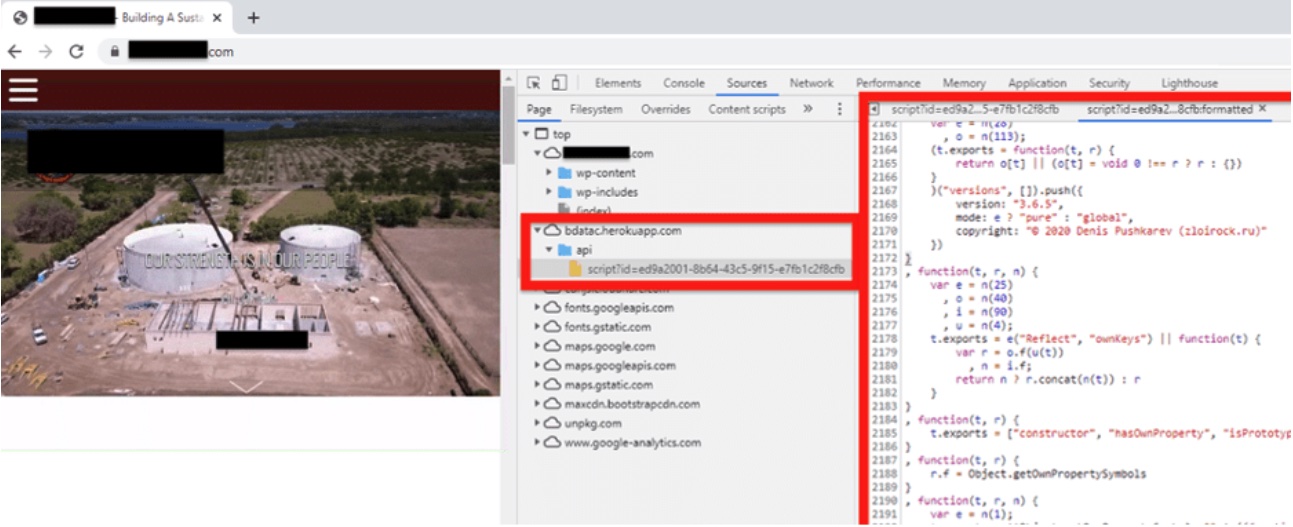
The malicious code also directed visitors to two separate sites that collected cryptographic hashes that uniquely identified each connecting device and uploaded the fingerprints to a database hosted at bdatac.herokuapp[.]com. The fingerprinting script used code from four different code projects: core-js, UAParser, regeneratorRuntime, and a data-collection script observed on only two other websites, both of which are associated with a domain registration, hosting, and web development company.

Florida water utility contractor website compromised with a unique browser enumeration and fingerprinting script.
Enlarge / Florida water utility contractor website compromised with a unique browser enumeration and fingerprinting script.

Dragos said it found only one other site serving the complex and sophisticated code to visitors. The site, DarkTeam[.]store, purports to be an underground market that supplies thousands of customers with gift cards and accounts. A portion of the site, company researchers found, may also be a check-in location for systems infected with a recent variant of botnet malware known as Tofsee.

Dragos also uncovered evidence that the same actor hacked the DarkTeam site and the water-infrastructure construction company site on the same day, December 20, 2020. Dragos observed 12,735 IP addresses it suspects are Tofsee-infected systems connecting to a nonpublic page, meaning it required authentication. The browser then presented a user agent string with a peculiar “Tesseract/1.0” artifact in it.

Unique “Tesseract/1.0” user agent substring artifact associated with browser check-ins to a restricted page on the darkteam.store site.
Enlarge / Unique “Tesseract/1.0” user agent substring artifact associated with browser check-ins to a restricted page on the darkteam.store site.

Not your typical watering hole

“With the forensic information we collected so far, Dragos’ best assessment is that an actor deployed the watering hole on the water infrastructure construction company site to collect legitimate browser data for the purpose of improving the botnet malware’s ability to impersonate legitimate web browser activity,” Backman wrote. “The botnet’s use of at least ten different cipher handshakes or JA3 hashes, some of which mimic legitimate browsers, compared to the widely published hash of a single handshake of a previous Tofsee bot iteration, is evidence of botnet improvement.”

Dragos, which helps secure industrial control systems used by governments and private companies, said it initially worried that the site posed a significant threat because of its:

  • Focus on Florida
  • Temporal correlation to the Oldsmar intrusion
  • Highly encoded and sophisticated JavaScript
  • Few code locations on the Internet
  • Similarity to watering-hole attacks by other ICS-targeting activity groups such as DYMALLOY, ALLANITE, and RASPITE.

Ultimately, Dragos doesn’t believe the watering-hole site served malware that delivered exploits or tried to gain unauthorized access to visiting computers. Backman went on to say that the discovery should nevertheless be a wake-up call.

“This is not a typical watering hole,” he wrote. “We have medium confidence it did not directly compromise any organization. But it does represent an exposure risk to the water industry and highlights the importance of controlling access to untrusted websites, especially for Operational Technology (OT) and Industrial Control System (ICS) environments.”

https://arstechnica.com/?p=1765767


All fossil fuel exploration needs to end this year, IEA says

Silhouette Oil Pumps On Field Against Cloudy Sky During Sunset

To limit global warming to 1.5˚C by the end of the century, the world has to deploy clean technologies en masse while slashing investment in new oil, gas, and coal supplies, according to a new report by the International Energy Agency.

Getting to net-zero carbon emissions by 2050 will require a historic deployment of widespread renewable power, electric vehicles, and new technologies, many of which are only now in the prototype stage. To get a jump-start, we’ll need to double our investments in clean technologies to $4 trillion by the end of the decade.

“The pathway to net zero by 2050 is narrow but still achievable if governments act now,” IEA Executive Director Fatih Birol said in a tweet. Most of the reductions in CO2 emissions through 2030 will come from technologies already on the market. But in 2050, almost half will come from technologies that are still in development.

“Big leaps in innovation are needed by 2030 to get these technologies ready in time,” Birol added.

The report comes as we’re unlikely to hit net zero by 2050. Currently, if countries stick to the voluntary contributions they’ve put forth to honor the Paris Agreement, we’re heading for more than 2˚C warming by 2100, the IEA says.

Bending the curve down to 1.5˚C will require overhauling just about every sector of the economy, hence the $4 trillion annual investment. It’s a significant sum, but it will also lift annual global GDP growth by 0.4 percent. Today, that number would add about $3.5 trillion in wealth worldwide.

Energy impacts

If global leaders started following the report’s recommendations tomorrow, the most significant—and immediate—impact would be the cessation of all new fossil fuel projects starting next year. Countries could continue extracting the oil, gas, and coal they’re currently exploiting, but they shouldn’t authorize any new exploration, drilling, or mining. Already, one oil company, Royal Dutch Shell, has said it won’t be exploring or drilling for new oil or gas beginning in 2025, though that’s still three years later than the IEA recommends.

“I don’t think anyone expected this from the IEA. It is a huge turnaround on their part,” Dave Jones, an analyst at climate think tank Ember, told the Financial Times. “It has been very pro-fossil, so to come out with something like this is just amazing… This is truly a knife in the fossil fuel industry.”

The rapid ramp-down of overall fossil fuel use—from 80 percent of the energy mix today to 20 percent in 2050—would necessitate a phase-out across the entire economy.

The IEA says that oil and gas demand should decline by 75 percent and 55 percent, respectively, and unabated coal demand needs to decline by 90 percent. Any coal plants still in operation by 2040 should be hooked up to carbon capture and sequestration (CCS) systems. By 2050, almost 70 percent of electricity should come from wind and solar power, with nuclear picking up much of the remainder. (The modest 15 percent growth of nuclear, the IEA expects, would likely come from new plants in China). Getting to a majority renewable grid will require a fourfold increase in annual installations of wind and solar generating capacity by the end of the decade.

We’ll have to get more efficient, too. Over the next 30 years, as the world adds 2 billion people, overall demand should decline by 8 percent, which would require significant increases in energy efficiency across the economy.

Changes to transportation

With transportation contributing about 20 percent of emissions today, the way we move will have to be rapidly decarbonized, too. Sales of electric cars—already up in the wake of the pandemic and looming regulations—will have to grow eighteen-fold by 2030. That would increase EVs’ market share from around 5 percent today to 60 percent in a decade, with nearly all light vehicles powered by batteries by 2050. The remaining 10 percent or so would be mostly fuel cell vehicles with very few plug-in hybrids.

Trucking would be similarly electrified, though with more hydrogen. Around 65 percent would be battery-electric, and the other 35 percent that cover distances greater than 400 miles in a day would be powered by fuel cells. For maritime shipping, the IEA doesn’t anticipate the sector to reach net zero. Instead, it expects hydrogen and ammonia to capture 60 percent of the market. Rail, the other primary shipping mode, is almost an afterthought because it is so straightforward to electrify.

Then there’s air travel. “Emissions are hard to abate because aviation requires fuel with a high energy density,” the report says. As a result, aviation gets a bit of a pass, contributing 10 percent of all unabated emissions in 2050 in the pathway. But to get there, the industry will still have to invest in what the IEA calls “sustainable aviation fuel,” which includes mostly biofuels with some help from synthetic fuels derived from CO2. To hit the targets, some air travel will have to disappear, primarily through replacing some short-haul flights with train trips and eliminating some business flights in favor of remote meetings (something we’ve all gotten accustomed to).

Housing and industry

Our homes and industry will have to change, too, though the IEA sees different pathways for each. For homes, heating and cooling can easily be switched to efficient, widely available heat pumps, which work at a surprisingly wide range of temperatures. Leaky buildings will have to be retrofitted with better insulation and air sealing, making them more comfortable to live in. Gas water heaters can be swapped for solar or heat pump models.

Natural gas will largely disappear from home use, with a small sliver of homes heated by hydrogen. Commercial buildings would largely follow the same trends. About 2–2.5 percent of all buildings worldwide will have to be retrofitted every year to hit the targets. Today, about 1 percent are.

Industrial uses of energy, including steel, cement, and chemical production, will have to switch to hydrogen or rely on CCS. The IEA says that about 40 percent of the reductions in industrial emissions by 2030 can happen through recycling, waste reduction, and more intelligent use of materials in building construction and design.

New technologies

The IEA’s models after 2030 rely heavily on technologies currently in the prototype phase to keep warming to 1.5˚C. In fact, almost half the emissions reductions by 2050 are forecast to come from clean tech that is currently at the demonstration or prototype phase. Most of those innovations will have to address heavy industry or long-distance transportation.

Both sectors have lagged because finding clean tech that can replace energy-dense fossil fuels is difficult. Shipping and aviation will be the most challenging, which the IEA acknowledges, reserving a significant percentage of unabated emissions for both.

Most industrial facilities can make the switch, though—typically, what’s needed is a heat source that is sufficiently concentrated and hot enough, not one that’s light enough to move around. A straightforward solution is to use electricity, but getting the necessary heat would involve adding considerably more renewable generating capacity. Another option is to swap higher-carbon materials, like steel, for lower-carbon alternatives, like compressed cellulose.

For industrial uses that we can’t easily electrify or replace, hydrogen has emerged as a leading candidate. The gas can always be burned, like a fossil fuel. It can also be used in clever ways to rethink how we make cement, which produces about 8 percent of emissions today. There’s also another source of hydrogen power—the Sun. The startup Heliogen has demonstrated that concentrated solar power can produce temperatures as high as 1,000˚C, which would be useful for the production of things like steel and cement.

Put it in the ground

Some emissions are difficult to avoid, of course. Many net-zero forecasts address the problem of unavoidable emissions by relying on carbon offsets, a process that attempts to quantify how much carbon is sequestered when forests are preserved, for example. Offsets are controversial, though, because companies can easily game today’s schemes, and it’s hard to guarantee that the offsets will remain valid in the distant future (a forest might burn, for example).

The IEA doesn’t rely on offsets for its roadmap, though. Instead, it turns to direct air capture and bioenergy with carbon capture and sequestration (BECCS). Both approaches suck CO2 out of the atmosphere and concentrate it for use or storage, but they go about it in different ways. Direct air capture modifies existing CCS technology to draw CO2 directly from the air (hence the name), while BECCS relies on chlorophyll. With BECCS, agricultural waste and fast-growing plants are collected and burned, with the resulting CO2 isolated for use or storage.

What it all means

The IEA is regarded as a relatively conservative agency. It’s a group that has consistently underestimated the growth of wind and solar power, in part because the agency takes a cautious approach to modeling by assuming linear rather than exponential growth (as is often the case with new technologies) and forecasting based on current climate policies rather than more aggressive targets.

This report is a significant stake in the ground for the IEA, and the agency’s serious reputation could help the roadmap become the factual basis for many arguments—policy, legal, and otherwise—against the continued development of fossil fuels.

https://arstechnica.com/?p=1765722


AT&T to spin off WarnerMedia, basically admitting giant merger was a mistake

AT&T's logo and stock price displayed on a monitor on the floor of the New York Stock Exchange in January 2019.

AT&T today announced it will spin off WarnerMedia—including HBO and Warner Bros.—into a new company, less than three years after AT&T bought Time Warner Inc. for $108 billion.

AT&T said it struck a deal with Discovery, Inc. to combine WarnerMedia and Discovery’s assets into a “standalone global entertainment company.” AT&T would receive $43 billion in the all-stock transaction through “a combination of cash, debt securities, and WarnerMedia’s retention of certain debt.” AT&T shareholders would receive stock in 71 percent of the new media company, while Discovery shareholders would own the other 29 percent.

AT&T expects it to take a full year to complete the spinoff and combination with Discovery. “The transaction is anticipated to close in mid-2022, subject to approval by Discovery shareholders and customary closing conditions, including receipt of regulatory approvals,” AT&T said.

AT&T says it will shift its own focus back to broadband.

“For AT&T shareholders, this is an opportunity to unlock value and be one of the best capitalized broadband companies, focused on investing in 5G and fiber to meet substantial, long-term demand for connectivity,” AT&T CEO John Stankey said. “AT&T shareholders will retain their stake in our leading communications company that comes with an attractive dividend. Plus, they will get a stake in the new company, a global media leader that can build one of the top streaming platforms in the world.”

The as-yet-unnamed WarnerMedia/Discovery company will consist of over 100 brands, including “HBO, Warner Bros., Discovery, DC Comics, CNN, Cartoon Network, HGTV, Food Network, the Turner Networks, TNT, TBS, Eurosport, Magnolia, TLC, Animal Planet, ID and many more,” AT&T said.

Telecom giants’ media bets failed

Today’s AT&T announcement comes just two weeks after Verizon said it agreed to sell Yahoo and AOL for $5 billion to private-equity firm Apollo Global Management. The telecom giants’ bets on the media business haven’t paid off as they hoped, but AT&T’s investment in media was much bigger than Verizon’s.

Today’s announcement “is an admission that putting a large content asset with a wireless phone company had few long-lasting synergies,” CNBC wrote. “If anything, WarnerMedia became an albatross on AT&T shares, which have underperformed Verizon and T-Mobile since the deal’s completion date on June 14, 2018.”

AT&T’s Time Warner and DirecTV acquisitions were both made under Stankey’s predecessor as CEO, Randall Stephenson.

Massive layoffs after AT&T/Time Warner merger

AT&T eliminated about 45,000 jobs across its media and telecom divisions after buying Time Warner. AT&T had 273,210 employees immediately after buying Time Warner in mid-2018 and just 228,470 as of March 31, 2021.

Stephenson had claimed that AT&T would create “7,000 jobs of people putting fiber in [the] ground” in exchange for a big corporate tax cut. AT&T continued laying employees off instead, hurting its ability to expand its fiber network and maintain its legacy copper network. A report commissioned by the California state government found that AT&T let its copper phone network deteriorate through neglect, especially in low-income communities and areas without substantial competition, despite raising its phone prices by 152.6 percent over 12 years.

With AT&T retaining its core telecom business, the company said the deal “results in two independent companies—one broadband connectivity and the other media—to sharpen the investment focus and attract the best investor base for each company.” With $43 billion coming back to AT&T, the telco said it will be “one of the best capitalized 5G and fiber broadband companies in the United States.”

The WarnerMedia/Discovery company “will be able to invest in more original content for its streaming services, enhance the programming options across its global linear pay TV and broadcast channels, and offer more innovative video experiences and consumer choices,” the deal announcement said. Stankey said that the deal “will support the fantastic growth and international launch of HBO Max with Discovery’s global footprint and create efficiencies [that] can be re-invested in producing more great content to give consumers what they want.”

Discovery CEO David Zaslav is expected to lead the new media company after the deal closes. “The new company’s Board of Directors will consist of 13 members, 7 initially appointed by AT&T, including the chairperson of the board; Discovery will initially appoint 6 members, including CEO David Zaslav,” the announcement said.

In February, AT&T announced a deal to sell a minority stake in DirecTV and spin it out into a new subsidiary. In that case, AT&T will own 70 percent of the spun-off DirecTV company.

AT&T plans more fiber expansion

After offloading WarnerMedia in mid-2022, AT&T said it plans “increased capital investment for incremental investments in 5G and fiber broadband,” with annual capital expenditures of around $24 billion. AT&T slashed capital expenditures the last couple years; after spending $21.25 billion in 2018, AT&T spent $19.64 billion in 2019 and $15.68 billion in 2020. AT&T recently said it plans $17 billion in capital expenditures in 2021.

“AT&T expects its 5G C-band network will cover 200 million people in the US by year-end 2023,” and “the company plans to expand its fiber footprint to cover 30 million customer locations by year-end 2025,” AT&T said today. Those 30 million locations would include both homes and businesses.

In March, AT&T said it “plans to increase its fiber footprint by an additional 3 million customer locations” in 2021. There are tens of millions of homes lacking fiber access in AT&T’s 21-state wireline territory. In October 2020, the Communications Workers of America union told us that 14.93 million out of 52.97 million households in AT&T’s home-Internet service area had fiber-to-the-home access. AT&T has ignored rural areas in its previous fiber buildouts, and the 3 million new locations this year are all planned for metro areas.

https://arstechnica.com/?p=1765461


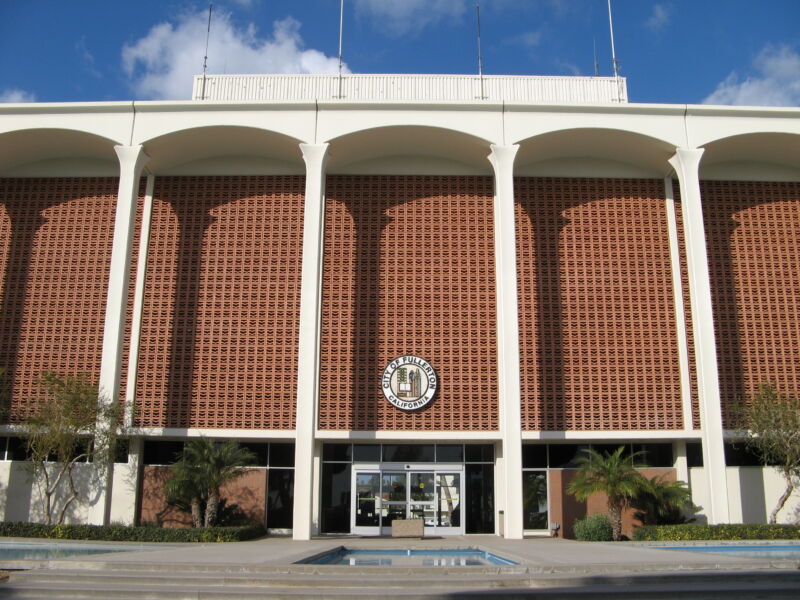
City pays $350,000 after suing “hackers” for opening Dropbox link it sent them

City pays $350,000 after suing “hackers” for opening Dropbox link it sent them

The city of Fullerton, California, has agreed to pay $350,000 to settle a lawsuit it brought against two bloggers it accused of hacking the city’s Dropbox account.

Joshua Ferguson and David Curlee frequently made public record requests in the course of covering city government for a local blog, Friends for Fullerton’s Future. The city used Dropbox to fulfill large file requests, and in response to a June 6, 2019, request for records related to police misconduct, Ferguson and Curlee were sent a link to a Dropbox folder containing a password-protected zip file. 

But a city employee also sent them a link to a more general “Outbox” shared folder that contained potential records request documents that had not yet been reviewed by the city attorney. The folder wasn’t password protected or access restricted. At the time, there were 19 zip files in the outbox, five of which were not password protected. 

The bloggers downloaded the files related to their records request and the 19 zip files in the outbox link. In the unprotected files, Ferguson and Curlee found emails relating to police internal affairs investigations and an insurance claim regarding an automobile crash involving an allegedly drunk city employee, among others. Throughout June 2019, the bloggers published posts using the documents as source material. 

The city sent two cease and desist letters to Ferguson and Curlee, claiming that the files were confidential and had not been intended for either blogger. On October 24, 2019, the city also filed a restraining order, asking the court to order the bloggers to stop further publication of the documents. The city also sought the return of the documents and requested that a third-party forensic firm be allowed to search the bloggers’ computers. 

In early November 2019, the city filed a lawsuit against the bloggers, alleging violations of the Computer Fraud and Abuse Act and California’s Comprehensive Computer Data Access and Fraud Act. An Orange County judge hearing the case granted the restraining order, which later was overturned by a California appellate court. Months later, the city again filed to block publication and again was rebuffed on appeal.

As the case made its way through the courts, both the Electronic Frontier Foundation and the Reporters Committee for Freedom of the Press filed amicus briefs earlier this year in support of the bloggers. The EFF’s brief was particularly pointed. “The City’s interpretation would permit public officials to decide—after making records publicly available online (through their own fault or otherwise)—that accessing those records was illegal,” the group wrote. “The City proposes that journalists perusing a website used to disclose public records must guess whether particular documents are intended for them or not, intuit the City’s intentions in posting those documents, and then politely look the other way—or be criminally liable.”

The city of Fullerton faced increasingly long odds of winning the lawsuit, and last week, the city council voted 3-2 to settle the suit. Under the terms of the settlement, the city will pay the defendants $230,000 in attorneys costs and $60,000 each in damages. The city will also post a public apology on its website.

https://arstechnica.com/?p=1765448


GameStop FOMO inspires a new wave of crypto pump-and-dumps

Physical representations of virtual dogecoins sit atop computer components.

After the California Gold Rush, in 1870, two Kentucky swindlers whipped up a scheme to prey on thirsty financiers’ FOMO. They invented a diamond field out West. Investors sunk millions in today’s money into the scheme. All of it, of course, was for naught—a cautionary tale about believing anyone who claims they have a surefire plan to get rich quick.

A hundred and fifty years later, a new generation of amateur investors is equally desperate not to miss the next big thing in the finance world. After watching the great GameStop stock boom play out on sites like Reddit and Discord this winter, hundreds of thousands of hopefuls are joining Discord groups that promise big earnings from manipulating the crypto market—also known as crypto pump-and-dumps. Step 1: Buy in early, when the coin is low. Step 2: convince other people to join you—the more, the merrier, the bigger the potential gains as the price of the coin goes up. Step 3: Sell out before the price tanks. Get the timing right, these groups promise, and you come out a winner (and richer). Losers are left holding the bag.

Crypto pumps have been on the rise for a few years now, thanks in part to the relative ease of making and marketing a new digital coin. In 2018, The Wall Street Journal identified 175 “pump” initiatives, moving over $825 million through 121 different crypto coins, most of them organized on Discord and Telegram. Since then, experts say, it’s only gotten bigger. Trade volume on cryptocurrency exchanges is surging, particularly with lesser-known coins that have no fundamental value outside of investing.

Originally a gaming-centric chat app, Discord has lately developed a strong culture of finance-centric servers. The app attracted tons of attention for its role in the WallStreetBets campaign to boost GameStop this January, when the meme stock rocketed from $20 to $347 in a matter of days. Later analysis attributed much of the spike to huge firms, rather than retail investors, but the spirit of the thing got people thinking: if they were in the right Discord server at the right time, maybe they could earn a buck. WallStreetBets users turned to Dogecoin next. They thought it would be funny, a good meme, to pump up the outdated and irrelevant cryptocurrency. And it worked. Doge spiked from $0.008 in late January to $0.68 on Wednesday.

According to moderators on four pump servers, a crop of new servers and social media “pump” accounts sprang up around the same time, with at least a dozen ripping off WallStreetBets’ name or logo. These accounts are not associated with the WallStreetBets subreddit or official Discord, according to a WallStreetBets moderator. (WallStreetBets only recently allowed discussions around crypto, but they are limited to Bitcoin, Ethereum, and Doge.) They are, however, cashing in on the WallStreetBets hype, advertising target gains of up to 500 percent. One of the servers has 83,000 members.

“Many young adults and others all of a sudden became extremely interested in stocks and investing, and this later also gave the crypto community and the cryptocurrencies a huge boost in popularity,” says one Discord user who goes by Alejandro. Alejandro was invited to his first crypto pump server in early February, during the GameStop hype. After making what he calls “a good profit,” 170 percent of his initial investment, Alejandro created his own group, FairPlay Crypto Pumps. It now has 10,500 members, who tune in every couple of days for a new “pump signal,” a server-wide message announcing which coin they’re pumping when. The gains, he says, comes from people who are not in the Discord. “This principle is called FOMO (fear of missing out),” he says. “Once outsiders see a sudden rise in an unexpected coin, they will buy shares. Meanwhile, the members of my group will sell their shares to the outsiders for a good chunk of profit.”

Discord is a perfect vehicle for these pumps, as a semi-public forum that allows users to advertise servers broadly, ping users about coordinated buy-ins, and discuss strategy. I’m a longtime Discord user, and anecdotally I’ve seen an enormous uptick in activity. Between early April and May, I received 47 invitations to join crypto pump groups over Discord. Eight of the groups have more than 20,000 members; the largest has over 80,000. Several of these servers’ moderators say they pay people—whom they call “advertisers”—to spam Discord users with invitations, sometimes including crypto giveaways.

New members are greeted with FAQs describing 2,000 percent pumps and the potential for hundreds or thousands in gains. That’s not necessarily the reality. “The Discord server is a casino. As the saying goes, ‘The house always wins,’ and they’re the house,” says Thomas Hurley, 21, a member of several crypto pump Discord servers. After crypto evangelists began joining his gaming servers to advertise pump groups, he tried his hand at a couple coordinated price pushes. He never made much profit, but other people did. When Hurley began looking closer at some of these coins’ market trading pages on sites like Binance, he noticed some interesting patterns.

“A few seconds before they announced which coin to pump, there would be a huge spike,” he says. It looked like someone in the know bought up a lot of the coin beforehand, hugely boosting their potential to earn big by selling early. Hurley never had a chance.

He isn’t alone. A 2018 study of Telegram-based pump groups found that five minutes before the pump signal (before the coin is even revealed), a designated coin’s price shot up about 5 percent. Back then, on average, only investors who bought in within the first 20 seconds after a pump could make a profit. Today, sources say, crypto pumps move so quickly that enthusiasts commission bots to buy and sell coins based on Discord announcements. The owner of one server, Pump It Up, says he lost several hundred dollars because he wasn’t using a bot, which can buy and sell within milliseconds. The experience prompted him to make his own group back in February.

“Crypto pumps prey on less-informed people in the space,” says Josh Kamps, a PhD candidate at University College London studying crypto fraud. People who found out about GameStop late want to jump on the next big thing. Kamps noticed, anecdotally, that a bunch of low-utility alt-coins cropped up right around then, which he says are “pretty much designed to be pumped.” For example, he says, pump groups are flocking to Shiba Inu Coin (or SHIB). One knock-off WallStreetBets pump group advertises that they pumped SHIB for more than 4 times profit. In the last 24 hours, the meme coin saw over $6.1 billion in trading volume.

“Discord welcomes a broad variety of personal finance discussions, including cryptocurrency, investment clubs, and day traders and encourages creative uses of our platform, as long as nothing compromises our values or amounts to illegal activity,” a Discord spokesperson said in an email to WIRED. They cautioned Discord users to carefully research advice they receive on the Internet.

Crypto pump schemes fall into a gray legal area. “There’s a lot of debate about whether we see cryptocurrencies as securities or not,” says Donghwa Shin, a professor at the University of North Carolina at Chapel Hill who coauthored the 2018 study. Pump-and-dumps are illegal for securities but not for cryptocurrencies. “That’s why there’s no clear regulation,” he says. Shin thinks it’s time for that to change. According to his research, these currencies’ liquidity and value increase in crypto exchanges where pump-and-dumps are banned. Not only does the market get better, it would be more challenging for the tiny fraction of people organizing these pumps—the people who most consistently make money off them—to take advantage of others.

“Unfairness exists in these markets. The winners in these markets are the insiders. All others are losers. In order to protect them, we have to regulate this market,” says Shin.

The US Commodity Futures Trading Commission warned consumers in 2018 to avoid virtual currency pump-and-dump schemes but also stated that it had limited authority over those markets. Earlier this year, however, federal prosecutors charged businessman John McAfee and an associate in connection to several pump-and-dump initiatives involving digital coins. The US alleges that between late 2017 and 2018, McAfee advertised a “coin of the day” on his Twitter account without disclosing to his million followers that the men had bought up the coin beforehand and would sell it when the price spiked. The CFTC heralded the case as its first-ever enforcement action for “a manipulative scheme involving digital assets.”

The current crypto rush is also inspiring more traditional forms of fraud. Last week, one group, WallStreetBets – Crypto Pumps, pulled off a $2 million scam, Bloomberg estimates, when it told its 340,000 Telegram subscribers it would be pumping its own coin, WSBFinance. The coin didn’t exist yet; it was allegedly a presale. Users sent money to a crypto wallet believing they would receive the WSBFinance coin. But there were never any coins.

“Sorry guys! Our bot had a small problem,” the account wrote to its Telegram members. Then, after a delay: “Buying lambo now.”

This story originally appeared on wired.com.

https://arstechnica.com/?p=1765272


ISPs claim broadband prices aren’t too high—Biden admin isn’t buying it

Illustration of Internet data and dollar signs
Getty Images | Guirong Hao

Biden administration officials are not convinced by the broadband industry’s claims that Internet prices aren’t too high, according to a report today by Axios.

The White House announced on March 31 that President Biden “is committed to working with Congress to find a solution to reduce Internet prices for all Americans.” Though Biden hasn’t revealed exactly how he intends to reduce prices, the announcement set off a flurry of lobbying by trade groups representing ISPs to convince Biden and the public that Americans are not paying too much for Internet access. ISPs even claim that prices have dropped, despite government data showing that the price Americans pay has risen four times faster than inflation.

A Biden official told Axios that the ISPs have not made a convincing case. “A senior administration official told Axios the bulk of the evidence shows prices have gone up recently and prices are higher than they are for comparable plans in Europe,” Axios wrote. “Biden noted the high cost of Internet service in March, and the official told Axios, ‘I don’t think we’ve seen anything since he made those comments to make us feel like we were wrong about that. We’re still committed to taking some bold action to make sure that we bring those prices down for folks.'”

The pressure coming from broadband lobby groups suggests that industry officials believe rate regulation is a real possibility. “They’re absolutely on edge,” one aide told Axios. “They are concerned at the highest levels over the prospect of rate regulation.”

Instead of believing the ISPs’ claims about prices, the White House is apparently paying close attention to research that shows prices are rising—in part due to a lack of competition. The White House “highlighted a working paper from Berkeley Law professor Tejas Narechania,” which “finds that broadband providers offer slower service for the same price in areas where they lack competition, and proposes a model statute for rate regulation of a basic tier broadband service in areas without competition,” Axios wrote. The administration also “pointed to a recent working paper from New York University finance professor Thomas Philippon that found Americans pay more for Internet service than consumers in other countries.”

Cable lobby cites lower “price per megabit”

The cable industry’s top lobby group, NCTA–The Internet & Television Association, this week accused advocacy groups of using “cherry-picked data.” But the cable group’s claims that prices are going down is contradicted by US government data showing that Americans are paying more every year.

The cable lobby’s argument that prices are going down relies on the price per megabit rather than the average price that consumers pay each month. The NCTA wrote:

When looking at the cost of American broadband, if factors such as speed are included, US prices have been falling dramatically. Based on NCTA’s analysis of the most widely purchased tiers of service, the quality-adjusted Price per Megabit per second (Price/Mbps) of cable broadband service has declined by 98 percent over the last 15 years, declining from $28.13/Mbps to $0.64/Mbps.

By that logic, Americans should feel lucky that they’re not paying $2,800 a month for 100Mbps service. But obviously, the bandwidth needs of Americans and the bandwidth capabilities of broadband networks have steadily increased over time, even as ISPs’ costs have dropped, just as the capabilities of smartphones, processors, and other technology products inexorably increase over time.

Big ISPs’ costs are dropping

ISPs’ costs have continually declined on a per-megabit basis and often decline on an absolute basis. Comcast’s cable capital expenditures dropped 4.4 percent in 2020, while AT&T’s capital expenditures dropped 20.2 percent.

Comcast and AT&T also cut capital spending between 2018 and 2019. Charter slashed about $1.7 billion off its capital spending in 2019 before a small increase in 2020.

In short, there is no financial or technical emergency that would require scaling prices up with each additional megabit provided, and the per-megabit price over 15 years is irrelevant to the important question of whether the amount that consumers have to pay for modern Internet access is going up or down.

Real prices rose 19% from 2016-2019

The USTelecom lobby group claims that prices are getting lower by tracking the advertised price of the “most popular [speed] tier” over time. The group also claims that the US broadband market is “ultra-competitive, defined by increasing speeds, declining prices, new entrants and next generation technologies,” a statement that ignores the reality of tens of millions of unserved and underserved Americans.

The actual prices consumers pay—which ISPs inflate with hidden fees, equipment rental charges, and data-cap charges—rose four times faster than inflation between 2016 and 2019, as we reported last week. Specifically, Bureau of Labor Statistics survey data cited by advocacy group Free Press shows that average annual household expenditures for home-Internet service rose from $437.71 in 2016 to $556.50 in 2019. That’s a 27 percent increase. When adjusted for inflation to match the value of 2020 dollars, the average annual cost rose from $472.25 in 2016 to $564.07 in 2019, a 19 percent increase.

Prices also increased by similar amounts during the last three years of the Obama administration. Trump’s Federal Communications Commission Chairman, Ajit Pai, claimed his deregulation of the broadband industry would reverse that trend and bring “cheaper Internet access to all Americans.” Instead, prices continued rising at about the same rates seen between 2013 and 2016.

ISPs fear rate regulation

Just what the Biden administration will do to lower prices still isn’t clear. The NCTA slammed Biden for what it called “the unfounded assertion that the government should be managing prices,” even though Biden didn’t say that he wants the government to directly manage prices.

Yet price regulation is a possibility, and it’s one that wouldn’t necessarily require congressional approval. The FCC is likely to bring back the Title II common-carrier regulation in order to reimplement the net neutrality rules that Pai discarded. The FCC could use that Title II authority to impose price controls, although it chose not to during the Obama administration.

According to Axios, the senior Biden administration official “said the White House hasn’t taken a position on rate regulation, but noted, ‘It’s pretty clear that it’s something that the FCC could do under the existing statutes that it has in its jurisdiction.'”

The FCC can’t do anything controversial yet because it’s still deadlocked at two Democrats and two Republicans. Biden still hasn’t nominated a third Democrat, and the Senate confirmation process could take months after he does so. Biden also must decide whether acting FCC Chairwoman Jessica Rosenworcel will keep the top spot after a third Democrat comes on board; Biden’s choice of chair would have a major impact on whether the FCC pursues any kind of rate regulation.

Fight over speeds and public networks

In addition to pledging lower prices, Biden in March proposed spending $100 billion to build and expand broadband networks. Biden’s plan calls for prioritizing “support for broadband networks owned, operated by, or affiliated with local governments, non-profits, and co-operatives—providers with less pressure to turn profits and with a commitment to serving entire communities.”

He also proposed “lifting barriers that prevent municipally owned or affiliated providers and rural electric co-ops from competing on an even playing field with private providers,” which could mean overturning state laws that restrict municipal broadband. Biden’s other major broadband proposal was to “requir[e] Internet providers to clearly disclose the prices they charge,” potentially ending the rampant practice of ISPs advertising a low rate and then charging customers much more by imposing a slew of hidden fees.

“When I say ‘affordable,’ I mean it,” Biden said in a speech on March 31. “Americans pay too much for Internet service. We’re going to drive down the price for families who have service now and make it easier for families who don’t have affordable service to be able to get it now.”

The Biden administration disappointed some community broadband advocates by deciding that American Rescue Plan Act funds can be used for broadband only in areas lacking wired networks with speeds of at least 25Mbps downstream and 3Mbps upstream. That would leave out any area that’s already served by at least one cable provider, even if there’s no competition and no fiber-to-the-home availability.

The $100 billion plan is separate and could use a different standard that targets both unserved areas and places dominated by a single cable provider. Biden’s proposal said he wants “100 percent coverage” and “future proof” networks, which could suggest widespread fiber deployment. But details have not been released, and ISPs will lobby Congress to send the money to private ISPs and to avoid ambitious speed requirements. AT&T recently opposed nationwide fiber deployment, arguing that rural people don’t need fiber-to-the-home and should be satisfied with Internet service that provides only 10Mbps upload speeds.

Disclosure: The Advance/Newhouse Partnership, which owns 13 percent of Charter, is part of Advance Publications. Advance Publications owns Condé Nast, which owns Ars Technica.

https://arstechnica.com/?p=1765202