Nestlé threatened with cease-and-desist over alleged illegal water use

Rows and rows of water bottles.

The snow hasn’t completely melted in the Sierra Nevada, but most of California is already deep into a drought. Over 96 percent of the Golden State is experiencing moderate to exceptional drought, compared with 36 percent last year, which was the worst year for wildfires since record keeping began. Meanwhile, in the San Bernardino National Forest, Nestlé continues to pump hundreds of thousands of gallons a week to sell as bottled water.

The folks at California’s State Water Resources Control Board aren’t amused. This week, they issued a cease-and-desist order, demanding that Nestlé “immediately cease all unauthorized diversions of water.”

Nestlé has been pumping water from a creek that feeds the Santa Ana River, which supplies a significant portion of Orange County’s drinking water. The company argues that it has water rights to the creek that date back to 1865, and while the water board admits that may be true, the board says that the company has grossly overdrawn its amount.

In the national forest, Nestlé collects the water through boreholes and tunnels that are drilled deep beneath the mountains, which travel downhill to a collection tank. Trucks then transport the water to a nearby bottling plant, where it’s sold under the Arrowhead name. As a conglomerate, Nestlé has a long history of selling bottled water, including under higher-end names like Perrier. Earlier this year, Nestlé spun off its North American bottled-water group to two private equity firms for $4.3 billion.

Nestlé acquired water rights in the San Bernardino Mountains when it bought Perrier in 1992, which itself had purchased the Arrowhead Drinking Water Co., which was founded in 1894 to sell “medicinal” water. Where Nestlé seems to have gotten itself into trouble was by overestimating the capacity of an early 20th-century train car.

A key contract from 1909 said the Arrowhead source would supply a bottled-water company with seven train cars of water per week. Nestlé, which bought those rights, said that tank cars from that era could hold 15,000 gallons. But Amanda Frye, a local activist, thought something was amiss, so she did some digging. After sifting through archives, she found buried in legal documents evidence that the actual train cars used carried 6,500 gallons—less than half what Nestlé claimed.

If the state water board is successful, it’s possible that Nestlé would only have rights to 2.36 million gallons of water per year, a far cry from the reported 58 million gallons last year. The company has 20 days to appeal the order and ask for a hearing. If the order is upheld and goes into force, Nestlé face fines up to $1,000 per day or ten-times that amount if a drought is declared.

The company has courted controversy over the years with its bottled-water operations. Last year, it lost battles in Oregon and Pennsylvania to build bottling plants that would have drawn from local aquifers. In 2005, its then-CEO got into hot water when, in a documentary, he appeared to say that access to water is not a human right.

One opinion, which I think is extreme, is represented by the NGOs, who bang on about declaring water a public right. That means that as a human being you should have a right to water. That’s an extreme solution. The other view says that water is a foodstuff like any other, and like any other foodstuff it should have a market value. Personally, I believe it’s better to give a foodstuff a value so that we’re all aware it has its price, and then that one should take specific measures for the part of the population that has no access to this water, and there are many different possibilities there.

The issue in the San Bernardino Mountains is more than about people having access to water, though that is of course a key dimension. Rather, it’s also about whether the watershed’s forest has enough water to sustain itself. In the last several years, drought conditions have exacerbated fire seasons in California, turning forests that would otherwise be vulnerable but resilient into veritable tinderboxes. Many trees plan for dry years by growing deep taproots to reach subterranean water. Draining rivers and aquifers makes that supply harder if not impossible to reach, stressing the trees further. Without deep reserves, the trees are more likely to go up in smoke.

The resulting fires don’t just devastate forests. As we’ve seen in California over the last several years, they also wipe out entire neighborhoods and send dangerous, sooty smoke billowing over nearby cities. Those clouds are laden with fine particulates, which aggravate respiratory conditions, sending many vulnerable people to the hospital. There’s also increasing evidence that particulate matter (and wildfire smoke more specifically) causes myriad health problems in children. Studies have found associations between components of wildfire smoke and asthma, ADHD, autism, lifetime cancer risk, blood pressure, and more.

Whether Nestlé’s water rights are upheld or curtailed, it’s likely there will be more battles over bottled water. The practice of selling the natural resource at a premium has always been controversial, and this fight in the context of California’s fire season only adds to that. Water rights in the West have always been fraught, and climate change is likely to ratchet up tensions further as droughts become more extreme and prolonged.

https://arstechnica.com/?p=1760783


FCC lets SpaceX cut satellite altitude to improve Starlink speed and latency

A SpaceX Starlink user terminal, also known as a satellite dish, seen against a city's skyline.
Enlarge / A SpaceX Starlink user terminal/satellite dish.

SpaceX today was granted permission to use a lower orbit for Starlink satellites, as regulators agreed with SpaceX that the change will improve broadband speed and latency while making it easier to minimize orbital debris. In granting SpaceX’s request, the Federal Communications Commission dismissed opposition from Viasat, Hughes, Dish Network, OneWeb, the Amazon subsidiary known as Kuiper, and other satellite companies that claimed the change would cause too much interference with other systems.

In 2018, SpaceX received FCC approval to launch 4,425 broadband satellites at orbits of 1,110 km to 1,325 km. An FCC order in 2019 gave SpaceX permission to use a lower altitude for over 1,500 of those satellites. Today’s FCC order granting SpaceX’s additional license-change request lowers the altitude for 2,814 of the satellites, letting them orbit in the 540-570 km range. Today’s FCC order will also let SpaceX use a lower elevation angle for antennas on user terminals and gateway Earth stations.

“Based on our review, we agree with SpaceX that the modification will improve the experience for users of the SpaceX service, including in often-underserved polar regions,” the FCC order said. “We conclude that the lower elevation angle of its earth station antennas and lower altitude of its satellites enables a better user experience by improving speeds and latency.”

The FCC order also said, “a number of the satellites being deployed pursuant to this modification are satellites orbiting at high inclinations, which are uniquely able to provide improved service to higher latitude regions.” As for the license change’s impact on orbital debris, the FCC said that “deployment to a lower altitude guarantees removal of satellites from orbit within a relatively short period of time, and consequently has beneficial effects with respect to orbital debris mitigation.”

The FCC previously allowed SpaceX to operate 1,584 of the satellites at an altitude of 550 km, via an approval in April 2019.

Many satellites at different altitudes

The number of Starlink satellites from the first batch approved in March 2018 has since been reduced from 4,425 to 4,408, and all of those are now approved for orbits between 540 and 570 km. SpaceX separately was granted permission in November 2018 to launch another 7,518 satellites at even lower altitudes of 335 km to 346 km. The space company is also seeking permission for 30,000 more satellites at altitudes ranging from 328 km to 614 km.

Besides what we’ve already mentioned, today’s FCC order gives SpaceX “authority to conduct launch and early orbit phase (LEOP) operations and payload testing during orbit-raising and deorbit of its satellites.”

“Our action will allow SpaceX to implement safety-focused changes to the deployment of its satellite constellation to deliver broadband service throughout the United States, including to those who live in areas underserved or unserved by terrestrial systems,” the FCC said.

Rejecting opposition’s interference claims

The FCC order said that SpaceX’s license change “does not create significant interference problems,” rejecting allegations made by Dish Network and other companies.

The FCC denied “petitions to deny or defer” SpaceX’s request filed by Viasat, SES Americom and O3B Limited, Kepler Communications, and Kuiper Systems. Other satellite companies such as Hughes and OneWeb had filed comments challenging SpaceX’s claims and requesting that the FCC impose new conditions on SpaceX. The FCC also denied Viasat’s petition to reconsider the commission’s earlier decision to let SpaceX use the 540-570 km altitudes for ten satellites.

Opponents of SpaceX argued that the license change “will increase the number of in-line interference events because of its proposed lower elevation angles and doubling of the number of satellites communicating with each gateway earth station simultaneously” and that “SpaceX’s redesigned antennas and wider beam footprints would worsen the interference environment and eliminate earth station separation as an interference mitigation technique,” the FCC said.

The FCC agreed that the license change “would result in new interference to other NGSO [non-geostationary satellite orbit] systems in certain areas where previously interference did not exist,” but the agency concluded that the license would not create “any significant interference problems.”

The FCC explained further:

Specifically, after analyzing the technical arguments in the record, we conclude that the lower altitude of the satellites will in fact result in fewer satellites in view, and therefore will result in fewer in-line interference events with respect to other NGSO operators, even if the number of active satellites in view of a particular earth station is increased. We observe that by lowering the earth station elevation angle, more of the sky is visible from the perspective of the earth station, and as a result more satellites may be visible. However, when the satellite altitude is lowered, the satellites will need to be closer to the earth station in order to be within view, and therefore lowering the altitude of the satellites helps to offset the fact that additional satellites may be visible due to the lower elevation angles, in turn offsetting the potential increase in inline interference events. We also conclude that the reduced satellite PFD [power flux-density] at the satellites enabled by operating the satellites at lower altitudes will help to offset the potential for increased interference.

SpaceX already has over 1,300 satellites in orbit while it provides Starlink service in beta for $99 a month plus $499 upfront for equipment. SpaceX has been advertising beta-service speeds of 50Mbps to 150Mbps, with latency of 20 ms to 40 ms. CEO Elon Musk said in February that speeds will hit 300Mbps later this year and that the service will become available to “most of Earth” by the end of 2021.

SpaceX was tentatively granted $885.51 million over 10 years in rural-broadband funding, but the company is facing opposition from other ISPs, and the FCC hasn’t made a final decision on the funding. SpaceX also has a pending application to be designated as an Eligible Telecommunications Carrier as part of plans to offer phone service and discounted telecom service to people with low incomes.

Update: Viasat contacted Ars with a statement, saying it is “pleased the commission confirmed that Starlink satellites must be reliable and safe, and also recognized the need to assess the cumulative (aggregate) collision risk presented by the entire Starlink constellation.” Viasat claimed that the FCC failed to use “a science-based approach” in its order.

Amazon also provided a statement, saying, “This is a positive outcome that places clear conditions on SpaceX, including requirements that it remain below 580 km and accept additional interference resulting from its redesign.”

The interference-related “condition means that if the [Starlink] redesign creates interference with other systems (including Kuiper), the burden is on SpaceX to either alter its operations or accept the impact on its service,” an Amazon spokesperson told Ars.

While SpaceX only asked for orbits between 540 and 570 km, Amazon told Ars that it requested the hard limit of 580 km because “SpaceX satellites have an orbital tolerance of +/- 30 km.” Amazon plans to use orbits as low as 590 km in its Kuiper constellation.

“These conditions address our primary concerns regarding space safety and interference, and we appreciate the commission’s work to maintain a safe and competitive environment in low-earth orbit,” Amazon said.

https://arstechnica.com/?p=1760553


EU to charge Apple with anticompetitive behavior this week

EU to charge Apple with anticompetitive behavior this week
SOPA Images | Getty

Margrethe Vestager, the EU’s competition chief, will later this week issue charges against Apple stating that its App Store rules break EU law, according to several people with direct knowledge of the situation.

The charges relate to a complaint brought two years ago by Spotify, the music streaming app, that Apple takes 30 percent commission to distribute apps through its iPhone App Store and forbids apps from directing users to pay for subscriptions elsewhere.

Brussels opened an official competition investigation in June, when Vestager said Apple appeared to be a so-called gatekeeper “when it comes to the distribution of apps and content to users of Apple’s popular devices.”

Apple, which has denied any allegations of anticompetitive behavior, did not immediately reply to a request for comment. At the time of Spotify’s initial complaint, Apple said the music app wanted to “keep all the benefits” of its App Store “without making any contributions to that marketplace.”

The case is one of the most high-profile antitrust cases in Europe against a US tech group. The people familiar with the process warned that the timing could still slip.

Brussels is also investigating Apple for allegedly breaking EU laws when it comes to promoting its own ebooks over rivals on the App Store and over concerns that it undermines competition in mobile payments by limiting access to the near-field communication chips in iPhones for rivals to Apple Pay.

If Apple is ultimately found guilty of breaking EU rules, after a long period of potential appeals, the company faces a fine of up to 10 percent of global revenues.

Separately, Brussels is pushing through a new Digital Markets Act that seeks to define when Big Tech companies are behaving in an anti-competitive way so that remedies can be applied faster.

SOPA Images | Getty

Spotify’s complaint against Apple

March 2019: Spotify launches official complaint against Apple in the EU. Spotify CEO Dan Ek warns of rising prices due to App Store’s fees.

May 2019: EU officials say they are preparing an official investigation.

June 2020: The EU begins probes against Apple Music, Apple’s ebook business, and Apple Pay.

March 2021: The EU says it is considering formal charges for Apple over Spotify’s complaint.

© 2021 The Financial Times Ltd. All rights reserved. Not to be redistributed, copied, or modified in any way.

https://arstechnica.com/?p=1760377


Legislation would mandate driver-monitoring tech in every car

A surprised woman gleefully lets go of her car's steering wheel.
Enlarge / A woman test drives Cadillac’s Super Cruise hands-free driver-assistance feature in 2018. Super Cruise includes a camera-based eye-tracking technology to ensure drivers are watching the road.

Three United States senators on Monday proposed legislation that would require all new cars in the United States to have driver-monitoring systems within six years. Two of the legislation’s sponsors—Ed Markey (D-Mass.) and Richard Blumenthal (D-Conn.)—recently sent a letter to federal regulators expressing concern about last week’s fatal Tesla crash in Texas.

It’s not clear how a 2019 Tesla Model S wound up crashing into a tree at high speed in a residential neighborhood outside Houston. Police reported that neither of the vehicle’s two passengers was in the driver’s seat: one was in the front passenger seat, while the other was sitting in a rear seat.

The crash has drawn more attention to the long-running debate over adding driver-monitoring technology to cars. A few carmakers have already adopted robust driver-monitoring technology. Cadillac’s Super Cruise driver-assistance technology, for example, uses a driver-facing camera to verify that the driver’s eyes are focused on the road. Drivers can take their hands off the wheel while Super Cruise is active. But if they stop looking at the road ahead, Super Cruise will warn them and eventually disengage.

Tesla vehicles use a more rudimentary technique to measure driver engagement: a torque sensor on the steering wheel. Unfortunately, hands on the wheel are no guarantee that a driver is paying attention. Also, torque sensors are easily defeated by hanging a weight from the steering wheel.

Legislation would mandate driver monitoring by 2027

Safety advocates have argued that any car with an advanced driver-assistance system (ADAS) should have a driver-monitoring system. That’s to combat the risk that drivers will start to trust their ADAS so much that they stop paying attention to the road. And many argue that a Tesla-style torque sensor isn’t good enough. Drivers’ failure to focus on the road likely contributed to three Autopilot deaths over the last five years, as well as a death caused by a prototype Uber self-driving vehicle in 2018.

And of course, distracted driving is a problem that extends well beyond Tesla or any manufacturer’s ADAS. The National Highway Traffic Safety Administration estimates that distracted driving is responsible for more than 3,000 deaths every year.

The Markey/Blumenthal bill, also co-sponsored by Sen. Amy Klobuchar (D-Minn.), would require the secretary of Transportation to draft rules requiring all vehicles to have driver-monitoring technology installed. The final version of the rule would have to be ready within four years, and it would give automakers another two years to comply. If the legislation passed this year, every new car would need to adopt some version of the technology by 2027.

All three senators are members of the House Commerce, Science and Transportation Committee, which is holding a hearing on Tuesday about the future of automotive safety.

Too much?

Requiring DMS for all vehicles, not just ADAS ones, might seem like a dramatic step. However, ADAS will only become more popular and more capable over the next six years. So many, perhaps even most, vehicles are likely to have some kind of ADAS by 2027. Indeed, cars in 2027 will likely handle even more of the driving task than today’s best systems. That will make it even more challenging for drivers to pay attention while their car does most of the driving.

European officials have been more aggressive than their American counterparts about requiring driver monitoring. Colin Barnden, an auto industry expert based in the United Kingdom, told Ars that recently enacted European rules require driver-monitoring systems in all new car models introduced from mid-2024 onward. European carmakers get a two-year grace period to continue selling car models approved before the deadline, but every new car sold would need a DMS starting in mid-2026.

Separately, Barnden said that Euro NCAP, a government-backed group that rates cars for safety, would require cars to have a driver-monitoring system in order to earn a five-star safety rating starting in 2023 or 2024.

https://arstechnica.com/?p=1760146


Pentagon explains odd transfer of 175 million IP addresses to obscure company

Illustration of Internet data, with long strings of numbers laid out on a grid.

The US Department of Defense puzzled Internet experts by apparently transferring control of tens of millions of dormant IP addresses to an obscure Florida company just before President Donald Trump left the White House, but the Pentagon has finally offered a partial explanation for why it happened. The Defense Department says it still owns the addresses but that it is using a third-party company in a “pilot” project to conduct security research.

“Minutes before Trump left office, millions of the Pentagon’s dormant IP addresses sprang to life” was the title of a Washington Post article on Saturday. Literally three minutes before Joe Biden became president, a company called Global Resource Systems LLC “discreetly announced to the world’s computer networks a startling development: It now was managing a huge unused swath of the Internet that, for several decades, had been owned by the US military,” the Post said.

The number of Pentagon-owned IP addresses announced by the company rose to 56 million by late January and 175 million by April, making it the world’s largest announcer of IP addresses in the IPv4 global routing table.

“The theories were many,” the Post article said. “Did someone at the Defense Department sell off part of the military’s vast collection of sought-after IP addresses as Trump left office? Had the Pentagon finally acted on demands to unload the billions of dollars worth of IP address space the military has been sitting on, largely unused, for decades?”

The Post said it got an answer from the Defense Department on Friday in the form of a statement from the director of “an elite Pentagon unit known as the Defense Digital Service.”

The Post wrote:

Brett Goldstein, the DDS’s director, said in a statement that his unit had authorized a “pilot effort” publicizing the IP space owned by the Pentagon.

“This pilot will assess, evaluate, and prevent unauthorized use of DoD IP address space,” Goldstein said. “Additionally, this pilot may identify potential vulnerabilities.”

Goldstein described the project as one of the Defense Department’s “many efforts focused on continually improving our cyber posture and defense in response to advanced persistent threats. We are partnering throughout DoD to ensure potential vulnerabilities are mitigated.”

“SWAT team of nerds”

The 6-year-old DDS consists of “82 engineers, data scientists, and computer scientists” who “worked on the much-publicized ‘hack the Pentagon‘ program” and a variety of other projects tackling some of the hardest technology problems faced by the military, a Department of Defense article said in October 2020. Goldstein has called the unit a “SWAT team of nerds.”

The Defense Department did not say what the unit’s specific objectives are in its project with Global Resource Systems, “and Pentagon officials declined to say why Goldstein’s unit had used a little-known Florida company to carry out the pilot effort rather than have the Defense Department itself ‘announce’ the addresses through BGP [Border Gateway Protocol] messages—a far more routine approach,” the Post said.

Still, the government’s explanation piqued the interest of Doug Madory, director of Internet analysis at network-security company Kentik.

“I interpret this to mean that the objectives of this effort are twofold,” Madory wrote in a blog post Saturday. “First, to announce this address space to scare off any would-be squatters, and secondly, to collect a massive amount of background Internet traffic for threat intelligence.”

New company remains mysterious

The Washington Post and Associated Press weren’t able to dig up many details about Global Resource Systems. “The company did not return phone calls or emails from The Associated Press. It has no web presence, though it has the domain grscorp.com,” an AP story yesterday said. “Its name doesn’t appear on the directory of its Plantation, Florida, domicile, and a receptionist drew a blank when an AP reporter asked for a company representative at the office earlier this month. She found its name on a tenant list and suggested trying email. Records show the company has not obtained a business license in Plantation.” The AP apparently wasn’t able to track down people associated with the company.

The AP said that the Pentagon “has not answered many basic questions, beginning with why it chose to entrust management of the address space to a company that seems not to have existed until September.” Global Resource Systems’ name “is identical to that of a firm that independent Internet fraud researcher Ron Guilmette says was sending out email spam using the very same Internet routing identifier,” the AP continued. “It shut down more than a decade ago. All that differs is the type of company. This one’s a limited liability corporation. The other was a corporation. Both used the same street address in Plantation, a suburb of Fort Lauderdale.”

The AP did find out that the Defense Department still owns the IP addresses, saying that “a Defense Department spokesman, Russell Goemaere, told the AP on Saturday that none of the newly announced space has been sold.”

Bigger than China Telecom and Comcast

Network experts were stumped by the emergence of Global Resource Systems for a while. Madory called it “a great mystery.”

At 11:57 am EST on January 20, three minutes before the Trump administration officially came to an end, “[a]n entity that hadn’t been heard from in over a decade began announcing large swaths of formerly unused IPv4 address space belonging to the US Department of Defense,” Madory wrote. Global Resource Systems is labeled AS8003 and GRS-DOD in BGP records.

Madory wrote:

By late January, AS8003 was announcing about 56 million IPv4 addresses, making it the sixth largest AS [autonomous system] in the IPv4 global routing table by originated address space. By mid-April, AS8003 dramatically increased the amount of formerly unused DoD address space that it announced to 175 million unique addresses.

Following the increase, AS8003 became, far and away, the largest AS in the history of the Internet as measured by originated IPv4 space. By comparison, AS8003 now announces 61 million more IP addresses than the now-second biggest AS in the world, China Telecom, and over 100 million more addresses than Comcast, the largest residential Internet provider in the US.

In fact, as of April 20, 2021, AS8003 is announcing so much IPv4 space that 5.7 percent of the entire IPv4 global routing table is presently originated by AS8003. In other words, more than one out of every 20 IPv4 addresses is presently originated by an entity that didn’t even appear in the routing table at the beginning of the year.

In mid-March, “astute contributors to the NANOG listserv highlighted the oddity of massive amounts of DoD address space being announced by what appeared to be a shell company,” Madory noted.

DoD has “massive ranges” of IPv4 space

The Defense Department “was allocated numerous massive ranges of IPv4 address space” decades ago, but “only a portion of that address space was ever utilized (i.e. announced by the DoD on the Internet),” Madory wrote. Expanding on his point that the Defense Department may want to “scare off any would-be squatters,” he wrote that “there is a vast world of fraudulent BGP routing out there. As I’ve documented over the years, various types of bad actors use unrouted address space to bypass blocklists in order to send spam and other types of malicious traffic.”

On the Defense Department’s goal of collecting “background Internet traffic for threat intelligence,” Madory noted that “there is a lot of background noise that can be scooped up when announcing large ranges of IPv4 address space.”

Potential routing problems

The emergence of previously dormant IP addresses could lead to routing problems. In 2018, AT&T unintentionally blocked its home-Internet customers from Cloudflare’s new DNS service because the Cloudflare service and the AT&T gateway were using the same IP address of 1.1.1.1.

Madory wrote:

For decades, Internet routing operated with a widespread assumption that ASes didn’t route these prefixes on the Internet (perhaps because they were canonical examples from networking textbooks). According to their blog post soon after the launch [of DNS resolver 1.1.1.1], Cloudflare received “~10Gbps of unsolicited background traffic” on their interfaces.

And that was just for 512 IPv4 addresses! Of course, those addresses were very special, but it stands to reason that 175 million IPv4 addresses will attract orders of magnitude more traffic [from] misconfigured devices and networks that mistakenly assumed that all of this DoD address space would never see the light of day.

Madory’s conclusion was that the new statement from the Defense Department “answers some questions,” but “much remains a mystery.” It isn’t clear why the Defense Department didn’t simply announce the address space itself instead of using an obscure outside entity, and it’s unclear why the project came “to life in the final moments of the previous administration,” he wrote.

But something good might come out of it, Madory added: “We likely won’t get all of the answers anytime soon, but we can certainly hope that the DoD uses the threat intel gleaned from the large amounts of background traffic for the benefit of everyone. Maybe they could come to a NANOG conference and present about the troves of erroneous traffic being sent their way.”

https://arstechnica.com/?p=1760167


Why lawmakers are so interested in Apple’s and Google’s “rents”

Maybe this textbook is from the Ma Bell era? #ThanksStockGettyImages
Enlarge / Maybe this textbook is from the Ma Bell era? #ThanksStockGettyImages
designer491 / Getty Images

Josh Hawley had some questions about how Apple came up with the money to buy back $58 billion in stock over the past year.

“I just want to focus on one major source of that income,” the Republican senator said to Apple’s lawyer. “It’s not innovation, it’s not research and development. It’s the monopoly rents that you collect out of your app store.”

I suspect you, unlike me, had better things to do last Wednesday than watch the Senate antitrust subcommittee hearing on Apple’s and Google’s mobile app stores. But if you did tune in, and you’re not an economist, you might have been baffled by that exchange. What is a monopoly rent—a term that was mentioned over and over at the hearing—and why is it bad? What does it have to do with app stores?

In economics, the concept of rent refers to money that a business makes in excess of what it would get in an efficient, competitive market. In other words, it’s money that isn’t earned by actually creating value. When corporations lobby government to give them a tax break or a special regulatory favor, they are often accused of “rent seeking.” It’s a pejorative term, and the precise limits of it are up for debate; it can be hard to draw the line between fair profits and unreasonable rents. But the basic premise is that businesses should try to get rich by improving their products and services, not by gaming the system.

Rents are a central concern of antitrust law. One of the most basic reasons why monopolies are bad is that when a company takes over a market, it can raise prices without worrying about being undercut by competitors. A “monopoly rent” is thus the money that a monopolist earns not because it offers the best product or service, but merely because it has the power to charge more. Which is exactly what the subcommittee accused Apple and Google of doing. Each company forces app developers to use their payment systems for digital purchases made within apps downloaded through their stores. And each takes up to a 30 percent cut of those purchases. This state of affairs costs companies like Spotify, which testified at the hearing, a huge amount of money, because Google and Apple control the entire mobile operating system market: Any customer who signs up on their phone, rather than on desktop, has to go through the app store toll booth. (Technically Google allows apps to be “side loaded,” without using its app store, but in practice few people bother to do that.) The commission is also at the heart of the video game developer Epic’s civil antitrust lawsuits against both companies. And, according to the senators who took Apple and Google to task, it leads app developers to pass those higher costs on to consumers.

At the hearing, Google’s and Apple’s representatives argued that most developers don’t end up paying the 30 percent rate. But they also insisted that the commission, which the biggest, most revenue-generating apps do have to pay, are competitive and industry standard. The problem is, they are the whole US industry. And no one on the antitrust subcommittee, from either party, seemed persuaded that the tens of billions in annual revenue the companies make via the commission represent anything close to what they would make if they didn’t have such control over the app market. As subcommittee chair Amy Klobuchar put it toward the end of the hearing, summing up the views of her Democratic and Republican colleagues, “I just think there’s something pretty messed up about this.”

The in-app payment commission is not the only app-store-related accusation being lodged against Apple and Google. Among other things, they also stand accused of using their access to competitors’ data to inform their own proprietary apps, and then preferencing those offerings. (In one spicy moment, Senator Richard Blumenthal asked whether the companies maintain a firewall between the teams handling data from the app store and the teams responsible for product design. The answer was not yes.) But the commission looms especially large because it is perhaps the purest distillation of monopoly rents from all the Big Tech antitrust inquiries. This helps explain why the subcommittee was uncommonly, almost eerily on-message—the usual grandstanding and weird off-topic partisan rants were basically absent. The term “monopoly rent” might be jargon, but the concept it describes is intuitive. Don’t underestimate the power of a simple argument. Google’s and Apple’s alleged rent-collecting days might be numbered.

This story originally appeared on wired.com.

https://arstechnica.com/?p=1759817


Apple’s AirDrop leaks users’ PII, and there’s not much they can do about it

Promotional image of tablet synced with smartphone.

AirDrop, the feature that allows Mac and iPhone users to wirelessly transfer files between devices, is leaking user emails and phone numbers, and there’s not much anyone can do to stop it other than to turn it off, researchers said.

AirDrop uses Wi-Fi and Bluetooth Low Energy to establish direct connections with nearby devices so they can beam pictures, documents, and other things from one iOS or macOS device to another. One mode allows only contacts to connect, a second allows anyone to connect, and the last allows no connections at all.

A matter of milliseconds

To determine if the device of a would-be sender should connect with other nearby devices, AirDrop broadcasts Bluetooth advertisements that contain a partial cryptographic hash of the sender’s phone number and email address. If any of the truncated hashes matches any phone number or email address in the address book of the receiving device or the device is set to receive from everyone, the two devices will engage in a mutual authentication handshake over Wi-Fi. During the handshake, the devices exchange the full SHA-256 hashes of the owners’ phone numbers and email addresses.

Hashes, of course, can’t be converted back into the cleartext that generated them, but depending on the amount of entropy or randomness in the cleartext, they are often possible to figure out. Hackers do this by performing a “brute-force attack,” which throws huge numbers of guesses and waits for the one that generates the sought-after hash. The less the entropy in the cleartext, the easier it is to guess or crack, since there are fewer possible candidates for an attacker to try.

The amount of entropy in a phone number is so minimal that this cracking process is trivial since it takes milliseconds to look up a hash in a precomputed database containing results for all possible phone numbers in the world. While many email addresses have more entropy, they too can be cracked using the billions of email addresses that have appeared in database breaches over the past 20 years.

“This is an important finding since it enables attackers to get hold of rather personal information of Apple users that in later steps can be abused for spear phishing attacks, scams, etc. or simply being sold,” said Christian Weinert, one of the researchers at Germany’s Technical University of Darmstadt who found the vulnerabilities. “Who doesn’t want to directly message, say, Donald Trump on WhatsApp? All attackers need is a Wi-Fi-enabled device in proximity of their victim.”

Sender leakage vs. receiver leakage

In a paper presented in August at the USENIX Security Symposium, Weinert and researchers from TU Darmstadt’s SEEMOO lab devised two ways to exploit the vulnerabilities.

The easiest and most powerful method is for an attacker to simply monitor the discovery requests that other nearby devices send. Since the sender device always discloses its own hashed phone number and email address every time it scans for available AirDrop receivers, the attacker need only wait for nearby Macs to open the share menu or nearby iOS devices to open the share sheet. The attacker need not have the phone number, email address, or any other prior knowledge of the target.

A second method works largely in reverse. An attacker can open a share menu or share sheet and see if any nearby devices respond with their own hashed details. This technique isn’t as powerful as the first one because it works only if the attacker’s phone number or email address is already in the receiver’s address book.

Still, the attack could be useful when the attacker is someone whose phone number or email address is well known to many people. A manager, for instance, could use it to get the phone number or email address of any employees who have the manager’s contact information stored in their address books.

In an email, Weinert wrote:

What we call “sender leakage” (i.e., somebody who intends to share a file leaks their hashed contact identifiers) could be exploited by planting “bugs” (small Wi-Fi enabled devices) in public hot spots or other places of interest.

Say, you plant such a bug in a conference room or an event where politicians, celebrities, or other “VIPs” come together (e.g., Oscar Awards). As soon as one of them opens the sharing pane on an Apple device, you can get hold of at least their private mobile phone number.

From a reporter perspective a scenario for what we call “receiver leakage”: Say you have been in email contact with a celebrity to cover a story. In case the celebrity has therefore stored your email address, you can easily get hold of their private mobile phone number when being in proximity (e.g., during an interview). In this case, the celebrity [does] not even have to open the sharing pane or otherwise touch their device!

Two years of silence from Apple

The researchers say they privately notified Apple of their findings in May 2019. A year and a half later, they presented Apple with “PrivateDrop,” a reworked AirDrop they developed that uses private set intersection, a cryptographic technique that allows two parties to perform contact discovery process without disclosing vulnerable hashes. The implementation of PrivateDrop is publicly available on GitHub.

“Our prototype implementation of PrivateDrop on iOS/macOS shows that our privacy-friendly mutual authentication approach is efficient enough to preserve AirDrop’s exemplary user experience with an authentication delay well below one second,” the researchers wrote in a post summarizing their work.

As of this week, Apple has yet to indicate if it has plans to adopt PrivateDrop or employ some other way to fix the leakage. Apple representatives didn’t respond to an email seeking comment for this post.

What this means is that every time someone opens a sharing panel in either macOS or iOS, they’re leaking hashes that, at a minimum, disclose their phone numbers and likely their email addresses, too. And in some cases, just having AirDrop enabled at all may be enough to leak these details.

Weinert said that, for now, the only way to prevent the leakage is to set AirDrop discovery to “no one” in the system settings menu and to also refrain from opening the sharing pane. When using AirDrop at home or other familiar settings, this advice may be overkill. It may make more sense when using a computer at a conference or other public venue.

https://arstechnica.com/?p=1759947


Republicans and Democrats increasingly agree: Big Tech is too powerful

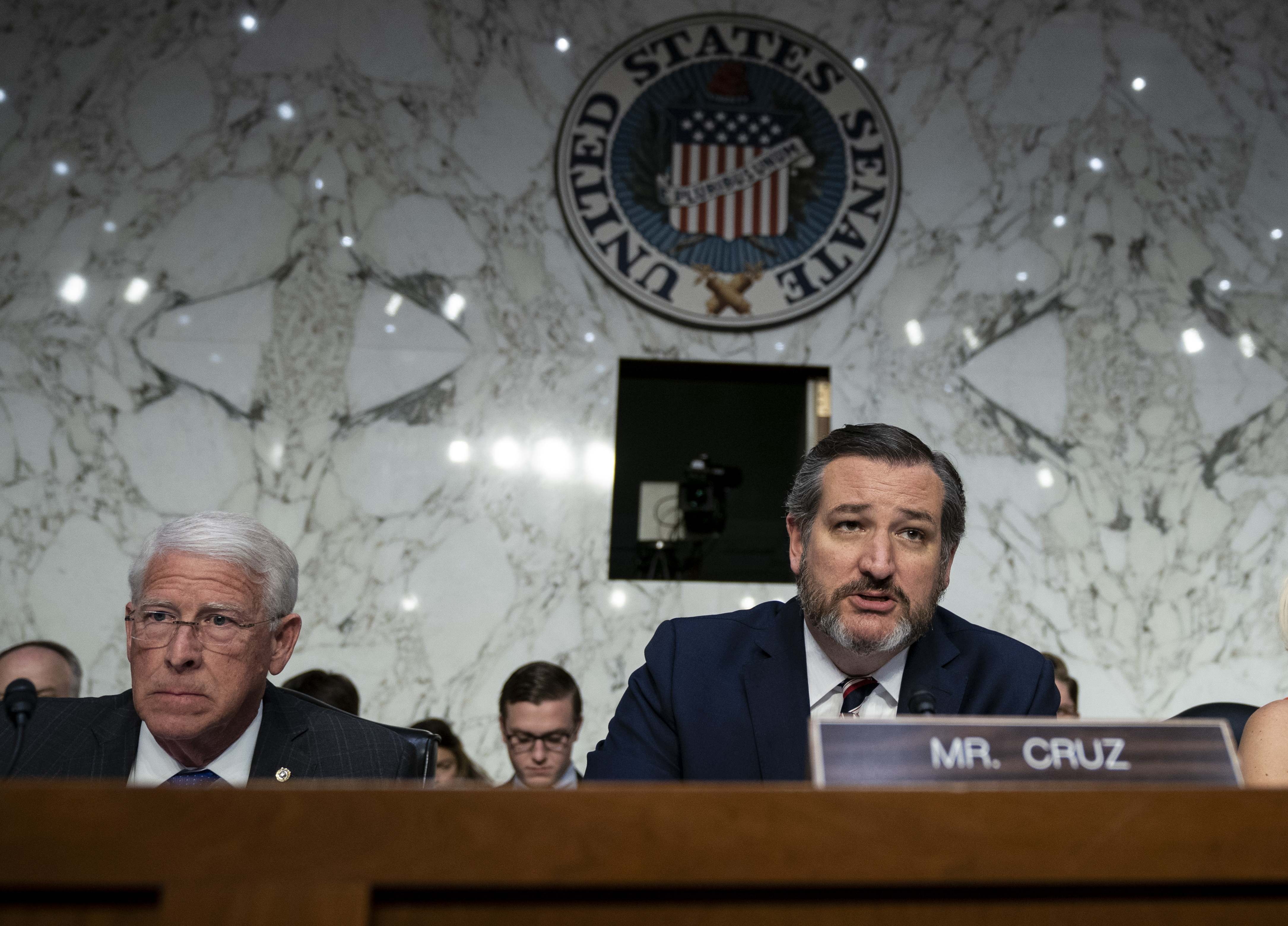
Sen. Roger Wicker (R-MS) and Sen. Ted Cruz (R-TX) are shown at a 2019 hearing. Both senators harshly criticized big technology companies at the 2021 confirmation hearing for Lina Khan to serve on the Federal Trade Commission.
Enlarge / Sen. Roger Wicker (R-MS) and Sen. Ted Cruz (R-TX) are shown at a 2019 hearing. Both senators harshly criticized big technology companies at the 2021 confirmation hearing for Lina Khan to serve on the Federal Trade Commission.
Drew Angerer/Getty Images

When President Joe Biden chose Lina Khan for one of the Federal Trade Commission’s five seats, it was an ominous sign for the nation’s largest technology companies. While still a law student, Khan made her academic career penning “Amazon’s Antitrust Paradox,” a scholarly 2017 treatise arguing for a tougher approach to regulating the Seattle behemoth.

Prior to law school, Khan worked for Barry Lynn, a scholar who was fired from the centrist New America Foundation over his aggressive criticism of Google, a major New America funder. After law school, Khan worked as the legal director of Lynn’s new organization, the Open Markets Institute.

So if we can expect anyone to push the Federal Trade Commission to enforce antitrust laws more aggressively against big technology companies, it would be Khan. The choice of Khan could also signal that the Biden administration more broadly will take a confrontational posture toward Big Tech.

But the really ominous sign for Big Tech is what happened when Khan had her confirmation hearing before the Senate Commerce Committee on Wednesday.

“I’ve become increasingly concerned”

You might have expected Republicans on the committee to go on the attack against Khan. Senators are usually happy to criticize nominees from the opposite party. And for most of the last 50 years, Republicans tended to favor a hands-off approach to antitrust law.

But only one Republican at Wednesday’s hearing raised any significant objections to the Khan pick—and her concerns weren’t about antitrust policy. Sen. Marsha Blackburn (R-Tenn.) said she worried about Khan’s “background and lack of experience” for such a senior position—Khan is in her early 30s.

Other Republicans seemed downright enthusiastic about Khan’s adversarial stance toward big technology companies and urged Khan to wield the FTC’s regulatory powers aggressively.

“I believe the FTC should be doing much more to rein in the anticompetitive abuses of Big Tech,” Sen. Ted Cruz (R-Texas) said to Khan.

Sen. Roger Wicker (R-Miss.) asked Khan about the portion of “Amazon’s Antitrust Paradox” that discusses treating Amazon as a common carrier. He also approvingly cited a recent concurring opinion by Justice Clarence Thomas suggesting that the law could treat social media giants as common carriers.

“I’ve become increasingly concerned about social media companies that promise to be a free and open marketplace for ideas, but they’re not in my view upholding those promise to their consumers,” said Sen. Jerry Moran (R-Kan.). Moran has introduced legislation allowing the FTC to punish social media companies if they don’t follow their own social media policies.

Democrats were equally critical of big tech companies, though they tended to focus on different issues. Sen. Amy Klobuchar (D-Minn.) blasted Google and Facebook for trying to “hold a whole country hostage” during the recent dispute over Australia’s news industry. Klobuchar also criticized Apple for its App Store policies.

The right is learning to love antitrust—at least for Silicon Valley

It would be misleading to suggest that there’s a left–right consensus on the best approach to regulating big technology companies. Republicans’ rising antipathy toward big technology companies is partly a reaction to social media companies’ increasingly aggressive moderation of right-wing content—including several sites banning Donald Trump back in January. Those moderation efforts are obviously popular among Democrats, so we can expect Democratic leaders to block legislative proposals like Moran’s.

But Republicans’ concerns are broader than just the moderation issue. For example, when the Trump administration filed major antitrust lawsuits against Google and Facebook late last year, the case was supported by the attorney general of almost every state, Democrat and Republican. And those lawsuits weren’t focused on content-moderation issues. Rather, they focused on traditional antitrust concerns that have long been held by left-leaning legal scholars like Khan.

The tech giants’ best hope of beating back this populist wave rests with the judiciary. Antitrust law is based on a small set of vague, century-old statutes that have been interpreted over time by a long sequence of court rulings. Starting in the 1980s, judges became more skeptical of strict antitrust enforcement. Over the last four decades, the Supreme Court handed down a series of rulings that weakened antitrust enforcement. Last year, for example, a federal appeals court rejected the FTC’s case that Qualcomm had abused its monopoly power in the modem chip market.

Antitrust law isn’t as ideologically polarized as some areas of the law, but it’s traditionally had some partisan tilt. Liberal judges usually favor stricter interpretations of the law than conservatives. For example, in one landmark 2018 ruling, the Supreme Court’s five conservative justices all voted to uphold an appeals court ruling that American Express had not violated antitrust law. The court’s four liberals all signed a dissent by Justice Stephen Breyer arguing that American Express had violated antitrust law.

This matters because Congress has become so polarized and dysfunctional that it’s unlikely to pass an overhaul of antitrust law—even if most members of Congress believe that recent antitrust policy has been too lenient. Hence, as long as the courts—and especially the nine members of the Supreme Court—favor weak enforcement of antitrust law, there may not be much that Khan or other members of the Biden administration can do to rein in big tech companies. It doesn’t matter how many big antitrust lawsuits the FTC or the Justice Department bring if the courts reject them.

At least one conservative justice is worried about Big Tech

And this is why that recent concurrence by Supreme Court Justice Clarence Thomas is so important. The case wasn’t an antitrust case. Rather, it concerned whether Donald Trump violated the First Amendment by blocking users from following him.

But Thomas went out of his way to express alarm about the market dominance of Facebook, Google, and other technology giants. He noted that Google has a 90 percent market share (it’s not clear which market this refers to) and that Facebook has 3 billion users. He warned that such a large market share gives tech giants a lot of control over the public’s communications.

While Justice Thomas didn’t suggest any specific changes to antitrust doctrine, he certainly seemed sympathetic to arguments that the tech giants have been abusing their market share. More generally, this seems like a sign that the changing view of big tech companies among Republican voters and Republican politicians is also affecting at least some conservative members of the judiciary.

It’s impossible to predict how Justice Thomas might rule if the Google or Facebook cases eventually reach the Supreme Court. And with six conservative justices, Thomas might not be a deciding vote even if he sided with the liberals.

But technology giants can’t be happy to face growing hostility across the political spectrum and from all three branches of government. Even if the companies manage to beat back the current wave of antitrust lawsuits, the next Republican president could share Donald Trump’s (and Joe Biden’s) hostility toward big technology companies and their enthusiasm for antitrust activism. And that would mean that sooner or later, the judiciary would turn against them, too.

https://arstechnica.com/?p=1759536


Conservative versus liberal: A knock-down, drag-out climate policy fight

Conservative versus liberal: A knock-down, drag-out climate policy fight

While the United States debates whether or not to put a price on carbon emissions, Canada is getting into the nitty-gritty of how best to do it. The country’s ruling Liberal Party enacted its carbon tax back in 2016 to much controversy. Former Conservative Party of Canada (CPC) leader Andrew Scheer decried the tax and suggested it was a blow to national unity within Canada. A few provinces with conservative governments—notably Ontario and oil-rich Alberta—took legal action against the tax, claiming that it wasn’t constitutional.

Recently, the Supreme Court of Canada decided that the tax was constitutional.

The CPC—which still retains ties with its provincial counterparts despite having a different name—has now proposed its own carbon-pricing scheme. Its strategy is a different beast from the Liberals’ existing policy. This is likely in no small part because the CPC’s relationship with the climate has long (but not always) been strained.

Current plans

As it stands, Canada’s current carbon tax has placed a CA$40-per-tonne price on CO2 or equivalent emitted by consumers. This sum is slated to increase each year until it reaches CA$170 per tonne by 2030. The hope is that this cost will discourage people from doing things that can result in carbon emissions, like filling up their cars with gas. Practically, it will also allow manufacturers time to design and produce more efficient automobiles and appliances. The timing should also help Canada reach its Paris Agreement Targets.

Currently, 90 percent of the funds garnered from the Liberal tax are evenly redistributed to households around Canada within the provinces from which they came—the other 10 percent returns to various groups like schools, small businesses, and Indigenous communities.

The CPC’s Personal Low Carbon Savings Account plan would also put a price on carbon, starting off at CA$20 per tonne and increasing to CA$50 per tonne but no higher. Rather than the government taking and distributing or using the levied funds, the cash would be added to a savings account set up for each person. This account would be specifically for people to purchase green goods like bikes or energy-efficient furnaces.

Both the Liberal and CPC plans also have provisions for large industrial emitters. Functionally, there’s a cap on emissions, and companies that go over the cap pay in accordance with it. If you go under, you receive a credit that you can sell to other companies. Industrial emitters are also subject to a federal fuel charge.

Ars spoke with Canada carbon-tax experts to get a sense of how the two different approaches stack up. We also reached out to the two parties for comment but didn’t hear back in time for publication—possibly because Canada’s federal budget was just announced.

Pros and cons

Nicholas Rivers, associate professor at the Graduate School of Public and International Affairs at the University of Ottawa, called the CPC’s fuel levy “gimmicky and likely to be ineffective.” He suspects the right-wing party decided to adopt a carbon-pricing policy as a political measure to help it broaden its appeal. However, carbon pricing remains contentious in conservative circles and as such, the Personal Low Carbon Savings Account is something of a misstep as far as carbon pricing goes. Under the Liberal carbon tax, for example, the more fuel a person burns, the more they pay in taxes, which incentivizes people to curtail their carbon consumption. That might not be the case with the CPC’s plan.

“Essentially, it’s taking money out of one of your pockets and putting it right back into the other. That will negate, or substantially mitigate, any incentive the carbon tax would give you to reduce your emissions,” he told Ars. “You’ll pay more tax, but you’ll also get more money in your carbon-savings account.”

Because, under the Liberal tax, the amount people get is not dependent on the carbon they used, the strategy should reduce consumption without disproportionately targeting lower-income people, he said. People who consume more carbon, however, end up paying more carbon tax and only receive what everyone else does.

“I know that if I reduce my emissions, I will pay less tax but still get the same amount of money back in my rebates,” Rivers said.

An “administrative nightmare”

Rivers also noted that, just in terms of raw numbers, the CPC’s plan is weaker than the Liberal Party’s. If implemented today, the plan would walk back the price on carbon by half—from CA$40 per tonne to CA$20 per tonne. The current maximum price of carbon under the Liberal tax is also more than three times higher than that of the CPC’s proposal. The CPC also hasn’t specified when its levy would end up reaching CA$50 per tonne.

Rivers also noted that it might be tricky to define what a low-carbon purchase is—and thus what the money in the proposed savings accounts could be spent on. The measure could also be an “administrative nightmare,” as it would require every Canadian to go out and get one of these accounts to participate.

Further, while the Liberals’ carbon tax was ultimately deemed constitutional, the legality of the CPC’s has yet to be put through the ringer. That’s not to say the court would not find it constitutional, but it’s unclear at the moment, Rivers said. Right now, provinces can avoid using the federal carbon tax if they implement a comparable or better strategy of their own. The CPC’s strategy only notes that if the party forms a government and enacts its plan, it will work with provinces to implement it. It’s unclear what that would mean or how it would work in practice, Rivers said.

“It’s not at all clear whether they could implement something like this. For many reasons, I think this is not an effective approach. It was designed to be ineffective from the start to satisfy members of the Conservative Party who don’t want this approach,” he said. But he also noted that the plan lacks the details necessary for him to give it a complete assessment.

“Less and less partisan”

Isabelle Turcotte, federal policy director of The Pembina Institute, a Canadian energy think-tank, said that the CPC’s carbon levy represents a welcome change. Despite all the arguments against carbon pricing made by conservative leaders around the country, the right-wing party’s decision to adopt the tactic is now shifting the debate toward how carbon should be priced rather than if it should be priced at all. “It was really great to see the Conservative Party acknowledge how pricing pollution is an essential tool, a very cost-effective and powerful tool to tackle climate change,” Turcotte said. “It’s great for all of us to be operating in a context where climate action is less and less partisan.”

However, she also noted that the CPC’s proposed carbon levy doesn’t make many provisions for reduction goals—like the IPCC goal of reducing CO2 emissions by 45 percent compared to 2010 levels by 2030 and reaching net-zero carbon by 2050. So if the CPC isn’t going to deploy a carbon tax to its full extent, it would need to make up for the carbon reductions elsewhere in its climate plan. The party’s climate plan does make some of these other provisions—such as investing CA$5 billion in carbon capture, utilization, and storage tech. But Turcotte noted that a robust carbon tax could also incentivize the development of this kind of technology, and it might be a better pathway to do so.

She also suggested that the Personal Low Carbon Savings Account idea could be “flipped on its head.” Rather than an account that gets filled up the more a person spends on carbon, there could be a maximum amount within these accounts that decreases each time a person consumes fossil fuels. This could be a more direct and representative way of showing that there is a limit on the emissions each person can generate, she said. If people know that for each tonne of carbon they burn, they get a certain amount of money, there could be a “perverse incentive for those who are able to afford it to just keep racking up the points,” she said.

Climate policy has a “long, long way to go”

Some elements within the CPC’s broader climate plan that, Rivers said, are actually good—though it’s likely the carbon levy will inevitably draw more headlines—and they don’t appear in the Liberal climate plan. For one thing, the party promises to mandate that natural gas will need to be 15 percent renewable content (gas that is captured from farms and landfills, for instance) by 2030. That could generate substantial—but not dramatic—emission reductions, he said. The CPC is also proposing a regulation that 30 percent of all vehicles sold be zero-emission, also by 2030.

“There are elements in the Conservative climate plan that are substantive and will generate real reductions,” he said.

The Liberal plan could also use some work. For example, most of the debate surrounding the carbon tax has centered on what it means for consumers rather than large emitters—a matter Turcotte calls a kind of “quiet, nerd debate.” In the Liberal (and Conservative) plans, stronger standards could be set in that area. Further, according to Rivers, the Liberal carbon tax’s current endpoint, CA$170 per tonne, might not be able to reduce carbon emissions to zero, which “is where we really need to be,” he said.

“We have a long, long way to go in climate policy.”

https://arstechnica.com/?p=1759825


Supreme Court kills FTC’s “strongest tool” for getting refunds to scam victims

Supreme Court Justices John Roberts, Stephen Breyer, and Elena Kagan sitting and listening to a State of the Union address in Congress.
Enlarge / Supreme Court Justices, from left, Chief Justice John Roberts, Stephen Breyer, and Elena Kagan listen during then-President Trump’s State of the Union address to a joint session of Congress at the US Capitol in Washington, DC, on Tuesday, Jan. 30, 2018.
Getty Images | Bloomberg

A Supreme Court ruling yesterday killed the Federal Trade Commission’s “strongest tool” for fighting scam artists and securing refunds for wronged consumers, the FTC’s acting chairwoman said.

“The Supreme Court ruled in favor of scam artists and dishonest corporations, leaving average Americans to pay for illegal behavior,” FTC Acting Chairwoman Rebecca Kelly Slaughter said in a statement after the ruling. “With this ruling, the Court has deprived the FTC of the strongest tool we had to help consumers when they need it most. We urge Congress to act swiftly to restore and strengthen the powers of the agency so we can make wronged consumers whole.”

Though it was criticized by Slaughter and consumer advocates, the Supreme Court’s ruling in a case involving deceptive payday lending practices was unanimous. In AMG Capital Management v. Federal Trade Commission, the court ruled that Section 13(b) of the Federal Trade Commission Act “does not authorize the Commission to seek, or a court to award, equitable monetary relief such as restitution or disgorgement” for consumers.

FTC used 13(b) to obtain billions in refunds

Section 13 relates to false advertisements, and the FTC will still be able to use 13(b) to secure injunctions to halt deceptive practices. The text of 13(b) says the FTC can seek temporary restraining orders and preliminary injunctions when it has reason to believe that “any person, partnership, or corporation is violating, or is about to violate, any provision of law enforced by the Federal Trade Commission.”

Section 13(b) does not specifically authorize the FTC to seek refunds, but the FTC has used it that way for decades, and federal courts allowed the practice. The FTC said yesterday:

Over the past four decades, the Commission has relied on Section 13(b) of the Federal Trade Commission Act to secure billions of dollars in relief for consumers in a wide variety of cases, including telemarketing fraud, anticompetitive pharmaceutical practices, data security and privacy, scams that target seniors and veterans, and deceptive business practices, among many others. More recently, in the wake of the pandemic, the FTC has used Section 13(b) to take action against entities operating COVID-related scams. Section 13(b) enforcement cases have resulted in the return of billions of dollars to consumers targeted by a wide variety of illegal scams and anticompetitive practices, including $11.2 billion in refunds to consumers during just the past five years.

That includes $20 million that Uber agreed to pay in 2017 to settle an FTC-filed lawsuit, which alleged that the ride-hailing company exaggerated what drivers could expect to earn in various cities nationwide.

In yesterday’s decision, “the Supreme Court ruled in favor of AMG Services, Inc. and Scott Tucker, who stole more than $1.3 billion from consumers through a deceptive payday lending scheme,” the FTC said. “By misrepresenting loan terms, the defendant caused borrowers to pay more than seven times the interest they were told they would pay.”

FTC’s other powers more “cumbersome”

The unanimous ruling explained that “Section 13(b) does not explicitly authorize the Commission to obtain court-ordered monetary relief, and such relief is foreclosed by the structure and history of the Act.” The Supreme Court said the commission has power to seek financial penalties and consumer relief under Sections 5 and 19 of the FTC Act:

Section 5 (l) of the Act authorizes the Commission, following completion of the administrative process and the issuance of a final cease and desist order, to seek civil penalties, and permits district courts to “grant mandatory injunctions and such other and further equitable relief as they deem appropriate in the enforcement of such final orders of the Commission.” Section 19 of the Act further authorizes district courts (subject to various conditions and limitations) to grant “such relief as the court finds necessary to redress injury to consumers,” in cases where someone has engaged in unfair or deceptive conduct with respect to which the Commission has issued a final cease and desist order applicable to that person.”

Among other reasons for ruling against the FTC, the court said that it “does not believe Congress would have enacted §19’s provisions expressly authorizing monetary relief if §13(b) already implicitly allowed the Commission to obtain that same monetary relief without satisfying §19’s conditions and limitations.”

Consumer advocates say the Section 5 and 19 powers require a more laborious process that makes it harder to help scam victims. “It just got easier to exploit consumers and harder for the FTC to do anything about it,” Public Knowledge Policy Counsel Alex Petros wrote. “We need an empowered FTC free from cumbersome administrative processes with the speed and flexibility to stand up for consumers against the companies that would exploit them—not additional red tape.”

TechFreedom, a libertarian-leaning think tank that filed a brief in the case, said the Supreme Court ruling “restores due process at the FTC.” TechFreedom President Berin Szóka wrote:

The text of the Act is clear: Section 13(b) allows the agency to stop deceitful or fraudulent conduct quickly, so that the conduct is not ongoing while the agency then completes a more rigorous process for clawing back ill-gotten gains. This process ensures a balance: fraudsters’ misconduct is promptly shut down, but the agency is forced to prove that its target is indeed engaged in fraud before taking money from it. Although the agency (and several Senators) have recently emphasized how important the agency’s Section 13(b) authority is for obtaining consumer redress, it is only important because the agency has made it so, by convincing courts to let the agency misuse it for that purpose.

Congress can restore FTC power

Public Knowledge said the ruling “decimates [the] FTC’s ability to protect consumers through restitution” but pointed out that Congress can restore the FTC’s powers by amending the law.

“As Justice [Stephen] Breyer noted in his opinion, Congress can easily fix this problem by clarifying that the FTC can seek equitable remedies along with an injunction,” Petros wrote. “Given that both sides of the aisle support the agency’s ability to seek restitution, it should be a priority for legislators. It’s common sense for ill-gotten gains to be returned to the pockets of consumers—not kept by those that would take advantage of them.”

Szóka argued that “Congress should amend Section 13(b) to authorize monetary relief when a reasonable person would have known the conduct was dishonest or fraudulent. This is the standard in Section 19. It ensures that the Commission can make consumers whole when they are clearly cheated, but also that companies are not punished for making honest mistakes.”

Lawmakers move toward FTC Act fix

Two days before the Supreme Court decision, the House Commerce Committee scheduled a hearing for April 27 on “legislation to preserve [the] FTC’s 13(b) consumer protection powers.”

“An uncertain impending Supreme Court decision on the FTC’s 13(b) authorities has given scammers new opportunities to take advantage of people, including those who are isolated at home due to the pandemic,” said a joint statement by Commerce Committee Chairman Frank Pallone, Jr. (D-N.J.) and Consumer Protection and Commerce Subcommittee Chair Jan Schakowsky (D-Ill.). “Next week, we will hold a hearing to consider legislation that would restore the FTC’s longstanding authorities to provide redress to consumers who’ve been scammed.”

The hearing will likely focus on a bill introduced Tuesday by Rep. Tony Cardenas (D-Calif.), which has 13 Democratic co-sponsors, all of whom are members of the Commerce Committee.

A corresponding effort is underway in the Senate. “We are working to move legislation immediately to make sure this authority is properly protected,” Senate Commerce Committee Chair Maria Cantwell (D-Wash.) said. A Politico report noted that “Republicans led by Senate Commerce ranking member Roger Wicker (R-Miss.) last year included a 13(b) fix in their privacy legislation, indicating there could be bipartisan support for a quick fix to the FTC Act.”

https://arstechnica.com/?p=1759776