How the Supreme Court saved the software industry from API copyrights

A lot of happy developers out there in the world today.
Enlarge / A lot of happy developers out there in the world today.
Aurich Lawson

Google and Oracle’s argument before the Supreme Court last October left opponents of API copyrights extremely nervous. For the previous decade, Google had been arguing in lower courts that it didn’t infringe copyright law when it re-implemented Java for use in Android. Google had lost—twice—at the appellate level.

Last October, justices for the nation’s highest court seemed skeptical as well. Not only were they asking Google’s lawyer, Tom Goldstein, a lot of tough questions, a number of them didn’t seem to even understand what an API was. That seemed like a bad sign for Google because the distinction between code that declares an API and code that implements it was fundamental to Google’s argument.

In an interview with Ars just after the oral argument, Cornell legal scholar James Grimmelman argued that Goldstein had botched the case.

“He did an abysmal job,” Grimmelman told me. “At the level of nuance he was willing to get into, his case was a loser.”

But Grimmelman now admits he was wrong. “I owe an apology to Tom Goldstein,” he told me on Monday. “I had my criticisms of the job he did at oral argument, but he did a good enough job to win.”

By a 6-2 vote, the nation’s highest court held that Google’s copying of Oracle’s Java API was fair use. The ruling means Google won’t have to pay billions of dollars in damages to Oracle. It also has huge implications for the broader software industry.

“It’s a minor miracle we got an opinion that reached the right result with pretty sound reasoning despite not one of the justices being able to explain how an API works,” Grimmelman said.

An unexpected focus on fair use

Prior to the ruling, Microsoft filed an amicus brief urging the Supreme Court to side with Google. The brief, which was cited in Monday’s ruling, provides one of the best explanations of the stakes in the case.

“Developers rely on sharing, modifying, and enhancing previously developed code to create new products and develop new functionality,” Microsoft wrote. “Both a cause and effect of this collaborative development is the increased demand for seamless interoperability and compatibility—i.e., the ability of different products, devices, and applications to communicate and work together without effort from the consumer.”

If APIs became subject to copyright protection, it would become much easier for an incumbent software provider to lock its customers into a proprietary standard. That would create more compatibility headaches for consumers, and it would make it harder for software startups to break in to established software markets. Opponents of API copyrights also warned that a ruling for Oracle could unleash a flood of API copyright lawsuits similar to the patent troll lawsuits of the last 20 years.

Opponents of API copyrights were hoping that the Supreme Court would declare that an API can’t be protected by copyright at all, making such lawsuits impossible. Oracle, of course, was hoping the Supreme Court would reach the opposite conclusion. But as it often does, the Supreme Court chose to take the case in a different direction.

The high court was actually considering two different questions in the case. Google not only argued that APIs can’t be copyrighted, Google also argued that its use of Oracle’s Java API was legal under copyright’s fair use doctrine. The Supreme Court decided to skip over the first question and focus on the second one.

“Given the rapidly changing technological, economic, and business-related circumstances, we believe we should not answer more than is necessary to resolve the parties’ dispute,” Justice Stephen Breyer wrote in his majority opinion. “We shall assume, but purely for argument’s sake, that the entire Sun Java API falls within the definition of that which can be copyrighted.”

In other words, the Supreme Court didn’t provide any guidance on whether an API can be copyrighted—the main question everyone expected the court to answer. Instead, the court ruled that even if APIs can be copyrighted, Google’s copying was protected by fair use.

Google went four for four on fair use

As regular readers know, fair use is one of the most important ideas in copyright law. It allows a news site like Ars to blockquote a paragraph from another publication for purposes of commentary and criticism. It allows consumers to record broadcast television shows for later viewing and to transfer legally purchased music between personal devices. A number of Google products rely on fair use, including thumbnails in Google Image Search and scanning for Google Books.

Courts consider four major criteria when decided whether a use is fair. The party that wins on a majority of these factors usually wins the case. In Monday’s ruling, Justice Breyer concluded that all four of these factors point in Google’s direction.

  • One factor is the nature of the original copyrighted work. Some types of work get stronger copyright protection than others. Creative works like novels get stronger protections (and hence stricter limits on fair use) than utilitarian works like dictionaries or phone books. In Justice Breyer’s view, the code that defines an API is more like a dictionary than a novel. “The declaring code is, if copyrightable at all, further than are most computer programs from the core of copyright,” he wrote.
  • Another factor is the purpose and character of the copying. Copying is more likely to be fair if it is “transformative”—if it’s used to do something new or innovative. The high court pointed to two common reasons people copy APIs: the desire to ensure interoperability between software products and the desire to enable programmers who learned skills on one platform (in this case the Java language) to re-use those skills elsewhere (like making Android apps).
  • The third factor is how much material was copied. Google took 11,500 lines of code—mostly function declarations—from Java. That might sound like a lot, but Justice Breyer pointed out that this was a tiny fraction of the 2.8 million lines that make up Oracle’s official Java implementation.
  • The final factor is the effect of the copying on the market for the original work. Oracle argued that Google’s copying had undermined Oracle’s business licensing the Java platform to other tech companies. But Justice Breyer wasn’t persuaded. He noted that Sun had struggled to gain traction in the mobile phone market in the years before Google launched Android.

Google didn’t need to win on all four of these factors in order to beat Oracle. But the fact that Google did win on all four will be important to future defendants, since it gives them a greater margin for error. Even if a defendant can’t show that their API copying was exactly like Google’s, they’re still likely to prevail if they can convince a court that their use was similar to Google in at least three of these four areas.

https://arstechnica.com/?p=1754639


Clarence Thomas blasts Section 230, wants “common-carrier” rules on Twitter

Supreme Court Justice Clarence Thomas arrives for the swearing-in of Justice Brett Kavanaugh in the East Room of the White House on October 8, 2018, in Washington, DC.
Enlarge / Supreme Court Justice Clarence Thomas arrives for the swearing-in of Justice Brett Kavanaugh in the East Room of the White House on October 8, 2018, in Washington, DC.
Getty Images | Chip Somodevilla

The US Supreme Court today vacated a 2019 appeals-court ruling that said then-President Donald Trump violated the First Amendment by blocking people on Twitter. The high court declared the case “moot” because Trump is no longer president.

For legal observers, the ruling itself was less interesting than a 12-page concurring opinion filed by Justice Clarence Thomas, who argued that Twitter and similar companies could face some First Amendment restrictions even though they are not government agencies. That’s in contrast to the standard view that the First Amendment’s free speech clause does not prohibit private companies from restricting speech on their platforms.

Thomas also criticized the Section 230 legal protections given to online platforms and argued that free-speech law shouldn’t necessarily prevent lawmakers from regulating those platforms as common carriers. He wrote that “regulation restricting a digital platform’s right to exclude [content] might not appreciably impede the platform from speaking.”

First Amendment

Thomas doesn’t seem to be arguing for a wide-ranging application of the First Amendment to all online moderation decisions. Instead, he wrote that free-speech law could apply “in limited circumstances,” such as when a digital platform blocks user-submitted content “in response to government threats.”

“Because of the change in Presidential administration, the Court correctly vacates the Second Circuit’s decision,” Thomas wrote. “I write separately to note that this petition highlights the principal legal difficulty that surrounds digital platforms—namely, that applying old doctrines to new digital platforms is rarely straightforward. Respondents [the Twitter users who sued Trump] have a point, for example, that some aspects of Mr. Trump’s account resemble a constitutionally protected public forum. But it seems rather odd to say that something is a government forum when a private company has unrestricted authority to do away with it.”

The Trump case didn’t give the Supreme Court a chance to rule on the questions Thomas raised, but he is hoping that future cases will provide such an opportunity:

The Second Circuit feared that then-President Trump cut off speech by using the features that Twitter made available to him. But if the aim is to ensure that speech is not smothered, then the more glaring concern must perforce be the dominant digital platforms themselves. As Twitter made clear, the right to cut off speech lies most powerfully in the hands of private digital platforms. The extent to which that power matters for purposes of the First Amendment and the extent to which that power could lawfully be modified raise interesting and important questions. This petition, unfortunately, affords us no opportunity to confront them.

US Rep. Ted Lieu (D-Calif.) blasted Thomas’ opinion. “Justice Clarence Thomas wants the government to regulate speech on the Internet. If you are a Republican who supports this view, don’t ever lecture anyone on free speech ever again,” Lieu wrote on Twitter.

“That Justice Thomas has… idiosyncratic.. views about the First Amendment is not exactly news,” wrote Stephen Vladeck, a professor at University of Texas School of Law who has argued before the Supreme Court. “That none of his conservative colleagues saw fit to join his concurrence in the Twitter case is probably the bigger story, at least for now.”

Trump “had only limited control of the account”

Twitter’s decision to permanently remove Trump from the platform (for inciting violence) demonstrated that Trump himself “had only limited control of the account,” Thomas wrote.

“The disparity between Twitter’s control and Mr. Trump’s control is stark, to say the least,” Thomas wrote. “Mr. Trump blocked several people from interacting with his messages. Twitter barred Mr. Trump not only from interacting with a few users, but removed him from the entire platform, thus barring all Twitter users from interacting with his messages. Under its terms of service, Twitter can remove any person from the platform—including the President of the United States—’at any time for any or no reason.'”

Thomas acknowledged that private entities usually aren’t constrained by the First Amendment but added that the First Amendment may apply on a private company’s online platform “if the government coerces or induces it to take action the government itself would not be permitted to do, such as censor expression of a lawful viewpoint.”

Thomas continued:

Consider government threats. “People do not lightly disregard public officers’ thinly veiled threats to institute criminal proceedings against them if they do not come around.” [Thomas was quoting a 1963 Supreme Court ruling in that sentence.] The government cannot accomplish through threats of adverse government action what the Constitution prohibits it from doing directly. Under this doctrine, plaintiffs might have colorable claims against a digital platform if it took adverse action against them in response to government threats.

But no such threat was alleged in the Trump case, and “[w]hat threats would cause a private choice by a digital platform to ‘be deemed… that of the State’ remains unclear,” he wrote.

Thomas also suggested that the First Amendment should not have applied to Trump blocking users because Twitter is the one that ultimately controls the digital space. “Because unbridled control of the account resided in the hands of a private party, First Amendment doctrine may not have applied to respondents’ complaint of stifled speech,” he wrote. “Whether governmental use of private space implicates the First Amendment often depends on the government’s control over that space.”

Thomas criticizes Section 230

Although Section 230 of the Communications Decency Act gives online platforms immunity from lawsuits over how they moderate user-submitted content, Thomas wrote that Congress “has not imposed corresponding responsibilities, like nondiscrimination, that would matter here.”

In a footnote, Thomas wrote that the legal immunity provided by Section 230 “eliminates the biggest deterrent—a private lawsuit—against caving to an unconstitutional government threat.” In the same footnote, Thomas cited an argument “that immunity provisions like Section 230 could potentially violate the First Amendment to the extent those provisions pre-empt state laws that protect speech from private censorship.”

Thomas’ Section 230 argument was disputed by Jeff Kosseff, assistant professor of cybersecurity law at the US Naval Academy and author of a book on Section 230. “I think that it’s very unlikely that a state must-carry law for social media would survive [First Amendment] scrutiny,” Kosseff wrote in a Twitter thread. Even if such a hypothetical state law passed First Amendment muster, it’s unlikely that Section 230 would be found to violate the First Amendment under existing interpretations of US law, he wrote.

Thomas: Online platforms are like common carriers

In addition to his First Amendment argument, Thomas wrote that digital platforms could be regulated as common carriers. “In many ways, digital platforms that hold themselves out to the public resemble traditional common carriers,” he wrote. “Though digital instead of physical, they are at bottom communications networks, and they ‘carry’ information from one user to another. A traditional telephone company laid physical wires to create a network connecting people. Digital platforms lay information infrastructure that can be controlled in much the same way.”

The similarity between online platforms and common carriers “is even clearer for digital platforms that have dominant market share,” such as Facebook, Google, and Amazon, Thomas continued.

“The Facebook suite of apps is valuable largely because 3 billion people use it,” he wrote. “Google search—at 90 percent of the market share—is valuable relative to other search engines because more people use it, creating data that Google’s algorithm uses to refine and improve search results. These network effects entrench these companies.” Thomas wrote that “Although both companies are public, one person controls Facebook (Mark Zuckerberg), and just two control Google (Larry Page and Sergey Brin).”

“Much like with a communications utility, this concentration gives some digital platforms enormous control over speech,” Thomas wrote. Google “can suppress content by deindexing or downlisting a search result or by steering users away from certain content by manually altering autocomplete results,” while “Facebook and Twitter can greatly narrow a person’s information flow through similar means.” Amazon, “as the distributor of the clear majority of e-books and about half of all physical books… can impose cataclysmic consequences on authors by, among other things, blocking a listing,” he wrote.

Arguing that lawmakers could impose common-carrier rules on digital platforms, Thomas wrote, “The similarities between some digital platforms and common carriers or places of public accommodation may give legislators strong arguments for similarly regulating digital platforms.”

“That is especially true because the space constraints on digital platforms are practically nonexistent (unlike on cable companies), so a regulation restricting a digital platform’s right to exclude might not appreciably impede the platform from speaking,” Thomas added. Thomas also wrote that his common-carrier analysis does not mean “that the First Amendment is irrelevant until a legislature imposes common-carrier or public-accommodation restrictions—only that the principal means for regulating digital platforms is through those methods.”

Thomas regretted Brand X decision

If Congress took up Thomas’ call to regulate online platforms, we could end up with a system in which Internet service providers like Comcast and AT&T are not regulated as common carriers while Twitter, Facebook, and Google do face the common-carrier restrictions that traditionally applied to telecommunications companies.

Thomas has played an important role in how common-carrier regulations are applied or not applied to Internet service providers. In the 2005 Brand X case, Thomas wrote the Supreme Court opinion that lets the Federal Communications Commission classify Internet service as either an information service or telecommunications as long as it provides a reasonable justification for its decision.

The FCC can only apply common-carrier rules to Internet service if it is classified as telecommunications, and the Brand X ruling allowed the FCC to change that classification decision multiple times under different administrations, including when then-FCC Chairman Ajit Pai deregulated broadband in 2017. Thomas last year wrote that he regrets the Brand X decision because it gave federal agencies like the FCC too much leeway in interpreting US law.

https://arstechnica.com/?p=1754677


Amazon illegally fired two employees who pushed for climate, labor action

An Amazon logo falls apart and catches fire.

Nearly a year ago, Amazon fired two employees who had criticized the company. The employees had publicly called on the company to do more to reduce its carbon footprint and had circulated a petition among Amazon employees supporting better compensation and support for warehouse workers. Now, the National Labor Relations Board, or NLRB, has found that Amazon acted illegally and in retaliation when it fired them, according to a report from The New York Times.

Emily Cunningham and Maren Costa were both designers at Amazon’s Seattle headquarters, and their tussles with management began in 2018 when they joined a group of employees who vocally backed shareholder petitions urging the company to do more to combat climate change. (The group had received Amazon stock as part of its compensation.)

They and a handful of other employees rallied others to the cause. On September 20, 2018, thousands of employees walked out in protest of the company’s climate policies. Lawyers told Cunningham, Costa, and others that in speaking out, they had violated company policies that restrict employees from talking about Amazon publicly. The group ultimately wrote an open letter, which was signed by more than 8,700 Amazon workers, to CEO Jeff Bezos and the board of directors.

A little over a year later, as the pandemic gained steam, Cunningham and Costa grew concerned about conditions in Amazon’s warehouses. There, workers whose jobs were strenuous under normal conditions were under greater stress due to the pandemic. Supply chains across the world had been snarled, and many people under lockdowns turned to Amazon. Order volumes surged, increasing workloads at the fulfillment centers. Warehouse workers’ status as “essential” kept them picking orders even after their colleagues had been diagnosed with COVID-19. In one warehouse in Minnesota, infection rates were four times higher than in the surrounding community.

Cunningham and Costa joined with other Amazon tech employees to circulate petitions internally that sought expanded hazard pay, sick leave, and childcare for warehouse employees. The group also planned a virtual event for warehouse and tech workers, allowing the latter to hear firsthand about the former’s working conditions.

Shortly thereafter, Amazon fired both Cunningham and Costa, claiming that they had been “repeatedly violating internal policies.” The two women filed complaints with the NLRB.

The NLRB recently told Amazon that if it did not settle the complaints with Cunningham and Costa, the agency would formally accuse the company of unfair labor practices. Such cases can result in settlements, injunctions, or remedial orders.

Increasing scrutiny

The NLRB determination has come at a time when Amazon is under increasing scrutiny for the way it deals with its employees—and for how it responds to such criticism. Amazon recently settled another NLRB complaint, this time with a warehouse worker who helped organize a walkout at a Queens, New York, fulfillment center. Jonathan Bailey, the worker, says he was falsely accused of harassment in a company bid to stifle his union-organizing activities. He continues to work at the same Amazon warehouse, and Amazon has had to post notices reminding employees of their right to organize.

Amazon has been aggressively defending its actions in the court of public opinion. Amazon PR’s Twitter account was recently filled with a number of tweets that were so confrontational that a security engineer at the company filed a support ticket because he thought the account had been hacked. One of those tweets questioned the veracity of reports saying that Amazon employees and contractors used bottles to relieve themselves while on the job. “You don’t really believe the peeing in bottles thing, do you?” the tweet said in reply to a message posted by Rep. Mark Pocan (D-WI). The company later posted an apology to the congressman. “The tweet was incorrect,” Amazon said.

Bailey’s, Cunningham’s, and Costa’s cases are just three of at least 37 NLRB complaints filed against Amazon since February 2020, according to an NBC News investigation, which points out that Walmart had only eight over the same time period.

Typically, NLRB complaints are handled at each of its 26 regional offices. But the sheer number filed against Amazon has the agency considering a national investigation into the company’s labor practices.

https://arstechnica.com/?p=1754597


Supreme Court rules API copying is fair use

A large Google sign seen on a window of Google's headquarters.
Enlarge / Exterior view of a Googleplex building, the corporate headquarters of Google and parent company Alphabet, May 2018.

The Supreme Court has sided with Google in its decade-long legal battle with Oracle over the copyright status of application programming interfaces. The ruling means that Google will not owe Oracle billions of dollars in damages. It also has big implications for the broader software industry, since a ruling in the opposite direction could have triggered a wave of lawsuits against software companies that re-implemented other companies’ APIs.

The case dates back to the creation of the Android platform in the mid-2000s. Google decided to base Android on Sun’s Java programming language, enabling existing Java programmers to easily develop for the platform. Google independently implemented the Java API methods, but to ensure compatibility, it copied Java’s method names, argument types, and the class and package hierarchy.

A few years later, Oracle acquired Sun and soon afterward sued Google, arguing that Google’s copying had infringed Sun’s copyrights. Over a decade of litigation, Google won twice at the trial court level, but each time, the ruling was overruled by the Federal Circuit appeals court. The case finally reached the Supreme Court last year.

Writing for a six-justice majority, Justice Stephen Breyer held that Google’s copying of the Java API calls was permissible under copyright’s fair use doctrine. The high court punted on whether APIs can be copyrighted in the first place. But the court’s fair use reasoning was broad enough that it should provide a strong defense for most API copying, making the question of API copyrights much less important.

We’ll publish an in-depth analysis of the court’s reasoning once we have time to fully digest it and see what the experts are saying.

https://arstechnica.com/?p=1754531


Amazon admits its drivers sometimes have to pee in bottles

A dark blue van with multiple Amazon logos.

Amazon has posted an apology to Rep. Mark Pocan (D-WI) for a tweet last week denying that it makes its workers urinate in water bottles.

The controversy started with a tweet by Pocan blasting Amazon for its treatment of workers—a topic of particular public interest as workers at an Amazon warehouse in Alabama were voting on whether to unionize.

“Paying workers $15/hr doesn’t make you a ‘progressive workplace’ when you union-bust & make workers urinate in water bottles,” Pocan wrote.

“You don’t really believe the peeing in bottles thing, do you?” Amazon responded on March 24. “If that were true, nobody would work for us.”

Recode’s Jason Del Rey reports that Amazon’s aggressive response was encouraged by CEO Jeff Bezos, who had been frustrated Amazon wasn’t pushing back hard enough against its critics.

But the tweet turned into a PR fiasco for Amazon. The next day, Vice published a story with the headline “Amazon Denies Workers Pee in Bottles. Here Are the Pee Bottles.” It included a photo of bottles with an Amazon worker’s urine in them.

Vice noted that this was a common topic of discussion on the r/AmazonDSPDrivers subreddit. There are “dozens of threads and hundreds of comments” with drivers lamenting their need to pee in bottles, hedges, and other things besides a toilet.

“The tweet was incorrect”

Now Amazon has changed its tune. “The tweet was incorrect,” Amazon admitted on its website. “It did not contemplate our large driver population and instead wrongly focused only on our fulfillment centers.”

Amazon says that “a typical Amazon fulfillment center has dozens of restrooms, and employees are able to step away from their work station at any time.”

However, the company acknowledged that this isn’t always true for its delivery drivers.

“We know that drivers can and do have trouble finding restrooms because of traffic or sometimes rural routes, and this has been especially the case during Covid when many public restrooms have been closed,” Amazon wrote.

“This is a long-standing, industry-wide issue and is not specific to Amazon,” the company added. Amazon says it wants to solve the problem: “We don’t yet know how, but will look for solutions.”

Amazon appears to be right about that. Drivers for Uber, Lyft, and food delivery services have reported trouble finding bathrooms while on the job. Drivers for UPS and FedEx have reported similar difficulties. The problem has gotten worse in the last year as the pandemic has closed a large number of stores and restaurants.

Amazon has been on the defensive in recent weeks as workers at its Bessemer fulfillment center vote on creating a union. Voting closed earlier this week, but the National Labor Relations Board has not yet announced the results. The stakes are high for Amazon, since a successful vote could give a boost to similar efforts in other segments of Amazon’s vast workforce. Amazon has more than 1.1 million workers.

https://arstechnica.com/?p=1754285


US sanctions are squeezing Huawei, but for how long?

US sanctions are squeezing Huawei, but for how long?
Barcroft Media | Getty Images

Huawei, the crown jewel of China’s tech industry, is reeling from a financial one-two punch delivered by US chip sanctions and a campaign aimed at cutting international markets.

But with Huawei rapidly expanding into new markets and the Chinese government investing heavily to gain technological independence from the West, that leverage may not last for long.

The US government has targeted Huawei over alleged espionage and ties to the state, claiming that the company’s 5G wireless equipment poses a security risk. The rise of Chinese companies is viewed by many in the West as linked to the Chinese government’s power and its brand of techno-authoritarianism.

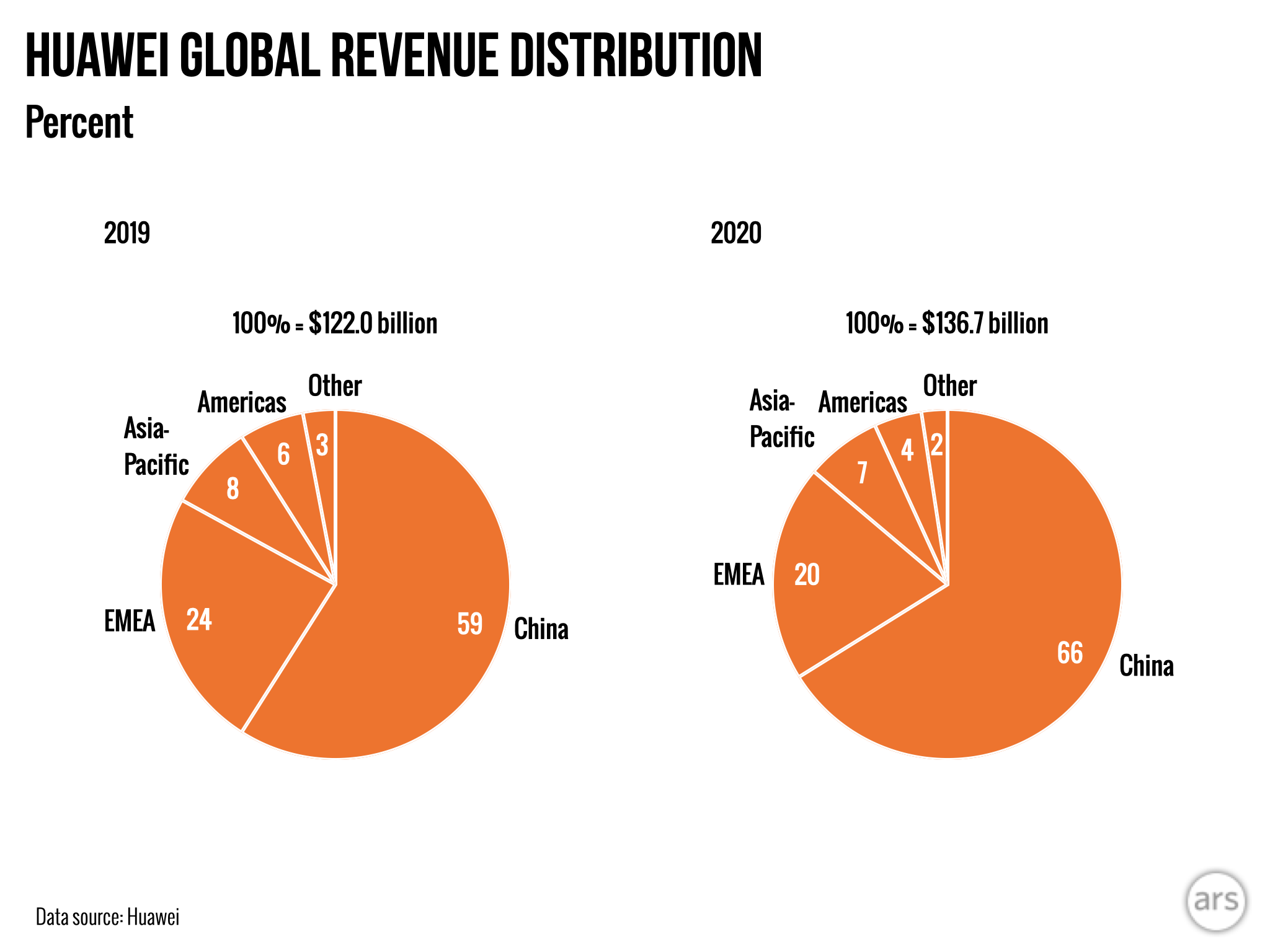
Huawei’s latest financial report, issued Wednesday, shows the financial cost of the US campaign. Revenue growth slowed to 3.8 percent last year, from 19 percent in 2019; international sales dropped sharply, especially in Europe.

The company’s smartphone sales have taken a big hit. Having ranked second in worldwide shipments behind Samsung in 2019, Huawei fell outside of the top five smartphone makers at the end of 2020, according to research firm Canalys.

“The US has been successful in checking the overall growth of Huawei, but it’s doubtful it will crush it as a global technology power,” says Peter Cowhey, dean of the School of Global Policy & Strategy at UC San Diego and a former US government official.

The US has banned Huawei networking equipment from domestic 5G networks and persuaded other countries, including the UK, Canada, and Australia, to impose similar restrictions. Last year, the US also imposed export controls to cut off the supply of high-end chips to Huawei and advanced chipmaking equipment to China, effectively crippling Huawei’s ability to make high-end smartphones.

“The supply restrictions for our smartphone business has caused us a great impact, and we haven’t been able to see a clear picture in the supply for our smartphones,” Ken Hu, a Huawei deputy chairman, said at a press conference held at the company’s headquarters in Shenzhen on Wednesday. “We think this is a very unfair situation to Huawei, and it has caused a lot of damage to us.”

Microchips are China’s Achilles’ heel, because it doesn’t have domestic capability to make the nanoscale features found on the most advanced and most powerful of these components. Chinese chipmakers such as SMIC produce chips for lower-end products, including internet-of-things devices.

Huawei's revenue grew in China in 2020 but shrank everywhere else.
Enlarge / Huawei’s revenue grew in China in 2020 but shrank everywhere else.
Ars Technica

The only companies capable of manufacturing high-end chips today are located in Taiwan, South Korea, and the US. China has spent decades, and billions, trying to build up its chipmaking capabilities, but its most-advanced companies still lag several generations behind.

Now, China’s leaders are making a renewed push. Beijing’s Made in China 2025 plan, announced in 2014, calls for China to have a dominant position in chipmaking by 2049. The country’s latest five-year plan, announced in March, calls for increasing spending on research and development by 7 percent annually for the next five years, with a special focus on increasing technological independence in semiconductor manufacturing and other emerging technologies.

This week, the Chinese government also announced cuts to import taxes on raw materials for domestic companies producing high-end computer chips. This follows a wide range of tax breaks for semiconductor companies announced by the government in July 2020.

China has ample capital, raw materials, and engineering talent, and companies like Huawei, Alibaba, and Baidu are capable of designing cutting-edge chips. But China also lacks expertise specific to advanced chip manufacturing as well as the highly specialized equipment needed to make the latest chips.

A report issued in January by the Brookings Institution, a think tank, concludes that China’s increasingly vibrant domestic chip industry is likely to advance more rapidly due to sanctions and the increased decoupling of the US and China.

Another report, published in September 2020 by the Eurasia Group, a consultancy, suggests that the pressure China faces in chipmaking will encourage Chinese companies to explore new chip architectures.

Cowhey, who studies the intersection of telecommunications and governance, says Huawei’s size and breadth are helping it pivot into new areas.

“Network equipment [sales] have stalled substantially, and it’s true that its mobile phone division is in trouble,” he says. “But the growth of laptop computers, smartwatches, and other things really speak to its continued strength in the internet of things.”

A key question for policymakers in the US and other countries is how to most effectively counter the threat posed by Chinese technology and influence, and challenge the country on key issues such as human rights.

This story originally appeared on wired.com.

https://arstechnica.com/?p=1754144


ISP imposes data cap, explains it to users with condescending pizza analogy

Illustration of a pizza with logos of Internet services like Spotify and Netflix on each slice.
Aurich Lawson | Getty Images

Cable company WideOpenWest (which markets itself as WOW!) yesterday told customers that it is imposing a data cap and explained the change with a pizza analogy that would seem more appropriate for a kindergarten classroom than for an email informing Internet users of new, artificial limits on their data usage.

The email said WOW is “introducing a monthly data usage plan for your Internet service on June 1, 2021” and described the system as follows:

What’s a monthly data usage plan? Let us illustrate …

Imagine that the WOW! network is a pizza. Piping hot. Toppings galore. Every WOW! customer gets their own slice of pizza, but the size of their slice is dependent on their Internet service plan. While customers who subscribe to 1 Gig get the largest slices, those with Internet 500 get a slightly smaller piece, and so on. But, it’s all the same delicious, high-speed pizza that you know and love.

Now, say you’re not full after your slice and you grab another. That extra slice is like a data overage. Don’t worry—we got extra pizza… umm, data… just in case. If you exceed your data allowance, we’ll automatically apply increments of 50GB for $10 to your account for the remainder of the current calendar month. Total overage charges will not exceed $50 per billing statement no matter how much data you use. Even better—the first time you experience a data overage, we’ll proactively waive fees.

Email omits most important details

The email did not mention that, unlike pizza, Internet data doesn’t run out and that there is plenty for everyone as long as a network is properly constructed and provisioned. And despite paragraphs of comparing data to pizza, the email literally never says how much data customers will be allowed to use before they are charged extra. The answer is in a newly updated “network management practices” document that says the monthly cap will range from 1TB to 3TB: the 50Mbps download plan gets 1TB, plans between 100 and 300Mbps download speeds get 1.5TB, the 500 and 600Mbps plans get 2.5TB, and the gigabit plan gets 3TB.

The document also points out that “[t]he amount of bandwidth usage of Customer’s account is the sole responsibility of Customer, whether or not such usage was by Customer or authorized by Customer.”

One Ars editor got the data cap email yesterday, and a reader named Shaun who received it forwarded it to us as well. Both live in Illinois, which seems to be the first and so far the only state getting the WOW cap.

“The pizza thing was making me confused if it was an April Fools’ Day joke or not, it’s so cringey,” Shaun told us. He also said that WOW has consistently failed to deliver the advertised 50Mbps upload speeds on his 500Mbps download plan. “WOW’s sole advantage over Comcast was no data cap, until now,” Shaun said.

WOW has over 800,000 Internet customers in parts of Alabama, Florida, Georgia, Illinois, Indiana, Michigan, Ohio, South Carolina, and Tennessee. It’s not clear when customers in states outside Illinois will have to endure the data cap. The network management practices document says the data cap is for “some service areas.”

WOW used to boast about not having data cap

Data caps are widely loathed by Internet customers, and ISPs that don’t impose them are quick to tout that fact to show how consumer-friendly they are. WOW did exactly that in June 2017 when it issued a press release titled, “WOW! Internet, Cable & Phone Takes Consumer Side in Data Cap Debate.”

WOW “today reinforced its commitment to continue providing data‐cap free Internet to all of its users, ensuring a better consumer Internet experience that is fast, reliable, and the best value in the market,” the company said at the time. “Consumers can use their WOW Internet how they want it, when they want it, with no limit—how Internet should be.” Unlike yesterday’s email, this 4-year-old announcement was written in a way that suggests at least somebody at WOW then knew that typical Internet users understand Internet data is nothing like pizza.

We asked WOW numerous questions today, including why it no longer “takes [the] consumer side in [the] data cap debate.” We’ll update this story if we get answers.

Comcast, the biggest Internet provider in the US, imposes a data cap in 27 of the 39 states it operates in. Comcast announced it would expand the cap to the rest of its territory starting in January 2021 but delayed that plan until 2022 after facing pressure from customers and lawmakers.

Cap allegedly will improve “Internet experience”

Yesterday’s email to customers seemed to hint that the WOW network is having trouble serving everyone:

Why are we doing this? It’s simple, really. A monthly data usage plan ensures that every WOW! customer has a consistent Internet experience. To put it in pizza terms: it’s so everyone gets the amount they ordered (or the amount to satisfy their hunger).

One of the questions we asked WOW is whether the above paragraph means that it has not been able to provide “a consistent Internet experience” without a data cap. But WOW previously claimed that its network is robust enough to handle increased usage during the pandemic even without data caps, saying on May 19, 2020 that “WOW!’s robust broadband network has the capacity to handle increased usage, including video streaming, as more people work and learn from home. The network is designed to deliver consistent, high-performing connectivity without disruption and without imposing data caps.”

WOW restricts unlimited-data option

The email to customers mentioned nothing about unlimited data. The network management practices document says that “[u]nlimited data plans may be added for an additional monthly charge” but doesn’t say how much it will cost.

“The Unlimited data option is not available for all service plans or packages,” the WOW document said, without specifying which packages the unlimited option is available for. It’s not even clear whether customers in Illinois who are the first to get the cap will be offered the unlimited-data option. One customer who contacted the billing department yesterday wrote on a DSLReports forum, “There is apparently no current plan to have an ‘actually unlimited’ plan or option.”

The email to customers said that usage of WOW! tv+—a streaming service the company offers—”won’t count toward your data usage plan.” This data cap exemption is called zero-rating, a practice that faces some restrictions under a California net neutrality law but not in the rest of the US. For example, the California law prevents ISPs from zero-rating their own streaming video services if they don’t also zero-rate video streaming services offered by other companies.

Update: WOW sent a slightly more detailed email to customers about four hours after this article was published. The new email included the sizes of the data caps for each speed tier but did not make any mention of an unlimited-data option and said that customers “cannot opt out of data plans.” WOW’s new email also said that “Data plans have become an industry standard that ensure all customers have a consistent and reliable experience,” but—obviously—WOW did not mention that many other ISPs do not impose data caps.

“Time to flood the FCC with complaints”

A bunch of WOW users have been complaining about the data cap in the DSLReports forum since the email went out yesterday.

“Time to flood the FCC with complaints,” one person wrote, noting that the WOW email didn’t disclose the size of the data caps, that WOW is imposing the caps in a pandemic with less than 90 days notice, and that it is “using caps in lieu of proper maintenance and upgrades.”

Several customers reported that the link to check data usage provided in yesterday’s email is broken, but one person wrote that “if you log in manually and then click the services tab it shows data usage (at least for me).”

Even worse than a bad April Fools joke

People in the DSLReports forum briefly debated whether the email was a bad April Fools’ Day joke. “Are you guys sure you’re not falling for an April Fools joke? I heard there was something about pizza in the email,” one person wrote. However, yesterday’s update to the network management practices document makes it clear that it’s not a joke.

One user called WOW and talked to a customer service rep who “wasn’t aware of any of this and had to go ask his supervisor.” After consulting with the supervisor, the rep confirmed to the customer that the data cap is real.

“I’m stunned they would email this on April Fools’ Day,” the user wrote. “There were broken links in my email and other indications that made me think this must be a joke. Par for the course with WOW.”

“Announce data caps right after increasing prices and on April Fools’ Day no less, nice… I also learned that according to their site I am being ‘rewarded’ as a longtime user by now having the privilege to pay $19 more per month than the current ‘regular’ price for my tier,” another user wrote.

“I understand the need to prevent people from abusing the network, but implementing caps during a time where the entire world needs (and depends) on Internet more than ever is an insult,” another wrote.

“Well there goes my Plex server,” another lamented.

Data usage soars during pandemic

The WOW email to customers said that the average user “will consume far less data than their plan allows and only a small percentage will ever be impacted by overage fees. This small percentage includes behaviors like using servers or file-sharing applications that consume extreme amounts of data… the vast majority of WOW customers will not be impacted by overage fees.”

But data usage has risen quickly in the pandemic with one study finding that 14.1 percent of US Internet subscribers used over 1TB of data per month in Q4 2020, up from 7.3 percent in Q4 2019.

“I have used anywhere between 700GB and 1.1TB (per month) over the past 12 months in a household of 5,” a Comcast customer wrote in the DSLReports thread. “That’s with purposely limiting (reducing quality options in streaming apps, disabling auto updates on games and software, etc) to prevent hitting Comcast’s cap (1.2TB).”

Here’s a screenshot of the email WOW sent to customers yesterday:

https://arstechnica.com/?p=1754084


Nuclear should be considered part of clean energy standard, White House says

Image of two power plant cooling towers.

More details have emerged about the climate and energy priorities of President Joe Biden’s infrastructure plan, and they include support for nuclear power and carbon capture with sequestration (CCS).

In a press conference yesterday with reporters, White House climate adviser Gina McCarthy said the administration would seek to implement a clean energy standard that would encourage utilities to use greener power sources. She added that both nuclear and CCS would be included in the administration’s desired portfolio. The clean energy standard adds a climate dimension to the Biden administration’s recently announced infrastructure plan, seeking to put the US on a path to eliminating carbon pollution.

“We think a CES is appropriate and advisable, and we think the industry itself sees it as one of the most flexible and most effective tools,” McCarthy told reporters. “The CES is going to be fairly robust and it is going to be inclusive.”

Biden has called for 100 percent of America’s electricity to be generated by carbon-free sources by 2035. Nuclear power does not produce any carbon pollution, and many experts say it should be included in any net-zero plans because of its large existing generating capacity and its ability to provide large amounts of power consistently. But nuclear has been criticized by some environmentalists over its radioactive waste and concerns about meltdowns.

Typically, state standards do not include nuclear in their portfolios. Rather, they usually focus on renewable energy sources like wind, solar, and hydropower. McCarthy did not provide details about how far a CES would go in supporting nuclear power. It’s possible that the policy may only cover plants that are currently operating, but it may also extend to include new plants. The former is more likely than the latter, though, given the challenges and costs involved in building new nuclear capacity.

The other technology McCarthy mentioned, CCS, has long been proposed as a solution to fossil fuels’ carbon pollution problems. The technology captures carbon dioxide from power plant exhaust streams and sequesters it underground. Typically, the process involves some kind of amine-based solution that absorbs carbon dioxide from the exhaust. The solution is then heated to release the pure carbon dioxide so the gas can be easily transported for storage or utilization. The technology has been condemned for prolonging reliance on fossil fuels, and no commercial power plant in the US currently uses CCS. One existing pilot-scale plant, NRG’s Petra Nova, was shut down over cost concerns, and CCS was dropped from another, Southern’s Kemper Project, for similar reasons.

Though the Biden administration favors the clean energy standard, McCarthy said they aren’t ruling out a carbon tax or fee to get to net-zero. Such taxes are generally based on the amount of carbon pollution a fossil fuel produces when burned. Economists tend to favor carbon taxes for their simplicity, but they’ve proven to be politically fraught.

Five members of President Biden’s cabinet, including the secretaries for transportation, energy, labor, commerce, and housing and urban development, are meeting with members of Congress to begin the legislative process.

https://arstechnica.com/?p=1754096


Supreme Court’s pro-Facebook ruling could unleash “flood” of robocalls

Two people communicate via tin cans connected by string, except one is a cartoon robot.

A Supreme Court ruling today in favor of Facebook limits the reach of a 1991 US law that bans certain kinds of robocalls and texts. The court found that the anti-robocall law only applies to systems that have the ability to generate random or sequential phone numbers. Systems that lack that capability are thus not considered autodialers under the law, even if they can store numbers and send calls and texts automatically.

Advocates say the ruling will make it harder to block automated calls and texts, potentially unleashing a “flood” of new robocalls.

The ruling “nullifies one of the most important protections against unwanted robocalls: the Telephone Consumer Protection Act’s (TCPA) prohibition against autodialed calls and texts to cellphones without the called party’s consent,” said the National Consumer Law Center (NCLC), which had filed a brief in the case.

“Companies will use autodialers that are not covered by the Supreme Court’s narrow definition to flood our cellphones with even more unwanted robocalls and automated texts,” said Margot Saunders, the group’s senior counsel. The court ruling “interpreted the statute’s definition of autodialer so narrowly that it applies to few or none of the autodialers in use today,” the NCLC also said.

Facebook system not an autodialer

The Facebook case was decided over a question of grammar, as the court had to decide exactly what Congress meant in a key section of the TCPA. The law imposes restrictions on calls made with an “automatic telephone dialing system” and defines that term as “equipment which has the capacity—(A) to store or produce telephone numbers to be called, using a random or sequential number generator; and (B) to dial such numbers.”

What that sentence means was at the heart of the case that Noah Duguid filed against Facebook. Today’s court decision recounted how the case began:

In 2014, respondent Noah Duguid received several login-notification text messages from Facebook, alerting him that someone had attempted to access the Facebook account associated with his phone number from an unknown browser. But Duguid has never had a Facebook account and never gave Facebook his phone number. Unable to stop the notifications, Duguid brought a putative class action against Facebook. He alleged that Facebook violated the TCPA by maintaining a database that stored phone numbers and programming its equipment to send automated text messages to those numbers each time the associated account was accessed by an unrecognized device or web browser.

Facebook countered “that Duguid failed to allege that Facebook used an autodialer because he did not claim Facebook sent text messages to numbers that were randomly or sequentially generated. Rather, Facebook argued, Duguid alleged that Facebook sent targeted, individualized texts to numbers linked to specific accounts,” today’s ruling said.

In 2017, the US District Court for the Northern District of California agreed with Facebook and dismissed Duguid’s case. But the US Court of Appeals for the 9th Circuit reversed that ruling, holding that a system can be an autodialer even if it doesn’t use a random or sequential generator to store numbers, as long as it has the ability to “store numbers to be called” and “to dial such numbers automatically.”

The Supreme Court decided to hear the case, noting that another circuit appeals court had ruled differently than the 9th Circuit, creating a conflict among the courts of appeals over whether an autodialer must be able to generate random or sequential phone numbers. Today, the Supreme Court reversed the 9th Circuit judgment.

The opinion for the court written by Justice Sonia Sotomayor said:

The question before the Court is whether that definition encompasses equipment that can “store” and dial telephone numbers, even if the device does not “us[e] a random or sequential number generator.” It does not. To qualify as an “automatic telephone dialing system,” a device must have the capacity either to store a telephone number using a random or sequential generator or to produce a telephone number using a random or sequential number generator.

Facebook’s notification system is not an autodialer because it “neither stores nor produces numbers ‘using a random or sequential number generator,'” the court found. All nine justices agreed with the ruling, though Justice Samuel Alito filed an opinion questioning some of the court’s reasoning while concurring in the judgment.

Justice explains grammar rules

Sotomayor’s opinion explained the question of grammar upon which the case turned:

We begin with the text. Congress defined an autodialer in terms of what it must do (“store or produce telephone numbers to be called”) and how it must do it (“using a random or sequential number generator”). The definition uses a familiar structure: a list of verbs followed by a modifying clause. Under conventional rules of grammar, “[w]hen there is a straightforward, parallel construction that involves all nouns or verbs in a series,” a modifier at the end of the list “normally applies to the entire series.” The Court often applies this interpretative rule, usually referred to as the “series-qualifier canon.” This canon generally reflects the most natural reading of a sentence. Imagine if a teacher announced that “students must not complete or check any homework to be turned in for a grade, using online homework-help websites.” It would be strange to read that rule as prohibiting students from completing homework altogether, with or without online support.

With the robocall law, “the series-qualifier canon recommends qualifying both antecedent verbs, ‘store’ and ‘produce,’ with the phrase ‘using a random or sequential number generator,'” Sotomayor wrote. This grammatical interpretation is “the most natural construction” and is supported by other text in the law, the justices found.

“The statutory context confirms that the TCPA’s autodialer definition excludes equipment that does not use a random or sequential number generator,” the opinion said. “Congress found autodialer technology harmful because autodialers can dial emergency lines randomly or tie up all of the sequentially numbered phone lines at a single entity. Facebook’s interpretation of [the TCPA] better matches the scope of the TCPA to these specific concerns. Duguid’s interpretation, on the other hand, would encompass any equipment that stores and dials telephone numbers.”

The court also said, “It would make little sense… to classify as autodialers all equipment with the capacity to store and dial telephone numbers, including virtually all modern cell phones.”

Congress might act as ruling sparks outrage

US Sen. Edward Markey (D-Mass.), one of the TCPA’s authors in 1991, and Rep. Anna Eshoo (D-Calif.) issued a joint statement calling the ruling “disastrous.”

“Today, the Supreme Court tossed aside years of precedent, clear legislative history, and essential consumer protection to issue a ruling that is disastrous for everyone who has a mobile phone in the United States,” the lawmakers said. “It was clear when the TCPA was introduced that Congress wanted to ban dialing from a database. By narrowing the scope of the TCPA, the court is allowing companies the ability to assault the public with a non-stop wave of unwanted calls and texts, around the clock.”

Markey and Eshoo said they “plan to soon introduce legislation to amend the TCPA, fix the court’s error, and protect consumers.”

Consumer Reports urged Congress to act quickly. “Resting on a strained reading of the punctuation in the definition of ‘autodialer,’ the court ruled that the technology involved, which Facebook was using to send automated texts to its users, falls through the cracks of the definition,” Consumer Reports said. “As a result, prior consent is not required for unleashing a potentially unlimited number of calls and texts using this technology, and there is no enforceable way for a consumer to stop them.”

https://arstechnica.com/?p=1753885


Feds say man broke into public water system and shut down safety processes

Kitchen sink with running water

Federal prosecutors have indicted a Kansas man for allegedly logging into a computer system at a public water system and tampering with the process for cleaning and disinfecting customers’ drinking water.

An indictment filed in US District Court for the District of Kansas said Wyatt A. Travnichek, 22, of Ellsworth County, Kansas, was an employee from January 2018 to January 2019 at the Ellsworth County Rural Water District No. 1. Also known as the Post Rock Water District, the facility serves more than 1,500 retail customers and 10 wholesale customers in eight Kansas counties. Part of Wyatt’s responsibilities included remotely logging in to the water district’s computer system to monitor the plant after hours.

Logging in with harmful intent

In late March 2019, Wednesday’s indictment said, Post Rock experienced a remote intrusion to its computer system that resulted in the shutdown of the facility’s processes for ensuring water is safe to drink.

“On or about March 27, 2019, in the District of Kansas, the defendant, Wyatt Travnichek, knowingly tampered with a public drinking water system, namely the Ellsworth County Rural Water District No. 1,” prosecutors alleged. “To wit: he logged in remotely to Post Rock Rural Water District’s computer system and performed activities that shut down processes at the facility which affect the facility’s cleaning and disinfecting procedures with the intention of harming the Ellsworth County Rural Water District No. 1.”

The allegations come seven weeks after authorities in Oldsmar, Florida said someone broke into the computer system of a municipal water treatment plant and tried to poison drinking water for the municipality’s roughly 15,000 residents.

The intruder changed the level of sodium hydroxide in the water to 11,100 parts per million, a significant increase from the normal amount of 100 ppm. Better known as lye, sodium hydroxide is used in small amounts to treat the acidity of water and to remove metals. At higher levels, the corrosive is toxic.

An operator at the water facility quickly discovered the change and reversed it. Had the change not been detected, it would have raised the level of lye to toxic levels. Even then, the authorities said the facility had multiple measures in place to prevent the contaminated water from being made available to residents. Nonetheless, the incident underscored the potential for such intrusions to have fatal consequences.

Sharing passwords

An advisory from officials in Massachusetts later said that the Oldsmar facility used an unsupported version of Windows with no firewall and shared the same TeamViewer password among its employees. The employees used the remote software to access plant controls known as a SCADA—short for “supervisory control and data acquisition”—system.

Wednesday’s indictment didn’t say how Wyatt allegedly gained access to the Post Rock facility. His prior position as a facility employee who remotely logged in to the water district’s computer system on a regular basis leaves open the possibility that water officials there also failed to secure credentials by not closing Wyatt’s remote access account after he left. No one at the facility was available to take questions for this post.

The indictment charges Wyatt with one count of tampering with a public water system and one count of reckless damage to a protected computer during unauthorized access. If convicted, he faces a maximum sentence of 25 years in prison and $500,000 in fines. Attempts to reach Wyatt for comment weren’t successful.

https://arstechnica.com/?p=1753884