Proposed law could force ISPs to stop hiding true size of monthly bills
Getty Images | McCaig
Internet service providers could be required to release “broadband nutrition labels” with detailed information about prices, speeds, and data caps under legislation introduced by US Rep. Angie Craig (D-Minn.).
The bill “would require straightforward disclosures in an easily understandable format to help consumers better understand the services they are purchasing and protect against hidden fees and sub-standard Internet performance,” Craig said in a press release yesterday. The press release said the bill “would require sellers of broadband services to provide the following information to all consumers”:
Price: Price points, including various charges like overage, equipment, early termination and administrative fees
Data Allowances: This is the carrier-defined plan limit after which consumers will face some consequence, such as additional charges or slowed data speeds
Performance: Broadband speed and other performance metrics
The bill is simple and barely a page long. It directs the FCC to adopt “regulations to promote and incentivize the widespread adoption of broadband consumer labels” like the ones described in a public notice issued by the Obama-era FCC in April 2016. The bill would give the FCC one year to issue these rules.
ISPs “notorious” for hiding key details
The bill’s language saying the FCC must “promote and incentivize” adoption of broadband labels makes it sound like they would be optional for ISPs. But Craig said her bill would “require” the disclosures, and the bill text could be updated to make sure it matches the intent.
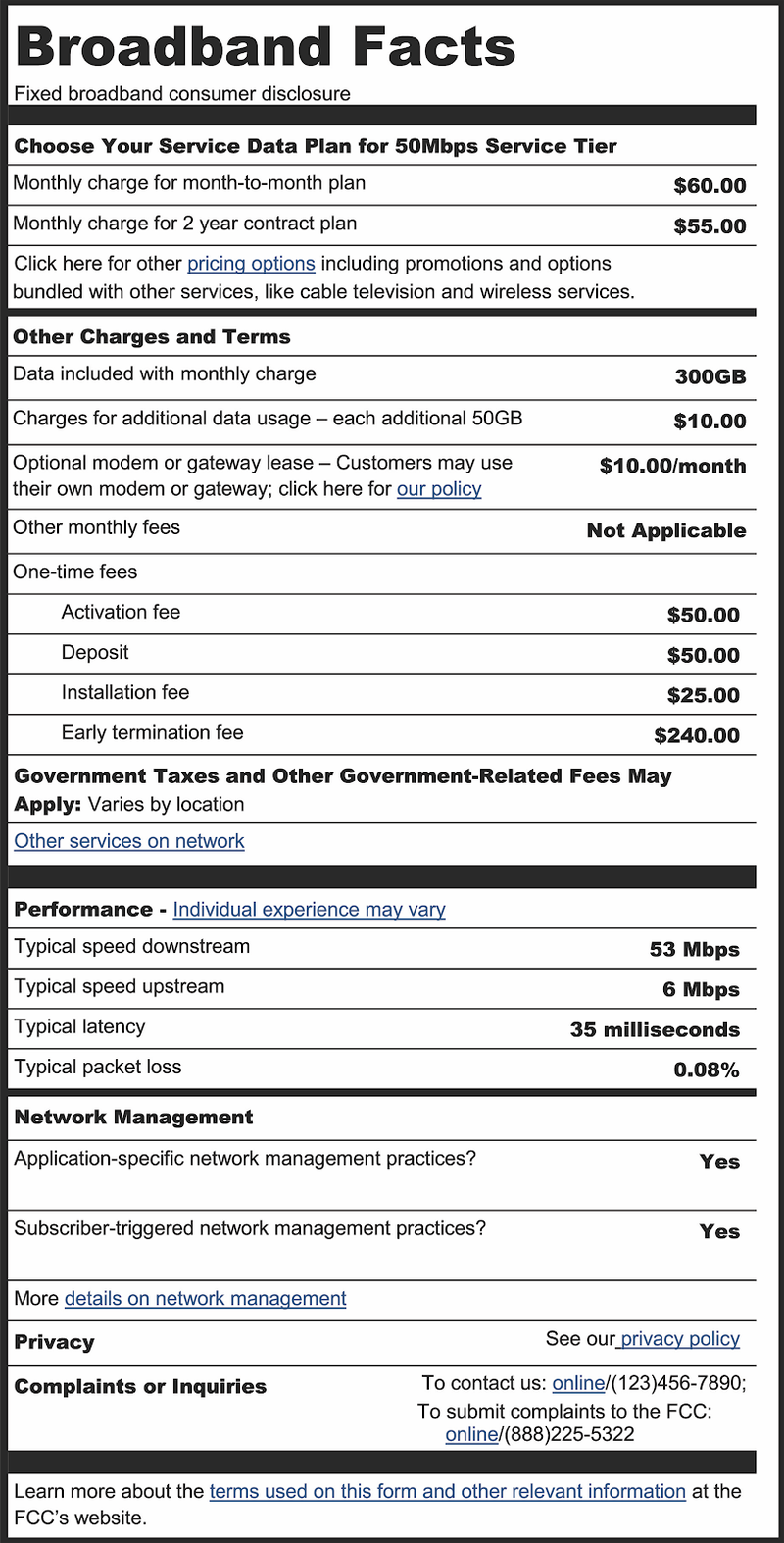
The Obama-era broadband labels included monthly charges, data caps and overage charges, hardware rental fees, activation and installation fees, early termination fees, taxes and government-related fees, “other monthly fees,” typical speeds both upstream and downstream, latency, and packet loss. Here’s what they looked like:
Open Technology Institute
The Obama-era FCC rules made the broadband nutrition labels optional but required ISPs to release the information online if they chose not to use the labels.
“Internet service providers are notorious for keeping customers in the dark,” Joshua Stager, deputy director at New America’s Open Technology Institute, said in a press release yesterday. “Hidden fees, surprise bills, and dense contracts are familiar problems to anyone that has dealt with these companies. Just this week, a report detailed how Comcast hides speed information from customers when they sign up for service.”
Stager was referring to our report about how Comcast’s website hides upload speeds until customers complete most of the checkout process and enter a valid credit card number. He also cited his own organization’s Cost of Connectivity report, saying it showed that “US Internet providers often bury information about service and price amid confusing contracts, hidden fees, and convoluted billing schemes,” and a Consumer Reports study finding “that cable companies added $450 in hidden fees to the average customer’s bill [each year].”
The Open Technology Institute has been calling for broadband truth-in-labeling rules for over a decade.
“Congresswoman Craig’s bill cuts through this confusion by creating a ‘broadband nutrition label’ that clearly discloses the cost and terms of internet plans,” Stager said. “This truth-in-billing legislation is urgently needed as millions of people rely on the Internet to work, learn, and live during the pandemic. Congress should pass this legislation as soon as possible. People need to know what they are paying for.”
FCC could act first—if it gets another Democrat
The House of Representatives approved a broadband nutrition label measure as part of a larger bill last year, but it didn’t pass in the Senate. Passage would be more likely now that Democrats control both chambers of Congress.
Even if the bill doesn’t pass Congress this time around, the Democratic-led FCC could bring the disclosure requirements back. But no major regulatory changes will come out of the FCC until President Biden nominates another Democrat to break the 2-2 deadlock between Democrats and Republicans.
FCC Acting Chairwoman Jessica Rosenworcel supported the transparency requirements, net neutrality rules, and common-carrier regulation of ISP. If Biden makes her the permanent chair, she is likely to reinstate regulations repealed by Pai once Democrats have an FCC majority.
https://arstechnica.com/?p=1747466
White House signals coming antitrust push with Tim Wu appointment
Enlarge/ The White House South Lawn, which is unfortunately not the view most folks working for a presidential administration have.
Longtime tech critic Tim Wu is joining the Biden administration as an adviser on technology and competition, a signal that the White House is likely to push for policies that rein in Big Tech.
Wu will be serving on the National Economic Council as special assistant to the president for technology and competition policy, the White House said this morning. Wu confirmed the news in a tweet.
Wu is best known in tech circles as the man who coined the term “net neutrality” in the early 2000s. He has held several positions at the federal level before, including advisory roles with both the Federal Trade Commission and the National Economic Council. He has also been a full professor at Columbia University law school since 2006, where he teaches First Amendment and antitrust law.
His 2010 book The Master Switch argued that the open Internet as we knew it was barreling toward a closed-off, walled-garden future. In 2018 he published another book, The Curse of Bigness, in which he argued that US regulators’ failure to enforce antitrust laws had led to “a new gilded age” and all its attendant problems.
Several prominent progressive Democratic lawmakers applauded the move. “Tim has been a longtime antitrust advocate, and he has pushed public officials to break up and rein in Big Tech,” said Sen. Elizabeth Warren (D-Mass.), who called for Big Tech breakups during her unsuccessful presidential primary run in 2019. “I’m glad to see him in this role.”
Sen. Amy Klobuchar (D-Minn.), who recently proposed a bill that would be the biggest antitrust overhaul since 1976 if enacted, also issued a statement in support of Wu’s new job. “It is clear this administration is serious about promoting competition in the United States,” Klobuchar said. “America has a major monopoly problem that must be urgently addressed… I look forward to working with Tim to modernize antitrust enforcement, strengthen our economy, and protect workers and consumers.”
Those who oppose his policy goals seem to worry about how seriously the White House may now be taking him. One industry lobbyist, critical of Wu, told Protocol that the appointment “should not be hand-waved away… This could be dangerous.”
All that said, Wu’s new role does not put him in a position to come leaping in with a metaphorical sledgehammer and start smashing up companies. The White House can make all the suggestions it wants, but actual antitrust enforcement comes from the Department of Justice and the FTC, both of which are still waiting to have new leadership nominated or confirmed. (Wu’s appointment to the NEC makes it clear he is not landing at either of those agencies, although the Washington rumor mill had considered him a candidate for both.)
Both agencies, however, are already neck-deep in landmark cases against Big Tech Firms. The FTC and a coalition of 47 states filed antitrust suits in December seeking to break up Facebook, arguing that its acquisitions of Instagram and WhatsApp were anticompetitive and should not have been allowed to happen.
Similarly, the DOJ and multiple groups of states have filed major cases against Google, arguing that the search-advertising-phone-everything giant behaves anticompetitively. Although those suits, now mostly consolidated, do not explicitly seek a breakup of Google, they do stress that “structural remedies” may be necessary.
https://arstechnica.com/?p=1747383
Arizona House advances bill targeting Apple, Google mobile app stores
Enlarge/ The Arizona State Capitol museum, flanked by the House of Representatives building (R) and a cactus (L).
The Arizona state House of Representatives this week passed a landmark bill that, if adopted, would require Google and Apple to allow Arizona-based app developers to choose their own alternate payment systems.
The House voted 31-29 in favor of the bill (PDF). The bill does not directly mention either major mobile platform, but it nonetheless squarely targets both, as the text specifically applies to any “digital application distribution platform” that has more than 1 million cumulative downloads in a calendar year from Arizona users.
The text prohibits those platforms from locking either Arizona-based developers or Arizona-based users into using proprietary first-party in-app payment systems. It also prohibits platforms from retaliating against Arizona consumers or developers for opting into using a payment system “that is not owned by, operated by, or affiliated with the provider.”
The bill, just like North Dakota’s before it, applies to app stores and payment processing services on “general-purpose hardware” such as tablets, smartphones, computers, and other similar devices, but it explicitly excludes “special-purpose digital application distribution platforms” such as gaming consoles and music players. In short, it’s a small target that means “Google and Apple” without actually having to mention either. (As written, the bill could also apply to the Mac OS and Windows app stores, but those platforms already do not restrict developers or users the same way Android or iOS do.)
This sounds familiar…
The North Dakota state Senate last month discussed an extremely similar bill but ultimately voted 36-11 against adopting the measure. Both bills are so similar largely because they’re being promoted by the same organization: the Coalition for App Fairness.
Back in August, Fortnite developer Epic Games deliberately baited Apple by launching a short-lived alternative in-app payment system for iOS Fortnite players. Apple responded within hours by booting Fortnite off the platform, and Epic was ready. The two companies are now embroiled in a high-profile, high-stakes antitrust suit.
Epic is far from the only firm to complain about Apple’s app-store practices in recent months, and a dozen other firms including Spotify, Basecamp, and Protonmail joined it to launch the coalition in September. The lobbying group, which now boasts more than 45 members, has proposed similar legislation in several other states; Arizona is the first state where either legislative chamber has advanced a bill.
Both Apple and Google sent their own lobbyists to Arizona to try to halt the bill. “This bill tells Apple it cannot use its own checkout lane and collect a commission in the store we built,” Apple executive Kyle Andeer told Arizona lawmakers in a February hearing.
Support for the bill in the Arizona House did not break down along party lines in the way one might expect for an antitrust-related bill. While antitrust reform at the federal level is currently more likely to come from Democrats, most of the support for the Arizona bill came from Republicans. Of the 31 votes in favor, 27 came from Republican representatives, and four were from Democrats. The tally was almost exactly inverted among the 29 “nay” votes, where 25 came from Democrats, and four were from Republicans.
“I think they have a monopoly on the market right now,” said Rep. Regina Cobb, a Republican who sponsored the bill. “There isn’t anybody in here that doesn’t have a Google Android or Apple phone, I guarantee it.”
Alternatively, “Arizona does not have an interest in this fight,” Democratic Rep. Diego Rodriguez said. “We don’t have a dog in this fight—what we need to do is be focused on policies that are protecting consumers. This bill does not protect consumers—it protects a $1 billion company from another billion-dollar company.”
https://arstechnica.com/?p=1747066
100Mbps uploads and downloads should be US broadband standard, senators say
Four US senators called on the Biden administration Thursday to establish a “21st century definition of high-speed broadband” of 100Mbps both upstream and downstream. This would be a big upgrade over the Federal Communications Commission broadband standard of 25Mbps downstream and 3Mbps upstream, which was established in 2015 and never updated by former President Trump’s FCC chair, Ajit Pai.
Today’s letter was sent to FCC Acting Chairwoman Jessica Rosenworcel and other federal officials by two Democrats, one independent who caucuses with Democrats, and one Republican. Noting that “the pandemic has reinforced the importance of high-speed broadband and underscored the cost of the persistent digital divide in our country,” they wrote:
Going forward, we should make every effort to spend limited federal dollars on broadband networks capable of providing sufficient download and upload speeds and quality, including low latency, high reliability, and low network jitter, for modern and emerging uses, like two-way videoconferencing, telehealth, remote learning, health IoT, and smart grid applications. Our goal for new deployment should be symmetrical speeds of 100 megabits per second (Mbps), allowing for limited variation when dictated by geography, topography, or unreasonable cost.
“We should also insist that new networks supported with federal funds meet this higher standard, with limited exceptions for truly hard-to-reach locations,” the senators wrote later in the letter. “For years, we have seen billions in taxpayer dollars subsidize network deployments that are outdated as soon as they are complete, lacking in capacity and failing to replace inadequate broadband infrastructure.”
The letter was written by Sens. Michael Bennet (D-Colo.), Angus King (I-Maine), Rob Portman (R-Ohio), and Joe Manchin (D-W.Va.). In addition to Rosenworcel, it was sent to Secretary of Commerce Gina Raimondo, Secretary of Agriculture Tom Vilsack, and Director of the National Economic Council Brian Deese.
“Ask any senior who connects with their physician via telemedicine, any farmer hoping to unlock the benefits of precision agriculture, any student who receives livestreamed instruction, or any family where both parents telework and multiple children are remote learning, and they will tell you that many networks fail to come close to ‘high-speed’ in the year 2021,” they wrote. “For any of these functions, upload speeds far greater than 3Mbps are particularly critical. These challenges will not end with the pandemic.”
Rosenworcel pushed for higher speeds
Rosenworcel already supports a standard above the FCC’s current one. “With so many of our nation’s providers rolling out gigabit service, it’s time for the FCC to adjust its baseline upward, too,” she said in April 2020, calling for a 100Mbps download standard and an upload standard that’s higher than 3Mbps. “At present, our standard [for uploads] is 3 megabits per second,” she said at the time. “But this asymmetrical approach is dated. We need to recognize that with extraordinary changes in data processing and cloud storage, upload speeds should be rethought.”
The FCC standard is important for the commission’s annual broadband deployment report that determines how many Americans are “unserved” and grades the country’s progress toward universal availability. Adopting a higher speed standard would make it more likely that the FCC will find that broadband deployment is not happening fast enough and take more aggressive action to speed up deployment.
The FCC isn’t as active as it could be right now because there is a 2-2 split between Democrats and Republicans. President Joe Biden can fix that by nominating a new Democratic commissioner, but he hasn’t done so yet.
100Mbps a big upgrade for uploads
Going from 25/3Mbps to 100/100Mbps would be an especially large upgrade on the upload side. Today’s offerings from cable companies would not meet the 100Mbps threshold for uploads, as even gigabit-download cable plans from Comcast and Charter come with only 35Mbps upload speeds. The cable industry for years has been promising faster upload speeds powered by upgrades to DOCSIS, the Data Over Cable Service Interface Specification. But cable’s speeds are still unbalanced, providing much greater download speeds than upload speeds.
By contrast, AT&T and Verizon’s fastest fiber plans come with 940Mbps download speeds and 880Mbps upload speeds. Even the cheaper, lower-tier plans offered by fiber-to-the-home ISPs meet the senators’ proposed 100/100Mbps standard.
Cable is far more widespread than fiber in the US. The eight biggest cable companies combined have 72.8 million Internet subscribers, according to Leichtman Research Group. The top eight wireline phone companies have 33 million Internet subscribers, but that includes both fiber-to-the-home and DSL, and those copper-line DSL networks are severely outdated and poorly maintained.
A serious commitment to symmetrical 100Mbps broadband may require a lot more fiber construction across the US. The senators’ letter didn’t quite take a fiber-or-bust stand, but they do want federal funding in rural areas to support higher upload speeds than what you normally get with cable:
While we recognize that in truly hard-to-reach areas, we need to be flexible in order to reach unserved Americans, we should strive to ensure that all members of a typical family can use these applications simultaneously. There is no reason federal funding to rural areas should not support the type of speeds used by households in typical well-served urban and suburban areas (e.g., according to speedtest.net’s January 2021 analysis, average service is currently 180Mbps download/65Mbps upload with 24 millisecond latency.
The senators are also frustrated by differing standards across agencies. “We now have multiple definitions across federal agencies for what constitutes an area as served with broadband, resulting in a patchwork without one consistent standard for broadband,” they wrote. “For example, the FCC defines high-speed broadband as download speeds of up to 25 megabits per second and upload speeds of up to 3 megabits per second (25/3Mbps). Alternatively, the US Department of Agriculture (USDA) defines it as just 10/1Mbps.”
FCC deployment data
The FCC is already supporting networks faster than the 25/3Mbps standard. The commission’s Rural Digital Opportunity Fund (RDOF) tentatively awarded $9.2 billion over 10 years to 180 entities to deploy broadband to 5.2 million unserved homes and businesses. The FCC said that “99.7 percent of these locations will be receiving broadband with speeds of at least 100/20Mbps, with an overwhelming majority (over 85 percent) getting gigabit-speed broadband.” The funding is going to a mix of cable, fiber, and fixed wireless providers, plus SpaceX’s Starlink satellite network.
The most recent FCC broadband deployment report said that, as of year-end 2019, 95.6 percent of Americans had access to fixed broadband with speeds of at least 25Mbps downstream and 3Mbps upstream. Deployment at higher speeds is more limited, especially in rural and tribal areas. For example, the report said that 250/25Mbps speeds are available to 87.2 percent of people nationwide, 55.6 percent of people in rural areas, and 49.6 percent of tribal residents.
Those data points likely undercount the number of unserved Americans because the FCC lets ISPs count an entire census block as served even if it can serve just one home in the block. The commission plans to collect geospatial maps from ISPs to make the data more accurate.
https://arstechnica.com/?p=1747140
Facebook lifts ban on US political advertising
Facebook will lift a ban on political advertising imposed after the US election to curb the spread of misinformation, and it has pledged to investigate whether its political ads systems need a further overhaul.
Advertisers would be able to resume running political ads on March 4, Facebook said in a blog post on Wednesday. It said it had introduced the temporary moratorium “to avoid confusion or abuse following Election Day.”
The social media company said it had received “feedback” about its ads system during the latest election cycle, including its inability to distinguish between ads from politicians and political groups and social issue ads from advocacy groups, for example.
“As a result, we plan to use the coming months to take a closer look at how these ads work on our service to see where further changes may be merited,” it said on Wednesday.
Mark Zuckerberg, Facebook’s chief executive, has long resisted pressure to fact-check political advertising, arguing that doing so is not in the interest of free expression and that private sector companies should not be the “arbiter of truth.”
However, the company rowed back on that hardline position shortly before the November 3 vote amid pressure from critics and a proliferation of election misinformation, initially announcing that no new political ads could run in the week leading up to the vote, plus a one-week post-vote political-ads blackout.
Facebook and Google, which took similar action, later extended their bans as former US President Donald Trump stoked unrest after Joe Biden’s win by repeatedly promoting conspiracy theories and unproven claims of election fraud.
Facebook has faced frustration over the ban from some political groups, who complain that they have been unable to fundraise or share messaging.
Just hours before the Facebook announcement, two Democratic party committees issued a joint statement accusing the company of “refusing to commit to a clear date for ending this misguided ban on political ads.”
“This reckless and haphazard policy has made it harder for campaigns and organizations that do provide accurate information to voters and engage with them in good faith, and it hinders communities of color in particular from fully participating in the democratic process.”
In December, Facebook temporarily lifted the ban for ads related to the Georgia senate runoff, despite previously telling critics that such a carve-out was not technically feasible. Google last week lifted its pause on political advertising for the second time, after having reimposed it after the January 6 Capitol riots.
Comcast hides upload speeds deep inside its infuriating ordering system
Comcast just released a 2020 Network Performance Data report with stats on how much Internet usage rose during the pandemic, and it said that upload use is growing faster than download use. “Peak downstream traffic in 2020 increased approximately 38 percent over 2019 levels and peak upstream traffic increased approximately 56 percent over 2019 levels,” Comcast said.
But while upload use on Comcast’s network quickly grows—driven largely by videoconferencing among people working and learning at home—the nation’s largest home-Internet provider with over 30 million customers advertises its speed tiers as if uploading doesn’t exist. Comcast’s 56 percent increase in upstream traffic made me wonder if the company will increase upload speeds any time soon, so I checked out Comcast’s Xfinity.com site today to see the current upload speeds. Getting that information was even more difficult than I expected.
The Xfinity website advertises cable-Internet plans with download speeds starting at 25Mbps without mentioning that upstream speeds are just a fraction of the downstream ones. I went through Comcast’s online ordering system today and found no mention of upload speeds anywhere. Even clicking “pricing & other info” and “view plan details” links to read the fine print on various Internet plans didn’t reveal upload speeds.
Even after adding a plan to the cart and going through most of the checkout process, I could not find any mention of upload speeds. I got to the point where you have to enter credit card information to continue, so I initially stopped there. I later confirmed that Comcast’s ordering system will show upload speeds after it checks whether your credit card is valid, in the final page where you submit an order.
Deliberately keeping customers in the dark
I’ve long known that it’s difficult to find upload speeds on Comcast’s website, but I’m not sure exactly when it became virtually impossible. There were complaints about this very problem on Comcast’s customer support forums in 2020 and in 2019, though. “What is my upload speed now? No where in the world can I find documentation,” one customer asked. The answer was that existing customers can find upload speeds for their own plan in their account settings after logging in and navigating to the correct section.
But that does not help people who are signing up for service and want to find out what upload speeds they’ll get or compare upload speeds of different plans. Even the Xfinity.com comparison tool that lets you compare details of different plans doesn’t reveal their upload speeds. The absence of upload speeds from Comcast’s website is so thorough that it is clearly a deliberate attempt to keep customers in the dark. This gallery shows how the Comcast Xfinity website displays Internet plans without mentioning upload speeds and continues that tactic through nearly the entire checkout process:
Comcast’s website displays these Internet offers in my location without stating upload speeds.
Comcast has a tool that lets you compare two plans—but it doesn’t show the plans’ different upload speeds.
After adding a plan to the cart, you can start the checkout process. No upload speeds are in sight.
We still don’t know what the upload speeds are, but Comcast tells us about its “Flex” streaming box.
Now we can select an installation date and time, but upload speeds still are not revealed.
Now you have to enter your credit card information—only after doing so will Comcast let you see the 300Mbps download plan’s 10Mbps upload speeds.
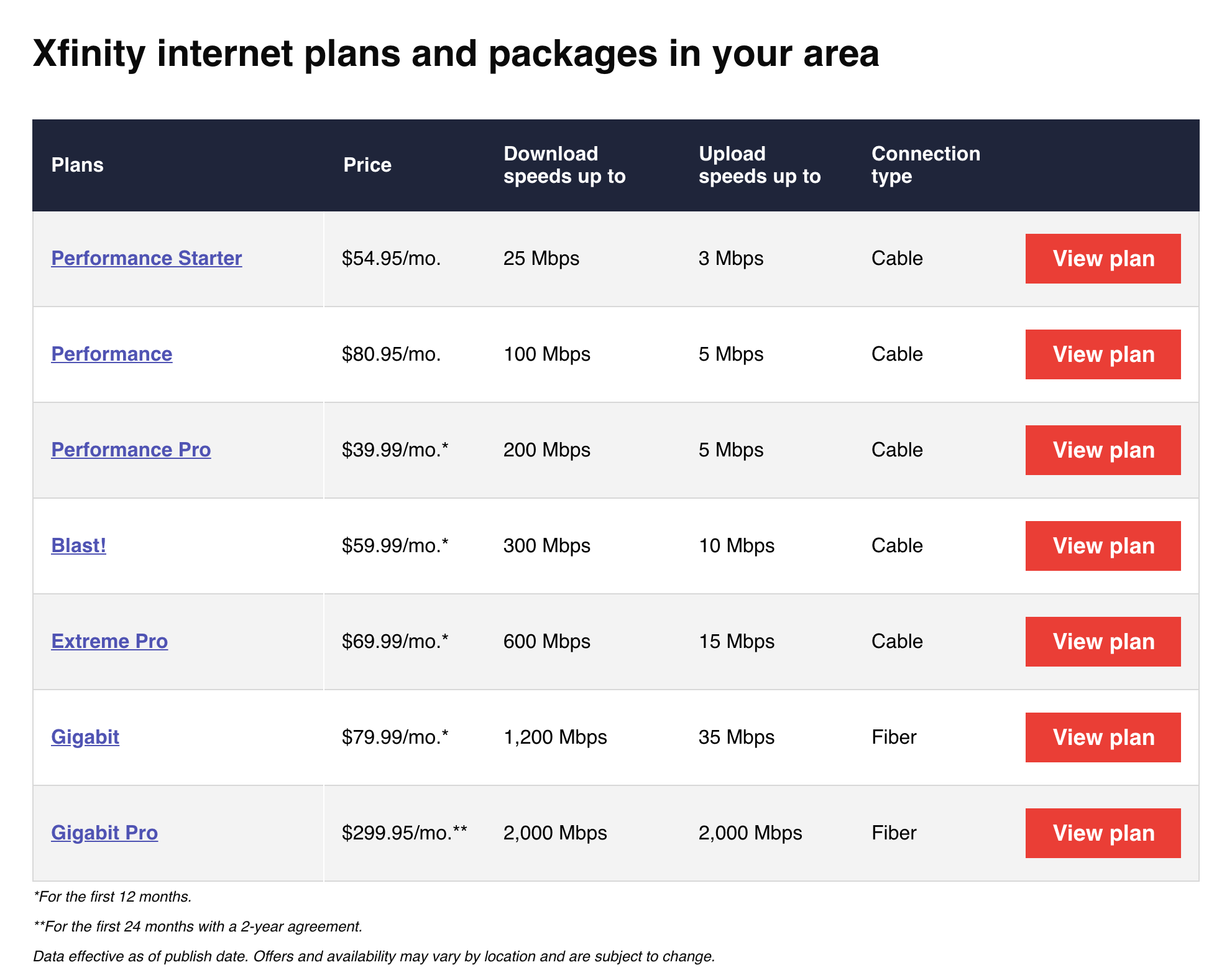
Thankfully, the third-party website CableTV.com lists both download and upload speeds, showing that Comcast’s 25Mbps download plan comes with 3Mbps uploads; the 100Mbps and 200Mbps download plans both have 5Mbps uploads; the 300Mbps download plan has 10Mbps uploads; the 600Mbps plan has 15Mbps uploads; and the 1Gbps download (1.2Gbps in some areas) comes with 35Mbps:
Enlarge/ Comcast speeds and prices, no thanks to Comcast’s website.
Comcast’s website does list the 35Mbps upload speeds for the gigabit plan at this page, but I couldn’t find anything similar for Comcast’s other cable-Internet plans. Comcast also offers a fiber-to-the-home service with 2Gbps speeds both downstream and upstream. But Comcast’s residential fiber requires installation charges of up to $500, and the service costs $300 a month, which is more than three times as much as the gigabit-cable plan that has 35Mbps downloads.
Comcast, why did you make this so hard?
I contacted Comcast today with two primary questions: is there any way to find upload speeds on Comcast’s website before submitting an order for Internet service, and does Comcast have any plans to raise its cable upload speeds?
Comcast’s answer on where to find upstream speeds was as follows:
Our network report shows that, despite the growth in upstream traffic in 2020, patterns remain highly asymmetrical as downstream volumes were 14x higher than upstream throughout 2020. Our website reflects the way customers use the Internet with downstream overwhelmingly dominating usage, but upstream speeds are included in your cart and are visible upon check out when you submit your order.
Despite Comcast claiming that “upstream speeds are included in your cart,” I could find no evidence of this. Adding a Comcast Internet plan to the cart and then clicking the cart icon brought me to an ordering page that does not mention upload speeds. I confirmed this behavior on Xfinity.com in both Chrome and Safari.
I circled back to the Comcast spokesperson and asked what exact steps I need to take to make upload speeds show up in the cart. It turns out the upload speeds never show up in the cart at all unless you define “cart” to include the entire ordering process. Comcast told us the upload speeds will finally appear “when you are at the step when you review your order.”
Despite my earlier reluctance to enter my credit card information for service I am not ordering, I finally did so to check whether this is accurate. I submitted my address, phone number, and credit card information, and I clicked “Next.” This triggered a step in which Comcast’s system checked to see whether I had entered a valid credit card. I accidentally entered a recently expired card number, so Comcast’s system “declined” my card and made me re-enter it. After I entered a card number that Comcast could charge, I finally got to this page, where the 300Mbps download-plan’s 10Mbps upload speeds are shown:
Enlarge/ The last page in Comcast’s ordering system.
Xfinity.com
At this page, with Comcast having already verified your card, you can view upload speeds and decide whether to submit the order or exit the ordering system. The part of Comcast’s statement that upload speeds are “visible upon check out when you submit your order” is thus accurate. But refusing to tell a prospective customer what they’re paying for until after they submit credit card information is simply ridiculous. You can probably get upload speeds earlier by asking a Comcast rep in an online chat or phone call, but that shouldn’t be necessary.
Update: After digging through Comcast’s list of customer agreements, policies, and disclosures, I found a now-outdated network management page that includes download and upload speeds. It appears to be the newest such list available on Comcast’s website, but it was published on August 19, 2019 and the listed speeds don’t match Comcast’s current offerings.
https://arstechnica.com/?p=1746817
Parler sues Amazon (again), claims AWS ban sank a billion-dollar valuation
Enlarge/ A person browsing Parler in early January, before the site got into a fight with AWS.
Social media platform Parler has dropped a federal lawsuit alleging that Amazon colluded with Twitter to drive a rival offline—but in its place, the platform has filed a new state lawsuit alleging that Amazon deliberately tanked Parler’s valuation.
Parler’s new suit (PDF)—filed in King County, Washington, where Amazon is headquartered—argues mainly that Parler is no worse than the competition and that Amazon defamed and devalued it when AWS discontinued service.
Parler launched in 2018 as a “free speech” alternative to mainstream social media companies such as Twitter and Facebook. By late 2020, it had gained a significant following among conservative and right-wing users—including far-right extremists who flocked to Parler as other platforms began to limit the spread of QAnon content.
Then everything hit the fan in the wake of the January 6 events at the US Capitol. Many of the participants in that mob livestreamed or posted photos from the Capitol on social media services, including Parler. Within a few days, both Google and Apple banned Parler from their mobile app stores, and AWS followed suit shortly thereafter.
Parler immediately filed a lawsuit against Amazon in federal court in Washington state, asking the court to force Amazon to reinstate its hosting. The judge assigned to the case rejected Parler’s request, finding that its claims against Amazon were weak at best.
Amazon, in its legal response to Parler’s lawsuit, effectively brought receipts showing more than 100 instances of violent content it had warned Parler about prior to the January 6 attack.
“If there is any breach [of contract], it is Parler’s demonstrated failure and inability to identify and remove such content,” Amazon wrote in its filing at the time. “Compelling AWS to host content that plans, encourages, and incites violence would be unprecedented.”
The road back to valuation
Parler’s new suit is unimpressed with Amazon’s claims about its old suit.
“Since its inception, Parler has carefully policed any content on its platform that incited violence,” the company claims. “To be sure, AWS had from time to time sent Parler problematic content, which content Parler immediately investigated and resolved.” Besides which, Parler argues, everyone else, including Amazon through its third-party retail marketplace, sells content that incites violence.
And when you get right down to it, Parler alleges, the real problem is money. “Just before all this occurred, Parler was about to seek funding and was valued at one billion dollars—something AWS also knew,” the suit claims. By booting Parler from AWS hosting, the argument follows, Amazon injured Parler and tanked that valuation through “deceptive and unfair trade practices,” defamation, and breach of contract.
Parler seems to be at a critical juncture in its attempt to bring itself back online, and the suit seems designed to bolster it in that endeavor. The site is back online—more or less—and under new leadership since the board fired founder and former CEO John Matze a month ago.
That board is now under the control of investor Rebekah Mercer, who seems to be trying to bring the company back as a major platform. The Wall Street Journal last year was first to report that Mercer is Parler’s biggest investor. The Mercer family, including Rebekah, are prominent supporters of several conservative cause, sites, and politicians, including former US President Donald Trump.
https://arstechnica.com/?p=1746668
Intel hit with $2.2 billion patent judgment
A Texas jury has ordered Intel to pay $2.18 billion in damages for infringing two patents. The lawsuit was filed by VLSI Technology LLC, a 4-year-old firm that Intel says has no products and no sources of revenue besides patent litigation.
The patents at issue in the case previously belonged to NXP Semiconductors, a Dutch company that spun off from Philips in 2006. NXP acquired the patents when it bought Freescale Semiconductor (itself a spinoff of Motorola) in 2015. Intel’s lawyer told jurors that NXP would get a portion of the proceeds from the lawsuit.
The two patents focus on methods for minimizing the power consumption of computing chips. One way to do this is by varying the system voltage: setting a higher voltage when high performance is needed, then lowering the voltage to conserve power afterward. One patent claims the concept of storing information about a memory chip’s minimum voltage in nonvolatile memory so the system can ensure that the memory circuit has a high enough voltage.
VLSI’s other patent focuses on altering clock frequencies as a power-saving technique. Once again, raising the clock frequency of an electrical bus can increase system performance but consume more power. NXP’s second patent is based on the idea that a device on a bus can request a change to the clock frequency when it needs faster performance.
At trial, Intel argued that it hadn’t copied these techniques from NXP or Freescale and that, in fact, Intel had invented its own, more sophisticated, techniques to accomplish these objectives. But a jury in Waco, Texas wasn’t convinced.
Intel had tried to get the trial postponed, arguing to a federal appeals court that COVID-19 rates in the Waco area were too high to hold the trial safely. The company also argued that it would be better to hold the trial in Austin, where Intel has a campus. But with the Austin courtroom closed, Judge Alan Albright decided to hold the case in Waco. In January, the Federal Circuit Appeals Court gave the green light.
The case isn’t over. Intel may ask the judge to find that the jury misapplied the law. If that fails, Intel will then have the opportunity to appeal the case. If the ruling is upheld, it would be one of the largest patent judgments in US history.
https://arstechnica.com/?p=1746490
Dish tries to disrupt SpaceX’s Starlink plans as companies fight at FCC
SpaceX and Dish Network are fighting at the Federal Communications Commission over Dish’s attempt to block a key designation that SpaceX’s Starlink division needs in order to get FCC broadband funding.
A SpaceX filing submitted yesterday said that Dish’s “baseless attempt” to block funding “would serve only to delay what matters most—connecting unserved Americans.” While Dish says it has valid concerns about interference in the 12 GHz band, SpaceX described Dish’s complaint to the FCC as a “facially spurious filing” that “is only the latest example of Dish’s abuse of Commission resources in its misguided effort to expropriate the 12 GHz band.”
The dispute is related to several FCC proceedings including one on a Starlink petition seeking designation as an Eligible Telecommunications Carrier (ETC) under the Communications Act. SpaceX needs this legal designation in some of the states where it won federal funding to deploy broadband in unserved areas. Dish asked the FCC to deny SpaceX the needed status in the 12 GHz band.
SpaceX was tentatively awarded $885.51 million over 10 years from the FCC’s Rural Digital Opportunity Fund (RDOF) but still needs final approval from the FCC, both for the ETC status and the funding itself. SpaceX’s funding would require it to deploy broadband to 642,925 homes and businesses in 35 states. For practical purposes, the money would partially subsidize SpaceX’s costs for deploying its low-Earth-orbit satellite network that could serve rural areas throughout the US, not just for those 642,925 locations. Some lobby groups representing small Internet service providers also objected to SpaceX’s funding.
Dish is a satellite-TV provider rather than a home-Internet provider, and it did not bid in the RDOF auction. But Dish is building a 5G mobile broadband network that could eventually use spectrum from the 12 GHz band that Dish already uses for satellite TV. With SpaceX also using 12 GHz frequencies, Dish says it is worried about interference.
Dish’s interference claims
Dish filed a petition last week asking the FCC to deny SpaceX’s request for ETC status in the 12.2-12.7 GHz band, while saying it “does not object to ETC status for SpaceX based on its access to other frequency bands.” Starlink’s ETC status for 12 GHz “should be denied or deferred, pending the resolution of the DBS [Direct Broadcast Satellite] interference concerns arising in that band from SpaceX’s proposed modification of its satellite system, and the sharing questions presented in the Commission’s recently initiated 12 GHz rulemaking,” Dish said.
As Dish’s petition noted, SpaceX intends to “fly its satellites at less than half” the originally planned altitude—540 km to 570 km instead of 1,110 km to 1,325 km—”and transmit to the US at close to half the elevation angle.” Dish said it commissioned a study using SpaceX’s own data to show that the change “could imperil DBS transmissions in the 12 GHz band.”
Dish told the FCC that SpaceX’s plan “would adversely affect reception at DBS consumer dishes and that the system as modified would exceed the applicable power limits under International Telecommunication Union and Commission rules. In other words, SpaceX would not be able [to] use the 12 GHz band to meet its RDOF obligations if such service interferes with DBS operations.”
SpaceX disputed Dish’s claim about power limits, saying that “Dish and its paid consultant allege only that they would have used different parameters if they ran SpaceX’s network and the way they would run it could violate [power flux-density] limits.”
Dish’s 5G ambitions
In 2016, a Dish-led coalition asked the FCC to let 5G mobile services operate in the 12 GHz band. In response, the FCC in January 2021 issued a Notice of Proposed Rulemaking that seeks public input on “whether the Commission could add a new or expanded terrestrial Mobile allocation in the 12 GHz band without causing harmful interference to incumbent licensees.” Dish wants the FCC to delay any decision on Starlink’s ETC status until this proceeding resolves spectrum-sharing concerns.
“As for the 12 GHz rulemaking, the Commission is considering allowing two-way mobile 5G service in the band, which, depending on the final outcome, could limit SpaceX from using the band as SpaceX proposes,” Dish told the FCC.
SpaceX has opposed mobile use in the 12 GHz band.
“Because SpaceX is using the 12 GHz Band for downlinks from SpaceX satellites to consumer terminals, any action to degrade the utility of the 12 GHz Band will directly harm consumers in the near term,” SpaceX told the FCC in June 2020. “By contrast, the theoretical terrestrial services proposed in the 2016 Petition are at best years away from deployment and, if ever deployed, are likely to track the same geography as today’s terrestrial networks.”
SpaceX: Dish trying to “commandeer” spectrum
SpaceX’s filing yesterday said that Dish’s real purpose is “to obstruct the ETC designation and RDOF processes as part of Dish’s larger efforts to hamstring a competitor and to commandeer valuable spectrum already being used to serve American homes and businesses.”
“Dish presents no valid basis on which to deny or defer Starlink Services’ ETC designation,” SpaceX told the FCC. “To the contrary, doing so would serve only to impede Starlink Services’ ability to meet its RDOF public interest obligations. Even more importantly, it would delay the provision of high-quality voice and broadband service to many of our nation’s hardest-to-serve communities, which have gone unconnected for far too long already.”
SpaceX also argued that Dish’s complaints are too late because the FCC already decided to let ISPs use the 12 GHz band for offering subsidized broadband. SpaceX pointed out that its application for a change to its satellite system “was filed months before” the FCC adopted procedures for the RDOF auction. “Nonetheless, the Commission decided to include the 12 GHz band in the auction and to allow SpaceX to participate, even after a short-form review involving heightened scrutiny,” SpaceX said. “Dish’s argument now that its opposition to the modification somehow renders those Commission decisions meaningless is nonsensical.”
In the RDOF auction, SpaceX said, the FCC did not block use of the 12 GHz band because “that spectrum had already been allocated for NGSO [non-geostationary orbit] satellite use and licensed to a number of NGSO satellite systems for broadband service at the time the procedures were adopted.”
SpaceX said that Dish’s petition also ignored details of the 12 GHz spectrum-sharing proceeding in which, SpaceX said, “the Commission made clear that no new rules could be adopted unless the Commission could do so ‘without causing harmful interference to incumbent licensees’ such as SpaceX.” Additionally, “the fact that 12 GHz spectrum licenses are subject to future Commission rulemakings [does not] change anything for purposes of Starlink Services’ ETC Petition,” SpaceX said.
SpaceX has also battled with Amazon at the FCC over the companies’ dueling plans for satellite broadband.
Charter and Frontier face opposition, too
SpaceX is not the only big company facing opposition to its FCC funding. Lobby groups for small ISPs last week challenged funding tentatively awarded to Charter and Frontier. The reverse auction format resulted in funding awards that were lower than expected and won’t cover the actual deployment costs, the groups said. They claimed that Charter and Frontier may prefer to pay penalties to the FCC years down the road instead of actually finishing the required build-outs.
Charter and Frontier “appear to have utilized a strategy that calls into question a true desire to build out gigabit broadband,” the small-ISP groups said. The big ISPs “have bid and won areas, possibly with the intent to protect territory and hold competition at bay, perhaps viewing the payment of default penalties several years from now as a fair price to pay for warding off competition and keeping other providers from gaining access to funding to serve areas in need. Frontier poses the added concern of being in Chapter 11 bankruptcy, bringing into question its financial viability to deliver on its commitments.”
Charter is set to receive $1.22 billion over 10 years from the RDOF to bring service to 1.06 million homes and businesses in 24 states. The ISP has said it will put up most of the deployment money itself. “Charter expects to invest approximately $5 billion to support its buildout initiative—offset by $1.2 billion in support won from the RDOF auction—expanding Charter’s network to lower-density, mostly rural communities that do not have access to broadband service of at least 25/3Mbps,” Charter said.
Frontier is due to receive $370.9 million to deploy broadband to 127,188 locations in eight states even though it missed previous broadband-deployment deadlines. With the FCC having yet to make a final decision on each ISP’s funding, Sen. Shelley Moore Capito (R-W.Va.) urged the commission to reject Frontier’s funding in West Virginia.
The RDOF is paid for by Americans through fees imposed on phone bills. FCC Acting Chairwoman Jessica Rosenworcel objected to the auction going forward when Republican Ajit Pai was chairman, saying the FCC should have waited until it can collect more accurate broadband-mapping data. Rosenworcel hasn’t said whether she will make any major changes to the funding awards yet.
Disclosure: The Advance/Newhouse Partnership, which owns 13 percent of Charter, is part of Advance Publications. Advance Publications owns Condé Nast, which owns Ars Technica.
https://arstechnica.com/?p=1746518
Microsoft issues emergency patches for 4 exploited 0-days in Exchange
Microsoft is urging customers to install emergency patches as soon as possible to protect against highly skilled hackers who are actively exploiting four zero-day vulnerabilities in Exchange Server.
The software maker said hackers working on behalf of the Chinese government have been using the previously unknown exploits to hack on-premises Exchange Server software that is fully patched. So far, Hafnium, as Microsoft is calling the hackers, is the only group it has seen exploiting the vulnerabilities, but the company said that could change.
“Even though we’ve worked quickly to deploy an update for the Hafnium exploits, we know that many nation-state actors and criminal groups will move quickly to take advantage of any unpatched systems,” Microsoft Corporate Vice President of Customer Security & Trust Tom Burt wrote in a post published Tuesday afternoon. “Promptly applying today’s patches is the best protection against this attack.”
Burt didn’t identify the targets other than to say they are businesses that use on-premises Exchange Server software. He said that Hafnium operates from China, primarily for the purpose of stealing data from US-based infectious disease researchers, law firms, higher-education institutions, defense contractors, policy think tanks, and nongovernmental organizations.
Burt added that Microsoft isn’t aware of individual consumers being targeted or that the exploits affected other Microsoft products. He also said the attacks are in no way connected to the SolarWinds-related hacks that breached at least nine US government agencies and about 100 private companies.
The zero-days are present in Microsoft Exchange Server 2013, 2016, and 2019. The four vulnerabilities are:
CVE-2021-26855, a server-side request forgery (SSRF) vulnerability that allowed the attackers to send arbitrary HTTP requests and authenticate as the Exchange server.
CVE-2021-26857, an insecure deserialization vulnerability in the Unified Messaging service. Insecure deserialization is when untrusted user-controllable data is deserialized by a program. Exploiting this vulnerability gave Hafnium the ability to run code as SYSTEM on the Exchange server. This requires administrator permission or another vulnerability to exploit.
CVE-2021-26858, a post-authentication arbitrary file write vulnerability. If Hafnium could authenticate with the Exchange server, then it could use this vulnerability to write a file to any path on the server. The group could authenticate by exploiting the CVE-2021-26855 SSRF vulnerability or by compromising a legitimate admin’s credentials.
CVE-2021-27065, a post-authentication arbitrary file write vulnerability. If Hafnium could authenticate with the Exchange server, they could use this vulnerability to write a file to any path on the server. It could authenticate by exploiting the CVE-2021-26855 SSRF vulnerability or by compromising a legitimate admin’s credentials.
The attack, Burt said, included the following steps:
Gain access to an Exchange server either with stolen passwords or by using the zero-days to disguise the hackers as personnel who should have access
Create a web shell to control the compromised server remotely
Use that remote access to steal data from a target’s network
As is usual for Hafnium, the group operated from leased virtual private servers in the US. Volexity, a security firm that privately reported the attacks to Microsoft, said the attacks appeared to start as early as January 6.
“While the attackers appear to have initially flown largely under the radar by simply stealing emails, they recently pivoted to launching exploits to gain a foothold,” Volexity researchers Josh Grunzweig, Matthew Meltzer, Sean Koessel, Steven Adair, and Thomas Lancaster wrote. “From Volexity’s perspective, this exploitation appears to involve multiple operators using a wide variety of tools and methods for dumping credentials, moving laterally, and further backdooring systems.”
More details, including indicators of compromise, are available here and here.
Besides Volexity, Microsoft also credited security firm Dubex with privately reporting different parts of the attack to Microsoft and assisting in an investigation that followed. Businesses using a vulnerable version of Exchange Server should apply the patches as soon as possible.