Cable ISP warns “excessive” uploaders, says network can’t handle heavy usage

A pair of scissors cutting an Ethernet cable.

Mediacom, a cable company with about 1.4 million Internet customers across 22 states, is telling heavy uploaders to reduce their data usage—even when those users are well below their monthly data caps.

Mediacom’s fastest Internet plan offers gigabit download speeds and 50Mbps upload speeds with a monthly data cap of 6TB. But as Stop the Cap wrote in a detailed report on Wednesday, the ISP is “reach[ing] out to a growing number of its heavy uploaders and telling them to reduce usage or face a speed throttle or the possible closure of their account.” Mediacom told Ars that it is contacting heavy uploaders “more frequently than before” because of increased usage triggered by the COVID-19 pandemic. The company said that heavy uploaders “may be under their total bandwidth usage allowance but still have a negative impact on Mediacom’s network.”

Mediacom’s terms and conditions say the company charges $10 fees for each additional block of 50GB used by customers who exceed the data cap. But users may be warned about their usage long before they risk overage fees. One user in East Moline, Illinois, who described the predicament on a DSLReports forum in early January, said they paid for the 6TB plan “to make sure we wouldn’t go over the cap” and had never used more than 4TB. The user wrote:

So, got a call from the Mediacom fraud and abuse department today. The rep told me they were calling customers that have “higher than average” bandwidth usage as they are having network issues. I hurried up and checked my account and only used a bit over 2.5TB last month. He told me my upload was 450GB over their average and if I didn’t reduce my usage they would either throttle or disconnect me. I argued that I used less than half of the total data allowed by my plan, but he said my 1.2TB of upload was too much and that this was my warning.

Another gigabit user in Missouri named Cory told Stop the Cap that the 6TB monthly cap “is way more than I will ever use, but I still received a warning letter claiming I was uploading too much. I discovered I used about 900GB over the last two months, setting up a cloud backup of my computer. At most I can send files at around 50Mbps, which they claim is interfering with other customers in my neighborhood. I don’t understand.”

Too much usage in “Mediacom’s sole opinion”

Letters sent by Mediacom to heavy uploaders said, “your account’s usage is greater than 99.5 percent of all Service customers. Due to your excessive use, you are negatively impacting Mediacom’s network and other users of the Service.”

The letter goes on to say that it’s a “violation” of Mediacom’s acceptable use policy to “use excessive bandwidth, whether upstream or downstream, that in Mediacom’s sole opinion, places an unusually large burden on the network or goes over normal usage. Mediacom has the right to impose limits on excessive bandwidth consumption via any means available to Mediacom.”

Mediacom provided slightly more detail to the Federal Communications Commission in response to customer complaints. A Mediacom letter to the FCC said the company’s “network is built to allow for more downstream usage than upstream usage.” Mediacom’s letter to the FCC also described the data cap as “a large conduit with a smaller conduit within it… Due to historical trends, the smaller conduit allows for upstream usage while the remainder of the conduit is reserved for downstream usage.” Heavy upload use can stress that “smaller conduit,” meaning that customers “can be under the total data usage allowance but still be negatively impacting the network.”

Mediacom blames pandemic

Even without the overall data caps, Mediacom’s Internet plans have built-in limits on uploading. While the gigabit-download plan limits uploads to 50Mbps, the 60Mbps-download plan limits uploads to just 5Mbps and the 100Mbps-download plan limits uploads to 10Mbps. The 60/5Mbps plan has a 200GB monthly cap, and the 100/10Mbps plan has a 1TB cap.

We asked Mediacom why it hasn’t upgraded its network enough to fully support the upload speeds and data allotments that its customers pay for, but we didn’t receive an answer. New versions of the Data Over Cable Service Interface Specification (DOCSIS), which have been heavily hyped by the cable industry, can support symmetrical download and upload speeds of 10Gbps. Even an earlier version of the DOCSIS 3.1 standard that’s now widely deployed theoretically allows 10Gbps downloads and 1Gbps upload speeds. But the cable industry has been slow to raise upload speeds.

When contacted by Ars, Mediacom pointed to cable-industry statistics showing 31.8 percent growth in downstream traffic and 51.1 percent growth in upstream traffic since the pandemic ramped up in March 2020. Mediacom spokesperson Thomas Larsen also told us:

Given the surge in traffic during the pandemic, we have been reaching out to the customers who fall into the top 0.5 percent of upstream users more frequently than before. This is not the easiest topic to explain because Internet usage is growing rapidly in this work from home/study from home environment, so it is difficult to give an exact number that puts a customer into the 0.5 percent category because that number changes from month to month.

Ideally, we can help the customer identify the cause of the upstream overutilization issue and help them take steps to manage it. We can offer business class services that are designed to support greater upload capacity, but that’s really not the point of this exercise.

Mediacom also contacts heavy download users “when their usage negatively impacts” other customers, Larsen said. “Since our network is engineered to be able to handle significantly more downstream traffic, this happens less frequently.”

As for whether customers who don’t lower their usage will face throttling or account terminations, Larsen said, “use that causes a negative impact on Mediacom’s network is prohibited and Mediacom may implement necessary network programs to address such use or suspend or terminate the service.”

Switching ISPs “not an option”

Mediacom’s handling of uploaders is reminiscent of steps taken by Cox Communications earlier in the pandemic. Cox imposed neighborhood-wide slowdowns in some cases, reducing the gigabit-download plan’s upload speeds from 35Mbps to 10Mbps. Mediacom doesn’t appear to have done anything that drastic, but telling users to reduce their upload usage when they haven’t even come close to hitting their data caps is frustrating for customers.

“If there were any other Internet options other than horribly slow AT&T DSL, with a small data cap, I would switch in a heartbeat,” the Mediacom customer in Illinois who posted on the DSLReports forum wrote. “Unfortunately with my job and working from home, going without usable Internet is not an option.”

https://arstechnica.com/?p=1738315



No, WallStreetBets isn’t robbing Wall Street to help the little guy

A closed GameStop store in Frankfurt, Germany, on Friday, Jan. 29, 2021.
Enlarge / A closed GameStop store in Frankfurt, Germany, on Friday, Jan. 29, 2021.
Alex Kraus/Bloomberg via Getty Images

You’ve probably seen stories about GameStop, the struggling video game retailer that has improbably seen its stock quintuple since the start of the week. The stock isn’t up because GameStop announced strong financial results or a new turnaround strategy. Instead, it was the focus of a coordinated buying campaign by members of the WallStreetBets subreddit.

The effort has been so effective in part because its architects have convinced people that it’s not just a pump and dump scheme. Instead, they’ve painted a seductive story in which retail investors found a loophole that allows them to make money at the expense of hedge funds and other wealthy investors who had shorted the stock.

In reality, most of the gains captured by early GameStop investors will come at the expense of later investors who will be left holding the bag when the stock falls.

Squeezing the shorts

When an investor shorts a stock, they borrow a share and immediately sell it. When the loan is over, the borrower has to buy a share on the open market and return it to the lender. If the stock’s price goes down in between these trades, the borrower makes a profit. If it goes up, the borrower loses.

Clever redditors noticed that GameStop was one of the most shorted stocks on Wall Street. Indeed, wealthy investors had shorted more shares of stock than the total number of shares available to trade. If a heavily shorted stock rises in value, that can lead to a phenomenon called a “short squeeze,” where short sellers trying to close out their short positions are all trying to buy the stock at the same time, pushing up its value still further and increasing their losses.

Some redditors believe that a short squeeze was part of the reason that GameStop’s stock rose so rapidly over the last week. As redditors pushed up its value, brokers started calling investors with short positions and asking them to put up more capital to cover the potential losses. Some shorts were forced to close out their short positions instead, which meant buying shares of GameStop. That created further demand for the stock and pushed its price up still further.

In the minds of many redditors—and a number of pundits—this maneuver is a way to transfer massive amounts of wealth from Wall Street insiders to the general public. Vice’s Jason Koebler, for example, wrote that “we are seeing one of the largest wealth transfers from the financial ruling class to the middle and middle-upper classes in recent memory.”

What went up will probably come down

There’s just one problem: the billions of dollars in new “wealth” people have supposedly gained is mostly in the form of inflated GameStop stock. Before they can actually use that wealth, they need to convert it to cash. And if a lot of people start selling their shares, the stock will crash. Most of that GameStop “wealth” will evaporate, with many shareholders getting a fraction of the value they expected.

Meanwhile, if GameStop’s stock price starts to fall, short sellers will start to make money. Any short sellers who maintained their short positions through the bubble will make back most of what they lost.

Sooner or later, GameStop’s stock is going to return to normal levels. And when it does, we are likely to find that little wealth was actually transferred from wealthy hedge fund investors to the general public. Short losses as the stock appreciated will be largely balanced out by short gains as the stock falls. The gains of GameStop shareholders as the stock appreciates will be balanced by losses as the stock declines.

But while there won’t be a big transfer between short sellers as a group to shareholders as a group, there will be big wealth transfers within these groups. People who bought GameStop early and who had the good sense to sell near the top of the bubble will make a lot of money. People who buy into GameStop near the top and don’t sell until after the stock starts to fall will lose money.

In other words, the GameStop bubble will have the same practical effect as any other pump-and-dump scheme: transferring wealth from those who got into the scheme late to those who got into it early. The fact that there are short-sellers on the other side of some of these trades doesn’t change the analysis.

So if you’re thinking about getting in on the GameStop craze—or buying other stocks promoted by the WallStreetBets crowd—you should be cautious. The biggest winners will be the folks who bought into the scheme days, weeks, or months ago. If you buy in now, there’s a good chance you’ll be one of the suckers who gets left holding the bag after the stock crashes.

And if you were lucky enough to get into GameStop days or weeks ago, you should seriously consider selling. At a minimum, sell enough to recoup your initial investment. Because not everyone who made big paper profits will see those gains realized.

https://arstechnica.com/?p=1738230


WallStreetsBets craze pushes dogecoin up 5x in 24 hours

Close-Up Of Brown Shiba Inu
Onay Jakobov / EyeEm / Getty

Dogecoin—the cryptocurrency based on a meme about an over-enthusiastic Shiba Inu dog—reached an all-time record price of 4 cents on Thursday evening. That represents an incredible fivefold increase over the preceding 24 hours. The cryptocurrency was trading for less than a penny on Wednesday evening.

Dogecoin’s rally appears to be connected to the WallStreetBets phenomenon. The subreddit WallStreetBets has been the nerve center of an online movement to pump up the value of GameStop and a handful of other stocks in an effort to bankrupt hedge funds that had taken big short positions in the stocks. GameStop’s value has risen nearly fivefold since the start of the week—and more than sixtyfold since last summer.

On Saturday morning, a Twitter account called WSB Chairman (which isn’t officially associated with the WallStreetBets subreddit) tweeted “has Doge ever been to a dollar?” The answer to that question is “no,” but some members of the WSB community apparently decided to try to change that.

Dogecoin is a particularly inspired way for the WallStreetBets community to jump into the cryptocurrency world. While a lot of bitcoin and ethereum fans are earnest hackers trying to change the world, dogecoin has been a meme-driven joke from the beginning. Dogecoin gained prominence largely because the concept was so ridiculous that it was fun to write about. And as more people wrote about it, it attracted new converts who bid the price still higher.

That process last peaked in early 2018, when dogecoin reached a high of almost 2 cents before crashing along with the rest of the cryptocurrency market. By early 2019, dogecoin had lost almost 90 percent of its value and was trading for a fraction of a penny. It has languished in obscurity over the last two years.

It’s fitting that the first cryptocurrency to see a big impact from the WallStreetBets craze is Dogecoin, arguably the first asset to have its value pushed up by the sheer force of social media enthusiasm.

https://arstechnica.com/?p=1738156


New Biden executive order makes science, evidence central to policy

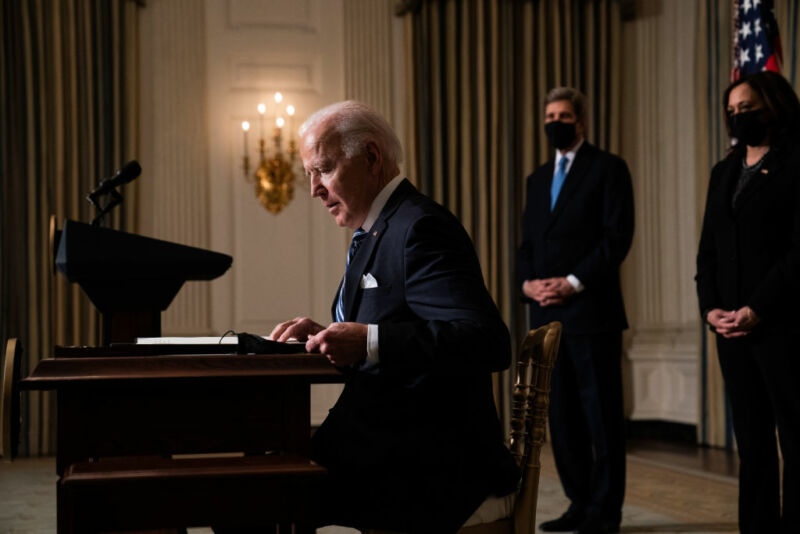
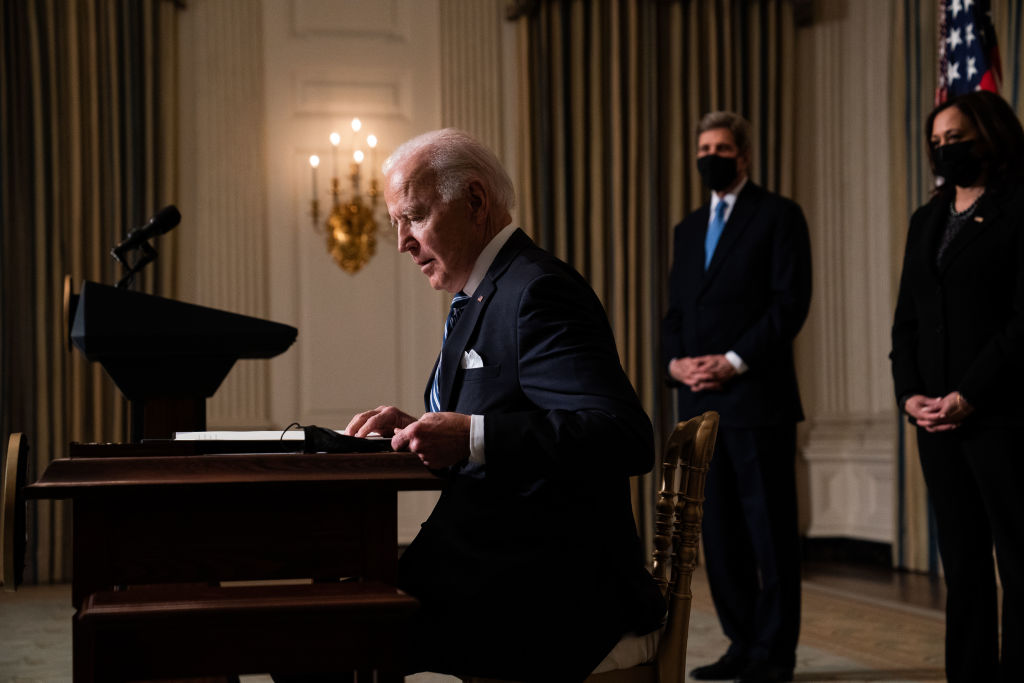
Image of a man seated at a desk, with a man and woman standing behind him.
Enlarge / U.S. President Joe Biden signs an executive order in the State Dining Room of the White House in Washington, D.C., on Wednesday, Jan. 27, 2021.

Yesterday, US President Joe Biden signed three executive orders. The order with the widest scope was focused on climate policy, and it received the most attention. But the other two, while more narrowly focused, may also have a profound impact because they seek to reorient the entire federal government’s approach to science itself. That includes both protecting scientists from political interference and ensuring that government decisions are based on the evidence produced by science as often as possible.

PCAST is back

One of the two executive orders officially starts off the Biden administration’s President’s Council of Advisors on Science and Technology, or PCAST. The organization is typically set up by an executive order and runs for two years before being renewed by a second. It dates back to the George H.W. Bush administration and has a broad remit to identify the current consensus in relevant fields of science and technology as well as to advise the entire executive branch regarding them.

The importance of PCAST isn’t just limited to science agencies; for example, an Obama-era council issued a report on forensic science that was relevant to everything from research-funding bodies to federal law enforcement agents.

The two-year term of PCAST ensures that each president would typically get the chance to establish their own shortly after inauguration. But President Donald Trump took nearly three years to name his first Council, meaning that it was still technically in place until yesterday, when Biden’s new order dissolved it. The quick action is likely to be indicative that the administration plans on leveraging the council’s advice. Biden has already named Nobel Laureate and Caltech chemist Frances Arnold and MIT planetary scientist Maria Zuber as PCAST co-chairs.

And it will be listened to

Having good science advice is not especially useful if it doesn’t get heard. Which is why an accompanying memorandum, entitled Restoring Trust in Government Through Scientific Integrity and Evidence-Based Policymaking, is a critical accompaniment to the formation of PCAST. The memo states a proposition that really shouldn’t be controversial but seemingly has been: “science, facts, and evidence are vital to addressing policy and programmatic issues across the Federal Government.”

The memorandum establishes President Biden’s policy regarding the use of evidence in government decision-making. The relationship between science and policy should be a two-way conversation. Science isn’t a body of facts that should be treated as the final word; it’s a collection of conclusions in which we have varying degrees of confidence. And policies necessarily involve compromises that may require input from scientists on how best to balance competing needs.

But there have been many instances—most notably in the pandemic response—when scientists were prevented from communicating accurate information to the public or when scientific conclusions were distorted in order to enable them to support a predetermined policy. “Improper political interference in the work of Federal scientists or other scientists who support the work of the Federal Government and in the communication of scientific facts undermines the welfare of the Nation, contributes to systemic inequities and injustices, and violates the trust that the public places in government to best serve its collective interests,” the memorandum argues.

The memorandum then goes on to say that the Office of Science and Technology Policy—a White House office that will be headed by geneticist Eric Lander—will be responsible for ensuring that the federal government follows scientific integrity policies. These policies ban political interference and prevent the “suppression or distortion of scientific or technological findings.” The National Science and Technology Council, a cabinet-level body, is charged with forming a task force for evaluating scientific-integrity policies in all agencies of the federal government.

The evaluation will include consideration of policies regarding instances when federal scientists and contractors interact directly with the public through news and social media. The task force will also identify means of handling areas of genuine scientific agreement (as opposed to fake disagreements, like those regarding the existence of climate change). Policies will be updated as needed due to recent advances in fields (such as artificial intelligence) and new methods (such as citizen science).

What to expect

When the report is done, every federal agency will be expected to name a chief science officer who will be responsible for ensuring that the agency follows the guidelines developed by the task force. Agencies will also be expected to provide annual reporting on any instances when there are complaints that the guidelines aren’t being followed and the outcome of any investigations into them.

The agencies will also be expected to apply evidence-based evaluations of their own activities. “Agencies’ evidence-building plans and annual evaluation plans shall include a broad set of methodological approaches for the evidence-based and iterative development and the equitable delivery of policies, programs, and agency operations,” the memorandum advises. These should include everything from analysis of data we already gather to evaluations of pilot projects and randomized control trials. In short, Biden wants agencies to have ways of determining whether what they’re doing is effective.

Overall, many agencies probably have polices that already handle some of these issues. But this executive order represents a significant effort to ensure that those policies are up to date and consistent across agencies. While the order might not fully restore “trust in government,” it could certainly repair some of the damage caused by the government’s recent attempt to tailor aspects of the pandemic response according to its political needs.

https://arstechnica.com/?p=1738071


Biden’s approach to climate: Calling it a crisis and treating it that way

A woman speaks while a man stands behind her.
Enlarge / National Climate Advisor Gina McCarthy and Special Presidential Envoy for Climate John Kerry answer questions during a press briefing at the White House.

Yesterday, US President Joe Biden signed an executive order entitled Putting the Climate Crisis at the Center of United States Foreign Policy and National Security. The document is sweeping, laying out a climate-focused agenda for the new administration and redirecting nearly every area of government to rethink its operations to bring them in line with that agenda. Targeted areas of government include everything from US diplomacy to the buildings that the government owns.

It’s difficult to overstate how large a difference this represents not only from the Trump administration, which treated climate change as if it didn’t exist, but even the Obama administration, which didn’t even attempt to tackle the climate until partway through its second term. Biden referred to the climate as a crisis during his campaign, and this document indicates his planned policies will actually reflect that language.

Foreign and domestic

Executive orders are limited in what they can do, in that they are limited by what’s allowed under existing laws; they can’t simply create new powers that don’t exist. There’s a considerable flexibility, however, in how existing laws are interpreted or which aspects of administration are emphasized. And this is perhaps truest in the area of diplomacy, where, outside of treaties and sanctions, the government has extensive flexibility in terms of how it manages its relationships with other nations.

“The United States will work with other countries and partners, both bilaterally and multilaterally, to put the world on a sustainable climate pathway,” the order declares early on. To manage that, Biden is bringing back former Secretary of State John Kerry to serve as his Special Presidential Envoy for Climate. Kerry will organize what’s being called a Leaders’ Climate Summit, held on Earth Day (April 22) this year. The administration will also restart an Obama-era initiative called the Major Economies Forum on Energy and Climate, a meeting of 17 major economies focused on climate issues.

One of the initiatives these meetings will focus on is an attempt to produce a climate finance plan to aid developing nations to adopt emissions reduction plans and build resilience to the impacts of rising temperatures. The United States will also push international financing efforts to focus on what it terms “climate-aligned investments.”

Separately, all federal agencies with overseas facilities, such as embassies or bases, will be tasked with ensuring that future planning takes the likely impact of climate change into account. In other words, no building overseas naval facilities on islands that are likely to be under water in a few decades. The wider security implications of climate change will be evaluated as part of a National Intelligence Estimate on the national and economic security impacts of climate change. The goal of this will be to provide material on likely changes that can be incorporated into everything from basic planning to war games.

All federal agencies with international activities will be asked to evaluate all their existing activities to ensure that aid and diplomacy align with the new policy. To the extent they don’t, plans will need to be submitted explaining how they will be brought into alignment. This sort of policy reanalysis makes many appearances in the domestic portion of the executive order as well; all branches of government are being asked to see what they can do within existing law that aligns their activities with Biden’s policy priorities.

Not quite a new deal

Democratic energy policies have, over the last few years, been dominated by comparisons with the Green New Deal proposal, which included plenty of policies (like guaranteed minimal income) that weren’t directly related to energy and climate. While the Biden approach to domestic climate policy doesn’t adopt the non-climate policies of the Green New Deal, it does adopt language that is clearly meant to appeal to those who backed it. There’s a consistent mention throughout that any new jobs created by adopting renewable energy or upgrading infrastructure should be “well-paying union jobs,” and policies should “deliver an equitable, clean-energy future.”

There is some explicit job creation as well, with the formation of a Civilian Climate Corps Initiative, meant “to mobilize the next generation of conservation and resilience workers and maximize the creation of accessible training opportunities and good jobs.”

Other aspects of the progressive language are easier to square with a changing energy policy. The health impacts of fossil fuel extraction and use are disproportionately felt by low-income communities, which are heavily tilted toward minorities. So, any attempt to limit fossil fuel use will necessarily have a component of social justice, which the executive order notes. But the order also calls for the formation of a White House Environmental Justice Interagency Council that will help identify disadvantaged communities and try to direct benefits from environmental programs to them.

The order also creates an Interagency Working Group on Coal and Power Plant Communities and Economic Revitalization. Recognizing that coal is going away and never coming back, the working group is meant to “prioritize grantmaking, Federal loan programs, technical assistance, financing, procurement, or other existing programs to support and revitalize the economies of coal and power plant communities.”

Zero-emission fleets

Beyond the social aspects, the actual policy changes are extensive. Two major goals are set out early: by 2035, our electricity-generating system should be emissions-free, and all government vehicles—including those of state and local governments—should be zero emissions. Existing laws favoring the purchase of American-made hardware will, the order argues, help ensure that this acts as a domestic jobs program. The US government also has extensive property holdings, from courthouses to military bases, and the administration will examine these for opportunities to both increase efficiency and harden them against expected climate changes.

Beyond encouraging social change, the order indicates it wants these developments to improve technological competitiveness. “Agencies shall consider the feasibility of using the purchasing power of the Federal Government to drive innovation,” it suggests.

All of the domestic changes will be coordinated by Gina McCarthy, a former head of the EPA whom Biden has named the White House National Climate Advisor.

De-fossilizing

One of the ironies of recent years is that, while governments made very public pledges to promote decarbonizing their economies, they continued to subsidize fossil fuels at the same time. The United States was not an exception here, but Biden would like to see that change. The executive order calls on all agencies to identify any fossil fuel subsidies they provide and, to the extent that existing law allows, stop them. As of fiscal 2022, Biden will submit a budget request that eliminates all remaining subsidies. That will be difficult to get through Congress, as there are a lot of states where fossil fuel extraction is a significant source of jobs.

One other form of subsidy is the low lease payments required of companies that extract fossil fuels from federal lands. To address these, Biden is instructing the secretary of the interior (pending confirmation, that will be Deb Haaland) to suspend new leases for oil and natural gas pending a review of existing practices. Any future leases will be made subject to higher fees in order to account for the social cost of carbon emissions, something that will be established due to an earlier executive order.

Similarly, the Department of Agriculture is being tasked with identifying “climate-smart agricultural and forestry practices” that limit wildfire risk and enable reduced carbon emissions from the agricultural sector.

Possibly related is the administration’s promise to conserve at least 30 percent of US land and water by 2030. How that works will depend on how “conserve” ends up being interpreted. There’s also a plan to establish jobs in communities that formerly produced fossil fuel by encouraging the rehabilitation of land damaged by that extraction. The order specifically mentions plugging leaks in oil and gas wells and reclaiming mining sites.

Overdue

To a certain extent, these changes are badly overdue. While the Trump administration was at best indifferent to dealing with the problems caused by climate change, Obama ostensibly took the issue seriously. But he never attempted to engage with the sort of top-to-bottom reevaluation of government programs to ensure that all policies reflected that seriousness. As a result, his administration presided over policies that were often inconsistent. This executive order clearly indicates Biden is attempting to push the entire US government into alignment with its evaluation of the risks posed by climate change.

Biden’s plans, however, are partly limited by what can be done without new legislation. And that legislation can pose a challenge, as many states have huge numbers of fossil fuel jobs. Ahead of the order’s signing, a press event with Kerry and McCarthy was dominated by questions about the potential loss of jobs as the US moves away from fossil fuels. The answers were an odd mix of emphasizing that Biden isn’t ending any existing fossil fuel leases and a recognition that renewable energy is a growth industry while fossil fuels just aren’t anymore.

That’s both accurate and a compelling argument for those who are already convinced. But this is a country dominated by an angry nostalgia for days when coal was king among those who have never been anywhere close to a mine, so this plan is likely to end up caught up in the United States’ general dysfunction.

https://arstechnica.com/?p=1737987


State reps try to ban Comcast data cap and price hikes until pandemic is over

Illustration of a water hose with Internet data trickling out of it, represented by 1s and 0s.

In response to Comcast imposing a data cap on Massachusetts residents, state lawmakers have proposed a ban on data caps, new fees, and price increases on home-Internet services for the duration of the pandemic.

The legislation was filed on Tuesday this week by Democratic state representatives Andy Vargas and Dave Rogers. Vargas called the bill a “response to Comcast Internet data cap plans,” while Rogers said the goal is “to push back at Comcast and any other service providers who try to raise prices or fees during a pandemic.” Verizon FiOS and RCN also provide Internet service in Massachusetts but do not impose data caps.

Vargas and Rogers previously led a group of 71 Massachusetts lawmakers who urged Comcast to halt enforcement of its 1.2TB monthly data cap, arguing that the cap hurts low-income people and is unnecessary because of Comcast’s robust network capacity. While Comcast already enforced the data cap in 27 states for several years, the cable company brought the cap to the rest of its territory—an additional 12 states including Massachusetts and the District of Columbia—this month. Comcast is easing-in enforcement so that the first overage charges for newly capped customers will be assessed for data usage in the April 2021 billing period.

The Massachusetts House has a 128-30 Democratic majority. Besides Vargas and Rogers, the bill so far has 21 cosponsors, most of whom just signed on today. We contacted Comcast about the bill today and will update this article if we get a response.

No caps, price hikes, or Internet shutoffs

The bill proposes “an emergency law, necessary for the immediate preservation of the public convenience.” It would remain in effect “for the duration” of the COVID-19 state of emergency that was declared by Governor Charlie Baker in March 2020 and for at least 60 days after the state of emergency is declared to be ended.

If passed, ISPs would not be allowed to “impose new data caps or allowances onto their subscribers.” The bill would also impose “a moratorium on any pre-existing data caps or allowances” that were already imposed by ISPs.

Moreover, ISPs would not be allowed to “increase the cost” of Internet plans, “levy any new fees or charges” related to broadband service, or “shut off Broadband Internet Access Service or services for subscribers that are unable to pay overdue bill[s] due to financial hardship caused by the COVID-19 emergency.”

The bill would also repeal a Massachusetts law that prohibits state or municipal regulation of the “rates, terms or conditions of VoIP Service or IP enabled service.” The bill doesn’t take any further action on VoIP offerings such as the phone services provided by cable companies and other ISPs, though.

The bill’s prohibitions on data caps, price increases, new fees, and shutoffs would affect home-Internet services and mass-market retail plans available to business customers. The bill would not affect cellular or mobile Internet services, with one exception: the bill would apply to “hotspots provided to students for educational purposes.”

The proposal to ban Internet shutoffs is similar to a provision in the “Keep Americans Connected Pledge” announced in March 2020 by then-Federal Communications Commission Chairman Ajit Pai. But with Pai having deregulated the broadband industry earlier in his term, the pledge was entirely voluntary for ISPs and expired at the end of June. Separately, Democrats in Congress proposed a law to ban Internet shutoffs until the pandemic is over, but it didn’t pass.

While the proposed Massachusetts emergency law would automatically expire 60 days after the state of emergency is declared to be over, it would also give the governor the option to extend the provisions “for a maximum of 180 days after the termination of the governor’s March 10, 2020 declaration of a state of emergency.”

https://arstechnica.com/?p=1737940


Facebook “Supreme Court” overrules company in 4 of its first 5 decisions

Facebook CEO Mark Zuckerberg in 2017.
Enlarge / Facebook CEO Mark Zuckerberg in 2017.
Mark Zuckerberg

The Oversight Board, an independent organization set up to review Facebook’s content moderation decisions, handed down its first batch of rulings on Thursday. The rulings didn’t go well for Facebook’s moderators. Out of five substantive rulings, the board overturned four and upheld one.

Most technology platforms have unfettered discretion to remove content. By contrast, Facebook decided in 2019 to create an independent organization, the Oversight Board, to review Facebook decisions, much as the US Supreme Court reviews decisions by lower courts. The board has an independent funding stream, and its members can’t be fired by Facebook. Facebook has promised to follow the board’s decisions unless doing so would be against the law.

The board’s first batch of five substantive decisions (a sixth case became moot after the user deleted their post) illustrates the difficult challenge facing Facebook’s moderators:

  • A user in Myanmar posted to Facebook that “Muslims have something wrong in their mindset” (or maybe “something is wrong with Muslims psychologically”—translations differ) arguing that Muslims should be more concerned about the genocide of Uighurs in China and less focused on hot-button issues like French cartoons mocking the Prophet Muhammad. Facebook removed the post as anti-Muslim hate speech. The Oversight Board re-instated it, finding that it was best understood as “commentary on the apparent inconsistency between Muslims’ reactions to events in France and in China.”
  • A user wrote that (in the board’s paraphrase) Azerbaijanis “are nomads and have no history compared to Armenians” and called for “an end to Azerbaijani aggression and vandalism.” The post was made during an armed conflict between Armenia and Azerbaijan. The board upheld Facebook’s decision to remove it as hate speech.
  • A user in Brazil uploaded an image to raise awareness about breast cancer that featured eight pictures of female breasts—five of them with visible nipples. Facebook’s software automatically removed the post because it contained nudity. Human Facebook moderators later restored the images, but Facebook’s Oversight Board still issued a ruling criticizing the original removal and calling for greater clarity and transparency about Facebook’s processes in this area.
  • A user in the United States shared an apocryphal quote from Joseph Goebbels that “stated that truth does not matter and is subordinate to tactics and psychology.” Facebook removed the post because it promoted a “dangerous individual”—Goebbels. The user objected, arguing that his intention wasn’t to promote Goebbels but to criticize Donald Trump by comparing him to a Nazi. The board overturned Facebook’s decision, finding that Facebook hadn’t provided enough transparency on its dangerous individuals rule.
  • A French user criticized the French government for refusing to allow the use of hydroxychloroquine for treating COVID-19. The post described the drug as “harmless.” Facebook removed the post for violating its policy against misinformation that can cause imminent harm. The board overturned the ruling, concluding that the post was commenting on an important policy debate, not giving people personal medical advice.

As you can see, Facebook has to make decisions on a wide range of topics, from ethnic conflict to health information. Often, Facebook is forced to choose sides between deeply antagonistic groups—Democrats and Republicans, Armenians and Azerbaijanis, public health advocates and anti-vaxxers. One benefit of creating the Oversight Board is to give Facebook an external scapegoat for controversial decisions. Facebook likely referred its suspension of Donald Trump to the Oversight Board for exactly this reason.

The big challenge is that Facebook is far too large—it has 2.7 billion users and 15,000 moderators—for the Oversight Board to review more than a tiny fraction of its moderation decisions. In order for the Oversight Board to have a meaningful impact on Facebook as a whole, the small number of cases it does review must create precedents that are followed by moderators in millions of other cases. This is how the Supreme Court supervises other courts in the US: the high court only reviews a fraction of cases, but lower courts treat those rulings as binding precedent for all future decisions.

Making this work for US courts isn’t easy. Parties in US court cases frequently hire lawyers who know how to find relevant Supreme Court precedents and present them to the judge. Judges and juries often spend hours or even days hearing testimony and deliberating before they reach a result. Appeals go to intermediate courts before they reach the Supreme Court.

It’s almost certainly not realistic for Facebook to replicate these complex procedures for moderation decisions. Moderators need to make decisions in minutes, not hours or days. They might not have time to research past Oversight Board precedents and make sure their ruling is consistent with them.

So what matters more than Thursday’s Oversight Board rulings is what Facebook does with them. As the Oversight Board hands down more rulings in the coming months, Facebook needs a process to make them understandable and searchable to its thousands of moderators.

Even if Facebook can’t bring a court-like level of consistency to its moderation decisions, the existence of the Oversight Board could still improve Facebook’s moderation process at the margins. In addition to ruling on individual cases, the Oversight Board also makes broader recommendations to Facebook to clarify its rules or improve its procedures. Those recommendations won’t be binding like its ruling on individual decisions. But it could still be healthy to have an external entity pressuring Facebook to make its policies clearer and more consistent.

https://arstechnica.com/?p=1737901


Biden vows to electrify the federal government’s 600,000-vehicle fleet

WASHINGTON, DC: President Joe Biden speaks before signing an executive order related to American manufacturing in the South Court Auditorium of the White House complex on January 25, 2021 in Washington, DC.
Enlarge / WASHINGTON, DC: President Joe Biden speaks before signing an executive order related to American manufacturing in the South Court Auditorium of the White House complex on January 25, 2021 in Washington, DC.
Drew Angerer/Getty Images

The federal government owns more than 600,000 civilian vehicles—trucks, vans, and passenger vehicles—with a large large majority running on gasoline or diesel fuel. On Monday, Joe Biden vowed to change that.

“The federal government owns an enormous fleet of vehicles, which we’re gonna to replace with clean electric vehicles made right here in America,” Biden said at a press conference to announce a new “Buy American” initiative.

This won’t be easy. In 2019, the most recent year for which data is available, the federal government owned fewer than 3,000 battery electric vehicles—less than one half of one percent of the federal vehicle fleet.

Gasoline and diesel-fueled vehicles accounted for 63 percent of the federal fleet that year, while “flex-fuel” vehicles capable of burning an 85 percent ethanol mixture accounted for another 31 percent. Just 4 percent of federal vehicles were hybrids in 2019 and most of these were not plug-in hybrids.

The slow progress hasn’t been from lack of trying. Over the last couple of decades, Congress has passed several laws mandating the federal government to shift toward more energy efficient and lower-emission vehicles. Under Barack Obama, the federal government did make some progress. For example, the number of hybrid vehicles rose from 1,766 in 2008 to 25,059 in 2017. The number of ethanol-capable vehicles rose from 129,000 in 2008 to 201,000 in 2017.

That progress wasn’t easy. Federal agencies need a variety of vehicle types, from sedans to large trucks and vans. In some cases, agencies had difficulty finding low-emission vehicles that met their requirements. Some agencies also operated in parts of the country where alternative fuels and charging infrastructure wasn’t available.

Hybrid and electric vehicles have lower emissions than conventional vehicles, but they were significantly more expensive than conventional vehicles. A 2019 report from the Government Accountability Office estimated the cost of low-emission vehicles for fiscal year 2017. It found that hybrid sedans cost up to $5,200 more than a conventional vehicle. Plug-in hybrid vehicles cost $8,700 to $15,300 more than conventional vehicles. Battery-electric sedans cost an extra $8,900.

Trump canceled Obama’s green car initiative

In 2015, President Obama signed an executive order requiring agencies to make plans for 20 percent of their vehicle purchases to be zero-emission vehicles or plug-in hybrids by 2020. It raised the target to 50 percent by 2025. But in 2018, President Trump signed a new executive order canceling these targets. Progress toward low-emission vehicles stalled. The number of flex-fuel, hybrid, and battery electric vehicles in the federal fleet all declined between 2018 and 2019.

Now Biden is looking to restart and possibly accelerate Obama’s efforts. It will be easier now than it was when Obama signed his executive order in 2015. Rapid declines in the cost of batteries means that plug-in hybrids and battery electric vehicles are more affordable now. Battery electric vehicles haven’t quite reached price parity with conventional vehicles, but the gap has narrowed and experts expect it to close completely around 2025—the year Biden’s first term ends.

There is now a much wider range of battery electric vehicles for federal agencies to choose from—including a growing number of trucks, vans, and SUVs. The amount of charging infrastructure is also increasing rapidly.

Despite all those gains, electrifying 100 percent of the federal fleet will be a big project. While Biden has declared this as a goal, he hasn’t given a specific timeline. Under any conceivable scenario, it will take a decade or more to fully replace the federal government’s 381,000 conventional vehicles and 191,000 flex-fuel vehicles with battery electric alternatives.

https://arstechnica.com/?p=1737376


This site posted every face from Parler’s Capitol Hill insurrection videos

Black-and-white photographs of faces arranged in a grid.

When hackers exploited a bug in Parler to download all of the right-wing social media platform’s contents last week, they were surprised to find that many of the pictures and videos contained geolocation metadata revealing exactly how many of the site’s users had taken part in the invasion of the US Capitol building just days before. But the videos uploaded to Parler also contain an equally sensitive bounty of data sitting in plain sight: thousands of images of unmasked faces, many of whom participated in the Capitol riot. Now one website has done the work of cataloging and publishing every one of those faces in a single, easy-to-browse lineup.

Late last week, a website called Faces of the Riot appeared online, showing nothing but a vast grid of more than 6,000 images of faces, each one tagged only with a string of characters associated with the Parler video in which it appeared. The site’s creator tells WIRED that he used simple, open source machine-learning and facial recognition software to detect, extract, and deduplicate every face from the 827 videos that were posted to Parler from inside and outside the Capitol building on January 6, the day when radicalized Trump supporters stormed the building in a riot that resulted in five people’s deaths. The creator of Faces of the Riot says his goal is to allow anyone to easily sort through the faces pulled from those videos to identify someone they may know, or recognize who took part in the mob, or even to reference the collected faces against FBI wanted posters and send a tip to law enforcement if they spot someone.

“Everybody who is participating in this violence, what really amounts to an insurrection, should be held accountable,” says the site’s creator, who asked for anonymity to avoid retaliation. “It’s entirely possible that a lot of people who were on this website now will face real-life consequences for their actions.”

Aside from the clear privacy concerns it raises, Faces of the Riot’s indiscriminate posting of faces doesn’t distinguish between lawbreakers—who trampled barriers, broke into the Capitol building, and trespassed in legislative chambers—and people who merely attended the protests outside. A recent upgrade to the site adds hyperlinks from faces to the video source, so that visitors can click on any face and see what the person was filmed doing on Parler. The Faces of the Riot creator, who says he’s a college student in the “greater DC area,” intends that added feature to help contextualize every face’s inclusion on the site and differentiate between bystanders, peaceful protesters, and violent insurrectionists.

He concedes that he and a co-creator are still working to scrub “non-rioter” faces, including those of police and press who were present. A message at the top of the site also warns against vigilante investigations, instead suggesting users report those they recognize to the FBI, with a link to an FBI tip page. “If you go on the website and you see someone you know, you might learn something about a relative,” he says. “Or you might be like, ‘Oh, I know this person,’ and then further that information to the authorities.”

Looking for faces

Despite its disclaimers and limitations, Faces of the Riot represents the serious privacy dangers of pervasive facial recognition technology, says Evan Greer, the campaign director for digital civil liberties nonprofit Fight for the Future. “Whether it’s used by an individual or by the government, this technology has profound implications for human rights and freedom of expression,” says Greer, whose organization has fought for a legislative ban on facial recognition technologies. “I think it would be an enormous mistake if we come out of this moment by glorifying or lionizing a technology that, broadly speaking, disproportionately harms communities of color, low-income communities, immigrant communities, Muslim communities, activists… the very same people that the faces on this website stormed the Capitol for the purpose of silencing and disenfranchising.”

The site’s developer counters that Faces of the Riot leans not on facial recognition but facial detection. While he did use the open source machine-learning tool TensorFlow and the facial recognition software Dlib to analyze the Parler videos, he says he used that software only to detect and “cluster” faces from the 11 hours of video of the Capitol riot; Dlib allowed him to deduplicate the 200,000 images of faces extracted from video frames to around 6,000 unique faces. (He concedes that there are nonetheless some duplicates and images of faces on protest signs included too. Even the number “45” on some signs was in some cases identified as a human face.)

He emphasizes also that there’s no search tool on the site, and it doesn’t attempt to link faces with names or other identifying details. Nor is there any feature for uploading an image and matching it with images in the site’s collection, which he says could lead to dangerous misidentifications. “There’s a very hard no on allowing a user to take a photo from a wanted poster and search for it,” the site’s creator says. “That’s never going to happen.”

The roughly 42 gigabytes of Parler videos that Faces of the Riot analyzed were downloaded prior to Amazon’s decision early last week to cut off Parler’s Web hosting, leaving the site largely offline since. Racing against that takedown, hacktivists took advantage of a security flaw in Parler that allowed them to download and archive every post from the service, which bills itself as an uncensored “free speech” alternative to Twitter or Facebook. Faces of the Riot obtained Parler’s salvaged videos after they were made available online by Kyle McDonald, a media artist who obtained them from a third party he declined to identify.

“Playing it really safe”

The Faces of the Riot site’s creator initially saw the data as a chance to experiment with machine-learning tools but quickly saw the potential for a more public project. “After about 10 minutes I thought, ‘This is actually a workable idea and I can do something that will help people,'” he says. Faces of the Riot is the first website he’s ever created.

McDonald has previously both criticized the power of facial recognition technology and himself implemented facial recognition projects like ICEspy, a tool he launched in 2018 for identifying agents of the Immigration and Customs Enforcement agency. He tells WIRED he also analyzed the leaked Parler videos with facial recognition tools to see if he could identify individuals, but he could only ID two, both of whom had already been named by media. He sees Faces of the Riot as “playing it really safe” compared even to his own facial recognition experiments, given that it doesn’t seek to link faces with named identities. “And I think it’s a good call because I don’t think that we need to legitimize this technology any more than it already is and has been falsely legitimized,” McDonald says.

But McDonald also points out that Faces of the Riot demonstrates just how accessible facial recognition technologies have become. “It shows how this tool that has been restricted only to people who have the most education, the most power, the most privilege is now in this more democratized state,” McDonald says.

The Faces of the Riot site’s creator sees it as more than an art project or demonstration. Despite the safeguards he put in place to limit its ability to automatically identify people, he still hopes that the effort will have real, tangible results—if only indirectly through reports to law enforcement. “It’s just felt like people got away with a lot of bad stuff for the last four years,” he says. “This is an opportunity to start trying to put that to an end.”

This story originally appeared on wired.com.

https://arstechnica.com/?p=1736948


Military intelligence buys location data instead of getting warrants, memo shows

If your phone knows where you are, the feds can, too.
Enlarge / If your phone knows where you are, the feds can, too.

The Defense Intelligence Agency, which provides military intelligence to the Department of Defense, confirmed in a memo that it purchases “commercially available” smartphone location data to gather information that would otherwise require use of a search warrant.

The DIA “currently provides funding to another agency that purchases commercially available geolocation metadata aggregated from smartphones,” the agency wrote in a memo (PDF) to Sen. Ron Wyden (D-Ore.), first obtained by the New York Times.

The Supreme Court held in its 2018 Carpenter v. United States ruling that the government needs an actual search warrant to collect an individual’s cell-site location data. “When the Government tracks the location of a cell phone it achieves near perfect surveillance, as if it had attached an ankle monitor to the phone’s user,” Chief Justice John Roberts wrote for the majority in his opinion. “The retrospective quality of the data here gives police access to a category of information otherwise unknowable.”

The reality of the market, however, has created a big fat loophole: There are countless entities on the private market that scoop up, collate, and resell all kinds of personal data from basically everyone in the country. So instead of doing their own searches, law enforcement agencies are just buying the data they want.

Last summer, for example, media reports found that Customs and Border Patrol buys license plate scanner data to track individuals’ movements. Later reports also revealed that CBP and Immigration and Customs Enforcement buy cell phone location data—information the agencies would otherwise be required to get a search warrant to obtain. The Department of Homeland Security inspector general in December opened an investigation to determine if these tactics “adhered to policies related to cell-phone surveillance devices.”

The Secret Service, IRS, and other agencies have also purchased mobile location data, according to media reports.

The DIA explains in the memo that it simply does not think the Carpenter ruling applies to it. “DIA does not construe the Carpenter decision to require a judicial warrant endorsing purchase or use of commercially-available data for intelligence purposes,” the agency wrote. “DIA’s acquisition, use, and storage of commercial geolocation data is governed” not by these civilian law enforcement rules but by the DoD’s own “Attorney General-approved data handling requirements.”

https://arstechnica.com/?p=1736842