Home alarm tech backdoored security cameras to spy on customers having sex
Getty Images / Aurich Lawson
A home security technician has admitted he repeatedly broke into cameras he installed and viewed customers engaging in sex and other intimate acts.
Telesforo Aviles, a 35-year-old former employee of home and small office security company ADT, said that over a five-year period, he accessed the cameras of roughly 200 customer accounts on more than 9,600 occasions—all without the permission or knowledge of customers. He said he took note of homes with women he found attractive and then viewed their cameras for sexual gratification. He said he watched nude women and couples as they had sex.
Aviles made the admissions Thursday in US District Court for the District of Northern Texas, where he pleaded guilty to one count of computer fraud and one count of invasive visual recording. He faces a maximum of five years in prison.
Aviles told prosecutors that he routinely added his email address to the list of users authorized to access customers’ ADT Pulse accounts, which allow customers to remotely connect to the ADT home security system so they can turn on or off lights, arm or disarm alarms, and view feeds from security cameras. In some cases, he told customers that he had to add himself temporarily so he could test the system. Other times, he added himself without their knowledge.
More legal fallout
An ADT spokesman said the company brought the illegal conduct to the attention of prosecutors last April after learning Aviles gained unauthorized access to the accounts of 220 customers in the Dallas area. The security company then contacted each customer “to help make this right.” The company has already resolved disputes with some of the customers. ADT published this statement last April and has continued to update it.
“We are grateful to the Dallas FBI and the US Attorney’s Office for holding Telesforo Aviles responsible for a federal crime,” the company wrote in an update posted on Friday.
In the aftermath of the breach discovery, ADT has been hit by at least two proposed class-action lawsuits, one on behalf of ADT customers and the other on behalf of minors and others living inside the homes. A plaintiff in one of the suits was allegedly a teenager at the time that the breach occurred. ADT informed her family that the technician spied on her home almost 100 times, according to the lawsuit.
The suits alleged that ADT marketed its camera systems as a way for parents to use smartphones to check in on kids and pets. ADT, the plaintiffs said, failed to implement safeguards—including as two-factor authentication or text alerts when new parties access the accounts—that could have alerted customers to the invasion. The breach was discovered when a customer noticed an unauthorized email among addresses that had permission to access the security system.
The revelation of an electronic Peeping Tom is a good reminder of the risks that come from installing network connected cameras inside the home or other locations where there’s a reasonable expectation of privacy. People who choose to accept these risks should take the time to educate themselves on how to use, configure, and maintain the devices. Among the first things to inspect are the list of users given access and who has actually logged into the system.
https://arstechnica.com/?p=1736874
Google: We’ll shut down Australian search before we pay news sites for links
Enlarge/ Tim Berners-Lee, inventor of the World Wide Web, criticized the Australian proposal.
Oliver Berg/picture alliance via Getty Images
Google says it would have “no real choice” but to shut down its search engine in Australia if Australia passes a new law requiring Google to pay news sites to link to their articles. This would “set an untenable precedent for our business and the digital economy,” said Google’s Mel Silva in Friday testimony before the Australian Senate.
News organizations around the world have been struggling financially over the last decade or two. Many have blamed Internet companies like Google and Facebook that—in their view—have diverted advertising revenue that once went to news organizations. Some in the news industry argue that Google benefits from including news stories in its search results and should compensate news sites for the privilege of doing so.
So last year, the Australian Competition and Consumer Commission proposed a new mandatory arbitration process designed to correct a supposed power imbalance between tech giants and Australian news sites. Under the new framework, news sites can demand that tech platforms (initially Google and Facebook) pay them for linking to their stories. Google and Facebook are required to negotiate “in good faith” toward a payment agreement.
You might think that Google would simply stop linking to Australian news sites. But that won’t be allowed under the ACCC proposal. New non-discrimination rules require Google to treat sites the same whether or not it has to pay to link to them.
Australia’s proposal has provoked a broad backlash from advocates of the open Web—including the inventor of the Web itself. In a letter to the Australian Senate earlier this week, Tim Berners-Lee argued that Australia’s proposal would set a damaging precedent.
“To my knowledge, there is no current example of legally requiring payments for links to other content,” Berners-Lee said. “The ability to link freely—meaning without limitations regarding the content of the linked site and without monetary fees—is fundamental to how the Web operates.”
Google is under pressure around the world
Australia isn’t the only country where Google is facing increasing pressure to pay news sites. This week, Google announced it had negotiated a framework to pay French news sites for the right to include them in its search results.
Technically, the French law is different from Australia’s proposal. In its law implementing the 2019 EU Copyright Directive, France required Google to pay for the use of news “snippets” in search results. Google stopped using the snippets to avoid paying. But then France’s competition authority objected, arguing that refusing to use snippets—and pay news sites for them—was an abuse of Google’s market power. Despite reservations about the French law, Google announced an agreement with French news organizations this week.
As we wrote on Thursday, France’s success provides a roadmap for other European countries that want to force Google to pay their news organizations, too. And it may undermine Google’s bargaining power in Australia as well. In Australia, Google has portrayed free links as a principle so sacrosanct that it would shut down its search engine before agreeing to pay. But in France, Google seems to have accepted a similar arrangement without shutting down its French search engine.
This may be because France has more leverage than Australia. Not only is France a larger country than Australia, but France’s membership in the EU may have given it added leverage.
On the other hand, it may be that the specifics of the Australian proposal make it more offensive to Google. One area of concern for Google is the use of baseball-style arbitration rules. Under this bargaining system, each side (in this case Google or Facebook on one side and a news publisher on the other) submits a single proposal to a neutral arbitrator. The arbitrator must then decide which of the two proposals is more “reasonable” and adopt it. In theory, this structure gives both sides an incentive to meet the other party halfway. But Google worries that the system will be based on “biased criteria” and will create “unmanageable financial and operational risk for Google.”
Australia’s proposal requires Google to notify Australian news sites of changes to its search algorithm 28 days in advance. Google has traditionally kept details about its algorithm secret and argues that disclosing this information to Australian news publishers would give those publishers an unfair advantage over other websites.
The new Australian law would also require Google to share traffic data with news sites, raising concerns about user privacy.
In any event, Australian officials don’t seem worried about Google’s opposition.
“We don’t respond to threats,” said Australian Prime Minister Scott Morrison on Friday. “Australia makes our rules for things you can do in Australia.”
https://arstechnica.com/?p=1736821
CenturyLink, Frontier missed FCC broadband deadlines in dozens of states
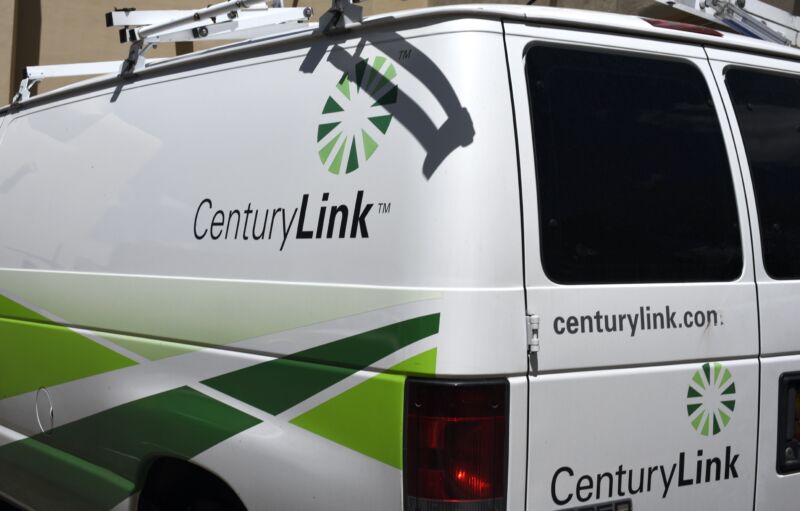
Enlarge/ A CenturyLink service van parked in Santa Fe, New Mexico, on May 2, 2019.
CenturyLink and Frontier Communications have again failed to meet broadband-deployment deadlines in dozens of states after taking money from the Federal Communications Commission.
When the FCC awarded Connect America Fund Phase II grants in 2015, CenturyLink accepted $505.7 million in annual support over six years in exchange for deploying broadband with 10Mbps download speeds and 1Mbps upload speeds to 1.17 million homes and businesses in 33 states. Frontier accepted $283.4 million in annual support over six years to deploy service to 659,587 homes and business in 28 states.
The deadline to hit 100 percent of the required deployments passed on December 31, 2020. Both CenturyLink and Frontier informed the FCC that they missed the deadline to finish deployment in numerous states.
The carriers won’t face the possibility of punishment yet. As Frontier said in its FCC filing on Friday last week, US law gives the ISP “until December 31, 2021 to complete its CAF II buildout in the states where it has not yet achieved the 100 percent milestone.” The law cited by Frontier says that once an ISP informs the FCC that it “has not met a final milestone,” the carrier “will have twelve months from the date of the final milestone deadline to come into full compliance.” After that, the government can take back an amount “equal to 1.89 times the average amount of support per location received in the support area,” plus 10 percent of the carrier’s total funding in that area.
CenturyLink told the FCC that its “preliminary year-end data” suggests it “may not have met” the 100 percent deployment milestone in 23 states. Those states are Arkansas, Arizona, Colorado, Idaho, Illinois, Indiana, Iowa, Kansas, Louisiana, Michigan, Minnesota, Missouri, Montana, Nebraska, New Mexico, North Dakota, Ohio, Oregon, South Dakota, Utah, Virginia, Washington, and Wisconsin. CenturyLink said it met or exceeded the milestone in 10 states, and “is on track” to hit 100 percent in the other states before the end of 2021.
Frontier said its preliminary data suggests it may not have met the 100 percent milestone in 17 states. Those are Alabama, Arizona, California, Illinois, Indiana, Iowa, Michigan, Minnesota, Nebraska, Nevada, New Mexico, New York, Ohio, Texas, Utah, Wisconsin, and West Virginia. Frontier said it met or exceeded the milestone in eight states.
Frontier said it expects to hit 100 percent by June 30, 2021 in all states “with the exception of Arizona, Utah, and New Mexico, where Frontier has faced extraordinary permitting delays that warranted a waiver of Frontier’s 2019 interim deployment milestone. Frontier expects to complete the deployments in Arizona, Utah and New Mexico by September 30, 2021.” CenturyLink and Frontier did not say exactly how far short they are of 100 percent deployment, but are due to give more detail to the FCC by March 1.
Texas wasn’t part of Frontier’s original funding awarded in 2015, but Frontier bought Verizon’s wireline network in the state in 2016. Frontier sold its network assets in four states—Idaho, Montana, Oregon, and Washington—to Ziply Fiber in May 2020. Ziply told the FCC that it has completed the required buildouts in Idaho, Montana and Oregon. Ziply said it completed 96.13 percent of the buildout in Washington and believes it will complete the rest by February 16.
ISPs get more money
The Connect America Fund and other universal service programs run by the FCC are paid for by Americans through fees imposed on phone bills. CenturyLink and Frontier are both getting more money from the FCC in the new Rural Digital Opportunity Fund, with CenturyLink getting $262.4 million spread over 10 years and Frontier getting $370.9 million over 10 years.
Sen. Shelley Moore Capito (R-W.Va.) recently urged the FCC to block Frontier’s new funding, saying that “Frontier has a documented pattern of history demonstrating inability to meet FCC deadlines for completion of Connect America Fund Phase II support in West Virginia.” Frontier, which is moving through bankruptcy proceedings, told the FCC that it will exit bankruptcy in March or April with $10 billion less debt and a plan to “continue its large scale fiber-to-the-premises investment that is already underway and to complete its transformation into a stronger service provider.”
As we’ve noted in previous coverage, former FCC Chairman Ajit Pai awarded the new funding weeks before he left the agency even though the FCC hasn’t finished collecting more accurate deployment data that will help target funding to areas that need it most. One day before Pai left office, a bipartisan group of 157 members of Congress sent a letter “urging the FCC to make sure that every funded ISP has the technical, financial, managerial, operational skills, capabilities, and resources to deliver the services that they have pledged.”
https://arstechnica.com/?p=1736804
A look at all of Biden’s changes to energy and environmental regulations
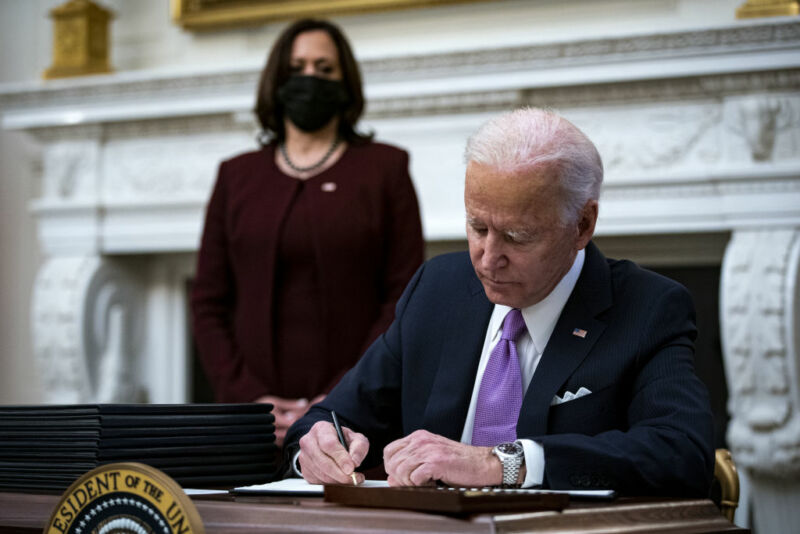
Enlarge/ US President Joe Biden signs an executive order with US Vice President Kamala Harris, left, looking on.
The series of executive orders signed by Joe Biden on his first evening in office included a heavy focus on environmental regulations. Some of the high-profile actions had been signaled in advance—we’re back in the Paris Agreement! The Keystone pipeline’s been put on indefinite hold!
But the suite of executive orders includes a long list that targets plenty of the changes Trump made in energy and environmental policies, many of which will have more subtle but significant effects of how the United States does business. Many of those make major changes, in some cases by eliminating policies adopted during the Trump years, a number of which we covered at the time. So, we’ve attempted to take a comprehensive look at Biden’s actions and their potential impacts.
Laws, rules, and policies
Environmental and energy regulations are set through three main mechanisms. The first is by specific laws, which would require the cooperation of both houses of Congress to change. Next are also more general laws, like the Clean Air and Clean Water Acts. These enable regulations to be put in place via a formal rule-making process run by the agencies of the executive branch. This process involves soliciting public feedback, incorporating economic considerations, and so on, a process that typically takes anywhere from eight months to over a year. Finally, the executive branch can set policies to cover details not spelled out by the law or the rule, such as how to handle things like deadlines and enforcement details.
It’s these latter two categories where President Biden can act immediately, since they’re left entirely to the executive branch, although subject to legal review. And that’s precisely what he’s done, by ordering reviews of existing rules established during the Trump administration and changing myriad policies put in place by prior executive orders.
The Congressional Review Act also allows federal rules that have been enacted within the past 60 days to be overturned by a joint resolution of the two houses of Congress. The clock is still running on a number of Trump rules and, with Democrats controlling both houses, there’s a chance we’ll see action here. But on his first day in office, Biden was taking no chances, and he targeted these rules along with a list of many that are outside the 60-day window.
Clearing limits
Trump-era policies often attempted to eliminate existing policies and cripple any future adoption of new ones. Perhaps the most striking of these was in Executive Order 13771, which flatly declared that any new regulation could only be adopted if two existing regulations were eliminated. The order gave no consideration to details like the total number of regulations that were available to eliminate or whether existing regulations were effective and/or efficient. Furthermore, the net economic impact on those regulated by the new and canceled rules had to be zero.
Another executive order established “regulatory reform officers” in every agency. They were supposed to help in the identification of regulations that were out-of-date or costly, then target those for elimination. Another order demanded that guidance documents, which agencies issue in order to help companies comply with regulations, could never contain phrasing that might be interpreted as creating regulations. Order 13892 required that any enforcement of regulations had to wait to allow those subject to the enforcement time to respond to the proposed action.
All of these executive orders are now gone. Citing the need for policies that tackle climate change and the pandemic, Biden’s new executive order describes them as “harmful policies and directives that threaten to frustrate the Federal Government’s ability to confront these problems” in justifying their elimination.
More difficult to deal with are actions that have gone through the full federal rule-making process. These include a number of efforts intended to make future rules more difficult to adopt. Notable among them:
The EPA decided that incidental benefits of pollution limits wouldn’t count toward the consideration of costs and benefits of regulations. In other words, if a regulation cost $100 in cleanup costs but avoided $100,000,000 in health care costs, only the first figure would matter during the rule-making process.
The EPA has changed its standards of evidence for studies on pollution harm so that epidemiological evidence on its own would not be sufficient to trigger regulation.
Not content with that, the agency has determined that epidemiological evidence that incorporates patient data can’t be used if privacy concerns keep the underlying data from being made public.
Biden cannot unilaterally eliminate these rules. But all agency heads have now been directed to review any rule adopted during the entire Trump administration to determine whether they run contrary to Biden’s policy goals. And the most recently adopted rules are subject to an executive order to agency heads that directs them to suspend said rules and reopen them for public comment as a route to enabling a replacement rule to be formulated. Any rules that are currently tied up in court will see the Justice Department ask for the case to be suspended while the relevant agencies revisit the rules.
Specific targets
Beyond these efforts, the early executive orders target a lot of efforts by Trump to block Obama-era policies. These include a new look at Trump’s effort to weaken Obama-era fuel-economy standards but go well beyond that. Other targets include Trump’s elimination of Obama-era rules on methane emissions from fossil fuel extraction and the Obama-era Waters of the USA rules. In their initial formulation, these treated things like small ponds and seasonal streams as part of a single, interlinked water system that was regulated under the Clean Water Act. Trump reversed the rule; Biden will consider reviving it. Fossil fuel extraction in the Arctic National Wildlife Refuge was prohibited under Obama, opened for leasing by Trump, and will likely be blocked again by Biden.
Fossil fuel extraction plays a major role in the policies Biden is reconsidering or reversing. One Trump executive order attempted to limit the use of the Clean Water Act to block energy development, the ability of state laws to limit export of fossil fuels, and—most bizarrely for a party that was supposedly enthused about the free market—targeted retirement funds that were limiting their holdings in the energy sector. That order has been eliminated in its entirely.
Trump also pushed efforts to favor energy development at the expense of the application of laws such as the Clean Water Act, National Environmental Policy Act, and Endangered Species Act. Biden has reversed the policies that resulted. Biden also targeted by orders that promote offshore drilling in the Gulf of Mexico and the Arctic and another that ordered a review of whether national monuments got in the way of energy development.
Trump actions to limit the size of several of these national monuments are also being reversed. These include Bears Ears and Grand Staircase-Escalante in the Southwest, as well as the Northeast Canyons and Seamounts offshore reserve off the coast of Maine.
Trump’s somewhat bizarre objections to efficiency rules for lightbulbs and appliances (notably toilets) led to the elimination of some of those. They’ll be back now.
Get some science back
Other actions taken so far suggest that Biden continues to be serious about his promise to bring science back into policy decisions. Trump had issued an executive order that targeted advisory committees, one of the ways that policymakers in the executive branch can solicit input from scientists (as well as those in industry and elsewhere). In recent years, there have typically been roughly a thousand advisory committees active at any point. Trump had issued an executive order that sought a rapid elimination of about a third of those and set a long-term target of having only 300 active. Those limits are gone.
Trump also blocked the use of a figure called the social cost of carbon, which attempts to use the future consequences of climate change to determine the cost of present-day emissions. Biden isn’t just reversing that decision—he’s expanding it so that it’s applied to two additional greenhouse gasses: methane and nitrous oxide. His executive order establishes an interagency working group that’s charged with producing an initial estimate within 30 days. This will allow the entire federal government to perform cost-benefit analyses for climate-related regulations, something that’s often a legal requirement.
To regulate or not?
Many of the other executive orders revoked by Biden were cases when Trump directed agencies to re-evaluate existing regulations to determine if they were efficient, cost-effective, overlapped with other regulations, or had simply been obviated by scientific or market developments. There was nothing obviously problematic with many aspects of these orders, which makes their elimination by Biden seem somewhat capricious—why would he object to the identification of ineffective regulations?
It’s important to recognize that, despite the apparently neutral language, the orders were meant to enable the Trump administration to eliminate regulations with no regard for their effectiveness. Through their elimination, Biden will free up staff to pursue new policy initiatives and restore government capacity that has been lost during the previous four years. How you feel about that will likely be determined by your attitudes toward regulations in general.
Overall, many of the decisions here are basic policy reversals—decisions about whether to limit Clean Water Act enforcement in order to foster energy development, for example. But underlying most of them is a clear policy vision that places addressing climate change as a very high priority and attempts to redirect existing laws to better reflect both that priority and the rapidly changing economic reality that makes doing so much less challenging than it was during the Obama administration.
With control of both houses of Congress, Biden should eventually be able to get new laws passed that allow these policy objectives to be pursued more effectively. But his opening actions indicate he’s not willing to wait for that or chance the prospect of gridlock dominating the capital for the next two years.
https://arstechnica.com/?p=1736724
Parler’s attempt to get back on Amazon Web Services rejected by judge
Enlarge/ Amazon Web Services (AWS) logo displayed during the 4th edition of the Viva Technology show at Parc des Expositions Porte de Versailles on May 17, 2019, in Paris, France.
A federal judge today rejected Parler’s motion for a preliminary injunction against Amazon Web Services (AWS), scuttling the social network’s attempt to quickly get back onto Amazon’s Web-hosting platform.
Parler, which bills itself as a conservative alternative to Twitter, had asked for a court order requiring Amazon to reinstate its Web-hosting service pending a full trial. But “Parler has fallen far short… of demonstrating, as it must, that it has raised serious questions going to the merits of its claims,” and it has failed to prove “that the balance of equities tips in its favor, let alone strongly so; or that the public interests lie in granting the injunction,” said the ruling by Judge Barbara Jacobs Rothstein in US District Court for the Western District of Washington.
Parler could still prevail in the case, but it won’t be reinstated to Amazon’s service in the meantime. Parler accused Amazon of conspiracy in restraint of trade, in violation of the Sherman Act; breach of contract; and tortious interference with business expectancy.
“AWS disputes all three claims, asserting that it is Parler, not AWS, that has violated the terms of the parties’ Agreement, and in particular AWS’s Acceptable Use Policy, which prohibits the ‘illegal, harmful, or offensive’ use of AWS services,” Rothstein wrote.
Amazon warned Parler repeatedly
Amazon cut off Parler’s Web-hosting service on January 10, saying that “we cannot provide services to a customer that is unable to effectively identify and remove content that encourages or incites violence against others.” Parler has shown that it “cannot comply with our terms of service and poses a very real risk to public safety,” Amazon also said.
Parler sued Amazon on January 11. Subsequently, Amazon said in a court filing that it issued warnings to Parler about more than 100 violent threats before disconnecting its service. As we wrote in previous coverage, posts that Amazon reported to Parler included calls for “killing a specific transgender person; actively wishing for a race war and the murder of Black and Jewish people; and killing several activists and politicians such as Stacey Abrams, Rep. Alexandria Ocasio-Cortez (D-N.Y.), and former President Barack Obama.”
This case is not about suppressing speech or stifling viewpoints. It is not about a conspiracy to restrain trade. Instead, this case is about Parler’s demonstrated unwillingness and inability to remove from the servers of Amazon Web Services content that threatens the public safety, such as by inciting and planning the rape, torture, and assassination of named public officials and private citizens. There is no legal basis in AWS’s customer agreements or otherwise to compel AWS to host content of this nature. AWS notified Parler repeatedly that its content violated the parties’ agreement, requested removal, and reviewed Parler’s plan to address the problem, only to determine that Parler was both unwilling and unable to do so. AWS suspended Parler’s account as a last resort to prevent further access to such content, including plans for violence to disrupt the impending Presidential transition.
Parler claims are weak, judge finds
Rothstein’s rejection of Parler’s motion said that “While Parler has not yet had an opportunity to conduct discovery, the evidence it has submitted in support of the [Sherman Act] claim is both dwindlingly slight, and disputed by AWS. Importantly, Parler has submitted no evidence that AWS and Twitter acted together intentionally—or even at all—in restraint of trade.”
Parler claimed that “by pulling the plug on Parler but leaving Twitter alone despite identical conduct by users on both sites, AWS reveals that its expressed reasons for suspending Parler’s account are but pretext.” But Rothstein pointed out that “Parler and Twitter are not similarly situated, because AWS does not provide online hosting services to Twitter.”
Parler’s breach-of-contract claim is similarly weak, Rothstein wrote. Parler has not denied that it was in violation of its agreement with Amazon at the time of the service termination, and the customer agreement “gives AWS the right either to suspend or to terminate, immediately upon notice, in the event Parler is in breach,” Rothstein wrote.
On the tortious interference claim, “Parler has failed to allege basic facts that would support several elements of this claim” and “has failed to raise more than the scantest speculation that AWS’s actions were taken for an improper purpose or by improper means,” the judge wrote.
If Amazon was forced to reinstate Parler’s services now, before Parler deploys a more effective moderation system, the result would be “continued posting of the kind of abusive, violent content that caused AWS to shut Parler down in the first place,” the ruling said. It continued:
The Court explicitly rejects any suggestion that the balance of equities or the public interest favors obligating AWS to host the kind of abusive, violent content at issue in this case, particularly in light of the recent riots at the US Capitol. That event was a tragic reminder that inflammatory rhetoric can—more swiftly and easily than many of us would have hoped—turn a lawful protest into a violent insurrection.
Parler.com is currently online as a static webpage with several posts from conservative figures like Sean Hannity and Sen. Rand Paul (R-Ky.), along with a note about “technical difficulties.”
https://arstechnica.com/?p=1736660
Google agrees to pay French news sites to send them traffic
French news sites have prevailed in negotiations with Google over “neighboring rights,” a new legal right granted by the 2019 EU Copyright Directive. An agreement between Google and the French news industry “establishes a framework within which Google will negotiate individual licensing agreements” with individual news organizations, according to Google. Under these deals, French news articles will be featured in a new Google product called News Showcase.
This isn’t the outcome Google wanted. For years, European news organizations have tried to force Google to pay them for the privilege of indexing their articles, and for years Google flatly refused to do so. When Spain passed legislation to force Google to pay to link to Spanish News organizations in 2014, Google responded by shutting down Google News in Spain.
Google tried to use that same playbook in France after the passage of the EU copyright directive. France was the first country to transpose the EU directive into its own laws. In 2019, Google announced it was going to stop displaying “snippets” from French news articles in search results. Google believed that showing only news story headlines, not brief excerpts from articles, would bring it into compliance with the new law.
But that move earned a rebuke from France’s competition regulator, which held that the move was likely an abuse of Google’s monopoly power. Google has around 90 percent of the French search market. The French Competition Authority held that the deal Google offered to news sites—let us index your site for free or we won’t index it at all—was an abuse of that market power and contrary to the spirit of the new French law.
French authorities ordered Google to conduct “good faith negotiations” with the news industry to decide how much Google would pay news sites for their content. And they made clear that the number had better not be zero.
Those negotiations were apparently successful, though Google’s announcement offers few details about the new framework.
“The remuneration that is included in these licensing agreements is based on criteria such as the publisher’s contribution to political and general information, the daily volume of publications, and its monthly internet traffic,” according to the announcement.
The agreement is particularly significant because it offers a model for other European countries that want to force Google to fork over cash to their own news sites.
In the past, Google’s hardball tactics deterred most European countries from trying to force Google to pay up. But with the passage of the EU copyright directive, European countries formed a united front against Google, making it much harder for Google to resist. Google’s capitulation in France will weaken its bargaining position as other European countries pass their own versions of the French law and news organizations in other countries line up for their share of Google cash.
https://arstechnica.com/?p=1736655
Facebook calls in its Oversight Board to rule on Trump ban
Enlarge/ Facebook’s Menlo Park, California, headquarters as seen in 2017.
Facebook’s Oversight Board is getting its highest-profile case yet, as the company kicks its decision to boot former-President Donald Trump off its platforms to the largely untested “Supreme Court” of social media for review.
Facebook suspended Trump’s Facebook and Instagram accounts on January 7 in the immediate aftermath of the insurrectionist riots at the US Capitol. “The shocking events of the last 24 hours clearly demonstrate that President Donald Trump intends to use his remaining time in office to undermine the peaceful and lawful transition of power to his elected successor, Joe Biden,” company CEO Mark Zuckerberg said at the time. “We believe the risks of allowing the President to continue to use our service during this period are simply too great. Therefore, we are extending the block we have placed on his Facebook and Instagram accounts indefinitely and for at least the next two weeks until the peaceful transition of power is complete.”
Although that two-week period is now complete, Facebook COO Sheryl Sandberg confirmed to Reuters last week that the company expected to continue the bans indefinitely and had “no plans” to let Trump resume posting content to their platforms.
“We believe our decision was necessary and right,” Facebook executive Nick Clegg wrote in a corporate blog post today. But, Clegg added, given the weight of that choice, “we think it is important for the board to review it and reach an independent judgment on whether it should be upheld.” The board’s decisions are final and binding; not even Zuckerberg can overrule them.
Facebook announced the Oversight Board initiative way back in 2019. The board was conceived as essentially a “Supreme Court” for Facebook—an independent body of experts that could review a small handful of content moderation appeals. Much like the US Supreme Court, Facebook’s Oversight Board by design is meant only to take on unique or important edge cases that are hard to qualify under Facebook’s existing rules, rather than as a mechanism for addressing Facebook’s broadermoderationchallenges.
The case is the first real test of the oversight board for US audiences and the board’s highest-profile assignment to date by far.
Facebook court is now in session
Although Facebook announced the formation of the board with much fanfare, the group didn’t actually didn’t get off the ground until last month, when it took on its first slate of four cases. (One of those cases was resolved before the board could review it, as the user involved chose to delete the post, so the board selected a fifth replacement case.)
This kind of case is exactly what the Oversight Board should be for, Clegg wrote. “The reaction to our decision [to ban Trump] shows the delicate balance private companies are being asked to strike. Some said that Facebook should have banned President Trump long ago, and that the violence on the Capitol was itself a product of social media; others that it was an unacceptable display of unaccountable corporate power over political speech.”
Clegg also blamed regulators for leaving Facebook—which reaches an audience of more than 2.7 billion users—to make its own decisions without having the guard rails of regulation to fall back on.
“Many argue private companies like Facebook shouldn’t be making these big decisions on their own,” Clegg wrote. “We agree. Every day, Facebook makes decisions about whether content is harmful, and these decisions are made according to Community Standards we have developed over many years. It would be better if these decisions were made according to frameworks agreed by democratically accountable lawmakers. But in the absence of such laws, there are decisions that we cannot duck.”
Zuckerberg himself has previously called on US lawmakers to impose more regulations on social media—regulations Facebook is of course happy to design itself.
https://arstechnica.com/?p=1736619
Democrat Jessica Rosenworcel replaces Ajit Pai, is now acting FCC chairwoman
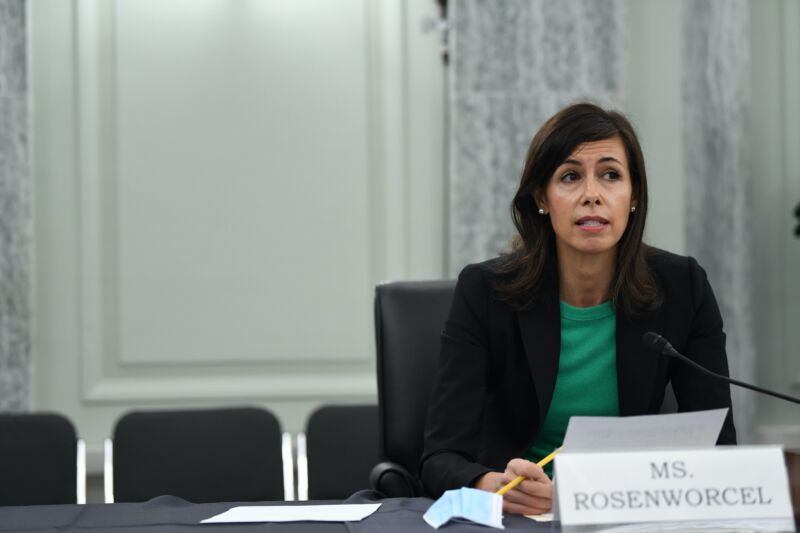
Enlarge/ Jessica Rosenworcel answers a question during a Senate Commerce Committee oversight hearing to examine the Federal Communications Commission on June 24, 2020 in Washington, DC.
President Joe Biden today appointed Democrat Jessica Rosenworcel to be the acting chairwoman of the Federal Communications Commission. Rosenworcel became an FCC commissioner in 2012 and served in a Democratic majority during the Obama years and in a Democratic minority during the Trump years.
“I am honored to be designated as the Acting Chairwoman of the Federal Communications Commission by President Biden,” Rosenworcel said in a statement. “I thank the President for the opportunity to lead an agency with such a vital mission and talented staff. It is a privilege to serve the American people and work on their behalf to expand the reach of communications opportunity in the digital age.”
With ex-Chairman Ajit Pai having left the FCC yesterday, there is a 2-2 split between Democrats and Republicans. To form a 3-2 Democratic majority, Biden will have to nominate a new commissioner and secure confirmation from the Senate—which shouldn’t be too difficult now that Democrats control the chamber. Biden’s decision to promote Rosenworcel from commissioner to acting chairwoman does not require Senate approval.
Designating Rosenworcel as the acting chairwoman means that she may not be the chair throughout Biden’s four-year term. Biden could upgrade her role to chairwoman on a permanent basis, or he could give the chair role to whomever he picks as the fifth commissioner. Technically, Biden could also give the permanent chair role to the FCC’s other Democrat, Geoffrey Starks, but that seems unlikely.
FCC could bring back net neutrality
As a commissioner, Rosenworcel has supported net neutrality rules and common-carrier regulation of broadband providers, pushed for increases in the FCC’s broadband-speed standard, and prioritized broadband access for children from low-income families.
The FCC press release announcing the appointment today said that “Rosenworcel has worked to promote greater opportunity, accessibility, and affordability in our communications services in order to ensure that all Americans get a fair shot at 21st century success. From fighting to protect net neutrality to ensuring access to the Internet for students caught in the Homework Gap, she has been a consistent champion for connecting all. She is a leader in spectrum policy, developing new ways to support wireless services from Wi-Fi to video and the Internet of things.”
Four years ago, President Donald Trump promoted Pai to the chairman’s spot without any “acting” designation. The last acting chair was Democrat Mignon Clyburn, who held the role for six months in 2013 before the Senate confirmation of Obama nominee Tom Wheeler. Wheeler, Clyburn, and Rosenworcel formed the Democratic majority that enacted the net neutrality rules that were later repealed by Pai’s Republican majority.
Even with a 2-2 deadlock, Rosenworcel can take some actions that don’t require a full commission vote, as we’ve previously written. For example, she could change the FCC’s positions in ongoing lawsuits, such as the one the Trump administration filed to block California’s state net neutrality law. Reinstating FCC net neutrality rules and common-carrier regulation of ISPs will require a majority.
Consumer-advocacy group Free Press applauded Biden’s pick of Rosenworcel, saying:
As a commissioner, Rosenworcel has challenged the Trump FCC’s worst actions and impulses. Now she must rebuild after the previous regime tried to demolish so much of the agency’s most important work. Rosenworcel’s long record of public service and deep knowledge of the issues before the FCC make her uniquely suited to fixing what has been broken at the agency over the past four years. We hope she will use the power of the office to push immediately for long-overdue changes that can improve people’s lives, create opportunities for new and diverse voices, and make the FCC an agency that’s committed to public needs rather than corporate greed.
Biden today also promoted Federal Trade Commission member Rebecca Kelly Slaughter to the FTC’s acting chair role. An FTC announcement said that Slaughter has “been particularly outspoken about combatting systemic racism, growing threats to competition, and the broad abuse of consumers’ data.” Free Press said that Slaughter has “been persistently clear-headed on combating corporate malfeasance and argued for real remedies that these same companies can’t shrug off as the cost of doing business.” The announcement added that she is likely to “chart a new path forward for the agency and use its powers to address pressing civil-rights harms and systemic racial inequalities in privacy, antitrust enforcement and in our economy writ large.”
https://arstechnica.com/?p=1736631
Treasury nominee Yellen is looking to curtail use of cryptocurrency
Enlarge/ Janet Yellen, Joe Biden’s nominee to be Secretary of the Treasury, at a December press conference.
Cryptocurrencies could come under renewed regulatory scrutiny over the next four years if Janet Yellen, Joe Biden’s pick to lead the Treasury Department, gets her way. During Yellen’s Tuesday confirmation hearing before the Senate Finance Committee, Sen. Maggie Hassan (D-N.H.) asked Yellen about the use of cryptocurrency by terrorists and other criminals.
“Cryptocurrencies are a particular concern,” Yellen responded. “I think many are used—at least in a transactions sense—mainly for illicit financing.”
She said she wanted to “examine ways in which we can curtail their use and make sure that [money laundering] doesn’t occur through those channels.”
Blockchain-based financial networks are attractive to criminals because they do not require users to identify themselves—as the law requires most conventional financial networks to do. Because no individual or organization controls these networks, there’s no easy way for governments to force them to comply with money-laundering laws.
So instead of trying to force the networks themselves to comply, regulators in the US—and many other jurisdictions—have focused on regulating bitcoin exchanges that help users trade between dollars and cryptocurrencies. Once a bitcoin exchange identifies who initially received a particular bitcoin payment, law enforcement can often trace subsequent payments through a blockchain network’s open payment ledger.
FinCEN
In December, Trump’s outgoing team at the Financial Crimes Enforcement Network—a unit of the Treasury Department focused on money laundering—proposed a new set of rules to tighten the screws on cryptocurrency-based money laundering.
Under the new rules, cryptocurrency-based exchanges would need to file transaction reports with FinCEN any time a customer made a cryptocurrency transaction worth more than $10,000. This would mirror existing rules requiring conventional banks to report when customers make cash withdrawals or deposits worth more than $10,000.
Even more controversial in the cryptocurrency world, FinCEN wants to impose new record-keeping requirements for transactions involving users who manage their own private keys—dubbed “unhosted wallets” by FinCEN. Under FinCEN’s proposal, if a cryptocurrency exchange’s customer sends more than $3,000 to an unhosted wallet, the exchange would be required to keep a record of the transaction, including the identity of the customer who initiated the payment.
These new rules didn’t take effect before Trump left office, so the incoming Biden team will need to decide what to do with them. The Biden administration could sign off on the existing rules, rewrite them, or scrap them altogether. Yellen’s Tuesday comments suggest that she is unlikely to scrap the rules. If anything, the Treasury Department is likely to consider additional regulations of the blockchain economy over the next four years.
https://arstechnica.com/?p=1736413
Amazon offers Biden help to speed up vaccine distribution
Enlarge/ An Amazon warehouse on a sunny day in Germany on April 2, 2020.
Amazon is one of the country’s largest businesses—and despite its faults and flaws, the company overall excels at logistics and distribution at scale. Therefore, Amazon suggests, the brand-new Biden administration should give the company a call to help ramp up COVID-19 distribution nationwide.
“Amazon stands ready to assist you in reaching your goal of vaccinating 100 million Americans in the first 100 days of your administration,” Dave Clark, the head of Amazon’s consumer business, wrote in a letter (PDF) to President Joe Biden Wednesday.
Amazon’s more than 800,000 employees should be in the vaccine queue as soon as possible, Clark noted, as individuals working in Amazon warehouses, AWS data centers, and Whole Foods stores are essential workers who cannot work from home. The company has inked a deal with a third-party health care firm to administer vaccines on-site at Amazon-owned facilities, Clark added—if they could just get vaccines to administer.
“We are prepared to move quickly once vaccines are available,” Clark wrote. “Additionally, we are prepared to leverage our operations, information technology, and communications capabilities and expertise to assist your administration’s vaccination efforts. Our scale allows us to make a meaningful impact immediately in the fight against COVID-19, and we stand ready to assist you in this effort.”
“A dismal failure”
There are two COVID-19 vaccines currently approved for use in the United States: one from Pfizer/BioNTech and one from Moderna. Federal regulators granted permission for both to be distributed and used in mid-December, more than a month ago, but the rollout has been rocky, to say the least.
A week after the Pfizer vaccine became available, state leaders complained that they were not receiving the doses they had been promised by the federal government. The Trump administration blamed manufacturers, but Pfizer issued a statement at the time saying it had “millions” of doses sitting in a warehouse ready to go but had not received any instructions from the federal government on where to ship them.
Before the end of December, the Trump administration had signed a deal with Pfizer for an additional 100 million doses of the vaccine, bringing the total number of doses the US had on order, across both manufacturers, to about 400 million. Getting those doses to materialize, however, remains challenging, and last week The Washington Post reported that the vaccine stockpile, meant to guarantee a reserve of second doses, had already been bled dry.
“The vaccine rollout in the United States has been a dismal failure thus far,” President Joe Biden said in a speech five days before he was sworn in. He promised to do everything in his power to accelerate vaccine distribution during his administration, with the stated goal of reaching 100 million doses administered in the first 100 days of his term.
“The supply is not where it needs to be,” Biden acknowledged in his remarks at the time, but his policy suggestions should mean that “as vaccines become available, they’ll reach more people that need them.”