Vote by mail doesn’t really change much, election wise
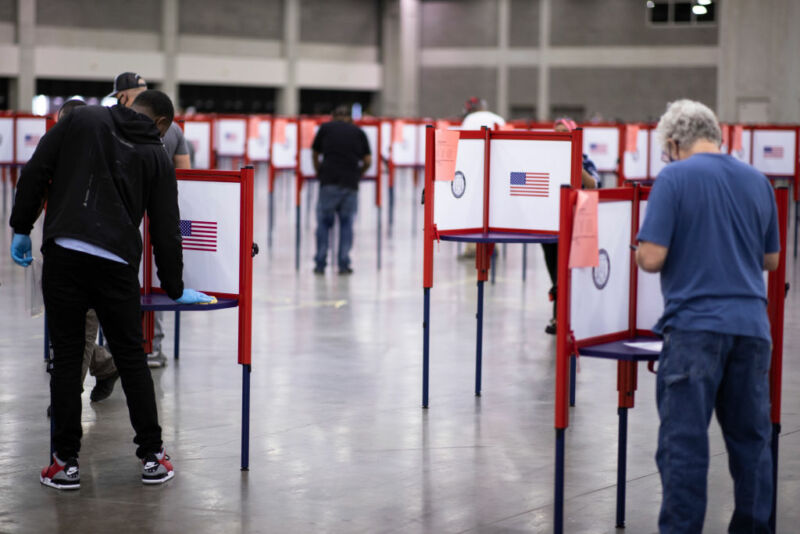
Image of widely spaced voting booths.
Enlarge / Socially distanced voting may not be needed if vote by mail is adopted.

With an uncontrolled pandemic raging, lots of states have been considering shifting to a vote-by-mail system. That’s turned out to be politically controversial, as President Trump has lodged evidence-free claims that it will lead to massive fraud or provide some other unspecified advantage to Democrats. Meanwhile, the advocates of vote by mail sometimes present it as the solution to the generally low participation of US citizens in elections. Vote by mail, they contend, will boost turnout significantly.

Two researchers decided this was something they could answer. Michael Barber of BYU and John Holbein of the University of Virginia took advantage of states where vote by mail was rolled out on a county-by-county basis. Their results suggest that vote by mail doesn’t provide either party with an advantage, but it also hasn’t done much to boost participation.

A tale of two states

The work relies on voter records and census data from two states that have vote by mail, but didn’t roll it out uniformly across the state. Instead, Utah and Washington both had different counties adopt the system at different times, providing a shifting set of experimental and control conditions. The two states nicely balance each other, as they can be viewed as something akin to mirror images. Eastern Washington is largely rural and conservative, but state politics are dominated by the urbanized coastal region. In Utah, while the Salt Lake City area is somewhat liberal, conservative politics dominate the state.

The challenge for the work is that each election has unique dynamics, so you’d expect a certain background of change going on in addition to the roll out of vote by mail. To handle this, Barber and Holbein perform what’s called a difference-in-difference analysis. This form of analysis tracks the changes in each county across elections, and then it compares those differences with the differences in other counties. Ideally, this will largely account for the inter-election differences, leaving the only thing to stand out being the differences caused as individual counties made the switch to mail in voting.

There are, however, multiple ways to implement difference-by-difference analysis, and the researchers tried a number of distinct mathematical models on their data. They also broke things down at the county level by using individual voting records and census data.

When it comes to turnout, the effects of vote by mail are small, but positive. Depending on the model used, voter turnout increases by anywhere from 1.8 to 2.9 percentage points, an effect that’s statistically significant.

A tale of two parties

But there was no indication that either party benefits from this increased turnout. Here, you can view the authors’ approach as the opposite of p hacking: they tried a variety of models and failed to come up with a statistically significant effect in any of them, giving them confidence in the negative result. While the average of the models is a boost in Democratic voter share by 0.7 percentage points, the confidence intervals extend to negative numbers—meaning it could just as easily boost Republican share.

“To us, it seems possible, perhaps even likely,” Barber and Holbein suggested, “that VBM is pulling in individuals who are on the fence about voting, of which there are plenty of individuals in both political parties.”

There are definitely nits to be picked with this study. While Utah and Washington may be great for balancing liberal/conservative issues, they’re definitely not representative of US demographics as a whole. And it’s possible that there are some subtle demographic differences linked to each county’s adoption of vote by mail in these states. But we’re unlikely to do much better than this analysis, and we certainly won’t before critical decisions need to be made about this year’s election. So, as states debate what to do, they should do so with the knowledge that the best available evidence suggests that vote by mail does not provide a partisan advantage.

Science Advances, 2020. DOI: 10.1126/sciadv.abc7685  (About DOIs).

https://arstechnica.com/?p=1701862


Bankrupt OneWeb gets FCC approval for another 1,280 broadband satellites

Illustration of a OneWeb satellite orbiting the Earth.
Enlarge / Illustration of a OneWeb satellite.

Amid a bankruptcy and a pending sale, OneWeb has secured US approval to offer broadband service from 2,000 satellites.

OneWeb already had Federal Communications Commission approval for a 720-satellite constellation that was green-lit in June 2017. In an order released yesterday, the FCC gave OneWeb approval for another 1,280 satellites.

The first 720 satellites, of which OneWeb has launched 74, are for low Earth orbital altitudes of 1,200km. The additional 1,280 satellites were approved for medium Earth orbits of 8,500km. Both are much lower than the 35,000km geostationary orbits used by traditional satellite-broadband networks, which should result in lower latency and a better experience for Internet users.

OneWeb filed another application in May 2020 to launch a whopping 47,844 satellites at an altitude of 1,200km, but it’s not clear how long it would take to get FCC approval. OneWeb’s application for 1,280 satellites had been pending for more than three years before the FCC approved it this week. In that intervening time, the FCC adopted several rule changes related to satellite broadband, including an April 2019 order with new licensing rules for one of the spectrum bands that OneWeb eventually got approval to use.

OneWeb, which is based in London, also needs approval from UK regulators.

New spectrum, more capacity

The newly approved 1,280 satellites will use V-Band spectrum (37.5-43.5GHz, 47.2-50.2 GHz, and 50.4-51.4GHz). The FCC decision also gave OneWeb permission to use those frequencies with the previously approved 720 satellites. Originally, the 720 satellites were authorized to use only the Ku and Ka spectrum bands.

“We are pleased to hear the FCC granted our V-Band application. The V-band is critical for next generation satellite broadband services,” OneWeb told Ars in a statement today. “OneWeb looks forward to the future growth opportunities this approval will enable as we commercialize our spectrum and execute on our mission to bring low-latency connectivity to communities, governments, businesses, and people in the US and around the world.”

The FCC approval is contingent on OneWeb complying with power limits and spectrum-sharing rules, preventing interference with other networks, following procedures to minimize orbital debris, and other conditions. Under FCC rules, OneWeb has six years to launch 50 percent of licensed satellites and nine years to launch all of them.

The FCC said granting OneWeb’s application is in the public interest, and that the “additional capacity would enhance OneWeb’s ability to offer its proposed broadband services in the United States.”

Bankruptcy and sale

OneWeb filed for bankruptcy and laid off most of its staff in late March. On July 3, OneWeb agreed to sell the business to a consortium including the UK government and Bharti Global Limited for $1 billion.

The sale needs approval from regulators and the US Bankruptcy Court; OneWeb said it expects to complete the sale in Q4 2020. Bankruptcy proceedings are ongoing, and OneWeb told Ars that it “continues to target Q4 for exit from Chapter 11.”

OneWeb will have to compete against SpaceX, which has already launched over 600 satellites and started beta tests with Internet users. SpaceX has FCC permission to launch nearly 12,000 satellites and has applied for authorization to launch another 30,000.

Like OneWeb, SpaceX is using V-Band spectrum. SpaceX argued in filings that OneWeb should have to “detail how it intends to deploy in both the Ku/Ka and V-bands, whether it will have to replace an initial wave of Ku/Ka-band satellites with a new generation of V-band equipped satellites, and if so, how it intends to manage the significant coordination, collision avoidance, and disposal management challenges that such a rapid turn-over would require,” the FCC said in a summary of SpaceX’s concerns. The FCC rejected SpaceX’s request, explaining that “the information provided by OneWeb is sufficient and consistent with what has been received from other applicants” and that the extra information SpaceX requested “does not affect the interference analyses relied upon for this grant.”

In July, Amazon received FCC approval to launch 3,236 low Earth orbit satellites for its planned “Project Kuiper” broadband service.

https://arstechnica.com/?p=1701729


iOS 14 privacy settings will tank ad targeting business, Facebook warns

iOS 14 privacy settings will tank ad targeting business, Facebook warns

Facebook is warning developers that privacy changes in an upcoming iOS update will severely curtail its ability to track users’ activity across the entire Internet and app ecosystem and prevent the social media platform from serving targeted ads to users inside other, non-Facebook apps on iPhones.

The next version of Apple’s mobile operating system, iOS 14, is expected to hit an iPhone near you this fall. Along with its many new consumer-facing features, iOS 14 requires app developers to notify users if their app collects a unique device code, known as an IDFA (ID for Advertisers).

The IDFA is a randomly generated code that Apple assigns to a device. (Google assigns similar numbers to Android devices.) Apps can then use those codes to tie together user activity. For example, Facebook, a local shopping app, and a local weather app might all access that identifier. Facebook and other advertising businesses can then use that cross-app use data to place targeted ads for advertisers on other apps, which is what Facebook does with its Audience Network program.

The changes requiring users to opt in make the IDFA essentially useless, Facebook warned developers today. Facebook apps on iOS 14—which includes Facebook, WhatsApp, Instagram, Messenger, and a host of others—will no longer collect users’ IDFA.

“Despite our best efforts, [the changes] may render Audience Network so ineffective on iOS 14 that it may not make sense to offer it on iOS 14 in the future,” Facebook further explained in a blog post. “Our ability to deliver targeted ads on iOS 14 will be limited… as a result, some iOS 14 users may not see any ads from Audience Network, while others may still see ads from us, but they’ll be less relevant.”

Less advertising means less money, Facebook added, saying, “Because of advertisers’ reduced ability to accurately target and measure their campaigns, app developers and publishers should expect lower CPMs [i.e., views of their ads] on Audience Network and likely other ad networks on iOS.”

“These updates have a far-reaching impact on the developer ecosystem,” Facebook noted, which is likely to be true. Facebook also seemed to indicate displeasure that Apple acted without first consulting Facebook about its preferences, saying, “We believe that industry consultation is critical for changes to platform policies… We look forward to continuing to engage” with industry and trade groups “to get this right for people and small businesses.”

The stakes

The company is almost certainly correct that users will not opt in to having their identifier tracked when presented with the option, and that absolutely will harm Facebook’s Audience Network business. Regulators and privacy advocates, however, may disagree with Facebook over whether that’s a bad thing.

Facebook is almost constantly under fire for how it handles different aspects of user privacy and user data. Last year it settled with the Federal Trade Commission for a record $5 billion penalty over a collection of allegations relating to users’ privacy.

Facebook’s ability to track anyone’s online activity, anywhere, and tie it together across software and platforms has been a large part of its advertising strategy since 2013, when it acquired a product called Atlas from Microsoft for around $100 million.

As Facebook described it at the time, the acquisition provided an “opportunity” for “marketers and agencies” to get “a holistic view of campaign performance” across “different channels.” In short, acquiring and building out that toolset—which has long since been fully integrated into Facebook’s advertiser platform—was Facebook’s key to finding the holy grail of online advertising. The company could finally track its effectiveness everywhere.

Meanwhile, the relationship between Facebook and Apple also appears to be growing more tense. Facebook last week followed in Epic Games’ footsteps to take a public swipe at Apple over the 30 percent fee Apple takes of any digital purchase made through an iOS app.

https://arstechnica.com/?p=1701438


Feds avert Russian man’s $1 million plot to infect Nevada company’s network

Feds avert Russian man’s $1 million plot to infect Nevada company’s network

A Russian national has been criminally charged for allegedly offering $1 million to a person in return for them infecting their employer’s network with malware.

Federal prosecutors said that Egor Igorevich Kriuchkov, 27, met with the unnamed employee on multiple occasions to entice them to install malware that would exfiltrate data from the unidentified Nevada-based company. The group behind the attack allegedly would then demand $4 million in return for the information.

A criminal complaint unsealed on Tuesday said that the malware would be custom developed to propagate through the company’s network. For it to work, prosecutors alleged, the group said it needed the employee to provide information about the employer’s network authorizations and network procedures. Kriuchkov said the malware could be transmitted either by inserting a USB drive into a company computer or clicking on an email attachment containing malware, Tuesday’s criminal complaint said.

The defendant allegedly said the infecting computer would have to run continuously for six to eight hours for the malware to move fully through the network. To distract network personnel, a first stage of the malware would perform a denial of service attack while a second stage performed the data exfiltration.

“The purpose of the conspiracy was to recruit an employee of a company to surreptitiously transmit malware provided by the coconspirators into the company’s computer system, exfiltrate data from the company’s network, and threaten to disclose the data online unless the company paid the coconspirators’ ransom demand,” prosecutors wrote in the complaint.

Attempts to reach Kriuchkov’s attorney weren’t immediately successful. The defendant was arrested over the weekend and made his initial court appearance on Tuesday. It wasn’t immediately known if he entered a plea. A magistrate judge ordered that Kriuchkov be detained.

The allegations paint the picture of a ransomware operation, which encrypts all of a company’s data and demands a hefty payment in return for the decryption key. Often, it’s less expensive for the company to pay the fee than to undergo outages that last days or weeks while administrators rebuild networks.

To diversify revenue streams, ransomware operators more recently have begun selling stolen data to the general public or requiring an additional payment from victims in return for a pinky swear not to make the data public.

The complaint, however, makes no mention of ransomware.

https://arstechnica.com/?p=1701540


FDA’s promotion of post-COVID plasma treatment was as bad as it appeared

Image of a man speaking from behind a podium.
Enlarge / FDA Commissioner Stephen Hahn, speaking at the press conference in which he badly mangled statistics.

After several days of rumors with ever-growing hype, the Trump administration announced on Sunday that the Food and Drug Administration was granting an Emergency Use Authorization (EUA) for a COVID-19 treatment. The move was controversial from the start, with reports indicating that the EUA was opposed by a number of health experts, including National Institutes of Health Director Francis Collins and National Institute of Allergy and Infectious Diseases Director Anthony Fauci. The press conference didn’t settle matters, with a growing chorus of scientists saying that the data presented in support of the EUA had been misrepresented.

On Monday night, FDA Commissioner Stephen Hahn acknowledged that he had made a significant error in presenting the benefits of the treatment, and he followed that statement with an apology on Tuesday. But Hahn pushed back against indications that the approval of the treatment on the eve of the Republican National Convention was motivated by political pressure.

Wrong kind of risk

The treatment at issue involves taking the antibody-containing plasma from those who have recovered from a SARS-CoV-2 infection (convalescent plasma) and giving it to those currently suffering from COVID-19 symptoms. At Sunday’s press conference, the principle justification for allowing this treatment under an EUA was a 35 percent drop in mortality for those receiving plasma in the first three days of treatment—specifically, Hahn said 35 of 100 people “would have been saved” by this treatment.

There were a number of obvious problems with this statement, which was supposedly based on a draft paper from a study of people who received this convalescent plasma treatment. The most obvious issue is that the paper doesn’t have a control group; everyone received convalescent plasma, but there were differences in how quickly the treatment was started. With no controls, it’s impossible to make any statements about how many people would have died without treatment.

While it was possible to find some numbers mentioned in the paper that could be interpreted as producing a 35 percent difference between different types of treatments, things got more complicated as the press conference went on and those present added additional caveats to the number: it only applied to those under the age of 80 who did not require a ventilator, and it required the identification of plasma with high levels of antibodies specific to the virus. As these numbers weren’t part of the analysis done by the authors of the draft, it was clear that the 35 percent figure had been generated by working with the raw data discussed in the study. Thus, it was impossible to tell how it was derived.

With Hahn’s acknowledgement, things are now a bit more clear. Hahn was talking about a figure called the relative risk, which—as its name implies—compares the risks faced by two different groups. He then discussed that risk as if it were absolute risk to produce his 35 of 100 figure—a very basic statistical error, and one science journalists are often cautioned against making.

To see why this is a problem, imagine a case where only three out of 100 people are affected, and an experimental condition changes that number to one out of 100. The relative risk is different by a factor of three—a 300 percent difference. But the absolute risk is the minor change of going from three percent to one percent.

The actual difference in absolute risk seen in the study was 4.8 percent, not 35 percent. That means an additional 4.8 lives per 100 COVID-19 patients might be saved with the treatment.

The politics of it all

Hahn committed a rookie mistake that made a treatment sound much better than it actually was, and that mistake added to the perception that politics was a key driver of the EUA. At the same time that he admitted his error, Hahn pushed back against the suspicion of political interference forcefully. He stated that the decision to allow the EUA had been made by a career FDA scientist rather than a political appointee.

That statement is actually completely consistent with the earlier reporting, which had suggested that the FDA was ready to issue the EUA, but health authorities outside the agency had pushed it to delay the decision until a randomized clinical trial could be completed. According to the New York Times, those urging caution included Francis Collins, Anthony Fauci, and Clifford Lane of the National Institute of Allergy and Infectious Diseases. According to a report last week, their opposition had put the EUA on hold.

But Trump seemed to blame unspecified delays on the FDA, accusing its staff of sabotaging his reelection, shortly before the EUA was approved. If there was political pressure involved, it wouldn’t have involved the original decision to approve within the FDA; instead, it would have overcome the opposition to the move from outside the agency.

Trump’s finger-pointing at the FDA, according to one source, was simply the product of his confusion over the precise roles of the FDA and the NIH.

In any case, the limited evidence we currently have is enough to meet the legal threshold for an EUA. But this error, the timing of the EUA, and its presentation in a press conference laden with praise of President Trump has hurt the credibility of the FDA. And, with several vaccines in the later stages of testing right now, it’s not an ideal time for that damage.

https://arstechnica.com/?p=1701250


Unredacted suit shows Google’s own engineers confused by privacy settings

Unredacted suit shows Google’s own engineers confused by privacy settings
Sean Gallup | Getty Images

Newly unsealed and partially unredacted documents from a consumer fraud suit the state of Arizona filed against Google show that company employees knew and discussed among themselves that the company’s location privacy settings were confusing and potentially misleading.

In 2018, the Associated Press reported that Maps and some other Google services (on both iPhone and Android) were storing users’ location data even when users had explicitly turned Location History off.

“There are a number of different ways that Google may use location to improve people’s experience, including: Location History, Web and App Activity, and through device-level Location Services,” a Google spokesperson told the AP at the time. “We provide clear descriptions of these tools, and robust controls so people can turn them on or off, and delete their histories at any time.”

Arizona Attorney General Mark Brnovich’s office launched its own investigation following the AP report, and in May 2020 the state sued Google, alleging that the company violated the Arizona Consumer Fraud Act.

The initial lawsuit was heavily redacted, as the Arizona Mirror reports. But following an August 3 petition from trade groups Digital Content Next and the News Media Alliance, the judge has ordered several documents related to the case to be unsealed, and a new, less-redacted version of the suit is now available.

The new version of the suit (PDF) includes a number of employee emails and chat logs where Google employees agreed with the AP story, and these employees highlighted their own frustrations with the settings. Among the highlights:

  • “The current UI feels like it is designed to make things possible, yet difficult enough that people won’t figure it out.”
  • “Some people (including even Googlers) don’t know that there is a global switch and a per-device switch.”
  • “Indeed we aren’t very good at explaining this to users. Add me to the list of Googlers who didn’t understand how this worked and was surprised when I read the article … we shipped a UI that confuses users.”
  • “I agree with the article. Location off should mean location off, not except for this case or that case.”

“Speaking as a user, WTF?” another employee said, in additional documentation obtained by the Arizona Mirror. “More specifically I **thought** I had location tracking turned off on my phone. So our messaging around this is enough to confuse a privacy focused (Google software engineer). That’s not good.”

“In the case of location information, we’ve heard feedback, and have worked hard to improve our privacy controls,” a Google spokesman told the Mirror. “In fact, even these cherry picked published extracts state clearly that the team’s goal was to ‘Reduce confusion around Location History Settings.'”

The “oh shit meeting”

The suit also provides a fascinating insight into how Google reacts when a negative news item about the company goes big. “The day the AP story was published,” the suit says, “Google turned into crisis mode and held a self-styled ‘Oh Shit’ meeting in reaction to the story.”

The company’s communications team published daily reports (PDF) after the AP’s story went live, tracking where and when stories about the AP’s bombshell were being published and following what social media accounts with significant influence were saying about the story.

Day-one coverage of the story was “100% negative,” the report found, with 93 percent of stories identified covering “the lack of user consent / creepy factor,” 51 percent mentioning “misleading controls,” and 32 percent of stories providing some kind of how-to information for customers to opt out or manage their data, the report concluded.

“We’re seeing a growing narrative driven by third party commentary (policy influencers) that alludes to FTC / congressional action,” the report said, citing stories by CNET, Vanity Fair, and Wired. “This will likely become a bigger focus as the week goes on.”

The day two, day three, and day four reports covered the slow decline of the headline in the natural churn of the news cycle. By the end of day two, “this story was no longer on the list of top 10 trending stories across tech,” and Google fielded fewer than 10 additional press inquiries, as opposed to the 40+ it received on day one.

https://arstechnica.com/?p=1701152


Florida order requiring all schools to reopen was illegal, judge rules

A school classroom filled with empty desks.
Getty Images | Mayu Tanaka | EyeEm

Florida’s state government cannot force schools to reopen this month, a judge ruled yesterday. The state’s order to reopen K-12 schools disregarded safety risks posed by COVID-19 and gave schools no meaningful alternative, according to the ruling issued by Judge Charles Dodson of the Second Judicial Circuit in Leon County.

On July 6, Florida Department of Education Commissioner Richard Corcoran issued an emergency order stating, “Upon reopening in August, all school boards and charter school governing boards must open brick and mortar schools at least five days per week for all students.” Schools that don’t meet this requirement could lose state funding. Corcoran, Governor Ron DeSantis, and other state officials were then sued by the Florida Education Association, a statewide teachers’ union; the NAACP; and several individual teachers and parents.

After summarizing the health risks of reopening schools during the pandemic, the judge wrote that the state’s order to reopen schools “takes none of that into consideration. It fails to mention consideration of community transmission rates, varying ages of students, or proper precautions. What has been clearly established is there is no easy decision and opening schools will most likely increase COVID‐19 cases in Florida. Thus, Plaintiffs have demonstrated a substantial likelihood of success in procuring a judgment declaring the Order is being applied arbitrarily across Florida.”

Dodson concluded that the state’s order violates the Florida state constitution “to the extent it arbitrarily disregards safety, denies local school boards decision making with respect to reopening brick and mortar schools, and conditions funding on an approved reopening plan with a start date in August.” Having found that the plaintiffs are likely to win at trial, the judge issued a temporary injunction that strikes down the controversial portions of the state’s school-reopening order.

“The districts have no meaningful alternative,” the ruling said. “If an individual school district chooses safety, that is, delaying the start of schools until it individually determines it is safe to do so for its county, it risks losing state funding, even though every student is being taught.”

Florida has so far recorded 600,000 COVID-19 cases and more than 10,000 deaths, the ruling said.

Governor appeals, claims suit is “frivolous”

The state may still be able to force schools to reopen this month unless another court order is issued. DeSantis, Corcoran, and the state Department of Education immediately appealed the ruling to Florida’s First District Court of Appeal and said in a court filing that the appeal “triggers an automatic stay pending review.”

Despite Judge Dodson finding that the state is likely to lose the case on the merits, Corcoran issued a statement saying, “We are 100 percent confident we will win this lawsuit.”

“If you are one of the 1.6 million students who have chosen to return to the classroom, a parent, or a classroom teacher that wanted to educate their student in person, we strongly encourage you to call the Florida Education Association and tell them to drop this frivolous lawsuit,” Corcoran said.

Florida Education Association President Fedrick Ingram said in a press conference held via Zoom, “shame on our governor and our commissioner of education who recklessly told us we had to have a brick and mortar option no matter what,” according to the Orlando Sentinel.

“Teachers want to be back in school,” Ingram also said. “We don’t want to risk our own lives.”

Local experts’ opinions disregarded

“Schools should reopen when the local decision-makers determine upon advice of medical experts, that it is safe to do so,” Dodson wrote in yesterday’s ruling, adding that the Florida constitution “requires safe schools.” The state “cannot constitutionally directly force schools statewide to reopen without regard to safety during a global pandemic,” which means the state also cannot achieve the same goal “indirectly by threatening loss of funding through the Order,” Dodson wrote.

The July 6 order said that schools must open in August “subject to advice and orders of the Florida Department of Health [and] local departments of health.” But the language about “local departments of health” didn’t actually provide leeway to remain closed.

As Judge Dodson wrote, the “Hillsborough County School Board called a special board meeting on August 6, 2020 with a panel of seven doctors to assess whether it was safe to reopen schools based on the current levels of COVID-19 in the community.” Five of the seven doctors said it wasn’t safe to reopen, while “[o]ne of the doctors stated it was not safe that day but maybe it would be in a few weeks,” and the other doctor declined to give an opinion.

“Based on the medical information at that meeting, the Hillsborough County School Board voted to delay the start of in‐person learning by three weeks, from August 24, 2020 to September 14, 2020. Virtual learning would still begin on August 24, 2020,” Dodson wrote.

The state wouldn’t allow it, Dodson explained:

The next day, August 7, 2020, the Superintendent and Chair of the Hillsborough County School Board received a letter from Commissioner Corcoran stating their proposal was not consistent with the Order. If they chose not to revise their plan, they would not receive the financial flexibility otherwise available under the Order. After another proposal, to delay reopening until September 7, was also rejected, Hillsborough County voted to reopen brick and mortar schools August 31, 2020. They had no real choice. Defendants arbitrarily prioritized reopening schools statewide in August over safety and the advice at health experts; and all school districts complied in order to avoid a drastic loss of State funding.

“Extremely unsafe conditions”

Evidence presented in a court hearing “demonstrated that some teachers are being told they must go back into classrooms under extremely unsafe conditions,” without enough room between desks for social distancing and without “adequate personal protection equipment,” Dodson wrote.

Plaintiffs showed evidence that “teachers throughout the State are deciding whether to retire, resign, or put themselves and their families in harms’ way,” the ruling said. “One witness testified that because of his preexisting condition, his doctor advised he will likely die if he contracts COVID-19. If he is forced to return to school, he will be risking his life on a daily basis.”

The state’s expert witness, Stanford University medical professor and doctor Jay Bhattacharya, testified that it is safe enough to reopen Florida schools, Dodson wrote. But the same expert “admitted Stanford University will not be holding in-person classes in the fall. Classes there will be taught remotely because of the pandemic.”

Even the court hearing on the state’s school-reopening order was conducted remotely, via Zoom. “That is because it has been decided it is unsafe to hold in-person trials in the Leon County courthouse during this highly dangerous pandemic,” Dodson wrote. “That was a local decision based on local conditions. Because of COVID-19, jurors and witnesses are not allowed to come into our courtrooms, almost all of which are larger than classrooms in our schools.”

https://arstechnica.com/?p=1701162


TikTok sues Trump admin., says ban is unconstitutional and political

TikTok logo next to inverted US flag.
Enlarge / TikTok’s US operations may soon be part of every cool teen’s favorite code conglomerate, Microsoft.

TikTok and its parent company, ByteDance, filed suit today in federal court arguing that President Donald Trump’s efforts to ban the app or force a sale to a US firm are not grounded in facts but instead are part of an “anti-China political campaign.”

An executive order curtailing TikTok’s US operations “is not rooted in bona fide national security concerns,” TikTok argues in its complaint (PDF). “Independent national security and information security experts have criticized the political nature of this executive order, and expressed doubt as to whether its stated national security objective is genuine,” the company adds.

TikTok’s complaint seeks to prevent the president and the Department of Commerce from “impermissively banning” the app, alleging that the authority under which the order was enacted (the International Emergency Economic Powers Act, or IEEPA) was a “gross misappropriation” and “a pretext for furthering the President’s broader campaign of anti-China rhetoric in the run-up to the US election.”

The complaint goes on:

Past presidents have used this power responsibly to protect the country from genuine threats from abroad … Through this executive order, however, President Trump seeks to use IEEPA against TikTok Inc., a US company—headquartered in Los Angeles with hundreds of employees the United States—to destroy an online community where millions of Americans have come together to express themselves, share video content, and make connections with each other. The order imposes these restrictions despite express limitations in IEEPA barring executive actions from restricting personal communications or the transmission of informational materials.

The White House earlier this month officially declared the existence of TikTok—along with another Chinese app, WeChat—to be a national emergency, and issued an executive order prohibiting anyone from making “transactions” with it and effectively ending its ability to operate inside the United States. The order alleged that TikTok’s data collection practices, “threatens to allow the Chinese Communist Party access to Americans’ personal and proprietary information—potentially allowing China to track the locations of Federal employees and contractors, build dossiers of personal information for blackmail, and conduct corporate espionage.”

TikTok has vehemently and repeatedly denied the allegations, arguing that its US customer data is handled on servers based in the United States and Singapore and kept separate from the data collected by ByteDance’s other products in China.

The fight goes on

The idea that TikTok might present a threat to national security was first publicly floated in October, when Sen. Tom Cotton (R-Ark.) and Sen. Chuck Schumer (D-N.Y.) asked the Director of National Intelligence to launch a probe. Reports then surfaced in November that TikTok was indeed facing review by the Committee on Foreign Investment in the United States, or CFIUS, which evaluates transactions in which an international business acquires part or all of a US business for national security concerns.

TikTok’s competition also may have dropped a bug in the administration’s ear last fall, The Wall Street Journal reported late yesterday, as Facebook CEO Mark Zuckerberg reportedly pushed the administration toward investigating TikTok around that time.

Sources told the WSJ that at a dinner in October, Zuckerberg told Trump specifically that the rise of Chinese firms can harm American businesses. Zuckerberg also discussed TikTok in meetings last fall with several sitting senators, the WSJ reports.

The administration publicly floated the idea of banning TikTok and other China-based social media apps outright in early July. Secretary of State Mike Pompeo told Fox News in an interview that a ban was “something we’re looking at.” Pompeo in the interview framed a potential ban as being in line with the administration’s actions against other Chinese tech firms, such as Huawei and ZTE.

Trump on August 3 personally issued an ultimatum telling TikTok it had until September 15 to sell to a US buyer if it wanted to keep operating inside the United States. Microsoft at the time publicly confirmed it was considering a way to purchase TikTok’s US assets. Trump at the time said: “We set a date, I set a date, of around September 15th, at which point it’s going to be out of business in the United States. But if somebody, whether it’s Microsoft or somebody else, buys it, that’ll be interesting.” Since then, Oracle has also reportedly thrown its hat in the ring.

The administration’s formal move to ban TikTok came only three days later, seemingly launched as part of the administration’s “Clean Network,” initiative, a set of goals to keep Chinese firms far away from US consumers, networks, and technologies.

https://arstechnica.com/?p=1700942


Apple apologizes to WordPress, no longer requires free app to add purchases

Screenshot of App Store icon.

WordPress for iOS is a free app that connects to the company’s free open source content management system, which millions of sites around the Web use for some part of their structure. WordPress the company also sells domain names and an array of personal, business, and enterprise Web hosting packages. Apple, unfortunately, seems to have mixed the two up over the weekend and briefly forced WordPress to add in-app purchases that it otherwise wouldn’t have, so it could take a cut.

“Heads up on why @WordPressiOS updates have been absent… we were locked by App Store,” WordPress founder Matt Mullenweg explained in a series of Tweets on Friday. “To be able to ship updates and bug fixes again, we had to commit to support in-app purchases for .com plans. I know why this is problematic, open to suggestions.”

WordPress opted for the path of least resistance, as The Verge reported, and agreed to add paths inside their iOS app for users to purchase premium offerings including domain names. Because of the agreements developers make with Apple to have their apps approved for the App Store, 30 percent of any purchases made through the WordPress app after that functionality was added would have gone to Apple.

“I’m aware there are other apps with similar functionality to @WordPressiOS, and in the same market, that don’t offer in-app purchase,” Mullenweg added. “My guess is they will get similar feedback soon so I’d encourage them to start making [in-app purchase] plans.”

Over the weekend, however, Apple seemed to realize it had messed up and reversed its ruling. “We believe the issue with the WordPress app has been resolved,” Apple said in a statement. “Since the developer removed the display of their service payment options from the app, it is now a free stand-alone app and does not have to offer in-app purchases. We have informed the developer and apologize for any confusion that we have caused.”

The app, however, always was a free, stand-alone app. “I am very grateful that folks at Apple re-reviewed @WordPressiOS and have let us know we do not need to implement in-app purchases to be able to continue to update the app,” Mullenweg wrote in another series of Tweets. He added:

My understanding was the previous decision was final, and we had already made many of the arguments people suggested privately over the several weeks the app was locked. We will continue to be responsive and do our best to be within both the spirit and letter of the app store rules, including closing any webview loopholes that pop up. This also made me appreciate the freedom of the open and independent web. My life’s mission, and the purpose of WordPress, is to increase the freedom of the internet. I hope in addition to native apps people continue to create websites and web apps that provide accessibility, autonomy, and freedom to the widest audience. Future generations deserve it.

Getting jumpy

It seems Apple may be feeling a bit besieged over its App Store terms at the moment, as its 30-percent cut of purchases—and the fact that some very large firms are able to negotiate better terms—is the center of international attention.

Less than two weeks ago, Fortnite developer Epic Games deliberately flouted Apple’s in-app purchase rule to goad Apple into banning it from the platform. Immediately after Apple did so, Epic filed a civil antitrust suit accusing Apple of harming competitors through anti-competitive terms.

In the days since, the case has only escalated: Apple threatened removal not only of Epic’s games, but also of Unreal Engine, from both iOS and Mac, which led to Microsoft joining the legal fray on Epic’s side.

Competition regulators around the world have also been closely scrutinizing Apple’s App Store terms. The European Union opened a formal probe into Apple’s pricing strategies following a 2019 complaint from music streaming service Spotify. Messaging app Telegram also filed a complaint with the EU last month.

US regulators, too, have been probing Apple, alongside Google, Amazon, and Facebook, over potentially anticompetitive behavior. Although Apple maintains it applies its App Store policies evenly across all developers, documents made public during a congressional hearing in July revealed that some developers, including Amazon Prime Video, were able to negotiate significant discounts.

https://arstechnica.com/?p=1700845


China trade war could push iPhone contractor Foxconn to build in Mexico

China trade war could push iPhone contractor Foxconn to build in Mexico
Samuel Axon

For years, iPhones (or their boxes) have said that they were “designed by Apple in California. Assembled in China.” But thanks to an escalating trade war between the US and China, that might not be true in the coming years. Reuters reports that two of Apple’s biggest manufacturing contractors, Foxconn and Pegatron, are working to expand their facilities in Mexico with an eye toward eventually building iPhones there.

Foxconn’s plans aren’t final, Reuters reports. Apple hasn’t signed off on the idea and declined to comment to Reuters. But Foxconn is reportedly looking to make a final decision this year.

Foxconn already has a significant presence in Mexico. Five Foxconn factories in Mexico make televisions, servers, and other products. But building iPhones could represent a major expansion of Foxconn’s activities in the Latin American country.

This isn’t Foxconn’s only effort to diversify away from China. Last year, Foxconn announced plans to begin manufacturing iPhones in India, and the company is now manufacturing the iPhone SE there.

Sources told Reuters that Taiwan-based iPhone contractor Pegatron is also considering a shift to Mexico, but few details about its plans are known.

Mexico is an attractive place for companies to locate labor-intensive manufacturing. It’s close to the United States, while workers there tend to earn lower wages than in the US or Canada. The Trump administration signed an updated trade deal with Canada and Mexico earlier this year, reducing uncertainty about the US-Mexico trade relationship.

But the COVID-19 outbreak could hamper efforts to shift iPhone production from China to Mexico. China has nearly eradicated the virus domestically, while Mexico has had only limited success. Mexico has reported about 6,000 confirmed cases per day in recent weeks. That’s better than the US on a per-capita basis but much worse than China.

At the same time, the deteriorating relationship between the US and China, especially over high-tech products, gives companies like Foxconn strong reasons to diversify. Earlier this month, for example, Donald Trump announced that he would force TikTok and WeChat out of the US market.

https://arstechnica.com/?p=1700869