Zuckerberg wrote “Instagram can hurt us” days before acquisition
Enlarge/ Mark Zuckerberg speaks via videoconference during a House Judiciary Subcommittee hearing in Washington.
In a 2012 email six weeks before acquiring Instagram, Facebook CEO Mark Zuckerberg wrote that one of his motivations for the acquisition was to “neutralize a potential competitor.” The emails were revealed during today’s hearing before the House antitrust committee featuring four technology moguls: Tim Cook, Sundar Pichai, Jeff Bezos, and Zuckerberg. The emails were first reported by the Verge.
Facebook was one of the Internet’s biggest social networks in 2012, but its dominant position was not as secure then as it is today. There were a lot of rival social networks, and Zuckerberg worried his company would get caught flat-footed by the shift to smartphones.
Neutralizing a potential competitor?
On the evening of February 27, 2012, Zuckerberg emailed Facebook Chief Financial Officer David Ebersman about the possibility of acquiring “mobile app companies like Instagram and Path that are building networks that are competitive with our own.” He worried that “if they grow to a large scale they could be very disruptive to us.”
In a reply the next morning, Ebersman encouraged Zuckerberg to make sure he had a good reason for making an acquisition. He suggested three possible reasons to do a deal: “1) neutralize a potential competitor,” “2) acquire talent,” and “3) integrate their products with ours in order to improve our service.” Ebersman argued that the first reason was a “bad reason” because “someone else will spring up immediately in their place.”
Zuckerberg replied within 20 minutes. “It’s a combination of (1) and (3),” he wrote. Then he spelled out his thinking:
One thing that may make (1) more reasonable here is that there are network effects around social products and a finite number of different social mechanics to invent. Once someone wins at a specific mechanic, it’s difficult for others to supplant them without doing something different. It’s possible someone beats Instagram by building something that is better to the point that they get network migration, but this is harder as long as Instagram keeps running as a product. (3) is also a factor but in reality we already know these companies’ social dynamics and will integrate them over the next 12-24 months anyway.
Zuckerberg added that another way to look at the acquisition strategy is as a way of “buying time.” “Even if some new competitors springs up, buying Instagram, Path, Foursquare, etc. now will give us a year or more to integrate their dynamics before anyone can get to their scale again,” he argued. New products “won’t get as much traction” once Facebook has replicated their social mechanics, Zuckerberg predicted.
Evidently, Zuckerberg soon realized how bad this email could look if it eventually became public. Less than an hour later, he sent Ebersman another email.
“I didn’t mean to imply that we’d be buying them to prevent them from competing with us in any way,” Zuck wrote. “Buying them would give us the people and time to incorporate their innovations into our core products, which is how we’d do the integration rather than actually combining the products. I’m mostly excited about what the companies could do together if we worked to build what they’ve invented into more people’s experiences.”
“Instagram can hurt us”
In an April email, Zuckerberg wrote that “Instagram can hurt us meaningfully without becoming a huge business.”
Days later, Facebook bought Instagram in a deal worth $1 billion. In an email exchange the day of the acquisition, Zuckerberg and a Facebook engineer discussed the relative importance of Instagram and Google+, Google’s social network.
“I remember your internal post about how Instagram was our threat and not Google+,” Zuckerberg wrote. “You were basically right. One thing about startups though is you can often acquire them.”
The deal sailed through a review from the Federal Trade Commission. Instagram was a small company with just 13 employees; it probably wasn’t obvious to regulators that it would grow to become one of the Internet’s largest social networks.
Now the deal is getting more scrutiny. House Democrats highlighted the emails during Wednesday’s hearing as they grilled Zuckerberg about the transaction.
“I’ve been clear that Instagram was a competitor in the space of mobile photo sharing,” Zuckerberg said during the hearing. “There were a lot of others at the time. They competed with apps like VSCO Cam and PicPlz and companies like Path. It was a subset of the overall space of connecting that we exist in.”
https://arstechnica.com/?p=1695083
Charter’s donations to charities and lawmakers may help it impose data caps
Enlarge/ A Charter Spectrum van in West Lake Hills, Texas, in April 2019.
Nonprofits and local politicians are lining up to support a Charter Communications petition that would let the ISP impose data caps on broadband users and seek interconnection payments from large online-video providers.
Charter filed the petition with the Federal Communications Commission last month, asking the FCC to eliminate merger conditions applied to its 2016 purchase of Time Warner Cable two years early. If Charter’s petition is granted, the company would be able to impose data caps on its Spectrum broadband service and charge network-interconnection fees to video providers after May 18, 2021, instead of in May 2023 as scheduled.
With the FCC seeking public comment, the docket is overwhelmingly filled with consumers urging the commission to oppose Charter’s request for permission to limit consumers’ data usage and charge data-overage fees. “In this age of Internet communication, data caps are an unscrupulous way to gouge money from clients, many of whom do not have alternative Internet sources. This is unacceptable,” one person wrote in a sentiment echoed by hundreds of other Internet users who wrote to the FCC in the past few weeks.
But alongside the angry users of Spectrum Internet service are a number of politicians and charities urging the FCC to grant the petition. Charter has donated to these nonprofits and politicians, and it has apparently made a big outreach effort to get their public support for the petition. Many of the letters to the FCC echo Charter’s argument that it shouldn’t be treated differently from other Internet providers that don’t face such conditions—even though Charter willingly agreed to them in order to secure approval for a merger that made it the second-largest ISP in the United States after Comcast. The letters from nonprofits and politicians ignore the negative impact data caps would have on broadband customers.
Charter told Ars last month that it doesn’t “currently” plan to impose data caps or change its interconnection policy. Instead, it merely seeks “a level playing field so that we can continue to grow and provide superior service to our customers across the country.” But if Charter had zero intention of imposing data caps or changing its interconnection policies, there would be no reason to spearhead a big lobbying effort involving charities and politicians.
Charter’s petition likely has a good chance at the Republican-majority FCC. FCC Chairman Ajit Pai voted against the conditions when they were imposed in 2016 under then-FCC Chairman Tom Wheeler, an Obama nominee. The FCC conditions were designed to prevent Charter from hindering online video providers that compete against the company’s cable TV service. Any FCC order that lifts the merger conditions two years early would likely cite arguments from the various filings supporting Charter’s case. May 18, 2021 is the earliest date on which the conditions can be eliminated under the original terms of the merger approval.
Nonprofits are ready for data caps
FCC filings submitted by charities and community groups discuss the donations Charter gave them. The Boys & Girls Club of Harlem told the FCC it received a $35,000 grant from Charter this year for a learning lab and that “we are happy to support Charter as they seek to sunset two merger conditions—one on data caps and usage-based pricing and the other on interconnection.”
The Boys & Girls Club of the West Valley in Canoga Park, California, told the FCC that Charter gave 10 Samsung Galaxy tablets to the club and that “it only seems fair to level the playing field for Charter so they can have the same opportunities to grow as companies similar to them.” Other Boys & Girls Club chapters supporting Charter after getting donations include ones in Fremont County, Colorado; Schenectady, New York (which received a $75,000 donation); and Niagara Falls in New York.
A US Veterans Corps filing in support of Charter’s petition notes that the ISP “is a major supporter of our Operation Coming Home initiative, which provides new homes to troops who have been injured or families of fallen in combat operations.” The veterans group said it is “happy to endorse their effort at the Federal Communications Commission (FCC) to remove two conditions from the merger.”
The Marshfield Clinic Health System in Wisconsin told the FCC of Charter’s involvement in fundraising efforts and its provision of Internet service to clinics.
“Most of our facilities rely on a single provider for Internet and telecommunications needs: Charter Communications. That is why I am writing today to support Charter’s recent petition to have its merger conditions sunset,” the health system’s Chief External Affairs Officer Ryan Natzke wrote. “I believe Charter should receive the same treatment as other providers, and I support a fair foundation for them in the marketplace,” Natzke wrote later in the same letter.
From New York to California
The YWCA of Syracuse and Onondaga County in New York told the FCC that it got $20,000 from Charter “to help with our computer lab and summer program” and that “we support their request to the FCC to sunset their merger conditions.”
Charter’s petition got support from the Albany, New York, branch of the NAACP, which told the FCC that it received a $10,000 grant from Charter to support a youth mentoring program. The group noted that the COVID-19 pandemic has been especially difficult on children who lack home-Internet access, adding that eliminating the merger conditions “will allow [Charter] to continue and enhance their efforts to bridge the digital divide in minority and low-income communities.”
Regarding its connection to local charities, Charter told Ars in a statement, “Our business is inherently local and we are committed to improving the communities we serve and impacting lives where our customers and employees live and work. These efforts include long-term relationships with local leaders and philanthropies, programs focused on engagement, philanthropic and in-kind support, and employee volunteerism. We are proud to support these important efforts and all they do to enhance the lives of millions each year.”
Politicians make Charter’s case
Now let’s take a look at state lawmakers who support Charter. Bryan Hughes, a Republican state senator in Texas, told the FCC that “Charter is a good corporate citizen” and “need[s] to be on a level playing field with their fellow providers” in order to continue “invest[ing] in our communities.” Charter is one of Hughes’ top donors, having given $12,500 in the current election cycle, according to campaign-finance tracker Vote Smart.
State Sen. Richard Funke, a Republican in New York who received $11,000 from Charter, told the FCC that there has been “no effort by Charter to stifle online video distributors” and that “I am confident that the previous conditions laid out by the FCC can officially be rolled back in May of 2021.”
State Sen. Dan Quick, a Nebraska Democrat who got $3,500 from Charter, told the FCC that he “fully support[s] a level playing field for Charter so it can operate the same as all other providers and continue to deliver critical services to American businesses and families.”
State Rep. Dan Zwonitzer, a Republican in Wyoming, urged the FCC to eliminate the merger conditions “so good corporate citizens like Charter can continue investing in communities like mine.” Zwonitzer received $300 from Charter.
The National Black Caucus of State Legislators, which represents more than 700 legislators, said it “is pleased to support the sunset of the two remaining merger conditions.” Charter has supported Black communities with diverse hiring and programming as well as “a $10 million investment to support Black and other minority-owned small businesses in underserved communities,” the letter to the FCC said. The letter was written by Caucus President Gilda Cobb-Hunter, a Democratic state representative in South Carolina. All eight members of the group’s executive committee are Democrats.
Other state lawmakers who received donations from Charter and supported the petition include State Sen. Affie Ellis, a Wyoming Republican who received $200 from Charter; State Rep. William Sutton, a Kansas Republican who received $500 from Charter; and State Sen. Dee Brown, a Republican in Montana who received $170 from Charter. Brown told the FCC that the merger conditions “are no longer necessary” because “there is sufficient competition” between cable TV and online video providers.
Charter has opponents, including Mass. AG
Charter customers are not the only ones opposing the petition to eliminate merger conditions. The petition received opposition from the Writers Guild of America, West, which said that “Charter has a history of bad-faith behavior regarding merger conditions” and pointed to Charter’s failure to comply with broadband-deployment requirements imposed by New York State. In that case, Charter agreed to pay $12 million toward new broadband deployments in a deal that gave the ISP an extra year to comply with the original requirements.
Massachusetts Attorney General Maura Healey told the FCC that granting Charter’s request would go against the public interest because of the pandemic, increasing use of broadband, and “Charter’s position as the sole fixed-broadband provider in almost all of its Massachusetts territories.”
“It would be somewhat perverse if less than a year from now—when Massachusetts residents may very well still be relying on broadband to maintain all aspects of their lives—Charter imposes data caps or pricing models on captive customers that dramatically increase the price of broadband for the average household,” Healey wrote.
Advocacy groups Public Knowledge and the Sports Fans Coalition opposed Charter’s petition as well. The FCC found during the 2016 merger review that Charter had “incentive and ability to restrict its customers’ ability to access competing video services,” and Charter has provided no evidence that this has changed, the groups said. “Charter has the incentive and ability to restrict its customers from accessing the online video services of their choice, charging them more if they do so through the discriminatory application of data caps, and through causing OVDs [online video distributors] to raise their rates to consumers by charging them access fees,” the groups said.
The first round of public comments on Charter’s petition expired on July 22, and reply comments are due by August 6. Comments can be filed on the docket by clicking “New Filing” or “Express.”
Disclosure: The Advance/Newhouse Partnership, which owns 13 percent of Charter, is part of Advance Publications. Advance Publications owns Condé Nast, which owns Ars Technica.
https://arstechnica.com/?p=1695073
Rite Aid deployed facial recognition in hundreds of stores, report finds
Enlarge/ A woman wearing a mask walks past a Rite-Aid store in Portland, Oregon, in May 2020.
Pharmacy chain Rite Aid deployed facial recognition technology in hundreds of store locations in the nation’s largest cities, particularly in low-income neighborhoods predominantly home to people of color, a new report has found.
Reuters today published an in-depth report citing internal documents, interviews with more than 40 sources familiar with the systems, and first-hand observation of cameras in stores, which found the technology was deployed in at least 200 stores, including 75 identified in New York and Los Angeles.
Whenever a customer entered a store that uses the tech, their image was logged in a database. On return visits, the software added new images to existing customer profiles. It then ran those images against a list of “people Rite Aid previously observed engaging in potential criminal activity.” When the software made a match, store security employees received a smartphone push notification.
Rite Aid declined to identify which store locations used the technology, but Reuters journalists in Manhattan and Los Angeles were able to spot 33 in 75 stores.
Among those 75 stores, Reuters found, stores in poorer areas were significantly more likely than stores in higher-income areas to have facial recognition in use—68 percent of the stores Reuters visited in lower-income areas had it, as compared to 25 percent of the stores in wealthy neighborhoods. In areas where Black or Latinx residents made up the largest demographic group, Rite Aid locations were more than three times as likely to be using facial recognition as in predominantly white neighborhoods.
One of the tools Rite Aid reportedly used was DeepCam, which is connected to Chinese state investment funds. Senator Marco Rubio (R-Fla.) told Reuters the link was “outrageous,” adding, “China’s efforts to export its surveillance state to collect data in America would be an unacceptable, serious threat.”
Rite Aid confirmed the existence of the program to Reuters in February and, at the time, defended the use of the technology. A week before Reuters published its story, though, Rite Aid apparently said it no longer used the software and that the cameras themselves had been turned off.
“This decision was in part based on a larger industry conversation,” a Rite Aid representative told Reuters. “Other large technology companies seem to be scaling back or rethinking their efforts around facial recognition given increasing uncertainty around the technology’s utility.”
That “larger industry conversation”
Facial recognition technology has notorious disparities in effectiveness depending on who it’s trying to identify. By and large, the algorithms in use work better on men and light-skinned people than they do on women and dark-skinned people. Adding masks to the mix, now that we are in the midst of a pandemic, makes facial recognition systems work even more poorly.
A Rite Aid employee based in Detroit, the population of which is more than 75 percent Black, told Reuters bluntly that the software the company started out using, “doesn’t pick up Black people well.” The loss-prevention staffer added, “If your eyes are the same way, or if you’re wearing your headband like another person is wearing a headband, you’re going to get a hit.”
The American Civil Liberties Union recently filed a complaint against the Detroit police on behalf of a Michigan man who was arrested in January based on a false positive match generated by facial recognition software. In light of the complaint, Detroit’s police chief admitted, “If we were just to use the technology by itself, to identify someone, I would say 96 percent of the time it would misidentify.”
The disparate impact of facial recognition on Black individuals has become part of the discussion in the midst of the nationwide protests against police brutality and overreach and in support of Black communities. IBM in June walked away from the facial recognition business, with CEO Arvind Krishna saying, “vendors and users of AI systems have a shared responsibility to ensure that AI is tested for bias, particularly when used in law enforcement, and that such bias testing is audited and reported.” Days later, Amazon, too, put a one-year moratorium on allowing police to use its facial recognition platform, Rekognition.
https://arstechnica.com/?p=1694729
Trump’s call for crackdown on Twitter and Facebook now on Ajit Pai’s desk
Getty Images | Peter Dazeley
President Trump’s attempt to punish social-media websites for alleged anti-conservative bias moved ahead this week as his administration formally asked the Federal Communications Commission to initiate a rulemaking process.
Trump’s executive order in May instructed the National Telecommunications and Information Administration (NTIA) to petition the FCC for new rules. The NTIA filed that petition with the FCC yesterday.
The petition’s summary quotes Ben Franklin as saying, “[w]hoever would overthrow the Liberty of a Nation, must begin by subduing the Freeness of Speech,” and claims that social-media websites like Facebook and Twitter are threatening free speech in the US. “[S]ocial media and its growing dominance present troubling questions on how to preserve First Amendment ideals and promote diversity of voices in modern communications technology,” the petition says. “Social media’s power stems in part from the legal immunities granted by the Communications Decency Act of 1996.”
As Trump ordered, the NTIA asks the FCC to issue a new interpretation of Section 230 of the Communications Decency Act that would limit social media platforms’ legal protections for hosting third-party content when the platforms take down content they consider objectionable. The NTIA petition says that Twitter “suppressed the speech of an American politician for ‘glorifying violence’ while permitting that of a foreign politician glorifying violence to pass without action” and, as evidence, links to a story about Twitter adding a content warning to a Trump tweet.
The petition approvingly quotes Republican FCC Commissioner Brendan Carr as saying that Twitter “punishes speakers based on whether it approves or disapproves of their politics,” while citing an Ars Technica article on Carr’s comments. The petition also points to a Fox News article about a Republican congressional candidate “accusing Facebook of ‘censorship’ after the social media giant took down a campaign video that shows her holding an AR-15 rifle and warning Antifa to ‘stay the hell out of northwest Georgia,'” and to an American Conservative opinion piece titled “Google Blacklists Conservative Websites.”
For further reading, Techdirt wrote an analysis debunking claims that Google discriminated against conservative sites. The claim that social-media sites discriminate against conservatives has been called a “myth” by the Columbia Journalism Review. Even the conservative American Enterprise Institute has repeatedly cast doubt on claims of social-media bias against conservatives.
The NTIA petition cites a few examples of alleged bias but says that, “unfortunately, few academic empirical studies exist of the phenomenon of social media bias.”
FCC shouldn’t be Trump’s “speech police”
The FCC’s two Democrats criticized the NTIA petition, with Commissioner Jessica Rosenworcel saying, “The FCC shouldn’t take this bait. While social media can be frustrating, turning this agency into the president’s speech police is not the answer. If we honor the Constitution, we will reject this petition immediately.”
Democrat Geoffrey Starks said that the NTIA’s petition “has not made the case that Congress gave the FCC any role here. Section 230 is best understood as it has long been understood: as an instruction to courts about when liability should not be imposed.” Starks further said the petition “reflect[s] the president’s attempt at retaliation and intimidation—at the very time when social media companies’ decisions could impact his own electoral future.”
Carr reiterated his support of the Trump petition and wrote a Newsweek op-ed arguing that “a handful of corporations with state-like influence now shape everything from the information we consume to the places where we shop.”
Carr’s willingness to take action against social-media websites isn’t necessarily shared by the rest of the FCC’s Republican majority. FCC Republican Michael O’Rielly last month said he has “deep reservations” that the FCC has authority to act as Trump directed. Chairman Ajit Pai has questioned Twitter’s moderation decisions but has not taken a public position on Trump’s social-media crackdown. Pai did not carry out Trump’s call in 2017 to revoke broadcast licenses from stations whose news coverage Trump disliked.
From platform to publisher
The NTIA petition urges the FCC “to clarify ambiguities in section 230 so as to make its interpretation appropriate to the current Internet marketplace and provide clearer guidance to courts, platforms, and users.”
Section 230 provides legal protection for platforms that block and screen offensive material by stating that providers of interactive computer services cannot be “treated as the publisher or speaker of any information provided by another information content provider.” Among other things, the Trump-administration petition asks the FCC to define “information content provider” more broadly to include platforms that make “editorial decisions that modify or alter content.” That could convert Facebook and Twitter from “interactive computer services” to “information content providers,” limiting their legal protections when they block or screen content.
The petition also urges the FCC to issue transparency rules requiring an online service to “publicly disclose accurate information regarding its content-management mechanisms as well as any other content moderation, promotion, and other curation practices of its interactive computer service.”
“Monumental waste of the FCC’s time”
Pai could simply decide not to act on the petition.
“It’s a shame that the FCC is being put in this position: legally, the FCC doesn’t have to dignify this petition with a response, but the political pressure to put it out for comment will be overwhelming,” TechFreedom General Counsel James Dunstan said. TechFreedom is a libertarian-leaning think tank that has consistently opposed new regulations on broadband providers and websites. Dunstan continued:
The petition is a monumental waste of the FCC’s time: it garbles both statutory interpretation and constitutional law. Both the executive order and petition seek to have the FCC collapse the three clearly distinct immunities in Section 230, and overlay a ‘good faith’ proof requirement that exists in only a narrow part of the statute. Applying a ‘good faith’ standard (whatever that means) to difficult content moderation decisions would eviscerate the critical function of Section 230: The law was written (by a Republican congressman) to shield websites not only against ultimate liability but also against being sued for content uploaded by third parties. Section 230 works because it allows websites to resolve such lawsuits via a motion to dismiss, without having to go through discovery, a motion for summary judgment, and a trial. Under the administration’s reinterpretation of the law, websites would face what one leading Republican judge called ‘death by ten thousand duck-bites.’ Ironically, only the largest social media sites could possibly survive this crushing liability.
Pai has said that the “debate is an important one” and that the FCC “will carefully review any petition for rulemaking.” As Dunstan noted, the FCC would seek public comment on the petition if Pai initiates a formal rulemaking process.
“Hypocrisy” after net neutrality repeal
Consumer-advocacy group Free Press called the petition “legally dubious” because Trump “cannot direct the FCC to put words in a statute that weren’t there before, nor suddenly give the agency authority to regulate Internet platforms.” The petition is also “a truly brazen act of hypocrisy” because “the administration that rejected net neutrality protections for broadband providers’ carriage of websites and other Internet content is attempting to regulate platforms and speakers instead—mandating protections for the president’s speech on other people’s websites,” Free Press Senior Counsel Gaurav Laroia said. Pai’s FCC eliminated the Obama-era net neutrality rules in a December 2017 vote.
Andrew Jay Schwartzman, senior counselor at the Benton Institute for Broadband & Society, said that “the FCC has no authority to interpret Section 230, and even if it did, the rule that Trump wants is utterly incompatible with the plain language of the statute. Even though this petition is going nowhere, its mere existence violates the First Amendment. It is a transparent attempt to intimidate social media platforms into advancing Trump’s agenda.”
While FCC Democrats opposed Trump’s order, Laroia wrote that it’s unfortunate that Trump’s “sycophants at the FCC like Commissioner Carr, who like to wrap themselves in First Amendment principles, have been enthusiastic cheerleaders for this direct call to turn the FCC into the president’s speech police.”
https://arstechnica.com/?p=1694740
Twitter suspends Donald Trump Jr. for posting COVID misinformation
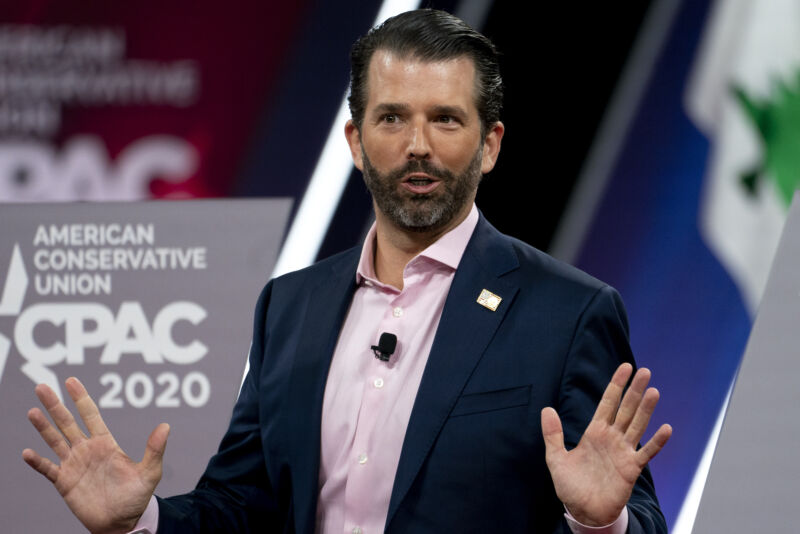
Enlarge/ Donald Trump Jr. speaks at CPAC in February 2020.
Andrew Harrer/Bloomberg via Getty Images
Twitter has suspended presidential son Donald Trump Jr. for 12 hours after the younger Trump tweeted a video featuring misinformation about COVID-19 treatment. Also in Twitter’s penalty box: Breitbart News, the publication that originally published the controversial video.
Twitter also removed posts featuring the video that were retweeted by President Trump himself, though it didn’t suspend the president’s account.
The video from Breitbart News showed a press conference outside the US Capitol where several doctors promoted views contradicted by science, including that hydroxychloroquine could cure COVID-19 and that it wasn’t necessary for people to wear masks.
On Monday, the Breitbart video went viral on major social media platforms—especially on Facebook where it racked up 14 million views in a few hours. Like Twitter, Facebook and YouTube also have policies against spreading misinformation about COVID. By Tuesday morning all three platforms had banned the video. It remains available on Breitbart’s website.
“This virus has a cure”
Speakers included Stella Immanuel, a Houston physician who trained in Nigeria.
“Nobody needs to get sick,” Immanuel said. “This virus has a cure. It’s called hydroxychloroquine, zinc, and Zithromax. I know people want to talk about a mask. Hello. You don’t need mask. There is a cure.”
Critics have questioned Immanuel’s scientific judgment. A Tuesday article from the Daily Beast reported on a sermon that Immanuel (a minister as well as a physician) gave in 2013 claiming that women have “serious gynecological problems” that result from having sex with spirits in their dreams.
“We call them all kinds of names—endometriosis, we call them molar pregnancies, we call them fibroids, we call them cysts, but most of them are evil deposits from the spirit husband,” Immanuel said, according to the Daily Beast.
While Immanuel claims to have successfully treated hundreds of COVID-19 patients with hydroxychloroquine, more systematic data cast doubt on the drug’s effectiveness as a COVID-19 cure. Ars Technica’s Beth Mole wrote last month about “a large, randomized trial in the UK run by researchers at the University of Oxford. On June 5, the lead investigators of the trial announced they were halting the use of hydroxychloroquine after reviewing early data.” The researchers found that hydroxychloroquine made no significant difference in the mortality rate, length of hospital stay, or other health outcomes.
Last month the World Health Organization stopped testing hydroxychloroquine as part of an international multi-drug testing effort after early results showed no signs hydroxychloroquine was effective at treating COVID-19.
At the same time, hydroxychloroquine has long been known to have significant side effects. We noted in April that side effects include “everything from headaches, vomiting, and rashes to loss of vision (retinopathy), seizures, hypoglycemia, heart arrhythmias, and deadly heart damage.”
Hydroxychloroquine has become a political football
In March, Donald Trump began enthusiastically endorsing the drug despite scant evidence of its effectiveness. In May he announced he had begun taking the drug himself.
Trump’s endorsement contributed to surging demand for the drug, creating shortages for patients with conditions like lupus and rheumatoid arthritis for which hydroxychloroquine has long been a standard treatment. Some government officials began restricting the drug to prioritize access for people with these conditions.
That, in turn, has fueled conspiracy theories that the medical establishment is deliberately suppressing access to the drug and evidence of its effectiveness against COVID-19.
https://arstechnica.com/?p=1694730
Google will keep 200,000 workers home through next summer
Enlarge/ Google CEO Sundar Pichai testifies before the House Judiciary Committee in 2018.
Google will keep “nearly all” of its workforce—around 200,000 employees and contractors—working from home for another year, The Wall Street Journal has reported. Google CEO Sundar Pichai reportedly made the decision last week.
The long timeline gives more certainty for Googlers who are making school and housing decisions for the coming academic year. Previously Google workers were due back in the office in January.
Companies across Silicon Valley—and across the broader US economy—have been keeping their offices closed longer as the severity of the coronavirus pandemic becomes more clear.
In May, Facebook announced that it was making a permanent shift toward allowing more employees to work from home. All Facebook workers are encouraged to work from home through the end of the year.
Amazon is encouraging employees to work from home through the end of the year. Twitter said in May that employees could work from home indefinitely. Its offices will be closed through at least September. Microsoft is allowing employees to work from home until at least October.
While working from home is a new option for a lot of American workers, Ars Technica has been a work-from-home organization for decades. Our writers and editors offered some remote working tips in a March article.
https://arstechnica.com/?p=1694567
Four days into season, MLB game cancelled over COVID-19 outbreak
Enlarge/ Swapping elbow bumps for high-fives and adding some mask use among players was not enough to prevent an outbreak of COVID-19 among the Miami Marlins. (Miami players Miguel Rojas and Isan Diaz celebrating during a game against the Phillies, July 26, 2020 in Philadelphia.)
This year’s weird, truncated baseball season kicked off just four days ago, after Major League Baseball had to delay Opening Day for months due to the pandemic sweeping the globe. Despite new precautions, though, COVID-19 has already led to the cancellation of at least one game, as the disease is apparently racing through the Miami Marlins’ roster.
The Marlins were supposed to host the Baltimore Orioles tonight for their home opener in Miami. But as ESPN’s Jeff Passan was first to report, the game has been cancelled after at least 14 Miami players and staff have tested positive for COVID-19.
The Marlins spent the weekend in Philadelphia, taking a three-game series against the Phillies 2-1. On Sunday, however, sources told ESPN that four players tested positive for the novel coronavirus, including Jose Urena, who was expected to pitch Sunday’s game.
The team delayed its flight home to Miami, spending an additional night in Philadelphia instead and planning to travel to Florida Monday morning ahead of tonight’s scheduled game against Baltimore. By Monday morning, however, an additional eight players and two coaches had tested positive for the coronavirus. The team’s flight back to Miami this morning was cancelled, and the Marlins for the moment remain grounded in Philadelphia.
The Phillies were supposed to host the New York Yankees Monday night, but after 10:30am Monday multiplereportersTweeted that tonight’s game between the Phillies and the Yankees has also been cancelled.
MLB’s coronavirus protocol calls for the players to be isolated from the team until they text negative for COVID-19 twice (at least 24 hours apart), have remained symptom-free for at least 72 hours, and are cleared to return by a physician. The outbreak among the Marlins, however, throws into doubt whether the shortened season, absence of crowds, and isolation protocol are enough to keep players safe.
Russia’s GRU hackers hit US government and energy targets
Enlarge/ The FBI notified organizations in May that Russia’s elite hackers had targeted them. The campaign likely remains ongoing.
Russia’s GRU military intelligence agency has carried out many of the most aggressive acts of hacking in history: destructive worms, blackouts, and—closest to home for Americans—a broad hacking-and-leaking operation designed to influence the outcome of the 2016 US presidential election. Now it appears the GRU has been hitting US networks again, in a series of previously unreported intrusions that targeted organizations ranging from government agencies to critical infrastructure.
From December 2018 until at least May of this year, the GRU hacker group known as APT28 or Fancy Bear carried out a broad hacking campaign against US targets, according to an FBI notification sent to victims of the breaches in May and obtained by WIRED. According to the FBI, the GRU hackers primarily attempted to break into victims’ mail servers, Microsoft Office 365 and email accounts, and VPN servers. The targets included “a wide range of US-based organizations, state and federal government agencies, and educational institutions,” the FBI notification states. And technical breadcrumbs included in that notice reveal that APT28 hackers have targeted the US energy sector, too, apparently as part of the same effort.
The revelation of a potentially ongoing US-targeted GRU hacking spree is especially troubling in light of the GRU’s past operations, which have often gone beyond mere espionage to include embarrassing email leaks or even disruptive cyberattacks. APT28 hackers in particular have been the subject of US indictments alleging hack-and-leak operations targeting both the 2016 US election and the Worldwide Anti-doping Agency. The latter attack was in apparent retaliation for the International Olympic Committee banning Russia from the 2018 Olympics for performance-enhancing drug use.
“Although not all motives are clear, we can make judgments based on the nature of the target as seen through past indictments,” an FBI spokesperson wrote in a statement responding to WIRED’s request for further comment on the notification sent to APT28 hacking victims. The FBI also says that the GRU hacking campaign has likely continued into recent months. “An Advanced Persistent Threat is just that,” the spokesperson added, referring to the APT acronym from which APT28 takes its name. “There is an expectation of continued activity.”
According to the FBI’s victim notification, the APT28 hackers have gained access to networks via spear-phishing emails sent to both personal and work email accounts. They’ve also used password-spraying attacks, in which hackers try common passwords across many accounts, as well as brute force attacks that guess a long list of passwords against one or a small number of accounts.
Within days of the FBI’s notification being sent to victims in early May, the NSA issued a public advisory that Sandworm, a separate but closely linked GRU hacker group, was exploiting a vulnerability in Exim mail servers to target victims. The FBI told WIRED it knew of no connection between that Exim exploitation and the APT28 campaign.
“They stole entire mailboxes”
One staff member at an affected organization told WIRED that the IT staff had seen no sign of a successful phishing attack—but nonetheless found that the hackers had accessed their email server. “Once they were on the server they stole entire mailboxes,” says the staffer, who asked that WIRED not reveal either their identity or the organization they work for.
The organization was eventually notified by the FBI that they had in fact been breached by APT28. “The natural worry is, am I the next John Podesta?” the staffer says, referring to the Hillary Clinton campaign director whose emails were stolen and leaked by APT28 ahead of the 2016 election. “Reading the victim notification and realizing how many different organizations were probably targeted, it just underscores that exactly what we worried about in 2016 is something that Russia is literally still doing as we speak.”
The FBI declined to comment on how many victims the APT28 campaign may have targeted, or how many of those attempts were successful. But security firm FireEye says it has learned of a “handful” of victim organizations that were compromised by hackers using the same IP addresses listed as used by APT28 in the FBI victim notification. In those cases, the hackers appear not to have infected systems with malware, says Ben Read, a cyberespionage analyst at FireEye, instead using stolen credentials to move around the corporate network as employees would. “It was a pretty light touch,” Read says.
While neither FireEye nor the FBI would reveal the identities of APT28’s victims, at least one of the group’s targets appears to have been in the US energy industry. A Department of Energy advisory issued in January warned that on Christmas Eve of last year, someone probed the login pages of a “US energy entity” from an IP address that had previously been used by APT28. That same IP address was also listed by the FBI among those used by APT28’s hackers through May, confirming that APT28 was very likely behind that incident.
“This is a concerning data point”
Energy-sector intrusions would represent a shift in targeting for APT28, says Joe Slowik, the security researcher at industrial-control-system security firm Dragos who spotted the connection between the DOE advisory and the FBI victim notification. “Just given what we understand about how APT28 operates and its typical victimology, identifying that group interacting with the US energy sector would be substantially different from how this group has behaved previously,” he says.
While apparently a new venture for APT28, the GRU as a whole does have a history of hacking critical infrastructure. The GRU hacker group Sandworm planted malware on the networks of US electric utilities in 2014, then carried out the first-ever cyberattack-induced blackouts in Ukraine in 2015 and 2016. The notion that APT28 may now be sniffing around US energy industry targets too—or that Sandworm is, given that the two groups have teamed up in the past—is disturbing, argues Slowik. “This is a concerning data point,” Slowik says. “It’s the first time in a while that this group has targeted US critical infrastructure.”
A new GRU hacking campaign targeting US organizations in 2020 also raises the specter of another round of election meddling, given the GRU’s notorious campaign of electoral interference in 2016. US intelligence officials have been warning since early this year that Russia has sought to interfere in US electoral politics again to help reelect President Trump. But the FBI and FireEye both say they saw no signs that this particular string of intrusions by APT28 were related to the upcoming presidential election.
Instead, says FireEye’s Read, the campaign shows that the GRU’s general interest in US targets hasn’t ended, even as its endgame remains unclear. “The US continues to be the chief antagonist for Russia in their mind. It’s an important reminder that this is still going on,” says Read. “It’s hard to say if it’s a significant escalation. But it’s obviously not good.”
FAA orders inspections of 737s after four non-fatal engine shutdowns
Enlarge/ Southwest has dozens of 737s in storage. The airline says it hasn’t experienced the glitch described in the FAA directive.
The Federal Aviation Administration has ordered airlines to inspect the engines of their 737 airplanes after four reports of “single-engine shutdowns.”
Many 737 aircraft have been sitting in hangars for weeks as the coronavirus pandemic suppressed demand for air travel. As airlines have resumed operations, they’ve discovered that a key valve has a tendency to get stuck after weeks without being used. The FAA estimates that around 2,000 aircraft could be affected.
“If this valve opens normally at takeoff power, it may become stuck in the open position during flight and fail to close when power is reduced at the top of descent,” the FAA’s directive warns. That could result in “an unrecoverable compressor stall and the inability to restart the engine.”
This has happened on four occasions in recent weeks. Alaska Airlines has acknowledged that one of its airplanes suffered from the problem during a flight from Seattle to Austin. The airplane was able to land safely despite the unexpected shutdown of one of its engines and no one was injured, the airline says.
Thankfully, the same was true of the other three incidents: only one engine shut down and no injuries occurred as a result. But the FAA worries that an aircraft could suffer the same malfunction in both engines simultaneously, which could “result in a forced off-airport landing.”
So the FAA is ordering airlines to carefully inspect the engines of any 737 aircraft that has been out of service for seven or more days in a row—and hasn’t flown 10 times since then. If a sticky valve is discovered, it must be replaced before the airplane can be put back into service. Most airlines said that the mandatory inspections would not significantly impact their flight schedules.
The order relates to older models of the 737—from the 737-300 line through the 737-900 line. Boeing’s newer 737-MAX line is still grounded as the company struggles to remedy design and software problems.
https://arstechnica.com/?p=1694326
CDC’s new school guidelines play down risk, play up attendance
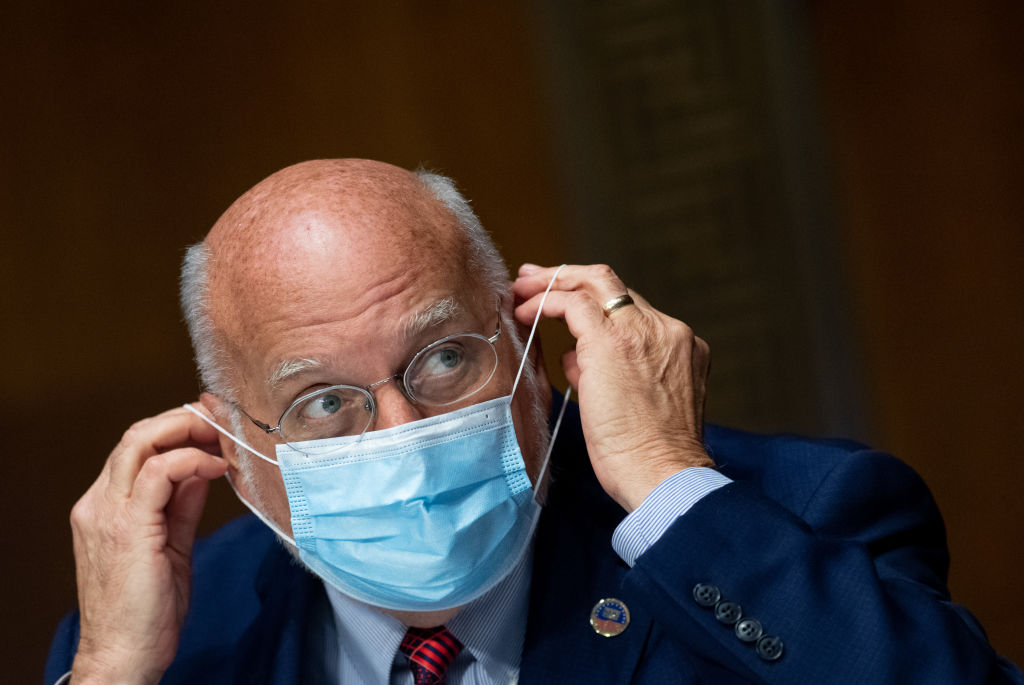
Enlarge/ WASHINGTON, DC – JULY 2: Dr. Robert Redfield, Director of the Centers for Disease Control and Prevention (CDC), removes his protective mask before speaking.
The Trump administration has been pushing for a return to normal behavior even as the number of COVID-19 cases in the United States has shot up to new records. Central to that effort has been a push to reopen schools in the fall, which would normally begin in a bit over a month. It’s a push that has been resisted by a number of major school districts and has been met with major skepticism among the public. And it’s one that hasn’t necessarily seemed consistent with the US government’s own advice, provided by the Centers for Disease Control.
That’s led to a conflict between the administration and the CDC. Trump has said he disagrees with what he termed the CDC’s “very tough and expensive” guidelines, and he was joined by the Department of Education in threatening to pull funding from schools that don’t open. Those CDC guidelines advised schools to improve their remote offerings, emphasized that the decision to reopen should be under local control, and discussed the reasons why schools should consider temporary shutdowns even if they start the school year as normal.
A temporary truce saw the CDC directed to issue updated guidelines for schools. Those arrived yesterday and were discussed by the CDC’s director, Robert Redfield, at a press conference today. Overall, the updated material retains some of the original documents—including one that terms a resumption of normal school activities “highest risk.” But there are substantial additional materials that emphasize the value of restarting school and describe in detail the lower risks that the pandemic poses for young students.
A little old, but a lot new
The earlier documents had been issued in mid-May and at least some of those have been retained in a place of prominence on the guideline’s new landing page. This includes advice on how to prepare schools for a return of students. The document describes normal school activities as “highest risk,” in contrast with remote education, which falls in the “lowest risk” category. This also includes advice that probably falls in the “very tough and expensive” category that the president was unhappy with, such as modifying classroom layouts to allow greater distancing, installing physical barriers, and extensive cleaning and disinfecting.
But newer documents, such as one directed at school administrators, have a clear change in emphasis. It still has a heavy dose of best practices, like wearing face masks, enabling social distancing for students, and extensive disinfection. But there are now large sections about the “Critical Role of Schools,” which indicates that “[t]he unique and critical role that schools play makes them a priority for opening and remaining open, enabling students to receive both academic instruction and support as well as critical services.”
If that weren’t enough, further down in the document, there’s a section entitled “Why is it Important to Open Schools for In-Person Instruction?” That’s followed by “Schools play a critical role in supporting the whole child, not just the academic achievement of students.” All told, about a quarter of the 5,000 word document is spent on text that promotes the importance of opening schools for in-person instruction.
Beyond that, the document includes an extensive section on how COVID-19 affects those in the school-aged population, noting that they account for 6.6 percent of the COVID-19 cases but a very small fraction of the deaths. It also cites some tentative data about children being somewhat less likely to transmit the disease. All of this is accurate, but it’s also an area where high-quality data on many of the issues is sparse, and different countries have seen different outcomes based on a combination of local conditions and factors that remain unidentified.
A slide into advocacy
There is still good information here—the checklist for parents and accompanying decision-making tool both do an excellent job of providing information in an easy-to-digest form that should allow parents to feel more confident that they’ve considered all the relevant information they need when managing risks for their children.
But it’s now mixed in with an overt push for reopening schools. There’s now an entire document entitled “The Importance of Reopening America’s Schools this Fall.” In contrast to most other CDC documents on this topic, which focus on providing information that parents and school administrators should consider, this one reads like advocacy. It barely discusses risks but includes passages like the following:
The best available evidence indicates if children become infected, they are far less likely to suffer severe symptoms. Death rates among school-aged children are much lower than among adults. At the same time, the harms attributed to closed schools on the social, emotional, and behavioral health, economic well-being, and academic achievement of children, in both the short- and long-term, are well-known and significant.
…
The best available evidence from countries that have opened schools indicates that COVID-19 poses low risks to school-aged children, at least in areas with low community transmission, and suggests that children are unlikely to be major drivers of the spread of the virus. Reopening schools creates opportunity to invest in the education, well-being, and future of one of America’s greatest assets—our children—while taking every precaution to protect students, teachers, staff and all their families.
The contrast is jarring. The first quote, which minimizes the risks of opening schools, is the only place in the document where risk is considered.
How this happened became apparent during the press conference that introduced the material. There, Erin Sauber-Schatz, who leads a CDC COVID-19 task force, emphasized that opening schools shouldn’t be a simple decision, as it’s one that comes with benefits and risks. She mentioned that, as a mom, she’s “heartbroken” about the number of people under the age of 18 that have died of COVID-19 in the United States and emphasized that the risks are even higher for teachers and staff.
CDC director Robert Redfield emphasized that society as a whole has to play a key role in limiting the pandemic, and he discussed how indications that an area was suffering from high levels of infections should be used to determine that keeping schools open would likely be unsafe.
But…
All of that is reasonable and in keeping with prior CDC approach to the issue. But the two were joined by Deputy Secretary of Education Mitchell Zais, who had a radically different message. “President Trump is leading a great American recovery, and part of that is getting students back to school,” he told reporters, going on to say “the default should be schools fully open.” He unequivocally said that the science indicates it’s “healthier and safer for children” to have schools open, and so it’s “not if it should be done, but how it must be done.”
But Zais’ respect for the research is limited. Back in the spring, there was almost no data on the spread of SARS-CoV-2 among school-aged kids or how COVID-19 affected them. Yet Zais said schools that shut in response to its spread “failed their students.” Zais went on to echo Trump’s threat that school systems that aren’t open for in-person instruction wouldn’t receive federal funding. (Trump has now at least modified that threat to acknowledge the CDC’s judgement that schools in areas with high levels of infections will need to close.)
The impression the press conference left is that some documents or sections of the new documents had been written by the Department of Education, rather than the CDC.
Developing these documents even under normal circumstances would have been challenging. In-person schooling clearly is very important to the health and development of children, but that has to be balanced against the known risks and significant unknowns regarding the spread and impact of COVID-19 in both the children and teachers. But the end result in this case is a discussion in which the balancing of these risks has been heavily skewed in favor of an outcome that’s the product of a political campaign that desires a return to normalcy. And that not only serves the US public poorly but threatens to damage the long-term credibility of the CDC by making it seem like just another campaign tool.