Bankrupt OneWeb seeks license for 48,000 satellites, even more than SpaceX

Illustration of a sunrise over planet Earth.

SpaceX and OneWeb have asked for US permission to launch tens of thousands of additional satellites into low Earth orbit.

SpaceX’s application to launch 30,000 satellites—in addition to the nearly 12,000 it already has permission for—is consistent with SpaceX’s previously announced plans for Starlink.

OneWeb’s application to launch nearly 48,000 satellites is surprising because the satellite-broadband company filed for bankruptcy in March. OneWeb is highly unlikely to launch a significant percentage of these satellites under its current structure, as the company reportedly “axed most of its staff” when it filed for bankruptcy and says it intends to use bankruptcy proceedings “to pursue a sale of its business in order to maximize the value of the company.” Getting FCC approval to launch more satellites could improve the value of OneWeb’s assets and give more options to whoever buys the company.

“OneWeb has already secured debtor-in-possession financing and expects to soon exit the Chapter 11 process in a manner that maximizes the value of OneWeb’s strategic assets and also ensures a viable path forward for its stakeholders and customers,” the company said in its FCC application.

The SpaceX and OneWeb applications were filed yesterday because of an FCC deadline. Other providers such as Telesat (1,671 satellites), Kepler (360 satellites), and Viasat (288 satellites) filed applications for smaller low-Earth-orbit constellations. Mangata Networks filed an application for 791 satellites in medium-Earth orbits.

“It’s important to understand that the reason OneWeb filed for so many satellites is that it will make others’ efforts more difficult, especially [for Amazon subsidiary] Kuiper, and thereby potentially enhance the value of OneWeb’s first gen license. Similar rationale to SpaceX’s 30K satellite proposal,” satellite-industry consultant Tim Farrar wrote on Twitter.

FCC rules give satellite licensees six years to launch 50 percent of licensed satellites and nine years to launch all of them, unless a waiver is granted.

Low-Earth orbits for lower latencies

OneWeb already had permission to launch 720 satellites, and its application seeks authorization of a second phase consisting of 47,844 satellites. OneWeb did not ask for a change in its orbital altitude of 1,200km. The company provided the FCC with more technical details on its plan in this document.

“Because of the use of combined orbits, the OneWeb satellites essentially pass over all parts of the Earth’s surface and therefore, in principle, have the ability to provide service to all Earth locations,” OneWeb wrote. “Every point on the Earth’s surface will see, at all times, a OneWeb satellite at an elevation no less than 55º, with increasing minimum elevation angles with latitude. For instance, users in Alaska will always experience elevation angles significantly higher than 55º.”

Low-Earth-orbit satellites are expected to provide much lower latency and faster speeds than geostationary satellites that orbit at about 35,000km. OneWeb said its users “will experience round-trip latency of less than 50 milliseconds, which is approximately 1/13th of the latency of GSO [geo-stationary orbit] satellites, and comparable to terrestrial networks.” OneWeb has also said its technology can provide average latency of 32ms.

SpaceX has publicly predicted sub-20ms latency for its service, but the company also used a sub-50ms figure in its application to the FCC and said this level of latency “is nearly unnoticeable to consumers.” The FCC has measured Comcast’s median latency at just over 20ms during peak usage hours and Verizon FiOS at just over 10ms.

SpaceX’s FCC filing says its proposed 30,000 satellites would be for a “Gen2 System” that builds on the first-generation system the company is currently deploying. More than 85 percent of the proposed 30,000 satellites would “operate at very low altitudes below 400km, using eight total orbital altitudes ranging from 328km to 614km.”

SpaceX’s application continued:

Just as large deployments of new densified 5G networks are helping those in more urban environments, the densified satellite constellation SpaceX proposes will substantially increase capacity and drive up the number of consumers even in rural and remote areas with access to truly robust broadband. While SpaceX’s next-generation constellation will use only a small fraction of the number of antennas being deployed for terrestrial technologies, its spectrally efficient designs and intensive spectral reuse will allow it to bring to rural areas the type of services and prices previously reserved only for urban customers.

By operating at low and very low altitudes, the SpaceX Gen2 System will enable smaller spot beams and greater satellite diversity, achieving the intensive frequency reuse needed to heighten capacity available anywhere in the world. And by guaranteeing multiple satellites in view for every customer located at any point on the ground, SpaceX’s next-generation system incorporates the flexibility necessary to coordinate with other spectrum users while still delivering robust service, even in a crowded spectrum setting.

OneWeb had launched 74 satellites before filing for bankruptcy. SpaceX has launched about 420 satellites so far, is aiming to provide service later this year, and just signed a deal with the US Army to test Starlink for military use.

https://arstechnica.com/?p=1679169



Trump tweet throws House surveillance debate into chaos

Trump tweet throws House surveillance debate into chaos
Aurich Lawson

President Donald Trump threw efforts to renew a controversial Patriot Act provision into turmoil on Tuesday evening with a tweet calling on Republican members of the House to reject spying legislation that is due for a vote this week. It’s the latest setback for a bill that has been embroiled in controversy for months.

The provision, known as Section 215, was first passed in the wake of the September 11 terrorist attacks. It gives the federal government broad powers to obtain “any tangible thing,” including “books, records, papers, documents, and other items,” without a warrant.

This power isn’t supposed to be used for ordinary criminal cases—only for foreign intelligence operations. But it has been subject to abuse in the past. Most notoriously, Section 215 was used to collect records of every phone call made in America for several years. The NSA ultimately terminated the program under sustained pressure from civil liberties groups.

Section 215 expired in March, and Congress has been working to renew it. The House of Representatives passed renewal legislation in March. The Senate passed its own version earlier this month. But the Senate version differed from the House version, necessitating another House vote before it can become law.

Privacy advocates have been pushing to modify the bill yet again. As we reported yesterday, the House is expected to vote on an amendment that would provide new privacy protections for Americans’ search and browsing history records. A similar amendment in the Senate failed by a single vote; 59 senators voted in favor, just short of the 60-vote supermajority required to overcome a filibuster.

Trump adds confusion to the legislative fight

That brings us to last night, when President Trump called on Republicans to reject the legislation:

The “greatest political, criminal, and subversive scandal in USA history” is apparently a reference to accusations that the FBI acted inappropriately when it investigated associates of the Trump campaign during the 2016 election. Theoretically, Trump is now in charge of the FBI, CIA, and other intelligence agencies. But he has continued to view them with suspicion. He has become increasingly focused on these issues in recent months, coining the term “Obamagate” to describe his predecessor’s alleged mishandling of investigations into Michael Flynn and other Trump associates.

The practical upshot of Trump’s tweet is to make it less likely that any kind of Section 215 legislation will pass Congress. It seems unlikely that controversy over the 2016 campaign and related investigations will be resolved this year—so Trump is effectively calling for renewal of Section 215 to be put on hold indefinitely.

That’s a stance that puts him at odds with a number of Republicans in Congress, including Senate Majority Leader Mitch McConnell. At the same time, Trump is not necessarily aligning himself with figures like Sen. Ron Wyden (D-Ore.) who have sought to add new privacy protections for search and browsing histories. It’s not clear if Trump actually wants Section 215 permanently repealed or if he’s just using the legislative debate as an excuse to tweet about one of his favorite subjects.

Something similar happened two years ago. In January 2018, the Trump White House was officially supporting legislation to renew another foreign surveillance power that was due to expire. But in the middle of the debate—possibly after watching a Fox News segment on the legislation—Trump posted a tweet contradicting the official White House line and suggesting that FISA powers had been used to spy on the Trump administration. A couple of hours later, after a frantic huddle with his national security advisers, Trump posted a follow-up tweet expressing support for the FISA legislation.

Wyden withdrew support for a House privacy amendment

Meanwhile, Sen. Wyden announced on Tuesday evening that he was withdrawing his support for the House search and browsing privacy amendment that’s due for a vote this week. He had supported the amendment earlier in the day on Tuesday. But he changed his mind after Rep. Adam Schiff (D-Calif.), the chairman of the House Intelligence Committee and an ally of intelligence agencies, suggested that it would provide less robust protections for search and browsing privacy than Wyden had hoped.

Schiff’s comments were significant because they came hours after Schiff had hashed out the text of the amendment with its lead co-sponsor, Rep. Zoe Lofgren (D-Calif.). Yesterday, we quoted a Lofgren statement claiming that the amendment would protect Americans from “incidental” collection of search and browsing records. But Schiff’s own comments to The New York Times suggested a weaker interpretation of the text. And particularly given Schiff’s role in drafting the text, Wyden worried that the courts would follow Schiff’s reading of the amendment rather than Lofgren’s.

Wyden is asking the House to vote on his own amendment—the one that got 59 votes in the Senate earlier this month. And if that amendment isn’t added to the bill, he’s asking the House to reject the entire package.

Privacy advocates have an unusual amount of leverage here. Normally, surveillance advocates try to push through renewals of spying legislation just before the previous legislation expires—a tactic that’s difficult for opponents to counter given fears of terrorist attacks. But now that Section 215 has been expired for a couple of months, it’s hard to create the same sense of urgency. If Congress does nothing, Section 215 will be gone forever. And that might suit privacy hawks in Congress just fine.

https://arstechnica.com/?p=1679104


YouTube auto-deletes comments with phrases critical of Chinese government [Updated]

Protesters in Taipei, Taiwan, demonstrate for granting political asylum to Hong Kongers in January 2020.
Enlarge / Protesters in Taipei, Taiwan, demonstrate for granting political asylum to Hong Kongers in January 2020.
Walid Berrazeg/SOPA Images/LightRocket via Getty Images

YouTube’s software is automatically deleting comments with two phrases critical of the Chinese Communist Party, the Verge reported on Tuesday morning.

“共匪” means “communist bandit.” It was a derogatory term used by Nationalists during the Chinese Civil War that ended in 1949. It continues to be used by Chinese-speaking critics of the Beijing regime, including in Taiwan.

“五毛” means “50-cent party.” It’s a derogatory term for people who are paid by the Chinese government to participate in online discussions and promote official Communist Party positions. In the early years of China’s censored Internet, such commenters were allegedly paid 50 cents (in China’s currency, the yuan) per post.

I’ve confirmed the behavior of YouTube’s commenting algorithm. Around 11:30am, I posted several comments on a YouTube video, some containing one of the two phrases, two with other Chinese phrases, and several with English content. The comments with “共匪” and “五毛” in them disappeared in less than a minute. The others are still up as I write this around noon Eastern time.

YouTube’s apparent policy is especially surprising because the search giant has long had an adversarial relationship with the communist regime. YouTube has been officially blocked in China since 2009. Google has refused to comply with China’s censorship requirements for search engines, which has locked Google out of the Chinese search market. Plans to re-enter the market with a censored search engine were scuttled last year after protests from Google employees, American elected officials, and human rights advocates.

The Chinese government has been exerting increasing pressure on companies around the world to censor content critical of the Communist regime in Beijing. Last fall, for example, Blizzard banned a professional Hearthstone gamer for expressing support for Hong Kong during a livestream. The National Basketball Association faced reprisals from the Chinese government after Rockets manager Daryl Morey tweeted support for Hong Kong’s protesters.

We don’t know if the Chinese government has been pressuring YouTube to censor phrases critical of the Communist Party, if YouTube adopted the policy for other reasons, or if it’s some kind of technical mistake.

While this is the first time we’ve heard about this policy, it’s not actually new. Users have been reporting it on YouTube’s support forums since at least last October.

Update: Google responded to our request for comment after publication. The deletion of comments critical of the Chinese government was due to “an error,” a YouTube spokesperson told Ars Technica in an email. “This appears to be an error in our enforcement systems and we are investigating,” YouTube said. “Users can report suspected issues to troubleshoot errors and help us make product improvements.”

https://arstechnica.com/?p=1678815


Making Internet service a utility—what’s the worst that could happen?

The cable industry takes a subtle approach to anti-Title II advertising.
It’s 2020, and a coronavirus pandemic has underscored how crucial broadband service is to the lives of Americans for work, entertainment, and school. Internet service is a necessity, and yet it isn’t regulated as a utility the way services like water and electricity are. But back in 2014 (when this story was originally published) and 2015, there was a hot debate over whether the Federal Communications Commission should treat broadband service like a utility—or, more precisely, as a Title II common-carrier service—in order to impose net neutrality rules.

We’re resurfacing this article from December 2014, which examined the cable industry’s argument that utility-style regulation would hurt broadband users and broadband providers. Ultimately, the FCC did reclassify broadband to enforce net neutrality in 2015, but never imposed strict utility regulations like price caps or network unbundling. Broadband users enthusiastically supported the rules and ISPs admitted to investors later that the extra regulation didn’t harm their businesses. But FCC Chairman Ajit Pai deregulated the broadband industry anyway, eliminating net neutrality rules and other consumer protections such as a prohibition on hidden fees. Since Pai’s decision, the top ISPs have been decreasing network investment despite operating in the mostly regulation-free environment they sought, and the FCC has relied on ISPs’ voluntary promises instead of real rules to keep customers online during the pandemic.

There seems to be nothing the broadband industry fears more than Title II of the Communications Act.

Title II gives the Federal Communications Commission power to regulate telecommunications providers as utilities or “common carriers.” Like landline phone providers, common carriers must offer service to the public on reasonable terms. To regulate Internet service providers (ISPs) as utilities, the FCC must reclassify broadband as a telecommunications service, a move that consumer advocacy groups and even President Obama have pushed the FCC to take.

Under Obama’s proposal, the reclassification would only be used to impose net neutrality rules that prevent ISPs from blocking or throttling applications and websites or from charging applications and websites for prioritized access to consumers. The FCC would be expected to avoid imposing more stringent utility rules in a legal process known as “forbearance.”

Although Title II offers perks that help providers build out networks, ISPs and telecom industry groups have argued that Title II would bring a host of oppressive regulations that the FCC would have a hard time not imposing. They claim that Title II will impose so many extra costs that they’ll be forced to raise prices—though customers might point out that ISPs aren’t shy about raising prices to begin with.

So what, exactly, are ISPs afraid of? We wanted to find out what the worst-case scenario for broadband providers is. Hypothetically, assuming the FCC were to impose all possible Title II regulations (even though Obama specifically said he doesn’t want that to happen), what kinds of new regulations would ISPs have to follow and what new costs would they absorb? And would consumers pay the price in higher bills and worse service?

The cable industry has a lot to say on this subject

To get answers, we spoke with the biggest cable industry trade group, the National Cable & Telecommunications Association (NCTA). It represents cable providers such as Comcast, Time Warner Cable, Cox, Cablevision, and Charter.

One big requirement Title II could bring is regulation of rates charged by Internet providers, either imposing a uniform limit on what all providers can charge or forcing each one to get permission for price increases and justify them based upon the amount they invest in their networks.

Theoretically, the FCC could also enforce “local loop unbundling,” which would force network operators to lease access to last mile infrastructure. In turn, this could bring a new set of competitors who would resell Internet service over the incumbents’ networks without having to lay their own wires throughout each city and town, similar to how the DSL market operated before the FCC removed the unbundling requirement in 2005.

On the plus side for cable companies, the NCTA is confident the FCC won’t enforce local loop unbundling.

“The thing that worries people the most is probably rate regulation.”

“Unbundling in the [Communications] Act, is under Section 251C, which only applies to incumbent local exchange carriers,” Steve Morris, the NCTA’s associate general counsel, told Ars.

An incumbent local exchange carrier, or “ILEC,” is a telephone company that held a regional monopoly before the markets were opened to competitive local exchange carriers or “CLECs.”

“Our preliminary view is that there’s no way you could find that an ISP is an incumbent local exchange carrier, so those provisions should not apply to ISPs,” Morris said. Landline phone companies that also offer Internet service, like AT&T and Verizon, are still ILECs and could theoretically be subject to unbundling. But this isn’t likely given that the FCC abandoned unbundling nearly a decade ago.

While other Title II regulations wouldn’t necessarily apply to Internet providers because of the FCC’s forbearance powers, industry groups argue that forbearance is a highly complicated process that will make it difficult for the FCC to avoid imposing common carrier rules that go far beyond net neutrality.

“I think the thing that worries people the most is probably rate regulation,” Morris said.

There are multiple markets in which the FCC could regulate the rates charged by Internet providers. The most obvious one is the prices charged to residential and business customers who subscribe to broadband. The NCTA doesn’t seem worried about that.

“Most people seem to say the commission could forbear from that,” Morris said. “The president seemed to say there was no need for that sort of regulation.”

More likely, though, is regulation of the interconnection deals Internet service providers strike with other large network operators such as Level 3 and Cogent and online content providers such as Netflix. Netflix and others have called upon the FCC to mandate “settlement-free peering,” interconnection deals that happen without payment. Traditionally, payment-free interconnection has only been available in cases where the ISP and the entity it connects to exchange a roughly equal amount of traffic. Netflix wants free network access regardless of whether the traffic is balanced, and the site could get its wish with Title II.

“Netflix and Level 3 and Cogent have all been pushing for mandatory, settlement-free interconnection and traffic exchange,” Morris said. “Well, that’s rate regulation. You know, saying that someone has to do something at a zero price, that’s rate regulation.”

The primary goal of net neutrality advocates is to outlaw paid prioritization deals in which online content providers pay to have their traffic sped up over the so-called “last mile,” the path from the edge of an ISP’s network to a consumer’s home. (ISPs have not struck any such deals yet, but they could because the FCC’s prior net neutrality rules were overturned in a court order in January 2014.) Interconnection is different from paid prioritization; it occurs only at the edge of an ISP’s network where it connects to the rest of the Internet and would not be affected by most net neutrality proposals.

Pro-net neutrality rally at the White House.
Enlarge / Pro-net neutrality rally at the White House.

The FCC is reviewing interconnection deals but hasn’t said whether it plans to regulate interconnection rates. With Title II, it could insist on reasonable rates without necessarily requiring that interconnection be free. “Reasonable” would be left open to interpretation and decided on a case-by-case basis when there are complaints.

Harold Feld, an attorney and senior VP of the pro-Title II group Public Knowledge, pointed out that Section 251A of Title II requires telecommunications carriers to interconnect with other carriers. A requirement like this could have helped force Comcast’s hand when it was demanding payment from Cogent in exchange for upgrading links used to carry Netflix and other traffic. That dispute was settled indirectly when Netflix paid Comcast, but customers suffered from worse performance in the meantime.

Assuming Cogent was also considered a telecommunications provider, “the FCC could say, ‘look, you’re not allowed to sit there and do nothing when you’re faced with capacity constraints,'” Feld told Ars. “‘There has to be some way in which you upgrade to meet the capacity demand when it’s clear there is capacity demand.’ They could even say generally, ‘your pricing has to bear some relationship to cost.'”

Under Title II, Netflix could also complain to the FCC if it believed Comcast and other ISPs were charging unreasonable rates for interconnection, because Netflix would be a customer of a common carrier, Feld said.

But rate regulation isn’t something the FCC does lightly. The commission has spent years gathering pricing data on the special access market, in which businesses such as Sprint and T-Mobile buy bandwidth from the likes of AT&T, Verizon, and CenturyLink, without making any final decision.

https://arstechnica.com/?p=583639


Facebook workers get remote work option—but it could come with a pay cut

Mark Zuckerberg demonstrates an Oculus Rift headset at a 2016 event.
Enlarge / Mark Zuckerberg demonstrates an Oculus Rift headset at a 2016 event.
David Paul Morris/Bloomberg via Getty Images

Facebook will become far more friendly to remote work, founder and CEO Mark Zuckerberg announced in a Thursday livestream to employees that was shared publicly.

“We’re going to be the most forward-leaning company on remote work at our scale,” Zuckerberg said. “I think that it’s quite possible that over the next five to 10 years, about 50 percent of our people could be working remotely.”

Right now, of course, far more than 50 percent of Facebook employees are working from home due to the pandemic. The company has told workers that they’ll be free to work remotely through the end of 2020. But even after the COVID-19 threat subsides, Facebook will be more accepting of remote workers than it was before the pandemic.

In practical terms, this means two big shifts in corporate policy. One is that many new Facebook jobs will be open to people living anywhere in the US—though Zuckerberg says that Facebook will focus its recruiting efforts on particular geographic areas.

Facebook will work to build up three new talent “hubs” in Atlanta, Dallas, and Denver. Facebook won’t necessarily establish offices there—at least not right away. But according to Zuckerberg, Facebook plans to “focus the recruiting energy” in those cities in an effort to “get to hundreds of engineers” in each location. He hopes that will allow for the development of local communities that will aid further recruitment.

Facebook will also seek to hire more people whose homes are less than a four-hour drive from existing Facebook engineering offices in Silicon Valley, Seattle, New York, and elsewhere.

“We’ll basically adjust salary”

Facebook’s other shift in corporate policy is that some Facebook employees—those with significant seniority and strong performance reviews—will be eligible to request remote work status and relocate to another metropolitan area. They might do this to be closer to family or to move to a city with a lower cost of living. But this option comes with a catch.

“Our policy here has been for years—is already—that [compensation] varies by location,” Zuckerberg said. “We pay a market rate, and that varies by location. We’re going to continue that principle here.”

In other words, a Bay Area engineer who chooses to relocate to Omaha or Birmingham would take a pay cut.

Zuckerberg didn’t go into detail about the size of the cut. Theoretically, it could be small enough that moving to a lower-cost area would still improve a worker’s standard of living.

And not everyone will be eligible to become remote workers. Lawyers who have to appear in court regularly, for example, won’t be able to relocate. Neither will moderators who have to deal with graphic or disturbing content. Zuckerberg says they’ll need to stay onsite so they can get mental health support.

Right now, in the midst of the pandemic, Facebook is giving employees wide latitude about where they work. But on January 1, Zuckerberg said, “we’re going to need everyone to tell us where you’re working from now.” He added that “we’ll basically adjust salary to your location at that point.”

Zuckerberg says that Facebook is “mostly going to rely on the honor code for this”—but not entirely. Facebook will check IP addresses to help detect people who lie about where they’re living.

“There will unfortunately have to be severe ramifications for people who are not honest about this,” Zuckerberg said. One reason for that, he said, is that Facebook needs to know where its employees live for tax purposes.

Remote-friendly policies could have downsides

Allowing people to work remotely has obvious benefits. Employees get more flexibility to live near friends and family. Facebook can expand its talent pool to include people who are unwilling or unable to move to a big city.

But Zuckerberg also acknowledged that the shift to remote work could have some significant downsides. Facebook recently surveyed its employees to gauge how they’ve felt about working from home during the pandemic.

“While the majority of people say that individual productivity is at least as high if not higher than it was before, people do report a lower feeling of alignment,” Zuckerberg said. “That’s less ability to build social bonds and connections, to build culture. It’s harder to have group creativity, things like white-boarding, more free-flowing conversations.”

“It’s unclear at this point how much we’re all drafting off of existing bonds that were built before this COVID period that have the potential to fray or break down over time,” he added.

The death of distance might be exaggerated, again

During the 1990s and early 2000s, many people predicted that the Internet would bring about the “death of distance.” People thought that as communications tools got better, it would become possible for people to work from anywhere, and as a result, economic activity would become less concentrated in urban centers.

Instead, during the 2000s and 2010s, the opposite occurred. High-paying jobs became increasingly concentrated in a handful of big cities, pushing up real estate values to astronomical levels.

The Internet seems to have played a role in this. In a number of industries, the Internet helped transform regional markets into national or global ones. The companies that came to dominate these markets ended up being concentrated in particular cities—San Francisco for software, New York for banking, and so forth.

But while the Internet has made long-distance communication easier, it hasn’t entirely reached parity with in-person interactions. Face-to-face meetings still tend to be more productive than video chats. You’ll get better industry gossip from a friend over drinks than you’ll ever get in a Slack conversation.

This is why Mark Zuckerberg moved from Cambridge to Silicon Valley 16 years ago to start Facebook—instead of trying to do it in Massachusetts (where he was in college), New York state (where his parents lived), or somewhere with a low cost of living. And it’s why Facebook insisted that most of its early engineers move to Silicon Valley, too. It’s possible to do software work remotely, but some teams tend to do their best work when they’re all in the same room—and when they regularly rub elbows with smart engineers from other technology companies.

Silicon Valley’s housing situation has become unsustainable

Facebook, Google, Apple, and other technology giants collectively needed hundreds of thousands of engineers. Those engineers, in turn, have been competing for Bay Area housing that keeps getting scarcer as the technology boom continues. Even with Facebook’s generous salaries, it’s hard for rank and file Facebook workers to afford a big enough house to comfortably raise a family.

So something needed to give if Facebook wanted its engineers to make their careers at the company. An expanded remote work program could be just what the company needs. Facebook isn’t a scrappy startup. It’s a big company with a deeply entrenched product. It probably doesn’t need the same level of rapid iteration that allowed Facebook to conquer the social media market in the first place.

But it does need to retain a large number of talented and experienced engineers over the coming decades. Letting some of them move to Dallas or Des Moines while they continue working for Facebook remotely helps them do that.

But I’m skeptical that this represents a permanent change in the broader American economy. COVID-19 won’t be around forever. When the pandemic is over, the professional and entrepreneurial advantages of face-to-face meetings—and hence, of living in a dynamic urban center—will be as strong as ever. Facebook might not need those creative forces as much as it did a decade ago. But the next generation of entrepreneurs and creative professionals probably will.

And even within Facebook, the most ambitious engineers and managers will likely still want to be in Menlo Park so they can be close to senior management. In an ideal world, physical proximity wouldn’t matter; Zuckerberg says Facebook will try to organize the company so that remote workers aren’t at a disadvantage. But the only way to make that true in practice might be for Zuckerberg and other Facebook executives to relocate themselves out of the San Francisco Bay Area.

https://arstechnica.com/?p=1677951


The story of cheaper batteries, from smartphones to Teslas

The story of cheaper batteries, from smartphones to Teslas
Aurich Lawson / Getty

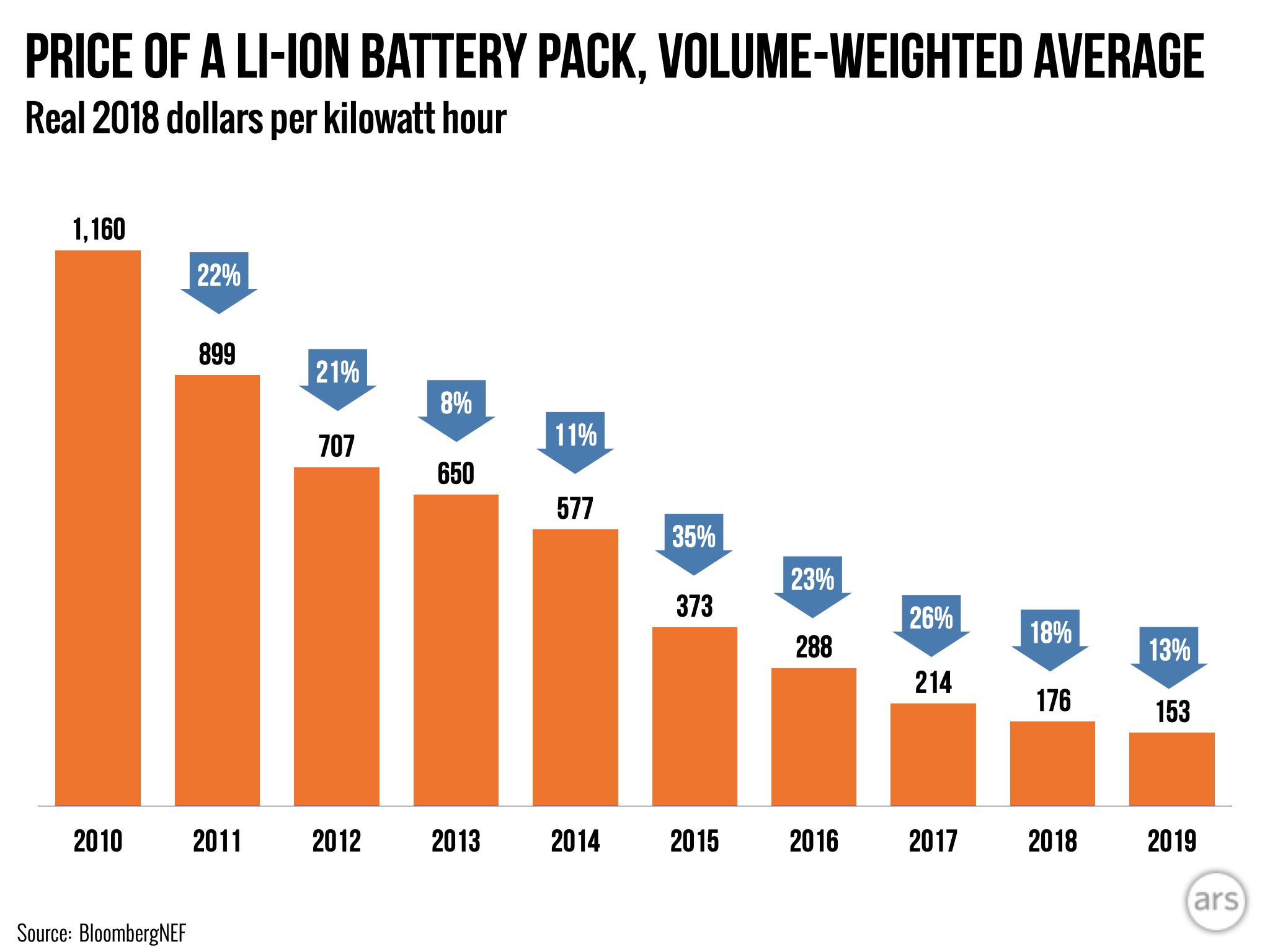
In 2010, a lithium-ion battery pack with 1 kWh of capacity—enough to power an electric car for three or four miles—cost more than $1,000. By 2019, the figure had fallen to $156, according to data compiled by BloombergNEF. That’s a massive drop, and experts expect continued—though perhaps not as rapid—progress in the coming decade. Several forecasters project the average cost of a kilowatt-hour of lithium-ion battery capacity to fall below $100 by the mid-2020s.

That’s the result of a virtuous circle where better, cheaper batteries expand the market, which in turn drives investments that produce further improvements in cost and performance. The trend is hugely significant because cheap batteries will be essential to shifting the world economy away from carbon-intensive energy sources like coal and gasoline.

Batteries and electric motors have emerged as the most promising technology for replacing cars powered by internal combustion engines. The high cost of batteries has historically made electric cars much more expensive than conventional cars. But once battery packs get cheap enough—again, experts estimate around $100 per kWh for non-luxury vehicles—electric cars should actually become cheaper than equivalent gas-powered cars. The cost advantage will be even bigger once you factor in the low cost of charging an electric car, so we can expect falling battery costs to accelerate the adoption of electric vehicles.

Batteries are a key technology for de-carbonizing electric power, too. We’ve seen robust growth of solar and wind energy sources over the last decade. But these carbon-free energy sources have a big downside: they only generate power some of the time. Customers, of course, expect power all the time.

Batteries provide an obvious solution. But here again, high costs have been an obstacle. Current prices still make it cost-prohibitive to use batteries to distribute daytime solar energy evenly over 24 hours. Rather, most utility-scale battery installations today are used to smooth out shorter-term fluctuations in supply and demand. A lack of storage limits how much solar and wind energy can be usefully integrated into the electric grid.

So continued declines in battery prices over the next decade will be a huge help as the world tries to de-carbonize, too.

Batteries have already gotten six times cheaper within the last decade, and that trend looks to continue to a lesser extent moving forward—but how did we get here? A number of factors from increased demand to smart grid solutions have been a factor. And perhaps most notably, Tesla has played an important role throughout this process. Tesla obviously helped to popularize the concept of a long-range battery electric car, but Tesla has been a battery company as much as it is a car company. Tesla recognized the potential scale of the battery market before most other companies and has become a leading player in the market for grid storage—a market that’s poised to become much bigger over the coming decade.

Cheap, powerful batteries made electric cars possible

Eric Bangeman, Ars Technica

Getting data on the true cost of batteries is difficult because so much of the market involves big companies negotiating private deals—often with substantial volume discounts. BloombergNEF is a research and consulting organization that has relationships with a wide variety of players in the battery business.

“We leverage our contacts across all sectors of the value chain,” said James Frith, the lead author of BloombergNEF’s battery surveys. “We talk to both end users as well as manufacturers and other people working in the industry. We talk to most of the large auto makers who are active in the electric vehicle space and the majority of the tier 1 battery manufacturers in China, Europe, the US, and South Korea.”

Their data shows battery costs falling more than sixfold since 2010. Cheaper batteries have expanded the market, which has helped to drive costs even lower.

This process was going on even before 2010. Think back to 2003, the year Tesla was founded. At the time, a booming market for laptops and cell phones was rapidly expanding the market for lithium-ion batteries. Companies were pouring millions of dollars into research and development to make batteries cheaper and more powerful.

JD Straubel, an electrical engineer who went on to become the CTO of Tesla, realized that these batteries had gotten good enough—and would soon be cheap enough—that you could use a few thousand of them to power an electric car. He brought the idea to Elon Musk, who provided early funding to Tesla based on the concept. A decade later, Tesla and Panasonic built a massive battery factory in Nevada called the Gigafactory that was designed to produce 50 GWh worth of battery packs annually. The investment made Tesla one of the world’s biggest producers—and users—of lithium-ion batteries.

In Tesla’s early days, batteries were still so expensive that it was only viable to sell the Roadster, a battery electric sports car with a six-figure price tag. But as batteries continued improving in cost and performance, Tesla was able to build the lower-cost Model S and then the much cheaper Model 3, which consumers can now buy for less than $40,000.

“Model S was designed and introduced about five years after the Roadster, and we saw improvements of around 40 percent on the battery technology, the fundamental chemistry, the packaging of the battery pack itself,” Straubel said in 2014. “That directly translated into how we can get close to 300 miles of range in a Model S, almost 85 kWh of energy storage in a pack that’s actually smaller than the Roadster pack.”

Today, of course, people still buy many more cell phones and laptops than electric cars. But a battery electric car needs so much battery capacity—40 to 100 kWh, thousands of times more than a smartphone—that they’ve significantly increased the global demand for lithium-ion batteries. That has helped drive additional price declines, which have started to make it cost-effective to use batteries to improve the electric grid.

How batteries are improving the electric grid

Tesla Powerpack batteries during a launch event at Hornsdale Wind Farm on September 29, 2017 in Adelaide, Australia.
Enlarge / Tesla Powerpack batteries during a launch event at Hornsdale Wind Farm on September 29, 2017 in Adelaide, Australia.

In 2017 Tesla completed installation of a massive battery system at the Hornsdale Wind Farm in South Australia. Its storage capacity was 129 MWh—about as much as 2,000 Model 3s or 10 million smartphones. The system’s owner, the French renewable company Neoen, considers it such a success that it plans to expand its capacity by 50 percent.

The battery is designed to deliver energy at a rate of 100 MW. With 129 MWh of storage capacity, that means that it can run out in a little more than an hour. But an hour of spare capacity can be hugely valuable. To ensure uninterrupted service, electric utilities rely on “peaker plants”—often gas-fired generators—that can be powered up at a moment’s notice during times of stress. Because these plants may only run for a few hours a year, the per-hour cost can be very high. Australian utilities have sometimes been forced to buy power on the spot market from suppliers who are able to charge as much as 50 times the usual rate.

The Hornsdale battery has allowed the region’s electric utility to largely opt out of this spot market. Neoen claims that the battery has already saved customers in the region tens of millions of dollars, while simultaneously making the region’s grid less susceptible to blackouts.

Saving utilities money during peak loads is nice for the utilities, but the environmental benefits may not be very significant. The big environmental benefits will come in the next phase, when the electric grid has enough batteries to store a significant fraction of the day’s energy demand. That will allow the grid to store up several hours worth of solar energy during the daytime and discharge it at night—allowing renewable energy to supply most or eventually all of the electricity. With enough capacity, we could even store energy across seasons, holding an excess of solar power from the summer to keep electrons flowing during the winter.

The sorts of small, fast-response batteries that help balance out short-term fluctuations may not be the best option for these longer-term storage needs. There are a number of other battery technologies in development—most notably flow batteries—that may be better-suited to this sort of storage. And whatever battery technology that is used will have to compete with alternate energy storage methods. Some of those, like pumped hydro, compressed air, and heat storage, are already in use in limited cases. Others, like using electricity for the production of fuels, are still in development.

The Hornsdale battery might have been the biggest in the world at the time, but its capacity is still tiny compared to US electricity demand. The US consumes roughly 10 terawatt-hours each day—more than 70,000 times the capacity of the Hornsdale plant. With battery costs continuing to fall and renewable power sources proliferating, demand for utility-scale battery installations will only increase in the coming years. In its quarterly earnings report last month, Tesla said it had multiple orders to build battery systems even bigger than the Hornsdale battery at sites around the world.

https://arstechnica.com/?p=1673193


Just turning your phone on qualifies as searching it, court rules

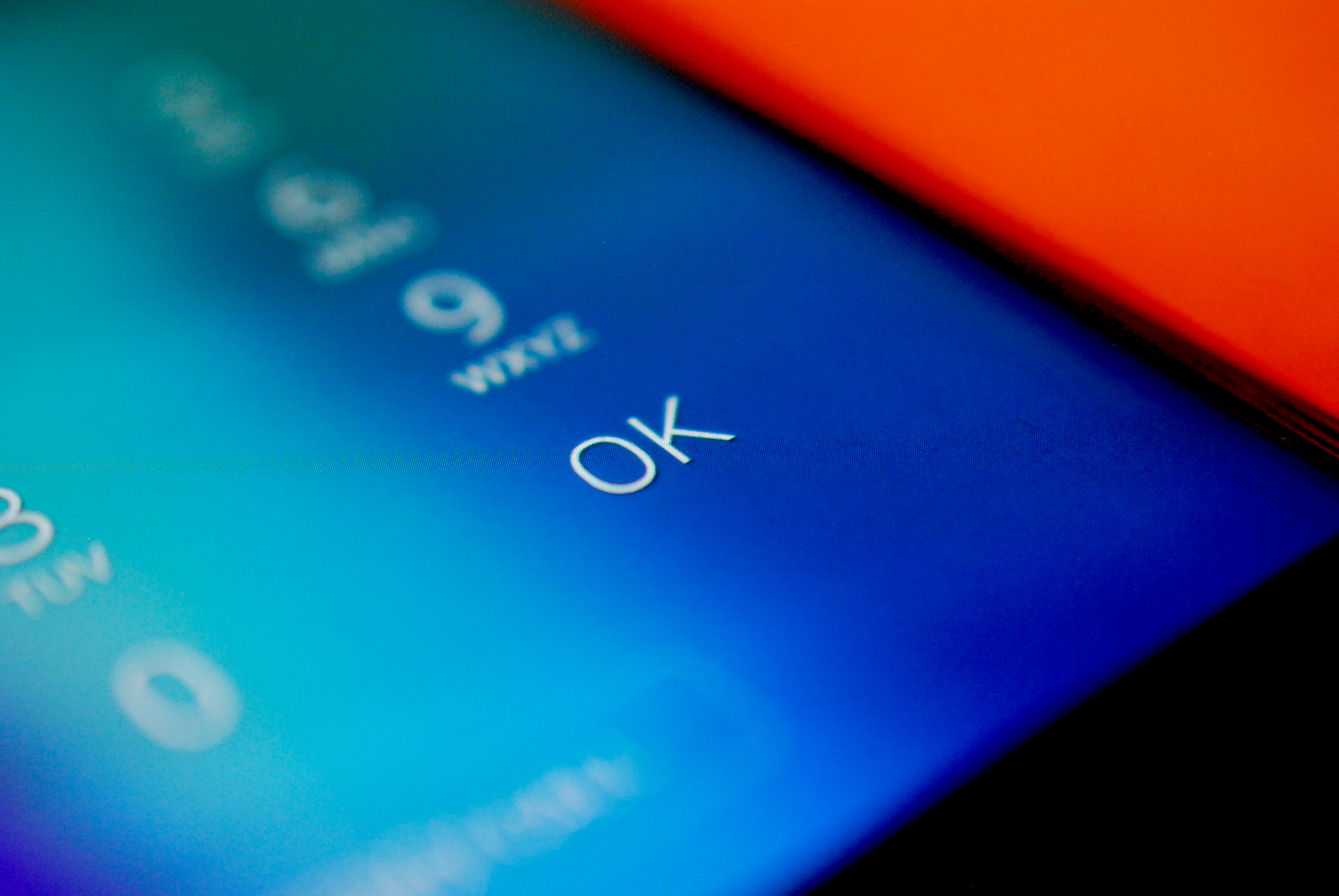
A close-up of the PIN entry form on a smartphone's unlock screen.
Enlarge / A close-up of the PIN entry form on a smartphone’s unlock screen.

Smartphones are a rich data trove not only for marketers but also for law enforcement. Police and federal investigators love to get their hands on all that juicy personal information during an investigation. But thanks to the Fourth Amendment of the US Constitution and all the case law built upon it, police generally need a warrant to search your phone—and that includes just looking at the lock screen, a judge has ruled (PDF).

Usually when the topic of a phone search comes up in court, the question has to do with unlocking. Generally, courts have held that law enforcement can compel you to use your body, such as your fingerprint (or your face), to unlock a phone but that they cannot compel you to share knowledge, such as a PIN. In this recent case, however, the FBI did not unlock the phone. Instead, they only looked at the phone’s lock screen for evidence.

A man from Washington state was arrested in May 2019 and was indicted on several charges related to robbery and assault. The suspect, Joseph Sam, was using an unspecified Motorola smartphone. When he was arrested, he says, one of the officers present hit the power button to bring up the phone’s lock screen. The filing does not say that any officer present attempted to unlock the phone or make the suspect do so at the time.

In February 2020, the FBI also turned the phone on to take a photograph of the phone’s lock screen, which displayed the name “Streezy” on it. Sam’s lawyer filed a motion arguing that this evidence should not have been sought without a warrant and should therefore be suppressed.

Two issues

District Judge John Coughenour of the US District Court in Seattle agreed. In his ruling, the judge determined that the police looking at the phone at the time of the arrest and the FBI looking at it again after the fact are two separate issues. Police are allowed to conduct searches without search warrant under special circumstances, Coughenour wrote, and looking at the phone’s lock screen may have been permissible as it “took place either incident to a lawful arrest or as part of the police’s efforts to inventory the personal effects” of the person arrested. Coughenour was unable to determine how, specifically, the police acted, and he ordered clarification to see if their search of the phone fell within those boundaries.

But where the police actions were unclear, the FBI’s were both crystal clear and counter to the defendant’s Fourth Amendment rights, Coughenour ruled. “Here, the FBI physically intruded on Mr. Sam’s personal effect when the FBI powered on his phone to take a picture of the phone’s lock screen.” That qualifies as a “search” under the terms of the Fourth Amendment, he found, and since the FBI did not have a warrant for that search, it was unconstitutional.

Attorneys for the government argued that Sam should have had no expectation of privacy on his lock screen—that is, after all, what everyone who isn’t you is meant to see when they try to access the phone. Instead of determining whether the lock screen is private or not, though, Coughenour found that it doesn’t matter. “When the Government gains evidence by physically intruding on a constitutionally protected area—as the FBI did here—it is ‘unnecessary to consider’ whether the government also violated the defendant’s reasonable expectation of privacy,” he wrote.

Basically, he ruled, the FBI pushing the button on the phone to activate the lock screen qualified as a search, regardless of the lock screen’s nature.

https://arstechnica.com/?p=1677782


AT&T still refuses to kill misleading 5GE network icon for 4G service

Logo for 5Ge is superimposed over lush forest landscape.
Enlarge / Screenshot from an AT&T commercial.

AT&T has reluctantly agreed to stop using the phrase “5G Evolution” to describe its 4G service in advertising but will apparently continue to use the misleading “5GE” icon as the network indicator on phone screens even when there’s no 5G service.

AT&T’s so-called 5G Evolution service is in reality just 4G with advanced LTE features like 256 QAM, 4×4 MIMO, and three-way carrier aggregation. AT&T has faced widespread ridicule since putting the 5GE network icon on 4G phones more than a year ago, but the icons have likely convinced many AT&T customers that they have 5G service when they really don’t. The other major carriers also deployed LTE-Advanced features but continued to accurately describe the service as 4G.

T-Mobile last year challenged AT&T’s 5GE campaign with the National Advertising Division (NAD), which serves as the advertising industry’s self-regulatory body, and the NAD subsequently ruled that AT&T should discontinue the 5G Evolution claims. AT&T appealed that decision, claiming that its ads “served to educate customers about the billions of dollars AT&T has invested to give customers an outstanding experience,” but the National Advertising Review Board (NARB) rejected the carrier’s appeal.

An NARB panel “recommended that AT&T discontinue its ‘5G Evolution’ and ‘5G Evolution, The First Step to 5G’ claims,” the group said in an announcement yesterday:

Agreeing with NAD’s findings and recommendations, the NARB panel determined that both claims will mislead reasonable consumers into believing that AT&T is offering a 5G network and recommended that the claims be discontinued. At NAD and on appeal, it was not disputed that the AT&T network is not a 5G network. The NARB Panel agreed with NAD’s analysis and concluded that the term “Evolution” is not likely to alert consumers to the fact that the service is not 5G. The Panel noted that the current prevalent technology in wireless is 4G LTE, and LTE stands for “evolution.” Thus, consumers may well interpret “Evolution” in the challenged claims as signifying that AT&T’s technology has already evolved into 5G.

AT&T’s claim that 5G Evolution is “The First Step to 5G” could convince reasonable consumers that AT&T is “promoting a 5G network, while promising an even more robust 5G network at a later time, especially since the slogan is being used in conjunction with ‘5G Evolution,'” the NARB said.

“AT&T will comply”

An AT&T spokesperson told Ars that “AT&T respectfully disagrees with the reasoning and result reached by the Panel majority. AT&T’s customers nationwide continue to benefit from dramatically superior speeds and performance that its current network provides. As a supporter of the self-regulatory process, however, AT&T will comply with the NARB’s decision.”

The AT&T spokesperson today refused to answer our questions about whether the company will keep using “5GE” on phone screens and would not even confirm that the 5GE indicator still appears on phones today. (It does, according to AT&T’s website.) Complying with the NARB decision by pulling ads doesn’t prevent AT&T from using the 5GE network indicator. AT&T “suggested that it will continue to display ‘5GE’ icons on customers’ phones,” The Wall Street Journal wrote yesterday.

“Asked whether AT&T will keep showing ‘5GE’ on phones, the spokesman said the decision only applies to its ads,” the Journal wrote. According to Light Reading, “AT&T said the NARB’s recommendation only applies to its advertising and therefore will not affect the one element that really matters: Its service icon.”

While AT&T will no longer use 5G Evolution in advertising, the company still hypes 5G Evolution on its website, saying that 5GE is “enabling faster speeds on our existing LTE network.”

“5G Evolution is now live in over 550 markets. Many of our most popular smartphones are displaying a ‘5GE’ indicator to let you know when you’re in an area where 5G Evolution is available,” the AT&T website says.

AT&T has continued using the 5GE icon despite now offering real 5G. AT&T uses “5G” for its 5G service on low- and mid-band spectrum, and “5G+” for its faster 5G service on millimeter-wave spectrum.

Verizon lost 5G case against AT&T

AT&T was on the other side of another recent 5G advertising dispute when it filed a complaint against Verizon. The NAD last week determined that Verizon’s claim to be “building the most powerful 5G experience for America” is “not supported by the evidence in the record.” The NAD also urged Verizon to more prominently disclose the fact that its 5G coverage in sports arenas is available in only parts of the arenas and that Verizon 5G “is available only in parts of select cities.”

The NAD said that Verizon agreed to “comply with NAD’s recommendations regarding the clarity and conspicuousness of disclosures,” but the carrier is filing an appeal that defends its claim to be “building the most powerful 5G experience for America.” The NAD said it “determined that in the context of the challenged advertising,” which includes visuals of fans in sports venues and some present-tense language, the Verizon claim communicates “the present-tense message that Verizon is delivering ‘the most powerful 5G network for America.'”

Verizon, however, argued that “the intent of the commercial is to inform consumers about the billions of dollars Verizon is investing in its 5G buildout” and that “consumers understand that this is the only message that is reasonably conveyed.”

https://arstechnica.com/?p=1677783


Ousted scientist says she was asked to manipulate Florida COVID-19 data

Florida began allowing businesses to reopen this week, but the ousted manager of the data behind that decision warns it may not be solid.
Enlarge / Florida began allowing businesses to reopen this week, but the ousted manager of the data behind that decision warns it may not be solid.

As Florida tries to move past the COVID-19 crisis and reopen businesses and venues, the former manager of the state’s novel coronavirus data project alleges she was fired for refusing to cook the numbers and make the state look better.

Rebekah Jones said Friday she was removed from her position, local outlet Florida Today was the first to report.

Jones built and managed the COVID-19 data dashboard for the state from March until May 5. Last week, she explained that for “reasons beyond my division’s control,” her office lost all connection to the portal, and neither she nor her team was any longer involved with it, its data, its publication, or answering questions.

“They are making a lot of changes. I would advise being diligent in your respective uses of this data,” she wrote last Friday in a message to researchers and collaborators on the dashboard project. She added, “I would not expect the new team to continue the same level of accessibility and transparency that I made central to the process during the first two months. After all, my commitment to both is largely (arguably entirely) the reason I am no longer managing it.”

Late Monday, Jones said she was not only removed from her position heading up the dashboard team but was fired from her job entirely because she refused to juke the stats. In an email to local outlet CBS12, Jones said she lost her position because she refused “to manually change data to drum up support for the plan to reopen” the state.

A spokesperson for Florida’s Republican Gov. Ron DeSantis said yesterday that Jones was fired for “a repeated course of insubordination,” adding that she exhibited “blatant disrespect” and was “disruptive.” DeSantis himself called the allegations of data manipulation “a nonissue.”

Florida was slow to adopt any shutdown or social-distancing measures, and it was fast to reopen, going to a “full phase 1” statewide this week. As of Monday, malls, restaurants, barbershops, and gyms have been allowed to resume business even in Florida’s busiest counties, Miami-Dade and Broward. DeSantis is also pushing for theme parks (such as Universal Studios and Walt Disney World) to reopen, according to Politico. Some individual cities, such as Miami Beach, are taking te reopening more slowly.

Other states have also faced allegations of manipulating data related to the novel coronavirus to make conditions appear more favorable. The Atlantic reported at length last week on data collection in Virginia, for example, where state health officials were combining data from two different kinds of COVID-19 test in a way that made the result look more favorable to the public. (The state has since discontinued the practice.)

Last last week, officials in Georgia, which has also been rapidly reopening businesses, faced criticism for publishing a deeply misleading bar chart that appeared to show a decline in COVID-19 diagnoses over time—by mixing up the dates on the X-axis and putting them out of order.

https://arstechnica.com/?p=1677446


Ajit Pai doubts Elon Musk’s SpaceX broadband-latency claims

SpaceX CEO Elon Musk gesturing with his hands and speaking during a conference.
Enlarge / SpaceX CEO Elon Musk at the Satellite 2020 Conference in Washington, DC, on Monday, March 9, 2020.

The Federal Communications Commission is not convinced that SpaceX’s Starlink broadband network will be able to deliver the low latencies promised by CEO Elon Musk. As a result, FCC Chairman Ajit Pai is proposing limits on SpaceX’s ability to apply for funding from a $16 billion rural-broadband program.

While traditional satellite broadband generally suffers from latency of about 600ms, Musk says that Starlink will offer “latency below 20 milliseconds, so somebody could play a fast-response video game at a competitive level.”

Everyone expects Starlink to offer much lower latency than traditional satellites because SpaceX satellites are being launched in low Earth orbits ranging from 540km to 570km. By contrast, geostationary satellites used for broadband orbit at about 35,000km.

“SpaceX claims that because its low-Earth orbit satellite system operates at ‘an altitude of 550 kilometers,’ it can deliver roundtrip latency at less than 50ms,” according to a public draft of Pai’s proposed rules for the $16 billion Rural Digital Opportunity Fund distribution. But the FCC plans to classify SpaceX and all other satellite operators as high-latency providers for purposes of the funding distribution, saying the providers haven’t proven they can deliver low-latency broadband.

The proposal, released yesterday, is scheduled for a vote by the five-member commission at its June 9 meeting. The $16 billion in phone and broadband subsidies will be distributed in a reverse auction scheduled to begin on October 29. ISPs can seek funding in census blocks where no provider offers home-Internet speeds of at least 25Mbps downstream and 3Mbps upstream.

ISPs that aren’t expected to provide latency below 100ms will be at a disadvantage because the FCC will prioritize low-latency networks when awarding funding. Pai’s plan would put SpaceX and other satellite providers into the high-latency category, even though SpaceX says its latency will be much lower than 100ms:

In the absence of a real world example of a non-geostationary orbit satellite network offering mass market fixed service to residential consumers that is able to meet our 100ms round trip latency requirements, Commission staff could not conclude that such an applicant is reasonably capable of meeting the Commission’s low latency requirements, and so we foreclose such applications.

Distance not the only factor in latency

To explain the decision, the proposed FCC order notes that the distance between Earth and satellites is not the only factor determining latency:

Service providers that intend [to] use low-Earth orbit satellites claim that the latency of their technology is “dictated by the laws of physics” due to the altitude of the satellite’s orbit. While satellites in low-Earth orbit may not be subject to the same absolute physical latency limitations as higher-orbiting satellites, we disagree that the altitude of a satellite’s orbit is the sole determinant of a satellite applicant’s ability to meet the Commission’s low latency performance requirements. As commenters have explained, the latency experienced by customers of a specific technology is not merely a matter of the physics of one link in the transmission. Other factors will affect network performance as well: The latency of a satellite network, in particular, consists of the “propagation delay,” the time it takes for a radio wave to travel from the satellite to the earth’s surface and back, and the “processing delay,” the time it takes for the network to process the data. It is true that a radio wave takes less time to travel from an earth station to a low-Earth orbiting satellite and back when compared to a geosynchronous or medium earth orbit satellite. Propagation delay in a satellite network does not account for latency in other parts of the network such as processing, routing, and transporting traffic to its destination.

The FCC plan further notes that, in networks using satellite-to-satellite transmissions, “the latency of these transmissions could add to the latency experienced by the end user. Further, the inherent latency of earth station to satellite round trips does not account for latency in other portions of the network, which could also affect the latency experienced by the consumer.”

To back the FCC’s position, Pai’s plan quotes Viasat, a traditional satellite provider, as saying that “measured latency depends, among other things, on the space and ground segments and how those segment[s] are designed, the performance of various network components, and the distance to the FCC-designated [Internet exchange point].” The FCC does “not yet have sufficient basis to assess the actual design and performance of these components for planned low-Earth orbit satellite constellations,” Pai’s plan said.

SpaceX and other satellite operators are also being ruled ineligible for a gigabit tier. Both the latency and gigabit decisions would put SpaceX at a disadvantage. As Pai said in an announcement, his plan “prioritizes bids offering to provide even faster speeds (up to a gigabit) and lower latency by giving those bids greater weight in the auction and awarding support to the bidder offering the best combination of speed and latency in each area.”

SpaceX asked for low-latency classification

SpaceX won’t like this decision, as the company previously told the FCC that excluding low-Earth orbit satellite operators from the low-latency tier “would create a technological bias, unsupported by the evidence, that prevents fair competition based on network capabilities, undermining the very purpose of the reverse auction.”

“Requiring SpaceX to bid as a high-latency service runs counter to the laws of physics and would mandate that SpaceX affirmatively mischaracterize the capabilities of its network in any bid,” SpaceX told the commission. SpaceX said its latency will be lower than “many terrestrial services and well below the Commission’s 100-millisecond threshold for low-latency services.” Because of the low orbits, “the roundtrip time for a signal to be sent from Earth to Starlink satellites and back is a fraction of the 100-millisecond threshold for a low-latency bid,” SpaceX said.

Like other universal service programs, the FCC’s rural-broadband fund is paid for by Americans through fees imposed on phone bills. The $16 billion will be distributed over 10 years, so ISPs that get funded will collect a total of about $1.6 billion a year and face requirements to deploy broadband service to a certain number of homes and businesses.

Satellite restricted to lower-speed tiers

The FCC plan would also prevent SpaceX and other satellite operators from applying for grants that require gigabit download speeds. SpaceX could still apply for funding in the 100Mbps-and-below categories.

Contrary to SpaceX’s argument, Pai’s proposal said that SpaceX does not have to mischaracterize its network capabilities. “Instead, our eligibility decisions mean that at this time we conclude that it is not in the public interest to permit low-Earth orbit satellite providers to bid for the Gigabit performance tier or low latency given their lack of a proven track record in offering the services that will be supported by Auction 904,” the plan said.

Restrictions would apply to all satellite operators. “[T]he Auction Application System will not allow an applicant that intends to use any form of satellite technology, whether geostationary, high-Earth orbit, medium-Earth orbit, or low-Earth orbit, to select the Gigabit performance tier or to select low latency,” the FCC plan said.

Pai’s plan said the FCC must avoid giving funding to ISPs that might “default and strand consumers with no service, unreliable service, or with service that is not reasonably comparable to service offered in urban areas.” The plan further explained:

Applying these principles, we find that the only applicants that can make a case to bid in the Gigabit performance tier or for low latency are those applicants proposing to use a technology: (1) that has a proven track record of offering mass market voice and broadband services directly to residential consumers; and (2) where there are concrete examples of such technology being used to offer service at speeds that would meet the requirements for the higher speed tiers or at latency levels meeting our low latency requirements.

While low-Earth satellite providers may apply for funding in the 100Mbps category, geostationary satellite providers would only be allowed to bid in the 50Mbps-and-below tiers.

USTelecom, a trade group representing ISPs that could compete against SpaceX for funding, argued in an FCC filing that SpaceX won’t have “sufficient capacity to provide gigabit service throughout rural America.”

Financial statements required

SpaceX may also have to provide financial statements and proof of funding to qualify for the auction. Under Pai’s proposal, applicants must demonstrate “operational experience and financial qualifications” to participate in the auction. Companies that don’t have at least two years of experience offering broadband service must submit three years worth of independently audited financial statements “including balance sheets, net income, and cash flow as well as the audit opinion and accompanying notes.” An applicant without two years experience “must also submit… a letter of interest from a qualified bank stating that the bank would provide a letter of credit to the applicant if the applicant becomes a winning bidder and is selected for bids of a certain dollar amount.”

We contacted SpaceX about Pai’s proposal today, and will update this article if we get a response.

Satellite is not the only category facing restrictions. Under the plan, a fixed-wireless or DSL operator that hasn’t previously reported offering gigabit service may only apply for gigabit funding if it demonstrates in its application “that it is reasonably capable of offering service meeting the Gigabit performance tier public interest obligations.” Applications would be evaluated on a case-by-case basis.

Despite the setback for satellite providers, the FCC has issued several decisions helping SpaceX and other low-Earth satellite operators enter the broadband market. The FCC approved SpaceX applications to launch nearly 12,000 satellites and deploy 1 million user terminals, and approved satellite-broadband applications by OneWeb, Space Norway, and Telesat. (OneWeb has since filed for bankruptcy.)

https://arstechnica.com/?p=1677486