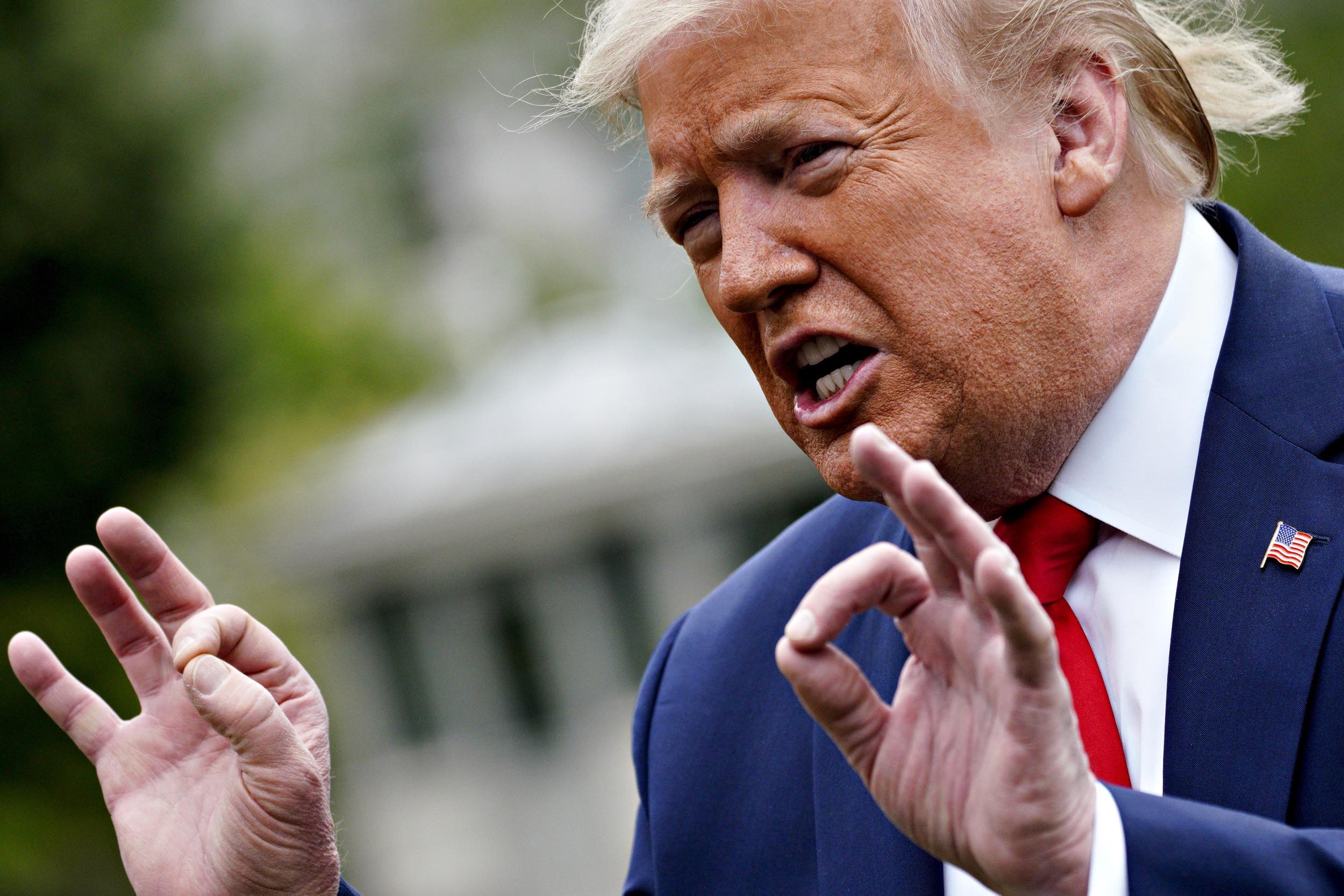
Trump declares scientific study a “Trump-enemy statement”

Closeup image of hands holding a small box labeled hydroxychloroquine.

Early in April, before much data was in on potential COVID-19 treatments, President Trump promoted one that seemed to have anecdotal support. Hydroxychloroquine was suggested as a potential treatment very early on in the pandemic and had picked up some weak support via a badly flawed French study. That was enough for Trump to suggest people take it, his rhetorical “What do you have to lose?” question breezing past the well-known and potentially dangerous side effects of the drug.

In the time since, however, Trump went silent on the topic, and the evidence piled up that chloroquine did little while retaining its problematic side effects. But it returned to the spotlight on Monday when Trump announced he had been taking it, possibly in response to several cases among the White House staff. This naturally led to questions about why he was doing that in light of the research that has come out in the intervening weeks. Trump’s response was to label a study done by government researchers a “Trump-enemy statement.”

The chloroquine saga

Chloroquine and its derivatives, like hydroxychloroquine, were first developed as anti-malarial drugs. But they have a variety of effects on the body and have found a use through their role as immune suppressors, treating autoimmune diseases like lupus. In cultured cells, they show a relatively general antiviral activity, including the suppression of SARS-CoV-1. This led a number of teams to try chloroquine against SARS-CoV-2 early on in the pandemic. Notably, a French team released a draft study that seemed to show some promising results.

Other researchers highlighted a number of serious flaws in the draft study, but by then, a landslide had started that was difficult to stop. Plenty of other groups started trials with the drug, and the FDA approved its emergency use for COVID-19. There was a run on the drug that made it difficult for those with autoimmune disorders to obtain their needed prescriptions—and that was before Trump’s “What have you got to lose?” promotion.

All of this seemed to ignore the very well-known side effects of the drug, which include slowing a key interval in the heart’s rhythm. This can set off fatal heart arrhythmias in vulnerable patients.

Since March, however, additional results have come in, most showing that chloroquine has limited impact on COVID-19, and the known side effects are still present and sometimes lethal. Prominent among these was a study by the US Veterans Administration, which was quickly followed by the FDA issuing a safety announcement, stating that the drugs should only be used in hospitalized patients or via clinical trials.

All of these studies were limited, having small patient populations and/or lacking randomization and placebo arms. But, over time, the trials got larger; a recent one tracked the outcomes of over 1,400 patients. And other researchers started doing meta-analyses, combining the data from multiple smaller trials. One of these combined records from over 4,000 patients and echoed the growing consensus: no impact on COVID-19 and “significantly higher incidence of adverse events with hydroxychloroquine use.”

Bring on the politics

Under normal circumstances, this would be when attention turns away from chloroquine derivatives and focuses on drugs that might actually work. Trump’s silence on the topic would undoubtedly have enabled this, although the drug had developed a fanatical following that seemed indifferent to the growing evidence. But things changed, perhaps due to some recent cases that turned up in testing of White House staff. Trump says that he recently asked his doctor to start him on the hydroxychloroquine and made that information public this week, and he went right back to promoting the drug.

In doing so, Trump is basically ignoring both developing and well-established science. In the well-established category, he is now essentially saying that the potentially fatal cardiac side effects don’t exist. In a pair of press Q&A’s held on Tuesday, Trump claimed: “I’m not going to get hurt by it,” and “it doesn’t hurt people,” and “you’re not going to get sick or die” if you take it. Those statements contradict decades of data and experience.

But Trump is also favoring anecdotes over the growing research consensus. “I think it’s good,” he said in response to a question. “I’ve heard a lot of good stories.” He later suggested those stories were the equivalent of evidence, saying, “Here’s my evidence: I get a lot of positive calls about it.” Elsewhere in the same session, however, he admitted, “It seems to have an impact, and maybe it does; maybe it doesn’t.”

This could easily be dismissed as ignorance of the state of the evidence, but that doesn’t seem to actually be true, because Trump made it clear he’s very aware of the Veterans Administration study that provided some of the first evidence that hydroxychloroquine is ineffective. But he has an explanation of why that evidence exists: it was a flawed study by a bunch of Trump haters.

Trump falsely declares that there’s only a single report that suggests chloroquine is ineffective and potentially harmful, saying, “And if you look at the one survey, the only bad survey, they were giving it to people that were in very bad shape. They were very old, almost dead.” Elsewhere, he termed it a “phony” report and an “unscientific report,” again emphasizing that the drug was given to those who were very ill. That is a limitation of the study, but again, that is not the only study that shows chloroquine is ineffective.

Not satisfied with assailing the quality of the study, Trump went on to attack the researchers themselves: “The only negative I’ve heard was the study where they gave it, was it the [Veterans Administration]? With, you know, people that aren’t big Trump fans gave it.” He later went on to term the study “a ‘Trump enemy’ statement.”

Personal beliefs vs. science

The number of issues in just these short statements is extraordinary. Trump is promoting misinformation about a medication with potentially fatal side effects. He’s ignoring a wealth of relevant studies. And he’s suggesting that the only reason a study produced results he didn’t like is because the researchers behind it decided to attack him.

This is hardly the first time people in power have misrepresented the state of science; climate change has suffered from this issue repeatedly. And politicians have sometimes suggested that climate scientists’ conclusions were driven by political or financial considerations rather than data-driven. But the accusation that scientists are reaching conclusions out of personal animosity toward a single politician appears to be a first, and it’s a potentially dangerous one.

How dangerous? As noted above, the FDA’s current policy is that chloroquine’s side effects are dangerous enough that it should not be used outside of hospitalization or a clinical trial. Yet when asked about how Trump’s use of the drug seems to go against that guidance, the FDA Commissioner appeared to back away from his agency’s own policy.

https://arstechnica.com/?p=1677490


Your Equifax settlement $125 isn’t coming, but banks get their $5.5M

Equifax corporate logo on an outdoor sign.
Enlarge / A shady company logo.

Back in 2017, Equifax infamously suffered a data breach that exposed devastating levels of personal and financial information of about 147 million Americans. Its punishment was a $575 million settlement with the Federal Trade Commission and a pinkie promise to go forth and sin no more. Individual consumers who were wronged were supposed to be able to claim $125 each from the settlement—until, that is, the FTC and Equifax remembered the wronged were still 144 million strong and the settlement fund didn’t have enough cash. Even so, though, individuals should be getting something—so where is it?

Equifax is indeed paying out right now—but not to you. Instead, the company has finally agreed to pay the banks (PDF) for the inconvenience of having to cancel and reissue millions of credit and debit cards, The Register points out. That agreement provides $5.5 million to “all financial institutions in the United States” that issued a Visa, MasterCard, Discover, or American Express card that was identified in the breach, except for banks that explicitly request to be excluded from the class. Equifax also promises to spend $25 million on strengthening its data security and will pay the administrative and legal costs for the banks involved in the settlement.

Granted, most individuals will see very little money from the settlement, if any. The original promise was that any affected person could receive either free credit monitoring or $125 in lieu of that if they had another active credit-monitoring solution. That bucket, however, was capped at $31 million in claims—enough to pay out a little under a quarter-million people, or 0.2 percent of those affected. After “unexpected” media attention drew an “overwhelming” number of claimants, the FTC dropped the option for choosing cash instead of credit monitoring altogether.

Individuals who did ask for the cash had an October 15 deadline to certify they already had credit-monitoring services in place. Everyone else had until January 22 of this year to file for the credit monitoring. But there’s been no contact from the settlement administrators since.

That could be due to class-action suits gumming up the works, The Register theorizes. A judge in March dismissed all the initial objections (PDF to the settlement from a would-be class-action suit. He found that, since 15 million people filed claims (including 3.3 million claims for credit monitoring) but “only 2,770” people asked to be excluded from the settlement and 388 directly objected, “in the wake of incomplete or misleading media coverage” or as “serial objectors,” the settlement could be considered reasonable and adequate.

https://arstechnica.com/?p=1677108


Trump threatens to take US out of WHO entirely and stop all funding

President Donald Trump speaking and gesturing with his hands.
Enlarge / President Donald Trump speaks to members of the media on the South Lawn of the White House on Thursday, May 14, 2020.
Getty Images | Bloomberg

President Trump yesterday threatened to permanently end US funding of the World Health Organization and withdraw the US from the WHO entirely.

In a letter to WHO Director General Tedros Adhanom Ghebreyesus, Trump alleged that “the repeated missteps by you and your organization in responding to the pandemic have been extremely costly for the world” and that the WHO must “demonstrate independence from China.”

“[I]f the World Health Organization does not commit to major substantive improvements within the next 30 days, I will make my temporary freeze of United States funding to the World Health Organization permanent and reconsider our membership in the organization,” Trump wrote. “I cannot allow American taxpayer dollars to continue to finance an organization that, in its present state, is so clearly not serving America’s interests.”

Trump posted the letter on Twitter, writing, “It is self-explanatory!”

Trump has repeatedly denied any responsibility for COVID-19 spreading in America and said on April 14 that the US would temporarily halt funding the WHO until his administration completed a review of the group’s response to the coronavirus pandemic. Trump’s letter yesterday said that “review has confirmed many of the serious concerns I raised last month and identified others that the World Health Organization should have addressed, especially the World Health Organization’s alarming lack of independence from the People’s Republic of China.”

Trump previously said his administration was considering various proposals, including one in which the US would pay only 10 percent of its former contribution to the WHO. The US would have to exit WHO in order to stop funding it entirely because the group charges membership dues. The US also makes voluntary contributions to the organization.

Trump letter makes false claim

Trump’s letter then lists a series of claims, the first being that the WHO “consistently ignored credible reports of the virus spreading in Wuhan in early December 2019 or even earlier, including reports from the Lancet medical journal.”

The Lancet quickly issued a response explaining that Trump is wrong. “This statement is factually incorrect,” The Lancet said. “The Lancet published no report in December, 2019, referring to a virus or outbreak in Wuhan or anywhere else in China.” The Lancet’s first reports on the topic were published on January 24, 2020 the statement said.

“The allegations leveled against WHO in President Trump’s letter are serious and damaging to efforts to strengthen international cooperation to control this pandemic,” The Lancet said. “It is essential that any review of the global response is based on a factually accurate account of what took place in December and January.”

A WHO spokesperson told Ars today that “WHO acknowledges receipt of the letter from the President of the United States. We are considering the contents of the letter.” Last month, the WHO responded to Trump’s temporary funding freeze with a call for global unity in the fight against the virus.

Trump may not be able to permanently end funding to the WHO unilaterally. The Wall Street Journal wrote last month that “congressional Democrats say Mr. Trump can’t cut WHO funding on his own,” but that the “White House budget office has concluded the president has several options to withhold money from the WHO without congressional approval,” such as by “order[ing] agencies to reroute the money to other related purposes.”

Trump still focused on travel ban

The US generally provides about 15 percent of the WHO’s budget and gave the organization $893 million during the WHO’s two-year funding cycle that ended on December 31. The US was reportedly already late on its payments to the WHO when Trump announced a temporary funding freeze.

Trump’s letter yesterday said, “Throughout this crisis, the World Health Organization has been curiously insistent on praising China for its alleged ‘transparency.'” Trump’s letter did not mention that Trump himself praised China for its “transparency” on January 24 or that Trump repeatedly praised China for its coronavirus response throughout February.

Trump is also still mad at the WHO for its response to his travel ban. Trump wrote:

You also strongly praised China’s strict domestic travel restrictions, but were inexplicably against my closing of the United States border, or the ban, with respect to people coming from China. I put the ban in place regardless of your wishes. Your political gamesmanship on this issue was deadly, as other governments, relying on your comments, delayed imposing life-saving restrictions on travel to and from China. Incredibly, on February 3, 2020, you reinforced your position, opining that because China was doing such a great job protecting the world from the virus, travel restrictions were “causing more harm than good.” Yet by then the world knew that, before locking down Wuhan, Chinese authorities had allowed more than five million people to leave the city and that many of these people were bound for international destinations all over the world.

Despite Trump’s claim, a USA Today article on April 11 said, “there is no public record of WHO at any point actively criticizing the US or any other country for deciding to implement a coronavirus-related travel ban” and that the WHO “opposes all travel bans during a pandemic, not just Trump’s.” The WHO on January 24 said it “advises against the application of any restrictions of international traffic based on the information currently available on this event.”

Health experts say Trump’s travel ban had little effect on the pandemic’s spread. Trump continued to downplay the virus’s severity by comparing it to the flu as late as March 24, nearly two months after the WHO declared a global health emergency. Trump has also fought state governors over their cautious approaches to reopening the economy.

“I’m tired of those who bear the responsibility accepting none of it while deflecting blame on others, [including] the previous administration, the World Health Organization, the Wuhan lab, anywhere but where the blame belongs,” US Rep. Anna Eshoo (D-Calif.) said last week at a hearing on a whistleblower complaint that says the Trump administration’s COVID-19 response was hampered by cronyism and denial about the virus’s severity.

https://arstechnica.com/?p=1677161


Members of Congress can vote from home for now—but not by using tech

The Capitol is big, but not big enough to give every member of Congress a whole lot of breathing room.
Enlarge / The Capitol is big, but not big enough to give every member of Congress a whole lot of breathing room.

Congress has a problem. Well, many problems, if you ask almost any American, but specifically—right now in the middle of a pandemic—it has a problem with physical space for social distancing.

The House of Representatives has 435 members, and while the House Chamber is big enough to seat them all, it’s definitely not large enough for every one of them to have a 6-foot radius of empty space around them. So Congress is looking to do what tens of millions of us are now currently doing: working remotely. But first, representatives have to agree on a new rule that lets them do so.

To that end, the House on Friday adopted Resolution 965, which will permit remote voting in the House for the first time since our legislative branch took form in 1789.

Your elected representative still can’t use Skype or Zoom to cast a vote from their couch, though. Instead, while a public health emergency “due to a novel coronavirus” is in effect, members of Congress can designate proxies to vote in their place. Basically, members have to issue signed, written letters—which can be emailed—saying who they authorize to vote in their stead, and what, very specifically, their proxy should do in their name. Those proxies can then go into the chamber and do all the voting as instructed.

The resolution allows for the speaker of the House, currently Rep. Nancy Pelosi (D-Calif.), to designate a 45-day period for the proxy rule to apply. If the public health emergency is still in effect when that period expires, the speaker may renew it for another 45 days. If the declared public health emergency expires during the 45-day window, then the proxy period also terminates early.

That said, however, the resolution does also call for a study of what it would take to do actual remote voting. Specifically, it instructs the Committee on House Administration to “study the feasibility of using technology to conduct remote voting in the House” and to tell the rest of the House when it determines that “operable and secure technology exists to conduct remote voting in the House.”

Everything is partisan for Congress in 2020, and working from home in a pandemic is apparently no exception. All 217 votes in favor of the resolution came from Democratic members, and all Republican representatives voted against.

https://arstechnica.com/?p=1676797


iPhone crypto hid al-Qaida link to naval base shooting, AG fumes

A man in a suit speaks at a podium.
Enlarge / Attorney General William Barr at a press conference discussing the iPhone showing al-Qaida ties to Mohammed Saeed Alshamrani, who is suspected of killing 3 and wounding 8 in the December 6, 2019, shooting at the Naval Air Station in Pensacola, Florida.

The US Department of Justice is using a newly discovered al-Qaida terrorist plot as fresh ammunition in its high-stakes fight against encryption in iPhones and other technologies.

Mohammed Saeed Alshamrani is suspected of carrying out the December 6 shooting that killed three people and wounded eight others at the Naval Air Station in Pensacola, Florida. Although the FBI obtained a search warrant to examine two iPhones he used, investigators were unable to guess the passcodes needed to decrypt the contents. Complicating matters, Alshamrani—a 21-year-old second lieutenant for the Saudi Air Force who was training with the US military at the time of the killings—fired a round into one of the phones.

Declaring the shooting an act of terrorism, the FBI called on Apple to help defeat the encryption. Apple officials said they turned over all data in their possession to investigators and would continue to support them. US Attorney General William Barr countered that Apple had provided no “substantive assistance” in the case.

The FBI on Monday said that, after four months of painstaking work, investigators finally unlocked the Apple devices. The contents, the FBI said, revealed that Alshamrani hadn’t radicalized after coming to the United States but years before that. Included in the unearthed data were conversations with a known operative of AQAP, or al-Qaida in the Arabian Peninsula, and a will that explained his motivations for the killings. The AQAP later released the same document in taking responsibility for the attack.

The FBI and DOJ quickly accused Apple, claiming that its lack of help cost investigators valuable time in establishing key facts in the case.

“Because the crucial evidence on the killer’s phones was kept from us, we did all that investigating not knowing what we do now: valuable intelligence about what to ask, what to look for,” FBI Director Christopher Wray wrote on Twitter. “If we had, our round-the-clock, all-hands effort would have been a lot more productive.” He also said, “Cybercrime, opioid trafficking, child sexual exploitation, you name it. Lack of lawful access affects every fight we’re in, and Americans need to understand that this isn’t just an issue for law enforcement.”

A social decision

At a press conference in Washington, DC, Barr reiterated that he has “seen no sign that Apple has moved the needle or is willing to try to move the needle” in the ongoing standoff. Although he has long sounded such refrains, his language Monday was the strongest yet.

Among other things, he hinted at the possibility of the US government using its legal authority to force concessions from technology companies. In response to a question from a Fox News reporter who asked if there was any indication Apple would capitulate, Barr said:

Businesses frequently make products that, if allowed out in the market in the form that the business may optimally want, could create dangers to public safety. Normally, what we do in that circumstance is we don’t leave the decision up to the business about the exact details and configuration of their products if we feel that it will cause harm to the public. That decision is not left to the business. It is a social decision that is made by our society, made by the public, in the public interest. We see that with restrictions or limitations or required features that are sometimes imposed on manufacturers to make sure the public is not put in danger. This is nothing new. This is what we normally do, but for some reason there are some tech companies who feel that they are above that and that they, unilaterally, can make decisions based on their business interests and regardless of the dangers posed to the public and we can not let that happen.

In a statement, Apple officials wrote:

On this and many thousands of other cases, we continue to work around-the-clock with the FBI and other investigators who keep Americans safe and bring criminals to justice. As a proud American company, we consider supporting law enforcement’s important work our responsibility. The false claims made about our company are an excuse to weaken encryption and other security measures that protect millions of users and our national security.

It is because we take our responsibility to national security so seriously that we do not believe in the creation of a backdoor—one which will make every device vulnerable to bad actors who threaten our national security and the data security of our customers. There is no such thing as a backdoor just for the good guys, and the American people do not have to choose between weakening encryption and effective investigations.

Customers count on Apple to keep their information secure and one of the ways in which we do so is by using strong encryption across our devices and servers. We sell the same iPhone everywhere, we don’t store customers’ passcodes and we don’t have the capacity to unlock passcode-protected devices. In data centers, we deploy strong hardware and software security protections to keep information safe and to ensure there are no backdoors into our systems. All of these practices apply equally to our operations in every country in the world.

The FBI went on to say that Alshamrani was “meticulous” in planning the shooting. Besides the will, the FBI said he made pocket-cam videos of his classroom building. The data on the iPhones showed the cadet wasn’t “just coordinating with [AQAP] about planning and tactics—he was helping the organization make the most it could out of his murders. And he continued to confer with his AQAP associates right until the end, the very night before he started shooting.” In a statement, Wray added:

We are still exploiting the evidence we’ve now obtained from al-Shamrani’s phones. And we’re continuing to run our investigation, now with the benefit of a lot more insight into the murderer’s mind and intentions, his relations with AQAP, and his tactics.

We have more to learn. But we know enough now to see al-Shamrani for what he was—a determined AQAP terrorist, who spent years preparing to attack us.

The FBI provided few details about how investigators unlocked the iPhones except to say that “FBI technical experts succeeded in accessing the phones’ contents.” Officials also said the success wasn’t likely to carry over to new cases.

“Unfortunately, the technique that we developed is not a fix for our broader Apple problem—it’s of pretty limited application,” Wray said in Monday’s statement. “But it has made a huge difference in this investigation.”

Perennial fight

The federal government has battled technology companies over cryptography since the mid-1990s, when strong encryption was classified as a munition and officials toyed with the idea of putting a so-called Clipper chip in devices that would make backdoors available to law enforcement.

A new chapter in this fight began in 2016, when the FBI obtained a court order requiring Apple to help unlock and decrypt the iPhone used by Syed Rizwan Farook, who killed 14 people and injured 17 others in a 2015 shooting rampage in San Bernardino, California.

The FBI wanted Apple to create a custom iOS firmware version that would bypass a protection that wipes an iPhone clean after 10 failed attempts to enter a passcode. In court documents and congressional testimony, FBI officials said they had no other way to access the contents of the iPhone so that investigators could determine if Farook and his wife, who also participated and died in the shooting, acted in concert with others to carry out the deadly attack. The government invoked an 18th-century law called the All Writs in seeking Apple’s assistance.

Apple vigorously resisted the FBI request. In a letter to Apple customers, company CEO Tim Cook warned that once such a backdoor existed, it would pose a threat to all iPhone users. Cook argued that if Apple was compelled to bypass the protections on the shooter’s iPhone, it would set a dangerous precedent that would undermine the privacy and security of people everywhere.

“The government suggests this tool could only be used once, on one phone,” he wrote. “But that’s simply not true. Once created, the technique could be used over and over again, on any number of devices.”

The dispute ended six weeks after the government obtained the order when government lawyers dropped the case and reported that FBI investigators had decrypted Farook’s iPhone 5C and no longer needed Apple’s help. Then FBI Director James Comey later suggested that the agency paid more than $1.3 million to an unnamed company to crack the phone’s encryption.

Defenders of strong encryption blasted the FBI on Monday.

“Every time there’s a traumatic event requiring investigation into digital devices, the Justice Department loudly claims that it needs backdoors to encryption, and then quietly announces it actually found a way to access information without threatening the security and privacy of the entire world,” the American Civil Liberties Union said. “The boy who cried wolf has nothing on the agency that cried encryption.”

The heated debate has raged ever since then. The new revelations about Alshamrani’s ties to AQAP are likely to further heighten the controversy.

https://arstechnica.com/?p=1676862


3 different countries, 1 result: Stay-at-home orders work

Classes have restarted in France following the lifting of restrictions.
Enlarge / Classes have restarted in France following the lifting of restrictions.
SEBASTIEN BOZON/Getty Images

The various forms of social restrictions, from distancing to stay-at-home orders, seem like a radical departure to most of us. But faced with a pathogen that spreads through human interactions, they’re an obvious potential solution to limit that spread. And a variety of epidemiological models have indicated that various combinations of these approaches should be effective.

But do they actually work in the real, messy, interconnected modern world, and against this specific pathogen? It’s important to try to confirm that the models accurately project real-world results, and epidemiologists are doing exactly that. So far, the results are good: across several countries and contexts, restrictions were associated with significant drops in the spread of SARS-CoV-2. The bad news is that more severe restrictions may be necessary to keep the number of infections from increasing.

Good news from France

France was one of a number of countries that went for a lockdown, with anyone found outside their home expected to have a permit explaining why they needed to travel. The country has only just started to ease these restrictions following a period in which the total number of infected individuals has fallen. An international team of researchers has now looked at the dynamics of SARS-CoV-2’s spread in the time before and after the lockdown was started on March 17.

The researchers built a model using a combination of data from France overall and from a cruise ship on which every infection was traced. They used the French data, which included over 95,000 hospitalizations, to develop national and regional models that accurately reproduced stats like the rate of hospital admissions and ICU treatment.

The model suggests that, just prior to the lockdown, each individual who became infected passed the virus on to nearly three additional people (put technically, the R0 was 2.9) After the lockdown, there was only a two-thirds chance that an infected individual would pass the virus on to anyone (the R0 was 0.67). This latter figure means that the rate of spread is insufficient to maintain the outbreak and is consistent with the decline in cases seen in France.

The researchers estimate that by the time restrictions were lifted, about 4 percent of the French population will have been infected. That, they say, is consistent with the finding that about three percent of the French blood donors have been testing positive for past infections. But that also means that the French population will remain very vulnerable to a return of the outbreak, which the authors argue means that many restrictions will have to stay in place (which is currently the plan in France).

Better and better in Germany

Germany put restrictions into place more gradually than its neighbor. The first thing to go was large public gatherings, which were halted in early March. Schools were closed about a week later in mid-March, and a strict person-to-person contact ban was put in place on March 22. A research team based in Germany took national statistics and plugged them into a standard epidemiological model called SIR, for susceptible-infected-recovered, to see how these restrictions influenced the spread of the pandemic.

Instead of trying to infer the properties of Germany’s outbreak—the virus’s infectivity, the length of the pre-symptomatic period, etc.—the team used a method of testing random values and identifying those that produced a good fit for their data. With the model trained, the researchers then examined the behavior of the model to explore whether there were any changes in the trajectory of the outbreak—in essence, looking for points at which the rates of infection changed.

Those were present, but they lagged the timing of changes in policy. Of course, that’s exactly what you’d expect—there would be a lag period where those infected before the change in policy would need to have the infection take hold, and then some delay as they sought out and received testing.

The authors find a model with three transitions fits somewhat better than with two, and they calculate the changes associated with each time the policy was tightened. They found the growth rate of the outbreak started at about 30 percent, and the combination of school closings and a ban on large public gatherings cut that down to 12 percent. But it took the ban on interpersonal contact to drop the growth rate down to two percent, reaching the point where exponential growth of new infections isn’t a concern.

In the heartland

There’s no real way to analyze what’s happening in the US in terms of policy, as it’s a patchwork of state and local rules. But some researchers have figured out a way to get some idea of what state-level policies are doing by looking at counties on the border of two states that are doing fairly different things. Iowa and Illinois share a border but do not share pandemic policies: Illinois issued a stay-at-home order, while Iowa hasn’t—although Iowa has closed schools, banned large gatherings, and closed some businesses. So the researchers looked at what’s happened in a set of border counties with a total population of over 700,000 residents.

Prior to March 21, the day Illinois’ order took effect, the counties in these states were on a similar trajectory: every 10 days, there were roughly an additional five cases for every 10,000 residents. But after Illinois put its stay-at-home order in place, there was a small but growing difference between the two. By 20 days after the order, Illinois saw 1.15 fewer cases per 10,000 residents. By 30 days, that difference approached five fewer cases.

In one month, the researchers estimate that the lack of a stay-at-home order resulted in an excess of 217 cases in Iowa compared to what it might have had otherwise. That may not sound like much, but it is nearly a third of the total cases seen in this area.

Overall, the three studies paint a consistent picture: across countries, the restrictions being put in place by governments are effective to slow the pandemic. This will surprise no one in the public health field, given that a combination of modeling and experience with past outbreaks had already indicated that this is exactly what should happen. But it’s always nice to have these sorts of expectations confirmed. And given that existing restrictions are increasingly being opposed by a vocal minority within the US, this confirmation can help bolster the majority’s case for continuing to limit the spread of the pandemic.

https://arstechnica.com/?p=1676848


Cell-tower attacks by idiots who claim 5G spreads COVID-19 reportedly hit US

A World Health Organization advisory noting that 5G is not spreading coronavirus because viruses cannot travel on radio waves or mobile networks.
Enlarge / A World Health Organization advisory.

The Department of Homeland Security is reportedly issuing alerts to wireless telecom providers and law enforcement agencies about potential attacks on cell towers and telecommunications workers by 5G/coronavirus conspiracy theorists. The DHS warned that there have already been “arson and physical attacks against cell towers in several US states.”

The preposterous claim that 5G can spread the coronavirus, either by suppressing the immune system or by directly transmitting the virus over radio waves, led to dozens of tower burnings in the UK and mainland Europe. Now, the DHS “is preparing to advise the US telecom industry on steps it can take to prevent attacks on 5G cell towers following a rash of incidents in Western Europe fueled by the false claim that the technology spreads the pathogen causing COVID-19,” The Washington Post reported last week.

The DHS alert will include “advice on ways to reduce the risk of attack, including installing appropriate sensing and barriers, cyber-intrusion detection systems, closed-circuit television and monitoring drone activity near towers,” the Post article said. A telecom-industry official said that carriers in the US “have seen sporadic attacks on their cell towers that were apparently prompted by COVID-19 disinformation” over the past few weeks, the Post wrote.

In addition to warning telecoms, DHS reportedly issued an intelligence report on the topic “to senior federal officials and law enforcement agencies around the country,” ABC News reported Saturday. DHS also teamed with the FBI and National Counterterrorism Center to issue a joint intelligence bulletin to federal officials and law enforcement agencies, the ABC News report said.

“We assess conspiracy theories linking the spread of COVID-19 to the expansion of the 5G cellular network are inciting attacks against the communications infrastructure globally and that these threats probably will increase as the disease continues to spread, including calls for violence against telecommunications workers,” the DHS intelligence report said, according to ABC.

ABC did not publish the full intelligence report but provided several quotes from it. We contacted DHS and the USTelecom trade group today and will update this article if we get any response.

“Misinformation campaigns”

ABC quoted DHS as saying that “since December 2019, unidentified actors conducted at least five arson incidents targeting cell towers in Memphis, Tenn., that resulted in more than $100,000 in damages… Additionally, 14 cell towers in western Tennessee, between February and April, were purposely turned off by way of disabling their electrical breakers.”

The warning to law enforcement agencies said that an April 22 Facebook post “encouraged individuals associated with anarchist extremist ideology to commit acts of sabotage by attacking buildings and 5G towers around the world… in furtherance of an ‘International Day of Sabotage'” and that videos have been posted online “showing people how to damage or destroy cell towers,” according to ABC.

“Violent extremists have drawn from misinformation campaigns online that claim wireless infrastructure is deleterious to human health and helps spread COVID-19, resulting in a global effort by like-minded individuals to share operational guidance and justification for conducting attacks against 5G infrastructure, some of which have already prompted arson and physical attacks against cell towers in several US states,” the DHS report said. The DHS report also warned of possible attacks against the electric grid.

The World Health Organization maintains a list of COVID-19 myths, including the 5G conspiracy theory. “Viruses cannot travel on radio waves/mobile networks,” the WHO explains. “COVID-19 is spreading in many countries that do not have 5G mobile networks.”

Rather than being spread by radio waves, the WHO notes, “COVID-19 is spread through respiratory droplets when an infected person coughs, sneezes or speaks. People can also be infected by touching a contaminated surface and then their eyes, mouth, or nose.”

Conspiracy theories also suggest that 5G contributes to the coronavirus pandemic by suppressing the immune system. But as Ars Science Editor John Timmer wrote recently, the immune-system claim is “completely evidence- and mechanism-free.

“In both these cases, the only ‘evidence’ offered in support is the timing of 5G rollouts versus the appearance of the coronavirus in some locations, as well as maps that compare the locations of 5G services to the locations with the highest incidence of SARS-CoV-2,” Timmer wrote. “Neither of these make sense as evidence. 5G was present in a variety of locations for a while without coronavirus appearing in them,” and “plenty of cities without 5G service have also had high incidence of the virus.”

https://arstechnica.com/?p=1676807


Uber lays off 3,000 people in second big round of cuts

Uber CEO Dara Khosrowshahi in December 2019.
Enlarge / Uber CEO Dara Khosrowshahi in December 2019.
Scott Heins/Getty Images

Uber is laying off another 3,000 workers, the company announced in a filing with the Securities and Exchange Commission on Monday. That’s in addition to the 3,700 workers the company laid off earlier this month. Uber had 26,900 employees at the end of last year. Uber drivers, whom the company treats as independent contractors, are not directly affected.

“Given the dramatic impact of the pandemic, and the unpredictable nature of any eventual recovery, we are concentrating our efforts on our core mobility and delivery platforms and resizing our company to match the realities of our business,” CEO Dara Khosrowshahi said in the SEC filing. “That’s led us to some painful decisions today.”

Uber’s core ride-hailing business has been devastated by the coronavirus pandemic. The Wall Street Journal reports that Uber’s rides business was down 80 percent, year over year, in April.

The declining rides business has been offset somewhat by strong demand for Uber Eats. But in an email to employees obtained by the Journal, Khosrowshahi wrote that the Eats business “doesn’t come close to covering our expenses.”

Uber estimates that it will spend $110 million to $140 million on severance packages and another $65 million to $80 million on expenses related to shutting down offices. The Wall Street Journal says Uber is closing 45 office locations. The two rounds of cuts are designed to reduce Uber’s overhead by more than $1 billion.

Earlier this month, the company reported a first-quarter loss of almost $3 billion. More than $2 billion of that figure reflected write-downs of the value of Uber’s minority stake in other ride-hailing businesses around the world that have had their value fall due to the coronavirus. Ignoring those write-downs, Uber lost $1.1 billion—on par with losses in previous quarters.

Earlier this year, Uber was aiming to achieve profitability by the end of the year. Now that strategy is in tatters. And the company’s second-quarter results are likely to be even worse, since the coronavirus only began to affect the US economy in the last few weeks of the first quarter.

https://arstechnica.com/?p=1676790


Man shoots down drone, gets hit with felony charges in Minnesota

A drone in flight is silhouetted against a cloudy sky.

A Minnesota man is facing two felony charges for shooting down a drone, The Free Press reports.

The incident began when an unnamed man flew a drone over Butterfield Foods, a producer of meat products—including chicken—in the Southern Minnesota town of Butterfield. The man later told a sheriff’s deputy he was trying to prove that chickens were being slaughtered because of the pandemic.

Two employees approached the man and asked him what he was doing. Soon afterwards, someone else shot the drone out of the sky. The man says his drone cost $1,900.

The authorities arrested 34-year-old Travis Duane Winters and charged him in Watonwan County District Court, The Free Press says. Officials say Winters admitted to shooting the drone. He faces charges of criminal damage to property and reckless discharge of a weapon within city limits.

This is not the first time someone has shot down a drone. We reported on several such shootings in 2016 and 2017. In one case, a man sued a neighbor who shot his drone when it flew over the neighbor’s land. A federal judge dismissed that lawsuit on procedural grounds, finding that it should have been filed in state, not federal, courts.

The Federal Aviation Administration has said that shooting down a drone is illegal under the same federal aviation laws that make it illegal to shoot down a crewed aircraft. But we don’t know of any cases of people being prosecuted under those laws.

https://arstechnica.com/?p=1676560


All your reaction GIFs now belong to Facebook, as it buys Giphy for $400M

Ironically, their logo is static, not animated.
Enlarge / Ironically, their logo is static, not animated.

Seven years ago, Facebook claimed not to support the 21st century’s new favorite communication tool, the animated GIF. Oh, how times have changed: Today, Facebook’s newest acquisition is one of the Internet’s most popular GIF hosting sites.

Facebook is making Giphy part of the Instagram team, the company said today. Axios, which was first to report the transaction, said the deal was valued at about $400 million.

According to Facebook, about half of Giphy’s current traffic already comes from Facebook products, especially Instagram. That’s perhaps unsurprising, given that Facebook’s big three apps—WhatsApp, Instagram, and flagship Facebook—have literally billions of daily users among them.

Giphy was, in fact, the first service to make animated images work on Facebook. It created a workaround back in 2013, when Facebook’s now-laughable official stance was, “Facebook does not support animated GIFs.”

Although animated reaction images may seem (and kind of are) inconsequential in the grand scheme of things, the deal is likely to attract a significant amount of scrutiny from federal regulators. The Justice Department, Congress, and the Federal Trade Commission are already all delving into even the smallest, lowest-value acquisitions that Big Tech firms such as Facebook have made in the last decade, scouring them for patterns of anticompetitive behavior.

Giphy is by no means the only GIF search and hosting platform on the Internet, but it is one of the largest. Several other platforms, including Twitter, use its API for GIF support.

Both Facebook and Giphy promised that access will continue. In its announcement, Giphy specifically said, “For our API/SDK partners and developers: GIPHY’s GIFs, Stickers, Emojis, etc. aren’t going anywhere. We will continue to make GIPHY openly available to the wider ecosystem.”

What the announcements did not mention, however, is that making Giphy a Facebook company can give Facebook access to all the data generated by those searches and API calls from other platforms. And using acquisitions to gather data on competitors is exactly the sort of behavior Facebook is under investigation for right now. https://arstechnica.com/?p=1676440